
big Brother 96
2.4k Publications

big Brother 96
Signaler
Bloquer l’utilisateur
311 Suivis
4.5K+ Abonnés
3.0K+ J’aime
Publications
Tous
Citations
Direct
$DOOD est le genre de graphique que je regarde deux fois avant d’appeler ça une cassure.
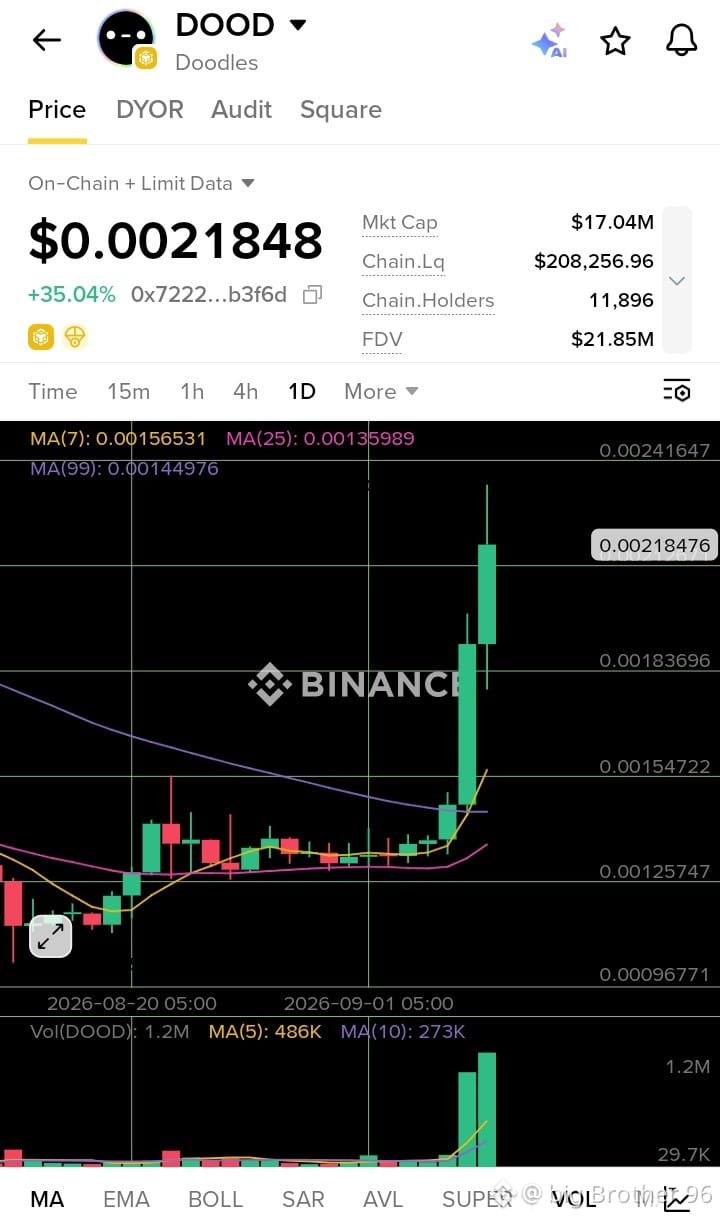
Sur le graphique 1D, le mouvement est évident : le prix se situe autour de 0,0021848 $, en hausse de 35,04 % sur la capture, et la bougie a dépassé nettement la zone de 0,00183696. Ce qui m’intéresse davantage, c’est ce qui s’est passé en dessous de ce mouvement.
Le volume s’est soudainement élargi à environ 1,2 M, alors que les moyennes affichées se situent près de 486 K et 273 K. Ce n’est pas une hausse tranquille. Quelqu’un prête réellement attention.
Les moyennes mobiles racontent la même histoire. $DOOD évolue au-dessus de la MM(7) à 0,00156531, de la MM(25) à 0,00135989 et de la MM(99) à 0,00144976. La moyenne à court terme a aussi commencé à s’infléchir vers le haut, tandis que le prix a laissé derrière lui la zone de compression précédente.
Mais je ne poursuis pas aveuglément la bougie verte.
Le premier niveau que je surveillerais lors d’un repli est 0,00183696. Si cela se transforme en support, la structure de cassure reste intéressante. En dessous, 0,00154722 est la zone technique plus importante, suivie de 0,001359–0,001450 où se trouvent les moyennes mobiles plus longues. Un échec plus profond ramènerait 0,00125747 dans le viseur.
Au-dessus du prix actuel, 0,00241647 est la résistance évidente du graphique. C’est là que le mouvement commence à poser une question différente : est-ce une expansion de tendance réelle, ou simplement un balayage violent de liquidité ?
Le détail plus discret, c’est la taille du marché. La capture montre une capitalisation boursière d’environ 17,04 M $, une liquidité en chaîne d’environ 208 K $, 11 896 détenteurs et environ 21,85 M $ de FDV. Les données actuelles de CoinGecko sont globalement dans la même fourchette, avec environ 7,8 Md de DOOD en circulation contre une offre maximale de 10 Md. �
CoinGecko
C’est important, car un actif à environ 17 M $ peut évoluer très différemment d’une crypto à grosse capitalisation. Une bougie de 35 % paraît impressionnante, mais la même structure de marché “fine” peut aussi rendre les retournements beaucoup plus rapides.
Et il y a un autre élément que les gens ont tendance à oublier : DOOD n’est pas né uniquement comme une opportunité de trading sur graphique. Doodles l’a lancé comme token de son écosystème, avec l’idée à plus long terme de l’étendre à l’utilité dans ses applications et sa communauté. � Binance a aussi ouvert le trading de DOOD et un perpétuel DOODUSDT en mai 2025, ce qui a donné la
$DOOD est le genre de graphique que je regarde deux fois avant d’appeler ça une cassure.
Sur le graphique 1D, le mouvement est évident : le prix se situe autour de 0,0021848 $, en hausse de 35,04 % sur la capture, et la bougie a dépassé nettement la zone de 0,00183696. Ce qui m’intéresse davantage, c’est ce qui s’est passé en dessous de ce mouvement.
Le volume s’est soudainement élargi à environ 1,2 M, alors que les moyennes affichées se situent près de 486 K et 273 K. Ce n’est pas une hausse tranquille. Quelqu’un prête réellement attention.
Les moyennes mobiles racontent la même histoire. $DOOD évolue au-dessus de la MM(7) à 0,00156531, de la MM(25) à 0,00135989 et de la MM(99) à 0,00144976. La moyenne à court terme a aussi commencé à s’infléchir vers le haut, tandis que le prix a laissé derrière lui la zone de compression précédente.
Mais je ne poursuis pas aveuglément la bougie verte.
Le premier niveau que je surveillerais lors d’un repli est 0,00183696. Si cela se transforme en support, la structure de cassure reste intéressante. En dessous, 0,00154722 est la zone technique plus importante, suivie de 0,001359–0,001450 où se trouvent les moyennes mobiles plus longues. Un échec plus profond ramènerait 0,00125747 dans le viseur.
Au-dessus du prix actuel, 0,00241647 est la résistance évidente du graphique. C’est là que le mouvement commence à poser une question différente : est-ce une expansion de tendance réelle, ou simplement un balayage violent de liquidité ?
Le détail plus discret, c’est la taille du marché. La capture montre une capitalisation boursière d’environ 17,04 M $, une liquidité en chaîne d’environ 208 K $, 11 896 détenteurs et environ 21,85 M $ de FDV. Les données actuelles de CoinGecko sont globalement dans la même fourchette, avec environ 7,8 Md de DOOD en circulation contre une offre maximale de 10 Md. �
CoinGecko
C’est important, car un actif à environ 17 M $ peut évoluer très différemment d’une crypto à grosse capitalisation. Une bougie de 35 % paraît impressionnante, mais la même structure de marché “fine” peut aussi rendre les retournements beaucoup plus rapides.
Et il y a un autre élément que les gens ont tendance à oublier : DOOD n’est pas né uniquement comme une opportunité de trading sur graphique. Doodles l’a lancé comme token de son écosystème, avec l’idée à plus long terme de l’étendre à l’utilité dans ses applications et sa communauté. � Binance a aussi ouvert le trading de DOOD et un perpétuel DOODUSDT en mai 2025, ce qui a donné la
Sur le graphique 1D, le mouvement est évident : le prix se situe autour de 0,0021848 $, en hausse de 35,04 % sur la capture, et la bougie a dépassé nettement la zone de 0,00183696. Ce qui m’intéresse davantage, c’est ce qui s’est passé en dessous de ce mouvement.
Le volume s’est soudainement élargi à environ 1,2 M, alors que les moyennes affichées se situent près de 486 K et 273 K. Ce n’est pas une hausse tranquille. Quelqu’un prête réellement attention.
Les moyennes mobiles racontent la même histoire. $DOOD évolue au-dessus de la MM(7) à 0,00156531, de la MM(25) à 0,00135989 et de la MM(99) à 0,00144976. La moyenne à court terme a aussi commencé à s’infléchir vers le haut, tandis que le prix a laissé derrière lui la zone de compression précédente.
Mais je ne poursuis pas aveuglément la bougie verte.
Le premier niveau que je surveillerais lors d’un repli est 0,00183696. Si cela se transforme en support, la structure de cassure reste intéressante. En dessous, 0,00154722 est la zone technique plus importante, suivie de 0,001359–0,001450 où se trouvent les moyennes mobiles plus longues. Un échec plus profond ramènerait 0,00125747 dans le viseur.
Au-dessus du prix actuel, 0,00241647 est la résistance évidente du graphique. C’est là que le mouvement commence à poser une question différente : est-ce une expansion de tendance réelle, ou simplement un balayage violent de liquidité ?
Le détail plus discret, c’est la taille du marché. La capture montre une capitalisation boursière d’environ 17,04 M $, une liquidité en chaîne d’environ 208 K $, 11 896 détenteurs et environ 21,85 M $ de FDV. Les données actuelles de CoinGecko sont globalement dans la même fourchette, avec environ 7,8 Md de DOOD en circulation contre une offre maximale de 10 Md. �
CoinGecko
C’est important, car un actif à environ 17 M $ peut évoluer très différemment d’une crypto à grosse capitalisation. Une bougie de 35 % paraît impressionnante, mais la même structure de marché “fine” peut aussi rendre les retournements beaucoup plus rapides.
Et il y a un autre élément que les gens ont tendance à oublier : DOOD n’est pas né uniquement comme une opportunité de trading sur graphique. Doodles l’a lancé comme token de son écosystème, avec l’idée à plus long terme de l’étendre à l’utilité dans ses applications et sa communauté. � Binance a aussi ouvert le trading de DOOD et un perpétuel DOODUSDT en mai 2025, ce qui a donné la
78
·
--
Haussier
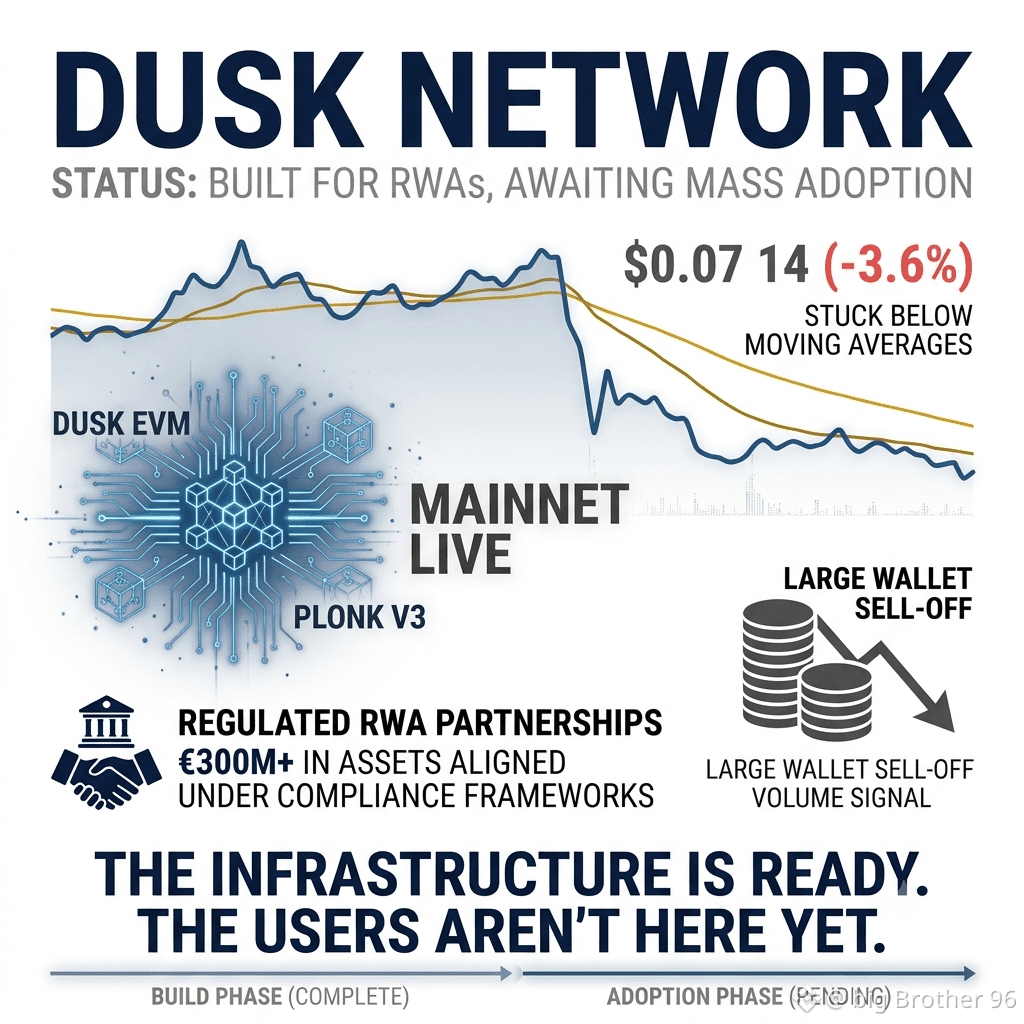
Je surveille DUSK comme tu vérifies un projet pour lequel tu étais autrefois plus enthousiaste — moitié habitude, moitié curiosité. Aujourd’hui, c’est en baisse de 3,6 %, autour de 0,0714 $ ; et mon premier réflexe n’a pas été de regarder le graphique, mais de vérifier ce qui a réellement été déployé. Il s’avère que DuskEVM et PLONK V3 sont tous les deux passés en ligne sur le mainnet quasiment le même jour où le token a été vendu. Personne n’avait prévu ce timing. C’est juste arrivé, et c’est assez révélateur.
Il y a aussi de vrais efforts qui sont faits du côté des partenariats RWA réglementés : quelque chose comme 300 M€ d’actifs mis en place dans le cadre de véritables exigences de conformité, pas les promesses vagues habituelles. Mais près d’un cinquième du volume de ce jour venait simplement de grosses adresses en route pour la sortie, et le prix reste bloqué sous toutes les moyennes mobiles qui comptent.
Ce qui me frappe, c’est que personne ne négocie encore les actifs pour lesquels cette chaîne a été construite. L’infrastructure est quasiment prête. Les utilisateurs ne sont pas encore là.
Certains projets se construisent longtemps avant que qui que ce soit ne se mette à les utiliser.
@Dusk_Foundation #dusk $DUSK
{future}(DUSKUSDT)
Je surveille DUSK comme tu vérifies un projet pour lequel tu étais autrefois plus enthousiaste — moitié habitude, moitié curiosité. Aujourd’hui, c’est en baisse de 3,6 %, autour de 0,0714 $ ; et mon premier réflexe n’a pas été de regarder le graphique, mais de vérifier ce qui a réellement été déployé. Il s’avère que DuskEVM et PLONK V3 sont tous les deux passés en ligne sur le mainnet quasiment le même jour où le token a été vendu. Personne n’avait prévu ce timing. C’est juste arrivé, et c’est assez révélateur.
Il y a aussi de vrais efforts qui sont faits du côté des partenariats RWA réglementés : quelque chose comme 300 M€ d’actifs mis en place dans le cadre de véritables exigences de conformité, pas les promesses vagues habituelles. Mais près d’un cinquième du volume de ce jour venait simplement de grosses adresses en route pour la sortie, et le prix reste bloqué sous toutes les moyennes mobiles qui comptent.
Ce qui me frappe, c’est que personne ne négocie encore les actifs pour lesquels cette chaîne a été construite. L’infrastructure est quasiment prête. Les utilisateurs ne sont pas encore là.
Certains projets se construisent longtemps avant que qui que ce soit ne se mette à les utiliser.
@Dusk #dusk $DUSK
Il y a aussi de vrais efforts qui sont faits du côté des partenariats RWA réglementés : quelque chose comme 300 M€ d’actifs mis en place dans le cadre de véritables exigences de conformité, pas les promesses vagues habituelles. Mais près d’un cinquième du volume de ce jour venait simplement de grosses adresses en route pour la sortie, et le prix reste bloqué sous toutes les moyennes mobiles qui comptent.
Ce qui me frappe, c’est que personne ne négocie encore les actifs pour lesquels cette chaîne a été construite. L’infrastructure est quasiment prête. Les utilisateurs ne sont pas encore là.
Certains projets se construisent longtemps avant que qui que ce soit ne se mette à les utiliser.
@Dusk #dusk $DUSK
82
·
--
Haussier
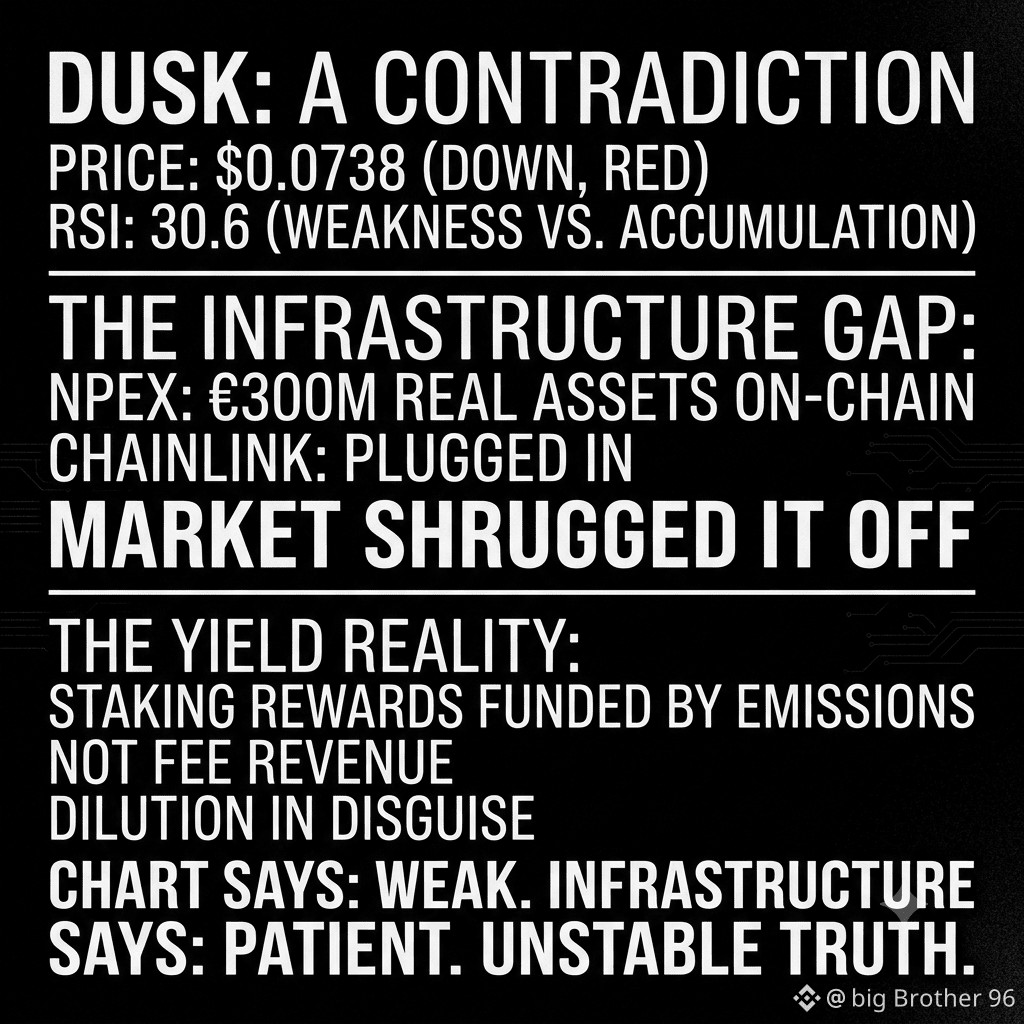
J’ai continué de vérifier le graphique de DUSK plus que je n’aurais dû aujourd’hui. Le prix est descendu à 0,0738 $, rouge toute la journée, RSI à 30,6 — un chiffre qui pousse soit les gens à paniquer et vendre, soit à accumuler tranquillement, rarement entre les deux.
Mais ce qui a vraiment retenu mon attention, ce n’était pas le prix. NPEX apporte 300 millions d’euros d’actifs réels sur cette chaîne, Chainlink est aussi branché, et le marché a juste haussé les épaules. Ce décalage vous en dit plus que les bougies. L’infrastructure d’actifs du monde réel ne bouge pas au rythme des gros titres — elle se construit discrètement, et ce n’est que bien plus tard que les gens réalisent que c’était important.
Ce qui me fait vraiment hésiter, c’est le rendement. Les récompenses de staking sont financées en grande partie par de nouvelles émissions, pas par de vrais revenus de frais, donc ce "TAUX annuel (APY) qui a l’air sain" est en partie une dilution déguisée.
Le graphique dit faible. L’infrastructure dit patient. Je ne suis pas sûr que les deux restent vrais encore longtemps.
@Dusk_Foundation
#dusk
$DUSK
J’ai continué de vérifier le graphique de DUSK plus que je n’aurais dû aujourd’hui. Le prix est descendu à 0,0738 $, rouge toute la journée, RSI à 30,6 — un chiffre qui pousse soit les gens à paniquer et vendre, soit à accumuler tranquillement, rarement entre les deux.
Mais ce qui a vraiment retenu mon attention, ce n’était pas le prix. NPEX apporte 300 millions d’euros d’actifs réels sur cette chaîne, Chainlink est aussi branché, et le marché a juste haussé les épaules. Ce décalage vous en dit plus que les bougies. L’infrastructure d’actifs du monde réel ne bouge pas au rythme des gros titres — elle se construit discrètement, et ce n’est que bien plus tard que les gens réalisent que c’était important.
Ce qui me fait vraiment hésiter, c’est le rendement. Les récompenses de staking sont financées en grande partie par de nouvelles émissions, pas par de vrais revenus de frais, donc ce "TAUX annuel (APY) qui a l’air sain" est en partie une dilution déguisée.
Le graphique dit faible. L’infrastructure dit patient. Je ne suis pas sûr que les deux restent vrais encore longtemps.
@Dusk
#dusk
$DUSK
Mais ce qui a vraiment retenu mon attention, ce n’était pas le prix. NPEX apporte 300 millions d’euros d’actifs réels sur cette chaîne, Chainlink est aussi branché, et le marché a juste haussé les épaules. Ce décalage vous en dit plus que les bougies. L’infrastructure d’actifs du monde réel ne bouge pas au rythme des gros titres — elle se construit discrètement, et ce n’est que bien plus tard que les gens réalisent que c’était important.
Ce qui me fait vraiment hésiter, c’est le rendement. Les récompenses de staking sont financées en grande partie par de nouvelles émissions, pas par de vrais revenus de frais, donc ce "TAUX annuel (APY) qui a l’air sain" est en partie une dilution déguisée.
Le graphique dit faible. L’infrastructure dit patient. Je ne suis pas sûr que les deux restent vrais encore longtemps.
@Dusk
#dusk
$DUSK
1
1
110
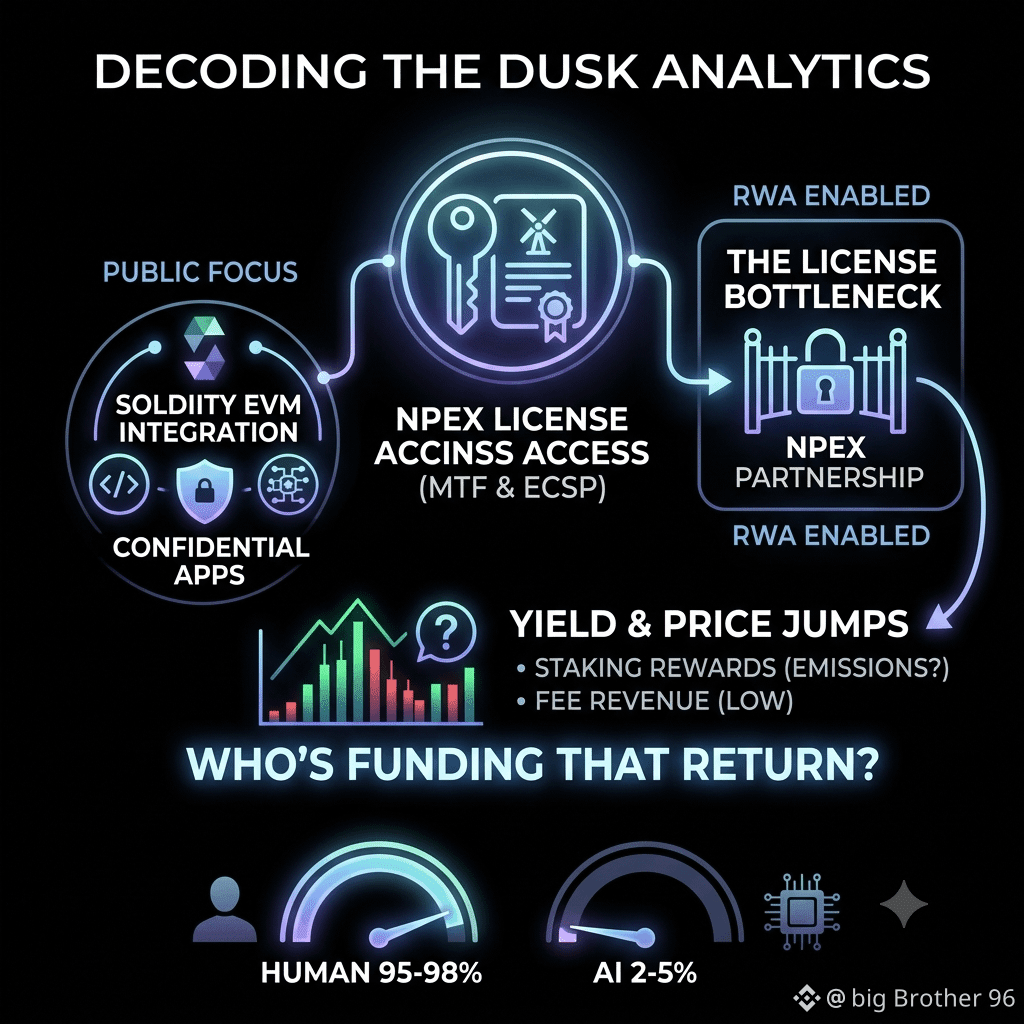
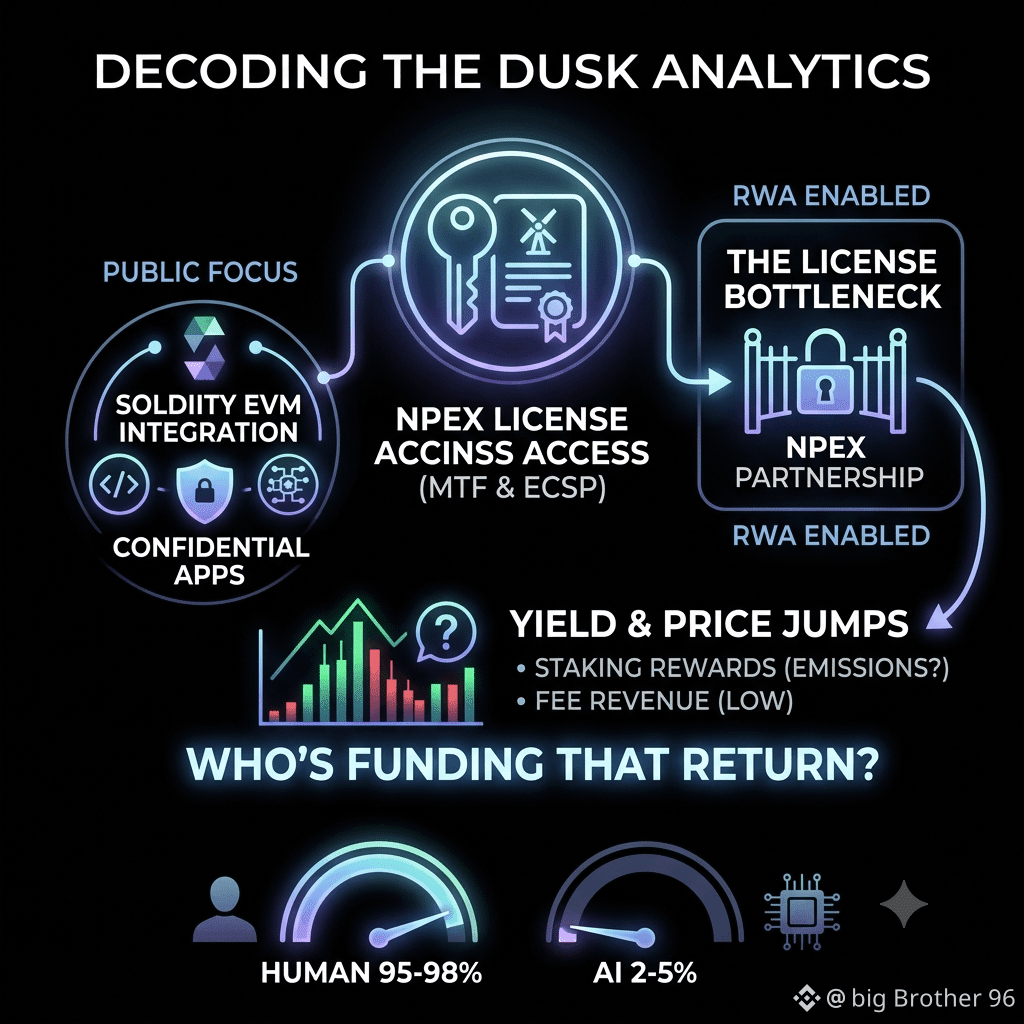
Je continue de regarder cette chaîne et, honnêtement, je ne peux pas vraiment expliquer pourquoi. Le prix monte et descend, autour de 0,07 $ aujourd’hui, autre chose demain — mais mon attention ne porte pas sur le prix. Elle porte sur NPEX. Cette petite bourse néerlandaise qui tourne depuis 2008, avec à la fois des licences MTF et ECSP. Dusk n’a pas obtenu ces licences elle-même — elle y a eu accès grâce au partenariat. La différence paraît faible, mais elle compte.
Tout le monde parle de l’intégration EVM, du fait que les développeurs Solidity peuvent désormais construire facilement des applications confidentielles. D’accord. Mais les licences sont le vrai goulot d’étranglement dans tout ce jeu RWA, et Dusk y a déjà accès.
Ce qui me trotte, c’est la question du rendement. Les récompenses de staking continuent d’être alimentées par les émissions, les revenus de frais ne sont pas vraiment là. Donc quand le prix fait soudain un bond, je ne me sens pas haussier — je me sens curieux. Qui finance réellement ce rendement ?
@Dusk_Foundation
#DUSKARMY.
$DUSK
Je continue de regarder cette chaîne et, honnêtement, je ne peux pas vraiment expliquer pourquoi. Le prix monte et descend, autour de 0,07 $ aujourd’hui, autre chose demain — mais mon attention ne porte pas sur le prix. Elle porte sur NPEX. Cette petite bourse néerlandaise qui tourne depuis 2008, avec à la fois des licences MTF et ECSP. Dusk n’a pas obtenu ces licences elle-même — elle y a eu accès grâce au partenariat. La différence paraît faible, mais elle compte.
Tout le monde parle de l’intégration EVM, du fait que les développeurs Solidity peuvent désormais construire facilement des applications confidentielles. D’accord. Mais les licences sont le vrai goulot d’étranglement dans tout ce jeu RWA, et Dusk y a déjà accès.
Ce qui me trotte, c’est la question du rendement. Les récompenses de staking continuent d’être alimentées par les émissions, les revenus de frais ne sont pas vraiment là. Donc quand le prix fait soudain un bond, je ne me sens pas haussier — je me sens curieux. Qui finance réellement ce rendement ?
@Dusk
#DUSKARMY.
$DUSK
Tout le monde parle de l’intégration EVM, du fait que les développeurs Solidity peuvent désormais construire facilement des applications confidentielles. D’accord. Mais les licences sont le vrai goulot d’étranglement dans tout ce jeu RWA, et Dusk y a déjà accès.
Ce qui me trotte, c’est la question du rendement. Les récompenses de staking continuent d’être alimentées par les émissions, les revenus de frais ne sont pas vraiment là. Donc quand le prix fait soudain un bond, je ne me sens pas haussier — je me sens curieux. Qui finance réellement ce rendement ?
@Dusk
#DUSKARMY.
$DUSK
94
·
--
Haussier
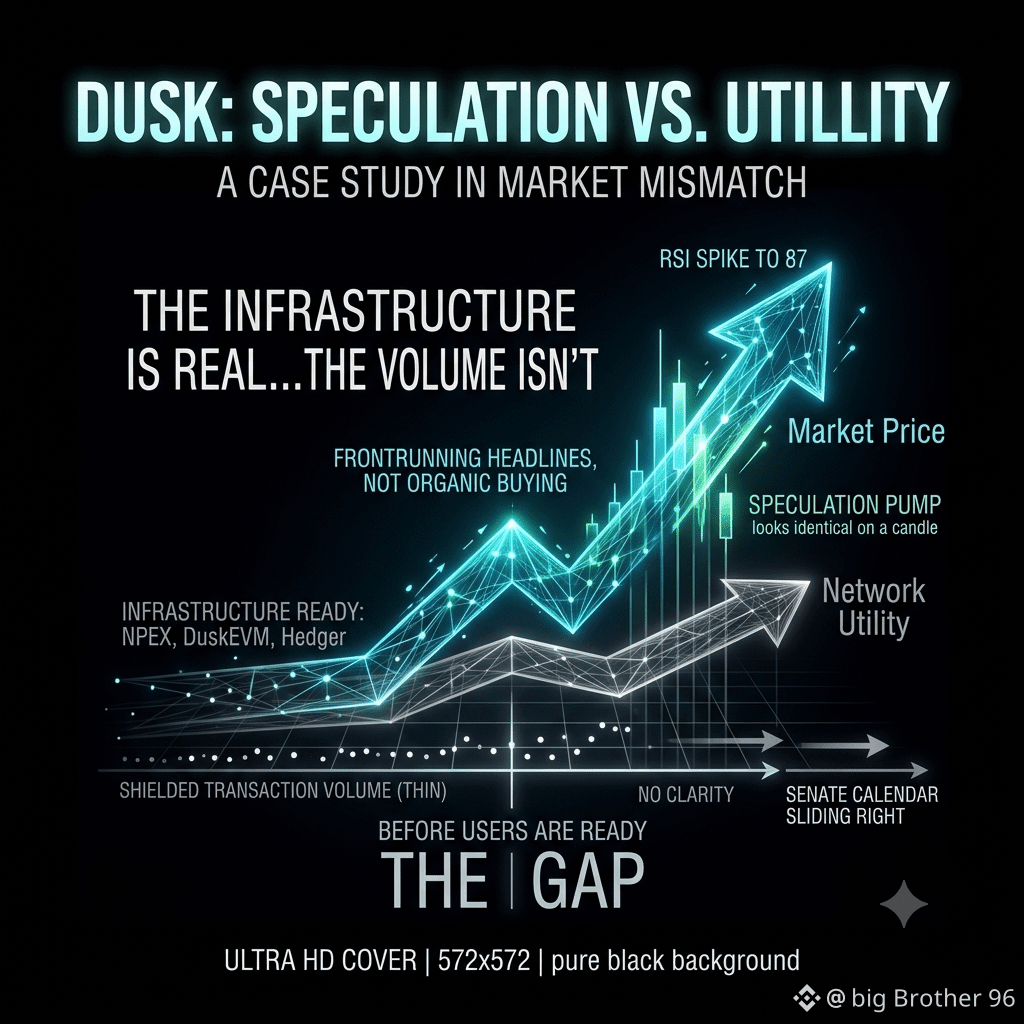
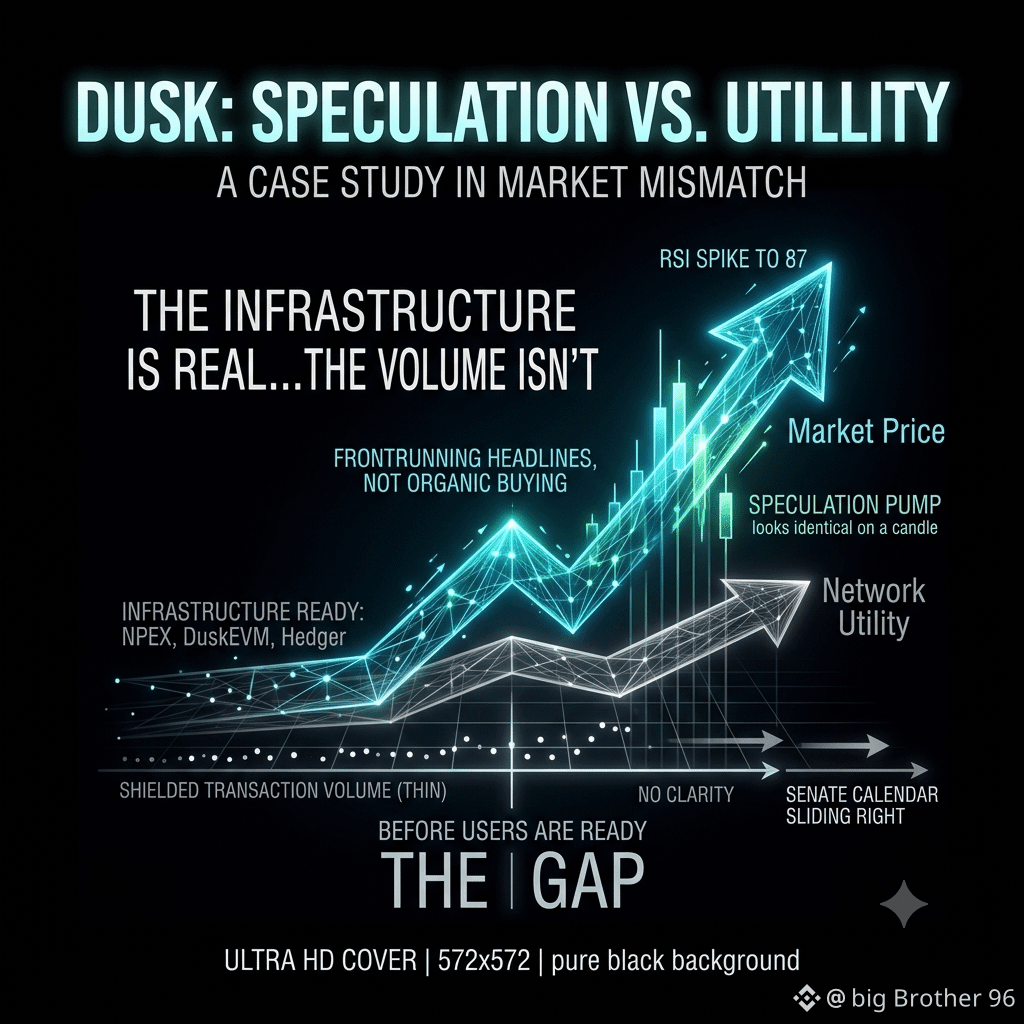
Je garde un petit sac $DUSK surtout par entêtement à ce stade. Je l’ai vu se bloquer ce matin à 0,079 $ et je me suis dit, oui, c’est la forme de chaque pompe RWA ces derniers temps : pas d’achats organiques, juste des gens qui se positionnent en avance sur un calendrier du Sénat qui cesse de glisser vers la droite. CLARITY est « proche » depuis juin.
Voici le point qui m’agace vraiment. L’infrastructure est réelle. NPEX tokenise des actions, $DUSK EVM laisse les développeurs Solidity entrer directement, Hedger fait une exécution confidentielle que la plupart des chaînes ne peuvent pas toucher. J’ai inspecté l’explorateur plus d’une fois à la recherche d’un volume de transactions masquées, et il est mince, presque silencieux. Donc un pic d’RSI à 87 n’était pas le réseau qui était réellement utilisé : c’était un titre qui était intégré à l’avance. Deux choses très différentes qui, sur une bougie, ont l’air identiques.
La chaîne est prête avant que les utilisateurs ne le soient. Cet écart n’apparaît dans aucun indicateur : on ne le remarque que si on surveille vraiment.
@Dusk_Foundation #dusk $DUSK
{spot}(DUSKUSDT)
Je garde un petit sac $DUSK surtout par entêtement à ce stade. Je l’ai vu se bloquer ce matin à 0,079 $ et je me suis dit, oui, c’est la forme de chaque pompe RWA ces derniers temps : pas d’achats organiques, juste des gens qui se positionnent en avance sur un calendrier du Sénat qui cesse de glisser vers la droite. CLARITY est « proche » depuis juin.
Voici le point qui m’agace vraiment. L’infrastructure est réelle. NPEX tokenise des actions, $DUSK EVM laisse les développeurs Solidity entrer directement, Hedger fait une exécution confidentielle que la plupart des chaînes ne peuvent pas toucher. J’ai inspecté l’explorateur plus d’une fois à la recherche d’un volume de transactions masquées, et il est mince, presque silencieux. Donc un pic d’RSI à 87 n’était pas le réseau qui était réellement utilisé : c’était un titre qui était intégré à l’avance. Deux choses très différentes qui, sur une bougie, ont l’air identiques.
La chaîne est prête avant que les utilisateurs ne le soient. Cet écart n’apparaît dans aucun indicateur : on ne le remarque que si on surveille vraiment.
@Dusk #dusk $DUSK
Voici le point qui m’agace vraiment. L’infrastructure est réelle. NPEX tokenise des actions, $DUSK EVM laisse les développeurs Solidity entrer directement, Hedger fait une exécution confidentielle que la plupart des chaînes ne peuvent pas toucher. J’ai inspecté l’explorateur plus d’une fois à la recherche d’un volume de transactions masquées, et il est mince, presque silencieux. Donc un pic d’RSI à 87 n’était pas le réseau qui était réellement utilisé : c’était un titre qui était intégré à l’avance. Deux choses très différentes qui, sur une bougie, ont l’air identiques.
La chaîne est prête avant que les utilisateurs ne le soient. Cet écart n’apparaît dans aucun indicateur : on ne le remarque que si on surveille vraiment.
@Dusk #dusk $DUSK
2
1
99
·
--
Haussier
Je reviens sans cesse à une chose, pendant que tout le monde fixe ce chiffre RSI supérieur à 83 : celui qui, quelle que soit la qualité de l’histoire, se termine généralement par une bougie rouge. Mais le graphique ne m’intéresse pas.
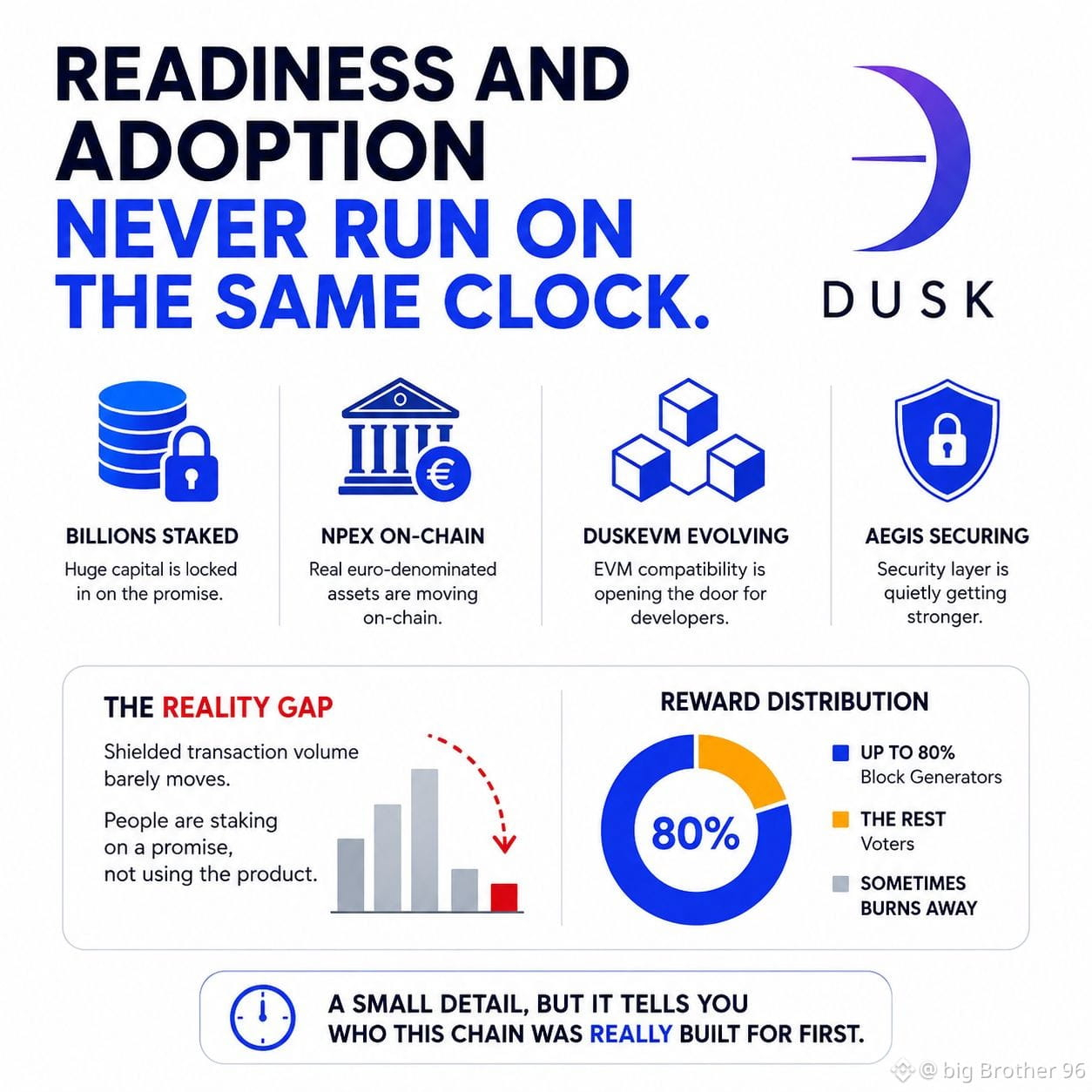
Ce qui attire vraiment mon attention, c’est l’écart entre le staking et l’utilisation réelle. Des milliards de valeur sont bloqués ; NPEX apporte de vrais actifs libellés en euros en chaîne ; DuskEVM prend forme ; AEGIS renforce discrètement la couche de sécurité, et pourtant, le volume des transactions shielded bouge à peine. Les gens misent sur une promesse, sans toucher au produit. Ce n’est pas forcément une mauvaise chose : c’est simplement la vérité sur l’état actuel des choses.
Ensuite, il y a la répartition des récompenses dont personne ne parle : les générateurs de blocs vont jusqu’à 80 %, les votants récupèrent ce qui reste, et parfois, cela finit juste par s’évaporer. Détail minuscule, mais il vous indique à quoi cette chaîne a vraiment été conçue en premier.
La préparation et l’adoption ne tournent jamais sur la même horloge.
@Dusk_Foundation #dusk $DUSK
{spot}(DUSKUSDT)
Je reviens sans cesse à une chose, pendant que tout le monde fixe ce chiffre RSI supérieur à 83 : celui qui, quelle que soit la qualité de l’histoire, se termine généralement par une bougie rouge. Mais le graphique ne m’intéresse pas.
Ce qui attire vraiment mon attention, c’est l’écart entre le staking et l’utilisation réelle. Des milliards de valeur sont bloqués ; NPEX apporte de vrais actifs libellés en euros en chaîne ; DuskEVM prend forme ; AEGIS renforce discrètement la couche de sécurité, et pourtant, le volume des transactions shielded bouge à peine. Les gens misent sur une promesse, sans toucher au produit. Ce n’est pas forcément une mauvaise chose : c’est simplement la vérité sur l’état actuel des choses.
Ensuite, il y a la répartition des récompenses dont personne ne parle : les générateurs de blocs vont jusqu’à 80 %, les votants récupèrent ce qui reste, et parfois, cela finit juste par s’évaporer. Détail minuscule, mais il vous indique à quoi cette chaîne a vraiment été conçue en premier.
La préparation et l’adoption ne tournent jamais sur la même horloge.
@Dusk #dusk $DUSK
Ce qui attire vraiment mon attention, c’est l’écart entre le staking et l’utilisation réelle. Des milliards de valeur sont bloqués ; NPEX apporte de vrais actifs libellés en euros en chaîne ; DuskEVM prend forme ; AEGIS renforce discrètement la couche de sécurité, et pourtant, le volume des transactions shielded bouge à peine. Les gens misent sur une promesse, sans toucher au produit. Ce n’est pas forcément une mauvaise chose : c’est simplement la vérité sur l’état actuel des choses.
Ensuite, il y a la répartition des récompenses dont personne ne parle : les générateurs de blocs vont jusqu’à 80 %, les votants récupèrent ce qui reste, et parfois, cela finit juste par s’évaporer. Détail minuscule, mais il vous indique à quoi cette chaîne a vraiment été conçue en premier.
La préparation et l’adoption ne tournent jamais sur la même horloge.
@Dusk #dusk $DUSK
4
4
95
·
--
Haussier
Je garde un œil sur DUSK surtout par habitude à ce stade, et cette semaine a suivi le scénario habituel : RSI monté vers 93, tout le monde dans les réponses faisait semblant d’être choqué quand la bougie rouge est apparue pile au bon moment. Cette partie ne mérite pas vraiment de réflexion.
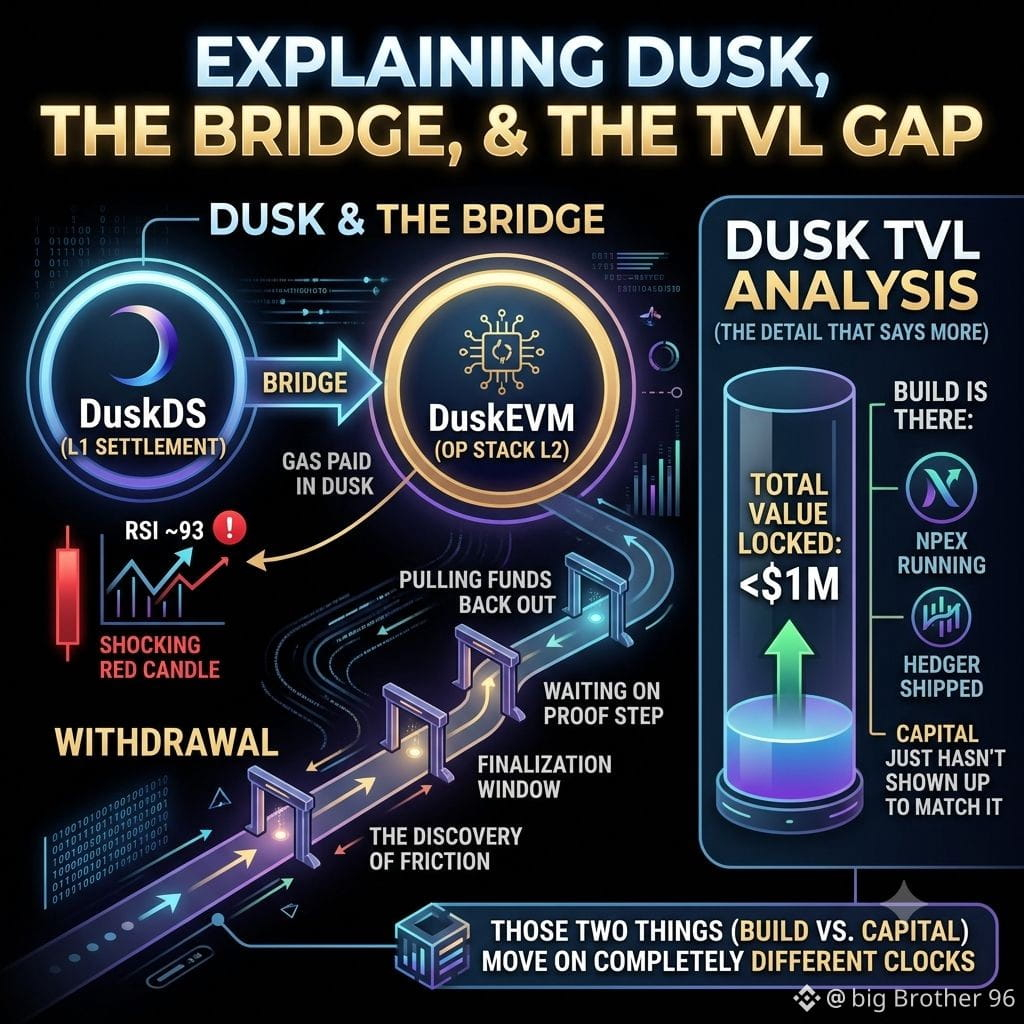
Ce qui m’a réellement fait faire une pause, c’est le pont. DuskEVM tourne sur OP Stack et règle en repassant par DuskDS, avec des frais de gaz payés en $DUSK , tout est bon en théorie… mais pour retirer des fonds, il faut attendre une étape de preuve et une fenêtre de finalisation dont pratiquement personne ne parle jusqu’au moment où on essaie déjà de partir. Mauvais moment pour découvrir une nouvelle friction.
Le détail qui en dit plus que le graphique, toutefois, c’est la TVL : elle est encore en dessous d’un million, même avec NPEX qui tourne et Hedger déjà expédié. Le build est là. Le capital, lui, n’est juste pas encore arrivé pour correspondre, et ces deux éléments ne progressent pas selon les mêmes horloges.
@Dusk_Foundation #dusk $DUSK
{future}(DUSKUSDT)
Je garde un œil sur DUSK surtout par habitude à ce stade, et cette semaine a suivi le scénario habituel : RSI monté vers 93, tout le monde dans les réponses faisait semblant d’être choqué quand la bougie rouge est apparue pile au bon moment. Cette partie ne mérite pas vraiment de réflexion.
Ce qui m’a réellement fait faire une pause, c’est le pont. DuskEVM tourne sur OP Stack et règle en repassant par DuskDS, avec des frais de gaz payés en $DUSK , tout est bon en théorie… mais pour retirer des fonds, il faut attendre une étape de preuve et une fenêtre de finalisation dont pratiquement personne ne parle jusqu’au moment où on essaie déjà de partir. Mauvais moment pour découvrir une nouvelle friction.
Le détail qui en dit plus que le graphique, toutefois, c’est la TVL : elle est encore en dessous d’un million, même avec NPEX qui tourne et Hedger déjà expédié. Le build est là. Le capital, lui, n’est juste pas encore arrivé pour correspondre, et ces deux éléments ne progressent pas selon les mêmes horloges.
@Dusk #dusk $DUSK
Ce qui m’a réellement fait faire une pause, c’est le pont. DuskEVM tourne sur OP Stack et règle en repassant par DuskDS, avec des frais de gaz payés en $DUSK , tout est bon en théorie… mais pour retirer des fonds, il faut attendre une étape de preuve et une fenêtre de finalisation dont pratiquement personne ne parle jusqu’au moment où on essaie déjà de partir. Mauvais moment pour découvrir une nouvelle friction.
Le détail qui en dit plus que le graphique, toutefois, c’est la TVL : elle est encore en dessous d’un million, même avec NPEX qui tourne et Hedger déjà expédié. Le build est là. Le capital, lui, n’est juste pas encore arrivé pour correspondre, et ces deux éléments ne progressent pas selon les mêmes horloges.
@Dusk #dusk $DUSK
6
7
96
·
--
Haussier
Pas un conseil financier juste quelques réflexions que j'ai eues en regardant ça depuis un moment.
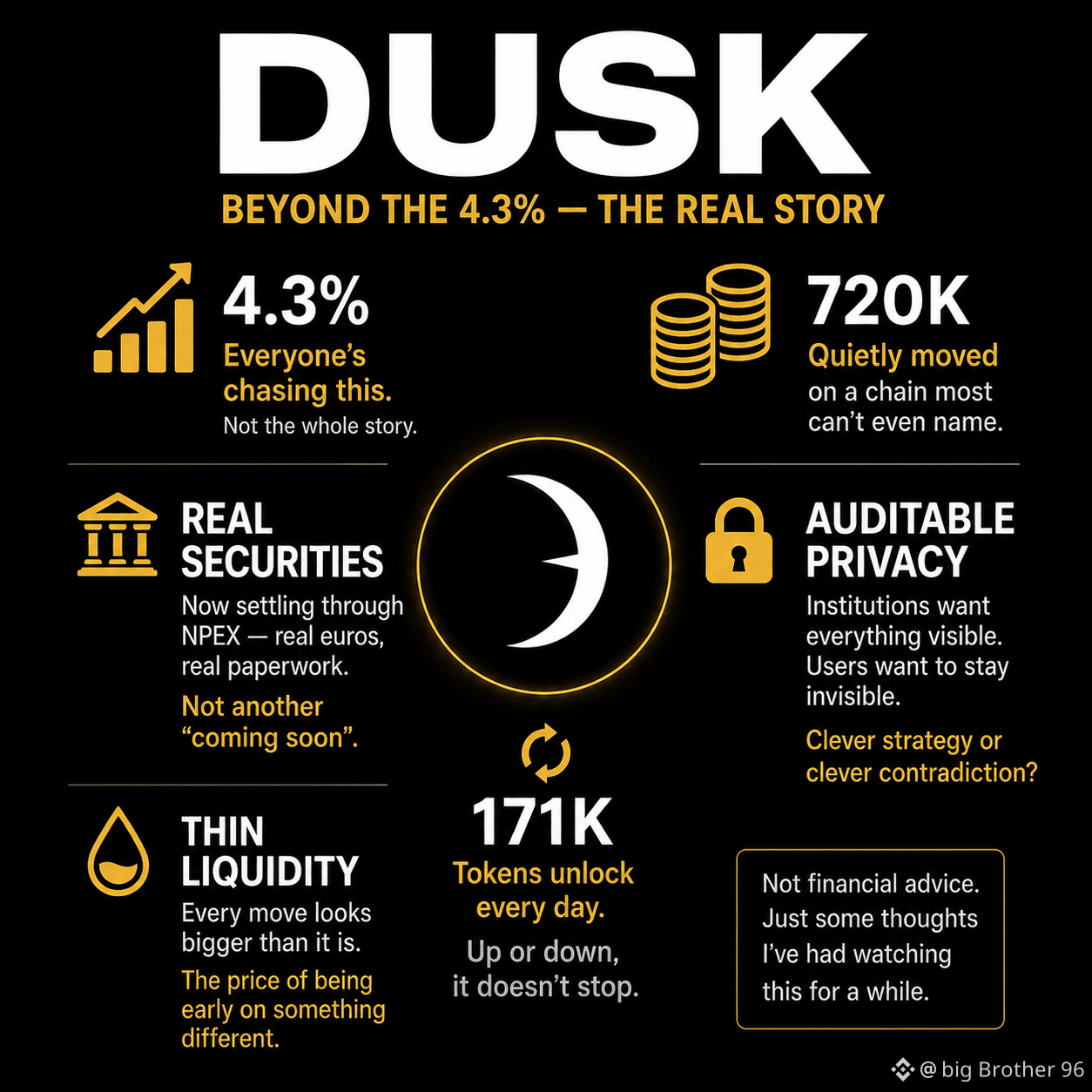
Tout le monde court après ces 4,3%, comme si c'était la vraie histoire. La vérité, c'est que le vrai sujet, c'est les 720k qui ont bougé discrètement sur une blockchain que la plupart des gens ne savent même pas nommer correctement. Je me souviens quand $DUSK n’était qu’un livre blanc, et que personne ne le prenait au sérieux, sauf une poignée de personnes dans un certain groupe Telegram. Maintenant, de vrais titres se règlent réellement via NPEX de vrais euros, de vrais documents pas une autre promesse de "bientôt". C’est juste que cette partie-là n’est pas aussi spectaculaire qu’une bougie verte, donc personne n’en parle.
D’un autre côté, 171k tokens se déverrouillent discrètement chaque jour, que le prix monte ou baisse personne ne montre ça dans une capture de graphique. La liquidité est faible, donc chaque mouvement paraît plus dramatique qu’il ne l’est vraiment c’est le prix à payer pour entrer dans quelque chose de petit et de différent dès le début.
Et puis il y a cette idée de "confidentialité vérifiable", qui est étrange aussi. Les institutions veulent tout voir ; les utilisateurs veulent rester invisibles. Dusk essaie de vendre les deux à la fois et honnêtement, je n’arrive toujours pas à dire si c’est une stratégie réellement ingénieuse ou juste une contradiction déguisée en bon marketing.
@Dusk_Foundation
#dusk
$DUSK
Pas un conseil financier juste quelques réflexions que j'ai eues en regardant ça depuis un moment.
Tout le monde court après ces 4,3%, comme si c'était la vraie histoire. La vérité, c'est que le vrai sujet, c'est les 720k qui ont bougé discrètement sur une blockchain que la plupart des gens ne savent même pas nommer correctement. Je me souviens quand $DUSK n’était qu’un livre blanc, et que personne ne le prenait au sérieux, sauf une poignée de personnes dans un certain groupe Telegram. Maintenant, de vrais titres se règlent réellement via NPEX de vrais euros, de vrais documents pas une autre promesse de "bientôt". C’est juste que cette partie-là n’est pas aussi spectaculaire qu’une bougie verte, donc personne n’en parle.
D’un autre côté, 171k tokens se déverrouillent discrètement chaque jour, que le prix monte ou baisse personne ne montre ça dans une capture de graphique. La liquidité est faible, donc chaque mouvement paraît plus dramatique qu’il ne l’est vraiment c’est le prix à payer pour entrer dans quelque chose de petit et de différent dès le début.
Et puis il y a cette idée de "confidentialité vérifiable", qui est étrange aussi. Les institutions veulent tout voir ; les utilisateurs veulent rester invisibles. Dusk essaie de vendre les deux à la fois et honnêtement, je n’arrive toujours pas à dire si c’est une stratégie réellement ingénieuse ou juste une contradiction déguisée en bon marketing.
@Dusk
#dusk
$DUSK
Tout le monde court après ces 4,3%, comme si c'était la vraie histoire. La vérité, c'est que le vrai sujet, c'est les 720k qui ont bougé discrètement sur une blockchain que la plupart des gens ne savent même pas nommer correctement. Je me souviens quand $DUSK n’était qu’un livre blanc, et que personne ne le prenait au sérieux, sauf une poignée de personnes dans un certain groupe Telegram. Maintenant, de vrais titres se règlent réellement via NPEX de vrais euros, de vrais documents pas une autre promesse de "bientôt". C’est juste que cette partie-là n’est pas aussi spectaculaire qu’une bougie verte, donc personne n’en parle.
D’un autre côté, 171k tokens se déverrouillent discrètement chaque jour, que le prix monte ou baisse personne ne montre ça dans une capture de graphique. La liquidité est faible, donc chaque mouvement paraît plus dramatique qu’il ne l’est vraiment c’est le prix à payer pour entrer dans quelque chose de petit et de différent dès le début.
Et puis il y a cette idée de "confidentialité vérifiable", qui est étrange aussi. Les institutions veulent tout voir ; les utilisateurs veulent rester invisibles. Dusk essaie de vendre les deux à la fois et honnêtement, je n’arrive toujours pas à dire si c’est une stratégie réellement ingénieuse ou juste une contradiction déguisée en bon marketing.
@Dusk
#dusk
$DUSK
10
7
92
·
--
Haussier
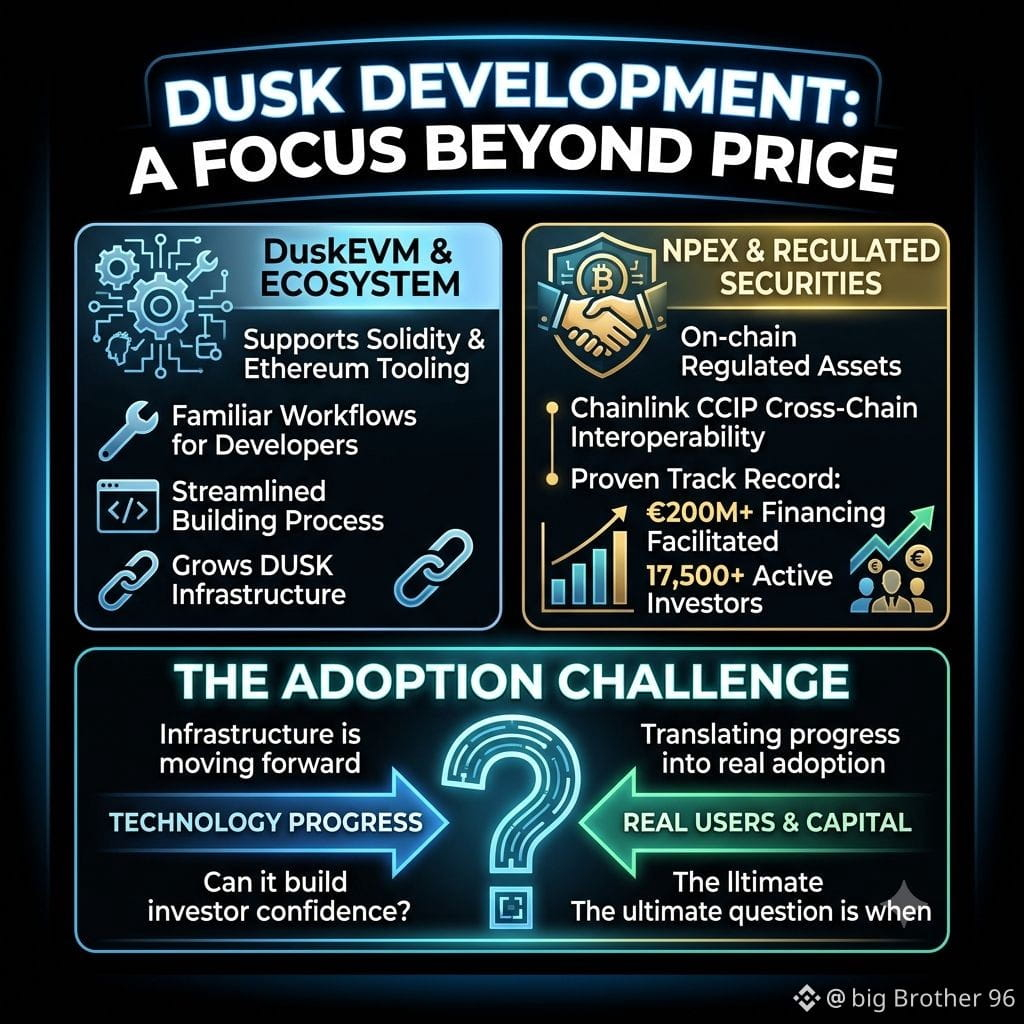
Pourquoi est-ce que je reviens toujours à DUSK ? Peut-être parce que son développement m’intéresse davantage que l’évolution des prix.
DuskEVM prend en charge Solidity et les outils Ethereum familiers, ce qui signifie que les développeurs peuvent construire sur $DUSK avec des workflows qu’ils connaissent déjà.
Ensuite, il y a NPEX. Dusk et NPEX travaillent à une infrastructure pour faire passer des valeurs mobilières réglementées on-chain, avec Chainlink CCIP utilisé pour l’interopérabilité inter-chaînes dans la configuration.
NPEX n’est pas non plus une simple autre plateforme. D’après Dusk, NPEX a facilité plus de 200 M€ de financement et compte 17 500+ investisseurs actifs à travers son réseau.
C’est la partie que je trouve la plus intéressante. L’infrastructure avance, mais reste à voir dans quelle mesure ces progrès se traduisent, à terme, par une adoption réelle.
Pour moi, la question la plus importante n’est désormais plus la technologie.
C’est le moment où de vrais utilisateurs et de vrais capitaux commencent à utiliser cette infrastructure avec le même niveau de confiance.
@Dusk_Foundation
#dusk
$DUSK
{spot}(DUSKUSDT)
Pourquoi est-ce que je reviens toujours à DUSK ? Peut-être parce que son développement m’intéresse davantage que l’évolution des prix.
DuskEVM prend en charge Solidity et les outils Ethereum familiers, ce qui signifie que les développeurs peuvent construire sur $DUSK avec des workflows qu’ils connaissent déjà.
Ensuite, il y a NPEX. Dusk et NPEX travaillent à une infrastructure pour faire passer des valeurs mobilières réglementées on-chain, avec Chainlink CCIP utilisé pour l’interopérabilité inter-chaînes dans la configuration.
NPEX n’est pas non plus une simple autre plateforme. D’après Dusk, NPEX a facilité plus de 200 M€ de financement et compte 17 500+ investisseurs actifs à travers son réseau.
C’est la partie que je trouve la plus intéressante. L’infrastructure avance, mais reste à voir dans quelle mesure ces progrès se traduisent, à terme, par une adoption réelle.
Pour moi, la question la plus importante n’est désormais plus la technologie.
C’est le moment où de vrais utilisateurs et de vrais capitaux commencent à utiliser cette infrastructure avec le même niveau de confiance.
@Dusk
#dusk
$DUSK
DuskEVM prend en charge Solidity et les outils Ethereum familiers, ce qui signifie que les développeurs peuvent construire sur $DUSK avec des workflows qu’ils connaissent déjà.
Ensuite, il y a NPEX. Dusk et NPEX travaillent à une infrastructure pour faire passer des valeurs mobilières réglementées on-chain, avec Chainlink CCIP utilisé pour l’interopérabilité inter-chaînes dans la configuration.
NPEX n’est pas non plus une simple autre plateforme. D’après Dusk, NPEX a facilité plus de 200 M€ de financement et compte 17 500+ investisseurs actifs à travers son réseau.
C’est la partie que je trouve la plus intéressante. L’infrastructure avance, mais reste à voir dans quelle mesure ces progrès se traduisent, à terme, par une adoption réelle.
Pour moi, la question la plus importante n’est désormais plus la technologie.
C’est le moment où de vrais utilisateurs et de vrais capitaux commencent à utiliser cette infrastructure avec le même niveau de confiance.
@Dusk
#dusk
$DUSK
2
1
101
·
--
Haussier
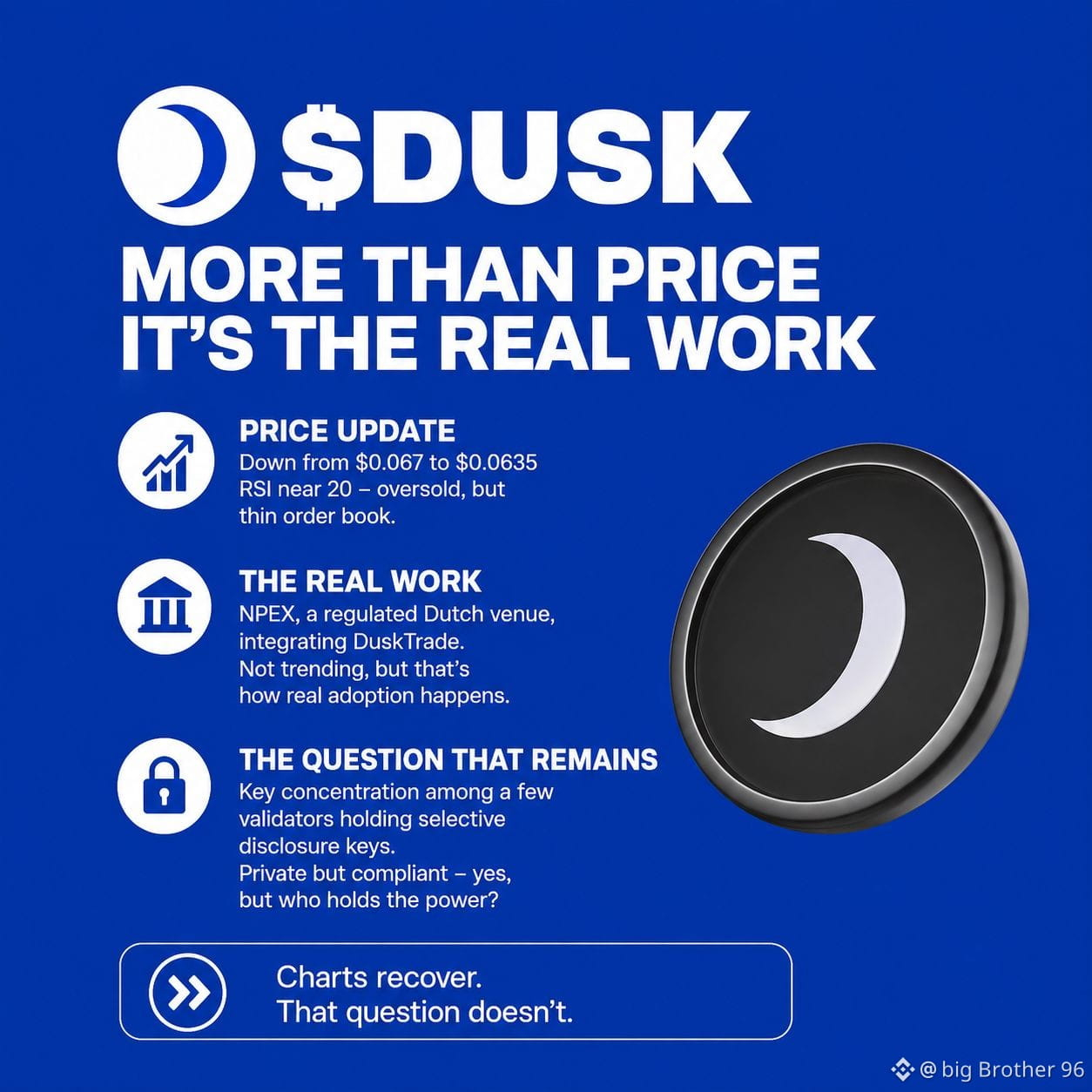
Remonté sur DUSK ce matin encore, plus par habitude que par autre chose. De .067 à .0635 en une journée, le RSI se maintenant près de 20, le genre de chiffre qui paraît alarmant jusqu’à ce que vous vous souveniez à quel point ce carnet d’ordres est mince.
Ce qui me trotte dans la tête, ce n’est pas le prix : c’est NPEX. Un lieu de trading réglementé aux Pays-Bas qui intègre tranquillement DuskTrade. Ça ne fait pas vraiment l’actualité sur les fils de tout le monde, mais c’est le travail réel : lent, peu glamour, la sorte de choses qui prend des années avant que ça ne signifie quelque chose. Tout le monde est trop occupé à répéter l’angle MiCA comme si c’était une nouveauté.
Ce qui m’intrigue vraiment, c’est la concentration des clés. Un petit groupe de validateurs détenant les clés de divulgation sélective, c’est une tension que personne ne veut affronter : ça va à l’encontre de toute la promesse « privée mais conforme ». Les graphiques se rétablissent. Cette question, non.
@Dusk_Foundation #dusk $DUSK
{spot}(DUSKUSDT)
Remonté sur DUSK ce matin encore, plus par habitude que par autre chose. De .067 à .0635 en une journée, le RSI se maintenant près de 20, le genre de chiffre qui paraît alarmant jusqu’à ce que vous vous souveniez à quel point ce carnet d’ordres est mince.
Ce qui me trotte dans la tête, ce n’est pas le prix : c’est NPEX. Un lieu de trading réglementé aux Pays-Bas qui intègre tranquillement DuskTrade. Ça ne fait pas vraiment l’actualité sur les fils de tout le monde, mais c’est le travail réel : lent, peu glamour, la sorte de choses qui prend des années avant que ça ne signifie quelque chose. Tout le monde est trop occupé à répéter l’angle MiCA comme si c’était une nouveauté.
Ce qui m’intrigue vraiment, c’est la concentration des clés. Un petit groupe de validateurs détenant les clés de divulgation sélective, c’est une tension que personne ne veut affronter : ça va à l’encontre de toute la promesse « privée mais conforme ». Les graphiques se rétablissent. Cette question, non.
@Dusk #dusk $DUSK
Ce qui me trotte dans la tête, ce n’est pas le prix : c’est NPEX. Un lieu de trading réglementé aux Pays-Bas qui intègre tranquillement DuskTrade. Ça ne fait pas vraiment l’actualité sur les fils de tout le monde, mais c’est le travail réel : lent, peu glamour, la sorte de choses qui prend des années avant que ça ne signifie quelque chose. Tout le monde est trop occupé à répéter l’angle MiCA comme si c’était une nouveauté.
Ce qui m’intrigue vraiment, c’est la concentration des clés. Un petit groupe de validateurs détenant les clés de divulgation sélective, c’est une tension que personne ne veut affronter : ça va à l’encontre de toute la promesse « privée mais conforme ». Les graphiques se rétablissent. Cette question, non.
@Dusk #dusk $DUSK
8
5
113
·
--
Baissier
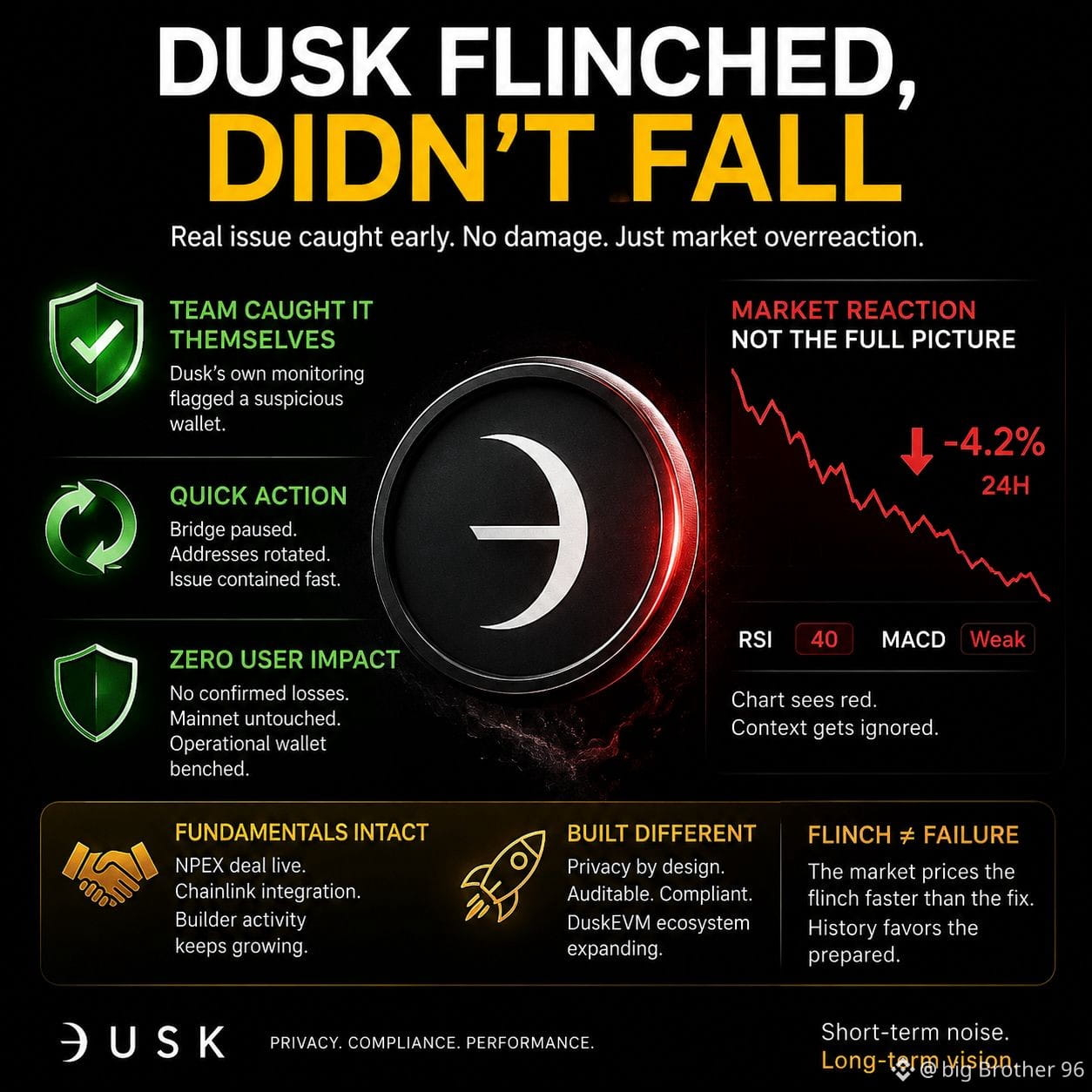
Dans le Discord de Dusk depuis la phase de test, donc pour moi, ça ne ressemblait pas à un titre : ça ressemblait plutôt à regarder quelqu’un que je connais à moitié trébucher sur quelque chose qu’il évite d’habitude, sans que ça fasse de bruit. Ce qui est passé sous silence, c’est que l’équipe l’a constaté elle-même. Pas un signal d’un whitehat. Pas un fil Twitter qui fait le travail à leur place. Leur propre monitoring a signalé un portefeuille qui se comportait bizarrement, et ils ont interrompu le pont puis fait pivoter les adresses avant même que la plupart des gens ne remarquent qu’il se passait quelque chose d’anormal. Lisez l’avis officiel : c’est presque ennuyeux. Aucune perte confirmée d’utilisateur. Le mainnet n’a jamais été touché. Juste un portefeuille opérationnel mis sur le banc en silence pendant qu’ils nettoyaient.
Mais le graphique ne sait rien de tout ça : il ne voit que du rouge. RSI qui descend vers 40, des dernières 24 heures un peu chaotiques, et soudain le deal NPEX et le travail sur Chainlink deviennent du bruit de fond, quelque chose que personne n’a envie de mentionner au milieu d’une baisse.
J’ai vu assez de situations comme celle-ci pour savoir faire la différence entre une chaîne qui saigne vraiment et une chaîne qui se contente de grimacer.
Le marché intègre généralement le sursaut plus vite qu’il n’intègre la correction.
@Dusk_Foundation
#dusk
$DUSK
{spot}(DUSKUSDT)
Dans le Discord de Dusk depuis la phase de test, donc pour moi, ça ne ressemblait pas à un titre : ça ressemblait plutôt à regarder quelqu’un que je connais à moitié trébucher sur quelque chose qu’il évite d’habitude, sans que ça fasse de bruit. Ce qui est passé sous silence, c’est que l’équipe l’a constaté elle-même. Pas un signal d’un whitehat. Pas un fil Twitter qui fait le travail à leur place. Leur propre monitoring a signalé un portefeuille qui se comportait bizarrement, et ils ont interrompu le pont puis fait pivoter les adresses avant même que la plupart des gens ne remarquent qu’il se passait quelque chose d’anormal. Lisez l’avis officiel : c’est presque ennuyeux. Aucune perte confirmée d’utilisateur. Le mainnet n’a jamais été touché. Juste un portefeuille opérationnel mis sur le banc en silence pendant qu’ils nettoyaient.
Mais le graphique ne sait rien de tout ça : il ne voit que du rouge. RSI qui descend vers 40, des dernières 24 heures un peu chaotiques, et soudain le deal NPEX et le travail sur Chainlink deviennent du bruit de fond, quelque chose que personne n’a envie de mentionner au milieu d’une baisse.
J’ai vu assez de situations comme celle-ci pour savoir faire la différence entre une chaîne qui saigne vraiment et une chaîne qui se contente de grimacer.
Le marché intègre généralement le sursaut plus vite qu’il n’intègre la correction.
@Dusk
#dusk
$DUSK
Mais le graphique ne sait rien de tout ça : il ne voit que du rouge. RSI qui descend vers 40, des dernières 24 heures un peu chaotiques, et soudain le deal NPEX et le travail sur Chainlink deviennent du bruit de fond, quelque chose que personne n’a envie de mentionner au milieu d’une baisse.
J’ai vu assez de situations comme celle-ci pour savoir faire la différence entre une chaîne qui saigne vraiment et une chaîne qui se contente de grimacer.
Le marché intègre généralement le sursaut plus vite qu’il n’intègre la correction.
@Dusk
#dusk
$DUSK
8
9
129
·
--
Haussier
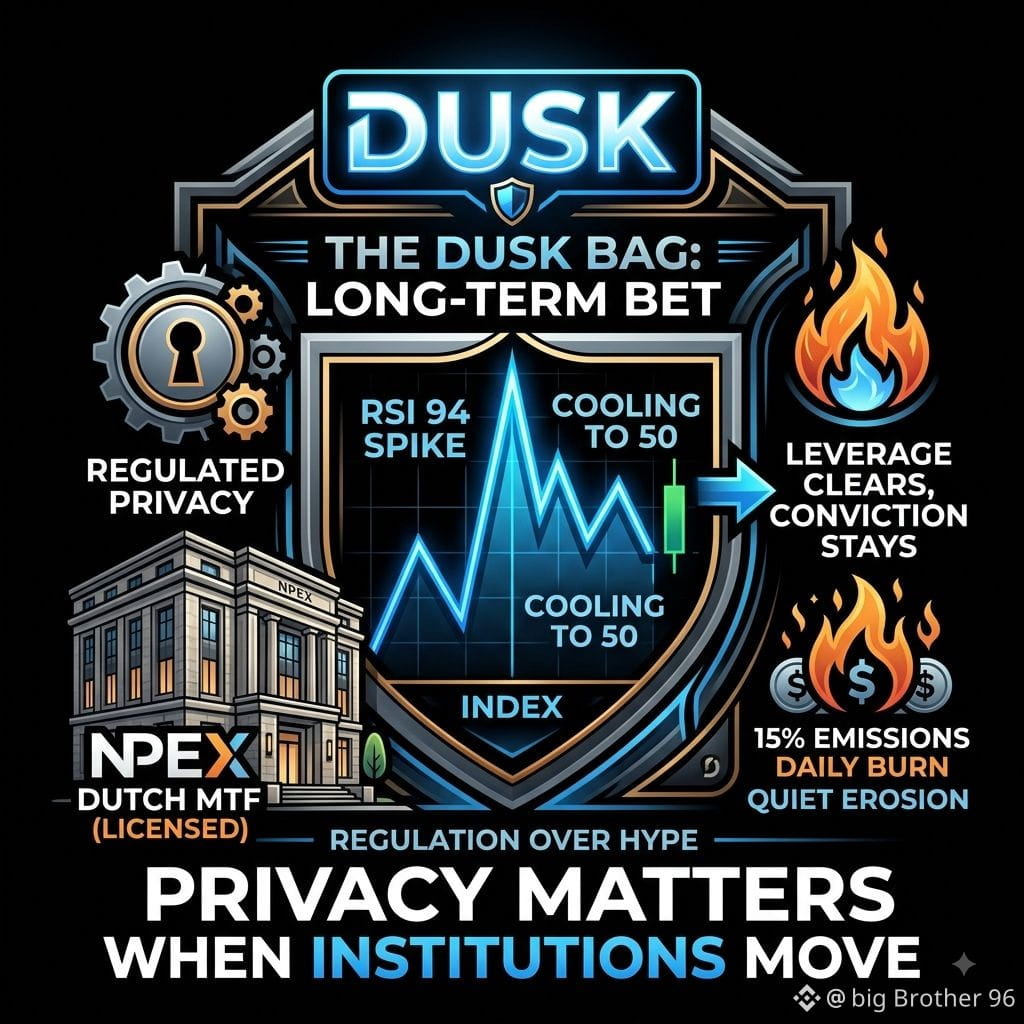
J’ai eu un petit sac DUSK tranquille depuis avant que quiconque daigne dire « privacy réglementée » comme si ça voulait dire quelque chose, alors quand les nouvelles NPEX ont touché mon fil, ça ne ressemblait pas à un titre, plutôt à regarder une mise lente commencer enfin à se payer. NPEX, ce n’est pas non plus une petite boutique DeFi qui chasse un récit. C’est un MTF néerlandais, agréé, qui bosse sans relâche depuis avant même que la crypto ait quelque chose de réel à prouver. Des institutions comme celle-là ne bougent pas vite, et elles ne bougent certainement pas pour le buzz : elles attendent que les rails aient réellement du poids, et c’est exactement la partie que tout le monde qui fait défiler rate en sautant la bougie des 8,8 %. Un RSI qui grimpe à 94 puis redescend à 50 ne me fait pas peur : ce n’est que du levier qui se purge, pas une conviction qui quitte les lieux. Ce que j’observe vraiment, c’est la combustion : 15 % des émissions qui disparaissent chaque jour, sans annonce, sans figure de graphique, juste une érosion silencieuse qui travaille pour toi pendant que tout le monde fixe le prix. La confidentialité ne devient vraiment importante que quand les gens qui ont quelque chose de réel à perdre commencent à la demander.
@Dusk_Foundation
#dusk
$DUSK
{spot}(DUSKUSDT)
J’ai eu un petit sac DUSK tranquille depuis avant que quiconque daigne dire « privacy réglementée » comme si ça voulait dire quelque chose, alors quand les nouvelles NPEX ont touché mon fil, ça ne ressemblait pas à un titre, plutôt à regarder une mise lente commencer enfin à se payer. NPEX, ce n’est pas non plus une petite boutique DeFi qui chasse un récit. C’est un MTF néerlandais, agréé, qui bosse sans relâche depuis avant même que la crypto ait quelque chose de réel à prouver. Des institutions comme celle-là ne bougent pas vite, et elles ne bougent certainement pas pour le buzz : elles attendent que les rails aient réellement du poids, et c’est exactement la partie que tout le monde qui fait défiler rate en sautant la bougie des 8,8 %. Un RSI qui grimpe à 94 puis redescend à 50 ne me fait pas peur : ce n’est que du levier qui se purge, pas une conviction qui quitte les lieux. Ce que j’observe vraiment, c’est la combustion : 15 % des émissions qui disparaissent chaque jour, sans annonce, sans figure de graphique, juste une érosion silencieuse qui travaille pour toi pendant que tout le monde fixe le prix. La confidentialité ne devient vraiment importante que quand les gens qui ont quelque chose de réel à perdre commencent à la demander.
@Dusk
#dusk
$DUSK
@Dusk
#dusk
$DUSK
7
3
97
·
--
Haussier
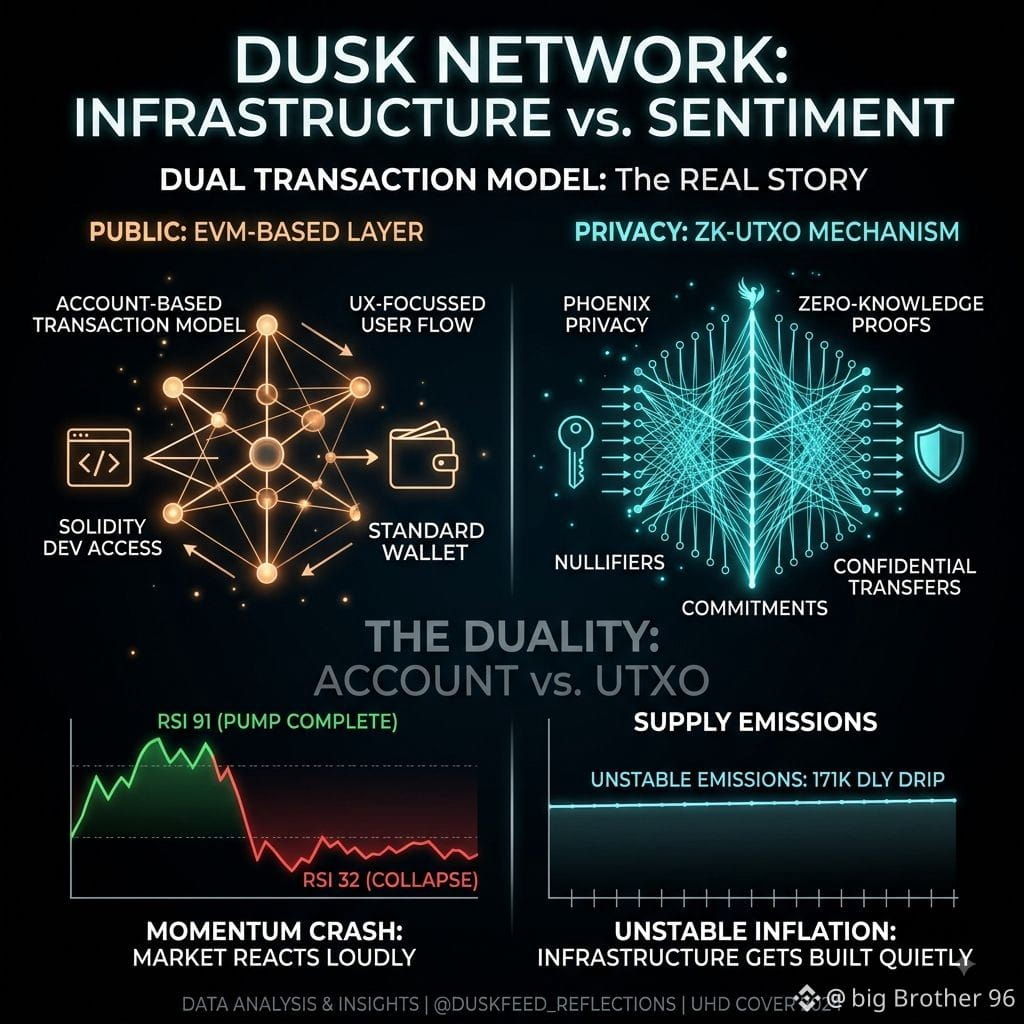
Assis avec le flux DUSK plus longtemps que je ne devrais ce soir. Tout le monde parle du testnet EVM comme si c’était toute l’histoire. Et bien sûr, laisser les développeurs Solidity entrer dans une infrastructure RWA régulée sans tout devoir réapprendre, c’est une vraie avancée—pas du vent. Mais ce qui me revient sans cesse, c’est le modèle de transaction double dont personne ne parle de lui-même. Un système basé sur des comptes pour ceux qui veulent juste que ça fonctionne, et un modèle UTXO en arrière-plan, discret, pour tous ceux qui se souviennent encore pourquoi cet espace tenait à la confidentialité. Voilà le vrai pari ici, pas l’accroche du testnet.
J’ai vérifié le RSI presque par hasard : 91 qui s’effondre à 32 en quelques heures. Le pump que tout le monde célèbre était déjà terminé avant que la plupart des gens lèvent les yeux.
Et les déblocages continuent de couler, 171 K par jour—facile à ignorer jusqu’à ce que ce ne soit plus le cas.
L’infrastructure se construit discrètement. Le prix réagit bruyamment. Rarement à la même horloge.
@Dusk_Foundation
#dusk
$DUSK
{spot}(DUSKUSDT)
Assis avec le flux DUSK plus longtemps que je ne devrais ce soir. Tout le monde parle du testnet EVM comme si c’était toute l’histoire. Et bien sûr, laisser les développeurs Solidity entrer dans une infrastructure RWA régulée sans tout devoir réapprendre, c’est une vraie avancée—pas du vent. Mais ce qui me revient sans cesse, c’est le modèle de transaction double dont personne ne parle de lui-même. Un système basé sur des comptes pour ceux qui veulent juste que ça fonctionne, et un modèle UTXO en arrière-plan, discret, pour tous ceux qui se souviennent encore pourquoi cet espace tenait à la confidentialité. Voilà le vrai pari ici, pas l’accroche du testnet.
J’ai vérifié le RSI presque par hasard : 91 qui s’effondre à 32 en quelques heures. Le pump que tout le monde célèbre était déjà terminé avant que la plupart des gens lèvent les yeux.
Et les déblocages continuent de couler, 171 K par jour—facile à ignorer jusqu’à ce que ce ne soit plus le cas.
L’infrastructure se construit discrètement. Le prix réagit bruyamment. Rarement à la même horloge.
@Dusk
#dusk
$DUSK
J’ai vérifié le RSI presque par hasard : 91 qui s’effondre à 32 en quelques heures. Le pump que tout le monde célèbre était déjà terminé avant que la plupart des gens lèvent les yeux.
Et les déblocages continuent de couler, 171 K par jour—facile à ignorer jusqu’à ce que ce ne soit plus le cas.
L’infrastructure se construit discrètement. Le prix réagit bruyamment. Rarement à la même horloge.
@Dusk
#dusk
$DUSK
12
8
107
·
--
Haussier
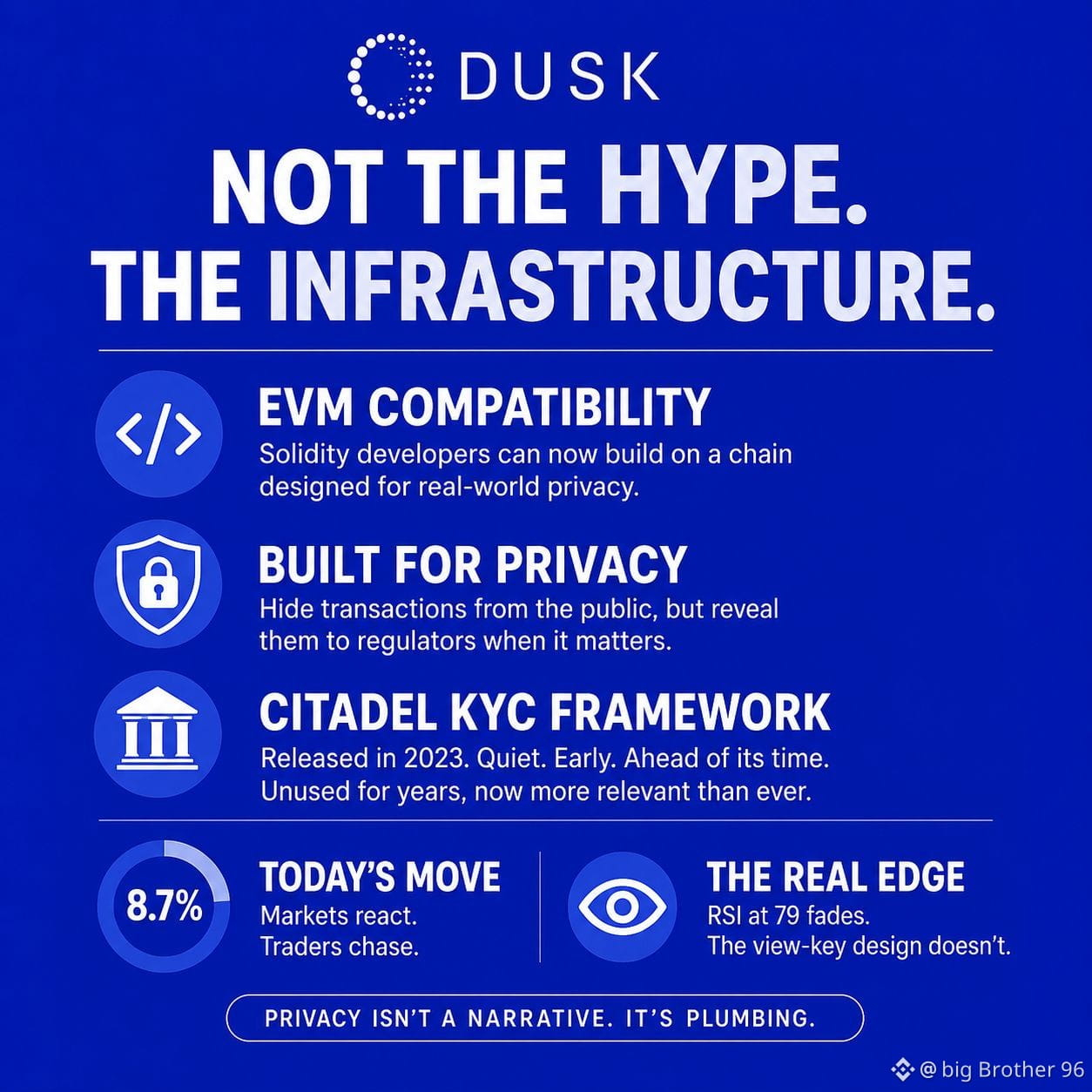
Je regarde Dusk à moitié depuis des années maintenant, la façon dont vous gardez un œil sur un projet qui manque ses propres délais mais ne s’arrête jamais de bouger. Six ans de « mainnet bientôt », puis il… apparaît. Le volet EVM, c’est ce qui a vraiment attiré mon attention, pas le prix. Les développeurs Solidity peuvent désormais déployer sur une chaîne construite autour d’un problème franchement peu glamour : comment cacher une transaction au public tout en en la montrant à un régulateur quand il le demande. Ce n’est pas un récit, c’est de la plomberie.
Tout le monde parle du mouvement de 8,7% aujourd’hui. Moi, je reviens plutôt à Citadel : ce cadre KYC qu’ils ont discrètement publié en 2023 et que quasiment personne n’a couvert. Il est resté là, inutilisé pendant des années, en attendant que le marché rattrape la raison pour laquelle c’était important. C’est généralement comme ça qu’on repère ce qui est réel : la chose pour laquelle on n’a pas applaud i à l’époque.
RSI à 79 : ça s’efface d’ici la semaine prochaine. Le design à clé de vue, lui, non.
@Dusk_Foundation
#dusk
$DUSK
{spot}(DUSKUSDT)
Je regarde Dusk à moitié depuis des années maintenant, la façon dont vous gardez un œil sur un projet qui manque ses propres délais mais ne s’arrête jamais de bouger. Six ans de « mainnet bientôt », puis il… apparaît. Le volet EVM, c’est ce qui a vraiment attiré mon attention, pas le prix. Les développeurs Solidity peuvent désormais déployer sur une chaîne construite autour d’un problème franchement peu glamour : comment cacher une transaction au public tout en en la montrant à un régulateur quand il le demande. Ce n’est pas un récit, c’est de la plomberie.
Tout le monde parle du mouvement de 8,7% aujourd’hui. Moi, je reviens plutôt à Citadel : ce cadre KYC qu’ils ont discrètement publié en 2023 et que quasiment personne n’a couvert. Il est resté là, inutilisé pendant des années, en attendant que le marché rattrape la raison pour laquelle c’était important. C’est généralement comme ça qu’on repère ce qui est réel : la chose pour laquelle on n’a pas applaud i à l’époque.
RSI à 79 : ça s’efface d’ici la semaine prochaine. Le design à clé de vue, lui, non.
@Dusk
#dusk
$DUSK
Tout le monde parle du mouvement de 8,7% aujourd’hui. Moi, je reviens plutôt à Citadel : ce cadre KYC qu’ils ont discrètement publié en 2023 et que quasiment personne n’a couvert. Il est resté là, inutilisé pendant des années, en attendant que le marché rattrape la raison pour laquelle c’était important. C’est généralement comme ça qu’on repère ce qui est réel : la chose pour laquelle on n’a pas applaud i à l’époque.
RSI à 79 : ça s’efface d’ici la semaine prochaine. Le design à clé de vue, lui, non.
@Dusk
#dusk
$DUSK
1
1
78
·
--
Haussier
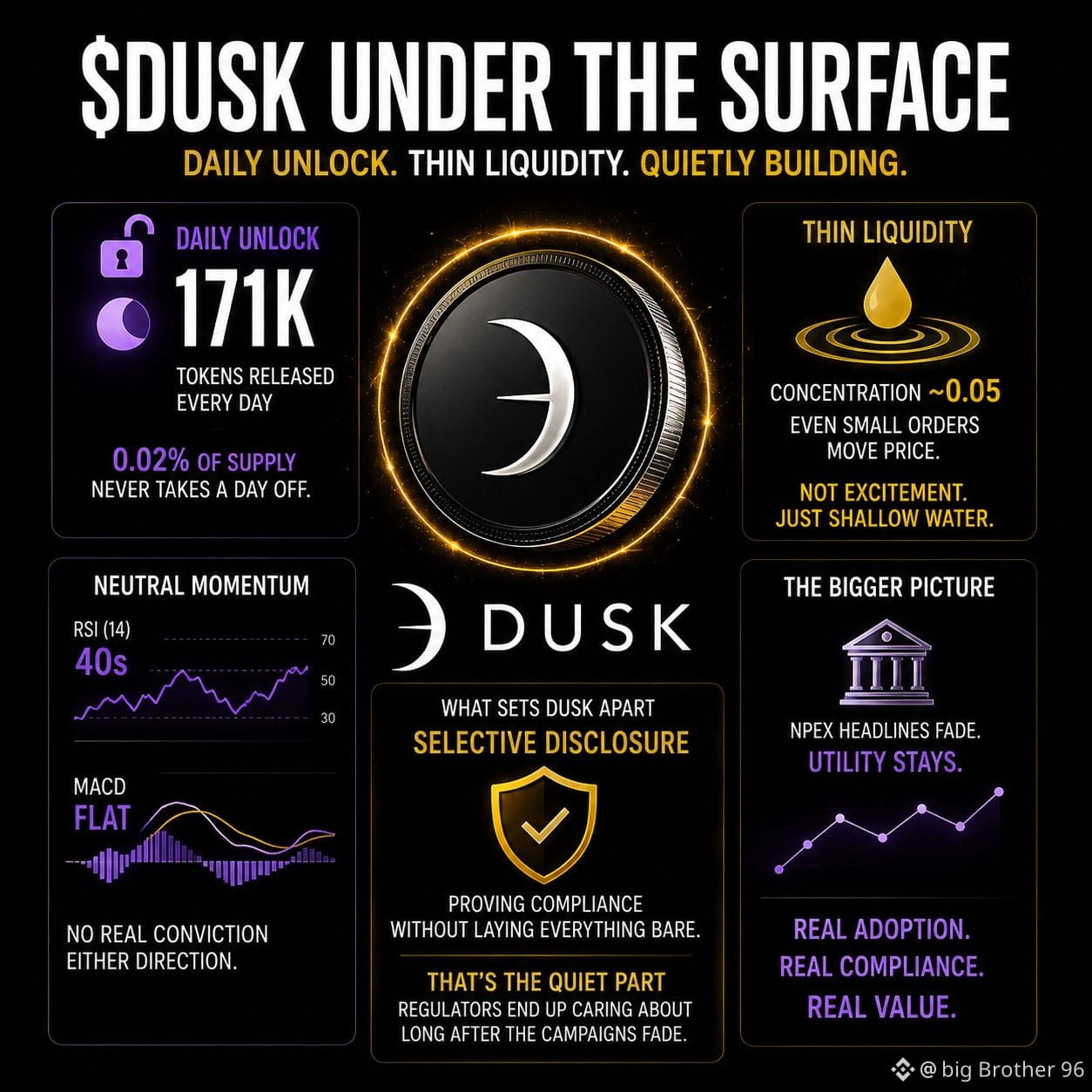
Je regarde DUSK depuis un moment et ce qui attire vraiment mon attention n’est pas le titre NPEX que tout le monde répète. C’est plutôt ce déverrouillage quotidien qui s’écoule tranquillement en dessous. Environ 171K tokens libérés chaque jour, juste 0,02%—facile à balayer du revers de la main jusqu’à ce qu’on remarque que ça ne fait jamais une pause.
Je consulte parfois le carnet d’ordres juste pour voir, et il est assez fin. La concentration est restée autour de 0,05 depuis un moment, donc même un ordre modeste fait bouger le prix davantage que ce qu’il devrait. Ce n’est pas de la volatilité due à l’excitation : c’est juste de l’eau peu profonde.
Le RSI dérive dans la zone des 40, et le MACD ne fait presque aucun mouvement—aucune conviction réelle dans un sens ou dans l’autre pour l’instant.
Ce qui retient surtout mon attention sur le long terme, c’est l’aspect de divulgation sélective : prouver sa conformité sans tout dévoiler. C’est la partie silencieuse qui finit par intéresser les régulateurs bien après la disparition des campagnes.
@Dusk_Foundation
#dusk
$DUSK
{spot}(DUSKUSDT)
Je regarde DUSK depuis un moment et ce qui attire vraiment mon attention n’est pas le titre NPEX que tout le monde répète. C’est plutôt ce déverrouillage quotidien qui s’écoule tranquillement en dessous. Environ 171K tokens libérés chaque jour, juste 0,02%—facile à balayer du revers de la main jusqu’à ce qu’on remarque que ça ne fait jamais une pause.
Je consulte parfois le carnet d’ordres juste pour voir, et il est assez fin. La concentration est restée autour de 0,05 depuis un moment, donc même un ordre modeste fait bouger le prix davantage que ce qu’il devrait. Ce n’est pas de la volatilité due à l’excitation : c’est juste de l’eau peu profonde.
Le RSI dérive dans la zone des 40, et le MACD ne fait presque aucun mouvement—aucune conviction réelle dans un sens ou dans l’autre pour l’instant.
Ce qui retient surtout mon attention sur le long terme, c’est l’aspect de divulgation sélective : prouver sa conformité sans tout dévoiler. C’est la partie silencieuse qui finit par intéresser les régulateurs bien après la disparition des campagnes.
@Dusk
#dusk
$DUSK
Je consulte parfois le carnet d’ordres juste pour voir, et il est assez fin. La concentration est restée autour de 0,05 depuis un moment, donc même un ordre modeste fait bouger le prix davantage que ce qu’il devrait. Ce n’est pas de la volatilité due à l’excitation : c’est juste de l’eau peu profonde.
Le RSI dérive dans la zone des 40, et le MACD ne fait presque aucun mouvement—aucune conviction réelle dans un sens ou dans l’autre pour l’instant.
Ce qui retient surtout mon attention sur le long terme, c’est l’aspect de divulgation sélective : prouver sa conformité sans tout dévoiler. C’est la partie silencieuse qui finit par intéresser les régulateurs bien après la disparition des campagnes.
@Dusk
#dusk
$DUSK
14
3
186
·
--
Haussier
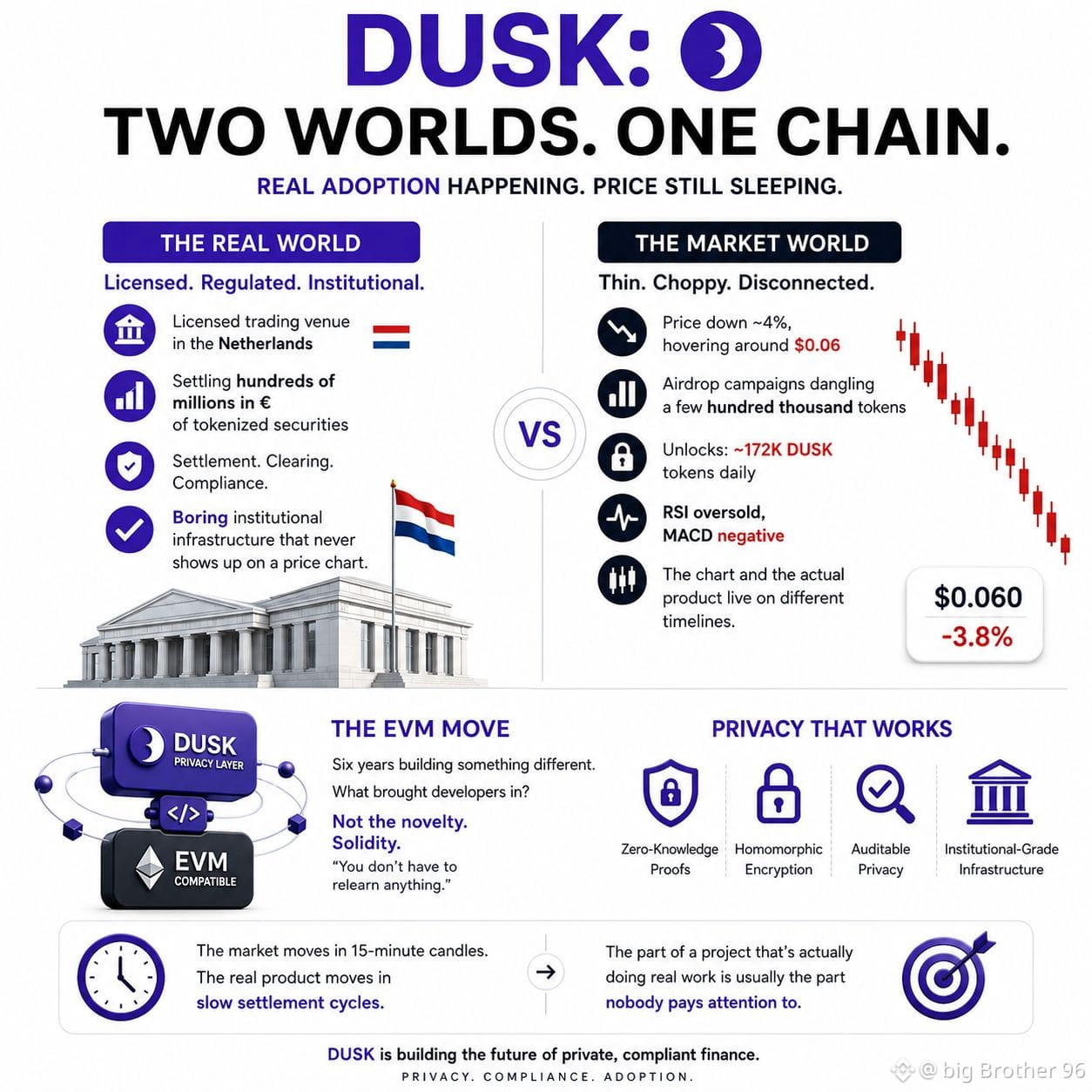
Je conserve une petite bourse de DUSK depuis le début de cette année, principalement parce que l’idée de confidentialité vérifiable avait vraiment du sens à mes yeux. Aujourd’hui, elle est de nouveau dans le rouge, en baisse de plus de 4 %, oscillant juste autour de six cents. Rien d’assez spectaculaire pour vous faire paniquer et vérifier votre portefeuille, juste cette progression lente.
Ce qui me déroute le plus en regardant ce graphique, c’est l’immense écart entre l’évolution du prix et l’adoption réelle. Quelque part aux Pays-Bas, un lieu entièrement autorisé règle des centaines de millions d’euros de titres tokenisés sur cette chaîne. Il y a un vrai volume institutionnel, du clearing en arrière-plan, des éléments qui ne deviennent jamais un tweet plein d’enthousiasme ni une bougie verte. Pendant ce temps, le marché de détail reste mince et instable, avec des mouvements provoqués par des campagnes aléatoires qui lâchent quelques centaines de milliers de tokens en guise d’appât. C’est fou : deux mondes totalement différents fonctionnent sur le même ticker.
Ensuite, il y a le pivot vers l’EVM. Ils ont passé six ans à construire quelque chose de totalement sur mesure : des preuves à connaissance nulle, le chiffrement homomorphe, toute une pile de confidentialité pensée de A à Z. Mais qu’est-ce qui a réellement attiré les développeurs ? Solidity. Le simple fait de dire aux gens : « Vous n’avez pas besoin d’apprendre un nouveau langage. » Presque drôle, si vous avez suivi DUSK assez longtemps pour vous souvenir que l’ensemble du discours portait sur le fait de ne pas être comme Ethereum.
Et en plus de tout ça, les émissions ne s’arrêtent pour rien. Environ 172 000 tokens arrivent sur le marché chaque jour, quoi qu’il arrive aux progrès institutionnels ou à la situation du marché. Le RSI est en zone de survente, le MACD paraît faible, et le graphique n’en a absolument rien à faire du module Hedger ni de l’avancement de la tokenisation côté back-end.
Le marché évolue en bougies de 15 minutes, mais le vrai produit suit des cycles de règlement lents. C’est drôle : la seule partie d’un projet qui fait réellement du travail est généralement celle à laquelle personne ne prête attention
@Dusk_Foundation
#dusk
$DUSK
Je conserve une petite bourse de DUSK depuis le début de cette année, principalement parce que l’idée de confidentialité vérifiable avait vraiment du sens à mes yeux. Aujourd’hui, elle est de nouveau dans le rouge, en baisse de plus de 4 %, oscillant juste autour de six cents. Rien d’assez spectaculaire pour vous faire paniquer et vérifier votre portefeuille, juste cette progression lente.
Ce qui me déroute le plus en regardant ce graphique, c’est l’immense écart entre l’évolution du prix et l’adoption réelle. Quelque part aux Pays-Bas, un lieu entièrement autorisé règle des centaines de millions d’euros de titres tokenisés sur cette chaîne. Il y a un vrai volume institutionnel, du clearing en arrière-plan, des éléments qui ne deviennent jamais un tweet plein d’enthousiasme ni une bougie verte. Pendant ce temps, le marché de détail reste mince et instable, avec des mouvements provoqués par des campagnes aléatoires qui lâchent quelques centaines de milliers de tokens en guise d’appât. C’est fou : deux mondes totalement différents fonctionnent sur le même ticker.
Ensuite, il y a le pivot vers l’EVM. Ils ont passé six ans à construire quelque chose de totalement sur mesure : des preuves à connaissance nulle, le chiffrement homomorphe, toute une pile de confidentialité pensée de A à Z. Mais qu’est-ce qui a réellement attiré les développeurs ? Solidity. Le simple fait de dire aux gens : « Vous n’avez pas besoin d’apprendre un nouveau langage. » Presque drôle, si vous avez suivi DUSK assez longtemps pour vous souvenir que l’ensemble du discours portait sur le fait de ne pas être comme Ethereum.
Et en plus de tout ça, les émissions ne s’arrêtent pour rien. Environ 172 000 tokens arrivent sur le marché chaque jour, quoi qu’il arrive aux progrès institutionnels ou à la situation du marché. Le RSI est en zone de survente, le MACD paraît faible, et le graphique n’en a absolument rien à faire du module Hedger ni de l’avancement de la tokenisation côté back-end.
Le marché évolue en bougies de 15 minutes, mais le vrai produit suit des cycles de règlement lents. C’est drôle : la seule partie d’un projet qui fait réellement du travail est généralement celle à laquelle personne ne prête attention
@Dusk
#dusk
$DUSK
Ce qui me déroute le plus en regardant ce graphique, c’est l’immense écart entre l’évolution du prix et l’adoption réelle. Quelque part aux Pays-Bas, un lieu entièrement autorisé règle des centaines de millions d’euros de titres tokenisés sur cette chaîne. Il y a un vrai volume institutionnel, du clearing en arrière-plan, des éléments qui ne deviennent jamais un tweet plein d’enthousiasme ni une bougie verte. Pendant ce temps, le marché de détail reste mince et instable, avec des mouvements provoqués par des campagnes aléatoires qui lâchent quelques centaines de milliers de tokens en guise d’appât. C’est fou : deux mondes totalement différents fonctionnent sur le même ticker.
Ensuite, il y a le pivot vers l’EVM. Ils ont passé six ans à construire quelque chose de totalement sur mesure : des preuves à connaissance nulle, le chiffrement homomorphe, toute une pile de confidentialité pensée de A à Z. Mais qu’est-ce qui a réellement attiré les développeurs ? Solidity. Le simple fait de dire aux gens : « Vous n’avez pas besoin d’apprendre un nouveau langage. » Presque drôle, si vous avez suivi DUSK assez longtemps pour vous souvenir que l’ensemble du discours portait sur le fait de ne pas être comme Ethereum.
Et en plus de tout ça, les émissions ne s’arrêtent pour rien. Environ 172 000 tokens arrivent sur le marché chaque jour, quoi qu’il arrive aux progrès institutionnels ou à la situation du marché. Le RSI est en zone de survente, le MACD paraît faible, et le graphique n’en a absolument rien à faire du module Hedger ni de l’avancement de la tokenisation côté back-end.
Le marché évolue en bougies de 15 minutes, mais le vrai produit suit des cycles de règlement lents. C’est drôle : la seule partie d’un projet qui fait réellement du travail est généralement celle à laquelle personne ne prête attention
@Dusk
#dusk
$DUSK
13
6
13
·
--
Haussier
$BABY plongé à 0,0103 $ ce matin, c’est le plus bas que j’aie vu, et franchement, je n’ai même pas bronché. Le RSI glisse vers 19 toute la semaine, donc ce chiffre n’était pas la surprise. Ce qui m’a surpris, c’est de voir tout le monde publier le même chiffre de « déblocage de 237 M » comme si c’était la seule donnée qui comptait aujourd’hui. Je suis allé récupérer le document réel de déblocage parce que ça me semblait gonflé, et oui, c’est gonflé : le vrai chiffre est plutôt proche de 136 M, soit environ 1,2 % de l’offre. Quelqu’un a arrondi pour l’effet une fois, et après ça, tout le monde l’a copié-collé.
Mais ce n’est même pas la partie qui mérite vraiment qu’on s’y attarde. En mai, Babylon a discrètement changé le déblocage des investisseurs : on est passé d’une grosse marche (cliff) à trente-six tranches mensuelles. Donc mardi, ce n’est pas « le déblocage », c’est le premier de trente-cinq déblocages supplémentaires, jusqu’en avril 2029. Tout le monde se prépare à un choc violent, alors que ce n’est en fait qu’un écoulement continu sur trois ans, peu importe où le prix se situe. Ça donne l’impression que ce n’est pas la bonne chose dont il faut avoir peur, ou en tout cas pas sur le mauvais calendrier.
Ce à quoi je pense plutôt, à bas bruit, c’est la vente aux enchères de burn (destruction). Les récompenses BSN font l’objet d’enchères sur BABY, et ce qui gagne est brûlé, supprimé. J’en ai vu une se régler il y a quelques semaines, tout en étant à moitié distrait par autre chose, et ça m’est resté en tête, parce que c’est la seule partie de ce token où l’utilisation du réseau coûte réellement de l’offre, au lieu d’y ajouter. Ce n’est pas près de compenser une émission annuelle de 8 %, même pas dans le voisinage, mais c’est réel : ça arrive parce que quelque chose a été utilisé.
Et le point de base reste vrai : la raison pour laquelle j’ai prêté attention à ça dès le départ. Le BTC misé via le système ne se wrap jamais, ne touche jamais un pont, et il n’y a pas de substitut synthétique qui prétendrait être l’actif réel. Ça n’a pas bougé d’un iota depuis avant que le prix ne fasse quoi que ce soit avec tout ce qu’il fait maintenant.
Le graphique ne fait pas la différence entre une tranche et une marche. Cette partie dépend de la personne qui le détient.
@babylonlabs_io
#baby
$BABY
{future}(BABYUSDT)
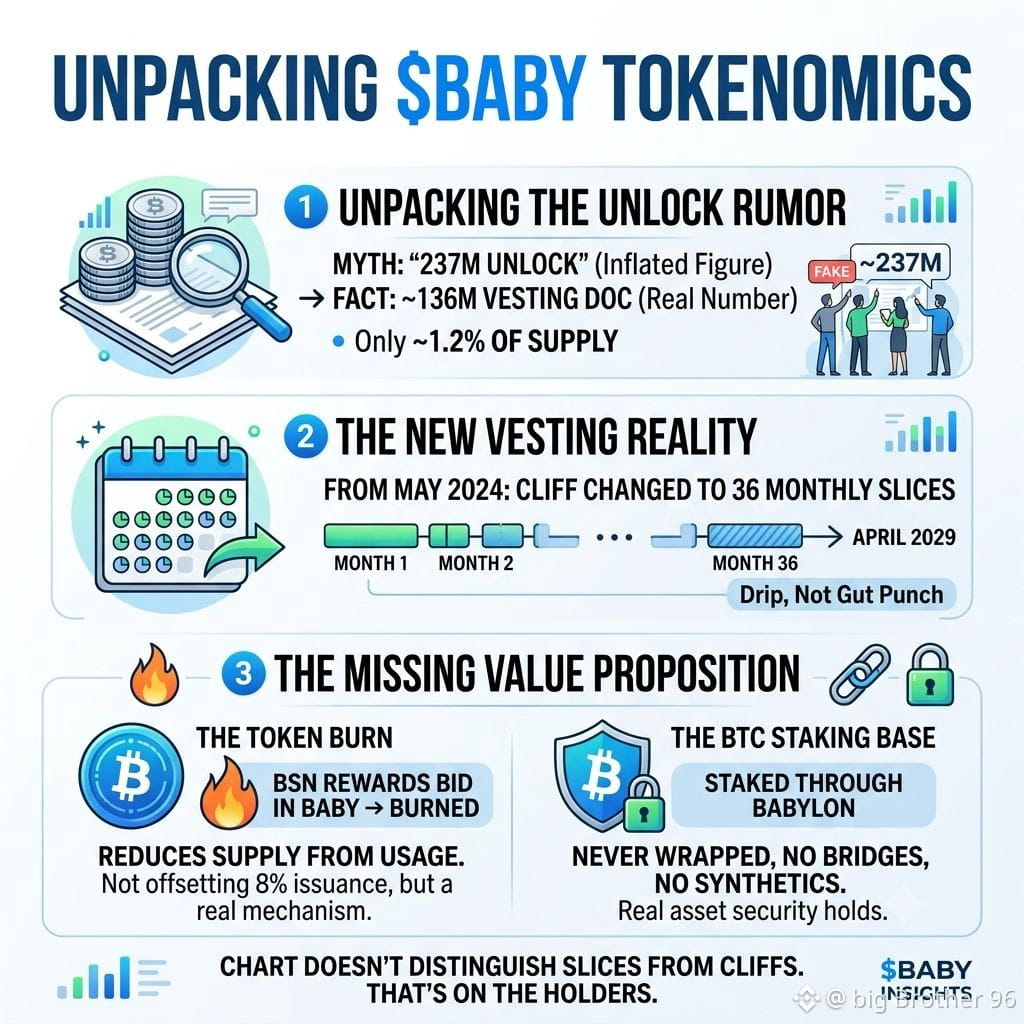
$BABY plongé à 0,0103 $ ce matin, c’est le plus bas que j’aie vu, et franchement, je n’ai même pas bronché. Le RSI glisse vers 19 toute la semaine, donc ce chiffre n’était pas la surprise. Ce qui m’a surpris, c’est de voir tout le monde publier le même chiffre de « déblocage de 237 M » comme si c’était la seule donnée qui comptait aujourd’hui. Je suis allé récupérer le document réel de déblocage parce que ça me semblait gonflé, et oui, c’est gonflé : le vrai chiffre est plutôt proche de 136 M, soit environ 1,2 % de l’offre. Quelqu’un a arrondi pour l’effet une fois, et après ça, tout le monde l’a copié-collé.
Mais ce n’est même pas la partie qui mérite vraiment qu’on s’y attarde. En mai, Babylon a discrètement changé le déblocage des investisseurs : on est passé d’une grosse marche (cliff) à trente-six tranches mensuelles. Donc mardi, ce n’est pas « le déblocage », c’est le premier de trente-cinq déblocages supplémentaires, jusqu’en avril 2029. Tout le monde se prépare à un choc violent, alors que ce n’est en fait qu’un écoulement continu sur trois ans, peu importe où le prix se situe. Ça donne l’impression que ce n’est pas la bonne chose dont il faut avoir peur, ou en tout cas pas sur le mauvais calendrier.
Ce à quoi je pense plutôt, à bas bruit, c’est la vente aux enchères de burn (destruction). Les récompenses BSN font l’objet d’enchères sur BABY, et ce qui gagne est brûlé, supprimé. J’en ai vu une se régler il y a quelques semaines, tout en étant à moitié distrait par autre chose, et ça m’est resté en tête, parce que c’est la seule partie de ce token où l’utilisation du réseau coûte réellement de l’offre, au lieu d’y ajouter. Ce n’est pas près de compenser une émission annuelle de 8 %, même pas dans le voisinage, mais c’est réel : ça arrive parce que quelque chose a été utilisé.
Et le point de base reste vrai : la raison pour laquelle j’ai prêté attention à ça dès le départ. Le BTC misé via le système ne se wrap jamais, ne touche jamais un pont, et il n’y a pas de substitut synthétique qui prétendrait être l’actif réel. Ça n’a pas bougé d’un iota depuis avant que le prix ne fasse quoi que ce soit avec tout ce qu’il fait maintenant.
Le graphique ne fait pas la différence entre une tranche et une marche. Cette partie dépend de la personne qui le détient.
@BabylonLabs_io
#baby
$BABY
Mais ce n’est même pas la partie qui mérite vraiment qu’on s’y attarde. En mai, Babylon a discrètement changé le déblocage des investisseurs : on est passé d’une grosse marche (cliff) à trente-six tranches mensuelles. Donc mardi, ce n’est pas « le déblocage », c’est le premier de trente-cinq déblocages supplémentaires, jusqu’en avril 2029. Tout le monde se prépare à un choc violent, alors que ce n’est en fait qu’un écoulement continu sur trois ans, peu importe où le prix se situe. Ça donne l’impression que ce n’est pas la bonne chose dont il faut avoir peur, ou en tout cas pas sur le mauvais calendrier.
Ce à quoi je pense plutôt, à bas bruit, c’est la vente aux enchères de burn (destruction). Les récompenses BSN font l’objet d’enchères sur BABY, et ce qui gagne est brûlé, supprimé. J’en ai vu une se régler il y a quelques semaines, tout en étant à moitié distrait par autre chose, et ça m’est resté en tête, parce que c’est la seule partie de ce token où l’utilisation du réseau coûte réellement de l’offre, au lieu d’y ajouter. Ce n’est pas près de compenser une émission annuelle de 8 %, même pas dans le voisinage, mais c’est réel : ça arrive parce que quelque chose a été utilisé.
Et le point de base reste vrai : la raison pour laquelle j’ai prêté attention à ça dès le départ. Le BTC misé via le système ne se wrap jamais, ne touche jamais un pont, et il n’y a pas de substitut synthétique qui prétendrait être l’actif réel. Ça n’a pas bougé d’un iota depuis avant que le prix ne fasse quoi que ce soit avec tout ce qu’il fait maintenant.
Le graphique ne fait pas la différence entre une tranche et une marche. Cette partie dépend de la personne qui le détient.
@BabylonLabs_io
#baby
$BABY
2
1
121
·
--
Haussier
J’ai re-vérifié BABY ce matin, surtout par habitude. 0,0108 $, rouge partout où je regardais. Mais franchement, ma première réaction ne concernait pas le prix : c’était plutôt à propos de ce déverrouillage du 10 août, quand tout le monde se met soudain à chuchoter comme si c’était une sorte de compte à rebours.
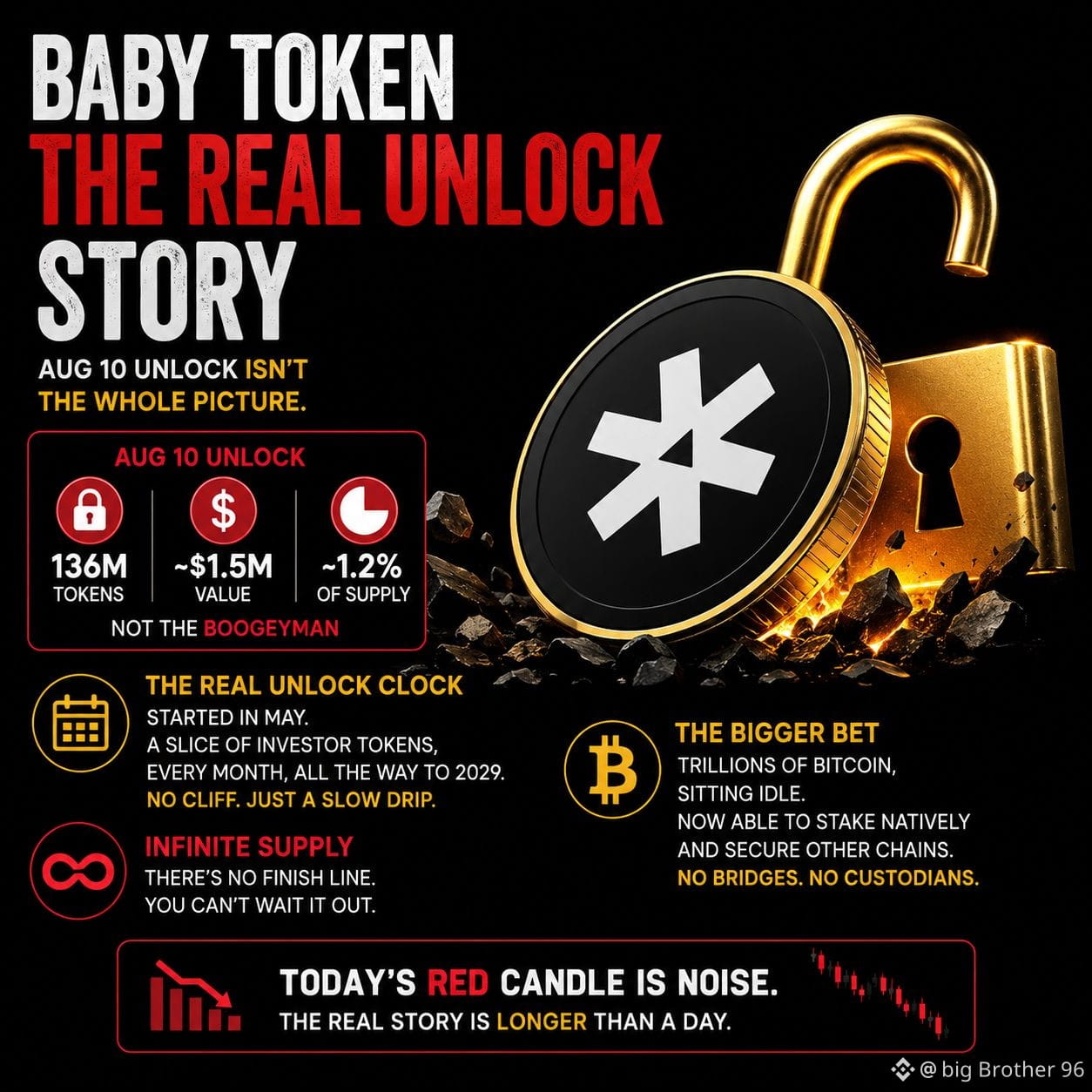
Du coup, au lieu d’acquiescer en suivant la panique, je suis allé vérifier le chiffre moi-même. Il s’avère que ce sont 136 millions de tokens, environ 1,5 M$, soit quelque chose comme 1,2 % de l’offre totale. (CoinGecko) C’est le monstre du placard. Entre le rapport et les discussions en groupe, ça s’est transformé en une affaire beaucoup plus grosse que ce que c’est réellement. Ça arrive souvent dans ce milieu : une petite sortie programmée, plutôt ennuyeuse, devient une « événement de pression à la vente » une fois que la rumeur a fait le tour.
Ce qui m’a vraiment marqué, c’est quelque chose de plus lointain, dont personne ne parle vraiment. Le vrai compte à rebours des déblocages a commencé en mai, avec le déblocage d’une tranche de la réserve d’investisseurs bloquée, puis la même tranche chaque mois après, jusqu’en 2029. (Babylonlabs) Pas de drama avec ça, donc ça n’attire pas l’attention. Ce n’est pas une falaise unique : c’est un écoulement mensuel lent, que la plupart des gens ont déjà cessé de suivre. Et honnêtement, il n’y a pas non plus de moment où ça s’arrête, parce que l’offre n’a aucune limite. Elle est infinie. (Tokenomist) On ne peut pas attendre que ça passe. Il n’y aura aucun « une fois qu’on est passé ce déblocage, tout est propre ».
Et par-dessus tout, il y a la prémisse vraiment étrange de l’ensemble : prendre des trillions de dollars de Bitcoin qui restent là sans rien faire, et leur donner un moyen de miser nativement et de sécuriser d’autres chaînes, sans pont, sans custodian impliqué. (CoinMarketCap) C’est vraiment un pari bizarre à essayer de valoriser avec un token. Les détenteurs de Bitcoin ne paniquent pas. Ils ne courent pas après. Donc tu te retrouves avec un token de gouvernance qui tente d’aller vite par-dessus une classe d’actifs qui, historiquement, ne bouge pour personne.
Du coup, la bougie rouge d’aujourd’hui donne l’impression d’être un peu à côté de la plaque, honnêtement.
@babylonlabs_io
#baby
$BABY
J’ai re-vérifié BABY ce matin, surtout par habitude. 0,0108 $, rouge partout où je regardais. Mais franchement, ma première réaction ne concernait pas le prix : c’était plutôt à propos de ce déverrouillage du 10 août, quand tout le monde se met soudain à chuchoter comme si c’était une sorte de compte à rebours.
Du coup, au lieu d’acquiescer en suivant la panique, je suis allé vérifier le chiffre moi-même. Il s’avère que ce sont 136 millions de tokens, environ 1,5 M$, soit quelque chose comme 1,2 % de l’offre totale. (CoinGecko) C’est le monstre du placard. Entre le rapport et les discussions en groupe, ça s’est transformé en une affaire beaucoup plus grosse que ce que c’est réellement. Ça arrive souvent dans ce milieu : une petite sortie programmée, plutôt ennuyeuse, devient une « événement de pression à la vente » une fois que la rumeur a fait le tour.
Ce qui m’a vraiment marqué, c’est quelque chose de plus lointain, dont personne ne parle vraiment. Le vrai compte à rebours des déblocages a commencé en mai, avec le déblocage d’une tranche de la réserve d’investisseurs bloquée, puis la même tranche chaque mois après, jusqu’en 2029. (Babylonlabs) Pas de drama avec ça, donc ça n’attire pas l’attention. Ce n’est pas une falaise unique : c’est un écoulement mensuel lent, que la plupart des gens ont déjà cessé de suivre. Et honnêtement, il n’y a pas non plus de moment où ça s’arrête, parce que l’offre n’a aucune limite. Elle est infinie. (Tokenomist) On ne peut pas attendre que ça passe. Il n’y aura aucun « une fois qu’on est passé ce déblocage, tout est propre ».
Et par-dessus tout, il y a la prémisse vraiment étrange de l’ensemble : prendre des trillions de dollars de Bitcoin qui restent là sans rien faire, et leur donner un moyen de miser nativement et de sécuriser d’autres chaînes, sans pont, sans custodian impliqué. (CoinMarketCap) C’est vraiment un pari bizarre à essayer de valoriser avec un token. Les détenteurs de Bitcoin ne paniquent pas. Ils ne courent pas après. Donc tu te retrouves avec un token de gouvernance qui tente d’aller vite par-dessus une classe d’actifs qui, historiquement, ne bouge pour personne.
Du coup, la bougie rouge d’aujourd’hui donne l’impression d’être un peu à côté de la plaque, honnêtement.
@BabylonLabs_io
#baby
$BABY
Du coup, au lieu d’acquiescer en suivant la panique, je suis allé vérifier le chiffre moi-même. Il s’avère que ce sont 136 millions de tokens, environ 1,5 M$, soit quelque chose comme 1,2 % de l’offre totale. (CoinGecko) C’est le monstre du placard. Entre le rapport et les discussions en groupe, ça s’est transformé en une affaire beaucoup plus grosse que ce que c’est réellement. Ça arrive souvent dans ce milieu : une petite sortie programmée, plutôt ennuyeuse, devient une « événement de pression à la vente » une fois que la rumeur a fait le tour.
Ce qui m’a vraiment marqué, c’est quelque chose de plus lointain, dont personne ne parle vraiment. Le vrai compte à rebours des déblocages a commencé en mai, avec le déblocage d’une tranche de la réserve d’investisseurs bloquée, puis la même tranche chaque mois après, jusqu’en 2029. (Babylonlabs) Pas de drama avec ça, donc ça n’attire pas l’attention. Ce n’est pas une falaise unique : c’est un écoulement mensuel lent, que la plupart des gens ont déjà cessé de suivre. Et honnêtement, il n’y a pas non plus de moment où ça s’arrête, parce que l’offre n’a aucune limite. Elle est infinie. (Tokenomist) On ne peut pas attendre que ça passe. Il n’y aura aucun « une fois qu’on est passé ce déblocage, tout est propre ».
Et par-dessus tout, il y a la prémisse vraiment étrange de l’ensemble : prendre des trillions de dollars de Bitcoin qui restent là sans rien faire, et leur donner un moyen de miser nativement et de sécuriser d’autres chaînes, sans pont, sans custodian impliqué. (CoinMarketCap) C’est vraiment un pari bizarre à essayer de valoriser avec un token. Les détenteurs de Bitcoin ne paniquent pas. Ils ne courent pas après. Donc tu te retrouves avec un token de gouvernance qui tente d’aller vite par-dessus une classe d’actifs qui, historiquement, ne bouge pour personne.
Du coup, la bougie rouge d’aujourd’hui donne l’impression d’être un peu à côté de la plaque, honnêtement.
@BabylonLabs_io
#baby
$BABY
5
1
103
·
--
Haussier
J’ai en fait suivi le processus du testnet de Babylon moi-même, ce qui n’est pas le cas de la plupart des gens qui publient des graphiques à ce sujet aujourd’hui. J’ai verrouillé du signet BTC dans un coffre, je l’ai vu apparaître comme collatéral utilisable sur Aave v4, et je n’ai jamais eu à le confier à un pont (bridge) ni à le transformer en une version synthétique de lui-même. Vous attendez toujours la contrepartie, le moment où vous devez faire confiance à un multisig avec vos fonds—et ça ne se produit tout simplement jamais. C’est ça qui m’a marqué plus que n’importe quelle bougie de prix.
Parce que oui, le token est en baisse de 6% aujourd’hui. Les gens traitent ça comme si c’était toute l’histoire. Mais de l’autre côté, les dépôts/entrées (peg in) via le coffre mettaient autrefois un temps fou, et maintenant ils sont ramenés à quelques heures ; les frais ont chuté jusqu’à un tiers de ce qu’ils étaient, et tout ça n’a pas été suffisant pour figurer dans la chronologie de qui que ce soit. C’est une progression peu glamour, celle qui ne compte vraiment que lorsque de l’argent réel commence à circuler, plutôt que du BTC de testnet.
La sortie que tout le monde pointe du doigt—près de 15 000 BTC qui semblent sortir en une seule manœuvre propre—ressemble moins à de la peur qu’à des touristes de rendement qui quittent les lieux une fois que l’incitation qui les a attirés a cessé d’exister. C’est exactement ce que fait le capital mercenaire. Il n’a jamais été loyal à la mission : il était loyal au chiffre.
Ce qui me reste en tête, c’est l’écart entre une capitalisation de 48,9 M$ et 5,6 Md$ en Bitcoin logé dans cet ensemble en tant que collatéral. Quelque part dans ces calculs, soit le marché sous-évalue fortement ce que signifie gérer des rails de prêts adossés à Bitcoin, soit le marché n’a tout simplement pas encore rattrapé son retard.
Un RSI à 29 vous dit que les gens ont peur en ce moment. Ça ne vous dit pas qu’ils ont raison.
@babylonlabs_io
#baby
$BABY
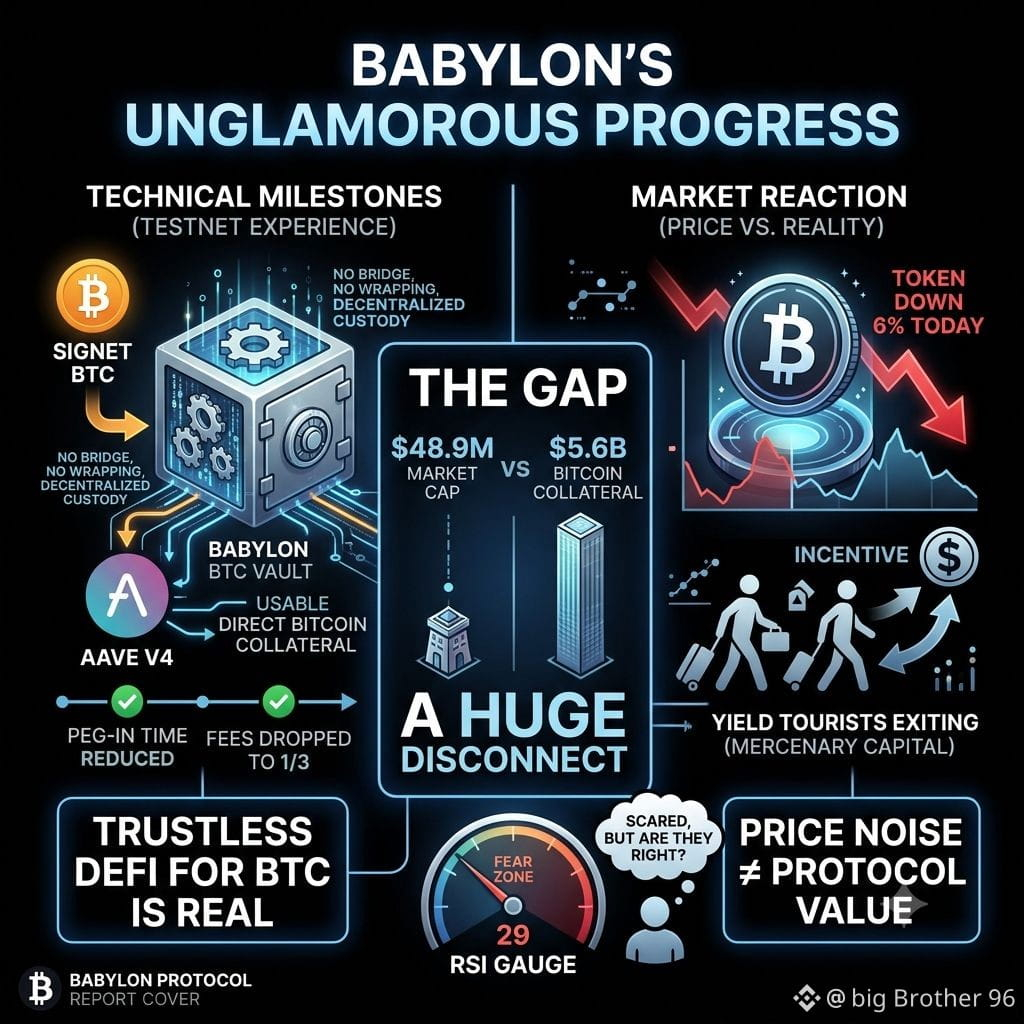
J’ai en fait suivi le processus du testnet de Babylon moi-même, ce qui n’est pas le cas de la plupart des gens qui publient des graphiques à ce sujet aujourd’hui. J’ai verrouillé du signet BTC dans un coffre, je l’ai vu apparaître comme collatéral utilisable sur Aave v4, et je n’ai jamais eu à le confier à un pont (bridge) ni à le transformer en une version synthétique de lui-même. Vous attendez toujours la contrepartie, le moment où vous devez faire confiance à un multisig avec vos fonds—et ça ne se produit tout simplement jamais. C’est ça qui m’a marqué plus que n’importe quelle bougie de prix.
Parce que oui, le token est en baisse de 6% aujourd’hui. Les gens traitent ça comme si c’était toute l’histoire. Mais de l’autre côté, les dépôts/entrées (peg in) via le coffre mettaient autrefois un temps fou, et maintenant ils sont ramenés à quelques heures ; les frais ont chuté jusqu’à un tiers de ce qu’ils étaient, et tout ça n’a pas été suffisant pour figurer dans la chronologie de qui que ce soit. C’est une progression peu glamour, celle qui ne compte vraiment que lorsque de l’argent réel commence à circuler, plutôt que du BTC de testnet.
La sortie que tout le monde pointe du doigt—près de 15 000 BTC qui semblent sortir en une seule manœuvre propre—ressemble moins à de la peur qu’à des touristes de rendement qui quittent les lieux une fois que l’incitation qui les a attirés a cessé d’exister. C’est exactement ce que fait le capital mercenaire. Il n’a jamais été loyal à la mission : il était loyal au chiffre.
Ce qui me reste en tête, c’est l’écart entre une capitalisation de 48,9 M$ et 5,6 Md$ en Bitcoin logé dans cet ensemble en tant que collatéral. Quelque part dans ces calculs, soit le marché sous-évalue fortement ce que signifie gérer des rails de prêts adossés à Bitcoin, soit le marché n’a tout simplement pas encore rattrapé son retard.
Un RSI à 29 vous dit que les gens ont peur en ce moment. Ça ne vous dit pas qu’ils ont raison.
@BabylonLabs_io
#baby
$BABY
Parce que oui, le token est en baisse de 6% aujourd’hui. Les gens traitent ça comme si c’était toute l’histoire. Mais de l’autre côté, les dépôts/entrées (peg in) via le coffre mettaient autrefois un temps fou, et maintenant ils sont ramenés à quelques heures ; les frais ont chuté jusqu’à un tiers de ce qu’ils étaient, et tout ça n’a pas été suffisant pour figurer dans la chronologie de qui que ce soit. C’est une progression peu glamour, celle qui ne compte vraiment que lorsque de l’argent réel commence à circuler, plutôt que du BTC de testnet.
La sortie que tout le monde pointe du doigt—près de 15 000 BTC qui semblent sortir en une seule manœuvre propre—ressemble moins à de la peur qu’à des touristes de rendement qui quittent les lieux une fois que l’incitation qui les a attirés a cessé d’exister. C’est exactement ce que fait le capital mercenaire. Il n’a jamais été loyal à la mission : il était loyal au chiffre.
Ce qui me reste en tête, c’est l’écart entre une capitalisation de 48,9 M$ et 5,6 Md$ en Bitcoin logé dans cet ensemble en tant que collatéral. Quelque part dans ces calculs, soit le marché sous-évalue fortement ce que signifie gérer des rails de prêts adossés à Bitcoin, soit le marché n’a tout simplement pas encore rattrapé son retard.
Un RSI à 29 vous dit que les gens ont peur en ce moment. Ça ne vous dit pas qu’ils ont raison.
@BabylonLabs_io
#baby
$BABY
10
3
122
·
--
Haussier
Je suis resté avec ce graphique de la BABY pendant un moment et un détail me tracasse plus que la pompe elle-même.
Tout le monde parle de "l’intégration Aave v4" comme si c’était chose faite. Ce n’est pas le cas. J’ai moi-même consulté le fil de la gouvernance : c’est un Temp Check. Il faut encore un vote du DAO, et il faut encore un audit de sécurité avant que l’un ou l’autre de ces Spokes ne soit réellement mis en ligne. Entre l’annonce et le graphique des prix, "soumis aux retours de la communauté" est passé à "livré", et le marché a tout de suite couru avec.
Ce qui m’a vraiment marqué, ce ne sont pas les nouvelles, ce sont les chiffres côte à côte. 5,6 Md$ bloqués dans ce protocole. 52 M$ de market cap pour le token. Cet écart n’est pas vraiment une question d’évaluation : c’est un indice. La majeure partie de ce BTC n’est pas là par conviction envers la BABY ; il est là pour le rendement et les points. Pendant ce temps, le token en dessous doit absorber les émissions quotidiennes, plus un autre déblocage dans neuf jours, quoi qu’il arrive au graphique cet après-midi.
Chapeau pour le mécanisme lui-même : Bitcoin ne quitte jamais sa propre chaîne. Pas d’enrobage, pas de redemption non encadrée, mais un délai conditionné par une vraie fenêtre fraud-proof au lieu de "faites-nous confiance". Sur ce point, l’ingénierie est solide, et ça comptera quel que soit ce que le token fera cette semaine. Mais l’infrastructure et le trading du token par-dessus avancent selon des horloges complètement différentes. L’un se compresse tranquillement sur des années. L’autre vient de passer d’un RSI à 92 à 38, parce que 474 000 $ sont entrés d’un coup, et qu’avec un carnet aussi fin, le marché n’avait aucun moyen de l’absorber.
Les carnets fins donnent des bougies spectaculaires. Ils ne donnent pas de conviction. À retenir la prochaine fois qu’un titre dit "intégration" comme si le vote avait déjà eu lieu.
@babylonlabs_io
#baby
$BABY
Je suis resté avec ce graphique de la BABY pendant un moment et un détail me tracasse plus que la pompe elle-même.
Tout le monde parle de "l’intégration Aave v4" comme si c’était chose faite. Ce n’est pas le cas. J’ai moi-même consulté le fil de la gouvernance : c’est un Temp Check. Il faut encore un vote du DAO, et il faut encore un audit de sécurité avant que l’un ou l’autre de ces Spokes ne soit réellement mis en ligne. Entre l’annonce et le graphique des prix, "soumis aux retours de la communauté" est passé à "livré", et le marché a tout de suite couru avec.
Ce qui m’a vraiment marqué, ce ne sont pas les nouvelles, ce sont les chiffres côte à côte. 5,6 Md$ bloqués dans ce protocole. 52 M$ de market cap pour le token. Cet écart n’est pas vraiment une question d’évaluation : c’est un indice. La majeure partie de ce BTC n’est pas là par conviction envers la BABY ; il est là pour le rendement et les points. Pendant ce temps, le token en dessous doit absorber les émissions quotidiennes, plus un autre déblocage dans neuf jours, quoi qu’il arrive au graphique cet après-midi.
Chapeau pour le mécanisme lui-même : Bitcoin ne quitte jamais sa propre chaîne. Pas d’enrobage, pas de redemption non encadrée, mais un délai conditionné par une vraie fenêtre fraud-proof au lieu de "faites-nous confiance". Sur ce point, l’ingénierie est solide, et ça comptera quel que soit ce que le token fera cette semaine. Mais l’infrastructure et le trading du token par-dessus avancent selon des horloges complètement différentes. L’un se compresse tranquillement sur des années. L’autre vient de passer d’un RSI à 92 à 38, parce que 474 000 $ sont entrés d’un coup, et qu’avec un carnet aussi fin, le marché n’avait aucun moyen de l’absorber.
Les carnets fins donnent des bougies spectaculaires. Ils ne donnent pas de conviction. À retenir la prochaine fois qu’un titre dit "intégration" comme si le vote avait déjà eu lieu.
@BabylonLabs_io
#baby
$BABY
Tout le monde parle de "l’intégration Aave v4" comme si c’était chose faite. Ce n’est pas le cas. J’ai moi-même consulté le fil de la gouvernance : c’est un Temp Check. Il faut encore un vote du DAO, et il faut encore un audit de sécurité avant que l’un ou l’autre de ces Spokes ne soit réellement mis en ligne. Entre l’annonce et le graphique des prix, "soumis aux retours de la communauté" est passé à "livré", et le marché a tout de suite couru avec.
Ce qui m’a vraiment marqué, ce ne sont pas les nouvelles, ce sont les chiffres côte à côte. 5,6 Md$ bloqués dans ce protocole. 52 M$ de market cap pour le token. Cet écart n’est pas vraiment une question d’évaluation : c’est un indice. La majeure partie de ce BTC n’est pas là par conviction envers la BABY ; il est là pour le rendement et les points. Pendant ce temps, le token en dessous doit absorber les émissions quotidiennes, plus un autre déblocage dans neuf jours, quoi qu’il arrive au graphique cet après-midi.
Chapeau pour le mécanisme lui-même : Bitcoin ne quitte jamais sa propre chaîne. Pas d’enrobage, pas de redemption non encadrée, mais un délai conditionné par une vraie fenêtre fraud-proof au lieu de "faites-nous confiance". Sur ce point, l’ingénierie est solide, et ça comptera quel que soit ce que le token fera cette semaine. Mais l’infrastructure et le trading du token par-dessus avancent selon des horloges complètement différentes. L’un se compresse tranquillement sur des années. L’autre vient de passer d’un RSI à 92 à 38, parce que 474 000 $ sont entrés d’un coup, et qu’avec un carnet aussi fin, le marché n’avait aucun moyen de l’absorber.
Les carnets fins donnent des bougies spectaculaires. Ils ne donnent pas de conviction. À retenir la prochaine fois qu’un titre dit "intégration" comme si le vote avait déjà eu lieu.
@BabylonLabs_io
#baby
$BABY
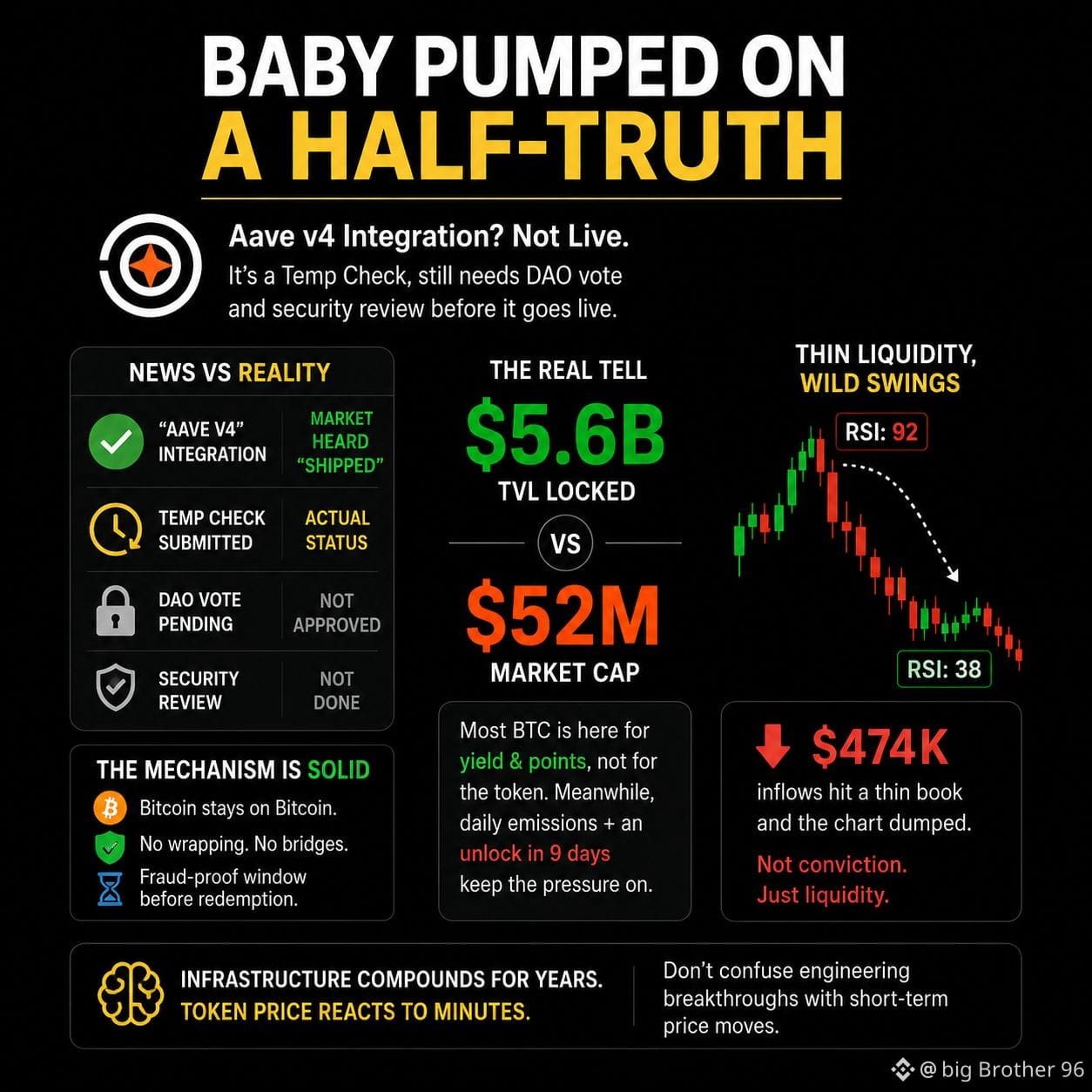
3
2
111
Connectez-vous pour découvrir plus de contenu
Rejoignez la communauté mondiale des adeptes de cryptomonnaies sur Binance Square
⚡️ Suviez les dernières informations importantes sur les cryptomonnaies.
💬 Jugé digne de confiance par la plus grande plateforme d’échange de cryptomonnaies au monde.
👍 Découvrez les connaissances que partagent les créateurs vérifiés.
Adresse e-mail/Nº de téléphone
Sujets d’actualité
BitcoinReboundsTo$79K
20,276 vues
174 mentions
🚨 $BTC est en train de progresser.
Le Bitcoin s’échange autour de 78 804 $ , en hausse d’environ 1,9 %, après avoir repris la zone des 78 K. Le prochain niveau à surveiller est le plus haut intraday, vers 78 905 $.
Une cassure nette au-dessus de ce niveau pourrait ouvrir la voie vers 79 K–80 K. Si le BTC est rejeté, le support se situe autour de 78 300 $, puis 77 975 $.
Les haussiers ont de l’élan, mais le BTC doit rester au-dessus de 78 K.
#Bitcoin #BTC #CryptoTrading #CryptoMarket #CryptoAnalysis
PulseON
·18 mentions J’aime
·17.3k vues
BitcoinSpotETFsNetInflow$160M
114 vues
27 mentions
SouthKoreaCryptoTaxDelayPetitionTops50000
9,113 vues
266 mentions