
表情包
1.7k Publications

表情包
Signaler
Bloquer l’utilisateur
1.3K+ Suivis
11.7K+ Abonnés
1.0K+ J’aime
Publications
Tous
Direct
·
--
Haussier
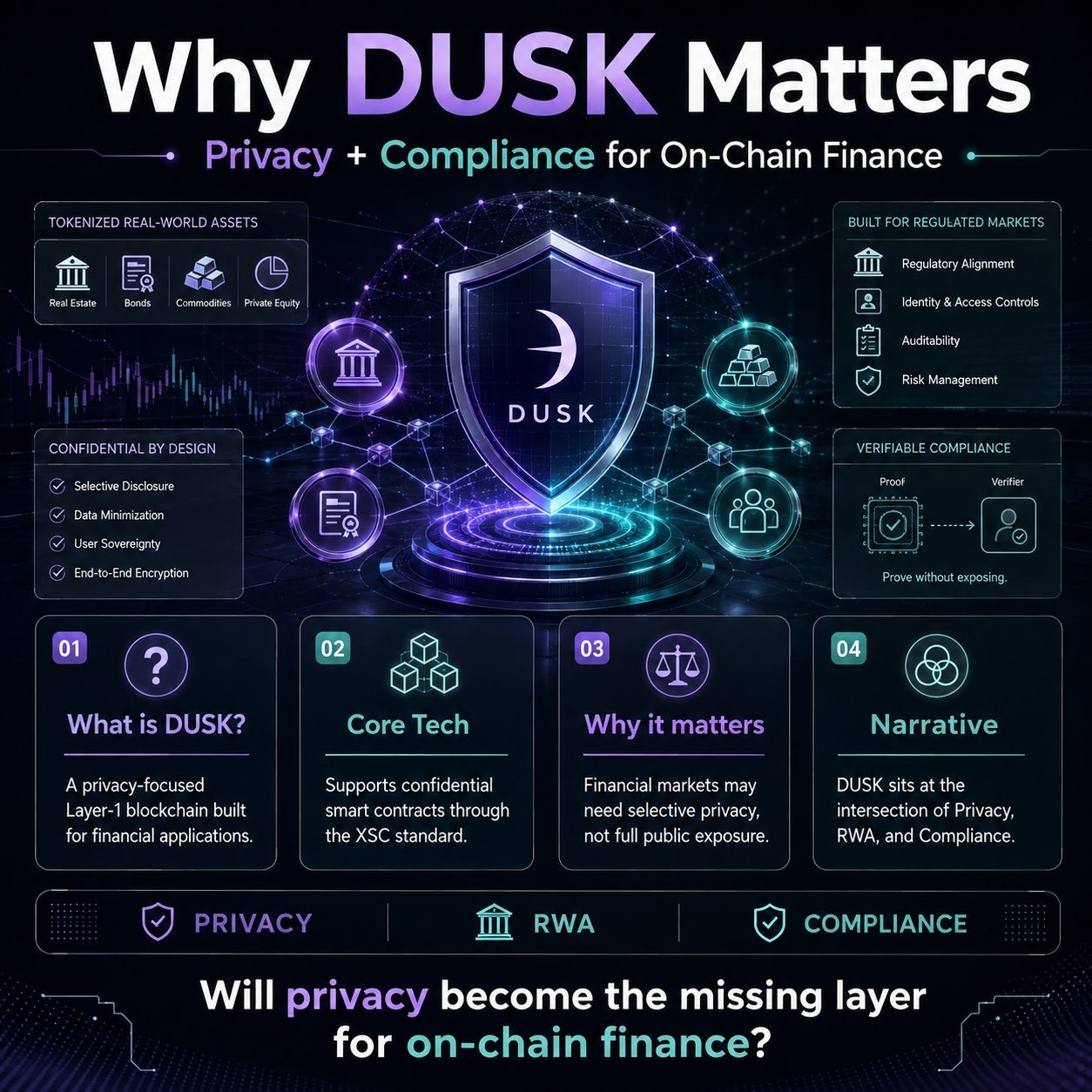
La plupart des blockchains ont résolu un problème : la transparence.
Mais les marchés financiers ont un autre défi :
Comment faire entrer des milliers de milliards de dollars d’actifs sur la chaîne, sans exposer publiquement chaque détail sensible ?
C’est là que le discours sur la confidentialité devient intéressant.
DUSK Network construit une approche autour d’une idée différente : une blockchain où les applications financières peuvent associer confidentialité et conformité.
À mesure que les RWA (Real-World Assets, Actifs du monde réel) continuent de gagner en attention, les institutions pourraient ne pas avoir seulement besoin de rapidité et d’efficacité. Elles pourraient aussi avoir besoin d’une visibilité contrôlée, de la protection de la vie privée et d’une infrastructure de règlement sécurisée.
La démarche de DUSK met l’accent sur une couche 1 (Layer-1) pensée pour la confidentialité, avec des smart contracts confidentiels alimentés par sa norme XSC, afin de relever les défis liés aux actifs numériques réglementés.
La question la plus importante n’est pas de savoir si la confidentialité compte aujourd’hui…
La question est :
La confidentialité va-t-elle devenir la couche d’infrastructure manquante qui aidera la finance traditionnelle à passer on-chain ?
Observer les projets à l’intersection des RWA + Confidentialité + Conformité pourrait devenir l’un des récits les plus captivants de ce cycle.
Quelle est votre opinion sur DUSK ?
#DUSK @Dusk_Foundation
$DUSK
{spot}(DUSKUSDT)
La plupart des blockchains ont résolu un problème : la transparence.
Mais les marchés financiers ont un autre défi :
Comment faire entrer des milliers de milliards de dollars d’actifs sur la chaîne, sans exposer publiquement chaque détail sensible ?
C’est là que le discours sur la confidentialité devient intéressant.
DUSK Network construit une approche autour d’une idée différente : une blockchain où les applications financières peuvent associer confidentialité et conformité.
À mesure que les RWA (Real-World Assets, Actifs du monde réel) continuent de gagner en attention, les institutions pourraient ne pas avoir seulement besoin de rapidité et d’efficacité. Elles pourraient aussi avoir besoin d’une visibilité contrôlée, de la protection de la vie privée et d’une infrastructure de règlement sécurisée.
La démarche de DUSK met l’accent sur une couche 1 (Layer-1) pensée pour la confidentialité, avec des smart contracts confidentiels alimentés par sa norme XSC, afin de relever les défis liés aux actifs numériques réglementés.
La question la plus importante n’est pas de savoir si la confidentialité compte aujourd’hui…
La question est :
La confidentialité va-t-elle devenir la couche d’infrastructure manquante qui aidera la finance traditionnelle à passer on-chain ?
Observer les projets à l’intersection des RWA + Confidentialité + Conformité pourrait devenir l’un des récits les plus captivants de ce cycle.
Quelle est votre opinion sur DUSK ?
#DUSK @Dusk
$DUSK
Mais les marchés financiers ont un autre défi :
Comment faire entrer des milliers de milliards de dollars d’actifs sur la chaîne, sans exposer publiquement chaque détail sensible ?
C’est là que le discours sur la confidentialité devient intéressant.
DUSK Network construit une approche autour d’une idée différente : une blockchain où les applications financières peuvent associer confidentialité et conformité.
À mesure que les RWA (Real-World Assets, Actifs du monde réel) continuent de gagner en attention, les institutions pourraient ne pas avoir seulement besoin de rapidité et d’efficacité. Elles pourraient aussi avoir besoin d’une visibilité contrôlée, de la protection de la vie privée et d’une infrastructure de règlement sécurisée.
La démarche de DUSK met l’accent sur une couche 1 (Layer-1) pensée pour la confidentialité, avec des smart contracts confidentiels alimentés par sa norme XSC, afin de relever les défis liés aux actifs numériques réglementés.
La question la plus importante n’est pas de savoir si la confidentialité compte aujourd’hui…
La question est :
La confidentialité va-t-elle devenir la couche d’infrastructure manquante qui aidera la finance traditionnelle à passer on-chain ?
Observer les projets à l’intersection des RWA + Confidentialité + Conformité pourrait devenir l’un des récits les plus captivants de ce cycle.
Quelle est votre opinion sur DUSK ?
#DUSK @Dusk
$DUSK
47
2
23
351
·
--
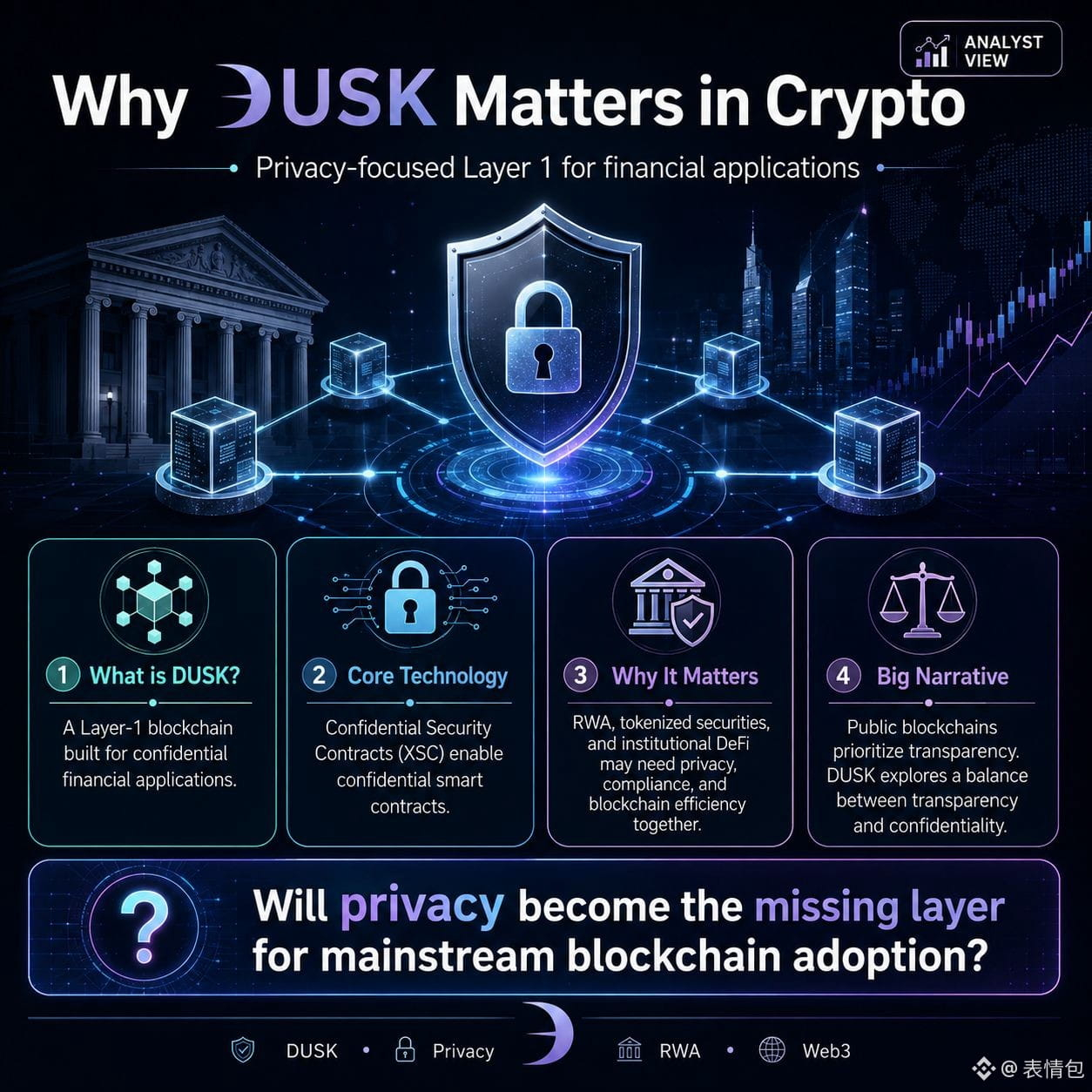
La plupart des blockchains ont résolu un seul problème : la transparence.
Mais le prochain défi des marchés financiers pourrait être différent : comment utiliser la blockchain sans exposer des données financières sensibles.
À mesure que les RWA (Real-World Assets), les titres tokenisés et la DeFi institutionnelle continuent de se développer, la confidentialité pourrait devenir une exigence d’infrastructure clé plutôt qu’une simple fonctionnalité optionnelle.
C’est là que DUSK Network construit son récit.
DUSK est une blockchain de couche 1 axée sur des applications financières confidentielles, s’appuyant sur des Confidential Security Contracts (XSC) et des smart contracts conçus pour la confidentialité afin d’explorer comment des actifs réglementés peuvent circuler on-chain tout en préservant la confidentialité.
Le point intéressant ne tient pas seulement à la technologie — il s’agit du problème que DUSK cherche à résoudre.
Les blockchains publiques ont apporté l’ouverture. Les institutions financières peuvent exiger un équilibre entre transparence, conformité et confidentialité.
La grande question :
La confidentialité deviendra-t-elle la couche manquante pour l’adoption grand public de la blockchain, ou la transparence restera-t-elle toujours la priorité ?
#DUSK $DUSK @Dusk_Foundation
{spot}(DUSKUSDT)
La plupart des blockchains ont résolu un seul problème : la transparence.
Mais le prochain défi des marchés financiers pourrait être différent : comment utiliser la blockchain sans exposer des données financières sensibles.
À mesure que les RWA (Real-World Assets), les titres tokenisés et la DeFi institutionnelle continuent de se développer, la confidentialité pourrait devenir une exigence d’infrastructure clé plutôt qu’une simple fonctionnalité optionnelle.
C’est là que DUSK Network construit son récit.
DUSK est une blockchain de couche 1 axée sur des applications financières confidentielles, s’appuyant sur des Confidential Security Contracts (XSC) et des smart contracts conçus pour la confidentialité afin d’explorer comment des actifs réglementés peuvent circuler on-chain tout en préservant la confidentialité.
Le point intéressant ne tient pas seulement à la technologie — il s’agit du problème que DUSK cherche à résoudre.
Les blockchains publiques ont apporté l’ouverture. Les institutions financières peuvent exiger un équilibre entre transparence, conformité et confidentialité.
La grande question :
La confidentialité deviendra-t-elle la couche manquante pour l’adoption grand public de la blockchain, ou la transparence restera-t-elle toujours la priorité ?
#DUSK $DUSK @Dusk
Mais le prochain défi des marchés financiers pourrait être différent : comment utiliser la blockchain sans exposer des données financières sensibles.
À mesure que les RWA (Real-World Assets), les titres tokenisés et la DeFi institutionnelle continuent de se développer, la confidentialité pourrait devenir une exigence d’infrastructure clé plutôt qu’une simple fonctionnalité optionnelle.
C’est là que DUSK Network construit son récit.
DUSK est une blockchain de couche 1 axée sur des applications financières confidentielles, s’appuyant sur des Confidential Security Contracts (XSC) et des smart contracts conçus pour la confidentialité afin d’explorer comment des actifs réglementés peuvent circuler on-chain tout en préservant la confidentialité.
Le point intéressant ne tient pas seulement à la technologie — il s’agit du problème que DUSK cherche à résoudre.
Les blockchains publiques ont apporté l’ouverture. Les institutions financières peuvent exiger un équilibre entre transparence, conformité et confidentialité.
La grande question :
La confidentialité deviendra-t-elle la couche manquante pour l’adoption grand public de la blockchain, ou la transparence restera-t-elle toujours la priorité ?
#DUSK $DUSK @Dusk
1
4
173
·
--
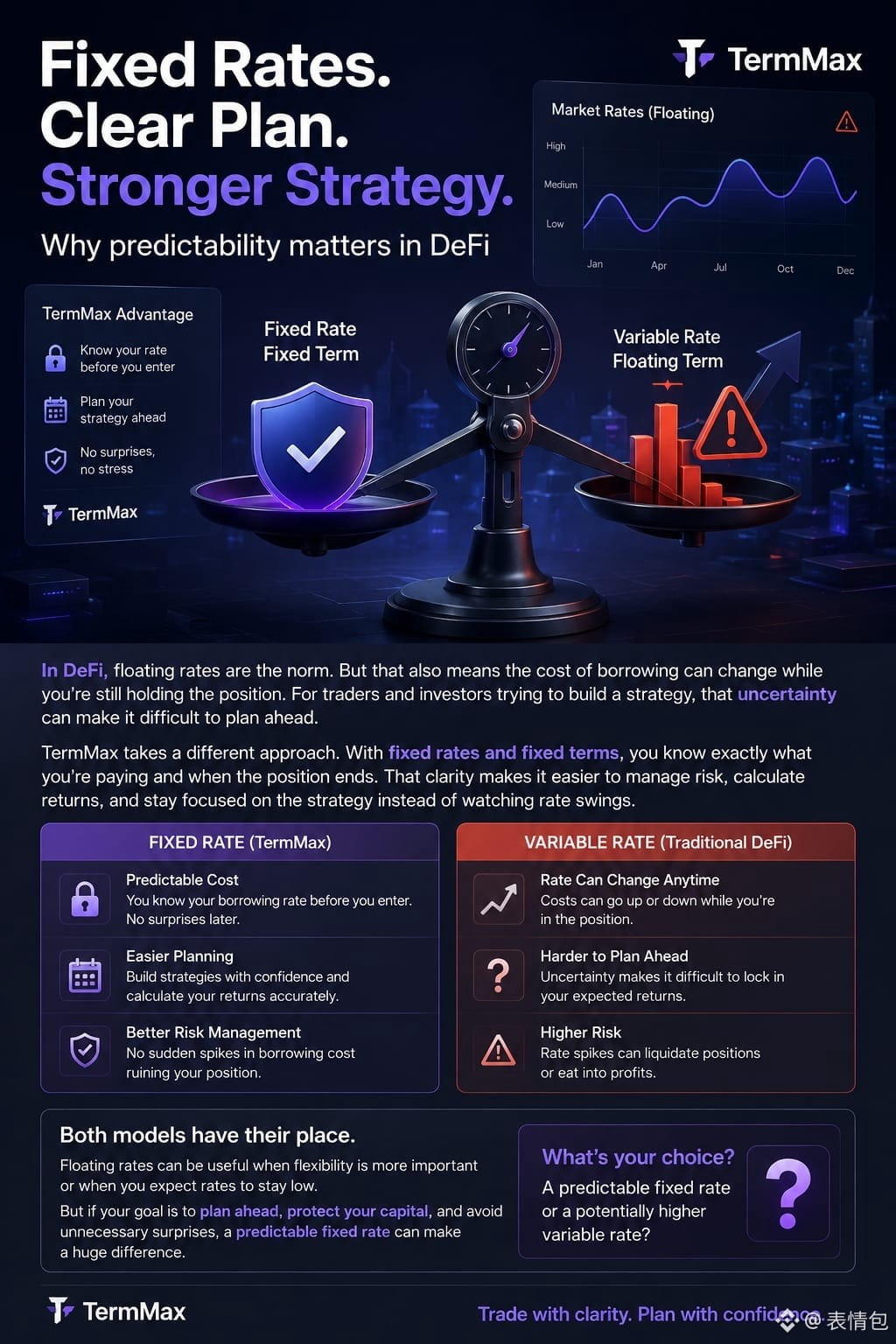
J’ai réfléchi dernièrement à une chose liée au @termmax : les taux fixes pourraient en réalité être plus utiles qu’ils n’en ont l’air au premier abord.
Dans la DeFi, les taux variables sont la norme. Mais cela signifie aussi que le coût de l’emprunt peut changer pendant que vous détenez encore la position. Pour quelqu’un qui cherche à planifier une stratégie au lieu de surveiller constamment le marché, cette incertitude peut devenir un vrai problème.
Ce qui m’intéresse avec TermMax, c’est l’accent mis sur les taux fixes et les durées fixes. Vous connaissez le taux et l’échéance au moment où vous entrez, ce qui rend la position beaucoup plus facile à comprendre.
Bien sûr, les taux fixes ne sont pas automatiquement meilleurs pour tout le monde. Les taux variables peuvent bien fonctionner lorsque la flexibilité est plus importante. Mais si je planifie à l’avance, je préfère connaître mon coût d’emprunt plutôt que continuer à deviner dans quelle direction le taux pourrait évoluer ensuite.
C’est probablement la partie de TermMax que je regarde de plus près.
Choisiriez-vous un taux fixe prévisible, ou prendriez-vous un taux variable potentiellement plus élevé ?
@termmax $TMX #TermMax
J’ai réfléchi dernièrement à une chose liée au @TermMax : les taux fixes pourraient en réalité être plus utiles qu’ils n’en ont l’air au premier abord.
Dans la DeFi, les taux variables sont la norme. Mais cela signifie aussi que le coût de l’emprunt peut changer pendant que vous détenez encore la position. Pour quelqu’un qui cherche à planifier une stratégie au lieu de surveiller constamment le marché, cette incertitude peut devenir un vrai problème.
Ce qui m’intéresse avec TermMax, c’est l’accent mis sur les taux fixes et les durées fixes. Vous connaissez le taux et l’échéance au moment où vous entrez, ce qui rend la position beaucoup plus facile à comprendre.
Bien sûr, les taux fixes ne sont pas automatiquement meilleurs pour tout le monde. Les taux variables peuvent bien fonctionner lorsque la flexibilité est plus importante. Mais si je planifie à l’avance, je préfère connaître mon coût d’emprunt plutôt que continuer à deviner dans quelle direction le taux pourrait évoluer ensuite.
C’est probablement la partie de TermMax que je regarde de plus près.
Choisiriez-vous un taux fixe prévisible, ou prendriez-vous un taux variable potentiellement plus élevé ?
@TermMax $TMX #TermMax
Dans la DeFi, les taux variables sont la norme. Mais cela signifie aussi que le coût de l’emprunt peut changer pendant que vous détenez encore la position. Pour quelqu’un qui cherche à planifier une stratégie au lieu de surveiller constamment le marché, cette incertitude peut devenir un vrai problème.
Ce qui m’intéresse avec TermMax, c’est l’accent mis sur les taux fixes et les durées fixes. Vous connaissez le taux et l’échéance au moment où vous entrez, ce qui rend la position beaucoup plus facile à comprendre.
Bien sûr, les taux fixes ne sont pas automatiquement meilleurs pour tout le monde. Les taux variables peuvent bien fonctionner lorsque la flexibilité est plus importante. Mais si je planifie à l’avance, je préfère connaître mon coût d’emprunt plutôt que continuer à deviner dans quelle direction le taux pourrait évoluer ensuite.
C’est probablement la partie de TermMax que je regarde de plus près.
Choisiriez-vous un taux fixe prévisible, ou prendriez-vous un taux variable potentiellement plus élevé ?
@TermMax $TMX #TermMax
47
2
22
294
·
--
Haussier
Vérifié
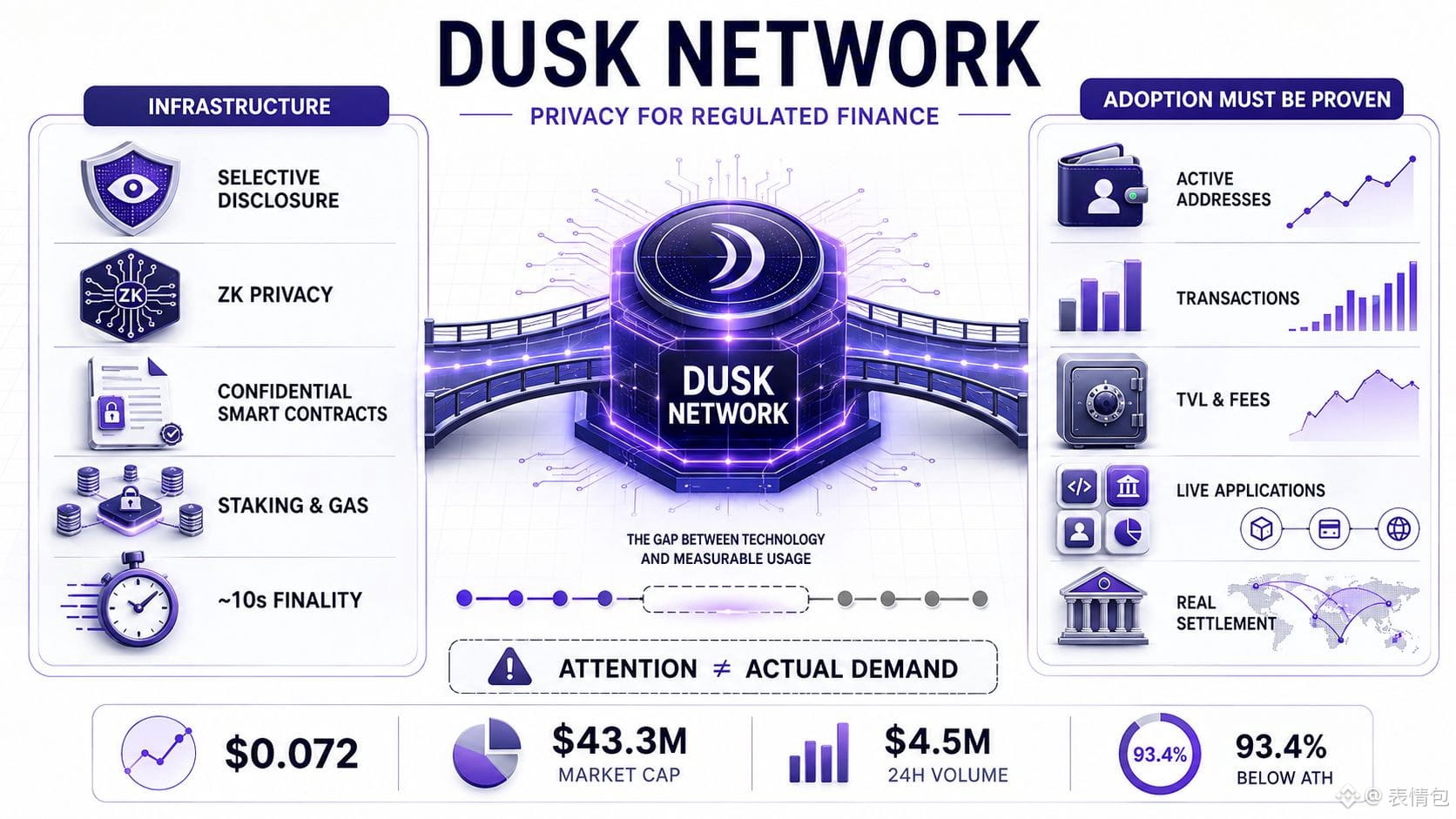
DUSK revient sur le radar des traders après avoir gagné environ 9 % en 24 heures et 17,5 % sur la semaine écoulée. Vers 0,072 $, il affiche une capitalisation boursière proche de 43,3 millions $, tandis que le volume de transactions quotidien se situe autour de 4,5 millions $. Cette dynamique est perceptible, mais le token reste 93,4 % en dessous de son sommet historique de 1,09 $, ce qui remet le mouvement en perspective.
Ce qui m’intéresse davantage, ce sont les infrastructures. Dusk construit une couche 1 destinée à la finance réglementée avec des transferts confidentiels, des smart contracts à connaissance nulle, une divulgation sélective et une finalité déterministe. DUSK est utilisé pour les frais de transaction et le staking, donnant au token un rôle concret au-delà de la simple spéculation sur les exchanges.
Le lancement récent du testnet DuskEVM abaisse aussi la barrière pour les développeurs Solidity. Toutefois, DuskEVM et la couche Hedger confidentielle sont encore en phase de test, tandis que Dusk Trade reste en développement.
C’est là que je deviens prudent. Dusk met en avant des relations institutionnelles, un volume d’émission planifié conséquent et plus de 210 millions de tokens mis en staking, mais des chiffres publics fiables et vérifiables concernant le nombre d’adresses actives, l’application TVL, les frais et l’activité de transactions récurrentes restent limités. La technologie semble sérieuse, mais l’infrastructure à elle seule ne prouve pas la demande. Je veux voir des applications en conditions réelles générer une utilisation mesurable avant d’interpréter l’attention récente du marché comme une adoption authentique à l’échelle du réseau en production.
@Dusk_Foundation #dusk $DUSK
{spot}(DUSKUSDT)
DUSK revient sur le radar des traders après avoir gagné environ 9 % en 24 heures et 17,5 % sur la semaine écoulée. Vers 0,072 $, il affiche une capitalisation boursière proche de 43,3 millions $, tandis que le volume de transactions quotidien se situe autour de 4,5 millions $. Cette dynamique est perceptible, mais le token reste 93,4 % en dessous de son sommet historique de 1,09 $, ce qui remet le mouvement en perspective.
Ce qui m’intéresse davantage, ce sont les infrastructures. Dusk construit une couche 1 destinée à la finance réglementée avec des transferts confidentiels, des smart contracts à connaissance nulle, une divulgation sélective et une finalité déterministe. DUSK est utilisé pour les frais de transaction et le staking, donnant au token un rôle concret au-delà de la simple spéculation sur les exchanges.
Le lancement récent du testnet DuskEVM abaisse aussi la barrière pour les développeurs Solidity. Toutefois, DuskEVM et la couche Hedger confidentielle sont encore en phase de test, tandis que Dusk Trade reste en développement.
C’est là que je deviens prudent. Dusk met en avant des relations institutionnelles, un volume d’émission planifié conséquent et plus de 210 millions de tokens mis en staking, mais des chiffres publics fiables et vérifiables concernant le nombre d’adresses actives, l’application TVL, les frais et l’activité de transactions récurrentes restent limités. La technologie semble sérieuse, mais l’infrastructure à elle seule ne prouve pas la demande. Je veux voir des applications en conditions réelles générer une utilisation mesurable avant d’interpréter l’attention récente du marché comme une adoption authentique à l’échelle du réseau en production.
@Dusk #dusk $DUSK
Ce qui m’intéresse davantage, ce sont les infrastructures. Dusk construit une couche 1 destinée à la finance réglementée avec des transferts confidentiels, des smart contracts à connaissance nulle, une divulgation sélective et une finalité déterministe. DUSK est utilisé pour les frais de transaction et le staking, donnant au token un rôle concret au-delà de la simple spéculation sur les exchanges.
Le lancement récent du testnet DuskEVM abaisse aussi la barrière pour les développeurs Solidity. Toutefois, DuskEVM et la couche Hedger confidentielle sont encore en phase de test, tandis que Dusk Trade reste en développement.
C’est là que je deviens prudent. Dusk met en avant des relations institutionnelles, un volume d’émission planifié conséquent et plus de 210 millions de tokens mis en staking, mais des chiffres publics fiables et vérifiables concernant le nombre d’adresses actives, l’application TVL, les frais et l’activité de transactions récurrentes restent limités. La technologie semble sérieuse, mais l’infrastructure à elle seule ne prouve pas la demande. Je veux voir des applications en conditions réelles générer une utilisation mesurable avant d’interpréter l’attention récente du marché comme une adoption authentique à l’échelle du réseau en production.
@Dusk #dusk $DUSK
5
4
267
·
--
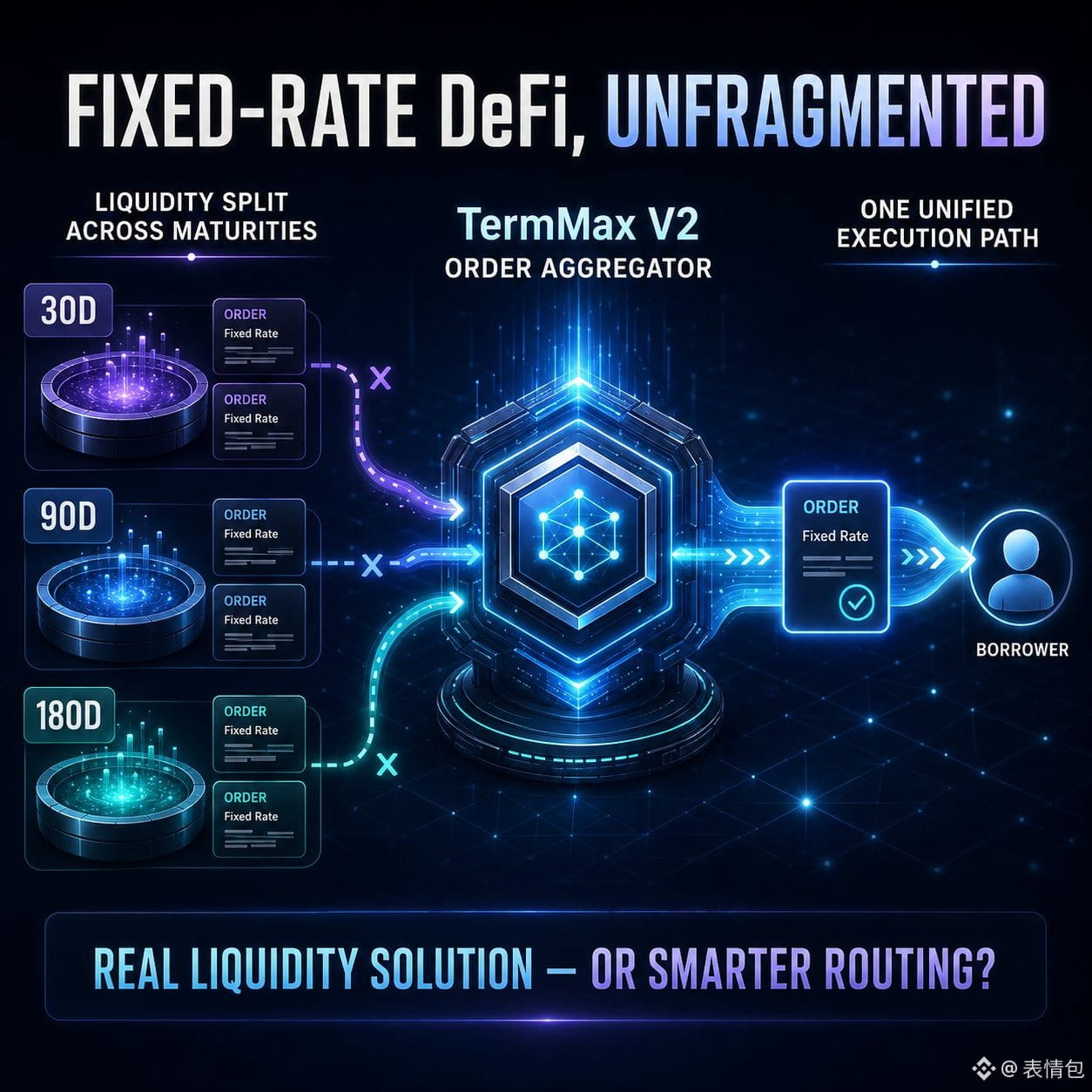
Je me suis demandé ce qui rend la DeFi à taux fixe réellement pratique au-delà de petits volumes.
Des taux prévisibles sont utiles, mais si la liquidité est dispersée entre plusieurs échéances et types d’ordres, l’exécution peut rester inefficace.
C’est pourquoi l’agrégateur d’ordres de la V2 @termmax se distingue. En combinant différentes sources de liquidité dans un seul chemin d’exécution, il pourrait rendre l’emprunt de montants plus importants beaucoup plus fluide.
Le vrai test, toutefois, est de savoir si l’agrégation crée une profondeur qui s’améliore de façon constante—ou si elle ne fait que rendre la liquidité fragmentée plus facile d’accès.
Qu’en pensez-vous : mise à niveau de l’infrastructure ou solution temporaire ?
@termmax #TermMax
Je me suis demandé ce qui rend la DeFi à taux fixe réellement pratique au-delà de petits volumes.
Des taux prévisibles sont utiles, mais si la liquidité est dispersée entre plusieurs échéances et types d’ordres, l’exécution peut rester inefficace.
C’est pourquoi l’agrégateur d’ordres de la V2 @TermMax se distingue. En combinant différentes sources de liquidité dans un seul chemin d’exécution, il pourrait rendre l’emprunt de montants plus importants beaucoup plus fluide.
Le vrai test, toutefois, est de savoir si l’agrégation crée une profondeur qui s’améliore de façon constante—ou si elle ne fait que rendre la liquidité fragmentée plus facile d’accès.
Qu’en pensez-vous : mise à niveau de l’infrastructure ou solution temporaire ?
@TermMax #TermMax
Des taux prévisibles sont utiles, mais si la liquidité est dispersée entre plusieurs échéances et types d’ordres, l’exécution peut rester inefficace.
C’est pourquoi l’agrégateur d’ordres de la V2 @TermMax se distingue. En combinant différentes sources de liquidité dans un seul chemin d’exécution, il pourrait rendre l’emprunt de montants plus importants beaucoup plus fluide.
Le vrai test, toutefois, est de savoir si l’agrégation crée une profondeur qui s’améliore de façon constante—ou si elle ne fait que rendre la liquidité fragmentée plus facile d’accès.
Qu’en pensez-vous : mise à niveau de l’infrastructure ou solution temporaire ?
@TermMax #TermMax
43
3
15
211
·
--
Haussier
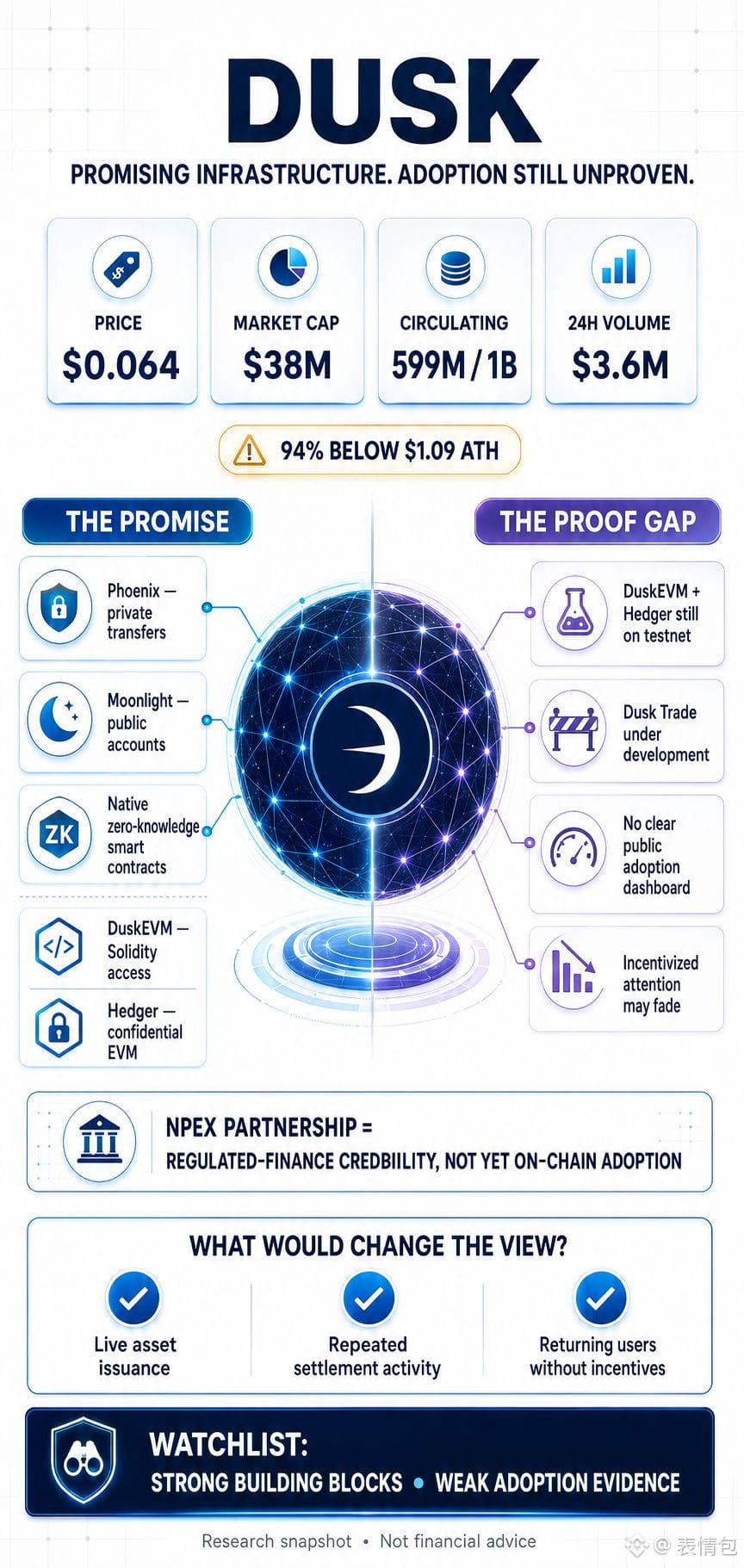
J’ai remarqué que DUSK apparaît dans davantage de conversations ces derniers temps, même si je ne suis pas convaincu que ce regain d’attention nous dise grand-chose sur l’adoption pour l’instant. Le token s’échange près de 0,064 $, ce qui lui donne une capitalisation boursière d’environ 38 millions de dollars. Environ 599 millions de tokens circulent sur un approvisionnement maximal d’un milliard, tandis que le volume quotidien se situe autour de 3,6 millions. C’est assez d’activité pour maintenir le marché en mouvement, mais DUSK reste encore d’environ 94 % en dessous de son sommet à 1,09 $. La campagne CreatorPad de Binance Square, qui porte sur 480 000 DUSK, attire aussi davantage l’attention sur le projet, même si l’attention payée peut disparaître rapidement une fois les récompenses terminées.
La technologie elle-même mérite un examen plus approfondi. Le réseau en direct de Dusk prend en charge des transferts Phoenix privés, des comptes Moonlight publics et des smart contracts natifs à connaissance nulle. DuskEVM est en cours de développement pour rendre l’écosystème plus accessible aux développeurs Solidity, tandis que Hedger expérimente des transactions EVM confidentielles via le chiffrement homomorphique et des preuves à connaissance nulle. Ce sont des éléments de base utiles pour des institutions financières qui ne peuvent pas exposer publiquement chaque solde, identité ou transaction.
Mon hésitation commence lorsque je cherche des personnes qui utilisent réellement ces briques. DuskEVM et Hedger restent sur le réseau de test, tandis que Dusk Trade est encore en développement. Je ne trouve pas non plus de chiffres publics simples et fiables concernant les adresses actives quotidiennes, la croissance des transactions, les frais, la TVL ou le volume au niveau des applications. L’absence de ces données ne signifie pas qu’il ne se passe rien, mais elle laisse trop de place entre le récit et les preuves.
Le partenariat NPEX donne à Dusk un lien sérieux avec la finance réglementée, mais l’historique de financement de NPEX (200 millions d’euros ou plus) et son réseau d’investisseurs ne devraient pas être confondus avec des actifs qui circulent déjà sur Dusk. Je veux voir une émission en direct, des activités de règlement répétées et des utilisateurs qui reviennent sans incitations. D’ici là, je vois Dusk comme une infrastructure prometteuse qui doit encore prouver qu’elle peut devenir une économie financière active.
#dusk @Dusk_Foundation $DUSK
{spot}(DUSKUSDT)
J’ai remarqué que DUSK apparaît dans davantage de conversations ces derniers temps, même si je ne suis pas convaincu que ce regain d’attention nous dise grand-chose sur l’adoption pour l’instant. Le token s’échange près de 0,064 $, ce qui lui donne une capitalisation boursière d’environ 38 millions de dollars. Environ 599 millions de tokens circulent sur un approvisionnement maximal d’un milliard, tandis que le volume quotidien se situe autour de 3,6 millions. C’est assez d’activité pour maintenir le marché en mouvement, mais DUSK reste encore d’environ 94 % en dessous de son sommet à 1,09 $. La campagne CreatorPad de Binance Square, qui porte sur 480 000 DUSK, attire aussi davantage l’attention sur le projet, même si l’attention payée peut disparaître rapidement une fois les récompenses terminées.
La technologie elle-même mérite un examen plus approfondi. Le réseau en direct de Dusk prend en charge des transferts Phoenix privés, des comptes Moonlight publics et des smart contracts natifs à connaissance nulle. DuskEVM est en cours de développement pour rendre l’écosystème plus accessible aux développeurs Solidity, tandis que Hedger expérimente des transactions EVM confidentielles via le chiffrement homomorphique et des preuves à connaissance nulle. Ce sont des éléments de base utiles pour des institutions financières qui ne peuvent pas exposer publiquement chaque solde, identité ou transaction.
Mon hésitation commence lorsque je cherche des personnes qui utilisent réellement ces briques. DuskEVM et Hedger restent sur le réseau de test, tandis que Dusk Trade est encore en développement. Je ne trouve pas non plus de chiffres publics simples et fiables concernant les adresses actives quotidiennes, la croissance des transactions, les frais, la TVL ou le volume au niveau des applications. L’absence de ces données ne signifie pas qu’il ne se passe rien, mais elle laisse trop de place entre le récit et les preuves.
Le partenariat NPEX donne à Dusk un lien sérieux avec la finance réglementée, mais l’historique de financement de NPEX (200 millions d’euros ou plus) et son réseau d’investisseurs ne devraient pas être confondus avec des actifs qui circulent déjà sur Dusk. Je veux voir une émission en direct, des activités de règlement répétées et des utilisateurs qui reviennent sans incitations. D’ici là, je vois Dusk comme une infrastructure prometteuse qui doit encore prouver qu’elle peut devenir une économie financière active.
#dusk @Dusk $DUSK
La technologie elle-même mérite un examen plus approfondi. Le réseau en direct de Dusk prend en charge des transferts Phoenix privés, des comptes Moonlight publics et des smart contracts natifs à connaissance nulle. DuskEVM est en cours de développement pour rendre l’écosystème plus accessible aux développeurs Solidity, tandis que Hedger expérimente des transactions EVM confidentielles via le chiffrement homomorphique et des preuves à connaissance nulle. Ce sont des éléments de base utiles pour des institutions financières qui ne peuvent pas exposer publiquement chaque solde, identité ou transaction.
Mon hésitation commence lorsque je cherche des personnes qui utilisent réellement ces briques. DuskEVM et Hedger restent sur le réseau de test, tandis que Dusk Trade est encore en développement. Je ne trouve pas non plus de chiffres publics simples et fiables concernant les adresses actives quotidiennes, la croissance des transactions, les frais, la TVL ou le volume au niveau des applications. L’absence de ces données ne signifie pas qu’il ne se passe rien, mais elle laisse trop de place entre le récit et les preuves.
Le partenariat NPEX donne à Dusk un lien sérieux avec la finance réglementée, mais l’historique de financement de NPEX (200 millions d’euros ou plus) et son réseau d’investisseurs ne devraient pas être confondus avec des actifs qui circulent déjà sur Dusk. Je veux voir une émission en direct, des activités de règlement répétées et des utilisateurs qui reviennent sans incitations. D’ici là, je vois Dusk comme une infrastructure prometteuse qui doit encore prouver qu’elle peut devenir une économie financière active.
#dusk @Dusk $DUSK
16
4
8
183
·
--
@termmax #TermMax
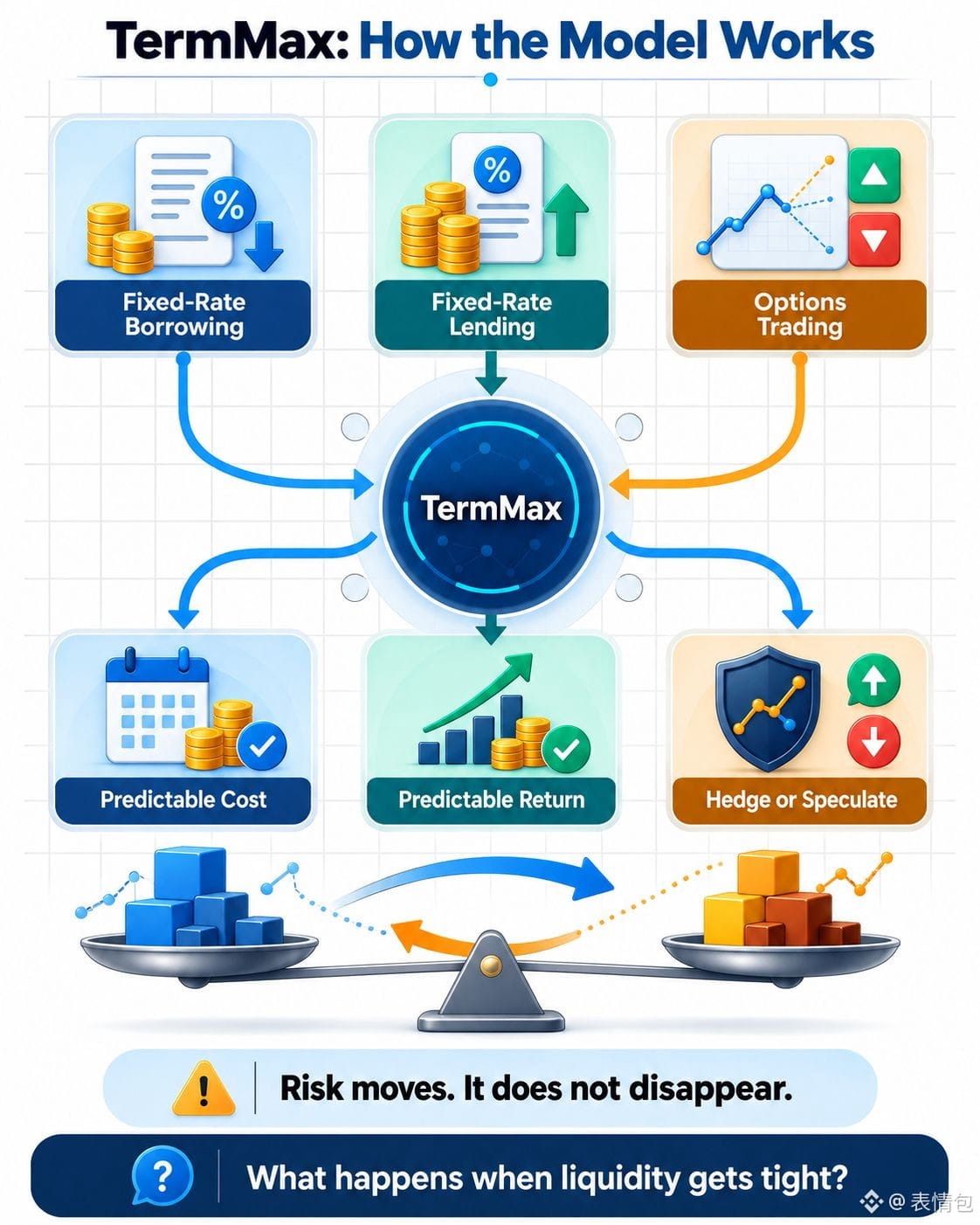
TermMax m’a fait faire une pause parce que je ne suis pas encore sûr que le fait d’intégrer des prêts à taux fixe et des options dans un seul protocole rende les choses plus utiles ou simplement plus compliquées.
La partie que je comprends, c’est le besoin de taux prévisibles. Si j’emprunte via TermMax, je devrais savoir combien le prêt va me coûter au lieu de regarder le taux changer avec le marché. Un prêteur peut aussi avoir une idée plus claire du rendement attendu. On dirait quelque chose de plus proche de la manière dont les gens planifient normalement leurs finances.
Ensuite, il y a la partie des options. Je vois pourquoi elle a sa place ici. Les options peuvent permettre aux utilisateurs de se couvrir contre certains risques ou de construire des positions en fonction de mouvements de prix futurs. Mais honnêtement, c’est aussi la partie où TermMax me semble plus difficile à évaluer. Les options sont utiles entre des mains expérimentées, mais elles peuvent aussi rapidement devenir une autre façon de prendre davantage de risques.
Je pense sans cesse à la personne qui se trouve de l’autre côté de chaque position à taux fixe. Quand le taux du marché évolue, un camp y gagne et l’autre renonce à quelque chose. TermMax n’efface pas cette tension : il crée un marché où les utilisateurs peuvent l’échanger. Le fait que ce marché reste liquide pendant les périodes de stress est probablement plus important que la façon dont il fonctionne un jour « normal ».
Donc, je vois bien l’utilité ici. TermMax essaie de rendre les coûts d’emprunt prévisibles tout en offrant aux utilisateurs des outils pour gérer leur exposition. Il me reste seulement à me demander si la plupart des gens utiliseront cette souplesse avec prudence, ou s’ils comprendront le risque seulement après que le marché se soit retourné contre eux.
@TermMax #TermMax
TermMax m’a fait faire une pause parce que je ne suis pas encore sûr que le fait d’intégrer des prêts à taux fixe et des options dans un seul protocole rende les choses plus utiles ou simplement plus compliquées.
La partie que je comprends, c’est le besoin de taux prévisibles. Si j’emprunte via TermMax, je devrais savoir combien le prêt va me coûter au lieu de regarder le taux changer avec le marché. Un prêteur peut aussi avoir une idée plus claire du rendement attendu. On dirait quelque chose de plus proche de la manière dont les gens planifient normalement leurs finances.
Ensuite, il y a la partie des options. Je vois pourquoi elle a sa place ici. Les options peuvent permettre aux utilisateurs de se couvrir contre certains risques ou de construire des positions en fonction de mouvements de prix futurs. Mais honnêtement, c’est aussi la partie où TermMax me semble plus difficile à évaluer. Les options sont utiles entre des mains expérimentées, mais elles peuvent aussi rapidement devenir une autre façon de prendre davantage de risques.
Je pense sans cesse à la personne qui se trouve de l’autre côté de chaque position à taux fixe. Quand le taux du marché évolue, un camp y gagne et l’autre renonce à quelque chose. TermMax n’efface pas cette tension : il crée un marché où les utilisateurs peuvent l’échanger. Le fait que ce marché reste liquide pendant les périodes de stress est probablement plus important que la façon dont il fonctionne un jour « normal ».
Donc, je vois bien l’utilité ici. TermMax essaie de rendre les coûts d’emprunt prévisibles tout en offrant aux utilisateurs des outils pour gérer leur exposition. Il me reste seulement à me demander si la plupart des gens utiliseront cette souplesse avec prudence, ou s’ils comprendront le risque seulement après que le marché se soit retourné contre eux.
TermMax m’a fait faire une pause parce que je ne suis pas encore sûr que le fait d’intégrer des prêts à taux fixe et des options dans un seul protocole rende les choses plus utiles ou simplement plus compliquées.
La partie que je comprends, c’est le besoin de taux prévisibles. Si j’emprunte via TermMax, je devrais savoir combien le prêt va me coûter au lieu de regarder le taux changer avec le marché. Un prêteur peut aussi avoir une idée plus claire du rendement attendu. On dirait quelque chose de plus proche de la manière dont les gens planifient normalement leurs finances.
Ensuite, il y a la partie des options. Je vois pourquoi elle a sa place ici. Les options peuvent permettre aux utilisateurs de se couvrir contre certains risques ou de construire des positions en fonction de mouvements de prix futurs. Mais honnêtement, c’est aussi la partie où TermMax me semble plus difficile à évaluer. Les options sont utiles entre des mains expérimentées, mais elles peuvent aussi rapidement devenir une autre façon de prendre davantage de risques.
Je pense sans cesse à la personne qui se trouve de l’autre côté de chaque position à taux fixe. Quand le taux du marché évolue, un camp y gagne et l’autre renonce à quelque chose. TermMax n’efface pas cette tension : il crée un marché où les utilisateurs peuvent l’échanger. Le fait que ce marché reste liquide pendant les périodes de stress est probablement plus important que la façon dont il fonctionne un jour « normal ».
Donc, je vois bien l’utilité ici. TermMax essaie de rendre les coûts d’emprunt prévisibles tout en offrant aux utilisateurs des outils pour gérer leur exposition. Il me reste seulement à me demander si la plupart des gens utiliseront cette souplesse avec prudence, ou s’ils comprendront le risque seulement après que le marché se soit retourné contre eux.
25
2
16
747
·
--
Haussier
$APR
{future}(APRUSDT)
APR a gagné plus de 14 % avec une activité de trading notable. Les acheteurs ont actuellement l’élan, et la prochaine consolidation pourrait révéler si la force peut se poursuivre.
$APR
APR a gagné plus de 14 % avec une activité de trading notable. Les acheteurs ont actuellement l’élan, et la prochaine consolidation pourrait révéler si la force peut se poursuivre.
APR a gagné plus de 14 % avec une activité de trading notable. Les acheteurs ont actuellement l’élan, et la prochaine consolidation pourrait révéler si la force peut se poursuivre.
1
86
·
--
Haussier
$BR
{future}(BRUSDT)
BR est en hausse d’environ 16 % alors que les acheteurs font monter le prix. Le mouvement semble solide aujourd’hui, mais il sera important de maintenir la zone de cassure récente pour conserver l’élan.
$BR
BR est en hausse d’environ 16 % alors que les acheteurs font monter le prix. Le mouvement semble solide aujourd’hui, mais il sera important de maintenir la zone de cassure récente pour conserver l’élan.
BR est en hausse d’environ 16 % alors que les acheteurs font monter le prix. Le mouvement semble solide aujourd’hui, mais il sera important de maintenir la zone de cassure récente pour conserver l’élan.
1
111
·
--
Haussier
$STAR
{future}(STARUSDT)
STAR a grimpé de plus de 17 % et attire de nouvelles attentions sur le marché. Je surveille si cet élan se transforme en poursuite de la tendance ou s’il s’essouffle après la poussée initiale.
$STAR
STAR a grimpé de plus de 17 % et attire de nouvelles attentions sur le marché. Je surveille si cet élan se transforme en poursuite de la tendance ou s’il s’essouffle après la poussée initiale.
STAR a grimpé de plus de 17 % et attire de nouvelles attentions sur le marché. Je surveille si cet élan se transforme en poursuite de la tendance ou s’il s’essouffle après la poussée initiale.
1
102
·
--
Haussier
$ACE
{spot}(ACEUSDT)
ACE affiche une forte dynamique avec une hausse de 24 % et une activité de trading importante. Un volume soutenu pourrait rendre la prochaine réaction du prix particulièrement à surveiller de près.
$ACE
ACE affiche une forte dynamique avec une hausse de 24 % et une activité de trading importante. Un volume soutenu pourrait rendre la prochaine réaction du prix particulièrement à surveiller de près.
ACE affiche une forte dynamique avec une hausse de 24 % et une activité de trading importante. Un volume soutenu pourrait rendre la prochaine réaction du prix particulièrement à surveiller de près.
1
107
·
--
$VELVET
{future}(VELVETUSDT)
VELVET évolue autour de 29% avec un volume solide qui soutient le mouvement. La force est impressionnante, et je surveille la question de savoir si les acheteurs pourront conserver le contrôle après cette expansion rapide.
$VELVET
VELVET évolue autour de 29% avec un volume solide qui soutient le mouvement. La force est impressionnante, et je surveille la question de savoir si les acheteurs pourront conserver le contrôle après cette expansion rapide.
VELVET évolue autour de 29% avec un volume solide qui soutient le mouvement. La force est impressionnante, et je surveille la question de savoir si les acheteurs pourront conserver le contrôle après cette expansion rapide.
1
119
·
--
Haussier
$BTW
{future}(BTWUSDT)
Au fait, BTW mène la tendance avec une hausse massive de 96% et un fort volume de transactions. L’élan est clairement en hausse, mais après une remontée aussi brutale, la gestion du risque compte davantage que de poursuivre la bougie.
$BTW
Au fait, BTW mène la tendance avec une hausse massive de 96% et un fort volume de transactions. L’élan est clairement en hausse, mais après une remontée aussi brutale, la gestion du risque compte davantage que de poursuivre la bougie.
Au fait, BTW mène la tendance avec une hausse massive de 96% et un fort volume de transactions. L’élan est clairement en hausse, mais après une remontée aussi brutale, la gestion du risque compte davantage que de poursuivre la bougie.
1
318
·
--
J’ai remarqué que Dusk Network me semble plus évident quand je regarde au-delà du récit habituel sur la confidentialité.
Dans la finance traditionnelle, les institutions ne peuvent pas mettre l’identité de chaque investisseur, l’historique de propriété ou le détail des transactions sur une blockchain entièrement transparente.
Cela crée un besoin réel de confidentialité, et Dusk essaie de s’attaquer à ce problème. Pourtant, je ne suis pas prêt à supposer qu’une bonne technologie mène automatiquement à une adoption réelle.
Je continue de me demander qui utilise le réseau aujourd’hui, qui en a réellement besoin, et si un capital significatif y circule vraiment.
Je veux aussi voir si les développeurs construisent des applications auxquelles les gens reviennent, et pas des projets qui deviennent silencieux une fois que les subventions et les incitations s’épuisent. Le token DUSK n’a de l’importance pour moi que si le réseau donne aux gens une raison naturelle de l’utiliser via des frais, le staking, le règlement, ou d’autres activités concrètes.
Si la majeure partie de la demande vient de la spéculation et de l’excitation des marchés à court terme, je sais que cette demande peut disparaître rapidement. La réglementation peut créer une opportunité, car les institutions ont besoin de confidentialité sans perdre leur conformité,
mais les gouvernements, les banques, les dépositaires et les investisseurs avancent lentement. Ils ont besoin de clarté juridique, de systèmes d’identité fiables, d’une forte liquidité et de confiance avant d’engager de l’argent sérieux.
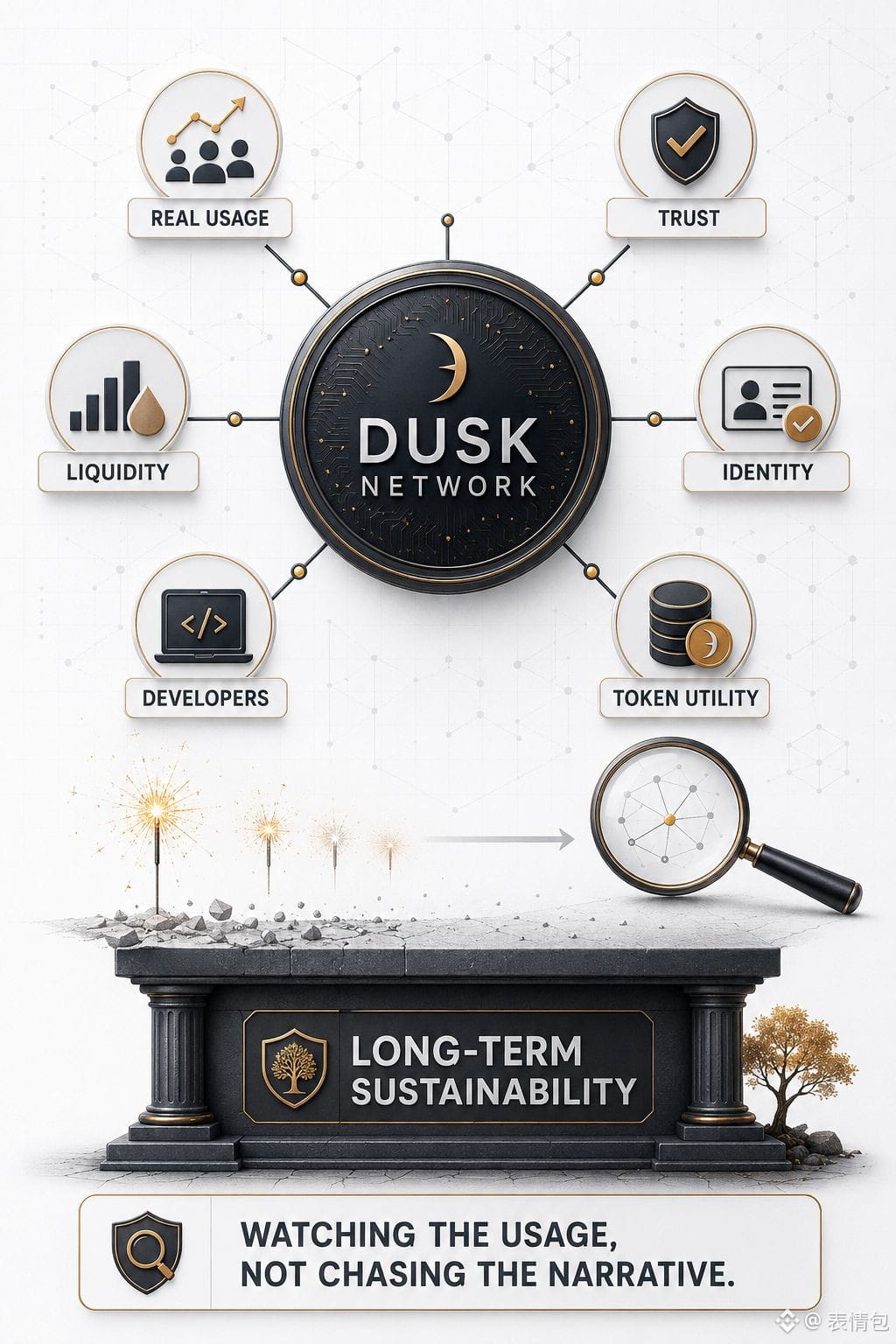
C’est pourquoi je surveille plutôt que de me précipiter pour acheter. Je comprends ce que Dusk veut devenir, mais j’ai encore besoin de voir des transactions régulières, des développeurs actifs, des émetteurs d’actifs sérieux, et des utilisateurs qui restent lorsque les récompenses diminuent.
Pour moi, la vraie question est simple : Dusk peut-il devenir une infrastructure sur laquelle la finance dépend réellement, ou restera-t-il une excellente idée en attente de son marché ?
@Dusk_Foundation #dusk $DUSK
{spot}(DUSKUSDT)
J’ai remarqué que Dusk Network me semble plus évident quand je regarde au-delà du récit habituel sur la confidentialité.
Dans la finance traditionnelle, les institutions ne peuvent pas mettre l’identité de chaque investisseur, l’historique de propriété ou le détail des transactions sur une blockchain entièrement transparente.
Cela crée un besoin réel de confidentialité, et Dusk essaie de s’attaquer à ce problème. Pourtant, je ne suis pas prêt à supposer qu’une bonne technologie mène automatiquement à une adoption réelle.
Je continue de me demander qui utilise le réseau aujourd’hui, qui en a réellement besoin, et si un capital significatif y circule vraiment.
Je veux aussi voir si les développeurs construisent des applications auxquelles les gens reviennent, et pas des projets qui deviennent silencieux une fois que les subventions et les incitations s’épuisent. Le token DUSK n’a de l’importance pour moi que si le réseau donne aux gens une raison naturelle de l’utiliser via des frais, le staking, le règlement, ou d’autres activités concrètes.
Si la majeure partie de la demande vient de la spéculation et de l’excitation des marchés à court terme, je sais que cette demande peut disparaître rapidement. La réglementation peut créer une opportunité, car les institutions ont besoin de confidentialité sans perdre leur conformité,
mais les gouvernements, les banques, les dépositaires et les investisseurs avancent lentement. Ils ont besoin de clarté juridique, de systèmes d’identité fiables, d’une forte liquidité et de confiance avant d’engager de l’argent sérieux.
C’est pourquoi je surveille plutôt que de me précipiter pour acheter. Je comprends ce que Dusk veut devenir, mais j’ai encore besoin de voir des transactions régulières, des développeurs actifs, des émetteurs d’actifs sérieux, et des utilisateurs qui restent lorsque les récompenses diminuent.
Pour moi, la vraie question est simple : Dusk peut-il devenir une infrastructure sur laquelle la finance dépend réellement, ou restera-t-il une excellente idée en attente de son marché ?
@Dusk #dusk $DUSK
Dans la finance traditionnelle, les institutions ne peuvent pas mettre l’identité de chaque investisseur, l’historique de propriété ou le détail des transactions sur une blockchain entièrement transparente.
Cela crée un besoin réel de confidentialité, et Dusk essaie de s’attaquer à ce problème. Pourtant, je ne suis pas prêt à supposer qu’une bonne technologie mène automatiquement à une adoption réelle.
Je continue de me demander qui utilise le réseau aujourd’hui, qui en a réellement besoin, et si un capital significatif y circule vraiment.
Je veux aussi voir si les développeurs construisent des applications auxquelles les gens reviennent, et pas des projets qui deviennent silencieux une fois que les subventions et les incitations s’épuisent. Le token DUSK n’a de l’importance pour moi que si le réseau donne aux gens une raison naturelle de l’utiliser via des frais, le staking, le règlement, ou d’autres activités concrètes.
Si la majeure partie de la demande vient de la spéculation et de l’excitation des marchés à court terme, je sais que cette demande peut disparaître rapidement. La réglementation peut créer une opportunité, car les institutions ont besoin de confidentialité sans perdre leur conformité,
mais les gouvernements, les banques, les dépositaires et les investisseurs avancent lentement. Ils ont besoin de clarté juridique, de systèmes d’identité fiables, d’une forte liquidité et de confiance avant d’engager de l’argent sérieux.
C’est pourquoi je surveille plutôt que de me précipiter pour acheter. Je comprends ce que Dusk veut devenir, mais j’ai encore besoin de voir des transactions régulières, des développeurs actifs, des émetteurs d’actifs sérieux, et des utilisateurs qui restent lorsque les récompenses diminuent.
Pour moi, la vraie question est simple : Dusk peut-il devenir une infrastructure sur laquelle la finance dépend réellement, ou restera-t-il une excellente idée en attente de son marché ?
@Dusk #dusk $DUSK
5
3
102
·
--
@termmax #TermMax
Pourquoi emprunter dans la DeFi semble-t-il encore imprévisible, même lorsque le prêt est lui-même surcollatéralisé ?
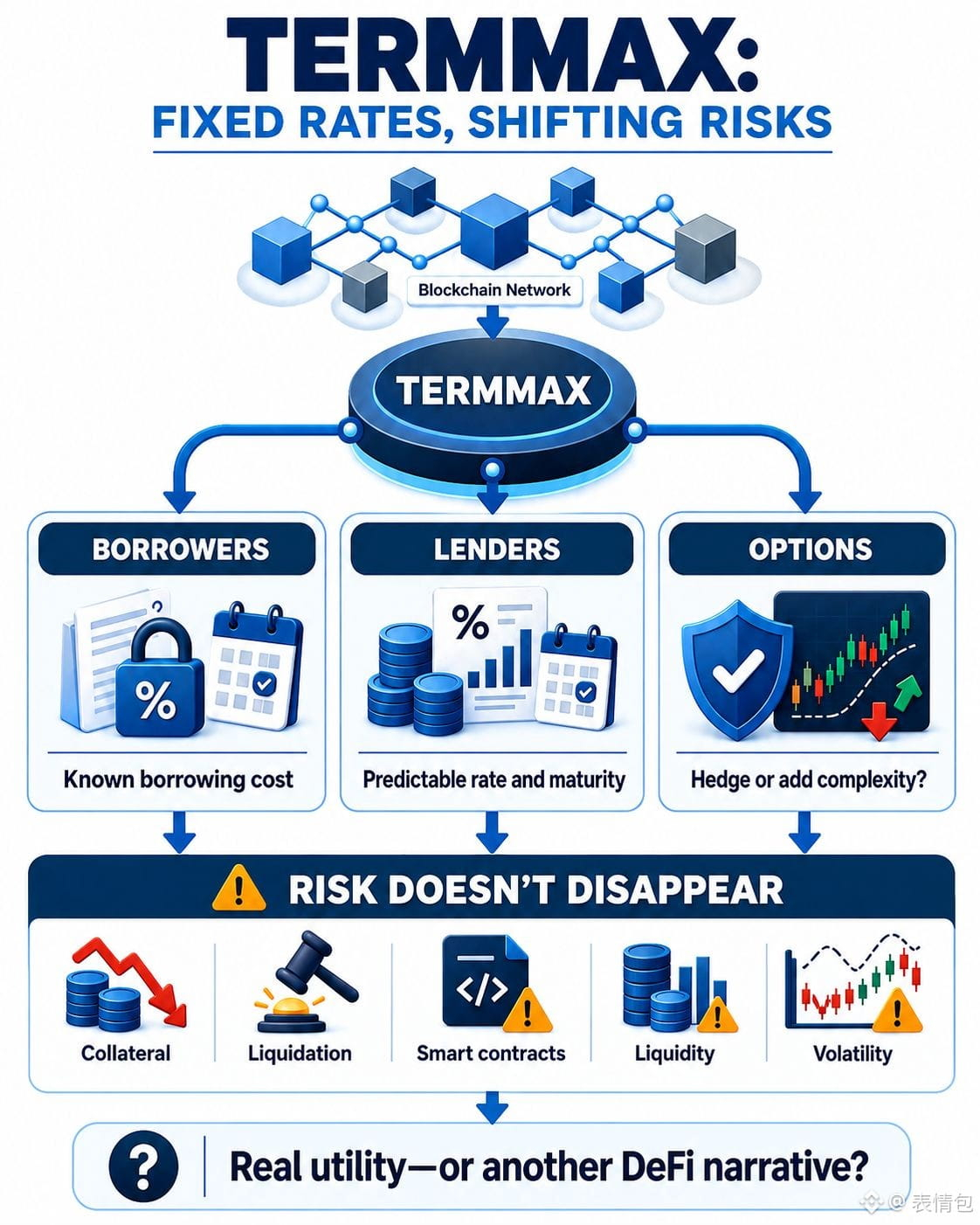
C’est ce qui m’a poussé à regarder de plus près TermMax. D’après ce que j’en comprends, il s’agit d’un protocole décentralisé axé sur l’emprunt, le prêt et le trading d’options à taux fixe.
La partie à taux fixe semble vraiment utile. La plupart des prêts DeFi ont des taux variables, ce qui signifie que le coût de l’emprunt peut changer à mesure que la demande du marché et la liquidité évoluent. Avec TermMax, les emprunteurs peuvent connaître à l’avance le coût de leurs intérêts et leur échéance, tandis que les prêteurs ont une vision plus claire du rendement attendu.
Mais honnêtement, des taux prévisibles ne rendent pas pour autant toute la position prévisible.
Les prix du collatéral peuvent encore baisser. Les liquidations peuvent encore se produire. Les smart contracts peuvent contenir des vulnérabilités, et la liquidité peut devenir insuffisante quand les utilisateurs veulent sortir. La partie options peut aider les traders expérimentés à couvrir ces risques, mais elle ajoute aussi davantage de complexité via les primes, les prix d’exercice et les dates d’expiration.
Je me demande parfois qui tirera le plus profit de cette structure. Est-ce qu’elle attirera des personnes qui ont réellement besoin de coûts d’emprunt stables, ou principalement des traders aguerris construisant des stratégies à court terme ?
Ce que j’ai compris, c’est que TermMax ne supprime pas le risque : il déplace simplement où ce risque se situe. L’incertitude liée aux taux d’intérêt peut diminuer, mais les risques liés au collatéral, à la liquidité, au marché et sur le plan technique restent présents.
Au final, le protocole s’attaque à une faiblesse réelle de la DeFi. Les marchés à taux fixe pourraient rendre l’emprunt on-chain plus pratique pour les utilisateurs qui ont besoin de certitude. Mais la vraie question est de savoir si la demande continue, sans incitations ni spéculation.
TermMax pourrait-il devenir une infrastructure financière utile, ou bien la DeFi à taux fixe restera-t-elle une autre idée qui semble plus forte sur le papier qu’elle ne l’est en pratique ?
@TermMax #TermMax
Pourquoi emprunter dans la DeFi semble-t-il encore imprévisible, même lorsque le prêt est lui-même surcollatéralisé ?
C’est ce qui m’a poussé à regarder de plus près TermMax. D’après ce que j’en comprends, il s’agit d’un protocole décentralisé axé sur l’emprunt, le prêt et le trading d’options à taux fixe.
La partie à taux fixe semble vraiment utile. La plupart des prêts DeFi ont des taux variables, ce qui signifie que le coût de l’emprunt peut changer à mesure que la demande du marché et la liquidité évoluent. Avec TermMax, les emprunteurs peuvent connaître à l’avance le coût de leurs intérêts et leur échéance, tandis que les prêteurs ont une vision plus claire du rendement attendu.
Mais honnêtement, des taux prévisibles ne rendent pas pour autant toute la position prévisible.
Les prix du collatéral peuvent encore baisser. Les liquidations peuvent encore se produire. Les smart contracts peuvent contenir des vulnérabilités, et la liquidité peut devenir insuffisante quand les utilisateurs veulent sortir. La partie options peut aider les traders expérimentés à couvrir ces risques, mais elle ajoute aussi davantage de complexité via les primes, les prix d’exercice et les dates d’expiration.
Je me demande parfois qui tirera le plus profit de cette structure. Est-ce qu’elle attirera des personnes qui ont réellement besoin de coûts d’emprunt stables, ou principalement des traders aguerris construisant des stratégies à court terme ?
Ce que j’ai compris, c’est que TermMax ne supprime pas le risque : il déplace simplement où ce risque se situe. L’incertitude liée aux taux d’intérêt peut diminuer, mais les risques liés au collatéral, à la liquidité, au marché et sur le plan technique restent présents.
Au final, le protocole s’attaque à une faiblesse réelle de la DeFi. Les marchés à taux fixe pourraient rendre l’emprunt on-chain plus pratique pour les utilisateurs qui ont besoin de certitude. Mais la vraie question est de savoir si la demande continue, sans incitations ni spéculation.
TermMax pourrait-il devenir une infrastructure financière utile, ou bien la DeFi à taux fixe restera-t-elle une autre idée qui semble plus forte sur le papier qu’elle ne l’est en pratique ?
Pourquoi emprunter dans la DeFi semble-t-il encore imprévisible, même lorsque le prêt est lui-même surcollatéralisé ?
C’est ce qui m’a poussé à regarder de plus près TermMax. D’après ce que j’en comprends, il s’agit d’un protocole décentralisé axé sur l’emprunt, le prêt et le trading d’options à taux fixe.
La partie à taux fixe semble vraiment utile. La plupart des prêts DeFi ont des taux variables, ce qui signifie que le coût de l’emprunt peut changer à mesure que la demande du marché et la liquidité évoluent. Avec TermMax, les emprunteurs peuvent connaître à l’avance le coût de leurs intérêts et leur échéance, tandis que les prêteurs ont une vision plus claire du rendement attendu.
Mais honnêtement, des taux prévisibles ne rendent pas pour autant toute la position prévisible.
Les prix du collatéral peuvent encore baisser. Les liquidations peuvent encore se produire. Les smart contracts peuvent contenir des vulnérabilités, et la liquidité peut devenir insuffisante quand les utilisateurs veulent sortir. La partie options peut aider les traders expérimentés à couvrir ces risques, mais elle ajoute aussi davantage de complexité via les primes, les prix d’exercice et les dates d’expiration.
Je me demande parfois qui tirera le plus profit de cette structure. Est-ce qu’elle attirera des personnes qui ont réellement besoin de coûts d’emprunt stables, ou principalement des traders aguerris construisant des stratégies à court terme ?
Ce que j’ai compris, c’est que TermMax ne supprime pas le risque : il déplace simplement où ce risque se situe. L’incertitude liée aux taux d’intérêt peut diminuer, mais les risques liés au collatéral, à la liquidité, au marché et sur le plan technique restent présents.
Au final, le protocole s’attaque à une faiblesse réelle de la DeFi. Les marchés à taux fixe pourraient rendre l’emprunt on-chain plus pratique pour les utilisateurs qui ont besoin de certitude. Mais la vraie question est de savoir si la demande continue, sans incitations ni spéculation.
TermMax pourrait-il devenir une infrastructure financière utile, ou bien la DeFi à taux fixe restera-t-elle une autre idée qui semble plus forte sur le papier qu’elle ne l’est en pratique ?
17
3
11
481
·
--
Haussier
$CBRS
{future}(CBRSUSDT)
a gagné 10,52 % et réalise un mouvement notable. Je surveille si elle peut consolider régulièrement à partir de là plutôt que de rendre le gain à travers une volatilité soudaine.
$CBRS
a gagné 10,52 % et réalise un mouvement notable. Je surveille si elle peut consolider régulièrement à partir de là plutôt que de rendre le gain à travers une volatilité soudaine.
a gagné 10,52 % et réalise un mouvement notable. Je surveille si elle peut consolider régulièrement à partir de là plutôt que de rendre le gain à travers une volatilité soudaine.
1
170
·
--
Haussier
$PRL
{future}(PRLUSDT)
est en hausse de 11,30 % et affiche pour l’instant une dynamique saine. La prochaine étape consiste à déterminer si de nouveaux achats se poursuivent plutôt que le mouvement perde de sa force après la première impulsion.
$PRL
est en hausse de 11,30 % et affiche pour l’instant une dynamique saine. La prochaine étape consiste à déterminer si de nouveaux achats se poursuivent plutôt que le mouvement perde de sa force après la première impulsion.
est en hausse de 11,30 % et affiche pour l’instant une dynamique saine. La prochaine étape consiste à déterminer si de nouveaux achats se poursuivent plutôt que le mouvement perde de sa force après la première impulsion.
1
119
·
--
Haussier
$VVV
{future}(VVVUSDT)
affiche une hausse de 12,55 % et a atteint aujourd’hui la partie la plus forte du marché. Le maintien de ce niveau pourrait attirer l’attention, mais la volatilité peut changer rapidement.
$VVV
affiche une hausse de 12,55 % et a atteint aujourd’hui la partie la plus forte du marché. Le maintien de ce niveau pourrait attirer l’attention, mais la volatilité peut changer rapidement.
affiche une hausse de 12,55 % et a atteint aujourd’hui la partie la plus forte du marché. Le maintien de ce niveau pourrait attirer l’attention, mais la volatilité peut changer rapidement.
1
58
·
--
Haussier
$H
{future}(HUSDT)
a grimpé de 12,71 % et construit calmement son élan. Je préférerais voir les acheteurs défendre la progression avant de supposer qu’il y a encore beaucoup plus de hausse à venir.
$H
a grimpé de 12,71 % et construit calmement son élan. Je préférerais voir les acheteurs défendre la progression avant de supposer qu’il y a encore beaucoup plus de hausse à venir.
a grimpé de 12,71 % et construit calmement son élan. Je préférerais voir les acheteurs défendre la progression avant de supposer qu’il y a encore beaucoup plus de hausse à venir.
1
68
·
--
Haussier
$ACE
{spot}(ACEUSDT)
est en hausse de 12,85 % et affiche une solide force à court terme. La prochaine étape permettra de voir s’il s’agit d’une continuation véritable ou si les traders se contentent de poursuivre l’élan.
$ACE
est en hausse de 12,85 % et affiche une solide force à court terme. La prochaine étape permettra de voir s’il s’agit d’une continuation véritable ou si les traders se contentent de poursuivre l’élan.
est en hausse de 12,85 % et affiche une solide force à court terme. La prochaine étape permettra de voir s’il s’agit d’une continuation véritable ou si les traders se contentent de poursuivre l’élan.
1
154
Connectez-vous pour découvrir plus de contenu
Rejoignez la communauté mondiale des adeptes de cryptomonnaies sur Binance Square
⚡️ Suviez les dernières informations importantes sur les cryptomonnaies.
💬 Jugé digne de confiance par la plus grande plateforme d’échange de cryptomonnaies au monde.
👍 Découvrez les connaissances que partagent les créateurs vérifiés.
Adresse e-mail/Nº de téléphone
Sujets d’actualité
FedRateWatch
1.1M vues
5,369 mentions
Partagez et gagnez une récompense de trafic dans notre campagne de hashtag tendance
✨Sujet : FOMC de septembre — Quelle sera la prochaine décision de la Fed ?
👉Comment participer :
Publiez une courte publication ou un article avec le hashtag #FedRateWatch
Créez du contenu à partir des angles ci-dessous :
- L’inflation cœur de l’IPC d’août a augmenté de 0,3% d’un mois sur l’autre, et les chances d’une hausse de 25 points de base cette semaine sont désormais proches de 90%. Anticipez-vous une hausse des taux cette semaine ? Est-ce un cas isolé, ou le début d’un cycle de hausses plus long ?
- Si la hausse a lieu, comment cela se répercute-t-il sur le BTC, les valeurs technologiques et l’or ? Plutôt haussier ou baissier ?
- Comment comptez-vous trader ensuite ? Partagez votre trading/positions BTC, actions ou or avec notre widget de partage de trades.
⏰Période de la campagne :
- 2026-09-15 11:00 - 2026-09-17 3:00 UTC
🎁Récompense :
- Les publications éligibles qui respectent les consignes ci-dessus et contiennent plus de 100 mots seront examinées et pourraient recevoir un boost aléatoire de trafic de 500 à 3 000 vues. Vous recevrez une notification de votre secrétaire de flux si votre publication est sélectionnée.
- Ayez une chance de faire apparaître votre article sur Binance Square Official
Vous manque-t-il des idées pour votre publication ? Visitez la page du sujet #FedRateWatch ou le Square Guide on How to Post for Better Reach.
Binance Square Official
·585 mentions J’aime
·1.4M vues
ZcashRises6%
2,341 vues
76 mentions
XRPSinks10%
653 vues
55 mentions