

Filecoin Re-poster
368 Publications

Filecoin Re-poster
Signaler
Bloquer l’utilisateur
Filecoin ⨎ is the largest decentralized data storage marketplace, protocol, & cryptocurrency. Twitter account is community managed.
0 Suivis
59 Abonnés
32 J’aime
Publications
Tous
Vidéos
Every completed artificial intelligence operation generates materials such as datasets, reports, code, and images that need a reliable permanent home. Filecoin steps in to host this information, offering onchain verification to ensure the files are successfully retained and all storage costs have been covered. Right now, developers have the ability to seamlessly access and build with this system by making use of the Synapse SDK.
https://medium.com/@filoz/filoz-in-2026-progress-report-d3ae680df5c0
Every completed artificial intelligence operation generates materials such as datasets, reports, code, and images that need a reliable permanent home. Filecoin steps in to host this information, offering onchain verification to ensure the files are successfully retained and all storage costs have been covered. Right now, developers have the ability to seamlessly access and build with this system by making use of the Synapse SDK.
https://medium.com/@filoz/filoz-in-2026-progress-report-d3ae680df5c0
https://medium.com/@filoz/filoz-in-2026-progress-report-d3ae680df5c0
89
Typically, if a coding agent reaches a rate limit, it is forced to start over from scratch and completely forgets its previous plan. A recently developed skill changes this by encrypting and locking the operational context before storing it on Filecoin. Thanks to this secure storage, models like Claude Code, Codex, OpenClaw, or Hermes are able to authenticate the data and seamlessly resume the task from another location.
https://github.com/FIL-Builders/filecoin-clawdi
Typically, if a coding agent reaches a rate limit, it is forced to start over from scratch and completely forgets its previous plan. A recently developed skill changes this by encrypting and locking the operational context before storing it on Filecoin. Thanks to this secure storage, models like Claude Code, Codex, OpenClaw, or Hermes are able to authenticate the data and seamlessly resume the task from another location.
https://github.com/FIL-Builders/filecoin-clawdi
https://github.com/FIL-Builders/filecoin-clawdi
115
1/ Transitioning your information from IPFS directly over to Filecoin is now remarkably straightforward. We invite you to discover a few of the groups that are currently opting to secure their pinned IPFS data on the Filecoin network. These adopters range from emerging NFT platforms to traditional institutions that must adhere to strict legal and compliance requirements regarding their information.
1/ Transitioning your information from IPFS directly over to Filecoin is now remarkably straightforward. We invite you to discover a few of the groups that are currently opting to secure their pinned IPFS data on the Filecoin network. These adopters range from emerging NFT platforms to traditional institutions that must adhere to strict legal and compliance requirements regarding their information.
73
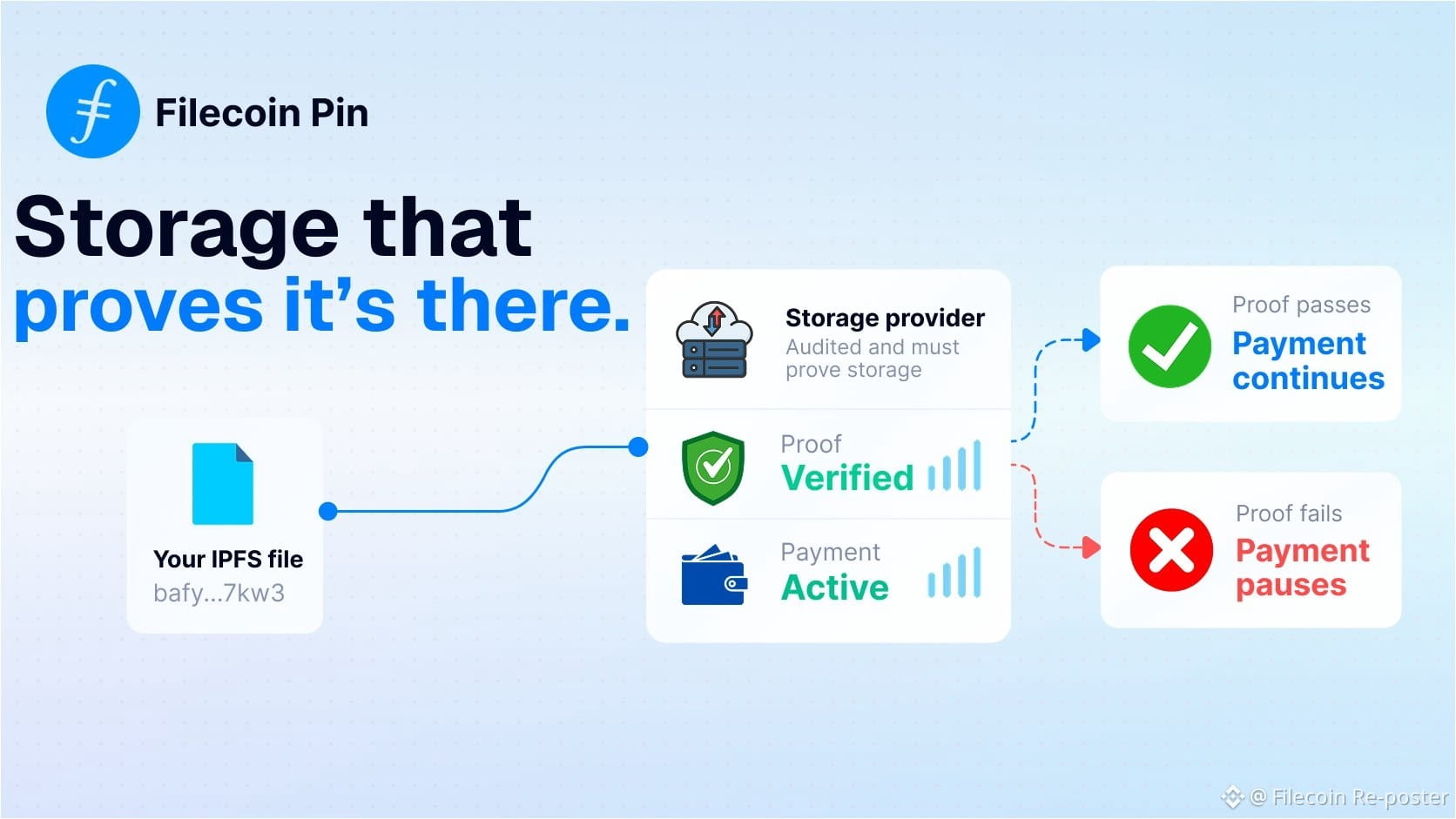
Keeping your IPFS data secure is straightforward with Filecoin Pin. The platform entrusts your files to audited storage providers who are mandated to demonstrate the safety of your information according to a strict schedule. Should a provider not pass one of these routine verifications, their payments are automatically suspended. This proactive measure takes effect instantly, addressing the situation long before you would ever need to submit a support ticket or even realize there was a problem. Visit the following link for further details.
https://docs.filecoin.io/build-on-filecoin/cookbook/filecoin-pin/migrate-ipfs-pins
Keeping your IPFS data secure is straightforward with Filecoin Pin. The platform entrusts your files to audited storage providers who are mandated to demonstrate the safety of your information according to a strict schedule. Should a provider not pass one of these routine verifications, their payments are automatically suspended. This proactive measure takes effect instantly, addressing the situation long before you would ever need to submit a support ticket or even realize there was a problem. Visit the following link for further details.
https://docs.filecoin.io/build-on-filecoin/cookbook/filecoin-pin/migrate-ipfs-pins
https://docs.filecoin.io/build-on-filecoin/cookbook/filecoin-pin/migrate-ipfs-pins
96
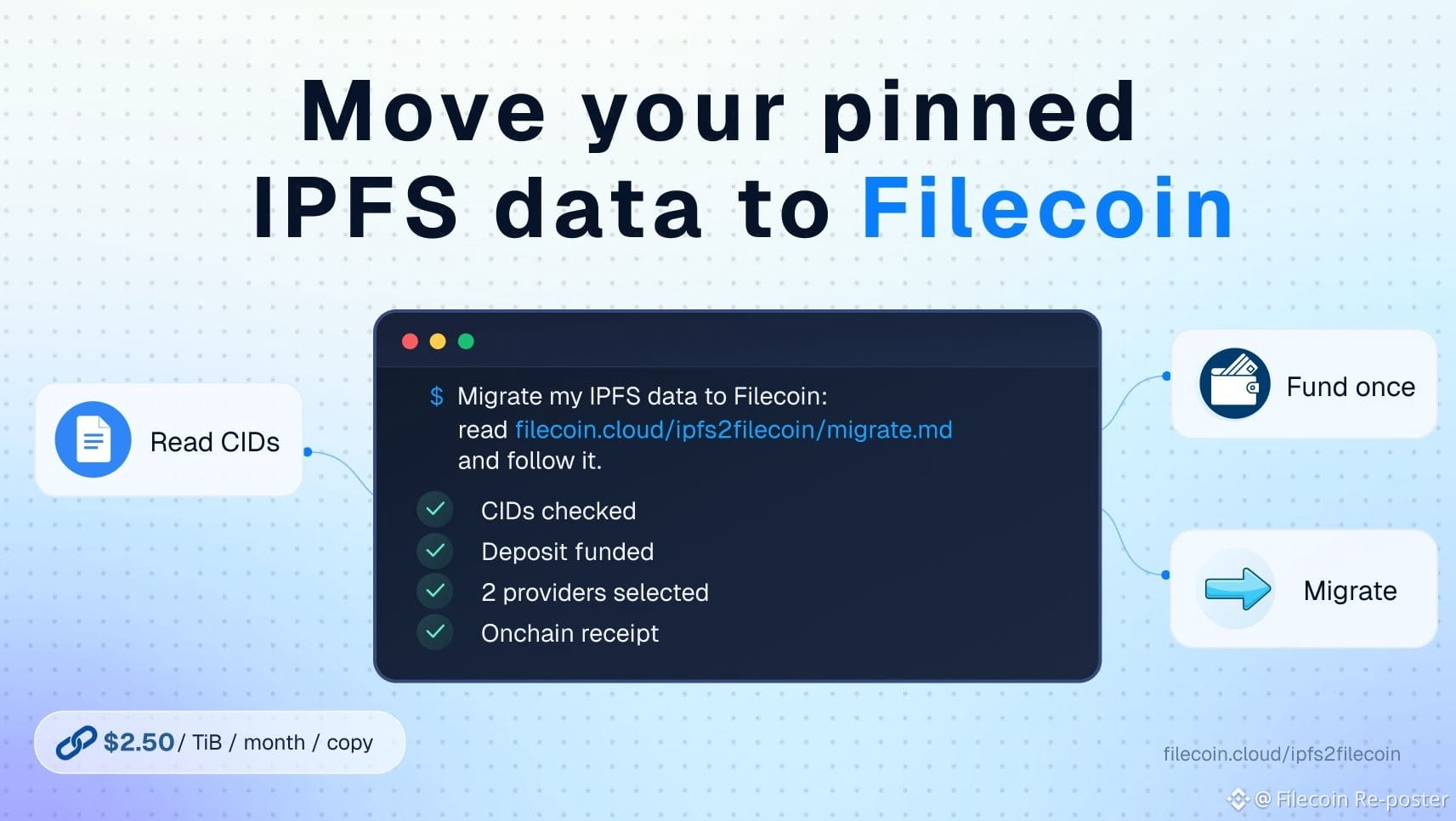
Transferring your IPFS files to Filecoin is a straightforward process when you utilize a programming assistant such as Cursor or Claude Code. To initiate this, you simply need to copy and paste the single line of text provided on the IPFS to Filecoin webpage. For security purposes, it is highly recommended to set up a brand new wallet containing only a minimal balance. Taking this precaution guarantees that the assistant is restricted to spending exactly the funds you have allocated for the task.
https://filecoin.cloud/ipfs2filecoin
Transferring your IPFS files to Filecoin is a straightforward process when you utilize a programming assistant such as Cursor or Claude Code. To initiate this, you simply need to copy and paste the single line of text provided on the IPFS to Filecoin webpage. For security purposes, it is highly recommended to set up a brand new wallet containing only a minimal balance. Taking this precaution guarantees that the assistant is restricted to spending exactly the funds you have allocated for the task.
https://filecoin.cloud/ipfs2filecoin
https://filecoin.cloud/ipfs2filecoin
107
1/ Participating hackers at the Runtime event in NYC last week were treated to an exclusive first look at our newly developed Publish skill. Utilizing this exact feature, every single one of the 100+ submissions is now pinned and safely stored on the Filecoin network.
1/ Participating hackers at the Runtime event in NYC last week were treated to an exclusive first look at our newly developed Publish skill. Utilizing this exact feature, every single one of the 100+ submissions is now pinned and safely stored on the Filecoin network.

99
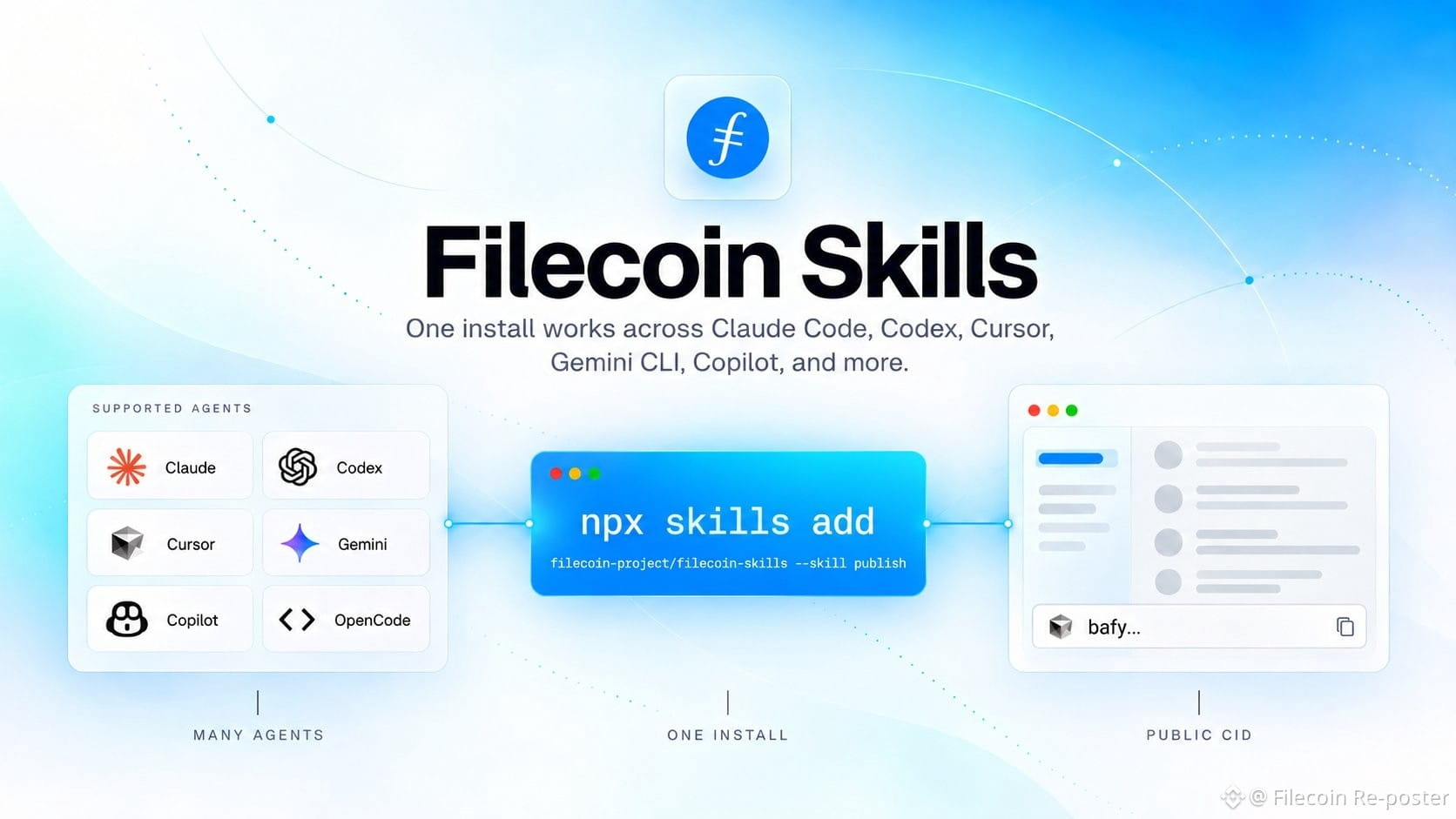
You are never locked into a single coding agent when using Filecoin Warm Storage. A solitary installation is all that is required to provide full compatibility across a wide variety of platforms. Depending on the interface you currently have open, the Publish skill integrates smoothly with Claude Code, Codex, Cursor, Gemini CLI, GitHub Copilot, and OpenCode, in addition to any other agents that happen to be skills.sh-compatible.
https://github.com/filecoin-project/filecoin-skills
You are never locked into a single coding agent when using Filecoin Warm Storage. A solitary installation is all that is required to provide full compatibility across a wide variety of platforms. Depending on the interface you currently have open, the Publish skill integrates smoothly with Claude Code, Codex, Cursor, Gemini CLI, GitHub Copilot, and OpenCode, in addition to any other agents that happen to be skills.sh-compatible.
https://github.com/filecoin-project/filecoin-skills
https://github.com/filecoin-project/filecoin-skills
2
Developers from the Filecoin community have successfully created a functional demonstration that connects an Avalanche property token directly to its corresponding deed. In this setup, the document is securely preserved on Filecoin while receiving a unique digital fingerprint through IPFS. Because of this design, modifying even a single line of the text instantly alters that fingerprint. Consequently, anyone verifying the document will immediately spot any changes. You can explore the complete reference architecture here:
https://github.com/SgtPooki/Avalanche-IPFS-Filecoin-RWA-reference-Architecture
Developers from the Filecoin community have successfully created a functional demonstration that connects an Avalanche property token directly to its corresponding deed. In this setup, the document is securely preserved on Filecoin while receiving a unique digital fingerprint through IPFS. Because of this design, modifying even a single line of the text instantly alters that fingerprint. Consequently, anyone verifying the document will immediately spot any changes. You can explore the complete reference architecture here:
https://github.com/SgtPooki/Avalanche-IPFS-Filecoin-RWA-reference-Architecture
https://github.com/SgtPooki/Avalanche-IPFS-Filecoin-RWA-reference-Architecture
94
Software creators frequently combine various AI models to handle distinct segments of a single application. Filecoin-Clawdi was specifically designed to accommodate this exact workflow. You can easily lock in your working context using Claude Code and subsequently access it through Codex, OpenClaw, or Hermes. Rather than relying on a simplified overview, the incoming agent will seamlessly resume your progress by directly absorbing the exact decisions that were previously made.
https://github.com/FIL-Builders/filecoin-clawdi
Software creators frequently combine various AI models to handle distinct segments of a single application. Filecoin-Clawdi was specifically designed to accommodate this exact workflow. You can easily lock in your working context using Claude Code and subsequently access it through Codex, OpenClaw, or Hermes. Rather than relying on a simplified overview, the incoming agent will seamlessly resume your progress by directly absorbing the exact decisions that were previously made.
https://github.com/FIL-Builders/filecoin-clawdi
https://github.com/FIL-Builders/filecoin-clawdi
37
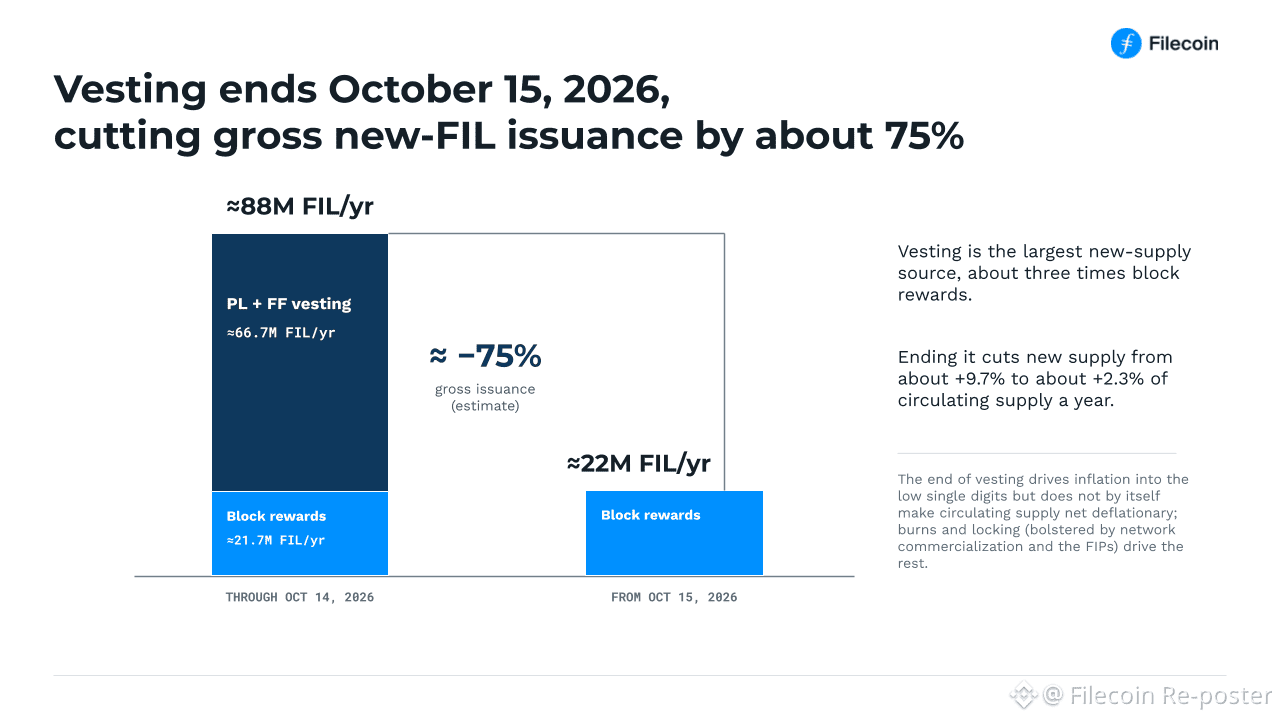
According to projections from FilecoinTLDR, the gross issuance of FIL is expected to drop by 75% once the vesting periods for Protocol Labs and the Filecoin Foundation wrap up in October 2026. Beyond that point, block rewards will carry on independently, while token burns and collateral locking will become the deciding factors for future supply. Be sure to check out the complete update for more details: https://filecointldr.io/blog/filecoin-network-2026-overview-update
According to projections from FilecoinTLDR, the gross issuance of FIL is expected to drop by 75% once the vesting periods for Protocol Labs and the Filecoin Foundation wrap up in October 2026. Beyond that point, block rewards will carry on independently, while token burns and collateral locking will become the deciding factors for future supply. Be sure to check out the complete update for more details: https://filecointldr.io/blog/filecoin-network-2026-overview-update
95
JavaScript developers can now easily access Filecoin storage through the Synapse SDK, which provides highly accessible APIs for uploading, retrieving, and paying. The setup process is incredibly straightforward, allowing you to get everything running with just a minimal amount of code.
This toolkit operates flawlessly across both Node.js and browser environments. Furthermore, it is designed to be highly modular and adaptable, offering a flexible experience rather than a rigid, single-purpose integration.
https://docs.filecoin.cloud/getting-started
JavaScript developers can now easily access Filecoin storage through the Synapse SDK, which provides highly accessible APIs for uploading, retrieving, and paying. The setup process is incredibly straightforward, allowing you to get everything running with just a minimal amount of code.
This toolkit operates flawlessly across both Node.js and browser environments. Furthermore, it is designed to be highly modular and adaptable, offering a flexible experience rather than a rigid, single-purpose integration.
https://docs.filecoin.cloud/getting-started
This toolkit operates flawlessly across both Node.js and browser environments. Furthermore, it is designed to be highly modular and adaptable, offering a flexible experience rather than a rigid, single-purpose integration.
https://docs.filecoin.cloud/getting-started
519
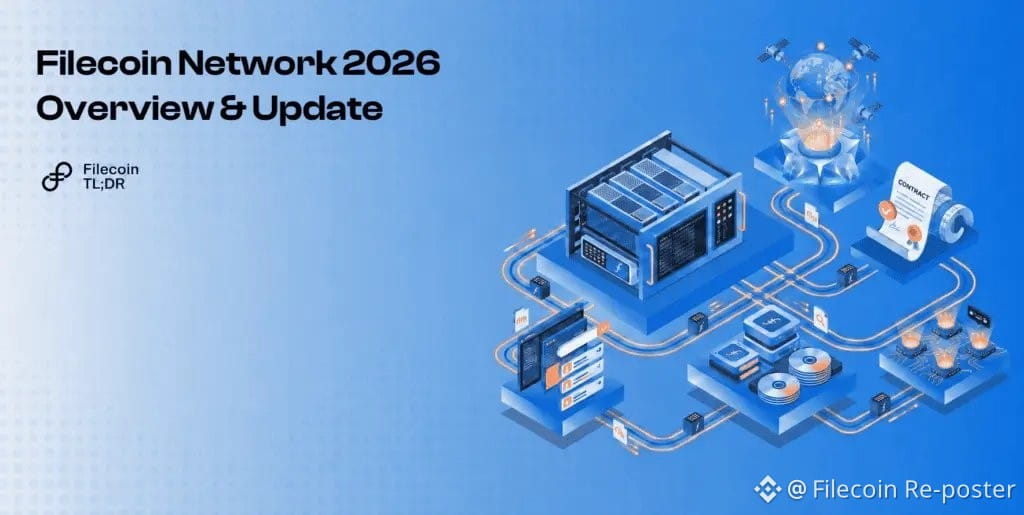
Ever since the launch of its mainnet, Filecoin has progressed through three distinct stages of development. The network first concentrated on expanding its storage capacity, which was subsequently followed by a drive to enhance usability. Now, beginning in 2025, the focus has shifted toward creating paid demand. This entire roadmap was officially mapped out in the 2026 Filecoin Network Strategy. We invite you to explore the comprehensive update by visiting https://filecointldr.io/blog/filecoin-network-2026-overview-update
Ever since the launch of its mainnet, Filecoin has progressed through three distinct stages of development. The network first concentrated on expanding its storage capacity, which was subsequently followed by a drive to enhance usability. Now, beginning in 2025, the focus has shifted toward creating paid demand. This entire roadmap was officially mapped out in the 2026 Filecoin Network Strategy. We invite you to explore the comprehensive update by visiting https://filecointldr.io/blog/filecoin-network-2026-overview-update
75
Distributing the plans, dashboards, and content generated by your agents beyond the typical chatbox interface is now incredibly straightforward. Thanks to Filecoin Warm Storage, exporting these creations is as effortless as using a standard skill. Any work produced by your agent can be instantly published to a publicly available link. Once the material is online, you can easily share it with anyone you choose, or simply allow a completely different agent to retrieve the data.
Distributing the plans, dashboards, and content generated by your agents beyond the typical chatbox interface is now incredibly straightforward. Thanks to Filecoin Warm Storage, exporting these creations is as effortless as using a standard skill. Any work produced by your agent can be instantly published to a publicly available link. Once the material is online, you can easily share it with anyone you choose, or simply allow a completely different agent to retrieve the data.
2
254
Partiellement vrai
Generating an approximate ARR of $139,789, Filecoin Pay has successfully processed $67,312 in stablecoins so far this year. These funds were distributed to 31 service providers from a group of 165 payers. Every piece of this data remains entirely transparent and is publicly trackable through the Filecoin Data Portal. We welcome you to explore all the details by reading the complete report here: https://medium.com/@filoz/filoz-in-2026-progress-report-d3ae680df5c0
Generating an approximate ARR of $139,789, Filecoin Pay has successfully processed $67,312 in stablecoins so far this year. These funds were distributed to 31 service providers from a group of 165 payers. Every piece of this data remains entirely transparent and is publicly trackable through the Filecoin Data Portal. We welcome you to explore all the details by reading the complete report here: https://medium.com/@filoz/filoz-in-2026-progress-report-d3ae680df5c0
1
1.3k
Configuring yourself as a Filecoin Onchain Cloud storage provider is now a remarkably quick task that takes approximately five minutes to complete.
The entire setup initiates with a single command, which instantly installs a Docker Compose stack containing both the database and the chain daemon. Following this installation, a convenient guided checklist is provided to walk you through the remaining tasks. It helps you seamlessly fund a wallet, attach your storage, set up a domain, and finalize your registration.
To read the complete guide, visit: https://medium.com/@filoz/become-a-filecoin-onchain-cloud-storage-provider-in-five-minutes-57abbcd95876
Configuring yourself as a Filecoin Onchain Cloud storage provider is now a remarkably quick task that takes approximately five minutes to complete.
The entire setup initiates with a single command, which instantly installs a Docker Compose stack containing both the database and the chain daemon. Following this installation, a convenient guided checklist is provided to walk you through the remaining tasks. It helps you seamlessly fund a wallet, attach your storage, set up a domain, and finalize your registration.
To read the complete guide, visit: https://medium.com/@filoz/become-a-filecoin-onchain-cloud-storage-provider-in-five-minutes-57abbcd95876
The entire setup initiates with a single command, which instantly installs a Docker Compose stack containing both the database and the chain daemon. Following this installation, a convenient guided checklist is provided to walk you through the remaining tasks. It helps you seamlessly fund a wallet, attach your storage, set up a domain, and finalize your registration.
To read the complete guide, visit: https://medium.com/@filoz/become-a-filecoin-onchain-cloud-storage-provider-in-five-minutes-57abbcd95876
36
Configuring your setup as a Filecoin Onchain Cloud storage provider currently takes roughly five minutes from start to finish. Deploying a Docker Compose stack, complete with the database and chain daemon, requires just a single command. Following this initial step, an intuitive checklist will walk you through funding a wallet, connecting your storage, configuring a domain, and finalizing your registration. Read the full details here: https://medium.com/@filoz/become-a-filecoin-onchain-cloud-storage-provider-in-five-minutes-57abbcd95876
Configuring your setup as a Filecoin Onchain Cloud storage provider currently takes roughly five minutes from start to finish. Deploying a Docker Compose stack, complete with the database and chain daemon, requires just a single command. Following this initial step, an intuitive checklist will walk you through funding a wallet, connecting your storage, configuring a domain, and finalizing your registration. Read the full details here: https://medium.com/@filoz/become-a-filecoin-onchain-cloud-storage-provider-in-five-minutes-57abbcd95876
56
Encountering a rate limit during an intense agent coding session can be incredibly frustrating. Thankfully, utilizing the Clawdi and Filecoin skill means we no longer have to worry about these interruptions. We can easily switch over to a completely different model and resume our work using the exact same context.
Encountering a rate limit during an intense agent coding session can be incredibly frustrating. Thankfully, utilizing the Clawdi and Filecoin skill means we no longer have to worry about these interruptions. We can easily switch over to a completely different model and resume our work using the exact same context.
88
Currently attending the Avalanche Summit on behalf of Filecoin, @shanvasion is sharing an exciting development. A working testnet demo is already live and available to explore. This fresh architectural approach utilizes IPFS to content-address the appraisals and deeds that back tokenized RWAs. Following this step, the information is securely held on Filecoin utilizing storage proofs, with the final onchain anchoring taking place through @avax. To discover more about how this system operates, please read the complete details at https://www.filecoin.io/blog/Real-world-assets-are-onchain-What-about-the-data-behind-them
Currently attending the Avalanche Summit on behalf of Filecoin, @shanvasion is sharing an exciting development. A working testnet demo is already live and available to explore. This fresh architectural approach utilizes IPFS to content-address the appraisals and deeds that back tokenized RWAs. Following this step, the information is securely held on Filecoin utilizing storage proofs, with the final onchain anchoring taking place through @avax. To discover more about how this system operates, please read the complete details at https://www.filecoin.io/blog/Real-world-assets-are-onchain-What-about-the-data-behind-them
97
It is our belief that agents should never require a dedicated storage team. Because of this, we have designed a new skill that empowers any agent to save data to Filecoin through the everyday tools they are currently using.
You are invited to catch the initial reveal tomorrow evening in NYC. Secure your attendance for the Storage is a Skill Salon by claiming your spot at the link below.
https://luma.com/knvvubia
It is our belief that agents should never require a dedicated storage team. Because of this, we have designed a new skill that empowers any agent to save data to Filecoin through the everyday tools they are currently using.
You are invited to catch the initial reveal tomorrow evening in NYC. Secure your attendance for the Storage is a Skill Salon by claiming your spot at the link below.
https://luma.com/knvvubia
You are invited to catch the initial reveal tomorrow evening in NYC. Secure your attendance for the Storage is a Skill Salon by claiming your spot at the link below.
https://luma.com/knvvubia
27
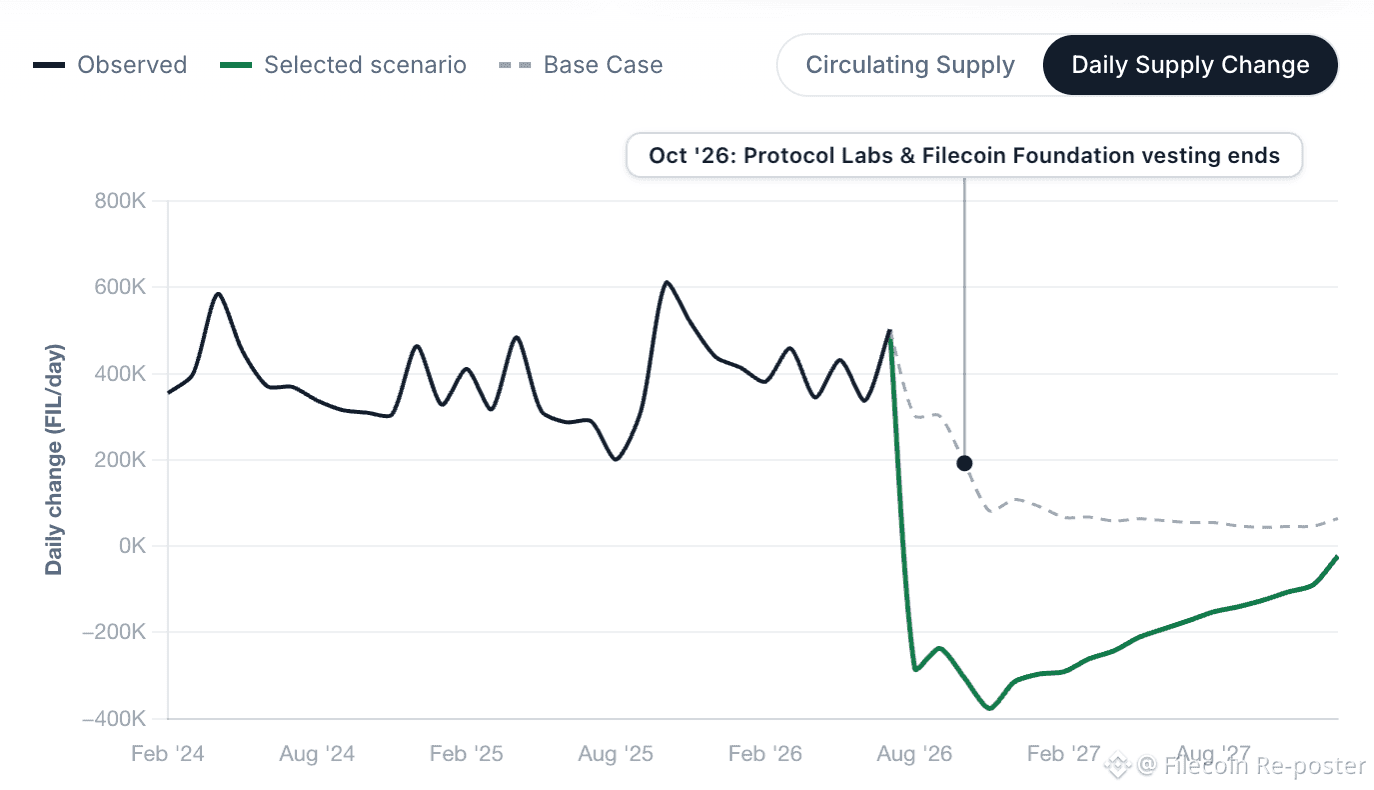
Based on recent modeling by @FilecoinTLDR, simulations indicate that the daily supply growth of FIL may see a significant reduction from current levels. As we approach the end of 2027, this rate could drop by a maximum of 119%. Should these upper end projections be realized, it will represent the very first time FIL becomes net deflationary. You are welcome to review the full update and learn more by visiting https://filecointldr.io/blog/filecoin-network-2026-overview-update
Based on recent modeling by @FilecoinTLDR, simulations indicate that the daily supply growth of FIL may see a significant reduction from current levels. As we approach the end of 2027, this rate could drop by a maximum of 119%. Should these upper end projections be realized, it will represent the very first time FIL becomes net deflationary. You are welcome to review the full update and learn more by visiting https://filecointldr.io/blog/filecoin-network-2026-overview-update
86
Connectez-vous pour découvrir plus de contenu
Rejoignez la communauté mondiale des adeptes de cryptomonnaies sur Binance Square
⚡️ Suviez les dernières informations importantes sur les cryptomonnaies.
💬 Jugé digne de confiance par la plus grande plateforme d’échange de cryptomonnaies au monde.
👍 Découvrez les connaissances que partagent les créateurs vérifiés.
Adresse e-mail/Nº de téléphone
Sujets d’actualité
BNBSurpasses$790
14,972 vues
126 mentions
$BNB strategic long plan -> FOCUS NOW
BNB has created 2 strong lows after taking out internal liquidity
I'm expecting a move towards swing high $815-$830 and looking for a long on a retest of the green box
#BNBSurpasses$790 #bnb
Ghost Writer
·6 mentions J’aime
·7.3k vues
ZamaRises15.99%ToIntradayHigh$0.09
11,593 vues
97 mentions
BitcoinSpotETFsDraw$6.34BInflowsInQ3
5,157 vues
82 mentions