

cRyPtO sMaRt Team
371 Publications

cRyPtO sMaRt Team
Signaler
Bloquer l’utilisateur
Your ultimate gateway to mastering the world of cryptocurrency trading. Deep insights into market psychology, proven strategies, and disciplined risk management
Ouvert au trading
Trade régulièrement
4.5 an(s)
67 Suivis
24 Abonnés
14 J’aime
Publications
Portefeuille
Tous
Vidéos
What if the loss already made your next decision for you?
After a red trade, the mind goes hunting for control. It tightens size out of fear, or doubles up to prove a point, both dressed up as "adjusting to the market." That's not strategy, that's emotion wearing strategy's clothes. The cost is quiet but real: a process built over months gets bent by one outcome that was never fully in your control to begin with.
Before the next entry, write down what your plan would've said if this loss never happened. Then follow that, not the story your ego is telling.
What's your usual tell that a loss is steering your next move?
$LINK $TRX $BTC #TradingPsychology #Mindset #Crypto #Trading
Follow for daily trading education · Education only, not financial advice.
What if the loss already made your next decision for you?
After a red trade, the mind goes hunting for control. It tightens size out of fear, or doubles up to prove a point, both dressed up as "adjusting to the market." That's not strategy, that's emotion wearing strategy's clothes. The cost is quiet but real: a process built over months gets bent by one outcome that was never fully in your control to begin with.
Before the next entry, write down what your plan would've said if this loss never happened. Then follow that, not the story your ego is telling.
What's your usual tell that a loss is steering your next move?
$LINK $TRX $BTC #TradingPsychology #Mindset #Crypto #Trading
Follow for daily trading education · Education only, not financial advice.
After a red trade, the mind goes hunting for control. It tightens size out of fear, or doubles up to prove a point, both dressed up as "adjusting to the market." That's not strategy, that's emotion wearing strategy's clothes. The cost is quiet but real: a process built over months gets bent by one outcome that was never fully in your control to begin with.
Before the next entry, write down what your plan would've said if this loss never happened. Then follow that, not the story your ego is telling.
What's your usual tell that a loss is steering your next move?
$LINK $TRX $BTC #TradingPsychology #Mindset #Crypto #Trading
Follow for daily trading education · Education only, not financial advice.

87
Some weeks the market teaches quiet lessons, the kind you only notice if you pause long enough to listen.
Discipline rarely feels exciting in the moment, but it's what separates a plan from a guess. Reacting to every flicker of movement often costs more than sitting still ever could, and protecting capital is always more valuable than chasing a feeling of missing out. Reviewing decisions after the fact, without judgment, is how a trader actually grows instead of just repeating the same instinctive mistakes.
Patience isn't passive either; it's an active choice to wait for your own criteria rather than the market's noise.
What's one lesson the market reminded you of this week?
$ADA $DOGE $AVAX #Crypto #Trading #WeeklyRecap #TA
Follow for daily trading education · Education only, not financial advice.
Some weeks the market teaches quiet lessons, the kind you only notice if you pause long enough to listen.
Discipline rarely feels exciting in the moment, but it's what separates a plan from a guess. Reacting to every flicker of movement often costs more than sitting still ever could, and protecting capital is always more valuable than chasing a feeling of missing out. Reviewing decisions after the fact, without judgment, is how a trader actually grows instead of just repeating the same instinctive mistakes.
Patience isn't passive either; it's an active choice to wait for your own criteria rather than the market's noise.
What's one lesson the market reminded you of this week?
$ADA $DOGE $AVAX #Crypto #Trading #WeeklyRecap #TA
Follow for daily trading education · Education only, not financial advice.
Discipline rarely feels exciting in the moment, but it's what separates a plan from a guess. Reacting to every flicker of movement often costs more than sitting still ever could, and protecting capital is always more valuable than chasing a feeling of missing out. Reviewing decisions after the fact, without judgment, is how a trader actually grows instead of just repeating the same instinctive mistakes.
Patience isn't passive either; it's an active choice to wait for your own criteria rather than the market's noise.
What's one lesson the market reminded you of this week?
$ADA $DOGE $AVAX #Crypto #Trading #WeeklyRecap #TA
Follow for daily trading education · Education only, not financial advice.

236
Winning fast feels like proof you've cracked the code. That's the trap.
It's the same reason a driver who just merges through traffic without a scratch starts speeding up right after — the near miss reads as skill instead of luck, so caution quietly drops. After a big win, the mind rewrites confidence as competence. Risk sizing loosens, setups get looser too, and the next trade gets taken on vibes instead of process. The cost isn't the loss itself — it's giving back what discipline just earned.
Next time you win big, treat the very next trade like a beginner would: same size, same checklist, no shortcuts.
What's your process for staying grounded right after a strong win?
$BNB $SOL $XRP #TradingPsychology #Mindset #Crypto #Trading
Follow for daily trading education · Education only, not financial advice.
Winning fast feels like proof you've cracked the code. That's the trap.
It's the same reason a driver who just merges through traffic without a scratch starts speeding up right after — the near miss reads as skill instead of luck, so caution quietly drops. After a big win, the mind rewrites confidence as competence. Risk sizing loosens, setups get looser too, and the next trade gets taken on vibes instead of process. The cost isn't the loss itself — it's giving back what discipline just earned.
Next time you win big, treat the very next trade like a beginner would: same size, same checklist, no shortcuts.
What's your process for staying grounded right after a strong win?
$BNB $SOL $XRP #TradingPsychology #Mindset #Crypto #Trading
Follow for daily trading education · Education only, not financial advice.
It's the same reason a driver who just merges through traffic without a scratch starts speeding up right after — the near miss reads as skill instead of luck, so caution quietly drops. After a big win, the mind rewrites confidence as competence. Risk sizing loosens, setups get looser too, and the next trade gets taken on vibes instead of process. The cost isn't the loss itself — it's giving back what discipline just earned.
Next time you win big, treat the very next trade like a beginner would: same size, same checklist, no shortcuts.
What's your process for staying grounded right after a strong win?
$BNB $SOL $XRP #TradingPsychology #Mindset #Crypto #Trading
Follow for daily trading education · Education only, not financial advice.

90
Beginners think funding rate is just "the fee for holding a perpetual." Wrong. It's a positioning gauge in disguise.
When funding turns sharply positive, longs are paying shorts — meaning the crowd has piled aggressively into one side of the trade. That imbalance doesn't predict direction, but it tells you how stretched sentiment has become. Extreme, sustained funding often means a market is crowded and vulnerable to a sharp unwind if conditions shift, since one-sided positioning has less room to add more of the same.
Watch how funding behaves during strong trends versus choppy ranges — notice when it spikes far from neutral relative to its own recent history.
What's the most extreme funding reading you've ever seen play out?
$TRX $BTC $ETH #Trading #TradingEducation #Crypto #TA
Follow for daily trading education · Education only, not financial advice.
Beginners think funding rate is just "the fee for holding a perpetual." Wrong. It's a positioning gauge in disguise.
When funding turns sharply positive, longs are paying shorts — meaning the crowd has piled aggressively into one side of the trade. That imbalance doesn't predict direction, but it tells you how stretched sentiment has become. Extreme, sustained funding often means a market is crowded and vulnerable to a sharp unwind if conditions shift, since one-sided positioning has less room to add more of the same.
Watch how funding behaves during strong trends versus choppy ranges — notice when it spikes far from neutral relative to its own recent history.
What's the most extreme funding reading you've ever seen play out?
$TRX $BTC $ETH #Trading #TradingEducation #Crypto #TA
Follow for daily trading education · Education only, not financial advice.
When funding turns sharply positive, longs are paying shorts — meaning the crowd has piled aggressively into one side of the trade. That imbalance doesn't predict direction, but it tells you how stretched sentiment has become. Extreme, sustained funding often means a market is crowded and vulnerable to a sharp unwind if conditions shift, since one-sided positioning has less room to add more of the same.
Watch how funding behaves during strong trends versus choppy ranges — notice when it spikes far from neutral relative to its own recent history.
What's the most extreme funding reading you've ever seen play out?
$TRX $BTC $ETH #Trading #TradingEducation #Crypto #TA
Follow for daily trading education · Education only, not financial advice.

95
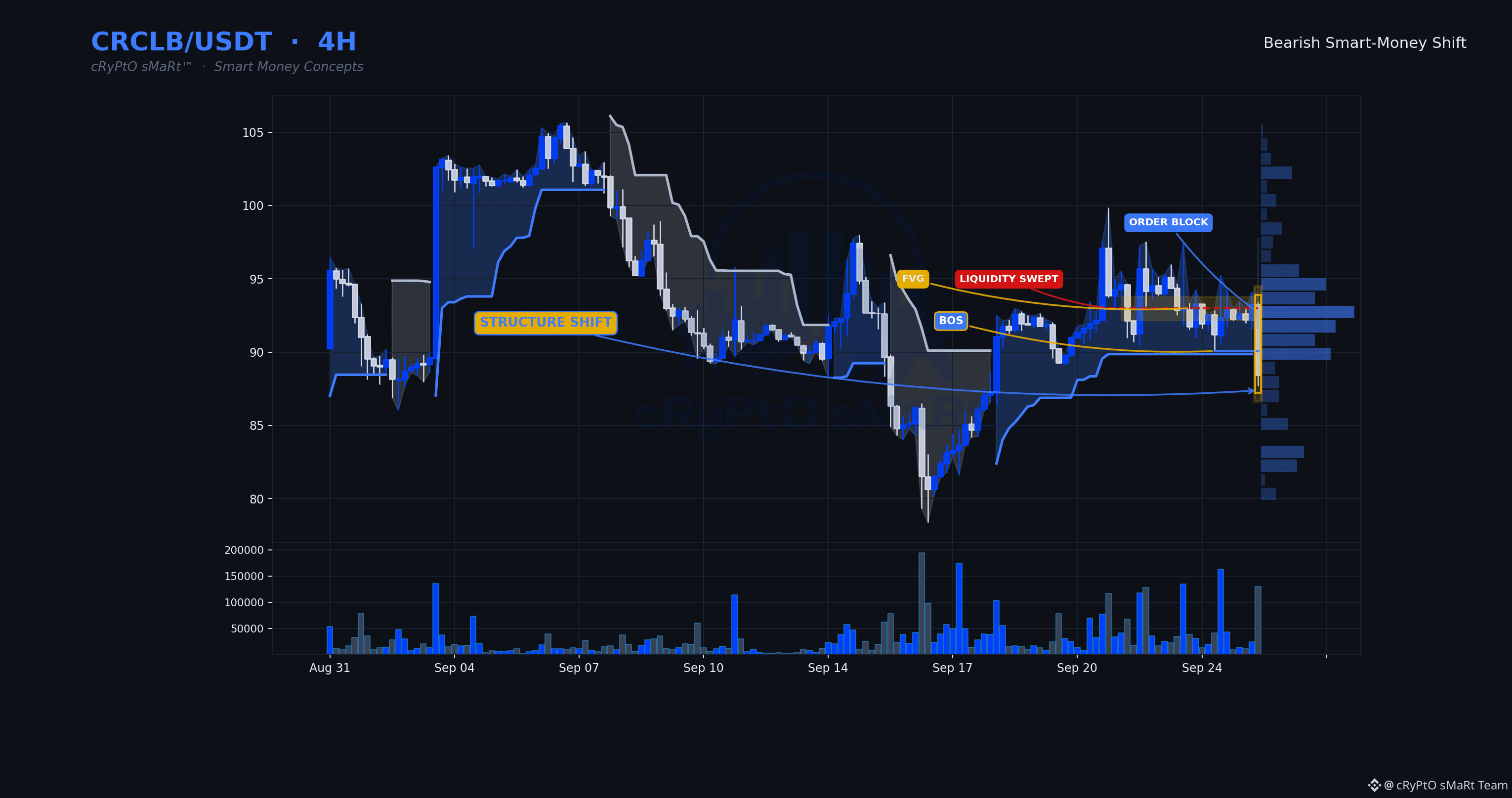
Sellers just took the highs, ran the resting liquidity, and immediately turned it into a structure break to the downside. That's not a shakeout that failed — displacement was strong and volume well above average, meaning real size drove this, not noise.
🗓 Daily: Neutral — daily is mixed — Supertrend and EMAs not aligned
⏱ 4H: Smart-Money Shift · Bearish bias
⏳ 1H: the 1H is trading below the level with its trend down — the lower timeframe confirms the setup.
📋 WHY IT QUALIFIES
✓ Smart-Money Shift structure completed
🧭 Bias: Bearish while price holds below $90.0800
⚠️ Invalidation: 4H close back above $90.0800
🔵 Support $90.0800 🟡 Resistance $92.9900
$CRCLB $BTC #SmartMoney
Education only, not financial advice.
Sellers just took the highs, ran the resting liquidity, and immediately turned it into a structure break to the downside. That's not a shakeout that failed — displacement was strong and volume well above average, meaning real size drove this, not noise.
🗓 Daily: Neutral — daily is mixed — Supertrend and EMAs not aligned
⏱ 4H: Smart-Money Shift · Bearish bias
⏳ 1H: the 1H is trading below the level with its trend down — the lower timeframe confirms the setup.
📋 WHY IT QUALIFIES
✓ Smart-Money Shift structure completed
🧭 Bias: Bearish while price holds below $90.0800
⚠️ Invalidation: 4H close back above $90.0800
🔵 Support $90.0800 🟡 Resistance $92.9900
$CRCLB $BTC #SmartMoney
Education only, not financial advice.
🗓 Daily: Neutral — daily is mixed — Supertrend and EMAs not aligned
⏱ 4H: Smart-Money Shift · Bearish bias
⏳ 1H: the 1H is trading below the level with its trend down — the lower timeframe confirms the setup.
📋 WHY IT QUALIFIES
✓ Smart-Money Shift structure completed
🧭 Bias: Bearish while price holds below $90.0800
⚠️ Invalidation: 4H close back above $90.0800
🔵 Support $90.0800 🟡 Resistance $92.9900
$CRCLB $BTC #SmartMoney
Education only, not financial advice.
172
The mistake: trusting willpower to make the hard call in real time. A trader builds a solid plan the night before, feels calm and clear-headed, then the market moves and adrenaline takes over. In that moment, willpower is competing with fear and greed, and it usually loses. That's not weakness, it's biology — decision-making quality drops under stress, no matter how disciplined someone believes they are. The fix isn't trying harder in the moment, it's removing the decision from the moment. Write the process down before entering, include exact conditions for exit, and follow it like a checklist, not a suggestion. What part of your plan tends to get abandoned first when things get tense?
$DOGE $AVAX $LINK #TradingPsychology #Mindset #Crypto #Trading
Follow for daily trading education · Education only, not financial advice.
The mistake: trusting willpower to make the hard call in real time. A trader builds a solid plan the night before, feels calm and clear-headed, then the market moves and adrenaline takes over. In that moment, willpower is competing with fear and greed, and it usually loses. That's not weakness, it's biology — decision-making quality drops under stress, no matter how disciplined someone believes they are. The fix isn't trying harder in the moment, it's removing the decision from the moment. Write the process down before entering, include exact conditions for exit, and follow it like a checklist, not a suggestion. What part of your plan tends to get abandoned first when things get tense?
$DOGE $AVAX $LINK #TradingPsychology #Mindset #Crypto #Trading
Follow for daily trading education · Education only, not financial advice.
$DOGE $AVAX $LINK #TradingPsychology #Mindset #Crypto #Trading
Follow for daily trading education · Education only, not financial advice.

166
Bitcoin holding near recent levels as bond markets catch a breather is the headline theme, but the real story is structural: crypto's fate is still tightly linked to broader rates and liquidity conditions, not just internal news. That matters because it shows the market hasn't decoupled from macro forces yet. Meanwhile, security and regulatory friction keep surfacing underneath — Bitget's exploit, New York's action against Polymarket, and the Fed's stablecoin rulemaking under the GENIUS Act all point to infrastructure and oversight still catching up with the industry's growth. Watch how exchanges respond to security scrutiny and how regulators shape stablecoin rules, since both affect trust and flow of funds. As these threads develop, does market stability look like calm, or just a pause before the next catalyst?
$SOL $XRP $ADA #Crypto #News #Bitcoin #Trading
Follow for daily trading education · Education only, not financial advice.
Bitcoin holding near recent levels as bond markets catch a breather is the headline theme, but the real story is structural: crypto's fate is still tightly linked to broader rates and liquidity conditions, not just internal news. That matters because it shows the market hasn't decoupled from macro forces yet. Meanwhile, security and regulatory friction keep surfacing underneath — Bitget's exploit, New York's action against Polymarket, and the Fed's stablecoin rulemaking under the GENIUS Act all point to infrastructure and oversight still catching up with the industry's growth. Watch how exchanges respond to security scrutiny and how regulators shape stablecoin rules, since both affect trust and flow of funds. As these threads develop, does market stability look like calm, or just a pause before the next catalyst?
$SOL $XRP $ADA #Crypto #News #Bitcoin #Trading
Follow for daily trading education · Education only, not financial advice.
$SOL $XRP $ADA #Crypto #News #Bitcoin #Trading
Follow for daily trading education · Education only, not financial advice.

114
Boredom trading feels like opening the fridge at midnight, not because there's hunger, just restlessness looking for something to do. The market didn't create a setup, the mind just wanted stimulation, and it dresses that craving up as opportunity. The cost is real money spent solving a feeling that had nothing to do with charts. Next time the urge hits with no clear reason behind it, name it out loud: "this is boredom, not a signal." Then step away for ten minutes and see if the trade still looks good. What's your go-to move when the itch to click buy has nothing backing it?
$BTC $ETH $BNB #TradingPsychology #Mindset #Crypto #Trading
Follow for daily trading education · Education only, not financial advice.
Boredom trading feels like opening the fridge at midnight, not because there's hunger, just restlessness looking for something to do. The market didn't create a setup, the mind just wanted stimulation, and it dresses that craving up as opportunity. The cost is real money spent solving a feeling that had nothing to do with charts. Next time the urge hits with no clear reason behind it, name it out loud: "this is boredom, not a signal." Then step away for ten minutes and see if the trade still looks good. What's your go-to move when the itch to click buy has nothing backing it?
$BTC $ETH $BNB #TradingPsychology #Mindset #Crypto #Trading
Follow for daily trading education · Education only, not financial advice.
$BTC $ETH $BNB #TradingPsychology #Mindset #Crypto #Trading
Follow for daily trading education · Education only, not financial advice.

89
Ever wonder why price loves to poke above the obvious high or dip below the obvious low right before it actually moves?
Here's the gap: those levels aren't random. Every trader who bought a low or shorted a high has orders parked just beyond it — stop losses, breakout entries, liquidations. That's resting liquidity, and it pools exactly where the crowd expects support or resistance to hold. Price doesn't respect those levels, it hunts them. Big players need that liquidity to fill their own size, so price gets pushed into the pocket, triggers the orders, then often reverses.
Next time you're watching a range, mark the highs and lows everyone can see. Watch what happens the moment price touches them — does it reverse hard after a quick spike through?
What level are you watching get swept right now?
$AVAX $LINK $TRX #Trading #TradingEducation #Crypto #TA
Follow for daily trading education · Education only, not financial advice.
Ever wonder why price loves to poke above the obvious high or dip below the obvious low right before it actually moves?
Here's the gap: those levels aren't random. Every trader who bought a low or shorted a high has orders parked just beyond it — stop losses, breakout entries, liquidations. That's resting liquidity, and it pools exactly where the crowd expects support or resistance to hold. Price doesn't respect those levels, it hunts them. Big players need that liquidity to fill their own size, so price gets pushed into the pocket, triggers the orders, then often reverses.
Next time you're watching a range, mark the highs and lows everyone can see. Watch what happens the moment price touches them — does it reverse hard after a quick spike through?
What level are you watching get swept right now?
$AVAX $LINK $TRX #Trading #TradingEducation #Crypto #TA
Follow for daily trading education · Education only, not financial advice.
Here's the gap: those levels aren't random. Every trader who bought a low or shorted a high has orders parked just beyond it — stop losses, breakout entries, liquidations. That's resting liquidity, and it pools exactly where the crowd expects support or resistance to hold. Price doesn't respect those levels, it hunts them. Big players need that liquidity to fill their own size, so price gets pushed into the pocket, triggers the orders, then often reverses.
Next time you're watching a range, mark the highs and lows everyone can see. Watch what happens the moment price touches them — does it reverse hard after a quick spike through?
What level are you watching get swept right now?
$AVAX $LINK $TRX #Trading #TradingEducation #Crypto #TA
Follow for daily trading education · Education only, not financial advice.

240
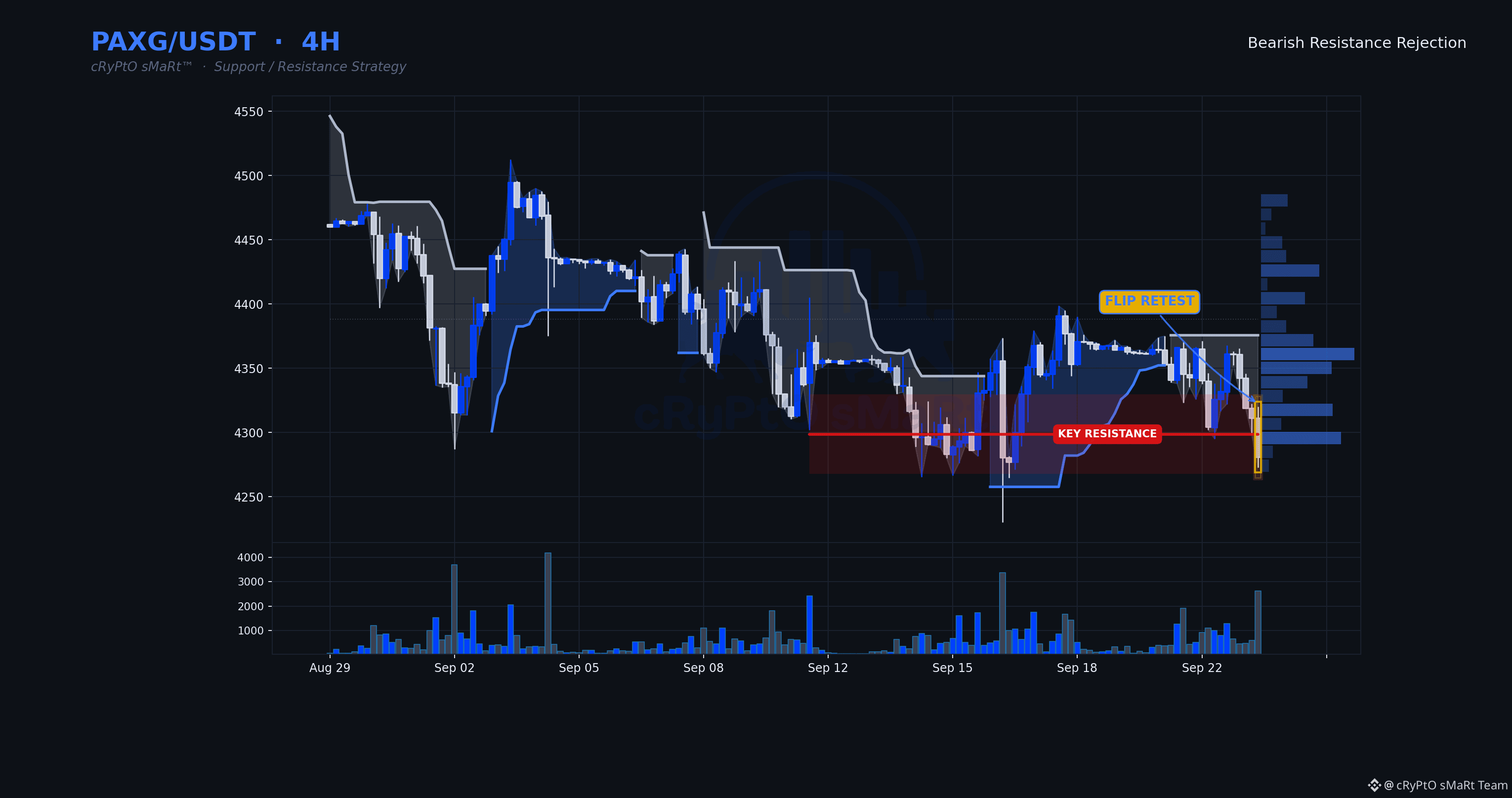
PAXG is doing exactly what a flip retest is supposed to do — old support gets tested as resistance and sellers show up with real size behind them. Volume well above average on this reaction tells you this isn't a quiet drift back to the level, participants are actively defending it.
🗓 Daily: Neutral — daily is mixed — Supertrend and EMAs not aligned
⏱ 4H: Support/Resistance Reaction · Bearish bias
⏳ 1H: the 1H is still above the level — the setup only triggers once it loses and holds below it.
📋 WHY IT QUALIFIES
✓ Support/Resistance Reaction structure completed
🧭 Bias: Bearish while price holds below $4,230.00
⚠️ Invalidation: 4H close back above $4,230.00
🔵 Support $4,230.00 🟡 Resistance $4,298.61
$PAXG $BTC #SupportResistance
Education only, not financial advice.
PAXG is doing exactly what a flip retest is supposed to do — old support gets tested as resistance and sellers show up with real size behind them. Volume well above average on this reaction tells you this isn't a quiet drift back to the level, participants are actively defending it.
🗓 Daily: Neutral — daily is mixed — Supertrend and EMAs not aligned
⏱ 4H: Support/Resistance Reaction · Bearish bias
⏳ 1H: the 1H is still above the level — the setup only triggers once it loses and holds below it.
📋 WHY IT QUALIFIES
✓ Support/Resistance Reaction structure completed
🧭 Bias: Bearish while price holds below $4,230.00
⚠️ Invalidation: 4H close back above $4,230.00
🔵 Support $4,230.00 🟡 Resistance $4,298.61
$PAXG $BTC #SupportResistance
Education only, not financial advice.
🗓 Daily: Neutral — daily is mixed — Supertrend and EMAs not aligned
⏱ 4H: Support/Resistance Reaction · Bearish bias
⏳ 1H: the 1H is still above the level — the setup only triggers once it loses and holds below it.
📋 WHY IT QUALIFIES
✓ Support/Resistance Reaction structure completed
🧭 Bias: Bearish while price holds below $4,230.00
⚠️ Invalidation: 4H close back above $4,230.00
🔵 Support $4,230.00 🟡 Resistance $4,298.61
$PAXG $BTC #SupportResistance
Education only, not financial advice.
119
Conviction has never once told you how many coins to buy.
Here's the mechanic most traders skip: position size should come from the distance between your entry and the point that proves you wrong, combined with how much of your account you're willing to lose if that happens. Wide invalidation, smaller size. Tight invalidation, larger size is possible. The excitement you feel about a setup has zero mathematical relationship to any of this. Size decided by emotion is just risk decided by accident.
Next time you enter, calculate size last, not first. Find invalidation, define acceptable account risk, then let the math hand you the size.
What's your process for setting invalidation before you size a trade?
$ETH $BNB $SOL #Trading #TradingEducation #Crypto #TA
Follow for daily trading education · Education only, not financial advice.
Conviction has never once told you how many coins to buy.
Here's the mechanic most traders skip: position size should come from the distance between your entry and the point that proves you wrong, combined with how much of your account you're willing to lose if that happens. Wide invalidation, smaller size. Tight invalidation, larger size is possible. The excitement you feel about a setup has zero mathematical relationship to any of this. Size decided by emotion is just risk decided by accident.
Next time you enter, calculate size last, not first. Find invalidation, define acceptable account risk, then let the math hand you the size.
What's your process for setting invalidation before you size a trade?
$ETH $BNB $SOL #Trading #TradingEducation #Crypto #TA
Follow for daily trading education · Education only, not financial advice.
Here's the mechanic most traders skip: position size should come from the distance between your entry and the point that proves you wrong, combined with how much of your account you're willing to lose if that happens. Wide invalidation, smaller size. Tight invalidation, larger size is possible. The excitement you feel about a setup has zero mathematical relationship to any of this. Size decided by emotion is just risk decided by accident.
Next time you enter, calculate size last, not first. Find invalidation, define acceptable account risk, then let the math hand you the size.
What's your process for setting invalidation before you size a trade?
$ETH $BNB $SOL #Trading #TradingEducation #Crypto #TA
Follow for daily trading education · Education only, not financial advice.

94
The costliest beginner mistake isn't missing a move — it's refusing to accept that it's missed. Something runs, the plan wasn't triggered, and instead of walking away, the mind starts negotiating: "it'll pull back," "there's still room." That's not analysis, that's regret talking. Chasing in late means buying someone else's exit, usually right where the move runs out of energy. Missing a trade costs nothing. Chasing one can cost real capital. Next time it runs without you, write down why you're staying out, not why you should jump in. What's your rule for letting a move go?
$LINK $TRX $BTC #TradingPsychology #Mindset #Crypto #Trading
Follow for daily trading education · Education only, not financial advice.
The costliest beginner mistake isn't missing a move — it's refusing to accept that it's missed. Something runs, the plan wasn't triggered, and instead of walking away, the mind starts negotiating: "it'll pull back," "there's still room." That's not analysis, that's regret talking. Chasing in late means buying someone else's exit, usually right where the move runs out of energy. Missing a trade costs nothing. Chasing one can cost real capital. Next time it runs without you, write down why you're staying out, not why you should jump in. What's your rule for letting a move go?
$LINK $TRX $BTC #TradingPsychology #Mindset #Crypto #Trading
Follow for daily trading education · Education only, not financial advice.
$LINK $TRX $BTC #TradingPsychology #Mindset #Crypto #Trading
Follow for daily trading education · Education only, not financial advice.

62
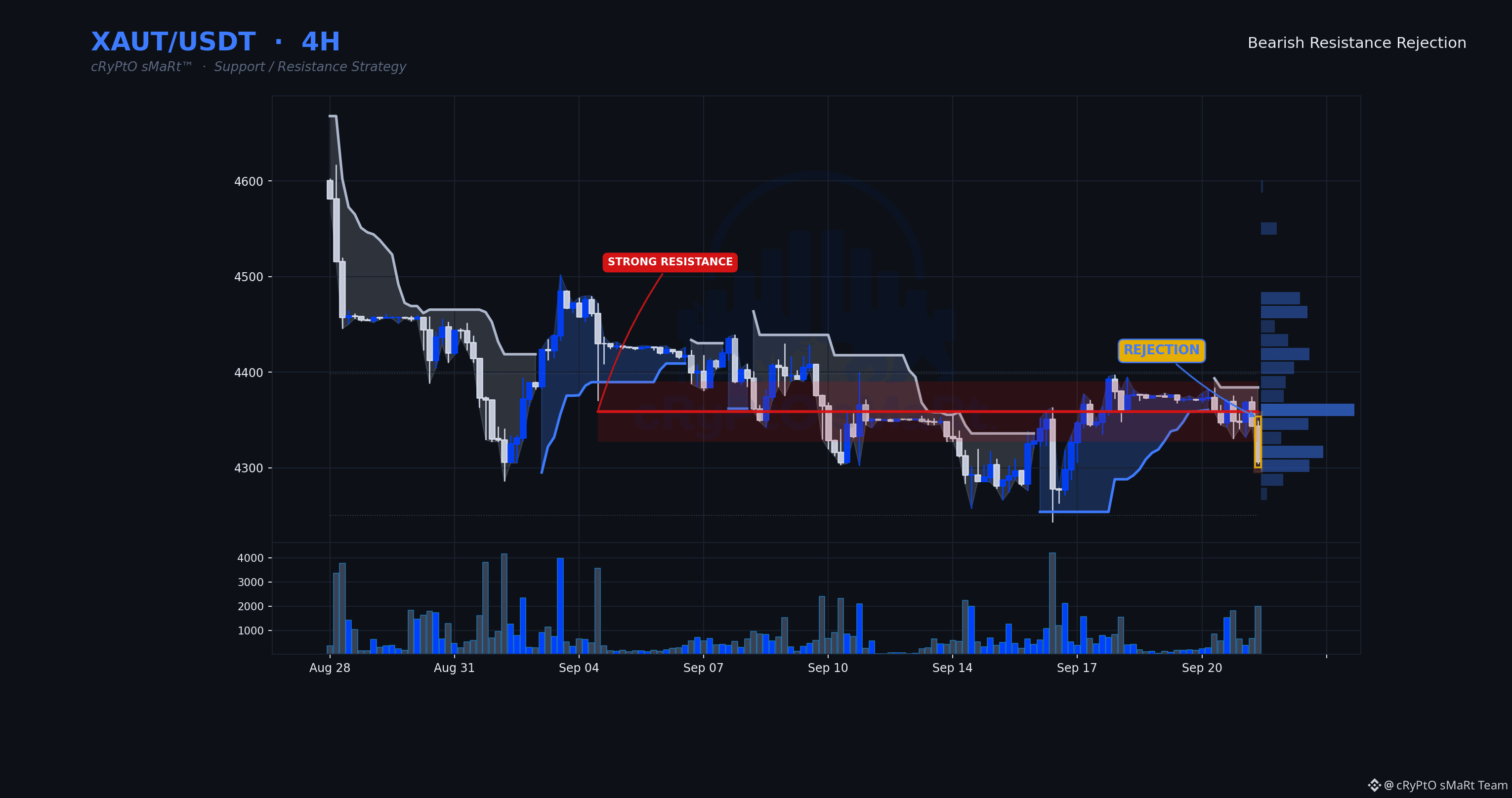
Sellers showed up hard at a level that's rejected price before, and this time they came with volume well above average — that's not passive profit-taking, that's active supply meeting the bid. The rejection tells you who's controlling the tape right now, but one wick doesn't confirm a trend.
🗓 Daily: Neutral — daily is mixed — Supertrend and EMAs not aligned
⏱ 4H: Support/Resistance Reaction · Bearish bias
⏳ 1H: the 1H is still above the level — the setup only triggers once it loses and holds below it.
📋 WHY IT QUALIFIES
✓ Support/Resistance Reaction structure completed
🧭 Bias: Bearish while price holds below $4,250.23
⚠️ Invalidation: 4H close back above $4,250.23
🔵 Support $4,250.23 🟡 Resistance $4,358.60
$XAUT $BTC #SupportResistance
Education only, not financial advice.
Sellers showed up hard at a level that's rejected price before, and this time they came with volume well above average — that's not passive profit-taking, that's active supply meeting the bid. The rejection tells you who's controlling the tape right now, but one wick doesn't confirm a trend.
🗓 Daily: Neutral — daily is mixed — Supertrend and EMAs not aligned
⏱ 4H: Support/Resistance Reaction · Bearish bias
⏳ 1H: the 1H is still above the level — the setup only triggers once it loses and holds below it.
📋 WHY IT QUALIFIES
✓ Support/Resistance Reaction structure completed
🧭 Bias: Bearish while price holds below $4,250.23
⚠️ Invalidation: 4H close back above $4,250.23
🔵 Support $4,250.23 🟡 Resistance $4,358.60
$XAUT $BTC #SupportResistance
Education only, not financial advice.
🗓 Daily: Neutral — daily is mixed — Supertrend and EMAs not aligned
⏱ 4H: Support/Resistance Reaction · Bearish bias
⏳ 1H: the 1H is still above the level — the setup only triggers once it loses and holds below it.
📋 WHY IT QUALIFIES
✓ Support/Resistance Reaction structure completed
🧭 Bias: Bearish while price holds below $4,250.23
⚠️ Invalidation: 4H close back above $4,250.23
🔵 Support $4,250.23 🟡 Resistance $4,358.60
$XAUT $BTC #SupportResistance
Education only, not financial advice.
114
Nobody boards a plane with only one engine. Airlines build in redundancy because a single failure shouldn't end the flight. Trading needs the same logic.
Here's the concept: capping risk to a small fraction of the account per trade means no single loss can ground you. Lose big once, and you need a huge win just to get back to even — math that quietly wrecks accounts. Lose small, repeatedly, and you stay in the game long enough for your edge to actually play out.
Watch how much of your account moves on a single bad trade. If one loss changes your mood or your month, the position was too big, not just the market too mean.
What's your personal ceiling per trade, and does your last month of trades actually respect it?
$ADA $DOGE $AVAX #Trading #TradingEducation #Crypto #TA
Follow for daily trading education · Education only, not financial advice.
Nobody boards a plane with only one engine. Airlines build in redundancy because a single failure shouldn't end the flight. Trading needs the same logic.
Here's the concept: capping risk to a small fraction of the account per trade means no single loss can ground you. Lose big once, and you need a huge win just to get back to even — math that quietly wrecks accounts. Lose small, repeatedly, and you stay in the game long enough for your edge to actually play out.
Watch how much of your account moves on a single bad trade. If one loss changes your mood or your month, the position was too big, not just the market too mean.
What's your personal ceiling per trade, and does your last month of trades actually respect it?
$ADA $DOGE $AVAX #Trading #TradingEducation #Crypto #TA
Follow for daily trading education · Education only, not financial advice.
Here's the concept: capping risk to a small fraction of the account per trade means no single loss can ground you. Lose big once, and you need a huge win just to get back to even — math that quietly wrecks accounts. Lose small, repeatedly, and you stay in the game long enough for your edge to actually play out.
Watch how much of your account moves on a single bad trade. If one loss changes your mood or your month, the position was too big, not just the market too mean.
What's your personal ceiling per trade, and does your last month of trades actually respect it?
$ADA $DOGE $AVAX #Trading #TradingEducation #Crypto #TA
Follow for daily trading education · Education only, not financial advice.

218
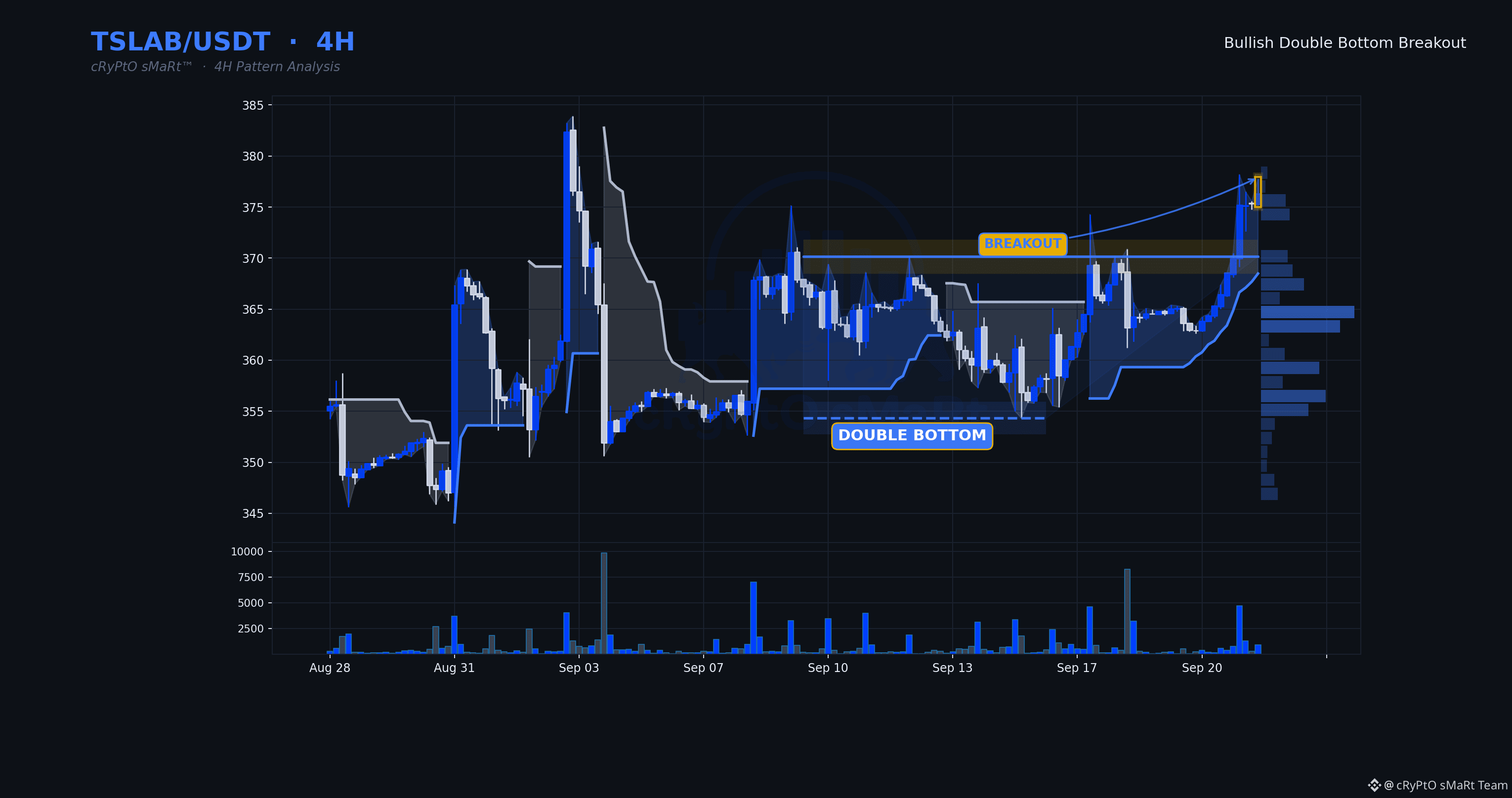
Two failed pushes lower, buyers stepped in both times at the same shelf, and now the breakout comes on volume that actually backs it. That's not a drift higher, that's demand showing up with intent.
🗓 Daily: Bullish — daily Supertrend up, price holding above the 50 EMA
⏱ 4H: Double Bottom · Bullish bias
⏳ 1H: the 1H is holding above the level with its trend up — the lower timeframe confirms the setup.
✅ Daily, 4H and 1H all point bullish.
📋 WHY IT QUALIFIES
✓ Double Bottom structure completed
✓ Decisive breakout — closed 1.7% beyond the line
✓ Volume 1.6× its 20-bar average
✓ RSI 76 — momentum confirms, not yet exhausted
🧭 Bias: Bullish while price holds above $370.1400
⚠️ Invalidation: 4H close back below $370.1400
🔵 Support $354.3200 🟡 Resistance $370.1400
$TSLAB $BTC #ChartPatterns
Education only, not financial advice.
Two failed pushes lower, buyers stepped in both times at the same shelf, and now the breakout comes on volume that actually backs it. That's not a drift higher, that's demand showing up with intent.
🗓 Daily: Bullish — daily Supertrend up, price holding above the 50 EMA
⏱ 4H: Double Bottom · Bullish bias
⏳ 1H: the 1H is holding above the level with its trend up — the lower timeframe confirms the setup.
✅ Daily, 4H and 1H all point bullish.
📋 WHY IT QUALIFIES
✓ Double Bottom structure completed
✓ Decisive breakout — closed 1.7% beyond the line
✓ Volume 1.6× its 20-bar average
✓ RSI 76 — momentum confirms, not yet exhausted
🧭 Bias: Bullish while price holds above $370.1400
⚠️ Invalidation: 4H close back below $370.1400
🔵 Support $354.3200 🟡 Resistance $370.1400
$TSLAB $BTC #ChartPatterns
Education only, not financial advice.
🗓 Daily: Bullish — daily Supertrend up, price holding above the 50 EMA
⏱ 4H: Double Bottom · Bullish bias
⏳ 1H: the 1H is holding above the level with its trend up — the lower timeframe confirms the setup.
✅ Daily, 4H and 1H all point bullish.
📋 WHY IT QUALIFIES
✓ Double Bottom structure completed
✓ Decisive breakout — closed 1.7% beyond the line
✓ Volume 1.6× its 20-bar average
✓ RSI 76 — momentum confirms, not yet exhausted
🧭 Bias: Bullish while price holds above $370.1400
⚠️ Invalidation: 4H close back below $370.1400
🔵 Support $354.3200 🟡 Resistance $370.1400
$TSLAB $BTC #ChartPatterns
Education only, not financial advice.
71
The costliest beginner mistake isn't a bad trade — it's an unnecessary one, taken because the chart was open and nothing was happening.
Boredom feels like a problem that needs solving right now, so a trader invents a setup that isn't really there. The cost hides well: it doesn't show up as one big loss, it shows up as a slow leak of small ones that never had a real edge behind them.
Next time the urge to act shows up without a real signal, write down what your plan actually requires, then check if it's present. If not, the trade is to do nothing.
What's your go-to way of telling boredom apart from a real setup?
$BNB $SOL $XRP #TradingPsychology #Mindset #Crypto #Trading
Follow for daily trading education · Education only, not financial advice.
The costliest beginner mistake isn't a bad trade — it's an unnecessary one, taken because the chart was open and nothing was happening.
Boredom feels like a problem that needs solving right now, so a trader invents a setup that isn't really there. The cost hides well: it doesn't show up as one big loss, it shows up as a slow leak of small ones that never had a real edge behind them.
Next time the urge to act shows up without a real signal, write down what your plan actually requires, then check if it's present. If not, the trade is to do nothing.
What's your go-to way of telling boredom apart from a real setup?
$BNB $SOL $XRP #TradingPsychology #Mindset #Crypto #Trading
Follow for daily trading education · Education only, not financial advice.
Boredom feels like a problem that needs solving right now, so a trader invents a setup that isn't really there. The cost hides well: it doesn't show up as one big loss, it shows up as a slow leak of small ones that never had a real edge behind them.
Next time the urge to act shows up without a real signal, write down what your plan actually requires, then check if it's present. If not, the trade is to do nothing.
What's your go-to way of telling boredom apart from a real setup?
$BNB $SOL $XRP #TradingPsychology #Mindset #Crypto #Trading
Follow for daily trading education · Education only, not financial advice.

91
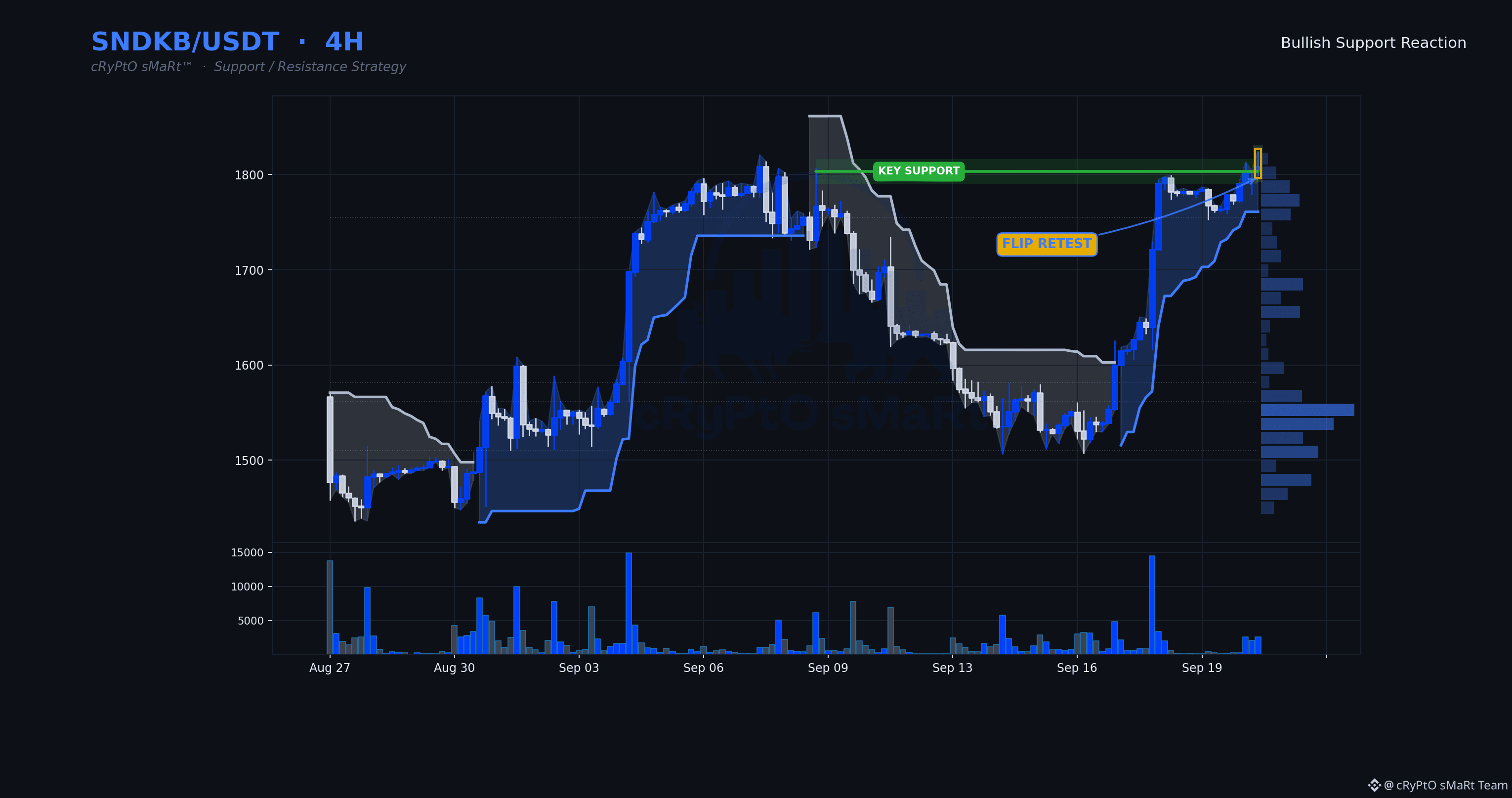
Buyers just turned old resistance into a support shelf, and they did it with volume that actually confirms intent, not a low-conviction drift. That flip-retest structure is exactly what desks want to see before trusting a breakout as real rather than a trap.
🗓 Daily: Bullish — daily Supertrend up, price holding above the 50 EMA
⏱ 4H: Support/Resistance Reaction · Bullish bias
⏳ 1H: the 1H still needs to reclaim and hold the level before the setup is confirmed on the lower timeframe.
📋 WHY IT QUALIFIES
✓ Support/Resistance Reaction structure completed
🧭 Bias: Bullish while price holds above $1,824.82
⚠️ Invalidation: 4H close back below $1,824.82
🔵 Support $1,803.16 🟡 Resistance $1,824.82
$SNDKB $BTC #SupportResistance
Education only, not financial advice.
Buyers just turned old resistance into a support shelf, and they did it with volume that actually confirms intent, not a low-conviction drift. That flip-retest structure is exactly what desks want to see before trusting a breakout as real rather than a trap.
🗓 Daily: Bullish — daily Supertrend up, price holding above the 50 EMA
⏱ 4H: Support/Resistance Reaction · Bullish bias
⏳ 1H: the 1H still needs to reclaim and hold the level before the setup is confirmed on the lower timeframe.
📋 WHY IT QUALIFIES
✓ Support/Resistance Reaction structure completed
🧭 Bias: Bullish while price holds above $1,824.82
⚠️ Invalidation: 4H close back below $1,824.82
🔵 Support $1,803.16 🟡 Resistance $1,824.82
$SNDKB $BTC #SupportResistance
Education only, not financial advice.
🗓 Daily: Bullish — daily Supertrend up, price holding above the 50 EMA
⏱ 4H: Support/Resistance Reaction · Bullish bias
⏳ 1H: the 1H still needs to reclaim and hold the level before the setup is confirmed on the lower timeframe.
📋 WHY IT QUALIFIES
✓ Support/Resistance Reaction structure completed
🧭 Bias: Bullish while price holds above $1,824.82
⚠️ Invalidation: 4H close back below $1,824.82
🔵 Support $1,803.16 🟡 Resistance $1,824.82
$SNDKB $BTC #SupportResistance
Education only, not financial advice.
85
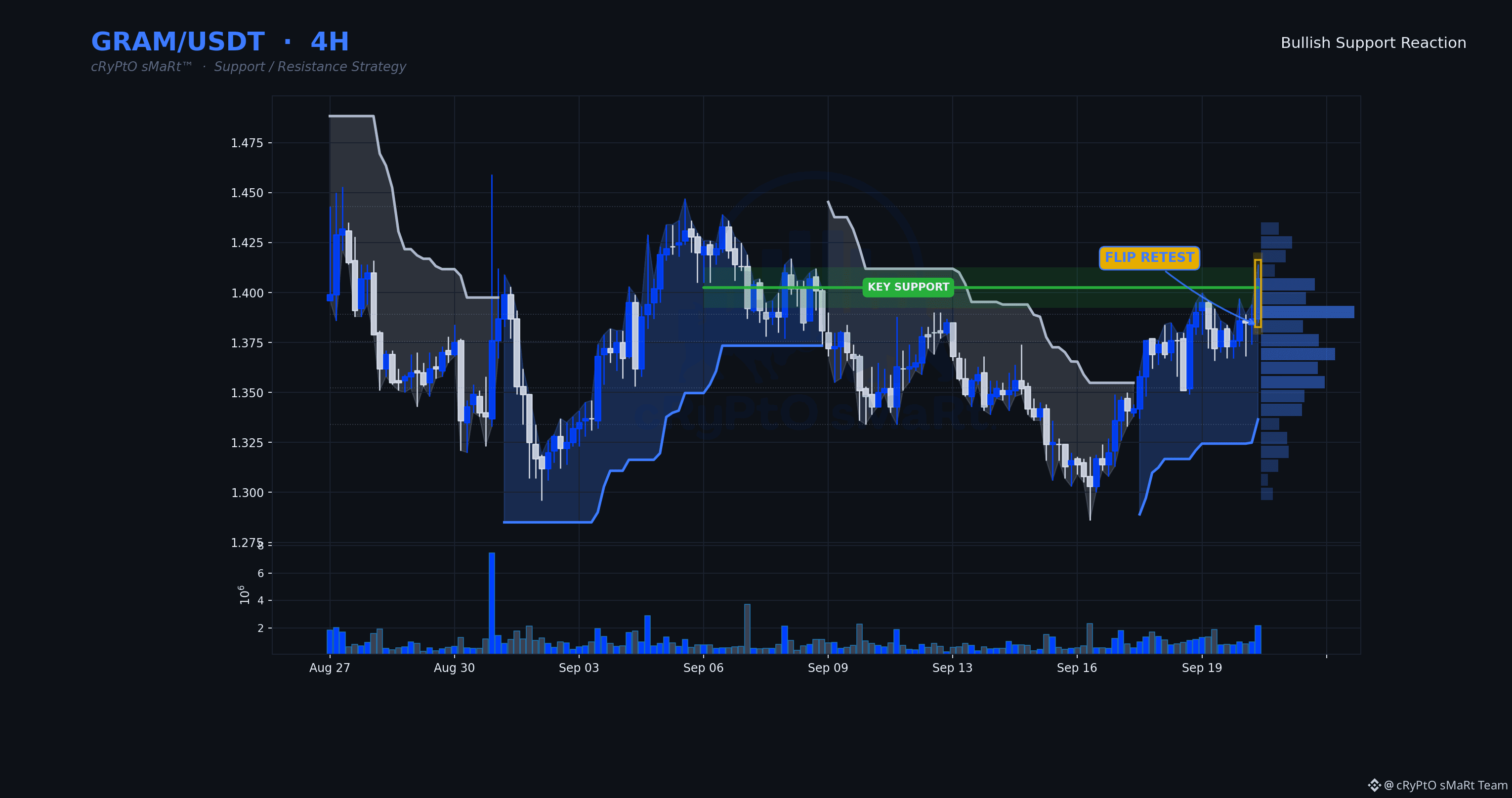
Buyers just turned old resistance into a launchpad, and they did it on volume well above average — that's not passive drift, that's participation showing up at the level.
🗓 Daily: Neutral — daily is mixed — Supertrend and EMAs not aligned
⏱ 4H: Support/Resistance Reaction · Bullish bias
⏳ 1H: the 1H still needs to reclaim and hold the level before the setup is confirmed on the lower timeframe.
📋 WHY IT QUALIFIES
✓ Support/Resistance Reaction structure completed
🧭 Bias: Bullish while price holds above $1.4430
⚠️ Invalidation: 4H close back below $1.4430
🔵 Support $1.4025 🟡 Resistance $1.4430
$GRAM $BTC #SupportResistance
Education only, not financial advice.
Buyers just turned old resistance into a launchpad, and they did it on volume well above average — that's not passive drift, that's participation showing up at the level.
🗓 Daily: Neutral — daily is mixed — Supertrend and EMAs not aligned
⏱ 4H: Support/Resistance Reaction · Bullish bias
⏳ 1H: the 1H still needs to reclaim and hold the level before the setup is confirmed on the lower timeframe.
📋 WHY IT QUALIFIES
✓ Support/Resistance Reaction structure completed
🧭 Bias: Bullish while price holds above $1.4430
⚠️ Invalidation: 4H close back below $1.4430
🔵 Support $1.4025 🟡 Resistance $1.4430
$GRAM $BTC #SupportResistance
Education only, not financial advice.
🗓 Daily: Neutral — daily is mixed — Supertrend and EMAs not aligned
⏱ 4H: Support/Resistance Reaction · Bullish bias
⏳ 1H: the 1H still needs to reclaim and hold the level before the setup is confirmed on the lower timeframe.
📋 WHY IT QUALIFIES
✓ Support/Resistance Reaction structure completed
🧭 Bias: Bullish while price holds above $1.4430
⚠️ Invalidation: 4H close back below $1.4430
🔵 Support $1.4025 🟡 Resistance $1.4430
$GRAM $BTC #SupportResistance
Education only, not financial advice.
203
Most beginners think support and resistance are exact lines. They're not. They're zones where price has reacted before, not laser-precise levels waiting to bounce on command.
Here's the real mechanic: when price breaks through a zone with conviction, that zone often flips roles. Old resistance becomes new support. Old support becomes new resistance. The market is just remembering where orders piled up before.
Watch how price behaves on the retest of a broken level. A clean reaction confirms the flip. A messy chop through it says the level never really held.
What's one level you've watched flip roles recently?
$TRX $BTC $ETH #Trading #TradingEducation #Crypto #TA
Follow for daily trading education · Education only, not financial advice.
Most beginners think support and resistance are exact lines. They're not. They're zones where price has reacted before, not laser-precise levels waiting to bounce on command.
Here's the real mechanic: when price breaks through a zone with conviction, that zone often flips roles. Old resistance becomes new support. Old support becomes new resistance. The market is just remembering where orders piled up before.
Watch how price behaves on the retest of a broken level. A clean reaction confirms the flip. A messy chop through it says the level never really held.
What's one level you've watched flip roles recently?
$TRX $BTC $ETH #Trading #TradingEducation #Crypto #TA
Follow for daily trading education · Education only, not financial advice.
Here's the real mechanic: when price breaks through a zone with conviction, that zone often flips roles. Old resistance becomes new support. Old support becomes new resistance. The market is just remembering where orders piled up before.
Watch how price behaves on the retest of a broken level. A clean reaction confirms the flip. A messy chop through it says the level never really held.
What's one level you've watched flip roles recently?
$TRX $BTC $ETH #Trading #TradingEducation #Crypto #TA
Follow for daily trading education · Education only, not financial advice.

92
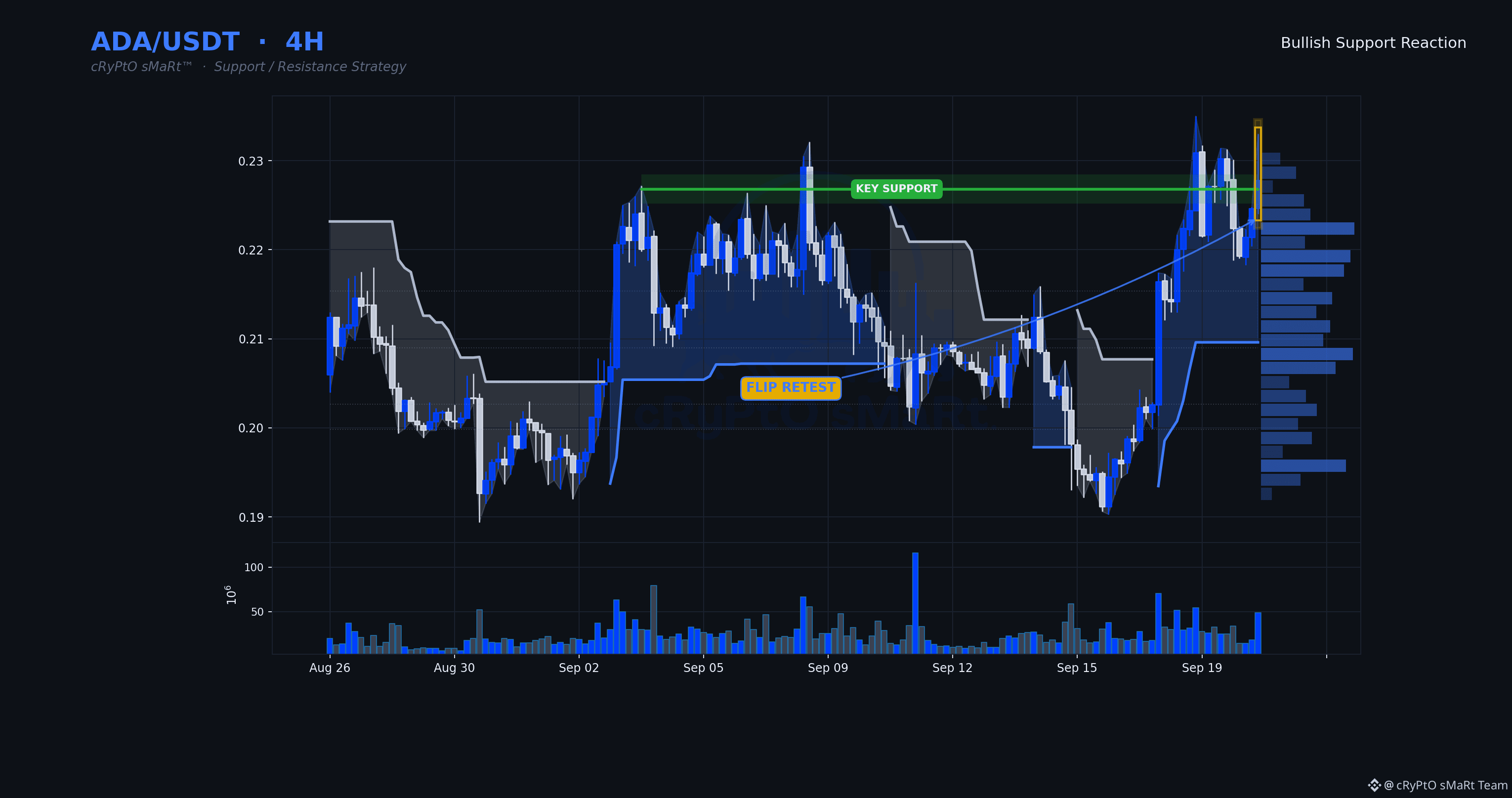
Buyers just flipped a well-established level into support and came back to defend it immediately, no hesitation. Volume stepping in well above average on the retest tells you this isn't a passive drift back to the level — there's real participation confirming the flip.
🗓 Daily: Bullish — daily Supertrend up, price holding above the 50 EMA
⏱ 4H: Support/Resistance Reaction · Bullish bias
⏳ 1H: the 1H still needs to reclaim and hold the level before the setup is confirmed on the lower timeframe.
📋 WHY IT QUALIFIES
✓ Support/Resistance Reaction structure completed
🧭 Bias: Bullish while price holds above $0.23500
⚠️ Invalidation: 4H close back below $0.23500
🔵 Support $0.22680 🟡 Resistance $0.23500
$ADA $BTC #SupportResistance
Education only, not financial advice.
Buyers just flipped a well-established level into support and came back to defend it immediately, no hesitation. Volume stepping in well above average on the retest tells you this isn't a passive drift back to the level — there's real participation confirming the flip.
🗓 Daily: Bullish — daily Supertrend up, price holding above the 50 EMA
⏱ 4H: Support/Resistance Reaction · Bullish bias
⏳ 1H: the 1H still needs to reclaim and hold the level before the setup is confirmed on the lower timeframe.
📋 WHY IT QUALIFIES
✓ Support/Resistance Reaction structure completed
🧭 Bias: Bullish while price holds above $0.23500
⚠️ Invalidation: 4H close back below $0.23500
🔵 Support $0.22680 🟡 Resistance $0.23500
$ADA $BTC #SupportResistance
Education only, not financial advice.
🗓 Daily: Bullish — daily Supertrend up, price holding above the 50 EMA
⏱ 4H: Support/Resistance Reaction · Bullish bias
⏳ 1H: the 1H still needs to reclaim and hold the level before the setup is confirmed on the lower timeframe.
📋 WHY IT QUALIFIES
✓ Support/Resistance Reaction structure completed
🧭 Bias: Bullish while price holds above $0.23500
⚠️ Invalidation: 4H close back below $0.23500
🔵 Support $0.22680 🟡 Resistance $0.23500
$ADA $BTC #SupportResistance
Education only, not financial advice.
59
Connectez-vous pour découvrir plus de contenu
Rejoignez la communauté mondiale des adeptes de cryptomonnaies sur Binance Square
⚡️ Suviez les dernières informations importantes sur les cryptomonnaies.
💬 Jugé digne de confiance par la plus grande plateforme d’échange de cryptomonnaies au monde.
👍 Découvrez les connaissances que partagent les créateurs vérifiés.
Adresse e-mail/Nº de téléphone
Sujets d’actualité
BTCFallsBelow$83000
3 vues
21 mentions
$BTC
这次只说跟着牛哥在86000附近开的空单,止盈在83000。
今天说的是破位83000位置以后的策略,破位后止盈在82300,82000区间。
如果破位82000位置,进入8200,到81500区间。最低止盈位置是80800到80500区间。止撑80000。
比特币牛顿
·0 mentions J’aime
·168 vues
FedProposesPaymentStablecoinRules
5,522 vues
157 mentions
ChinaMayLetAlibabaByteDanceBuyNvidiaChips
8,028 vues
240 mentions