

CryptoQuant Quicktake
9.1k Publications

CryptoQuant Quicktake
 Compte Square Vérifié+
Signaler
Bloquer l’utilisateur
CryptoQuant.com - Leading On-chain Data/Analytics Provider
0 Suivis
24.8K+ Abonnés
27.3K+ J’aime
Publications
Article
Bitcoin: 6,036 BTC in Net Outflows — a Bullish Signal?Bitcoin’s exchange outflows remain supportive, but rising open interest and funding need monitoring.
The October 4 snapshot shows net outflows of 1,071 BTC, bringing September 28–October 4 outflows to 6,036 BTC. Withdrawals alone do not confirm buying.
Open interest increased 1.39% day over day to $25.85 billion. Without price data, this does not establish a matching increase in leverage.
Funding rebounded from 0.00175% to 0.00463%, remaining below its seven-day average of 0.00531%. This suggests stronger bullish positioning, with insufficient evidence of overheating.
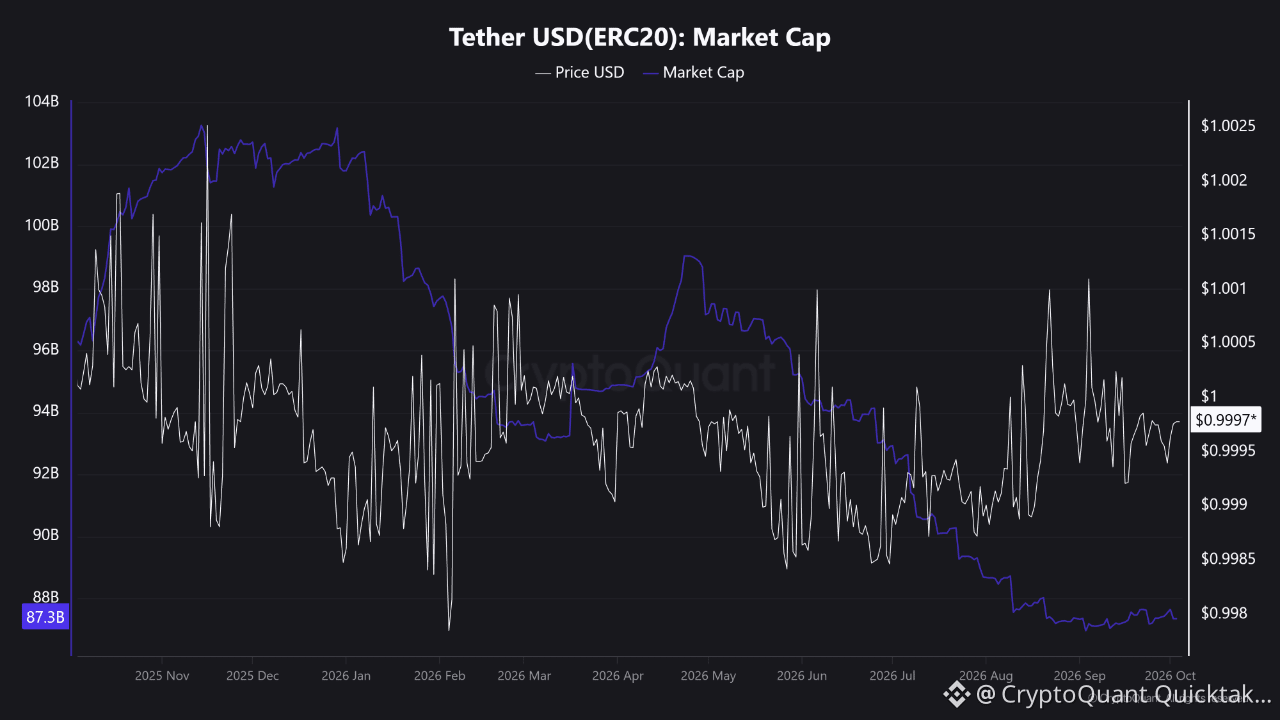
ERC20 USDT market cap reached $87.35 billion on October 3, essentially unchanged over a week. This measures Ethereum-based USDT, rather than total stablecoin liquidity.
My view is neutral to slightly positive. Repeated exchange inflows alongside rapidly rising funding and open interest would weaken that outlook and raise volatility concerns.
Outflows are encouraging. Derivatives require further confirmation. Strong buying pressure remains unconfirmed.
Tomorrow, I’ll watch whether outflows persist and whether funding and open interest continue rising together. Updated ERC20 USDT data will help assess whether liquidity is expanding.
Written by CoinNiel
Bitcoin: 6,036 BTC in Net Outflows — a Bullish Signal?
Bitcoin’s exchange outflows remain supportive, but rising open interest and funding need monitoring.
The October 4 snapshot shows net outflows of 1,071 BTC, bringing September 28–October 4 outflows to 6,036 BTC. Withdrawals alone do not confirm buying.
Open interest increased 1.39% day over day to $25.85 billion. Without price data, this does not establish a matching increase in leverage.
Funding rebounded from 0.00175% to 0.00463%, remaining below its seven-day average of 0.00531%. This suggests stronger bullish positioning, with insufficient evidence of overheating.
ERC20 USDT market cap reached $87.35 billion on October 3, essentially unchanged over a week. This measures Ethereum-based USDT, rather than total stablecoin liquidity.
My view is neutral to slightly positive. Repeated exchange inflows alongside rapidly rising funding and open interest would weaken that outlook and raise volatility concerns.
Outflows are encouraging. Derivatives require further confirmation. Strong buying pressure remains unconfirmed.
Tomorrow, I’ll watch whether outflows persist and whether funding and open interest continue rising together. Updated ERC20 USDT data will help assess whether liquidity is expanding.
Written by CoinNiel
The October 4 snapshot shows net outflows of 1,071 BTC, bringing September 28–October 4 outflows to 6,036 BTC. Withdrawals alone do not confirm buying.
Open interest increased 1.39% day over day to $25.85 billion. Without price data, this does not establish a matching increase in leverage.
Funding rebounded from 0.00175% to 0.00463%, remaining below its seven-day average of 0.00531%. This suggests stronger bullish positioning, with insufficient evidence of overheating.
ERC20 USDT market cap reached $87.35 billion on October 3, essentially unchanged over a week. This measures Ethereum-based USDT, rather than total stablecoin liquidity.
My view is neutral to slightly positive. Repeated exchange inflows alongside rapidly rising funding and open interest would weaken that outlook and raise volatility concerns.
Outflows are encouraging. Derivatives require further confirmation. Strong buying pressure remains unconfirmed.
Tomorrow, I’ll watch whether outflows persist and whether funding and open interest continue rising together. Updated ERC20 USDT data will help assess whether liquidity is expanding.
Written by CoinNiel
1
159
Article
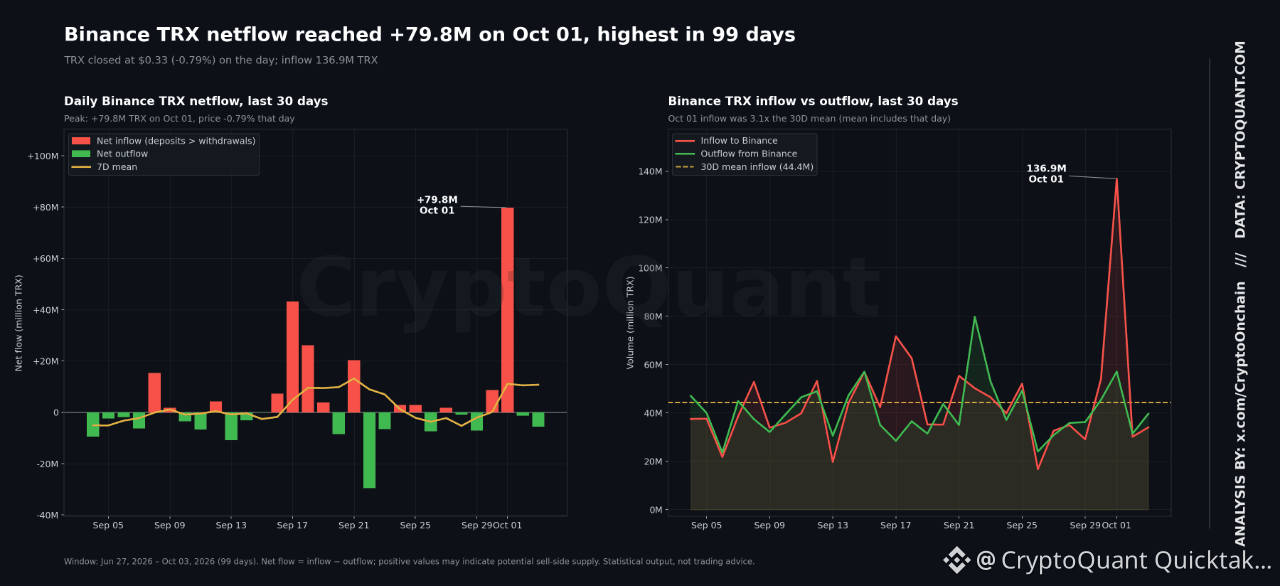
Binance TRX Netflow Hits +79.8M on October 1, Largest Daily Net Inflow in 99 DaysBinance TRX netflow was +79.8 million TRX on October 1, the highest reading in the 99-day dataset. Inflow reached 136.9 million TRX that day, 3.1 times the 30-day daily mean. TRX closed at $0.33 on October 1, down 0.79%.
The dataset runs from June 27 to October 3, so “highest” refers to this window, not full history. Seventeen days are flagged as whale outliers, and NVT covers native TRX transfers only, excluding USDT on TRON.
The inflow came one day before the scheduled US September payrolls release on October 2. TRX moved −0.04% on payrolls day, so the flow did not coincide with a price reaction. One candidate explanation, unverified: a single large holder deposited TRX to Binance.
Against the baseline, the last-7-day net was +75.3 million TRX, versus −25.9 million in the prior seven days. October 1 supplies 76% of that total; excluding it, the 7-day net is −4.5 million TRX. Cumulative netflow rose from 11.0 million to 37.7 million on October 1, and its 7-day mean sits 2.2 standard deviations above the 90-day baseline. Netflow then turned negative on October 2 (−1.3 million) and October 3 (−5.6 million).
A single-day inflow concentration with a stable price creates conditions that call for confirmation. If inflows persist beyond one day, exchange-side supply may build; if not, the spike may prove to be a one-off transfer.
“For now, the clearest reading is that one day of heavy inflow, not a sustained trend, drove the weekly figure.”
Written by CryptoOnchain
Binance TRX Netflow Hits +79.8M on October 1, Largest Daily Net Inflow in 99 Days
Binance TRX netflow was +79.8 million TRX on October 1, the highest reading in the 99-day dataset. Inflow reached 136.9 million TRX that day, 3.1 times the 30-day daily mean. TRX closed at $0.33 on October 1, down 0.79%.
The dataset runs from June 27 to October 3, so “highest” refers to this window, not full history. Seventeen days are flagged as whale outliers, and NVT covers native TRX transfers only, excluding USDT on TRON.
The inflow came one day before the scheduled US September payrolls release on October 2. TRX moved −0.04% on payrolls day, so the flow did not coincide with a price reaction. One candidate explanation, unverified: a single large holder deposited TRX to Binance.
Against the baseline, the last-7-day net was +75.3 million TRX, versus −25.9 million in the prior seven days. October 1 supplies 76% of that total; excluding it, the 7-day net is −4.5 million TRX. Cumulative netflow rose from 11.0 million to 37.7 million on October 1, and its 7-day mean sits 2.2 standard deviations above the 90-day baseline. Netflow then turned negative on October 2 (−1.3 million) and October 3 (−5.6 million).
A single-day inflow concentration with a stable price creates conditions that call for confirmation. If inflows persist beyond one day, exchange-side supply may build; if not, the spike may prove to be a one-off transfer.
“For now, the clearest reading is that one day of heavy inflow, not a sustained trend, drove the weekly figure.”
Written by CryptoOnchain
The dataset runs from June 27 to October 3, so “highest” refers to this window, not full history. Seventeen days are flagged as whale outliers, and NVT covers native TRX transfers only, excluding USDT on TRON.
The inflow came one day before the scheduled US September payrolls release on October 2. TRX moved −0.04% on payrolls day, so the flow did not coincide with a price reaction. One candidate explanation, unverified: a single large holder deposited TRX to Binance.
Against the baseline, the last-7-day net was +75.3 million TRX, versus −25.9 million in the prior seven days. October 1 supplies 76% of that total; excluding it, the 7-day net is −4.5 million TRX. Cumulative netflow rose from 11.0 million to 37.7 million on October 1, and its 7-day mean sits 2.2 standard deviations above the 90-day baseline. Netflow then turned negative on October 2 (−1.3 million) and October 3 (−5.6 million).
A single-day inflow concentration with a stable price creates conditions that call for confirmation. If inflows persist beyond one day, exchange-side supply may build; if not, the spike may prove to be a one-off transfer.
“For now, the clearest reading is that one day of heavy inflow, not a sustained trend, drove the weekly figure.”
Written by CryptoOnchain
49
Article
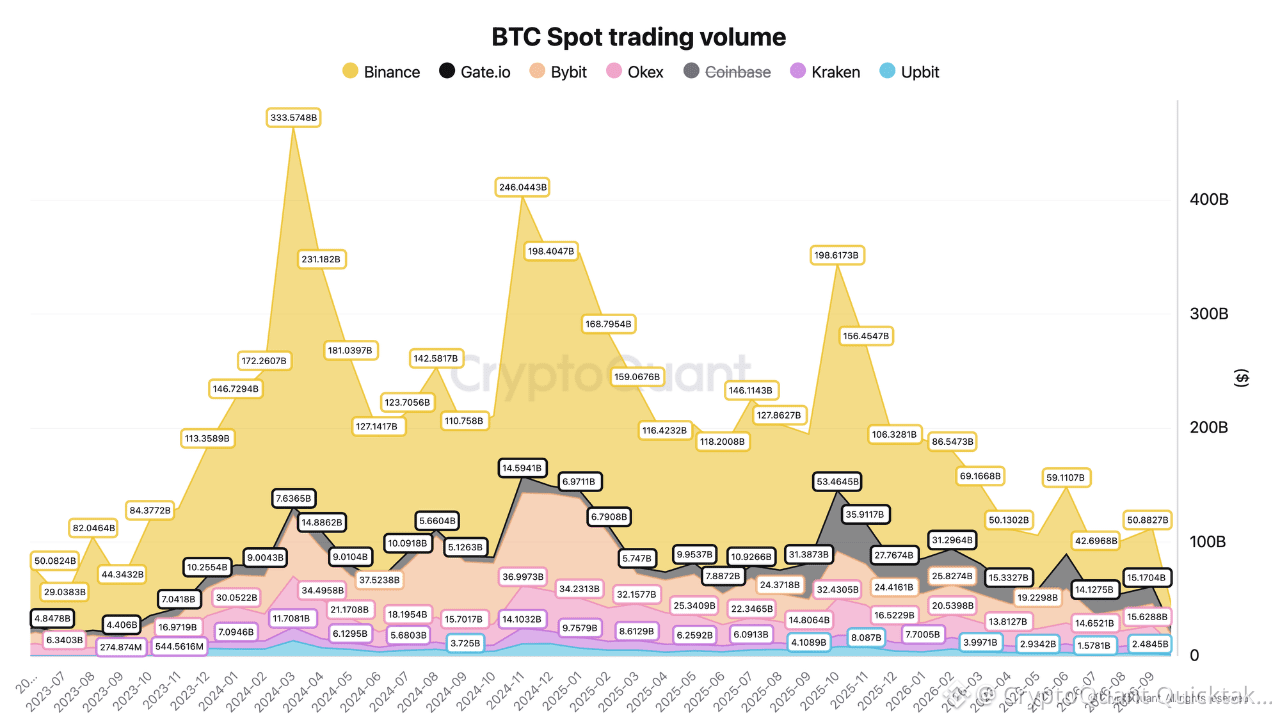
Spot Volumes Are Rising Timidly Since the July LowIn July, as Bitcoin was printing its low, spot volumes also hit their lowest level since the previous bear market.
This marked the weakest interest in Bitcoin in nearly 3 years.
Since then, volumes have picked up slightly but are still struggling to recover decisively.
On Binance, spot volume topped $50B in September, versus $42B in July. These are the highest volumes recorded among the major exchanges.
Bybit recorded $19B versus $14B in July, and Kraken did the same with $8B versus $4B.
This modest increase came alongside the new momentum on Bitcoin.
The trend now needs to accelerate, with more spot volume and above all more demand, for Bitcoin to attempt new highs.
Written by Darkfost
Spot Volumes Are Rising Timidly Since the July Low
In July, as Bitcoin was printing its low, spot volumes also hit their lowest level since the previous bear market.
This marked the weakest interest in Bitcoin in nearly 3 years.
Since then, volumes have picked up slightly but are still struggling to recover decisively.
On Binance, spot volume topped $50B in September, versus $42B in July. These are the highest volumes recorded among the major exchanges.
Bybit recorded $19B versus $14B in July, and Kraken did the same with $8B versus $4B.
This modest increase came alongside the new momentum on Bitcoin.
The trend now needs to accelerate, with more spot volume and above all more demand, for Bitcoin to attempt new highs.
Written by Darkfost
This marked the weakest interest in Bitcoin in nearly 3 years.
Since then, volumes have picked up slightly but are still struggling to recover decisively.
On Binance, spot volume topped $50B in September, versus $42B in July. These are the highest volumes recorded among the major exchanges.
Bybit recorded $19B versus $14B in July, and Kraken did the same with $8B versus $4B.
This modest increase came alongside the new momentum on Bitcoin.
The trend now needs to accelerate, with more spot volume and above all more demand, for Bitcoin to attempt new highs.
Written by Darkfost
1
46
Article
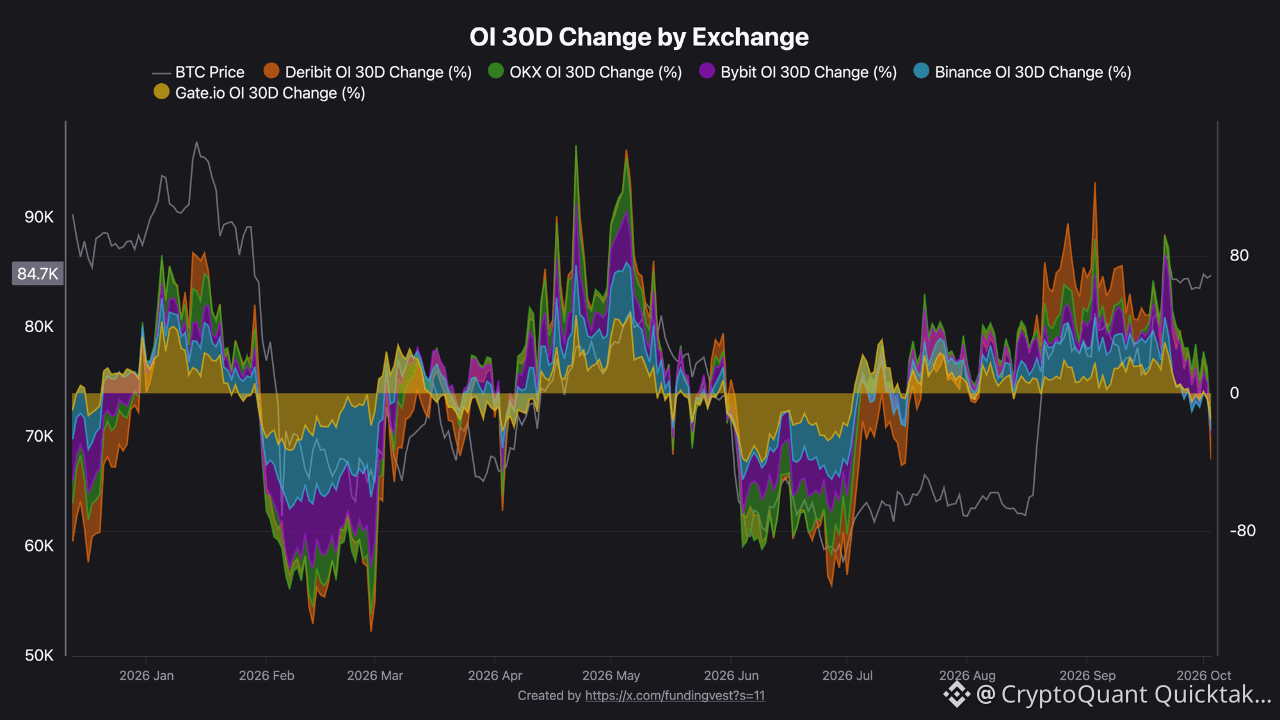
Do Open Interest Losses Signal a Distribution Phase?As Bitcoin approaches the $87,000 level, it continues to lose momentum and face deepening sell-offs. Alongside this price action, the ongoing decline in market Open Interest (OI) stands out as a key metric.
When examining the 30-day (30D) change, the current price structure mirrors previous local tops. The contraction in Open Interest—a dynamic frequently encountered during distribution phases—is clearly evident in the current setup.
Open Interest changes across three critical exchanges highlighting market cooling:
- Binance: Open Interest dropped by 6%, signaling a loss in the volatility balance sustained over the past 30 days. As a benchmark, this decline on Binance provides a strong indicator for the broader market sentiment.
- Deribit: As the dominant force in the options market, Deribit saw a 15% reduction in Open Interest. A drop of this magnitude points to significant position unwinding and shifting expectations in derivative markets.
- Gate.io: Open Interest decreased by 15%, reflecting weakening trading volume and declining volatility expectations on the exchange.
While other exchanges experienced only marginal losses in volatility, the sharp drops observed across Binance, Deribit, and Gate.io confirm that the market is entering a clear cooling-off phase.
Historical Parallels and Market Outlook
Comparing the current pullback and 30D Open Interest trends to historical patterns reveals a familiar structure. During similar setups in January 2026 and May 2026, Bitcoin underwent pullbacks of approximately $10,000.
As the drain in Open Interest persists, data from these three key exchanges continues to offer critical insights into the depth of the retracement and evolving market dynamics.
Written by FundingVest
Do Open Interest Losses Signal a Distribution Phase?
As Bitcoin approaches the $87,000 level, it continues to lose momentum and face deepening sell-offs. Alongside this price action, the ongoing decline in market Open Interest (OI) stands out as a key metric.
When examining the 30-day (30D) change, the current price structure mirrors previous local tops. The contraction in Open Interest—a dynamic frequently encountered during distribution phases—is clearly evident in the current setup.
Open Interest changes across three critical exchanges highlighting market cooling:
- Binance: Open Interest dropped by 6%, signaling a loss in the volatility balance sustained over the past 30 days. As a benchmark, this decline on Binance provides a strong indicator for the broader market sentiment.
- Deribit: As the dominant force in the options market, Deribit saw a 15% reduction in Open Interest. A drop of this magnitude points to significant position unwinding and shifting expectations in derivative markets.
- Gate.io: Open Interest decreased by 15%, reflecting weakening trading volume and declining volatility expectations on the exchange.
While other exchanges experienced only marginal losses in volatility, the sharp drops observed across Binance, Deribit, and Gate.io confirm that the market is entering a clear cooling-off phase.
Historical Parallels and Market Outlook
Comparing the current pullback and 30D Open Interest trends to historical patterns reveals a familiar structure. During similar setups in January 2026 and May 2026, Bitcoin underwent pullbacks of approximately $10,000.
As the drain in Open Interest persists, data from these three key exchanges continues to offer critical insights into the depth of the retracement and evolving market dynamics.
Written by FundingVest
When examining the 30-day (30D) change, the current price structure mirrors previous local tops. The contraction in Open Interest—a dynamic frequently encountered during distribution phases—is clearly evident in the current setup.
Open Interest changes across three critical exchanges highlighting market cooling:
- Binance: Open Interest dropped by 6%, signaling a loss in the volatility balance sustained over the past 30 days. As a benchmark, this decline on Binance provides a strong indicator for the broader market sentiment.
- Deribit: As the dominant force in the options market, Deribit saw a 15% reduction in Open Interest. A drop of this magnitude points to significant position unwinding and shifting expectations in derivative markets.
- Gate.io: Open Interest decreased by 15%, reflecting weakening trading volume and declining volatility expectations on the exchange.
While other exchanges experienced only marginal losses in volatility, the sharp drops observed across Binance, Deribit, and Gate.io confirm that the market is entering a clear cooling-off phase.
Historical Parallels and Market Outlook
Comparing the current pullback and 30D Open Interest trends to historical patterns reveals a familiar structure. During similar setups in January 2026 and May 2026, Bitcoin underwent pullbacks of approximately $10,000.
As the drain in Open Interest persists, data from these three key exchanges continues to offer critical insights into the depth of the retracement and evolving market dynamics.
Written by FundingVest
126
Article
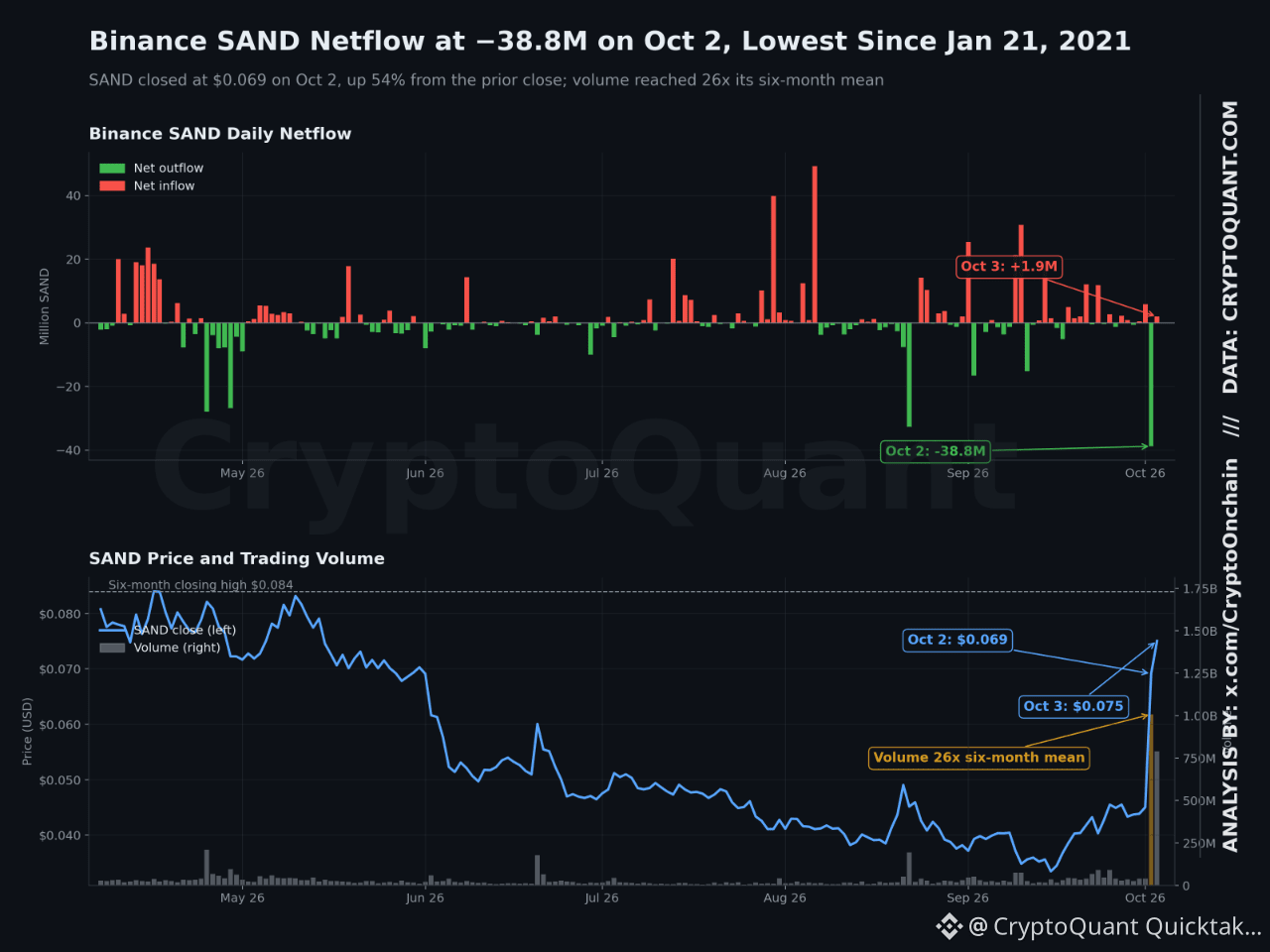
Binance SAND Netflow Hits −38.8M on October 2, Largest Daily Net Outflow in Six MonthsBinance SAND netflow was −38.8 million SAND on October 2, the lowest reading in the six-month window. SAND closed at $0.069 that day, up 53% from $0.045. Trading volume reached 1.01 billion on October 2, 26 times its six-month mean.
The six-month window contains zero-inflow days, so short-window inflow ratios are approximate. Minted and burned supply are excluded because both are zero. On October 3, netflow turned positive at +1.9 million SAND.
The move came on October 2, the scheduled release date for US September payrolls. BTC closed down 0.4% that day at $84,499, so SAND moved independently of the broader market. One candidate explanation, unverified: a token-specific catalyst drew traders to Binance on both sides of the book.
Both inflows and outflows set six-month highs on October 2, at 166.1 million and 204.9 million SAND. Outflows were spread across 2,113 transactions averaging about 97,000 SAND each. This suggests broad participation rather than a few large wallets. Active addresses rose to 2,026, five times the six-month mean, and 1.51 billion SAND moved on-chain.
Against the six-month baseline, the Binance reserve fell 10.1% to 343.9 million on October 2. A day earlier it stood at 382.8 million, its six-month high. The reserve remains about 50% above its six-month mean of 230.1 million, after climbing from a low of 133.1 million. Price at $0.075 is still below the $0.084 six-month closing high.
A volume shock paired with net exchange outflows creates conditions that historically preceded extended volatility. Reserves are still elevated, which suggests sell-side supply on Binance has not contracted meaningfully.
“For now, the clearest reading is that SAND drew heavy two-way traffic on Binance, and one day of outflows has not undone months of reserve buildup.”
Written by CryptoOnchain
Binance SAND Netflow Hits −38.8M on October 2, Largest Daily Net Outflow in Six Months
Binance SAND netflow was −38.8 million SAND on October 2, the lowest reading in the six-month window. SAND closed at $0.069 that day, up 53% from $0.045. Trading volume reached 1.01 billion on October 2, 26 times its six-month mean.
The six-month window contains zero-inflow days, so short-window inflow ratios are approximate. Minted and burned supply are excluded because both are zero. On October 3, netflow turned positive at +1.9 million SAND.
The move came on October 2, the scheduled release date for US September payrolls. BTC closed down 0.4% that day at $84,499, so SAND moved independently of the broader market. One candidate explanation, unverified: a token-specific catalyst drew traders to Binance on both sides of the book.
Both inflows and outflows set six-month highs on October 2, at 166.1 million and 204.9 million SAND. Outflows were spread across 2,113 transactions averaging about 97,000 SAND each. This suggests broad participation rather than a few large wallets. Active addresses rose to 2,026, five times the six-month mean, and 1.51 billion SAND moved on-chain.
Against the six-month baseline, the Binance reserve fell 10.1% to 343.9 million on October 2. A day earlier it stood at 382.8 million, its six-month high. The reserve remains about 50% above its six-month mean of 230.1 million, after climbing from a low of 133.1 million. Price at $0.075 is still below the $0.084 six-month closing high.
A volume shock paired with net exchange outflows creates conditions that historically preceded extended volatility. Reserves are still elevated, which suggests sell-side supply on Binance has not contracted meaningfully.
“For now, the clearest reading is that SAND drew heavy two-way traffic on Binance, and one day of outflows has not undone months of reserve buildup.”
Written by CryptoOnchain
The six-month window contains zero-inflow days, so short-window inflow ratios are approximate. Minted and burned supply are excluded because both are zero. On October 3, netflow turned positive at +1.9 million SAND.
The move came on October 2, the scheduled release date for US September payrolls. BTC closed down 0.4% that day at $84,499, so SAND moved independently of the broader market. One candidate explanation, unverified: a token-specific catalyst drew traders to Binance on both sides of the book.
Both inflows and outflows set six-month highs on October 2, at 166.1 million and 204.9 million SAND. Outflows were spread across 2,113 transactions averaging about 97,000 SAND each. This suggests broad participation rather than a few large wallets. Active addresses rose to 2,026, five times the six-month mean, and 1.51 billion SAND moved on-chain.
Against the six-month baseline, the Binance reserve fell 10.1% to 343.9 million on October 2. A day earlier it stood at 382.8 million, its six-month high. The reserve remains about 50% above its six-month mean of 230.1 million, after climbing from a low of 133.1 million. Price at $0.075 is still below the $0.084 six-month closing high.
A volume shock paired with net exchange outflows creates conditions that historically preceded extended volatility. Reserves are still elevated, which suggests sell-side supply on Binance has not contracted meaningfully.
“For now, the clearest reading is that SAND drew heavy two-way traffic on Binance, and one day of outflows has not undone months of reserve buildup.”
Written by CryptoOnchain
2
512
Article
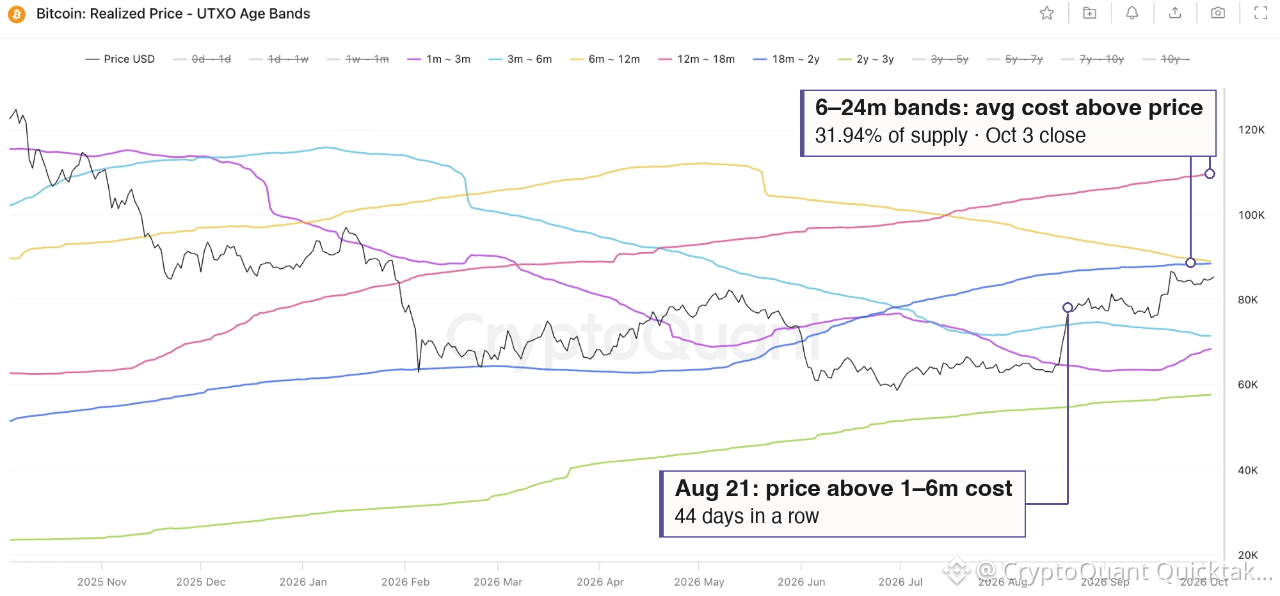
Coins Held 6 to 24 Months, 31.94% of Bitcoin's Supply, Carry an Average Cost Above PriceAt the October 3 close, Bitcoin traded at $84,765.53. Three age bands of supply have an average cost above that price:
- 6 to 12 months: 17.12% of supply, $88,943 (+4.9%)
- 12 to 18 months: 8.73%, $109,495 (+29.2%)
- 18 to 24 months: 6.09%, $88,416 (+4.3%)
Average cost is the Realized Price by age band: the average price at which each band's coins last moved.
What is not new, and what is
- At least one of these three bands has had an average cost above price on 323 of the last 364 days: every day but one since November 14, 2025.
- What changed is the short end. Coins held 1 to 6 months have had an average cost below price for 44 days in a row, the longest run in the last 12 months (51 days in total): 1 to 3 months at $68,341 (19.4% below), 3 to 6 months at $71,430 (15.7% below).
- Every band older than 2 years also has an average cost below price.
What it means
These are the only bands whose average holder is underwater: coins that last moved 6 to 24 months ago. These already count as Long-Term Holders (LTH: coins unmoved for about five months or more).
Their spending is ordinary: 272,156 BTC moved on-chain in the last 30 days, the 60th percentile of 30-day windows this year.
Limits
- Band averages hide coins on both sides of price. CryptoQuant's supply in loss is 25.09%, below the 31.94% in these bands.
- The 6 to 12 month band is only 4.9% above price. A close above $88,943 would leave only the 12 to 18 month band above price, as long as average costs hold.
Written by thechessONCHAIN
Coins Held 6 to 24 Months, 31.94% of Bitcoin's Supply, Carry an Average Cost Above Price
At the October 3 close, Bitcoin traded at $84,765.53. Three age bands of supply have an average cost above that price:
- 6 to 12 months: 17.12% of supply, $88,943 (+4.9%)
- 12 to 18 months: 8.73%, $109,495 (+29.2%)
- 18 to 24 months: 6.09%, $88,416 (+4.3%)
Average cost is the Realized Price by age band: the average price at which each band's coins last moved.
What is not new, and what is
- At least one of these three bands has had an average cost above price on 323 of the last 364 days: every day but one since November 14, 2025.
- What changed is the short end. Coins held 1 to 6 months have had an average cost below price for 44 days in a row, the longest run in the last 12 months (51 days in total): 1 to 3 months at $68,341 (19.4% below), 3 to 6 months at $71,430 (15.7% below).
- Every band older than 2 years also has an average cost below price.
What it means
These are the only bands whose average holder is underwater: coins that last moved 6 to 24 months ago. These already count as Long-Term Holders (LTH: coins unmoved for about five months or more).
Their spending is ordinary: 272,156 BTC moved on-chain in the last 30 days, the 60th percentile of 30-day windows this year.
Limits
- Band averages hide coins on both sides of price. CryptoQuant's supply in loss is 25.09%, below the 31.94% in these bands.
- The 6 to 12 month band is only 4.9% above price. A close above $88,943 would leave only the 12 to 18 month band above price, as long as average costs hold.
Written by thechessONCHAIN
- 6 to 12 months: 17.12% of supply, $88,943 (+4.9%)
- 12 to 18 months: 8.73%, $109,495 (+29.2%)
- 18 to 24 months: 6.09%, $88,416 (+4.3%)
Average cost is the Realized Price by age band: the average price at which each band's coins last moved.
What is not new, and what is
- At least one of these three bands has had an average cost above price on 323 of the last 364 days: every day but one since November 14, 2025.
- What changed is the short end. Coins held 1 to 6 months have had an average cost below price for 44 days in a row, the longest run in the last 12 months (51 days in total): 1 to 3 months at $68,341 (19.4% below), 3 to 6 months at $71,430 (15.7% below).
- Every band older than 2 years also has an average cost below price.
What it means
These are the only bands whose average holder is underwater: coins that last moved 6 to 24 months ago. These already count as Long-Term Holders (LTH: coins unmoved for about five months or more).
Their spending is ordinary: 272,156 BTC moved on-chain in the last 30 days, the 60th percentile of 30-day windows this year.
Limits
- Band averages hide coins on both sides of price. CryptoQuant's supply in loss is 25.09%, below the 31.94% in these bands.
- The 6 to 12 month band is only 4.9% above price. A close above $88,943 would leave only the 12 to 18 month band above price, as long as average costs hold.
Written by thechessONCHAIN
138
Article
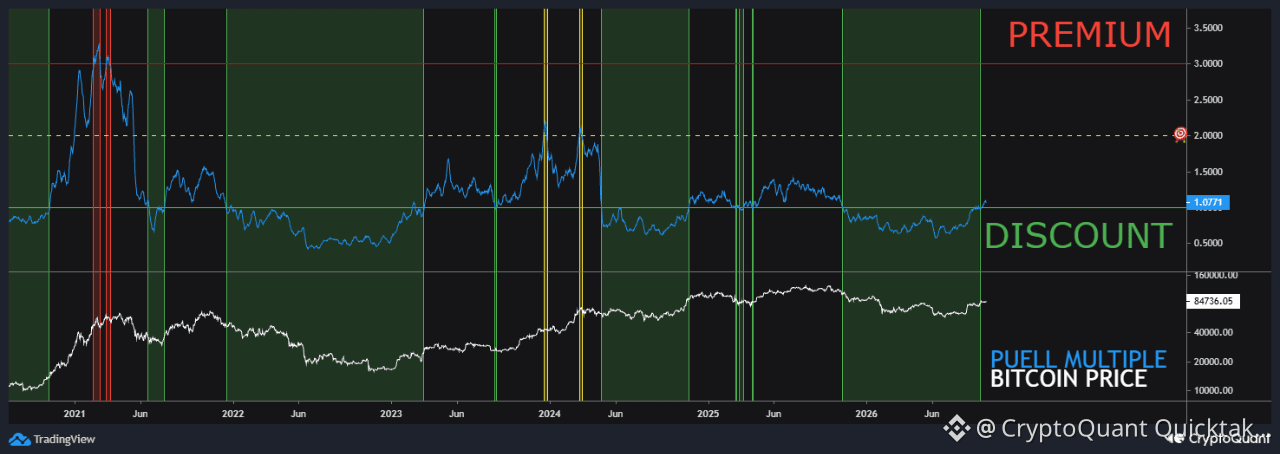
Puell Multiple Hits 11-month High 🔥Since November 2025, the Puell Multiple MA7d has been in Discount zone🟢 and has remained below 1.00 for about 10 months👀
Historically, whenever this indicator has traded below 1.00 (discount zone), it has signaled periods of Bitcoin accumulation associated with market bottoms.
As the Puell Multiple breaks above 1.00 — exiting the accumulation zone — a reversal is expected to be underway, with an initial target of 2.00🟨 — BTC price has room to continue rising in an attempt to break through key resistance levels.
Written by G a a h
Puell Multiple Hits 11-month High 🔥
Since November 2025, the Puell Multiple MA7d has been in Discount zone🟢 and has remained below 1.00 for about 10 months👀
Historically, whenever this indicator has traded below 1.00 (discount zone), it has signaled periods of Bitcoin accumulation associated with market bottoms.
As the Puell Multiple breaks above 1.00 — exiting the accumulation zone — a reversal is expected to be underway, with an initial target of 2.00🟨 — BTC price has room to continue rising in an attempt to break through key resistance levels.
Written by G a a h
Historically, whenever this indicator has traded below 1.00 (discount zone), it has signaled periods of Bitcoin accumulation associated with market bottoms.
As the Puell Multiple breaks above 1.00 — exiting the accumulation zone — a reversal is expected to be underway, with an initial target of 2.00🟨 — BTC price has room to continue rising in an attempt to break through key resistance levels.
Written by G a a h
76
Article
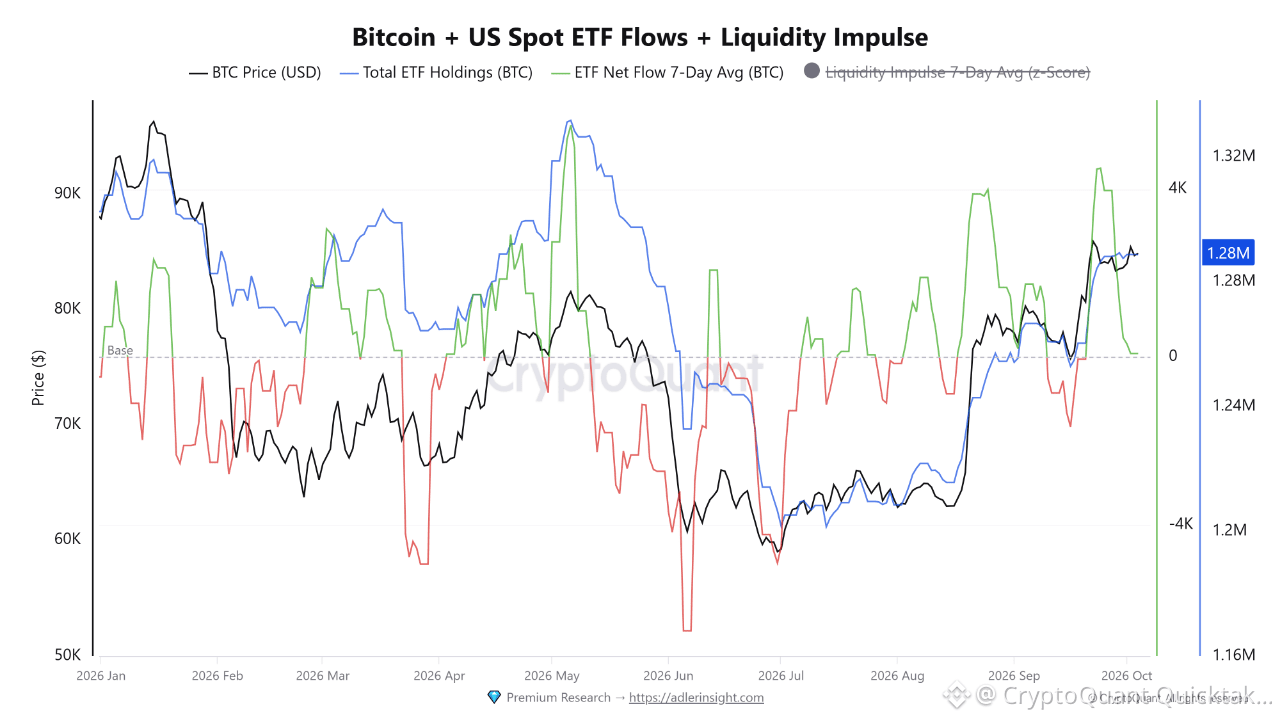
US Bitcoin ETFs Add 88,000 BTC Since JulyBitcoin has climbed from about $59,500 on July 1 to roughly $85,000 by October 4, a gain of $25,500, or 42.9%.
Over the same period, US spot Bitcoin ETF holdings increased from around 1.20 million BTC to 1.288 million BTC.
That represents an addition of roughly 88,000 BTC, or 7.3%.
Bitcoin’s rally was accompanied by continued growth in US spot ETF holdings.
Rather than declining as prices moved higher, ETF-held Bitcoin increased by roughly 88,000 BTC over the period, showing that the rise from $59,500 to $85,000 occurred alongside continued expansion in ETF holdings.
This does not imply ETFs account for only part of the rally, but it shows that price appreciation materially outpaced the expansion in ETF holdings.
Written by Amr Taha
US Bitcoin ETFs Add 88,000 BTC Since July
Bitcoin has climbed from about $59,500 on July 1 to roughly $85,000 by October 4, a gain of $25,500, or 42.9%.
Over the same period, US spot Bitcoin ETF holdings increased from around 1.20 million BTC to 1.288 million BTC.
That represents an addition of roughly 88,000 BTC, or 7.3%.
Bitcoin’s rally was accompanied by continued growth in US spot ETF holdings.
Rather than declining as prices moved higher, ETF-held Bitcoin increased by roughly 88,000 BTC over the period, showing that the rise from $59,500 to $85,000 occurred alongside continued expansion in ETF holdings.
This does not imply ETFs account for only part of the rally, but it shows that price appreciation materially outpaced the expansion in ETF holdings.
Written by Amr Taha
Over the same period, US spot Bitcoin ETF holdings increased from around 1.20 million BTC to 1.288 million BTC.
That represents an addition of roughly 88,000 BTC, or 7.3%.
Bitcoin’s rally was accompanied by continued growth in US spot ETF holdings.
Rather than declining as prices moved higher, ETF-held Bitcoin increased by roughly 88,000 BTC over the period, showing that the rise from $59,500 to $85,000 occurred alongside continued expansion in ETF holdings.
This does not imply ETFs account for only part of the rally, but it shows that price appreciation materially outpaced the expansion in ETF holdings.
Written by Amr Taha
107
Article
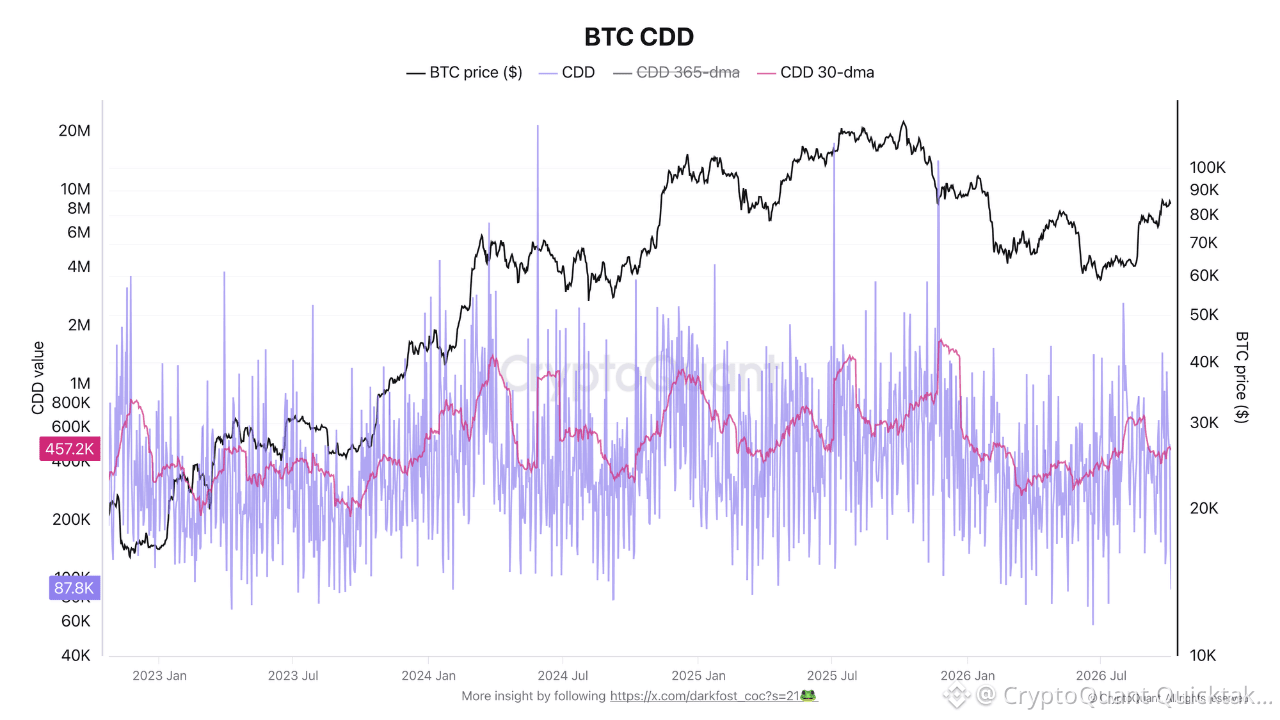
Coin Days Destroyed Shows LTHs Are Staying PatientReading the Bitcoin Coin Days Destroyed (CDD) signals that LTH activity remains very moderate, despite the nice rebound since July.
The monthly average climbed to 688 at the end of August as BTC approached $80,000, before dropping to 457 today.
Despite a slight uptick, LTH activity remains moderate. They are not rushing to lock in quick profits, they prefer to be patient.
CDD is a good way to gauge this activity. It aggregates the number of days each BTC was held before being spent.
The higher it climbs, as we can see at each local top, the more active LTHs are becoming and the stronger their selling pressure gets.
Today there is not much cause for concern at this level, but it is something to keep an eye on.
Written by Darkfost
Coin Days Destroyed Shows LTHs Are Staying Patient
Reading the Bitcoin Coin Days Destroyed (CDD) signals that LTH activity remains very moderate, despite the nice rebound since July.
The monthly average climbed to 688 at the end of August as BTC approached $80,000, before dropping to 457 today.
Despite a slight uptick, LTH activity remains moderate. They are not rushing to lock in quick profits, they prefer to be patient.
CDD is a good way to gauge this activity. It aggregates the number of days each BTC was held before being spent.
The higher it climbs, as we can see at each local top, the more active LTHs are becoming and the stronger their selling pressure gets.
Today there is not much cause for concern at this level, but it is something to keep an eye on.
Written by Darkfost
The monthly average climbed to 688 at the end of August as BTC approached $80,000, before dropping to 457 today.
Despite a slight uptick, LTH activity remains moderate. They are not rushing to lock in quick profits, they prefer to be patient.
CDD is a good way to gauge this activity. It aggregates the number of days each BTC was held before being spent.
The higher it climbs, as we can see at each local top, the more active LTHs are becoming and the stronger their selling pressure gets.
Today there is not much cause for concern at this level, but it is something to keep an eye on.
Written by Darkfost
135
Article
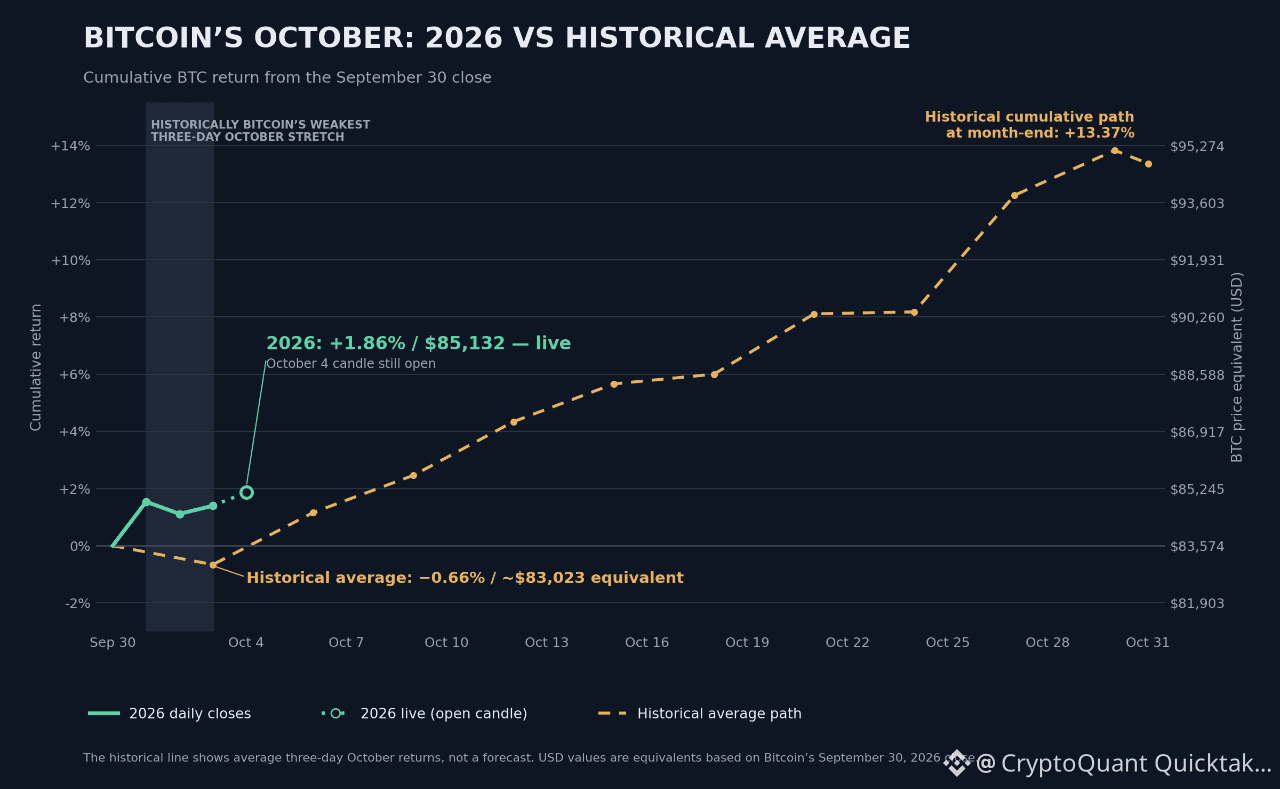
Bitcoin Holds Up Through October's Weakest Three DaysBitcoin’s first three days of October have historically been its weakest three-day stretch of the month, averaging a 0.66% decline.
2026 has already held up better.
Bitcoin closed September at $83,574 and October 3 at $84,743, a gain of 1.40%. On a like-for-like basis, from the October 1 close to the October 3 close, BTC slipped just 0.14%, compared with the historical average decline of 0.66%.
As of October 4, Bitcoin is trading near $85,132, around 1.86% above its September close. Since the day is still underway, that number may change.
September was also stronger than usual, finishing up 6.39% versus a historical average decline of 4.02%. October has made a solid start too.
Written by Andrew Kamsky
Bitcoin Holds Up Through October's Weakest Three Days
Bitcoin’s first three days of October have historically been its weakest three-day stretch of the month, averaging a 0.66% decline.
2026 has already held up better.
Bitcoin closed September at $83,574 and October 3 at $84,743, a gain of 1.40%. On a like-for-like basis, from the October 1 close to the October 3 close, BTC slipped just 0.14%, compared with the historical average decline of 0.66%.
As of October 4, Bitcoin is trading near $85,132, around 1.86% above its September close. Since the day is still underway, that number may change.
September was also stronger than usual, finishing up 6.39% versus a historical average decline of 4.02%. October has made a solid start too.
Written by Andrew Kamsky
2026 has already held up better.
Bitcoin closed September at $83,574 and October 3 at $84,743, a gain of 1.40%. On a like-for-like basis, from the October 1 close to the October 3 close, BTC slipped just 0.14%, compared with the historical average decline of 0.66%.
As of October 4, Bitcoin is trading near $85,132, around 1.86% above its September close. Since the day is still underway, that number may change.
September was also stronger than usual, finishing up 6.39% versus a historical average decline of 4.02%. October has made a solid start too.
Written by Andrew Kamsky
1
157
Article
CryptoQuant CEO: Bitcoin’s Bear Market Ended This Summer — a New Buyer Base Is EmergingCryptoQuant CEO Ki Young Ju recently shared his latest Bitcoin outlook on Bitcoin Magazine’s YouTube program BMTV, saying Bitcoin’s bear market ended this summer and that the market is now in the early stage of a new cycle.
The key point is not just his “3–5x from the lows” outlook. Fresh capital is entering, OG whale selling is easing, and large futures players have rebuilt long exposure near the bottom.
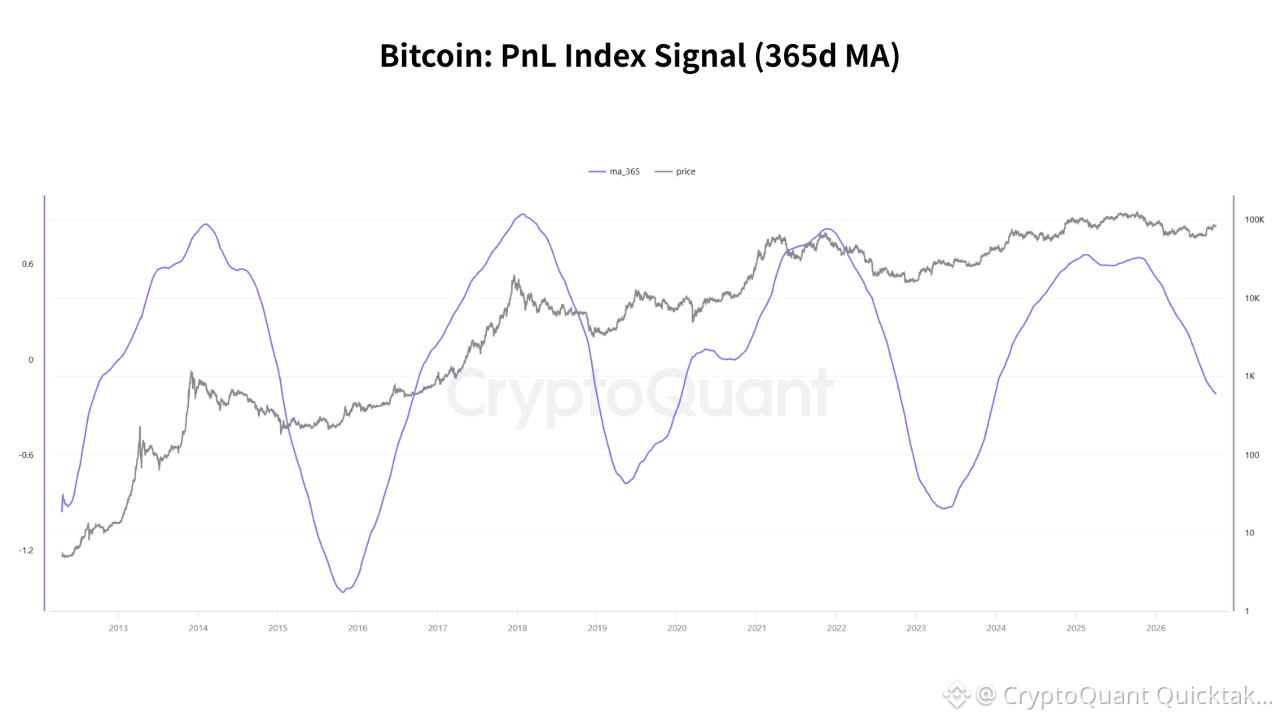
Three on-chain signals are especially notable. First, the PnL Index 365-day MA is still soft, but Ki sees broader profitability and valuation metrics reaching important inflection points. Second, inflows to Accumulation Addresses have risen sharply, with the 30-day average also turning higher. Third, MVRV is far less extreme than in past cycles: earlier peaks reached 4–5+, while this cycle has stayed much lower, suggesting both euphoria and capitulation are becoming milder.
ETF flows are improving, but we still cannot know exactly who the end buyers are. That is why custodial flows matter more now.
The bigger story is a changing market structure: Bitcoin is shifting from a retail-and-OG-whale market toward one increasingly shaped by ETFs, institutions, custodians, macro conditions, and regulation.
The key questions are: Who is buying? Who has stopped selling? Is fresh capital still coming in?
Written by XWIN Japan
CryptoQuant CEO: Bitcoin’s Bear Market Ended This Summer — a New Buyer Base Is Emerging
CryptoQuant CEO Ki Young Ju recently shared his latest Bitcoin outlook on Bitcoin Magazine’s YouTube program BMTV, saying Bitcoin’s bear market ended this summer and that the market is now in the early stage of a new cycle.
The key point is not just his “3–5x from the lows” outlook. Fresh capital is entering, OG whale selling is easing, and large futures players have rebuilt long exposure near the bottom.
Three on-chain signals are especially notable. First, the PnL Index 365-day MA is still soft, but Ki sees broader profitability and valuation metrics reaching important inflection points. Second, inflows to Accumulation Addresses have risen sharply, with the 30-day average also turning higher. Third, MVRV is far less extreme than in past cycles: earlier peaks reached 4–5+, while this cycle has stayed much lower, suggesting both euphoria and capitulation are becoming milder.
ETF flows are improving, but we still cannot know exactly who the end buyers are. That is why custodial flows matter more now.
The bigger story is a changing market structure: Bitcoin is shifting from a retail-and-OG-whale market toward one increasingly shaped by ETFs, institutions, custodians, macro conditions, and regulation.
The key questions are: Who is buying? Who has stopped selling? Is fresh capital still coming in?
Written by XWIN Japan
The key point is not just his “3–5x from the lows” outlook. Fresh capital is entering, OG whale selling is easing, and large futures players have rebuilt long exposure near the bottom.
Three on-chain signals are especially notable. First, the PnL Index 365-day MA is still soft, but Ki sees broader profitability and valuation metrics reaching important inflection points. Second, inflows to Accumulation Addresses have risen sharply, with the 30-day average also turning higher. Third, MVRV is far less extreme than in past cycles: earlier peaks reached 4–5+, while this cycle has stayed much lower, suggesting both euphoria and capitulation are becoming milder.
ETF flows are improving, but we still cannot know exactly who the end buyers are. That is why custodial flows matter more now.
The bigger story is a changing market structure: Bitcoin is shifting from a retail-and-OG-whale market toward one increasingly shaped by ETFs, institutions, custodians, macro conditions, and regulation.
The key questions are: Who is buying? Who has stopped selling? Is fresh capital still coming in?
Written by XWIN Japan
145
Article
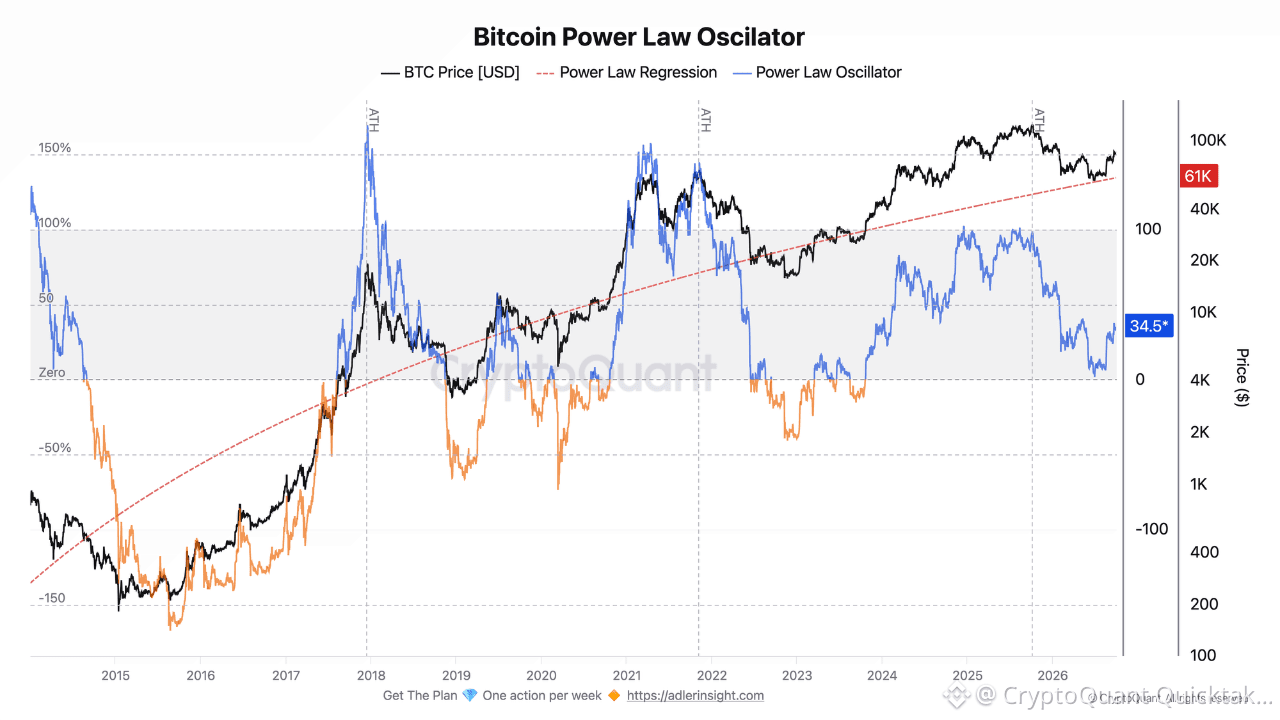
Bitcoin At $157K: What the Power Law Calculation ShowsOver the past ten years, bitcoin’s fluctuations around the Power Law line have become less pronounced. Oscillator peaks declined from +169 in 2018 to +102 in 2025. The standard deviation of its daily changes fell from 4.81 to 2.47 points, a 49% decline. As of October 3, the oscillator stands at +34.5, with bitcoin priced at $84.7K.
Based on the model’s parameters as of October 3, the +100 threshold corresponds to a price of $157.8K, roughly 86% above the current price. This is a reference price level: if the regression parameters remain unchanged, it will rise as the Power Law line rises.
Written by AxelAdlerJr
Bitcoin At $157K: What the Power Law Calculation Shows
Over the past ten years, bitcoin’s fluctuations around the Power Law line have become less pronounced. Oscillator peaks declined from +169 in 2018 to +102 in 2025. The standard deviation of its daily changes fell from 4.81 to 2.47 points, a 49% decline. As of October 3, the oscillator stands at +34.5, with bitcoin priced at $84.7K.
Based on the model’s parameters as of October 3, the +100 threshold corresponds to a price of $157.8K, roughly 86% above the current price. This is a reference price level: if the regression parameters remain unchanged, it will rise as the Power Law line rises.
Written by AxelAdlerJr
Based on the model’s parameters as of October 3, the +100 threshold corresponds to a price of $157.8K, roughly 86% above the current price. This is a reference price level: if the regression parameters remain unchanged, it will rise as the Power Law line rises.
Written by AxelAdlerJr
1
287
Article
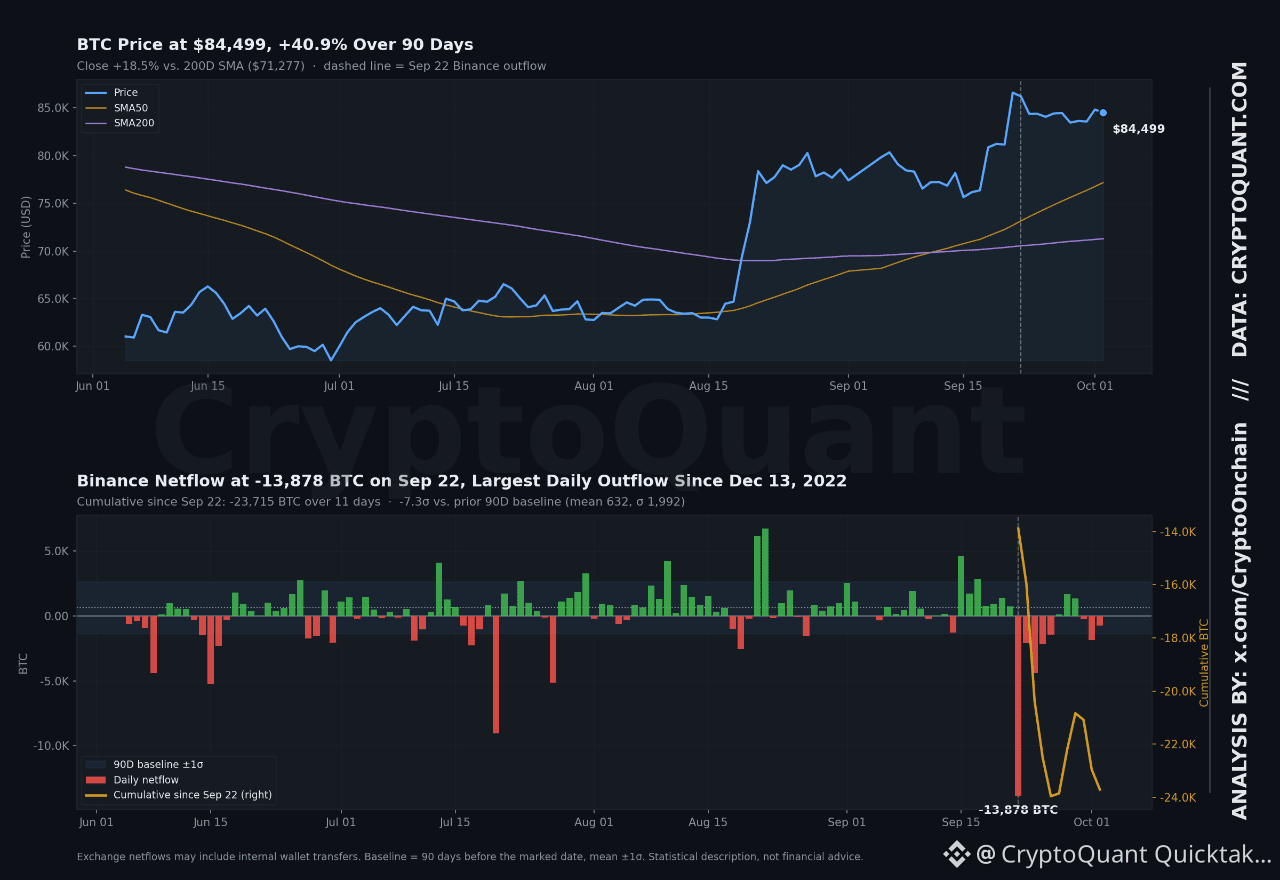
Binance Sees 23.7K BTC Outflow While Leverage Stays Cool: Is Spot Accumulation Driving the Rally?BTC trades at $84.5K. It is up 40.9% in 90 days and sits 18.5% above its 200-day SMA ($71.3K). The Mayer Multiple is 1.19, which is healthy rather than overheated. On-chain data suggests coins leaving exchanges are supporting the rebound, and Binance is at the center of it.
1. Binance Netflow: heavy outflows
On Sep 22, Binance recorded a net outflow of −13,878 BTC in a single day. Cumulative netflow since then is about −23.7K BTC over 11 days. When large amounts leave the biggest exchange, it usually means coins are moving into custody, which reduces the supply available to sell right away.
2. Exchange supply is shrinking
The all-exchange supply ratio (0.13) is at Z = −2.37 vs. the past 90 days, which is the 20th percentile of the year. Coinbase netflow is also negative (7D avg: −467 BTC).
3. Leverage is not the driver
Binance funding rates are near neutral (~0.00–0.01%), with Z90 = −1.03. Overleveraged longs are not fueling this rally, so the risk of a long squeeze is lower.
4. No euphoria
STH-SOPR is 1.02, so short-term holders are only slightly in profit and there are no signs of aggressive distribution.
⚠️ Risks
Coinbase Premium remains negative (−0.02 to −0.08), which points to weak US spot demand.
The estimated leverage ratio is rising (+1.39σ over 30D), diverging from the cool funding rates.
Price is still 32% below the $124.7K ATH.
Conclusion: Binance outflows combined with low funding point to spot accumulation. Watch for Binance netflow turning persistently positive. If that happens, BTC could stall near the $86.6K local high.
Written by CryptoOnchain
Binance Sees 23.7K BTC Outflow While Leverage Stays Cool: Is Spot Accumulation Driving the Rally?
BTC trades at $84.5K. It is up 40.9% in 90 days and sits 18.5% above its 200-day SMA ($71.3K). The Mayer Multiple is 1.19, which is healthy rather than overheated. On-chain data suggests coins leaving exchanges are supporting the rebound, and Binance is at the center of it.
1. Binance Netflow: heavy outflows
On Sep 22, Binance recorded a net outflow of −13,878 BTC in a single day. Cumulative netflow since then is about −23.7K BTC over 11 days. When large amounts leave the biggest exchange, it usually means coins are moving into custody, which reduces the supply available to sell right away.
2. Exchange supply is shrinking
The all-exchange supply ratio (0.13) is at Z = −2.37 vs. the past 90 days, which is the 20th percentile of the year. Coinbase netflow is also negative (7D avg: −467 BTC).
3. Leverage is not the driver
Binance funding rates are near neutral (~0.00–0.01%), with Z90 = −1.03. Overleveraged longs are not fueling this rally, so the risk of a long squeeze is lower.
4. No euphoria
STH-SOPR is 1.02, so short-term holders are only slightly in profit and there are no signs of aggressive distribution.
⚠️ Risks
Coinbase Premium remains negative (−0.02 to −0.08), which points to weak US spot demand.
The estimated leverage ratio is rising (+1.39σ over 30D), diverging from the cool funding rates.
Price is still 32% below the $124.7K ATH.
Conclusion: Binance outflows combined with low funding point to spot accumulation. Watch for Binance netflow turning persistently positive. If that happens, BTC could stall near the $86.6K local high.
Written by CryptoOnchain
1. Binance Netflow: heavy outflows
On Sep 22, Binance recorded a net outflow of −13,878 BTC in a single day. Cumulative netflow since then is about −23.7K BTC over 11 days. When large amounts leave the biggest exchange, it usually means coins are moving into custody, which reduces the supply available to sell right away.
2. Exchange supply is shrinking
The all-exchange supply ratio (0.13) is at Z = −2.37 vs. the past 90 days, which is the 20th percentile of the year. Coinbase netflow is also negative (7D avg: −467 BTC).
3. Leverage is not the driver
Binance funding rates are near neutral (~0.00–0.01%), with Z90 = −1.03. Overleveraged longs are not fueling this rally, so the risk of a long squeeze is lower.
4. No euphoria
STH-SOPR is 1.02, so short-term holders are only slightly in profit and there are no signs of aggressive distribution.
⚠️ Risks
Coinbase Premium remains negative (−0.02 to −0.08), which points to weak US spot demand.
The estimated leverage ratio is rising (+1.39σ over 30D), diverging from the cool funding rates.
Price is still 32% below the $124.7K ATH.
Conclusion: Binance outflows combined with low funding point to spot accumulation. Watch for Binance netflow turning persistently positive. If that happens, BTC could stall near the $86.6K local high.
Written by CryptoOnchain
2
199
Article
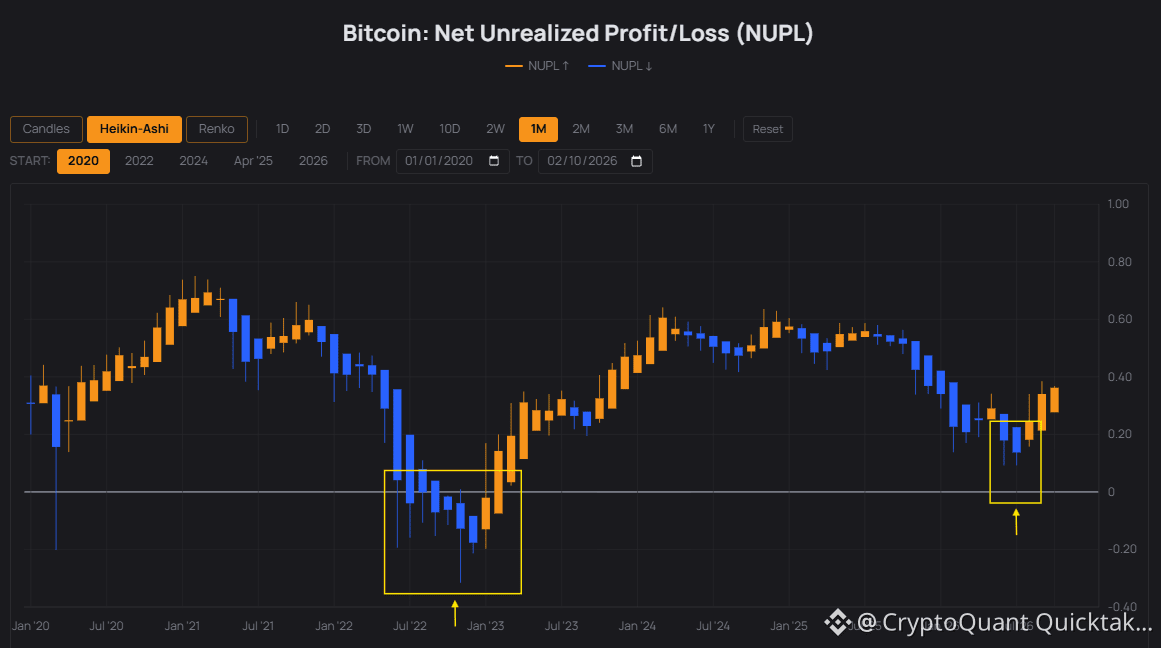
Bitcoin: the State of Holders - NUPL ↓• During the previous bear cycle, NUPL declined for approximately one year, eventually falling below 0 before beginning a sustained recovery. It reached -0.31.
• In the current cycle, the deterioration also lasted about one year, but the recovery began from a considerably less severe level of market stress. NUPL never fell below 0 and reached a low of only +0.09, meaning that the market remained in aggregate unrealized profit even at the deepest point of the decline.
• From its low, NUPL increased to +0.38, representing a rise of approximately 300%. This recovery occurred in just three months. The last time a recovery of similar magnitude occurred after a downtrend was in early 2023, which preceded a major bullish trend that extended through 2025.
Written by Facundo Fama
Bitcoin: the State of Holders - NUPL ↓
• During the previous bear cycle, NUPL declined for approximately one year, eventually falling below 0 before beginning a sustained recovery. It reached -0.31.
• In the current cycle, the deterioration also lasted about one year, but the recovery began from a considerably less severe level of market stress. NUPL never fell below 0 and reached a low of only +0.09, meaning that the market remained in aggregate unrealized profit even at the deepest point of the decline.
• From its low, NUPL increased to +0.38, representing a rise of approximately 300%. This recovery occurred in just three months. The last time a recovery of similar magnitude occurred after a downtrend was in early 2023, which preceded a major bullish trend that extended through 2025.
Written by Facundo Fama
• In the current cycle, the deterioration also lasted about one year, but the recovery began from a considerably less severe level of market stress. NUPL never fell below 0 and reached a low of only +0.09, meaning that the market remained in aggregate unrealized profit even at the deepest point of the decline.
• From its low, NUPL increased to +0.38, representing a rise of approximately 300%. This recovery occurred in just three months. The last time a recovery of similar magnitude occurred after a downtrend was in early 2023, which preceded a major bullish trend that extended through 2025.
Written by Facundo Fama
186
Article
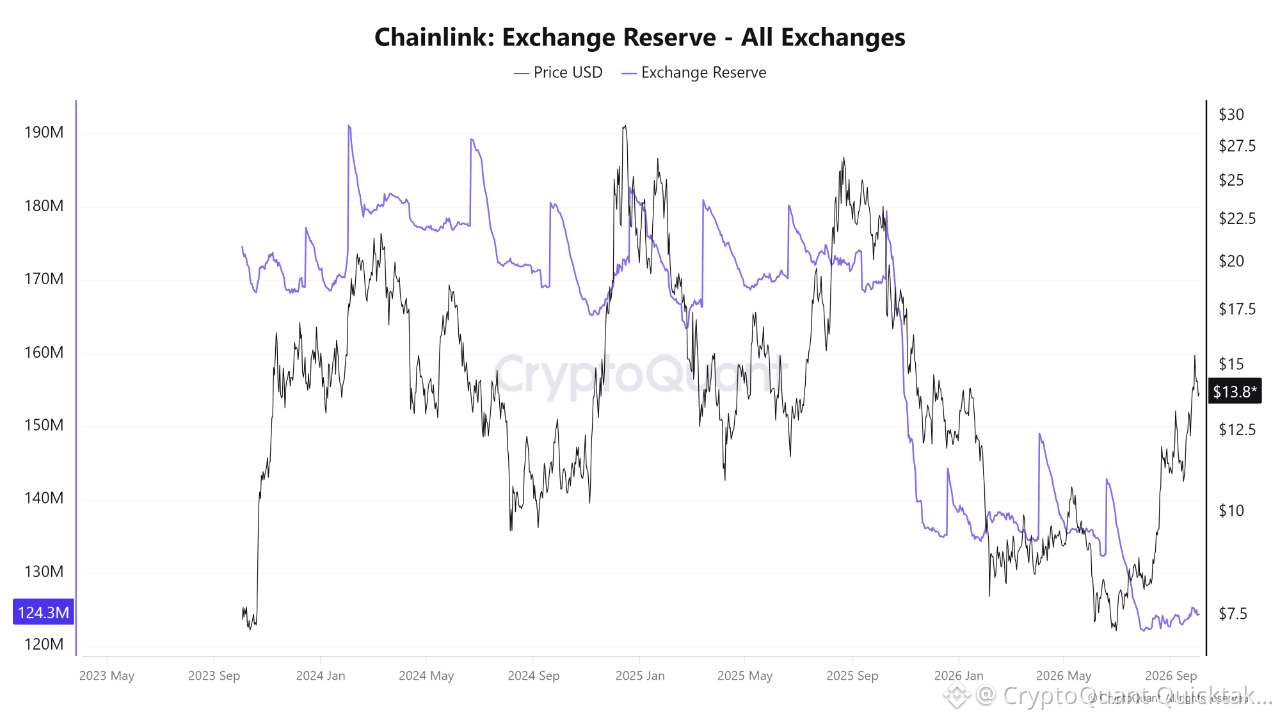
Chainlink Rallies From $9 to Above $15 While Exchange Reserves Sit Near a Multi-Year LowLINK broke out of a seven month $7 to $10 range starting in September, rallying to a peak above $15.50 before pulling back to its current $13.887. What makes this breakout different from several prior rallies on this same chart is what exchange reserves did, or rather, didn't do, while it happened.
Looking at the reserve chart since late 2023, a clear sawtooth pattern repeats, reserves build gradually, then jump sharply in a single move, a pattern that's shown up at least six or seven times, early 2024, mid 2024, late 2024, early and mid 2025, and once more in early 2026. Several of those spikes land close to local price tops or precede price weakness, consistent with sudden reserve increases reflecting coins moving toward exchanges ahead of potential selling.
This latest rally breaks that pattern. Reserves have stayed essentially flat near 124 to 130M through the entire September to October move, no sharp spike accompanying this breakout the way one accompanied several prior rallies. Reserves currently sit at 124.3M, near the lowest point of the entire multi-year window shown, well below the 190M peak from early 2024.
What stands out too is the broader structural decline, reserves have fallen from that 190M peak to current levels through a mix of gradual declines and periodic spikes, a multi-year downtrend in available exchange supply persisting across multiple price cycles.
My honest read: a rally happening without the characteristic reserve spike that's marked several prior tops is a genuinely different setup, suggesting less fresh supply arriving at exchanges than in past comparable moves. Not proof the rally continues, but the absence of that historical warning sign is worth noting.
What I'm watching: whether a reserve spike eventually shows up as this rally continues or if LINK pushes back toward its recent highs, since that's been the pattern's typical trigger point historically.
Written by R3N
Chainlink Rallies From $9 to Above $15 While Exchange Reserves Sit Near a Multi-Year Low
LINK broke out of a seven month $7 to $10 range starting in September, rallying to a peak above $15.50 before pulling back to its current $13.887. What makes this breakout different from several prior rallies on this same chart is what exchange reserves did, or rather, didn't do, while it happened.
Looking at the reserve chart since late 2023, a clear sawtooth pattern repeats, reserves build gradually, then jump sharply in a single move, a pattern that's shown up at least six or seven times, early 2024, mid 2024, late 2024, early and mid 2025, and once more in early 2026. Several of those spikes land close to local price tops or precede price weakness, consistent with sudden reserve increases reflecting coins moving toward exchanges ahead of potential selling.
This latest rally breaks that pattern. Reserves have stayed essentially flat near 124 to 130M through the entire September to October move, no sharp spike accompanying this breakout the way one accompanied several prior rallies. Reserves currently sit at 124.3M, near the lowest point of the entire multi-year window shown, well below the 190M peak from early 2024.
What stands out too is the broader structural decline, reserves have fallen from that 190M peak to current levels through a mix of gradual declines and periodic spikes, a multi-year downtrend in available exchange supply persisting across multiple price cycles.
My honest read: a rally happening without the characteristic reserve spike that's marked several prior tops is a genuinely different setup, suggesting less fresh supply arriving at exchanges than in past comparable moves. Not proof the rally continues, but the absence of that historical warning sign is worth noting.
What I'm watching: whether a reserve spike eventually shows up as this rally continues or if LINK pushes back toward its recent highs, since that's been the pattern's typical trigger point historically.
Written by R3N
Looking at the reserve chart since late 2023, a clear sawtooth pattern repeats, reserves build gradually, then jump sharply in a single move, a pattern that's shown up at least six or seven times, early 2024, mid 2024, late 2024, early and mid 2025, and once more in early 2026. Several of those spikes land close to local price tops or precede price weakness, consistent with sudden reserve increases reflecting coins moving toward exchanges ahead of potential selling.
This latest rally breaks that pattern. Reserves have stayed essentially flat near 124 to 130M through the entire September to October move, no sharp spike accompanying this breakout the way one accompanied several prior rallies. Reserves currently sit at 124.3M, near the lowest point of the entire multi-year window shown, well below the 190M peak from early 2024.
What stands out too is the broader structural decline, reserves have fallen from that 190M peak to current levels through a mix of gradual declines and periodic spikes, a multi-year downtrend in available exchange supply persisting across multiple price cycles.
My honest read: a rally happening without the characteristic reserve spike that's marked several prior tops is a genuinely different setup, suggesting less fresh supply arriving at exchanges than in past comparable moves. Not proof the rally continues, but the absence of that historical warning sign is worth noting.
What I'm watching: whether a reserve spike eventually shows up as this rally continues or if LINK pushes back toward its recent highs, since that's been the pattern's typical trigger point historically.
Written by R3N
234
Article
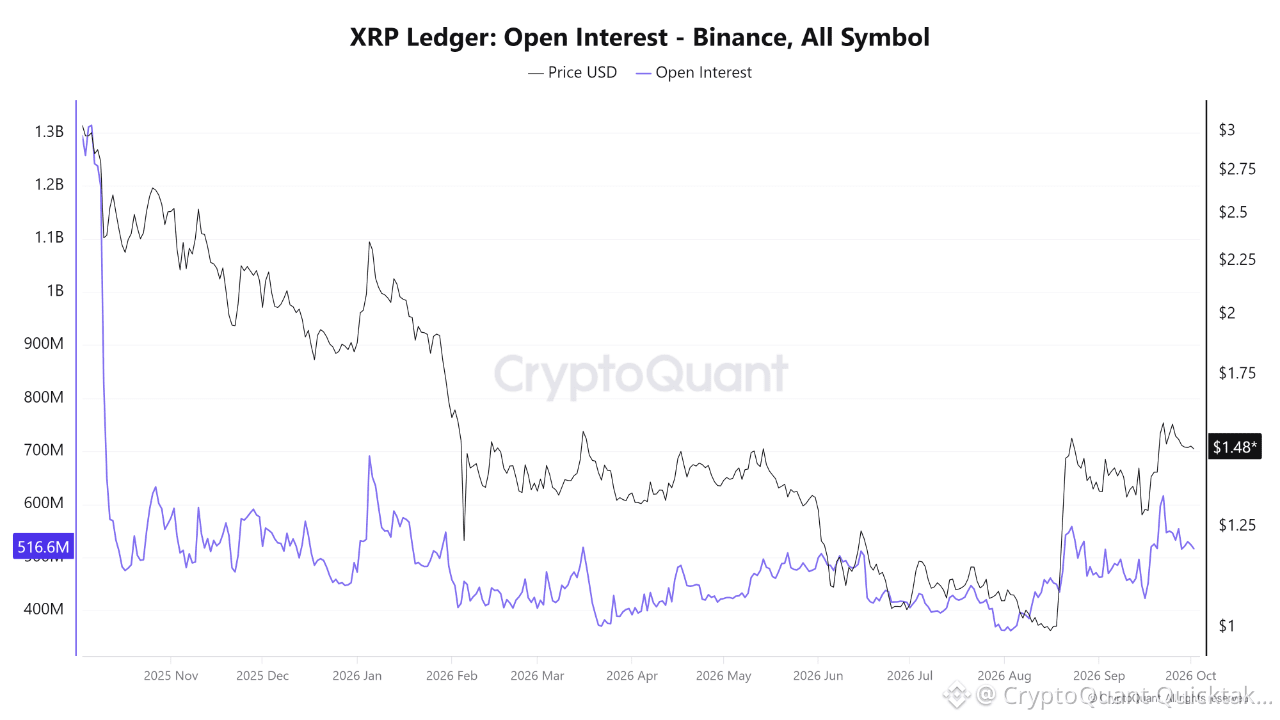
XRP Open Interest on Binance Recovers to 516.6M, Still Far Below Its October 2025 Starting PointXRP open interest on Binance sits at 516.6M, up from a 2026 low near 350 to 400M, but still a fraction of where it started this chart, above 1.3B last October. Price has recovered to $1.48 from a February low near $1, a genuine rebound open interest hasn't matched in scale.
The two series have largely moved together through this entire window. The sharpest open interest collapse happened almost immediately, cratering from 1.3B to the 500 to 600M range within the first weeks shown, right alongside price sliding from near $3 toward $2.20. Both continued declining through a volatile February, open interest dropping to its cycle low near 350 to 400M as price fell sharply toward $1.50. From March through July, both chopped sideways in a tight range, open interest mostly 400 to 700M, price $1 to $1.75, no clean directional trend in either.
The most recent move is where this gets interesting. Late August into September saw both lines spike together, open interest jumping from around 400M toward above 700M, price climbing from near $1 to the $1.25 to $1.30 area, before both pulled back. A genuine joint recovery in positioning and price, not price moving independently of leverage.
What stands out is the gap that remains. Price at $1.48 represents a real recovery off its own lows, but open interest at 516.6M is still well below both its October 2025 starting point and its own recent September peak above 700M. That asymmetry suggests leveraged positioning hasn't fully returned to the scale price action alone might suggest.
My honest read: open interest and price have been genuinely correlated throughout, making the current gap meaningful rather than noise. Price recovering faster than open interest rebuilds typically points to a less leveraged, more cautious market than a year ago.
What I'm watching: whether open interest continues climbing back toward its recent September peak, or whether this current pullback in both series extends further.
Written by R3N
XRP Open Interest on Binance Recovers to 516.6M, Still Far Below Its October 2025 Starting Point
XRP open interest on Binance sits at 516.6M, up from a 2026 low near 350 to 400M, but still a fraction of where it started this chart, above 1.3B last October. Price has recovered to $1.48 from a February low near $1, a genuine rebound open interest hasn't matched in scale.
The two series have largely moved together through this entire window. The sharpest open interest collapse happened almost immediately, cratering from 1.3B to the 500 to 600M range within the first weeks shown, right alongside price sliding from near $3 toward $2.20. Both continued declining through a volatile February, open interest dropping to its cycle low near 350 to 400M as price fell sharply toward $1.50. From March through July, both chopped sideways in a tight range, open interest mostly 400 to 700M, price $1 to $1.75, no clean directional trend in either.
The most recent move is where this gets interesting. Late August into September saw both lines spike together, open interest jumping from around 400M toward above 700M, price climbing from near $1 to the $1.25 to $1.30 area, before both pulled back. A genuine joint recovery in positioning and price, not price moving independently of leverage.
What stands out is the gap that remains. Price at $1.48 represents a real recovery off its own lows, but open interest at 516.6M is still well below both its October 2025 starting point and its own recent September peak above 700M. That asymmetry suggests leveraged positioning hasn't fully returned to the scale price action alone might suggest.
My honest read: open interest and price have been genuinely correlated throughout, making the current gap meaningful rather than noise. Price recovering faster than open interest rebuilds typically points to a less leveraged, more cautious market than a year ago.
What I'm watching: whether open interest continues climbing back toward its recent September peak, or whether this current pullback in both series extends further.
Written by R3N
The two series have largely moved together through this entire window. The sharpest open interest collapse happened almost immediately, cratering from 1.3B to the 500 to 600M range within the first weeks shown, right alongside price sliding from near $3 toward $2.20. Both continued declining through a volatile February, open interest dropping to its cycle low near 350 to 400M as price fell sharply toward $1.50. From March through July, both chopped sideways in a tight range, open interest mostly 400 to 700M, price $1 to $1.75, no clean directional trend in either.
The most recent move is where this gets interesting. Late August into September saw both lines spike together, open interest jumping from around 400M toward above 700M, price climbing from near $1 to the $1.25 to $1.30 area, before both pulled back. A genuine joint recovery in positioning and price, not price moving independently of leverage.
What stands out is the gap that remains. Price at $1.48 represents a real recovery off its own lows, but open interest at 516.6M is still well below both its October 2025 starting point and its own recent September peak above 700M. That asymmetry suggests leveraged positioning hasn't fully returned to the scale price action alone might suggest.
My honest read: open interest and price have been genuinely correlated throughout, making the current gap meaningful rather than noise. Price recovering faster than open interest rebuilds typically points to a less leveraged, more cautious market than a year ago.
What I'm watching: whether open interest continues climbing back toward its recent September peak, or whether this current pullback in both series extends further.
Written by R3N
1
276
Article
Bitcoin Supply Is Tightening, but U.S. Spot Buyers Haven't Shown Up YetBitcoin is trading near $85K, and the on-chain picture is split: supply-side metrics are clearly constructive, while U.S. spot demand still lags.
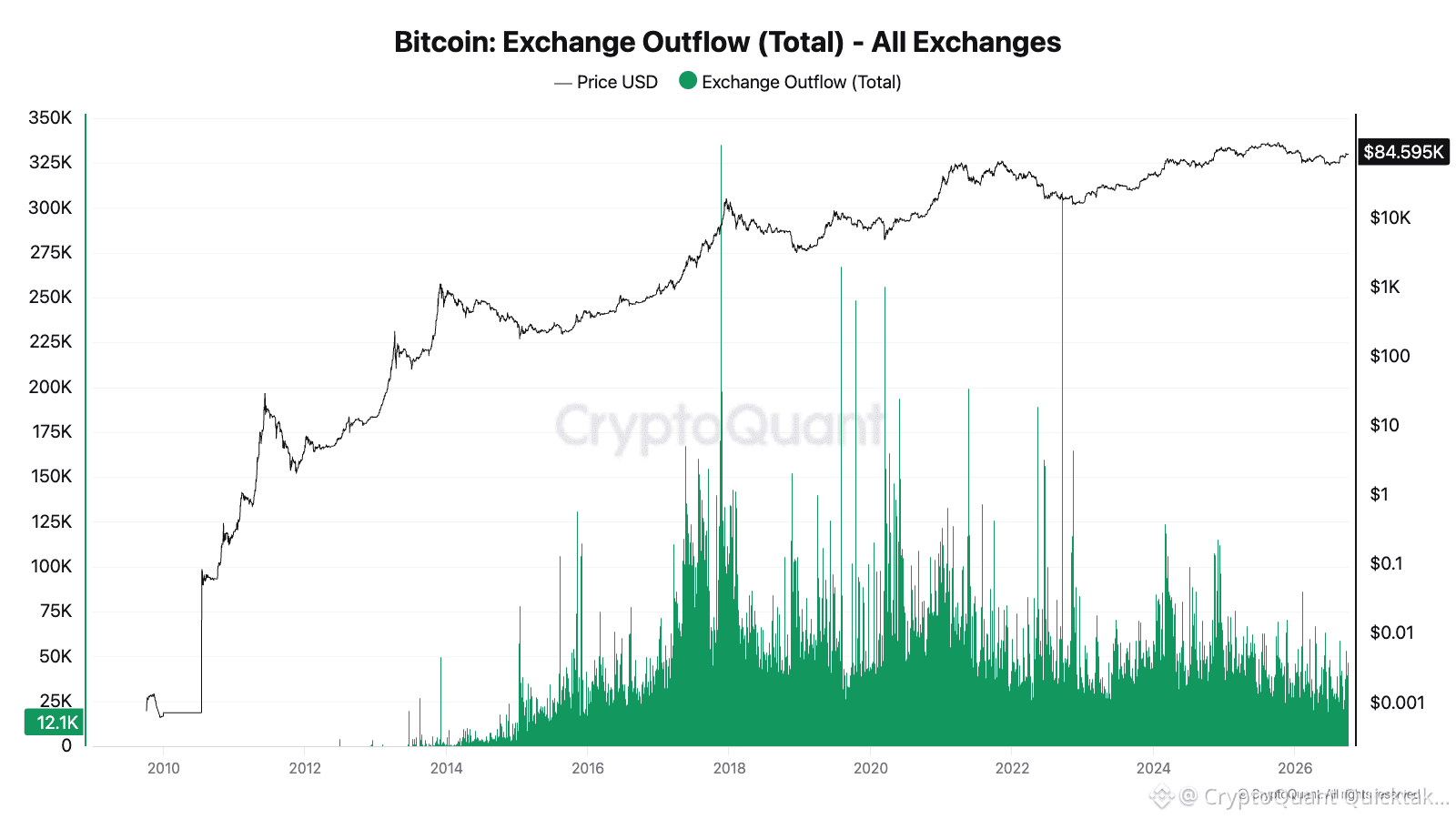
Supply is tightening. All-exchange reserves have fallen to about 2.68M BTC, the lowest since at least September 2023, and have declined through every price cycle since the early-2024 peak near 3.2M BTC. Exchanges recorded net outflows on six of seven days from September 24 to 30, roughly 18.2K BTC in total.
Institutional flows have turned. U.S. spot ETFs are now +2,312 BTC year-to-date after absorbing 85.4K BTC since the July low. Short-term holders are back in profit, with STH Market Cap about 15% above STH Realized Cap.
The missing piece is U.S. spot demand. The Coinbase Premium has been negative for 26 consecutive days, and Apparent Demand (30D) is improving but still negative near -101K BTC.
Derivatives are calm. DVOL sits near 36, lower than on 95% of days since 2021, and funding is neutral. Low leverage makes the move cleaner, but compressed volatility has often come before sharp expansions.
My read: structurally constructive, tactically unconfirmed. Outflows and ETF absorption are tightening liquid supply, but without U.S. spot bids, rallies risk stalling, as the quick rejection from $87K after the jobs report showed.
What I'm watching: a Coinbase Premium flip to positive, Apparent Demand crossing above zero, and whether outflows continue as price approaches $95K. Coins flowing back onto exchanges into strength would invalidate the setup.
Written by Zakariya Sharif
Bitcoin Supply Is Tightening, but U.S. Spot Buyers Haven't Shown Up Yet
Bitcoin is trading near $85K, and the on-chain picture is split: supply-side metrics are clearly constructive, while U.S. spot demand still lags.
Supply is tightening. All-exchange reserves have fallen to about 2.68M BTC, the lowest since at least September 2023, and have declined through every price cycle since the early-2024 peak near 3.2M BTC. Exchanges recorded net outflows on six of seven days from September 24 to 30, roughly 18.2K BTC in total.
Institutional flows have turned. U.S. spot ETFs are now +2,312 BTC year-to-date after absorbing 85.4K BTC since the July low. Short-term holders are back in profit, with STH Market Cap about 15% above STH Realized Cap.
The missing piece is U.S. spot demand. The Coinbase Premium has been negative for 26 consecutive days, and Apparent Demand (30D) is improving but still negative near -101K BTC.
Derivatives are calm. DVOL sits near 36, lower than on 95% of days since 2021, and funding is neutral. Low leverage makes the move cleaner, but compressed volatility has often come before sharp expansions.
My read: structurally constructive, tactically unconfirmed. Outflows and ETF absorption are tightening liquid supply, but without U.S. spot bids, rallies risk stalling, as the quick rejection from $87K after the jobs report showed.
What I'm watching: a Coinbase Premium flip to positive, Apparent Demand crossing above zero, and whether outflows continue as price approaches $95K. Coins flowing back onto exchanges into strength would invalidate the setup.
Written by Zakariya Sharif
Supply is tightening. All-exchange reserves have fallen to about 2.68M BTC, the lowest since at least September 2023, and have declined through every price cycle since the early-2024 peak near 3.2M BTC. Exchanges recorded net outflows on six of seven days from September 24 to 30, roughly 18.2K BTC in total.
Institutional flows have turned. U.S. spot ETFs are now +2,312 BTC year-to-date after absorbing 85.4K BTC since the July low. Short-term holders are back in profit, with STH Market Cap about 15% above STH Realized Cap.
The missing piece is U.S. spot demand. The Coinbase Premium has been negative for 26 consecutive days, and Apparent Demand (30D) is improving but still negative near -101K BTC.
Derivatives are calm. DVOL sits near 36, lower than on 95% of days since 2021, and funding is neutral. Low leverage makes the move cleaner, but compressed volatility has often come before sharp expansions.
My read: structurally constructive, tactically unconfirmed. Outflows and ETF absorption are tightening liquid supply, but without U.S. spot bids, rallies risk stalling, as the quick rejection from $87K after the jobs report showed.
What I'm watching: a Coinbase Premium flip to positive, Apparent Demand crossing above zero, and whether outflows continue as price approaches $95K. Coins flowing back onto exchanges into strength would invalidate the setup.
Written by Zakariya Sharif
3
242
Article
Bitcoin Between Two Walls: High Yields and Profit-Taking Meet ETF DemandBitcoin is caught between forces capping gains and demand cushioning declines.
High U.S. Treasury yields, uncertainty ahead of the midterm elections, and profit-taking weigh on prices. AI investment may also compete for capital, although direct flows from Bitcoin into AI stocks have not been established.
Spot Bitcoin ETFs remain a key support, but inflows have slowed. Farside data show net inflows of about $2.39 billion on September 21–25, versus just $51.2 million across September 28–October 1.
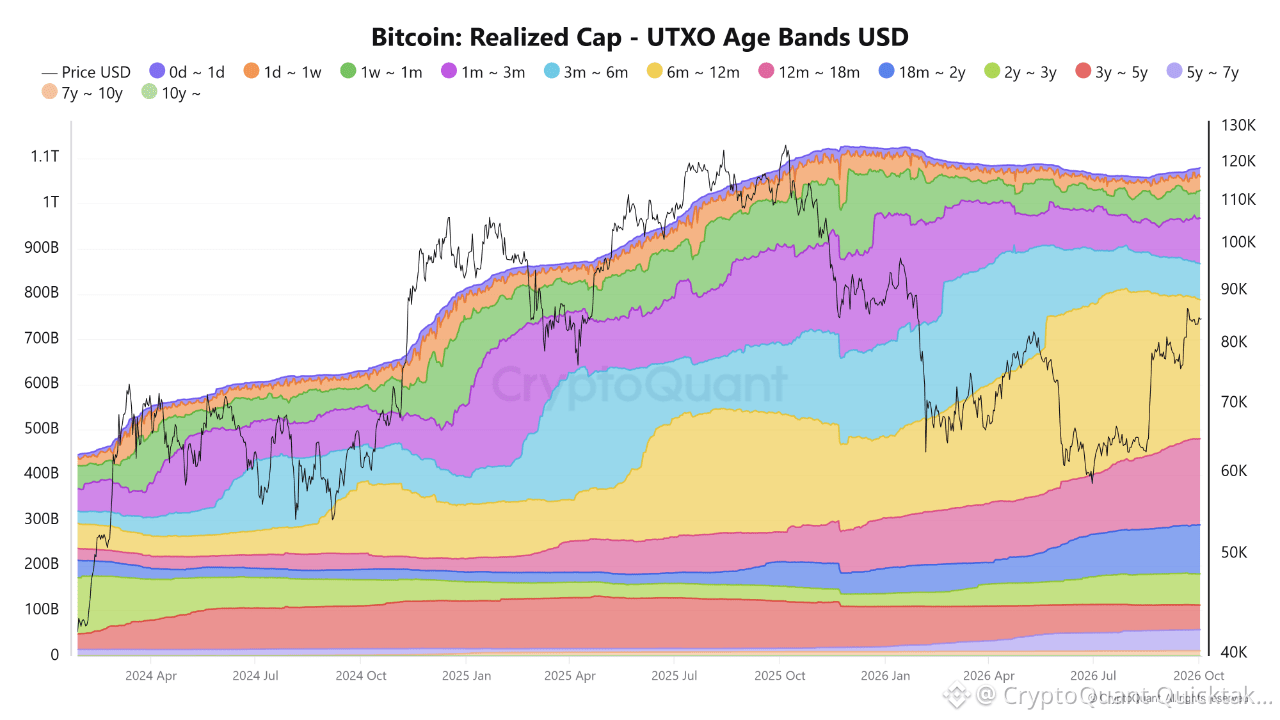
CryptoQuant's Realized Cap chart shows a modest recovery after declining earlier in 2026, suggesting improvement in the capital represented by coins' last-moved prices. However, this is not a direct measure of cash inflows, and changes across age bands also reflect coins aging.
Funding rates have generally remained slightly positive, easing toward zero at the chart's endpoint. They show less overheating than earlier rally peaks, but cannot guarantee limited liquidation risk.
The key is whether spot buying broadens beyond ETFs and absorbs profit-taking. Neither wall is permanent. Watch demand and long-term yields, and remain prepared for a move in either direction.
Written by XWIN Japan
Bitcoin Between Two Walls: High Yields and Profit-Taking Meet ETF Demand
Bitcoin is caught between forces capping gains and demand cushioning declines.
High U.S. Treasury yields, uncertainty ahead of the midterm elections, and profit-taking weigh on prices. AI investment may also compete for capital, although direct flows from Bitcoin into AI stocks have not been established.
Spot Bitcoin ETFs remain a key support, but inflows have slowed. Farside data show net inflows of about $2.39 billion on September 21–25, versus just $51.2 million across September 28–October 1.
CryptoQuant's Realized Cap chart shows a modest recovery after declining earlier in 2026, suggesting improvement in the capital represented by coins' last-moved prices. However, this is not a direct measure of cash inflows, and changes across age bands also reflect coins aging.
Funding rates have generally remained slightly positive, easing toward zero at the chart's endpoint. They show less overheating than earlier rally peaks, but cannot guarantee limited liquidation risk.
The key is whether spot buying broadens beyond ETFs and absorbs profit-taking. Neither wall is permanent. Watch demand and long-term yields, and remain prepared for a move in either direction.
Written by XWIN Japan
High U.S. Treasury yields, uncertainty ahead of the midterm elections, and profit-taking weigh on prices. AI investment may also compete for capital, although direct flows from Bitcoin into AI stocks have not been established.
Spot Bitcoin ETFs remain a key support, but inflows have slowed. Farside data show net inflows of about $2.39 billion on September 21–25, versus just $51.2 million across September 28–October 1.
CryptoQuant's Realized Cap chart shows a modest recovery after declining earlier in 2026, suggesting improvement in the capital represented by coins' last-moved prices. However, this is not a direct measure of cash inflows, and changes across age bands also reflect coins aging.
Funding rates have generally remained slightly positive, easing toward zero at the chart's endpoint. They show less overheating than earlier rally peaks, but cannot guarantee limited liquidation risk.
The key is whether spot buying broadens beyond ETFs and absorbs profit-taking. Neither wall is permanent. Watch demand and long-term yields, and remain prepared for a move in either direction.
Written by XWIN Japan
BTC+2,44%
IEFETF-0,13%
1
153
Article
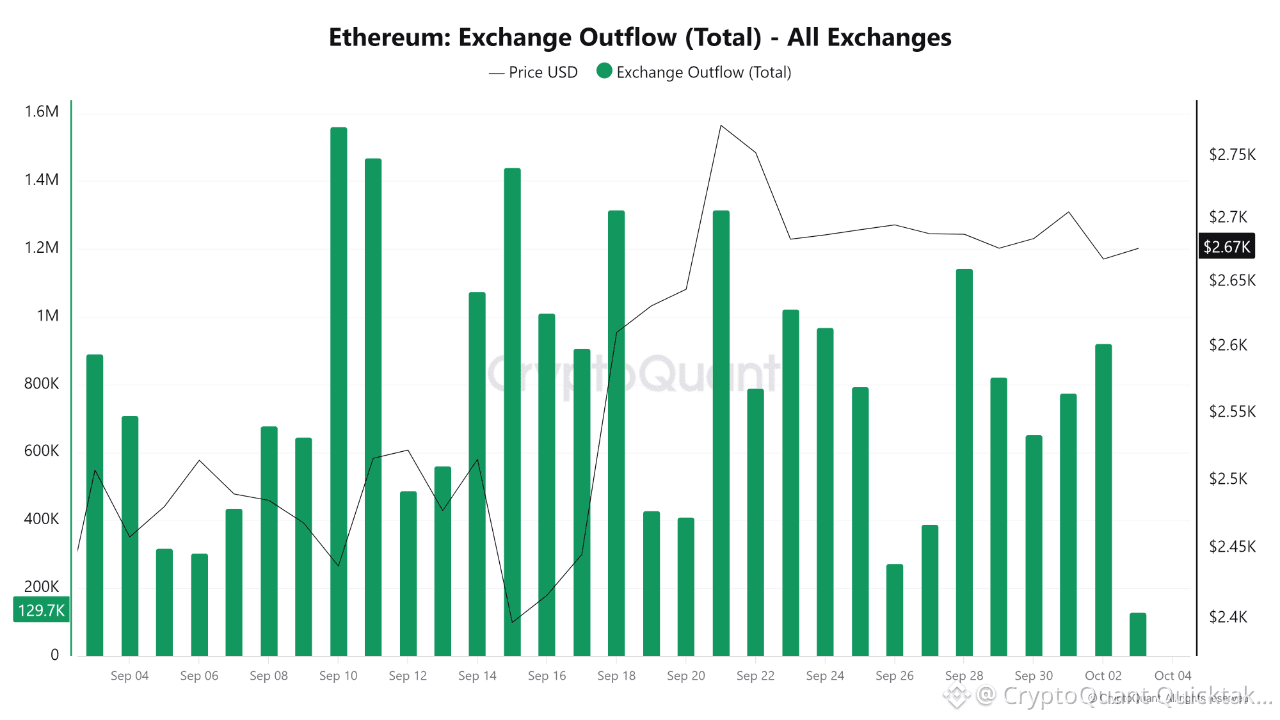
Ethereum Exchange Inflow Vs Outflow: a Month of Near Perfect Twin Spikes, Until the Final ReadingEthereum's exchange inflow and outflow have moved in near lockstep for most of the past month, both spiking on the same days, both easing on the same days. The exception is the most recent reading, where outflow finally pulled ahead of inflow, 129.7K versus 116.7K.
Looking at both charts side by side, the pattern through September is strikingly synchronized. The largest spikes, September 10 near 1.58M in and 1.55M out, September 18 around 1.45M in and 1.3M out, September 22 near 1.3M on both sides, September 28 around 1.15M on both sides, all land on identical days with nearly matching magnitude. That kind of twin movement usually points to high churn, large volumes cycling through exchanges, rather than one directional trend building across the month.
What changes at the very end is worth flagging. The latest print shows outflow at 129.7K against inflow at 116.7K, a net negative flow day, coins leaving exchanges rather than the roughly balanced churn that dominated the prior four weeks. One data point doesn't establish a new trend, but it's the first clear divergence in an otherwise matched month.
Price moved from around $2.40K in mid September up to $2.67K by early October, with the sharpest jump, roughly $2.45K to $2.70K between September 19 and 21, landing right after the September 18 inflow and outflow spike. Large two sided flow preceding a price breakout is worth noting, though it doesn't establish causation.
My honest read: a month of matched inflow and outflow mostly describes active trading and repositioning, not sustained accumulation or distribution. The final day's shift toward net outflow is the one genuinely new signal, worth watching for confirmation rather than treating as settled.
What I'm watching: whether outflow continues leading inflow over the next several sessions, which would mark an actual shift from this month's balanced pattern, or whether this reverts back to matched twin spikes.
Written by R3N
Ethereum Exchange Inflow Vs Outflow: a Month of Near Perfect Twin Spikes, Until the Final Reading
Ethereum's exchange inflow and outflow have moved in near lockstep for most of the past month, both spiking on the same days, both easing on the same days. The exception is the most recent reading, where outflow finally pulled ahead of inflow, 129.7K versus 116.7K.
Looking at both charts side by side, the pattern through September is strikingly synchronized. The largest spikes, September 10 near 1.58M in and 1.55M out, September 18 around 1.45M in and 1.3M out, September 22 near 1.3M on both sides, September 28 around 1.15M on both sides, all land on identical days with nearly matching magnitude. That kind of twin movement usually points to high churn, large volumes cycling through exchanges, rather than one directional trend building across the month.
What changes at the very end is worth flagging. The latest print shows outflow at 129.7K against inflow at 116.7K, a net negative flow day, coins leaving exchanges rather than the roughly balanced churn that dominated the prior four weeks. One data point doesn't establish a new trend, but it's the first clear divergence in an otherwise matched month.
Price moved from around $2.40K in mid September up to $2.67K by early October, with the sharpest jump, roughly $2.45K to $2.70K between September 19 and 21, landing right after the September 18 inflow and outflow spike. Large two sided flow preceding a price breakout is worth noting, though it doesn't establish causation.
My honest read: a month of matched inflow and outflow mostly describes active trading and repositioning, not sustained accumulation or distribution. The final day's shift toward net outflow is the one genuinely new signal, worth watching for confirmation rather than treating as settled.
What I'm watching: whether outflow continues leading inflow over the next several sessions, which would mark an actual shift from this month's balanced pattern, or whether this reverts back to matched twin spikes.
Written by R3N
Looking at both charts side by side, the pattern through September is strikingly synchronized. The largest spikes, September 10 near 1.58M in and 1.55M out, September 18 around 1.45M in and 1.3M out, September 22 near 1.3M on both sides, September 28 around 1.15M on both sides, all land on identical days with nearly matching magnitude. That kind of twin movement usually points to high churn, large volumes cycling through exchanges, rather than one directional trend building across the month.
What changes at the very end is worth flagging. The latest print shows outflow at 129.7K against inflow at 116.7K, a net negative flow day, coins leaving exchanges rather than the roughly balanced churn that dominated the prior four weeks. One data point doesn't establish a new trend, but it's the first clear divergence in an otherwise matched month.
Price moved from around $2.40K in mid September up to $2.67K by early October, with the sharpest jump, roughly $2.45K to $2.70K between September 19 and 21, landing right after the September 18 inflow and outflow spike. Large two sided flow preceding a price breakout is worth noting, though it doesn't establish causation.
My honest read: a month of matched inflow and outflow mostly describes active trading and repositioning, not sustained accumulation or distribution. The final day's shift toward net outflow is the one genuinely new signal, worth watching for confirmation rather than treating as settled.
What I'm watching: whether outflow continues leading inflow over the next several sessions, which would mark an actual shift from this month's balanced pattern, or whether this reverts back to matched twin spikes.
Written by R3N
208
Article
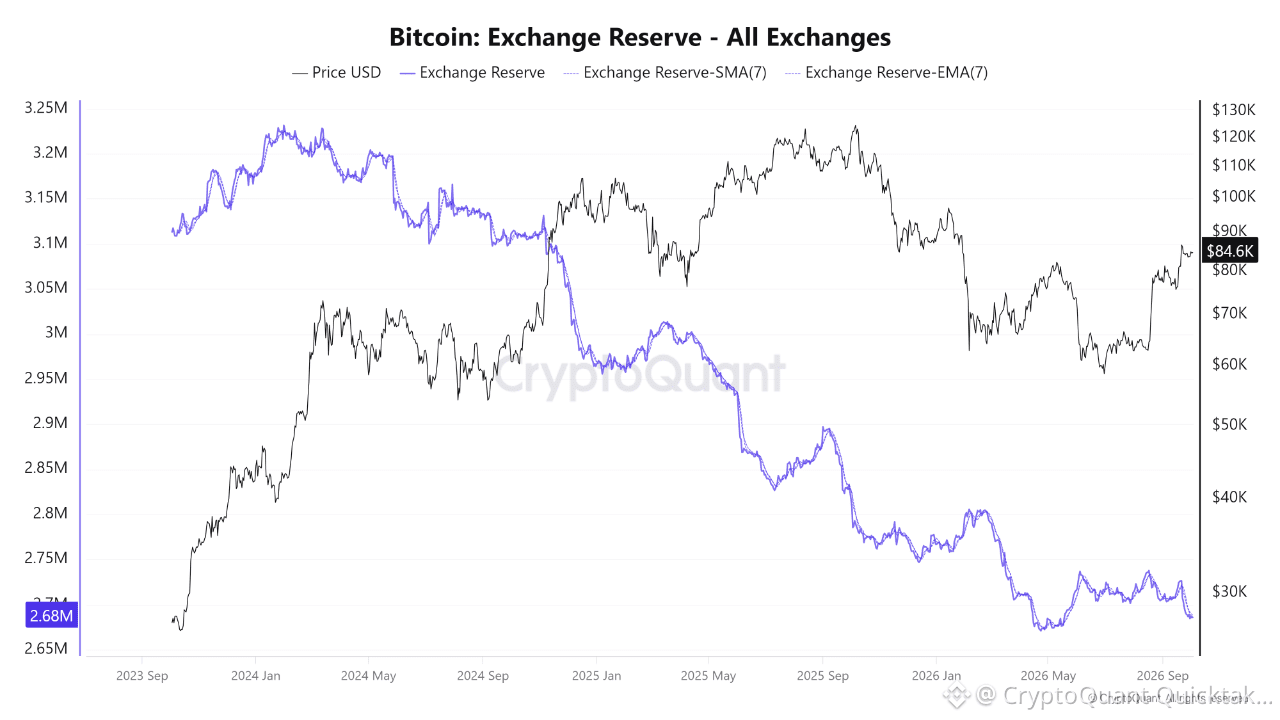
Bitcoin Exchange Reserves Hit a Fresh Multi-Year Low As Price Climbs Back Toward $85KAll exchange Bitcoin reserves sit at 2.68 million BTC, the lowest level on this chart since at least September 2023, while price has climbed back to $84,600. That combination, falling reserves alongside a recovering price, is the actual structural story, not just where price sits today.
Zooming out, the trend is strikingly consistent despite multiple price cycles in either direction. Reserves peaked near 3.2 million BTC in early 2024, when price was still well below $70K. From there, reserves declined in a persistent downtrend through every subsequent price cycle, the 2024 highs near $73K, the 2025 run toward $126K, and the pullback into 2026, reserves kept falling through all of it rather than tracking price moves.
What stands out is the period from late 2024 into 2025, where reserves dropped sharply, from around 3.1 million toward 2.9 million, even as price worked through a wide consolidation range. Coins leaving exchanges independent of any single price catalyst, a steady outflow pattern rather than event driven spikes.
The SMA and EMA overlays track the raw reserve line closely throughout, no major divergence between short term smoothing and the actual balance, suggesting this isn't noisy day to day volatility distorting the picture, it's a genuine sustained trend.
My honest read: persistent exchange reserve decline across multiple price regimes is typically read as a sign of accumulation or long term holding intent, since coins aren't sitting available for immediate sale. Reasonable here given how consistent the decline has been, though reserves leaving exchanges doesn't by itself confirm where those coins are going, cold storage, OTC desks, or other custody would all show the same pattern.
What I'm watching: whether this reserve decline continues as price pushes higher, or whether a rally toward new highs starts pulling supply back onto exchanges the way past cycles eventually did.
Written by R3N
Bitcoin Exchange Reserves Hit a Fresh Multi-Year Low As Price Climbs Back Toward $85K
All exchange Bitcoin reserves sit at 2.68 million BTC, the lowest level on this chart since at least September 2023, while price has climbed back to $84,600. That combination, falling reserves alongside a recovering price, is the actual structural story, not just where price sits today.
Zooming out, the trend is strikingly consistent despite multiple price cycles in either direction. Reserves peaked near 3.2 million BTC in early 2024, when price was still well below $70K. From there, reserves declined in a persistent downtrend through every subsequent price cycle, the 2024 highs near $73K, the 2025 run toward $126K, and the pullback into 2026, reserves kept falling through all of it rather than tracking price moves.
What stands out is the period from late 2024 into 2025, where reserves dropped sharply, from around 3.1 million toward 2.9 million, even as price worked through a wide consolidation range. Coins leaving exchanges independent of any single price catalyst, a steady outflow pattern rather than event driven spikes.
The SMA and EMA overlays track the raw reserve line closely throughout, no major divergence between short term smoothing and the actual balance, suggesting this isn't noisy day to day volatility distorting the picture, it's a genuine sustained trend.
My honest read: persistent exchange reserve decline across multiple price regimes is typically read as a sign of accumulation or long term holding intent, since coins aren't sitting available for immediate sale. Reasonable here given how consistent the decline has been, though reserves leaving exchanges doesn't by itself confirm where those coins are going, cold storage, OTC desks, or other custody would all show the same pattern.
What I'm watching: whether this reserve decline continues as price pushes higher, or whether a rally toward new highs starts pulling supply back onto exchanges the way past cycles eventually did.
Written by R3N
Zooming out, the trend is strikingly consistent despite multiple price cycles in either direction. Reserves peaked near 3.2 million BTC in early 2024, when price was still well below $70K. From there, reserves declined in a persistent downtrend through every subsequent price cycle, the 2024 highs near $73K, the 2025 run toward $126K, and the pullback into 2026, reserves kept falling through all of it rather than tracking price moves.
What stands out is the period from late 2024 into 2025, where reserves dropped sharply, from around 3.1 million toward 2.9 million, even as price worked through a wide consolidation range. Coins leaving exchanges independent of any single price catalyst, a steady outflow pattern rather than event driven spikes.
The SMA and EMA overlays track the raw reserve line closely throughout, no major divergence between short term smoothing and the actual balance, suggesting this isn't noisy day to day volatility distorting the picture, it's a genuine sustained trend.
My honest read: persistent exchange reserve decline across multiple price regimes is typically read as a sign of accumulation or long term holding intent, since coins aren't sitting available for immediate sale. Reasonable here given how consistent the decline has been, though reserves leaving exchanges doesn't by itself confirm where those coins are going, cold storage, OTC desks, or other custody would all show the same pattern.
What I'm watching: whether this reserve decline continues as price pushes higher, or whether a rally toward new highs starts pulling supply back onto exchanges the way past cycles eventually did.
Written by R3N
268
Connectez-vous pour découvrir plus de contenu
Rejoignez la communauté mondiale des adeptes de cryptomonnaies sur Binance Square
⚡️ Suviez les dernières informations importantes sur les cryptomonnaies.
💬 Jugé digne de confiance par la plus grande plateforme d’échange de cryptomonnaies au monde.
👍 Découvrez les connaissances que partagent les créateurs vérifiés.
Adresse e-mail/Nº de téléphone
Sujets d’actualité
ZamaRises15.99%ToIntradayHigh$0.09
19,397 vues
107 mentions
#ZamaRises15.99%ToIntradayHigh$0.09
ZAMA just woke up and chose violence! 🚀 Token #ZamaRises15.99%ToIntradayHigh$0.09, breaking out of nowhere to touch the 0.09 USDT mark. What triggered this pump? Smart money accumulating or a sudden FOMO wave catching the bears off guard? 💸
Will it keep pumping or dump back down? 🎢 It's flirting right at the resistance line. If it holds, we fly; if not, it’s a classic trap!
What should traders do? Secure some profits if you rode it up, set tight stop-losses, and don’t chase the green candle like a degen. Watch the volume closely! 🧐
Not financial advice (NFA).
Join Binance now! Code: VINHTOCDO
Link: https://www.binance.com/register?ref=VINHTOCDO
Click to trade below to support me:
$ZAMA
$BTC
$BNB
#Zama #CryptoPumping #TradingAlert #AltcoinSeason #VINHTOCDO
Vinhtocdo
·1 mentions J’aime
·308 vues
BitcoinSpotETFsDraw$6.34BInflowsInQ3
6,528 vues
94 mentions
EthereumValidatorExitQueueJumps392%
108,104 vues
993 mentions