

东京小姐
4.7k Publications

东京小姐
Signaler
Bloquer l’utilisateur
绿色就是目标 🗼🔥
Ouvert au trading
Trade régulièrement
5 an(s)
312 Suivis
22.5K+ Abonnés
12.8K+ J’aime
Publications
Portefeuille
Tous
Citations
Vidéos
Direct
·
--
Haussier
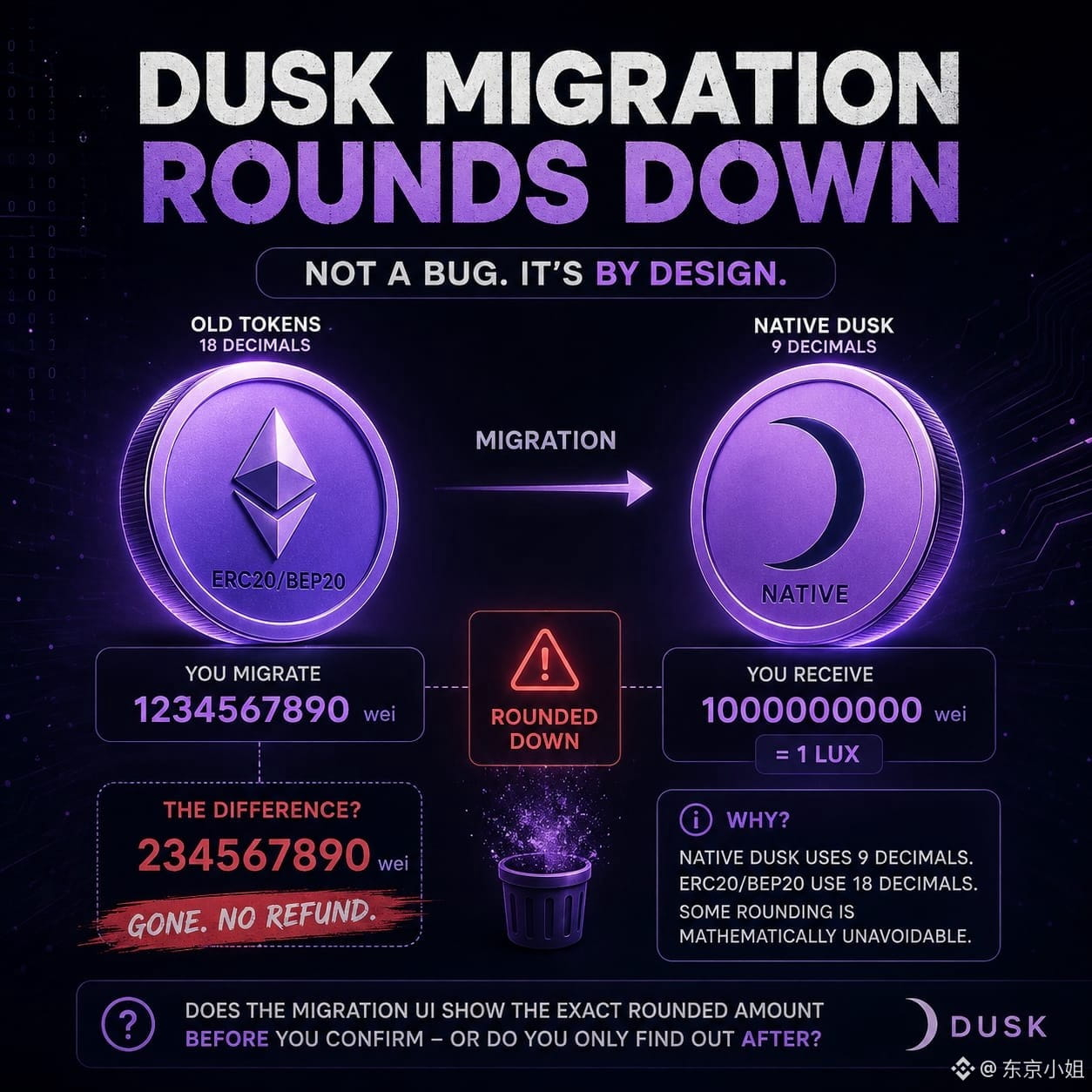
docs.dusk.network's migration guide has a rounding detail buried in the faq that i hadn't seen mentioned anywhere else. if you migrate an amount of erc20 or bep20 dusk that isn't a clean multiple of 1 lux, the contract just rounds it down — and i had to run their own example twice in my head before it actually clicked, migrate 1234567890 wei of dusk, and it rounds to exactly 1000000000 wei, one clean lux, no partial credit for the rest.
so the remainder isn't refunded, isn't queued for a later top-up, it's just gone from what you receive on the native side. that's a real cost baked into the migration mechanics themselves, not a bug, since native dusk uses 9 decimals and erc20/bep20 uses 18, so some rounding is mathematically unavoidable somewhere in the conversion.
for most people migrating a normal wallet balance this is probably fractions of a cent and genuinely doesn't matter. but nobody migrating for the first time expects "round down and lose the difference" to be the default behavior on a network built around deterministic settlement precision.
does the migration ui actually show people the exact rounded amount before they confirm, or do they only find out after the fact? 🧐
#dusk $DUSK @Dusk_Foundation
docs.dusk.network's migration guide has a rounding detail buried in the faq that i hadn't seen mentioned anywhere else. if you migrate an amount of erc20 or bep20 dusk that isn't a clean multiple of 1 lux, the contract just rounds it down — and i had to run their own example twice in my head before it actually clicked, migrate 1234567890 wei of dusk, and it rounds to exactly 1000000000 wei, one clean lux, no partial credit for the rest.
so the remainder isn't refunded, isn't queued for a later top-up, it's just gone from what you receive on the native side. that's a real cost baked into the migration mechanics themselves, not a bug, since native dusk uses 9 decimals and erc20/bep20 uses 18, so some rounding is mathematically unavoidable somewhere in the conversion.
for most people migrating a normal wallet balance this is probably fractions of a cent and genuinely doesn't matter. but nobody migrating for the first time expects "round down and lose the difference" to be the default behavior on a network built around deterministic settlement precision.
does the migration ui actually show people the exact rounded amount before they confirm, or do they only find out after the fact? 🧐
#dusk $DUSK @Dusk
so the remainder isn't refunded, isn't queued for a later top-up, it's just gone from what you receive on the native side. that's a real cost baked into the migration mechanics themselves, not a bug, since native dusk uses 9 decimals and erc20/bep20 uses 18, so some rounding is mathematically unavoidable somewhere in the conversion.
for most people migrating a normal wallet balance this is probably fractions of a cent and genuinely doesn't matter. but nobody migrating for the first time expects "round down and lose the difference" to be the default behavior on a network built around deterministic settlement precision.
does the migration ui actually show people the exact rounded amount before they confirm, or do they only find out after the fact? 🧐
#dusk $DUSK @Dusk
1
184
·
--
@Dusk_Foundation
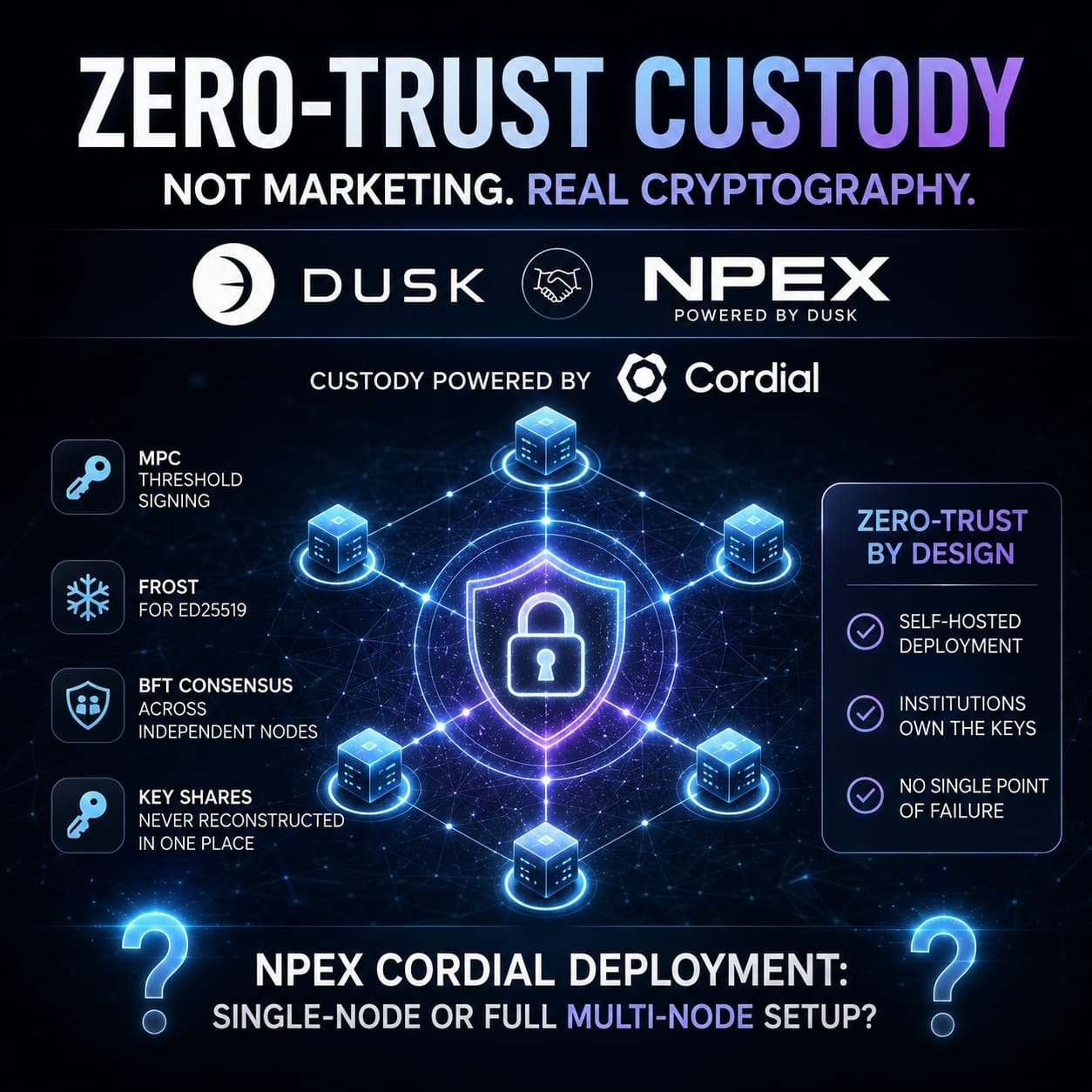
i went to check exactly what "zero-trust custody" means in the dusk-cordial-npex announcement, since that term usually implies a specific cryptographic architecture, and figured the press release was probably using it loosely for "self-hosted instead of third-party saas." i was wrong, and honestly i almost wrote this whole post around that wrong assumption before actually pulling cordial's own technical docs — their treasury product genuinely uses mpc threshold signing, frost for ed25519, a bft consensus layer across independent nodes, key shares that never get reconstructed in one place. that's real distributed-trust cryptography, not marketing dressed up as one.
so npex choosing self-hosted deployment and getting genuine zero-trust architecture aren't actually in tension the way i assumed going in, cordial's whole pitch is letting institutions run that architecture themselves instead of trusting a saas vendor's cloud.
what i still don't know is whether npex is running the full multi-node bft setup or something closer to a single-node deployment, since cordial's docs mention both are technically available. those aren't equally "zero-trust" in practice even on the same underlying software.
does anyone know if npex's actual cordial deployment is single-node or a genuine multi-node threshold setup? 🧐
#dusk $DUSK
@Dusk
i went to check exactly what "zero-trust custody" means in the dusk-cordial-npex announcement, since that term usually implies a specific cryptographic architecture, and figured the press release was probably using it loosely for "self-hosted instead of third-party saas." i was wrong, and honestly i almost wrote this whole post around that wrong assumption before actually pulling cordial's own technical docs — their treasury product genuinely uses mpc threshold signing, frost for ed25519, a bft consensus layer across independent nodes, key shares that never get reconstructed in one place. that's real distributed-trust cryptography, not marketing dressed up as one.
so npex choosing self-hosted deployment and getting genuine zero-trust architecture aren't actually in tension the way i assumed going in, cordial's whole pitch is letting institutions run that architecture themselves instead of trusting a saas vendor's cloud.
what i still don't know is whether npex is running the full multi-node bft setup or something closer to a single-node deployment, since cordial's docs mention both are technically available. those aren't equally "zero-trust" in practice even on the same underlying software.
does anyone know if npex's actual cordial deployment is single-node or a genuine multi-node threshold setup? 🧐
#dusk $DUSK
i went to check exactly what "zero-trust custody" means in the dusk-cordial-npex announcement, since that term usually implies a specific cryptographic architecture, and figured the press release was probably using it loosely for "self-hosted instead of third-party saas." i was wrong, and honestly i almost wrote this whole post around that wrong assumption before actually pulling cordial's own technical docs — their treasury product genuinely uses mpc threshold signing, frost for ed25519, a bft consensus layer across independent nodes, key shares that never get reconstructed in one place. that's real distributed-trust cryptography, not marketing dressed up as one.
so npex choosing self-hosted deployment and getting genuine zero-trust architecture aren't actually in tension the way i assumed going in, cordial's whole pitch is letting institutions run that architecture themselves instead of trusting a saas vendor's cloud.
what i still don't know is whether npex is running the full multi-node bft setup or something closer to a single-node deployment, since cordial's docs mention both are technically available. those aren't equally "zero-trust" in practice even on the same underlying software.
does anyone know if npex's actual cordial deployment is single-node or a genuine multi-node threshold setup? 🧐
#dusk $DUSK
1
2
114
·
--
Haussier
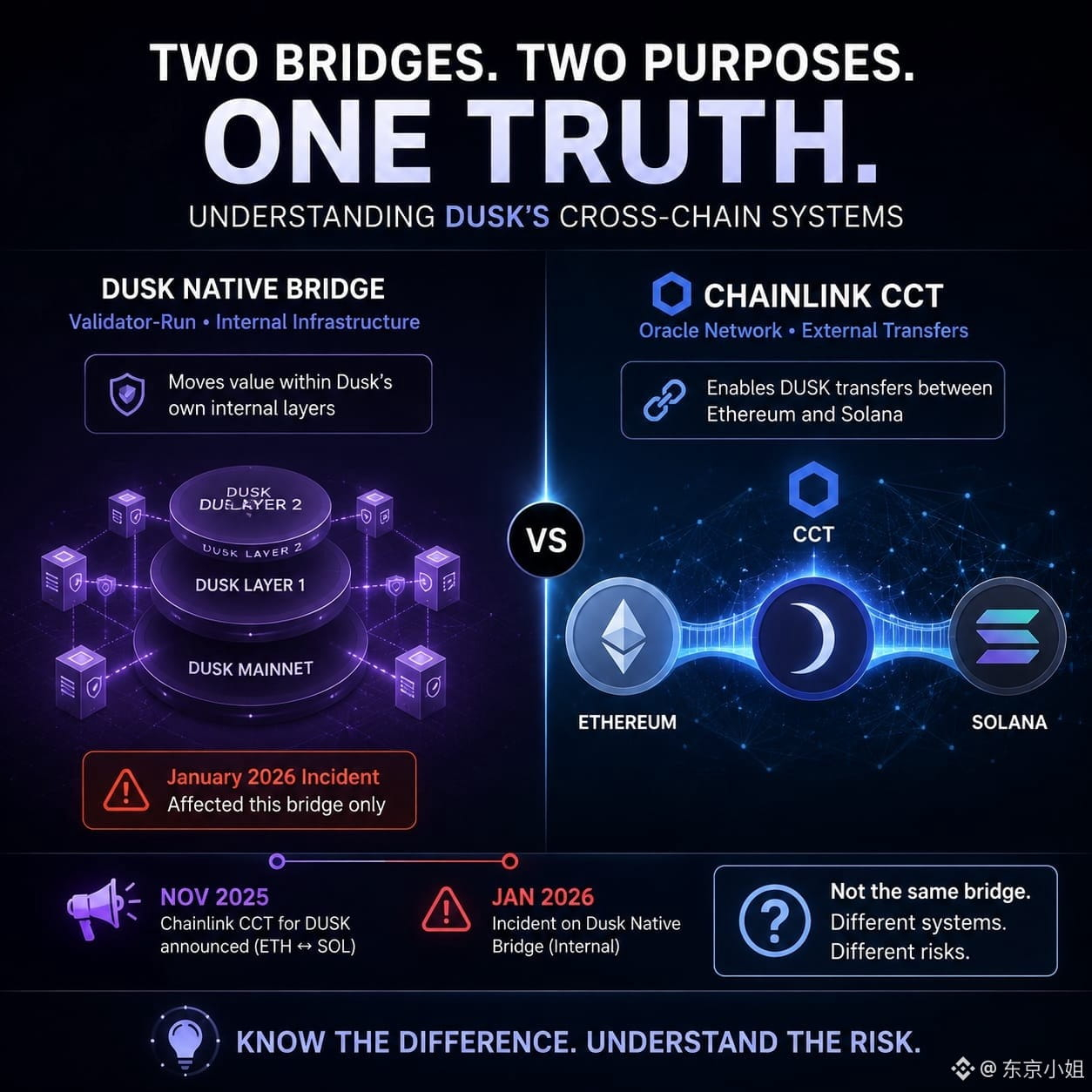
chainlink's cct standard for moving dusk between ethereum and solana was announced back in november 2025, months before the january bridge incident we already know happened on dusk's other cross-chain pathway. i went to check whether these are actually the same bridge under two names — honestly i half expected they'd turn out to be the same thing with different branding — and they're not. dusk's own architecture page describes a separate validator-run native bridge that moves value between dusk's own internal layers, while chainlink cct runs on chainlink's own decentralized oracle network for external eth-solana transfers. two genuinely distinct systems.
so the january incident, which hit the native bridge specifically, wouldn't have touched the chainlink pathway at all, based on how differently these are architected. that's actually reassuring in a way i didn't expect going in.
but here's what still doesn't sit right — nobody explained this distinction anywhere when the incident notice went out. if you're someone who just knows "dusk had a bridge issue in january," there's nothing pointing you toward "that only affected one of two separate bridging systems," and the burden of figuring that out fell entirely on cross-referencing two unrelated announcements myself.
is there a single page anywhere that actually maps out which bridge does what for dusk, or does confirming this require piecing together separate press releases like i just did? 🧐
#dusk $DUSK @Dusk_Foundation
chainlink's cct standard for moving dusk between ethereum and solana was announced back in november 2025, months before the january bridge incident we already know happened on dusk's other cross-chain pathway. i went to check whether these are actually the same bridge under two names — honestly i half expected they'd turn out to be the same thing with different branding — and they're not. dusk's own architecture page describes a separate validator-run native bridge that moves value between dusk's own internal layers, while chainlink cct runs on chainlink's own decentralized oracle network for external eth-solana transfers. two genuinely distinct systems.
so the january incident, which hit the native bridge specifically, wouldn't have touched the chainlink pathway at all, based on how differently these are architected. that's actually reassuring in a way i didn't expect going in.
but here's what still doesn't sit right — nobody explained this distinction anywhere when the incident notice went out. if you're someone who just knows "dusk had a bridge issue in january," there's nothing pointing you toward "that only affected one of two separate bridging systems," and the burden of figuring that out fell entirely on cross-referencing two unrelated announcements myself.
is there a single page anywhere that actually maps out which bridge does what for dusk, or does confirming this require piecing together separate press releases like i just did? 🧐
#dusk $DUSK @Dusk
so the january incident, which hit the native bridge specifically, wouldn't have touched the chainlink pathway at all, based on how differently these are architected. that's actually reassuring in a way i didn't expect going in.
but here's what still doesn't sit right — nobody explained this distinction anywhere when the incident notice went out. if you're someone who just knows "dusk had a bridge issue in january," there's nothing pointing you toward "that only affected one of two separate bridging systems," and the burden of figuring that out fell entirely on cross-referencing two unrelated announcements myself.
is there a single page anywhere that actually maps out which bridge does what for dusk, or does confirming this require piecing together separate press releases like i just did? 🧐
#dusk $DUSK @Dusk
1
131
·
--
Haussier
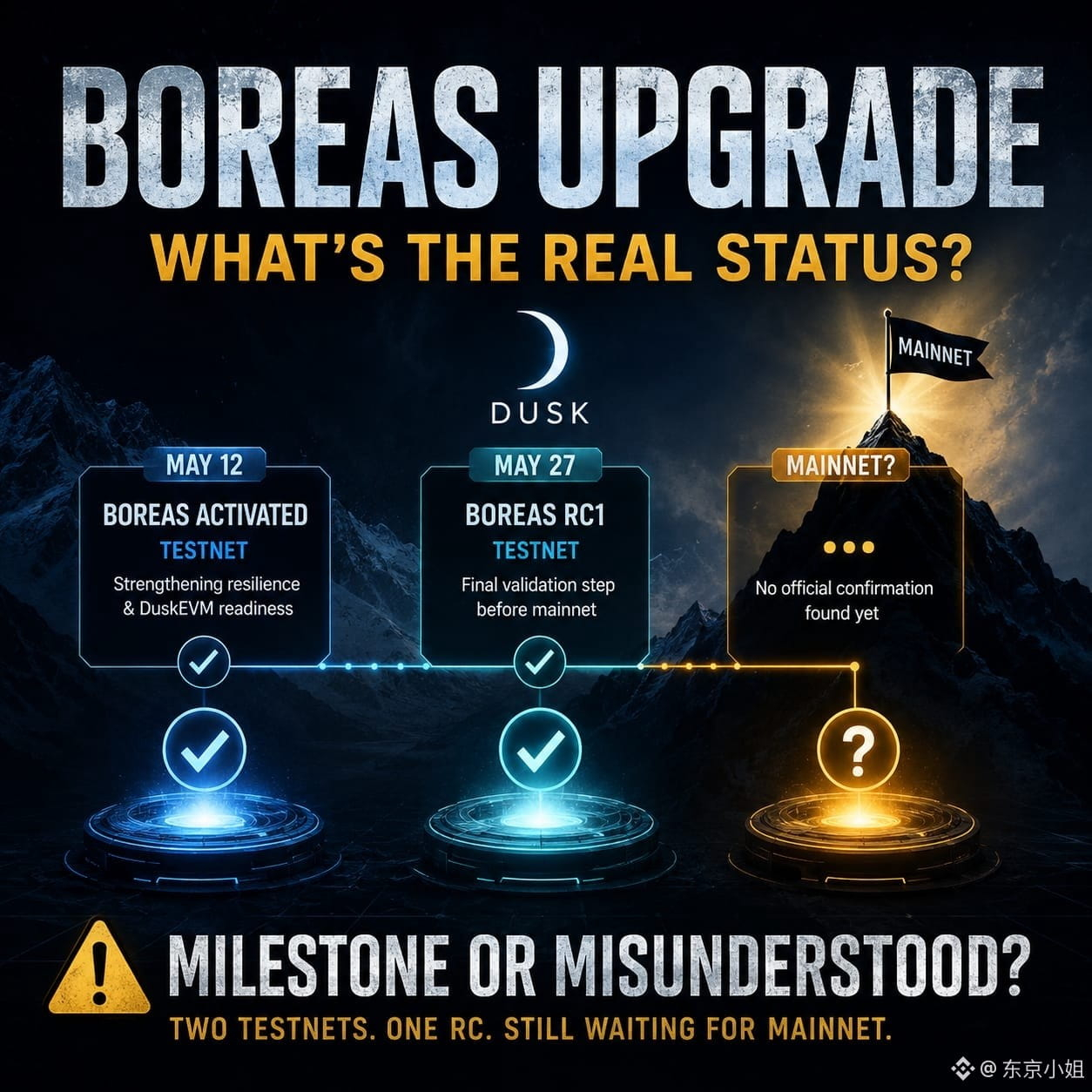
i went to check whether boreas ever actually made it to mainnet, since it's been floating around as a big milestone. what i found instead was two separate testnet events under the same name, two weeks apart, and honestly i almost stopped at the may 12th date assuming that was the whole story. dusk activated boreas on the testnet may 12th, framed as strengthening resilience and duskevm readiness. then may 27th, a "boreas release candidate 1" went live, also on testnet, explicitly called the final validation step before mainnet.
so the may 12th activation wasn't actually the finish line, it was an earlier phase, and there's a second checkpoint after it that i hadn't seen mentioned anywhere until i went looking specifically. i still can't find an announcement confirming boreas actually reached mainnet after that release candidate.
it's a normal way to stage a hard fork, testnet then RC then mainnet, nothing wrong with the process itself. i just think a lot of coverage treats "boreas activated" as one clean event when it's actually at least two testnet stages, and possibly still hasn't cleared the last one.
has boreas actually gone live on mainnet since may 27th, or is that release candidate still the most recent confirmed step? 🧐
#dusk $DUSK @Dusk_Foundation
i went to check whether boreas ever actually made it to mainnet, since it's been floating around as a big milestone. what i found instead was two separate testnet events under the same name, two weeks apart, and honestly i almost stopped at the may 12th date assuming that was the whole story. dusk activated boreas on the testnet may 12th, framed as strengthening resilience and duskevm readiness. then may 27th, a "boreas release candidate 1" went live, also on testnet, explicitly called the final validation step before mainnet.
so the may 12th activation wasn't actually the finish line, it was an earlier phase, and there's a second checkpoint after it that i hadn't seen mentioned anywhere until i went looking specifically. i still can't find an announcement confirming boreas actually reached mainnet after that release candidate.
it's a normal way to stage a hard fork, testnet then RC then mainnet, nothing wrong with the process itself. i just think a lot of coverage treats "boreas activated" as one clean event when it's actually at least two testnet stages, and possibly still hasn't cleared the last one.
has boreas actually gone live on mainnet since may 27th, or is that release candidate still the most recent confirmed step? 🧐
#dusk $DUSK @Dusk
so the may 12th activation wasn't actually the finish line, it was an earlier phase, and there's a second checkpoint after it that i hadn't seen mentioned anywhere until i went looking specifically. i still can't find an announcement confirming boreas actually reached mainnet after that release candidate.
it's a normal way to stage a hard fork, testnet then RC then mainnet, nothing wrong with the process itself. i just think a lot of coverage treats "boreas activated" as one clean event when it's actually at least two testnet stages, and possibly still hasn't cleared the last one.
has boreas actually gone live on mainnet since may 27th, or is that release candidate still the most recent confirmed step? 🧐
#dusk $DUSK @Dusk
3
120
·
--
Haussier
@Dusk_Foundation
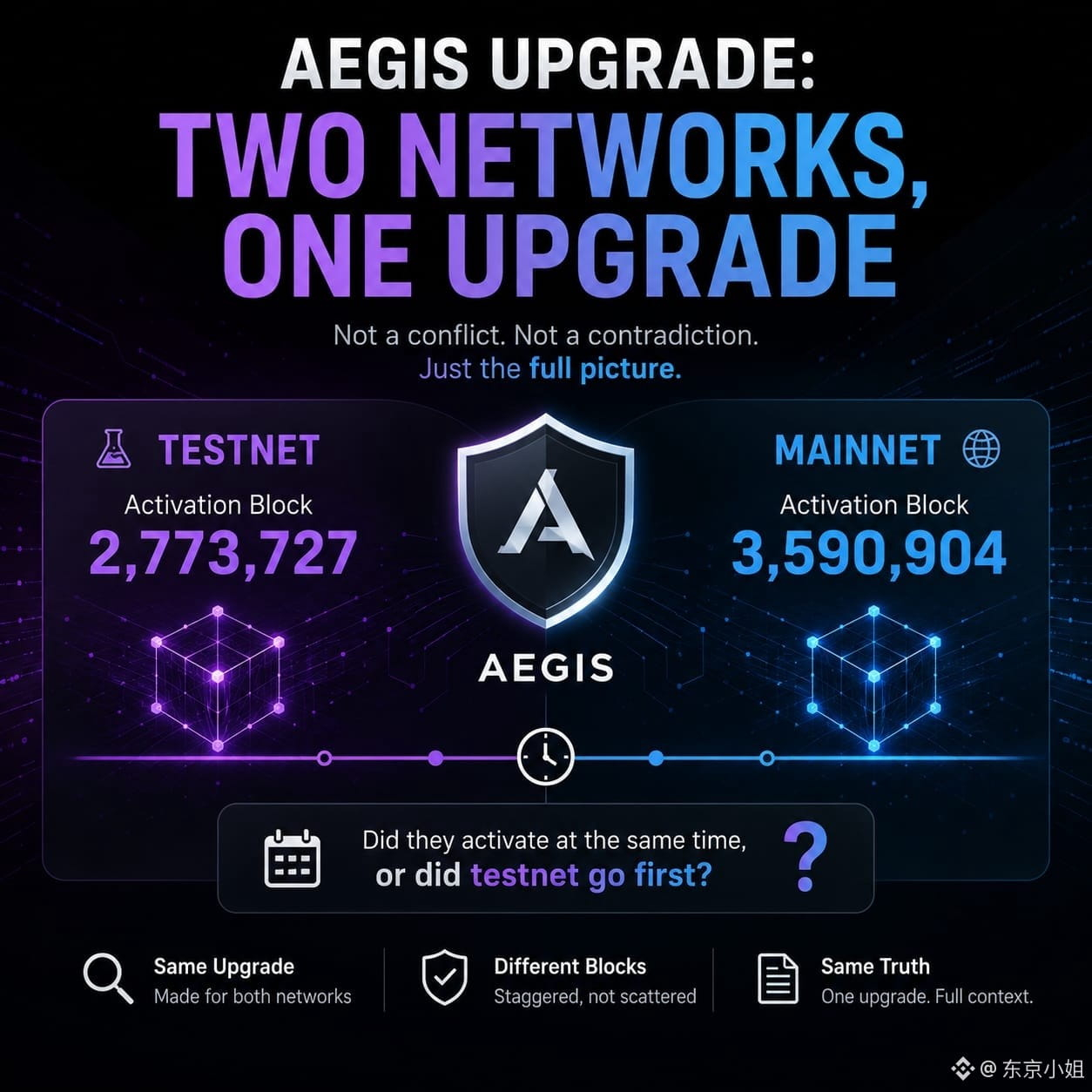
i went to check exactly what the aegis upgrade touched, since march 3rd gets cited as a major milestone but different sources describe it differently — one says mandatory for all node operators, another calls it a testnet-only prep step. turns out both are just incomplete versions of the same thing, and honestly i almost stopped at "one of these is just wrong" before digging into dusk's actual github repo. their rusk release notes list separate aegis activation block heights for mainnet and testnet, 3,590,904 and 2,773,727, confirming it hit both networks, just not at the same block number.
so there wasn't actually a scope conflict, there was a coverage gap — nobody covering it in the press wrote it up as "mainnet and testnet, here are both activation heights," they each picked one network and called it the whole story.
it's a pretty normal way to roll out a hard fork, stagger testnet slightly differently from mainnet, that part isn't unusual or concerning on its own. i just think it's worth noticing how a genuinely simple two-network rollout got flattened into two competing, incomplete narratives once it passed through secondary coverage.
does anyone know if the two activation heights lined up in wall-clock time, or did testnet actually activate before mainnet? 🧐
#dusk $DUSK
@Dusk
i went to check exactly what the aegis upgrade touched, since march 3rd gets cited as a major milestone but different sources describe it differently — one says mandatory for all node operators, another calls it a testnet-only prep step. turns out both are just incomplete versions of the same thing, and honestly i almost stopped at "one of these is just wrong" before digging into dusk's actual github repo. their rusk release notes list separate aegis activation block heights for mainnet and testnet, 3,590,904 and 2,773,727, confirming it hit both networks, just not at the same block number.
so there wasn't actually a scope conflict, there was a coverage gap — nobody covering it in the press wrote it up as "mainnet and testnet, here are both activation heights," they each picked one network and called it the whole story.
it's a pretty normal way to roll out a hard fork, stagger testnet slightly differently from mainnet, that part isn't unusual or concerning on its own. i just think it's worth noticing how a genuinely simple two-network rollout got flattened into two competing, incomplete narratives once it passed through secondary coverage.
does anyone know if the two activation heights lined up in wall-clock time, or did testnet actually activate before mainnet? 🧐
#dusk $DUSK
i went to check exactly what the aegis upgrade touched, since march 3rd gets cited as a major milestone but different sources describe it differently — one says mandatory for all node operators, another calls it a testnet-only prep step. turns out both are just incomplete versions of the same thing, and honestly i almost stopped at "one of these is just wrong" before digging into dusk's actual github repo. their rusk release notes list separate aegis activation block heights for mainnet and testnet, 3,590,904 and 2,773,727, confirming it hit both networks, just not at the same block number.
so there wasn't actually a scope conflict, there was a coverage gap — nobody covering it in the press wrote it up as "mainnet and testnet, here are both activation heights," they each picked one network and called it the whole story.
it's a pretty normal way to roll out a hard fork, stagger testnet slightly differently from mainnet, that part isn't unusual or concerning on its own. i just think it's worth noticing how a genuinely simple two-network rollout got flattened into two competing, incomplete narratives once it passed through secondary coverage.
does anyone know if the two activation heights lined up in wall-clock time, or did testnet actually activate before mainnet? 🧐
#dusk $DUSK
1
4
205
·
--
Haussier
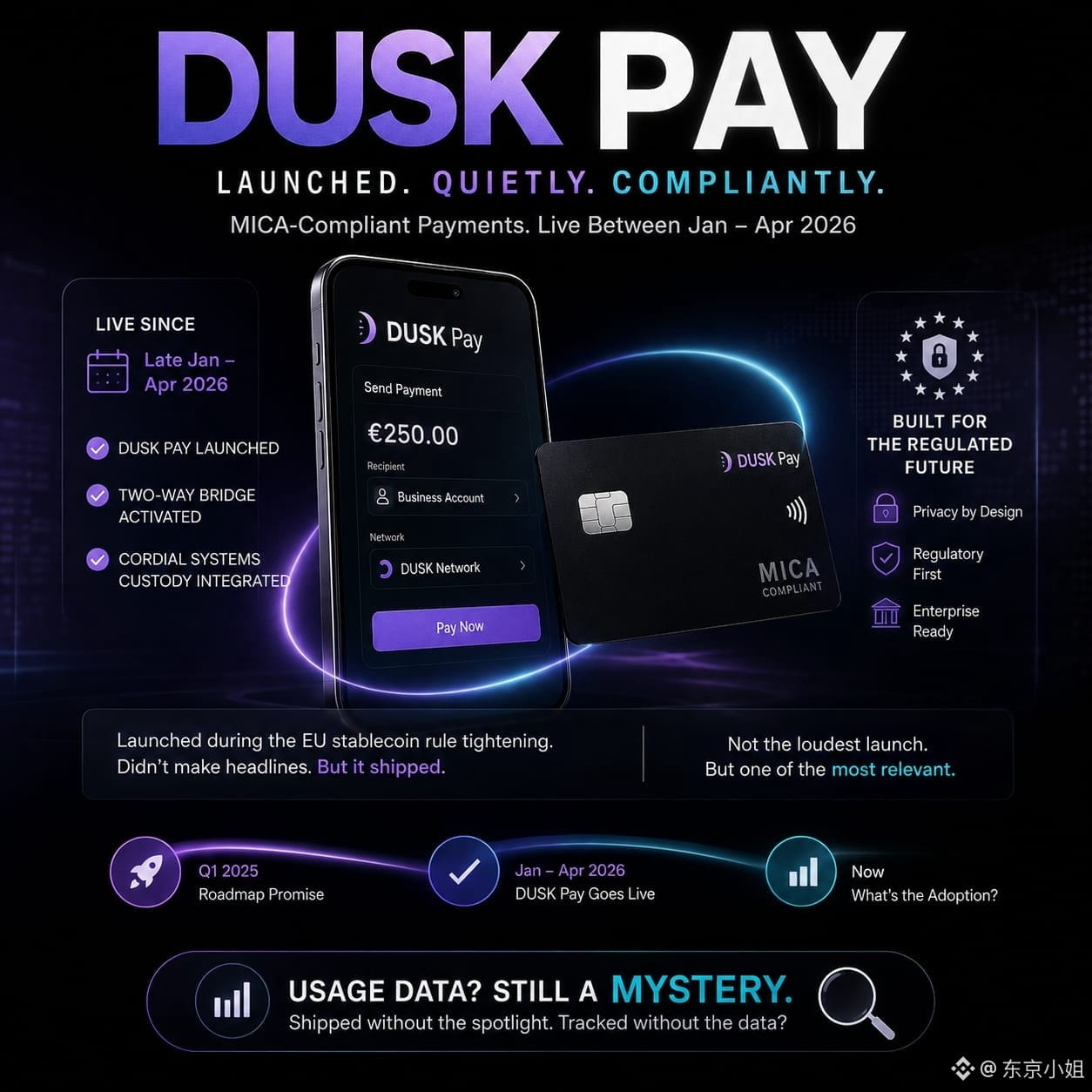
i went looking for whether dusk pay actually launched, since it was named in the january 2025 roadmap as a q1 deliverable and then seemed to vanish from most 2026 writeups i was reading. turns out i just wasn't looking in the right place — actually, i almost concluded it never shipped at all before i found a may 2026 development-tracking piece stating plainly that dusk pay launched sometime between late january and april this year, alongside the two-way bridge activation and the cordial systems custody integration.
so it did launch, just not with the kind of headline coverage duskevm or the npex partnership got. that's kind of its own point actually — a mica-compliant payments product landing during the exact stretch when eu stablecoin rules were tightening barely registered anywhere, while flashier architecture announcements got picked up everywhere.
i don't think that's necessarily bad, quiet shipping isn't the same as failing to ship. but for a product this regulation-relevant, the coverage gap between "duskevm is live" headlines and "dusk pay is live" silence says more about crypto media's priorities than about dusk's execution.
is there any actual usage data on dusk pay since launch, or did it ship without anyone tracking adoption? 🧐
#dusk $DUSK @Dusk_Foundation
i went looking for whether dusk pay actually launched, since it was named in the january 2025 roadmap as a q1 deliverable and then seemed to vanish from most 2026 writeups i was reading. turns out i just wasn't looking in the right place — actually, i almost concluded it never shipped at all before i found a may 2026 development-tracking piece stating plainly that dusk pay launched sometime between late january and april this year, alongside the two-way bridge activation and the cordial systems custody integration.
so it did launch, just not with the kind of headline coverage duskevm or the npex partnership got. that's kind of its own point actually — a mica-compliant payments product landing during the exact stretch when eu stablecoin rules were tightening barely registered anywhere, while flashier architecture announcements got picked up everywhere.
i don't think that's necessarily bad, quiet shipping isn't the same as failing to ship. but for a product this regulation-relevant, the coverage gap between "duskevm is live" headlines and "dusk pay is live" silence says more about crypto media's priorities than about dusk's execution.
is there any actual usage data on dusk pay since launch, or did it ship without anyone tracking adoption? 🧐
#dusk $DUSK @Dusk
so it did launch, just not with the kind of headline coverage duskevm or the npex partnership got. that's kind of its own point actually — a mica-compliant payments product landing during the exact stretch when eu stablecoin rules were tightening barely registered anywhere, while flashier architecture announcements got picked up everywhere.
i don't think that's necessarily bad, quiet shipping isn't the same as failing to ship. but for a product this regulation-relevant, the coverage gap between "duskevm is live" headlines and "dusk pay is live" silence says more about crypto media's priorities than about dusk's execution.
is there any actual usage data on dusk pay since launch, or did it ship without anyone tracking adoption? 🧐
#dusk $DUSK @Dusk
2
102
·
--
Haussier
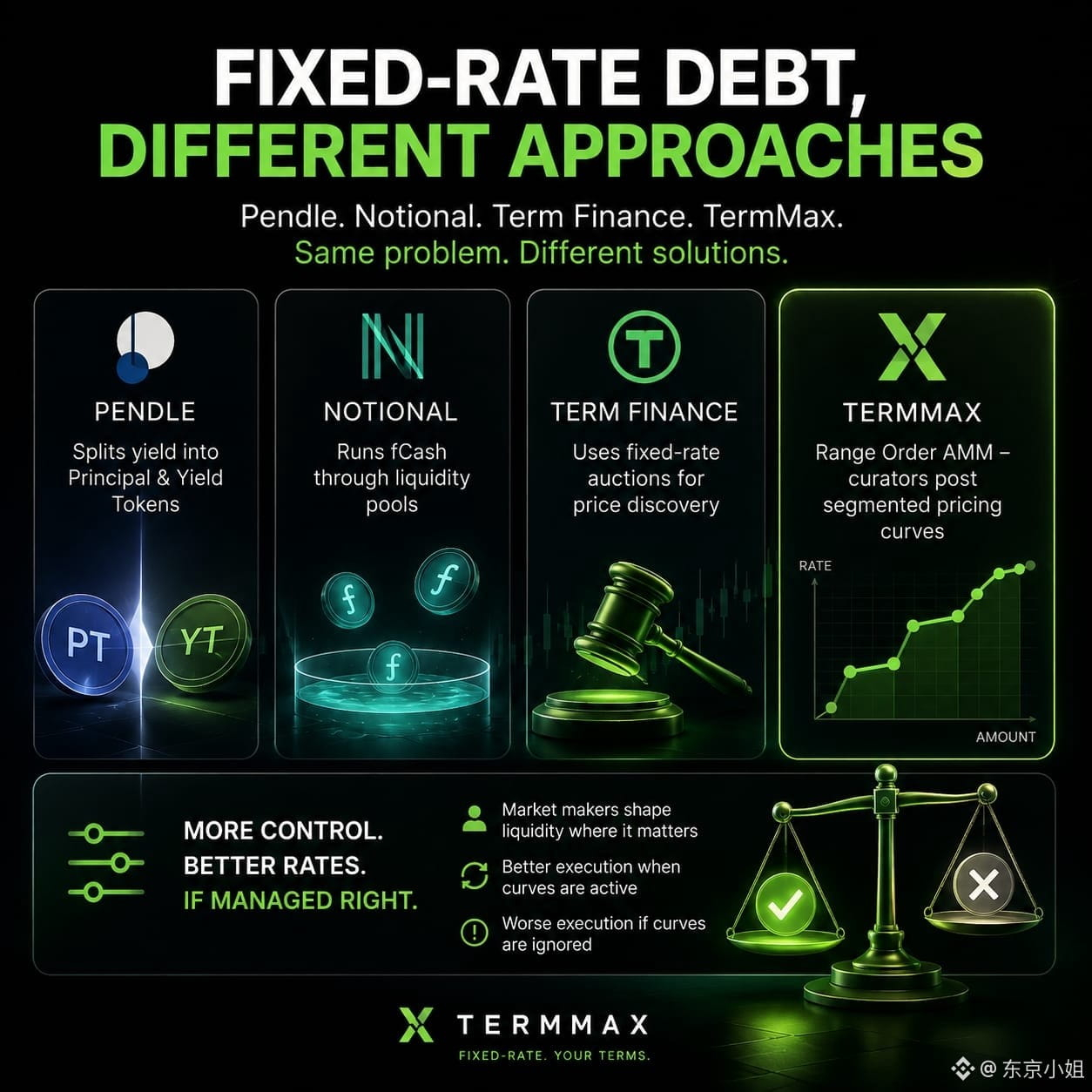
termmax's niche is fixed-rate tokenized debt, and it's not actually alone there — pendle, notional, and term finance are all circling the same problem from different angles. pendle splits yield-bearing assets into principal and yield tokens. notional runs fcash through liquidity pools. termmax's own solution is the range order amm, curators posting segmented pricing curves that borrowers and lenders match against directly.
i went back and forth on why that specific approach over an auction model or a pure yield-split, and i think it comes down to control — a range order setter can shape exactly where liquidity sits on the curve instead of just accepting a clearing price. that's more hands-on for market makers, which cuts both ways: better rates when someone's actually managing the curve well, worse ones if nobody bothers to update it as conditions shift.
haven't actually run the same trade size through pendle and termmax side by side to compare real execution, so this is a structural read, not a backtested one 📐
#termmax @termmax
termmax's niche is fixed-rate tokenized debt, and it's not actually alone there — pendle, notional, and term finance are all circling the same problem from different angles. pendle splits yield-bearing assets into principal and yield tokens. notional runs fcash through liquidity pools. termmax's own solution is the range order amm, curators posting segmented pricing curves that borrowers and lenders match against directly.
i went back and forth on why that specific approach over an auction model or a pure yield-split, and i think it comes down to control — a range order setter can shape exactly where liquidity sits on the curve instead of just accepting a clearing price. that's more hands-on for market makers, which cuts both ways: better rates when someone's actually managing the curve well, worse ones if nobody bothers to update it as conditions shift.
haven't actually run the same trade size through pendle and termmax side by side to compare real execution, so this is a structural read, not a backtested one 📐
#termmax @TermMax
i went back and forth on why that specific approach over an auction model or a pure yield-split, and i think it comes down to control — a range order setter can shape exactly where liquidity sits on the curve instead of just accepting a clearing price. that's more hands-on for market makers, which cuts both ways: better rates when someone's actually managing the curve well, worse ones if nobody bothers to update it as conditions shift.
haven't actually run the same trade size through pendle and termmax side by side to compare real execution, so this is a structural read, not a backtested one 📐
#termmax @TermMax
2
4
186
·
--
Haussier
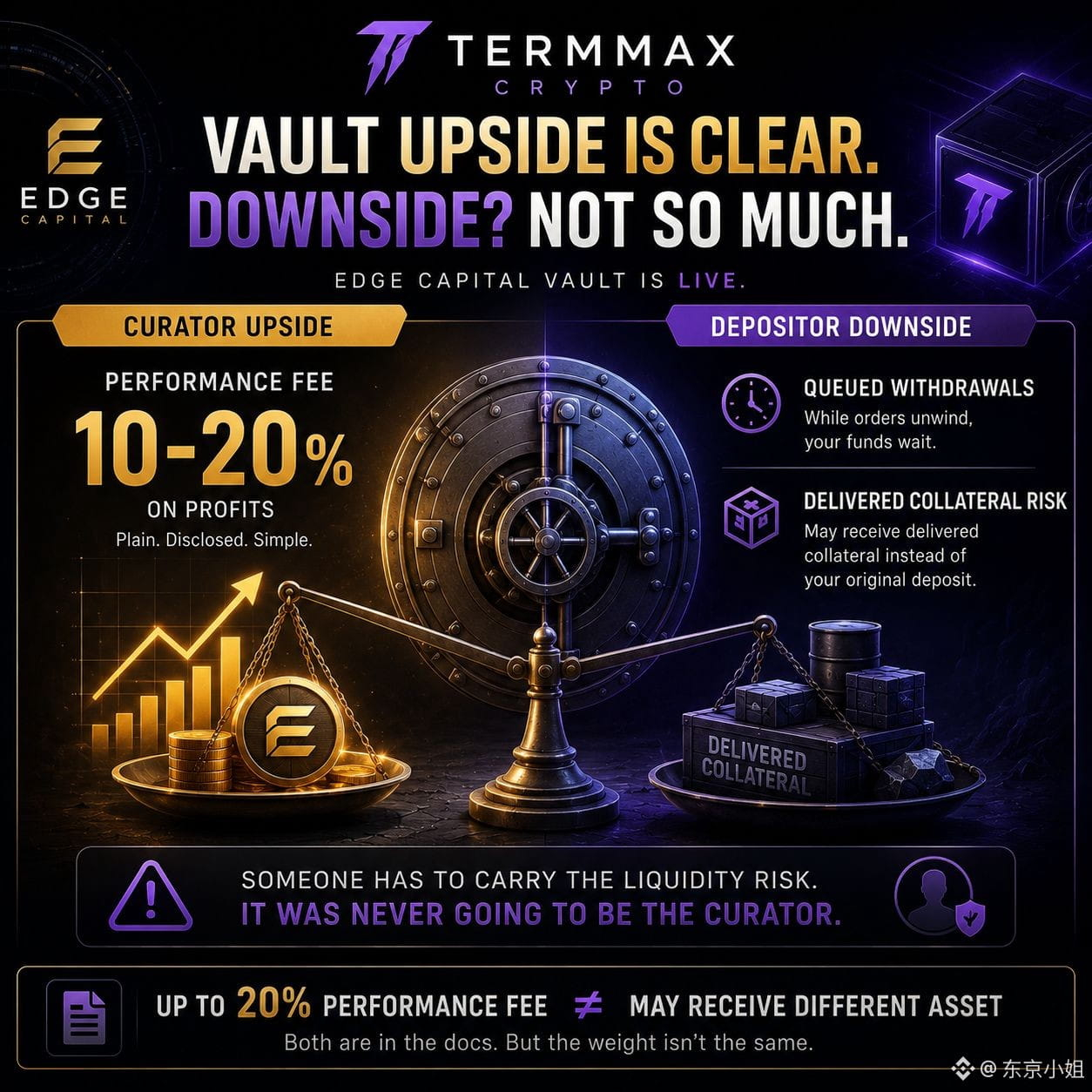
edge capital's vault is live right now, and this is exactly the kind of setup where the disclosure gap shows up. curators earn a performance fee of 10 to 20 percent on whatever profit their vault generates, right there in the vault mechanics docs, plain and stated. what doesn't get anywhere near that same clarity is — actually, it barely shows up at all — what depositors are actually exposed to if a vault like that hits a rough stretch: queued withdrawals while orders unwind, or worse, ending up holding delivered collateral instead of the debt token they originally put in, if a market goes through physical delivery.
so the curator's upside is a clean, disclosed percentage. the depositor's downside is a queue position and possibly a different asset than what they deposited. not calling that a scandal, someone has to carry the liquidity risk in an actively managed vault and it was never going to be the person running it. i just don't think "up to 20% performance fee" and "may receive delivered collateral instead of your deposit" read as symmetrical when they're one paragraph apart in the same docs section.
genuinely torn on whether that's a fair trade for professional management or just how every vault structure ends up shaking out, defi or not 🤷
#termmax @termmax
edge capital's vault is live right now, and this is exactly the kind of setup where the disclosure gap shows up. curators earn a performance fee of 10 to 20 percent on whatever profit their vault generates, right there in the vault mechanics docs, plain and stated. what doesn't get anywhere near that same clarity is — actually, it barely shows up at all — what depositors are actually exposed to if a vault like that hits a rough stretch: queued withdrawals while orders unwind, or worse, ending up holding delivered collateral instead of the debt token they originally put in, if a market goes through physical delivery.
so the curator's upside is a clean, disclosed percentage. the depositor's downside is a queue position and possibly a different asset than what they deposited. not calling that a scandal, someone has to carry the liquidity risk in an actively managed vault and it was never going to be the person running it. i just don't think "up to 20% performance fee" and "may receive delivered collateral instead of your deposit" read as symmetrical when they're one paragraph apart in the same docs section.
genuinely torn on whether that's a fair trade for professional management or just how every vault structure ends up shaking out, defi or not 🤷
#termmax @TermMax
so the curator's upside is a clean, disclosed percentage. the depositor's downside is a queue position and possibly a different asset than what they deposited. not calling that a scandal, someone has to carry the liquidity risk in an actively managed vault and it was never going to be the person running it. i just don't think "up to 20% performance fee" and "may receive delivered collateral instead of your deposit" read as symmetrical when they're one paragraph apart in the same docs section.
genuinely torn on whether that's a fair trade for professional management or just how every vault structure ends up shaking out, defi or not 🤷
#termmax @TermMax
1
156
·
--
Haussier
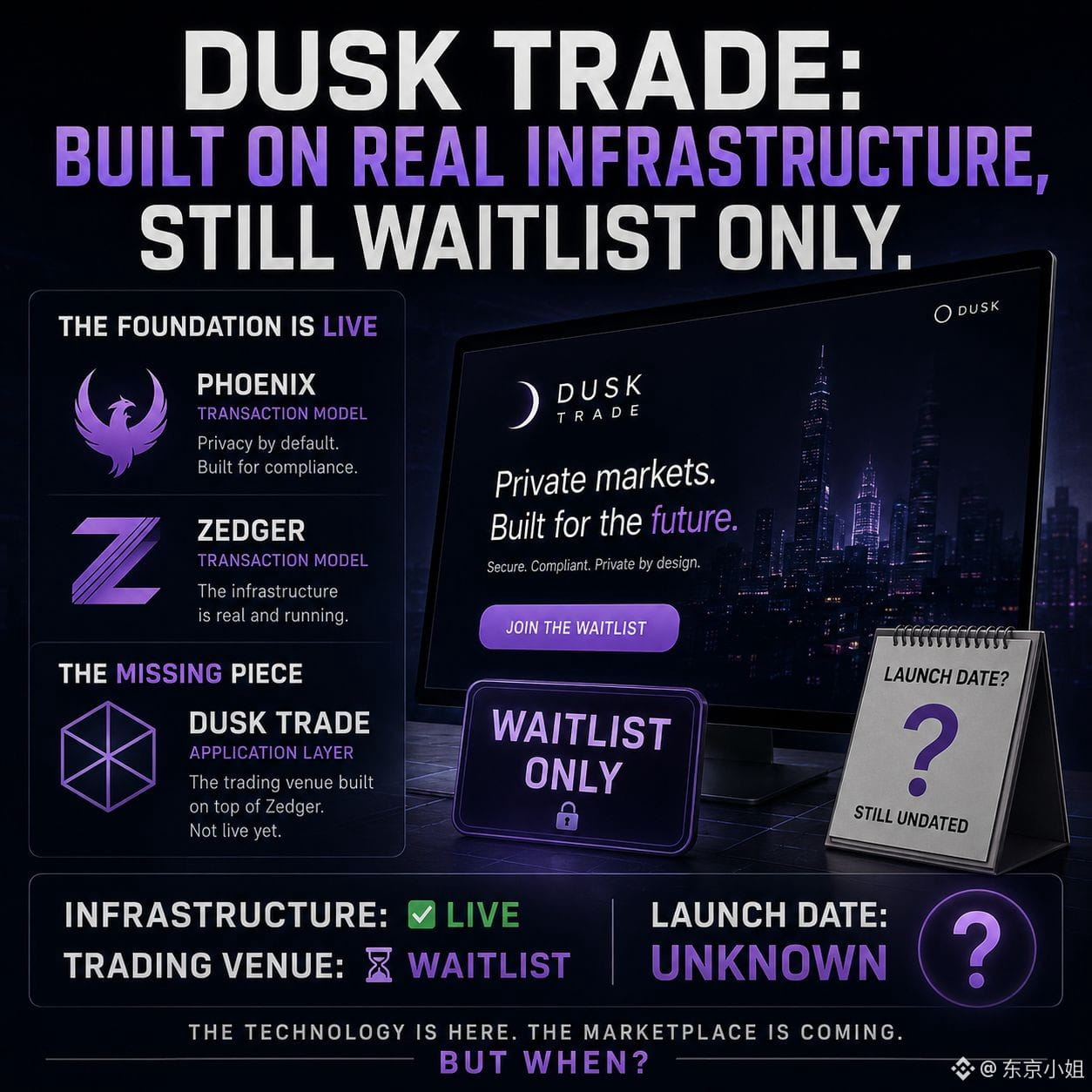
i went to check on zedger since people still cite it as live infrastructure, and it actually still is — dusk's own current docs list phoenix and zedger as the two transaction models available right now, so my first assumption that it quietly disappeared was wrong.
what's real though is dusk trade, the application layer meant to sit on top of that and give users an actual place to trade tokenized assets. i checked trade.dusk.network directly and it's still waitlist-only, "join the waitlist" is the entire call to action on the page right now.
that's a different gap than i first thought, and honestly a more concrete one — the original post-mainnet roadmap's final phase promised "full zedger," fully operational asset issuance, clearance, and settlement, positioned as part of dusk's 2025 vision. the underlying transaction model exists, but the actual trading venue built on it is still pre-launch with no visible timeline on the waitlist page itself.
does anyone know if dusk trade has an actual launch date attached anywhere, or is it still in an undated waitlist phase? 🧐
#dusk $DUSK @Dusk_Foundation
i went to check on zedger since people still cite it as live infrastructure, and it actually still is — dusk's own current docs list phoenix and zedger as the two transaction models available right now, so my first assumption that it quietly disappeared was wrong.
what's real though is dusk trade, the application layer meant to sit on top of that and give users an actual place to trade tokenized assets. i checked trade.dusk.network directly and it's still waitlist-only, "join the waitlist" is the entire call to action on the page right now.
that's a different gap than i first thought, and honestly a more concrete one — the original post-mainnet roadmap's final phase promised "full zedger," fully operational asset issuance, clearance, and settlement, positioned as part of dusk's 2025 vision. the underlying transaction model exists, but the actual trading venue built on it is still pre-launch with no visible timeline on the waitlist page itself.
does anyone know if dusk trade has an actual launch date attached anywhere, or is it still in an undated waitlist phase? 🧐
#dusk $DUSK @Dusk
what's real though is dusk trade, the application layer meant to sit on top of that and give users an actual place to trade tokenized assets. i checked trade.dusk.network directly and it's still waitlist-only, "join the waitlist" is the entire call to action on the page right now.
that's a different gap than i first thought, and honestly a more concrete one — the original post-mainnet roadmap's final phase promised "full zedger," fully operational asset issuance, clearance, and settlement, positioned as part of dusk's 2025 vision. the underlying transaction model exists, but the actual trading venue built on it is still pre-launch with no visible timeline on the waitlist page itself.
does anyone know if dusk trade has an actual launch date attached anywhere, or is it still in an undated waitlist phase? 🧐
#dusk $DUSK @Dusk
1
112
·
--
Haussier
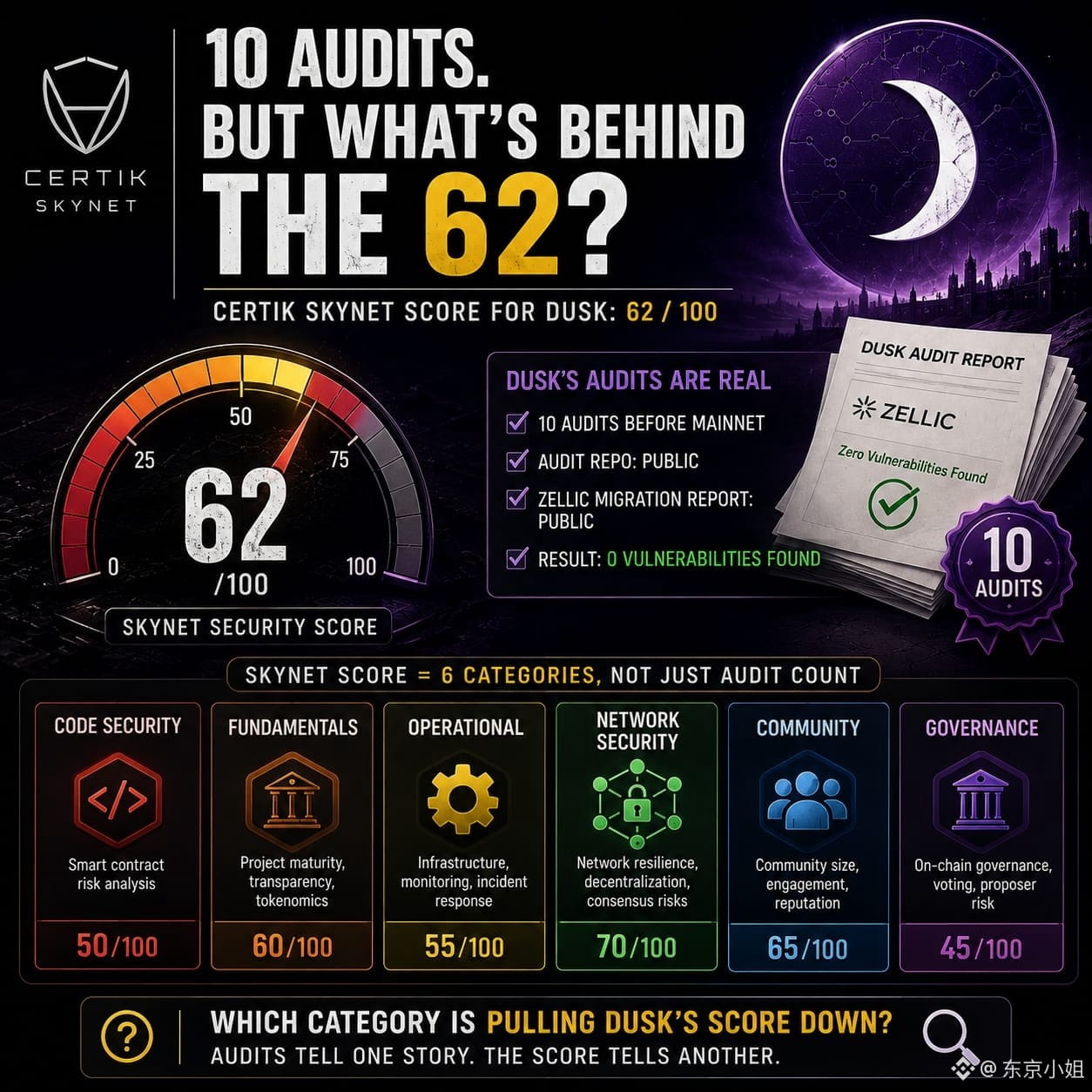
i went to check dusk's third-party security score since they market "ten audits before mainnet" pretty heavily, and certik's skynet score for dusk sits at 62 out of 100. i went in expecting that number to roughly track the audit count — actually, i had to stop and reread certik's methodology page because i assumed a security score would basically just be an audit tally, it's not, it's six separate categories blended together.
the audits themselves are real, dusk's own audit repo and zellic's migration contract report are both public, zero vulnerabilities found there. so the individual audits aren't in question. it's more that a stack of clean audit reports and a single composite trust score are answering different questions, and marketing copy tends to treat the two as interchangeable when they're not.
to be fair, i don't have a clean benchmark for what a "good" skynet score looks like for an l1 at dusk's stage, so i can't say 62 is bad, just that it's not obviously explained by the audit history alone.
does anyone know which of the six skynet categories is actually pulling that number down for dusk specifically? 🧐
#dusk $DUSK @Dusk_Foundation
{future}(DUSKUSDT)
i went to check dusk's third-party security score since they market "ten audits before mainnet" pretty heavily, and certik's skynet score for dusk sits at 62 out of 100. i went in expecting that number to roughly track the audit count — actually, i had to stop and reread certik's methodology page because i assumed a security score would basically just be an audit tally, it's not, it's six separate categories blended together.
the audits themselves are real, dusk's own audit repo and zellic's migration contract report are both public, zero vulnerabilities found there. so the individual audits aren't in question. it's more that a stack of clean audit reports and a single composite trust score are answering different questions, and marketing copy tends to treat the two as interchangeable when they're not.
to be fair, i don't have a clean benchmark for what a "good" skynet score looks like for an l1 at dusk's stage, so i can't say 62 is bad, just that it's not obviously explained by the audit history alone.
does anyone know which of the six skynet categories is actually pulling that number down for dusk specifically? 🧐
#dusk $DUSK @Dusk
the audits themselves are real, dusk's own audit repo and zellic's migration contract report are both public, zero vulnerabilities found there. so the individual audits aren't in question. it's more that a stack of clean audit reports and a single composite trust score are answering different questions, and marketing copy tends to treat the two as interchangeable when they're not.
to be fair, i don't have a clean benchmark for what a "good" skynet score looks like for an l1 at dusk's stage, so i can't say 62 is bad, just that it's not obviously explained by the audit history alone.
does anyone know which of the six skynet categories is actually pulling that number down for dusk specifically? 🧐
#dusk $DUSK @Dusk
1
1
122
·
--
Haussier
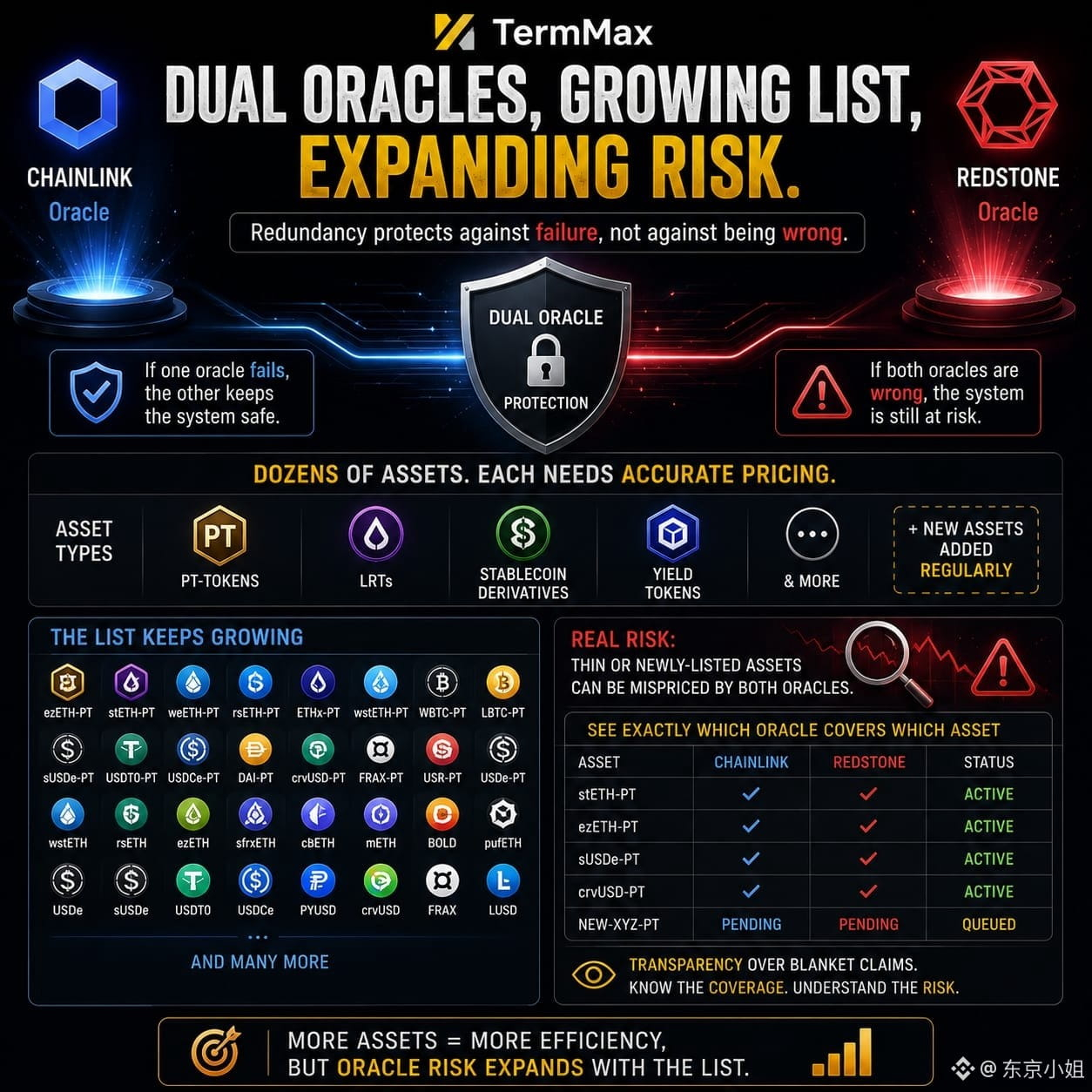
termmax runs dual oracles, chainlink and redstone, and the docs frame it as protection against a single feed failing. fair enough. but i went through the actual oracle asset list on their docs and it's dozens of individual pt-tokens, lrts, and stablecoin derivatives now, each one needing its own price feed configured correctly, with new ones getting added pretty regularly.
that's — actually, the real risk isn't the dual-oracle design itself, it's that redundancy protects you if one feed goes down, not if both feeds are simply wrong about a thin, newly-listed asset at the same time. more collateral types is good for capital efficiency, i get that. it just means the oracle risk section isn't static, it's expanding every time a new asset gets whitelisted.
what'd actually resolve this for me is seeing which specific provider covers which specific asset published somewhere, instead of just "chainlink and redstone" as one blanket line covering everything 🔍
#termmax @termmax
termmax runs dual oracles, chainlink and redstone, and the docs frame it as protection against a single feed failing. fair enough. but i went through the actual oracle asset list on their docs and it's dozens of individual pt-tokens, lrts, and stablecoin derivatives now, each one needing its own price feed configured correctly, with new ones getting added pretty regularly.
that's — actually, the real risk isn't the dual-oracle design itself, it's that redundancy protects you if one feed goes down, not if both feeds are simply wrong about a thin, newly-listed asset at the same time. more collateral types is good for capital efficiency, i get that. it just means the oracle risk section isn't static, it's expanding every time a new asset gets whitelisted.
what'd actually resolve this for me is seeing which specific provider covers which specific asset published somewhere, instead of just "chainlink and redstone" as one blanket line covering everything 🔍
#termmax @TermMax
that's — actually, the real risk isn't the dual-oracle design itself, it's that redundancy protects you if one feed goes down, not if both feeds are simply wrong about a thin, newly-listed asset at the same time. more collateral types is good for capital efficiency, i get that. it just means the oracle risk section isn't static, it's expanding every time a new asset gets whitelisted.
what'd actually resolve this for me is seeing which specific provider covers which specific asset published somewhere, instead of just "chainlink and redstone" as one blanket line covering everything 🔍
#termmax @TermMax
110
·
--
Haussier
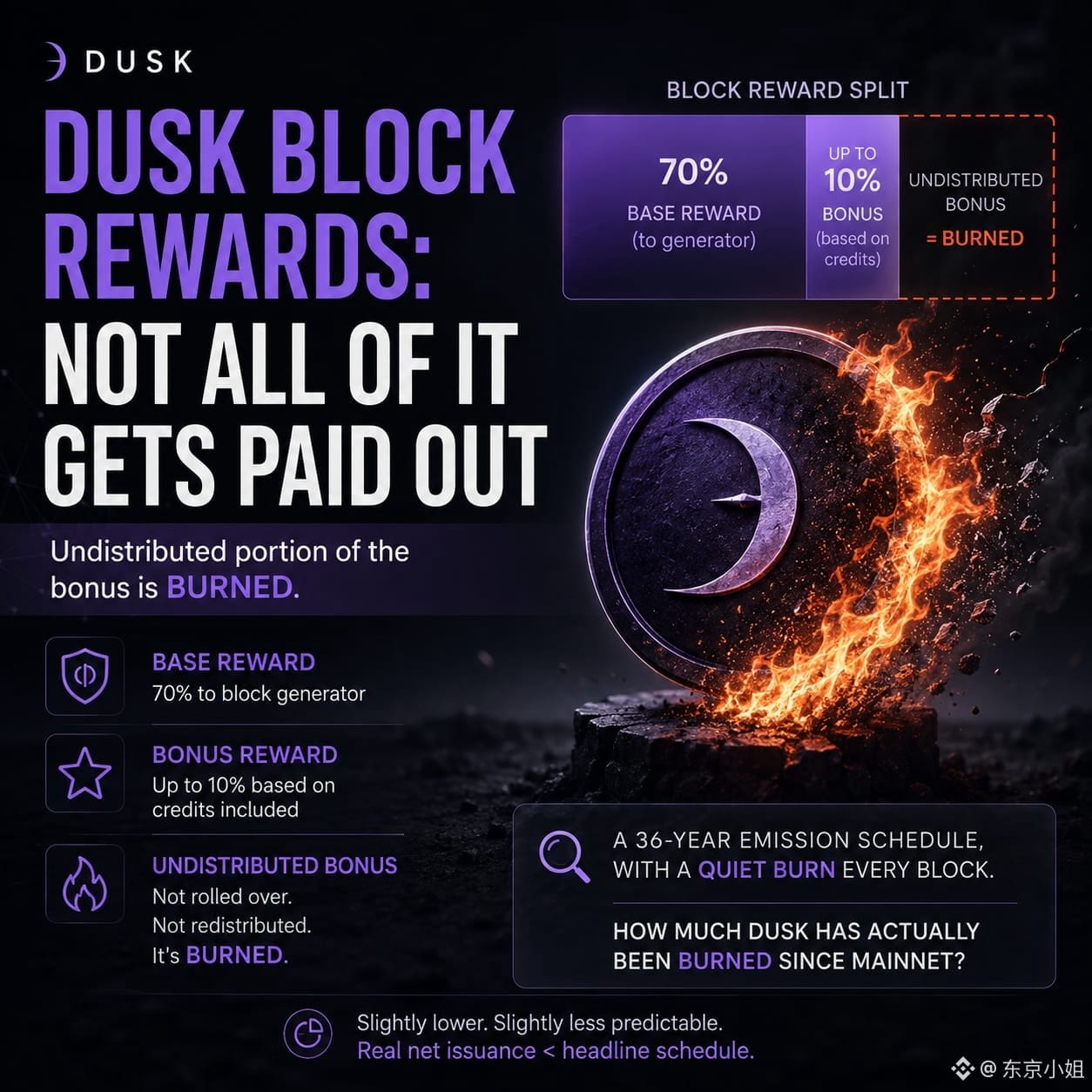
i went to see how dusk's block rewards actually get split, and there's a burn mechanic in there that i hadn't noticed before. block generators get a base 70%, plus up to another 10% depending on how many credits get included in the certificate — but whatever portion of that extra 10% doesn't get distributed isn't rolled over or redistributed, it's just burned, and i had to reread that line a second time because i assumed "undistributed" meant it just carried into the next block's pool.
so unlike most pos chains where the whole reward pool gets paid out regardless of participation quality, dusk is quietly deflationary at the margin every single block, depending on how complete the generator's certificate is. a chain running a 36-year, halving-based emission schedule is also burning small amounts on the other end based on execution quality, and i haven't seen that framed as a real net-supply factor anywhere.
it's a small percentage per block, i'm not saying this changes the supply curve dramatically. but "36-year emission schedule" implies a predictable, additive curve, and this burn mechanic means the actual net issuance is slightly lower and slightly less predictable than the headline schedule suggests.
does anyone track how much dusk has actually been burned this way since mainnet, or is that number not published anywhere? 🧐#dusk $DUSK @Dusk_Foundation
i went to see how dusk's block rewards actually get split, and there's a burn mechanic in there that i hadn't noticed before. block generators get a base 70%, plus up to another 10% depending on how many credits get included in the certificate — but whatever portion of that extra 10% doesn't get distributed isn't rolled over or redistributed, it's just burned, and i had to reread that line a second time because i assumed "undistributed" meant it just carried into the next block's pool.
so unlike most pos chains where the whole reward pool gets paid out regardless of participation quality, dusk is quietly deflationary at the margin every single block, depending on how complete the generator's certificate is. a chain running a 36-year, halving-based emission schedule is also burning small amounts on the other end based on execution quality, and i haven't seen that framed as a real net-supply factor anywhere.
it's a small percentage per block, i'm not saying this changes the supply curve dramatically. but "36-year emission schedule" implies a predictable, additive curve, and this burn mechanic means the actual net issuance is slightly lower and slightly less predictable than the headline schedule suggests.
does anyone track how much dusk has actually been burned this way since mainnet, or is that number not published anywhere? 🧐#dusk $DUSK @Dusk
so unlike most pos chains where the whole reward pool gets paid out regardless of participation quality, dusk is quietly deflationary at the margin every single block, depending on how complete the generator's certificate is. a chain running a 36-year, halving-based emission schedule is also burning small amounts on the other end based on execution quality, and i haven't seen that framed as a real net-supply factor anywhere.
it's a small percentage per block, i'm not saying this changes the supply curve dramatically. but "36-year emission schedule" implies a predictable, additive curve, and this burn mechanic means the actual net issuance is slightly lower and slightly less predictable than the headline schedule suggests.
does anyone track how much dusk has actually been burned this way since mainnet, or is that number not published anywhere? 🧐#dusk $DUSK @Dusk
1
1
102
·
--
Haussier
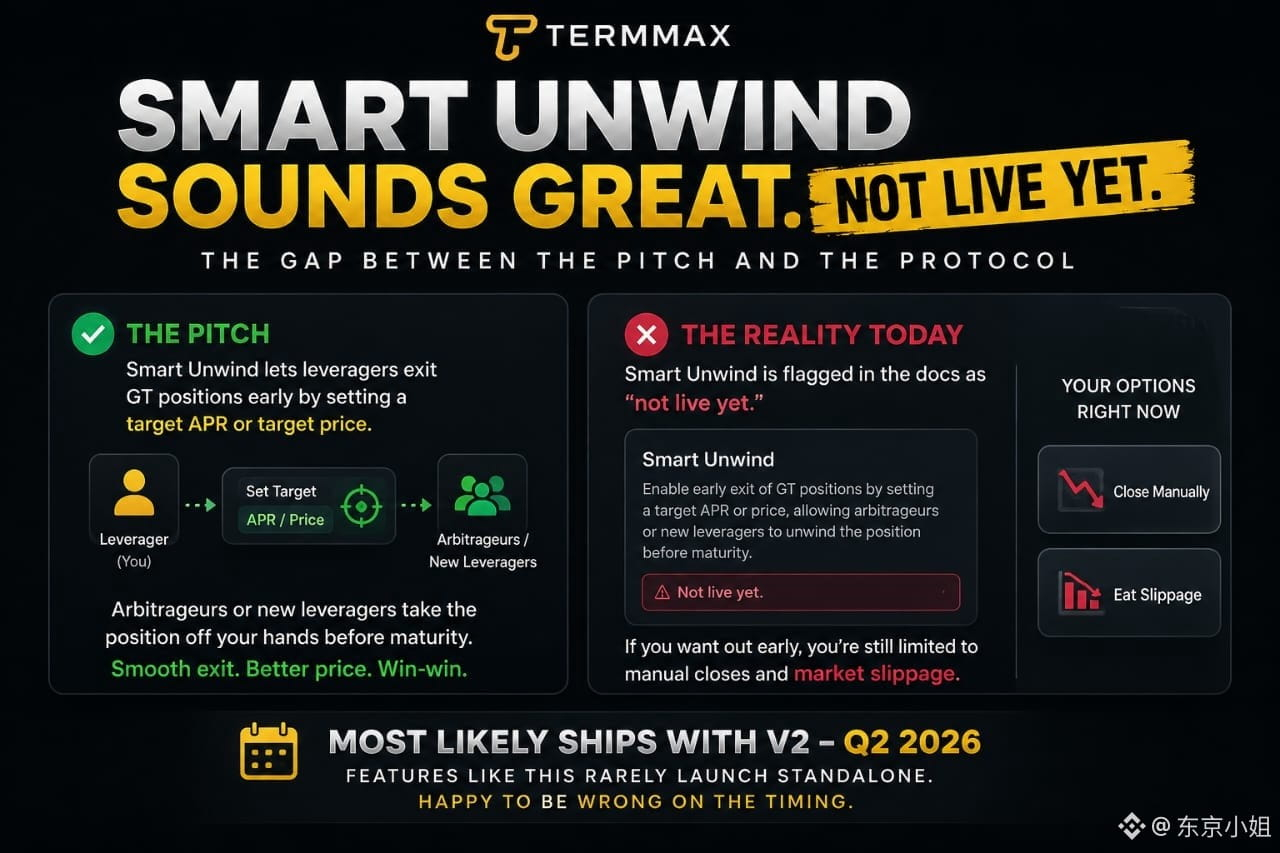
there's a feature termmax talks about like it's already working, and it's not — smart unwind. it's positioned as the way leveragers exit gt positions early by setting a target apr or target price, letting arbitrageurs or new leveragers take the position off your hands before maturity. sounds great on paper. the actual docs page for it, though, has one line at the bottom flagging it as "not live yet."
so right now if you're leveraged and you want out early, you're stuck with the same options that existed before this feature was ever announced — closing manually, eating whatever slippage the market gives you. i get why it's being talked up ahead of time, teams do this to build anticipation for v2. still, there's a real gap between what the messaging implies you can do today and what the contracts actually let you do today.
my actual read: this ships alongside the rest of the q2 2026 v2 rollout, not before it and not much after — features like this rarely launch standalone. happy to be wrong on the timing, but that's where i'd put it 🎯
#termmax @termmax
there's a feature termmax talks about like it's already working, and it's not — smart unwind. it's positioned as the way leveragers exit gt positions early by setting a target apr or target price, letting arbitrageurs or new leveragers take the position off your hands before maturity. sounds great on paper. the actual docs page for it, though, has one line at the bottom flagging it as "not live yet."
so right now if you're leveraged and you want out early, you're stuck with the same options that existed before this feature was ever announced — closing manually, eating whatever slippage the market gives you. i get why it's being talked up ahead of time, teams do this to build anticipation for v2. still, there's a real gap between what the messaging implies you can do today and what the contracts actually let you do today.
my actual read: this ships alongside the rest of the q2 2026 v2 rollout, not before it and not much after — features like this rarely launch standalone. happy to be wrong on the timing, but that's where i'd put it 🎯
#termmax @TermMax
so right now if you're leveraged and you want out early, you're stuck with the same options that existed before this feature was ever announced — closing manually, eating whatever slippage the market gives you. i get why it's being talked up ahead of time, teams do this to build anticipation for v2. still, there's a real gap between what the messaging implies you can do today and what the contracts actually let you do today.
my actual read: this ships alongside the rest of the q2 2026 v2 rollout, not before it and not much after — features like this rarely launch standalone. happy to be wrong on the timing, but that's where i'd put it 🎯
#termmax @TermMax
2
1
131
·
--
Haussier
keyrock and hardcoded lab are both running live vaults right now, and there's a detail in how termmax handles idle capital that i don't see anyone actually talking about — any lending order capital that hasn't been borrowed yet gets auto-routed into aave, morpho, or venus so it's not just sitting dead. smart treasury move, honestly.
but it means the whole "fixed rate" pitch is quietly resting on floating-rate protocols for however long your money's waiting to get matched. i'm not calling it a flaw, it's clearly the better option versus letting usdc earn zero — still, with two active curators running strategies right now, i can't tell how much of their advertised apy is coming from actual matched fixed-rate lending versus this floating-rate layer doing the heavy lifting on slow days 📊
curious if anyone's ever seen that split actually broken down anywhere.
#termmax @termmax
keyrock and hardcoded lab are both running live vaults right now, and there's a detail in how termmax handles idle capital that i don't see anyone actually talking about — any lending order capital that hasn't been borrowed yet gets auto-routed into aave, morpho, or venus so it's not just sitting dead. smart treasury move, honestly.
but it means the whole "fixed rate" pitch is quietly resting on floating-rate protocols for however long your money's waiting to get matched. i'm not calling it a flaw, it's clearly the better option versus letting usdc earn zero — still, with two active curators running strategies right now, i can't tell how much of their advertised apy is coming from actual matched fixed-rate lending versus this floating-rate layer doing the heavy lifting on slow days 📊
curious if anyone's ever seen that split actually broken down anywhere.
#termmax @TermMax
but it means the whole "fixed rate" pitch is quietly resting on floating-rate protocols for however long your money's waiting to get matched. i'm not calling it a flaw, it's clearly the better option versus letting usdc earn zero — still, with two active curators running strategies right now, i can't tell how much of their advertised apy is coming from actual matched fixed-rate lending versus this floating-rate layer doing the heavy lifting on slow days 📊
curious if anyone's ever seen that split actually broken down anywhere.
#termmax @TermMax

1
1
186
·
--
@Dusk_Foundation
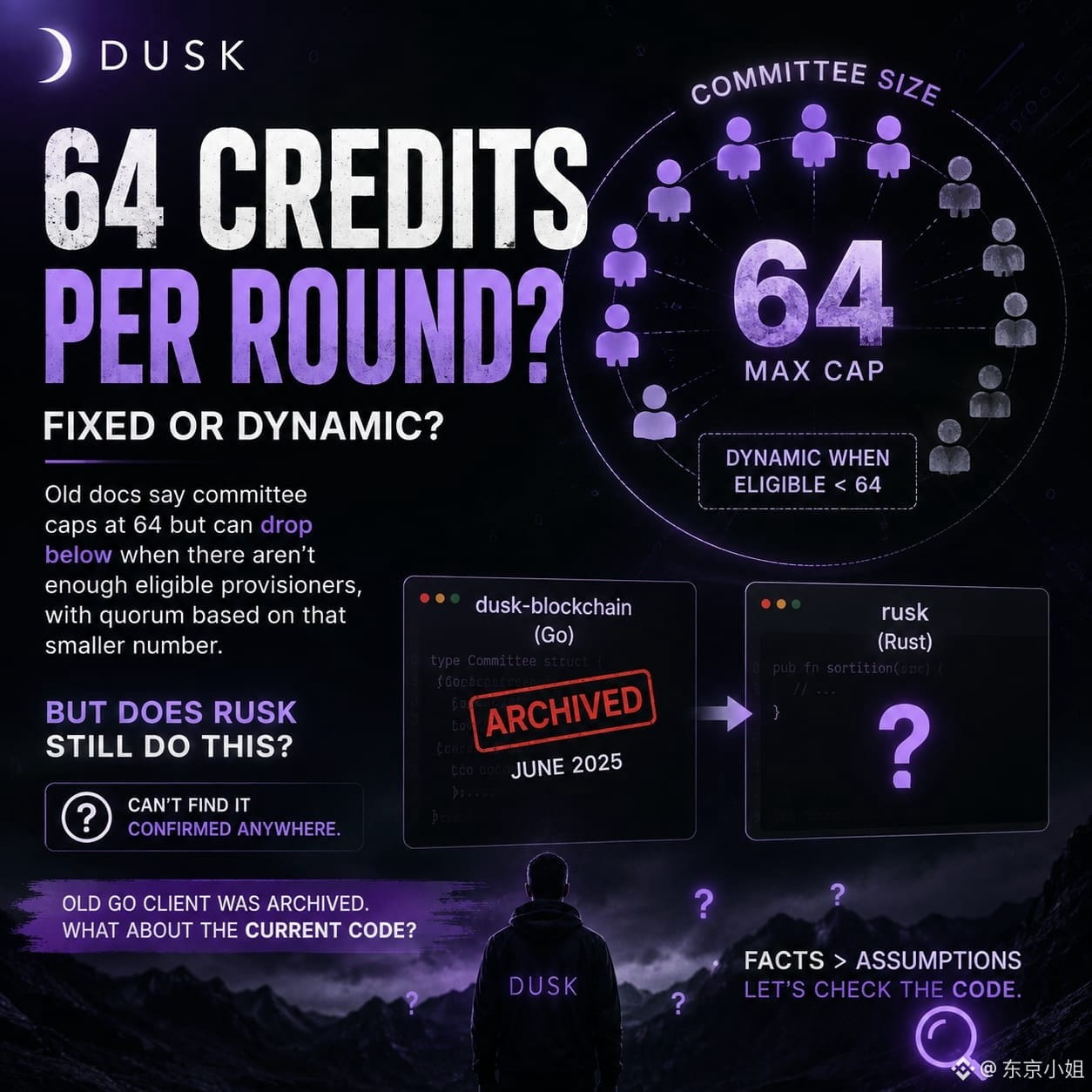
i went digging into how dusk's committee size actually works, since "64 credits per round" gets repeated everywhere as fixed. found a github issue describing something different — committee size caps at 64 but drops below that when there aren't enough eligible provisioners, with quorum computed off that smaller number. except when i went to check which codebase that issue was filed against, it's dusk-blockchain, the old golang client, archived by its own team back in june 2025.
so this was documented behavior in the pre-mainnet implementation, not necessarily what's running now — actually wait, i should be more precise, it's not that it's necessarily different now, it's that i genuinely can't find anything either way. mainnet uses rusk, a full rust rewrite, and whether this exact sortition logic carried over or got redesigned along the way isn't something i could confirm.
that's a weirdly specific gap for a network this deep into public docs — the historical behavior is real and traceable, but nothing i've found actually confirms or denies it in the current live codebase.
has anyone actually checked the current rusk sortition code for this, or is everyone just repeating the old go client's behavior as if it's still true? 🧐
#dusk $DUSK
@Dusk
i went digging into how dusk's committee size actually works, since "64 credits per round" gets repeated everywhere as fixed. found a github issue describing something different — committee size caps at 64 but drops below that when there aren't enough eligible provisioners, with quorum computed off that smaller number. except when i went to check which codebase that issue was filed against, it's dusk-blockchain, the old golang client, archived by its own team back in june 2025.
so this was documented behavior in the pre-mainnet implementation, not necessarily what's running now — actually wait, i should be more precise, it's not that it's necessarily different now, it's that i genuinely can't find anything either way. mainnet uses rusk, a full rust rewrite, and whether this exact sortition logic carried over or got redesigned along the way isn't something i could confirm.
that's a weirdly specific gap for a network this deep into public docs — the historical behavior is real and traceable, but nothing i've found actually confirms or denies it in the current live codebase.
has anyone actually checked the current rusk sortition code for this, or is everyone just repeating the old go client's behavior as if it's still true? 🧐
#dusk $DUSK
i went digging into how dusk's committee size actually works, since "64 credits per round" gets repeated everywhere as fixed. found a github issue describing something different — committee size caps at 64 but drops below that when there aren't enough eligible provisioners, with quorum computed off that smaller number. except when i went to check which codebase that issue was filed against, it's dusk-blockchain, the old golang client, archived by its own team back in june 2025.
so this was documented behavior in the pre-mainnet implementation, not necessarily what's running now — actually wait, i should be more precise, it's not that it's necessarily different now, it's that i genuinely can't find anything either way. mainnet uses rusk, a full rust rewrite, and whether this exact sortition logic carried over or got redesigned along the way isn't something i could confirm.
that's a weirdly specific gap for a network this deep into public docs — the historical behavior is real and traceable, but nothing i've found actually confirms or denies it in the current live codebase.
has anyone actually checked the current rusk sortition code for this, or is everyone just repeating the old go client's behavior as if it's still true? 🧐
#dusk $DUSK
7
4
162
·
--
Haussier
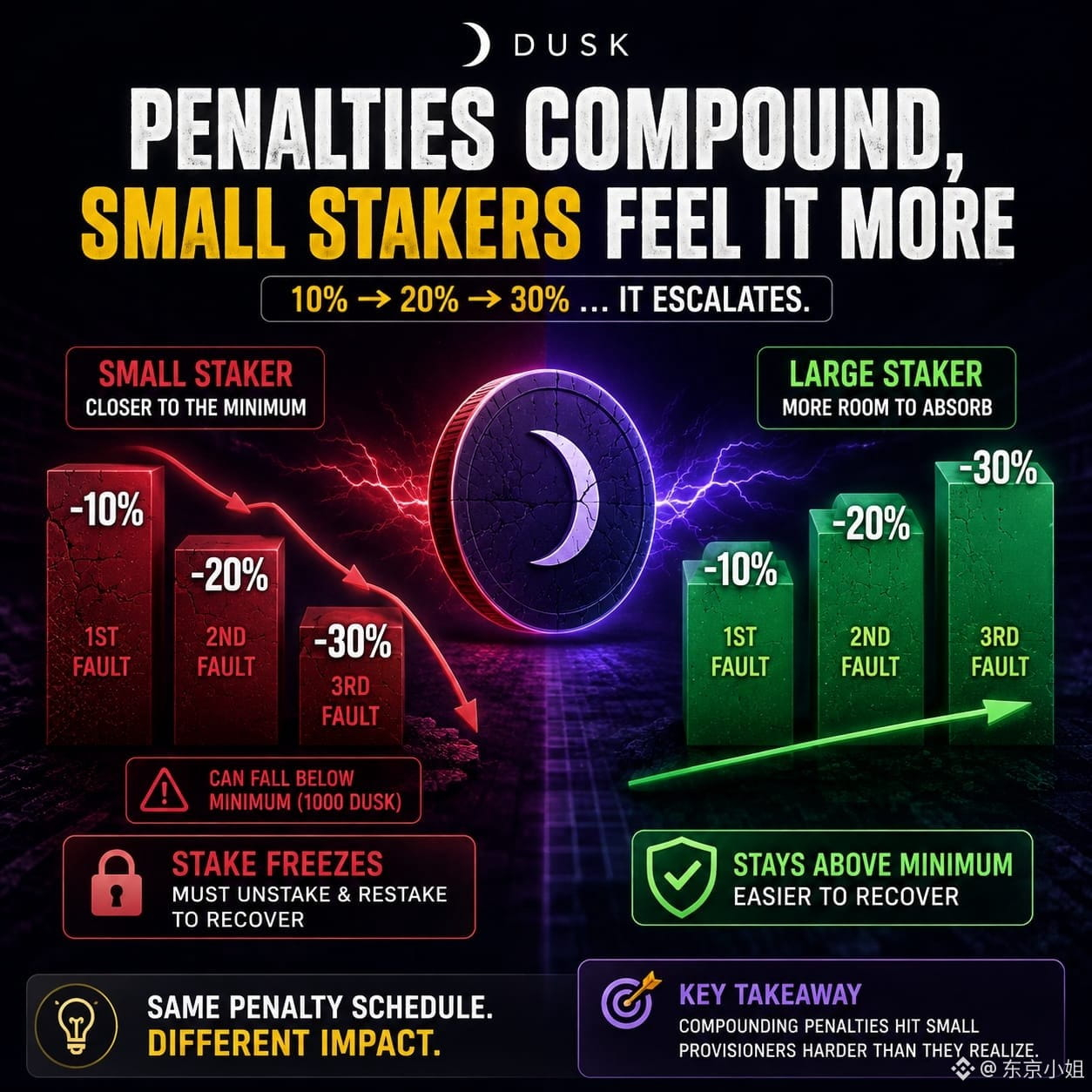
i was reading through dusk's engineering updates on penalization and noticed the percentages actually compound — first suspension costs 10% of stake, second costs 20%, then 30%, climbing each time. that's not flat, it escalates.
which means a provisioner running close to the 1000 dusk minimum has way less room to recover than a bigger one. two or three consecutive faults and a small staker could get pushed below minimum entirely, at which point the docs say the stake freezes and has to be fully unstaked and restaked to come back — not just waiting out a suspension, an actual reset.
a large provisioner eating the same 10-20-30% sequence barely notices it relative to their total stake. so the same penalty schedule meant to punish bad behavior equally ends up hitting small validators harder — i went back and reread the percentages twice actually, because i kept assuming i'd misread "increasing by 10%" as some flat repeated 10% instead.
is there any minimum stake buffer recommended anywhere so smaller provisioners don't get pushed into that reset cycle by accident? 🧐
#dusk $DUSK @Dusk_Foundation
{spot}(DUSKUSDT)
i was reading through dusk's engineering updates on penalization and noticed the percentages actually compound — first suspension costs 10% of stake, second costs 20%, then 30%, climbing each time. that's not flat, it escalates.
which means a provisioner running close to the 1000 dusk minimum has way less room to recover than a bigger one. two or three consecutive faults and a small staker could get pushed below minimum entirely, at which point the docs say the stake freezes and has to be fully unstaked and restaked to come back — not just waiting out a suspension, an actual reset.
a large provisioner eating the same 10-20-30% sequence barely notices it relative to their total stake. so the same penalty schedule meant to punish bad behavior equally ends up hitting small validators harder — i went back and reread the percentages twice actually, because i kept assuming i'd misread "increasing by 10%" as some flat repeated 10% instead.
is there any minimum stake buffer recommended anywhere so smaller provisioners don't get pushed into that reset cycle by accident? 🧐
#dusk $DUSK @Dusk
which means a provisioner running close to the 1000 dusk minimum has way less room to recover than a bigger one. two or three consecutive faults and a small staker could get pushed below minimum entirely, at which point the docs say the stake freezes and has to be fully unstaked and restaked to come back — not just waiting out a suspension, an actual reset.
a large provisioner eating the same 10-20-30% sequence barely notices it relative to their total stake. so the same penalty schedule meant to punish bad behavior equally ends up hitting small validators harder — i went back and reread the percentages twice actually, because i kept assuming i'd misread "increasing by 10%" as some flat repeated 10% instead.
is there any minimum stake buffer recommended anywhere so smaller provisioners don't get pushed into that reset cycle by accident? 🧐
#dusk $DUSK @Dusk
1
2
152
·
--
@Dusk_Foundation
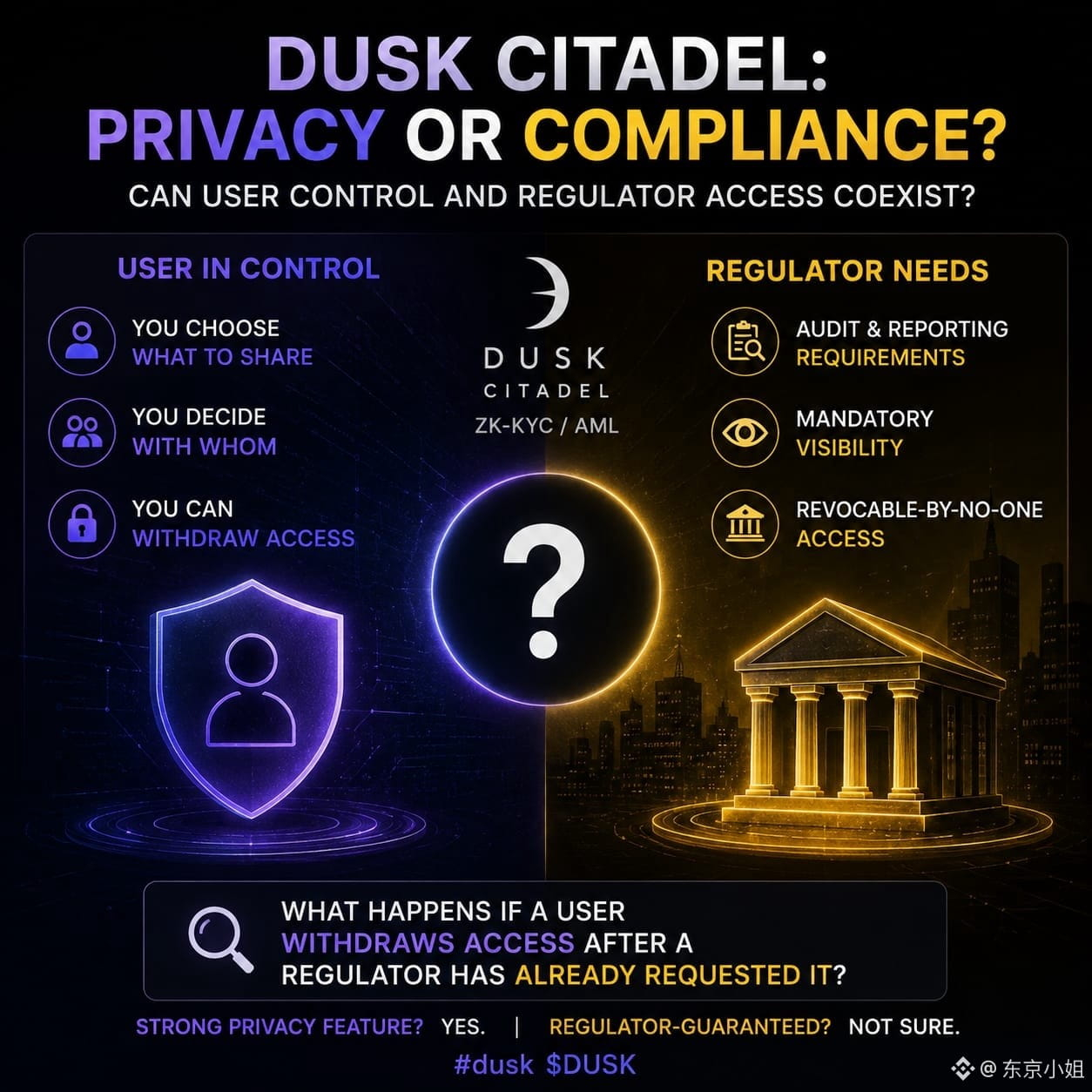
i went back to read how dusk's citadel actually works instead of just repeating the "privacy plus selective disclosure" pitch, and something doesn't line up. citadel describes the user as fully in charge of their data — they choose what to share, with whom, and can even withdraw access to it later. that's still the current framing too — actually i went in expecting this to be some shelved 2023 idea, but it's sitting right there in dusk's post-mainnet roadmap as the live zk-kyc/aml piece.
but regulators generally don't want optional access. audit and reporting requirements usually mean mandatory, revocable-by-no-one visibility, not something a user consents to once and can pull back later. if citadel gives users the power to withdraw disclosure, i'm not sure how that squares with the "regulator can see what they need" framing dusk uses elsewhere — unless there's a separate compliance layer sitting underneath that i just haven't found yet.
worth saying: user-controlled data is a genuinely strong privacy feature for dusk, i'm not knocking that part. i just don't think "user-revocable" and "regulator-guaranteed" can both be true of the same disclosure at the same time.
anyone seen documentation on what happens if a dusk user withdraws access after a regulator already requested it? 🧐
#dusk $DUSK
@Dusk
i went back to read how dusk's citadel actually works instead of just repeating the "privacy plus selective disclosure" pitch, and something doesn't line up. citadel describes the user as fully in charge of their data — they choose what to share, with whom, and can even withdraw access to it later. that's still the current framing too — actually i went in expecting this to be some shelved 2023 idea, but it's sitting right there in dusk's post-mainnet roadmap as the live zk-kyc/aml piece.
but regulators generally don't want optional access. audit and reporting requirements usually mean mandatory, revocable-by-no-one visibility, not something a user consents to once and can pull back later. if citadel gives users the power to withdraw disclosure, i'm not sure how that squares with the "regulator can see what they need" framing dusk uses elsewhere — unless there's a separate compliance layer sitting underneath that i just haven't found yet.
worth saying: user-controlled data is a genuinely strong privacy feature for dusk, i'm not knocking that part. i just don't think "user-revocable" and "regulator-guaranteed" can both be true of the same disclosure at the same time.
anyone seen documentation on what happens if a dusk user withdraws access after a regulator already requested it? 🧐
#dusk $DUSK
i went back to read how dusk's citadel actually works instead of just repeating the "privacy plus selective disclosure" pitch, and something doesn't line up. citadel describes the user as fully in charge of their data — they choose what to share, with whom, and can even withdraw access to it later. that's still the current framing too — actually i went in expecting this to be some shelved 2023 idea, but it's sitting right there in dusk's post-mainnet roadmap as the live zk-kyc/aml piece.
but regulators generally don't want optional access. audit and reporting requirements usually mean mandatory, revocable-by-no-one visibility, not something a user consents to once and can pull back later. if citadel gives users the power to withdraw disclosure, i'm not sure how that squares with the "regulator can see what they need" framing dusk uses elsewhere — unless there's a separate compliance layer sitting underneath that i just haven't found yet.
worth saying: user-controlled data is a genuinely strong privacy feature for dusk, i'm not knocking that part. i just don't think "user-revocable" and "regulator-guaranteed" can both be true of the same disclosure at the same time.
anyone seen documentation on what happens if a dusk user withdraws access after a regulator already requested it? 🧐
#dusk $DUSK
7
11
146
·
--
Haussier
Partiellement vrai
@Dusk_Foundation
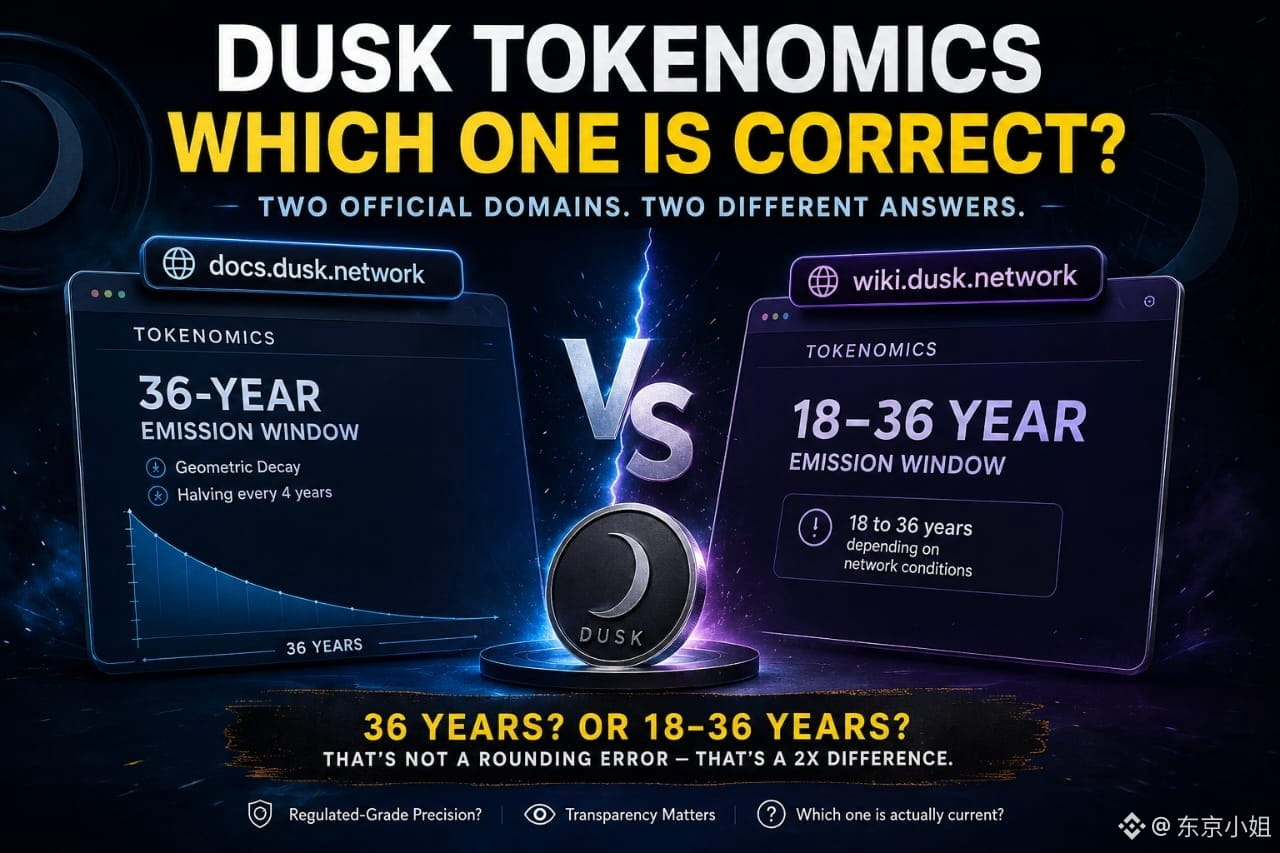
i was cross-checking the emission schedule for something else entirely and noticed two of dusk's own domains don't even agree with each other. docs.dusk.network — the actual tokenomics page — says a flat 36-year emission window, geometric decay, halving every 4 years, straightforward. wiki.dusk.network, which sits on their own subdomain, not some random third-party mirror, says something looser: an 18 to 36 year range depending on network conditions.
that's not a rounding difference, it's basically a 2x spread on how long the reward tail runs — and i almost dismissed it as a fan wiki thing until i noticed it's literally hosted under dusk.network, not somewhere external.
i get that block-time variance shifts the real calendar length a little, that part tracks. but a document called "tokenomics" citing one fixed number while a page on the team's own domain cites a range isn't a rounding issue, it's two different answers to "when does emission stop." for a project built on regulated-grade precision, that's not the kind of gap i'd expect between two pages they both control.
anyone know which one's actually current, or are both just stale in different directions? 🧐
#dusk $DUSK
@Dusk
i was cross-checking the emission schedule for something else entirely and noticed two of dusk's own domains don't even agree with each other. docs.dusk.network — the actual tokenomics page — says a flat 36-year emission window, geometric decay, halving every 4 years, straightforward. wiki.dusk.network, which sits on their own subdomain, not some random third-party mirror, says something looser: an 18 to 36 year range depending on network conditions.
that's not a rounding difference, it's basically a 2x spread on how long the reward tail runs — and i almost dismissed it as a fan wiki thing until i noticed it's literally hosted under dusk.network, not somewhere external.
i get that block-time variance shifts the real calendar length a little, that part tracks. but a document called "tokenomics" citing one fixed number while a page on the team's own domain cites a range isn't a rounding issue, it's two different answers to "when does emission stop." for a project built on regulated-grade precision, that's not the kind of gap i'd expect between two pages they both control.
anyone know which one's actually current, or are both just stale in different directions? 🧐
#dusk $DUSK
i was cross-checking the emission schedule for something else entirely and noticed two of dusk's own domains don't even agree with each other. docs.dusk.network — the actual tokenomics page — says a flat 36-year emission window, geometric decay, halving every 4 years, straightforward. wiki.dusk.network, which sits on their own subdomain, not some random third-party mirror, says something looser: an 18 to 36 year range depending on network conditions.
that's not a rounding difference, it's basically a 2x spread on how long the reward tail runs — and i almost dismissed it as a fan wiki thing until i noticed it's literally hosted under dusk.network, not somewhere external.
i get that block-time variance shifts the real calendar length a little, that part tracks. but a document called "tokenomics" citing one fixed number while a page on the team's own domain cites a range isn't a rounding issue, it's two different answers to "when does emission stop." for a project built on regulated-grade precision, that's not the kind of gap i'd expect between two pages they both control.
anyone know which one's actually current, or are both just stale in different directions? 🧐
#dusk $DUSK
9
11
139
·
--
Haussier
{spot}(DUSKUSDT)
@Dusk_Foundation
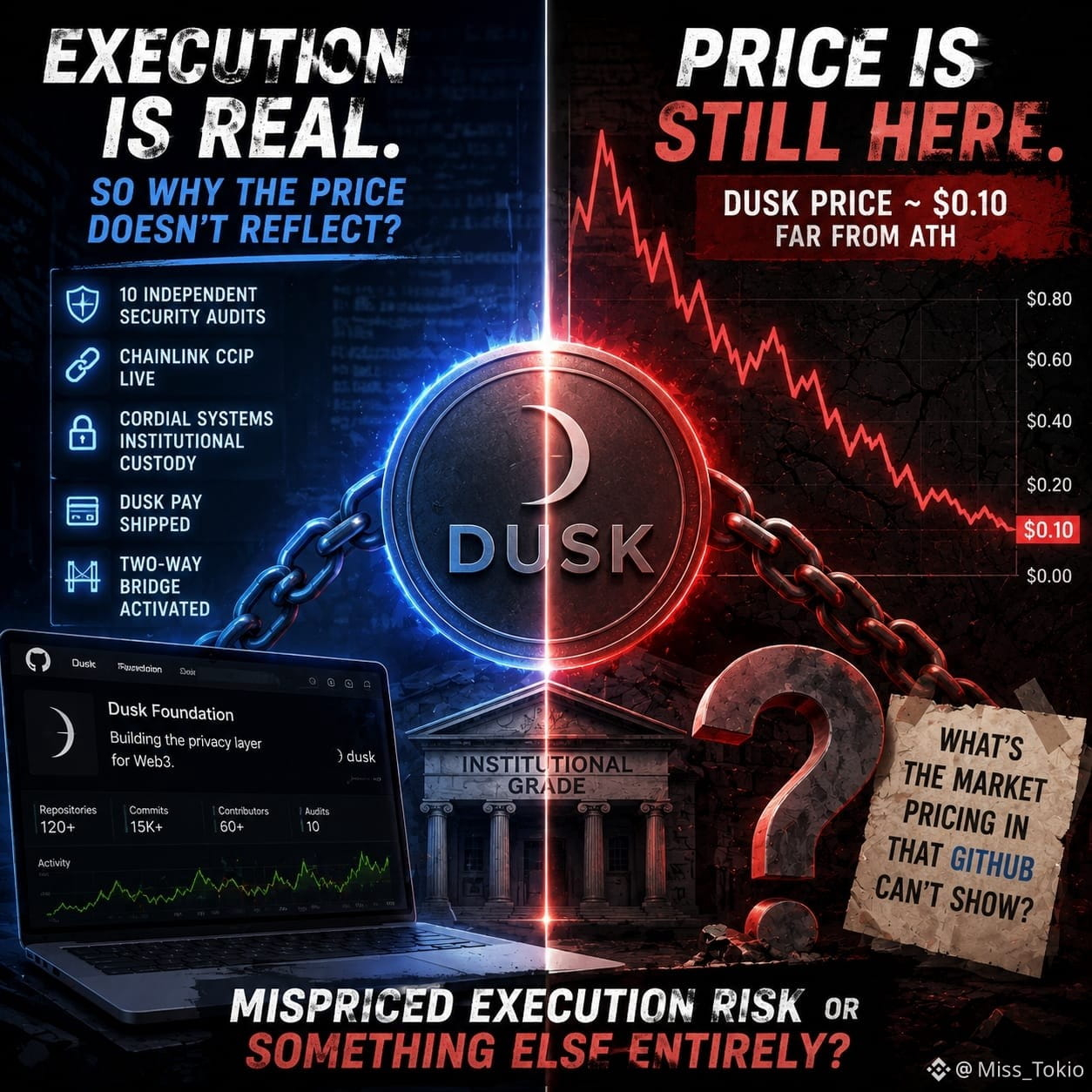
i pulled up dusk's github alongside its price chart earlier today just to see if the numbers matched the story, and they don't — not even close. ten independent security audits before mainnet, chainlink ccip live, cordial systems onboarded for institutional custody, dusk pay shipped, the two-way bridge activated. that's not a quiet quarter for any l1.
price is sitting near $0.10, way off its ath, like none of that happened.
i get that commit counts alone don't mean much — you can pad a repo with doc changes and dependency bumps and call it activity. but ten audits and a live custody integration aren't cosmetic, those are things that actually have to work before institutions touch the chain. so either the market's mispricing execution risk that's already been retired, or it's pricing in something else entirely that i'm just not seeing from the dev side.
which one is it, and if it's the second thing — what's actually being priced in that github can't show me? 🧐
#dusk $DUSK
@Dusk
i pulled up dusk's github alongside its price chart earlier today just to see if the numbers matched the story, and they don't — not even close. ten independent security audits before mainnet, chainlink ccip live, cordial systems onboarded for institutional custody, dusk pay shipped, the two-way bridge activated. that's not a quiet quarter for any l1.
price is sitting near $0.10, way off its ath, like none of that happened.
i get that commit counts alone don't mean much — you can pad a repo with doc changes and dependency bumps and call it activity. but ten audits and a live custody integration aren't cosmetic, those are things that actually have to work before institutions touch the chain. so either the market's mispricing execution risk that's already been retired, or it's pricing in something else entirely that i'm just not seeing from the dev side.
which one is it, and if it's the second thing — what's actually being priced in that github can't show me? 🧐
#dusk $DUSK
i pulled up dusk's github alongside its price chart earlier today just to see if the numbers matched the story, and they don't — not even close. ten independent security audits before mainnet, chainlink ccip live, cordial systems onboarded for institutional custody, dusk pay shipped, the two-way bridge activated. that's not a quiet quarter for any l1.
price is sitting near $0.10, way off its ath, like none of that happened.
i get that commit counts alone don't mean much — you can pad a repo with doc changes and dependency bumps and call it activity. but ten audits and a live custody integration aren't cosmetic, those are things that actually have to work before institutions touch the chain. so either the market's mispricing execution risk that's already been retired, or it's pricing in something else entirely that i'm just not seeing from the dev side.
which one is it, and if it's the second thing — what's actually being priced in that github can't show me? 🧐
#dusk $DUSK
2
119
·
--
@babylonlabs_io
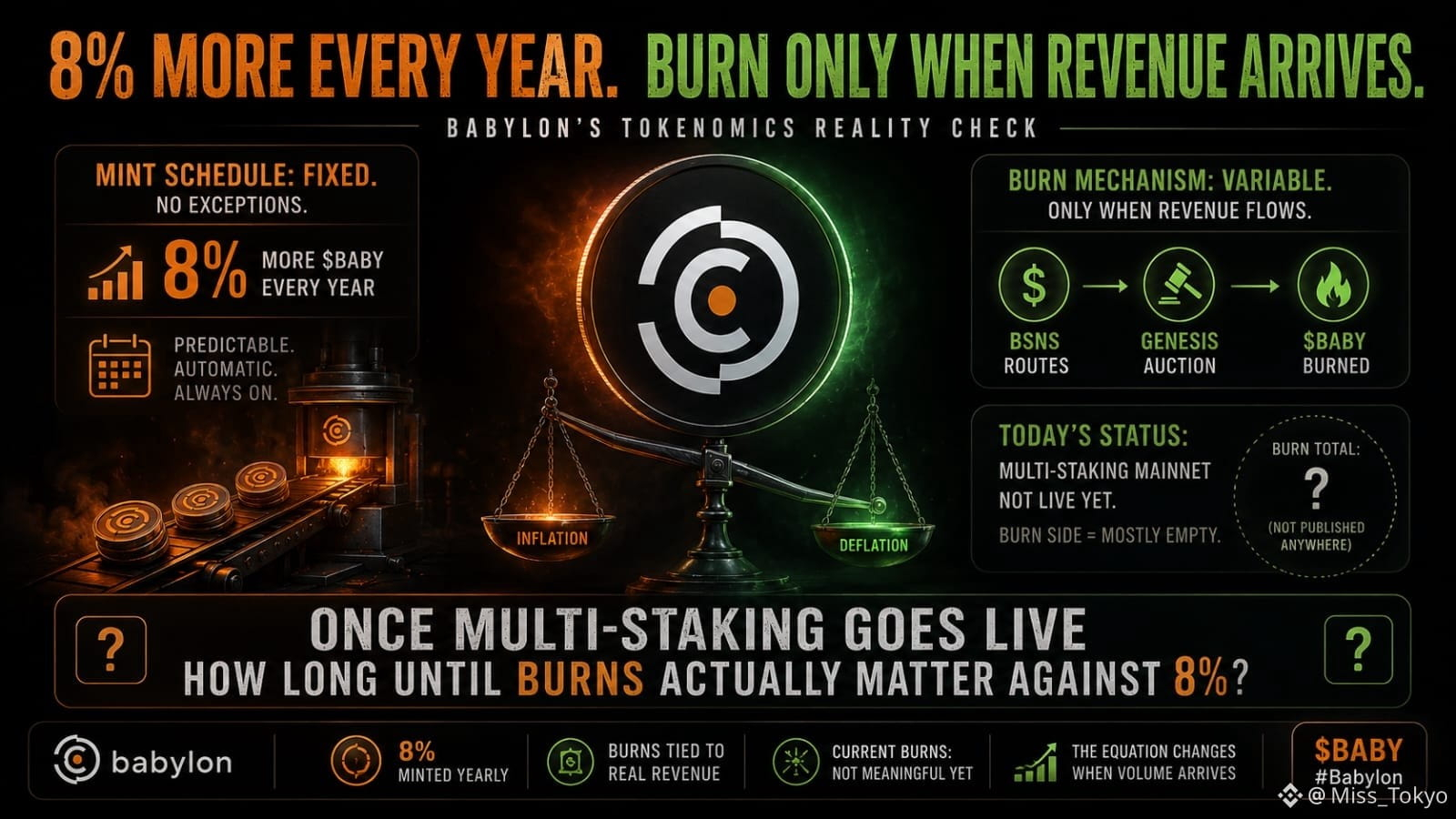
babylon mints roughly 8% more baby every year on a fixed schedule, no exceptions. the mechanism built to offset that isn't on a schedule at all it only burns baby when bsns route real staking rewards through genesis's auction, and multi-staking mainnet still hasn't launched, so that side of the ledger is mostly sitting empty right now.
an auction tied to actual revenue is a better design than an arbitrary burn target, on paper. right now, though, "tied to actual revenue" just describes a formula with nothing plugged into it yet.
i looked for a current burn total and didn't find one published anywhere probably because there isn't much of one yet, not because anyone's hiding it.
once multi-staking ships and bsns start routing real volume, how long before that burn side catches up enough to actually matter against the 8%? $BABY #baby 🔥
@BabylonLabs_io
babylon mints roughly 8% more baby every year on a fixed schedule, no exceptions. the mechanism built to offset that isn't on a schedule at all it only burns baby when bsns route real staking rewards through genesis's auction, and multi-staking mainnet still hasn't launched, so that side of the ledger is mostly sitting empty right now.
an auction tied to actual revenue is a better design than an arbitrary burn target, on paper. right now, though, "tied to actual revenue" just describes a formula with nothing plugged into it yet.
i looked for a current burn total and didn't find one published anywhere probably because there isn't much of one yet, not because anyone's hiding it.
once multi-staking ships and bsns start routing real volume, how long before that burn side catches up enough to actually matter against the 8%? $BABY #baby 🔥
babylon mints roughly 8% more baby every year on a fixed schedule, no exceptions. the mechanism built to offset that isn't on a schedule at all it only burns baby when bsns route real staking rewards through genesis's auction, and multi-staking mainnet still hasn't launched, so that side of the ledger is mostly sitting empty right now.
an auction tied to actual revenue is a better design than an arbitrary burn target, on paper. right now, though, "tied to actual revenue" just describes a formula with nothing plugged into it yet.
i looked for a current burn total and didn't find one published anywhere probably because there isn't much of one yet, not because anyone's hiding it.
once multi-staking ships and bsns start routing real volume, how long before that burn side catches up enough to actually matter against the 8%? $BABY #baby 🔥
6
2
181
Connectez-vous pour découvrir plus de contenu
Rejoignez la communauté mondiale des adeptes de cryptomonnaies sur Binance Square
⚡️ Suviez les dernières informations importantes sur les cryptomonnaies.
💬 Jugé digne de confiance par la plus grande plateforme d’échange de cryptomonnaies au monde.
👍 Découvrez les connaissances que partagent les créateurs vérifiés.
Adresse e-mail/Nº de téléphone
Sujets d’actualité
BinancePick
2.7M vues
143,397 mentions
Join #EarningsSeason: Predict Earnings on Binance Pick, Share Your Take on Binance Square!
Binance Square Official
·402 mentions J’aime
·339k vues
EarningsSeason
5M vues
24,614 mentions
SouthKoreaReportedlyWeighsFourthCryptoTaxDelay
1,176 vues
89 mentions