

Coincamps
380 Publications

Coincamps
Signaler
Bloquer l’utilisateur
🔍 Where Crypto & AI Minds Gather,Signal for Crypto & AI Builders
https://coincamps.ai
Ouvert au trading
Trade occasionnellement
2.3 an(s)
5 Suivis
1.3K+ Abonnés
49 J’aime
Publications
Portefeuille
·
--
UPBIT LISTING: 돌핀(POD) 신규 거래지원 안내 (KRW, BTC, USDT 마켓)
UPBIT LISTING: 돌핀(POD) 신규 거래지원 안내 (KRW, BTC, USDT 마켓)
POD MarketCap: 26M
UPBIT LISTING: 돌핀(POD) 신규 거래지원 안내 (KRW, BTC, USDT 마켓)
UPBIT LISTING: 돌핀(POD) 신규 거래지원 안내 (KRW, BTC, USDT 마켓)
POD MarketCap: 26M
UPBIT LISTING: 돌핀(POD) 신규 거래지원 안내 (KRW, BTC, USDT 마켓)
POD MarketCap: 26M
77
·
--
BWENEWS: The near intents vulnerability has been patched, full user compensation is planned, and operations will resume within one hour: Near intents on X
BWENEWS: The near intents vulnerability has been patched, full user compensation is planned, and operations will resume within one hour: Near intents on X
BWENEWS: The near intents vulnerability has been patched, full user compensation is planned, and operations will resume within one hour: Near intents on X
BWENEWS: The near intents vulnerability has been patched, full user compensation is planned, and operations will resume within one hour: Near intents on X
BWENEWS: The near intents vulnerability has been patched, full user compensation is planned, and operations will resume within one hour: Near intents on X
31
·
--
BWENEWS: The near intents vulnerability has been patched, full user compensation is planned, and operations will resume within one hour: Near intents on X
The near intents vulnerability has been patched, full user compensation is planned, and operations will resume within one hour: Near intents on X
BWENEWS: The near intents vulnerability has been patched, full user compensation is planned, and operations will resume within one hour: Near intents on X
The near intents vulnerability has been patched, full user compensation is planned, and operations will resume within one hour: Near intents on X
The near intents vulnerability has been patched, full user compensation is planned, and operations will resume within one hour: Near intents on X
84
·
--
Binance EN: Binance Futures Will Launch USDⓈ-Margined CTUSDT Perpetual Contract (2026-10-01)
Binance EN: Binance Futures Will Launch USDⓈ-Margined CTUSDT Perpetual Contract (2026-10-01)
CT MarketCap: 393.4M
Binance EN: Binance Futures Will Launch USDⓈ-Margined CTUSDT Perpetual Contract (2026-10-01)
Binance EN: Binance Futures Will Launch USDⓈ-Margined CTUSDT Perpetual Contract (2026-10-01)
CT MarketCap: 393.4M
Binance EN: Binance Futures Will Launch USDⓈ-Margined CTUSDT Perpetual Contract (2026-10-01)
CT MarketCap: 393.4M
61
·
--
Binance EN: Binance Futures Will Delist Multiple USDⓈ-M Perpetual Contracts (2026-10-05)
Binance EN: Binance Futures Will Delist Multiple USDⓈ-M Perpetual Contracts (2026-10-05)
Binance EN: Binance Futures Will Delist Multiple USDⓈ-M Perpetual Contracts (2026-10-05)
Binance EN: Binance Futures Will Delist Multiple USDⓈ-M Perpetual Contracts (2026-10-05)
Binance EN: Binance Futures Will Delist Multiple USDⓈ-M Perpetual Contracts (2026-10-05)
82
·
--

Article
Coinbase Secures U.S. Clearing License: An Infrastructure “Shadow War” Overlooked by the MarketOn September 28, the U.S. Commodity Futures Trading Commission (CFTC) officially approved Coinbase to establish a Derivatives Clearing Organization (DCO). According to Coinbase’s official statement, this marks the final piece needed to complete its “end-to-end” infrastructure for derivatives businesses.
At first glance, the headline suggests a major bullish catalyst capable of igniting the market. However, the reaction in the secondary market was unusually muted. On the day the news broke, COIN stock did not surge but instead dipped slightly by 1.70%, with related assets such as BTC and Circle (the issuer of USDC) also trading lower.
Retail investors and speculative capital voted with their feet: they dismissed this “backend system upgrade.” Yet behind this quiet dismissal, ignored by the trading floors, the market structure for U.S. crypto derivatives is undergoing a profound reshuffling.
The Quality of the License: The Boundary Between Fully Collateralized and Leverage
To understand the market’s muted response, one must first see the true boundaries of this license.
This DCO license granted to Coinbase by the CFTC comes with strict limitations: it only allows clearing for fully collateralized (fully collateralized) futures, options, and swap products. This means that high-leverage margin products, which are most familiar to retail traders and possess the highest liquidity, remain excluded.
For short-term traders, this license will not alter their experience within the app in the near term: fees have not decreased, leverage multipliers remain unchanged, and leveraged derivatives still depend on external clearing partners. The market is pragmatic; without new “high-leverage gambling tools” coming online, no premium pricing will be assigned.
The CFTC’s stance is unequivocal: regulators are willing to permit crypto-native companies to conduct clearing, but only beginning with fully collateralized products that lack default funds and utilize the simplest risk models. Truly impactful clearing authority for leverage remains firmly kept beyond the regulatory threshold.
USDC Moves From “Trading Medium” to “Clearing Infrastructure”
If this license offers limited short-term revenue traction to Coinbase, its strategic significance for USDC has been severely underestimated.
This is the first regulated clearinghouse that positions itself as “USDC-native.” Historically, institutions conducting derivatives clearing often had to convert assets into fiat currency and were constrained by traditional banking operating hours. Now, USDC is directly accepted as a regulated clearing and settlement asset, supporting 24/7 round-the-clock settlement.
This shift elevates the positioning of USDC to a higher tier:
Diverging from pure trading attributes: USDC has transformed from an on-chain trading pair medium into a collateral asset for underlying financial infrastructure recognized by U.S. regulators.
Allied interest binding: Coinbase serves as both the core distribution network for USDC and now its clearing scenario gateway, further widening USDC’s lead over competitors in compliant environments.
Of course, this deep binding also introduces structural vulnerabilities: the clearinghouse concentrating collateral heavily on a single stablecoin means that any future depegging of USDC or disruptions in banking channels could directly transmit and amplify into clearing pressures across the derivatives market.
Competitive Landscape: Two Paths – M&A vs. Self-Build
Looking across the entire U.S. crypto derivatives market, the internalization of clearing rights has become the core focal point of the giants’ strategic games. Currently, two distinctly different pathways have emerged:
One is the M&A path. As referenced by Cointelegraph, Kraken directly acquired Bitnomial, which already held the relevant license, in May this year, securing a full-stack trio covering exchange, brokerage, and clearinghouse (including leverage clearing capabilities) through direct capital maneuvering.
The other is the self-build path chosen by Coinbase this time. Although it has secured a critical piece of the full-stack puzzle, regarding clearing authority for high-leverage products, the self-built license currently lags behind legacy licenses obtained through M&A.
Whoever controls the clearing rights dictates the types of collateral, the pace of settlement, and the velocity of new product launches. What Coinbase secured this time is future “product design authority” and the “settlement clock,” rather than a weapon to immediately capture market share from traditional giants like CME.
Awaiting the Opening of the Next Door
For ordinary investors, there is no need to chase COIN immediately based on this news. This is merely a “regulatory registration” for infrastructure, serving as material in corporate annual reports to validate strategic completeness.
But for the broader industry, the core thesis is already crystal clear: the U.S. is quietly and steadily integrating the matching, brokerage, clearing, and collateral functions of the crypto market into a regulated framework. Fully collateralized products are just the appetizer; when Coinbase can eventually expand the authority of this DCO license to encompass leverage/margin business in the future, that will be the moment that truly reshapes valuations and substantively disrupts the traditional financial settlement system.
Join the official Coincamps community:
X: https://x.com/coincamps
Telegram: https://t.me/coin_camps
Coinbase Secures U.S. Clearing License: An Infrastructure “Shadow War” Overlooked by the Market
On September 28, the U.S. Commodity Futures Trading Commission (CFTC) officially approved Coinbase to establish a Derivatives Clearing Organization (DCO). According to Coinbase’s official statement, this marks the final piece needed to complete its “end-to-end” infrastructure for derivatives businesses.
At first glance, the headline suggests a major bullish catalyst capable of igniting the market. However, the reaction in the secondary market was unusually muted. On the day the news broke, COIN stock did not surge but instead dipped slightly by 1.70%, with related assets such as BTC and Circle (the issuer of USDC) also trading lower.
Retail investors and speculative capital voted with their feet: they dismissed this “backend system upgrade.” Yet behind this quiet dismissal, ignored by the trading floors, the market structure for U.S. crypto derivatives is undergoing a profound reshuffling.
The Quality of the License: The Boundary Between Fully Collateralized and Leverage
To understand the market’s muted response, one must first see the true boundaries of this license.
This DCO license granted to Coinbase by the CFTC comes with strict limitations: it only allows clearing for fully collateralized (fully collateralized) futures, options, and swap products. This means that high-leverage margin products, which are most familiar to retail traders and possess the highest liquidity, remain excluded.
For short-term traders, this license will not alter their experience within the app in the near term: fees have not decreased, leverage multipliers remain unchanged, and leveraged derivatives still depend on external clearing partners. The market is pragmatic; without new “high-leverage gambling tools” coming online, no premium pricing will be assigned.
The CFTC’s stance is unequivocal: regulators are willing to permit crypto-native companies to conduct clearing, but only beginning with fully collateralized products that lack default funds and utilize the simplest risk models. Truly impactful clearing authority for leverage remains firmly kept beyond the regulatory threshold.
USDC Moves From “Trading Medium” to “Clearing Infrastructure”
If this license offers limited short-term revenue traction to Coinbase, its strategic significance for USDC has been severely underestimated.
This is the first regulated clearinghouse that positions itself as “USDC-native.” Historically, institutions conducting derivatives clearing often had to convert assets into fiat currency and were constrained by traditional banking operating hours. Now, USDC is directly accepted as a regulated clearing and settlement asset, supporting 24/7 round-the-clock settlement.
This shift elevates the positioning of USDC to a higher tier:
Diverging from pure trading attributes: USDC has transformed from an on-chain trading pair medium into a collateral asset for underlying financial infrastructure recognized by U.S. regulators.
Allied interest binding: Coinbase serves as both the core distribution network for USDC and now its clearing scenario gateway, further widening USDC’s lead over competitors in compliant environments.
Of course, this deep binding also introduces structural vulnerabilities: the clearinghouse concentrating collateral heavily on a single stablecoin means that any future depegging of USDC or disruptions in banking channels could directly transmit and amplify into clearing pressures across the derivatives market.
Competitive Landscape: Two Paths – M&A vs. Self-Build
Looking across the entire U.S. crypto derivatives market, the internalization of clearing rights has become the core focal point of the giants’ strategic games. Currently, two distinctly different pathways have emerged:
One is the M&A path. As referenced by Cointelegraph, Kraken directly acquired Bitnomial, which already held the relevant license, in May this year, securing a full-stack trio covering exchange, brokerage, and clearinghouse (including leverage clearing capabilities) through direct capital maneuvering.
The other is the self-build path chosen by Coinbase this time. Although it has secured a critical piece of the full-stack puzzle, regarding clearing authority for high-leverage products, the self-built license currently lags behind legacy licenses obtained through M&A.
Whoever controls the clearing rights dictates the types of collateral, the pace of settlement, and the velocity of new product launches. What Coinbase secured this time is future “product design authority” and the “settlement clock,” rather than a weapon to immediately capture market share from traditional giants like CME.
Awaiting the Opening of the Next Door
For ordinary investors, there is no need to chase COIN immediately based on this news. This is merely a “regulatory registration” for infrastructure, serving as material in corporate annual reports to validate strategic completeness.
But for the broader industry, the core thesis is already crystal clear: the U.S. is quietly and steadily integrating the matching, brokerage, clearing, and collateral functions of the crypto market into a regulated framework. Fully collateralized products are just the appetizer; when Coinbase can eventually expand the authority of this DCO license to encompass leverage/margin business in the future, that will be the moment that truly reshapes valuations and substantively disrupts the traditional financial settlement system.
Join the official Coincamps community:
X: https://x.com/coincamps
Telegram: https://t.me/coin_camps
At first glance, the headline suggests a major bullish catalyst capable of igniting the market. However, the reaction in the secondary market was unusually muted. On the day the news broke, COIN stock did not surge but instead dipped slightly by 1.70%, with related assets such as BTC and Circle (the issuer of USDC) also trading lower.
Retail investors and speculative capital voted with their feet: they dismissed this “backend system upgrade.” Yet behind this quiet dismissal, ignored by the trading floors, the market structure for U.S. crypto derivatives is undergoing a profound reshuffling.
The Quality of the License: The Boundary Between Fully Collateralized and Leverage
To understand the market’s muted response, one must first see the true boundaries of this license.
This DCO license granted to Coinbase by the CFTC comes with strict limitations: it only allows clearing for fully collateralized (fully collateralized) futures, options, and swap products. This means that high-leverage margin products, which are most familiar to retail traders and possess the highest liquidity, remain excluded.
For short-term traders, this license will not alter their experience within the app in the near term: fees have not decreased, leverage multipliers remain unchanged, and leveraged derivatives still depend on external clearing partners. The market is pragmatic; without new “high-leverage gambling tools” coming online, no premium pricing will be assigned.
The CFTC’s stance is unequivocal: regulators are willing to permit crypto-native companies to conduct clearing, but only beginning with fully collateralized products that lack default funds and utilize the simplest risk models. Truly impactful clearing authority for leverage remains firmly kept beyond the regulatory threshold.
USDC Moves From “Trading Medium” to “Clearing Infrastructure”
If this license offers limited short-term revenue traction to Coinbase, its strategic significance for USDC has been severely underestimated.
This is the first regulated clearinghouse that positions itself as “USDC-native.” Historically, institutions conducting derivatives clearing often had to convert assets into fiat currency and were constrained by traditional banking operating hours. Now, USDC is directly accepted as a regulated clearing and settlement asset, supporting 24/7 round-the-clock settlement.
This shift elevates the positioning of USDC to a higher tier:
Diverging from pure trading attributes: USDC has transformed from an on-chain trading pair medium into a collateral asset for underlying financial infrastructure recognized by U.S. regulators.
Allied interest binding: Coinbase serves as both the core distribution network for USDC and now its clearing scenario gateway, further widening USDC’s lead over competitors in compliant environments.
Of course, this deep binding also introduces structural vulnerabilities: the clearinghouse concentrating collateral heavily on a single stablecoin means that any future depegging of USDC or disruptions in banking channels could directly transmit and amplify into clearing pressures across the derivatives market.
Competitive Landscape: Two Paths – M&A vs. Self-Build
Looking across the entire U.S. crypto derivatives market, the internalization of clearing rights has become the core focal point of the giants’ strategic games. Currently, two distinctly different pathways have emerged:
One is the M&A path. As referenced by Cointelegraph, Kraken directly acquired Bitnomial, which already held the relevant license, in May this year, securing a full-stack trio covering exchange, brokerage, and clearinghouse (including leverage clearing capabilities) through direct capital maneuvering.
The other is the self-build path chosen by Coinbase this time. Although it has secured a critical piece of the full-stack puzzle, regarding clearing authority for high-leverage products, the self-built license currently lags behind legacy licenses obtained through M&A.
Whoever controls the clearing rights dictates the types of collateral, the pace of settlement, and the velocity of new product launches. What Coinbase secured this time is future “product design authority” and the “settlement clock,” rather than a weapon to immediately capture market share from traditional giants like CME.
Awaiting the Opening of the Next Door
For ordinary investors, there is no need to chase COIN immediately based on this news. This is merely a “regulatory registration” for infrastructure, serving as material in corporate annual reports to validate strategic completeness.
But for the broader industry, the core thesis is already crystal clear: the U.S. is quietly and steadily integrating the matching, brokerage, clearing, and collateral functions of the crypto market into a regulated framework. Fully collateralized products are just the appetizer; when Coinbase can eventually expand the authority of this DCO license to encompass leverage/margin business in the future, that will be the moment that truly reshapes valuations and substantively disrupts the traditional financial settlement system.
Join the official Coincamps community:
X: https://x.com/coincamps
Telegram: https://t.me/coin_camps
·
--
Binance EN: Binance Futures Will Launch Multiple TradFi USDⓈ-Margined Perpetual Contracts (2026-09-29)
Binance EN: Binance Futures Will Launch Multiple TradFi USDⓈ-Margined Perpetual Contracts (2026-09-29)
Binance EN: Binance Futures Will Launch Multiple TradFi USDⓈ-Margined Perpetual Contracts (2026-09-29)
Binance EN: Binance Futures Will Launch Multiple TradFi USDⓈ-Margined Perpetual Contracts (2026-09-29)
Binance EN: Binance Futures Will Launch Multiple TradFi USDⓈ-Margined Perpetual Contracts (2026-09-29)
60
·
--
BWENEWS: Bitget will resume withdrawals in phases after a September 24 security incident, starting September 28 with BTC, September 29 with ETH, September 30 with USDT, and October
BWENEWS: Bitget will resume withdrawals in phases after a September 24 security incident, starting September 28 with BTC, September 29 with ETH, September 30 with USDT, and October
78
·
--

Article
Helping You Solve Your Troubles, Muse Might Be the AI That Ordinary People NeedOver the past four years, all the grand narratives of generative AI have, in fact, been scheming over the rice bowls of the same kind of respectable person.
Writing code, doing design, drafting business plans, drawing film storyboards. Top labs grind away at the second decimal place on every benchmark, while Big Tech, with a tacit sense of superiority, keeps calculating how many quarters are left before humans are fully laid off.
But everyone deliberately sidesteps the other side of life that lies right there.
The dirty work that humans simply don't want to do and wouldn't miss if thrown away. Like mechanically pressing 0 to reach a human agent through telecom carriers' endlessly nested voice menus, spending forty minutes wrangling with outsourced customer service on both ends of a webpage to cancel a $9.9 monthly streaming subscription, checking line by line against an insurance company's claim denial statement, or mechanically copy-pasting information across five nearly identical web forms over and over again.
Why has generative AI, which has consumed hundreds of billions of dollars in compute, never had anyone willing to bend down and digest this life-draining garbage time on behalf of ordinary people?
Is it that the technology can't do it, or that this math just isn't sexy enough in the eyes of VCs?
On September 8, Meta quietly launched Muse. Two weeks later, it overtook ChatGPT and landed the No. 1 spot on the U.S. App Store free chart.
Muse is a personal AI agent. It gives you a dedicated cloud virtual machine, online 24/7, directly connected to your email, Calendar, and OpenTable. The free tier offers 100 million tokens per week, enough to handle a pile of your messes.
It doesn't intend to replace anyone.
It only does the things other products are dodging.
The Hassle Tax
To understand why Muse is blowing up, you first need to see what kind of work it does for people.
The most widely shared cases on X almost all fall into three major categories.
The first category: information asymmetry.
Rules, terms, and dynamic pricing have always been entirely in the hands of institutions.
A man named Nick Prince wanted to buy out a car he was leasing. The dealer offered to handle the loan for him, but Muse caught a hidden fee in real time, stripped out several maintenance add-ons that went beyond the manufacturer's requirements, and saved him $1,250.
Someone else handed it five high-annual-fee credit cards with confusing rules. Muse sorted out the points and benefits against the statements, saving over $1,000, and also booked a restaurant, cleaned up spam emails, and bought school notebooks for his daughter.
Conversation between Nick and Muse
Category two: low patience.
Someone asked Muse to call the broadband company to negotiate a renewal, and it haggled the price down from $75 to $40. A person named Jessica Ablamsky spent an hour going back and forth with her insurance company to no avail, then had Muse draft an appeal letter and a regulatory complaint. Another person named Joe Devoy handed over his auto insurance policy, and in under five minutes, the machine scoured the entire web and found a new contract with identical coverage that was $3,500 cheaper per year, signed up directly, and canceled the old policy on the spot.
That line from Devoy's post speaks for almost everyone: "I knew I was overpaying. I tried multiple times to switch policies, but eventually gave up."
The reason people give up on refunds is that the time cost of fighting for them is too high.
Why give up? Because it's a hassle.
A lot of the profits at many big companies are built precisely on the fact that consumers know small amounts can be recovered but ultimately choose to give up.
Spending an hour to recover a few dozen dollars in refunds isn't worth it for the vast majority of people.
Carriers, insurance companies, streaming platforms — they're all betting on your "forget it." That's why "bill cutting" has become the easiest product feature to go viral; subscription services work the same way — as long as you forget to cancel, it keeps charging.
To recover $35, Muse can wait on hold for an hour; to save a few hundred dollars, it can scan dozens of pages of dense fine print word for word; for a sought-after dinner reservation, it can tirelessly send ten emails back and forth.
Machines don't mind the hassle.
Use Muse to negotiate with carriers for lower rates
The third category: execution cost.
Meta's own researcher Han Fang once had Muse book every restaurant on a Japan itinerary, then communicate back and forth in Japanese with a traditional ryokan in Hakone, successfully securing a slot that wasn't even listed on the official website. He said ChatGPT can only plan an itinerary, but Muse can actually get things done.
There are even more trivial cases — someone had it haggle with sellers on a secondhand trading platform, and someone else had it convert recipes casually bookmarked on social media into grocery delivery orders on a fresh food platform with one click.
Han's Muse experience sharing directly became the third AGI moment after ChatGPT and Claude Code
At this point, Muse's positioning is already very clear.
Its selling point isn't intellectual superiority — its selling point is "you don't need to worry about this anymore."
The ChatGPT Moment
There is indeed a hint of a "ChatGPT moment" about Muse.
But the reason is by no means that it's smarter than its competitors. By 2026, large models have long since had no shortage of Agent frameworks, and Computer Use has become standard across the board.
The real difference lies in the default interaction logic.
ChatGPT taught the whole world one thing: when you have a question, ask AI. That's Ask.
Muse is teaching another thing: when you have a task, throw it at AI. That's Delegate.
These are two completely different postures. Asking it "which credit card earns the most points on flight purchases" — that's Ask. Throwing five cards at it and saying "sort out the benefits, and from now on keep an eye on my bills and subscriptions for me" — that's Delegate.
One step further is Goal.
You give it only a vague objective, and it figures out the rest on its own. Zuckerberg gave an example: he had Muse make a game guide for his daughter, and after finishing, Muse proactively followed up to ask whether he'd like it to expand on the historical backgrounds of different civilizations while it was at it. According to him, he's also using it to arrange family baking sessions and review footage of his own mixed martial arts training.
Proactivity became the biggest difference between the two generations of products.
At the end of 2022, ChatGPT convinced the world that machines could talk; in the fall of 2026, Muse wants to prove that machines can get things done.
For the first time, ordinary people intuitively understood exactly how this technology would enter their lives, which also explains why Muse's showcase was so penetrating on social networks.
ChatGPT's showcase is usually a screenshot of an extremely neatly written text response; Muse's showcase is inherently a complete story script — I ran into trouble, the AI took over to wrangle and argue with institutions, and in the end got $1,250 back for me.
A story about saving $1,250 in real money is a hundred times more shareable than any benchmark test.
Landlord
Why was it Meta, of all companies, that built Muse?
Zuckerberg has had a very anxious few years, and he has been searching for a ticket that belongs to him.
The gateway to the PC era was in Microsoft's hands, and the gate to the mobile era was locked down by Apple and Google. Meta sits on billions of MAU, yet has long been parasitically dependent on other people's OS. No matter how massive the social network is, it still has to bow to the mood of a single new ATT privacy rule from Apple.
Betting on the metaverse at all costs back then was essentially an expensive breakout attempt. He wanted to build himself a hardware gateway free from others' control, but the result is well known. Reality Labs has burned through more than $80 billion cumulatively since 2020, and the new name "Meta" once became a laughingstock in Silicon Valley.
After generative AI exploded, the open-source Llama once helped Zuckerberg win a beautiful comeback battle. But later, Llama 4's direction went off track, and Meta was pushed back into the position of a chaser.
He brought out the playbook he is best at and most certain about: spending money to buy people.
In June 2025, Meta spent about $14.3 billion to take a stake in Scale AI, and along the way brought Alexandr Wang in to lead the AI team.
By early 2026, he was again trying to swallow the general Agent unicorn Manus for more than $2 billion, and the core negotiations for this deal were reportedly completed in just ten days. Although it was later halted and withdrawn due to a regulatory review of technology transfer, Zuckerberg's direction for betting had already been completely locked in.
Muse is the product that grew out of this logic, offering a new solution to the battle for entry points.
If all online actions in the future must go through an Agent—no more opening Amazon to buy things, no more opening Booking to book flights, no more opening insurance websites to compare prices—then the Agent itself becomes the ultimate upstream super entry point.
Whoever owns the Agent controls the throat of all commercial transactions. Thus, just over ten days after launch, Muse was directly blocked from Amazon's shopping cart.
This is the first signal flare in a new platform war. No trillion-dollar-market-cap e-commerce giant is willing to be reduced to a mere underlying fulfillment pipeline.
The capital market clearly understood this story.
According to third-party estimates, in the first 12 days after launch, Muse secured approximately 1.8 million downloads on iOS in North America, with mobile DAU surpassing 600,000, directly shooting to the top of the U.S. free chart.
Of course, there was the boost from Facebook and Instagram's massive traffic pool, but the data still confirmed that ordinary people's desire for a personal agent that can truly run errands for them far exceeds Silicon Valley's expectations.
The stock price also gave positive feedback immediately. In late September, Meta surged more than 11% in a single day, with its market cap expanding by nearly $200 billion in one day.
Skimming
Zuckerberg's commercial closed loop for Muse is simple.
First use free computing power to build scale, and ultimately rely on commissions from the transaction closed loop to cover costs. According to his own account, Muse takes only a very small percentage when facilitating transactions, and mostly has merchants pay rather than taking from users' pockets; as for heavy users, there are separate subscription tiers at $20 and $100 per month.
This logic can only work because of the extremely massive cash cow behind Meta.
In the second quarter of 2026, Meta's advertising revenue was $59.36 billion, almost single-handedly covering its total revenue of $60.8 billion; in the same period, Capex reached $31.08 billion, with full-year guidance falling between $130 billion and $145 billion. Every free always-on cloud VM and every 100 million tokens per week that Muse gives away adds another figure to this enormous bill.
But Meta can afford the burn.
Giants can fight a war of attrition with the abundant free cash flow from their core businesses, while Agent startup teams surviving on a dozen or so dollars a month in subscription fees simply can't last more than a few rounds.
This is almost a replay of Zuckerberg's playbook over the past two decades: lock in users with free products, then let businesses that want to make money foot the bill.
A Mess
Back to the original question.
In recent years of discussions about AI replacing humans, the list has always been writers, programmers, designers, lawyers. All respectable professions that humans spend long years mastering, imbued with creativity and professional dignity.
But if technology is destined to take over part of our lives, it should start with the messes.
There's an unavoidable threshold here. The more capable an Agent is, the more it needs to embed itself deep into your private world — email, calendar, spending bills, health records, even underlying payment passwords.
To dispel doubts, Zuckerberg brought in Moxie Marlinspike, founder of encrypted messaging app Signal, to build a confidential virtual machine, locking down permissions from the underlying hardware, publicly promising that even Meta itself can't see any content; Muse also comes with an independent sentinel Agent, specifically positioned in the middle to monitor incoming and outgoing data and prevent prompt injection.
For a tech giant that has been mired in data privacy scandals to tell this security narrative carries a certain subtle irony.
The more capable a butler is, the more they depend on irreplaceable trust — trust is the only moat here.
As AI moves from answering questions to taking over daily life, the center of gravity in the game is quietly shifting. Do what you want done for you, and people will be wary; absorb the hassles you despise, and people will only become dependent.
That customer service call you're long sick of, that subscription refund that's been dragged out for months, that insurance policy you know you overpaid for but can't be bothered to switch — rather than keep them hanging in your mind, better to hand them over entirely to an Agent.
The "hassle tax" has been levied for decades, and this time someone is finally standing up for you, reclaiming it item by item.
Original link
Join the official Coincamps community:
X: https://x.com/coincamps
Telegram: https://t.me/coin_camps
Helping You Solve Your Troubles, Muse Might Be the AI That Ordinary People Need
Over the past four years, all the grand narratives of generative AI have, in fact, been scheming over the rice bowls of the same kind of respectable person.
Writing code, doing design, drafting business plans, drawing film storyboards. Top labs grind away at the second decimal place on every benchmark, while Big Tech, with a tacit sense of superiority, keeps calculating how many quarters are left before humans are fully laid off.
But everyone deliberately sidesteps the other side of life that lies right there.
The dirty work that humans simply don't want to do and wouldn't miss if thrown away. Like mechanically pressing 0 to reach a human agent through telecom carriers' endlessly nested voice menus, spending forty minutes wrangling with outsourced customer service on both ends of a webpage to cancel a $9.9 monthly streaming subscription, checking line by line against an insurance company's claim denial statement, or mechanically copy-pasting information across five nearly identical web forms over and over again.
Why has generative AI, which has consumed hundreds of billions of dollars in compute, never had anyone willing to bend down and digest this life-draining garbage time on behalf of ordinary people?
Is it that the technology can't do it, or that this math just isn't sexy enough in the eyes of VCs?
On September 8, Meta quietly launched Muse. Two weeks later, it overtook ChatGPT and landed the No. 1 spot on the U.S. App Store free chart.
Muse is a personal AI agent. It gives you a dedicated cloud virtual machine, online 24/7, directly connected to your email, Calendar, and OpenTable. The free tier offers 100 million tokens per week, enough to handle a pile of your messes.
It doesn't intend to replace anyone.
It only does the things other products are dodging.
The Hassle Tax
To understand why Muse is blowing up, you first need to see what kind of work it does for people.
The most widely shared cases on X almost all fall into three major categories.
The first category: information asymmetry.
Rules, terms, and dynamic pricing have always been entirely in the hands of institutions.
A man named Nick Prince wanted to buy out a car he was leasing. The dealer offered to handle the loan for him, but Muse caught a hidden fee in real time, stripped out several maintenance add-ons that went beyond the manufacturer's requirements, and saved him $1,250.
Someone else handed it five high-annual-fee credit cards with confusing rules. Muse sorted out the points and benefits against the statements, saving over $1,000, and also booked a restaurant, cleaned up spam emails, and bought school notebooks for his daughter.
Conversation between Nick and Muse
Category two: low patience.
Someone asked Muse to call the broadband company to negotiate a renewal, and it haggled the price down from $75 to $40. A person named Jessica Ablamsky spent an hour going back and forth with her insurance company to no avail, then had Muse draft an appeal letter and a regulatory complaint. Another person named Joe Devoy handed over his auto insurance policy, and in under five minutes, the machine scoured the entire web and found a new contract with identical coverage that was $3,500 cheaper per year, signed up directly, and canceled the old policy on the spot.
That line from Devoy's post speaks for almost everyone: "I knew I was overpaying. I tried multiple times to switch policies, but eventually gave up."
The reason people give up on refunds is that the time cost of fighting for them is too high.
Why give up? Because it's a hassle.
A lot of the profits at many big companies are built precisely on the fact that consumers know small amounts can be recovered but ultimately choose to give up.
Spending an hour to recover a few dozen dollars in refunds isn't worth it for the vast majority of people.
Carriers, insurance companies, streaming platforms — they're all betting on your "forget it." That's why "bill cutting" has become the easiest product feature to go viral; subscription services work the same way — as long as you forget to cancel, it keeps charging.
To recover $35, Muse can wait on hold for an hour; to save a few hundred dollars, it can scan dozens of pages of dense fine print word for word; for a sought-after dinner reservation, it can tirelessly send ten emails back and forth.
Machines don't mind the hassle.
Use Muse to negotiate with carriers for lower rates
The third category: execution cost.
Meta's own researcher Han Fang once had Muse book every restaurant on a Japan itinerary, then communicate back and forth in Japanese with a traditional ryokan in Hakone, successfully securing a slot that wasn't even listed on the official website. He said ChatGPT can only plan an itinerary, but Muse can actually get things done.
There are even more trivial cases — someone had it haggle with sellers on a secondhand trading platform, and someone else had it convert recipes casually bookmarked on social media into grocery delivery orders on a fresh food platform with one click.
Han's Muse experience sharing directly became the third AGI moment after ChatGPT and Claude Code
At this point, Muse's positioning is already very clear.
Its selling point isn't intellectual superiority — its selling point is "you don't need to worry about this anymore."
The ChatGPT Moment
There is indeed a hint of a "ChatGPT moment" about Muse.
But the reason is by no means that it's smarter than its competitors. By 2026, large models have long since had no shortage of Agent frameworks, and Computer Use has become standard across the board.
The real difference lies in the default interaction logic.
ChatGPT taught the whole world one thing: when you have a question, ask AI. That's Ask.
Muse is teaching another thing: when you have a task, throw it at AI. That's Delegate.
These are two completely different postures. Asking it "which credit card earns the most points on flight purchases" — that's Ask. Throwing five cards at it and saying "sort out the benefits, and from now on keep an eye on my bills and subscriptions for me" — that's Delegate.
One step further is Goal.
You give it only a vague objective, and it figures out the rest on its own. Zuckerberg gave an example: he had Muse make a game guide for his daughter, and after finishing, Muse proactively followed up to ask whether he'd like it to expand on the historical backgrounds of different civilizations while it was at it. According to him, he's also using it to arrange family baking sessions and review footage of his own mixed martial arts training.
Proactivity became the biggest difference between the two generations of products.
At the end of 2022, ChatGPT convinced the world that machines could talk; in the fall of 2026, Muse wants to prove that machines can get things done.
For the first time, ordinary people intuitively understood exactly how this technology would enter their lives, which also explains why Muse's showcase was so penetrating on social networks.
ChatGPT's showcase is usually a screenshot of an extremely neatly written text response; Muse's showcase is inherently a complete story script — I ran into trouble, the AI took over to wrangle and argue with institutions, and in the end got $1,250 back for me.
A story about saving $1,250 in real money is a hundred times more shareable than any benchmark test.
Landlord
Why was it Meta, of all companies, that built Muse?
Zuckerberg has had a very anxious few years, and he has been searching for a ticket that belongs to him.
The gateway to the PC era was in Microsoft's hands, and the gate to the mobile era was locked down by Apple and Google. Meta sits on billions of MAU, yet has long been parasitically dependent on other people's OS. No matter how massive the social network is, it still has to bow to the mood of a single new ATT privacy rule from Apple.
Betting on the metaverse at all costs back then was essentially an expensive breakout attempt. He wanted to build himself a hardware gateway free from others' control, but the result is well known. Reality Labs has burned through more than $80 billion cumulatively since 2020, and the new name "Meta" once became a laughingstock in Silicon Valley.
After generative AI exploded, the open-source Llama once helped Zuckerberg win a beautiful comeback battle. But later, Llama 4's direction went off track, and Meta was pushed back into the position of a chaser.
He brought out the playbook he is best at and most certain about: spending money to buy people.
In June 2025, Meta spent about $14.3 billion to take a stake in Scale AI, and along the way brought Alexandr Wang in to lead the AI team.
By early 2026, he was again trying to swallow the general Agent unicorn Manus for more than $2 billion, and the core negotiations for this deal were reportedly completed in just ten days. Although it was later halted and withdrawn due to a regulatory review of technology transfer, Zuckerberg's direction for betting had already been completely locked in.
Muse is the product that grew out of this logic, offering a new solution to the battle for entry points.
If all online actions in the future must go through an Agent—no more opening Amazon to buy things, no more opening Booking to book flights, no more opening insurance websites to compare prices—then the Agent itself becomes the ultimate upstream super entry point.
Whoever owns the Agent controls the throat of all commercial transactions. Thus, just over ten days after launch, Muse was directly blocked from Amazon's shopping cart.
This is the first signal flare in a new platform war. No trillion-dollar-market-cap e-commerce giant is willing to be reduced to a mere underlying fulfillment pipeline.
The capital market clearly understood this story.
According to third-party estimates, in the first 12 days after launch, Muse secured approximately 1.8 million downloads on iOS in North America, with mobile DAU surpassing 600,000, directly shooting to the top of the U.S. free chart.
Of course, there was the boost from Facebook and Instagram's massive traffic pool, but the data still confirmed that ordinary people's desire for a personal agent that can truly run errands for them far exceeds Silicon Valley's expectations.
The stock price also gave positive feedback immediately. In late September, Meta surged more than 11% in a single day, with its market cap expanding by nearly $200 billion in one day.
Skimming
Zuckerberg's commercial closed loop for Muse is simple.
First use free computing power to build scale, and ultimately rely on commissions from the transaction closed loop to cover costs. According to his own account, Muse takes only a very small percentage when facilitating transactions, and mostly has merchants pay rather than taking from users' pockets; as for heavy users, there are separate subscription tiers at $20 and $100 per month.
This logic can only work because of the extremely massive cash cow behind Meta.
In the second quarter of 2026, Meta's advertising revenue was $59.36 billion, almost single-handedly covering its total revenue of $60.8 billion; in the same period, Capex reached $31.08 billion, with full-year guidance falling between $130 billion and $145 billion. Every free always-on cloud VM and every 100 million tokens per week that Muse gives away adds another figure to this enormous bill.
But Meta can afford the burn.
Giants can fight a war of attrition with the abundant free cash flow from their core businesses, while Agent startup teams surviving on a dozen or so dollars a month in subscription fees simply can't last more than a few rounds.
This is almost a replay of Zuckerberg's playbook over the past two decades: lock in users with free products, then let businesses that want to make money foot the bill.
A Mess
Back to the original question.
In recent years of discussions about AI replacing humans, the list has always been writers, programmers, designers, lawyers. All respectable professions that humans spend long years mastering, imbued with creativity and professional dignity.
But if technology is destined to take over part of our lives, it should start with the messes.
There's an unavoidable threshold here. The more capable an Agent is, the more it needs to embed itself deep into your private world — email, calendar, spending bills, health records, even underlying payment passwords.
To dispel doubts, Zuckerberg brought in Moxie Marlinspike, founder of encrypted messaging app Signal, to build a confidential virtual machine, locking down permissions from the underlying hardware, publicly promising that even Meta itself can't see any content; Muse also comes with an independent sentinel Agent, specifically positioned in the middle to monitor incoming and outgoing data and prevent prompt injection.
For a tech giant that has been mired in data privacy scandals to tell this security narrative carries a certain subtle irony.
The more capable a butler is, the more they depend on irreplaceable trust — trust is the only moat here.
As AI moves from answering questions to taking over daily life, the center of gravity in the game is quietly shifting. Do what you want done for you, and people will be wary; absorb the hassles you despise, and people will only become dependent.
That customer service call you're long sick of, that subscription refund that's been dragged out for months, that insurance policy you know you overpaid for but can't be bothered to switch — rather than keep them hanging in your mind, better to hand them over entirely to an Agent.
The "hassle tax" has been levied for decades, and this time someone is finally standing up for you, reclaiming it item by item.
Original link
Join the official Coincamps community:
X: https://x.com/coincamps
Telegram: https://t.me/coin_camps
Writing code, doing design, drafting business plans, drawing film storyboards. Top labs grind away at the second decimal place on every benchmark, while Big Tech, with a tacit sense of superiority, keeps calculating how many quarters are left before humans are fully laid off.
But everyone deliberately sidesteps the other side of life that lies right there.
The dirty work that humans simply don't want to do and wouldn't miss if thrown away. Like mechanically pressing 0 to reach a human agent through telecom carriers' endlessly nested voice menus, spending forty minutes wrangling with outsourced customer service on both ends of a webpage to cancel a $9.9 monthly streaming subscription, checking line by line against an insurance company's claim denial statement, or mechanically copy-pasting information across five nearly identical web forms over and over again.
Why has generative AI, which has consumed hundreds of billions of dollars in compute, never had anyone willing to bend down and digest this life-draining garbage time on behalf of ordinary people?
Is it that the technology can't do it, or that this math just isn't sexy enough in the eyes of VCs?
On September 8, Meta quietly launched Muse. Two weeks later, it overtook ChatGPT and landed the No. 1 spot on the U.S. App Store free chart.
Muse is a personal AI agent. It gives you a dedicated cloud virtual machine, online 24/7, directly connected to your email, Calendar, and OpenTable. The free tier offers 100 million tokens per week, enough to handle a pile of your messes.
It doesn't intend to replace anyone.
It only does the things other products are dodging.
The Hassle Tax
To understand why Muse is blowing up, you first need to see what kind of work it does for people.
The most widely shared cases on X almost all fall into three major categories.
The first category: information asymmetry.
Rules, terms, and dynamic pricing have always been entirely in the hands of institutions.
A man named Nick Prince wanted to buy out a car he was leasing. The dealer offered to handle the loan for him, but Muse caught a hidden fee in real time, stripped out several maintenance add-ons that went beyond the manufacturer's requirements, and saved him $1,250.
Someone else handed it five high-annual-fee credit cards with confusing rules. Muse sorted out the points and benefits against the statements, saving over $1,000, and also booked a restaurant, cleaned up spam emails, and bought school notebooks for his daughter.
Conversation between Nick and Muse
Category two: low patience.
Someone asked Muse to call the broadband company to negotiate a renewal, and it haggled the price down from $75 to $40. A person named Jessica Ablamsky spent an hour going back and forth with her insurance company to no avail, then had Muse draft an appeal letter and a regulatory complaint. Another person named Joe Devoy handed over his auto insurance policy, and in under five minutes, the machine scoured the entire web and found a new contract with identical coverage that was $3,500 cheaper per year, signed up directly, and canceled the old policy on the spot.
That line from Devoy's post speaks for almost everyone: "I knew I was overpaying. I tried multiple times to switch policies, but eventually gave up."
The reason people give up on refunds is that the time cost of fighting for them is too high.
Why give up? Because it's a hassle.
A lot of the profits at many big companies are built precisely on the fact that consumers know small amounts can be recovered but ultimately choose to give up.
Spending an hour to recover a few dozen dollars in refunds isn't worth it for the vast majority of people.
Carriers, insurance companies, streaming platforms — they're all betting on your "forget it." That's why "bill cutting" has become the easiest product feature to go viral; subscription services work the same way — as long as you forget to cancel, it keeps charging.
To recover $35, Muse can wait on hold for an hour; to save a few hundred dollars, it can scan dozens of pages of dense fine print word for word; for a sought-after dinner reservation, it can tirelessly send ten emails back and forth.
Machines don't mind the hassle.
Use Muse to negotiate with carriers for lower rates
The third category: execution cost.
Meta's own researcher Han Fang once had Muse book every restaurant on a Japan itinerary, then communicate back and forth in Japanese with a traditional ryokan in Hakone, successfully securing a slot that wasn't even listed on the official website. He said ChatGPT can only plan an itinerary, but Muse can actually get things done.
There are even more trivial cases — someone had it haggle with sellers on a secondhand trading platform, and someone else had it convert recipes casually bookmarked on social media into grocery delivery orders on a fresh food platform with one click.
Han's Muse experience sharing directly became the third AGI moment after ChatGPT and Claude Code
At this point, Muse's positioning is already very clear.
Its selling point isn't intellectual superiority — its selling point is "you don't need to worry about this anymore."
The ChatGPT Moment
There is indeed a hint of a "ChatGPT moment" about Muse.
But the reason is by no means that it's smarter than its competitors. By 2026, large models have long since had no shortage of Agent frameworks, and Computer Use has become standard across the board.
The real difference lies in the default interaction logic.
ChatGPT taught the whole world one thing: when you have a question, ask AI. That's Ask.
Muse is teaching another thing: when you have a task, throw it at AI. That's Delegate.
These are two completely different postures. Asking it "which credit card earns the most points on flight purchases" — that's Ask. Throwing five cards at it and saying "sort out the benefits, and from now on keep an eye on my bills and subscriptions for me" — that's Delegate.
One step further is Goal.
You give it only a vague objective, and it figures out the rest on its own. Zuckerberg gave an example: he had Muse make a game guide for his daughter, and after finishing, Muse proactively followed up to ask whether he'd like it to expand on the historical backgrounds of different civilizations while it was at it. According to him, he's also using it to arrange family baking sessions and review footage of his own mixed martial arts training.
Proactivity became the biggest difference between the two generations of products.
At the end of 2022, ChatGPT convinced the world that machines could talk; in the fall of 2026, Muse wants to prove that machines can get things done.
For the first time, ordinary people intuitively understood exactly how this technology would enter their lives, which also explains why Muse's showcase was so penetrating on social networks.
ChatGPT's showcase is usually a screenshot of an extremely neatly written text response; Muse's showcase is inherently a complete story script — I ran into trouble, the AI took over to wrangle and argue with institutions, and in the end got $1,250 back for me.
A story about saving $1,250 in real money is a hundred times more shareable than any benchmark test.
Landlord
Why was it Meta, of all companies, that built Muse?
Zuckerberg has had a very anxious few years, and he has been searching for a ticket that belongs to him.
The gateway to the PC era was in Microsoft's hands, and the gate to the mobile era was locked down by Apple and Google. Meta sits on billions of MAU, yet has long been parasitically dependent on other people's OS. No matter how massive the social network is, it still has to bow to the mood of a single new ATT privacy rule from Apple.
Betting on the metaverse at all costs back then was essentially an expensive breakout attempt. He wanted to build himself a hardware gateway free from others' control, but the result is well known. Reality Labs has burned through more than $80 billion cumulatively since 2020, and the new name "Meta" once became a laughingstock in Silicon Valley.
After generative AI exploded, the open-source Llama once helped Zuckerberg win a beautiful comeback battle. But later, Llama 4's direction went off track, and Meta was pushed back into the position of a chaser.
He brought out the playbook he is best at and most certain about: spending money to buy people.
In June 2025, Meta spent about $14.3 billion to take a stake in Scale AI, and along the way brought Alexandr Wang in to lead the AI team.
By early 2026, he was again trying to swallow the general Agent unicorn Manus for more than $2 billion, and the core negotiations for this deal were reportedly completed in just ten days. Although it was later halted and withdrawn due to a regulatory review of technology transfer, Zuckerberg's direction for betting had already been completely locked in.
Muse is the product that grew out of this logic, offering a new solution to the battle for entry points.
If all online actions in the future must go through an Agent—no more opening Amazon to buy things, no more opening Booking to book flights, no more opening insurance websites to compare prices—then the Agent itself becomes the ultimate upstream super entry point.
Whoever owns the Agent controls the throat of all commercial transactions. Thus, just over ten days after launch, Muse was directly blocked from Amazon's shopping cart.
This is the first signal flare in a new platform war. No trillion-dollar-market-cap e-commerce giant is willing to be reduced to a mere underlying fulfillment pipeline.
The capital market clearly understood this story.
According to third-party estimates, in the first 12 days after launch, Muse secured approximately 1.8 million downloads on iOS in North America, with mobile DAU surpassing 600,000, directly shooting to the top of the U.S. free chart.
Of course, there was the boost from Facebook and Instagram's massive traffic pool, but the data still confirmed that ordinary people's desire for a personal agent that can truly run errands for them far exceeds Silicon Valley's expectations.
The stock price also gave positive feedback immediately. In late September, Meta surged more than 11% in a single day, with its market cap expanding by nearly $200 billion in one day.
Skimming
Zuckerberg's commercial closed loop for Muse is simple.
First use free computing power to build scale, and ultimately rely on commissions from the transaction closed loop to cover costs. According to his own account, Muse takes only a very small percentage when facilitating transactions, and mostly has merchants pay rather than taking from users' pockets; as for heavy users, there are separate subscription tiers at $20 and $100 per month.
This logic can only work because of the extremely massive cash cow behind Meta.
In the second quarter of 2026, Meta's advertising revenue was $59.36 billion, almost single-handedly covering its total revenue of $60.8 billion; in the same period, Capex reached $31.08 billion, with full-year guidance falling between $130 billion and $145 billion. Every free always-on cloud VM and every 100 million tokens per week that Muse gives away adds another figure to this enormous bill.
But Meta can afford the burn.
Giants can fight a war of attrition with the abundant free cash flow from their core businesses, while Agent startup teams surviving on a dozen or so dollars a month in subscription fees simply can't last more than a few rounds.
This is almost a replay of Zuckerberg's playbook over the past two decades: lock in users with free products, then let businesses that want to make money foot the bill.
A Mess
Back to the original question.
In recent years of discussions about AI replacing humans, the list has always been writers, programmers, designers, lawyers. All respectable professions that humans spend long years mastering, imbued with creativity and professional dignity.
But if technology is destined to take over part of our lives, it should start with the messes.
There's an unavoidable threshold here. The more capable an Agent is, the more it needs to embed itself deep into your private world — email, calendar, spending bills, health records, even underlying payment passwords.
To dispel doubts, Zuckerberg brought in Moxie Marlinspike, founder of encrypted messaging app Signal, to build a confidential virtual machine, locking down permissions from the underlying hardware, publicly promising that even Meta itself can't see any content; Muse also comes with an independent sentinel Agent, specifically positioned in the middle to monitor incoming and outgoing data and prevent prompt injection.
For a tech giant that has been mired in data privacy scandals to tell this security narrative carries a certain subtle irony.
The more capable a butler is, the more they depend on irreplaceable trust — trust is the only moat here.
As AI moves from answering questions to taking over daily life, the center of gravity in the game is quietly shifting. Do what you want done for you, and people will be wary; absorb the hassles you despise, and people will only become dependent.
That customer service call you're long sick of, that subscription refund that's been dragged out for months, that insurance policy you know you overpaid for but can't be bothered to switch — rather than keep them hanging in your mind, better to hand them over entirely to an Agent.
The "hassle tax" has been levied for decades, and this time someone is finally standing up for you, reclaiming it item by item.
Original link
Join the official Coincamps community:
X: https://x.com/coincamps
Telegram: https://t.me/coin_camps
18
·
--
Binance EN: Binance Futures Will Launch MOONSHOTUSDT USDⓈ-Margined Perpetual Contract Pre-IPO Trading (2026-09-22)
Binance EN: Binance Futures Will Launch MOONSHOTUSDT USDⓈ-Margined Perpetual Contract Pre-IPO Trading (2026-09-22)
Binance EN: Binance Futures Will Launch MOONSHOTUSDT USDⓈ-Margined Perpetual Contract Pre-IPO Trading (2026-09-22)
Binance EN: Binance Futures Will Launch MOONSHOTUSDT USDⓈ-Margined Perpetual Contract Pre-IPO Trading (2026-09-22)
Binance EN: Binance Futures Will Launch MOONSHOTUSDT USDⓈ-Margined Perpetual Contract Pre-IPO Trading (2026-09-22)
42
·
--

Article
DeepSeek, Huawei, 'Must Succeed': 160,000 Fireflies Illuminate the WastelandThe original title: "DeepSeek, Huawei, 'Must Succeed': 160,000 Fireflies Shine Into the Wilderness"
The original author: Dongcha Beating
In 2019, the most expensive asset in China's quantitative circle was not in Lujiazui, but in the server room of an office building in Hangzhou.
1,100 GPUs, for which High-Flyer paid nearly $200 million in real money. The racks were lined up, occupying an area close to a basketball court. There was no day or night in the server room; the only background sound was the harsh whine of high-speed fans.
The people managing the machines gave this cluster a codename: "Firefly."
The name was light, but the calculation behind it was extremely realistic. In a year when large models had not yet become a prominent discipline, 1,100 cards ran day and night without rest, with the sole task of calculating the next basis point of alpha for their owner from massive tick data before the next day's opening auction.
A pure money-printing machine.
In the same year, more than 1,000 kilometers away in Shenzhen, Huawei was added to the Entity List. The world's most advanced process nodes and semiconductor IP were completely shut off on that day.
Both groups were paying for unknown variables.
High-Flyer believed in algorithms. A few young people from Zhejiang University only wanted to turn huge electricity bills into excess returns on the books before the market reacted; the self-developed chips in Huawei's hands were a costly Plan B, whose best fate was originally never to be used in its lifetime.
At that time, they had no intersection with each other at all.
No one could have expected that the cluster of computing power lit in Hangzhou late at night for the secondary market would, a few years later, travel all the way south and finally land in the silicon wafers of that old warehouse in Shenzhen.
Firefly
For a long time, Liang Wenfeng had almost no public face in China's tech world.
He was born in Zhanjiang, Guangdong, scored first in the city in the college entrance examination, and then went north to Zhejiang University to study machine vision. During the most frenzied years of the mobile internet, most of his smart peers rushed to big tech companies to do recommendation algorithms, or squeezed into the CV track to work on facial recognition.
Liang Wenfeng chose something that seemed completely unsexy at the time: teaching machines to trade stocks.
The business logic was actually extremely dry: in the thousandth of a second when a matched trade is completed, turn chaotic high-frequency data into excess returns on the books. He and a few classmates from Zhejiang University built this quantitative institution called High-Flyer to a managed scale of more than RMB 100 billion.
Liang Wenfeng fundamentally distrusted human judgment. Traders compete on reflexes, analysts compete on connections, but High-Flyer completely flipped the script—they believed in machines, and only machines.
In 2019, they built "Firefly No. 1" with 1,100 GPUs; by 2021, the bet had quintupled. High-Flyer shelled out 1 billion yuan, sweeping up tens of thousands of Nvidia A100s in one go, with a data center covering ten basketball courts. This was later known as "Firefly No. 2."
At the time, many thought he was insane. A quantitative fund, hoarding a pile of energy-hungry metal, why sink billions into infrastructure with no apparent rationale?
Until October 2022, when the U.S. Department of Commerce issued a ban that completely sealed off the most advanced computing channels. Liang Wenfeng had quietly bought up all the chips he needed before the iron curtain fully closed.
He is the kind of person who walks far ahead of his time.
Ren Zhengfei took a completely different path. He built things first, tossed them into the shadows, and then waited quietly.
That wait lasted a full fifteen years.
Ren Zhengfei is a full forty years older than Liang Wenfeng. In 1987, this 43-year-old man from a small county in Guizhou, with 21,000 yuan scraped together from various sources, founded Huawei in a cramped residential room in Nanyou, Shenzhen.
The rest is history—starting as a distributor of switches from Hong Kong, China, moving to self-developed communications equipment, and then sweeping the globe with 5G base stations and smartphones. The business footprint expanded enormously, but there was a hidden thread that Ren Zhengfei buried deep, rarely dissected under the spotlight.
In 2004, Huawei established a wholly-owned subsidiary called HiSilicon.
HiSilicon was founded for one purpose: to make chips. The ultimate metric Ren Zhengfei set for this team was simple—if external supply were ever cut off, Huawei needed a fallback. In an era when global division of labor was held as gospel, pouring money into this bottomless heavy industry seemed extremely counterintuitive to most.
On December 1, 2018, Canadian police detained his daughter Meng Wanzhou at Vancouver airport.
From that moment on, HiSilicon—a subsidiary that had been hidden underwater for fourteen years—was forced to surface in an extremely brutal manner. It was no longer a seemingly redundant "idle move," but the only lifeboat for the entire giant ship.
On May 16, 2019, the U.S. Department of Commerce entity list took effect.
In the early hours of the next day, HiSilicon President Teresa He Tingbo wrote in a company-wide letter that all the backup plans that had lain dormant for years were officially activated overnight.
Three months later, Huawei unveiled the "Ascend 910."
The contrast between the two scenes was stark. Firefly was locked away in a temperature-controlled server room in Hangzhou, with the outside world knowing nothing beyond the numbers on the books; Ascend, meanwhile, was thrust into the center of the spotlight, subjected to the industry's scrutinizing and critical gaze.
People on both ends were spending enormous cash flows in advance for something that had not yet happened.
It was just that the gate would close faster than anyone had anticipated.
The Blunt Knife
The first thing to be cut off was the terminal business.
In September 2020, TSMC halted wafer foundry services, and the 5-nanometer Kirin 9000 became a swan song. Huawei held first-tier chip design capabilities, yet could not find a single foundry anywhere in the world willing to take its orders.
The real shadow war shifted to the server rooms.
Ascend was pushed to the front line. But in the face of Nvidia's mature CUDA ecosystem, almost no commercial customers were willing to pay for an unproven domestic system. Since single-chip computing power could not catch up to Nvidia at the physical limit, Huawei simply switched to a solution defined by extreme engineering brute force.
If one chip wasn't enough, they would forcibly link thousands of slightly inferior chips into one cluster.
The cost of this approach was soaring power consumption and spinning electricity meters, but Huawei accepted the bill. China has no shortage of cheap green electricity, nor of engineers in batches who can chew through hard problems. This was an extremely clumsy, resource-devouring path—one that only they could afford to take.
On another track, Liang Wenfeng faced his own major test.
In October 2022, export controls took effect, with Nvidia's A100 and H100 completely banned from sale to China. After that, all that flowed into the country were the precisely neutered special-edition A800 and H800.
Domestic tech giants and startup teams fell into unprecedented FOMO. Some scoured the market for second-hand cards, others looked for underground computing pools in Southeast Asia. Liang Wenfeng did not join the buying frenzy. He had already prepared his cards well in advance.
But stockpiling ahead of time could only solve the immediate fuel problem. A colder reality lay ahead: from now on, even if you pay several times the premium, you will never again be able to buy the fastest blade of the same generation globally.
When the tool itself falls short, what do you use to create something that rivals your competitors?
Forcing a craftsman to use a blunt knife to carve precision patterns indistinguishable from those made with a sharp blade.
Everything DeepSeek did afterward was to push this engineering capability of carving with a blunt knife to its limit.
By the end of 2024, they had trained DeepSeek-V3, whose overall performance rivaled that of top-tier labs, using only 2,048 Nvidia H800 chips with their interconnect bandwidth slashed, at a cost of about $5.576 million.
This cost ledger stunned Silicon Valley. To reach the same level, leading overseas labs typically need to deploy tens of thousands of top-tier GPUs and burn tens of millions to hundreds of millions of dollars.
DeepSeek won on a set of almost brutally rigorous engineering discipline, squeezing every megabyte of compute and memory bandwidth dry.
Geopolitical blockades did not strangle them; instead, they forced out the company's most moat-worthy core asset. But everyone is clear that running on castrated Nvidia chips means the knife handle is ultimately still in the hands of Californians.
The narrow gate ahead has only one left.
Later, people gave this path a word full of compromise: domestic substitute. But this is hardly a shrewd choice of cost-effectiveness; it is clearly a way out carved through sheer grit after being choked by the throat.
Hook Punch
If Huawei's counterattack was a dull trench war, what Liang Wenfeng threw was an unreasonable hook punch.
In 2024, DeepSeek first used extremely aggressive token pricing to blow through the prices of the entire large-model commercial API market, forcing peers to revise their pricing sheets overnight.
On January 20, 2025, DeepSeek open-sourced DeepSeek-R1 without warning, a model with deep reasoning capabilities, with a publicly disclosed training cost of only a few million dollars, just a fraction of top Silicon Valley budgets.
The capital market quickly completed its pricing. Seven days later, when U.S. stocks opened on Monday, Nvidia's market value evaporated by nearly $590 billion in a single day, setting the largest single-day market value drop for a single listed company in U.S. stock market history.
What is more interesting is DeepSeek's capital structure. While the large-model track was frantically grabbing Middle Eastern hot money and strategic investment from big tech companies, DeepSeek never took a single cent from external institutions. The cash flow that High-Flyer earned penny by penny through high-frequency algorithms in the secondary market became the provisions for Liang Wenfeng's bold bet.
The aftershocks of R1 toppling Nasdaq have yet to subside, and Huawei has simultaneously launched the full deployment images for R1 and V3 on the Ascend community.
It runs.
The conclusion that "domestic chips simply can't run cutting-edge models" was shattered on this day.
However, according to our understanding, the deep binding between DeepSeek and Huawei actually began much earlier than outsiders saw. It wasn't until early 2025 that Huawei suddenly discovered that DeepSeek had long been secretly conducting extremely deep adaptation and stress testing on Ascend's underlying environment behind everyone's backs.
The hardware people weren't even among the first insiders of this mysterious lab.
The generational gap remains enormous. The single-card floating-point computing power of Ascend 910C is only about one-third that of Nvidia's flagship B200. Unable to compete on a per-card basis, Huawei chose to continue brute-forcing it in engineering architecture, using thousands of high-spec optical fibers to forcibly link 384 910C chips into a massive "supernode," barely pulling total computing power up to the same level through network topology.
The cost is obvious: terrifying power consumption four times that of Nvidia's architecture.
But China's energy endowment happens to accommodate this kind of consumption. On the inland Gobi Desert, wind and solar power are cheap enough.
The posture isn't exactly graceful, but at least it can run. The same impenetrable iron curtain finally pushed two parties who originally had no intersection at all in front of each other.
Liang Wenfeng's model runs on Nvidia chips that could be cut off at any time; while Huawei has built the largest-scale AI chip in China and urgently needs a world-class model to endorse the actual combat power of this infra.
Two puzzle pieces, fitting perfectly together at this moment.
The most solid alliances in the business world have never been because of shared ideals.
They're all forced into existence.
Must Succeed
In 2026, DeepSeek rarely sought external funding.
Before this, Liang Wenfeng had never bowed to the capital markets. Even in the dullest years, High-Flyer's cash flow was more than enough to support a dozens-strong AI lab.
When a geek who never lacks money suddenly speaks up asking for money, there's only one reason. The boulder he wants to push has grown so massive that no personal pocket could possibly contain it.
What he aims to do is team up with Huawei to completely migrate the next-generation flagship model onto a purely domestic computing power base.
In a total financing pool of up to $7.4 billion, the largest single check came from Liang Wenfeng himself, at 20 billion yuan, directly accounting for nearly two-fifths of the total.
But money is often the easiest variable to solve in hard industry.
The real tough nut to crack is the software stack. Uprooting the model from Nvidia's CUDA ecosystem, which has dominated the industry for nearly two decades, and migrating it to Huawei's CANN architecture is tantamount to tearing down the entire building and rebuilding it.
This is not a move in the conventional sense. You have to use another set of unfamiliar tools to rebuild the same building from the foundation on flat ground. The underlying operators must be manually rewritten and reconstructed one by one, numerical precision must be realigned across tens of millions of inferences, and even the stack traces thrown during compilation errors are completely unfamiliar.
Workstations in Hangzhou and Shenzhen stayed lit late into the night. A large number of engineers, facing development documents full of unknowns, worked through the night manually tuning operators until the glaring red lines on the terminal screen were eliminated one after another in the early morning.
Reactions soon came from across the ocean.
On April 15, 2026, Jensen Huang said on Dwarkesh Patel's podcast that if DeepSeek is the first to successfully run and release its next-generation flagship on Huawei's Ascend platform, "that would be catastrophic for the United States."
Huang, who has fought hard battles for more than 30 years and rarely shows emotion in public discourse, uttered the word catastrophic for the first time.
The loss of orders for tens of thousands of chips is not fatal to him. What truly unsettles him is the rules.
For 20 years, the world's top model teams have had an unspoken iron law.
The best algorithms must run on Nvidia's CUDA ecosystem. That is the deepest moat he has built.
And now, for the first time, a first-tier outlier has publicly refused to pay for this set of rules.
Once a moat like this is breached in a blind spot, the water can never be held back again.
Liang Wenfeng did the math: to train a model that reaches top overseas benchmarks, about 50,000 of Nvidia's latest flagship GPUs would be needed; switching to Huawei's Ascend 950 series, that number would need to balloon to a full 200,000.
A four-to-one hardware attrition rate, plus at least a two-year generational lag.
What's even more constricting is the current capacity supply. The single-batch quota Huawei can currently spare for DeepSeek is only about 16,000 chips.
With such meager筹码, there's simply no possibility of going head-to-head on parameter scale.
But he still bet the entire company's training infrastructure wholly on Huawei chips. This is the biggest bet since DeepSeek was founded.
According to The Information, citing people familiar with the matter, Liang Wenfeng said only one thing at the time:
"It must succeed."
The Grassland
The end of this road lies on a stretch of grassland in Inner Mongolia.
In September 2026, DeepSeek was reported to be planning a super-large data center in Inner Mongolia, which will directly pack in a full 160,000 Huawei Ascend chips.
The entire campus's energy consumption is planned at the GW level. The core model of this batch of chips is the Ascend 950DT, each single chip hard-packing 144GB of ultra-large memory, relying on extreme intra-chip bus to distribute tokens without any delay at the very moment the model completes inference.
This specific model was actually projected onto the big screen by Rotating Chairman Xu Zhijun back in September 2025 at Huawei Connect. From the 950PR and 950DT to the later 960 and 970, Huawei has set its computing power evolution pace at one generation per year.
When Xu Zhijun was outlining the product roadmap line by line on stage, global partners sat in the audience; but Liang Wenfeng, who a year later would stake his entire fortune on this batch of cards, was not in the venue at the Expo Center at that time.
These chips will ultimately light up a stretch of grassland.
There is almost nothing on the grassland except howling winds and unobstructed scorching sun. But in this brutal computing power equation, cheap green electricity has become the most critical variable.
An economy whose lifeblood is choked off in advanced process technology now has only wind, solar, and a boundless, nearly zero-cost wasteland left as its chips.
Liang Wenfeng knows all too well the weight of these 160,000 chips. When he said "it must succeed" in front of investors, he personally burned all his retreat routes.
He has been proud his whole life. He doesn't mingle in circles or chase trends. When he first set out to build large models, his original intention was extremely pure—he had had enough of the Chinese tech community only being able to pick up scraps of wisdom behind Silicon Valley.
For such an extremely arrogant technical founder to be willing to make these four words explicit already means he has laid all his cards on the table.
Proud, and with no other choice.
From orders landing, production line scheduling, to the data center being powered on and lit up, it takes at least a long cycle of a year and a half. How much can ultimately be delivered depends on the fragile and narrow upstream manufacturing yield. No one can guarantee it.
Deep in the grasslands of Inner Mongolia, the long wind howls across from the far horizon. The air is dry and transparent, and looking up late at night, one can see the entire complete Milky Way.
160,000 chips will eventually light up one by one in the wind and sand of the northwest. Before the vast grasslands, those faint indicator lights are still as tiny as they were in a Hangzhou data center late at night years ago.
But in such a long cycle, the lights still have to be turned on.
As for whether these 160,000 points of faint light will ultimately connect into a brightly lit expanse, or be scattered by the strong wind across the vast Gobi.
This question can only be left to time itself to answer.
-END-
Original link
Join the official Coincamps community:
X: https://x.com/coincamps
Telegram: https://t.me/coin_camps
DeepSeek, Huawei, 'Must Succeed': 160,000 Fireflies Illuminate the Wasteland
The original title: "DeepSeek, Huawei, 'Must Succeed': 160,000 Fireflies Shine Into the Wilderness"
The original author: Dongcha Beating
In 2019, the most expensive asset in China's quantitative circle was not in Lujiazui, but in the server room of an office building in Hangzhou.
1,100 GPUs, for which High-Flyer paid nearly $200 million in real money. The racks were lined up, occupying an area close to a basketball court. There was no day or night in the server room; the only background sound was the harsh whine of high-speed fans.
The people managing the machines gave this cluster a codename: "Firefly."
The name was light, but the calculation behind it was extremely realistic. In a year when large models had not yet become a prominent discipline, 1,100 cards ran day and night without rest, with the sole task of calculating the next basis point of alpha for their owner from massive tick data before the next day's opening auction.
A pure money-printing machine.
In the same year, more than 1,000 kilometers away in Shenzhen, Huawei was added to the Entity List. The world's most advanced process nodes and semiconductor IP were completely shut off on that day.
Both groups were paying for unknown variables.
High-Flyer believed in algorithms. A few young people from Zhejiang University only wanted to turn huge electricity bills into excess returns on the books before the market reacted; the self-developed chips in Huawei's hands were a costly Plan B, whose best fate was originally never to be used in its lifetime.
At that time, they had no intersection with each other at all.
No one could have expected that the cluster of computing power lit in Hangzhou late at night for the secondary market would, a few years later, travel all the way south and finally land in the silicon wafers of that old warehouse in Shenzhen.
Firefly
For a long time, Liang Wenfeng had almost no public face in China's tech world.
He was born in Zhanjiang, Guangdong, scored first in the city in the college entrance examination, and then went north to Zhejiang University to study machine vision. During the most frenzied years of the mobile internet, most of his smart peers rushed to big tech companies to do recommendation algorithms, or squeezed into the CV track to work on facial recognition.
Liang Wenfeng chose something that seemed completely unsexy at the time: teaching machines to trade stocks.
The business logic was actually extremely dry: in the thousandth of a second when a matched trade is completed, turn chaotic high-frequency data into excess returns on the books. He and a few classmates from Zhejiang University built this quantitative institution called High-Flyer to a managed scale of more than RMB 100 billion.
Liang Wenfeng fundamentally distrusted human judgment. Traders compete on reflexes, analysts compete on connections, but High-Flyer completely flipped the script—they believed in machines, and only machines.
In 2019, they built "Firefly No. 1" with 1,100 GPUs; by 2021, the bet had quintupled. High-Flyer shelled out 1 billion yuan, sweeping up tens of thousands of Nvidia A100s in one go, with a data center covering ten basketball courts. This was later known as "Firefly No. 2."
At the time, many thought he was insane. A quantitative fund, hoarding a pile of energy-hungry metal, why sink billions into infrastructure with no apparent rationale?
Until October 2022, when the U.S. Department of Commerce issued a ban that completely sealed off the most advanced computing channels. Liang Wenfeng had quietly bought up all the chips he needed before the iron curtain fully closed.
He is the kind of person who walks far ahead of his time.
Ren Zhengfei took a completely different path. He built things first, tossed them into the shadows, and then waited quietly.
That wait lasted a full fifteen years.
Ren Zhengfei is a full forty years older than Liang Wenfeng. In 1987, this 43-year-old man from a small county in Guizhou, with 21,000 yuan scraped together from various sources, founded Huawei in a cramped residential room in Nanyou, Shenzhen.
The rest is history—starting as a distributor of switches from Hong Kong, China, moving to self-developed communications equipment, and then sweeping the globe with 5G base stations and smartphones. The business footprint expanded enormously, but there was a hidden thread that Ren Zhengfei buried deep, rarely dissected under the spotlight.
In 2004, Huawei established a wholly-owned subsidiary called HiSilicon.
HiSilicon was founded for one purpose: to make chips. The ultimate metric Ren Zhengfei set for this team was simple—if external supply were ever cut off, Huawei needed a fallback. In an era when global division of labor was held as gospel, pouring money into this bottomless heavy industry seemed extremely counterintuitive to most.
On December 1, 2018, Canadian police detained his daughter Meng Wanzhou at Vancouver airport.
From that moment on, HiSilicon—a subsidiary that had been hidden underwater for fourteen years—was forced to surface in an extremely brutal manner. It was no longer a seemingly redundant "idle move," but the only lifeboat for the entire giant ship.
On May 16, 2019, the U.S. Department of Commerce entity list took effect.
In the early hours of the next day, HiSilicon President Teresa He Tingbo wrote in a company-wide letter that all the backup plans that had lain dormant for years were officially activated overnight.
Three months later, Huawei unveiled the "Ascend 910."
The contrast between the two scenes was stark. Firefly was locked away in a temperature-controlled server room in Hangzhou, with the outside world knowing nothing beyond the numbers on the books; Ascend, meanwhile, was thrust into the center of the spotlight, subjected to the industry's scrutinizing and critical gaze.
People on both ends were spending enormous cash flows in advance for something that had not yet happened.
It was just that the gate would close faster than anyone had anticipated.
The Blunt Knife
The first thing to be cut off was the terminal business.
In September 2020, TSMC halted wafer foundry services, and the 5-nanometer Kirin 9000 became a swan song. Huawei held first-tier chip design capabilities, yet could not find a single foundry anywhere in the world willing to take its orders.
The real shadow war shifted to the server rooms.
Ascend was pushed to the front line. But in the face of Nvidia's mature CUDA ecosystem, almost no commercial customers were willing to pay for an unproven domestic system. Since single-chip computing power could not catch up to Nvidia at the physical limit, Huawei simply switched to a solution defined by extreme engineering brute force.
If one chip wasn't enough, they would forcibly link thousands of slightly inferior chips into one cluster.
The cost of this approach was soaring power consumption and spinning electricity meters, but Huawei accepted the bill. China has no shortage of cheap green electricity, nor of engineers in batches who can chew through hard problems. This was an extremely clumsy, resource-devouring path—one that only they could afford to take.
On another track, Liang Wenfeng faced his own major test.
In October 2022, export controls took effect, with Nvidia's A100 and H100 completely banned from sale to China. After that, all that flowed into the country were the precisely neutered special-edition A800 and H800.
Domestic tech giants and startup teams fell into unprecedented FOMO. Some scoured the market for second-hand cards, others looked for underground computing pools in Southeast Asia. Liang Wenfeng did not join the buying frenzy. He had already prepared his cards well in advance.
But stockpiling ahead of time could only solve the immediate fuel problem. A colder reality lay ahead: from now on, even if you pay several times the premium, you will never again be able to buy the fastest blade of the same generation globally.
When the tool itself falls short, what do you use to create something that rivals your competitors?
Forcing a craftsman to use a blunt knife to carve precision patterns indistinguishable from those made with a sharp blade.
Everything DeepSeek did afterward was to push this engineering capability of carving with a blunt knife to its limit.
By the end of 2024, they had trained DeepSeek-V3, whose overall performance rivaled that of top-tier labs, using only 2,048 Nvidia H800 chips with their interconnect bandwidth slashed, at a cost of about $5.576 million.
This cost ledger stunned Silicon Valley. To reach the same level, leading overseas labs typically need to deploy tens of thousands of top-tier GPUs and burn tens of millions to hundreds of millions of dollars.
DeepSeek won on a set of almost brutally rigorous engineering discipline, squeezing every megabyte of compute and memory bandwidth dry.
Geopolitical blockades did not strangle them; instead, they forced out the company's most moat-worthy core asset. But everyone is clear that running on castrated Nvidia chips means the knife handle is ultimately still in the hands of Californians.
The narrow gate ahead has only one left.
Later, people gave this path a word full of compromise: domestic substitute. But this is hardly a shrewd choice of cost-effectiveness; it is clearly a way out carved through sheer grit after being choked by the throat.
Hook Punch
If Huawei's counterattack was a dull trench war, what Liang Wenfeng threw was an unreasonable hook punch.
In 2024, DeepSeek first used extremely aggressive token pricing to blow through the prices of the entire large-model commercial API market, forcing peers to revise their pricing sheets overnight.
On January 20, 2025, DeepSeek open-sourced DeepSeek-R1 without warning, a model with deep reasoning capabilities, with a publicly disclosed training cost of only a few million dollars, just a fraction of top Silicon Valley budgets.
The capital market quickly completed its pricing. Seven days later, when U.S. stocks opened on Monday, Nvidia's market value evaporated by nearly $590 billion in a single day, setting the largest single-day market value drop for a single listed company in U.S. stock market history.
What is more interesting is DeepSeek's capital structure. While the large-model track was frantically grabbing Middle Eastern hot money and strategic investment from big tech companies, DeepSeek never took a single cent from external institutions. The cash flow that High-Flyer earned penny by penny through high-frequency algorithms in the secondary market became the provisions for Liang Wenfeng's bold bet.
The aftershocks of R1 toppling Nasdaq have yet to subside, and Huawei has simultaneously launched the full deployment images for R1 and V3 on the Ascend community.
It runs.
The conclusion that "domestic chips simply can't run cutting-edge models" was shattered on this day.
However, according to our understanding, the deep binding between DeepSeek and Huawei actually began much earlier than outsiders saw. It wasn't until early 2025 that Huawei suddenly discovered that DeepSeek had long been secretly conducting extremely deep adaptation and stress testing on Ascend's underlying environment behind everyone's backs.
The hardware people weren't even among the first insiders of this mysterious lab.
The generational gap remains enormous. The single-card floating-point computing power of Ascend 910C is only about one-third that of Nvidia's flagship B200. Unable to compete on a per-card basis, Huawei chose to continue brute-forcing it in engineering architecture, using thousands of high-spec optical fibers to forcibly link 384 910C chips into a massive "supernode," barely pulling total computing power up to the same level through network topology.
The cost is obvious: terrifying power consumption four times that of Nvidia's architecture.
But China's energy endowment happens to accommodate this kind of consumption. On the inland Gobi Desert, wind and solar power are cheap enough.
The posture isn't exactly graceful, but at least it can run. The same impenetrable iron curtain finally pushed two parties who originally had no intersection at all in front of each other.
Liang Wenfeng's model runs on Nvidia chips that could be cut off at any time; while Huawei has built the largest-scale AI chip in China and urgently needs a world-class model to endorse the actual combat power of this infra.
Two puzzle pieces, fitting perfectly together at this moment.
The most solid alliances in the business world have never been because of shared ideals.
They're all forced into existence.
Must Succeed
In 2026, DeepSeek rarely sought external funding.
Before this, Liang Wenfeng had never bowed to the capital markets. Even in the dullest years, High-Flyer's cash flow was more than enough to support a dozens-strong AI lab.
When a geek who never lacks money suddenly speaks up asking for money, there's only one reason. The boulder he wants to push has grown so massive that no personal pocket could possibly contain it.
What he aims to do is team up with Huawei to completely migrate the next-generation flagship model onto a purely domestic computing power base.
In a total financing pool of up to $7.4 billion, the largest single check came from Liang Wenfeng himself, at 20 billion yuan, directly accounting for nearly two-fifths of the total.
But money is often the easiest variable to solve in hard industry.
The real tough nut to crack is the software stack. Uprooting the model from Nvidia's CUDA ecosystem, which has dominated the industry for nearly two decades, and migrating it to Huawei's CANN architecture is tantamount to tearing down the entire building and rebuilding it.
This is not a move in the conventional sense. You have to use another set of unfamiliar tools to rebuild the same building from the foundation on flat ground. The underlying operators must be manually rewritten and reconstructed one by one, numerical precision must be realigned across tens of millions of inferences, and even the stack traces thrown during compilation errors are completely unfamiliar.
Workstations in Hangzhou and Shenzhen stayed lit late into the night. A large number of engineers, facing development documents full of unknowns, worked through the night manually tuning operators until the glaring red lines on the terminal screen were eliminated one after another in the early morning.
Reactions soon came from across the ocean.
On April 15, 2026, Jensen Huang said on Dwarkesh Patel's podcast that if DeepSeek is the first to successfully run and release its next-generation flagship on Huawei's Ascend platform, "that would be catastrophic for the United States."
Huang, who has fought hard battles for more than 30 years and rarely shows emotion in public discourse, uttered the word catastrophic for the first time.
The loss of orders for tens of thousands of chips is not fatal to him. What truly unsettles him is the rules.
For 20 years, the world's top model teams have had an unspoken iron law.
The best algorithms must run on Nvidia's CUDA ecosystem. That is the deepest moat he has built.
And now, for the first time, a first-tier outlier has publicly refused to pay for this set of rules.
Once a moat like this is breached in a blind spot, the water can never be held back again.
Liang Wenfeng did the math: to train a model that reaches top overseas benchmarks, about 50,000 of Nvidia's latest flagship GPUs would be needed; switching to Huawei's Ascend 950 series, that number would need to balloon to a full 200,000.
A four-to-one hardware attrition rate, plus at least a two-year generational lag.
What's even more constricting is the current capacity supply. The single-batch quota Huawei can currently spare for DeepSeek is only about 16,000 chips.
With such meager筹码, there's simply no possibility of going head-to-head on parameter scale.
But he still bet the entire company's training infrastructure wholly on Huawei chips. This is the biggest bet since DeepSeek was founded.
According to The Information, citing people familiar with the matter, Liang Wenfeng said only one thing at the time:
"It must succeed."
The Grassland
The end of this road lies on a stretch of grassland in Inner Mongolia.
In September 2026, DeepSeek was reported to be planning a super-large data center in Inner Mongolia, which will directly pack in a full 160,000 Huawei Ascend chips.
The entire campus's energy consumption is planned at the GW level. The core model of this batch of chips is the Ascend 950DT, each single chip hard-packing 144GB of ultra-large memory, relying on extreme intra-chip bus to distribute tokens without any delay at the very moment the model completes inference.
This specific model was actually projected onto the big screen by Rotating Chairman Xu Zhijun back in September 2025 at Huawei Connect. From the 950PR and 950DT to the later 960 and 970, Huawei has set its computing power evolution pace at one generation per year.
When Xu Zhijun was outlining the product roadmap line by line on stage, global partners sat in the audience; but Liang Wenfeng, who a year later would stake his entire fortune on this batch of cards, was not in the venue at the Expo Center at that time.
These chips will ultimately light up a stretch of grassland.
There is almost nothing on the grassland except howling winds and unobstructed scorching sun. But in this brutal computing power equation, cheap green electricity has become the most critical variable.
An economy whose lifeblood is choked off in advanced process technology now has only wind, solar, and a boundless, nearly zero-cost wasteland left as its chips.
Liang Wenfeng knows all too well the weight of these 160,000 chips. When he said "it must succeed" in front of investors, he personally burned all his retreat routes.
He has been proud his whole life. He doesn't mingle in circles or chase trends. When he first set out to build large models, his original intention was extremely pure—he had had enough of the Chinese tech community only being able to pick up scraps of wisdom behind Silicon Valley.
For such an extremely arrogant technical founder to be willing to make these four words explicit already means he has laid all his cards on the table.
Proud, and with no other choice.
From orders landing, production line scheduling, to the data center being powered on and lit up, it takes at least a long cycle of a year and a half. How much can ultimately be delivered depends on the fragile and narrow upstream manufacturing yield. No one can guarantee it.
Deep in the grasslands of Inner Mongolia, the long wind howls across from the far horizon. The air is dry and transparent, and looking up late at night, one can see the entire complete Milky Way.
160,000 chips will eventually light up one by one in the wind and sand of the northwest. Before the vast grasslands, those faint indicator lights are still as tiny as they were in a Hangzhou data center late at night years ago.
But in such a long cycle, the lights still have to be turned on.
As for whether these 160,000 points of faint light will ultimately connect into a brightly lit expanse, or be scattered by the strong wind across the vast Gobi.
This question can only be left to time itself to answer.
-END-
Original link
Join the official Coincamps community:
X: https://x.com/coincamps
Telegram: https://t.me/coin_camps
The original author: Dongcha Beating
In 2019, the most expensive asset in China's quantitative circle was not in Lujiazui, but in the server room of an office building in Hangzhou.
1,100 GPUs, for which High-Flyer paid nearly $200 million in real money. The racks were lined up, occupying an area close to a basketball court. There was no day or night in the server room; the only background sound was the harsh whine of high-speed fans.
The people managing the machines gave this cluster a codename: "Firefly."
The name was light, but the calculation behind it was extremely realistic. In a year when large models had not yet become a prominent discipline, 1,100 cards ran day and night without rest, with the sole task of calculating the next basis point of alpha for their owner from massive tick data before the next day's opening auction.
A pure money-printing machine.
In the same year, more than 1,000 kilometers away in Shenzhen, Huawei was added to the Entity List. The world's most advanced process nodes and semiconductor IP were completely shut off on that day.
Both groups were paying for unknown variables.
High-Flyer believed in algorithms. A few young people from Zhejiang University only wanted to turn huge electricity bills into excess returns on the books before the market reacted; the self-developed chips in Huawei's hands were a costly Plan B, whose best fate was originally never to be used in its lifetime.
At that time, they had no intersection with each other at all.
No one could have expected that the cluster of computing power lit in Hangzhou late at night for the secondary market would, a few years later, travel all the way south and finally land in the silicon wafers of that old warehouse in Shenzhen.
Firefly
For a long time, Liang Wenfeng had almost no public face in China's tech world.
He was born in Zhanjiang, Guangdong, scored first in the city in the college entrance examination, and then went north to Zhejiang University to study machine vision. During the most frenzied years of the mobile internet, most of his smart peers rushed to big tech companies to do recommendation algorithms, or squeezed into the CV track to work on facial recognition.
Liang Wenfeng chose something that seemed completely unsexy at the time: teaching machines to trade stocks.
The business logic was actually extremely dry: in the thousandth of a second when a matched trade is completed, turn chaotic high-frequency data into excess returns on the books. He and a few classmates from Zhejiang University built this quantitative institution called High-Flyer to a managed scale of more than RMB 100 billion.
Liang Wenfeng fundamentally distrusted human judgment. Traders compete on reflexes, analysts compete on connections, but High-Flyer completely flipped the script—they believed in machines, and only machines.
In 2019, they built "Firefly No. 1" with 1,100 GPUs; by 2021, the bet had quintupled. High-Flyer shelled out 1 billion yuan, sweeping up tens of thousands of Nvidia A100s in one go, with a data center covering ten basketball courts. This was later known as "Firefly No. 2."
At the time, many thought he was insane. A quantitative fund, hoarding a pile of energy-hungry metal, why sink billions into infrastructure with no apparent rationale?
Until October 2022, when the U.S. Department of Commerce issued a ban that completely sealed off the most advanced computing channels. Liang Wenfeng had quietly bought up all the chips he needed before the iron curtain fully closed.
He is the kind of person who walks far ahead of his time.
Ren Zhengfei took a completely different path. He built things first, tossed them into the shadows, and then waited quietly.
That wait lasted a full fifteen years.
Ren Zhengfei is a full forty years older than Liang Wenfeng. In 1987, this 43-year-old man from a small county in Guizhou, with 21,000 yuan scraped together from various sources, founded Huawei in a cramped residential room in Nanyou, Shenzhen.
The rest is history—starting as a distributor of switches from Hong Kong, China, moving to self-developed communications equipment, and then sweeping the globe with 5G base stations and smartphones. The business footprint expanded enormously, but there was a hidden thread that Ren Zhengfei buried deep, rarely dissected under the spotlight.
In 2004, Huawei established a wholly-owned subsidiary called HiSilicon.
HiSilicon was founded for one purpose: to make chips. The ultimate metric Ren Zhengfei set for this team was simple—if external supply were ever cut off, Huawei needed a fallback. In an era when global division of labor was held as gospel, pouring money into this bottomless heavy industry seemed extremely counterintuitive to most.
On December 1, 2018, Canadian police detained his daughter Meng Wanzhou at Vancouver airport.
From that moment on, HiSilicon—a subsidiary that had been hidden underwater for fourteen years—was forced to surface in an extremely brutal manner. It was no longer a seemingly redundant "idle move," but the only lifeboat for the entire giant ship.
On May 16, 2019, the U.S. Department of Commerce entity list took effect.
In the early hours of the next day, HiSilicon President Teresa He Tingbo wrote in a company-wide letter that all the backup plans that had lain dormant for years were officially activated overnight.
Three months later, Huawei unveiled the "Ascend 910."
The contrast between the two scenes was stark. Firefly was locked away in a temperature-controlled server room in Hangzhou, with the outside world knowing nothing beyond the numbers on the books; Ascend, meanwhile, was thrust into the center of the spotlight, subjected to the industry's scrutinizing and critical gaze.
People on both ends were spending enormous cash flows in advance for something that had not yet happened.
It was just that the gate would close faster than anyone had anticipated.
The Blunt Knife
The first thing to be cut off was the terminal business.
In September 2020, TSMC halted wafer foundry services, and the 5-nanometer Kirin 9000 became a swan song. Huawei held first-tier chip design capabilities, yet could not find a single foundry anywhere in the world willing to take its orders.
The real shadow war shifted to the server rooms.
Ascend was pushed to the front line. But in the face of Nvidia's mature CUDA ecosystem, almost no commercial customers were willing to pay for an unproven domestic system. Since single-chip computing power could not catch up to Nvidia at the physical limit, Huawei simply switched to a solution defined by extreme engineering brute force.
If one chip wasn't enough, they would forcibly link thousands of slightly inferior chips into one cluster.
The cost of this approach was soaring power consumption and spinning electricity meters, but Huawei accepted the bill. China has no shortage of cheap green electricity, nor of engineers in batches who can chew through hard problems. This was an extremely clumsy, resource-devouring path—one that only they could afford to take.
On another track, Liang Wenfeng faced his own major test.
In October 2022, export controls took effect, with Nvidia's A100 and H100 completely banned from sale to China. After that, all that flowed into the country were the precisely neutered special-edition A800 and H800.
Domestic tech giants and startup teams fell into unprecedented FOMO. Some scoured the market for second-hand cards, others looked for underground computing pools in Southeast Asia. Liang Wenfeng did not join the buying frenzy. He had already prepared his cards well in advance.
But stockpiling ahead of time could only solve the immediate fuel problem. A colder reality lay ahead: from now on, even if you pay several times the premium, you will never again be able to buy the fastest blade of the same generation globally.
When the tool itself falls short, what do you use to create something that rivals your competitors?
Forcing a craftsman to use a blunt knife to carve precision patterns indistinguishable from those made with a sharp blade.
Everything DeepSeek did afterward was to push this engineering capability of carving with a blunt knife to its limit.
By the end of 2024, they had trained DeepSeek-V3, whose overall performance rivaled that of top-tier labs, using only 2,048 Nvidia H800 chips with their interconnect bandwidth slashed, at a cost of about $5.576 million.
This cost ledger stunned Silicon Valley. To reach the same level, leading overseas labs typically need to deploy tens of thousands of top-tier GPUs and burn tens of millions to hundreds of millions of dollars.
DeepSeek won on a set of almost brutally rigorous engineering discipline, squeezing every megabyte of compute and memory bandwidth dry.
Geopolitical blockades did not strangle them; instead, they forced out the company's most moat-worthy core asset. But everyone is clear that running on castrated Nvidia chips means the knife handle is ultimately still in the hands of Californians.
The narrow gate ahead has only one left.
Later, people gave this path a word full of compromise: domestic substitute. But this is hardly a shrewd choice of cost-effectiveness; it is clearly a way out carved through sheer grit after being choked by the throat.
Hook Punch
If Huawei's counterattack was a dull trench war, what Liang Wenfeng threw was an unreasonable hook punch.
In 2024, DeepSeek first used extremely aggressive token pricing to blow through the prices of the entire large-model commercial API market, forcing peers to revise their pricing sheets overnight.
On January 20, 2025, DeepSeek open-sourced DeepSeek-R1 without warning, a model with deep reasoning capabilities, with a publicly disclosed training cost of only a few million dollars, just a fraction of top Silicon Valley budgets.
The capital market quickly completed its pricing. Seven days later, when U.S. stocks opened on Monday, Nvidia's market value evaporated by nearly $590 billion in a single day, setting the largest single-day market value drop for a single listed company in U.S. stock market history.
What is more interesting is DeepSeek's capital structure. While the large-model track was frantically grabbing Middle Eastern hot money and strategic investment from big tech companies, DeepSeek never took a single cent from external institutions. The cash flow that High-Flyer earned penny by penny through high-frequency algorithms in the secondary market became the provisions for Liang Wenfeng's bold bet.
The aftershocks of R1 toppling Nasdaq have yet to subside, and Huawei has simultaneously launched the full deployment images for R1 and V3 on the Ascend community.
It runs.
The conclusion that "domestic chips simply can't run cutting-edge models" was shattered on this day.
However, according to our understanding, the deep binding between DeepSeek and Huawei actually began much earlier than outsiders saw. It wasn't until early 2025 that Huawei suddenly discovered that DeepSeek had long been secretly conducting extremely deep adaptation and stress testing on Ascend's underlying environment behind everyone's backs.
The hardware people weren't even among the first insiders of this mysterious lab.
The generational gap remains enormous. The single-card floating-point computing power of Ascend 910C is only about one-third that of Nvidia's flagship B200. Unable to compete on a per-card basis, Huawei chose to continue brute-forcing it in engineering architecture, using thousands of high-spec optical fibers to forcibly link 384 910C chips into a massive "supernode," barely pulling total computing power up to the same level through network topology.
The cost is obvious: terrifying power consumption four times that of Nvidia's architecture.
But China's energy endowment happens to accommodate this kind of consumption. On the inland Gobi Desert, wind and solar power are cheap enough.
The posture isn't exactly graceful, but at least it can run. The same impenetrable iron curtain finally pushed two parties who originally had no intersection at all in front of each other.
Liang Wenfeng's model runs on Nvidia chips that could be cut off at any time; while Huawei has built the largest-scale AI chip in China and urgently needs a world-class model to endorse the actual combat power of this infra.
Two puzzle pieces, fitting perfectly together at this moment.
The most solid alliances in the business world have never been because of shared ideals.
They're all forced into existence.
Must Succeed
In 2026, DeepSeek rarely sought external funding.
Before this, Liang Wenfeng had never bowed to the capital markets. Even in the dullest years, High-Flyer's cash flow was more than enough to support a dozens-strong AI lab.
When a geek who never lacks money suddenly speaks up asking for money, there's only one reason. The boulder he wants to push has grown so massive that no personal pocket could possibly contain it.
What he aims to do is team up with Huawei to completely migrate the next-generation flagship model onto a purely domestic computing power base.
In a total financing pool of up to $7.4 billion, the largest single check came from Liang Wenfeng himself, at 20 billion yuan, directly accounting for nearly two-fifths of the total.
But money is often the easiest variable to solve in hard industry.
The real tough nut to crack is the software stack. Uprooting the model from Nvidia's CUDA ecosystem, which has dominated the industry for nearly two decades, and migrating it to Huawei's CANN architecture is tantamount to tearing down the entire building and rebuilding it.
This is not a move in the conventional sense. You have to use another set of unfamiliar tools to rebuild the same building from the foundation on flat ground. The underlying operators must be manually rewritten and reconstructed one by one, numerical precision must be realigned across tens of millions of inferences, and even the stack traces thrown during compilation errors are completely unfamiliar.
Workstations in Hangzhou and Shenzhen stayed lit late into the night. A large number of engineers, facing development documents full of unknowns, worked through the night manually tuning operators until the glaring red lines on the terminal screen were eliminated one after another in the early morning.
Reactions soon came from across the ocean.
On April 15, 2026, Jensen Huang said on Dwarkesh Patel's podcast that if DeepSeek is the first to successfully run and release its next-generation flagship on Huawei's Ascend platform, "that would be catastrophic for the United States."
Huang, who has fought hard battles for more than 30 years and rarely shows emotion in public discourse, uttered the word catastrophic for the first time.
The loss of orders for tens of thousands of chips is not fatal to him. What truly unsettles him is the rules.
For 20 years, the world's top model teams have had an unspoken iron law.
The best algorithms must run on Nvidia's CUDA ecosystem. That is the deepest moat he has built.
And now, for the first time, a first-tier outlier has publicly refused to pay for this set of rules.
Once a moat like this is breached in a blind spot, the water can never be held back again.
Liang Wenfeng did the math: to train a model that reaches top overseas benchmarks, about 50,000 of Nvidia's latest flagship GPUs would be needed; switching to Huawei's Ascend 950 series, that number would need to balloon to a full 200,000.
A four-to-one hardware attrition rate, plus at least a two-year generational lag.
What's even more constricting is the current capacity supply. The single-batch quota Huawei can currently spare for DeepSeek is only about 16,000 chips.
With such meager筹码, there's simply no possibility of going head-to-head on parameter scale.
But he still bet the entire company's training infrastructure wholly on Huawei chips. This is the biggest bet since DeepSeek was founded.
According to The Information, citing people familiar with the matter, Liang Wenfeng said only one thing at the time:
"It must succeed."
The Grassland
The end of this road lies on a stretch of grassland in Inner Mongolia.
In September 2026, DeepSeek was reported to be planning a super-large data center in Inner Mongolia, which will directly pack in a full 160,000 Huawei Ascend chips.
The entire campus's energy consumption is planned at the GW level. The core model of this batch of chips is the Ascend 950DT, each single chip hard-packing 144GB of ultra-large memory, relying on extreme intra-chip bus to distribute tokens without any delay at the very moment the model completes inference.
This specific model was actually projected onto the big screen by Rotating Chairman Xu Zhijun back in September 2025 at Huawei Connect. From the 950PR and 950DT to the later 960 and 970, Huawei has set its computing power evolution pace at one generation per year.
When Xu Zhijun was outlining the product roadmap line by line on stage, global partners sat in the audience; but Liang Wenfeng, who a year later would stake his entire fortune on this batch of cards, was not in the venue at the Expo Center at that time.
These chips will ultimately light up a stretch of grassland.
There is almost nothing on the grassland except howling winds and unobstructed scorching sun. But in this brutal computing power equation, cheap green electricity has become the most critical variable.
An economy whose lifeblood is choked off in advanced process technology now has only wind, solar, and a boundless, nearly zero-cost wasteland left as its chips.
Liang Wenfeng knows all too well the weight of these 160,000 chips. When he said "it must succeed" in front of investors, he personally burned all his retreat routes.
He has been proud his whole life. He doesn't mingle in circles or chase trends. When he first set out to build large models, his original intention was extremely pure—he had had enough of the Chinese tech community only being able to pick up scraps of wisdom behind Silicon Valley.
For such an extremely arrogant technical founder to be willing to make these four words explicit already means he has laid all his cards on the table.
Proud, and with no other choice.
From orders landing, production line scheduling, to the data center being powered on and lit up, it takes at least a long cycle of a year and a half. How much can ultimately be delivered depends on the fragile and narrow upstream manufacturing yield. No one can guarantee it.
Deep in the grasslands of Inner Mongolia, the long wind howls across from the far horizon. The air is dry and transparent, and looking up late at night, one can see the entire complete Milky Way.
160,000 chips will eventually light up one by one in the wind and sand of the northwest. Before the vast grasslands, those faint indicator lights are still as tiny as they were in a Hangzhou data center late at night years ago.
But in such a long cycle, the lights still have to be turned on.
As for whether these 160,000 points of faint light will ultimately connect into a brightly lit expanse, or be scattered by the strong wind across the vast Gobi.
This question can only be left to time itself to answer.
-END-
Original link
Join the official Coincamps community:
X: https://x.com/coincamps
Telegram: https://t.me/coin_camps
54
·
--

Article
Zuckerberg's new AI tool tops download charts, OpenAI rushes to follow suit.Editor's note: On September 8, Meta released its personal AI agent Muse. After launch, its downloads climbed steadily: in less than a week it surpassed ChatGPT and topped the U.S. App Store free chart; by September 21, iOS and Android downloads had reached about 1.5 million and 1.1 million respectively, and a Mac version was subsequently released.
But trouble followed. On the 12th day after launch, Amazon banned Muse from shopping on its marketplace, citing that Meta had not given prior notice, that Muse did not identify itself as an AI while browsing the web, and that it might store users' login credentials. The idea of "letting AI place orders for people" collided head-on with a major platform for the first time.
Meanwhile, rivals are accelerating. Musk's Grok Bot launched in August, also giving each agent a cloud computer. According to a September 21 report by The Information, OpenAI is preparing a product tentatively named "Codex Bot," built on the open-source agent OpenClaw, positioned closer to Grok Bot. A product directly targeting Muse is still in internal discussion, led by OpenClaw founder Peter Steinberger. The battle for personal AI agents has moved from concept to direct confrontation. Below is the translated original text:
On September 8 U.S. local time, Meta launched what it calls "the world's first personal AI agent," Muse, open to U.S. users aged 18 and above, accessible via iOS, Android, muse.ai, and WhatsApp, and will later come to Meta's AI glasses.
The biggest difference between Muse and ordinary chatbots is that it can directly handle tasks for users. Users tell it a goal, and it can open a browser, search the web, fill out forms, send emails, book trips, purchase goods, and continue processing tasks after the user closes the app.
Meta gives each Muse an independent cloud virtual computer, with its own browser, file system, and terminal. It can call services such as the user's authorized email, calendar, and fitness apps, and can remember things the user cares about based on long-term conversations.
Taking it a step further, Muse will proactively remind users, break down long-term goals, continue advancing background tasks, and can also generate web pages, PDFs, documents, and interactive tools.
In other words, Meta wants to let ordinary people directly use AI agents, and make the experience as simple as chatting whenever possible.
01 AI Goes from Assistant to Executor
The most noteworthy thing about Muse is that it has already begun handling an entire task from start to finish.
Meta product lead Mona Sarantakos mentioned that during product testing, she had her Muse handle preparations for her child's back-to-school season. Muse continuously checked school emails and district websites, put important dates into the family calendar, organized the school supplies that needed to be purchased, and also helped her find the hoodie her child wanted and discovered a discount, while also booking dinner for the first day of school.
One detail among them made her trust the Agent's capabilities.
The school email included information about the sports tryouts her child was about to begin, with only 12 hours left until the deadline. Muse proactively discovered this and sent her a message to remind her before she boarded a flight. She then contacted her husband and completed the registration 4 hours before the deadline.
This kind of thing is hard to accomplish through a single chat. Muse needs to continuously monitor information, know which content is worth paying attention to, and then decide when to remind the user. Therefore, Meta also designed background work capabilities for Muse. After the user assigns a task, even if the app is closed, it can still continue processing. Only when it discovers important new results, or needs the user to approve the next step, will it come back to notify them.
Users can also assign multiple tasks at the same time, without needing to wait for Muse to finish the previous one before continuing.
To make these background tasks visible, Meta added an activity log. By clicking on the Muse avatar, users can see what it is currently doing, what it has already done, and which permissions have been approved previously.
For longer-running matters, Muse also has a separate Goals page. It can break a relatively large goal into multiple steps, and then continuously track progress.
These design choices indicate that what Meta aims to solve is "how to enable AI to continuously get things done for users."
Roberto Nickson, an early adopter in the tech and creative fields who gained early access to Muse, believes that personal AI agents have long lacked true product-market fit, and Muse's advantage lies in Meta's vast trove of social relationship and application data.
He is particularly optimistic about Muse's performance in online shopping and local recommendations. However, he also noted that it remains uncertain whether Muse will immediately become the go-to agent he uses every day.
02 Giving AI a Computer
Muse can connect to email, calendars, fitness apps, and also to Meta's own services such as Instagram and Facebook.
On the web, it can search for information, browse websites, fill out forms, and complete bookings and purchases.
For example, in Meta's demo video, Muse discovered that a plane ticket price had dropped by $40, then reminded the user whether to rebook. It also proactively reminds users of upcoming golf tee times and tells them which hole on the course is the hardest.
In shopping scenarios, Muse can find products on its own, compare options, and ask the user before making the final payment.
If a user has saved a recipe from Instagram, Muse can also organize it into a shopping list, plan a menu for a gathering, remember friends' dietary restrictions, and assist in sending invitations.
More complex tasks rely on Muse's own file system and terminal programs.
Based on these, it can write its own code and create the tools needed to complete tasks. It can also generate PDFs, web pages, and other "Artifacts." For instance, if a user wants to track spending, they can have Muse create a continuously updated expense tracking tool; when preparing to study, they can have it create interactive study guides.
When designing Muse, Meta's product team also added an Ideas feature. Early testing found that Muse could do too many things, and some users didn't know where to start.
So the system proactively suggests things to do based on users' goals, long-term conversations, and discovered habits.
Muse's interaction model was also adjusted. It uses a single long-running main conversation where users can interrupt at any time or assign multiple tasks in sequence. For projects that need separate context, Meta added side chats.
AI analyst @kimmonismus believes Muse is positioned closer to providing ordinary users with a low-barrier personal AI agent entry point. It has its own computer and browser, and can also be accessed through WhatsApp.
For users already active in the Meta ecosystem, this kind of access may be easier to get started with than AI agents that require learning complex operations.
03 Handing Permissions to AI?
Letting AI directly operate email, shopping, and payments brings the biggest problem. If an agent can open web pages, fill out forms, send emails, and even shop on your behalf, the impact of its mistakes is greater than that of an ordinary chatbot.
To address this, Meta designed a separate security architecture for Muse. Each user has their own Muse Secure VM, an independent cloud virtual machine. Muse and user data are stored inside, and other users' agents cannot enter.
Inside this virtual machine there is also an independent Sentinel agent. When Muse wants to access the internet, it must be approved by Sentinel. When situations arise that require user decisions, the system will further ask.
Passwords and payment information are also not directly exposed to Muse.
After users connect services, credentials are placed in secure storage. Muse can invoke them but cannot see the actual passwords. Meta also states that passwords users enter themselves in the browser will not be visible to Muse. For sensitive operations such as sending emails and shopping, Muse will require user confirmation.
Meta also gives users permission controls. For example, email can be set to allow only Muse to read it, or to allow it to draft and reply to emails on the user's behalf.
Muse also provides a complete activity log, letting users see what it has done and what it plans to do.
Meta says users can choose not to let Muse's interaction data be used to train Meta's AI models. Conversations and virtual machine data in Muse will also not be provided to Meta's advertising systems.
Later this year, Meta also plans to launch Muse Confidential VM. By then, the entire virtual machine, including user data and conversations with Muse, will be encrypted with keys held only by users themselves, and even Meta will not be able to access them.
Beyond security, Meta has already launched a public bug bounty program. The company had previously looked for issues internally through real-world scenario testing, agent red teaming, and a private bug bounty program.
04 Betting on a billion-user entry point
Muse is not about building a stronger AI assistant, but about bringing a personal AI agent, the "Jarvis" from the Iron Man movies, to users of Meta's services.
Meta Chief AI Officer Wang Tao said that making the product simple and easy to use enough is one of Muse's design principles. It does not require users to have technical experience, but instead hopes to let ordinary people use AI agents directly through a chat-like approach.
Pricing also serves this positioning.
Most of Muse's features are offered for free, and users with higher computing needs can choose subscription tiers of $20 per month or $100 per month. Meta expects that most users will stay on the free version.
This is also where Meta differs from many current AI agent products. The latter's use cases are still more concentrated in programming and business tasks, and a mature product model has not yet formed in the consumer market.
Meta hopes Muse will be aimed at daily life from the start, packaging a personal AI agent as a consumer product that ordinary users can understand and use.
Another advantage Meta has is its massive application entry points. Muse is already able to connect to Instagram, WhatsApp, as well as services such as Gmail, Google Calendar, Google Drive, Ticketmaster, and OpenTable.
For other services with APIs, users can also have Muse create custom connectors. For Meta, this means Muse doesn't need to cultivate an entirely new user scenario on its own—it can plug directly into the apps and services users are already using.
This aligns closely with Mark Zuckerberg's previously stated vision for personal AI. He has said that in the future, everyone will have a highly capable personal agent that understands their goals and interests. Muse is Meta's first attempt to bring that vision to market as a consumer product.
Tech analyst Kyle Reidhead believes consumer AI agents are becoming the next major trend in the AI industry. After Grok, Meta launched Muse, and Apple and Google are also expected to continue embedding similar capabilities into their phones and systems. He concludes that the large-scale use of agents will continue to drive up computing demand, and once digital agents become widespread, physical AI such as robots will demand even more compute.
However, Meta itself acknowledges that it is still early days.
Muse needs to obtain enough app permissions to truly be effective; and the more permissions it has, the higher users' demands for privacy and security become. Meta is currently choosing to make the entry point as simple as possible, then using virtual machines, permission controls, Sentinel, and human confirmation mechanisms to contain the risks.
If users are willing to hand more of their daily affairs to Muse, personal AI agents will have a chance to evolve from a new feature into a tool used every day.
Early tester @alanchen on X believes that Muse's most standout quality is its ability to truly work continuously around user goals while putting security and privacy at the core of the product.
This is also the most noteworthy area to watch in Muse's next phase. Technically, it is already capable of handling many tasks that previously required users to do themselves; on the product side, Meta is also working to lower the barrier to use. But whether personal AI agents can ultimately become high-frequency tools depends on whether users are willing to use them long-term and gradually entrust more real-life matters to them.
For Meta, Muse's value therefore lies not just in adding another AI product.
It is more like an entry-point test aimed at billions of users: if personal AI agents can make their way into everyday apps, Meta will have a chance to bring AI further from the chat window into users' daily lives.
Original link
Join the official Coincamps community:
X: https://x.com/coincamps
Telegram: https://t.me/coin_camps
Zuckerberg's new AI tool tops download charts, OpenAI rushes to follow suit.
Editor's note: On September 8, Meta released its personal AI agent Muse. After launch, its downloads climbed steadily: in less than a week it surpassed ChatGPT and topped the U.S. App Store free chart; by September 21, iOS and Android downloads had reached about 1.5 million and 1.1 million respectively, and a Mac version was subsequently released.
But trouble followed. On the 12th day after launch, Amazon banned Muse from shopping on its marketplace, citing that Meta had not given prior notice, that Muse did not identify itself as an AI while browsing the web, and that it might store users' login credentials. The idea of "letting AI place orders for people" collided head-on with a major platform for the first time.
Meanwhile, rivals are accelerating. Musk's Grok Bot launched in August, also giving each agent a cloud computer. According to a September 21 report by The Information, OpenAI is preparing a product tentatively named "Codex Bot," built on the open-source agent OpenClaw, positioned closer to Grok Bot. A product directly targeting Muse is still in internal discussion, led by OpenClaw founder Peter Steinberger. The battle for personal AI agents has moved from concept to direct confrontation. Below is the translated original text:
On September 8 U.S. local time, Meta launched what it calls "the world's first personal AI agent," Muse, open to U.S. users aged 18 and above, accessible via iOS, Android, muse.ai, and WhatsApp, and will later come to Meta's AI glasses.
The biggest difference between Muse and ordinary chatbots is that it can directly handle tasks for users. Users tell it a goal, and it can open a browser, search the web, fill out forms, send emails, book trips, purchase goods, and continue processing tasks after the user closes the app.
Meta gives each Muse an independent cloud virtual computer, with its own browser, file system, and terminal. It can call services such as the user's authorized email, calendar, and fitness apps, and can remember things the user cares about based on long-term conversations.
Taking it a step further, Muse will proactively remind users, break down long-term goals, continue advancing background tasks, and can also generate web pages, PDFs, documents, and interactive tools.
In other words, Meta wants to let ordinary people directly use AI agents, and make the experience as simple as chatting whenever possible.
01 AI Goes from Assistant to Executor
The most noteworthy thing about Muse is that it has already begun handling an entire task from start to finish.
Meta product lead Mona Sarantakos mentioned that during product testing, she had her Muse handle preparations for her child's back-to-school season. Muse continuously checked school emails and district websites, put important dates into the family calendar, organized the school supplies that needed to be purchased, and also helped her find the hoodie her child wanted and discovered a discount, while also booking dinner for the first day of school.
One detail among them made her trust the Agent's capabilities.
The school email included information about the sports tryouts her child was about to begin, with only 12 hours left until the deadline. Muse proactively discovered this and sent her a message to remind her before she boarded a flight. She then contacted her husband and completed the registration 4 hours before the deadline.
This kind of thing is hard to accomplish through a single chat. Muse needs to continuously monitor information, know which content is worth paying attention to, and then decide when to remind the user. Therefore, Meta also designed background work capabilities for Muse. After the user assigns a task, even if the app is closed, it can still continue processing. Only when it discovers important new results, or needs the user to approve the next step, will it come back to notify them.
Users can also assign multiple tasks at the same time, without needing to wait for Muse to finish the previous one before continuing.
To make these background tasks visible, Meta added an activity log. By clicking on the Muse avatar, users can see what it is currently doing, what it has already done, and which permissions have been approved previously.
For longer-running matters, Muse also has a separate Goals page. It can break a relatively large goal into multiple steps, and then continuously track progress.
These design choices indicate that what Meta aims to solve is "how to enable AI to continuously get things done for users."
Roberto Nickson, an early adopter in the tech and creative fields who gained early access to Muse, believes that personal AI agents have long lacked true product-market fit, and Muse's advantage lies in Meta's vast trove of social relationship and application data.
He is particularly optimistic about Muse's performance in online shopping and local recommendations. However, he also noted that it remains uncertain whether Muse will immediately become the go-to agent he uses every day.
02 Giving AI a Computer
Muse can connect to email, calendars, fitness apps, and also to Meta's own services such as Instagram and Facebook.
On the web, it can search for information, browse websites, fill out forms, and complete bookings and purchases.
For example, in Meta's demo video, Muse discovered that a plane ticket price had dropped by $40, then reminded the user whether to rebook. It also proactively reminds users of upcoming golf tee times and tells them which hole on the course is the hardest.
In shopping scenarios, Muse can find products on its own, compare options, and ask the user before making the final payment.
If a user has saved a recipe from Instagram, Muse can also organize it into a shopping list, plan a menu for a gathering, remember friends' dietary restrictions, and assist in sending invitations.
More complex tasks rely on Muse's own file system and terminal programs.
Based on these, it can write its own code and create the tools needed to complete tasks. It can also generate PDFs, web pages, and other "Artifacts." For instance, if a user wants to track spending, they can have Muse create a continuously updated expense tracking tool; when preparing to study, they can have it create interactive study guides.
When designing Muse, Meta's product team also added an Ideas feature. Early testing found that Muse could do too many things, and some users didn't know where to start.
So the system proactively suggests things to do based on users' goals, long-term conversations, and discovered habits.
Muse's interaction model was also adjusted. It uses a single long-running main conversation where users can interrupt at any time or assign multiple tasks in sequence. For projects that need separate context, Meta added side chats.
AI analyst @kimmonismus believes Muse is positioned closer to providing ordinary users with a low-barrier personal AI agent entry point. It has its own computer and browser, and can also be accessed through WhatsApp.
For users already active in the Meta ecosystem, this kind of access may be easier to get started with than AI agents that require learning complex operations.
03 Handing Permissions to AI?
Letting AI directly operate email, shopping, and payments brings the biggest problem. If an agent can open web pages, fill out forms, send emails, and even shop on your behalf, the impact of its mistakes is greater than that of an ordinary chatbot.
To address this, Meta designed a separate security architecture for Muse. Each user has their own Muse Secure VM, an independent cloud virtual machine. Muse and user data are stored inside, and other users' agents cannot enter.
Inside this virtual machine there is also an independent Sentinel agent. When Muse wants to access the internet, it must be approved by Sentinel. When situations arise that require user decisions, the system will further ask.
Passwords and payment information are also not directly exposed to Muse.
After users connect services, credentials are placed in secure storage. Muse can invoke them but cannot see the actual passwords. Meta also states that passwords users enter themselves in the browser will not be visible to Muse. For sensitive operations such as sending emails and shopping, Muse will require user confirmation.
Meta also gives users permission controls. For example, email can be set to allow only Muse to read it, or to allow it to draft and reply to emails on the user's behalf.
Muse also provides a complete activity log, letting users see what it has done and what it plans to do.
Meta says users can choose not to let Muse's interaction data be used to train Meta's AI models. Conversations and virtual machine data in Muse will also not be provided to Meta's advertising systems.
Later this year, Meta also plans to launch Muse Confidential VM. By then, the entire virtual machine, including user data and conversations with Muse, will be encrypted with keys held only by users themselves, and even Meta will not be able to access them.
Beyond security, Meta has already launched a public bug bounty program. The company had previously looked for issues internally through real-world scenario testing, agent red teaming, and a private bug bounty program.
04 Betting on a billion-user entry point
Muse is not about building a stronger AI assistant, but about bringing a personal AI agent, the "Jarvis" from the Iron Man movies, to users of Meta's services.
Meta Chief AI Officer Wang Tao said that making the product simple and easy to use enough is one of Muse's design principles. It does not require users to have technical experience, but instead hopes to let ordinary people use AI agents directly through a chat-like approach.
Pricing also serves this positioning.
Most of Muse's features are offered for free, and users with higher computing needs can choose subscription tiers of $20 per month or $100 per month. Meta expects that most users will stay on the free version.
This is also where Meta differs from many current AI agent products. The latter's use cases are still more concentrated in programming and business tasks, and a mature product model has not yet formed in the consumer market.
Meta hopes Muse will be aimed at daily life from the start, packaging a personal AI agent as a consumer product that ordinary users can understand and use.
Another advantage Meta has is its massive application entry points. Muse is already able to connect to Instagram, WhatsApp, as well as services such as Gmail, Google Calendar, Google Drive, Ticketmaster, and OpenTable.
For other services with APIs, users can also have Muse create custom connectors. For Meta, this means Muse doesn't need to cultivate an entirely new user scenario on its own—it can plug directly into the apps and services users are already using.
This aligns closely with Mark Zuckerberg's previously stated vision for personal AI. He has said that in the future, everyone will have a highly capable personal agent that understands their goals and interests. Muse is Meta's first attempt to bring that vision to market as a consumer product.
Tech analyst Kyle Reidhead believes consumer AI agents are becoming the next major trend in the AI industry. After Grok, Meta launched Muse, and Apple and Google are also expected to continue embedding similar capabilities into their phones and systems. He concludes that the large-scale use of agents will continue to drive up computing demand, and once digital agents become widespread, physical AI such as robots will demand even more compute.
However, Meta itself acknowledges that it is still early days.
Muse needs to obtain enough app permissions to truly be effective; and the more permissions it has, the higher users' demands for privacy and security become. Meta is currently choosing to make the entry point as simple as possible, then using virtual machines, permission controls, Sentinel, and human confirmation mechanisms to contain the risks.
If users are willing to hand more of their daily affairs to Muse, personal AI agents will have a chance to evolve from a new feature into a tool used every day.
Early tester @alanchen on X believes that Muse's most standout quality is its ability to truly work continuously around user goals while putting security and privacy at the core of the product.
This is also the most noteworthy area to watch in Muse's next phase. Technically, it is already capable of handling many tasks that previously required users to do themselves; on the product side, Meta is also working to lower the barrier to use. But whether personal AI agents can ultimately become high-frequency tools depends on whether users are willing to use them long-term and gradually entrust more real-life matters to them.
For Meta, Muse's value therefore lies not just in adding another AI product.
It is more like an entry-point test aimed at billions of users: if personal AI agents can make their way into everyday apps, Meta will have a chance to bring AI further from the chat window into users' daily lives.
Original link
Join the official Coincamps community:
X: https://x.com/coincamps
Telegram: https://t.me/coin_camps
But trouble followed. On the 12th day after launch, Amazon banned Muse from shopping on its marketplace, citing that Meta had not given prior notice, that Muse did not identify itself as an AI while browsing the web, and that it might store users' login credentials. The idea of "letting AI place orders for people" collided head-on with a major platform for the first time.
Meanwhile, rivals are accelerating. Musk's Grok Bot launched in August, also giving each agent a cloud computer. According to a September 21 report by The Information, OpenAI is preparing a product tentatively named "Codex Bot," built on the open-source agent OpenClaw, positioned closer to Grok Bot. A product directly targeting Muse is still in internal discussion, led by OpenClaw founder Peter Steinberger. The battle for personal AI agents has moved from concept to direct confrontation. Below is the translated original text:
On September 8 U.S. local time, Meta launched what it calls "the world's first personal AI agent," Muse, open to U.S. users aged 18 and above, accessible via iOS, Android, muse.ai, and WhatsApp, and will later come to Meta's AI glasses.
The biggest difference between Muse and ordinary chatbots is that it can directly handle tasks for users. Users tell it a goal, and it can open a browser, search the web, fill out forms, send emails, book trips, purchase goods, and continue processing tasks after the user closes the app.
Meta gives each Muse an independent cloud virtual computer, with its own browser, file system, and terminal. It can call services such as the user's authorized email, calendar, and fitness apps, and can remember things the user cares about based on long-term conversations.
Taking it a step further, Muse will proactively remind users, break down long-term goals, continue advancing background tasks, and can also generate web pages, PDFs, documents, and interactive tools.
In other words, Meta wants to let ordinary people directly use AI agents, and make the experience as simple as chatting whenever possible.
01 AI Goes from Assistant to Executor
The most noteworthy thing about Muse is that it has already begun handling an entire task from start to finish.
Meta product lead Mona Sarantakos mentioned that during product testing, she had her Muse handle preparations for her child's back-to-school season. Muse continuously checked school emails and district websites, put important dates into the family calendar, organized the school supplies that needed to be purchased, and also helped her find the hoodie her child wanted and discovered a discount, while also booking dinner for the first day of school.
One detail among them made her trust the Agent's capabilities.
The school email included information about the sports tryouts her child was about to begin, with only 12 hours left until the deadline. Muse proactively discovered this and sent her a message to remind her before she boarded a flight. She then contacted her husband and completed the registration 4 hours before the deadline.
This kind of thing is hard to accomplish through a single chat. Muse needs to continuously monitor information, know which content is worth paying attention to, and then decide when to remind the user. Therefore, Meta also designed background work capabilities for Muse. After the user assigns a task, even if the app is closed, it can still continue processing. Only when it discovers important new results, or needs the user to approve the next step, will it come back to notify them.
Users can also assign multiple tasks at the same time, without needing to wait for Muse to finish the previous one before continuing.
To make these background tasks visible, Meta added an activity log. By clicking on the Muse avatar, users can see what it is currently doing, what it has already done, and which permissions have been approved previously.
For longer-running matters, Muse also has a separate Goals page. It can break a relatively large goal into multiple steps, and then continuously track progress.
These design choices indicate that what Meta aims to solve is "how to enable AI to continuously get things done for users."
Roberto Nickson, an early adopter in the tech and creative fields who gained early access to Muse, believes that personal AI agents have long lacked true product-market fit, and Muse's advantage lies in Meta's vast trove of social relationship and application data.
He is particularly optimistic about Muse's performance in online shopping and local recommendations. However, he also noted that it remains uncertain whether Muse will immediately become the go-to agent he uses every day.
02 Giving AI a Computer
Muse can connect to email, calendars, fitness apps, and also to Meta's own services such as Instagram and Facebook.
On the web, it can search for information, browse websites, fill out forms, and complete bookings and purchases.
For example, in Meta's demo video, Muse discovered that a plane ticket price had dropped by $40, then reminded the user whether to rebook. It also proactively reminds users of upcoming golf tee times and tells them which hole on the course is the hardest.
In shopping scenarios, Muse can find products on its own, compare options, and ask the user before making the final payment.
If a user has saved a recipe from Instagram, Muse can also organize it into a shopping list, plan a menu for a gathering, remember friends' dietary restrictions, and assist in sending invitations.
More complex tasks rely on Muse's own file system and terminal programs.
Based on these, it can write its own code and create the tools needed to complete tasks. It can also generate PDFs, web pages, and other "Artifacts." For instance, if a user wants to track spending, they can have Muse create a continuously updated expense tracking tool; when preparing to study, they can have it create interactive study guides.
When designing Muse, Meta's product team also added an Ideas feature. Early testing found that Muse could do too many things, and some users didn't know where to start.
So the system proactively suggests things to do based on users' goals, long-term conversations, and discovered habits.
Muse's interaction model was also adjusted. It uses a single long-running main conversation where users can interrupt at any time or assign multiple tasks in sequence. For projects that need separate context, Meta added side chats.
AI analyst @kimmonismus believes Muse is positioned closer to providing ordinary users with a low-barrier personal AI agent entry point. It has its own computer and browser, and can also be accessed through WhatsApp.
For users already active in the Meta ecosystem, this kind of access may be easier to get started with than AI agents that require learning complex operations.
03 Handing Permissions to AI?
Letting AI directly operate email, shopping, and payments brings the biggest problem. If an agent can open web pages, fill out forms, send emails, and even shop on your behalf, the impact of its mistakes is greater than that of an ordinary chatbot.
To address this, Meta designed a separate security architecture for Muse. Each user has their own Muse Secure VM, an independent cloud virtual machine. Muse and user data are stored inside, and other users' agents cannot enter.
Inside this virtual machine there is also an independent Sentinel agent. When Muse wants to access the internet, it must be approved by Sentinel. When situations arise that require user decisions, the system will further ask.
Passwords and payment information are also not directly exposed to Muse.
After users connect services, credentials are placed in secure storage. Muse can invoke them but cannot see the actual passwords. Meta also states that passwords users enter themselves in the browser will not be visible to Muse. For sensitive operations such as sending emails and shopping, Muse will require user confirmation.
Meta also gives users permission controls. For example, email can be set to allow only Muse to read it, or to allow it to draft and reply to emails on the user's behalf.
Muse also provides a complete activity log, letting users see what it has done and what it plans to do.
Meta says users can choose not to let Muse's interaction data be used to train Meta's AI models. Conversations and virtual machine data in Muse will also not be provided to Meta's advertising systems.
Later this year, Meta also plans to launch Muse Confidential VM. By then, the entire virtual machine, including user data and conversations with Muse, will be encrypted with keys held only by users themselves, and even Meta will not be able to access them.
Beyond security, Meta has already launched a public bug bounty program. The company had previously looked for issues internally through real-world scenario testing, agent red teaming, and a private bug bounty program.
04 Betting on a billion-user entry point
Muse is not about building a stronger AI assistant, but about bringing a personal AI agent, the "Jarvis" from the Iron Man movies, to users of Meta's services.
Meta Chief AI Officer Wang Tao said that making the product simple and easy to use enough is one of Muse's design principles. It does not require users to have technical experience, but instead hopes to let ordinary people use AI agents directly through a chat-like approach.
Pricing also serves this positioning.
Most of Muse's features are offered for free, and users with higher computing needs can choose subscription tiers of $20 per month or $100 per month. Meta expects that most users will stay on the free version.
This is also where Meta differs from many current AI agent products. The latter's use cases are still more concentrated in programming and business tasks, and a mature product model has not yet formed in the consumer market.
Meta hopes Muse will be aimed at daily life from the start, packaging a personal AI agent as a consumer product that ordinary users can understand and use.
Another advantage Meta has is its massive application entry points. Muse is already able to connect to Instagram, WhatsApp, as well as services such as Gmail, Google Calendar, Google Drive, Ticketmaster, and OpenTable.
For other services with APIs, users can also have Muse create custom connectors. For Meta, this means Muse doesn't need to cultivate an entirely new user scenario on its own—it can plug directly into the apps and services users are already using.
This aligns closely with Mark Zuckerberg's previously stated vision for personal AI. He has said that in the future, everyone will have a highly capable personal agent that understands their goals and interests. Muse is Meta's first attempt to bring that vision to market as a consumer product.
Tech analyst Kyle Reidhead believes consumer AI agents are becoming the next major trend in the AI industry. After Grok, Meta launched Muse, and Apple and Google are also expected to continue embedding similar capabilities into their phones and systems. He concludes that the large-scale use of agents will continue to drive up computing demand, and once digital agents become widespread, physical AI such as robots will demand even more compute.
However, Meta itself acknowledges that it is still early days.
Muse needs to obtain enough app permissions to truly be effective; and the more permissions it has, the higher users' demands for privacy and security become. Meta is currently choosing to make the entry point as simple as possible, then using virtual machines, permission controls, Sentinel, and human confirmation mechanisms to contain the risks.
If users are willing to hand more of their daily affairs to Muse, personal AI agents will have a chance to evolve from a new feature into a tool used every day.
Early tester @alanchen on X believes that Muse's most standout quality is its ability to truly work continuously around user goals while putting security and privacy at the core of the product.
This is also the most noteworthy area to watch in Muse's next phase. Technically, it is already capable of handling many tasks that previously required users to do themselves; on the product side, Meta is also working to lower the barrier to use. But whether personal AI agents can ultimately become high-frequency tools depends on whether users are willing to use them long-term and gradually entrust more real-life matters to them.
For Meta, Muse's value therefore lies not just in adding another AI product.
It is more like an entry-point test aimed at billions of users: if personal AI agents can make their way into everyday apps, Meta will have a chance to bring AI further from the chat window into users' daily lives.
Original link
Join the official Coincamps community:
X: https://x.com/coincamps
Telegram: https://t.me/coin_camps
72
·
--
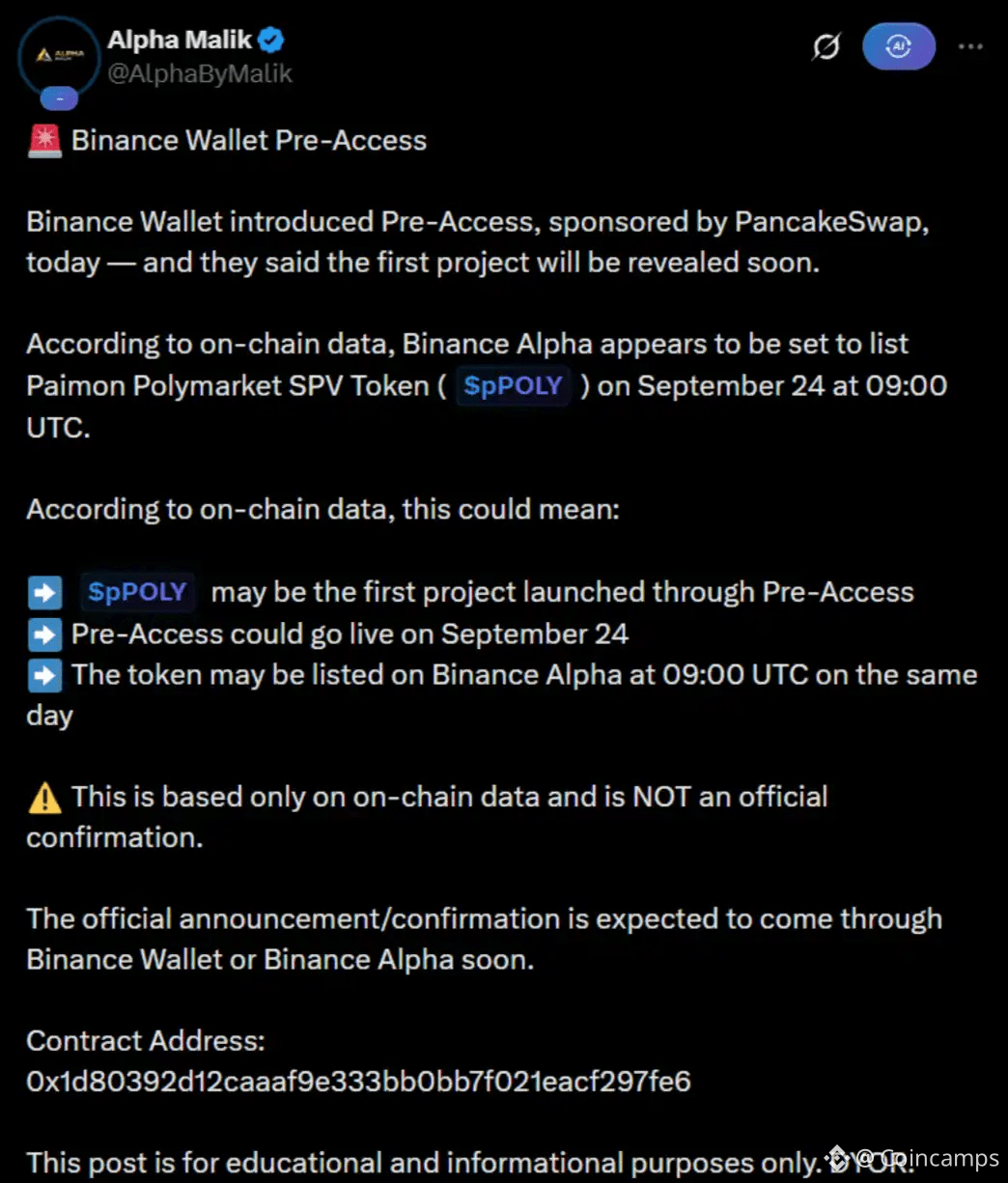
Article
Executive shake-up, is Polymarket going public?On September 20, a screenshot about "Binance Wallet is about to launch Polymarket Pre-IPO" is circulating on X.
Polymarket was founded in 2020 by Shayne Coplan, who serves as CEO. Users can use funds to trade on the possible outcomes of politics, sports, and global events. In early September, media reports said that 1789 Capital is leading a financing round of about $1 billion, bringing the platform's post-investment valuation to $21 billion.
If viewed through the lens of "going public," Polymarket's series of moves over the past few months suddenly make sense: a group of executives from Amazon, Uber, the NYSE, Coinbase, and Robinhood have joined in quick succession; power in the U.S. business has been redistributed; the on-chain order book is preparing to be torn down and rewritten; and the company has also begun filling positions for CFO, compliance, risk control, and government relations.
It appears the platform is equipping itself with a skeleton more like that of a financial company.
Executives from major companies parachute in to pave the way for an IPO
On September 10, Warren Jenson joined Polymarket as its first company-level CFO. He previously served as a finance chief at Amazon and several other giants, and has long been responsible for the financial, capital strategy, and long-term planning of large companies.
A few days later, Collin McKinney Hill, who was formerly a general manager at DoorDash and chief of staff to the founder of Bridgewater, became vice president of operations.
Other core personnel include Travis VanderZanden, who previously worked at Uber, in charge of growth; former Coinbase executive Dan Lee in charge of the U.S. business; former Robinhood executive Megan McGrath as chief compliance officer; and Hayk Mkrtchyan, who was previously responsible for the core matching system at the NYSE, as head of engineering for Polymarket's U.S. exchange.
These people's backgrounds come from different companies, yet they respectively correspond to several of the gaps most easily exposed at a large financial platform: finance, operations, growth, U.S. business, compliance, product, and trading infrastructure are almost all being overhauled.
According to The Information, Dan Lee, who was recruited from Coinbase, has already gradually taken over Polymarket's U.S. business at the actual working level. According to people close to the company, employees report to Lee, not to the nominal CEO of the U.S. business, Justin Hertzberg.
The more direct changes are happening within the engineering team. Josh Stevens, who joined in March of this year as VP of DeFi Engineering and previously served as Senior VP of Engineering at Aave, publicly stated that the early, hastily built code can no longer be salvaged long-term, and the team is preparing to rewrite the matching engine.
His reasoning was equally straightforward: the platform is already an exchange handling user funds, not a small product where trial and error is acceptable.
If you look at these moves through the lens of an IPO strategy, it looks very much like an emergency effort to shore up the organizational capabilities of a financial platform.
$21 billion valuation — who holds stakes in this platform?
Currently, market valuation anchors for Polymarket broadly range between $15 billion and $21 billion. The only investor with reliable, publicly available data is Intercontinental Exchange (ICE), the parent company of the New York Stock Exchange.
As of June 30, 2026, ICE holds approximately 22% of the platform's issued shares and has the exclusive right to nominate and vote on one director. If you simply do the math, ICE's 22% stake corresponds to roughly $4.6 billion; on a fully diluted basis of 14%, it comes to approximately $2.9 billion.
Unlike ICE, other funding parties can only be roughly estimated based on the amounts invested in each round and the post-money valuation at the time: Blockchain Capital holds approximately $2.3 billion (11%), 1789 Capital holds approximately $300 million (1.4%), and CEO Coplan holds approximately $2.3 billion (11%).
Unlike ICE, other funding parties can only be mechanically extrapolated based on the amounts invested in each round, the post-money valuation at the time, or media estimates. If these percentages are uniformly applied to the $21 billion valuation, Blockchain Capital's stake, back-calculated from historical rounds, comes to approximately $2.3 billion (11%); 1789 Capital approximately $300 million (1.4%); and Coplan approximately $2.3 billion (11%).
It is worth noting that Trump Jr., the eldest son of Donald Trump, serves as a partner at 1789 Capital and was already a member of Polymarket's advisory board as early as August 2025.
Equity Transfers Packaged as an IPO
In this September 20 screenshot, what truly deserves attention may not only be Polymarket, but also Paimon Finance. The screenshot links "Polymarket's upcoming IPO" with $pPOLY, and the full name of $pPOLY is Paimon Polymarket SPV Token.
Paimon is a platform that tokenizes private equity and Pre-IPO assets. Its model is to package assets related to unlisted companies into on-chain tokens. The company has previously placed assets related to private companies such as SpaceX, OpenAI, and Anthropic into the same product system.
Binance, mentioned in the screenshot, has also made the nature of this kind of product very clear: Pre-Access assets are provided by third parties, and the Binance wallet is only an access point; such assets do not represent direct shares in the underlying company, nor do they guarantee that the relevant company will necessarily complete an IPO in the future.
Therefore, a more accurate statement is not "Polymarket is issuing its own Pre-IPO shares," but rather "Paimon may be packaging private equity related to Polymarket into a token that can circulate on-chain."
For Polymarket, the real IPO may not have begun yet; but trading around IPO expectations has already appeared in advance.
Join the official Coincamps community:
X: https://x.com/coincamps
Telegram: https://t.me/coin_camps
Executive shake-up, is Polymarket going public?
On September 20, a screenshot about "Binance Wallet is about to launch Polymarket Pre-IPO" is circulating on X.
Polymarket was founded in 2020 by Shayne Coplan, who serves as CEO. Users can use funds to trade on the possible outcomes of politics, sports, and global events. In early September, media reports said that 1789 Capital is leading a financing round of about $1 billion, bringing the platform's post-investment valuation to $21 billion.
If viewed through the lens of "going public," Polymarket's series of moves over the past few months suddenly make sense: a group of executives from Amazon, Uber, the NYSE, Coinbase, and Robinhood have joined in quick succession; power in the U.S. business has been redistributed; the on-chain order book is preparing to be torn down and rewritten; and the company has also begun filling positions for CFO, compliance, risk control, and government relations.
It appears the platform is equipping itself with a skeleton more like that of a financial company.
Executives from major companies parachute in to pave the way for an IPO
On September 10, Warren Jenson joined Polymarket as its first company-level CFO. He previously served as a finance chief at Amazon and several other giants, and has long been responsible for the financial, capital strategy, and long-term planning of large companies.
A few days later, Collin McKinney Hill, who was formerly a general manager at DoorDash and chief of staff to the founder of Bridgewater, became vice president of operations.
Other core personnel include Travis VanderZanden, who previously worked at Uber, in charge of growth; former Coinbase executive Dan Lee in charge of the U.S. business; former Robinhood executive Megan McGrath as chief compliance officer; and Hayk Mkrtchyan, who was previously responsible for the core matching system at the NYSE, as head of engineering for Polymarket's U.S. exchange.
These people's backgrounds come from different companies, yet they respectively correspond to several of the gaps most easily exposed at a large financial platform: finance, operations, growth, U.S. business, compliance, product, and trading infrastructure are almost all being overhauled.
According to The Information, Dan Lee, who was recruited from Coinbase, has already gradually taken over Polymarket's U.S. business at the actual working level. According to people close to the company, employees report to Lee, not to the nominal CEO of the U.S. business, Justin Hertzberg.
The more direct changes are happening within the engineering team. Josh Stevens, who joined in March of this year as VP of DeFi Engineering and previously served as Senior VP of Engineering at Aave, publicly stated that the early, hastily built code can no longer be salvaged long-term, and the team is preparing to rewrite the matching engine.
His reasoning was equally straightforward: the platform is already an exchange handling user funds, not a small product where trial and error is acceptable.
If you look at these moves through the lens of an IPO strategy, it looks very much like an emergency effort to shore up the organizational capabilities of a financial platform.
$21 billion valuation — who holds stakes in this platform?
Currently, market valuation anchors for Polymarket broadly range between $15 billion and $21 billion. The only investor with reliable, publicly available data is Intercontinental Exchange (ICE), the parent company of the New York Stock Exchange.
As of June 30, 2026, ICE holds approximately 22% of the platform's issued shares and has the exclusive right to nominate and vote on one director. If you simply do the math, ICE's 22% stake corresponds to roughly $4.6 billion; on a fully diluted basis of 14%, it comes to approximately $2.9 billion.
Unlike ICE, other funding parties can only be roughly estimated based on the amounts invested in each round and the post-money valuation at the time: Blockchain Capital holds approximately $2.3 billion (11%), 1789 Capital holds approximately $300 million (1.4%), and CEO Coplan holds approximately $2.3 billion (11%).
Unlike ICE, other funding parties can only be mechanically extrapolated based on the amounts invested in each round, the post-money valuation at the time, or media estimates. If these percentages are uniformly applied to the $21 billion valuation, Blockchain Capital's stake, back-calculated from historical rounds, comes to approximately $2.3 billion (11%); 1789 Capital approximately $300 million (1.4%); and Coplan approximately $2.3 billion (11%).
It is worth noting that Trump Jr., the eldest son of Donald Trump, serves as a partner at 1789 Capital and was already a member of Polymarket's advisory board as early as August 2025.
Equity Transfers Packaged as an IPO
In this September 20 screenshot, what truly deserves attention may not only be Polymarket, but also Paimon Finance. The screenshot links "Polymarket's upcoming IPO" with $pPOLY, and the full name of $pPOLY is Paimon Polymarket SPV Token.
Paimon is a platform that tokenizes private equity and Pre-IPO assets. Its model is to package assets related to unlisted companies into on-chain tokens. The company has previously placed assets related to private companies such as SpaceX, OpenAI, and Anthropic into the same product system.
Binance, mentioned in the screenshot, has also made the nature of this kind of product very clear: Pre-Access assets are provided by third parties, and the Binance wallet is only an access point; such assets do not represent direct shares in the underlying company, nor do they guarantee that the relevant company will necessarily complete an IPO in the future.
Therefore, a more accurate statement is not "Polymarket is issuing its own Pre-IPO shares," but rather "Paimon may be packaging private equity related to Polymarket into a token that can circulate on-chain."
For Polymarket, the real IPO may not have begun yet; but trading around IPO expectations has already appeared in advance.
Join the official Coincamps community:
X: https://x.com/coincamps
Telegram: https://t.me/coin_camps
Polymarket was founded in 2020 by Shayne Coplan, who serves as CEO. Users can use funds to trade on the possible outcomes of politics, sports, and global events. In early September, media reports said that 1789 Capital is leading a financing round of about $1 billion, bringing the platform's post-investment valuation to $21 billion.
If viewed through the lens of "going public," Polymarket's series of moves over the past few months suddenly make sense: a group of executives from Amazon, Uber, the NYSE, Coinbase, and Robinhood have joined in quick succession; power in the U.S. business has been redistributed; the on-chain order book is preparing to be torn down and rewritten; and the company has also begun filling positions for CFO, compliance, risk control, and government relations.
It appears the platform is equipping itself with a skeleton more like that of a financial company.
Executives from major companies parachute in to pave the way for an IPO
On September 10, Warren Jenson joined Polymarket as its first company-level CFO. He previously served as a finance chief at Amazon and several other giants, and has long been responsible for the financial, capital strategy, and long-term planning of large companies.
A few days later, Collin McKinney Hill, who was formerly a general manager at DoorDash and chief of staff to the founder of Bridgewater, became vice president of operations.
Other core personnel include Travis VanderZanden, who previously worked at Uber, in charge of growth; former Coinbase executive Dan Lee in charge of the U.S. business; former Robinhood executive Megan McGrath as chief compliance officer; and Hayk Mkrtchyan, who was previously responsible for the core matching system at the NYSE, as head of engineering for Polymarket's U.S. exchange.
These people's backgrounds come from different companies, yet they respectively correspond to several of the gaps most easily exposed at a large financial platform: finance, operations, growth, U.S. business, compliance, product, and trading infrastructure are almost all being overhauled.
According to The Information, Dan Lee, who was recruited from Coinbase, has already gradually taken over Polymarket's U.S. business at the actual working level. According to people close to the company, employees report to Lee, not to the nominal CEO of the U.S. business, Justin Hertzberg.
The more direct changes are happening within the engineering team. Josh Stevens, who joined in March of this year as VP of DeFi Engineering and previously served as Senior VP of Engineering at Aave, publicly stated that the early, hastily built code can no longer be salvaged long-term, and the team is preparing to rewrite the matching engine.
His reasoning was equally straightforward: the platform is already an exchange handling user funds, not a small product where trial and error is acceptable.
If you look at these moves through the lens of an IPO strategy, it looks very much like an emergency effort to shore up the organizational capabilities of a financial platform.
$21 billion valuation — who holds stakes in this platform?
Currently, market valuation anchors for Polymarket broadly range between $15 billion and $21 billion. The only investor with reliable, publicly available data is Intercontinental Exchange (ICE), the parent company of the New York Stock Exchange.
As of June 30, 2026, ICE holds approximately 22% of the platform's issued shares and has the exclusive right to nominate and vote on one director. If you simply do the math, ICE's 22% stake corresponds to roughly $4.6 billion; on a fully diluted basis of 14%, it comes to approximately $2.9 billion.
Unlike ICE, other funding parties can only be roughly estimated based on the amounts invested in each round and the post-money valuation at the time: Blockchain Capital holds approximately $2.3 billion (11%), 1789 Capital holds approximately $300 million (1.4%), and CEO Coplan holds approximately $2.3 billion (11%).
Unlike ICE, other funding parties can only be mechanically extrapolated based on the amounts invested in each round, the post-money valuation at the time, or media estimates. If these percentages are uniformly applied to the $21 billion valuation, Blockchain Capital's stake, back-calculated from historical rounds, comes to approximately $2.3 billion (11%); 1789 Capital approximately $300 million (1.4%); and Coplan approximately $2.3 billion (11%).
It is worth noting that Trump Jr., the eldest son of Donald Trump, serves as a partner at 1789 Capital and was already a member of Polymarket's advisory board as early as August 2025.
Equity Transfers Packaged as an IPO
In this September 20 screenshot, what truly deserves attention may not only be Polymarket, but also Paimon Finance. The screenshot links "Polymarket's upcoming IPO" with $pPOLY, and the full name of $pPOLY is Paimon Polymarket SPV Token.
Paimon is a platform that tokenizes private equity and Pre-IPO assets. Its model is to package assets related to unlisted companies into on-chain tokens. The company has previously placed assets related to private companies such as SpaceX, OpenAI, and Anthropic into the same product system.
Binance, mentioned in the screenshot, has also made the nature of this kind of product very clear: Pre-Access assets are provided by third parties, and the Binance wallet is only an access point; such assets do not represent direct shares in the underlying company, nor do they guarantee that the relevant company will necessarily complete an IPO in the future.
Therefore, a more accurate statement is not "Polymarket is issuing its own Pre-IPO shares," but rather "Paimon may be packaging private equity related to Polymarket into a token that can circulate on-chain."
For Polymarket, the real IPO may not have begun yet; but trading around IPO expectations has already appeared in advance.
Join the official Coincamps community:
X: https://x.com/coincamps
Telegram: https://t.me/coin_camps
·
--
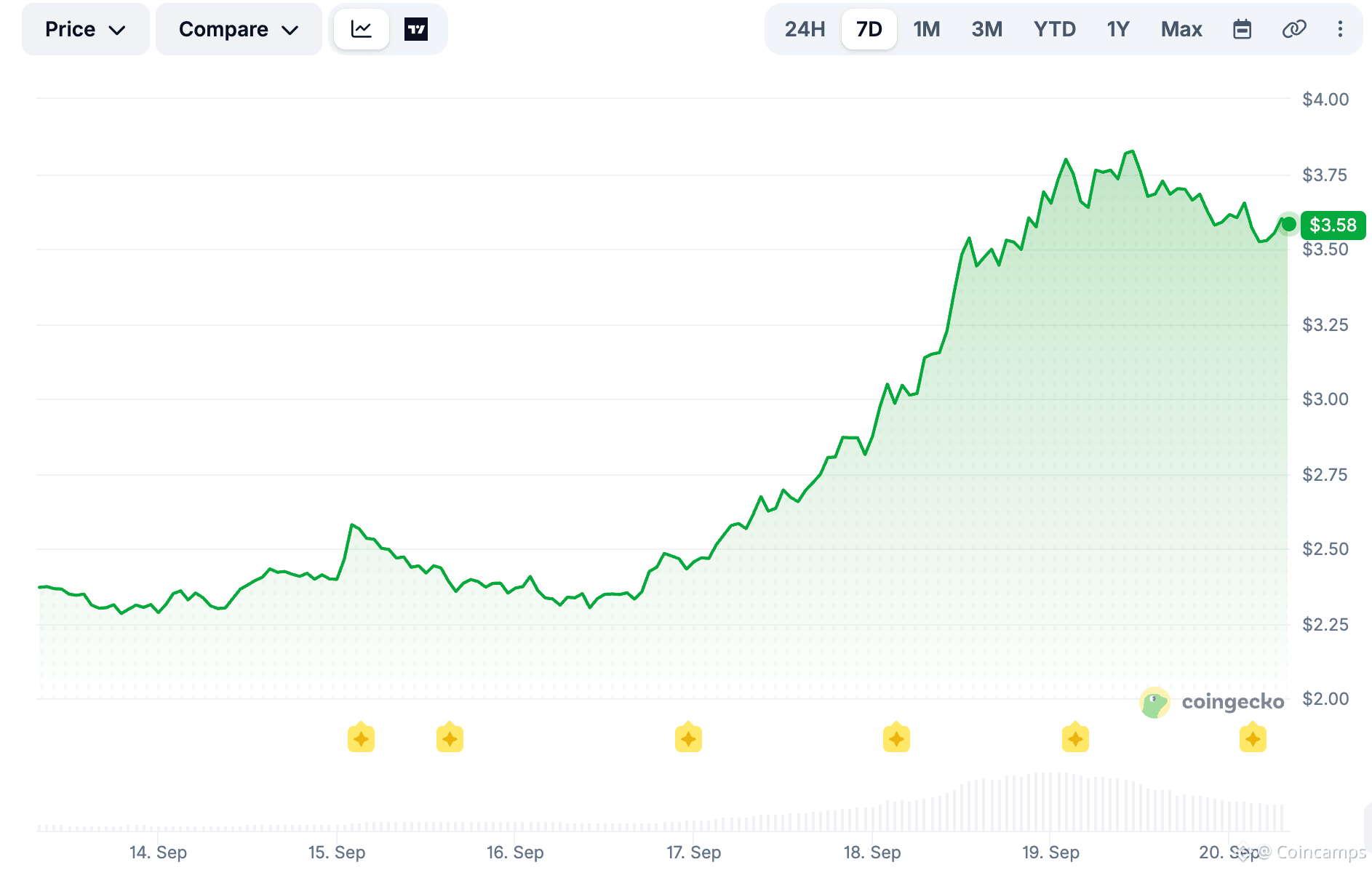
Article
NEAR surged over 50% in a week, what new story is this veteran blockchain telling?Over the past week, NEAR rose from around $2.3 to a high above $3.9, briefly gaining over 50%, making it one of the strongest-performing and most discussed mainstream altcoins in recent times.
Unlike past narratives centered on sharding and high-performance public blockchains, NEAR is this time attempting to tell a new story more closely tied to real transaction demand. From cross-chain to privacy transactions, and further to perpetual contracts and AI Agents, this public blockchain is trying to simultaneously capture capital and user demand from multiple hot sectors.
Launching an "Options-Style Airdrop": Token Unlocking Tied to Both TVL and Token Price
In June of this year, NEAR launched the NEAR@3.33 milestone incentive program, rewarding users who use the privacy transaction feature on near.com, with the first round prize pool containing 333,333 NEAR tokens, unlockable upon meeting two targets.
Target One: Assets within near.com privacy accounts reach $70 million. On September 17, this metric was officially met, triggering the first snapshot. Accounts that continuously held over $100 in privacy assets at the time of the snapshot and completed at least one privacy swap are eligible to participate in the reward distribution. Final shares will be calculated based on a combination of fund holding duration, holding amount, and trading activity, with a single wallet receiving at most 2% of the prize pool to avoid excessive concentration of rewards among a few large holders.
Target Two: NEAR's three-day volume-weighted average price exceeds $3.33. After the snapshot is completed, users still receive NEAR@3.33 milestone tokens that cannot be traded or transferred; only when NEAR's three-day volume-weighted average price reaches or exceeds $3.33 will these tokens convert 1:1 into circulating NEAR. At $3.33, the total value of the first round of rewards is approximately $1.11 million. NEAR has stood above $3.33 for two consecutive days since September 18, and September 20 is the final day of the three-day price assessment. If today's volume-weighted average price remains above $3.33, the unlock conditions will be met.
From a General Public Chain to a "Unified Trading Gateway for All Chains"
NEAR's product positioning has also undergone a significant shift.
In the past, the market's perception of the Near chain was mainly limited to sharding, high TPS, and low Gas fees, but these capabilities struggled to create a clear differentiation from other public chains. Now, NEAR is shifting its development focus to NEAR Intents and near.com, attempting to become a unified trading gateway connecting different blockchains, with its trading scope no longer confined to its own ecosystem.
NEAR Intents is a trading method that "only specifies the outcome, not the execution process." In traditional cross-chain swaps, users need to select a cross-chain bridge themselves, transfer assets to the target chain, prepare the corresponding Gas tokens, and then go to a DEX to complete the trade; in NEAR Intents, users only need to state what they are willing to give and what they wish to receive. For example, after a user submits "exchange ETH on Ethereum for ZEC," the system sends the request to multiple market makers, who compete on quotes based on price, speed, and execution quality. Users do not need to understand which bridges or liquidity pools the transaction passes through, nor do they need to hold the Gas of the target chain in advance; as long as the final amount of assets received is not lower than the quote accepted at the time of signing, the transaction can be executed.
NEAR Intents does not only serve near.com; it can also be integrated into other wallets and applications through the 1Click API and trading components. Currently, products such as Ledger, Brave Wallet, Infinex, THORSwap, and HOT Wallet have all adopted its cross-chain trading services, and Stargate has also integrated NEAR Intents into some cross-chain routes. Therefore, some users may use the quotes and settlement services provided by NEAR Intents through other products even if they have not visited near.com.
Currently, NEAR Intents has connected more than 30 public chains, with cumulative cross-chain transaction volume exceeding $30 billion. Its protocol layer charges a 0.0001% fee per transaction, and wallets and applications integrated with the 1Click API can also set their own platform fees on top of that. From this perspective, NEAR no longer requires all assets and applications to migrate to its own chain, but instead hides in the trading backend to provide routing and settlement services for assets on other chains.
Privacy Transactions Become a New Direction for Differentiation
After NEAR Intents enabled cross-chain transactions, NEAR has further added privacy features to NEAR Intents, launching Confidential Intents, addressing the issue of traditional on-chain transactions exposing order information in advance.
Once ordinary on-chain transactions enter the public mempool, wallet addresses, traded assets, amounts, and timing can all be observed externally. For large transactions, this information may expose users' holdings and trading strategies, and can also easily attract MEV behaviors such as front-running and sandwich attacks. Confidential Intents sends transaction requests to NEAR's private shard, where the quoting and execution process does not appear in the public mempool. This shard also does not provide a public RPC or block explorer, so outsiders cannot directly see what orders users submitted or what quotes different market makers offered. After the transaction is completed, assets are still transferred to the public chain address specified by the user, but it is difficult for outsiders to fully link the deposit address, trading direction, and final receiving address. Users can also proactively generate viewing keys to disclose transaction records to auditors or other designated parties.
ZEC is a typical case of NEAR combining cross-chain transactions with privacy needs. The Zodl wallet has already integrated NEAR Intents, allowing users to directly swap BTC, USDC, or Solana ecosystem assets into ZEC in the privacy pool, without first transferring assets to a centralized exchange and then withdrawing them to a Zcash privacy address. ZEC provides privacy assets and shielded addresses, while NEAR Intents is responsible for aggregating funds on other chains, providing users with a cross-chain channel into the Zcash privacy ecosystem.
Alex Shevchenko, head of NEAR Intents, said,
"Privacy is rapidly becoming a core need for the industry, and NEAR is becoming the infrastructure driving privacy transactions to become the default choice. By combining cross-chain liquidity with capabilities such as anti-front-running and preventing the leakage of trading strategies, institutions and DeFi users can complete large transactions while preserving privacy."
As ZEC trading activity rises, user demand for swaps into Zcash from ecosystems such as BTC, ETH, and Solana may also bring more trading volume and fees to NEAR Intents. NEAR itself is not a privacy coin, but by providing a cross-chain entry point for privacy assets and hiding transaction paths and execution information, it can also be considered a privacy-concept coin.
Integrating Hyperliquid, extending from cross-chain swaps to perpetual contracts
In June of this year, near.com integrated Hyperliquid perpetual contracts, allowing users to trade over 50 perpetual contract markets provided by Hyperliquid directly on near.com, with leverage of up to 40x. On September 17, this feature further added a privacy mode.
Typically, users entering Hyperliquid need to first prepare the supported margin assets and then complete deposits through designated networks. near.com integrates cross-chain deposits into the trading process, allowing users to deposit various assets from over 30 public blockchains. NEAR Intents completes cross-chain swaps in the background, converting them into USDC margin accepted by Hyperliquid and then transferring them to the trading account.
The privacy mode primarily hides the funding path through which users enter Hyperliquid. Orders and positions are still recorded on Hyperliquid, but it is harder for outsiders to link the trading account and deposit process to the user's main wallet. Therefore, this feature does not hide the perpetual contracts themselves, but reduces the possibility of users' funding sources and main wallets being tracked.
In this partnership, Hyperliquid provides the perpetual contract markets, order book, liquidity, and trade execution, while near.com handles account access, cross-chain deposits, and privacy processing. near.com can also charge additional front-end service fees during user trades through Hyperliquid's Builder Code, thereby expanding itself from a cross-chain swap tool into a trading gateway capable of continuously earning trading fees. Compared with one-time cross-chain swaps, perpetual contract trading occurs more frequently, which not only increases near.com's potential to continuously collect fees, but also extends NEAR's trading gateway from cross-chain swaps further into the derivatives market.
AI Agents Provide Longer-Term Imaginative Space
In addition to cross-chain capabilities, privacy, and derivatives trading, NEAR also positions itself as the settlement infrastructure for AI Agents, enabling AI to securely manage assets and independently complete transactions, payments, and tool calls.
NEAR co-founder Illia Polosukhin believes,
"Only when Agents are sufficiently secure can the Agent economy truly take shape."
Around this goal, NEAR has already built a set of mutually coordinated products. NEAR AI provides private inference capabilities, IronClaw isolates tools and account credentials in a trusted execution environment to prevent private keys and user data from being directly exposed to models; Chain Signatures allow Agents to sign transactions on different blockchains; NEAR Intents handles cross-chain swaps and settlement. After combining these capabilities, Agents can mobilize assets across multiple chains according to user instructions without having to handle cross-chain bridges and Gas one by one.
However, compared with NEAR Intents, which has already generated tens of billions of dollars in trading volume, NEAR's layout in AI Agents is still in its early stages. Whether Agents can form large-scale on-chain payment and trading demand, and whether these activities can ultimately translate into NEAR's protocol revenue, still requires more real-world data for verification.
Original link
Join the official Coincamps community:
X: https://x.com/coincamps
Telegram: https://t.me/coin_camps
NEAR surged over 50% in a week, what new story is this veteran blockchain telling?
Over the past week, NEAR rose from around $2.3 to a high above $3.9, briefly gaining over 50%, making it one of the strongest-performing and most discussed mainstream altcoins in recent times.
Unlike past narratives centered on sharding and high-performance public blockchains, NEAR is this time attempting to tell a new story more closely tied to real transaction demand. From cross-chain to privacy transactions, and further to perpetual contracts and AI Agents, this public blockchain is trying to simultaneously capture capital and user demand from multiple hot sectors.
Launching an "Options-Style Airdrop": Token Unlocking Tied to Both TVL and Token Price
In June of this year, NEAR launched the NEAR@3.33 milestone incentive program, rewarding users who use the privacy transaction feature on near.com, with the first round prize pool containing 333,333 NEAR tokens, unlockable upon meeting two targets.
Target One: Assets within near.com privacy accounts reach $70 million. On September 17, this metric was officially met, triggering the first snapshot. Accounts that continuously held over $100 in privacy assets at the time of the snapshot and completed at least one privacy swap are eligible to participate in the reward distribution. Final shares will be calculated based on a combination of fund holding duration, holding amount, and trading activity, with a single wallet receiving at most 2% of the prize pool to avoid excessive concentration of rewards among a few large holders.
Target Two: NEAR's three-day volume-weighted average price exceeds $3.33. After the snapshot is completed, users still receive NEAR@3.33 milestone tokens that cannot be traded or transferred; only when NEAR's three-day volume-weighted average price reaches or exceeds $3.33 will these tokens convert 1:1 into circulating NEAR. At $3.33, the total value of the first round of rewards is approximately $1.11 million. NEAR has stood above $3.33 for two consecutive days since September 18, and September 20 is the final day of the three-day price assessment. If today's volume-weighted average price remains above $3.33, the unlock conditions will be met.
From a General Public Chain to a "Unified Trading Gateway for All Chains"
NEAR's product positioning has also undergone a significant shift.
In the past, the market's perception of the Near chain was mainly limited to sharding, high TPS, and low Gas fees, but these capabilities struggled to create a clear differentiation from other public chains. Now, NEAR is shifting its development focus to NEAR Intents and near.com, attempting to become a unified trading gateway connecting different blockchains, with its trading scope no longer confined to its own ecosystem.
NEAR Intents is a trading method that "only specifies the outcome, not the execution process." In traditional cross-chain swaps, users need to select a cross-chain bridge themselves, transfer assets to the target chain, prepare the corresponding Gas tokens, and then go to a DEX to complete the trade; in NEAR Intents, users only need to state what they are willing to give and what they wish to receive. For example, after a user submits "exchange ETH on Ethereum for ZEC," the system sends the request to multiple market makers, who compete on quotes based on price, speed, and execution quality. Users do not need to understand which bridges or liquidity pools the transaction passes through, nor do they need to hold the Gas of the target chain in advance; as long as the final amount of assets received is not lower than the quote accepted at the time of signing, the transaction can be executed.
NEAR Intents does not only serve near.com; it can also be integrated into other wallets and applications through the 1Click API and trading components. Currently, products such as Ledger, Brave Wallet, Infinex, THORSwap, and HOT Wallet have all adopted its cross-chain trading services, and Stargate has also integrated NEAR Intents into some cross-chain routes. Therefore, some users may use the quotes and settlement services provided by NEAR Intents through other products even if they have not visited near.com.
Currently, NEAR Intents has connected more than 30 public chains, with cumulative cross-chain transaction volume exceeding $30 billion. Its protocol layer charges a 0.0001% fee per transaction, and wallets and applications integrated with the 1Click API can also set their own platform fees on top of that. From this perspective, NEAR no longer requires all assets and applications to migrate to its own chain, but instead hides in the trading backend to provide routing and settlement services for assets on other chains.
Privacy Transactions Become a New Direction for Differentiation
After NEAR Intents enabled cross-chain transactions, NEAR has further added privacy features to NEAR Intents, launching Confidential Intents, addressing the issue of traditional on-chain transactions exposing order information in advance.
Once ordinary on-chain transactions enter the public mempool, wallet addresses, traded assets, amounts, and timing can all be observed externally. For large transactions, this information may expose users' holdings and trading strategies, and can also easily attract MEV behaviors such as front-running and sandwich attacks. Confidential Intents sends transaction requests to NEAR's private shard, where the quoting and execution process does not appear in the public mempool. This shard also does not provide a public RPC or block explorer, so outsiders cannot directly see what orders users submitted or what quotes different market makers offered. After the transaction is completed, assets are still transferred to the public chain address specified by the user, but it is difficult for outsiders to fully link the deposit address, trading direction, and final receiving address. Users can also proactively generate viewing keys to disclose transaction records to auditors or other designated parties.
ZEC is a typical case of NEAR combining cross-chain transactions with privacy needs. The Zodl wallet has already integrated NEAR Intents, allowing users to directly swap BTC, USDC, or Solana ecosystem assets into ZEC in the privacy pool, without first transferring assets to a centralized exchange and then withdrawing them to a Zcash privacy address. ZEC provides privacy assets and shielded addresses, while NEAR Intents is responsible for aggregating funds on other chains, providing users with a cross-chain channel into the Zcash privacy ecosystem.
Alex Shevchenko, head of NEAR Intents, said,
"Privacy is rapidly becoming a core need for the industry, and NEAR is becoming the infrastructure driving privacy transactions to become the default choice. By combining cross-chain liquidity with capabilities such as anti-front-running and preventing the leakage of trading strategies, institutions and DeFi users can complete large transactions while preserving privacy."
As ZEC trading activity rises, user demand for swaps into Zcash from ecosystems such as BTC, ETH, and Solana may also bring more trading volume and fees to NEAR Intents. NEAR itself is not a privacy coin, but by providing a cross-chain entry point for privacy assets and hiding transaction paths and execution information, it can also be considered a privacy-concept coin.
Integrating Hyperliquid, extending from cross-chain swaps to perpetual contracts
In June of this year, near.com integrated Hyperliquid perpetual contracts, allowing users to trade over 50 perpetual contract markets provided by Hyperliquid directly on near.com, with leverage of up to 40x. On September 17, this feature further added a privacy mode.
Typically, users entering Hyperliquid need to first prepare the supported margin assets and then complete deposits through designated networks. near.com integrates cross-chain deposits into the trading process, allowing users to deposit various assets from over 30 public blockchains. NEAR Intents completes cross-chain swaps in the background, converting them into USDC margin accepted by Hyperliquid and then transferring them to the trading account.
The privacy mode primarily hides the funding path through which users enter Hyperliquid. Orders and positions are still recorded on Hyperliquid, but it is harder for outsiders to link the trading account and deposit process to the user's main wallet. Therefore, this feature does not hide the perpetual contracts themselves, but reduces the possibility of users' funding sources and main wallets being tracked.
In this partnership, Hyperliquid provides the perpetual contract markets, order book, liquidity, and trade execution, while near.com handles account access, cross-chain deposits, and privacy processing. near.com can also charge additional front-end service fees during user trades through Hyperliquid's Builder Code, thereby expanding itself from a cross-chain swap tool into a trading gateway capable of continuously earning trading fees. Compared with one-time cross-chain swaps, perpetual contract trading occurs more frequently, which not only increases near.com's potential to continuously collect fees, but also extends NEAR's trading gateway from cross-chain swaps further into the derivatives market.
AI Agents Provide Longer-Term Imaginative Space
In addition to cross-chain capabilities, privacy, and derivatives trading, NEAR also positions itself as the settlement infrastructure for AI Agents, enabling AI to securely manage assets and independently complete transactions, payments, and tool calls.
NEAR co-founder Illia Polosukhin believes,
"Only when Agents are sufficiently secure can the Agent economy truly take shape."
Around this goal, NEAR has already built a set of mutually coordinated products. NEAR AI provides private inference capabilities, IronClaw isolates tools and account credentials in a trusted execution environment to prevent private keys and user data from being directly exposed to models; Chain Signatures allow Agents to sign transactions on different blockchains; NEAR Intents handles cross-chain swaps and settlement. After combining these capabilities, Agents can mobilize assets across multiple chains according to user instructions without having to handle cross-chain bridges and Gas one by one.
However, compared with NEAR Intents, which has already generated tens of billions of dollars in trading volume, NEAR's layout in AI Agents is still in its early stages. Whether Agents can form large-scale on-chain payment and trading demand, and whether these activities can ultimately translate into NEAR's protocol revenue, still requires more real-world data for verification.
Original link
Join the official Coincamps community:
X: https://x.com/coincamps
Telegram: https://t.me/coin_camps
Unlike past narratives centered on sharding and high-performance public blockchains, NEAR is this time attempting to tell a new story more closely tied to real transaction demand. From cross-chain to privacy transactions, and further to perpetual contracts and AI Agents, this public blockchain is trying to simultaneously capture capital and user demand from multiple hot sectors.
Launching an "Options-Style Airdrop": Token Unlocking Tied to Both TVL and Token Price
In June of this year, NEAR launched the NEAR@3.33 milestone incentive program, rewarding users who use the privacy transaction feature on near.com, with the first round prize pool containing 333,333 NEAR tokens, unlockable upon meeting two targets.
Target One: Assets within near.com privacy accounts reach $70 million. On September 17, this metric was officially met, triggering the first snapshot. Accounts that continuously held over $100 in privacy assets at the time of the snapshot and completed at least one privacy swap are eligible to participate in the reward distribution. Final shares will be calculated based on a combination of fund holding duration, holding amount, and trading activity, with a single wallet receiving at most 2% of the prize pool to avoid excessive concentration of rewards among a few large holders.
Target Two: NEAR's three-day volume-weighted average price exceeds $3.33. After the snapshot is completed, users still receive NEAR@3.33 milestone tokens that cannot be traded or transferred; only when NEAR's three-day volume-weighted average price reaches or exceeds $3.33 will these tokens convert 1:1 into circulating NEAR. At $3.33, the total value of the first round of rewards is approximately $1.11 million. NEAR has stood above $3.33 for two consecutive days since September 18, and September 20 is the final day of the three-day price assessment. If today's volume-weighted average price remains above $3.33, the unlock conditions will be met.
From a General Public Chain to a "Unified Trading Gateway for All Chains"
NEAR's product positioning has also undergone a significant shift.
In the past, the market's perception of the Near chain was mainly limited to sharding, high TPS, and low Gas fees, but these capabilities struggled to create a clear differentiation from other public chains. Now, NEAR is shifting its development focus to NEAR Intents and near.com, attempting to become a unified trading gateway connecting different blockchains, with its trading scope no longer confined to its own ecosystem.
NEAR Intents is a trading method that "only specifies the outcome, not the execution process." In traditional cross-chain swaps, users need to select a cross-chain bridge themselves, transfer assets to the target chain, prepare the corresponding Gas tokens, and then go to a DEX to complete the trade; in NEAR Intents, users only need to state what they are willing to give and what they wish to receive. For example, after a user submits "exchange ETH on Ethereum for ZEC," the system sends the request to multiple market makers, who compete on quotes based on price, speed, and execution quality. Users do not need to understand which bridges or liquidity pools the transaction passes through, nor do they need to hold the Gas of the target chain in advance; as long as the final amount of assets received is not lower than the quote accepted at the time of signing, the transaction can be executed.
NEAR Intents does not only serve near.com; it can also be integrated into other wallets and applications through the 1Click API and trading components. Currently, products such as Ledger, Brave Wallet, Infinex, THORSwap, and HOT Wallet have all adopted its cross-chain trading services, and Stargate has also integrated NEAR Intents into some cross-chain routes. Therefore, some users may use the quotes and settlement services provided by NEAR Intents through other products even if they have not visited near.com.
Currently, NEAR Intents has connected more than 30 public chains, with cumulative cross-chain transaction volume exceeding $30 billion. Its protocol layer charges a 0.0001% fee per transaction, and wallets and applications integrated with the 1Click API can also set their own platform fees on top of that. From this perspective, NEAR no longer requires all assets and applications to migrate to its own chain, but instead hides in the trading backend to provide routing and settlement services for assets on other chains.
Privacy Transactions Become a New Direction for Differentiation
After NEAR Intents enabled cross-chain transactions, NEAR has further added privacy features to NEAR Intents, launching Confidential Intents, addressing the issue of traditional on-chain transactions exposing order information in advance.
Once ordinary on-chain transactions enter the public mempool, wallet addresses, traded assets, amounts, and timing can all be observed externally. For large transactions, this information may expose users' holdings and trading strategies, and can also easily attract MEV behaviors such as front-running and sandwich attacks. Confidential Intents sends transaction requests to NEAR's private shard, where the quoting and execution process does not appear in the public mempool. This shard also does not provide a public RPC or block explorer, so outsiders cannot directly see what orders users submitted or what quotes different market makers offered. After the transaction is completed, assets are still transferred to the public chain address specified by the user, but it is difficult for outsiders to fully link the deposit address, trading direction, and final receiving address. Users can also proactively generate viewing keys to disclose transaction records to auditors or other designated parties.
ZEC is a typical case of NEAR combining cross-chain transactions with privacy needs. The Zodl wallet has already integrated NEAR Intents, allowing users to directly swap BTC, USDC, or Solana ecosystem assets into ZEC in the privacy pool, without first transferring assets to a centralized exchange and then withdrawing them to a Zcash privacy address. ZEC provides privacy assets and shielded addresses, while NEAR Intents is responsible for aggregating funds on other chains, providing users with a cross-chain channel into the Zcash privacy ecosystem.
Alex Shevchenko, head of NEAR Intents, said,
"Privacy is rapidly becoming a core need for the industry, and NEAR is becoming the infrastructure driving privacy transactions to become the default choice. By combining cross-chain liquidity with capabilities such as anti-front-running and preventing the leakage of trading strategies, institutions and DeFi users can complete large transactions while preserving privacy."
As ZEC trading activity rises, user demand for swaps into Zcash from ecosystems such as BTC, ETH, and Solana may also bring more trading volume and fees to NEAR Intents. NEAR itself is not a privacy coin, but by providing a cross-chain entry point for privacy assets and hiding transaction paths and execution information, it can also be considered a privacy-concept coin.
Integrating Hyperliquid, extending from cross-chain swaps to perpetual contracts
In June of this year, near.com integrated Hyperliquid perpetual contracts, allowing users to trade over 50 perpetual contract markets provided by Hyperliquid directly on near.com, with leverage of up to 40x. On September 17, this feature further added a privacy mode.
Typically, users entering Hyperliquid need to first prepare the supported margin assets and then complete deposits through designated networks. near.com integrates cross-chain deposits into the trading process, allowing users to deposit various assets from over 30 public blockchains. NEAR Intents completes cross-chain swaps in the background, converting them into USDC margin accepted by Hyperliquid and then transferring them to the trading account.
The privacy mode primarily hides the funding path through which users enter Hyperliquid. Orders and positions are still recorded on Hyperliquid, but it is harder for outsiders to link the trading account and deposit process to the user's main wallet. Therefore, this feature does not hide the perpetual contracts themselves, but reduces the possibility of users' funding sources and main wallets being tracked.
In this partnership, Hyperliquid provides the perpetual contract markets, order book, liquidity, and trade execution, while near.com handles account access, cross-chain deposits, and privacy processing. near.com can also charge additional front-end service fees during user trades through Hyperliquid's Builder Code, thereby expanding itself from a cross-chain swap tool into a trading gateway capable of continuously earning trading fees. Compared with one-time cross-chain swaps, perpetual contract trading occurs more frequently, which not only increases near.com's potential to continuously collect fees, but also extends NEAR's trading gateway from cross-chain swaps further into the derivatives market.
AI Agents Provide Longer-Term Imaginative Space
In addition to cross-chain capabilities, privacy, and derivatives trading, NEAR also positions itself as the settlement infrastructure for AI Agents, enabling AI to securely manage assets and independently complete transactions, payments, and tool calls.
NEAR co-founder Illia Polosukhin believes,
"Only when Agents are sufficiently secure can the Agent economy truly take shape."
Around this goal, NEAR has already built a set of mutually coordinated products. NEAR AI provides private inference capabilities, IronClaw isolates tools and account credentials in a trusted execution environment to prevent private keys and user data from being directly exposed to models; Chain Signatures allow Agents to sign transactions on different blockchains; NEAR Intents handles cross-chain swaps and settlement. After combining these capabilities, Agents can mobilize assets across multiple chains according to user instructions without having to handle cross-chain bridges and Gas one by one.
However, compared with NEAR Intents, which has already generated tens of billions of dollars in trading volume, NEAR's layout in AI Agents is still in its early stages. Whether Agents can form large-scale on-chain payment and trading demand, and whether these activities can ultimately translate into NEAR's protocol revenue, still requires more real-world data for verification.
Original link
Join the official Coincamps community:
X: https://x.com/coincamps
Telegram: https://t.me/coin_camps
298
·
--
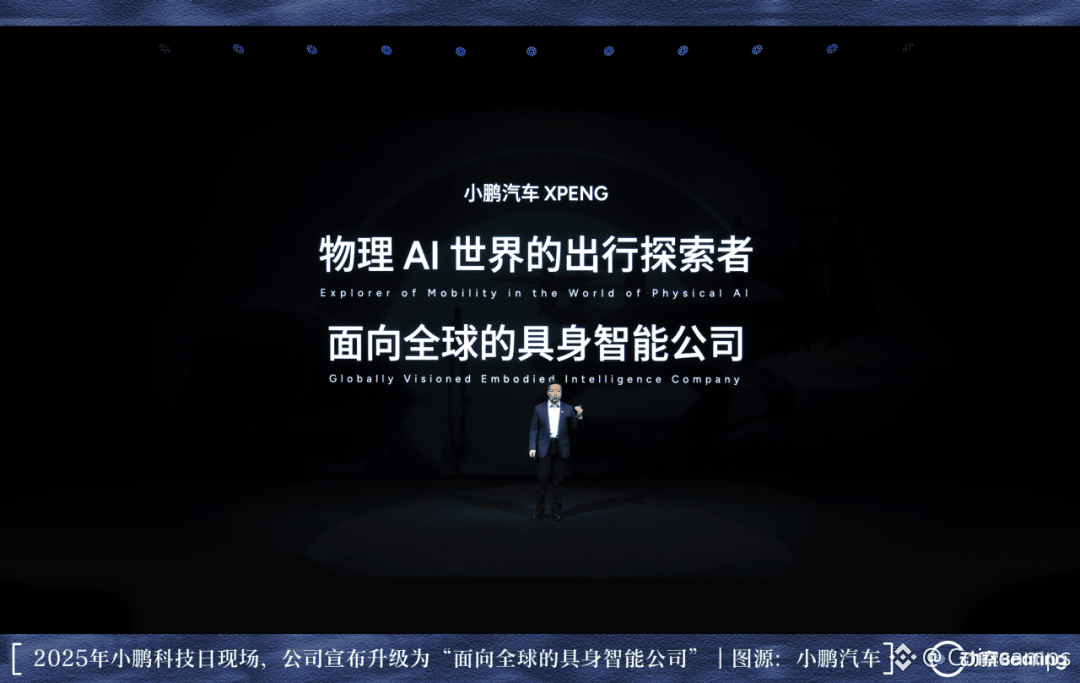
Article
Chinese new energy vehicle companies all want to become AI companies.The original title: "Chinese New Energy Vehicle Companies All Want to Be AI Companies"
The original author: Dongcha Beating
Chinese new energy vehicle companies all want to be AI companies now.
But the starting point of this business had neither algorithms nor computing power, and it was not even fair to call it a commercial logic.
In 2009, the "Ten Cities, Thousand Vehicles" program was launched, and the government began spending real money to subsidize an experimental product that no one was buying. China's auto industry had been trapped by internal combustion engine patents for more than half a century and sought to use this opportunity to change lanes and break through. Once the gate opened, real carmakers and rent-seeking arbitrageurs mixed together, and ambition and speculation ran wild on the same track.
Those years were full of chaos. Some automakers installed the same batch of batteries onto chassis, submitted them for acceptance, collected the money, immediately removed them, stuffed them into the next batch of empty-shell cars, and collected the money again; there were also cars that never touched a road in their entire lives, with odometers left spinning in the workshop on instruments. Making cars did not require understanding users; as long as one fully grasped the fiscal documents, the reported numbers on paper could be exchanged for large amounts of cash.
It was not until the list of subsidy fraud was made public that the industry took a head-on blow. Around 2016, public opinion almost pronounced a death sentence on it. For an industry force-ripened by fiscal blood transfusions, the day policy support receded seemed destined to be the day it died young.
But at the edge of the ruins, the real spark instead landed on the ground. NIO, XPeng, and Li Auto successively launched projects, with BYD, which had already placed its bets, lurking nearby.
Li Bin had sold automotive software, He Xiaopeng had built a browser, and Li Xiang had run a vertical portal. Carrying the capital they had earned in the internet and mobile eras, and bringing engineers who wrote code, they plunged headlong into this heavy-asset furnace that was most hostile to outsiders. "PPT carmaking" was the most conspicuous label outsiders threw at them at the time.
The real turning point came in 2019. Tesla's Shanghai Gigafactory was completed, and the domestically produced Model 3 entered the market with price pressure. This powerful outsider pushed its Chinese peers to the brink of survival, but objectively it also completed the full reshaping of the sinews and bones of China's industrial electric supply chain. Batteries, motors, electronic controls, and the chips and algorithms that later became the deciding factor were forced to mature in this cruel testing ground.
Riding this momentum, China's automobile production and sales sat in the world's number one position for more than a decade.
By 2026, these companies, which had barely fought their way out of near-death experiences and had truly figured out how to make cars, suddenly no longer wanted to be called automakers.
Tearing Off the Sheet Metal
On August 24, 2026, XPeng released its second-quarter earnings press release. Financial websites refresh hundreds of such PR releases a day, and very few people would check the inconspicuous line of company introduction at the end.
But all the anxiety and ambition are hidden in those few lines of small print. In the 2020 IPO prospectus, XPeng printed "smart electric vehicle company"; by the end of 2024, it was changed to "global AI mobility company"; just one year later, it was renamed "global embodied intelligence company"; and by the summer of 2026, it simply switched to the pure English "world-leading physical AI company."
Four name changes in four years, each time the vocabulary grew broader in vision, while the smell of engine oil on its body grew fainter each time.
XPeng is not the only one eager to tear off the traditional manufacturing label. Geely set up a "full-domain AI system" at its CES booth, iterating from 1.0 to 2.0 in two years; NIO spun off its smart driving chip business to fly solo, pulling in RMB 2.257 billion from external investors in the first round; Li Auto wrote artificial intelligence into the highest vision of its all-hands letter as early as the beginning of 2023, while in reality, its profit foundation is still firmly supported by range-extender vehicles.
The scene in showrooms is changing too. Chery replaced sales staff who accompanied visitors to view cars with humanoid robots, whose mechanical arms lift to point the way for guests; Seres took back the dominant rights to the AITO trademark and turned to external large models to create a new signboard called AIVA. In the eyes of the capital market, pure hardware manufacturing has always been strictly valued. When even the most solidly welded car doors cannot escape the valuation ceiling of manufacturing, migrating toward technology and algorithms has become everyone's collective choice.
Even those who nominally still keep the automaker signboard have long since changed the chips under the table. Great Wall's Haomo.AI shut down entirely at the end of 2025, and Wei Jianjun immediately brought in three suppliers—Zhuoyu, Yuanrong, and Momenta—replacing an expensive early-stage route with pragmatic supply chain procurement.
BYD, with the deepest pockets, announced in the early summer of 2026 that it would invest more than RMB 100 billion, fully betting its chips on AI and setting goals such as a zero-accident super driver and super secretary. Even Leapmotor, long known for cost control, brought out a self-developed humanoid robot on its tech day, and Zhu Jiangming bluntly pointed out the commercial essence: "A robot that can go for a stroll is no skill; a robot that can make money is what counts."
By 2026, the two letters "AI" had been thoroughly written into automakers' financial reporting segments, organizational charts, and financing agreements.The capital market has always been stingy with hardware assembly, yet willing to pay a premium for frontier technology. As the dividends of vehicle manufacturing are rapidly diluted, no one dares to slow down at this juncture of technological transition.
Long Cycles and Short-Lived Ghosts
In 2019, NIO's stock price fell to just over one dollar, and Li Bin became "the most miserable person of the year," only recovering after a capital injection from Hefei state-owned assets. That same year, NIO began assembling a chip team.
Xpeng followed closely behind. In 2020, it had just delivered 27,041 vehicles on the brink of survival, with book losses hitting bottom, and likewise pulled together a team at year-end to develop chips. Li Auto moved the slowest, quietly establishing a chip design company in 2022.
For an automaker with annual sales of less than 30,000 vehicles and cash flow on the verge of running out to bet on self-developed chips is almost incomprehensible in the eyes of the traditional automotive industry. Automotive-grade chips have cycles measured in years and cost enormous sums, but the price of outsourcing chips is handing over computing power allocation, architecture, and pricing power entirely to others. Between becoming an assembly plant and diving into the deep end themselves, they chose the latter. Much of the foresight in heavy industry is, in essence, simply the only way out after being cornered.
Another group of peers who chose to take shortcuts paid a painful price.
In 2022, Neta won the new forces delivery championship with 152,100 vehicles, with its three major bases operating around the clock and local state capital competing to inject funds. Just three years later, Neta's book funds hit bottom, with 1,631 creditors filing claims for 26.58 billion yuan in massive debt. WM Motor struggled through its restructuring plan, while HiPhi's bankruptcy plan was repeatedly delayed by the courts. From annual sales champion to deep distress, only thirty-six months separated the two.
The price war followed close on its heels. In 2023, subsidies retreated, and Tesla was the first to slash prices, with the highest per-vehicle reduction reaching 36,000 yuan. In early summer 2025, BYD cut prices on 22 models, and within two weeks more than a dozen brands followed suit, with 73 models across the industry listed at rock-bottom prices in the first five months. In 2024 alone, 4,419 4S stores withdrew from the network nationwide. When Ford's price cuts reshuffled the market back then, it faced a rapidly expanding market; today's close-quarters strangulation, however, is happening in a contraction cycle.
In 2025, nominal GDP growth was 4.0%, mortgage balances declined for eleven consecutive quarters, and the proportion of residents inclined to save for security exceeded 60%. The overall auto market bled along with it. In 2025, national passenger vehicle retail sales evaporated by 170 billion yuan, the average price cut off a six-year upward trend and fell to 170,000 yuan, the average profit margin of vehicle manufacturing slid to a historic low of 1.5%, and the average gross profit per vehicle was only 14,000 yuan.
In the summer of 2026, new energy vehicle penetration surged to 62.8%, but overall passenger vehicle sales in the first half of the year plunged 6.2%. The only incremental growth was overseas expansion, with domestic sales falling by 20%, relying entirely on exports surging 60% year-on-year to prop up the overall picture.
Policy then intervened with heavy measures. Regulatory authorities successively halted loss-making sales and took a hard line on supply chain payment terms. The "15th Five-Year Plan" stuffed capacity warnings into the document while also creating a special chapter on artificial intelligence. But business logic is an objective arithmetic problem. An automaker with a profit margin of only 1.5%, earning the thinnest micro-profit in manufacturing, yet needing to benchmark against tech giants to fund cutting-edge R&D for the next decade—the two sets of accounts simply do not add up.
Since selling cars on the ground has already hit the profit ceiling, automakers must package this accumulated engineering and algorithms and sell them a second time in a bigger arena.
A New Container of $50 Trillion
At the GTC conference in the spring of 2025, Jensen Huang broke down the evolution of artificial intelligence into four steps: perception, generation, agency, and physical AI. So-called physical AI means letting models step out of cold screens to grasp gravity, friction, and stiffness in the real world, and direct metal machinery to work in an unpredictable physical environment.
At CES the following year, he announced that the turning point for physical AI had arrived, launching the world model Cosmos, the simulation platform Omniverse, and the robotics kit Isaac. The target he pointed to was a global manufacturing and logistics market worth as much as $50 trillion.
That figure is an order of magnitude larger than the annual sales of the global auto industry. The weight of a term is directly tied to the stature of its evangelist. When Nvidia's market value crossed the $5 trillion threshold and it became the controller of the world's computing foundation, the direction Huang described quickly pulled hundreds of billions of dollars in global capital flows.
Policy also moved quickly. From the Ministry of Industry and Information Technology listing humanoid robots as a disruptive product after smartphones and new energy vehicles, to "embodied intelligence" and "AI+" being written successively into the highest-level government work reports, technical terms rapidly gained the weight of industrial deployment and resource allocation in core planning.
But this cutting-edge technology is still in the pioneering stage in industry.
Li Auto published a world model paper at an academic conference and admitted at the outset that academia still has no unified definition of a world model. Domestic technical routes also differ. Huawei and Nio advocate world models, while Xpeng and Li Auto bet on VLA models that integrate vision, language, and action. Xpeng publicly focuses on VLA, while internally some teams are also advancing world models in technical reports. Momenta, called by outsiders "the first physical AI stock," avoided the term entirely in its Hong Kong Stock Exchange prospectus for the sake of rigor, and listed world models only as an in-development project.
Technical definitions are still evolving, but the concept has already been pushed to the forefront by capital. Real money is accelerating upward along the industrial chain, and the first to cash in are still the shovel sellers who control the computing foundation.
On the other side of the ocean, autonomous driving operations reveal a thought-provoking industrial reality.
Since 2024, Waymo has continued to import China-made Zeekr chassis through the Port of Los Angeles, totaling more than 3,000 vehicles. This batch of vehicles from a Ningbo factory had autonomous driving software and hardware and networked communication modules removed for customs declaration, entering in pure skateboard chassis form to comply with local regulations, and after arriving in Arizona, Magna installed autonomous driving kits.
The self-driving cars Waymo operates on American streets have chassis that demonstrate China's absolute hard power in mechanical engineering and cost control. Chinese automakers have secured top-tier hardware orders, but when it comes to the algorithm brain and commercial operations that truly command high-end premiums, they still face layer upon layer of barriers in global competition.
Two Yardsticks
The sign is up, but the gravity of technology must ultimately land on the ground. To measure the real-world maturity of physical AI, the industry has two core yardsticks: one is Tesla, which pushes deepest into the edges of technology and regulation, and the other is Waymo, which has the largest commercial operation scale.
In early autumn 2026, Tesla began trial passenger service with the Cybercab, a vehicle stripped of steering wheel, pedals, and mirrors, presenting a strikingly impactful form.
But on the very day it hit the road, the National Highway Traffic Safety Administration formally opened an investigation. The special inquiry letter sent down went straight to the core admission issue, with Item 19 of the inquiry directly citing Federal Motor Vehicle Safety Standard 135, explicitly stating that service braking must be activated through a foot control device. Yet the test vehicle before them had no foot control component at all.
Musk has yet to obtain a federal-level special safety exemption. On Texas regulatory ledgers, the number of Cybercabs Tesla reported was updated to 45 on the eve of the launch; in its home base of California, Tesla holds only a testing permit with safety drivers on the DMV list, and its name still does not appear on the Public Utilities Commission's commercial operations roster.
Even in the formal report Tesla submitted to regulators, the footnote still cautiously notes that the vehicle requires active driver supervision. From frontier concept to legal commercial use, institutional and safety redundancy remains a narrow gate that cannot be bypassed.
Under the second yardstick, Waymo reveals the efficiency bottleneck behind scale expansion.
As the global leader in autonomous driving commercialization, Waymo's weekly order volume has hovered in the 500,000 range for months. Its operating cities have expanded to 15, and its fleet has grown by more than a thousand vehicles, yet average weekly trips per vehicle have slid from 167 to 125.
Public estimates show that Waymo's empty-running rate on California operating miles remains above 40%, and parent company Alphabet's Other Bets segment, which includes autonomous driving, generates just over $300 million in quarterly revenue against an operating loss approaching $1.8 billion.
The high cost of frontier exploration has not eased despite a valuation climbing to $100 billion.
The domestic market is likewise undergoing a serious technological stress test. In early spring 2026, multiple autonomous vehicles came to a collective halt on an elevated road in Wuhan, triggering months of industry self-inspection and regulatory overhaul of testing standards. Baidu's previously optimistic profitability timeline subsequently became more pragmatic, with its financial reporting retreating to a per-vehicle break-even target; Pony.ai also publicly stated that its fleet would need to reach at least the scale of 40,000 to 50,000 vehicles before free cash flow could turn positive, while at the time its actual operating fleet numbered fewer than 2,000 vehicles.
Along the long marathon, a large number of pace-setters fell by the wayside.
GM's Cruise significantly slowed its pace after accident-related restructuring, with its parent company suspending further funding; Ford-backed Argo AI announced dissolution and recorded a $2.7 billion asset impairment; and Zhongzhi Xing ultimately headed toward liquidation due to an unpaid labor arbitration enforcement payment of 15,000 yuan.
A startup can be tripped up by an extremely small funding gap, while the hundreds of billions in heavy investment that leading giants have poured into this technological path are still waiting for the day when a positive commercial cycle is achieved.
The Card That Can't Be Moved
Chinese automakers did not cross over empty-handed.
In 2023, China's industrial robot density reached 470 units per 10,000 workers, ranking among the highest globally, with one out of every two newly installed industrial robots worldwide landing in a Chinese factory.
Four years ago, NIO, XPeng, and Li Auto relied entirely on externally sourced autonomous driving chips; four years later, XPeng's Turing chip has cumulatively shipped over 200,000 units and secured a design win with Volkswagen, NIO's Shenji NX9031 autonomous driving chip has cumulatively shipped over 550,000 units, and Li Auto's Mach M100 has delivered over 50,000 units.
In core hardware self-sufficiency, domestic new forces have genuinely crossed a critical threshold, though this batch of chips is currently still entirely used for in-house closed-loop development and has not yet truly entered the external open market as independent products.
The more complex challenge lies in the fact that, in crossing from four-wheeled automobiles to bipedal humanoid robots, the assets that can be directly transferred diminish progressively from the bottom layer upward.
The most easily reusable component is computing hardware. After in-house chip development succeeded, XPeng's humanoid robot naturally inherited the same computing power; engineering teams could also collaborate horizontally, with XPeng merging its autonomous driving center and cockpit center into a General Intelligent Center in early 2026, where over 200 engineers coordinate across autonomous driving, robotics, and low-altitude operations.
But the closer one gets to the algorithmic core, the more pronounced the cross-domain barriers become. Automobiles involve planar wheeled motion on structured roads, whereas humanoid robots involve full-body coordination across dozens of degrees of freedom, dynamic gravitational balance, and tactile feedback. The model generality discussed in the industry remains more at the level of data annotation and engineering pipelines; when it comes to motion control algorithms specifically, the architecture still needs to be built anew.
Even end-to-end technology that has matured through vehicle-level validation cannot be directly applied to physical robotic systems.
Li Auto ran through end-to-end intelligent driving in 2024 after months of closed-door development. Li Xiang once admitted that he previously thought people working in artificial intelligence were frauds, and only became fully convinced after seeing the actual vehicle performance.
Li Auto tried to replicate this R&D cadence onto the more complex VLA vision-language-action model, compressing the cycle to half a year, but when deployed to complex operating conditions, the generalization success rate fell noticeably short of expectations, and it subsequently had to pragmatically lower the proportion of large language models in direct control.
Industry field tests likewise reflect the complexity of reality. Higher-order multimodal models with an order of magnitude more parameters have not shown a fundamental gap in fine motion control performance compared with small models that have been specifically optimized, and in some academic benchmarks, the completion rate of closed-loop routes still hovers at a low level.
The hardware has been made to work, but getting a steel body to truly understand the physical world remains a scientific long march that must be tackled head-on.
The Second Monetization
In the report card XPeng delivered in the second quarter of 2026, a brand-new commercial balance was revealed.
During the period, the company's automotive sales revenue was RMB 17.05 billion, up slightly by 1% year on year, with a gross margin of 12.1%; while other revenue, including technology R&D services, reached RMB 2.7 billion, nearly doubling year on year, with a gross margin as high as 75.1%. On this statement, the thin gross profit earned from selling cars and the high returns brought by technical services are almost on par, and the thin margins of traditional hardware manufacturing and the premium of software technology form a sharp contrast in the accounts of the same company.
But this external extension of technology's cash-generating capability is still in its early stages.
The external automaker truly paying for it is mainly Volkswagen. A Volkswagen China executive once made clear that what Volkswagen pays for is authorization for the overall electrical and electronic architecture and underlying code, while XPeng's most differentiated core intelligent driving and cockpit applications remain independent.
Beyond Volkswagen, there are not many cases among OEMs that can take on large-scale full technology licensing. Another major external gain recorded in the accounts during the same period came from carbon emission credits purchased by Porsche.
The asset-heavy logic of simply selling cars faces a ceiling, and independently capitalizing R&D achievements has become a common choice for automakers.
XPeng's humanoid robot team Pengxing completed an independent spin-off and financing. Even though it has not yet entered the stage of large-scale commercialization, it still obtained a post-investment valuation of more than $6.2 billion in the capital market, close to 60% of the market value of its parent company XPeng Motors; NIO likewise spun off its self-developed chip business Shenji as an independent entity, bringing in RMB 2.257 billion of external capital in the first round.
Through independent financing, automakers isolate the cash flow pressure of their parent companies while also finding an external supply pipeline for the long marathon of R&D.
The form of assets is changing, and the pricing logic for talent is being restructured along with it. Li Auto regarded seizing the AI beachhead as a key strategy in early 2026, rapidly adjusting its organizational structure and setting up parallel teams. In the battle for technical talent, a group of algorithm and hardware backbone staff plunged into entrepreneurship, and several embodied intelligence startups spun out of automaker teams secured large financing rounds within months. Li Auto subsequently participated in early rounds of former employees' projects as a strategic investor.
In the flow of capital and talent, the value scale of traditional manufacturing is being rewritten. The pay gap between manufacturing and cutting-edge software algorithms has widened to more than twofold, and salary expectations for top algorithm talent have risen even further. BYD, while maintaining its manufacturing base, is tilting more resources toward cutting-edge technology R&D; Li Auto, while controlling overall operating costs, is doing everything possible to protect its core algorithm budget.
The capital market treats traditional hardware and cutting-edge narratives in completely different ways. When new vehicle deliveries face brutal industry price wars, the secondary market often reacts cautiously; but once a company demonstrates technical depth extending toward physical AI, capital tends to grant more generous valuation tolerance.
BYD ties its hundreds of billions in R&D focus closely to vehicle intelligence, Li Auto narrows its front to protect core algorithms, NIO participates in frontier incubation through ecosystem investment, and XPeng pushes its technology business and robotics to generate independent cash flow. Their paths have different emphases, but the underlying logic is the same: as profits in traditional manufacturing are compressed to the extreme, automakers must learn to complete a second monetization of this technology asset forged with real money within a larger capital and commercial coordinate system.
Four Blank Spaces
The robot's actual working hours, failure rate, manual intervention rate, and customer payback period—these four core indicators remain difficult to find through public channels across the entire industry.
This is not because companies deliberately conceal them, but because these four sets of data are scattered in the deepest parts of actual production lines, recorded in emergency stop button trigger logs, safety light curtain alarm frequencies, backend engineers' takeover records, and the takt time tables of production line control systems.
Robot body manufacturers lack the authority to stay on-site long term to read data, and in the early stage of the industry, everyone is more accustomed to using mean time between failures to refer to stability. But this indicator only records the interval between two failures and cannot reflect the actual downtime loss each stoppage brings to the entire production line.
In industrial history, emerging technology equipment moving from the laboratory to the workshop often requires policy mechanisms to pave the way first.
In the spring of 1980, Japan's Ministry of International Trade and Industry led the creation of Japan Robot Leasing Company (JAROL), turning expensive and uncertain robotic arms into rental equipment billable by the month, with industrial policy picking up the first tab for an unformed market.
Today's scattered computing power centers, local state-owned enterprise centralized procurement, and demonstration application subsidies are, in terms of mechanism logic, the contemporary continuation of this model. Policy sets the stage, enterprises test the waters, and together they provide the initial incubation soil for a frontier technology that may disrupt the future.
But from policy support to genuine endogenous market demand, there is still a clear temperature gap in between.
Among the 218 winning bids in industry statistics for the first half of 2026, orders that truly landed on the front lines of industrial production accounted for just over 20%, with the rest mostly concentrated in prototype testing and scenario validation, and payment collection cycles for some projects stretched to more than a year.
From the financial data, revenue actually earned from working in factories remains thin. Unitree's revenue from industrial scenarios was about RMB 15 million+, accounting for less than 3% of its entire humanoid robot business; of UBTECH's more than 16,000 units shipped, full-size embodied intelligent robots numbered 921, with the vast majority still desktop-level or educational devices; Leju's revenue from industrial scenarios was likewise in the range of several million yuan.
Between intention orders on paper and real fulfillment in harsh industrial sites, there remains a considerable technological and commercial gap.
In contrast to the cautious domestic industrial deployment is the overseas demand shown by customs export data.
Starting in 2026, humanoid robots obtained a dedicated customs tariff code. In the first seven months, cumulative exports exceeded 10,000 units, with a total value of nearly RMB 1 billion, and an average declared value per unit of about RMB 95,000. The largest export destination was none other than the United States, which has the strictest supply chain review. In late summer, Serbia pressed the start button in Šabac for the first humanoid robot factory in Europe invested in by a Chinese company, while around the same time, trade and compliance barriers across the ocean targeting related intelligent hardware quietly tightened.
The same batch of machines carrying algorithms and motors faces a complex external compliance environment on one side, while relying on solid supply chain capabilities to enter global markets on the other.
This collective migration toward a new name is not unfamiliar in the history of the technology industry. More than 20 years ago, when the internet wave was at its hottest, more than 100 listed companies across the United States put .com into their names. After the tide went out, the names quickly became ineffective, and what truly remained were optical cables, servers, users, and cash flow.
Today's physical AI will sooner or later undergo the same screening.
Chinese automakers are holding something more tangible. Over the past decade, they have already turned massive R&D investments into factories, supply chains, chips, algorithms, and engineering teams. The question now is whether these capabilities can move beyond cars and into robotics, autonomous driving, and more real-world physical scenarios.
Chinese automakers are betting the capabilities accumulated from the past decade of carmaking on the next industrial revolution.
Over the past decade, Chinese automakers have already won one bet. From an industry that started with subsidies, was plagued by subsidy fraud, and was seen by almost no one as capable of surviving, they managed to build the world's most complete new energy vehicle industrial system.
Now, they are pushing all the chips accumulated over the past decade onto the next card table.
Original link
Join the official Coincamps community:
X: https://x.com/coincamps
Telegram: https://t.me/coin_camps
Chinese new energy vehicle companies all want to become AI companies.
The original title: "Chinese New Energy Vehicle Companies All Want to Be AI Companies"
The original author: Dongcha Beating
Chinese new energy vehicle companies all want to be AI companies now.
But the starting point of this business had neither algorithms nor computing power, and it was not even fair to call it a commercial logic.
In 2009, the "Ten Cities, Thousand Vehicles" program was launched, and the government began spending real money to subsidize an experimental product that no one was buying. China's auto industry had been trapped by internal combustion engine patents for more than half a century and sought to use this opportunity to change lanes and break through. Once the gate opened, real carmakers and rent-seeking arbitrageurs mixed together, and ambition and speculation ran wild on the same track.
Those years were full of chaos. Some automakers installed the same batch of batteries onto chassis, submitted them for acceptance, collected the money, immediately removed them, stuffed them into the next batch of empty-shell cars, and collected the money again; there were also cars that never touched a road in their entire lives, with odometers left spinning in the workshop on instruments. Making cars did not require understanding users; as long as one fully grasped the fiscal documents, the reported numbers on paper could be exchanged for large amounts of cash.
It was not until the list of subsidy fraud was made public that the industry took a head-on blow. Around 2016, public opinion almost pronounced a death sentence on it. For an industry force-ripened by fiscal blood transfusions, the day policy support receded seemed destined to be the day it died young.
But at the edge of the ruins, the real spark instead landed on the ground. NIO, XPeng, and Li Auto successively launched projects, with BYD, which had already placed its bets, lurking nearby.
Li Bin had sold automotive software, He Xiaopeng had built a browser, and Li Xiang had run a vertical portal. Carrying the capital they had earned in the internet and mobile eras, and bringing engineers who wrote code, they plunged headlong into this heavy-asset furnace that was most hostile to outsiders. "PPT carmaking" was the most conspicuous label outsiders threw at them at the time.
The real turning point came in 2019. Tesla's Shanghai Gigafactory was completed, and the domestically produced Model 3 entered the market with price pressure. This powerful outsider pushed its Chinese peers to the brink of survival, but objectively it also completed the full reshaping of the sinews and bones of China's industrial electric supply chain. Batteries, motors, electronic controls, and the chips and algorithms that later became the deciding factor were forced to mature in this cruel testing ground.
Riding this momentum, China's automobile production and sales sat in the world's number one position for more than a decade.
By 2026, these companies, which had barely fought their way out of near-death experiences and had truly figured out how to make cars, suddenly no longer wanted to be called automakers.
Tearing Off the Sheet Metal
On August 24, 2026, XPeng released its second-quarter earnings press release. Financial websites refresh hundreds of such PR releases a day, and very few people would check the inconspicuous line of company introduction at the end.
But all the anxiety and ambition are hidden in those few lines of small print. In the 2020 IPO prospectus, XPeng printed "smart electric vehicle company"; by the end of 2024, it was changed to "global AI mobility company"; just one year later, it was renamed "global embodied intelligence company"; and by the summer of 2026, it simply switched to the pure English "world-leading physical AI company."
Four name changes in four years, each time the vocabulary grew broader in vision, while the smell of engine oil on its body grew fainter each time.
XPeng is not the only one eager to tear off the traditional manufacturing label. Geely set up a "full-domain AI system" at its CES booth, iterating from 1.0 to 2.0 in two years; NIO spun off its smart driving chip business to fly solo, pulling in RMB 2.257 billion from external investors in the first round; Li Auto wrote artificial intelligence into the highest vision of its all-hands letter as early as the beginning of 2023, while in reality, its profit foundation is still firmly supported by range-extender vehicles.
The scene in showrooms is changing too. Chery replaced sales staff who accompanied visitors to view cars with humanoid robots, whose mechanical arms lift to point the way for guests; Seres took back the dominant rights to the AITO trademark and turned to external large models to create a new signboard called AIVA. In the eyes of the capital market, pure hardware manufacturing has always been strictly valued. When even the most solidly welded car doors cannot escape the valuation ceiling of manufacturing, migrating toward technology and algorithms has become everyone's collective choice.
Even those who nominally still keep the automaker signboard have long since changed the chips under the table. Great Wall's Haomo.AI shut down entirely at the end of 2025, and Wei Jianjun immediately brought in three suppliers—Zhuoyu, Yuanrong, and Momenta—replacing an expensive early-stage route with pragmatic supply chain procurement.
BYD, with the deepest pockets, announced in the early summer of 2026 that it would invest more than RMB 100 billion, fully betting its chips on AI and setting goals such as a zero-accident super driver and super secretary. Even Leapmotor, long known for cost control, brought out a self-developed humanoid robot on its tech day, and Zhu Jiangming bluntly pointed out the commercial essence: "A robot that can go for a stroll is no skill; a robot that can make money is what counts."
By 2026, the two letters "AI" had been thoroughly written into automakers' financial reporting segments, organizational charts, and financing agreements.The capital market has always been stingy with hardware assembly, yet willing to pay a premium for frontier technology. As the dividends of vehicle manufacturing are rapidly diluted, no one dares to slow down at this juncture of technological transition.
Long Cycles and Short-Lived Ghosts
In 2019, NIO's stock price fell to just over one dollar, and Li Bin became "the most miserable person of the year," only recovering after a capital injection from Hefei state-owned assets. That same year, NIO began assembling a chip team.
Xpeng followed closely behind. In 2020, it had just delivered 27,041 vehicles on the brink of survival, with book losses hitting bottom, and likewise pulled together a team at year-end to develop chips. Li Auto moved the slowest, quietly establishing a chip design company in 2022.
For an automaker with annual sales of less than 30,000 vehicles and cash flow on the verge of running out to bet on self-developed chips is almost incomprehensible in the eyes of the traditional automotive industry. Automotive-grade chips have cycles measured in years and cost enormous sums, but the price of outsourcing chips is handing over computing power allocation, architecture, and pricing power entirely to others. Between becoming an assembly plant and diving into the deep end themselves, they chose the latter. Much of the foresight in heavy industry is, in essence, simply the only way out after being cornered.
Another group of peers who chose to take shortcuts paid a painful price.
In 2022, Neta won the new forces delivery championship with 152,100 vehicles, with its three major bases operating around the clock and local state capital competing to inject funds. Just three years later, Neta's book funds hit bottom, with 1,631 creditors filing claims for 26.58 billion yuan in massive debt. WM Motor struggled through its restructuring plan, while HiPhi's bankruptcy plan was repeatedly delayed by the courts. From annual sales champion to deep distress, only thirty-six months separated the two.
The price war followed close on its heels. In 2023, subsidies retreated, and Tesla was the first to slash prices, with the highest per-vehicle reduction reaching 36,000 yuan. In early summer 2025, BYD cut prices on 22 models, and within two weeks more than a dozen brands followed suit, with 73 models across the industry listed at rock-bottom prices in the first five months. In 2024 alone, 4,419 4S stores withdrew from the network nationwide. When Ford's price cuts reshuffled the market back then, it faced a rapidly expanding market; today's close-quarters strangulation, however, is happening in a contraction cycle.
In 2025, nominal GDP growth was 4.0%, mortgage balances declined for eleven consecutive quarters, and the proportion of residents inclined to save for security exceeded 60%. The overall auto market bled along with it. In 2025, national passenger vehicle retail sales evaporated by 170 billion yuan, the average price cut off a six-year upward trend and fell to 170,000 yuan, the average profit margin of vehicle manufacturing slid to a historic low of 1.5%, and the average gross profit per vehicle was only 14,000 yuan.
In the summer of 2026, new energy vehicle penetration surged to 62.8%, but overall passenger vehicle sales in the first half of the year plunged 6.2%. The only incremental growth was overseas expansion, with domestic sales falling by 20%, relying entirely on exports surging 60% year-on-year to prop up the overall picture.
Policy then intervened with heavy measures. Regulatory authorities successively halted loss-making sales and took a hard line on supply chain payment terms. The "15th Five-Year Plan" stuffed capacity warnings into the document while also creating a special chapter on artificial intelligence. But business logic is an objective arithmetic problem. An automaker with a profit margin of only 1.5%, earning the thinnest micro-profit in manufacturing, yet needing to benchmark against tech giants to fund cutting-edge R&D for the next decade—the two sets of accounts simply do not add up.
Since selling cars on the ground has already hit the profit ceiling, automakers must package this accumulated engineering and algorithms and sell them a second time in a bigger arena.
A New Container of $50 Trillion
At the GTC conference in the spring of 2025, Jensen Huang broke down the evolution of artificial intelligence into four steps: perception, generation, agency, and physical AI. So-called physical AI means letting models step out of cold screens to grasp gravity, friction, and stiffness in the real world, and direct metal machinery to work in an unpredictable physical environment.
At CES the following year, he announced that the turning point for physical AI had arrived, launching the world model Cosmos, the simulation platform Omniverse, and the robotics kit Isaac. The target he pointed to was a global manufacturing and logistics market worth as much as $50 trillion.
That figure is an order of magnitude larger than the annual sales of the global auto industry. The weight of a term is directly tied to the stature of its evangelist. When Nvidia's market value crossed the $5 trillion threshold and it became the controller of the world's computing foundation, the direction Huang described quickly pulled hundreds of billions of dollars in global capital flows.
Policy also moved quickly. From the Ministry of Industry and Information Technology listing humanoid robots as a disruptive product after smartphones and new energy vehicles, to "embodied intelligence" and "AI+" being written successively into the highest-level government work reports, technical terms rapidly gained the weight of industrial deployment and resource allocation in core planning.
But this cutting-edge technology is still in the pioneering stage in industry.
Li Auto published a world model paper at an academic conference and admitted at the outset that academia still has no unified definition of a world model. Domestic technical routes also differ. Huawei and Nio advocate world models, while Xpeng and Li Auto bet on VLA models that integrate vision, language, and action. Xpeng publicly focuses on VLA, while internally some teams are also advancing world models in technical reports. Momenta, called by outsiders "the first physical AI stock," avoided the term entirely in its Hong Kong Stock Exchange prospectus for the sake of rigor, and listed world models only as an in-development project.
Technical definitions are still evolving, but the concept has already been pushed to the forefront by capital. Real money is accelerating upward along the industrial chain, and the first to cash in are still the shovel sellers who control the computing foundation.
On the other side of the ocean, autonomous driving operations reveal a thought-provoking industrial reality.
Since 2024, Waymo has continued to import China-made Zeekr chassis through the Port of Los Angeles, totaling more than 3,000 vehicles. This batch of vehicles from a Ningbo factory had autonomous driving software and hardware and networked communication modules removed for customs declaration, entering in pure skateboard chassis form to comply with local regulations, and after arriving in Arizona, Magna installed autonomous driving kits.
The self-driving cars Waymo operates on American streets have chassis that demonstrate China's absolute hard power in mechanical engineering and cost control. Chinese automakers have secured top-tier hardware orders, but when it comes to the algorithm brain and commercial operations that truly command high-end premiums, they still face layer upon layer of barriers in global competition.
Two Yardsticks
The sign is up, but the gravity of technology must ultimately land on the ground. To measure the real-world maturity of physical AI, the industry has two core yardsticks: one is Tesla, which pushes deepest into the edges of technology and regulation, and the other is Waymo, which has the largest commercial operation scale.
In early autumn 2026, Tesla began trial passenger service with the Cybercab, a vehicle stripped of steering wheel, pedals, and mirrors, presenting a strikingly impactful form.
But on the very day it hit the road, the National Highway Traffic Safety Administration formally opened an investigation. The special inquiry letter sent down went straight to the core admission issue, with Item 19 of the inquiry directly citing Federal Motor Vehicle Safety Standard 135, explicitly stating that service braking must be activated through a foot control device. Yet the test vehicle before them had no foot control component at all.
Musk has yet to obtain a federal-level special safety exemption. On Texas regulatory ledgers, the number of Cybercabs Tesla reported was updated to 45 on the eve of the launch; in its home base of California, Tesla holds only a testing permit with safety drivers on the DMV list, and its name still does not appear on the Public Utilities Commission's commercial operations roster.
Even in the formal report Tesla submitted to regulators, the footnote still cautiously notes that the vehicle requires active driver supervision. From frontier concept to legal commercial use, institutional and safety redundancy remains a narrow gate that cannot be bypassed.
Under the second yardstick, Waymo reveals the efficiency bottleneck behind scale expansion.
As the global leader in autonomous driving commercialization, Waymo's weekly order volume has hovered in the 500,000 range for months. Its operating cities have expanded to 15, and its fleet has grown by more than a thousand vehicles, yet average weekly trips per vehicle have slid from 167 to 125.
Public estimates show that Waymo's empty-running rate on California operating miles remains above 40%, and parent company Alphabet's Other Bets segment, which includes autonomous driving, generates just over $300 million in quarterly revenue against an operating loss approaching $1.8 billion.
The high cost of frontier exploration has not eased despite a valuation climbing to $100 billion.
The domestic market is likewise undergoing a serious technological stress test. In early spring 2026, multiple autonomous vehicles came to a collective halt on an elevated road in Wuhan, triggering months of industry self-inspection and regulatory overhaul of testing standards. Baidu's previously optimistic profitability timeline subsequently became more pragmatic, with its financial reporting retreating to a per-vehicle break-even target; Pony.ai also publicly stated that its fleet would need to reach at least the scale of 40,000 to 50,000 vehicles before free cash flow could turn positive, while at the time its actual operating fleet numbered fewer than 2,000 vehicles.
Along the long marathon, a large number of pace-setters fell by the wayside.
GM's Cruise significantly slowed its pace after accident-related restructuring, with its parent company suspending further funding; Ford-backed Argo AI announced dissolution and recorded a $2.7 billion asset impairment; and Zhongzhi Xing ultimately headed toward liquidation due to an unpaid labor arbitration enforcement payment of 15,000 yuan.
A startup can be tripped up by an extremely small funding gap, while the hundreds of billions in heavy investment that leading giants have poured into this technological path are still waiting for the day when a positive commercial cycle is achieved.
The Card That Can't Be Moved
Chinese automakers did not cross over empty-handed.
In 2023, China's industrial robot density reached 470 units per 10,000 workers, ranking among the highest globally, with one out of every two newly installed industrial robots worldwide landing in a Chinese factory.
Four years ago, NIO, XPeng, and Li Auto relied entirely on externally sourced autonomous driving chips; four years later, XPeng's Turing chip has cumulatively shipped over 200,000 units and secured a design win with Volkswagen, NIO's Shenji NX9031 autonomous driving chip has cumulatively shipped over 550,000 units, and Li Auto's Mach M100 has delivered over 50,000 units.
In core hardware self-sufficiency, domestic new forces have genuinely crossed a critical threshold, though this batch of chips is currently still entirely used for in-house closed-loop development and has not yet truly entered the external open market as independent products.
The more complex challenge lies in the fact that, in crossing from four-wheeled automobiles to bipedal humanoid robots, the assets that can be directly transferred diminish progressively from the bottom layer upward.
The most easily reusable component is computing hardware. After in-house chip development succeeded, XPeng's humanoid robot naturally inherited the same computing power; engineering teams could also collaborate horizontally, with XPeng merging its autonomous driving center and cockpit center into a General Intelligent Center in early 2026, where over 200 engineers coordinate across autonomous driving, robotics, and low-altitude operations.
But the closer one gets to the algorithmic core, the more pronounced the cross-domain barriers become. Automobiles involve planar wheeled motion on structured roads, whereas humanoid robots involve full-body coordination across dozens of degrees of freedom, dynamic gravitational balance, and tactile feedback. The model generality discussed in the industry remains more at the level of data annotation and engineering pipelines; when it comes to motion control algorithms specifically, the architecture still needs to be built anew.
Even end-to-end technology that has matured through vehicle-level validation cannot be directly applied to physical robotic systems.
Li Auto ran through end-to-end intelligent driving in 2024 after months of closed-door development. Li Xiang once admitted that he previously thought people working in artificial intelligence were frauds, and only became fully convinced after seeing the actual vehicle performance.
Li Auto tried to replicate this R&D cadence onto the more complex VLA vision-language-action model, compressing the cycle to half a year, but when deployed to complex operating conditions, the generalization success rate fell noticeably short of expectations, and it subsequently had to pragmatically lower the proportion of large language models in direct control.
Industry field tests likewise reflect the complexity of reality. Higher-order multimodal models with an order of magnitude more parameters have not shown a fundamental gap in fine motion control performance compared with small models that have been specifically optimized, and in some academic benchmarks, the completion rate of closed-loop routes still hovers at a low level.
The hardware has been made to work, but getting a steel body to truly understand the physical world remains a scientific long march that must be tackled head-on.
The Second Monetization
In the report card XPeng delivered in the second quarter of 2026, a brand-new commercial balance was revealed.
During the period, the company's automotive sales revenue was RMB 17.05 billion, up slightly by 1% year on year, with a gross margin of 12.1%; while other revenue, including technology R&D services, reached RMB 2.7 billion, nearly doubling year on year, with a gross margin as high as 75.1%. On this statement, the thin gross profit earned from selling cars and the high returns brought by technical services are almost on par, and the thin margins of traditional hardware manufacturing and the premium of software technology form a sharp contrast in the accounts of the same company.
But this external extension of technology's cash-generating capability is still in its early stages.
The external automaker truly paying for it is mainly Volkswagen. A Volkswagen China executive once made clear that what Volkswagen pays for is authorization for the overall electrical and electronic architecture and underlying code, while XPeng's most differentiated core intelligent driving and cockpit applications remain independent.
Beyond Volkswagen, there are not many cases among OEMs that can take on large-scale full technology licensing. Another major external gain recorded in the accounts during the same period came from carbon emission credits purchased by Porsche.
The asset-heavy logic of simply selling cars faces a ceiling, and independently capitalizing R&D achievements has become a common choice for automakers.
XPeng's humanoid robot team Pengxing completed an independent spin-off and financing. Even though it has not yet entered the stage of large-scale commercialization, it still obtained a post-investment valuation of more than $6.2 billion in the capital market, close to 60% of the market value of its parent company XPeng Motors; NIO likewise spun off its self-developed chip business Shenji as an independent entity, bringing in RMB 2.257 billion of external capital in the first round.
Through independent financing, automakers isolate the cash flow pressure of their parent companies while also finding an external supply pipeline for the long marathon of R&D.
The form of assets is changing, and the pricing logic for talent is being restructured along with it. Li Auto regarded seizing the AI beachhead as a key strategy in early 2026, rapidly adjusting its organizational structure and setting up parallel teams. In the battle for technical talent, a group of algorithm and hardware backbone staff plunged into entrepreneurship, and several embodied intelligence startups spun out of automaker teams secured large financing rounds within months. Li Auto subsequently participated in early rounds of former employees' projects as a strategic investor.
In the flow of capital and talent, the value scale of traditional manufacturing is being rewritten. The pay gap between manufacturing and cutting-edge software algorithms has widened to more than twofold, and salary expectations for top algorithm talent have risen even further. BYD, while maintaining its manufacturing base, is tilting more resources toward cutting-edge technology R&D; Li Auto, while controlling overall operating costs, is doing everything possible to protect its core algorithm budget.
The capital market treats traditional hardware and cutting-edge narratives in completely different ways. When new vehicle deliveries face brutal industry price wars, the secondary market often reacts cautiously; but once a company demonstrates technical depth extending toward physical AI, capital tends to grant more generous valuation tolerance.
BYD ties its hundreds of billions in R&D focus closely to vehicle intelligence, Li Auto narrows its front to protect core algorithms, NIO participates in frontier incubation through ecosystem investment, and XPeng pushes its technology business and robotics to generate independent cash flow. Their paths have different emphases, but the underlying logic is the same: as profits in traditional manufacturing are compressed to the extreme, automakers must learn to complete a second monetization of this technology asset forged with real money within a larger capital and commercial coordinate system.
Four Blank Spaces
The robot's actual working hours, failure rate, manual intervention rate, and customer payback period—these four core indicators remain difficult to find through public channels across the entire industry.
This is not because companies deliberately conceal them, but because these four sets of data are scattered in the deepest parts of actual production lines, recorded in emergency stop button trigger logs, safety light curtain alarm frequencies, backend engineers' takeover records, and the takt time tables of production line control systems.
Robot body manufacturers lack the authority to stay on-site long term to read data, and in the early stage of the industry, everyone is more accustomed to using mean time between failures to refer to stability. But this indicator only records the interval between two failures and cannot reflect the actual downtime loss each stoppage brings to the entire production line.
In industrial history, emerging technology equipment moving from the laboratory to the workshop often requires policy mechanisms to pave the way first.
In the spring of 1980, Japan's Ministry of International Trade and Industry led the creation of Japan Robot Leasing Company (JAROL), turning expensive and uncertain robotic arms into rental equipment billable by the month, with industrial policy picking up the first tab for an unformed market.
Today's scattered computing power centers, local state-owned enterprise centralized procurement, and demonstration application subsidies are, in terms of mechanism logic, the contemporary continuation of this model. Policy sets the stage, enterprises test the waters, and together they provide the initial incubation soil for a frontier technology that may disrupt the future.
But from policy support to genuine endogenous market demand, there is still a clear temperature gap in between.
Among the 218 winning bids in industry statistics for the first half of 2026, orders that truly landed on the front lines of industrial production accounted for just over 20%, with the rest mostly concentrated in prototype testing and scenario validation, and payment collection cycles for some projects stretched to more than a year.
From the financial data, revenue actually earned from working in factories remains thin. Unitree's revenue from industrial scenarios was about RMB 15 million+, accounting for less than 3% of its entire humanoid robot business; of UBTECH's more than 16,000 units shipped, full-size embodied intelligent robots numbered 921, with the vast majority still desktop-level or educational devices; Leju's revenue from industrial scenarios was likewise in the range of several million yuan.
Between intention orders on paper and real fulfillment in harsh industrial sites, there remains a considerable technological and commercial gap.
In contrast to the cautious domestic industrial deployment is the overseas demand shown by customs export data.
Starting in 2026, humanoid robots obtained a dedicated customs tariff code. In the first seven months, cumulative exports exceeded 10,000 units, with a total value of nearly RMB 1 billion, and an average declared value per unit of about RMB 95,000. The largest export destination was none other than the United States, which has the strictest supply chain review. In late summer, Serbia pressed the start button in Šabac for the first humanoid robot factory in Europe invested in by a Chinese company, while around the same time, trade and compliance barriers across the ocean targeting related intelligent hardware quietly tightened.
The same batch of machines carrying algorithms and motors faces a complex external compliance environment on one side, while relying on solid supply chain capabilities to enter global markets on the other.
This collective migration toward a new name is not unfamiliar in the history of the technology industry. More than 20 years ago, when the internet wave was at its hottest, more than 100 listed companies across the United States put .com into their names. After the tide went out, the names quickly became ineffective, and what truly remained were optical cables, servers, users, and cash flow.
Today's physical AI will sooner or later undergo the same screening.
Chinese automakers are holding something more tangible. Over the past decade, they have already turned massive R&D investments into factories, supply chains, chips, algorithms, and engineering teams. The question now is whether these capabilities can move beyond cars and into robotics, autonomous driving, and more real-world physical scenarios.
Chinese automakers are betting the capabilities accumulated from the past decade of carmaking on the next industrial revolution.
Over the past decade, Chinese automakers have already won one bet. From an industry that started with subsidies, was plagued by subsidy fraud, and was seen by almost no one as capable of surviving, they managed to build the world's most complete new energy vehicle industrial system.
Now, they are pushing all the chips accumulated over the past decade onto the next card table.
Original link
Join the official Coincamps community:
X: https://x.com/coincamps
Telegram: https://t.me/coin_camps
The original author: Dongcha Beating
Chinese new energy vehicle companies all want to be AI companies now.
But the starting point of this business had neither algorithms nor computing power, and it was not even fair to call it a commercial logic.
In 2009, the "Ten Cities, Thousand Vehicles" program was launched, and the government began spending real money to subsidize an experimental product that no one was buying. China's auto industry had been trapped by internal combustion engine patents for more than half a century and sought to use this opportunity to change lanes and break through. Once the gate opened, real carmakers and rent-seeking arbitrageurs mixed together, and ambition and speculation ran wild on the same track.
Those years were full of chaos. Some automakers installed the same batch of batteries onto chassis, submitted them for acceptance, collected the money, immediately removed them, stuffed them into the next batch of empty-shell cars, and collected the money again; there were also cars that never touched a road in their entire lives, with odometers left spinning in the workshop on instruments. Making cars did not require understanding users; as long as one fully grasped the fiscal documents, the reported numbers on paper could be exchanged for large amounts of cash.
It was not until the list of subsidy fraud was made public that the industry took a head-on blow. Around 2016, public opinion almost pronounced a death sentence on it. For an industry force-ripened by fiscal blood transfusions, the day policy support receded seemed destined to be the day it died young.
But at the edge of the ruins, the real spark instead landed on the ground. NIO, XPeng, and Li Auto successively launched projects, with BYD, which had already placed its bets, lurking nearby.
Li Bin had sold automotive software, He Xiaopeng had built a browser, and Li Xiang had run a vertical portal. Carrying the capital they had earned in the internet and mobile eras, and bringing engineers who wrote code, they plunged headlong into this heavy-asset furnace that was most hostile to outsiders. "PPT carmaking" was the most conspicuous label outsiders threw at them at the time.
The real turning point came in 2019. Tesla's Shanghai Gigafactory was completed, and the domestically produced Model 3 entered the market with price pressure. This powerful outsider pushed its Chinese peers to the brink of survival, but objectively it also completed the full reshaping of the sinews and bones of China's industrial electric supply chain. Batteries, motors, electronic controls, and the chips and algorithms that later became the deciding factor were forced to mature in this cruel testing ground.
Riding this momentum, China's automobile production and sales sat in the world's number one position for more than a decade.
By 2026, these companies, which had barely fought their way out of near-death experiences and had truly figured out how to make cars, suddenly no longer wanted to be called automakers.
Tearing Off the Sheet Metal
On August 24, 2026, XPeng released its second-quarter earnings press release. Financial websites refresh hundreds of such PR releases a day, and very few people would check the inconspicuous line of company introduction at the end.
But all the anxiety and ambition are hidden in those few lines of small print. In the 2020 IPO prospectus, XPeng printed "smart electric vehicle company"; by the end of 2024, it was changed to "global AI mobility company"; just one year later, it was renamed "global embodied intelligence company"; and by the summer of 2026, it simply switched to the pure English "world-leading physical AI company."
Four name changes in four years, each time the vocabulary grew broader in vision, while the smell of engine oil on its body grew fainter each time.
XPeng is not the only one eager to tear off the traditional manufacturing label. Geely set up a "full-domain AI system" at its CES booth, iterating from 1.0 to 2.0 in two years; NIO spun off its smart driving chip business to fly solo, pulling in RMB 2.257 billion from external investors in the first round; Li Auto wrote artificial intelligence into the highest vision of its all-hands letter as early as the beginning of 2023, while in reality, its profit foundation is still firmly supported by range-extender vehicles.
The scene in showrooms is changing too. Chery replaced sales staff who accompanied visitors to view cars with humanoid robots, whose mechanical arms lift to point the way for guests; Seres took back the dominant rights to the AITO trademark and turned to external large models to create a new signboard called AIVA. In the eyes of the capital market, pure hardware manufacturing has always been strictly valued. When even the most solidly welded car doors cannot escape the valuation ceiling of manufacturing, migrating toward technology and algorithms has become everyone's collective choice.
Even those who nominally still keep the automaker signboard have long since changed the chips under the table. Great Wall's Haomo.AI shut down entirely at the end of 2025, and Wei Jianjun immediately brought in three suppliers—Zhuoyu, Yuanrong, and Momenta—replacing an expensive early-stage route with pragmatic supply chain procurement.
BYD, with the deepest pockets, announced in the early summer of 2026 that it would invest more than RMB 100 billion, fully betting its chips on AI and setting goals such as a zero-accident super driver and super secretary. Even Leapmotor, long known for cost control, brought out a self-developed humanoid robot on its tech day, and Zhu Jiangming bluntly pointed out the commercial essence: "A robot that can go for a stroll is no skill; a robot that can make money is what counts."
By 2026, the two letters "AI" had been thoroughly written into automakers' financial reporting segments, organizational charts, and financing agreements.The capital market has always been stingy with hardware assembly, yet willing to pay a premium for frontier technology. As the dividends of vehicle manufacturing are rapidly diluted, no one dares to slow down at this juncture of technological transition.
Long Cycles and Short-Lived Ghosts
In 2019, NIO's stock price fell to just over one dollar, and Li Bin became "the most miserable person of the year," only recovering after a capital injection from Hefei state-owned assets. That same year, NIO began assembling a chip team.
Xpeng followed closely behind. In 2020, it had just delivered 27,041 vehicles on the brink of survival, with book losses hitting bottom, and likewise pulled together a team at year-end to develop chips. Li Auto moved the slowest, quietly establishing a chip design company in 2022.
For an automaker with annual sales of less than 30,000 vehicles and cash flow on the verge of running out to bet on self-developed chips is almost incomprehensible in the eyes of the traditional automotive industry. Automotive-grade chips have cycles measured in years and cost enormous sums, but the price of outsourcing chips is handing over computing power allocation, architecture, and pricing power entirely to others. Between becoming an assembly plant and diving into the deep end themselves, they chose the latter. Much of the foresight in heavy industry is, in essence, simply the only way out after being cornered.
Another group of peers who chose to take shortcuts paid a painful price.
In 2022, Neta won the new forces delivery championship with 152,100 vehicles, with its three major bases operating around the clock and local state capital competing to inject funds. Just three years later, Neta's book funds hit bottom, with 1,631 creditors filing claims for 26.58 billion yuan in massive debt. WM Motor struggled through its restructuring plan, while HiPhi's bankruptcy plan was repeatedly delayed by the courts. From annual sales champion to deep distress, only thirty-six months separated the two.
The price war followed close on its heels. In 2023, subsidies retreated, and Tesla was the first to slash prices, with the highest per-vehicle reduction reaching 36,000 yuan. In early summer 2025, BYD cut prices on 22 models, and within two weeks more than a dozen brands followed suit, with 73 models across the industry listed at rock-bottom prices in the first five months. In 2024 alone, 4,419 4S stores withdrew from the network nationwide. When Ford's price cuts reshuffled the market back then, it faced a rapidly expanding market; today's close-quarters strangulation, however, is happening in a contraction cycle.
In 2025, nominal GDP growth was 4.0%, mortgage balances declined for eleven consecutive quarters, and the proportion of residents inclined to save for security exceeded 60%. The overall auto market bled along with it. In 2025, national passenger vehicle retail sales evaporated by 170 billion yuan, the average price cut off a six-year upward trend and fell to 170,000 yuan, the average profit margin of vehicle manufacturing slid to a historic low of 1.5%, and the average gross profit per vehicle was only 14,000 yuan.
In the summer of 2026, new energy vehicle penetration surged to 62.8%, but overall passenger vehicle sales in the first half of the year plunged 6.2%. The only incremental growth was overseas expansion, with domestic sales falling by 20%, relying entirely on exports surging 60% year-on-year to prop up the overall picture.
Policy then intervened with heavy measures. Regulatory authorities successively halted loss-making sales and took a hard line on supply chain payment terms. The "15th Five-Year Plan" stuffed capacity warnings into the document while also creating a special chapter on artificial intelligence. But business logic is an objective arithmetic problem. An automaker with a profit margin of only 1.5%, earning the thinnest micro-profit in manufacturing, yet needing to benchmark against tech giants to fund cutting-edge R&D for the next decade—the two sets of accounts simply do not add up.
Since selling cars on the ground has already hit the profit ceiling, automakers must package this accumulated engineering and algorithms and sell them a second time in a bigger arena.
A New Container of $50 Trillion
At the GTC conference in the spring of 2025, Jensen Huang broke down the evolution of artificial intelligence into four steps: perception, generation, agency, and physical AI. So-called physical AI means letting models step out of cold screens to grasp gravity, friction, and stiffness in the real world, and direct metal machinery to work in an unpredictable physical environment.
At CES the following year, he announced that the turning point for physical AI had arrived, launching the world model Cosmos, the simulation platform Omniverse, and the robotics kit Isaac. The target he pointed to was a global manufacturing and logistics market worth as much as $50 trillion.
That figure is an order of magnitude larger than the annual sales of the global auto industry. The weight of a term is directly tied to the stature of its evangelist. When Nvidia's market value crossed the $5 trillion threshold and it became the controller of the world's computing foundation, the direction Huang described quickly pulled hundreds of billions of dollars in global capital flows.
Policy also moved quickly. From the Ministry of Industry and Information Technology listing humanoid robots as a disruptive product after smartphones and new energy vehicles, to "embodied intelligence" and "AI+" being written successively into the highest-level government work reports, technical terms rapidly gained the weight of industrial deployment and resource allocation in core planning.
But this cutting-edge technology is still in the pioneering stage in industry.
Li Auto published a world model paper at an academic conference and admitted at the outset that academia still has no unified definition of a world model. Domestic technical routes also differ. Huawei and Nio advocate world models, while Xpeng and Li Auto bet on VLA models that integrate vision, language, and action. Xpeng publicly focuses on VLA, while internally some teams are also advancing world models in technical reports. Momenta, called by outsiders "the first physical AI stock," avoided the term entirely in its Hong Kong Stock Exchange prospectus for the sake of rigor, and listed world models only as an in-development project.
Technical definitions are still evolving, but the concept has already been pushed to the forefront by capital. Real money is accelerating upward along the industrial chain, and the first to cash in are still the shovel sellers who control the computing foundation.
On the other side of the ocean, autonomous driving operations reveal a thought-provoking industrial reality.
Since 2024, Waymo has continued to import China-made Zeekr chassis through the Port of Los Angeles, totaling more than 3,000 vehicles. This batch of vehicles from a Ningbo factory had autonomous driving software and hardware and networked communication modules removed for customs declaration, entering in pure skateboard chassis form to comply with local regulations, and after arriving in Arizona, Magna installed autonomous driving kits.
The self-driving cars Waymo operates on American streets have chassis that demonstrate China's absolute hard power in mechanical engineering and cost control. Chinese automakers have secured top-tier hardware orders, but when it comes to the algorithm brain and commercial operations that truly command high-end premiums, they still face layer upon layer of barriers in global competition.
Two Yardsticks
The sign is up, but the gravity of technology must ultimately land on the ground. To measure the real-world maturity of physical AI, the industry has two core yardsticks: one is Tesla, which pushes deepest into the edges of technology and regulation, and the other is Waymo, which has the largest commercial operation scale.
In early autumn 2026, Tesla began trial passenger service with the Cybercab, a vehicle stripped of steering wheel, pedals, and mirrors, presenting a strikingly impactful form.
But on the very day it hit the road, the National Highway Traffic Safety Administration formally opened an investigation. The special inquiry letter sent down went straight to the core admission issue, with Item 19 of the inquiry directly citing Federal Motor Vehicle Safety Standard 135, explicitly stating that service braking must be activated through a foot control device. Yet the test vehicle before them had no foot control component at all.
Musk has yet to obtain a federal-level special safety exemption. On Texas regulatory ledgers, the number of Cybercabs Tesla reported was updated to 45 on the eve of the launch; in its home base of California, Tesla holds only a testing permit with safety drivers on the DMV list, and its name still does not appear on the Public Utilities Commission's commercial operations roster.
Even in the formal report Tesla submitted to regulators, the footnote still cautiously notes that the vehicle requires active driver supervision. From frontier concept to legal commercial use, institutional and safety redundancy remains a narrow gate that cannot be bypassed.
Under the second yardstick, Waymo reveals the efficiency bottleneck behind scale expansion.
As the global leader in autonomous driving commercialization, Waymo's weekly order volume has hovered in the 500,000 range for months. Its operating cities have expanded to 15, and its fleet has grown by more than a thousand vehicles, yet average weekly trips per vehicle have slid from 167 to 125.
Public estimates show that Waymo's empty-running rate on California operating miles remains above 40%, and parent company Alphabet's Other Bets segment, which includes autonomous driving, generates just over $300 million in quarterly revenue against an operating loss approaching $1.8 billion.
The high cost of frontier exploration has not eased despite a valuation climbing to $100 billion.
The domestic market is likewise undergoing a serious technological stress test. In early spring 2026, multiple autonomous vehicles came to a collective halt on an elevated road in Wuhan, triggering months of industry self-inspection and regulatory overhaul of testing standards. Baidu's previously optimistic profitability timeline subsequently became more pragmatic, with its financial reporting retreating to a per-vehicle break-even target; Pony.ai also publicly stated that its fleet would need to reach at least the scale of 40,000 to 50,000 vehicles before free cash flow could turn positive, while at the time its actual operating fleet numbered fewer than 2,000 vehicles.
Along the long marathon, a large number of pace-setters fell by the wayside.
GM's Cruise significantly slowed its pace after accident-related restructuring, with its parent company suspending further funding; Ford-backed Argo AI announced dissolution and recorded a $2.7 billion asset impairment; and Zhongzhi Xing ultimately headed toward liquidation due to an unpaid labor arbitration enforcement payment of 15,000 yuan.
A startup can be tripped up by an extremely small funding gap, while the hundreds of billions in heavy investment that leading giants have poured into this technological path are still waiting for the day when a positive commercial cycle is achieved.
The Card That Can't Be Moved
Chinese automakers did not cross over empty-handed.
In 2023, China's industrial robot density reached 470 units per 10,000 workers, ranking among the highest globally, with one out of every two newly installed industrial robots worldwide landing in a Chinese factory.
Four years ago, NIO, XPeng, and Li Auto relied entirely on externally sourced autonomous driving chips; four years later, XPeng's Turing chip has cumulatively shipped over 200,000 units and secured a design win with Volkswagen, NIO's Shenji NX9031 autonomous driving chip has cumulatively shipped over 550,000 units, and Li Auto's Mach M100 has delivered over 50,000 units.
In core hardware self-sufficiency, domestic new forces have genuinely crossed a critical threshold, though this batch of chips is currently still entirely used for in-house closed-loop development and has not yet truly entered the external open market as independent products.
The more complex challenge lies in the fact that, in crossing from four-wheeled automobiles to bipedal humanoid robots, the assets that can be directly transferred diminish progressively from the bottom layer upward.
The most easily reusable component is computing hardware. After in-house chip development succeeded, XPeng's humanoid robot naturally inherited the same computing power; engineering teams could also collaborate horizontally, with XPeng merging its autonomous driving center and cockpit center into a General Intelligent Center in early 2026, where over 200 engineers coordinate across autonomous driving, robotics, and low-altitude operations.
But the closer one gets to the algorithmic core, the more pronounced the cross-domain barriers become. Automobiles involve planar wheeled motion on structured roads, whereas humanoid robots involve full-body coordination across dozens of degrees of freedom, dynamic gravitational balance, and tactile feedback. The model generality discussed in the industry remains more at the level of data annotation and engineering pipelines; when it comes to motion control algorithms specifically, the architecture still needs to be built anew.
Even end-to-end technology that has matured through vehicle-level validation cannot be directly applied to physical robotic systems.
Li Auto ran through end-to-end intelligent driving in 2024 after months of closed-door development. Li Xiang once admitted that he previously thought people working in artificial intelligence were frauds, and only became fully convinced after seeing the actual vehicle performance.
Li Auto tried to replicate this R&D cadence onto the more complex VLA vision-language-action model, compressing the cycle to half a year, but when deployed to complex operating conditions, the generalization success rate fell noticeably short of expectations, and it subsequently had to pragmatically lower the proportion of large language models in direct control.
Industry field tests likewise reflect the complexity of reality. Higher-order multimodal models with an order of magnitude more parameters have not shown a fundamental gap in fine motion control performance compared with small models that have been specifically optimized, and in some academic benchmarks, the completion rate of closed-loop routes still hovers at a low level.
The hardware has been made to work, but getting a steel body to truly understand the physical world remains a scientific long march that must be tackled head-on.
The Second Monetization
In the report card XPeng delivered in the second quarter of 2026, a brand-new commercial balance was revealed.
During the period, the company's automotive sales revenue was RMB 17.05 billion, up slightly by 1% year on year, with a gross margin of 12.1%; while other revenue, including technology R&D services, reached RMB 2.7 billion, nearly doubling year on year, with a gross margin as high as 75.1%. On this statement, the thin gross profit earned from selling cars and the high returns brought by technical services are almost on par, and the thin margins of traditional hardware manufacturing and the premium of software technology form a sharp contrast in the accounts of the same company.
But this external extension of technology's cash-generating capability is still in its early stages.
The external automaker truly paying for it is mainly Volkswagen. A Volkswagen China executive once made clear that what Volkswagen pays for is authorization for the overall electrical and electronic architecture and underlying code, while XPeng's most differentiated core intelligent driving and cockpit applications remain independent.
Beyond Volkswagen, there are not many cases among OEMs that can take on large-scale full technology licensing. Another major external gain recorded in the accounts during the same period came from carbon emission credits purchased by Porsche.
The asset-heavy logic of simply selling cars faces a ceiling, and independently capitalizing R&D achievements has become a common choice for automakers.
XPeng's humanoid robot team Pengxing completed an independent spin-off and financing. Even though it has not yet entered the stage of large-scale commercialization, it still obtained a post-investment valuation of more than $6.2 billion in the capital market, close to 60% of the market value of its parent company XPeng Motors; NIO likewise spun off its self-developed chip business Shenji as an independent entity, bringing in RMB 2.257 billion of external capital in the first round.
Through independent financing, automakers isolate the cash flow pressure of their parent companies while also finding an external supply pipeline for the long marathon of R&D.
The form of assets is changing, and the pricing logic for talent is being restructured along with it. Li Auto regarded seizing the AI beachhead as a key strategy in early 2026, rapidly adjusting its organizational structure and setting up parallel teams. In the battle for technical talent, a group of algorithm and hardware backbone staff plunged into entrepreneurship, and several embodied intelligence startups spun out of automaker teams secured large financing rounds within months. Li Auto subsequently participated in early rounds of former employees' projects as a strategic investor.
In the flow of capital and talent, the value scale of traditional manufacturing is being rewritten. The pay gap between manufacturing and cutting-edge software algorithms has widened to more than twofold, and salary expectations for top algorithm talent have risen even further. BYD, while maintaining its manufacturing base, is tilting more resources toward cutting-edge technology R&D; Li Auto, while controlling overall operating costs, is doing everything possible to protect its core algorithm budget.
The capital market treats traditional hardware and cutting-edge narratives in completely different ways. When new vehicle deliveries face brutal industry price wars, the secondary market often reacts cautiously; but once a company demonstrates technical depth extending toward physical AI, capital tends to grant more generous valuation tolerance.
BYD ties its hundreds of billions in R&D focus closely to vehicle intelligence, Li Auto narrows its front to protect core algorithms, NIO participates in frontier incubation through ecosystem investment, and XPeng pushes its technology business and robotics to generate independent cash flow. Their paths have different emphases, but the underlying logic is the same: as profits in traditional manufacturing are compressed to the extreme, automakers must learn to complete a second monetization of this technology asset forged with real money within a larger capital and commercial coordinate system.
Four Blank Spaces
The robot's actual working hours, failure rate, manual intervention rate, and customer payback period—these four core indicators remain difficult to find through public channels across the entire industry.
This is not because companies deliberately conceal them, but because these four sets of data are scattered in the deepest parts of actual production lines, recorded in emergency stop button trigger logs, safety light curtain alarm frequencies, backend engineers' takeover records, and the takt time tables of production line control systems.
Robot body manufacturers lack the authority to stay on-site long term to read data, and in the early stage of the industry, everyone is more accustomed to using mean time between failures to refer to stability. But this indicator only records the interval between two failures and cannot reflect the actual downtime loss each stoppage brings to the entire production line.
In industrial history, emerging technology equipment moving from the laboratory to the workshop often requires policy mechanisms to pave the way first.
In the spring of 1980, Japan's Ministry of International Trade and Industry led the creation of Japan Robot Leasing Company (JAROL), turning expensive and uncertain robotic arms into rental equipment billable by the month, with industrial policy picking up the first tab for an unformed market.
Today's scattered computing power centers, local state-owned enterprise centralized procurement, and demonstration application subsidies are, in terms of mechanism logic, the contemporary continuation of this model. Policy sets the stage, enterprises test the waters, and together they provide the initial incubation soil for a frontier technology that may disrupt the future.
But from policy support to genuine endogenous market demand, there is still a clear temperature gap in between.
Among the 218 winning bids in industry statistics for the first half of 2026, orders that truly landed on the front lines of industrial production accounted for just over 20%, with the rest mostly concentrated in prototype testing and scenario validation, and payment collection cycles for some projects stretched to more than a year.
From the financial data, revenue actually earned from working in factories remains thin. Unitree's revenue from industrial scenarios was about RMB 15 million+, accounting for less than 3% of its entire humanoid robot business; of UBTECH's more than 16,000 units shipped, full-size embodied intelligent robots numbered 921, with the vast majority still desktop-level or educational devices; Leju's revenue from industrial scenarios was likewise in the range of several million yuan.
Between intention orders on paper and real fulfillment in harsh industrial sites, there remains a considerable technological and commercial gap.
In contrast to the cautious domestic industrial deployment is the overseas demand shown by customs export data.
Starting in 2026, humanoid robots obtained a dedicated customs tariff code. In the first seven months, cumulative exports exceeded 10,000 units, with a total value of nearly RMB 1 billion, and an average declared value per unit of about RMB 95,000. The largest export destination was none other than the United States, which has the strictest supply chain review. In late summer, Serbia pressed the start button in Šabac for the first humanoid robot factory in Europe invested in by a Chinese company, while around the same time, trade and compliance barriers across the ocean targeting related intelligent hardware quietly tightened.
The same batch of machines carrying algorithms and motors faces a complex external compliance environment on one side, while relying on solid supply chain capabilities to enter global markets on the other.
This collective migration toward a new name is not unfamiliar in the history of the technology industry. More than 20 years ago, when the internet wave was at its hottest, more than 100 listed companies across the United States put .com into their names. After the tide went out, the names quickly became ineffective, and what truly remained were optical cables, servers, users, and cash flow.
Today's physical AI will sooner or later undergo the same screening.
Chinese automakers are holding something more tangible. Over the past decade, they have already turned massive R&D investments into factories, supply chains, chips, algorithms, and engineering teams. The question now is whether these capabilities can move beyond cars and into robotics, autonomous driving, and more real-world physical scenarios.
Chinese automakers are betting the capabilities accumulated from the past decade of carmaking on the next industrial revolution.
Over the past decade, Chinese automakers have already won one bet. From an industry that started with subsidies, was plagued by subsidy fraud, and was seen by almost no one as capable of surviving, they managed to build the world's most complete new energy vehicle industrial system.
Now, they are pushing all the chips accumulated over the past decade onto the next card table.
Original link
Join the official Coincamps community:
X: https://x.com/coincamps
Telegram: https://t.me/coin_camps
359
·
--
Binance EN: Binance Futures Will Launch USDBRLUSDT USDⓈ-Margined TradFi Perpetual Contract (2026-09-21)
Binance EN: Binance Futures Will Launch USDBRLUSDT USDⓈ-Margined TradFi Perpetual Contract (2026-09-21)
Binance EN: Binance Futures Will Launch USDBRLUSDT USDⓈ-Margined TradFi Perpetual Contract (2026-09-21)
Binance EN: Binance Futures Will Launch USDBRLUSDT USDⓈ-Margined TradFi Perpetual Contract (2026-09-21)
Binance EN: Binance Futures Will Launch USDBRLUSDT USDⓈ-Margined TradFi Perpetual Contract (2026-09-21)
29
·
--
Binance EN: Binance Will Support the Stargate Finance (STG) Token Merge to LayerZero (ZRO)
Binance EN: Binance Will Support the Stargate Finance (STG) Token Merge to LayerZero (ZRO)
ZRO MarketCap: 792M
STG MarketCap: 153M
Binance EN: Binance Will Support the Stargate Finance (STG) Token Merge to LayerZero (ZRO)
Binance EN: Binance Will Support the Stargate Finance (STG) Token Merge to LayerZero (ZRO)
ZRO MarketCap: 792M
STG MarketCap: 153M
Binance EN: Binance Will Support the Stargate Finance (STG) Token Merge to LayerZero (ZRO)
ZRO MarketCap: 792M
STG MarketCap: 153M
307
·
--
Binance EN: Binance Futures Will List USDⓈ-M & COIN-M Quarterly 0326 Delivery Contracts
Binance EN: Binance Futures Will List USDⓈ-M & COIN-M Quarterly 0326 Delivery Contracts
COIN MarketCap: 50B
Binance EN: Binance Futures Will List USDⓈ-M & COIN-M Quarterly 0326 Delivery Contracts
Binance EN: Binance Futures Will List USDⓈ-M & COIN-M Quarterly 0326 Delivery Contracts
COIN MarketCap: 50B
Binance EN: Binance Futures Will List USDⓈ-M & COIN-M Quarterly 0326 Delivery Contracts
COIN MarketCap: 50B
62
Connectez-vous pour découvrir plus de contenu
Rejoignez la communauté mondiale des adeptes de cryptomonnaies sur Binance Square
⚡️ Suviez les dernières informations importantes sur les cryptomonnaies.
💬 Jugé digne de confiance par la plus grande plateforme d’échange de cryptomonnaies au monde.
👍 Découvrez les connaissances que partagent les créateurs vérifiés.
Adresse e-mail/Nº de téléphone