

ChessProMaster
748 Publications

ChessProMaster
Signaler
Bloquer l’utilisateur
Passionate about Forex and Crypto trading, using Price Action and Smart Money Concepts while managing campaigns.
17 Suivis
8.3K+ Abonnés
659 J’aime
Publications
Tous
Citations
Vidéos
Direct
@termmax #TermMax
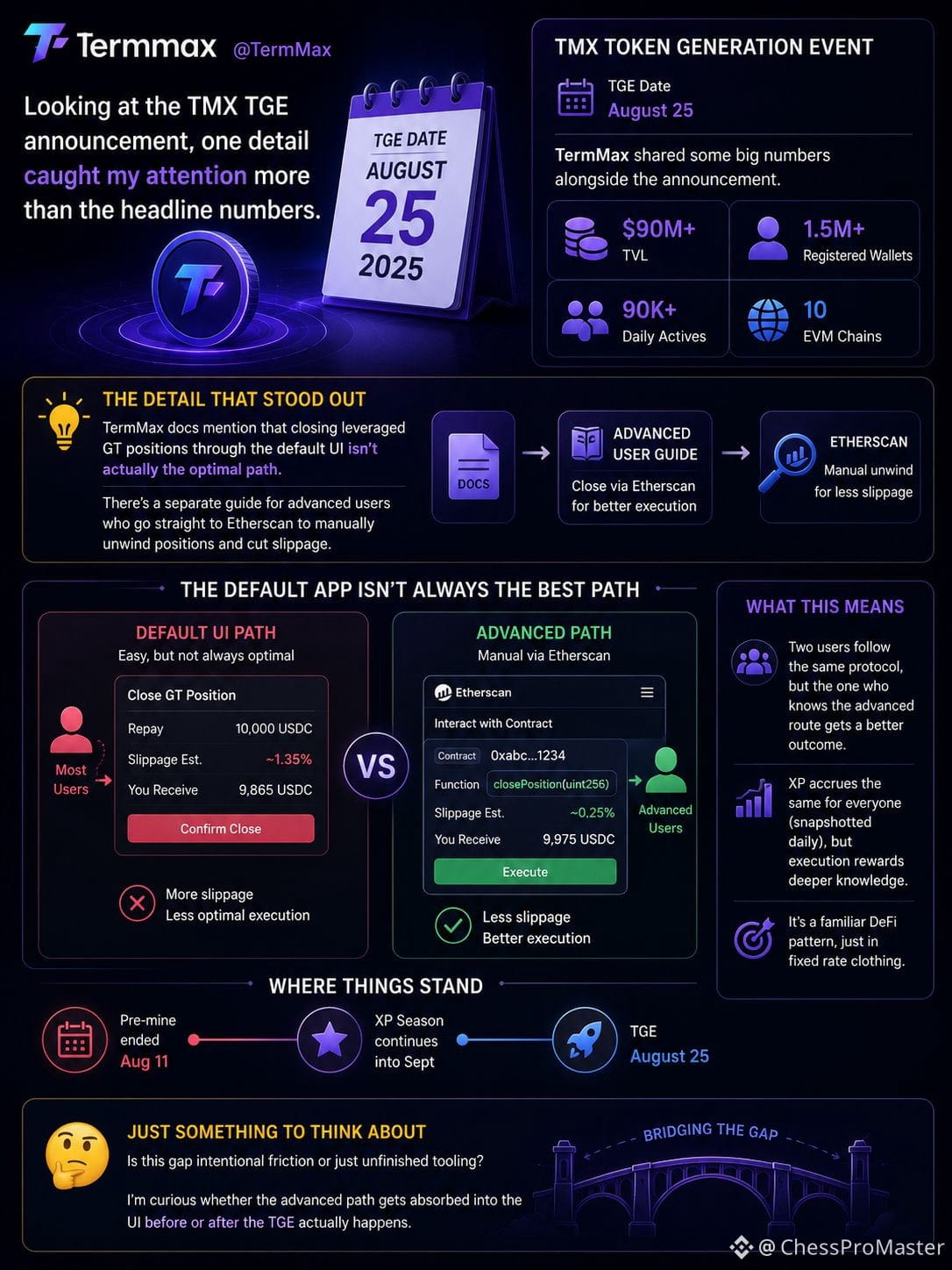
I was looking through the TMX TGE announcement and one detail caught my attention more than the headline numbers.
The TGE is set for August 25, with TermMax reporting $90M+ TVL, 1.5M+ registered wallets, 90K+ daily active users, and activity across 10 EVM chains.
But the interesting part is how leveraged GT positions are closed. The default interface isn't always the best route for execution. TermMax has a separate guide showing advanced users how to unwind positions directly through Etherscan and potentially reduce slippage.
That creates an interesting gap. Two users can follow the same protocol, but the one who understands the advanced route may get a better outcome.
XP accumulation may be straightforward, but execution still seems to reward deeper knowledge.
With pre-mine ending August 11 and the XP season continuing into September, I'm curious whether this advanced workflow becomes part of the main UI before or after TGE.
@TermMax #TermMax
I was looking through the TMX TGE announcement and one detail caught my attention more than the headline numbers.
The TGE is set for August 25, with TermMax reporting $90M+ TVL, 1.5M+ registered wallets, 90K+ daily active users, and activity across 10 EVM chains.
But the interesting part is how leveraged GT positions are closed. The default interface isn't always the best route for execution. TermMax has a separate guide showing advanced users how to unwind positions directly through Etherscan and potentially reduce slippage.
That creates an interesting gap. Two users can follow the same protocol, but the one who understands the advanced route may get a better outcome.
XP accumulation may be straightforward, but execution still seems to reward deeper knowledge.
With pre-mine ending August 11 and the XP season continuing into September, I'm curious whether this advanced workflow becomes part of the main UI before or after TGE.
I was looking through the TMX TGE announcement and one detail caught my attention more than the headline numbers.
The TGE is set for August 25, with TermMax reporting $90M+ TVL, 1.5M+ registered wallets, 90K+ daily active users, and activity across 10 EVM chains.
But the interesting part is how leveraged GT positions are closed. The default interface isn't always the best route for execution. TermMax has a separate guide showing advanced users how to unwind positions directly through Etherscan and potentially reduce slippage.
That creates an interesting gap. Two users can follow the same protocol, but the one who understands the advanced route may get a better outcome.
XP accumulation may be straightforward, but execution still seems to reward deeper knowledge.
With pre-mine ending August 11 and the XP season continuing into September, I'm curious whether this advanced workflow becomes part of the main UI before or after TGE.
163
#termmax @termmax
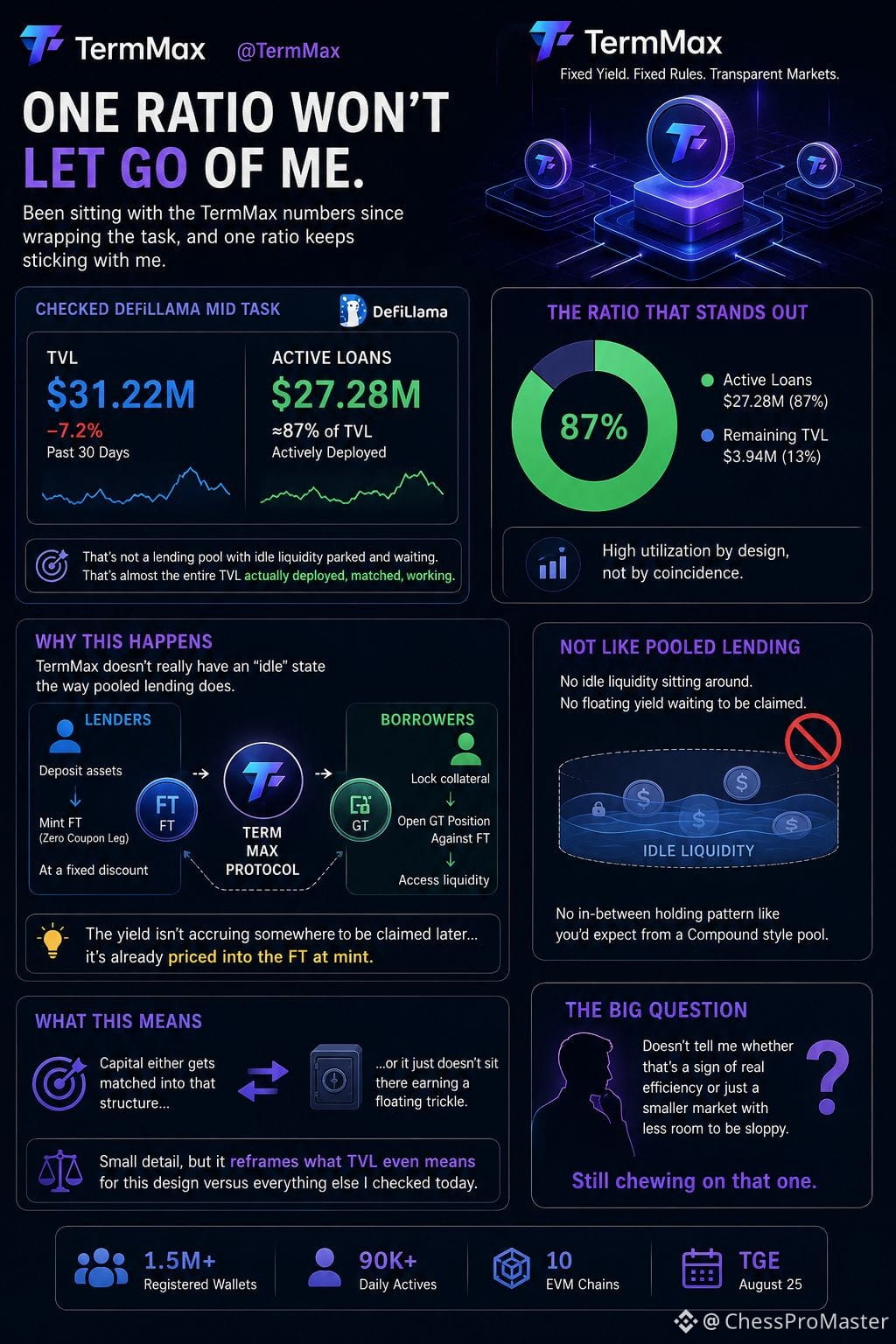
One ratio from the TermMax numbers keeps sticking with me.
I checked DefiLlama and saw TVL around $31.22M, down 7.2% over 30 days. Nothing unusual there. But active loans were sitting at $27.28M.
That means most of the TVL is actually being used, not just sitting idle.
The reason clicked when I looked closer at the design. TermMax uses FT and GT positions instead of a typical pooled lending model. Lenders get the fixed-yield leg through an FT, while borrowers lock GT positions against it. The yield is built into the FT price from the start.
So TVL means something slightly different here.
Now I'm wondering: is that genuine capital efficiency, or simply a smaller market with less idle liquidity?
#termmax @TermMax
One ratio from the TermMax numbers keeps sticking with me.
I checked DefiLlama and saw TVL around $31.22M, down 7.2% over 30 days. Nothing unusual there. But active loans were sitting at $27.28M.
That means most of the TVL is actually being used, not just sitting idle.
The reason clicked when I looked closer at the design. TermMax uses FT and GT positions instead of a typical pooled lending model. Lenders get the fixed-yield leg through an FT, while borrowers lock GT positions against it. The yield is built into the FT price from the start.
So TVL means something slightly different here.
Now I'm wondering: is that genuine capital efficiency, or simply a smaller market with less idle liquidity?
One ratio from the TermMax numbers keeps sticking with me.
I checked DefiLlama and saw TVL around $31.22M, down 7.2% over 30 days. Nothing unusual there. But active loans were sitting at $27.28M.
That means most of the TVL is actually being used, not just sitting idle.
The reason clicked when I looked closer at the design. TermMax uses FT and GT positions instead of a typical pooled lending model. Lenders get the fixed-yield leg through an FT, while borrowers lock GT positions against it. The yield is built into the FT price from the start.
So TVL means something slightly different here.
Now I'm wondering: is that genuine capital efficiency, or simply a smaller market with less idle liquidity?
135
@termmax #TermMax
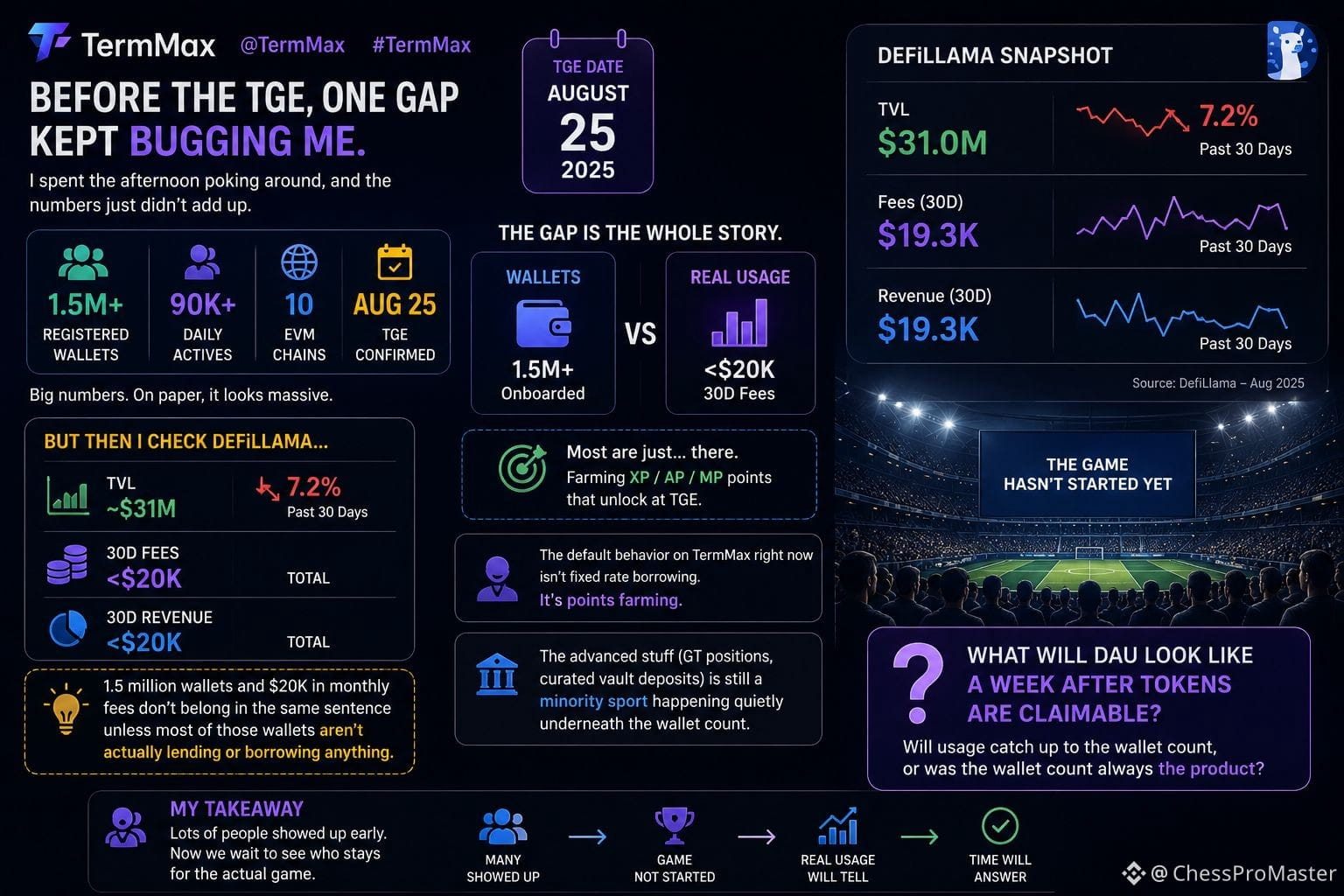
I spent some time looking at TermMax before the TGE, and one thing kept bothering me.
The headline numbers are impressive: 1.5M+ registered wallets, 90K+ daily actives, 10 EVM chains, and the TMX TGE set for August 25.
But then I checked DefiLlama. TVL is around $31M, down 7.2% over the month, while 30-day fees are still under $20K.
That gap tells an interesting story.
Maybe a huge portion of those wallets aren't actually lending or borrowing. They're simply farming points ahead of TGE.
It feels like a stadium packed before the game starts. Everyone is there, but the real question is how many stay once the incentives disappear.
What will DAU look like one week after TMX becomes claimable?
@TermMax #TermMax
I spent some time looking at TermMax before the TGE, and one thing kept bothering me.
The headline numbers are impressive: 1.5M+ registered wallets, 90K+ daily actives, 10 EVM chains, and the TMX TGE set for August 25.
But then I checked DefiLlama. TVL is around $31M, down 7.2% over the month, while 30-day fees are still under $20K.
That gap tells an interesting story.
Maybe a huge portion of those wallets aren't actually lending or borrowing. They're simply farming points ahead of TGE.
It feels like a stadium packed before the game starts. Everyone is there, but the real question is how many stay once the incentives disappear.
What will DAU look like one week after TMX becomes claimable?
I spent some time looking at TermMax before the TGE, and one thing kept bothering me.
The headline numbers are impressive: 1.5M+ registered wallets, 90K+ daily actives, 10 EVM chains, and the TMX TGE set for August 25.
But then I checked DefiLlama. TVL is around $31M, down 7.2% over the month, while 30-day fees are still under $20K.
That gap tells an interesting story.
Maybe a huge portion of those wallets aren't actually lending or borrowing. They're simply farming points ahead of TGE.
It feels like a stadium packed before the game starts. Everyone is there, but the real question is how many stay once the incentives disappear.
What will DAU look like one week after TMX becomes claimable?
105
#dusk $DUSK @Dusk_Foundation
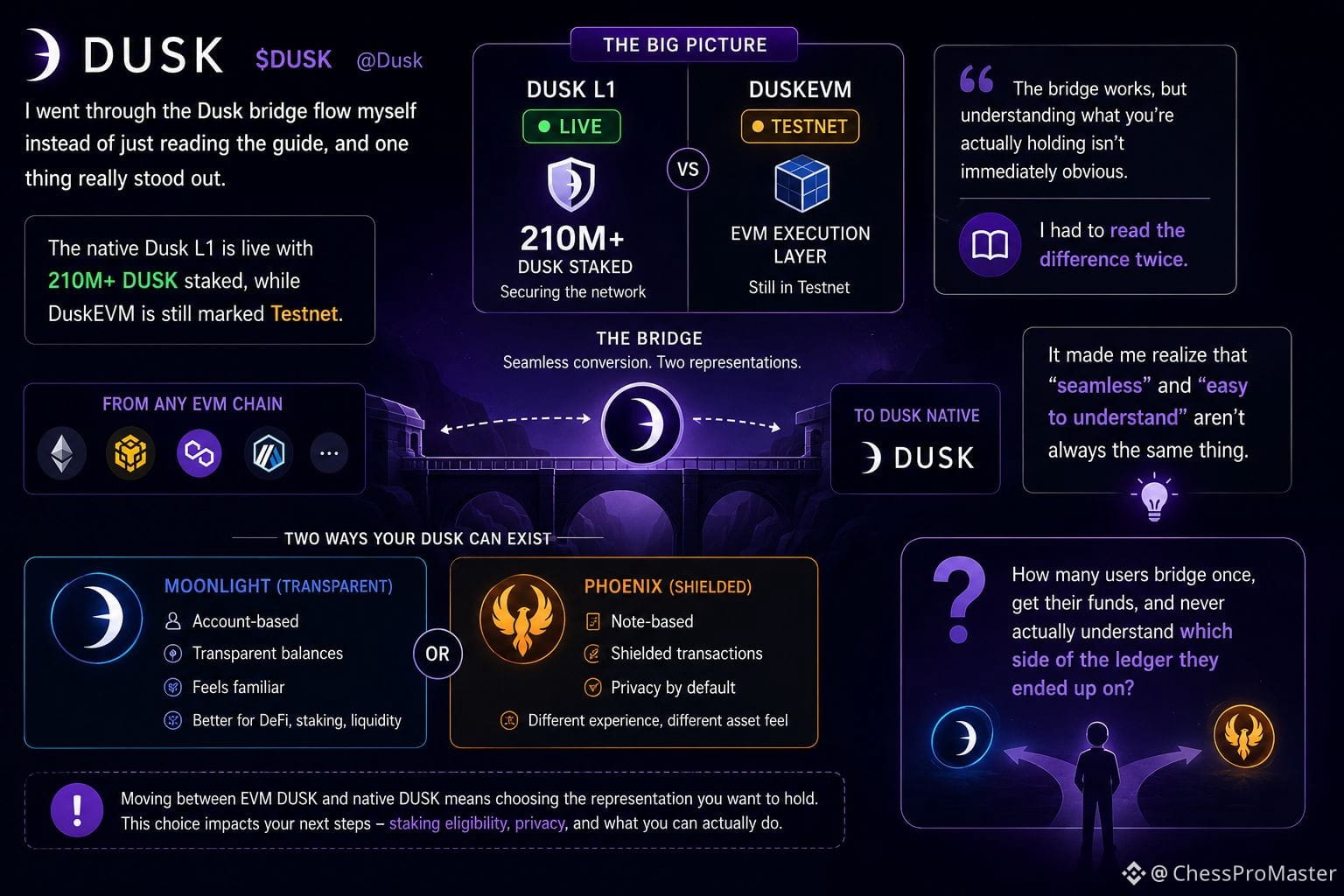
I went through the Dusk bridge flow myself instead of just reading the guide, and one thing really stood out.
The native Dusk L1 is live with 210M+ DUSK staked, while DuskEVM is still marked Testnet.
The bigger surprise was the bridge design. DUSK can exist as Moonlight, which is transparent and account-based, or Phoenix, which is shielded and note-based.
The bridge works, but understanding what you're actually holding isn't immediately obvious. I had to read the difference twice.
It made me realize that “seamless” and “easy to understand” aren't always the same thing. The real question is how many users bridge once without knowing which version of DUSK they ended up with.
#dusk $DUSK @Dusk
I went through the Dusk bridge flow myself instead of just reading the guide, and one thing really stood out.
The native Dusk L1 is live with 210M+ DUSK staked, while DuskEVM is still marked Testnet.
The bigger surprise was the bridge design. DUSK can exist as Moonlight, which is transparent and account-based, or Phoenix, which is shielded and note-based.
The bridge works, but understanding what you're actually holding isn't immediately obvious. I had to read the difference twice.
It made me realize that “seamless” and “easy to understand” aren't always the same thing. The real question is how many users bridge once without knowing which version of DUSK they ended up with.
I went through the Dusk bridge flow myself instead of just reading the guide, and one thing really stood out.
The native Dusk L1 is live with 210M+ DUSK staked, while DuskEVM is still marked Testnet.
The bigger surprise was the bridge design. DUSK can exist as Moonlight, which is transparent and account-based, or Phoenix, which is shielded and note-based.
The bridge works, but understanding what you're actually holding isn't immediately obvious. I had to read the difference twice.
It made me realize that “seamless” and “easy to understand” aren't always the same thing. The real question is how many users bridge once without knowing which version of DUSK they ended up with.
133
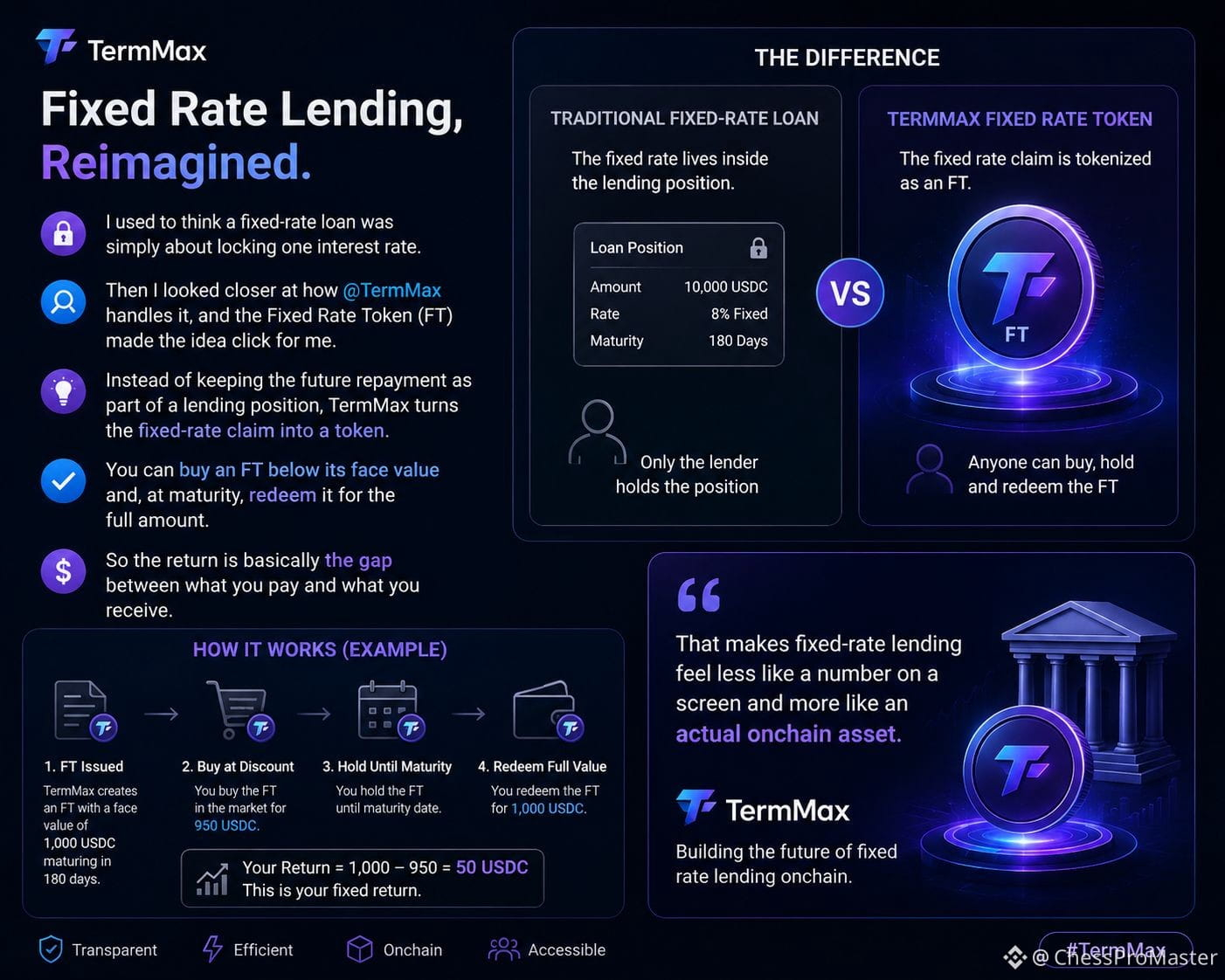
I used to think a fixed-rate loan was simply about locking one interest rate.
Then I looked closer at how @termmax handles it, and the Fixed Rate Token (FT) made the idea click for me.
Instead of keeping the future repayment as part of a lending position, TermMax turns the fixed-rate claim into a token. You can buy an FT below its face value and, at maturity, redeem it for the full amount.
So the return is basically the gap between what you pay and what you receive.
That makes fixed-rate lending feel less like a number on a screen and more like an actual onchain asset.
#TermMax
I used to think a fixed-rate loan was simply about locking one interest rate.
Then I looked closer at how @TermMax handles it, and the Fixed Rate Token (FT) made the idea click for me.
Instead of keeping the future repayment as part of a lending position, TermMax turns the fixed-rate claim into a token. You can buy an FT below its face value and, at maturity, redeem it for the full amount.
So the return is basically the gap between what you pay and what you receive.
That makes fixed-rate lending feel less like a number on a screen and more like an actual onchain asset.
#TermMax
Then I looked closer at how @TermMax handles it, and the Fixed Rate Token (FT) made the idea click for me.
Instead of keeping the future repayment as part of a lending position, TermMax turns the fixed-rate claim into a token. You can buy an FT below its face value and, at maturity, redeem it for the full amount.
So the return is basically the gap between what you pay and what you receive.
That makes fixed-rate lending feel less like a number on a screen and more like an actual onchain asset.
#TermMax
1
147
Day 6 — Binance Campaign
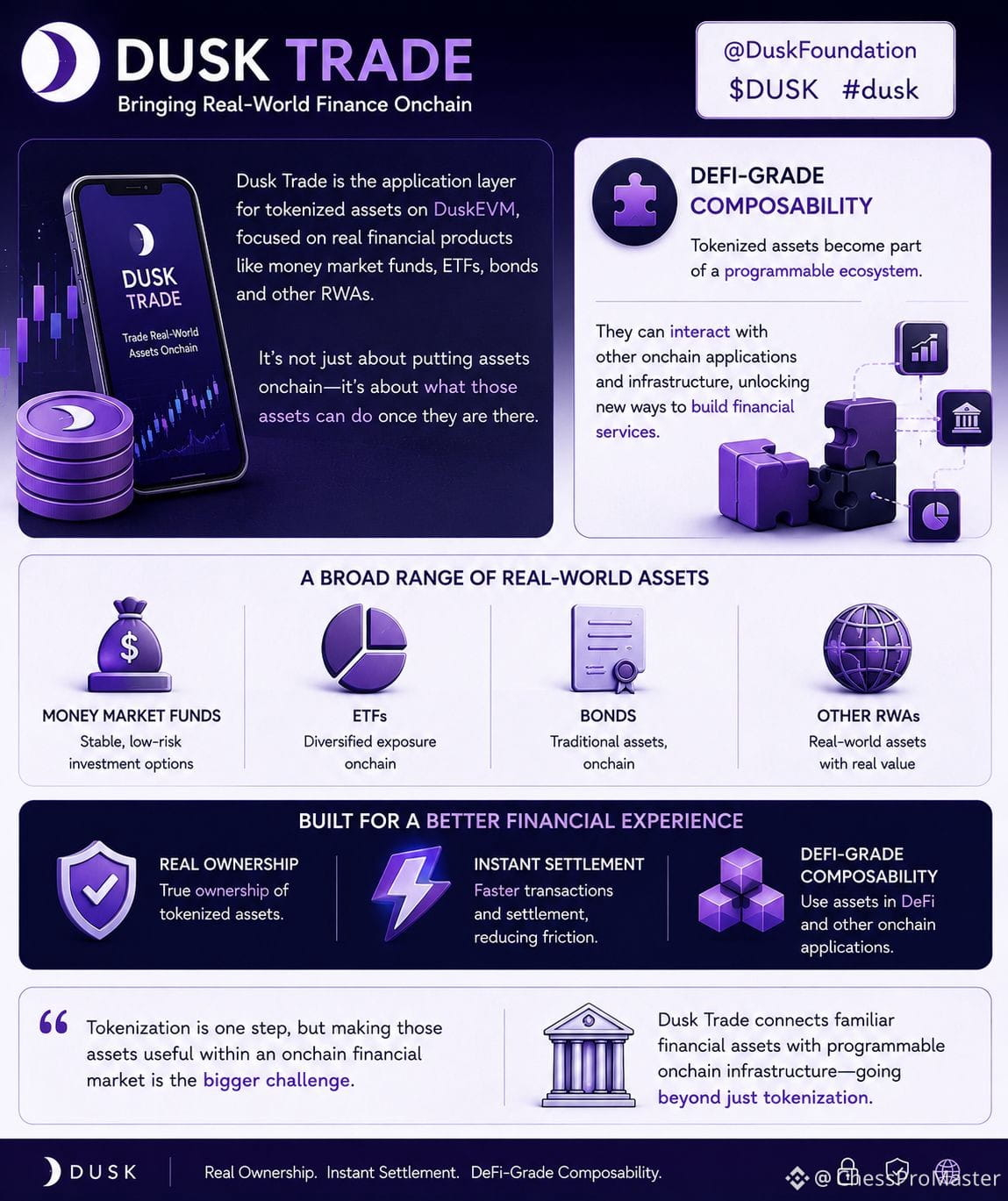
One part of the Dusk Trade story I find especially interesting is DeFi-grade composability. @Dusk_Foundation isn’t only talking about putting traditional financial assets onchain; Dusk Trade is positioned as the application layer for tokenized assets on DuskEVM, with products such as money market funds, ETFs, bonds and other RWAs.
The idea of composability matters because tokenized assets can become part of a programmable blockchain environment rather than remaining isolated representations of traditional products. If these assets can interact with other onchain applications and infrastructure, there could be more ways to build financial services around them.
This is also why I think Dusk Trade’s focus on real ownership, instant settlement and DeFi-grade composability fits together. Tokenization is one step, but making those assets useful within an onchain financial market is the bigger challenge.
For me, that’s where Dusk Trade becomes more than just a tokenization story. It’s about connecting familiar financial assets with programmable onchain infrastructure.
$DUSK #dusk
Day 6 — Binance Campaign
One part of the Dusk Trade story I find especially interesting is DeFi-grade composability. @Dusk isn’t only talking about putting traditional financial assets onchain; Dusk Trade is positioned as the application layer for tokenized assets on DuskEVM, with products such as money market funds, ETFs, bonds and other RWAs.
The idea of composability matters because tokenized assets can become part of a programmable blockchain environment rather than remaining isolated representations of traditional products. If these assets can interact with other onchain applications and infrastructure, there could be more ways to build financial services around them.
This is also why I think Dusk Trade’s focus on real ownership, instant settlement and DeFi-grade composability fits together. Tokenization is one step, but making those assets useful within an onchain financial market is the bigger challenge.
For me, that’s where Dusk Trade becomes more than just a tokenization story. It’s about connecting familiar financial assets with programmable onchain infrastructure.
$DUSK #dusk
One part of the Dusk Trade story I find especially interesting is DeFi-grade composability. @Dusk isn’t only talking about putting traditional financial assets onchain; Dusk Trade is positioned as the application layer for tokenized assets on DuskEVM, with products such as money market funds, ETFs, bonds and other RWAs.
The idea of composability matters because tokenized assets can become part of a programmable blockchain environment rather than remaining isolated representations of traditional products. If these assets can interact with other onchain applications and infrastructure, there could be more ways to build financial services around them.
This is also why I think Dusk Trade’s focus on real ownership, instant settlement and DeFi-grade composability fits together. Tokenization is one step, but making those assets useful within an onchain financial market is the bigger challenge.
For me, that’s where Dusk Trade becomes more than just a tokenization story. It’s about connecting familiar financial assets with programmable onchain infrastructure.
$DUSK #dusk
1
1
193
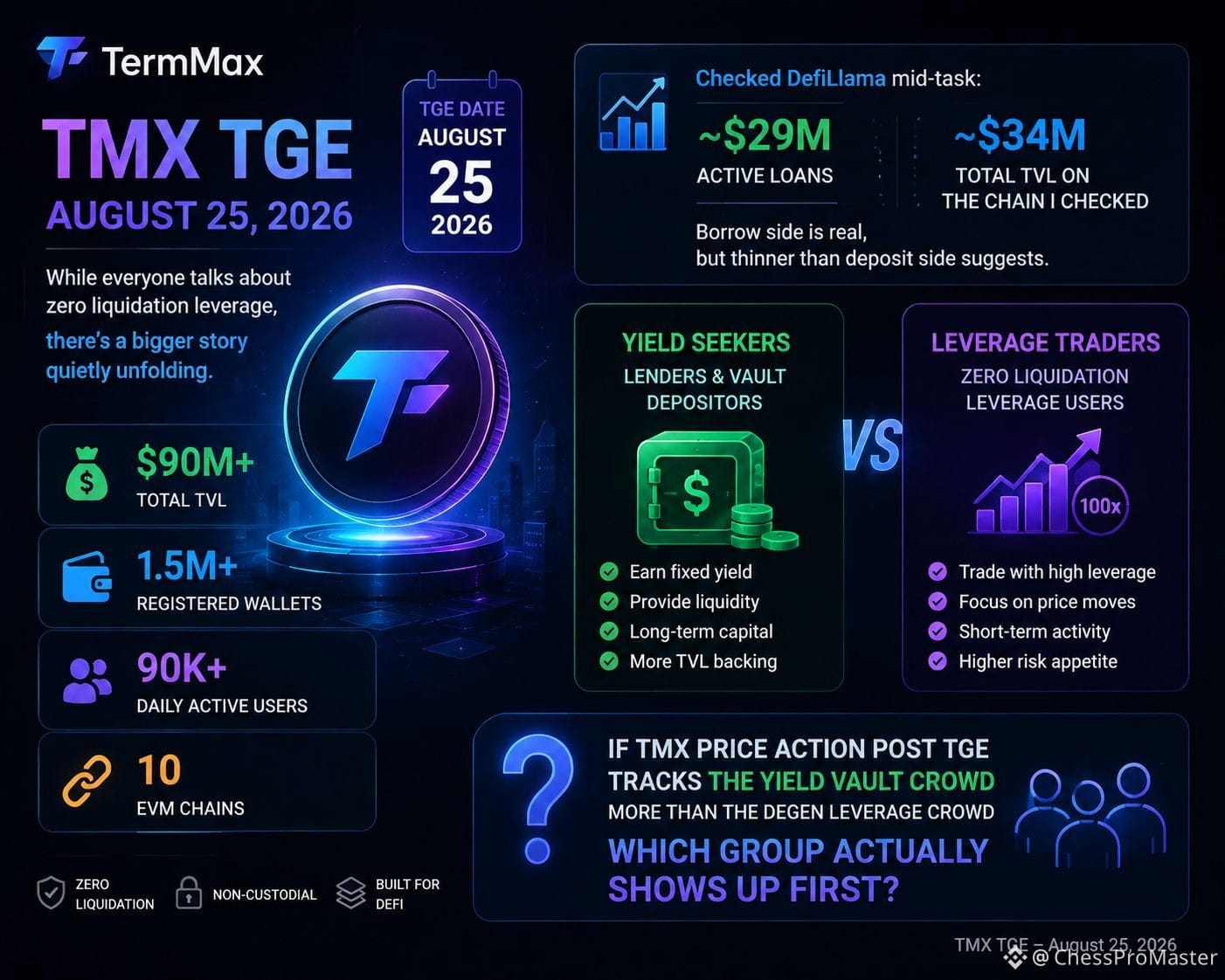
#termmax @termmax confirmed the TMX TGE for August 25, and the numbers made me look twice: $90M+ TVL, 1.5M+ registered wallets, and 90K+ daily active users across 10 EVM chains.
I started looking into TermMax because of its zero-liquidation leverage model, but the deeper story seems to be on the lending side. A big part of the liquidity comes from lenders and vault depositors earning fixed yield, while active borrowing is much smaller than total deposits.
That makes me wonder: after TGE, will TMX be driven more by yield-focused users or the leverage crowd?
#termmax @TermMax confirmed the TMX TGE for August 25, and the numbers made me look twice: $90M+ TVL, 1.5M+ registered wallets, and 90K+ daily active users across 10 EVM chains.
I started looking into TermMax because of its zero-liquidation leverage model, but the deeper story seems to be on the lending side. A big part of the liquidity comes from lenders and vault depositors earning fixed yield, while active borrowing is much smaller than total deposits.
That makes me wonder: after TGE, will TMX be driven more by yield-focused users or the leverage crowd?
I started looking into TermMax because of its zero-liquidation leverage model, but the deeper story seems to be on the lending side. A big part of the liquidity comes from lenders and vault depositors earning fixed yield, while active borrowing is much smaller than total deposits.
That makes me wonder: after TGE, will TMX be driven more by yield-focused users or the leverage crowd?
144
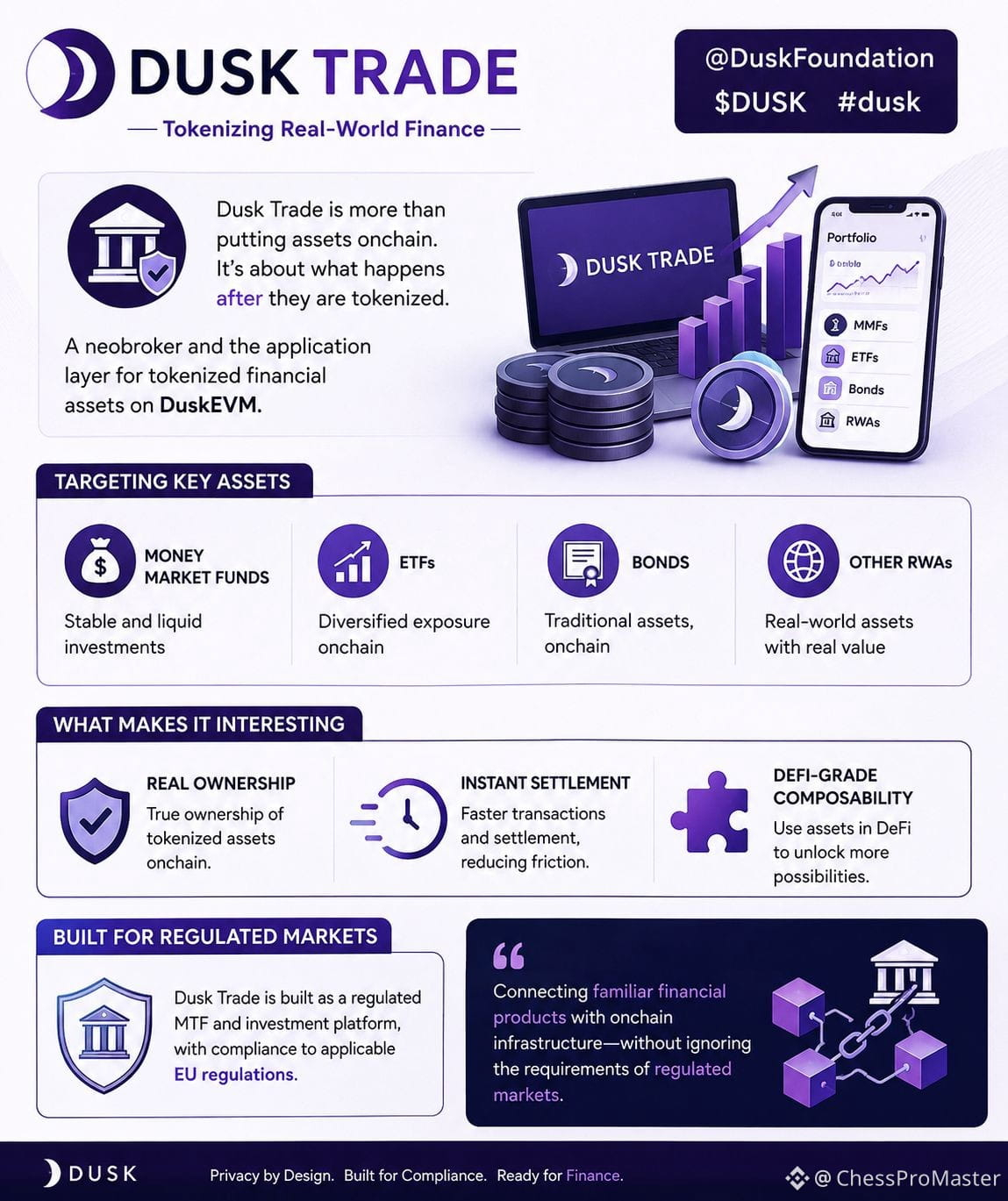
What stands out to me about Dusk Trade is that it isn’t only focused on putting financial assets onchain. The bigger idea is what happens after those assets are tokenized.
Dusk Trade is positioned as a neobroker and the application layer for tokenized financial assets on DuskEVM, targeting products such as money market funds, ETFs, bonds and other RWAs. The focus on real ownership, instant settlement and DeFi-grade composability is what makes this approach interesting to me.
If a traditional financial asset becomes an onchain asset, being able to settle it quickly and use it within a programmable environment could open up different ways of interacting with that asset. At the same time, Dusk Trade is designed around a regulated MTF and investment platform model, with applicable EU regulations in mind.
For me, the interesting part is connecting familiar financial products with onchain infrastructure without ignoring the requirements of regulated markets.
@Dusk_Foundation $DUSK #dusk
What stands out to me about Dusk Trade is that it isn’t only focused on putting financial assets onchain. The bigger idea is what happens after those assets are tokenized.
Dusk Trade is positioned as a neobroker and the application layer for tokenized financial assets on DuskEVM, targeting products such as money market funds, ETFs, bonds and other RWAs. The focus on real ownership, instant settlement and DeFi-grade composability is what makes this approach interesting to me.
If a traditional financial asset becomes an onchain asset, being able to settle it quickly and use it within a programmable environment could open up different ways of interacting with that asset. At the same time, Dusk Trade is designed around a regulated MTF and investment platform model, with applicable EU regulations in mind.
For me, the interesting part is connecting familiar financial products with onchain infrastructure without ignoring the requirements of regulated markets.
@Dusk $DUSK #dusk
Dusk Trade is positioned as a neobroker and the application layer for tokenized financial assets on DuskEVM, targeting products such as money market funds, ETFs, bonds and other RWAs. The focus on real ownership, instant settlement and DeFi-grade composability is what makes this approach interesting to me.
If a traditional financial asset becomes an onchain asset, being able to settle it quickly and use it within a programmable environment could open up different ways of interacting with that asset. At the same time, Dusk Trade is designed around a regulated MTF and investment platform model, with applicable EU regulations in mind.
For me, the interesting part is connecting familiar financial products with onchain infrastructure without ignoring the requirements of regulated markets.
@Dusk $DUSK #dusk
163
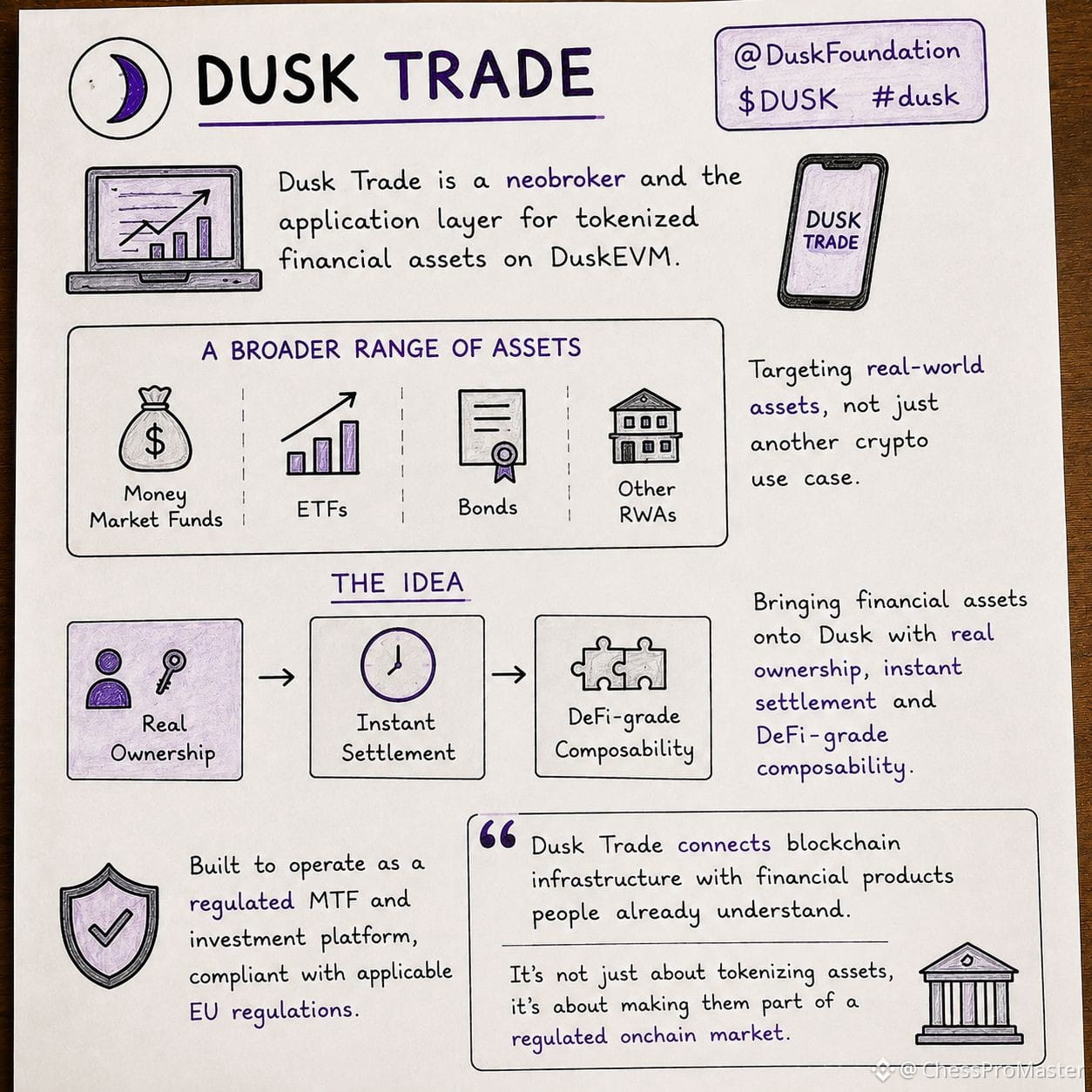
I’ve been looking at another part of @Dusk_Foundation that makes the project feel more focused on actual financial infrastructure: Dusk Trade. It’s described as a neobroker and the application layer for tokenized financial assets on DuskEVM. What caught my attention is the range of assets being targeted money market funds, ETFs, bonds and other RWAs rather than treating tokenization as just another crypto use case.
The idea is to bring these financial assets onto Dusk with real ownership, instant settlement and DeFi-grade composability. Dusk Trade is also structured around operating as a regulated MTF and investment platform, with compliance with applicable EU regulations.
For me, this makes the Dusk Trade story interesting because it connects blockchain infrastructure directly to financial products people already understand. The question isn’t only how assets can be tokenized, but how they can actually become part of a regulated onchain market.
$DUSK #dusk
I’ve been looking at another part of @Dusk that makes the project feel more focused on actual financial infrastructure: Dusk Trade. It’s described as a neobroker and the application layer for tokenized financial assets on DuskEVM. What caught my attention is the range of assets being targeted money market funds, ETFs, bonds and other RWAs rather than treating tokenization as just another crypto use case.
The idea is to bring these financial assets onto Dusk with real ownership, instant settlement and DeFi-grade composability. Dusk Trade is also structured around operating as a regulated MTF and investment platform, with compliance with applicable EU regulations.
For me, this makes the Dusk Trade story interesting because it connects blockchain infrastructure directly to financial products people already understand. The question isn’t only how assets can be tokenized, but how they can actually become part of a regulated onchain market.
$DUSK #dusk
The idea is to bring these financial assets onto Dusk with real ownership, instant settlement and DeFi-grade composability. Dusk Trade is also structured around operating as a regulated MTF and investment platform, with compliance with applicable EU regulations.
For me, this makes the Dusk Trade story interesting because it connects blockchain infrastructure directly to financial products people already understand. The question isn’t only how assets can be tokenized, but how they can actually become part of a regulated onchain market.
$DUSK #dusk
119
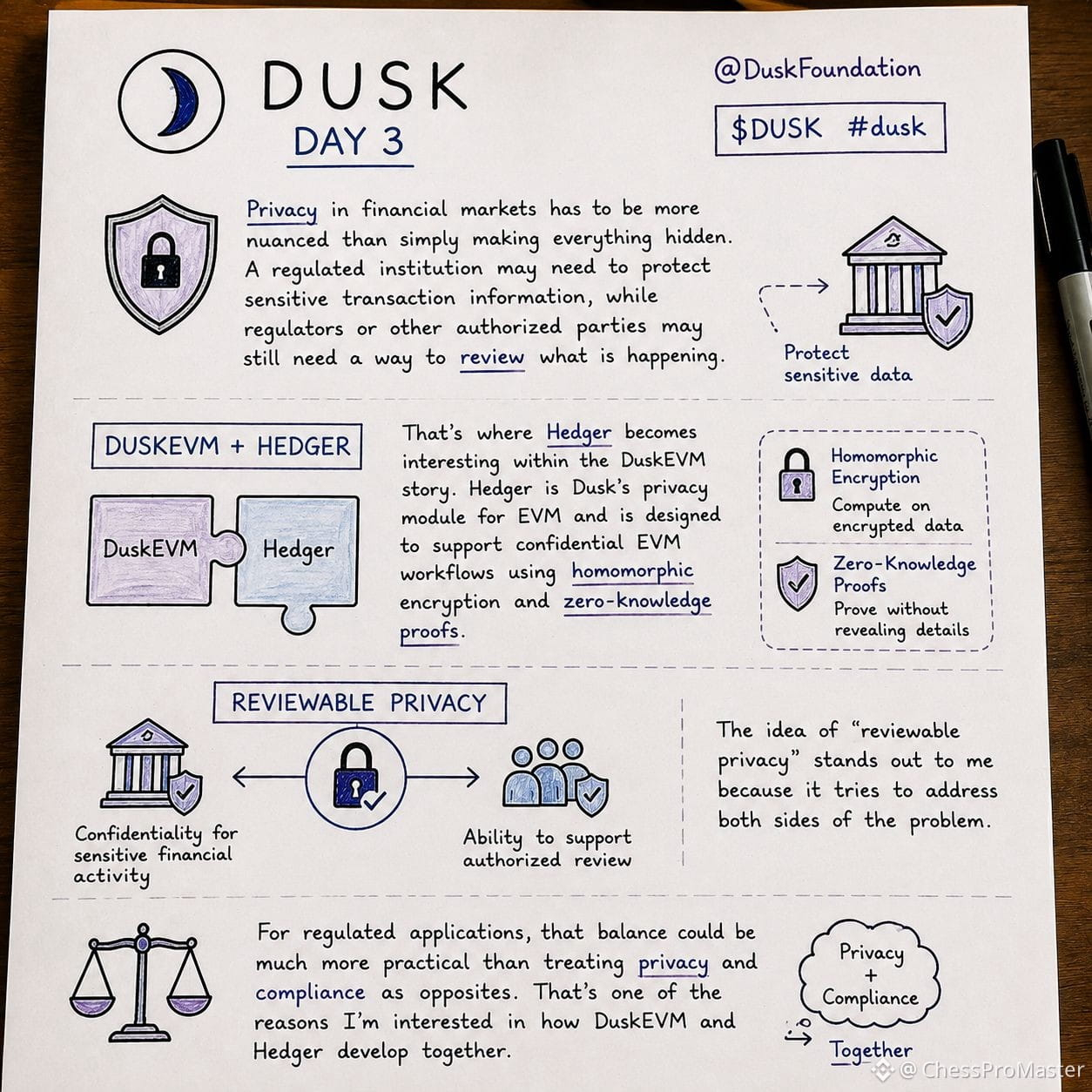
One thing I keep coming back to with @Dusk_Foundation is that privacy in financial markets has to be more nuanced than simply making everything hidden. A regulated institution may need to protect sensitive transaction information, while regulators or other authorized parties may still need a way to review what is happening.
That’s where Hedger becomes interesting within the DuskEVM story. Hedger is Dusk’s privacy module for EVM and is designed to support confidential EVM workflows using homomorphic encryption and zero-knowledge proofs. The idea of “reviewable privacy” stands out to me because it tries to address both sides of the problem: confidentiality for sensitive financial activity and the ability to support authorized review.
For regulated applications, that balance could be much more practical than treating privacy and compliance as opposites. That’s one of the reasons I’m interested in how DuskEVM and Hedger develop together.
$DUSK #dusk
One thing I keep coming back to with @Dusk is that privacy in financial markets has to be more nuanced than simply making everything hidden. A regulated institution may need to protect sensitive transaction information, while regulators or other authorized parties may still need a way to review what is happening.
That’s where Hedger becomes interesting within the DuskEVM story. Hedger is Dusk’s privacy module for EVM and is designed to support confidential EVM workflows using homomorphic encryption and zero-knowledge proofs. The idea of “reviewable privacy” stands out to me because it tries to address both sides of the problem: confidentiality for sensitive financial activity and the ability to support authorized review.
For regulated applications, that balance could be much more practical than treating privacy and compliance as opposites. That’s one of the reasons I’m interested in how DuskEVM and Hedger develop together.
$DUSK #dusk
That’s where Hedger becomes interesting within the DuskEVM story. Hedger is Dusk’s privacy module for EVM and is designed to support confidential EVM workflows using homomorphic encryption and zero-knowledge proofs. The idea of “reviewable privacy” stands out to me because it tries to address both sides of the problem: confidentiality for sensitive financial activity and the ability to support authorized review.
For regulated applications, that balance could be much more practical than treating privacy and compliance as opposites. That’s one of the reasons I’m interested in how DuskEVM and Hedger develop together.
$DUSK #dusk
121
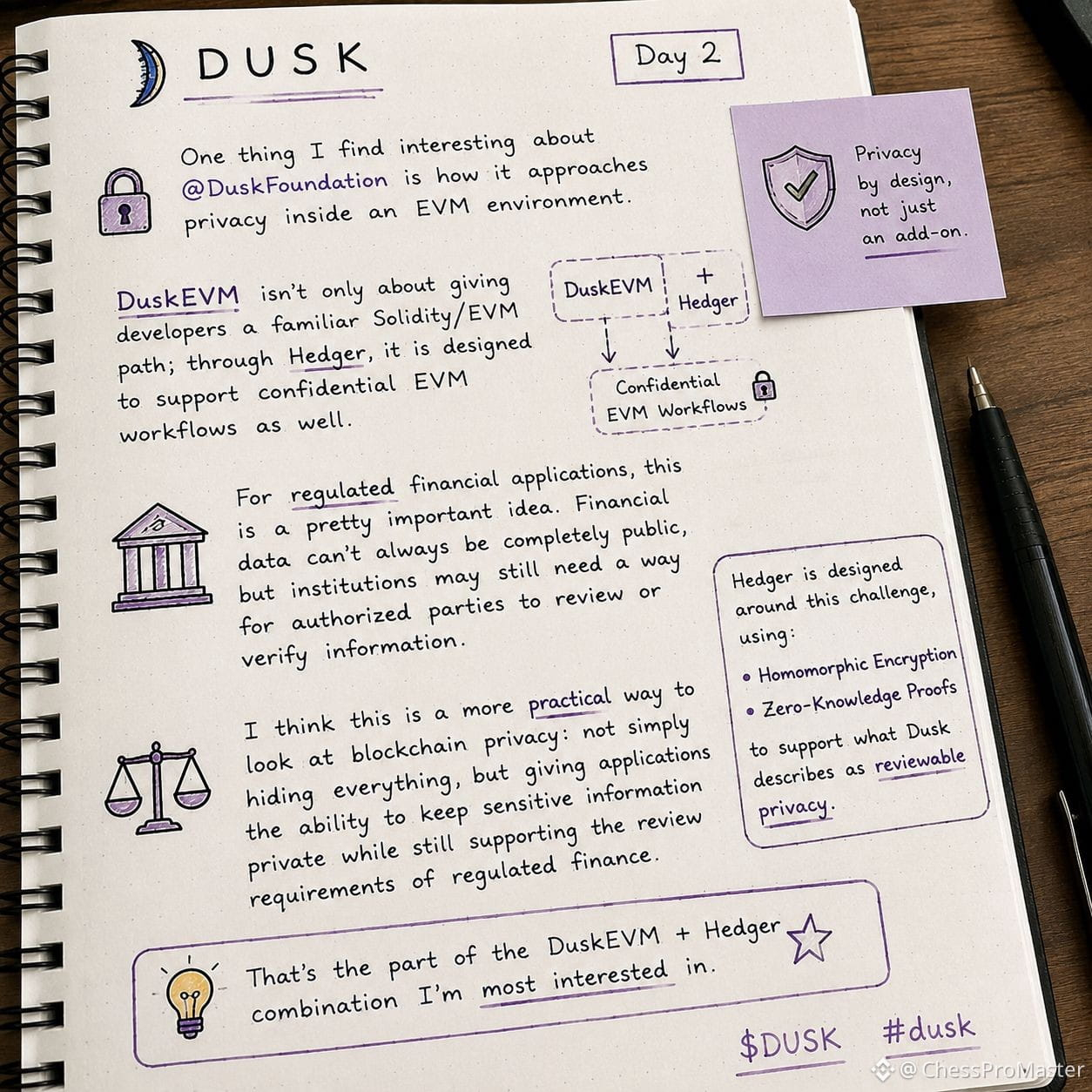
One thing I find interesting about @Dusk_Foundation is how it approaches privacy inside an EVM environment. DuskEVM isn’t only about giving developers a familiar Solidity/EVM path; through Hedger, it is designed to support confidential EVM workflows as well.
For regulated financial applications, this is a pretty important idea. Financial data can’t always be completely public, but institutions may still need a way for authorized parties to review or verify information. Hedger is designed around this challenge, using homomorphic encryption and zero-knowledge proofs to support what Dusk describes as reviewable privacy.
I think this is a more practical way to look at blockchain privacy: not simply hiding everything, but giving applications the ability to keep sensitive information private while still supporting the review requirements of regulated finance.
That’s the part of the DuskEVM + Hedger combination I’m most interested in. $DUSK #dusk
One thing I find interesting about @Dusk is how it approaches privacy inside an EVM environment. DuskEVM isn’t only about giving developers a familiar Solidity/EVM path; through Hedger, it is designed to support confidential EVM workflows as well.
For regulated financial applications, this is a pretty important idea. Financial data can’t always be completely public, but institutions may still need a way for authorized parties to review or verify information. Hedger is designed around this challenge, using homomorphic encryption and zero-knowledge proofs to support what Dusk describes as reviewable privacy.
I think this is a more practical way to look at blockchain privacy: not simply hiding everything, but giving applications the ability to keep sensitive information private while still supporting the review requirements of regulated finance.
That’s the part of the DuskEVM + Hedger combination I’m most interested in. $DUSK #dusk
For regulated financial applications, this is a pretty important idea. Financial data can’t always be completely public, but institutions may still need a way for authorized parties to review or verify information. Hedger is designed around this challenge, using homomorphic encryption and zero-knowledge proofs to support what Dusk describes as reviewable privacy.
I think this is a more practical way to look at blockchain privacy: not simply hiding everything, but giving applications the ability to keep sensitive information private while still supporting the review requirements of regulated finance.
That’s the part of the DuskEVM + Hedger combination I’m most interested in. $DUSK #dusk
119
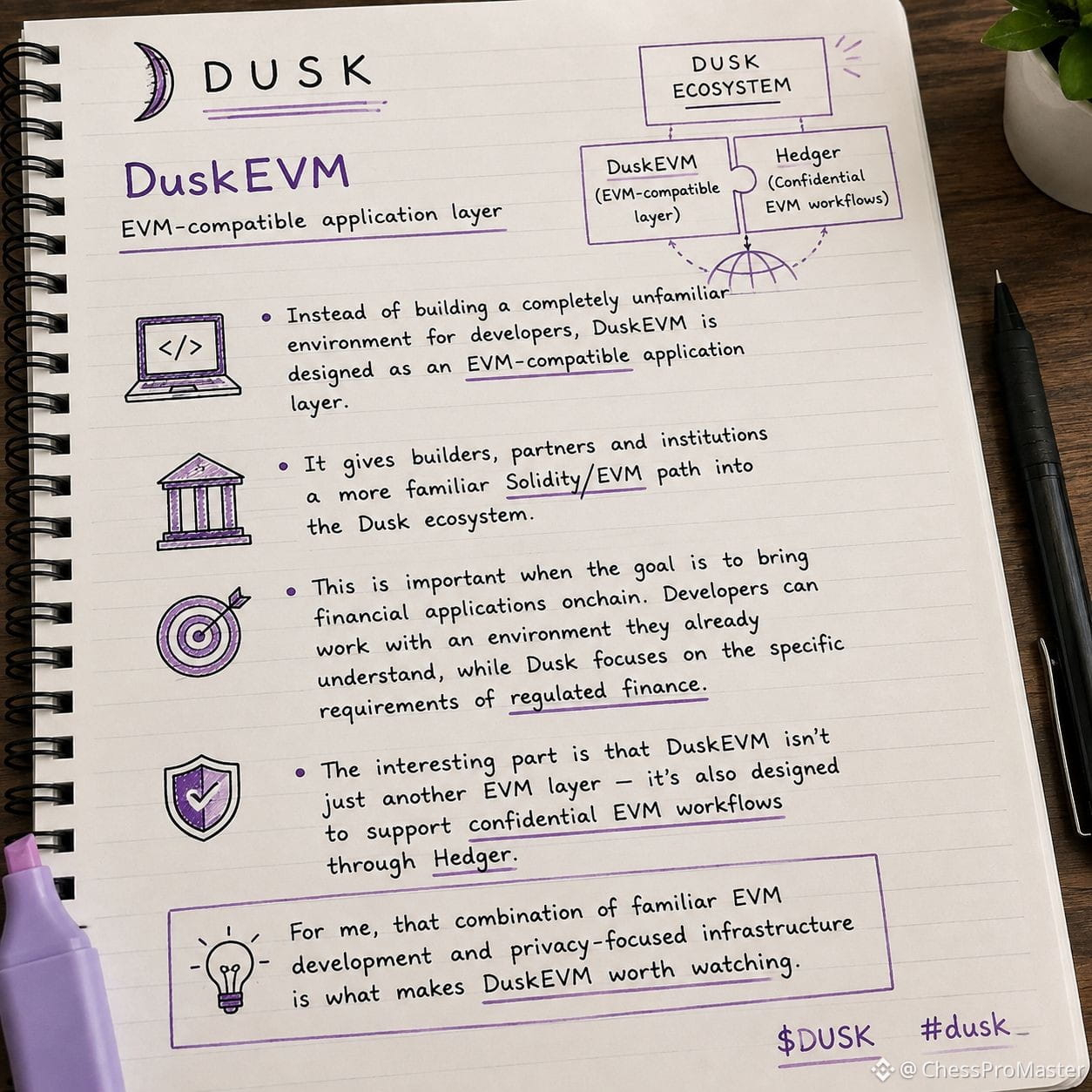
Day 1 — DuskEVM
What caught my attention about @Dusk_Foundation is the direction they’re taking with DuskEVM. Instead of building a completely unfamiliar environment for developers, DuskEVM is designed as an EVM-compatible application layer, giving builders, partners and institutions a more familiar Solidity/EVM path into the Dusk ecosystem.
I think this is important when the goal is to bring financial applications onchain. Developers can work with an environment they already understand, while Dusk focuses on the specific requirements of regulated finance. And the interesting part is that DuskEVM isn’t being presented as just another EVM layer it’s also designed to support confidential EVM workflows through Hedger.
For me, that combination of familiar EVM development and privacy focused infrastructure is what makes DuskEVM worth watching. $DUSK #dusk
Day 1 — DuskEVM
What caught my attention about @Dusk is the direction they’re taking with DuskEVM. Instead of building a completely unfamiliar environment for developers, DuskEVM is designed as an EVM-compatible application layer, giving builders, partners and institutions a more familiar Solidity/EVM path into the Dusk ecosystem.
I think this is important when the goal is to bring financial applications onchain. Developers can work with an environment they already understand, while Dusk focuses on the specific requirements of regulated finance. And the interesting part is that DuskEVM isn’t being presented as just another EVM layer it’s also designed to support confidential EVM workflows through Hedger.
For me, that combination of familiar EVM development and privacy focused infrastructure is what makes DuskEVM worth watching. $DUSK #dusk
What caught my attention about @Dusk is the direction they’re taking with DuskEVM. Instead of building a completely unfamiliar environment for developers, DuskEVM is designed as an EVM-compatible application layer, giving builders, partners and institutions a more familiar Solidity/EVM path into the Dusk ecosystem.
I think this is important when the goal is to bring financial applications onchain. Developers can work with an environment they already understand, while Dusk focuses on the specific requirements of regulated finance. And the interesting part is that DuskEVM isn’t being presented as just another EVM layer it’s also designed to support confidential EVM workflows through Hedger.
For me, that combination of familiar EVM development and privacy focused infrastructure is what makes DuskEVM worth watching. $DUSK #dusk
89
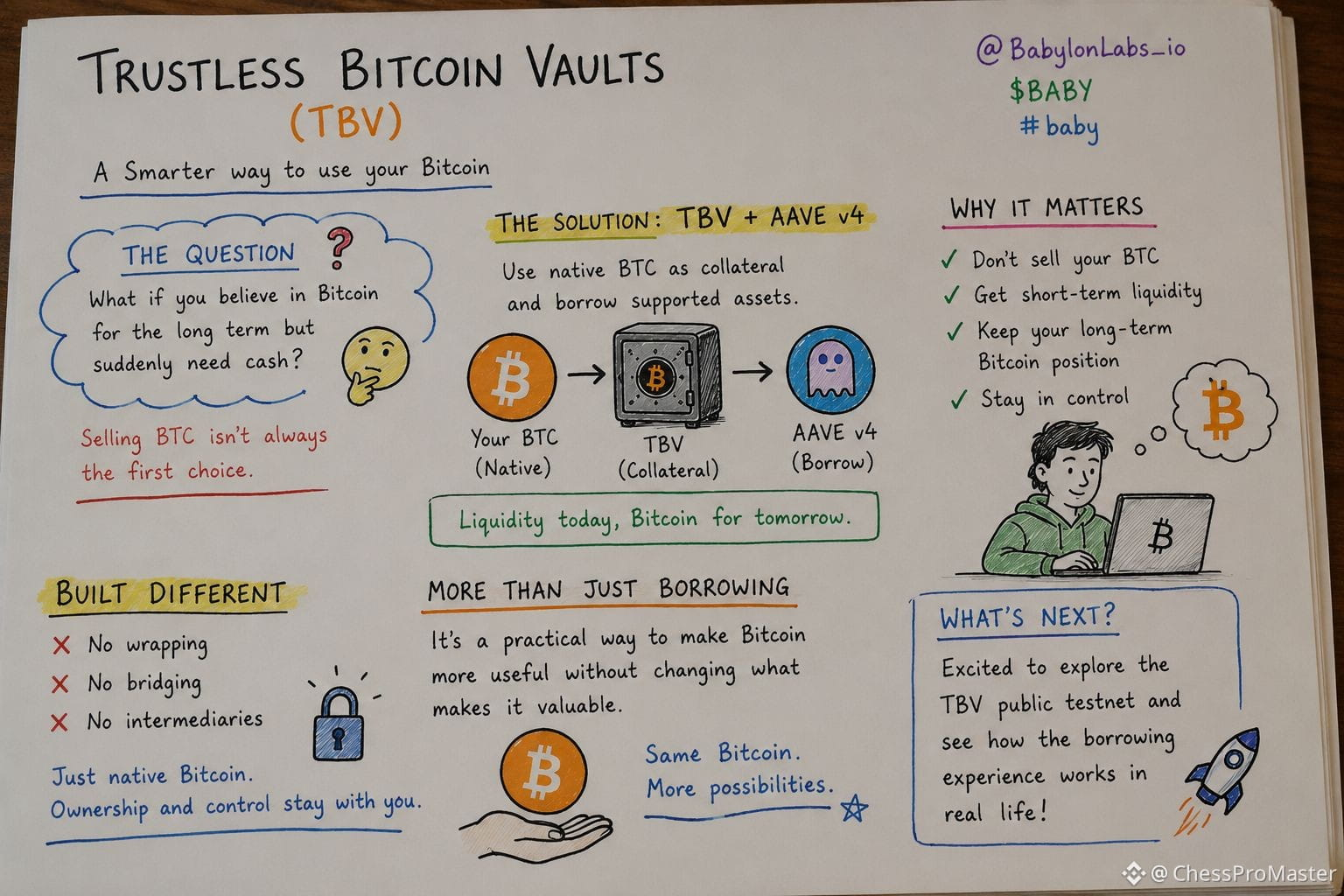
#baby $BABY One question came to my mind while reading about Trustless Bitcoin Vaults (TBV): What if someone believes in Bitcoin for the long term but suddenly needs cash? Selling BTC isn't always the first choice, especially if you plan to keep it for years.
That's why the first use case of TBV with Aave v4 caught my attention. Instead of selling your Bitcoin, TBV makes it possible to use native BTC as collateral and borrow supported assets. I think that's a much smarter option for people who want short-term liquidity without giving up their long-term Bitcoin position.
What I also like is that the process is built around native Bitcoin. There's no wrapping, no bridging, and no need to rely on intermediaries. That keeps the idea simple and stays closer to what many Bitcoin users actually want—ownership and control.
For me, this isn't just another borrowing feature. It feels like a practical way to make Bitcoin more useful without changing what makes it valuable in the first place. I'm looking forward to trying the TBV public testnet and seeing how the borrowing experience works from a user's point of view.
@babylonlabs_io
#baby $BABY One question came to my mind while reading about Trustless Bitcoin Vaults (TBV): What if someone believes in Bitcoin for the long term but suddenly needs cash? Selling BTC isn't always the first choice, especially if you plan to keep it for years.
That's why the first use case of TBV with Aave v4 caught my attention. Instead of selling your Bitcoin, TBV makes it possible to use native BTC as collateral and borrow supported assets. I think that's a much smarter option for people who want short-term liquidity without giving up their long-term Bitcoin position.
What I also like is that the process is built around native Bitcoin. There's no wrapping, no bridging, and no need to rely on intermediaries. That keeps the idea simple and stays closer to what many Bitcoin users actually want—ownership and control.
For me, this isn't just another borrowing feature. It feels like a practical way to make Bitcoin more useful without changing what makes it valuable in the first place. I'm looking forward to trying the TBV public testnet and seeing how the borrowing experience works from a user's point of view.
@BabylonLabs_io
That's why the first use case of TBV with Aave v4 caught my attention. Instead of selling your Bitcoin, TBV makes it possible to use native BTC as collateral and borrow supported assets. I think that's a much smarter option for people who want short-term liquidity without giving up their long-term Bitcoin position.
What I also like is that the process is built around native Bitcoin. There's no wrapping, no bridging, and no need to rely on intermediaries. That keeps the idea simple and stays closer to what many Bitcoin users actually want—ownership and control.
For me, this isn't just another borrowing feature. It feels like a practical way to make Bitcoin more useful without changing what makes it valuable in the first place. I'm looking forward to trying the TBV public testnet and seeing how the borrowing experience works from a user's point of view.
@BabylonLabs_io
1
4
147
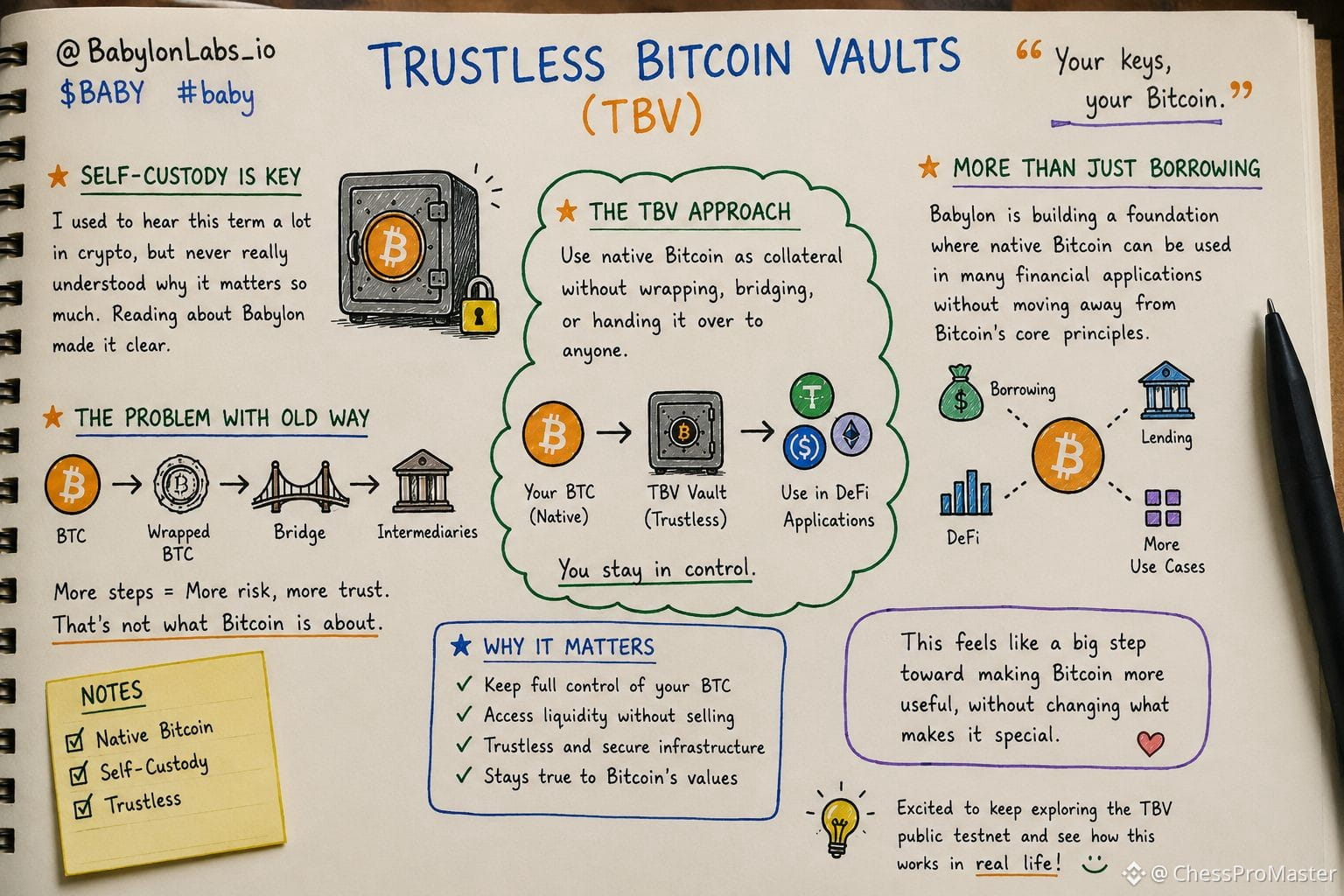
#baby $BABY One feature of Trustless Bitcoin Vaults (TBV) that really stood out to me is the idea of self-custody. It's a phrase I had heard many times in crypto, but I never stopped to think about why it matters so much until I started reading about Babylon.
Many Bitcoin holders don't just see BTC as another digital asset. They value the freedom of owning it without depending on someone else. That's why TBV's approach feels interesting to me. Instead of asking users to wrap their Bitcoin or hand it over to an intermediary, TBV is designed around using native BTC as collateral while keeping the process trustless.
I also like that this isn't just about borrowing. It feels like Babylon is trying to build a foundation where native Bitcoin can be used across different financial applications without moving away from Bitcoin's core principles. That makes the idea much bigger than a single use case.
The more I learn about TBV, the more I understand why the phrase "Your keys, your Bitcoin" is so important. Keeping control of your assets while unlocking new ways to use them sounds like a direction many Bitcoin users have been waiting for. I'm excited to keep exploring the public testnet and see how this works in practice.
@babylonlabs_io
#baby $BABY One feature of Trustless Bitcoin Vaults (TBV) that really stood out to me is the idea of self-custody. It's a phrase I had heard many times in crypto, but I never stopped to think about why it matters so much until I started reading about Babylon.
Many Bitcoin holders don't just see BTC as another digital asset. They value the freedom of owning it without depending on someone else. That's why TBV's approach feels interesting to me. Instead of asking users to wrap their Bitcoin or hand it over to an intermediary, TBV is designed around using native BTC as collateral while keeping the process trustless.
I also like that this isn't just about borrowing. It feels like Babylon is trying to build a foundation where native Bitcoin can be used across different financial applications without moving away from Bitcoin's core principles. That makes the idea much bigger than a single use case.
The more I learn about TBV, the more I understand why the phrase "Your keys, your Bitcoin" is so important. Keeping control of your assets while unlocking new ways to use them sounds like a direction many Bitcoin users have been waiting for. I'm excited to keep exploring the public testnet and see how this works in practice.
@BabylonLabs_io
Many Bitcoin holders don't just see BTC as another digital asset. They value the freedom of owning it without depending on someone else. That's why TBV's approach feels interesting to me. Instead of asking users to wrap their Bitcoin or hand it over to an intermediary, TBV is designed around using native BTC as collateral while keeping the process trustless.
I also like that this isn't just about borrowing. It feels like Babylon is trying to build a foundation where native Bitcoin can be used across different financial applications without moving away from Bitcoin's core principles. That makes the idea much bigger than a single use case.
The more I learn about TBV, the more I understand why the phrase "Your keys, your Bitcoin" is so important. Keeping control of your assets while unlocking new ways to use them sounds like a direction many Bitcoin users have been waiting for. I'm excited to keep exploring the public testnet and see how this works in practice.
@BabylonLabs_io
3
104
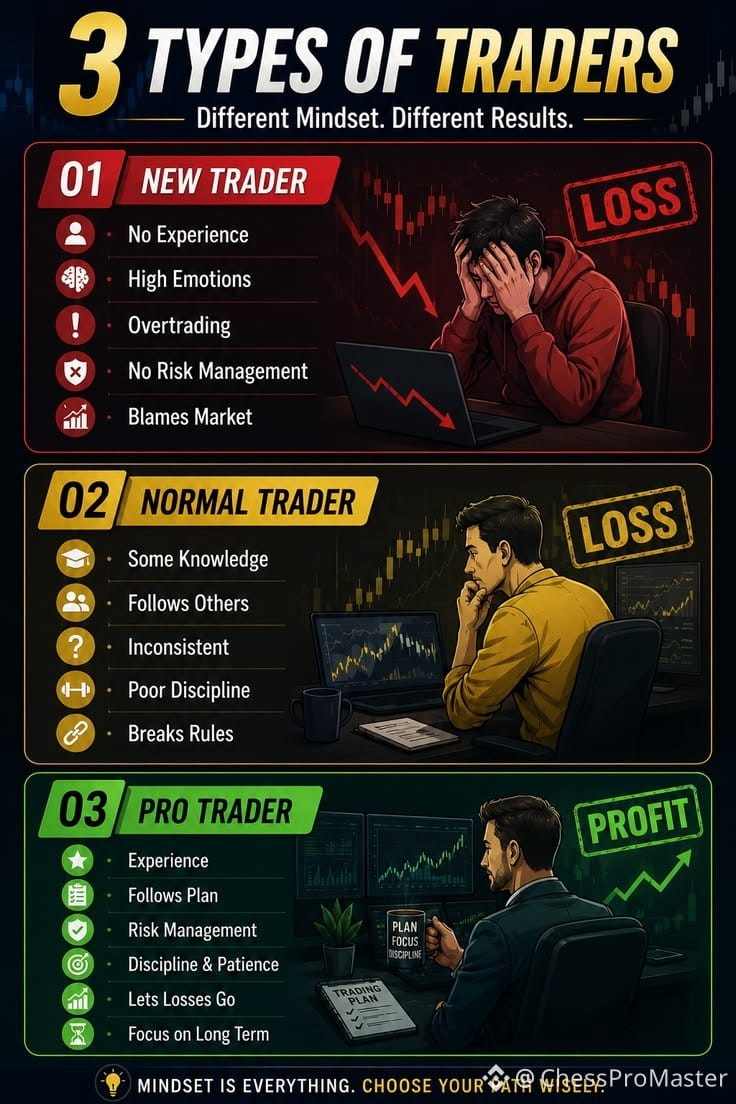
Practice in Trading and Risk management too
Practice in Trading and Risk management too
1
4
83
Connectez-vous pour découvrir plus de contenu
Rejoignez la communauté mondiale des adeptes de cryptomonnaies sur Binance Square
⚡️ Suviez les dernières informations importantes sur les cryptomonnaies.
💬 Jugé digne de confiance par la plus grande plateforme d’échange de cryptomonnaies au monde.
👍 Découvrez les connaissances que partagent les créateurs vérifiés.
Adresse e-mail/Nº de téléphone
Sujets d’actualité
BinancePick
3.3M vues
162,646 mentions
Join #EarningsSeason: Predict Earnings on Binance Pick, Share Your Take on Binance Square!
Binance Square Official
·417 mentions J’aime
·344.8k vues
EarningsSeason
5.4M vues
26,648 mentions
StrategySkipsBitcoinPurchasesSpends$205MOnSTRCBuybacks
219 vues
16 mentions