
BitcoinPierre
379 Publications

BitcoinPierre
Signaler
Bloquer l’utilisateur
0 Suivis
11 Abonnés
42 J’aime
Publications
Voir la traduction
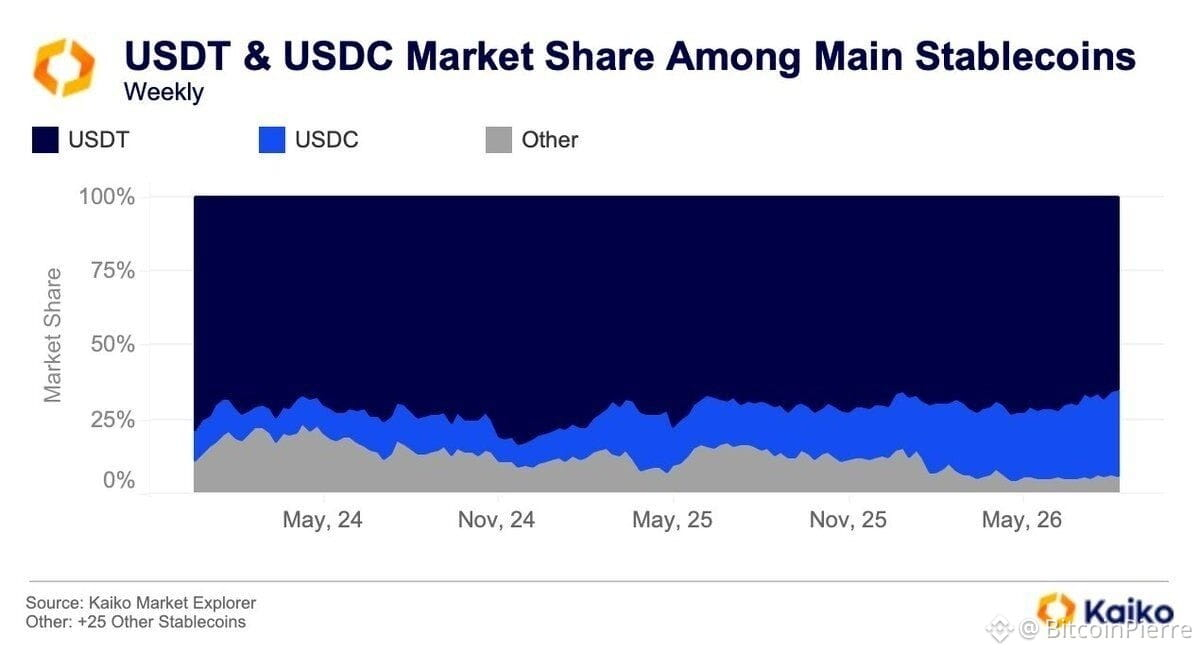
USDT and USDC now dominate the market. Together, Tether’s USDT and Circle’s USDC account for roughly 94% of circulating stablecoin supply, showing just how concentrated the stablecoin market remains. That dominance matters because stablecoins are becoming core infrastructure for trading, payments, DeFi and cross border settlement. The bigger question is whether new stablecoins can meaningfully challenge this duopoly as onchain finance keeps expanding. Two stablecoins still control almost the entire market. #Macro Insights# #StableCoin $USDT $ETH
USDT and USDC now dominate the market. Together, Tether’s USDT and Circle’s USDC account for roughly 94% of circulating stablecoin supply, showing just how concentrated the stablecoin market remains. That dominance matters because stablecoins are becoming core infrastructure for trading, payments, DeFi and cross border settlement. The bigger question is whether new stablecoins can meaningfully challenge this duopoly as onchain finance keeps expanding. Two stablecoins still control almost the entire market. #Macro Insights# #StableCoin $USDT $ETH
47
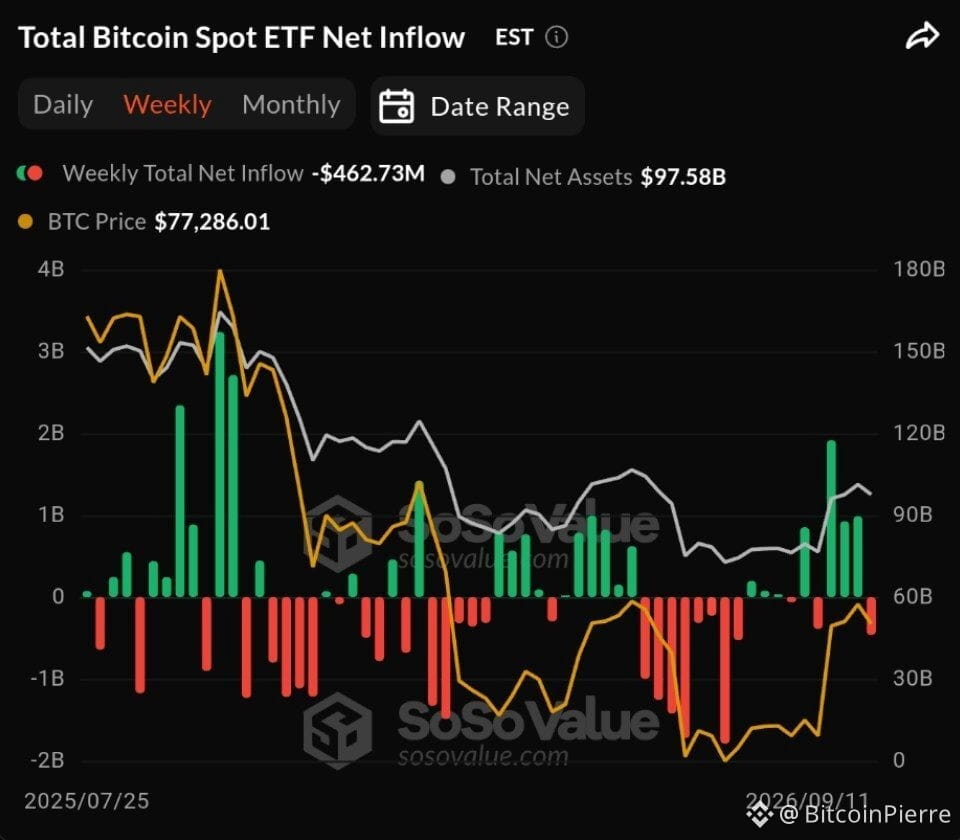
🚨 VEILLE ETF : Les ETF Bitcoin ont échoué à prolonger leur série gagnante. Après trois semaines consécutives d’entrées nettes, les ETF Bitcoin au comptant américains se dirigent désormais vers une quatrième semaine sans flux nets positifs, plusieurs séances ayant vu des investisseurs retirer de l’argent. C’est un changement notable, surtout alors que les ETF Ethereum viennent d’enregistrer leur quatrième semaine consécutive d’entrées. Le contexte macro n’aide pas non plus. Une inflation plus élevée et la hausse des attentes concernant une augmentation du taux de la Fed maintiennent la pression sur les actifs à risque. Pour le BTC, la question clé est de savoir si ces sorties liées aux ETF ne sont qu’une réaction temporaire à l’incertitude macroéconomique ou le début d’un ralentissement plus large de la demande institutionnelle. L’ETH attire des flux. Le Bitcoin perd de l’élan. Cette divergence mérite d’être surveillée. #Analyse du prix BTC# #ETF $BTC $ETH
🚨 VEILLE ETF : Les ETF Bitcoin ont échoué à prolonger leur série gagnante. Après trois semaines consécutives d’entrées nettes, les ETF Bitcoin au comptant américains se dirigent désormais vers une quatrième semaine sans flux nets positifs, plusieurs séances ayant vu des investisseurs retirer de l’argent. C’est un changement notable, surtout alors que les ETF Ethereum viennent d’enregistrer leur quatrième semaine consécutive d’entrées. Le contexte macro n’aide pas non plus. Une inflation plus élevée et la hausse des attentes concernant une augmentation du taux de la Fed maintiennent la pression sur les actifs à risque. Pour le BTC, la question clé est de savoir si ces sorties liées aux ETF ne sont qu’une réaction temporaire à l’incertitude macroéconomique ou le début d’un ralentissement plus large de la demande institutionnelle. L’ETH attire des flux. Le Bitcoin perd de l’élan. Cette divergence mérite d’être surveillée. #Analyse du prix BTC# #ETF $BTC $ETH
65
Voir la traduction
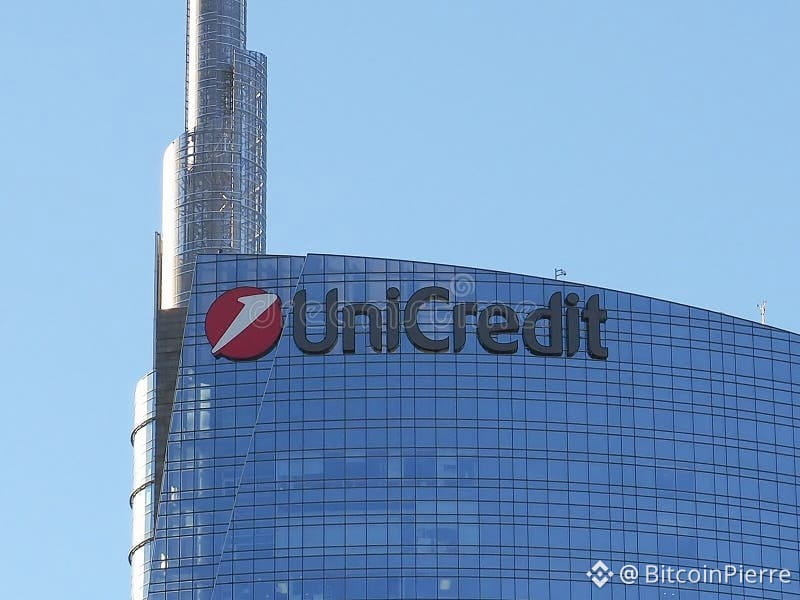
UniCredit is reportedly preparing to launch crypto trading and custody services. Italy’s second-largest bank is moving deeper into digital assets, giving its clients a potential route to buy, sell and hold crypto directly through a traditional banking institution. That’s significant because this isn’t a crypto native company entering finance. It’s an established European bank bringing crypto closer to its existing customer base. UniCredit already has a major presence across Europe, so its move could put further pressure on other banks to develop their own digital-asset offerings. European banking is slowly moving from watching crypto to building around it. #BTC Price Analysis# #Macro Insights# $BTC
UniCredit is reportedly preparing to launch crypto trading and custody services. Italy’s second-largest bank is moving deeper into digital assets, giving its clients a potential route to buy, sell and hold crypto directly through a traditional banking institution. That’s significant because this isn’t a crypto native company entering finance. It’s an established European bank bringing crypto closer to its existing customer base. UniCredit already has a major presence across Europe, so its move could put further pressure on other banks to develop their own digital-asset offerings. European banking is slowly moving from watching crypto to building around it. #BTC Price Analysis# #Macro Insights# $BTC

Voir la traduction
Canada just cleared the way for banks to put deposits onchain. Canada’s banking regulator says federally regulated financial institutions can offer tokenized and digitally represented deposits, provided they comply with existing laws and risk-management requirements. The important part is that the regulator is taking a technology-neutral approach: a deposit doesn’t become a different legal product simply because it runs on blockchain. That could open the door for faster settlement, programmable payments and deeper integration between traditional banking and onchain finance. Banks putting deposits onchain could be a much bigger deal than another crypto narrative. #BTC Price Analysis# #Macro Insights# $BTC $ETH
Canada just cleared the way for banks to put deposits onchain. Canada’s banking regulator says federally regulated financial institutions can offer tokenized and digitally represented deposits, provided they comply with existing laws and risk-management requirements. The important part is that the regulator is taking a technology-neutral approach: a deposit doesn’t become a different legal product simply because it runs on blockchain. That could open the door for faster settlement, programmable payments and deeper integration between traditional banking and onchain finance. Banks putting deposits onchain could be a much bigger deal than another crypto narrative. #BTC Price Analysis# #Macro Insights# $BTC $ETH

67
Voir la traduction
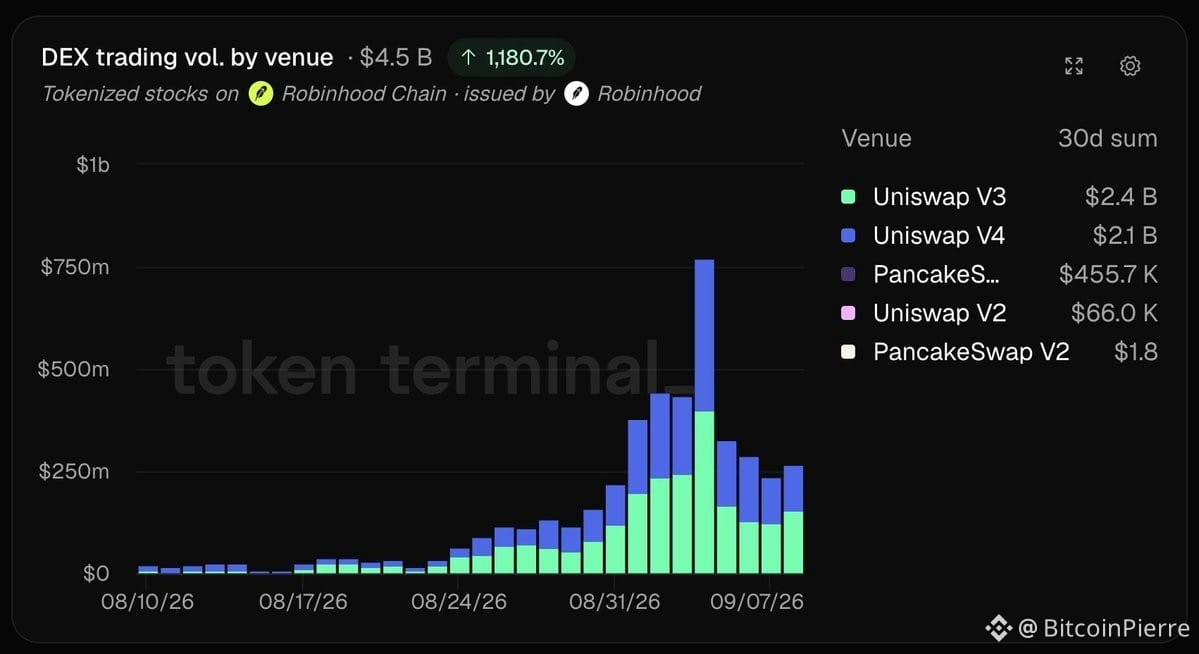
Robinhood’s stock-token ecosystem is seeing billions of dollars in onchain trading activity. Token Terminal data highlights just how quickly tokenized equities are gaining traction across decentralized markets. The growth is happening alongside Robinhood Chain’s rapid expansion, with more than 190 Stock Tokens now available and tokenized equities making up the majority of the network’s tokenized value. #BTC Price Analysis# #Macro Insights# $BTC $ETH
Robinhood’s stock-token ecosystem is seeing billions of dollars in onchain trading activity. Token Terminal data highlights just how quickly tokenized equities are gaining traction across decentralized markets. The growth is happening alongside Robinhood Chain’s rapid expansion, with more than 190 Stock Tokens now available and tokenized equities making up the majority of the network’s tokenized value. #BTC Price Analysis# #Macro Insights# $BTC $ETH
Voir la traduction
Launching a token is one thing. Making sure there is a clear path from the first trade to sustainable liquidity is another challenge entirely. That’s why the Stonks integration with Stonfi caught my attention. Stonks brings token launches, custom bonding curves, liquidity seeding and presales into one ecosystem, while stonfi provides the liquidity infrastructure on the other side. The important part is what happens between those stages. Tokens launched through bonding curves can graduate directly into Stonfi pools, allowing liquidity to continue moving forward instead of forcing teams to rebuild the process manually. Builders can also provision liquidity into Stonfi pools directly. For users, the integration adds another layer of accessibility. STON.fi tokens can be swapped through the Stonks terminal and Telegram bot, while Omniston can provide optimized routes ahead of migration. This is the kind of infrastructure connection that can make TON’s DeFi ecosystem more composable: launch, liquidity and trading becoming parts of the same flow rather than isolated products. #BTC Price Analysis# #Macro Insights# $BTC $ETH
Launching a token is one thing. Making sure there is a clear path from the first trade to sustainable liquidity is another challenge entirely. That’s why the Stonks integration with Stonfi caught my attention. Stonks brings token launches, custom bonding curves, liquidity seeding and presales into one ecosystem, while stonfi provides the liquidity infrastructure on the other side. The important part is what happens between those stages. Tokens launched through bonding curves can graduate directly into Stonfi pools, allowing liquidity to continue moving forward instead of forcing teams to rebuild the process manually. Builders can also provision liquidity into Stonfi pools directly. For users, the integration adds another layer of accessibility. STON.fi tokens can be swapped through the Stonks terminal and Telegram bot, while Omniston can provide optimized routes ahead of migration. This is the kind of infrastructure connection that can make TON’s DeFi ecosystem more composable: launch, liquidity and trading becoming parts of the same flow rather than isolated products. #BTC Price Analysis# #Macro Insights# $BTC $ETH

65
Voir la traduction
Treasury Secretary Scott Bessent is pushing lawmakers to advance the CLARITY Act, warning that failing to act would signal that the U.S. is unwilling to lead the future of digital assets. The timing is important. The Senate is preparing for a key procedural vote on the bill on September 15, while crypto and banking groups are intensifying their lobbying efforts. The CLARITY Act is designed to establish a clearer regulatory framework for digital assets, including defining which tokens and activities fall under different federal regulators. Supporters argue that clearer rules could give crypto companies more certainty and encourage innovation to remain in the U.S. But the bill still faces significant opposition, including concerns around consumer protection, illicit finance and its potential impact on the banking sector. For crypto markets, this is bigger than another Washington debate. Clearer legislation could reduce one of the industry’s biggest uncertainties: who regulates what. If the Senate moves the bill forward, it could become a major catalyst for the U.S. crypto industry. If lawmakers fail to reach a deal, the uncertainty continues. The next major test comes September 15. #BTC Price Analysis# #Macro Insights# $BTC $ETH
Treasury Secretary Scott Bessent is pushing lawmakers to advance the CLARITY Act, warning that failing to act would signal that the U.S. is unwilling to lead the future of digital assets. The timing is important. The Senate is preparing for a key procedural vote on the bill on September 15, while crypto and banking groups are intensifying their lobbying efforts. The CLARITY Act is designed to establish a clearer regulatory framework for digital assets, including defining which tokens and activities fall under different federal regulators. Supporters argue that clearer rules could give crypto companies more certainty and encourage innovation to remain in the U.S. But the bill still faces significant opposition, including concerns around consumer protection, illicit finance and its potential impact on the banking sector. For crypto markets, this is bigger than another Washington debate. Clearer legislation could reduce one of the industry’s biggest uncertainties: who regulates what. If the Senate moves the bill forward, it could become a major catalyst for the U.S. crypto industry. If lawmakers fail to reach a deal, the uncertainty continues. The next major test comes September 15. #BTC Price Analysis# #Macro Insights# $BTC $ETH

36
Voir la traduction
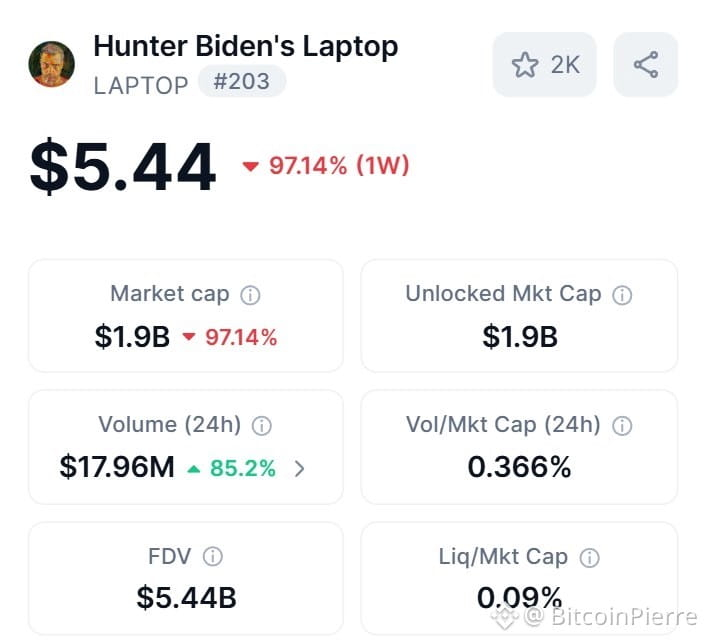
$LAPTOP entered the market with a highly controversial narrative, including a planned community allocation for people who lost money on $TRUMP . But even a strong story cannot guarantee sustained buying pressure. The bigger lesson is the same one the market keeps repeating: viral attention is not the same as lasting demand. $LAPTOP went from political spectacle to a 97%+ drawdown extremely fast. Now the question is whether buyers step back in, or whether the launch becomes another example of why chasing memecoin hype can be extremely dangerous. #BTC Price Analysis#
$LAPTOP entered the market with a highly controversial narrative, including a planned community allocation for people who lost money on $TRUMP . But even a strong story cannot guarantee sustained buying pressure. The bigger lesson is the same one the market keeps repeating: viral attention is not the same as lasting demand. $LAPTOP went from political spectacle to a 97%+ drawdown extremely fast. Now the question is whether buyers step back in, or whether the launch becomes another example of why chasing memecoin hype can be extremely dangerous. #BTC Price Analysis#
39
Voir la traduction
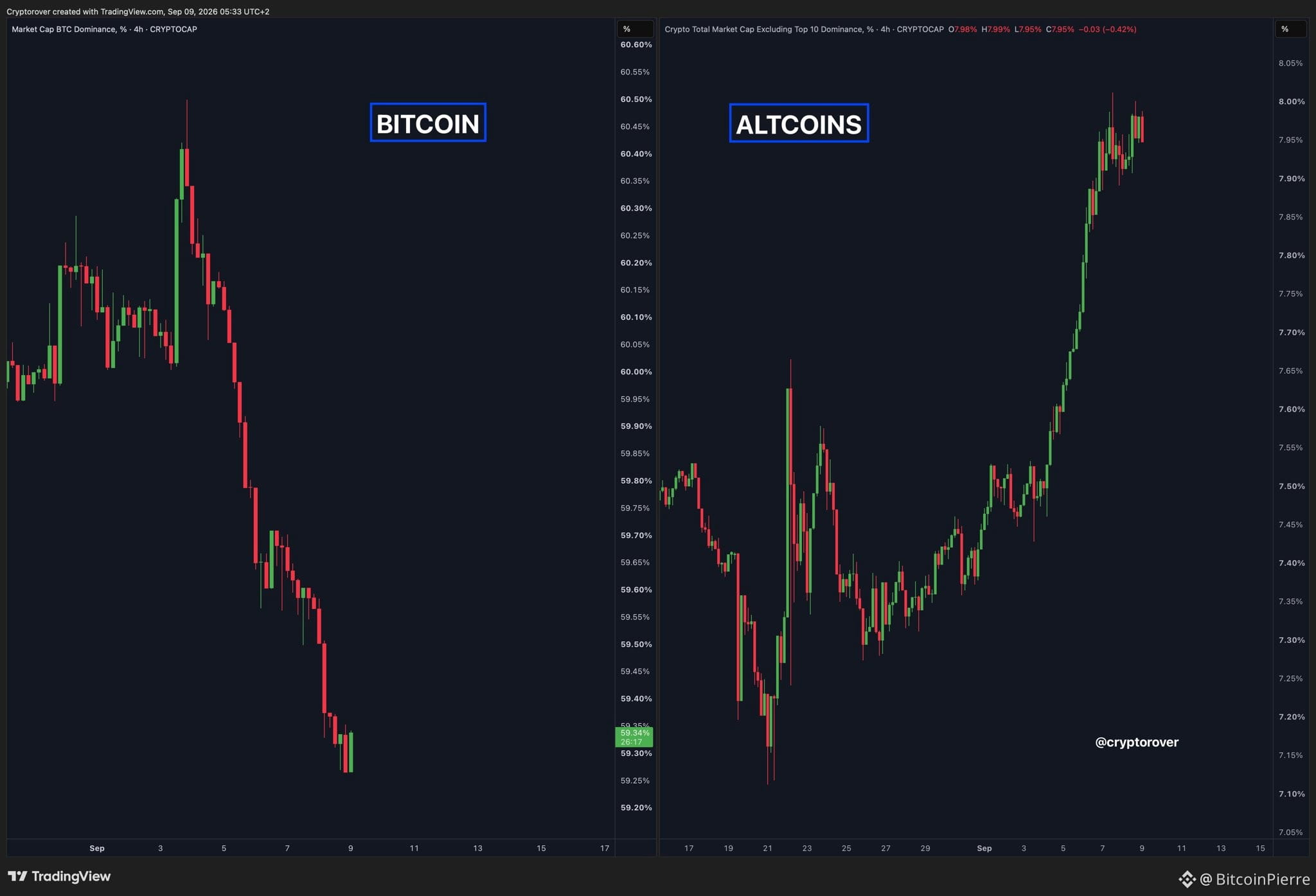
Bitcoin dominance is slipping while altcoins are taking back market share. This is the kind of setup traders watch when looking for a potential shift from Bitcoin season to altseason. BTC is currently hovering around the $79K area after pulling back from last week’s highs, while parts of the altcoin market are showing stronger relative performance. Falling BTC dominance alone doesn’t guarantee an altseason. The stronger signal comes when BTC dominance falls while total crypto market capitalization continues rising, meaning capital is actually rotating into higher beta assets rather than simply leaving the market. #BTC Price Analysis# #Altcoin Season# $ZEC $ARB
Bitcoin dominance is slipping while altcoins are taking back market share. This is the kind of setup traders watch when looking for a potential shift from Bitcoin season to altseason. BTC is currently hovering around the $79K area after pulling back from last week’s highs, while parts of the altcoin market are showing stronger relative performance. Falling BTC dominance alone doesn’t guarantee an altseason. The stronger signal comes when BTC dominance falls while total crypto market capitalization continues rising, meaning capital is actually rotating into higher beta assets rather than simply leaving the market. #BTC Price Analysis# #Altcoin Season# $ZEC $ARB
53
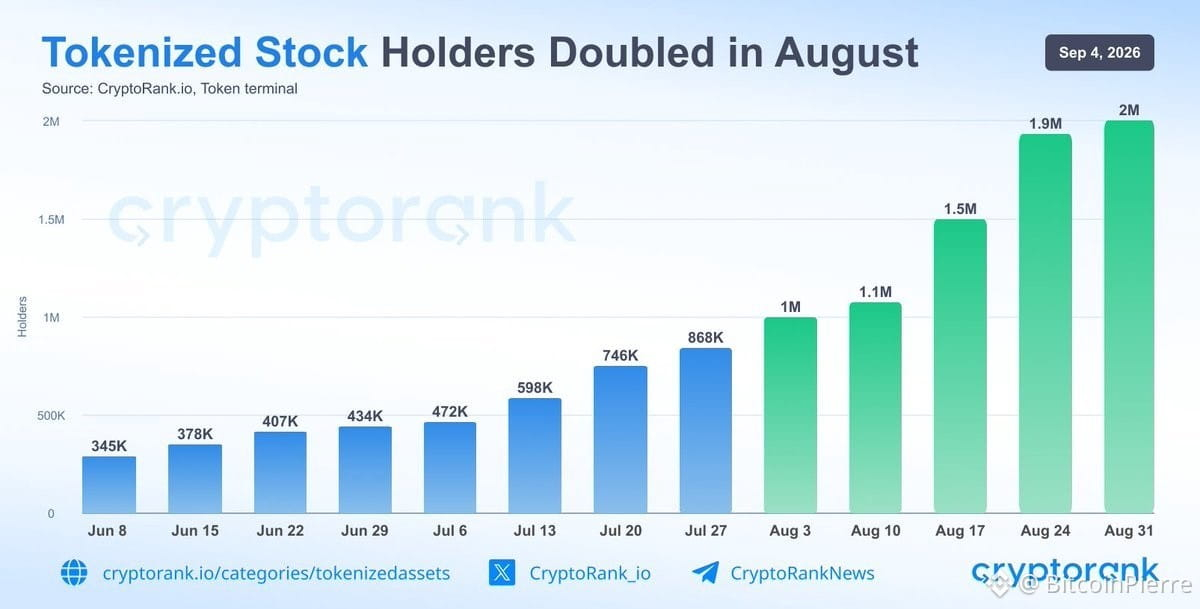
Les détenteurs d’actions tokenisées ont doublé en août, atteignant 2 millions. D’après les données de CryptoRank, le nombre de portefeuilles détenant des actions tokenisées est passé d’environ 1 million à 2 millions en un seul mois. Il s’agit d’une accélération notable pour une classe d’actifs encore relativement récente sur l’ensemble du marché. Encore plus intéressant : la concentration de cette activité. La Robinhood Chain, la BNB Chain et la Solana représentent environ 95% de tous les détenteurs d’actions tokenisées, ce qui montre que seuls quelques réseaux capturent actuellement la majeure partie de la demande. La croissance intervient aussi alors que les actions tokenisées s’étendent au-delà du simple fait de répliquer des actions traditionnelles onchain. Le trading devient l’un des principaux cas d’usage, avec un volume hebdomadaire au comptant d’actions tokenisées atteignant près de 3 milliards de dollars début août, et un TVL onchain dépassant 110 millions de dollars fin août. Mais l’adoption n’est encore qu’une partie de l’histoire. La prochaine phase consistera à savoir si ces actifs tokenisés deviennent utiles comme collatéral, dans le crédit et dans l’ensemble des applications DeFi plus larges. #Analyse du prix du BTC# #Saison des altcoins# $BTC $BNB
Les détenteurs d’actions tokenisées ont doublé en août, atteignant 2 millions. D’après les données de CryptoRank, le nombre de portefeuilles détenant des actions tokenisées est passé d’environ 1 million à 2 millions en un seul mois. Il s’agit d’une accélération notable pour une classe d’actifs encore relativement récente sur l’ensemble du marché. Encore plus intéressant : la concentration de cette activité. La Robinhood Chain, la BNB Chain et la Solana représentent environ 95% de tous les détenteurs d’actions tokenisées, ce qui montre que seuls quelques réseaux capturent actuellement la majeure partie de la demande. La croissance intervient aussi alors que les actions tokenisées s’étendent au-delà du simple fait de répliquer des actions traditionnelles onchain. Le trading devient l’un des principaux cas d’usage, avec un volume hebdomadaire au comptant d’actions tokenisées atteignant près de 3 milliards de dollars début août, et un TVL onchain dépassant 110 millions de dollars fin août. Mais l’adoption n’est encore qu’une partie de l’histoire. La prochaine phase consistera à savoir si ces actifs tokenisés deviennent utiles comme collatéral, dans le crédit et dans l’ensemble des applications DeFi plus larges. #Analyse du prix du BTC# #Saison des altcoins# $BTC $BNB
46
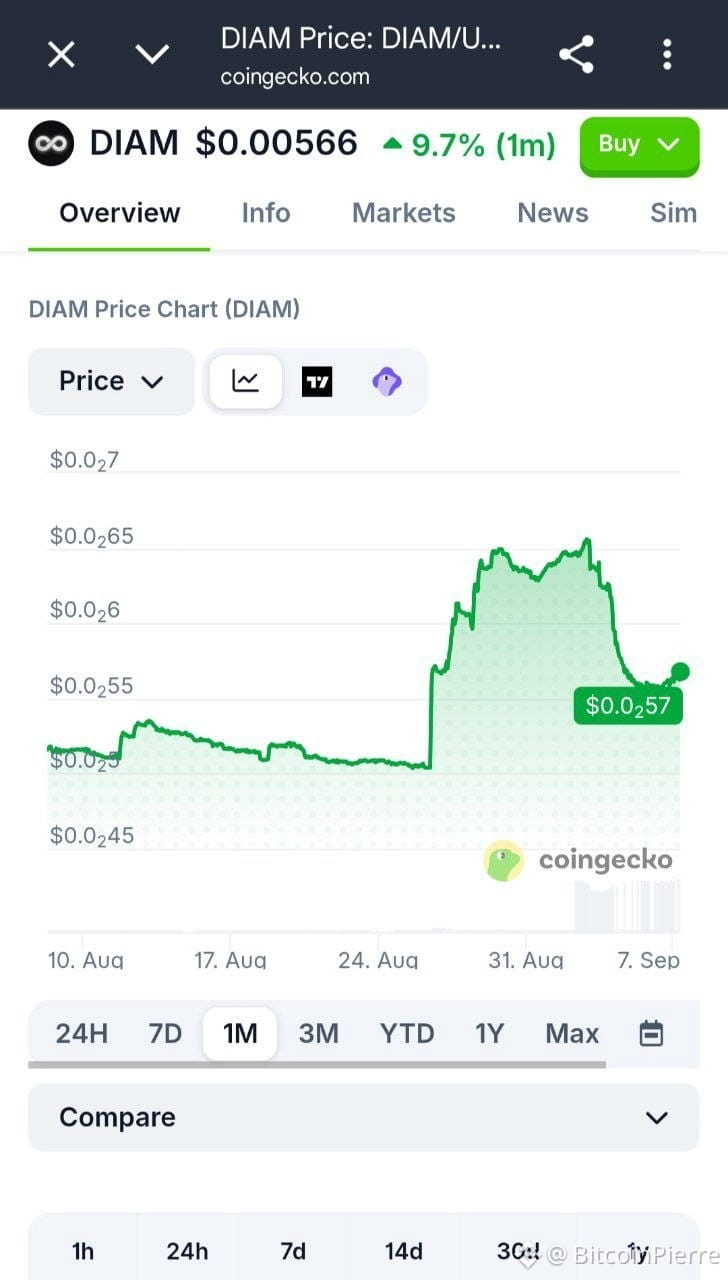
BTC continue de donner le ton au marché plus large, mais certains altcoins commencent à montrer des signes de regain de force. $DIAM en fait partie, et s’échange actuellement autour de 0,00566 $. Avec plus de 9% de hausse au cours du dernier mois, les acheteurs semblent progressivement revenir après la récente phase de consolidation. Le prochain niveau de résistance est là où les choses pourraient devenir intéressantes. Une cassure nette, soutenue par un volume important, donnerait plus de crédibilité au mouvement et pourrait ouvrir la porte à un potentiel de hausse supplémentaire. Pour l’instant, il n’est pas nécessaire de forcer le récit. Laissez le graphique confirmer le mouvement. @Diam #Analyse du prix du BTC# #Perspectives macro# $TAO
BTC continue de donner le ton au marché plus large, mais certains altcoins commencent à montrer des signes de regain de force. $DIAM en fait partie, et s’échange actuellement autour de 0,00566 $. Avec plus de 9% de hausse au cours du dernier mois, les acheteurs semblent progressivement revenir après la récente phase de consolidation. Le prochain niveau de résistance est là où les choses pourraient devenir intéressantes. Une cassure nette, soutenue par un volume important, donnerait plus de crédibilité au mouvement et pourrait ouvrir la porte à un potentiel de hausse supplémentaire. Pour l’instant, il n’est pas nécessaire de forcer le récit. Laissez le graphique confirmer le mouvement. @Diam #Analyse du prix du BTC# #Perspectives macro# $TAO
70
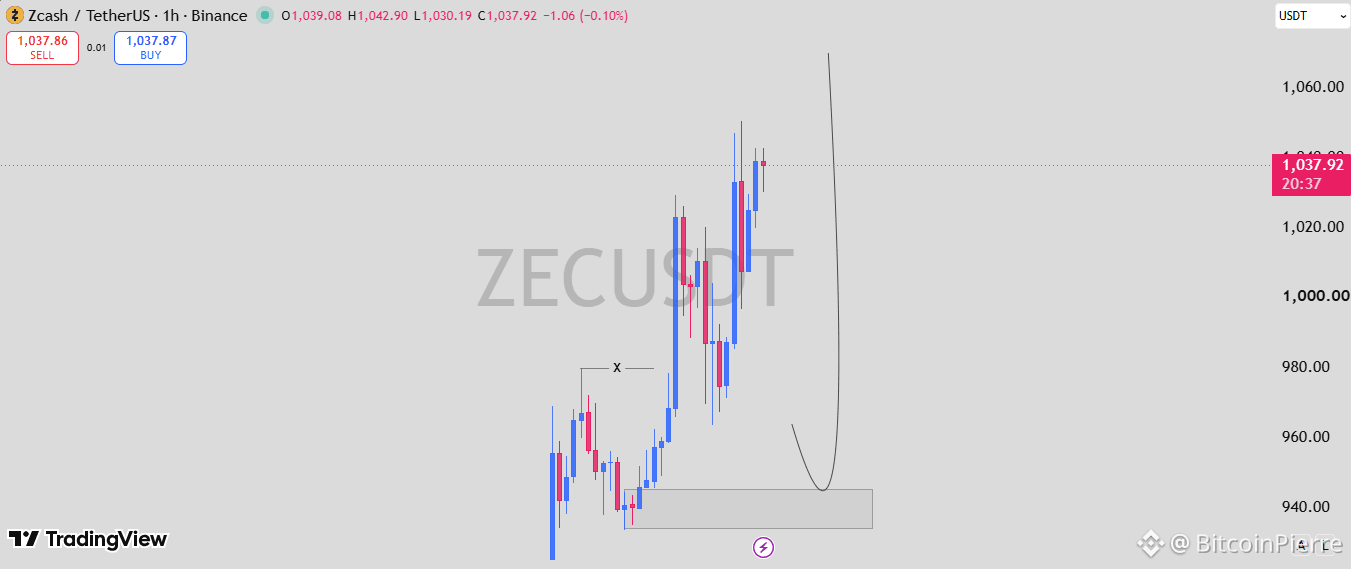
$ZEC BREAKS ABOVE $1,000 AS BUYERS TARGET A NEW HIGHER RANGE Zcash affiche une dynamique agressive sur le graphique 1H, avec ZEC qui grimpe depuis la zone de demande $940–$950 et reprend le niveau psychologique des $1 000. La structure est clairement haussière à court terme, avec des plus hauts et des plus bas plus élevés après la consolidation précédente. La question immédiate est de savoir si ZEC peut maintenir la cassure ou s’il faut un autre retest. Le prix est déjà entré dans la zone $1 030–$1 040, donc une prise de profits autour de ces niveaux serait normale après un mouvement aussi prolongé. La zone de demande marquée $935–$950 reste la zone clé à surveiller en cas de repli. Si les acheteurs la défendent, la structure actuelle pourrait soutenir une poursuite vers $1 060 et potentiellement plus. En revanche, perdre $935 affaiblirait la configuration haussière et suggérerait une correction plus profonde. Le mouvement plus large est également significatif : ZEC a fortement progressé au cours des derniers sessions, avec des données récentes montrant de fortes hausses quotidiennes et une activité de trading accrue. #Zcash
$ZEC BREAKS ABOVE $1,000 AS BUYERS TARGET A NEW HIGHER RANGE Zcash affiche une dynamique agressive sur le graphique 1H, avec ZEC qui grimpe depuis la zone de demande $940–$950 et reprend le niveau psychologique des $1 000. La structure est clairement haussière à court terme, avec des plus hauts et des plus bas plus élevés après la consolidation précédente. La question immédiate est de savoir si ZEC peut maintenir la cassure ou s’il faut un autre retest. Le prix est déjà entré dans la zone $1 030–$1 040, donc une prise de profits autour de ces niveaux serait normale après un mouvement aussi prolongé. La zone de demande marquée $935–$950 reste la zone clé à surveiller en cas de repli. Si les acheteurs la défendent, la structure actuelle pourrait soutenir une poursuite vers $1 060 et potentiellement plus. En revanche, perdre $935 affaiblirait la configuration haussière et suggérerait une correction plus profonde. Le mouvement plus large est également significatif : ZEC a fortement progressé au cours des derniers sessions, avec des données récentes montrant de fortes hausses quotidiennes et une activité de trading accrue. #Zcash
41
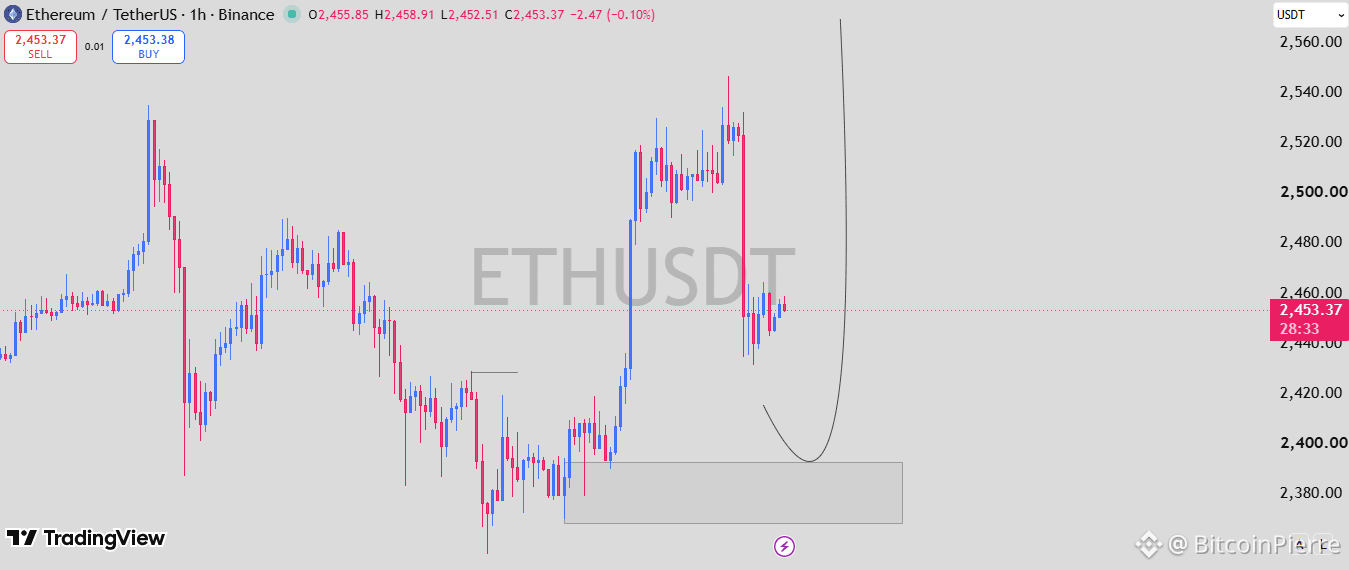
Ethereum se consolide autour de 2 453 $ après un net rejet depuis la zone des 2 520–2 540 $. Le graphique en 1H montre un mouvement impulsif agressif suivi d’un retracement rapide, mais les acheteurs ont réussi à stabiliser le prix autour de la zone des 2 450 $, plutôt que de permettre une cassure plus profonde. La structure clé est la zone de demande marquée des 2 370–2 400 $. C’est la zone que je surveillerais pour un éventuel setup de continuation. Si $ETH retrace vers cette zone et que les acheteurs interviennent, la structure de plus bas plus élevé actuelle pourrait soutenir une nouvelle tentative vers 2 520–2 540, avec 2 560 comme prochain niveau majeur de cassure. Une cassure nette au-dessus de 2 560 renforcerait le scénario de continuation haussière. En revanche, perdre 2 370 affaiblirait considérablement la configuration et suggérerait que la récente hausse nécessite une correction plus profonde. Cela concorde aussi avec la structure du marché plus large, où 2 550 reste un niveau de résistance majeur tandis que 2 438 a été identifié comme support important. #BTC Price Analysis# #Ethereum
Ethereum se consolide autour de 2 453 $ après un net rejet depuis la zone des 2 520–2 540 $. Le graphique en 1H montre un mouvement impulsif agressif suivi d’un retracement rapide, mais les acheteurs ont réussi à stabiliser le prix autour de la zone des 2 450 $, plutôt que de permettre une cassure plus profonde. La structure clé est la zone de demande marquée des 2 370–2 400 $. C’est la zone que je surveillerais pour un éventuel setup de continuation. Si $ETH retrace vers cette zone et que les acheteurs interviennent, la structure de plus bas plus élevé actuelle pourrait soutenir une nouvelle tentative vers 2 520–2 540, avec 2 560 comme prochain niveau majeur de cassure. Une cassure nette au-dessus de 2 560 renforcerait le scénario de continuation haussière. En revanche, perdre 2 370 affaiblirait considérablement la configuration et suggérerait que la récente hausse nécessite une correction plus profonde. Cela concorde aussi avec la structure du marché plus large, où 2 550 reste un niveau de résistance majeur tandis que 2 438 a été identifié comme support important. #BTC Price Analysis# #Ethereum
29
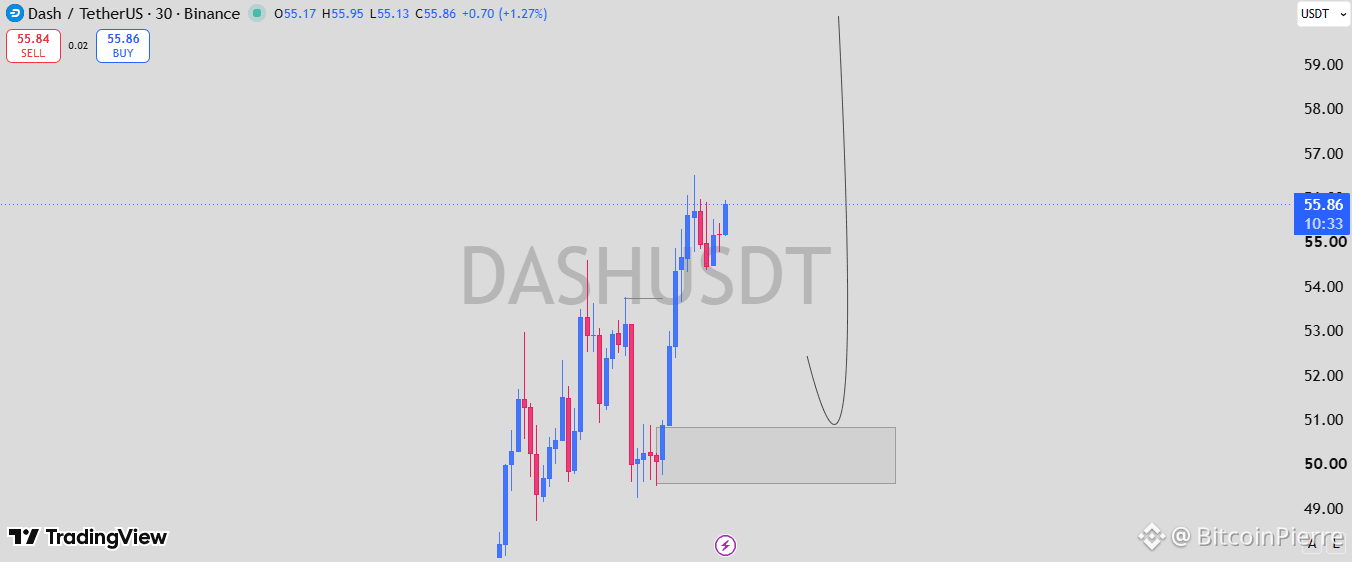
DASH CONSOLIDE LA HAUSSE, MAIS 51–50 EST LA ZONE DE RETEST CLÉ $DASH maintient une forte tendance haussière à court terme sur le graphique 30 minutes, s’échangeant actuellement autour de 55,86 $ après une séquence de plus hauts et de plus bas ascendants. Le développement important est le mouvement impulsif depuis la zone de demande 50–51 $, qui a désormais poussé le prix vers la zone des 56 $. Cependant, après une expansion aussi marquée, une correction ne remettrait pas nécessairement en cause la structure haussière. La zone de demande 49,8–50,9 $ indiquée est la zone clé à surveiller si le prix retrace. Une réaction maîtrisée à cet endroit pourrait fournir la base pour une nouvelle impulsion vers 57–59 $. Le scénario s’affaiblit si $DASH perd la zone de demande de manière décisive, notamment avec des échanges soutenus en dessous de 49,80 $. Cela suggérerait que la percée récente perd son élan et pourrait déclencher une correction plus profonde. Comme DASH enregistre également un élan de marché inhabituellement fort aujourd’hui, la volatilité est susceptible de rester élevée. #BTC Price Analysis# #DASH #Macro Insights#
DASH CONSOLIDE LA HAUSSE, MAIS 51–50 EST LA ZONE DE RETEST CLÉ $DASH maintient une forte tendance haussière à court terme sur le graphique 30 minutes, s’échangeant actuellement autour de 55,86 $ après une séquence de plus hauts et de plus bas ascendants. Le développement important est le mouvement impulsif depuis la zone de demande 50–51 $, qui a désormais poussé le prix vers la zone des 56 $. Cependant, après une expansion aussi marquée, une correction ne remettrait pas nécessairement en cause la structure haussière. La zone de demande 49,8–50,9 $ indiquée est la zone clé à surveiller si le prix retrace. Une réaction maîtrisée à cet endroit pourrait fournir la base pour une nouvelle impulsion vers 57–59 $. Le scénario s’affaiblit si $DASH perd la zone de demande de manière décisive, notamment avec des échanges soutenus en dessous de 49,80 $. Cela suggérerait que la percée récente perd son élan et pourrait déclencher une correction plus profonde. Comme DASH enregistre également un élan de marché inhabituellement fort aujourd’hui, la volatilité est susceptible de rester élevée. #BTC Price Analysis# #DASH #Macro Insights#
47
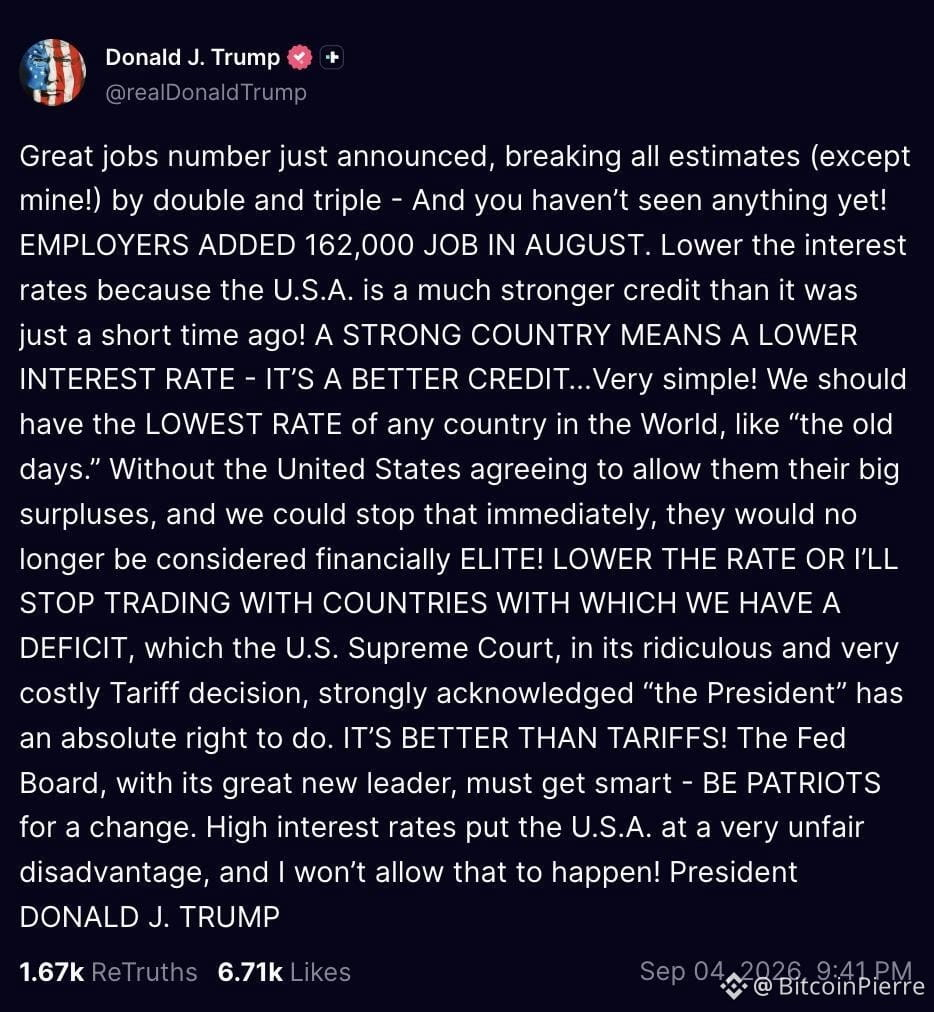
Trump intensifie la pression sur la Réserve fédérale pour qu’elle baisse les taux d’intérêt. Le président Donald Trump a appelé à des taux plus bas et a menacé de suspendre les échanges avec des pays avec lesquels les États-Unis affichent des déficits commerciaux si la Fed n’agit pas. Ces propos ont été formulés peu après la publication de données sur l’emploi d’août plus solides que prévu, renforçant les attentes selon lesquelles la banque centrale pourrait maintenir sa politique restrictive. Le calendrier rend cette évolution particulièrement significative. Les États-Unis ont créé 162 000 emplois en août, bien au-dessus des prévisions, tandis que le taux de chômage restait à 4,1 %. Dans le même temps, l’inflation demeure élevée, ce qui donne à la Fed une raison d’être prudente avant de baisser les taux. Pour les marchés, le conflit entre la pression politique et la politique monétaire pourrait devenir de plus en plus important. Des taux plus bas soutiennent généralement la liquidité et les actifs à risque, dont la crypto, mais une trajectoire de baisses de taux agressive alors que l’inflation reste tenace pourrait engendrer un tout autre ensemble de risques. L’indépendance de la Fed fait désormais face à un nouvel important test. Les décideurs politiques donneront-ils la priorité aux données économiques, ou la pression politique commencera-t-elle à influencer la trajectoire des taux ? #Analyse du prix du BTC# #SEC $BTC $TRUMP
Trump intensifie la pression sur la Réserve fédérale pour qu’elle baisse les taux d’intérêt. Le président Donald Trump a appelé à des taux plus bas et a menacé de suspendre les échanges avec des pays avec lesquels les États-Unis affichent des déficits commerciaux si la Fed n’agit pas. Ces propos ont été formulés peu après la publication de données sur l’emploi d’août plus solides que prévu, renforçant les attentes selon lesquelles la banque centrale pourrait maintenir sa politique restrictive. Le calendrier rend cette évolution particulièrement significative. Les États-Unis ont créé 162 000 emplois en août, bien au-dessus des prévisions, tandis que le taux de chômage restait à 4,1 %. Dans le même temps, l’inflation demeure élevée, ce qui donne à la Fed une raison d’être prudente avant de baisser les taux. Pour les marchés, le conflit entre la pression politique et la politique monétaire pourrait devenir de plus en plus important. Des taux plus bas soutiennent généralement la liquidité et les actifs à risque, dont la crypto, mais une trajectoire de baisses de taux agressive alors que l’inflation reste tenace pourrait engendrer un tout autre ensemble de risques. L’indépendance de la Fed fait désormais face à un nouvel important test. Les décideurs politiques donneront-ils la priorité aux données économiques, ou la pression politique commencera-t-elle à influencer la trajectoire des taux ? #Analyse du prix du BTC# #SEC $BTC $TRUMP
59
L’un des plus grands défis liés à l’activité inter-chaînes consiste à rendre le processus compréhensible pour les utilisateurs qui ne veulent pas gérer une infrastructure compliquée. C’est là que les expériences guidées peuvent faire la différence. La campagne « One Swap. Across Chains » de Stonfi est conçue pour permettre aux utilisateurs d’apprendre en participant. Au lieu de simplement expliquer comment fonctionnent les swaps inter-chaînes, la campagne transforme le processus en tâches, missions et récompenses que les utilisateurs peuvent accomplir lorsqu’ils explorent. La liste d’attente de deux semaines fait déjà partie intégrante de la campagne. Les 1 000 premiers utilisateurs qui connectent leur portefeuille TON peuvent réclamer 1 000 miles bonus, ainsi qu’un billet Priority Passenger Ticket personnalisé et un statut prioritaire. Plus de miles peuvent être gagnés grâce à des missions futures et utilisés pour des Flight Deals en quantité limitée tout au long de la campagne. Le tableau d’ensemble vaut le coup d’être surveillé. À mesure que la DeFi devient de plus en plus multichaîne, réduire les frictions liées au transfert d’actifs entre les réseaux pourrait être aussi important que d’étendre la liquidité elle-même. Liste d’attente : https://cross-chain.ston.fi/ #BTC Price Analysis# #Macro Insights# $BTC $ZEC
L’un des plus grands défis liés à l’activité inter-chaînes consiste à rendre le processus compréhensible pour les utilisateurs qui ne veulent pas gérer une infrastructure compliquée. C’est là que les expériences guidées peuvent faire la différence. La campagne « One Swap. Across Chains » de Stonfi est conçue pour permettre aux utilisateurs d’apprendre en participant. Au lieu de simplement expliquer comment fonctionnent les swaps inter-chaînes, la campagne transforme le processus en tâches, missions et récompenses que les utilisateurs peuvent accomplir lorsqu’ils explorent. La liste d’attente de deux semaines fait déjà partie intégrante de la campagne. Les 1 000 premiers utilisateurs qui connectent leur portefeuille TON peuvent réclamer 1 000 miles bonus, ainsi qu’un billet Priority Passenger Ticket personnalisé et un statut prioritaire. Plus de miles peuvent être gagnés grâce à des missions futures et utilisés pour des Flight Deals en quantité limitée tout au long de la campagne. Le tableau d’ensemble vaut le coup d’être surveillé. À mesure que la DeFi devient de plus en plus multichaîne, réduire les frictions liées au transfert d’actifs entre les réseaux pourrait être aussi important que d’étendre la liquidité elle-même. Liste d’attente : https://cross-chain.ston.fi/ #BTC Price Analysis# #Macro Insights# $BTC $ZEC

71
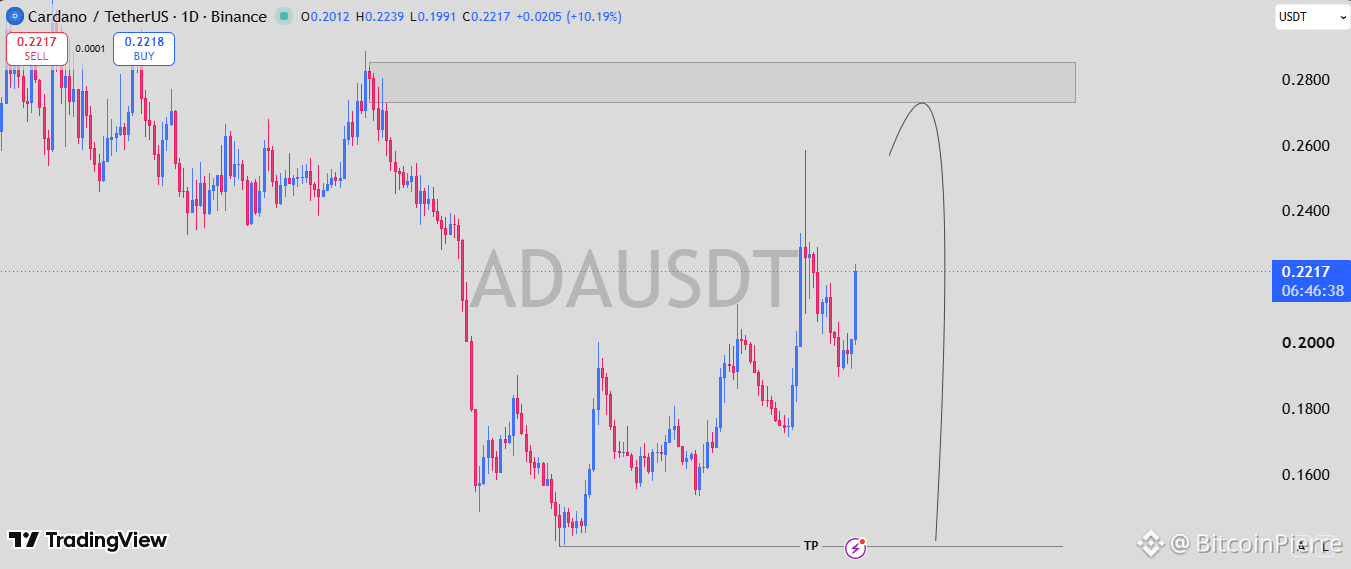
$ADA GRIMPE DE 10% EN RÉSISTANCE Cardano affiche une forte reprise quotidienne : ADA grimpe de plus de 10% et reprend la zone des 0,22 $. Cependant, la structure globale comporte encore un obstacle majeur au-dessus. La zone clé se situe autour de 0,27–0,285 $, où les mouvements de prix précédents ont généré une pression de vente significative. La hausse actuelle pourrait donc ne devenir un mouvement de continuation que si les acheteurs parviennent à accumuler assez d’élan pour percer cette offre. D’ici là, le graphique plaide pour la prudence aux niveaux plus élevés. Un rejet depuis la région des 0,27–0,285 $ pourrait déclencher une correction substantielle, avec 0,20 $ comme niveau intermédiaire important avant que la structure baissière plus profonde autour de 0,15 $ ne soit mise en évidence. Cela correspondrait aussi au grand schéma de reprise puis rejet visible sur le graphique quotidien. Le scénario haussier change si $ADA passe au-dessus de 0,285 $ et s’y maintient en tant que support. Cela invaliderait le setup de rejet immédiat et renforcerait l’hypothèse d’une poursuite de la hausse. #BTC Price Analysis# #Cardano
$ADA GRIMPE DE 10% EN RÉSISTANCE Cardano affiche une forte reprise quotidienne : ADA grimpe de plus de 10% et reprend la zone des 0,22 $. Cependant, la structure globale comporte encore un obstacle majeur au-dessus. La zone clé se situe autour de 0,27–0,285 $, où les mouvements de prix précédents ont généré une pression de vente significative. La hausse actuelle pourrait donc ne devenir un mouvement de continuation que si les acheteurs parviennent à accumuler assez d’élan pour percer cette offre. D’ici là, le graphique plaide pour la prudence aux niveaux plus élevés. Un rejet depuis la région des 0,27–0,285 $ pourrait déclencher une correction substantielle, avec 0,20 $ comme niveau intermédiaire important avant que la structure baissière plus profonde autour de 0,15 $ ne soit mise en évidence. Cela correspondrait aussi au grand schéma de reprise puis rejet visible sur le graphique quotidien. Le scénario haussier change si $ADA passe au-dessus de 0,285 $ et s’y maintient en tant que support. Cela invaliderait le setup de rejet immédiat et renforcerait l’hypothèse d’une poursuite de la hausse. #BTC Price Analysis# #Cardano
32
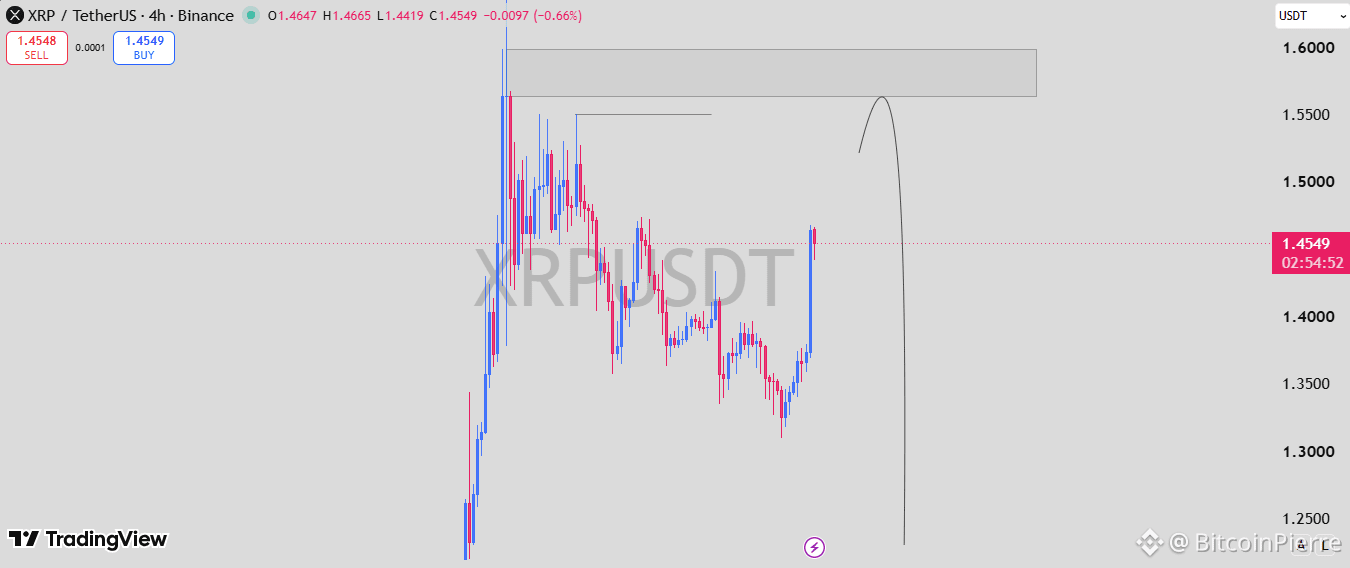
$XRP FAIT UN SAUT DANS UN IMPORTANT NIVEAU D’OFFRE : LE RISQUE DE REVIREMENT S’ACCROÎT $XRP vient tout juste d’offrir un rebond net sur le graphique en 4H, passant de la zone $1.30–$1.35 vers $1.45 et retrouvant un élan à court terme. Toutefois, la hausse s’approche désormais d’une zone de résistance beaucoup plus cruciale. La zone clé à surveiller est celle des $1.55–$1.60, où l’action précédente des prix a montré une forte pression vendeuse. Si XRP continue à monter et atteint cette zone sans qu’il y ait un vrai breakout, la structure pourrait favoriser un nouveau rejet. Un échec autour de $1.50–$1.55 augmenterait la probabilité d’une correction vers $1.35 en premier, la structure du graphique laissant ensuite de la place pour un mouvement plus profond vers $1.25. Le scénario haussier change si XRP casse et tient de manière décisive au-dessus de $1.60. Cela invaliderait la configuration de rejet immédiat et signalerait un potentiel de continuation plus solide. Pour l’instant, le ratio risque/récompense devient de plus en plus important à mesure que le prix grimpe vers une zone d’offre. Les données actuelles du marché indiquent également que XRP s’échange autour du milieu des $1.30 jusqu’aux $1.40, rendant la zone $1.35–$1.40 toujours pertinente comme structure proche. #BTC Price Analysis# #XRP
$XRP FAIT UN SAUT DANS UN IMPORTANT NIVEAU D’OFFRE : LE RISQUE DE REVIREMENT S’ACCROÎT $XRP vient tout juste d’offrir un rebond net sur le graphique en 4H, passant de la zone $1.30–$1.35 vers $1.45 et retrouvant un élan à court terme. Toutefois, la hausse s’approche désormais d’une zone de résistance beaucoup plus cruciale. La zone clé à surveiller est celle des $1.55–$1.60, où l’action précédente des prix a montré une forte pression vendeuse. Si XRP continue à monter et atteint cette zone sans qu’il y ait un vrai breakout, la structure pourrait favoriser un nouveau rejet. Un échec autour de $1.50–$1.55 augmenterait la probabilité d’une correction vers $1.35 en premier, la structure du graphique laissant ensuite de la place pour un mouvement plus profond vers $1.25. Le scénario haussier change si XRP casse et tient de manière décisive au-dessus de $1.60. Cela invaliderait la configuration de rejet immédiat et signalerait un potentiel de continuation plus solide. Pour l’instant, le ratio risque/récompense devient de plus en plus important à mesure que le prix grimpe vers une zone d’offre. Les données actuelles du marché indiquent également que XRP s’échange autour du milieu des $1.30 jusqu’aux $1.40, rendant la zone $1.35–$1.40 toujours pertinente comme structure proche. #BTC Price Analysis# #XRP
30
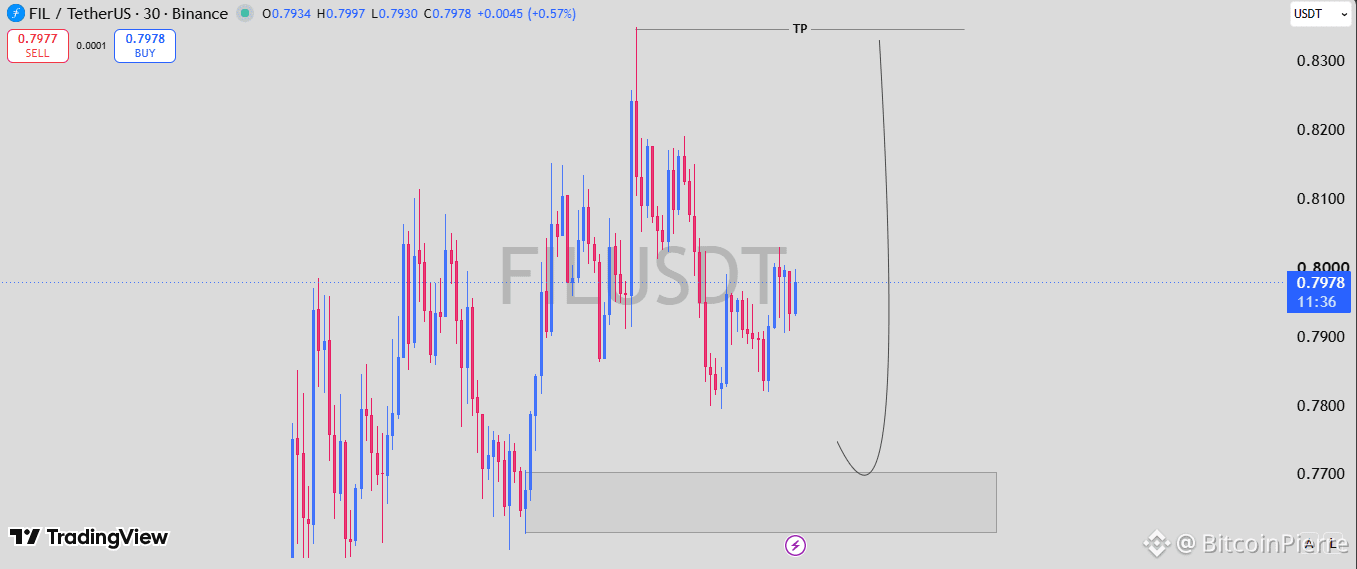
$FIL DETIENT AU-DESSUS DU SUPPORT ALORS QUE LES ACHETEURS PRÉPARENT UNE AUTRE RELANCE $FIL se consolide autour de 0,79 $ après une forte reprise depuis la zone de 0,68–0,70 $. Le graphique sur 30 minutes montre que le prix défend à plusieurs reprises la zone des 0,78–0,79 $ tout en restant sous la résistance psychologique des 0,80 $. La structure suggère une possible baisse vers la zone de demande marquée à 0,76–0,77 $ avant une nouvelle tentative à la hausse. Cette zone est importante car elle pourrait fournir la liquidité dont les acheteurs ont besoin pour se repositionner. Une reconquête solide de 0,80 $ renforcerait le scénario de continuation, le graphique pointant vers 0,83–0,84 $ comme prochain objectif majeur. Les données récentes du marché montrent aussi que FIL conserve un élan élevé après sa reprise spectaculaire. Toutefois, la perte de 0,76 $ affaiblirait le scénario et ramènerait l’attention vers un support plus bas. $FIL se trouve à un point de décision clé : conserver la demande et repartir à la hausse, ou perdre la structure. #BTC Price Analysis# #Macro Insights# #FIL
$FIL DETIENT AU-DESSUS DU SUPPORT ALORS QUE LES ACHETEURS PRÉPARENT UNE AUTRE RELANCE $FIL se consolide autour de 0,79 $ après une forte reprise depuis la zone de 0,68–0,70 $. Le graphique sur 30 minutes montre que le prix défend à plusieurs reprises la zone des 0,78–0,79 $ tout en restant sous la résistance psychologique des 0,80 $. La structure suggère une possible baisse vers la zone de demande marquée à 0,76–0,77 $ avant une nouvelle tentative à la hausse. Cette zone est importante car elle pourrait fournir la liquidité dont les acheteurs ont besoin pour se repositionner. Une reconquête solide de 0,80 $ renforcerait le scénario de continuation, le graphique pointant vers 0,83–0,84 $ comme prochain objectif majeur. Les données récentes du marché montrent aussi que FIL conserve un élan élevé après sa reprise spectaculaire. Toutefois, la perte de 0,76 $ affaiblirait le scénario et ramènerait l’attention vers un support plus bas. $FIL se trouve à un point de décision clé : conserver la demande et repartir à la hausse, ou perdre la structure. #BTC Price Analysis# #Macro Insights# #FIL
75
Hargreaves Lansdown ouvre le trading d’ETN sur le Bitcoin et l’Ether à près de 2 millions d’investisseurs. La plus grande plateforme d’investissement britannique a enfin fait son entrée sur le marché de la crypto de détail, offrant à ses quelque 2 millions de clients un accès à neuf ETN négociés en bourse sur le Bitcoin et l’Ether émis notamment par iShares de BlackRock, WisdomTree et 21Shares. Le timing est remarquable. La FCA a levé son interdiction de quatre ans visant l’accès des particuliers britanniques aux ETN de crypto en octobre 2025, mais Hargreaves Lansdown était resté l’un des principaux opposants. Désormais, ses clients peuvent obtenir une exposition au BTC et à l’ETH via une plateforme d’investissement traditionnelle, sans devoir utiliser une bourse de crypto. #Analyse du prix du BTC# #Ethereum $BTC $ETH
Hargreaves Lansdown ouvre le trading d’ETN sur le Bitcoin et l’Ether à près de 2 millions d’investisseurs. La plus grande plateforme d’investissement britannique a enfin fait son entrée sur le marché de la crypto de détail, offrant à ses quelque 2 millions de clients un accès à neuf ETN négociés en bourse sur le Bitcoin et l’Ether émis notamment par iShares de BlackRock, WisdomTree et 21Shares. Le timing est remarquable. La FCA a levé son interdiction de quatre ans visant l’accès des particuliers britanniques aux ETN de crypto en octobre 2025, mais Hargreaves Lansdown était resté l’un des principaux opposants. Désormais, ses clients peuvent obtenir une exposition au BTC et à l’ETH via une plateforme d’investissement traditionnelle, sans devoir utiliser une bourse de crypto. #Analyse du prix du BTC# #Ethereum $BTC $ETH


50
Connectez-vous pour découvrir plus de contenu
Rejoignez la communauté mondiale des adeptes de cryptomonnaies sur Binance Square
⚡️ Suviez les dernières informations importantes sur les cryptomonnaies.
💬 Jugé digne de confiance par la plus grande plateforme d’échange de cryptomonnaies au monde.
👍 Découvrez les connaissances que partagent les créateurs vérifiés.
Adresse e-mail/Nº de téléphone
Sujets d’actualité
ClarityActFacesProceduralVoteSept15
37,111 vues
587 mentions
Mardi 15 septembre, 2 h 15 (heure de l’Est). Marquez-le. 🗓️
Le Sénat se prononce sur la possibilité même de débattre de la loi CLARITY, le projet de loi qui définirait enfin quels types de pièces sont des valeurs mobilières ou des matières premières en vertu du droit américain.
Il faut 60 voix. Les Républicains en ont 53. Plusieurs Démocrates doivent traverser la ligne, et rien ne garantit que ce sera le cas.
Échec de ce vote = le projet de loi est mort pour 2026, probablement jusqu’en 2029 (les élections de mi-mandat mangent ensuite le calendrier).
Adoption de ce vote = les portes s’ouvrent à un vrai débat, mais on est encore loin d’une loi effective.
Le plus grand moment de régulation crypto de l’année arrive dans quelques jours.
#ClarityActFacesProceduralVoteSept15
NewbieToNode
·3 mentions J’aime
·2.9k vues
US2YearYieldRisesTo4.61%
30,106 vues
582 mentions
US10YearTreasuryYieldNears5%
16,893 vues
332 mentions