
Iri Denis
746 Publications

Iri Denis
Signaler
Bloquer l’utilisateur
Crypto Analyst breaking down charts, trends & narratives. Swing trader | Macro watcher | Pattern hunter Turning volatility into strategy 📊
0 Suivis
2.9K+ Abonnés
2.3K+ J’aime
Publications
·
--
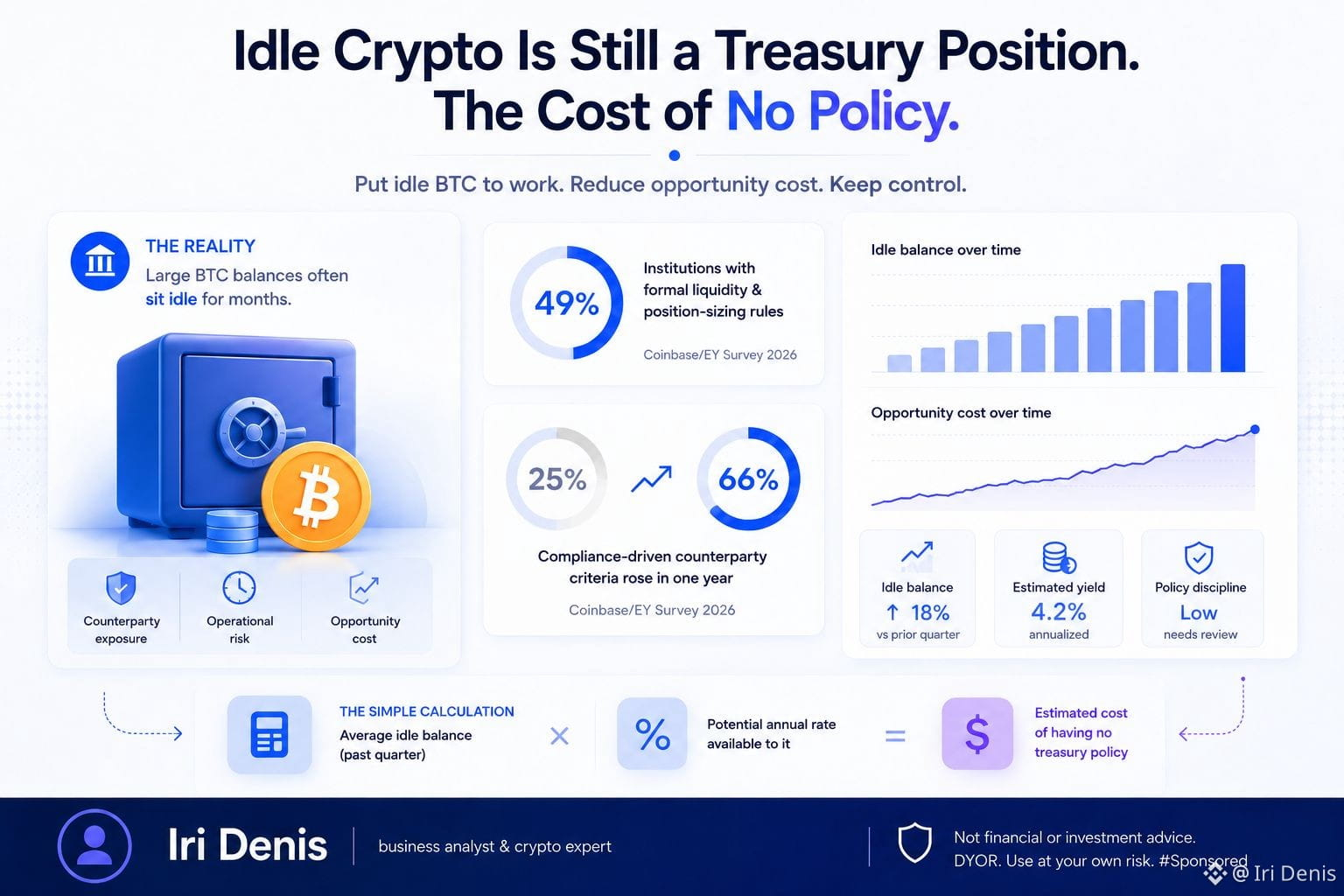
Quelle part de la trésorerie en $BTC est vraiment mise au travail ? Une fintech détenant du $BTC pour les règlements a analysé la part du solde qui était restée intacte pendant le trimestre écoulé. Sur le papier, le laisser au repos semblait être l’option la plus sûre. 🤏 Pas de trading, pas de nouvelle stratégie, et pas de questions à adresser au conseil. Pourtant, l’entreprise a tout de même assumé des risques opérationnels et envers des contreparties tout en acceptant le coût d’opportunité. C’est ce que beaucoup d’équipes de trésorerie sous-estiment. « Aucune action » devient quand même une position de trésorerie lorsqu’un solde important de stablecoins reste inutilisé pendant des mois. La décision peut aussi manquer de limites documentées, de critères de contrepartie, d’échéance (tenor) et de mécanismes de sortie. 📄 Le secteur évolue vers une discipline plus formelle. Une enquête Coinbase/EY de 2026 a révélé que 49 % des institutions avaient formalisé des règles de liquidité et de dimensionnement des positions, tandis que les critères de contrepartie dictés par la conformité sont passés de 25 % à 66 % en un an. 📈 Le principal blocage vient généralement de l’hypothèse selon laquelle mettre une crypto inactive au travail crée davantage de risque et de complexité. Résultat : les entreprises laissent l’intégralité du solde inactive, sans calculer le coût de ce choix. C’est là que WhiteBIT Crypto Lending pour les entreprises pourrait valoir le coup d’être examinée comme une option possible. https://institutional.whitebit.com/crypto-lending-for-business?utm_source=coinmarketcap&utm_medium=cryptolandingiri&utm_campaign=post La formule peut inclure : 💰 Des plans individuels à partir de 600 000 USDT 📈 Des taux flexibles 🗓️ Des durées allant de 10 jours à plusieurs années 🪙 Plusieurs actifs pris en charge 🧾 Aucun frais de dépôt supplémentaire Calculez la moyenne du solde inactif du trimestre précédent et appliquez-y le taux annuel potentiel disponible. Ce chiffre pourrait indiquer le coût estimé de l’absence de politique de trésorerie. Avertissement : ceci ne constitue pas un conseil financier ou d’investissement. Faites vos propres recherches avant de prendre toute décision. À utiliser à vos propres risques. #Analyse du prix du BTC# #Prédiction du prix du Bitcoin : quelle sera la prochaine étape de Bitcoins ?#
Quelle part de la trésorerie en $BTC est vraiment mise au travail ? Une fintech détenant du $BTC pour les règlements a analysé la part du solde qui était restée intacte pendant le trimestre écoulé. Sur le papier, le laisser au repos semblait être l’option la plus sûre. 🤏 Pas de trading, pas de nouvelle stratégie, et pas de questions à adresser au conseil. Pourtant, l’entreprise a tout de même assumé des risques opérationnels et envers des contreparties tout en acceptant le coût d’opportunité. C’est ce que beaucoup d’équipes de trésorerie sous-estiment. « Aucune action » devient quand même une position de trésorerie lorsqu’un solde important de stablecoins reste inutilisé pendant des mois. La décision peut aussi manquer de limites documentées, de critères de contrepartie, d’échéance (tenor) et de mécanismes de sortie. 📄 Le secteur évolue vers une discipline plus formelle. Une enquête Coinbase/EY de 2026 a révélé que 49 % des institutions avaient formalisé des règles de liquidité et de dimensionnement des positions, tandis que les critères de contrepartie dictés par la conformité sont passés de 25 % à 66 % en un an. 📈 Le principal blocage vient généralement de l’hypothèse selon laquelle mettre une crypto inactive au travail crée davantage de risque et de complexité. Résultat : les entreprises laissent l’intégralité du solde inactive, sans calculer le coût de ce choix. C’est là que WhiteBIT Crypto Lending pour les entreprises pourrait valoir le coup d’être examinée comme une option possible. https://institutional.whitebit.com/crypto-lending-for-business?utm_source=coinmarketcap&utm_medium=cryptolandingiri&utm_campaign=post La formule peut inclure : 💰 Des plans individuels à partir de 600 000 USDT 📈 Des taux flexibles 🗓️ Des durées allant de 10 jours à plusieurs années 🪙 Plusieurs actifs pris en charge 🧾 Aucun frais de dépôt supplémentaire Calculez la moyenne du solde inactif du trimestre précédent et appliquez-y le taux annuel potentiel disponible. Ce chiffre pourrait indiquer le coût estimé de l’absence de politique de trésorerie. Avertissement : ceci ne constitue pas un conseil financier ou d’investissement. Faites vos propres recherches avant de prendre toute décision. À utiliser à vos propres risques. #Analyse du prix du BTC# #Prédiction du prix du Bitcoin : quelle sera la prochaine étape de Bitcoins ?#
66
·
--
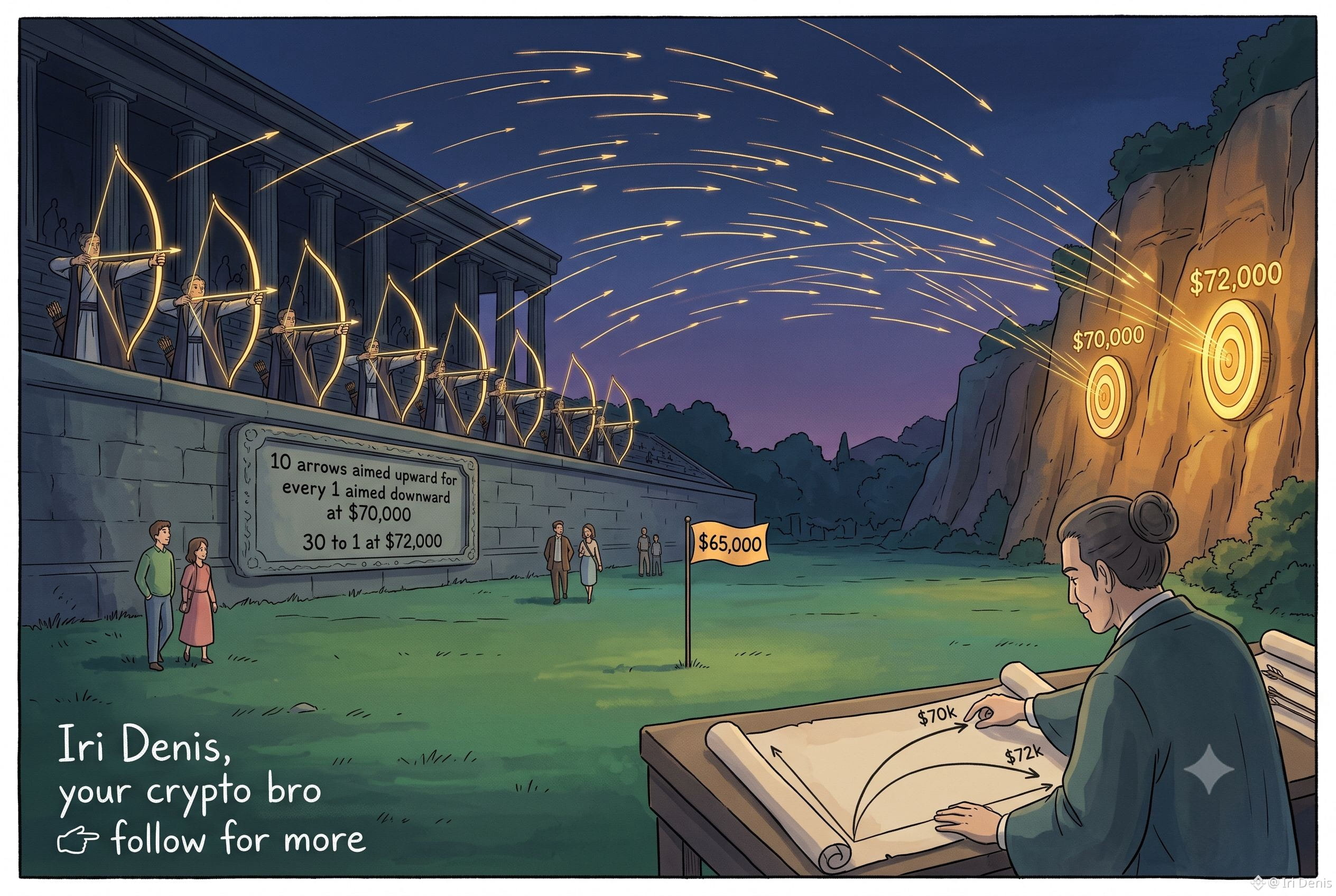
Pourquoi les traders viennent de garer 5 milliards de dollars sur $BTC en visant $72,000. Un mur haussier de 5 milliards de dollars sur Deribit : quelles options les traders préparent en secret. Ne vous laissez pas tromper par l’action des prix discrète du Bitcoin autour de 65,000 $. En coulisses, des traders institutionnels d’options placent d’immenses paris multi-milliards de dollars que $BTC fonce tout droit vers $72,000. Sur la principale plateforme de dérivés Deribit, un impressionnant regroupement de 5 milliards de dollars d’intérêt ouvert s’est formé autour des prix d’exercice des options call à $70,000 et $72,000. Voici, en termes simples, ce que ce montage d’options révèle sur le sentiment des traders : 📍 Dominance écrasante des calls : Ce regroupement de 5 milliards de dollars représente près de 18 % de l’intérêt ouvert total de Deribit sur les options Bitcoin, soit 28 milliards de dollars. À l’exercice de $70,000, les options call dépassent les puts d’environ 10 à 1, et à $72,000, les calls dépassent les puts de plus de 30 à 1. 📍 Des bull call spreads à dominante institutionnelle : Les données de Laevitas indiquent qu’environ la moitié de cet intérêt ouvert est portée par des stratégies professionnelles de « bull call spread » : les traders achètent des calls à $70,000 et vendent des calls à $72,000 pour profiter d’une hausse contrôlée dans cette plage précise. 📍 Pari direct à forte conviction : En plus des stratégies en spread, certains traders individuels ont payé des millions de dollars en primes initiales pour de simples options call à $70,000, montrant une forte confiance que les prix pousseront plus haut à court terme. Les marchés spot peuvent sembler calmes, mais les traders d’options engagent des milliards de dollars de capitaux pour une hausse ciblée vers la zone $70,000–$72,000. Iri Denis, ton pote crypto Suis pour plus d’insights 🚀 #Bitcoin Price Prediction: What is Bitcoins next move?# #BTC Price Analysis#
Pourquoi les traders viennent de garer 5 milliards de dollars sur $BTC en visant $72,000. Un mur haussier de 5 milliards de dollars sur Deribit : quelles options les traders préparent en secret. Ne vous laissez pas tromper par l’action des prix discrète du Bitcoin autour de 65,000 $. En coulisses, des traders institutionnels d’options placent d’immenses paris multi-milliards de dollars que $BTC fonce tout droit vers $72,000. Sur la principale plateforme de dérivés Deribit, un impressionnant regroupement de 5 milliards de dollars d’intérêt ouvert s’est formé autour des prix d’exercice des options call à $70,000 et $72,000. Voici, en termes simples, ce que ce montage d’options révèle sur le sentiment des traders : 📍 Dominance écrasante des calls : Ce regroupement de 5 milliards de dollars représente près de 18 % de l’intérêt ouvert total de Deribit sur les options Bitcoin, soit 28 milliards de dollars. À l’exercice de $70,000, les options call dépassent les puts d’environ 10 à 1, et à $72,000, les calls dépassent les puts de plus de 30 à 1. 📍 Des bull call spreads à dominante institutionnelle : Les données de Laevitas indiquent qu’environ la moitié de cet intérêt ouvert est portée par des stratégies professionnelles de « bull call spread » : les traders achètent des calls à $70,000 et vendent des calls à $72,000 pour profiter d’une hausse contrôlée dans cette plage précise. 📍 Pari direct à forte conviction : En plus des stratégies en spread, certains traders individuels ont payé des millions de dollars en primes initiales pour de simples options call à $70,000, montrant une forte confiance que les prix pousseront plus haut à court terme. Les marchés spot peuvent sembler calmes, mais les traders d’options engagent des milliards de dollars de capitaux pour une hausse ciblée vers la zone $70,000–$72,000. Iri Denis, ton pote crypto Suis pour plus d’insights 🚀 #Bitcoin Price Prediction: What is Bitcoins next move?# #BTC Price Analysis#
89
·
--
Baisse massive de 800 milliards de dollars dans la tech : comment le $BTC est resté solide alors que les actions liées à l’IA ont connu leur pire journée. Le Bitcoin affiche une résistance remarquable autour de 65 400 $ et reste quasiment stable pendant qu’en l’espace d’une seule séance, près de 800 milliards de dollars de valeur boursière s’évaporent des principales valeurs technologiques américaines. La forte chute des valeurs traditionnelles a été déclenchée par les inquiétudes concernant les dépenses en IA de Big Tech. Des entreprises comme Alphabet et Tesla ont indiqué des investissements agressifs, se chiffrant en plusieurs milliards, dans l’infrastructure IA, ravivant la crainte que les dépenses des entreprises dépassent les retours sur profit à court terme. Au cours du mois écoulé, le $BTC avait été négocié presque comme un proxy direct du cycle des capitaux liés à l’IA : il montait avec les valeurs de semi-conducteurs et reculait chaque fois que la confiance dans la tech vacillait. Toutefois, tandis que le groupe de méga-capitals « Magnificent Seven » subissait une baisse de 4,8 % lors de sa pire chute depuis le début de 2025, le Bitcoin a tenu bon avec un mouvement inférieur à 1 %. Ce rare signe d’indépendance apporte la première vraie indication que les actifs numériques pourraient se découpler des actions technologiques et retrouver leur statut de classe d’actifs mondiale indépendante. Le fait de voir le Bitcoin résister pendant une secousse de 800 milliards de dollars sur le marché actions laisse penser que la corrélation étroite de la crypto avec les semi-conducteurs et les valeurs liées à l’IA pourrait enfin être en train de se rompre. Iri Denis, ton crypto bro Suis pour plus d’insights 🚀 #Bitcoin Price Prediction: What is Bitcoins next move?# #BTC Price Analysis#
Baisse massive de 800 milliards de dollars dans la tech : comment le $BTC est resté solide alors que les actions liées à l’IA ont connu leur pire journée. Le Bitcoin affiche une résistance remarquable autour de 65 400 $ et reste quasiment stable pendant qu’en l’espace d’une seule séance, près de 800 milliards de dollars de valeur boursière s’évaporent des principales valeurs technologiques américaines. La forte chute des valeurs traditionnelles a été déclenchée par les inquiétudes concernant les dépenses en IA de Big Tech. Des entreprises comme Alphabet et Tesla ont indiqué des investissements agressifs, se chiffrant en plusieurs milliards, dans l’infrastructure IA, ravivant la crainte que les dépenses des entreprises dépassent les retours sur profit à court terme. Au cours du mois écoulé, le $BTC avait été négocié presque comme un proxy direct du cycle des capitaux liés à l’IA : il montait avec les valeurs de semi-conducteurs et reculait chaque fois que la confiance dans la tech vacillait. Toutefois, tandis que le groupe de méga-capitals « Magnificent Seven » subissait une baisse de 4,8 % lors de sa pire chute depuis le début de 2025, le Bitcoin a tenu bon avec un mouvement inférieur à 1 %. Ce rare signe d’indépendance apporte la première vraie indication que les actifs numériques pourraient se découpler des actions technologiques et retrouver leur statut de classe d’actifs mondiale indépendante. Le fait de voir le Bitcoin résister pendant une secousse de 800 milliards de dollars sur le marché actions laisse penser que la corrélation étroite de la crypto avec les semi-conducteurs et les valeurs liées à l’IA pourrait enfin être en train de se rompre. Iri Denis, ton crypto bro Suis pour plus d’insights 🚀 #Bitcoin Price Prediction: What is Bitcoins next move?# #BTC Price Analysis#

101
·
--
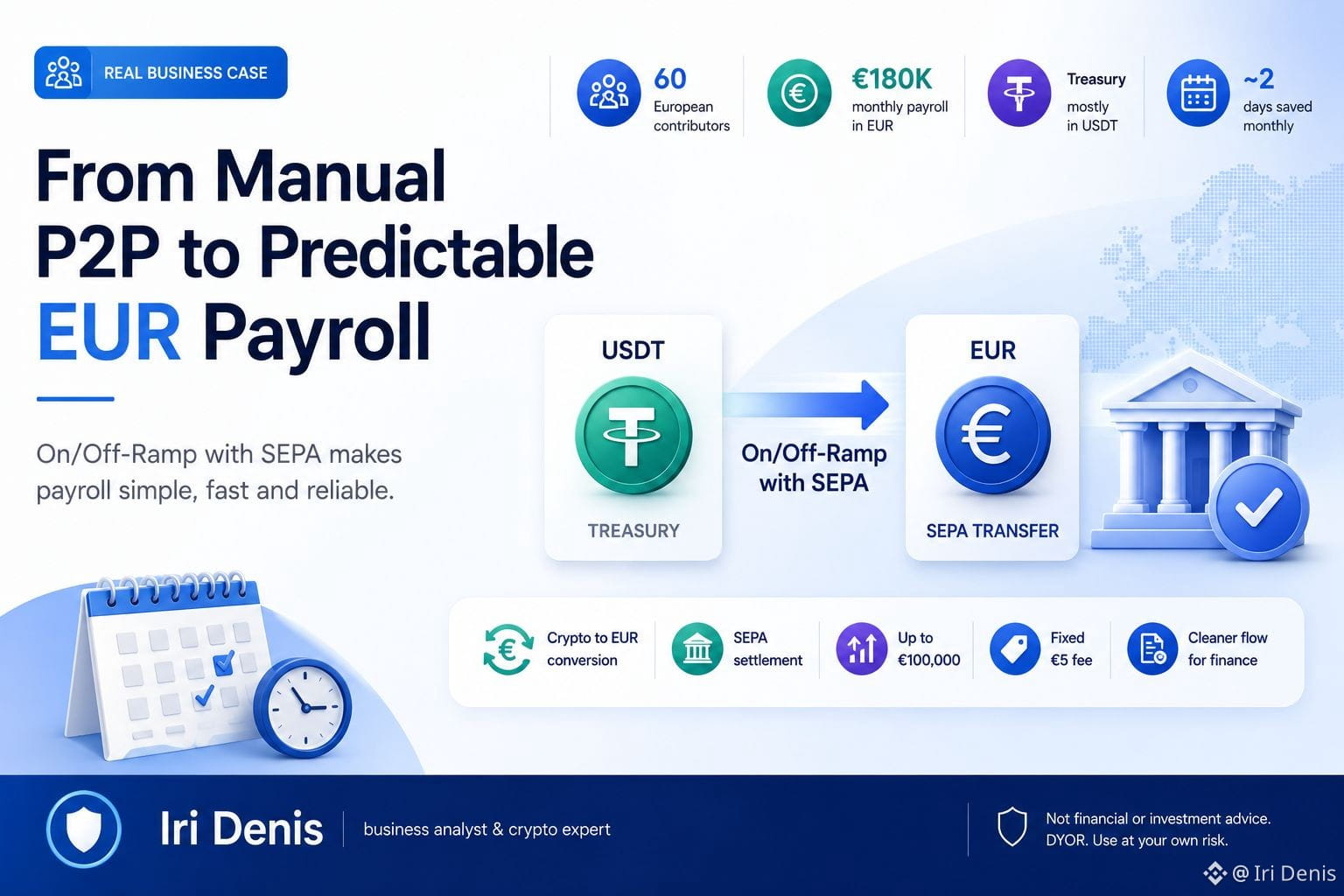
Pourquoi les projets crypto ont besoin de flux de paie EUR plus efficaces 📈 Après le TGE, un projet de token comptait 60 contributeurs européens recevant des paiements mensuels en EUR. La trésorerie comprenait des BTC$BTC et d’autres actifs crypto, tandis que la paie nécessitait environ 180 000 € chaque mois via des virements bancaires classiques. Le processus était compliqué : l’équipe a scindé les paiements en de petites transactions P2P inférieures à 15 000 €, les a rapprochées manuellement, et a géré un règlement incohérent la plupart des mois. Le P2P convient à des cas d’usage flexibles, mais une paie récurrente exige davantage de prévisibilité. Le COO a passé presque deux jours complets par mois à gérer la conversion de la paie. Les prestataires demandaient sans cesse pourquoi les délais changeaient, et trois contributeurs seniors ont conditionné leurs décisions de renouvellement à des opérations de paiement plus fiables. C’est là que l’infrastructure d’on/off-ramp pourrait valoir le coup d’être évaluée. Par exemple, WhiteBIT On/Off-Ramp avec SEPA pourrait être pertinent pour les entreprises qui convertissent régulièrement leurs revenus crypto en EUR et ont besoin d’une manière plus prévisible d’acheminer les fonds via les circuits bancaires, avec des limites, des frais et un flux de règlement plus clairs. https://institutional.whitebit.com/payments-for-businesses?utm_source=coinmarketcap&utm_medium=onofframpiri&utm_campaign=post Pour un cas de paie comme celui-ci, les bénéfices potentiels peuvent être : 🔄 Conversion crypto → EUR 🏦 Règlement SEPA 📊 Transactions jusqu’à 100 000 € 💰 Des frais fixes de 5 € 🧾 Un flux de paiement plus clair pour les équipes finance Au lieu de fractionner 180 000 € en de nombreux petits virements manuels, le projet pourrait traiter la paie en seulement deux transactions plus importantes : 10 € de commission totale fixe, et une structure bien plus propre pour l’équipe finance. Avertissement : ceci ne constitue pas un conseil financier ni en investissement. Faites vos propres recherches avant de prendre toute décision. #Prédiction du prix du Bitcoin : quel sera le prochain mouvement de Bitcoin?# #Analyse du prix du BTC# #Article sponsorisé
Pourquoi les projets crypto ont besoin de flux de paie EUR plus efficaces 📈 Après le TGE, un projet de token comptait 60 contributeurs européens recevant des paiements mensuels en EUR. La trésorerie comprenait des BTC$BTC et d’autres actifs crypto, tandis que la paie nécessitait environ 180 000 € chaque mois via des virements bancaires classiques. Le processus était compliqué : l’équipe a scindé les paiements en de petites transactions P2P inférieures à 15 000 €, les a rapprochées manuellement, et a géré un règlement incohérent la plupart des mois. Le P2P convient à des cas d’usage flexibles, mais une paie récurrente exige davantage de prévisibilité. Le COO a passé presque deux jours complets par mois à gérer la conversion de la paie. Les prestataires demandaient sans cesse pourquoi les délais changeaient, et trois contributeurs seniors ont conditionné leurs décisions de renouvellement à des opérations de paiement plus fiables. C’est là que l’infrastructure d’on/off-ramp pourrait valoir le coup d’être évaluée. Par exemple, WhiteBIT On/Off-Ramp avec SEPA pourrait être pertinent pour les entreprises qui convertissent régulièrement leurs revenus crypto en EUR et ont besoin d’une manière plus prévisible d’acheminer les fonds via les circuits bancaires, avec des limites, des frais et un flux de règlement plus clairs. https://institutional.whitebit.com/payments-for-businesses?utm_source=coinmarketcap&utm_medium=onofframpiri&utm_campaign=post Pour un cas de paie comme celui-ci, les bénéfices potentiels peuvent être : 🔄 Conversion crypto → EUR 🏦 Règlement SEPA 📊 Transactions jusqu’à 100 000 € 💰 Des frais fixes de 5 € 🧾 Un flux de paiement plus clair pour les équipes finance Au lieu de fractionner 180 000 € en de nombreux petits virements manuels, le projet pourrait traiter la paie en seulement deux transactions plus importantes : 10 € de commission totale fixe, et une structure bien plus propre pour l’équipe finance. Avertissement : ceci ne constitue pas un conseil financier ni en investissement. Faites vos propres recherches avant de prendre toute décision. #Prédiction du prix du Bitcoin : quel sera le prochain mouvement de Bitcoin?# #Analyse du prix du BTC# #Article sponsorisé
88
·
--
Comment Strategy se concentre sur la croissance nette du $BTC plutôt que sur le bruit des marchés à court terme. 📊 Wall Street prête désormais beaucoup plus d’attention à la manière dont Strategy (anciennement MicroStrategy) gère sa gigantesque trésorerie d’entreprise. Au lieu d’évaluer MSRT à travers des cadres d’actions traditionnels, les investisseurs institutionnels se concentrent de plus en plus sur des indicateurs de trésorerie sous-jacents tels que le Net Bitcoin par action et le mNAV. L’objectif central de la feuille de route de Strategy reste simple : faire croître continuellement ses avoirs nets en Bitcoin et maximiser la valeur de $BTC qui garantit chaque action ordinaire. En s’appuyant sur un ingénierie financière sophistiquée - allant des actions privilégiées aux billets convertibles - l’entreprise vise à maintenir une accumulation à long terme qui s’avère bénéfique malgré les fluctuations de prix à court terme. Même lorsque des ajustements mineurs du bilan ou le service des dividendes génèrent des commentaires en première page, la direction continue de réaffirmer l’expansion à long terme de la trésorerie. En se concentrant sur le rendement net en BTC plutôt que sur les variations quotidiennes de prix, Strategy conserve sa position unique en tant que moteur de trésorerie Bitcoin, hautement levierisé, de premier plan. Évaluer MSRT exige de dépasser les indicateurs boursiers traditionnels - le véritable tableau de bord est la façon dont la société fait croître efficacement ses avoirs nets en Bitcoin par action au fil du temps. Iri Denis, ton pote crypto. Abonne-toi pour plus d’analyses 🚀 #Bitcoin Price Prediction: What is Bitcoins next move?# #BTC Price Analysis#
Comment Strategy se concentre sur la croissance nette du $BTC plutôt que sur le bruit des marchés à court terme. 📊 Wall Street prête désormais beaucoup plus d’attention à la manière dont Strategy (anciennement MicroStrategy) gère sa gigantesque trésorerie d’entreprise. Au lieu d’évaluer MSRT à travers des cadres d’actions traditionnels, les investisseurs institutionnels se concentrent de plus en plus sur des indicateurs de trésorerie sous-jacents tels que le Net Bitcoin par action et le mNAV. L’objectif central de la feuille de route de Strategy reste simple : faire croître continuellement ses avoirs nets en Bitcoin et maximiser la valeur de $BTC qui garantit chaque action ordinaire. En s’appuyant sur un ingénierie financière sophistiquée - allant des actions privilégiées aux billets convertibles - l’entreprise vise à maintenir une accumulation à long terme qui s’avère bénéfique malgré les fluctuations de prix à court terme. Même lorsque des ajustements mineurs du bilan ou le service des dividendes génèrent des commentaires en première page, la direction continue de réaffirmer l’expansion à long terme de la trésorerie. En se concentrant sur le rendement net en BTC plutôt que sur les variations quotidiennes de prix, Strategy conserve sa position unique en tant que moteur de trésorerie Bitcoin, hautement levierisé, de premier plan. Évaluer MSRT exige de dépasser les indicateurs boursiers traditionnels - le véritable tableau de bord est la façon dont la société fait croître efficacement ses avoirs nets en Bitcoin par action au fil du temps. Iri Denis, ton pote crypto. Abonne-toi pour plus d’analyses 🚀 #Bitcoin Price Prediction: What is Bitcoins next move?# #BTC Price Analysis#

40
·
--
Le projet NENYA ouvre le marché des stablecoins d’un trillion de dollars aux banques de taille moyenne. 📊 Alors que des actifs majeurs comme $BTC établissent une présence durable dans les portefeuilles institutionnels, la course pour contrôler les dollars numériques s’accélère. La société fintech Tassat a dévoilé « Project NENYA », une initiative toute nouvelle conçue pour aider les banques régionales et de taille moyenne aux États-Unis à capter une part du marché explosif des stablecoins, avant que les grandes banques de Wall Street ne les en écartent définitivement. Avec des projections d’établissements financiers de premier plan estimant que le secteur des stablecoins pourrait atteindre jusqu’à 4 billions de dollars d’ici 2030, les banques plus petites font face à un défi de taille. La plupart des institutions de taille moyenne ne disposent pas des infrastructures techniques, des équipes de conformité et des outils automatisés nécessaires pour servir les émetteurs de stablecoins et gérer des réserves de trésorerie à fort volume. Project NENYA résout ce problème en créant un moteur d’exécution et un marché permettant aux émetteurs de stablecoins de distribuer en toute sécurité des dépôts en cash et des actifs tokenisés entre des banques régionales. Cette plateforme empêche la liquidité de se concentrer uniquement au sein de deux ou trois méga-banques, réduisant ainsi le risque bancaire systémique, tout en donnant aux prêteurs régionaux accès à des dépôts cruciaux. Visant des programmes pilotes pour début 2027, Tassat cherche à rétablir l’équité dans la finance traditionnelle. L’initiative garantit que les banques communautaires de taille moyenne ne seront pas laissées pour compte pendant que la liquidité en dollars numériques remplace discrètement l’infrastructure bancaire historique. Iri Denis, ton crypto bro Abonne-toi pour plus d’insights 🚀 #Bitcoin Price Prediction: What is Bitcoins next move?# #BTC Price Analysis#
Le projet NENYA ouvre le marché des stablecoins d’un trillion de dollars aux banques de taille moyenne. 📊 Alors que des actifs majeurs comme $BTC établissent une présence durable dans les portefeuilles institutionnels, la course pour contrôler les dollars numériques s’accélère. La société fintech Tassat a dévoilé « Project NENYA », une initiative toute nouvelle conçue pour aider les banques régionales et de taille moyenne aux États-Unis à capter une part du marché explosif des stablecoins, avant que les grandes banques de Wall Street ne les en écartent définitivement. Avec des projections d’établissements financiers de premier plan estimant que le secteur des stablecoins pourrait atteindre jusqu’à 4 billions de dollars d’ici 2030, les banques plus petites font face à un défi de taille. La plupart des institutions de taille moyenne ne disposent pas des infrastructures techniques, des équipes de conformité et des outils automatisés nécessaires pour servir les émetteurs de stablecoins et gérer des réserves de trésorerie à fort volume. Project NENYA résout ce problème en créant un moteur d’exécution et un marché permettant aux émetteurs de stablecoins de distribuer en toute sécurité des dépôts en cash et des actifs tokenisés entre des banques régionales. Cette plateforme empêche la liquidité de se concentrer uniquement au sein de deux ou trois méga-banques, réduisant ainsi le risque bancaire systémique, tout en donnant aux prêteurs régionaux accès à des dépôts cruciaux. Visant des programmes pilotes pour début 2027, Tassat cherche à rétablir l’équité dans la finance traditionnelle. L’initiative garantit que les banques communautaires de taille moyenne ne seront pas laissées pour compte pendant que la liquidité en dollars numériques remplace discrètement l’infrastructure bancaire historique. Iri Denis, ton crypto bro Abonne-toi pour plus d’insights 🚀 #Bitcoin Price Prediction: What is Bitcoins next move?# #BTC Price Analysis#

25
·
--
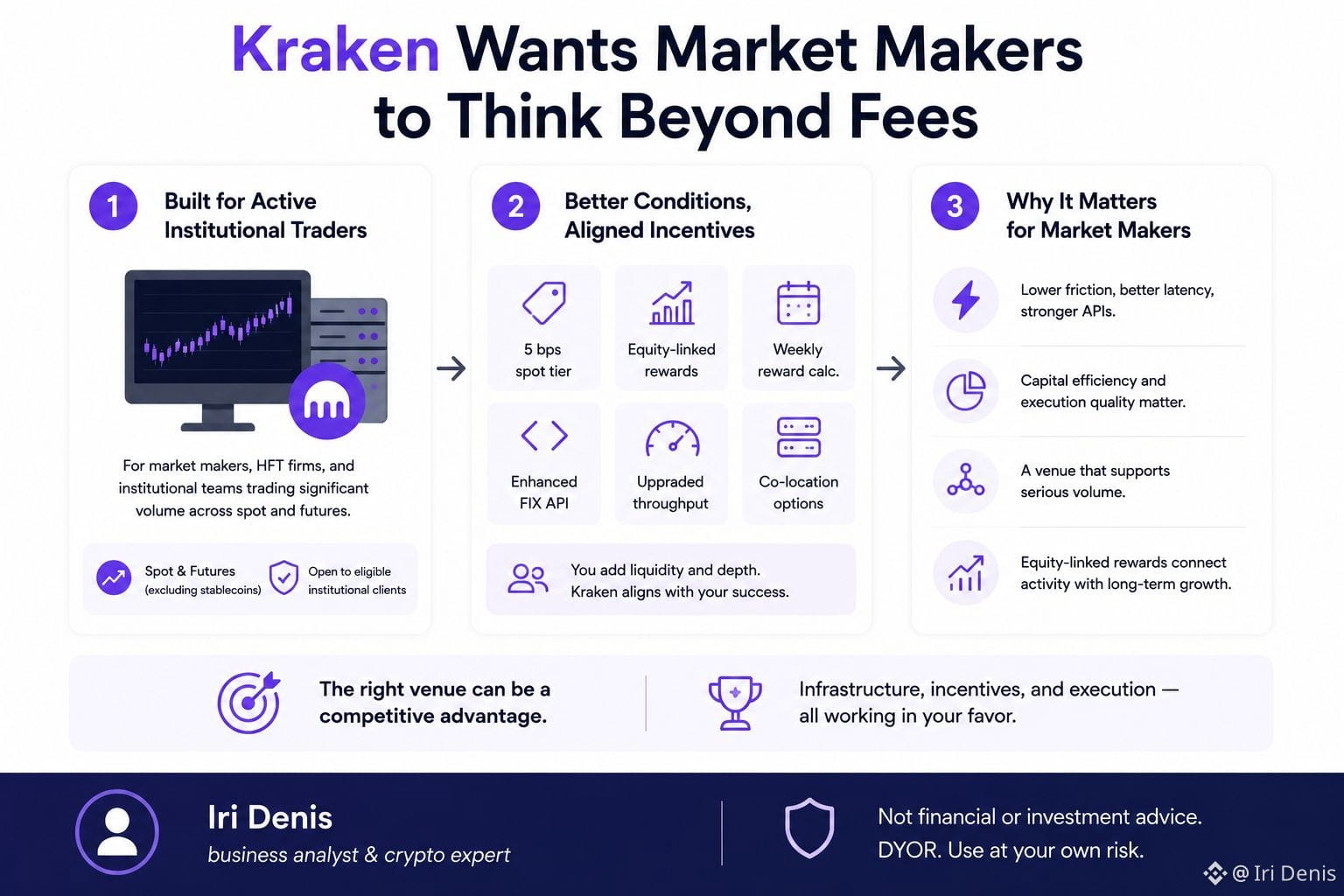
Kraken veut que les market makers réfléchissent au-delà des frais Si vous êtes un market maker, une société HFT ou une équipe de trading institutionnel, le choix de la bourse ne se limite pas au placement d’ordres. Il influe sur l’accès à la liquidité, la latence, la qualité de l’API, la structure des frais, l’efficacité du capital et la capacité à gérer les volumes sans friction. C’est pourquoi le programme de participation aux marchés de Kraken pourrait valoir le coup d’œil. https://www.kraken.com/ca/institutions/market-makers?utm_source=coinmarketcap&utm_medium=denis_makingprog&utm_campaign=post Conçu pour les clients institutionnels éligibles négociant des volumes significatifs sur le spot et les futures, des partenaires de trading actifs aident à améliorer la profondeur, tandis que Kraken propose de meilleures conditions et des incitations alignées. La configuration inclut une tranche de trading spot à 5 points de base, des récompenses liées à des actions en fonction de l’activité, des calculs hebdomadaires, une API FIX améliorée, un débit accru et des options de colocation pour un trading à faible latence. Pour les market makers, l’environnement de trading fait partie de la stratégie. Si une équipe dépend de la vitesse, de la qualité d’exécution et d’une infrastructure prévisible, les moindres détails deviennent rapidement importants. Kraken met en avant la participation ouverte, des conditions standardisées, des critères clairs et une couverture sur le crypto spot et les futures, en excluant les paires liées aux stablecoins. La partie la plus intéressante est le modèle de récompense lié à des actions. De nombreux programmes se concentrent principalement sur les frais et les rabais, mais Kraken relie la contribution de liquidité à la croissance à long terme de la bourse. Cela le rend pertinent pour les équipes qui négocient des volumes importants et qui comparent attentivement l’infrastructure, les incitations et les conditions d’exécution. Avertissement : ceci ne constitue pas un conseil financier ou d’investissement. Faites vos propres recherches avant de prendre toute décision. #Analyse du prix BTC# #Prévision du prix du Bitcoin : quelle sera la prochaine étape des Bitcoins ?# #Sponsorisé
Kraken veut que les market makers réfléchissent au-delà des frais Si vous êtes un market maker, une société HFT ou une équipe de trading institutionnel, le choix de la bourse ne se limite pas au placement d’ordres. Il influe sur l’accès à la liquidité, la latence, la qualité de l’API, la structure des frais, l’efficacité du capital et la capacité à gérer les volumes sans friction. C’est pourquoi le programme de participation aux marchés de Kraken pourrait valoir le coup d’œil. https://www.kraken.com/ca/institutions/market-makers?utm_source=coinmarketcap&utm_medium=denis_makingprog&utm_campaign=post Conçu pour les clients institutionnels éligibles négociant des volumes significatifs sur le spot et les futures, des partenaires de trading actifs aident à améliorer la profondeur, tandis que Kraken propose de meilleures conditions et des incitations alignées. La configuration inclut une tranche de trading spot à 5 points de base, des récompenses liées à des actions en fonction de l’activité, des calculs hebdomadaires, une API FIX améliorée, un débit accru et des options de colocation pour un trading à faible latence. Pour les market makers, l’environnement de trading fait partie de la stratégie. Si une équipe dépend de la vitesse, de la qualité d’exécution et d’une infrastructure prévisible, les moindres détails deviennent rapidement importants. Kraken met en avant la participation ouverte, des conditions standardisées, des critères clairs et une couverture sur le crypto spot et les futures, en excluant les paires liées aux stablecoins. La partie la plus intéressante est le modèle de récompense lié à des actions. De nombreux programmes se concentrent principalement sur les frais et les rabais, mais Kraken relie la contribution de liquidité à la croissance à long terme de la bourse. Cela le rend pertinent pour les équipes qui négocient des volumes importants et qui comparent attentivement l’infrastructure, les incitations et les conditions d’exécution. Avertissement : ceci ne constitue pas un conseil financier ou d’investissement. Faites vos propres recherches avant de prendre toute décision. #Analyse du prix BTC# #Prévision du prix du Bitcoin : quelle sera la prochaine étape des Bitcoins ?# #Sponsorisé
47
·
--
Un nouveau rapport révèle l’impact massif de Web3 sur l’emploi aux États-Unis. 🛠️ La plupart des gros titres restent axés sur les fluctuations de prix à court terme du $BTC, mais un rapport majeur met en lumière une histoire bien plus importante en train de se dérouler derrière les graphiques. L’industrie américaine des cryptomonnaies a évolué bien au-delà du trading spéculatif : elle est désormais officiellement devenue un moteur essentiel d’emplois américains bien rémunérés et d’expansion économique. D’après le dernier Economic Impact Report, le secteur crypto soutient aujourd’hui des dizaines de milliers de postes directs et indirects, dans le développement logiciel, la conformité juridique et la cybersécurité. Ces postes sont mieux rémunérés que la moyenne nationale, ce qui permet de retenir des talents techniques de niveau mondial et de maintenir l’innovation financière solidement ancrée aux États-Unis. L’impact va bien au-delà du recrutement direct. L’écosystème plus large de Web3 injecte des milliards de dollars dans les économies locales grâce aux contributions fiscales, au développement de centres de données et aux investissements en capital-risque. Les entreprises traditionnelles intensifient elles aussi leurs recrutements liés à la blockchain, prouvant que la croissance de la main-d’œuvre crypto est pensée pour durer. Web3 a officiellement quitté le statut de niche spéculative pour devenir un pilier vital de l’emploi moderne et du développement économique. Iri Denis, ton crypto bro. Abonne-toi pour plus d’insights 🚀 #Bitcoin Price Prediction : Quelle sera la prochaine étape de Bitcoins ?# #BTC Price Analysis#
Un nouveau rapport révèle l’impact massif de Web3 sur l’emploi aux États-Unis. 🛠️ La plupart des gros titres restent axés sur les fluctuations de prix à court terme du $BTC, mais un rapport majeur met en lumière une histoire bien plus importante en train de se dérouler derrière les graphiques. L’industrie américaine des cryptomonnaies a évolué bien au-delà du trading spéculatif : elle est désormais officiellement devenue un moteur essentiel d’emplois américains bien rémunérés et d’expansion économique. D’après le dernier Economic Impact Report, le secteur crypto soutient aujourd’hui des dizaines de milliers de postes directs et indirects, dans le développement logiciel, la conformité juridique et la cybersécurité. Ces postes sont mieux rémunérés que la moyenne nationale, ce qui permet de retenir des talents techniques de niveau mondial et de maintenir l’innovation financière solidement ancrée aux États-Unis. L’impact va bien au-delà du recrutement direct. L’écosystème plus large de Web3 injecte des milliards de dollars dans les économies locales grâce aux contributions fiscales, au développement de centres de données et aux investissements en capital-risque. Les entreprises traditionnelles intensifient elles aussi leurs recrutements liés à la blockchain, prouvant que la croissance de la main-d’œuvre crypto est pensée pour durer. Web3 a officiellement quitté le statut de niche spéculative pour devenir un pilier vital de l’emploi moderne et du développement économique. Iri Denis, ton crypto bro. Abonne-toi pour plus d’insights 🚀 #Bitcoin Price Prediction : Quelle sera la prochaine étape de Bitcoins ?# #BTC Price Analysis#

47
·
--
Pourquoi le pionnier de la crypto, BitMEX, ferme définitivement ses portes. Un immense chapitre de l’histoire de la crypto touche officiellement à sa fin. Alors que le trading de dérivés du $BTC s’est transformé en un marché institutionnel de plusieurs milliards de dollars, BitMEX – la bourse qui a tout déclenché – ferme définitivement toutes ses activités le 23 septembre 2026. Fondée en 2014 par Arthur Hayes, Benjamin Delo et Samuel Reed, BitMEX a changé fondamentalement la finance Web3 à jamais. La plateforme a inventé le contrat de perpetual swap et a ouvert la voie au trading à fort levier, créant concrètement le modèle de la manière dont les actifs numériques sont échangés aujourd’hui. La société mère de l’échange, HDR Global Trading, a décidé de mettre fin à la plateforme à la suite d’une revue stratégique de son activité. Les traders ne pourront plus ouvrir ni étendre leurs positions à partir du 26 août 2026, et toutes les transactions restantes seront réglées de force à la date limite finale du 23 septembre. Tous les fonds des clients restent 100% garantis et en sécurité, et les canaux de retrait restent entièrement opérationnels pendant toute la transition. Toutefois, les comptes laissés inactifs après la date de fermeture finale feront face à des frais de maintenance mensuels, ce qui rend crucial le fait pour les utilisateurs de retirer leurs actifs rapidement. C’est véritablement la fin d’une ère pour la plateforme qui a introduit la crypto au levier. Si vous avez encore des actifs ou des positions ouvertes sur BitMEX, assurez-vous de les clôturer bien avant la coupure du mois d’août. Iri Denis, ton crypto broIri Denis, ton crypto bro Suis pour plus d’insights 🚀 #Prédiction du prix du Bitcoin : quelle sera la prochaine étape de Bitcoins ?# #Analyse du prix BTC#
Pourquoi le pionnier de la crypto, BitMEX, ferme définitivement ses portes. Un immense chapitre de l’histoire de la crypto touche officiellement à sa fin. Alors que le trading de dérivés du $BTC s’est transformé en un marché institutionnel de plusieurs milliards de dollars, BitMEX – la bourse qui a tout déclenché – ferme définitivement toutes ses activités le 23 septembre 2026. Fondée en 2014 par Arthur Hayes, Benjamin Delo et Samuel Reed, BitMEX a changé fondamentalement la finance Web3 à jamais. La plateforme a inventé le contrat de perpetual swap et a ouvert la voie au trading à fort levier, créant concrètement le modèle de la manière dont les actifs numériques sont échangés aujourd’hui. La société mère de l’échange, HDR Global Trading, a décidé de mettre fin à la plateforme à la suite d’une revue stratégique de son activité. Les traders ne pourront plus ouvrir ni étendre leurs positions à partir du 26 août 2026, et toutes les transactions restantes seront réglées de force à la date limite finale du 23 septembre. Tous les fonds des clients restent 100% garantis et en sécurité, et les canaux de retrait restent entièrement opérationnels pendant toute la transition. Toutefois, les comptes laissés inactifs après la date de fermeture finale feront face à des frais de maintenance mensuels, ce qui rend crucial le fait pour les utilisateurs de retirer leurs actifs rapidement. C’est véritablement la fin d’une ère pour la plateforme qui a introduit la crypto au levier. Si vous avez encore des actifs ou des positions ouvertes sur BitMEX, assurez-vous de les clôturer bien avant la coupure du mois d’août. Iri Denis, ton crypto broIri Denis, ton crypto bro Suis pour plus d’insights 🚀 #Prédiction du prix du Bitcoin : quelle sera la prochaine étape de Bitcoins ?# #Analyse du prix BTC#

60
·
--
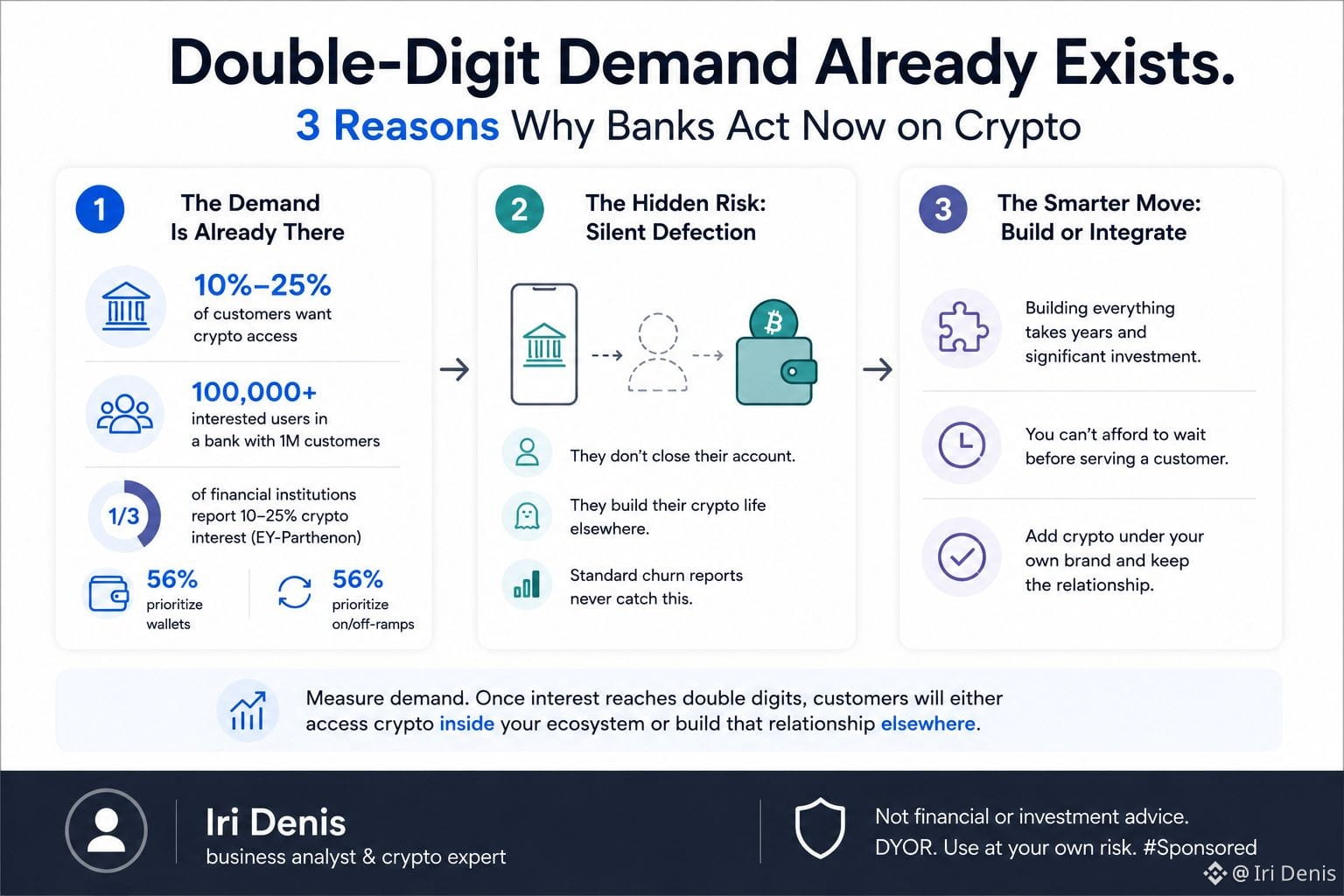
De l’application bancaire au portefeuille crypto : où l’attention des clients se déplace 👀 Une banque a constaté que 10–25 % de ses clients veulent $BTC , des stablecoins et des portefeuilles crypto dans l’application 🏦 Pour une banque comptant 1M de clients, cela représente 100 000+ personnes qui cherchent déjà ailleurs. 📊 EY-Parthenon confirme : un tiers des institutions financières observe un intérêt crypto de 10–25 % parmi ses clients, et 56 % donnent désormais la priorité à l’infrastructure des wallets et aux rampes d’accès fiat/crypto on/off. 🔄 Le risque est facile à manquer : les clients ne ferment pas les comptes — ils ouvrent simplement un portefeuille ailleurs et y transfèrent leurs fonds. Les rapports de churn standard ne détectent jamais cela, puisque le compte semble toujours actif. Avec ces chiffres, tout développer en interne pourrait prendre des années et nécessiter un investissement important avant de servir ne serait-ce qu’un seul client 🧩 C’est là qu’une banque pourrait évaluer si WhiteBIT Crypto-as-a-Service pourrait offrir une voie plus rapide ✅ https://institutional.whitebit.com/crypto-as-a-service?utm_source=coinmarketcap&utm_medium=irideniscaas&utm_campaign=post Au lieu de construire une infrastructure crypto à partir de zéro, une banque, une fintech ou un prestataire de paiement pourrait utiliser CaaS pour ajouter des fonctionnalités crypto sous sa propre marque, incluant : 👛 Des wallets pour 340+ actifs sur 80+ réseaux 🔄 Dépôts, retraits, trading et conversion crypto 🛡️ Des outils KYC/AML et de conformité 🔌 Intégration API Le CaaS peut réduire le temps de développement et les coûts d’infrastructure tout en aidant les banques à faire croître le LTV client, les revenus moyens et les revenus de commissions 📈 La première étape consiste à mesurer la demande. Une fois que l’intérêt atteint deux chiffres, les clients accéderont à la crypto au sein de votre écosystème ou construiront cette relation ailleurs. Avertissement : ceci ne constitue pas un conseil financier ni un conseil en investissement. Faites vos propres recherches avant de prendre des décisions. Utilisez-les à vos propres risques. #Sponsored #BTC Price Analysis# #Bitcoin Price Prediction: What is Bitcoins next move?#
De l’application bancaire au portefeuille crypto : où l’attention des clients se déplace 👀 Une banque a constaté que 10–25 % de ses clients veulent $BTC , des stablecoins et des portefeuilles crypto dans l’application 🏦 Pour une banque comptant 1M de clients, cela représente 100 000+ personnes qui cherchent déjà ailleurs. 📊 EY-Parthenon confirme : un tiers des institutions financières observe un intérêt crypto de 10–25 % parmi ses clients, et 56 % donnent désormais la priorité à l’infrastructure des wallets et aux rampes d’accès fiat/crypto on/off. 🔄 Le risque est facile à manquer : les clients ne ferment pas les comptes — ils ouvrent simplement un portefeuille ailleurs et y transfèrent leurs fonds. Les rapports de churn standard ne détectent jamais cela, puisque le compte semble toujours actif. Avec ces chiffres, tout développer en interne pourrait prendre des années et nécessiter un investissement important avant de servir ne serait-ce qu’un seul client 🧩 C’est là qu’une banque pourrait évaluer si WhiteBIT Crypto-as-a-Service pourrait offrir une voie plus rapide ✅ https://institutional.whitebit.com/crypto-as-a-service?utm_source=coinmarketcap&utm_medium=irideniscaas&utm_campaign=post Au lieu de construire une infrastructure crypto à partir de zéro, une banque, une fintech ou un prestataire de paiement pourrait utiliser CaaS pour ajouter des fonctionnalités crypto sous sa propre marque, incluant : 👛 Des wallets pour 340+ actifs sur 80+ réseaux 🔄 Dépôts, retraits, trading et conversion crypto 🛡️ Des outils KYC/AML et de conformité 🔌 Intégration API Le CaaS peut réduire le temps de développement et les coûts d’infrastructure tout en aidant les banques à faire croître le LTV client, les revenus moyens et les revenus de commissions 📈 La première étape consiste à mesurer la demande. Une fois que l’intérêt atteint deux chiffres, les clients accéderont à la crypto au sein de votre écosystème ou construiront cette relation ailleurs. Avertissement : ceci ne constitue pas un conseil financier ni un conseil en investissement. Faites vos propres recherches avant de prendre des décisions. Utilisez-les à vos propres risques. #Sponsored #BTC Price Analysis# #Bitcoin Price Prediction: What is Bitcoins next move?#
71
·
--
Que signifie la divergence récente d’accumulation de $XRP pour le marché. Alors que $BTC continue de consolider, XRP prépare discrètement une forte progression — en rebondissant de 1,00 $ à 1,16 $. D’après les données on-chain de Santiment, on observe un énorme écart entre les gros investisseurs et les traders particuliers. Voici ce qui se passe en coulisses, en termes simples : 📍 Les baleines achètent agressivement : les portefeuilles détenant entre 100 000 et 100 millions de XRP ont augmenté leurs avoirs de 2,8 % au cours des cinq dernières semaines. 📍 Les particuliers vendent paniqués : les petits détenteurs ont cédé 5,2 % de leurs tokens exactement sur la même période, par impatience et lassitude du marché. 📍 Signal haussier classique : historiquement, le prix de XRP suit la grosse “monnaie” plutôt que les petits traders. Quand les particuliers déversent et que les baleines renforcent leurs positions, cela indique souvent un point bas local avant un grand rallye. 📍 Moteurs fondamentaux : les investisseurs aux poches profondes accumulent en vue des prochains catalyseurs majeurs, notamment l’expansion de l’utilité des paiements, la croissance de la stablecoin RLUSD, et des approbations d’ETF potentielles. Les particuliers secouent le marché, mais l’argent institutionnel utilise la période calme pour constituer de très grosses positions sur le long terme. Iri Denis, ton crypto bro Suis pour plus d’analyses 🚀 #Bitcoin Price Prediction: What is Bitcoins next move?# #BTC Price Analysis#
Que signifie la divergence récente d’accumulation de $XRP pour le marché. Alors que $BTC continue de consolider, XRP prépare discrètement une forte progression — en rebondissant de 1,00 $ à 1,16 $. D’après les données on-chain de Santiment, on observe un énorme écart entre les gros investisseurs et les traders particuliers. Voici ce qui se passe en coulisses, en termes simples : 📍 Les baleines achètent agressivement : les portefeuilles détenant entre 100 000 et 100 millions de XRP ont augmenté leurs avoirs de 2,8 % au cours des cinq dernières semaines. 📍 Les particuliers vendent paniqués : les petits détenteurs ont cédé 5,2 % de leurs tokens exactement sur la même période, par impatience et lassitude du marché. 📍 Signal haussier classique : historiquement, le prix de XRP suit la grosse “monnaie” plutôt que les petits traders. Quand les particuliers déversent et que les baleines renforcent leurs positions, cela indique souvent un point bas local avant un grand rallye. 📍 Moteurs fondamentaux : les investisseurs aux poches profondes accumulent en vue des prochains catalyseurs majeurs, notamment l’expansion de l’utilité des paiements, la croissance de la stablecoin RLUSD, et des approbations d’ETF potentielles. Les particuliers secouent le marché, mais l’argent institutionnel utilise la période calme pour constituer de très grosses positions sur le long terme. Iri Denis, ton crypto bro Suis pour plus d’analyses 🚀 #Bitcoin Price Prediction: What is Bitcoins next move?# #BTC Price Analysis#

91
·
--
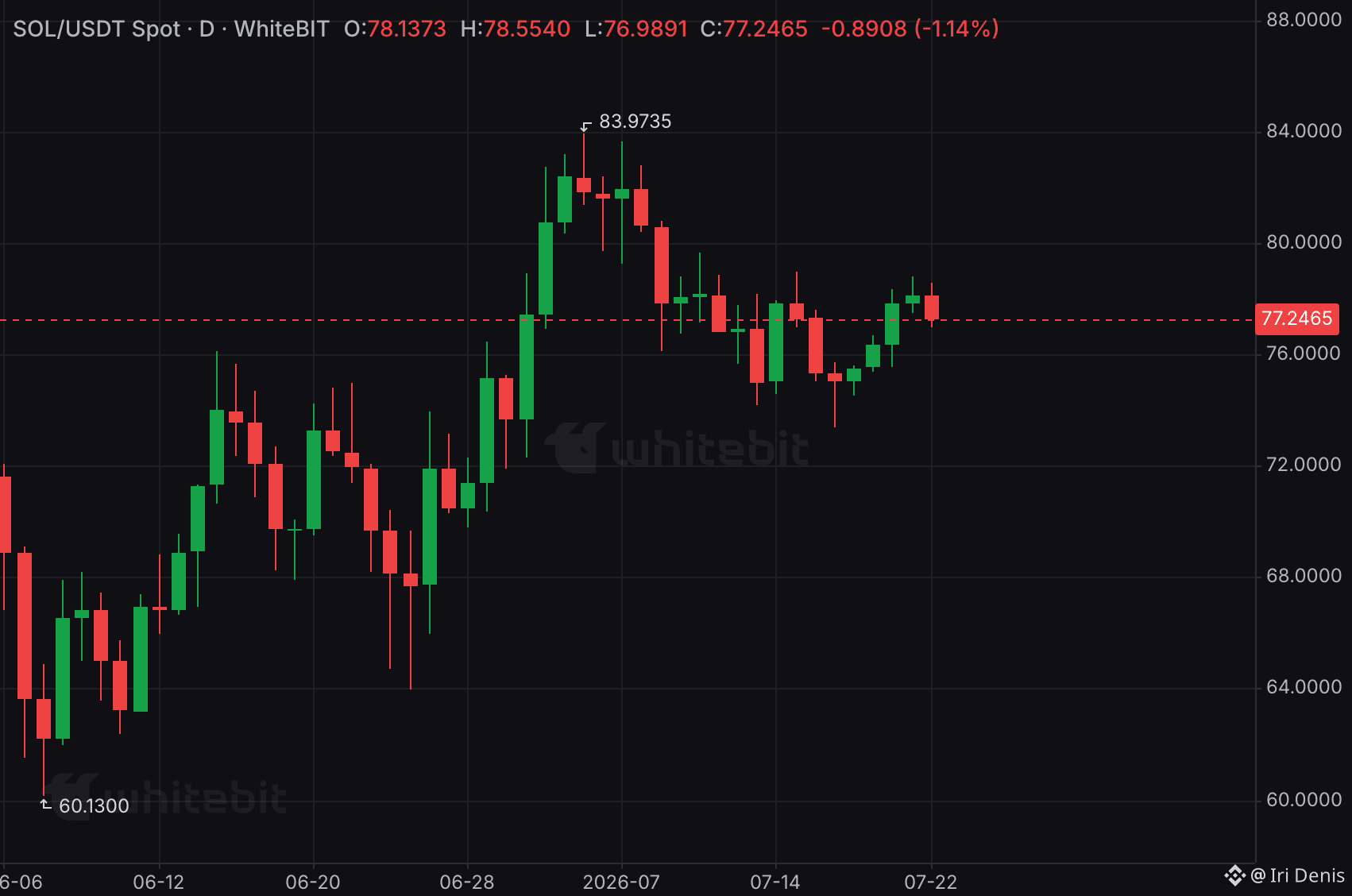
Adieu Proof of History : comment la plus grande mise à niveau de $SOL change l’économie des nœuds. Solana prépare officiellement des validateurs pour la refonte de protocole la plus ambitieuse de son histoire : la mise à jour Alpenglow. Plutôt que de simplement corriger des fonctionnalités superficielles, cette version remplace entièrement la couche de consensus centrale de Solana — en abandonnant Proof of History (PoH) et Tower BFT au profit de deux tous nouveaux systèmes appelés Votor et Rotor. Voici le décryptage approfondi de ce que couvre l’article et pourquoi ce changement technique compte : D’abord, on parle d’un gain de vitesse de 100x. La finalité des transactions passe de 12,8 secondes à une médiane ultra-rapide de 100 à 150 millisecondes, dépassant des passerelles de paiement traditionnelles comme Visa et rendant le gaming Web3 ainsi que le trading à haute fréquence réellement instantanés. Ensuite, elle récupère 75 % de l’espace de blocs du réseau. Historiquement, les trois quarts de la capacité de Solana étaient encombrés par les transactions de vote des validateurs en chaîne. Alpenglow déplace le vote hors chaîne, libérant instantanément une énorme bande passante pour les dApps des utilisateurs, la DeFi et les transferts. Troisièmement, elle remodèle entièrement l’économie des validateurs. Les coûts d’exploitation des nœuds devraient chuter jusqu’à 98 %, tandis que le capital minimum rentable passe d’environ 4 850 SOL à seulement 450 SOL — réduisant drastiquement les barrières à l’entrée et renforçant la décentralisation. Quatrièmement, le calendrier de déploiement est déjà en cours. Les validateurs se préparent via la mise à jour Agave 4.1, avec une activation complète sur le mainnet visée pour la fin du T3 ou le T4 2026. Alpenglow n’est pas un simple patch incrémental — c’est une reconstruction fondamentale du moteur d’exécution de $SOL conçue pour gérer un volume à l’échelle Web2 sans sacrifier la décentralisation. Iri Denis, ton pote crypto, Suis pour plus d’insights 🚀 #Bitcoin Price Prediction: What is Bitcoins next move?# #BTC Price Analysis#
Adieu Proof of History : comment la plus grande mise à niveau de $SOL change l’économie des nœuds. Solana prépare officiellement des validateurs pour la refonte de protocole la plus ambitieuse de son histoire : la mise à jour Alpenglow. Plutôt que de simplement corriger des fonctionnalités superficielles, cette version remplace entièrement la couche de consensus centrale de Solana — en abandonnant Proof of History (PoH) et Tower BFT au profit de deux tous nouveaux systèmes appelés Votor et Rotor. Voici le décryptage approfondi de ce que couvre l’article et pourquoi ce changement technique compte : D’abord, on parle d’un gain de vitesse de 100x. La finalité des transactions passe de 12,8 secondes à une médiane ultra-rapide de 100 à 150 millisecondes, dépassant des passerelles de paiement traditionnelles comme Visa et rendant le gaming Web3 ainsi que le trading à haute fréquence réellement instantanés. Ensuite, elle récupère 75 % de l’espace de blocs du réseau. Historiquement, les trois quarts de la capacité de Solana étaient encombrés par les transactions de vote des validateurs en chaîne. Alpenglow déplace le vote hors chaîne, libérant instantanément une énorme bande passante pour les dApps des utilisateurs, la DeFi et les transferts. Troisièmement, elle remodèle entièrement l’économie des validateurs. Les coûts d’exploitation des nœuds devraient chuter jusqu’à 98 %, tandis que le capital minimum rentable passe d’environ 4 850 SOL à seulement 450 SOL — réduisant drastiquement les barrières à l’entrée et renforçant la décentralisation. Quatrièmement, le calendrier de déploiement est déjà en cours. Les validateurs se préparent via la mise à jour Agave 4.1, avec une activation complète sur le mainnet visée pour la fin du T3 ou le T4 2026. Alpenglow n’est pas un simple patch incrémental — c’est une reconstruction fondamentale du moteur d’exécution de $SOL conçue pour gérer un volume à l’échelle Web2 sans sacrifier la décentralisation. Iri Denis, ton pote crypto, Suis pour plus d’insights 🚀 #Bitcoin Price Prediction: What is Bitcoins next move?# #BTC Price Analysis#
49
·
--
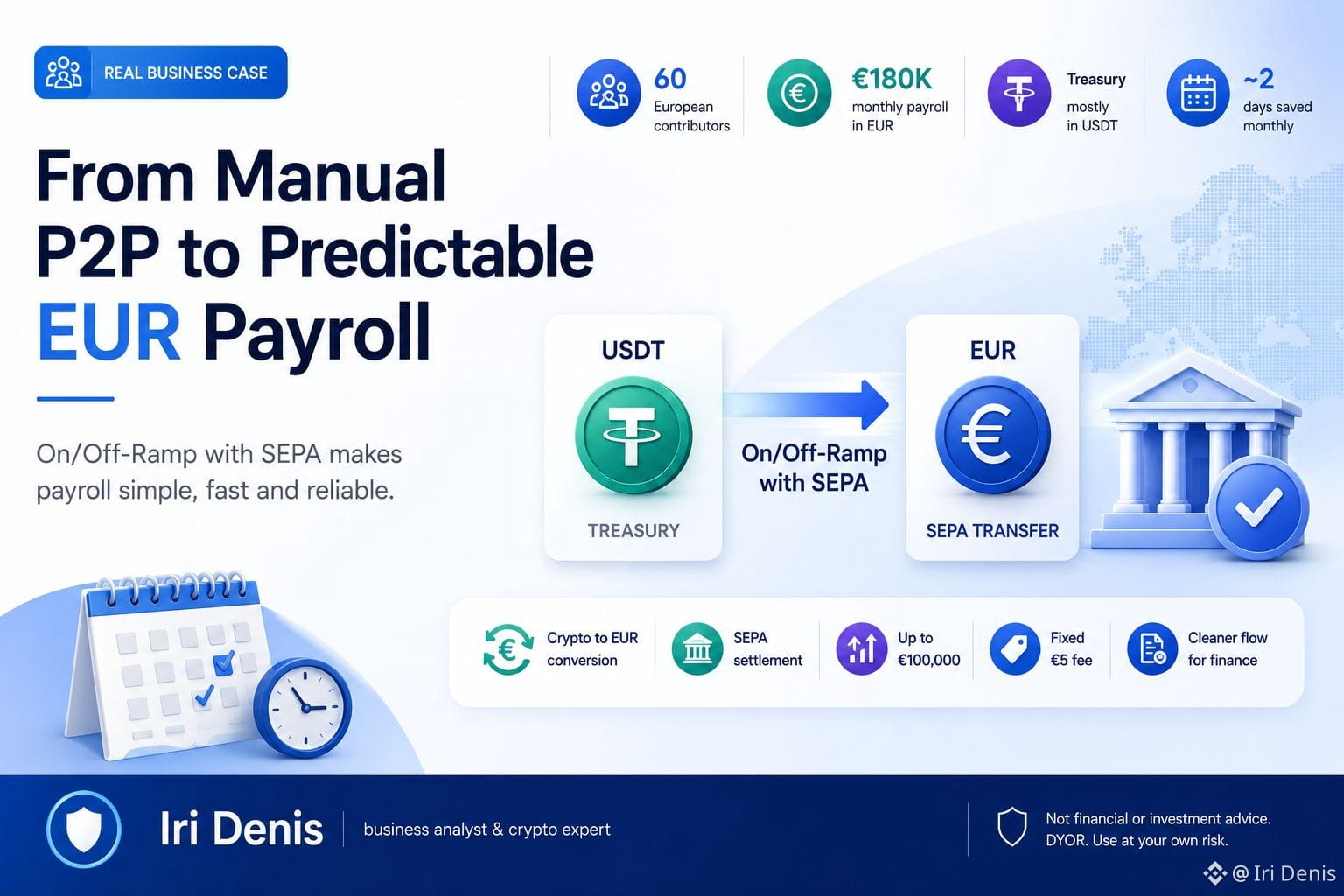
Pourquoi les projets crypto ont besoin de flux de paie EUR plus performants 📈 Un projet de token post-TGE comptait 60 contributeurs européens recevant des paiements mensuels en EUR. La trésorerie comprenait $BTC et d’autres actifs crypto, tandis que la paie devait s’élever à environ 180 000 € par mois via des virements bancaires classiques. Le processus était laborieux : l’équipe divisait les paiements en transactions P2P plus petites, chacune inférieure à 15 000 €, les rapprochait manuellement, et gérait un règlement incohérent la plupart des mois. Le P2P convient à des cas d’usage flexibles, mais une paie récurrente a besoin de davantage de prévisibilité. Le COO a passé presque deux jours entiers par mois à gérer la conversion de la paie. Les prestataires ne cessaient de demander pourquoi le calendrier changeait, et trois contributeurs seniors ont lié leurs décisions de renouvellement à des opérations de paiement plus fiables. C’est là que l’infrastructure on/off-ramp pourrait valoir le coup d’être évaluée. Par exemple, WhiteBIT On/Off-Ramp avec SEPA pourrait être pertinent pour les entreprises qui convertissent régulièrement des revenus crypto en EUR et ont besoin d’une manière plus prévisible de faire circuler les fonds via les rails bancaires, avec des limites, des frais et un déroulement de règlement plus clairs. institutional.whitebit.com/pay ... Pour un cas de paie comme celui-ci, les bénéfices potentiels peuvent être : 🔄 Conversion crypto → EUR 🏦 Règlement SEPA 📊 Transactions jusqu’à 100 000 € 💰 Des frais fixes de 5 € 🧾 Un flux de paiement plus propre pour les équipes finance Au lieu de fractionner 180 000 € en de nombreux petits virements manuels, le projet pourrait traiter la paie en seulement deux transactions plus importantes — 10 € de commission totale fixe, et une structure beaucoup plus nette pour l’équipe finance. Avertissement : ceci ne constitue pas un conseil financier ni un conseil en investissement. Faites vos propres recherches avant de prendre toute décision. #Sponsored #Bitcoin Price Prediction: What is Bitcoins next move?# #BTC Price Analysis#
Pourquoi les projets crypto ont besoin de flux de paie EUR plus performants 📈 Un projet de token post-TGE comptait 60 contributeurs européens recevant des paiements mensuels en EUR. La trésorerie comprenait $BTC et d’autres actifs crypto, tandis que la paie devait s’élever à environ 180 000 € par mois via des virements bancaires classiques. Le processus était laborieux : l’équipe divisait les paiements en transactions P2P plus petites, chacune inférieure à 15 000 €, les rapprochait manuellement, et gérait un règlement incohérent la plupart des mois. Le P2P convient à des cas d’usage flexibles, mais une paie récurrente a besoin de davantage de prévisibilité. Le COO a passé presque deux jours entiers par mois à gérer la conversion de la paie. Les prestataires ne cessaient de demander pourquoi le calendrier changeait, et trois contributeurs seniors ont lié leurs décisions de renouvellement à des opérations de paiement plus fiables. C’est là que l’infrastructure on/off-ramp pourrait valoir le coup d’être évaluée. Par exemple, WhiteBIT On/Off-Ramp avec SEPA pourrait être pertinent pour les entreprises qui convertissent régulièrement des revenus crypto en EUR et ont besoin d’une manière plus prévisible de faire circuler les fonds via les rails bancaires, avec des limites, des frais et un déroulement de règlement plus clairs. institutional.whitebit.com/pay ... Pour un cas de paie comme celui-ci, les bénéfices potentiels peuvent être : 🔄 Conversion crypto → EUR 🏦 Règlement SEPA 📊 Transactions jusqu’à 100 000 € 💰 Des frais fixes de 5 € 🧾 Un flux de paiement plus propre pour les équipes finance Au lieu de fractionner 180 000 € en de nombreux petits virements manuels, le projet pourrait traiter la paie en seulement deux transactions plus importantes — 10 € de commission totale fixe, et une structure beaucoup plus nette pour l’équipe finance. Avertissement : ceci ne constitue pas un conseil financier ni un conseil en investissement. Faites vos propres recherches avant de prendre toute décision. #Sponsored #Bitcoin Price Prediction: What is Bitcoins next move?# #BTC Price Analysis#
59
·
--
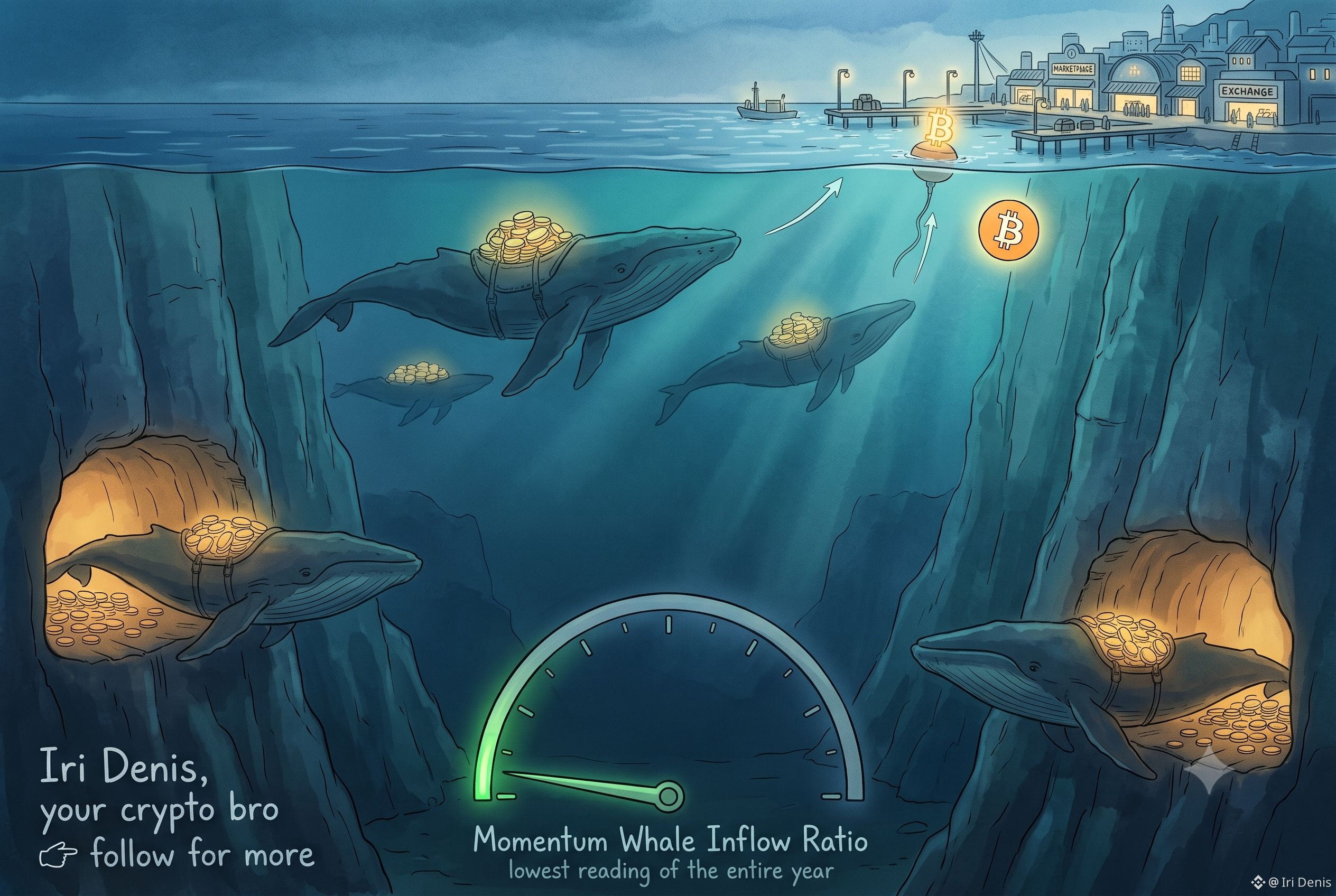
Que signifie une reprise du prix du $BTC . Les données en chaîne révèlent un changement majeur dans le comportement des baleines, alors que le ratio d’afflux de baleines (Momentum Whale Inflow Ratio) atteint son plus bas niveau de 2026. Pendant que $BTC consolide autour du seuil des 65 900 $, les gros détenteurs ralentissent drastiquement leurs dépôts de jetons sur les échanges centralisés. Que signifie cela, en termes simples, pour les traders du quotidien ? ▪️ Atténuation de la pression vendeuse : Lorsque les baleines envoient moins de pièces vers les échanges, l’offre disponible sur le marché diminue. Un ratio d’afflux de baleines sur l’instant (Momentum Whale Inflow Ratio) négatif indique que les gros détenteurs choisissent de conserver plutôt que de vendre, ce qui réduit fortement la pression à la baisse. ▪️ Préparer la voie à la reprise : Avec un refroidissement de l’activité de vente des baleines, il faut beaucoup moins de volume d’achat pour faire monter le prix. Cette baisse de l’offre sur les échanges crée des conditions idéales pour que le BTC prépare sa prochaine phase de reprise vers des objectifs de résistance plus élevés. Le fait que les baleines se retirent des ventes sur les échanges est un signal classique que l’anxiété du marché diminue, créant un environnement bien plus sain pour que Bitcoin puisse repartir à la hausse. Iri Denis, ton pote crypto Suis pour plus d’insights 🚀 #Prédiction du prix du Bitcoin : Quelle sera la prochaine étape de Bitcoins ?# #Analyse du prix du BTC#
Que signifie une reprise du prix du $BTC . Les données en chaîne révèlent un changement majeur dans le comportement des baleines, alors que le ratio d’afflux de baleines (Momentum Whale Inflow Ratio) atteint son plus bas niveau de 2026. Pendant que $BTC consolide autour du seuil des 65 900 $, les gros détenteurs ralentissent drastiquement leurs dépôts de jetons sur les échanges centralisés. Que signifie cela, en termes simples, pour les traders du quotidien ? ▪️ Atténuation de la pression vendeuse : Lorsque les baleines envoient moins de pièces vers les échanges, l’offre disponible sur le marché diminue. Un ratio d’afflux de baleines sur l’instant (Momentum Whale Inflow Ratio) négatif indique que les gros détenteurs choisissent de conserver plutôt que de vendre, ce qui réduit fortement la pression à la baisse. ▪️ Préparer la voie à la reprise : Avec un refroidissement de l’activité de vente des baleines, il faut beaucoup moins de volume d’achat pour faire monter le prix. Cette baisse de l’offre sur les échanges crée des conditions idéales pour que le BTC prépare sa prochaine phase de reprise vers des objectifs de résistance plus élevés. Le fait que les baleines se retirent des ventes sur les échanges est un signal classique que l’anxiété du marché diminue, créant un environnement bien plus sain pour que Bitcoin puisse repartir à la hausse. Iri Denis, ton pote crypto Suis pour plus d’insights 🚀 #Prédiction du prix du Bitcoin : Quelle sera la prochaine étape de Bitcoins ?# #Analyse du prix du BTC#
72
·
--
Que signifie une légère baisse de $BTC jusqu’à environ $65,800 pour le marché. Le Bitcoin a récemment touché le niveau de 66 900 $ avant de reculer légèrement pour se consolider autour de 65 800 $. Ce mouvement local se produit dans un contexte macroéconomique pour le moins chaotique : les valeurs des semi-conducteurs prolongent leur rallye, tandis que le Yen japonais a chuté vers un plus bas historique sur 40 ans face au dollar américain. En termes simples, qu’est-ce que cela signifie pour les investisseurs du quotidien ? 📍 Affaiblissement des monnaies nationales : lorsque des grandes devises mondiales comme le Yen subissent une forte dévaluation, les investisseurs recherchent des actifs rares et non souverains pour protéger leur pouvoir d’achat. Cette pression macro pousse naturellement l’attention vers $BTC en tant que couverture mondiale. Forte appétence pour le risque : la hausse continue des actions technologiques et des puces montre que les investisseurs traditionnels ont encore soif d’actifs de croissance. Le sentiment positif sur les marchés tech contribue à maintenir un socle solide sous le crypto, de sorte qu’une baisse vers 65 800 $ ressemble davantage à une digestion normale du marché qu’à une vente-panique. En bref : tester 66 000 $ et rester solide autour de 65 800 $ au milieu de turbulences monétaires majeures indique que le marché dans son ensemble demeure résilient. Iri Denis, votre crypto bro Abonnez-vous pour plus d’insights 🚀 #Bitcoin Price Prediction: What is Bitcoins next move?# #BTC Price Analysis#
Que signifie une légère baisse de $BTC jusqu’à environ $65,800 pour le marché. Le Bitcoin a récemment touché le niveau de 66 900 $ avant de reculer légèrement pour se consolider autour de 65 800 $. Ce mouvement local se produit dans un contexte macroéconomique pour le moins chaotique : les valeurs des semi-conducteurs prolongent leur rallye, tandis que le Yen japonais a chuté vers un plus bas historique sur 40 ans face au dollar américain. En termes simples, qu’est-ce que cela signifie pour les investisseurs du quotidien ? 📍 Affaiblissement des monnaies nationales : lorsque des grandes devises mondiales comme le Yen subissent une forte dévaluation, les investisseurs recherchent des actifs rares et non souverains pour protéger leur pouvoir d’achat. Cette pression macro pousse naturellement l’attention vers $BTC en tant que couverture mondiale. Forte appétence pour le risque : la hausse continue des actions technologiques et des puces montre que les investisseurs traditionnels ont encore soif d’actifs de croissance. Le sentiment positif sur les marchés tech contribue à maintenir un socle solide sous le crypto, de sorte qu’une baisse vers 65 800 $ ressemble davantage à une digestion normale du marché qu’à une vente-panique. En bref : tester 66 000 $ et rester solide autour de 65 800 $ au milieu de turbulences monétaires majeures indique que le marché dans son ensemble demeure résilient. Iri Denis, votre crypto bro Abonnez-vous pour plus d’insights 🚀 #Bitcoin Price Prediction: What is Bitcoins next move?# #BTC Price Analysis#

84
·
--
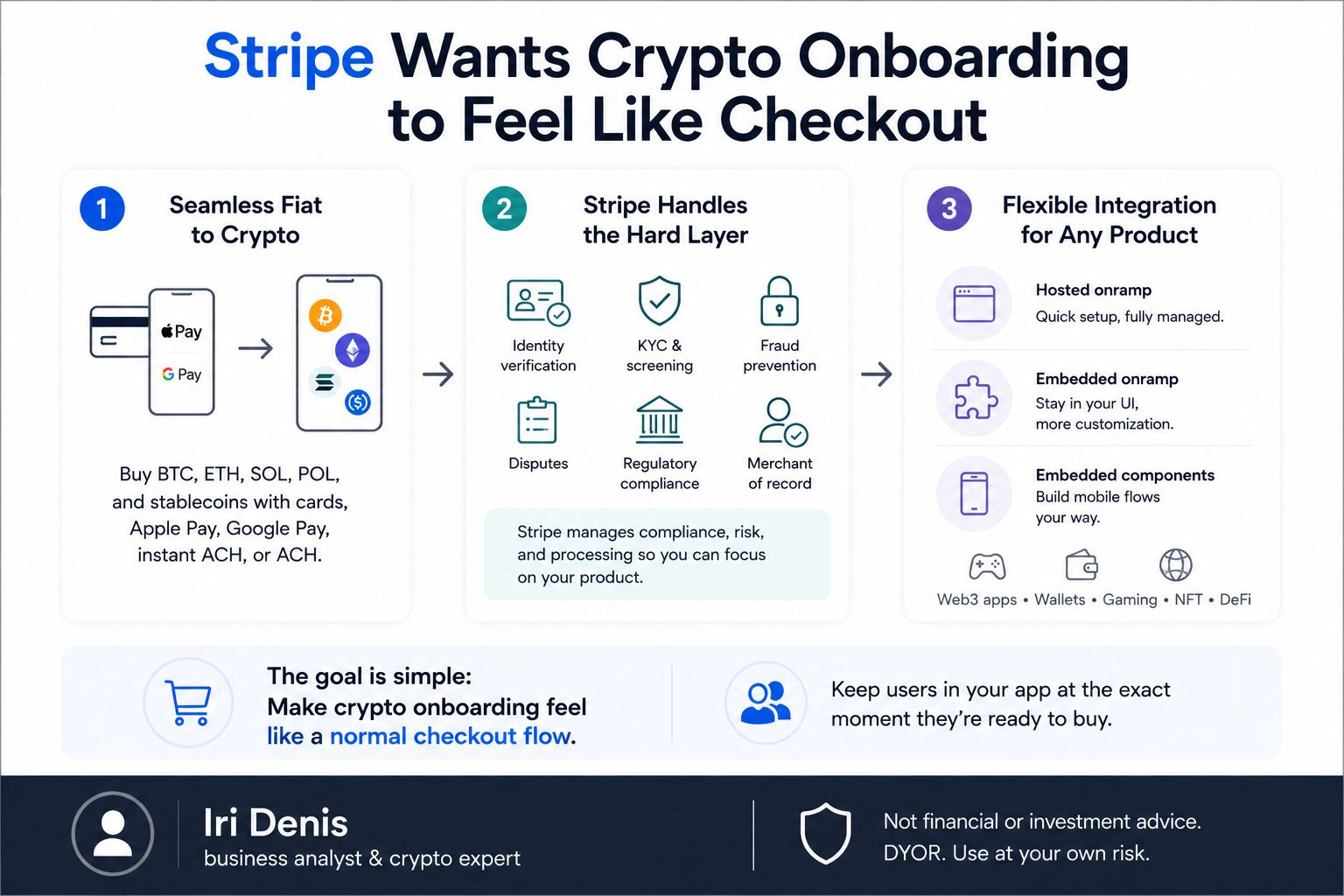
Stripe veut que l’onboarding crypto ressemble à un checkout 📊 L’un des plus gros problèmes lors de l’onboarding du $BTC ou d’autres cryptos ne concerne pas le portefeuille lui-même. C’est le moment où un utilisateur veut passer de la monnaie fiduciaire à la crypto et que le produit le fait soudain passer par des étapes supplémentaires, des redirections, des paiements échoués, des frictions liées au KYC ou encore l’interface d’un autre prestataire. C’est pourquoi Stripe Crypto On-ramp est intéressant. https://stripe.com/crypto-onramp?utm_source=coinmarketcap&utm_medium=denisrampoffon&utm_campaign=post Le produit permet aux plateformes d’ajouter des achats fiat-vers-crypto directement dans leur application ou sur leur site web. Un utilisateur peut acheter des actifs comme $BTC, ETH, SOL, POL, ou des stablecoins en utilisant des méthodes de paiement familières telles que les cartes, Apple Pay, Google Pay, l’ACH instantané ou l’ACH classique. Le point utile, c’est que Stripe gère une grande partie de la couche technique derrière le parcours : traitement des paiements, vérification de l’identité, KYC, filtrage des sanctions, prévention de la fraude, litiges et exigences réglementaires. Stripe agit aussi comme commerçant responsable pour les transactions d’onramp. Pour les applications Web3, les portefeuilles, les plateformes de jeu, les produits NFT et les interfaces DeFi, cela pourrait réduire considérablement les frictions liées à l’onboarding. Au lieu d’éloigner les utilisateurs au moment exact où ils sont prêts à alimenter un portefeuille, le parcours d’achat peut rester plus proche de l’expérience produit. Stripe propose aussi différents modes d’intégration : onramp hébergé, onramp intégré, et composants intégrés pour mobile. Cela offre aux équipes une certaine flexibilité, selon le niveau de contrôle qu’elles souhaitent sur l’expérience utilisateur. Pour moi, le point intéressant, c’est le positionnement. Stripe ne cherche pas à rendre l’onboarding crypto « natif crypto ». Il cherche à le rendre comme un parcours de checkout normal. Et c’est peut-être exactement ce dont de nombreux utilisateurs ont besoin avant de faire leur premier achat de crypto. Avertissement : Ceci ne constitue pas un conseil financier ni en investissement. Faites vos propres recherches avant de prendre toute décision. Utilisez-le à vos propres risques. #Sponsorisé #Prédiction du prix du Bitcoin : Quel sera le prochain mouvement des Bitcoins ?# #Analyse du prix du BTC#
Stripe veut que l’onboarding crypto ressemble à un checkout 📊 L’un des plus gros problèmes lors de l’onboarding du $BTC ou d’autres cryptos ne concerne pas le portefeuille lui-même. C’est le moment où un utilisateur veut passer de la monnaie fiduciaire à la crypto et que le produit le fait soudain passer par des étapes supplémentaires, des redirections, des paiements échoués, des frictions liées au KYC ou encore l’interface d’un autre prestataire. C’est pourquoi Stripe Crypto On-ramp est intéressant. https://stripe.com/crypto-onramp?utm_source=coinmarketcap&utm_medium=denisrampoffon&utm_campaign=post Le produit permet aux plateformes d’ajouter des achats fiat-vers-crypto directement dans leur application ou sur leur site web. Un utilisateur peut acheter des actifs comme $BTC, ETH, SOL, POL, ou des stablecoins en utilisant des méthodes de paiement familières telles que les cartes, Apple Pay, Google Pay, l’ACH instantané ou l’ACH classique. Le point utile, c’est que Stripe gère une grande partie de la couche technique derrière le parcours : traitement des paiements, vérification de l’identité, KYC, filtrage des sanctions, prévention de la fraude, litiges et exigences réglementaires. Stripe agit aussi comme commerçant responsable pour les transactions d’onramp. Pour les applications Web3, les portefeuilles, les plateformes de jeu, les produits NFT et les interfaces DeFi, cela pourrait réduire considérablement les frictions liées à l’onboarding. Au lieu d’éloigner les utilisateurs au moment exact où ils sont prêts à alimenter un portefeuille, le parcours d’achat peut rester plus proche de l’expérience produit. Stripe propose aussi différents modes d’intégration : onramp hébergé, onramp intégré, et composants intégrés pour mobile. Cela offre aux équipes une certaine flexibilité, selon le niveau de contrôle qu’elles souhaitent sur l’expérience utilisateur. Pour moi, le point intéressant, c’est le positionnement. Stripe ne cherche pas à rendre l’onboarding crypto « natif crypto ». Il cherche à le rendre comme un parcours de checkout normal. Et c’est peut-être exactement ce dont de nombreux utilisateurs ont besoin avant de faire leur premier achat de crypto. Avertissement : Ceci ne constitue pas un conseil financier ni en investissement. Faites vos propres recherches avant de prendre toute décision. Utilisez-le à vos propres risques. #Sponsorisé #Prédiction du prix du Bitcoin : Quel sera le prochain mouvement des Bitcoins ?# #Analyse du prix du BTC#
96
·
--
Pourquoi le co-créateur de Ripple a vendu du $XRP à 10 cents. ⚡⚡ L’ancien CTO de Ripple, David Schwartz, a relancé un débat au sein de la communauté en admettant qu’il regrette d’avoir vendu du XRP à 0,10 $ et de l’Ethereum à 1 $, même si des actifs comme $BTC ont ensuite atteint des valorisations massives. En réponse aux critiques passées concernant ses sorties précoces, Schwartz a expliqué qu’un accord de longue date avec sa femme l’obligeait à vendre à chaque nouvel plus haut historique, car il déteste profondément le risque financier. Que signifie cela pour les traders du quotidien, simplement ? 📍 Gestion du risque plutôt que la cupidité : Même les ingénieurs brillants qui construisent ces protocoles sont confrontés au FOMO et à la vente trop tôt. Schwartz a privilégié la sécurisation de la stabilité financière de sa famille et la tranquillité d’esprit plutôt que d’attendre des prix absolument au sommet. 📍 L’importance d’un plan de sortie : Avoir une stratégie claire de prise de profits—comme vendre un pourcentage à chaque nouveau pic—évite de prendre des décisions émotionnelles, même si cela implique de laisser des gains supplémentaires sur la table. 📍 Indice subtil du marché : Certains détenteurs de XRP spéculent que le fait que Schwartz évoque maintenant sa règle de take-profit basée sur l’ATH pourrait être un rappel discret pour verrouiller ses gains pendant que le marché prend de l’élan. Prendre des profits n’est jamais une erreur. Même si vous ne captez pas le sommet absolu, suivre une stratégie disciplinée est la façon de survivre et de gagner dans la crypto sur le long terme. Iri Denis, ton bro crypto. Abonne-toi pour plus d’insights 🚀 #Bitcoin Price Prediction: What is Bitcoins next move?# #BTC Price Analysis#
Pourquoi le co-créateur de Ripple a vendu du $XRP à 10 cents. ⚡⚡ L’ancien CTO de Ripple, David Schwartz, a relancé un débat au sein de la communauté en admettant qu’il regrette d’avoir vendu du XRP à 0,10 $ et de l’Ethereum à 1 $, même si des actifs comme $BTC ont ensuite atteint des valorisations massives. En réponse aux critiques passées concernant ses sorties précoces, Schwartz a expliqué qu’un accord de longue date avec sa femme l’obligeait à vendre à chaque nouvel plus haut historique, car il déteste profondément le risque financier. Que signifie cela pour les traders du quotidien, simplement ? 📍 Gestion du risque plutôt que la cupidité : Même les ingénieurs brillants qui construisent ces protocoles sont confrontés au FOMO et à la vente trop tôt. Schwartz a privilégié la sécurisation de la stabilité financière de sa famille et la tranquillité d’esprit plutôt que d’attendre des prix absolument au sommet. 📍 L’importance d’un plan de sortie : Avoir une stratégie claire de prise de profits—comme vendre un pourcentage à chaque nouveau pic—évite de prendre des décisions émotionnelles, même si cela implique de laisser des gains supplémentaires sur la table. 📍 Indice subtil du marché : Certains détenteurs de XRP spéculent que le fait que Schwartz évoque maintenant sa règle de take-profit basée sur l’ATH pourrait être un rappel discret pour verrouiller ses gains pendant que le marché prend de l’élan. Prendre des profits n’est jamais une erreur. Même si vous ne captez pas le sommet absolu, suivre une stratégie disciplinée est la façon de survivre et de gagner dans la crypto sur le long terme. Iri Denis, ton bro crypto. Abonne-toi pour plus d’insights 🚀 #Bitcoin Price Prediction: What is Bitcoins next move?# #BTC Price Analysis#

77
·
--
Blockchain invisible : pourquoi le PDG de MoneyGram pense que la crypto fonctionne mieux « sous le capot ». 👀 Dans un marché où la plupart des regards restent rivés aux mouvements du prix de $BTC , le PDG de MoneyGram, Anthony Soohoo, vient de donner une grande leçon de réalité sur l’adoption de la crypto dans le monde réel. Il a souligné que la technologie blockchain fonctionne en fait mieux quand les clients du quotidien ne se rendent même pas compte qu’elle est là. ⚡ Au lieu d’imposer à 60 millions d’utilisateurs des phrases de seed complexes ou des frais de gas, MoneyGram fait tourner une infrastructure de stablecoins de façon invisible en arrière-plan sur des réseaux comme Stellar, $SOL , et Tempo. Le géant des paiements a déjà réglé plus de 2 milliards de dollars avec des actifs numériques, en traitant la crypto comme un moteur de liquidité 24/7 pour transférer de l’argent à l’échelle mondiale en quelques secondes. Cette approche « sous le capot » résout les plus gros problèmes des paiements transfrontaliers en éliminant les retards de règlement du week-end et en libérant du capital de travail immobilisé. Elle prouve que l’utilité évolue rapidement via des rails financiers back-end plutôt que par des interfaces complexes côté consommateur. Le point clé est simple : le véritable tournant pour une adoption massive de Web3 n’est pas de convaincre tout le monde d’étudier les mécanismes de la blockchain, mais de construire des rails financiers si rapides et si invisibles que les utilisateurs n’aient jamais besoin d’y penser. Iri Denis, ton crypto bro. Suis pour plus d’insights 🚀 #Bitcoin Price Prediction : Quelle sera la prochaine étape de Bitcoins ?# #BTC Price Analysis#
Blockchain invisible : pourquoi le PDG de MoneyGram pense que la crypto fonctionne mieux « sous le capot ». 👀 Dans un marché où la plupart des regards restent rivés aux mouvements du prix de $BTC , le PDG de MoneyGram, Anthony Soohoo, vient de donner une grande leçon de réalité sur l’adoption de la crypto dans le monde réel. Il a souligné que la technologie blockchain fonctionne en fait mieux quand les clients du quotidien ne se rendent même pas compte qu’elle est là. ⚡ Au lieu d’imposer à 60 millions d’utilisateurs des phrases de seed complexes ou des frais de gas, MoneyGram fait tourner une infrastructure de stablecoins de façon invisible en arrière-plan sur des réseaux comme Stellar, $SOL , et Tempo. Le géant des paiements a déjà réglé plus de 2 milliards de dollars avec des actifs numériques, en traitant la crypto comme un moteur de liquidité 24/7 pour transférer de l’argent à l’échelle mondiale en quelques secondes. Cette approche « sous le capot » résout les plus gros problèmes des paiements transfrontaliers en éliminant les retards de règlement du week-end et en libérant du capital de travail immobilisé. Elle prouve que l’utilité évolue rapidement via des rails financiers back-end plutôt que par des interfaces complexes côté consommateur. Le point clé est simple : le véritable tournant pour une adoption massive de Web3 n’est pas de convaincre tout le monde d’étudier les mécanismes de la blockchain, mais de construire des rails financiers si rapides et si invisibles que les utilisateurs n’aient jamais besoin d’y penser. Iri Denis, ton crypto bro. Suis pour plus d’insights 🚀 #Bitcoin Price Prediction : Quelle sera la prochaine étape de Bitcoins ?# #BTC Price Analysis#

65
·
--
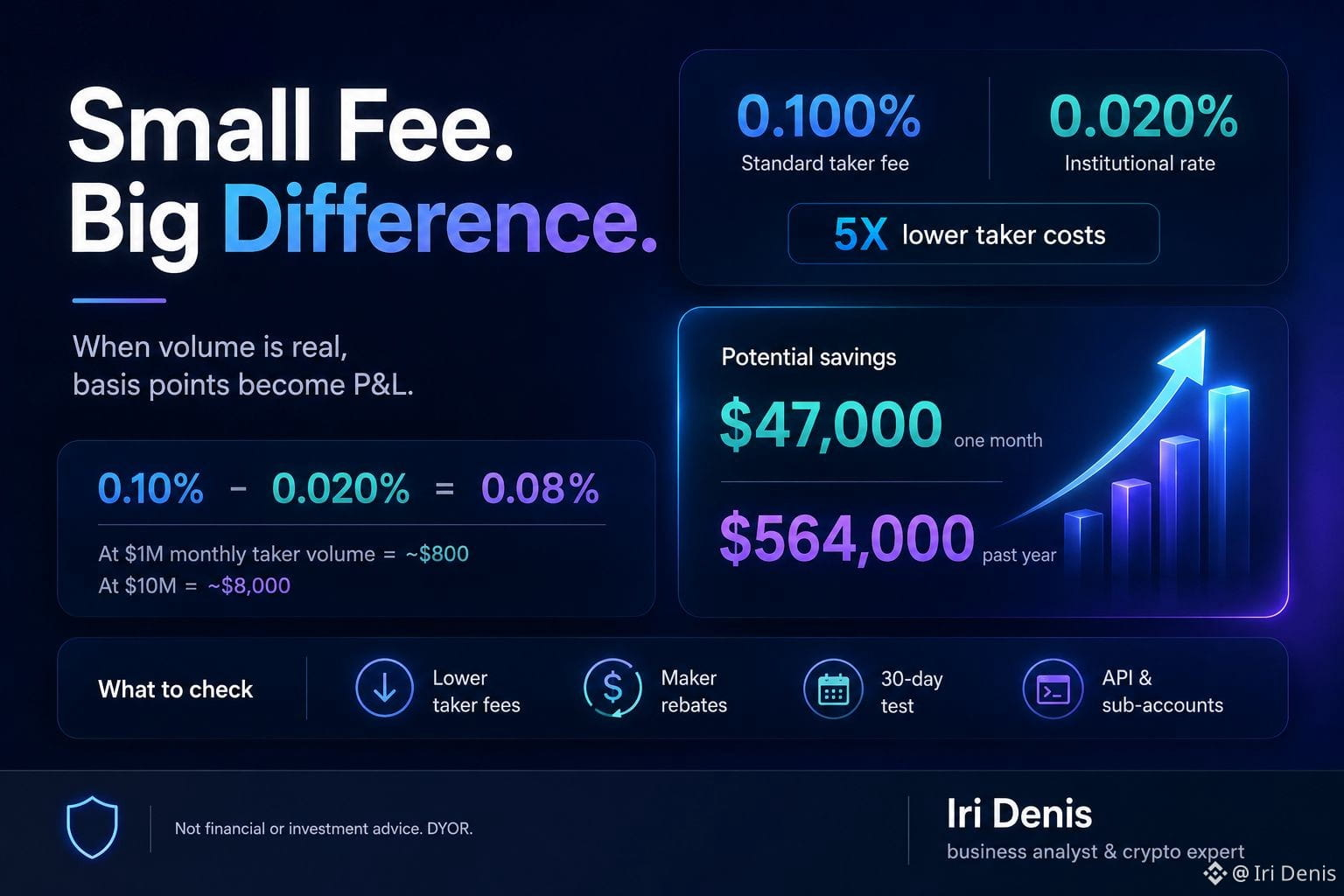
À quel point les frais de trading « standards » vous coûtent discrètement ? Une société de trading travaillant avec $BTC et d’autres actifs liquides a comparé deux chiffres le mois dernier : la commission standard (0,1 %) et le taux institutionnel (0,020 %). 🤏 Sur le papier, l’écart semblait faible, mais sur un volume réel, cela représentait environ 47 000 $ d’économies mensuelles et ~564 000 $ par an. La demande de meilleures conditions a été soumise le même après-midi ✍ Voilà ce que beaucoup de traders professionnels sous-estiment : les frais ressemblent à un détail mineur jusqu’à ce que le volume transforme chaque point de base en argent réel 💵 0,1 % contre 0,020 %, c’est une réduction par 5 des coûts pour les takers 📉, ce qui impacte directement le P&L mensuel. L’obstacle habituel, c’est l’hypothèse selon laquelle il est difficile d’obtenir des conditions institutionnelles : processus long, minimums élevés, historique strict des plateformes 🚧 Du coup, les traders restent sur des conditions standard et paient discrètement la différence chaque mois. 🧮 Le calcul : 0,1 % − 0,020 % = 0,08 %. À 1 M$ de volume mensuel, cela fait environ 800 $/mois de « coût du retard ». À 10 M$, c’est 8 000 $. C’est là que le programme de Market Making de WhiteBIT pourrait valoir le détour en tant qu’une option possible. https://institutional.whitebit.com/market-making-program?utm_source=coinmarketcap&utm_medium=denis_makingprog&utm_campaign=post Le programme de Market Making de WhiteBIT peut être pertinent pour les market makers, les traders HFT, les traders algorithmiques et les équipes d’arbitrage. La configuration peut inclure : 📈 Des rebates pour les makers jusqu’à -0,012 % 📉 Des frais taker plus bas 📄 Une preuve d’activité de trading depuis d’autres plateformes 🗓️ Une période d’essai de 30 jours 🧩 Des sous-comptes 🔌 Un accès API pour la gestion de stratégie Multipliez le volume taker du mois dernier par 0,08 %. Ce chiffre représente le coût mensuel estimé de ne pas vérifier si des conditions institutionnelles sont disponibles pour vous. Avertissement : ceci ne constitue pas un conseil financier ou d’investissement. Faites vos propres recherches avant de prendre toute décision. #Sponsorisé #Analyse du prix du BTC# #Prédiction du prix du Bitcoin : Quelle sera la prochaine étape pour les Bitcoins?#
À quel point les frais de trading « standards » vous coûtent discrètement ? Une société de trading travaillant avec $BTC et d’autres actifs liquides a comparé deux chiffres le mois dernier : la commission standard (0,1 %) et le taux institutionnel (0,020 %). 🤏 Sur le papier, l’écart semblait faible, mais sur un volume réel, cela représentait environ 47 000 $ d’économies mensuelles et ~564 000 $ par an. La demande de meilleures conditions a été soumise le même après-midi ✍ Voilà ce que beaucoup de traders professionnels sous-estiment : les frais ressemblent à un détail mineur jusqu’à ce que le volume transforme chaque point de base en argent réel 💵 0,1 % contre 0,020 %, c’est une réduction par 5 des coûts pour les takers 📉, ce qui impacte directement le P&L mensuel. L’obstacle habituel, c’est l’hypothèse selon laquelle il est difficile d’obtenir des conditions institutionnelles : processus long, minimums élevés, historique strict des plateformes 🚧 Du coup, les traders restent sur des conditions standard et paient discrètement la différence chaque mois. 🧮 Le calcul : 0,1 % − 0,020 % = 0,08 %. À 1 M$ de volume mensuel, cela fait environ 800 $/mois de « coût du retard ». À 10 M$, c’est 8 000 $. C’est là que le programme de Market Making de WhiteBIT pourrait valoir le détour en tant qu’une option possible. https://institutional.whitebit.com/market-making-program?utm_source=coinmarketcap&utm_medium=denis_makingprog&utm_campaign=post Le programme de Market Making de WhiteBIT peut être pertinent pour les market makers, les traders HFT, les traders algorithmiques et les équipes d’arbitrage. La configuration peut inclure : 📈 Des rebates pour les makers jusqu’à -0,012 % 📉 Des frais taker plus bas 📄 Une preuve d’activité de trading depuis d’autres plateformes 🗓️ Une période d’essai de 30 jours 🧩 Des sous-comptes 🔌 Un accès API pour la gestion de stratégie Multipliez le volume taker du mois dernier par 0,08 %. Ce chiffre représente le coût mensuel estimé de ne pas vérifier si des conditions institutionnelles sont disponibles pour vous. Avertissement : ceci ne constitue pas un conseil financier ou d’investissement. Faites vos propres recherches avant de prendre toute décision. #Sponsorisé #Analyse du prix du BTC# #Prédiction du prix du Bitcoin : Quelle sera la prochaine étape pour les Bitcoins?#
41
·
--
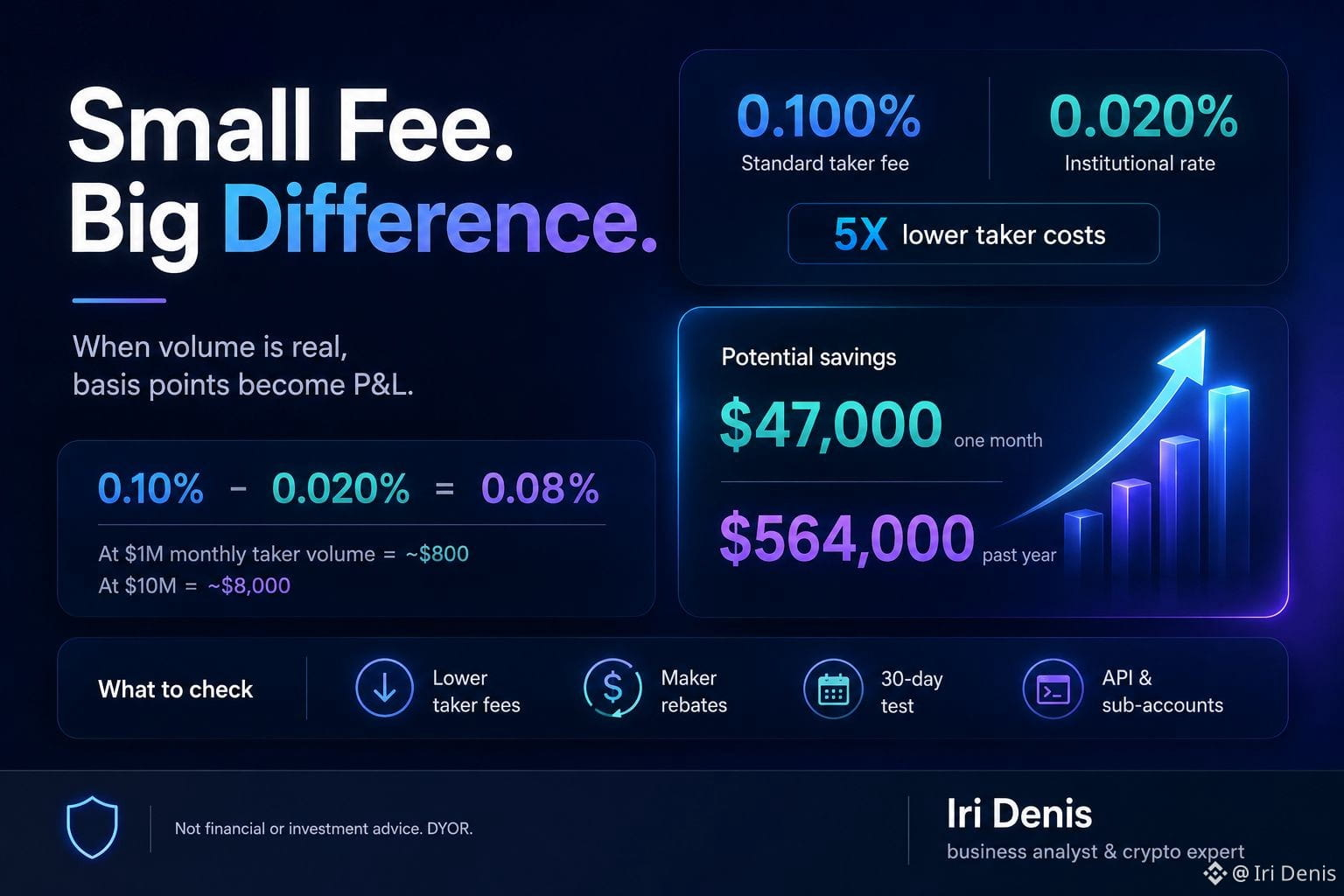
Combien les frais de trading standard vous coûtent-ils discrètement ? Un cabinet de trading travaillant avec $BTC et d’autres actifs liquides a comparé deux chiffres le mois dernier : les frais standard (0,1 %) et le taux institutionnel (0,020 %). 🤏 Sur le papier, l’écart semblait faible, mais sur un volume réel, cela représentait environ 47 000 $ d’économies mensuelles et ~564 000 $ par an. La demande de meilleures conditions a été soumise le même après-midi ✍ C’est ce que beaucoup de traders professionnels sous-estiment : les frais paraissent être un détail mineur jusqu’à ce que le volume transforme chaque point de base en argent réel 💵 0,1 % contre 0,020 %, c’est une réduction par 5 des coûts du taker 📉, qui impacte directement le P&L mensuel. L’obstacle habituel vient de l’hypothèse que les conditions institutionnelles sont difficiles à obtenir : processus long, minimums élevés, historique de la plateforme strict 🚧 Du coup, les traders restent sur des conditions standard et paient discrètement la différence chaque mois. 🧮 Le calcul : 0,1 % − 0,020 % = 0,08 %. Avec 1 M$ de volume mensuel, cela fait environ 800 $/mois de « coût du retard ». À 10 M$, c’est 8 000 $. C’est là que le programme de Market Making de WhiteBIT pourrait valoir le coup d’être examiné, comme une option possible. https://institutional.whitebit.com/market-making-program?utm_source=coinmarketcap&utm_medium=denis_makingprog&utm_campaign=post Le programme de Market Making de WhiteBIT peut être pertinent pour les market makers, les traders HFT, les traders algorithmiques et les équipes d’arbitrage. La configuration peut inclure : 📈 Des rebates pour le maker jusqu’à -0,012 % 📉 Des frais de taker réduits 📄 Une preuve d’activité de trading provenant d’autres plateformes 🗓 Une période d’essai de 30 jours 🧩 Des sous-comptes 🔌 Un accès API pour la gestion de la stratégie Multipliez le volume du taker du mois dernier par 0,08 %. Ce chiffre correspond au coût mensuel estimé de ne pas vérifier si des conditions institutionnelles sont disponibles pour vous. Déclaration : ceci ne constitue pas un conseil financier ou d’investissement. Faites vos propres recherches avant de prendre des décisions. #Ads #Bitcoin Price Prediction : Quelle sera la prochaine étape de Bitcoin ?# #BTC Price Analysis#
Combien les frais de trading standard vous coûtent-ils discrètement ? Un cabinet de trading travaillant avec $BTC et d’autres actifs liquides a comparé deux chiffres le mois dernier : les frais standard (0,1 %) et le taux institutionnel (0,020 %). 🤏 Sur le papier, l’écart semblait faible, mais sur un volume réel, cela représentait environ 47 000 $ d’économies mensuelles et ~564 000 $ par an. La demande de meilleures conditions a été soumise le même après-midi ✍ C’est ce que beaucoup de traders professionnels sous-estiment : les frais paraissent être un détail mineur jusqu’à ce que le volume transforme chaque point de base en argent réel 💵 0,1 % contre 0,020 %, c’est une réduction par 5 des coûts du taker 📉, qui impacte directement le P&L mensuel. L’obstacle habituel vient de l’hypothèse que les conditions institutionnelles sont difficiles à obtenir : processus long, minimums élevés, historique de la plateforme strict 🚧 Du coup, les traders restent sur des conditions standard et paient discrètement la différence chaque mois. 🧮 Le calcul : 0,1 % − 0,020 % = 0,08 %. Avec 1 M$ de volume mensuel, cela fait environ 800 $/mois de « coût du retard ». À 10 M$, c’est 8 000 $. C’est là que le programme de Market Making de WhiteBIT pourrait valoir le coup d’être examiné, comme une option possible. https://institutional.whitebit.com/market-making-program?utm_source=coinmarketcap&utm_medium=denis_makingprog&utm_campaign=post Le programme de Market Making de WhiteBIT peut être pertinent pour les market makers, les traders HFT, les traders algorithmiques et les équipes d’arbitrage. La configuration peut inclure : 📈 Des rebates pour le maker jusqu’à -0,012 % 📉 Des frais de taker réduits 📄 Une preuve d’activité de trading provenant d’autres plateformes 🗓 Une période d’essai de 30 jours 🧩 Des sous-comptes 🔌 Un accès API pour la gestion de la stratégie Multipliez le volume du taker du mois dernier par 0,08 %. Ce chiffre correspond au coût mensuel estimé de ne pas vérifier si des conditions institutionnelles sont disponibles pour vous. Déclaration : ceci ne constitue pas un conseil financier ou d’investissement. Faites vos propres recherches avant de prendre des décisions. #Ads #Bitcoin Price Prediction : Quelle sera la prochaine étape de Bitcoin ?# #BTC Price Analysis#
59
Connectez-vous pour découvrir plus de contenu
Rejoignez la communauté mondiale des adeptes de cryptomonnaies sur Binance Square
⚡️ Suviez les dernières informations importantes sur les cryptomonnaies.
💬 Jugé digne de confiance par la plus grande plateforme d’échange de cryptomonnaies au monde.
👍 Découvrez les connaissances que partagent les créateurs vérifiés.
Adresse e-mail/Nº de téléphone
Sujets d’actualité
SECReceivesGrayscaleLitecoinTrustETFFiling
57,720 vues
1,099 mentions
#secreceivesgrayscalelitecointrustetffiling
LA SEC DÉPOSE UN DOSSIER POUR UN ETF SPOT SUR LE LITECOIN EN GRAYSCALE : LTC VIENT D’ATTIRER ENCORE PLUS L’ATTENTION 🚨
Le marché avançait tranquillement quand une autre actualité sur le Litecoin a fait surface. Pour les traders qui observent de loin, c’est le genre de dépôt qui vous fait faire une pause et vous demander : l’accès institutionnel se rapproche-t-il ?
Le Grayscale Litecoin Trust a franchi une nouvelle étape vers une structure d’ETF, avec des dépôts récents liés à la transition proposée et au processus d’inscription sur le NYSE Arca. Le dossier de la SEC montre des démarches antérieures autour de la proposition de Grayscale concernant le Litecoin, tandis que les dernières activités de dépôt maintiennent l’histoire en vie.
Le point important, c’est qu’un dépôt n’est pas une approbation. Les investisseurs doivent distinguer les progrès réglementaires des attentes d’un lancement immédiat d’ETF.
Mon avis : l’histoire la plus marquante, c’est l’accessibilité. Une structure d’ETF pourrait potentiellement rendre l’exposition au LTC plus simple pour les investisseurs traditionnels qui préfèrent des produits de marché régulés plutôt que de détenir directement des crypto-monnaies.
Le Litecoin se négocie actuellement autour de 53,69 $ sur Binance, avec un mouvement modeste sur 24 heures. Cela rend l’évolution réglementaire plus intéressante que le simple fait de chercher une réaction de prix portée par un titre.
Le vrai test arrive ensuite : décisions réglementaires, demande du marché, liquidité, et la question de savoir si l’intérêt institutionnel suit réellement la paperasse.
Un dépôt peut ouvrir la porte, mais la demande décide de ce qui se passe une fois la porte ouverte.
❓Pensez-vous qu’un ETF sur le Litecoin de Grayscale pourrait changer de manière significative la demande institutionnelle pour le LTC ?
Avertissement : ceci est fourni uniquement à des fins d’information et ne constitue pas un conseil financier. Les actifs crypto sont volatils et les résultats réglementaires sont incertains.
#Litecoin #CryptoETF #GrowWithSAC $LTC $ETH $SOL
#SECReceivesGrayscaleLitecoinTrustETFFiling
Sienna Leo-你真棒-带我走
·2 mentions J’aime
·1.9k vues
ClarityActFacesProceduralVoteSept15
176,988 vues
2,000 mentions
US10YearTreasuryYieldNears5%
60,308 vues
1,085 mentions