

Anh_ba_Cong - COLE
20.3k Publications

Anh_ba_Cong - COLE
Signaler
Bloquer l’utilisateur
I'm COLE (also known as Anh Ba Cong in Vietnam).
EA Expert with 4 years in Funds.
30K followers on YT and Binance.
Mastering automated trading together!

Détenteur pour BNB
Trade régulièrement
8.8 an(s)
248 Suivis
18.5K+ Abonnés
29.2K+ J’aime
Publications
Tous
Citations
Vidéos
Direct
Sometimes, the more I watch the crypto market, the more I realize that price alone doesn't tell the whole story. Understanding what's happening behind a project matters too. Right now, ZEC and NEAR have caught my attention.
ZEC is getting noticed as interest in financial privacy grows. Its upcoming NU7 upgrade, which targets 25-second block times, could bring fresh attention, but upgrade expectations can also lead to sharp price swings.
Then there's NEAR, which is building around cross-chain transactions and AI agent infrastructure. NEAR Intents has reportedly processed over $32B in cumulative volume, and I'm curious to see how that activity develops. Still, cross-chain security and competition shouldn't be ignored.
Personally, I'd watch the charts and BTC direction before making a move.
Which one are you watching more closely, ZEC or NEAR? $ZEC $NEAR $BTC
{future}(BTCUSDT)
{future}(NEARUSDT)
{future}(ZECUSDT)
Sometimes, the more I watch the crypto market, the more I realize that price alone doesn't tell the whole story. Understanding what's happening behind a project matters too. Right now, ZEC and NEAR have caught my attention.
ZEC is getting noticed as interest in financial privacy grows. Its upcoming NU7 upgrade, which targets 25-second block times, could bring fresh attention, but upgrade expectations can also lead to sharp price swings.
Then there's NEAR, which is building around cross-chain transactions and AI agent infrastructure. NEAR Intents has reportedly processed over $32B in cumulative volume, and I'm curious to see how that activity develops. Still, cross-chain security and competition shouldn't be ignored.
Personally, I'd watch the charts and BTC direction before making a move.
Which one are you watching more closely, ZEC or NEAR? $ZEC $NEAR $BTC

1
420
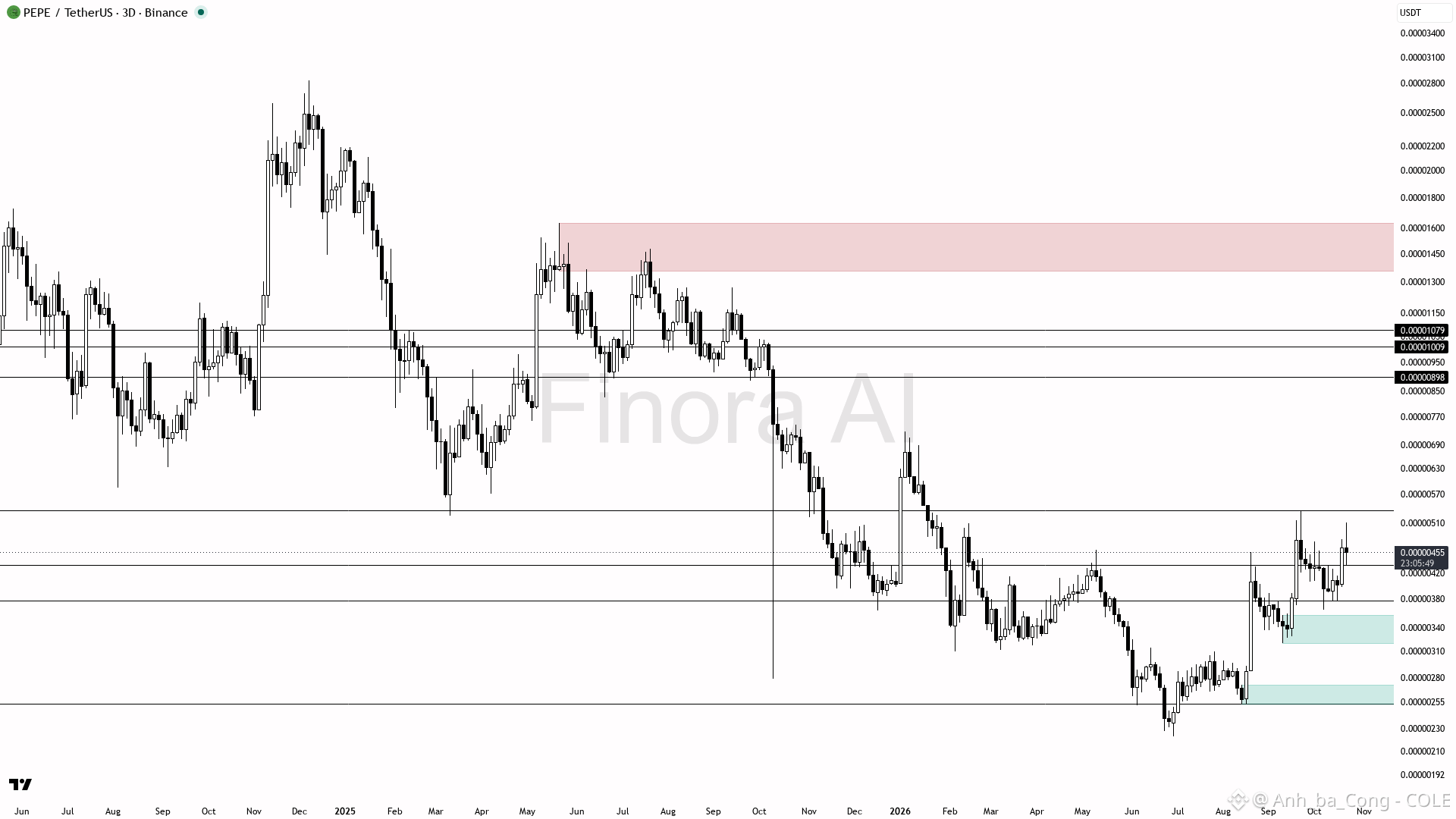
The 3-day timeframe shows a bullish bias for PEPEUSDT, confirmed by an established uptrend and a safe distance above the flip level at 0.00000364. Current price is 0.00000455, above the higher low of 0.00000364 and targeting resistance near 0.00000536 as the first major target. A valid long entry requires a 3-day candle close above 0.00000472 with increased volume. Further targets include 0.00000580 and 0.00000726 if momentum sustains. The flip level at 0.00000364 acts as key support; a close below would turn the bias bearish. Note the weekly trend remains bearish, making this a counter-trend setup that needs strong confirmation. Additional risk comes from BTC selling pressure potentially limiting upside. $PEPE
{spot}(PEPEUSDT)
The 3-day timeframe shows a bullish bias for PEPEUSDT, confirmed by an established uptrend and a safe distance above the flip level at 0.00000364. Current price is 0.00000455, above the higher low of 0.00000364 and targeting resistance near 0.00000536 as the first major target. A valid long entry requires a 3-day candle close above 0.00000472 with increased volume. Further targets include 0.00000580 and 0.00000726 if momentum sustains. The flip level at 0.00000364 acts as key support; a close below would turn the bias bearish. Note the weekly trend remains bearish, making this a counter-trend setup that needs strong confirmation. Additional risk comes from BTC selling pressure potentially limiting upside. $PEPE
2
245
·
--
Baissier
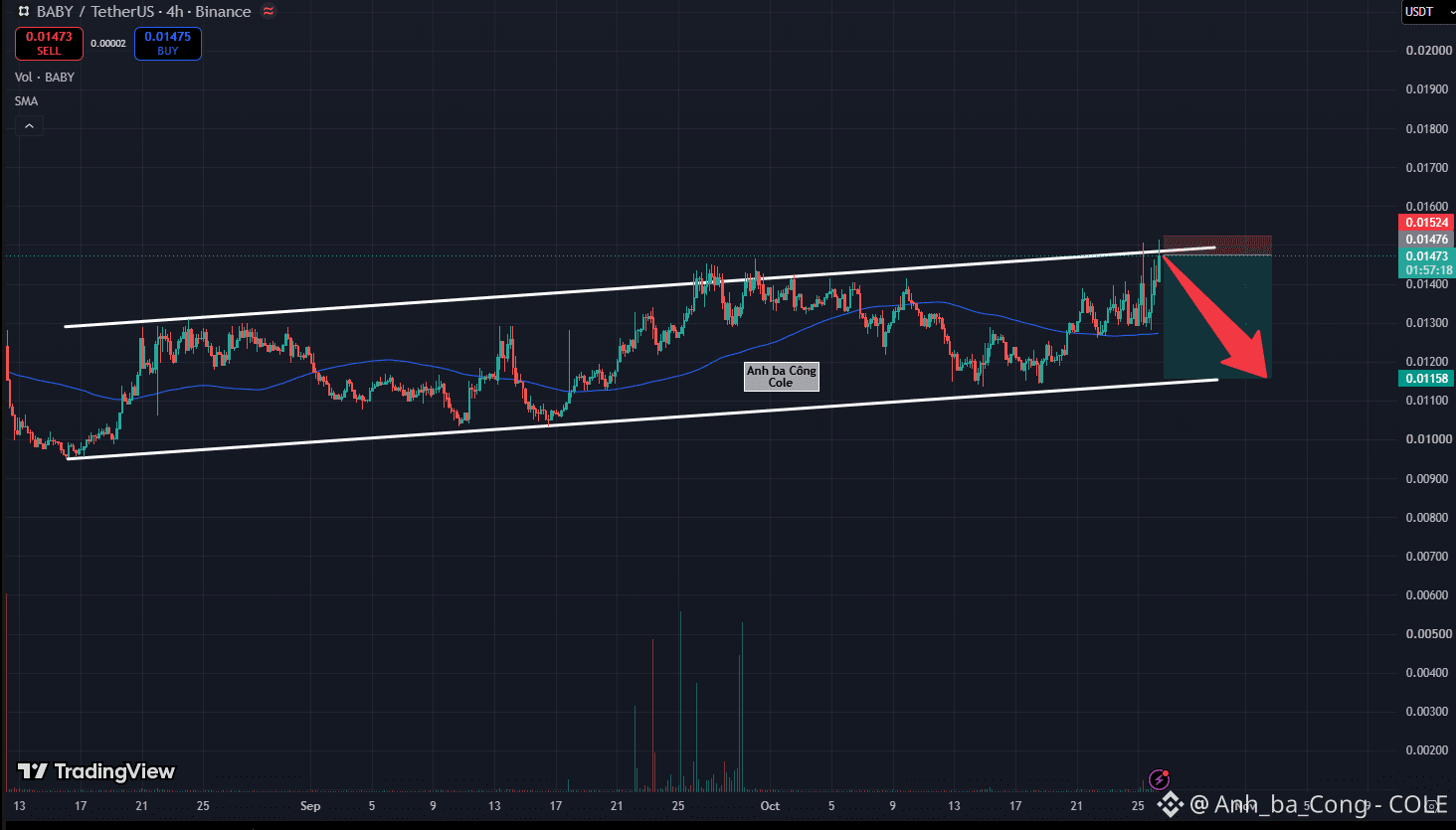
BABY Tests Upper Ascending Channel Boundary for the Third Time: High R:R Mean-Reversion Short Toward Channel Floor?
BABY on the 4-hour timeframe continues to trade in a very disciplined manner within a gradual ascending channel established since mid-August. This slow grind upward reflects a grinding consolidation structure, where price oscillates cyclically between two parallel diagonal support and resistance baselines.
The standout technical catalyst is the recent upward push directly tagging the upper boundary of the channel near the 0.0148 USD mark. This marks the third consecutive time within this channel formation that buyers have failed to secure a breakout above the upper diagonal ceiling. Analyzing the active 4-hour candle reaction, selling pressure and profit-taking surfaced immediately, printing an upper rejection wick near 0.01473 USD. Upside volume lacks explosive expansion, signaling that aggressive buying demand is practically exhausted as price collides with the resistance barrier.
This upper-boundary rejection unlocks an asymmetric Short opportunity with an outstanding risk-to-reward ratio. The primary downside objective for this retracement aims straight toward the lower ascending channel boundary near 0.01158 USD. Capital risk is strictly capped by placing a tight stop-loss just above the local rejection wick at 0.01524 USD for disciplined risk management.
DYOR $BABY
{future}(BABYUSDT)
BABY Tests Upper Ascending Channel Boundary for the Third Time: High R:R Mean-Reversion Short Toward Channel Floor?
BABY on the 4-hour timeframe continues to trade in a very disciplined manner within a gradual ascending channel established since mid-August. This slow grind upward reflects a grinding consolidation structure, where price oscillates cyclically between two parallel diagonal support and resistance baselines.
The standout technical catalyst is the recent upward push directly tagging the upper boundary of the channel near the 0.0148 USD mark. This marks the third consecutive time within this channel formation that buyers have failed to secure a breakout above the upper diagonal ceiling. Analyzing the active 4-hour candle reaction, selling pressure and profit-taking surfaced immediately, printing an upper rejection wick near 0.01473 USD. Upside volume lacks explosive expansion, signaling that aggressive buying demand is practically exhausted as price collides with the resistance barrier.
This upper-boundary rejection unlocks an asymmetric Short opportunity with an outstanding risk-to-reward ratio. The primary downside objective for this retracement aims straight toward the lower ascending channel boundary near 0.01158 USD. Capital risk is strictly capped by placing a tight stop-loss just above the local rejection wick at 0.01524 USD for disciplined risk management.
DYOR $BABY
1
173
🏦 Crypto accumulation by major institutions over the past week (Oct 19–25, 2026)
🥇 Strive: +6,182 BTC ($511.4 million)
🥈 Bitmine: +10,452 ETH ($24.6 million)
🥉 Strategy: +0 BTC
🟢 Bitcoin ETFs: +$301.2 million
🔴 Ethereum ETFs: -$220.7 million
$BTC $ETH #Colecolen
{future}(ETHUSDT)
{future}(BTCUSDT)
🏦 Crypto accumulation by major institutions over the past week (Oct 19–25, 2026)
🥇 Strive: +6,182 BTC ($511.4 million)
🥈 Bitmine: +10,452 ETH ($24.6 million)
🥉 Strategy: +0 BTC
🟢 Bitcoin ETFs: +$301.2 million
🔴 Ethereum ETFs: -$220.7 million
$BTC $ETH #Colecolen
🥇 Strive: +6,182 BTC ($511.4 million)
🥈 Bitmine: +10,452 ETH ($24.6 million)
🥉 Strategy: +0 BTC
🟢 Bitcoin ETFs: +$301.2 million
🔴 Ethereum ETFs: -$220.7 million
$BTC $ETH #Colecolen

135
·
--
Haussier
MAJOR TOKEN UNLOCK WAVE LOOMS: SUPPLY DILUTION PRESSURES FOR FF, CARDS, SIGN, AND SUI
The crypto market faces substantial structural token unlocks scheduled from October 28 to November 1, led by Falcon Finance (FF) releasing 208 million tokens valued at 20.7 million USD, alongside sizable expansions from CARDS, SIGN, KMNO, EIGEN, and SUI.
Upcoming cliff unlocks display clear divergence in relative dilution intensity against active circulating floats. For FF, unlocking 208 million tokens (6.62% of circulating supply) worth 20.7 million USD, alongside SIGN releasing 12.63% of total issuance and CARDS injecting 9.60% of float, creates direct supply expansion across order books. As vested allocations unlock for early backers and operational treasuries, the risk of structural distribution across major trading venues increases unless spot order book depth is sufficiently resilient to absorb new inventory. Conversely, established networks with nominal unlock ratios, such as SUI (0.32% of float) and KMNO (2.73%), face minimal programmatic dilution, as these schedules are largely priced into forward curves. Macro liquidity constraints across the altcoin landscape suggest that incoming supply tranches could pressure secondary valuations, prompting disciplined hedging rather than aggressive positioning ahead of unlock timestamps.
Moving forward, assets bearing unlock burdens above 5%—notably SIGN, CARDS, and FF—will likely undergo volatility consolidation while market depth absorbs incremental float. Stabilization will precede any durable trend continuation.
How are you positioning your trading strategy ahead of these major supply expansions this week? If this logic makes sense, drop a follow for more market breakdowns.
Please do your own research carefully before making any transactions (DYOR). $FF $SIGN $EIGEN #Colecolen
{future}(EIGENUSDT)
{future}(SIGNUSDT)
{future}(FFUSDT)
MAJOR TOKEN UNLOCK WAVE LOOMS: SUPPLY DILUTION PRESSURES FOR FF, CARDS, SIGN, AND SUI
The crypto market faces substantial structural token unlocks scheduled from October 28 to November 1, led by Falcon Finance (FF) releasing 208 million tokens valued at 20.7 million USD, alongside sizable expansions from CARDS, SIGN, KMNO, EIGEN, and SUI.
Upcoming cliff unlocks display clear divergence in relative dilution intensity against active circulating floats. For FF, unlocking 208 million tokens (6.62% of circulating supply) worth 20.7 million USD, alongside SIGN releasing 12.63% of total issuance and CARDS injecting 9.60% of float, creates direct supply expansion across order books. As vested allocations unlock for early backers and operational treasuries, the risk of structural distribution across major trading venues increases unless spot order book depth is sufficiently resilient to absorb new inventory. Conversely, established networks with nominal unlock ratios, such as SUI (0.32% of float) and KMNO (2.73%), face minimal programmatic dilution, as these schedules are largely priced into forward curves. Macro liquidity constraints across the altcoin landscape suggest that incoming supply tranches could pressure secondary valuations, prompting disciplined hedging rather than aggressive positioning ahead of unlock timestamps.
Moving forward, assets bearing unlock burdens above 5%—notably SIGN, CARDS, and FF—will likely undergo volatility consolidation while market depth absorbs incremental float. Stabilization will precede any durable trend continuation.
How are you positioning your trading strategy ahead of these major supply expansions this week? If this logic makes sense, drop a follow for more market breakdowns.
Please do your own research carefully before making any transactions (DYOR). $FF $SIGN $EIGEN #Colecolen

110
·
--
Haussier
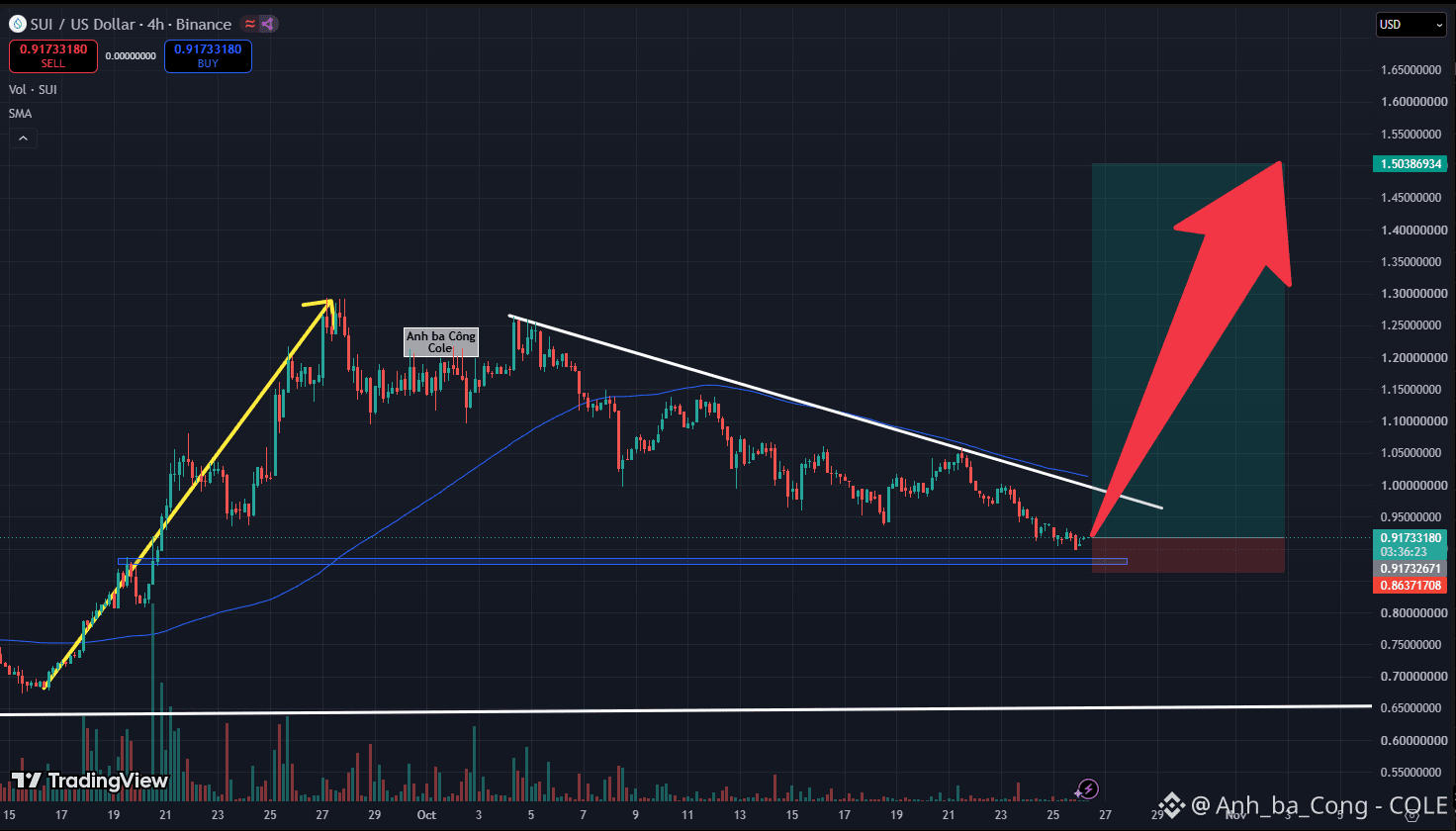
SUI Completes Fourth Descending Step: High R:R Long Setup Targeting 1.5 USD Rebound?
SUI on the 4-hour timeframe is entering a decisive inflection phase following a month-long cascading stair-step correction. This steady retracement has functioned as a necessary consolidation phase to reset leverage after the previous vertical expansion. The market has now completed its fourth corrective leg, compressing directly against a major structural shelf.
Historically, once an extended corrective cycle exhausts three to four descending waves, downside selling momentum dries up and frequently triggers an aggressive upward expansion. Analyzing recent 4-hour candle behavior near 0.917 USD, downward continuation has visibly stalled as price repeatedly prints lower wick rejections across the blue horizontal base. Depleted selling volume confirms seller exhaustion, indicating that residual floating supply is being absorbed by patient buyers.
Price stabilization right below the diagonal trendline unlocks an asymmetric Long setup with an exceptional risk-to-reward ratio. The primary upside target for this expansion impulse aims toward the previous macro resistance ceiling near 1.50 USD. A tight protective stop-loss is placed at 0.863 USD. Should this fourth wave fail and extend into a fifth sweep, the 0.80 USD round-number shelf will serve as an ideal secondary accumulation zone.
DYOR $SUI #Colecolen
{future}(SUIUSDT)
SUI Completes Fourth Descending Step: High R:R Long Setup Targeting 1.5 USD Rebound?
SUI on the 4-hour timeframe is entering a decisive inflection phase following a month-long cascading stair-step correction. This steady retracement has functioned as a necessary consolidation phase to reset leverage after the previous vertical expansion. The market has now completed its fourth corrective leg, compressing directly against a major structural shelf.
Historically, once an extended corrective cycle exhausts three to four descending waves, downside selling momentum dries up and frequently triggers an aggressive upward expansion. Analyzing recent 4-hour candle behavior near 0.917 USD, downward continuation has visibly stalled as price repeatedly prints lower wick rejections across the blue horizontal base. Depleted selling volume confirms seller exhaustion, indicating that residual floating supply is being absorbed by patient buyers.
Price stabilization right below the diagonal trendline unlocks an asymmetric Long setup with an exceptional risk-to-reward ratio. The primary upside target for this expansion impulse aims toward the previous macro resistance ceiling near 1.50 USD. A tight protective stop-loss is placed at 0.863 USD. Should this fourth wave fail and extend into a fifth sweep, the 0.80 USD round-number shelf will serve as an ideal secondary accumulation zone.
DYOR $SUI #Colecolen
177
ANTHONY POMPLIANO PROJECTS BITCOIN TO OUTPERFORM OVER 20 YEARS: MACRO MONETARY HEDGE FOR BTC
Prominent investor Anthony Pompliano has issued a macro thesis forecasting that Bitcoin (BTC), gold, and real estate will deliver superior performance over the next 20 years as ongoing US money supply expansion continues, while noting that high-quality AI infrastructure remains systematically undervalued.
Pompliano's outlook directly addresses the structural mechanics of global wealth migration amid persistent sovereign currency dilution. While gold serves traditional wealth preservation and land provides finite physical utility, Bitcoin represents the only programmatic asset combining a hard ceiling of 21 million units with instantaneous borderless liquidity. As venture capital models merge more closely with public markets, institutional allocators are increasingly treating BTC as a core non-sovereign reserve asset. Furthermore, the rapid ascent of autonomous AI agents demands programmable, uninterrupted, decentralized payment rails—an operational environment where digital asset networks naturally excel. This structural accumulation steadily absorbs circulating secondary float across major trading venues, transforming macroeconomic volatility into methodical institutional balance-sheet absorption rather than liquidation cascades.
Looking ahead, capital formation will increasingly prioritize niche verticals where traditional finance is not yet deeply entrenched, including prediction markets, compute distribution, and decentralized data brokerage. Baseline accumulation remains structurally anchored as BTC's monetary role solidifies.
Do you view Bitcoin or artificial intelligence as the superior asset class for wealth compounding over the next two decades? If this logic makes sense, drop a follow for more market breakdowns.
Please do your own research carefully before making any transactions (DYOR). $XAU $XAUT $PAXG
#Colecolen
{future}(PAXGUSDT)
{future}(XAUTUSDT)
{future}(XAUUSDT)
ANTHONY POMPLIANO PROJECTS BITCOIN TO OUTPERFORM OVER 20 YEARS: MACRO MONETARY HEDGE FOR BTC
Prominent investor Anthony Pompliano has issued a macro thesis forecasting that Bitcoin (BTC), gold, and real estate will deliver superior performance over the next 20 years as ongoing US money supply expansion continues, while noting that high-quality AI infrastructure remains systematically undervalued.
Pompliano's outlook directly addresses the structural mechanics of global wealth migration amid persistent sovereign currency dilution. While gold serves traditional wealth preservation and land provides finite physical utility, Bitcoin represents the only programmatic asset combining a hard ceiling of 21 million units with instantaneous borderless liquidity. As venture capital models merge more closely with public markets, institutional allocators are increasingly treating BTC as a core non-sovereign reserve asset. Furthermore, the rapid ascent of autonomous AI agents demands programmable, uninterrupted, decentralized payment rails—an operational environment where digital asset networks naturally excel. This structural accumulation steadily absorbs circulating secondary float across major trading venues, transforming macroeconomic volatility into methodical institutional balance-sheet absorption rather than liquidation cascades.
Looking ahead, capital formation will increasingly prioritize niche verticals where traditional finance is not yet deeply entrenched, including prediction markets, compute distribution, and decentralized data brokerage. Baseline accumulation remains structurally anchored as BTC's monetary role solidifies.
Do you view Bitcoin or artificial intelligence as the superior asset class for wealth compounding over the next two decades? If this logic makes sense, drop a follow for more market breakdowns.
Please do your own research carefully before making any transactions (DYOR). $XAU $XAUT $PAXG
#Colecolen

245
·
--
Haussier
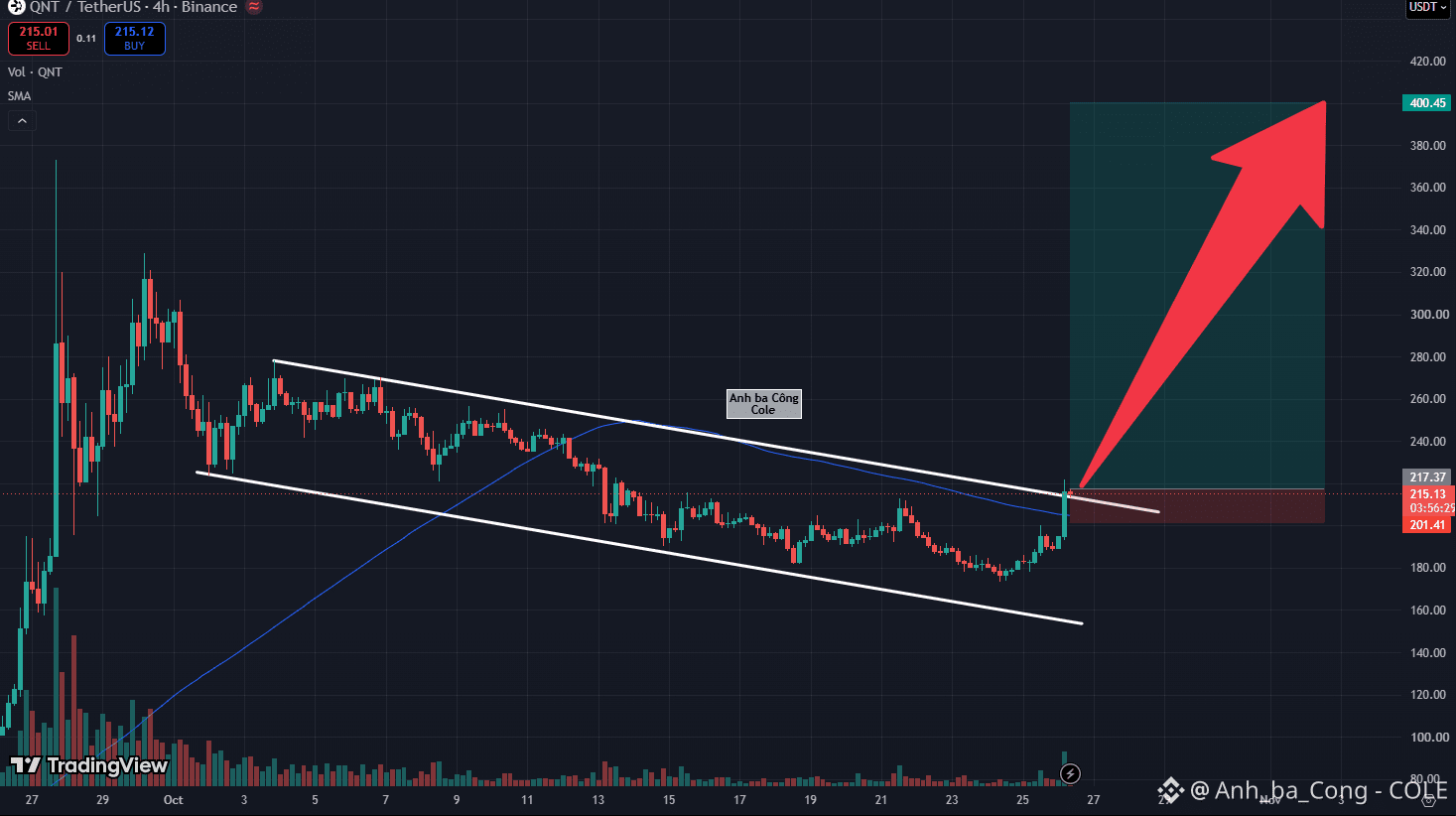
QNT Breaks Descending Channel: High R:R Breakout Long Setup Toward 400 USD?
QNT on the 4-hour timeframe has delivered a highly convincing technical breakout, officially escaping the descending parallel channel held since early October. The preceding corrective grind essentially served as a healthy volatility compression phase to absorb overhead selling following the massive late-September impulsive surge.
The decisive technical catalyst is the expansive 4-hour green candle slicing cleanly through both the channel’s upper diagonal resistance and the dynamic moving average baseline. This dual breakout is backed by a visible expansion in buying volume, confirming renewed institutional accumulation that thoroughly absorbed residual floating supply. The current candle is consolidating firmly near 215 USD, validating that former diagonal resistance has successfully flipped into reliable structural support. With buyers firmly reclaiming momentum, the path is cleared for aggressive trend continuation.
This confirmed structural shift unlocks an asymmetric Long setup featuring an outstanding risk-to-reward ratio. The primary upside target for this expansion wave points directly toward the major psychological round-number ceiling at 400 USD (specifically 400.45 USD). Risk is strictly capped by placing a tight stop-loss just beneath the moving average baseline at 201.41 USD for disciplined capital management.
DYOR $QNT
#QNT
{future}(QNTUSDT)
QNT Breaks Descending Channel: High R:R Breakout Long Setup Toward 400 USD?
QNT on the 4-hour timeframe has delivered a highly convincing technical breakout, officially escaping the descending parallel channel held since early October. The preceding corrective grind essentially served as a healthy volatility compression phase to absorb overhead selling following the massive late-September impulsive surge.
The decisive technical catalyst is the expansive 4-hour green candle slicing cleanly through both the channel’s upper diagonal resistance and the dynamic moving average baseline. This dual breakout is backed by a visible expansion in buying volume, confirming renewed institutional accumulation that thoroughly absorbed residual floating supply. The current candle is consolidating firmly near 215 USD, validating that former diagonal resistance has successfully flipped into reliable structural support. With buyers firmly reclaiming momentum, the path is cleared for aggressive trend continuation.
This confirmed structural shift unlocks an asymmetric Long setup featuring an outstanding risk-to-reward ratio. The primary upside target for this expansion wave points directly toward the major psychological round-number ceiling at 400 USD (specifically 400.45 USD). Risk is strictly capped by placing a tight stop-loss just beneath the moving average baseline at 201.41 USD for disciplined capital management.
DYOR $QNT
#QNT
221
·
--
Haussier
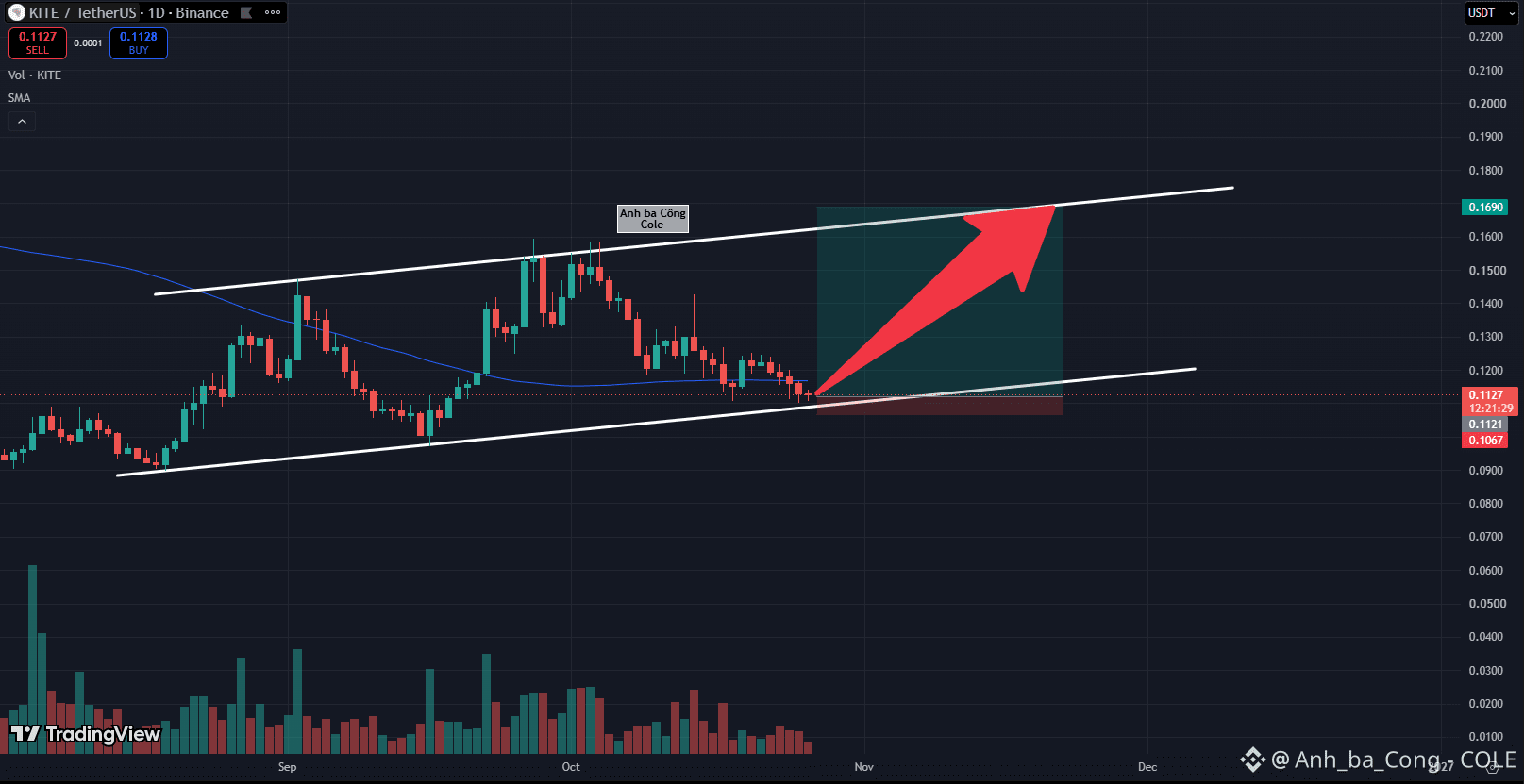
KITE Rebounds off Lower Ascending Channel Boundary: High R:R Long Setup Toward Channel Top?
KITE on the daily (1D) timeframe continues to exhibit textbook price action within an ascending parallel channel established since August. Following an extended corrective wave from its early October peak near 0.160 USD, price action has descended directly into a major technical test along the lower channel boundary.
In chart technicals, the lower boundary of an ascending channel functions as a primary accumulation shelf for disciplined trend-following traders. The latest daily candle immediately produced a lower wick rejection upon tapping the upward-sloping baseline near 0.110 – 0.112 USD, stabilizing price around 0.1127 USD. Persistent selling pressure has noticeably dried up, accompanied by trading volume contracting toward multi-week lows. This exhaustion confirms that sellers lack follow-through momentum, allowing responsive buyers to absorb remaining floating supply and defend the prevailing mid-term trend.
Entering a Long position off this verified structural baseline provides an asymmetric trade setup with an outstanding risk-to-reward ratio. The primary upside target for the ensuing expansion cycle points straight toward the upper channel boundary near 0.169 USD. Risk is strictly capped by placing a tight stop-loss cleanly beneath the channel floor at 0.1067 USD for disciplined capital management.
DYOR
$KITE
#KİTE #Colecolen
{future}(KITEUSDT)
KITE Rebounds off Lower Ascending Channel Boundary: High R:R Long Setup Toward Channel Top?
KITE on the daily (1D) timeframe continues to exhibit textbook price action within an ascending parallel channel established since August. Following an extended corrective wave from its early October peak near 0.160 USD, price action has descended directly into a major technical test along the lower channel boundary.
In chart technicals, the lower boundary of an ascending channel functions as a primary accumulation shelf for disciplined trend-following traders. The latest daily candle immediately produced a lower wick rejection upon tapping the upward-sloping baseline near 0.110 – 0.112 USD, stabilizing price around 0.1127 USD. Persistent selling pressure has noticeably dried up, accompanied by trading volume contracting toward multi-week lows. This exhaustion confirms that sellers lack follow-through momentum, allowing responsive buyers to absorb remaining floating supply and defend the prevailing mid-term trend.
Entering a Long position off this verified structural baseline provides an asymmetric trade setup with an outstanding risk-to-reward ratio. The primary upside target for the ensuing expansion cycle points straight toward the upper channel boundary near 0.169 USD. Risk is strictly capped by placing a tight stop-loss cleanly beneath the channel floor at 0.1067 USD for disciplined capital management.
DYOR
$KITE
#KİTE #Colecolen
101
FRANKLIN TEMPLETON FILES FOR TWO BITCOIN DRIP ETFS: REINVESTING DIVIDENDS INTO BTC
Franklin Templeton has filed Form 8-A with the US SEC to list two index ETFs on Nasdaq—FBEQ and FIBT—featuring a dividend reinvestment plan (DRIP) that channels equity cash dividends into Bitcoin (BTC) exposure, launching with a 95% equity and 5% Bitcoin allocation.
Deploying a Bitcoin dividend reinvestment plan marks an inventive integration of corporate cash flows with digital assets. Rather than compounding dividends back into equities, both funds systematically deploy distributions to purchase exchange-traded Bitcoin instruments—principally Franklin's spot ETF (EZBC), futures, and options—at the open following the ex-dividend date. Because FBEQ tracks the US Large-Cap 500 and FIBT tracks the Nasdaq Innovation 100, this creates a programmatic bid powered by corporate earnings. Although systematic rebalancing enforces disciplined risk management—trimming Bitcoin exposure back to 4.5% if it crosses 5% quarterly or exceeds 20% intra-quarter—this continuous buying absorbs circulating supply across major trading venues. This hybrid vehicle provides equity holders with asymmetric upside while constructing resilient structural demand foundations for BTC over the long term.
Looking ahead, with the funds effective on October 27, initial trading volumes will gauge institutional appetite. Sustained dividend reinvestment should underpin steady macro consolidation as traditional finance builds innovative capital onboarding pipelines.
Do you believe dividend-funded Bitcoin reinvestment models will become a standard portfolio strategy for institutional wealth? If this logic makes sense, drop a follow for more market breakdowns.
Please do your own research carefully before making any transactions (DYOR). $BTC #Colecolen
{future}(BTCUSDT)
FRANKLIN TEMPLETON FILES FOR TWO BITCOIN DRIP ETFS: REINVESTING DIVIDENDS INTO BTC
Franklin Templeton has filed Form 8-A with the US SEC to list two index ETFs on Nasdaq—FBEQ and FIBT—featuring a dividend reinvestment plan (DRIP) that channels equity cash dividends into Bitcoin (BTC) exposure, launching with a 95% equity and 5% Bitcoin allocation.
Deploying a Bitcoin dividend reinvestment plan marks an inventive integration of corporate cash flows with digital assets. Rather than compounding dividends back into equities, both funds systematically deploy distributions to purchase exchange-traded Bitcoin instruments—principally Franklin's spot ETF (EZBC), futures, and options—at the open following the ex-dividend date. Because FBEQ tracks the US Large-Cap 500 and FIBT tracks the Nasdaq Innovation 100, this creates a programmatic bid powered by corporate earnings. Although systematic rebalancing enforces disciplined risk management—trimming Bitcoin exposure back to 4.5% if it crosses 5% quarterly or exceeds 20% intra-quarter—this continuous buying absorbs circulating supply across major trading venues. This hybrid vehicle provides equity holders with asymmetric upside while constructing resilient structural demand foundations for BTC over the long term.
Looking ahead, with the funds effective on October 27, initial trading volumes will gauge institutional appetite. Sustained dividend reinvestment should underpin steady macro consolidation as traditional finance builds innovative capital onboarding pipelines.
Do you believe dividend-funded Bitcoin reinvestment models will become a standard portfolio strategy for institutional wealth? If this logic makes sense, drop a follow for more market breakdowns.
Please do your own research carefully before making any transactions (DYOR). $BTC #Colecolen

144

·
--
Baissier
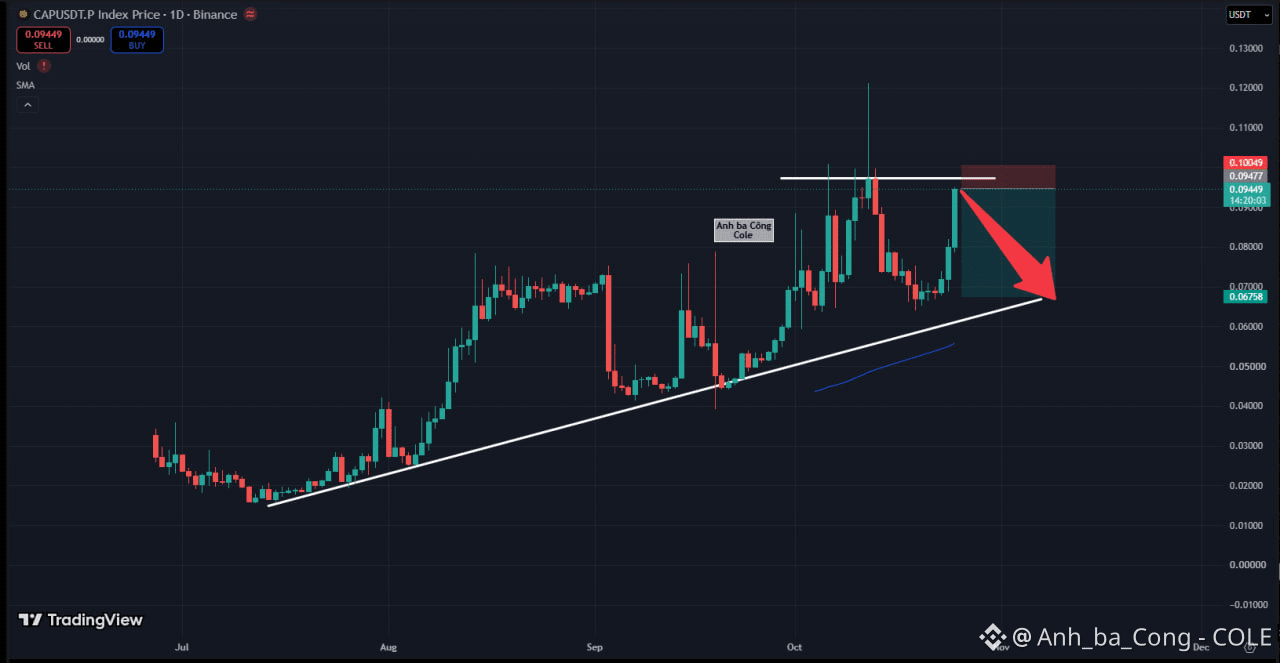
CAP's daily chart retests the sturdy 0.095 – 0.100 USD resistance shelf after multiple historical rejections. With Bitcoin sliding toward 80k and dampening broader sentiment, CAP's upward momentum is stalling near 0.0945 USD. Technical indicators favor an exploratory counter-trend Short with small position sizing, targeting the lower ascending trendline support near 0.06758 USD with an attractive risk-to-reward ratio. Stop-loss is tightly managed above 0.10049 USD.
DYOR $CAP
{future}(CAPUSDT)
CAP's daily chart retests the sturdy 0.095 – 0.100 USD resistance shelf after multiple historical rejections. With Bitcoin sliding toward 80k and dampening broader sentiment, CAP's upward momentum is stalling near 0.0945 USD. Technical indicators favor an exploratory counter-trend Short with small position sizing, targeting the lower ascending trendline support near 0.06758 USD with an attractive risk-to-reward ratio. Stop-loss is tightly managed above 0.10049 USD.
DYOR $CAP
DYOR $CAP
148
GLOBAL GOLD PLUNGES BELOW 4,000 USD PER OUNCE: MACRO DRIVERS AND IMPLICATIONS FOR BTC
Asian spot gold dipped below 4,000 USD per ounce on October 23, marking a weekly decline exceeding 3% and breaching this psychological benchmark for the first time since July, establishing systemic liquidity implications for BTC and alternative store-of-value assets.
This precious metal pullback stems from a triad of macro pressures: Brent crude exceeding 114 USD per barrel cementing inflation persistence, rising expectations of a December Fed rate hike driving the US dollar and Treasury yields higher, and coordinated global liquidity tightening paired with debt deleveraging. While rising opportunity costs trigger structural outflows from non-yielding commodities, this environment creates a bifurcated landscape for digital assets. For Bitcoin, dollar strength and tighter credit conditions generate near-term volatility, inducing portfolio rebalancing across major venues. However, BTC’s continuous market liquidity and sovereign custody architecture position it as both a flexible collateral instrument during deleveraging cycles and a prime beneficiary once market participants seek non-sovereign monetary debasement hedges amid entrenched inflation.
Looking into late October and early November, gold and risk assets will likely remain range-bound under persistent policy pressure. Constructive consolidation around structural support levels remains the baseline scenario ahead of upcoming central bank decisions.
Do you view gold's pullback as a liquidity rotation catalyst into Bitcoin, or a warning of broader monetary tightening? If this logic makes sense, drop a follow for more market breakdowns.
Please do your own research carefully before making any transactions (DYOR). $PAXG $XAUT
{future}(XAUTUSDT)
{future}(PAXGUSDT)
GLOBAL GOLD PLUNGES BELOW 4,000 USD PER OUNCE: MACRO DRIVERS AND IMPLICATIONS FOR BTC
Asian spot gold dipped below 4,000 USD per ounce on October 23, marking a weekly decline exceeding 3% and breaching this psychological benchmark for the first time since July, establishing systemic liquidity implications for BTC and alternative store-of-value assets.
This precious metal pullback stems from a triad of macro pressures: Brent crude exceeding 114 USD per barrel cementing inflation persistence, rising expectations of a December Fed rate hike driving the US dollar and Treasury yields higher, and coordinated global liquidity tightening paired with debt deleveraging. While rising opportunity costs trigger structural outflows from non-yielding commodities, this environment creates a bifurcated landscape for digital assets. For Bitcoin, dollar strength and tighter credit conditions generate near-term volatility, inducing portfolio rebalancing across major venues. However, BTC’s continuous market liquidity and sovereign custody architecture position it as both a flexible collateral instrument during deleveraging cycles and a prime beneficiary once market participants seek non-sovereign monetary debasement hedges amid entrenched inflation.
Looking into late October and early November, gold and risk assets will likely remain range-bound under persistent policy pressure. Constructive consolidation around structural support levels remains the baseline scenario ahead of upcoming central bank decisions.
Do you view gold's pullback as a liquidity rotation catalyst into Bitcoin, or a warning of broader monetary tightening? If this logic makes sense, drop a follow for more market breakdowns.
Please do your own research carefully before making any transactions (DYOR). $PAXG $XAUT

1
370
STRIPE AND PLASMA PARTNER ON STABLECOIN CARDS: EXPANDING REAL-WORLD UTILITY FOR USDC
Global fintech leader Stripe has partnered with Plasma to introduce a multi-currency stablecoin payment card targeting expansion across more than 100 countries by 2027, establishing an institutional catalyst for USDC and digital asset payment rails.
Integrating global merchant infrastructure with dedicated blockchain rails marks a pivotal milestone for non-speculative digital asset velocity. Stripe’s stablecoin issuance stack currently processes approximately 1.2 billion USD in monthly transaction volume across 30 countries, demonstrating rising consumer demand for programmable currency. Unifying the Plasma One digital banking app and its multi-currency fiat accounts—spanning US dollars, euros, Brazilian real, Mexican peso, and Colombian peso—directly into Stripe’s card rails resolves friction between decentralized liquidity and legacy point-of-sale terminals. Economically, circulating balances in USDC and OUSD transition from passive yield vaults into active transactional velocity. This continuous utilization creates organic absorption for stablecoin supply, dampening secondary market redemption volatility across major venues and validating on-chain assets as standard global commercial liquidity.
Looking ahead, market participants will monitor merchant adoption rates across emerging regions. Sustained expansion reinforces steady accumulation across digital payment infrastructure, decoupling stablecoin growth from speculative trading volumes.
Will mainstream consumer adoption of stablecoin cards permanently alter global payment settlement frameworks? If this logic makes sense, drop a follow for more market breakdowns.
Please do your own research carefully before making any transactions (DYOR). $XPL
{future}(XPLUSDT)
STRIPE AND PLASMA PARTNER ON STABLECOIN CARDS: EXPANDING REAL-WORLD UTILITY FOR USDC
Global fintech leader Stripe has partnered with Plasma to introduce a multi-currency stablecoin payment card targeting expansion across more than 100 countries by 2027, establishing an institutional catalyst for USDC and digital asset payment rails.
Integrating global merchant infrastructure with dedicated blockchain rails marks a pivotal milestone for non-speculative digital asset velocity. Stripe’s stablecoin issuance stack currently processes approximately 1.2 billion USD in monthly transaction volume across 30 countries, demonstrating rising consumer demand for programmable currency. Unifying the Plasma One digital banking app and its multi-currency fiat accounts—spanning US dollars, euros, Brazilian real, Mexican peso, and Colombian peso—directly into Stripe’s card rails resolves friction between decentralized liquidity and legacy point-of-sale terminals. Economically, circulating balances in USDC and OUSD transition from passive yield vaults into active transactional velocity. This continuous utilization creates organic absorption for stablecoin supply, dampening secondary market redemption volatility across major venues and validating on-chain assets as standard global commercial liquidity.
Looking ahead, market participants will monitor merchant adoption rates across emerging regions. Sustained expansion reinforces steady accumulation across digital payment infrastructure, decoupling stablecoin growth from speculative trading volumes.
Will mainstream consumer adoption of stablecoin cards permanently alter global payment settlement frameworks? If this logic makes sense, drop a follow for more market breakdowns.
Please do your own research carefully before making any transactions (DYOR). $XPL

1
391
STRATEGY AND STRIVE FACE CAPITAL REBALANCING: DIVIDEND COMMITMENTS PRESSURE SUPPLY FOR BTC
Institutional treasuries Strategy and Strive confront balance-sheet friction balancing continued strategic accumulation against escalating perpetual preferred equity dividend obligations, creating structural dynamics for BTC.
Fidelity data indicates preferred shares funded the acquisition of 135,979 BTC between 2025 and October 5. However, with the preferred market reaching 12 billion USD, expanding dividend liabilities place acute demands on operational liquidity. Strategy deploying 193 million USD to repurchase discounted STRC shares while transferring a portion of corporate Bitcoin holdings to settle dividend commitments highlights the structural cost of hybrid leverage. While Bitwise emphasizes that US spot ETFs—holding 106 billion USD in assets alongside 57 billion USD in cumulative net inflows—remain the primary macro demand driver, mandatory distributions from leveraged treasuries inject secondary supply across major trading venues. If preferred instruments trade below par value, issuing subsequent tranches to finance spot purchases becomes dilutive, forcing corporate sponsors into defensive liquidity preservation rather than aggressive accumulation.
Looking ahead, market participants will monitor whether corporate issuers can expand balance sheets without secondary asset sales. Continued range-bound consolidation remains likely as corporate rebalancing interacts with sustained spot ETF absorption.
Could relying on perpetual preferred equity structures create recurring liquidation pressures on corporate Bitcoin treasuries? If this logic makes sense, drop a follow for more market breakdowns.
Please do your own research carefully before making any transactions (DYOR). $BTC
{future}(BTCUSDT)
STRATEGY AND STRIVE FACE CAPITAL REBALANCING: DIVIDEND COMMITMENTS PRESSURE SUPPLY FOR BTC
Institutional treasuries Strategy and Strive confront balance-sheet friction balancing continued strategic accumulation against escalating perpetual preferred equity dividend obligations, creating structural dynamics for BTC.
Fidelity data indicates preferred shares funded the acquisition of 135,979 BTC between 2025 and October 5. However, with the preferred market reaching 12 billion USD, expanding dividend liabilities place acute demands on operational liquidity. Strategy deploying 193 million USD to repurchase discounted STRC shares while transferring a portion of corporate Bitcoin holdings to settle dividend commitments highlights the structural cost of hybrid leverage. While Bitwise emphasizes that US spot ETFs—holding 106 billion USD in assets alongside 57 billion USD in cumulative net inflows—remain the primary macro demand driver, mandatory distributions from leveraged treasuries inject secondary supply across major trading venues. If preferred instruments trade below par value, issuing subsequent tranches to finance spot purchases becomes dilutive, forcing corporate sponsors into defensive liquidity preservation rather than aggressive accumulation.
Looking ahead, market participants will monitor whether corporate issuers can expand balance sheets without secondary asset sales. Continued range-bound consolidation remains likely as corporate rebalancing interacts with sustained spot ETF absorption.
Could relying on perpetual preferred equity structures create recurring liquidation pressures on corporate Bitcoin treasuries? If this logic makes sense, drop a follow for more market breakdowns.
Please do your own research carefully before making any transactions (DYOR). $BTC

1
108
·
--
Haussier
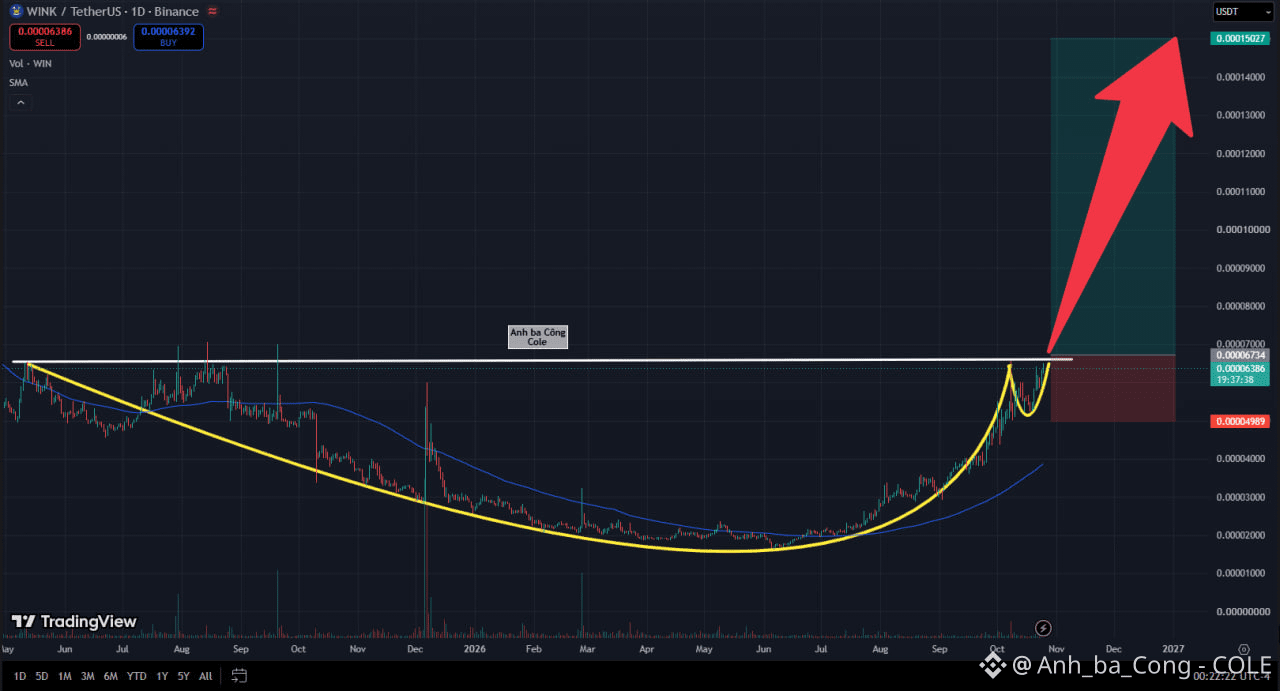
WIN Completes Macro Cup and Handle: Patiently Waiting for Neckline Breakout to Trigger Massive Long Setup?
WIN on the daily (1D) timeframe is carving out a textbook macro bullish reversal pattern after an extensive base-building accumulation phase dating back to 2025. The expansive rounded bottom of the cup has formed cleanly, and the recent orderly pullback has successfully finalized the handle structure above the 0.000050 USD support shelf.
The pivotal technical inflection point lies directly at the horizontal white neckline near 0.0000673 USD. Analyzing active daily price action, buyers are driving price decisively toward 0.0000638 USD, backed by dynamic support from the upward-sloping moving average baseline underneath. In cup and handle structures, disciplined patience is paramount. Traders should avoid front-running before resistance yields; waiting for a confirmed daily candle close above the neckline completely eliminates the risk of an unexpected local rejection.
Once the breakout is officially verified, an explosive trend-continuation Long setup will be triggered with an exceptional risk-to-reward profile. The primary macro target, derived from the depth of the cup base, points straight toward the psychological round-number level at 0.000150 USD. Capital is strictly protected with a stop-loss positioned below the handle base at 0.0000498 USD.
DYOR $WIN #Colecolen
{spot}(WINUSDT)
WIN Completes Macro Cup and Handle: Patiently Waiting for Neckline Breakout to Trigger Massive Long Setup?
WIN on the daily (1D) timeframe is carving out a textbook macro bullish reversal pattern after an extensive base-building accumulation phase dating back to 2025. The expansive rounded bottom of the cup has formed cleanly, and the recent orderly pullback has successfully finalized the handle structure above the 0.000050 USD support shelf.
The pivotal technical inflection point lies directly at the horizontal white neckline near 0.0000673 USD. Analyzing active daily price action, buyers are driving price decisively toward 0.0000638 USD, backed by dynamic support from the upward-sloping moving average baseline underneath. In cup and handle structures, disciplined patience is paramount. Traders should avoid front-running before resistance yields; waiting for a confirmed daily candle close above the neckline completely eliminates the risk of an unexpected local rejection.
Once the breakout is officially verified, an explosive trend-continuation Long setup will be triggered with an exceptional risk-to-reward profile. The primary macro target, derived from the depth of the cup base, points straight toward the psychological round-number level at 0.000150 USD. Capital is strictly protected with a stop-loss positioned below the handle base at 0.0000498 USD.
DYOR $WIN #Colecolen
268
·
--
Haussier
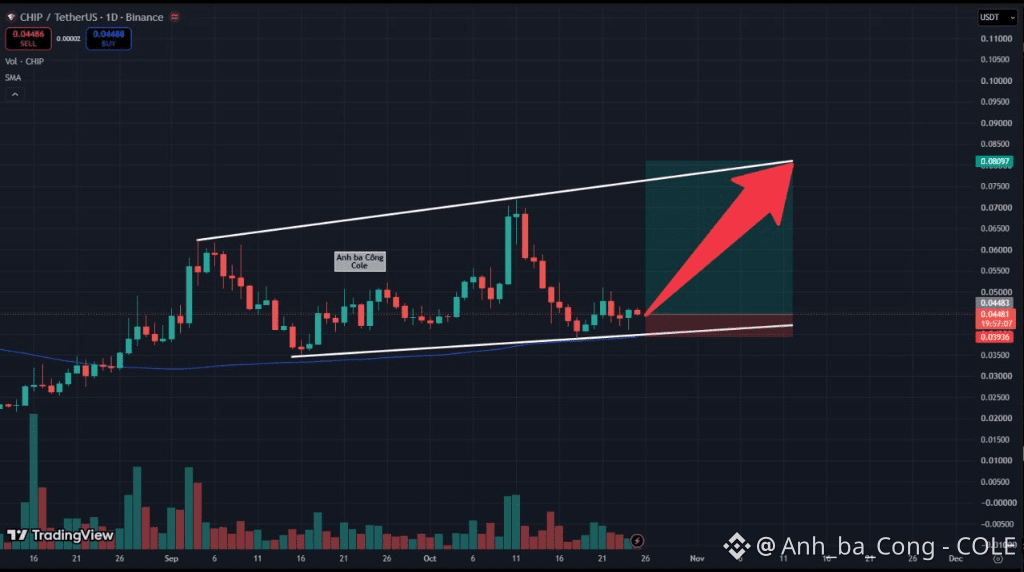
CHIP's daily chart trades within an expanding triangle, currently testing its lower boundary confluent with dynamic MA100 moving average support near 0.0448 USD. Fading sell volume paired with lower wick absorption confirms active buyer defense along this critical baseline. Market structure favors a textbook Long setup targeting the upper boundary at 0.08097 USD with an exceptional risk-to-reward profile. Stop-loss is positioned tightly below 0.03936 USD.
DYOR $CHIP
{future}(CHIPUSDT)
CHIP's daily chart trades within an expanding triangle, currently testing its lower boundary confluent with dynamic MA100 moving average support near 0.0448 USD. Fading sell volume paired with lower wick absorption confirms active buyer defense along this critical baseline. Market structure favors a textbook Long setup targeting the upper boundary at 0.08097 USD with an exceptional risk-to-reward profile. Stop-loss is positioned tightly below 0.03936 USD.
DYOR $CHIP
DYOR $CHIP
1
153
GRAYSCALE IDENTIFIES TOP THREE AI INFRASTRUCTURE ASSETS: CAPITAL AND DILUTION FOR DATA, CHIP, AND PEARL
A research report published October 23 by Grayscale highlights DATA Network (DATA), USD.AI (CHIP), and Pearl (PEARL) as specialized digital assets addressing fundamental AI infrastructure, including data licensing, GPU financing, and compute.
Grayscale's selection reflects an institutional rotation from consumer AI applications toward base infrastructure essential to the machine learning lifecycle. However, sharp tokenomic divergences reveal distinct risk profiles. DATA dropped 42.07% over 90 days to 0.15243 USD, yet secures long-term development runway via a 30 million USD investment from the Sui Foundation. Conversely, CHIP gained 47.98% to 0.04386 USD following a 100 million USD credit facility from Bullish, validating demand for hardware financialization. Most volatile is PEARL, which surged 528.24% to 2.00 USD, but confronts severe tokenomic overhang: daily token emissions approximate 1.2 million units alongside a fully diluted valuation of 4.2 billion USD against a 713 million USD market cap. This mismatch risks triggering heavy distribution across major trading venues once liquidity fails to absorb programmatic supply.
Moving forward, institutional allocators will prioritize verified cash flows over promotional milestones. A fragmented accumulation pattern is anticipated, where protocols backed by balance-sheet utility defend market structure far better than dilutive reward frameworks.
Which of these three infrastructure protocols possesses the most resilient economic model to lead decentralized computing? If this logic makes sense, drop a follow for more market breakdowns.
Please do your own research carefully before making any transactions (DYOR). $DATA $CHIP
{future}(CHIPUSDT)
GRAYSCALE IDENTIFIES TOP THREE AI INFRASTRUCTURE ASSETS: CAPITAL AND DILUTION FOR DATA, CHIP, AND PEARL
A research report published October 23 by Grayscale highlights DATA Network (DATA), USD.AI (CHIP), and Pearl (PEARL) as specialized digital assets addressing fundamental AI infrastructure, including data licensing, GPU financing, and compute.
Grayscale's selection reflects an institutional rotation from consumer AI applications toward base infrastructure essential to the machine learning lifecycle. However, sharp tokenomic divergences reveal distinct risk profiles. DATA dropped 42.07% over 90 days to 0.15243 USD, yet secures long-term development runway via a 30 million USD investment from the Sui Foundation. Conversely, CHIP gained 47.98% to 0.04386 USD following a 100 million USD credit facility from Bullish, validating demand for hardware financialization. Most volatile is PEARL, which surged 528.24% to 2.00 USD, but confronts severe tokenomic overhang: daily token emissions approximate 1.2 million units alongside a fully diluted valuation of 4.2 billion USD against a 713 million USD market cap. This mismatch risks triggering heavy distribution across major trading venues once liquidity fails to absorb programmatic supply.
Moving forward, institutional allocators will prioritize verified cash flows over promotional milestones. A fragmented accumulation pattern is anticipated, where protocols backed by balance-sheet utility defend market structure far better than dilutive reward frameworks.
Which of these three infrastructure protocols possesses the most resilient economic model to lead decentralized computing? If this logic makes sense, drop a follow for more market breakdowns.
Please do your own research carefully before making any transactions (DYOR). $DATA $CHIP

213

STARKNET COMMUNITY BACKS QUANTUM-RESISTANT STANDALONE CHAIN STUDY: STRATEGIC INFRASTRUCTURE SHIFT FOR STRK
The Starknet community has officially passed a governance proposal to study transitioning into an independent, quantum-resistant Layer-1 blockchain with 93.52% voting approval, marking record network voter turnout and setting a pivotal trajectory for STRK.
Pivoting from an Ethereum-dependent Layer 2 toward a sovereign settlement network represents a calculated strategic transition. By establishing dedicated consensus powered by post-quantum zero-knowledge cryptography, Starknet circumvents underlying base-layer fee constraints while structurally elevating the utility profile of STRK. Transitioning to native consensus collateral elevates STRK into a staking asset required for validator security, generating structural lockup demand. Although official network decoupling requires a secondary governance vote following StarkWare’s upcoming November technical paper, overwhelming community alignment helps resolve token utility ambiguity. This programmatic shift anchors long-term capital, steadily reducing secondary market transfer pressure across major trading venues while expanding spot absorption capacity.
Moving forward, market attention will focus on StarkWare’s November technical specification release to evaluate network economic models and execution timelines. Constructive consolidation remains the primary outlook, establishing a resilient floor for STRK ahead of definitive roadmap updates.
Will transitioning to an independent Layer-1 network bolster Starknet's long-term competitive moat against rival execution environments? If this logic makes sense, drop a follow for more market breakdowns.
Please do your own research carefully before making any transactions (DYOR). $STRK
{future}(STRKUSDT)
STARKNET COMMUNITY BACKS QUANTUM-RESISTANT STANDALONE CHAIN STUDY: STRATEGIC INFRASTRUCTURE SHIFT FOR STRK
The Starknet community has officially passed a governance proposal to study transitioning into an independent, quantum-resistant Layer-1 blockchain with 93.52% voting approval, marking record network voter turnout and setting a pivotal trajectory for STRK.
Pivoting from an Ethereum-dependent Layer 2 toward a sovereign settlement network represents a calculated strategic transition. By establishing dedicated consensus powered by post-quantum zero-knowledge cryptography, Starknet circumvents underlying base-layer fee constraints while structurally elevating the utility profile of STRK. Transitioning to native consensus collateral elevates STRK into a staking asset required for validator security, generating structural lockup demand. Although official network decoupling requires a secondary governance vote following StarkWare’s upcoming November technical paper, overwhelming community alignment helps resolve token utility ambiguity. This programmatic shift anchors long-term capital, steadily reducing secondary market transfer pressure across major trading venues while expanding spot absorption capacity.
Moving forward, market attention will focus on StarkWare’s November technical specification release to evaluate network economic models and execution timelines. Constructive consolidation remains the primary outlook, establishing a resilient floor for STRK ahead of definitive roadmap updates.
Will transitioning to an independent Layer-1 network bolster Starknet's long-term competitive moat against rival execution environments? If this logic makes sense, drop a follow for more market breakdowns.
Please do your own research carefully before making any transactions (DYOR). $STRK

116
Connectez-vous pour découvrir plus de contenu
Rejoignez la communauté mondiale des adeptes de cryptomonnaies sur Binance Square
⚡️ Suviez les dernières informations importantes sur les cryptomonnaies.
💬 Jugé digne de confiance par la plus grande plateforme d’échange de cryptomonnaies au monde.
👍 Découvrez les connaissances que partagent les créateurs vérifiés.
Adresse e-mail/Nº de téléphone
Sujets d’actualité
BinancePick
2.9M vues
150,864 mentions
Join #EarningsSeason: Predict Earnings on Binance Pick, Share Your Take on Binance Square!
Binance Square Official
·407 mentions J’aime
·342k vues
EarningsSeason
5.2M vues
25,691 mentions
AnthropicTTMRevenueGrewAbout1200%
13,700 vues
292 mentions