

Paxton 1
434 Publications

Paxton 1
Signaler
Bloquer l’utilisateur
Alt Trader | Marketing Maven | KOL Connector | On-Chain Degen | Bringing You Alpha on Innovative Investments.
0 Suivis
1.7K+ Abonnés
248 J’aime
Publications
·
--
Event day changes the standard 👀
Across $AVAX and $NEAR , crypto communities spend weeks building narratives around what comes next, but once the date arrives, anticipation is no longer enough.
The conversation shifts from what was promised to what people can actually see, experience and remember.
That is why today’s gathering in Seoul is worth remembering.
Around 100 guests expected at an invite-only event on the final day of Korea Blockchain Week.
The event sits separately from the $Trump Coin Club’s Singapore programme, but it represents another opportunity to turn online attention into something tangible.
A strong announcement can earn attention for a day, and a well-executed experience can give a community stories that last much longer.
In crypto, plans create interest but proof creates credibility.
#Macro Insights#
Event day changes the standard 👀
Across $AVAX and $NEAR , crypto communities spend weeks building narratives around what comes next, but once the date arrives, anticipation is no longer enough.
The conversation shifts from what was promised to what people can actually see, experience and remember.
That is why today’s gathering in Seoul is worth remembering.
Around 100 guests expected at an invite-only event on the final day of Korea Blockchain Week.
The event sits separately from the $Trump Coin Club’s Singapore programme, but it represents another opportunity to turn online attention into something tangible.
A strong announcement can earn attention for a day, and a well-executed experience can give a community stories that last much longer.
In crypto, plans create interest but proof creates credibility.
#Macro Insights#
Across $AVAX and $NEAR , crypto communities spend weeks building narratives around what comes next, but once the date arrives, anticipation is no longer enough.
The conversation shifts from what was promised to what people can actually see, experience and remember.
That is why today’s gathering in Seoul is worth remembering.
Around 100 guests expected at an invite-only event on the final day of Korea Blockchain Week.
The event sits separately from the $Trump Coin Club’s Singapore programme, but it represents another opportunity to turn online attention into something tangible.
A strong announcement can earn attention for a day, and a well-executed experience can give a community stories that last much longer.
In crypto, plans create interest but proof creates credibility.
#Macro Insights#

1
217
·
--
More Bandwidth Doesn't Mean Less Delay 🛣️
$2Z is built around a networking distinction that crypto often ignores.
$AVAX can benefit from huge network capacity without automatically reducing the time each message takes to arrive.
Think of a highway, adding more lanes means more cars can travel simultaneously.It does not shorten the distance between two cities.
Networking works the same way.
Bandwidth measures how much information a connection can carry.Latency measures how long each piece of information takes to reach its destination.
High-performance blockchains increasingly need both.
More capacity for growing traffic, and infrastructure designed to move individual messages efficiently.
#Infrastructure #DeFi
More Bandwidth Doesn't Mean Less Delay 🛣️
$2Z is built around a networking distinction that crypto often ignores.
$AVAX can benefit from huge network capacity without automatically reducing the time each message takes to arrive.
Think of a highway, adding more lanes means more cars can travel simultaneously.It does not shorten the distance between two cities.
Networking works the same way.
Bandwidth measures how much information a connection can carry.Latency measures how long each piece of information takes to reach its destination.
High-performance blockchains increasingly need both.
More capacity for growing traffic, and infrastructure designed to move individual messages efficiently.
#Infrastructure #DeFi
$2Z is built around a networking distinction that crypto often ignores.
$AVAX can benefit from huge network capacity without automatically reducing the time each message takes to arrive.
Think of a highway, adding more lanes means more cars can travel simultaneously.It does not shorten the distance between two cities.
Networking works the same way.
Bandwidth measures how much information a connection can carry.Latency measures how long each piece of information takes to reach its destination.
High-performance blockchains increasingly need both.
More capacity for growing traffic, and infrastructure designed to move individual messages efficiently.
#Infrastructure #DeFi
349
·
--
Options volume counts 👀
Most trading reward campaigns in DeFi are framed around perpetuals, which can leave options traders feeling like a separate audience.
That is becoming harder to justify as markets around $HYPE and $SOL develop traders who want more than a leveraged long or short, and if someone already trades calls and puts, switching that activity into a perp just to qualify for rewards changes the strategy itself.
The instrument should fit the view first.
I think the better model is letting traders use the structure they intended while still recognizing the volume they generate.
Aevo does this with its projected 808,800 USDC year-end distribution.
Eligible options volume counts toward the same 10m cumulative requirement as qualifying Perp Majors.
The other requirement is an active COMMANDER or LEGEND stake, but what stands out to me is that options are part of the main qualification system rather than being treated as a side campaign.
That matters as more perp traders begin using options to express the same market views with different payoffs.
#Macro Insights#
Options volume counts 👀
Most trading reward campaigns in DeFi are framed around perpetuals, which can leave options traders feeling like a separate audience.
That is becoming harder to justify as markets around $HYPE and $SOL develop traders who want more than a leveraged long or short, and if someone already trades calls and puts, switching that activity into a perp just to qualify for rewards changes the strategy itself.
The instrument should fit the view first.
I think the better model is letting traders use the structure they intended while still recognizing the volume they generate.
Aevo does this with its projected 808,800 USDC year-end distribution.
Eligible options volume counts toward the same 10m cumulative requirement as qualifying Perp Majors.
The other requirement is an active COMMANDER or LEGEND stake, but what stands out to me is that options are part of the main qualification system rather than being treated as a side campaign.
That matters as more perp traders begin using options to express the same market views with different payoffs.
#Macro Insights#
Most trading reward campaigns in DeFi are framed around perpetuals, which can leave options traders feeling like a separate audience.
That is becoming harder to justify as markets around $HYPE and $SOL develop traders who want more than a leveraged long or short, and if someone already trades calls and puts, switching that activity into a perp just to qualify for rewards changes the strategy itself.
The instrument should fit the view first.
I think the better model is letting traders use the structure they intended while still recognizing the volume they generate.
Aevo does this with its projected 808,800 USDC year-end distribution.
Eligible options volume counts toward the same 10m cumulative requirement as qualifying Perp Majors.
The other requirement is an active COMMANDER or LEGEND stake, but what stands out to me is that options are part of the main qualification system rather than being treated as a side campaign.
That matters as more perp traders begin using options to express the same market views with different payoffs.
#Macro Insights#
329
·
--
Privacy coins proved the demand 🔒
$ZEC and $XMR showed that financial privacy has a lasting market in crypto, but I think the next privacy cycle will be decided outside the privacy-coin category.
As RWAs and other financial assets move onchain, public-by-default infrastructure can expose positions and transaction activity.
That becomes a practical problem when institutions need confidentiality around how they operate, as privacy has to work inside financial applications, not only when value moves between wallets.
This is why Injective stands out to me.
Injective has teased native privacy across financial activity, from trading through tokenization.
I think this is where the privacy narrative becomes much bigger than one category of coins.
Injective is applying it directly to the financial activity moving onchain 👀
#Macro Insights#
Privacy coins proved the demand 🔒
$ZEC and $XMR showed that financial privacy has a lasting market in crypto, but I think the next privacy cycle will be decided outside the privacy-coin category.
As RWAs and other financial assets move onchain, public-by-default infrastructure can expose positions and transaction activity.
That becomes a practical problem when institutions need confidentiality around how they operate, as privacy has to work inside financial applications, not only when value moves between wallets.
This is why Injective stands out to me.
Injective has teased native privacy across financial activity, from trading through tokenization.
I think this is where the privacy narrative becomes much bigger than one category of coins.
Injective is applying it directly to the financial activity moving onchain 👀
#Macro Insights#
$ZEC and $XMR showed that financial privacy has a lasting market in crypto, but I think the next privacy cycle will be decided outside the privacy-coin category.
As RWAs and other financial assets move onchain, public-by-default infrastructure can expose positions and transaction activity.
That becomes a practical problem when institutions need confidentiality around how they operate, as privacy has to work inside financial applications, not only when value moves between wallets.
This is why Injective stands out to me.
Injective has teased native privacy across financial activity, from trading through tokenization.
I think this is where the privacy narrative becomes much bigger than one category of coins.
Injective is applying it directly to the financial activity moving onchain 👀
#Macro Insights#
1
667
·
--
Your Router Sees The Trade First 🛣️
$JUP shipped Ultra v3 last October and it is the clearest picture of where Solana execution went, routing through its own quote desk, JupiterZ, which handles around $100M a day at zero slippage with sandwich protection it measures at 34 times the previous version.
That works because the order stops being a public broadcast and becomes a quote request, which on $SOL is now the shape of most serious DeFi execution.
The tradeoff moved rather than disappeared. The party filling you knows your size and your direction before anyone else does, every single time.
It beats being sandwiched by a stranger, and it still means one counterparty reads your intention as the price of getting a good fill.
Arcium moves the matching itself, splitting orders into fragments across a cluster of nodes where no single node can read a size or a side, and the match still comes out correct.
The fill settles on Solana as an ordinary public transaction, so the trade stays checkable exactly like any other.
That compute layer has been live on Mainnet Alpha since February 2 with more than 2.5 million computations, while sealing the transfer amount itself is C-SPL and that has not shipped.
Execution on Solana got faster by moving the reader closer to the trader, and the version worth watching is the one where there is no reader at all.
#DeFi #Solana
Your Router Sees The Trade First 🛣️
$JUP shipped Ultra v3 last October and it is the clearest picture of where Solana execution went, routing through its own quote desk, JupiterZ, which handles around $100M a day at zero slippage with sandwich protection it measures at 34 times the previous version.
That works because the order stops being a public broadcast and becomes a quote request, which on $SOL is now the shape of most serious DeFi execution.
The tradeoff moved rather than disappeared. The party filling you knows your size and your direction before anyone else does, every single time.
It beats being sandwiched by a stranger, and it still means one counterparty reads your intention as the price of getting a good fill.
Arcium moves the matching itself, splitting orders into fragments across a cluster of nodes where no single node can read a size or a side, and the match still comes out correct.
The fill settles on Solana as an ordinary public transaction, so the trade stays checkable exactly like any other.
That compute layer has been live on Mainnet Alpha since February 2 with more than 2.5 million computations, while sealing the transfer amount itself is C-SPL and that has not shipped.
Execution on Solana got faster by moving the reader closer to the trader, and the version worth watching is the one where there is no reader at all.
#DeFi #Solana
$JUP shipped Ultra v3 last October and it is the clearest picture of where Solana execution went, routing through its own quote desk, JupiterZ, which handles around $100M a day at zero slippage with sandwich protection it measures at 34 times the previous version.
That works because the order stops being a public broadcast and becomes a quote request, which on $SOL is now the shape of most serious DeFi execution.
The tradeoff moved rather than disappeared. The party filling you knows your size and your direction before anyone else does, every single time.
It beats being sandwiched by a stranger, and it still means one counterparty reads your intention as the price of getting a good fill.
Arcium moves the matching itself, splitting orders into fragments across a cluster of nodes where no single node can read a size or a side, and the match still comes out correct.
The fill settles on Solana as an ordinary public transaction, so the trade stays checkable exactly like any other.
That compute layer has been live on Mainnet Alpha since February 2 with more than 2.5 million computations, while sealing the transfer amount itself is C-SPL and that has not shipped.
Execution on Solana got faster by moving the reader closer to the trader, and the version worth watching is the one where there is no reader at all.
#DeFi #Solana
174
·
--
The hidden cost of splitting hedges 👀
$HYPE and $SOL traders often use a perp for the core position and an option to reshape the risk, to me, those legs are one trade because both respond to the same underlying move.
When venues split them, each margin system sees only half the strategy.
Collateral must be maintained in both accounts, and neither venue recognizes the offsetting exposure.
This is the part I think traders overlook when comparing derivatives venues.
Fees and liquidity matter, but the account structure can change how efficiently the hedge is held.
Aevo keeps options and perps inside one account and collateral pool, so for accounts above $5k in equity, portfolio margin can net options against perps on the same underlying.
A SOL put can therefore be assessed alongside a SOL perp instead of each leg existing in a separate account.
In DeFi, that can matter before the PnL even starts moving 🔥
#Macro Insights#
The hidden cost of splitting hedges 👀
$HYPE and $SOL traders often use a perp for the core position and an option to reshape the risk, to me, those legs are one trade because both respond to the same underlying move.
When venues split them, each margin system sees only half the strategy.
Collateral must be maintained in both accounts, and neither venue recognizes the offsetting exposure.
This is the part I think traders overlook when comparing derivatives venues.
Fees and liquidity matter, but the account structure can change how efficiently the hedge is held.
Aevo keeps options and perps inside one account and collateral pool, so for accounts above $5k in equity, portfolio margin can net options against perps on the same underlying.
A SOL put can therefore be assessed alongside a SOL perp instead of each leg existing in a separate account.
In DeFi, that can matter before the PnL even starts moving 🔥
#Macro Insights#
$HYPE and $SOL traders often use a perp for the core position and an option to reshape the risk, to me, those legs are one trade because both respond to the same underlying move.
When venues split them, each margin system sees only half the strategy.
Collateral must be maintained in both accounts, and neither venue recognizes the offsetting exposure.
This is the part I think traders overlook when comparing derivatives venues.
Fees and liquidity matter, but the account structure can change how efficiently the hedge is held.
Aevo keeps options and perps inside one account and collateral pool, so for accounts above $5k in equity, portfolio margin can net options against perps on the same underlying.
A SOL put can therefore be assessed alongside a SOL perp instead of each leg existing in a separate account.
In DeFi, that can matter before the PnL even starts moving 🔥
#Macro Insights#
1
541
·
--
Options Are Rewriting Onchain Leverage ⚡
$AAVE made capital efficiency a core part of DeFi. $SYN is adding another risk structure through fully paid Hypercall options.
Perpetuals provide continuous directional exposure, but traders must manage funding, margin and liquidation risk.
A fully paid long option establishes the premium at risk before entry. An adverse move does not trigger a margin liquidation on the option itself.
Time becomes the main constraint. The premium can expire worthless if the anticipated move happens too late.
Derive, Aevo and Lyra helped establish onchain options as a category. Hypercall combines options access with Hyperliquid’s existing markets and hedge liquidity.
That gives traders another way to express direction, volatility and timing without replacing the perpetual markets they already use.
#Altcoin Season#
Options Are Rewriting Onchain Leverage ⚡
$AAVE made capital efficiency a core part of DeFi. $SYN is adding another risk structure through fully paid Hypercall options.
Perpetuals provide continuous directional exposure, but traders must manage funding, margin and liquidation risk.
A fully paid long option establishes the premium at risk before entry. An adverse move does not trigger a margin liquidation on the option itself.
Time becomes the main constraint. The premium can expire worthless if the anticipated move happens too late.
Derive, Aevo and Lyra helped establish onchain options as a category. Hypercall combines options access with Hyperliquid’s existing markets and hedge liquidity.
That gives traders another way to express direction, volatility and timing without replacing the perpetual markets they already use.
#Altcoin Season#
$AAVE made capital efficiency a core part of DeFi. $SYN is adding another risk structure through fully paid Hypercall options.
Perpetuals provide continuous directional exposure, but traders must manage funding, margin and liquidation risk.
A fully paid long option establishes the premium at risk before entry. An adverse move does not trigger a margin liquidation on the option itself.
Time becomes the main constraint. The premium can expire worthless if the anticipated move happens too late.
Derive, Aevo and Lyra helped establish onchain options as a category. Hypercall combines options access with Hyperliquid’s existing markets and hedge liquidity.
That gives traders another way to express direction, volatility and timing without replacing the perpetual markets they already use.
#Altcoin Season#
2
458
·
--
Partiellement vrai
Zora’s Comeback Has Actual User Data 📈
The growth of $HYPE reinforced how quickly crypto attention follows products people genuinely use.
The early activity around $ZORA is why its revival deserves more than a casual glance.
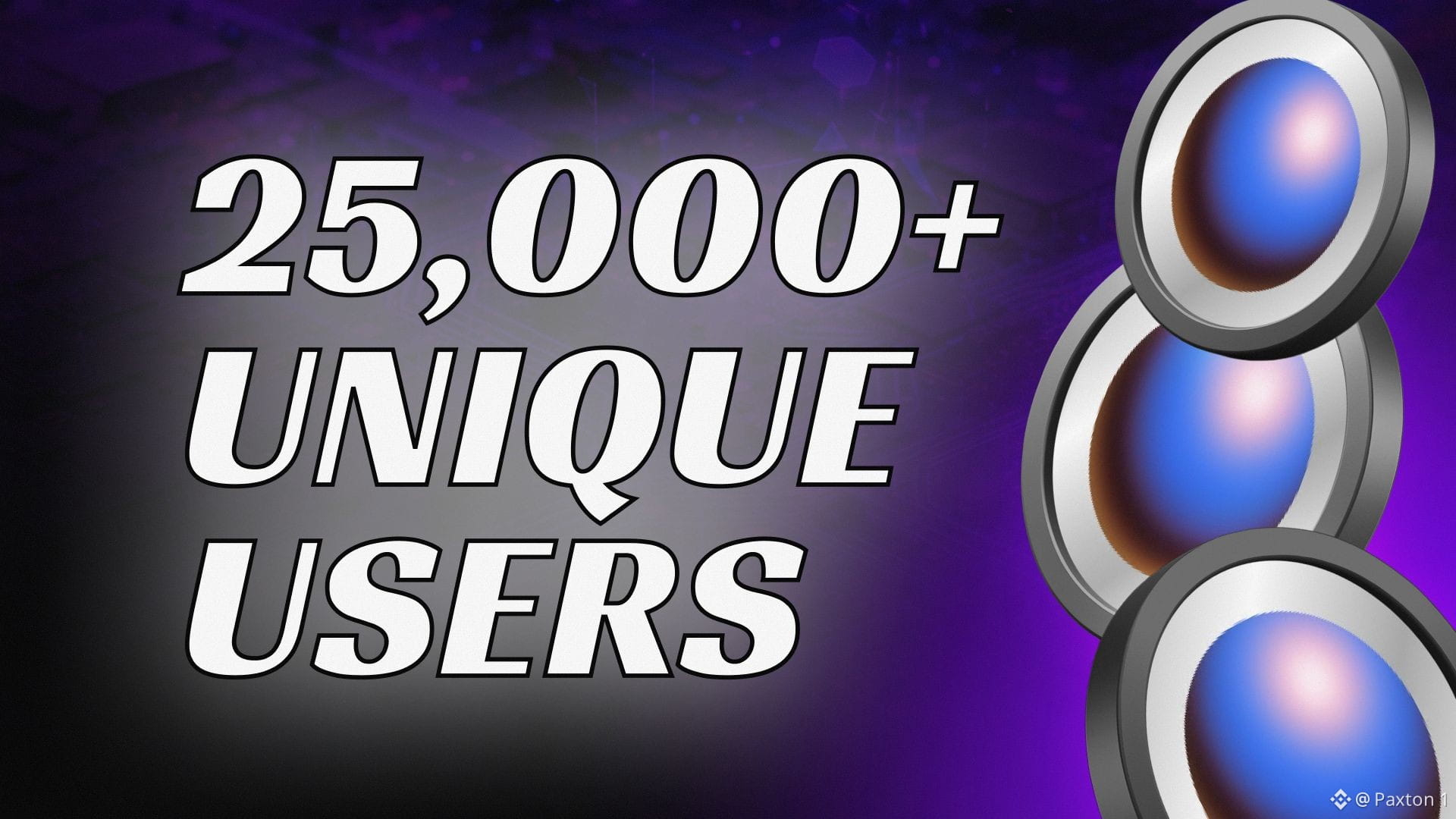
According to CEO Dee Goens, Zora recorded 25,000 unique app users over the previous 90 days.
It is also acquiring or re-engaging approximately 5,000 users each week.
Those figures are still early, but they give the turnaround narrative real substance.
Zora now has a broader reason for people to return.
The platform has expanded from its creator-focused foundations into mobile Custom Pairs and crosschain trading across Solana, BNB Chain, Robinhood Chain and Base.
Dee brings continuity as a co-founder, but his arrival as CEO also marks a change in urgency.
The product is moving faster.
The communication is becoming clearer.
The addressable audience now includes creators, traders and token communities.
I think the combination of weekly user growth and an aggressive shipping cadence is the real story here.
If Zora sustains that pace, the comeback could develop into measurable platform expansion.
#Altcoin Season# #MemeFi
Zora’s Comeback Has Actual User Data 📈
The growth of $HYPE reinforced how quickly crypto attention follows products people genuinely use.
The early activity around $ZORA is why its revival deserves more than a casual glance.
According to CEO Dee Goens, Zora recorded 25,000 unique app users over the previous 90 days.
It is also acquiring or re-engaging approximately 5,000 users each week.
Those figures are still early, but they give the turnaround narrative real substance.
Zora now has a broader reason for people to return.
The platform has expanded from its creator-focused foundations into mobile Custom Pairs and crosschain trading across Solana, BNB Chain, Robinhood Chain and Base.
Dee brings continuity as a co-founder, but his arrival as CEO also marks a change in urgency.
The product is moving faster.
The communication is becoming clearer.
The addressable audience now includes creators, traders and token communities.
I think the combination of weekly user growth and an aggressive shipping cadence is the real story here.
If Zora sustains that pace, the comeback could develop into measurable platform expansion.
#Altcoin Season# #MemeFi
The growth of $HYPE reinforced how quickly crypto attention follows products people genuinely use.
The early activity around $ZORA is why its revival deserves more than a casual glance.
According to CEO Dee Goens, Zora recorded 25,000 unique app users over the previous 90 days.
It is also acquiring or re-engaging approximately 5,000 users each week.
Those figures are still early, but they give the turnaround narrative real substance.
Zora now has a broader reason for people to return.
The platform has expanded from its creator-focused foundations into mobile Custom Pairs and crosschain trading across Solana, BNB Chain, Robinhood Chain and Base.
Dee brings continuity as a co-founder, but his arrival as CEO also marks a change in urgency.
The product is moving faster.
The communication is becoming clearer.
The addressable audience now includes creators, traders and token communities.
I think the combination of weekly user growth and an aggressive shipping cadence is the real story here.
If Zora sustains that pace, the comeback could develop into measurable platform expansion.
#Altcoin Season# #MemeFi
2
339
·
--
From Volume To Token Demand 🔄
$SYN has a proposed value-accrual mechanism resembling the fee-driven model investors associate with $HYPE .
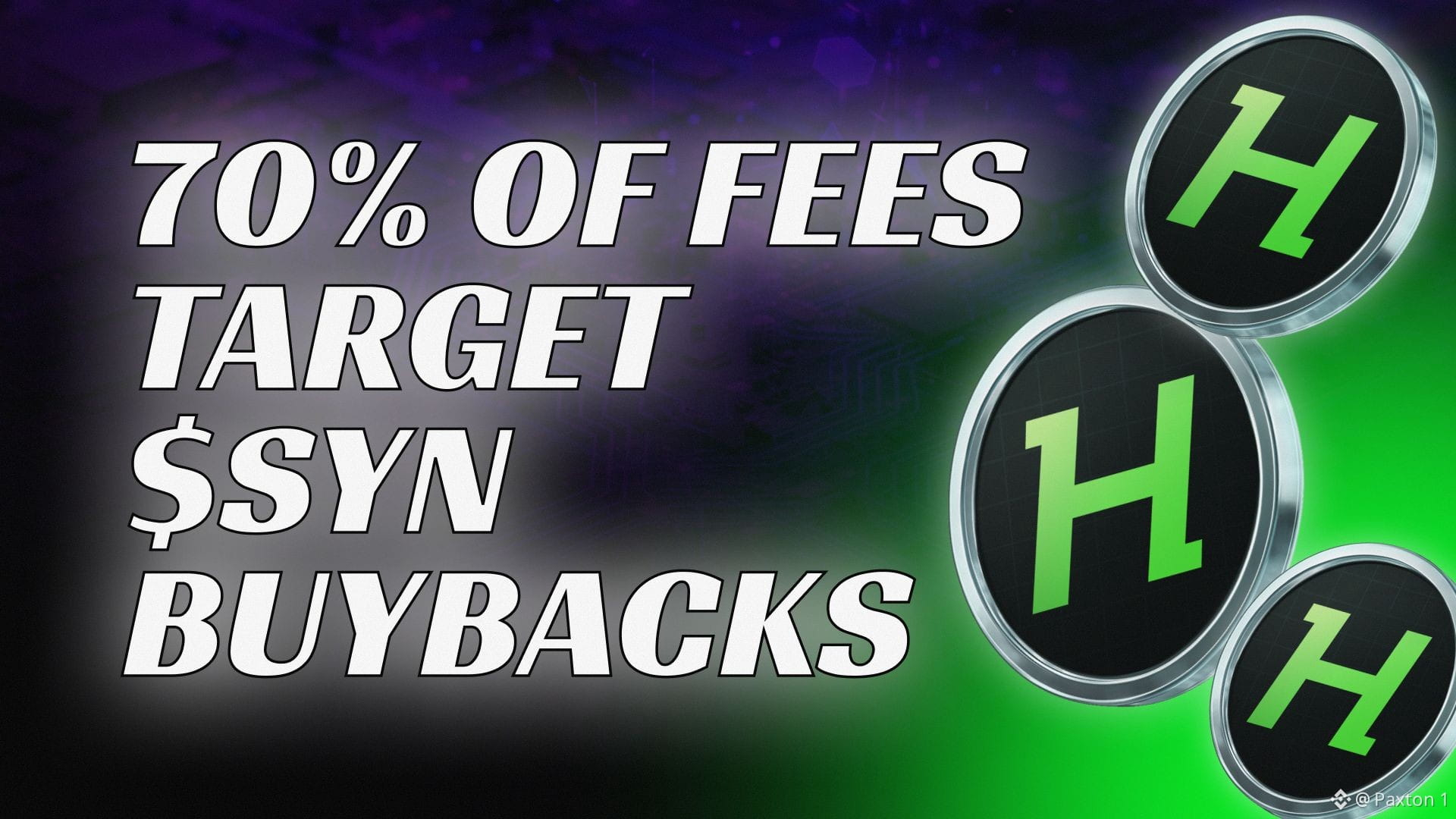
The proposal would direct 70% of certain protocol fees toward open-market SYN purchases.
If approved and implemented, growing Hypercall activity could create a direct relationship between product usage and token demand.
That makes trading volume more meaningful. It would become an input into the token model instead of remaining a product metric alone.
My confirmation points are approval of the proposal, activation of fees and sustained trading activity after incentives normalize.
Altcoin Season rewards strong narratives, but durable repricing also requires measurable value flowing back to the asset.
#Altcoin Season#
From Volume To Token Demand 🔄
$SYN has a proposed value-accrual mechanism resembling the fee-driven model investors associate with $HYPE .
The proposal would direct 70% of certain protocol fees toward open-market SYN purchases.
If approved and implemented, growing Hypercall activity could create a direct relationship between product usage and token demand.
That makes trading volume more meaningful. It would become an input into the token model instead of remaining a product metric alone.
My confirmation points are approval of the proposal, activation of fees and sustained trading activity after incentives normalize.
Altcoin Season rewards strong narratives, but durable repricing also requires measurable value flowing back to the asset.
#Altcoin Season#
$SYN has a proposed value-accrual mechanism resembling the fee-driven model investors associate with $HYPE .
The proposal would direct 70% of certain protocol fees toward open-market SYN purchases.
If approved and implemented, growing Hypercall activity could create a direct relationship between product usage and token demand.
That makes trading volume more meaningful. It would become an input into the token model instead of remaining a product metric alone.
My confirmation points are approval of the proposal, activation of fees and sustained trading activity after incentives normalize.
Altcoin Season rewards strong narratives, but durable repricing also requires measurable value flowing back to the asset.
#Altcoin Season#
398
·
--
Arc Captured 7% Mindshare on Launch Day
The launch of Arc mainnet placed $ARC and $USDC near the center of a rapidly changing crypto conversation. $arc
Kaito AI data showed Arc reaching approximately 7% mindshare on mainnet launch day. That happened as crypto’s overall share of online discussion rose 64% in only four days, recovering from a six-month low to reach nearly one-third of total attention.
What makes this interesting is the wider market environment.
The CLARITY Act failed to advance, approximately $88 billion was erased from the crypto market and almost $300 million in long positions was reportedly liquidated within twenty minutes.
Despite that uncertainty, attention continued moving toward new infrastructure and emerging ecosystems. Arc’s USDC-based network launch—and activity around a separate token using the ARC ticker, gave traders and creators a fresh narrative to follow.
This is where Kaito AI becomes useful for me. The Mindshare Arena lets me compare timeframes, identify sudden attention spikes and find the leading voices discussing a project.
For traders, that can surface narratives before they become crowded. For creators, it reveals which topics audiences are beginning to care about.
The timeline moves quickly. Kaito helps me understand where it is moving.
#Altcoin Season# #Macro Insights#
Arc Captured 7% Mindshare on Launch Day
The launch of Arc mainnet placed $ARC and $USDC near the center of a rapidly changing crypto conversation. $arc
Kaito AI data showed Arc reaching approximately 7% mindshare on mainnet launch day. That happened as crypto’s overall share of online discussion rose 64% in only four days, recovering from a six-month low to reach nearly one-third of total attention.
What makes this interesting is the wider market environment.
The CLARITY Act failed to advance, approximately $88 billion was erased from the crypto market and almost $300 million in long positions was reportedly liquidated within twenty minutes.
Despite that uncertainty, attention continued moving toward new infrastructure and emerging ecosystems. Arc’s USDC-based network launch—and activity around a separate token using the ARC ticker, gave traders and creators a fresh narrative to follow.
This is where Kaito AI becomes useful for me. The Mindshare Arena lets me compare timeframes, identify sudden attention spikes and find the leading voices discussing a project.
For traders, that can surface narratives before they become crowded. For creators, it reveals which topics audiences are beginning to care about.
The timeline moves quickly. Kaito helps me understand where it is moving.
#Altcoin Season# #Macro Insights#
The launch of Arc mainnet placed $ARC and $USDC near the center of a rapidly changing crypto conversation. $arc
Kaito AI data showed Arc reaching approximately 7% mindshare on mainnet launch day. That happened as crypto’s overall share of online discussion rose 64% in only four days, recovering from a six-month low to reach nearly one-third of total attention.
What makes this interesting is the wider market environment.
The CLARITY Act failed to advance, approximately $88 billion was erased from the crypto market and almost $300 million in long positions was reportedly liquidated within twenty minutes.
Despite that uncertainty, attention continued moving toward new infrastructure and emerging ecosystems. Arc’s USDC-based network launch—and activity around a separate token using the ARC ticker, gave traders and creators a fresh narrative to follow.
This is where Kaito AI becomes useful for me. The Mindshare Arena lets me compare timeframes, identify sudden attention spikes and find the leading voices discussing a project.
For traders, that can surface narratives before they become crowded. For creators, it reveals which topics audiences are beginning to care about.
The timeline moves quickly. Kaito helps me understand where it is moving.
#Altcoin Season# #Macro Insights#
1
2
1.9k
·
--
Public Blockchains Leak Too Much For Finance 🔒
Businesses cannot move serious financial workflows onchain while exposing every balance, payment and commercial relationship.
$SUI is building directly around that problem.
Confidential Transfers can protect balances and transaction amounts while selective access preserves visibility for authorised parties.
That matters for payroll, merchant settlement, supplier payments and treasury operations.
Sui is also connecting confidentiality with programmable assets, Seal, Nautilus and gasless stablecoin transfers inside one environment.
I think this is where the institutional blockchain race becomes far more serious.
Speed attracts attention, but companies also need privacy, policy and automation to work together.
Sui is building those capabilities as one financial stack.
That is infrastructure businesses can realistically use.
#Altcoin Season# #Privacy
Public Blockchains Leak Too Much For Finance 🔒
Businesses cannot move serious financial workflows onchain while exposing every balance, payment and commercial relationship.
$SUI is building directly around that problem.
Confidential Transfers can protect balances and transaction amounts while selective access preserves visibility for authorised parties.
That matters for payroll, merchant settlement, supplier payments and treasury operations.
Sui is also connecting confidentiality with programmable assets, Seal, Nautilus and gasless stablecoin transfers inside one environment.
I think this is where the institutional blockchain race becomes far more serious.
Speed attracts attention, but companies also need privacy, policy and automation to work together.
Sui is building those capabilities as one financial stack.
That is infrastructure businesses can realistically use.
#Altcoin Season# #Privacy
Businesses cannot move serious financial workflows onchain while exposing every balance, payment and commercial relationship.
$SUI is building directly around that problem.
Confidential Transfers can protect balances and transaction amounts while selective access preserves visibility for authorised parties.
That matters for payroll, merchant settlement, supplier payments and treasury operations.
Sui is also connecting confidentiality with programmable assets, Seal, Nautilus and gasless stablecoin transfers inside one environment.
I think this is where the institutional blockchain race becomes far more serious.
Speed attracts attention, but companies also need privacy, policy and automation to work together.
Sui is building those capabilities as one financial stack.
That is infrastructure businesses can realistically use.
#Altcoin Season# #Privacy
1
105
·
--
Trade Equity-Linked Options 24/7 🌍
$ONDO has helped put real-world assets and tokenized markets at the center of the onchain conversation.
$SYN brings another angle through Hypercall: equity-linked options that remain tradable when traditional markets are closed.
Company news and global events can arrive overnight or over a weekend. Hypercall lets you react when the news happens, with options settled on Hyperliquid.
That gives you equity-linked markets a place to trade contracts while traditional markets are closed, and its traders still asleep.
More trading hours gives you more flexibility and more chances to be ahead of the curve.
This is a concrete application of the RWA and DeFi thesis, and one reason Hypercall deserves attention.
#Hyperliquid
Trade Equity-Linked Options 24/7 🌍
$ONDO has helped put real-world assets and tokenized markets at the center of the onchain conversation.
$SYN brings another angle through Hypercall: equity-linked options that remain tradable when traditional markets are closed.
Company news and global events can arrive overnight or over a weekend. Hypercall lets you react when the news happens, with options settled on Hyperliquid.
That gives you equity-linked markets a place to trade contracts while traditional markets are closed, and its traders still asleep.
More trading hours gives you more flexibility and more chances to be ahead of the curve.
This is a concrete application of the RWA and DeFi thesis, and one reason Hypercall deserves attention.
#Hyperliquid
$ONDO has helped put real-world assets and tokenized markets at the center of the onchain conversation.
$SYN brings another angle through Hypercall: equity-linked options that remain tradable when traditional markets are closed.
Company news and global events can arrive overnight or over a weekend. Hypercall lets you react when the news happens, with options settled on Hyperliquid.
That gives you equity-linked markets a place to trade contracts while traditional markets are closed, and its traders still asleep.
More trading hours gives you more flexibility and more chances to be ahead of the curve.
This is a concrete application of the RWA and DeFi thesis, and one reason Hypercall deserves attention.
#Hyperliquid
1
526
·
--
The Compute Trade Is Getting Bigger 👀
BlackRock just said AI compute could eventually be tokenized, traded, financed and even used as collateral. That is a pretty serious signal for where this market could be heading.
$TAO already gives us one version of that future. Bittensor has 128 active subnets, with roughly 5.4M TAO staked on root.
But $B3 is the one I expect people to look at differently if compute itself becomes an asset.
B3IQ currently lists an NVIDIA H200 NVL system at $54,516, or roughly $16,355 down through rent-to-own. B3 builds and hosts the machine, and owners can keep 85% of what it earns when they make the capacity available.
That is extremely easy for me to understand.
TAO is building markets around AI intelligence.
B3IQ is turning the actual GPU into something you can own and earn from.
And now BlackRock is openly talking about compute becoming a financial asset.
If that narrative keeps growing, I expect the attention around $B3 to go up with it. 🔥
#Ai #DePIN
The Compute Trade Is Getting Bigger 👀
BlackRock just said AI compute could eventually be tokenized, traded, financed and even used as collateral. That is a pretty serious signal for where this market could be heading.
$TAO already gives us one version of that future. Bittensor has 128 active subnets, with roughly 5.4M TAO staked on root.
But $B3 is the one I expect people to look at differently if compute itself becomes an asset.
B3IQ currently lists an NVIDIA H200 NVL system at $54,516, or roughly $16,355 down through rent-to-own. B3 builds and hosts the machine, and owners can keep 85% of what it earns when they make the capacity available.
That is extremely easy for me to understand.
TAO is building markets around AI intelligence.
B3IQ is turning the actual GPU into something you can own and earn from.
And now BlackRock is openly talking about compute becoming a financial asset.
If that narrative keeps growing, I expect the attention around $B3 to go up with it. 🔥
#Ai #DePIN
BlackRock just said AI compute could eventually be tokenized, traded, financed and even used as collateral. That is a pretty serious signal for where this market could be heading.
$TAO already gives us one version of that future. Bittensor has 128 active subnets, with roughly 5.4M TAO staked on root.
But $B3 is the one I expect people to look at differently if compute itself becomes an asset.
B3IQ currently lists an NVIDIA H200 NVL system at $54,516, or roughly $16,355 down through rent-to-own. B3 builds and hosts the machine, and owners can keep 85% of what it earns when they make the capacity available.
That is extremely easy for me to understand.
TAO is building markets around AI intelligence.
B3IQ is turning the actual GPU into something you can own and earn from.
And now BlackRock is openly talking about compute becoming a financial asset.
If that narrative keeps growing, I expect the attention around $B3 to go up with it. 🔥
#Ai #DePIN
1
335
·
--
Compare The Contract Before The Exchange 🧐
$UNI makes swapping assets familiar. Hypercall, the options exchange behind $SYN , adds choices about expiry and payoff to the trading decision.
Access to an asset and the way you trade it are separate questions.
That distinction matters when comparing options venues. I would start with the contract a trader actually needs.
• Is the underlying available?
• Does the expiry fit the view?
• What size can be traded at the quoted price?
• What are the loss and payoff limits?
Derive and Aevo belong in that research. Hyperliquid’s perps provide another way to express directional exposure.
Hypercall adds a specific proposition to the comparison. Options on names including NVDA, MU, SanDisk and SpaceX, with fractional sizing and weekend access.
That puts Hypercall in a useful part of the RWA and DeFi discussion, where the instrument matters as much as the underlying.
The case for paying attention to SYN gets clearer when you compare what a trader can actually do with the product.
#DeFi
Compare The Contract Before The Exchange 🧐
$UNI makes swapping assets familiar. Hypercall, the options exchange behind $SYN , adds choices about expiry and payoff to the trading decision.
Access to an asset and the way you trade it are separate questions.
That distinction matters when comparing options venues. I would start with the contract a trader actually needs.
• Is the underlying available?
• Does the expiry fit the view?
• What size can be traded at the quoted price?
• What are the loss and payoff limits?
Derive and Aevo belong in that research. Hyperliquid’s perps provide another way to express directional exposure.
Hypercall adds a specific proposition to the comparison. Options on names including NVDA, MU, SanDisk and SpaceX, with fractional sizing and weekend access.
That puts Hypercall in a useful part of the RWA and DeFi discussion, where the instrument matters as much as the underlying.
The case for paying attention to SYN gets clearer when you compare what a trader can actually do with the product.
#DeFi
$UNI makes swapping assets familiar. Hypercall, the options exchange behind $SYN , adds choices about expiry and payoff to the trading decision.
Access to an asset and the way you trade it are separate questions.
That distinction matters when comparing options venues. I would start with the contract a trader actually needs.
• Is the underlying available?
• Does the expiry fit the view?
• What size can be traded at the quoted price?
• What are the loss and payoff limits?
Derive and Aevo belong in that research. Hyperliquid’s perps provide another way to express directional exposure.
Hypercall adds a specific proposition to the comparison. Options on names including NVDA, MU, SanDisk and SpaceX, with fractional sizing and weekend access.
That puts Hypercall in a useful part of the RWA and DeFi discussion, where the instrument matters as much as the underlying.
The case for paying attention to SYN gets clearer when you compare what a trader can actually do with the product.
#DeFi
2
471
·
--
Nasdaq changes the frame 👀
$PYTH is no longer easy to box into the normal oracle category, and $XLM brings the payments, financial rails and cross-border liquidity crowd that should understand why data distribution matters.
Pyth being an external distributor of Nasdaq Basic through the Data Marketplace is the kind of update that makes people recheck the whole project.
This is not about another crypto feed.
Nasdaq Basic carries real-time U.S. equity quotes and trades: best bid, best offer, associated size, last sale, trade size, and official opening and closing reference prices.
That data is used by serious financial applications.
Now approved clients can receive it via Pyth after licensing directly with Nasdaq.
The alpha here is simple: the market may still be looking at $PYTH through an old lens.
Pyth already priced $723.77B of August RWA perp volume, covering 96.27% of the tracked market. It also crossed $10.4M ARR in August, with around $2.9M in gross new ARR.
Those are not meme metrics.
That is usage plus commercial traction.
Nasdaq Basic entering the Pyth Data Marketplace adds brand gravity to a product story that was already getting stronger.
If Pyth keeps moving from crypto oracle into institutional market-data distribution, $PYTH may still be early in how the market understands it.
#Altcoin Season# #RWA
Nasdaq changes the frame 👀
$PYTH is no longer easy to box into the normal oracle category, and $XLM brings the payments, financial rails and cross-border liquidity crowd that should understand why data distribution matters.
Pyth being an external distributor of Nasdaq Basic through the Data Marketplace is the kind of update that makes people recheck the whole project.
This is not about another crypto feed.
Nasdaq Basic carries real-time U.S. equity quotes and trades: best bid, best offer, associated size, last sale, trade size, and official opening and closing reference prices.
That data is used by serious financial applications.
Now approved clients can receive it via Pyth after licensing directly with Nasdaq.
The alpha here is simple: the market may still be looking at $PYTH through an old lens.
Pyth already priced $723.77B of August RWA perp volume, covering 96.27% of the tracked market. It also crossed $10.4M ARR in August, with around $2.9M in gross new ARR.
Those are not meme metrics.
That is usage plus commercial traction.
Nasdaq Basic entering the Pyth Data Marketplace adds brand gravity to a product story that was already getting stronger.
If Pyth keeps moving from crypto oracle into institutional market-data distribution, $PYTH may still be early in how the market understands it.
#Altcoin Season# #RWA
$PYTH is no longer easy to box into the normal oracle category, and $XLM brings the payments, financial rails and cross-border liquidity crowd that should understand why data distribution matters.
Pyth being an external distributor of Nasdaq Basic through the Data Marketplace is the kind of update that makes people recheck the whole project.
This is not about another crypto feed.
Nasdaq Basic carries real-time U.S. equity quotes and trades: best bid, best offer, associated size, last sale, trade size, and official opening and closing reference prices.
That data is used by serious financial applications.
Now approved clients can receive it via Pyth after licensing directly with Nasdaq.
The alpha here is simple: the market may still be looking at $PYTH through an old lens.
Pyth already priced $723.77B of August RWA perp volume, covering 96.27% of the tracked market. It also crossed $10.4M ARR in August, with around $2.9M in gross new ARR.
Those are not meme metrics.
That is usage plus commercial traction.
Nasdaq Basic entering the Pyth Data Marketplace adds brand gravity to a product story that was already getting stronger.
If Pyth keeps moving from crypto oracle into institutional market-data distribution, $PYTH may still be early in how the market understands it.
#Altcoin Season# #RWA
2
250
·
--
Nasdaq data just found new rails.
$JUP has the DeFi routing, swaps and liquidity crowd watching how markets move across venues. $INJ has the exchange, derivatives and onchain finance audience that understands why real-time data decides whether a market can actually scale.
That is the lens I’d use for this Pyth update.
Pyth has been approved as an external distributor for Nasdaq Basic through the Pyth Data Marketplace.
Nasdaq Basic is not a random dataset. It carries real-time U.S. equity quotes and trades, including best bid and offer, size, last sale data, and Nasdaq’s official opening and closing prices.
The alpha is not “Nasdaq mentioned Pyth.”
The alpha is that Pyth is becoming a distribution path for serious market data.
That matters because modern finance is moving into apps, APIs, trading venues, tokenized products, prediction markets and always-on markets. All of them need reliable data before they can handle real volume.
Pyth already priced 96.27% of August’s tracked RWA perp volume, across $751.9B in market activity.
It also crossed $10.4M ARR in August.
Now Nasdaq Basic enters the Data Marketplace story.
That is the kind of proof point that changes how people categorize Pyth.
Not just feeds.
Distribution.
#Altcoin Season# #DeFi
Nasdaq data just found new rails.
$JUP has the DeFi routing, swaps and liquidity crowd watching how markets move across venues. $INJ has the exchange, derivatives and onchain finance audience that understands why real-time data decides whether a market can actually scale.
That is the lens I’d use for this Pyth update.
Pyth has been approved as an external distributor for Nasdaq Basic through the Pyth Data Marketplace.
Nasdaq Basic is not a random dataset. It carries real-time U.S. equity quotes and trades, including best bid and offer, size, last sale data, and Nasdaq’s official opening and closing prices.
The alpha is not “Nasdaq mentioned Pyth.”
The alpha is that Pyth is becoming a distribution path for serious market data.
That matters because modern finance is moving into apps, APIs, trading venues, tokenized products, prediction markets and always-on markets. All of them need reliable data before they can handle real volume.
Pyth already priced 96.27% of August’s tracked RWA perp volume, across $751.9B in market activity.
It also crossed $10.4M ARR in August.
Now Nasdaq Basic enters the Data Marketplace story.
That is the kind of proof point that changes how people categorize Pyth.
Not just feeds.
Distribution.
#Altcoin Season# #DeFi
$JUP has the DeFi routing, swaps and liquidity crowd watching how markets move across venues. $INJ has the exchange, derivatives and onchain finance audience that understands why real-time data decides whether a market can actually scale.
That is the lens I’d use for this Pyth update.
Pyth has been approved as an external distributor for Nasdaq Basic through the Pyth Data Marketplace.
Nasdaq Basic is not a random dataset. It carries real-time U.S. equity quotes and trades, including best bid and offer, size, last sale data, and Nasdaq’s official opening and closing prices.
The alpha is not “Nasdaq mentioned Pyth.”
The alpha is that Pyth is becoming a distribution path for serious market data.
That matters because modern finance is moving into apps, APIs, trading venues, tokenized products, prediction markets and always-on markets. All of them need reliable data before they can handle real volume.
Pyth already priced 96.27% of August’s tracked RWA perp volume, across $751.9B in market activity.
It also crossed $10.4M ARR in August.
Now Nasdaq Basic enters the Data Marketplace story.
That is the kind of proof point that changes how people categorize Pyth.
Not just feeds.
Distribution.
#Altcoin Season# #DeFi
1
396
·
--
Smart Contracts Forget A Lot 🧠
A smart contract can execute perfectly and still know almost nothing about what happened before the current transaction.
That's a weird limitation when you think about it.
What if a lending protocol wants to know whether a wallet repaid its previous loans?
Or whether someone held an asset for 90 days?
Or what that address did across multiple chains?
Space and Time was built around making those kinds of historical and cross-chain questions available to smart contracts, with Proof of SQL proving the result instead of asking the contract to trust a database.
That's why I wouldn't really put $SXT in the generic L1 bucket.
Something like $SUI is focused on making blockchain applications faster and easier to build.
Space and Time is solving a different headache: giving those applications more context.
Execution matters.
But knowing what you're executing against matters too.
#Altcoin Season#
Smart Contracts Forget A Lot 🧠
A smart contract can execute perfectly and still know almost nothing about what happened before the current transaction.
That's a weird limitation when you think about it.
What if a lending protocol wants to know whether a wallet repaid its previous loans?
Or whether someone held an asset for 90 days?
Or what that address did across multiple chains?
Space and Time was built around making those kinds of historical and cross-chain questions available to smart contracts, with Proof of SQL proving the result instead of asking the contract to trust a database.
That's why I wouldn't really put $SXT in the generic L1 bucket.
Something like $SUI is focused on making blockchain applications faster and easier to build.
Space and Time is solving a different headache: giving those applications more context.
Execution matters.
But knowing what you're executing against matters too.
#Altcoin Season#
A smart contract can execute perfectly and still know almost nothing about what happened before the current transaction.
That's a weird limitation when you think about it.
What if a lending protocol wants to know whether a wallet repaid its previous loans?
Or whether someone held an asset for 90 days?
Or what that address did across multiple chains?
Space and Time was built around making those kinds of historical and cross-chain questions available to smart contracts, with Proof of SQL proving the result instead of asking the contract to trust a database.
That's why I wouldn't really put $SXT in the generic L1 bucket.
Something like $SUI is focused on making blockchain applications faster and easier to build.
Space and Time is solving a different headache: giving those applications more context.
Execution matters.
But knowing what you're executing against matters too.
#Altcoin Season#
2
425
·
--
6 energy indices hit Pyth 🔥
$NEAR has the AI, chain abstraction and app-layer crowd watching infrastructure that can power real use cases. $VVV brings the Venice, private AI and agent economy angle into the same conversation.
That matters because AI agents and onchain apps still need clean references when they move beyond crypto-native assets.
Pyth just made that cleaner for energy markets.
WTI, Brent, Henry Hub, Henry LD1, London WTI and Dutch TTF are now live as constant maturity futures indices through Pyth Indices.
Normal futures feeds follow one contract until expiry. As that contract moves closer to the end date, the time horizon keeps shrinking.
That creates a messy reference for builders.
A constant maturity index fixes the horizon instead.
One month out, every day.
No roll schedule to manage. No roll date to track. No manual contract migration every time the futures curve moves forward.
For builders, this is the kind of boring infrastructure that actually matters.
Energy markets are global, volatile and deeply tied to macro trading. If RWAs are coming onchain, oil and gas cannot depend on messy references that break every time the front contract changes.
Pyth already has first-party data, 3,500+ market feeds and 24/7 pricing products.
Now it is adding cleaner futures references for the markets builders actually want to package, trade and settle.
This is how real-world markets become programmable.
#Altcoin Season# #Trading
6 energy indices hit Pyth 🔥
$NEAR has the AI, chain abstraction and app-layer crowd watching infrastructure that can power real use cases. $VVV brings the Venice, private AI and agent economy angle into the same conversation.
That matters because AI agents and onchain apps still need clean references when they move beyond crypto-native assets.
Pyth just made that cleaner for energy markets.
WTI, Brent, Henry Hub, Henry LD1, London WTI and Dutch TTF are now live as constant maturity futures indices through Pyth Indices.
Normal futures feeds follow one contract until expiry. As that contract moves closer to the end date, the time horizon keeps shrinking.
That creates a messy reference for builders.
A constant maturity index fixes the horizon instead.
One month out, every day.
No roll schedule to manage. No roll date to track. No manual contract migration every time the futures curve moves forward.
For builders, this is the kind of boring infrastructure that actually matters.
Energy markets are global, volatile and deeply tied to macro trading. If RWAs are coming onchain, oil and gas cannot depend on messy references that break every time the front contract changes.
Pyth already has first-party data, 3,500+ market feeds and 24/7 pricing products.
Now it is adding cleaner futures references for the markets builders actually want to package, trade and settle.
This is how real-world markets become programmable.
#Altcoin Season# #Trading
$NEAR has the AI, chain abstraction and app-layer crowd watching infrastructure that can power real use cases. $VVV brings the Venice, private AI and agent economy angle into the same conversation.
That matters because AI agents and onchain apps still need clean references when they move beyond crypto-native assets.
Pyth just made that cleaner for energy markets.
WTI, Brent, Henry Hub, Henry LD1, London WTI and Dutch TTF are now live as constant maturity futures indices through Pyth Indices.
Normal futures feeds follow one contract until expiry. As that contract moves closer to the end date, the time horizon keeps shrinking.
That creates a messy reference for builders.
A constant maturity index fixes the horizon instead.
One month out, every day.
No roll schedule to manage. No roll date to track. No manual contract migration every time the futures curve moves forward.
For builders, this is the kind of boring infrastructure that actually matters.
Energy markets are global, volatile and deeply tied to macro trading. If RWAs are coming onchain, oil and gas cannot depend on messy references that break every time the front contract changes.
Pyth already has first-party data, 3,500+ market feeds and 24/7 pricing products.
Now it is adding cleaner futures references for the markets builders actually want to package, trade and settle.
This is how real-world markets become programmable.
#Altcoin Season# #Trading
2
406
·
--
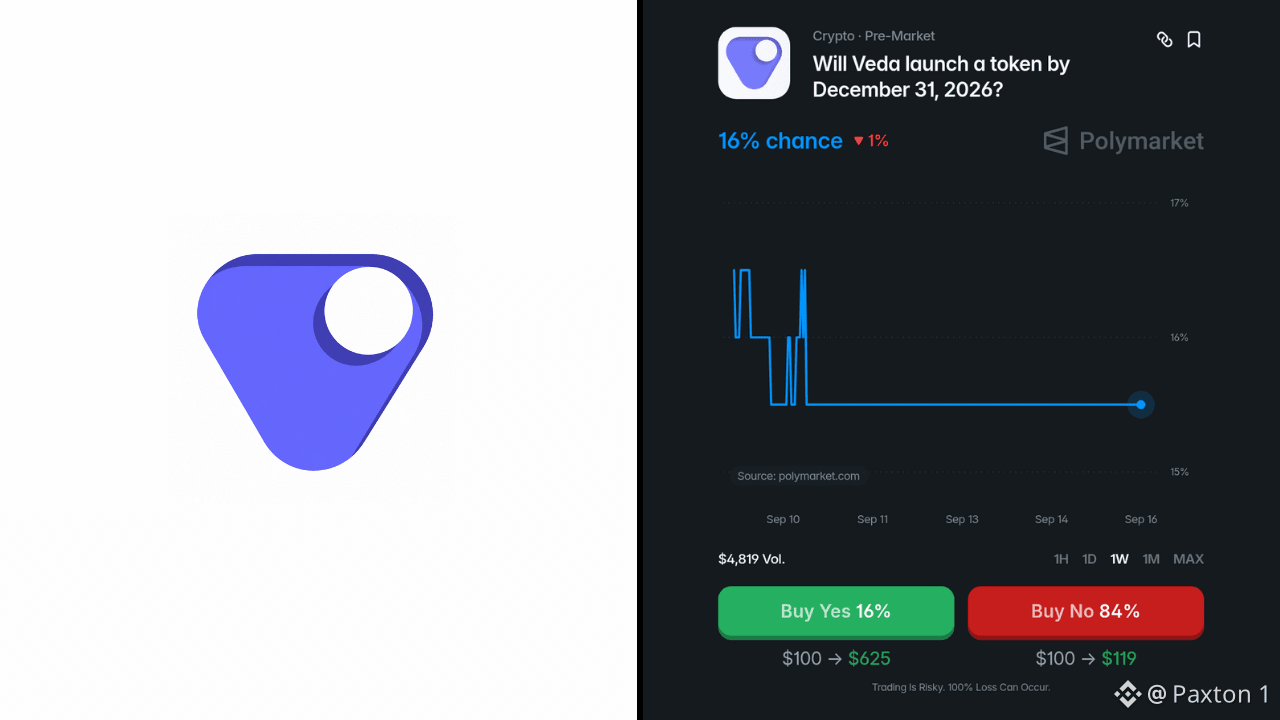
Veda looks late for 2026 ⏳
16% on Yes.
I'm taking No.
Veda clearly isn't standing still as a business. Its 2026 activity includes integrations and coverage around products involving MetaMask, Aave and Privy, so there is real infrastructure being built around the project.
But product traction and token timing are different questions.
Polymarket only cares whether the specified token event actually happens before the deadline.
Right now, the market has 84% sitting on No, and I don't see enough reason to fight that.
This is also a good example of why I like Polymarket even when I'm bearish on the prediction.
I don't need every trade to be another bullish token bet.
I'd rather redirect some $TRUMP exposure into a clear No position where the calendar itself is working in my favor.
Every week without a launch shortens the runway.
And if something changes?
I'm not trapped.
If credible token information suddenly appears, I can close the position before resolution and reassess.
That's a much more flexible setup than buying a bag and convincing myself to hold it forever.
For now, No is where I want to be.
#Altcoin Season#
Veda looks late for 2026 ⏳
16% on Yes.
I'm taking No.
Veda clearly isn't standing still as a business. Its 2026 activity includes integrations and coverage around products involving MetaMask, Aave and Privy, so there is real infrastructure being built around the project.
But product traction and token timing are different questions.
Polymarket only cares whether the specified token event actually happens before the deadline.
Right now, the market has 84% sitting on No, and I don't see enough reason to fight that.
This is also a good example of why I like Polymarket even when I'm bearish on the prediction.
I don't need every trade to be another bullish token bet.
I'd rather redirect some $TRUMP exposure into a clear No position where the calendar itself is working in my favor.
Every week without a launch shortens the runway.
And if something changes?
I'm not trapped.
If credible token information suddenly appears, I can close the position before resolution and reassess.
That's a much more flexible setup than buying a bag and convincing myself to hold it forever.
For now, No is where I want to be.
#Altcoin Season#
16% on Yes.
I'm taking No.
Veda clearly isn't standing still as a business. Its 2026 activity includes integrations and coverage around products involving MetaMask, Aave and Privy, so there is real infrastructure being built around the project.
But product traction and token timing are different questions.
Polymarket only cares whether the specified token event actually happens before the deadline.
Right now, the market has 84% sitting on No, and I don't see enough reason to fight that.
This is also a good example of why I like Polymarket even when I'm bearish on the prediction.
I don't need every trade to be another bullish token bet.
I'd rather redirect some $TRUMP exposure into a clear No position where the calendar itself is working in my favor.
Every week without a launch shortens the runway.
And if something changes?
I'm not trapped.
If credible token information suddenly appears, I can close the position before resolution and reassess.
That's a much more flexible setup than buying a bag and convincing myself to hold it forever.
For now, No is where I want to be.
#Altcoin Season#
1
53
·
--
Why Does Gas Need To Be Money? ⛽
Most blockchains made one asset do almost everything.
$ETH is something people hold, trade and use to pay for computation, while $BNB plays a similarly broad role across its own ecosystem.
That design works, but it also means using the network requires consuming a transferable asset. That’s why Midnight is so interesting to me, it separates those jobs.
First, it has NIGHT is the public governance and value asset, while holding NIGHT produces DUST, a separate non-transferable resource used to pay for private transactions.
So the thing providing network capacity does not need to behave like another coin sitting on an exchange.
That distinction becomes more interesting for applications with predictable usage, because transaction capacity can be treated as an operational resource rather than just another market-priced asset.
Crypto has spent years redesigning gas markets.
Midnight is redesigning what gas actually is.
#Tokenomics #Infrastructure
Why Does Gas Need To Be Money? ⛽
Most blockchains made one asset do almost everything.
$ETH is something people hold, trade and use to pay for computation, while $BNB plays a similarly broad role across its own ecosystem.
That design works, but it also means using the network requires consuming a transferable asset. That’s why Midnight is so interesting to me, it separates those jobs.
First, it has NIGHT is the public governance and value asset, while holding NIGHT produces DUST, a separate non-transferable resource used to pay for private transactions.
So the thing providing network capacity does not need to behave like another coin sitting on an exchange.
That distinction becomes more interesting for applications with predictable usage, because transaction capacity can be treated as an operational resource rather than just another market-priced asset.
Crypto has spent years redesigning gas markets.
Midnight is redesigning what gas actually is.
#Tokenomics #Infrastructure
Most blockchains made one asset do almost everything.
$ETH is something people hold, trade and use to pay for computation, while $BNB plays a similarly broad role across its own ecosystem.
That design works, but it also means using the network requires consuming a transferable asset. That’s why Midnight is so interesting to me, it separates those jobs.
First, it has NIGHT is the public governance and value asset, while holding NIGHT produces DUST, a separate non-transferable resource used to pay for private transactions.
So the thing providing network capacity does not need to behave like another coin sitting on an exchange.
That distinction becomes more interesting for applications with predictable usage, because transaction capacity can be treated as an operational resource rather than just another market-priced asset.
Crypto has spent years redesigning gas markets.
Midnight is redesigning what gas actually is.
#Tokenomics #Infrastructure
1
77
Connectez-vous pour découvrir plus de contenu
Rejoignez la communauté mondiale des adeptes de cryptomonnaies sur Binance Square
⚡️ Suviez les dernières informations importantes sur les cryptomonnaies.
💬 Jugé digne de confiance par la plus grande plateforme d’échange de cryptomonnaies au monde.
👍 Découvrez les connaissances que partagent les créateurs vérifiés.
Adresse e-mail/Nº de téléphone
Sujets d’actualité
AmazonPlansToSell$8BNvidiaChips
285 vues
18 mentions
🔥 Amazon's $8B NVIDIA Chip Move: What It Means for Tech & Markets
Nurul Hasnat Samir
·0 mentions J’aime
·64 vues
NEARFallsToAround$4.70Down14%
27,220 vues
54 mentions
EthereumFoundationLaunchesZkAPIOnMainnet
24,534 vues
387 mentions