

Bit_Rase
29.2k Publications

Bit_Rase
 Compte Square Vérifié+
Signaler
Bloquer l’utilisateur
Crypto Enthusiast | #BTC since 2017 | NFTs, Exchanges and Blockchain Analysis #Binance kol X.🇵🇰 @X_Girlz0
Ouvert au trading
Trade régulièrement
4.9 an(s)
359 Suivis
42.9K+ Abonnés
110.5K+ J’aime
Publications
Portefeuille
Tous
Citations
Direct
·
--
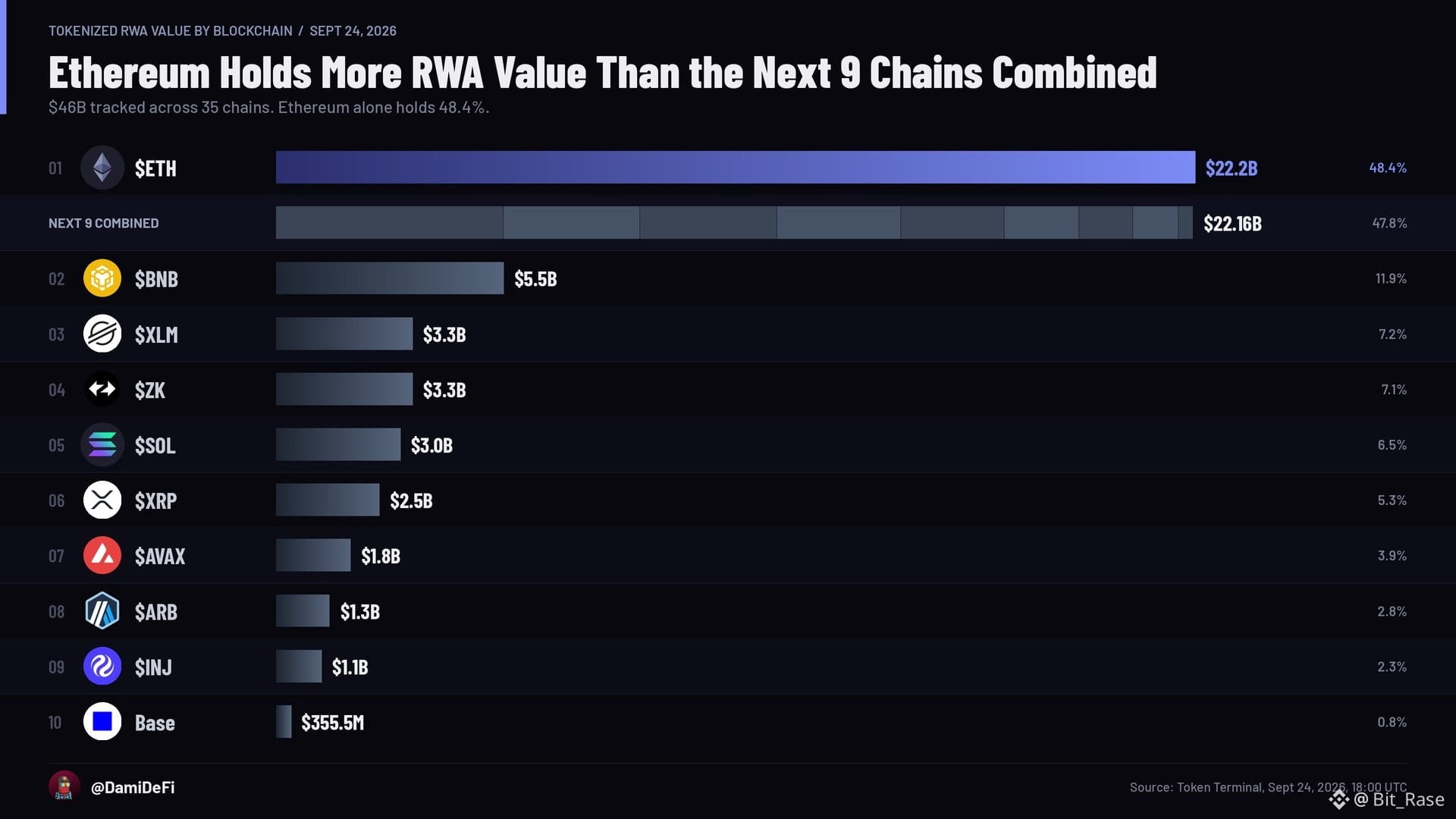
Ethereum Alone Holds Nearly Half of All Tokenized Real-World Asset Value Across 35 Blockchains, More Than the Next Nine Chains Combined.
Here's the RWA asset value breakdown by blockchain as of September 24, 2026, per Token Terminal:
$ETH : $22.2B (48.4% market share)
$BNB: $5.5B (11.9%)
$XLM: $3.3B (7.2%)
$ZK: $3.3B (7.1%)
$SOL: $3.0B (6.5%)
$XRP: $2.5B (5.3%)
$AVAX: $1.8B (3.9%)
$ARB: $1.3B (2.8%)
$INJ: $1.1B (2.3%)
Base: $355.5M (0.8%)
The total tokenized RWA market sits at $46B spread across 35 chains, and Ethereum's lead isn't close, it holds more RWA value than the remaining 34 chains combined.
$BNB is a distant second at under a quarter of Ethereum's share.
What's notable further down the list is $XLM and $ZK essentially tied for third, two chains with very different reputations, one built explicitly around payments and the other a general-purpose zkEVM, both carving out similar footholds in tokenized assets.
$BASE rounds out the top 10 at under 1% market share, a surprisingly small slice given how dominant the chain has been in other metrics like stablecoin settlement and smart wallet adoption this year.
Source: Token Terminal
Ethereum Alone Holds Nearly Half of All Tokenized Real-World Asset Value Across 35 Blockchains, More Than the Next Nine Chains Combined.
Here's the RWA asset value breakdown by blockchain as of September 24, 2026, per Token Terminal:
$ETH : $22.2B (48.4% market share)
$BNB : $5.5B (11.9%)
$XLM: $3.3B (7.2%)
$ZK : $3.3B (7.1%)
$SOL: $3.0B (6.5%)
$XRP: $2.5B (5.3%)
$AVAX: $1.8B (3.9%)
$ARB: $1.3B (2.8%)
$INJ: $1.1B (2.3%)
Base: $355.5M (0.8%)
The total tokenized RWA market sits at $46B spread across 35 chains, and Ethereum's lead isn't close, it holds more RWA value than the remaining 34 chains combined.
$BNB is a distant second at under a quarter of Ethereum's share.
What's notable further down the list is $XLM and $ZK essentially tied for third, two chains with very different reputations, one built explicitly around payments and the other a general-purpose zkEVM, both carving out similar footholds in tokenized assets.
$BASE rounds out the top 10 at under 1% market share, a surprisingly small slice given how dominant the chain has been in other metrics like stablecoin settlement and smart wallet adoption this year.
Source: Token Terminal
Here's the RWA asset value breakdown by blockchain as of September 24, 2026, per Token Terminal:
$ETH : $22.2B (48.4% market share)
$BNB : $5.5B (11.9%)
$XLM: $3.3B (7.2%)
$ZK : $3.3B (7.1%)
$SOL: $3.0B (6.5%)
$XRP: $2.5B (5.3%)
$AVAX: $1.8B (3.9%)
$ARB: $1.3B (2.8%)
$INJ: $1.1B (2.3%)
Base: $355.5M (0.8%)
The total tokenized RWA market sits at $46B spread across 35 chains, and Ethereum's lead isn't close, it holds more RWA value than the remaining 34 chains combined.
$BNB is a distant second at under a quarter of Ethereum's share.
What's notable further down the list is $XLM and $ZK essentially tied for third, two chains with very different reputations, one built explicitly around payments and the other a general-purpose zkEVM, both carving out similar footholds in tokenized assets.
$BASE rounds out the top 10 at under 1% market share, a surprisingly small slice given how dominant the chain has been in other metrics like stablecoin settlement and smart wallet adoption this year.
Source: Token Terminal
123
·
--
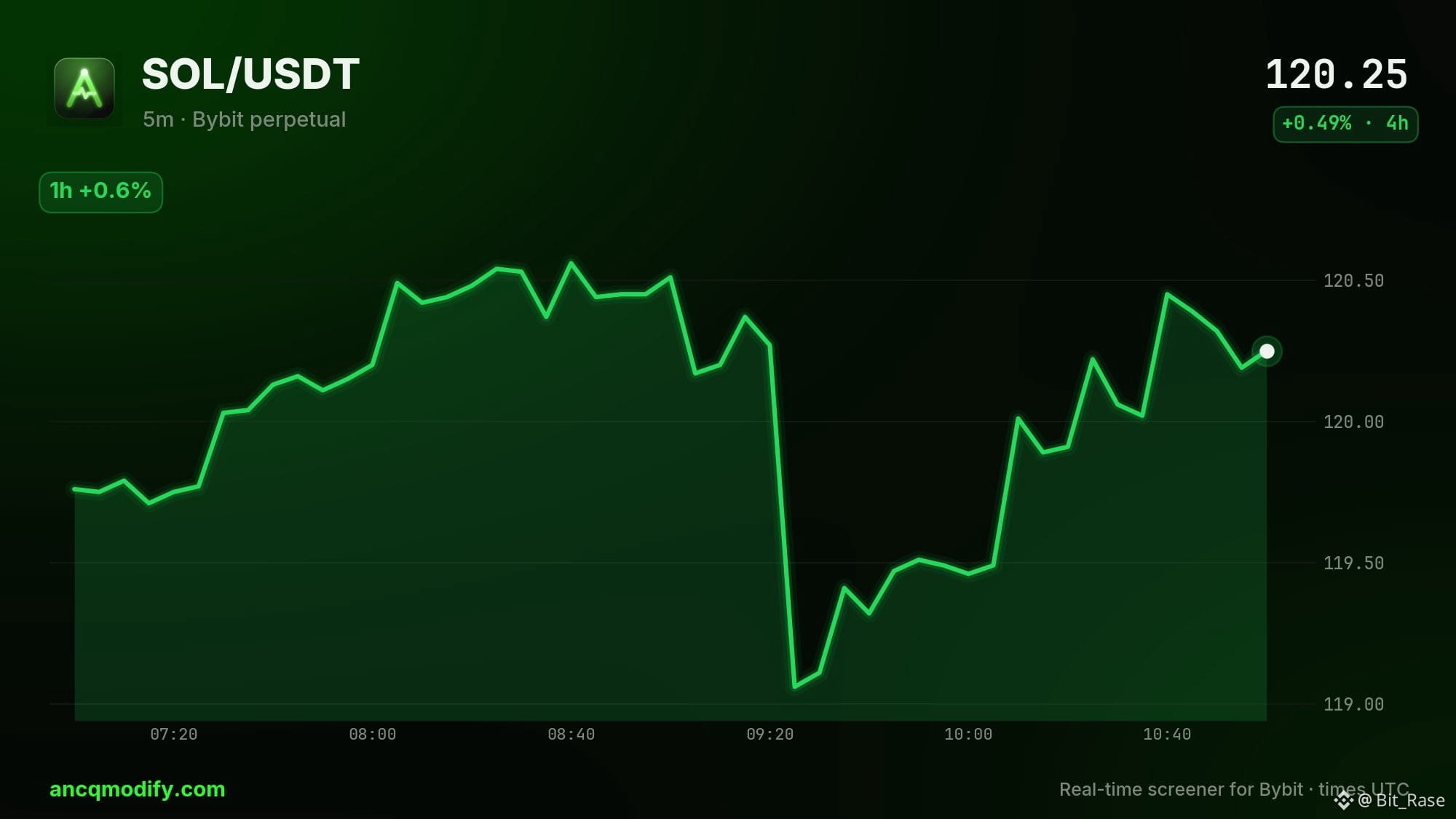
NEW: The Solana Foundation has launched Solana DVP, an open-source atomic Delivery-versus-Payment standard designed for institutional securities settlement.
The initiative includes input from J.P. Morgan, adding further institutional expertise to Solana’s push into tokenized financial markets.
Solana DVP aims to enable securities and payments to settle atomically, helping make on-chain settlement more efficient, transparent, and programmable.
A notable step toward bringing traditional financial infrastructure further on-chain. $SOL
{future}(SOLUSDT)
NEW: The Solana Foundation has launched Solana DVP, an open-source atomic Delivery-versus-Payment standard designed for institutional securities settlement.
The initiative includes input from J.P. Morgan, adding further institutional expertise to Solana’s push into tokenized financial markets.
Solana DVP aims to enable securities and payments to settle atomically, helping make on-chain settlement more efficient, transparent, and programmable.
A notable step toward bringing traditional financial infrastructure further on-chain. $SOL
The initiative includes input from J.P. Morgan, adding further institutional expertise to Solana’s push into tokenized financial markets.
Solana DVP aims to enable securities and payments to settle atomically, helping make on-chain settlement more efficient, transparent, and programmable.
A notable step toward bringing traditional financial infrastructure further on-chain. $SOL
1
165
·
--
Hyperscale Data holds approximately $56.4 million in bitcoin, cash, and cash on October 4th, 2026.
美股速考
29 minutes ago
Hyperscale Data holds approximately $56.4 million in bitcoin, cash, and cash on October 4th, 2026.
$BTC
{future}(BTCUSDT)
Hyperscale Data holds approximately $56.4 million in bitcoin, cash, and cash on October 4th, 2026.
美股速考
29 minutes ago
Hyperscale Data holds approximately $56.4 million in bitcoin, cash, and cash on October 4th, 2026.
$BTC
美股速考
29 minutes ago
Hyperscale Data holds approximately $56.4 million in bitcoin, cash, and cash on October 4th, 2026.
$BTC
170
·
--
Article
Ethereum is testing whether GlamsterdamEthereum is testing whether Glamsterdam can push Sepolia’s gas limit from 60M to 200M without compromising validator performance.
The 3.3× capacity jump could materially expand @ethereum’s L1 execution headroom for DeFi and stablecoin activity.
Here’s how $ETH is engineering the capacity jump.
— — —
► Ethereum needs more block capacity
Ethereum has steadily raised its gas limit from 30M in 2021 to 60M in 2025, rather than making one abrupt capacity jump.
Now, Glamsterdam is testing 60M → 200M, a 3.33× increase in available block capacity.
But 200M gas ≠ 3.33× TPS.
Gas measures computational work, while actual throughput depends on execution complexity, state access, propagation, demand, and validator hardware. Block time remains 12 seconds.
— — —
► Why not simply increase the gas limit?
Larger blocks increase the load on validators, bandwidth, CPUs, storage, and block propagation.
At 200M gas:
• Old state pricing → ~380 GiB/year of state growth
• New approach → ~120 GiB/year target
That is why Glamsterdam combines higher capacity with parallel execution and better state economics.
— — —
► ePBS: improve block production and propagation
EIP-7732 moves proposer-builder separation into Ethereum’s protocol, reducing reliance on external MEV-Boost relays.
Builder commits → proposer selects → payload revealed
• Propagation window: ~2s → ~9s
• Payload Timeliness Committee verifies timely payload reveal
This gives validators more time to handle larger blocks as Ethereum increases capacity.
— — —
► Block-Level Access Lists: parallelizing execution
EIP-7928 lets blocks include the accounts, storage slots, and state changes touched by transactions.
This enables:
• Parallel disk reads
• Parallel execution of non-conflicting transactions
• Cheaper state-root computation
200M gas creates more work, while BALs help process that work in parallel, making larger blocks more practical.
— — —
► State repricing: making higher capacity sustainable
Higher block capacity means more state-changing activity, increasing the long-term burden on Ethereum nodes.
State repricing separates the cost of creating new state from using existing state:
• Existing-account transfers can become up to ~71% cheaper
• New accounts and storage become more expensive
This makes persistent state growth more economically sustainable.
— — —
► Why the Prysm update matters
Prysm v7.2.1 was released just before the Sepolia test because the previous version still defaulted to a 60M gas limit.
• Prysm 7.2.0 → 60M default
• Prysm 7.2.1 → 200M scheduled default
• Teku 26.9.1 → 60M default
Without the update, validators could have continued proposing smaller blocks and weakened the 200M capacity test.
— — —
► devnet-11 already showed an early signal
Before Sepolia, Ethereum tested the BAL path on devnet-11.
• 2,302 BAL performance tests passed
• 570.7B gas processed in 3m 15s
• ~2.9B gas/s execution throughput
• Gas limit moved from 60M → 200M without loss of finality
However, 2.9B gas/s measures client execution throughput, not TPS.
— — —
► The biggest operational risk: fake builders
Under ePBS, builders bid → win the slot → reveal the payload.
On Sepolia, attackers can create multiple builder identities, win slots with aggressive bids, and withhold the payload.
This empty-payload griefing could disrupt the public rehearsal and interfere with testing the new builder pipeline.
Client-side builder identity rejection was proposed as a mitigation.
— — —
The real test is whether Ethereum can scale L1 capacity without pushing validators beyond practical hardware limits.
Glamsterdam is attacking that constraint through parallel execution, better block propagation, and sustainable state economics.
If Sepolia holds at 200M gas, Ethereum gets a stronger case for materially higher L1 capacity.
Ethereum is testing whether Glamsterdam
Ethereum is testing whether Glamsterdam can push Sepolia’s gas limit from 60M to 200M without compromising validator performance.
The 3.3× capacity jump could materially expand @ethereum’s L1 execution headroom for DeFi and stablecoin activity.
Here’s how $ETH is engineering the capacity jump.
— — —
► Ethereum needs more block capacity
Ethereum has steadily raised its gas limit from 30M in 2021 to 60M in 2025, rather than making one abrupt capacity jump.
Now, Glamsterdam is testing 60M → 200M, a 3.33× increase in available block capacity.
But 200M gas ≠ 3.33× TPS.
Gas measures computational work, while actual throughput depends on execution complexity, state access, propagation, demand, and validator hardware. Block time remains 12 seconds.
— — —
► Why not simply increase the gas limit?
Larger blocks increase the load on validators, bandwidth, CPUs, storage, and block propagation.
At 200M gas:
• Old state pricing → ~380 GiB/year of state growth
• New approach → ~120 GiB/year target
That is why Glamsterdam combines higher capacity with parallel execution and better state economics.
— — —
► ePBS: improve block production and propagation
EIP-7732 moves proposer-builder separation into Ethereum’s protocol, reducing reliance on external MEV-Boost relays.
Builder commits → proposer selects → payload revealed
• Propagation window: ~2s → ~9s
• Payload Timeliness Committee verifies timely payload reveal
This gives validators more time to handle larger blocks as Ethereum increases capacity.
— — —
► Block-Level Access Lists: parallelizing execution
EIP-7928 lets blocks include the accounts, storage slots, and state changes touched by transactions.
This enables:
• Parallel disk reads
• Parallel execution of non-conflicting transactions
• Cheaper state-root computation
200M gas creates more work, while BALs help process that work in parallel, making larger blocks more practical.
— — —
► State repricing: making higher capacity sustainable
Higher block capacity means more state-changing activity, increasing the long-term burden on Ethereum nodes.
State repricing separates the cost of creating new state from using existing state:
• Existing-account transfers can become up to ~71% cheaper
• New accounts and storage become more expensive
This makes persistent state growth more economically sustainable.
— — —
► Why the Prysm update matters
Prysm v7.2.1 was released just before the Sepolia test because the previous version still defaulted to a 60M gas limit.
• Prysm 7.2.0 → 60M default
• Prysm 7.2.1 → 200M scheduled default
• Teku 26.9.1 → 60M default
Without the update, validators could have continued proposing smaller blocks and weakened the 200M capacity test.
— — —
► devnet-11 already showed an early signal
Before Sepolia, Ethereum tested the BAL path on devnet-11.
• 2,302 BAL performance tests passed
• 570.7B gas processed in 3m 15s
• ~2.9B gas/s execution throughput
• Gas limit moved from 60M → 200M without loss of finality
However, 2.9B gas/s measures client execution throughput, not TPS.
— — —
► The biggest operational risk: fake builders
Under ePBS, builders bid → win the slot → reveal the payload.
On Sepolia, attackers can create multiple builder identities, win slots with aggressive bids, and withhold the payload.
This empty-payload griefing could disrupt the public rehearsal and interfere with testing the new builder pipeline.
Client-side builder identity rejection was proposed as a mitigation.
— — —
The real test is whether Ethereum can scale L1 capacity without pushing validators beyond practical hardware limits.
Glamsterdam is attacking that constraint through parallel execution, better block propagation, and sustainable state economics.
If Sepolia holds at 200M gas, Ethereum gets a stronger case for materially higher L1 capacity.
The 3.3× capacity jump could materially expand @ethereum’s L1 execution headroom for DeFi and stablecoin activity.
Here’s how $ETH is engineering the capacity jump.
— — —
► Ethereum needs more block capacity
Ethereum has steadily raised its gas limit from 30M in 2021 to 60M in 2025, rather than making one abrupt capacity jump.
Now, Glamsterdam is testing 60M → 200M, a 3.33× increase in available block capacity.
But 200M gas ≠ 3.33× TPS.
Gas measures computational work, while actual throughput depends on execution complexity, state access, propagation, demand, and validator hardware. Block time remains 12 seconds.
— — —
► Why not simply increase the gas limit?
Larger blocks increase the load on validators, bandwidth, CPUs, storage, and block propagation.
At 200M gas:
• Old state pricing → ~380 GiB/year of state growth
• New approach → ~120 GiB/year target
That is why Glamsterdam combines higher capacity with parallel execution and better state economics.
— — —
► ePBS: improve block production and propagation
EIP-7732 moves proposer-builder separation into Ethereum’s protocol, reducing reliance on external MEV-Boost relays.
Builder commits → proposer selects → payload revealed
• Propagation window: ~2s → ~9s
• Payload Timeliness Committee verifies timely payload reveal
This gives validators more time to handle larger blocks as Ethereum increases capacity.
— — —
► Block-Level Access Lists: parallelizing execution
EIP-7928 lets blocks include the accounts, storage slots, and state changes touched by transactions.
This enables:
• Parallel disk reads
• Parallel execution of non-conflicting transactions
• Cheaper state-root computation
200M gas creates more work, while BALs help process that work in parallel, making larger blocks more practical.
— — —
► State repricing: making higher capacity sustainable
Higher block capacity means more state-changing activity, increasing the long-term burden on Ethereum nodes.
State repricing separates the cost of creating new state from using existing state:
• Existing-account transfers can become up to ~71% cheaper
• New accounts and storage become more expensive
This makes persistent state growth more economically sustainable.
— — —
► Why the Prysm update matters
Prysm v7.2.1 was released just before the Sepolia test because the previous version still defaulted to a 60M gas limit.
• Prysm 7.2.0 → 60M default
• Prysm 7.2.1 → 200M scheduled default
• Teku 26.9.1 → 60M default
Without the update, validators could have continued proposing smaller blocks and weakened the 200M capacity test.
— — —
► devnet-11 already showed an early signal
Before Sepolia, Ethereum tested the BAL path on devnet-11.
• 2,302 BAL performance tests passed
• 570.7B gas processed in 3m 15s
• ~2.9B gas/s execution throughput
• Gas limit moved from 60M → 200M without loss of finality
However, 2.9B gas/s measures client execution throughput, not TPS.
— — —
► The biggest operational risk: fake builders
Under ePBS, builders bid → win the slot → reveal the payload.
On Sepolia, attackers can create multiple builder identities, win slots with aggressive bids, and withhold the payload.
This empty-payload griefing could disrupt the public rehearsal and interfere with testing the new builder pipeline.
Client-side builder identity rejection was proposed as a mitigation.
— — —
The real test is whether Ethereum can scale L1 capacity without pushing validators beyond practical hardware limits.
Glamsterdam is attacking that constraint through parallel execution, better block propagation, and sustainable state economics.
If Sepolia holds at 200M gas, Ethereum gets a stronger case for materially higher L1 capacity.
335
·
--
$SUI
{future}(SUIUSDT)
SUI is breaking above $1.24 with rising volume and strong futures activity. Holding $1.21 keeps the breakout structure intact, with $1.27 as the key trigger.
Long setup.
Entry: $1.22 - $1.25
TP: $1.28 - $1.32 - $1.38 - $1.45
SL: $1.18
$SUI
SUI is breaking above $1.24 with rising volume and strong futures activity. Holding $1.21 keeps the breakout structure intact, with $1.27 as the key trigger.
Long setup.
Entry: $1.22 - $1.25
TP: $1.28 - $1.32 - $1.38 - $1.45
SL: $1.18
SUI is breaking above $1.24 with rising volume and strong futures activity. Holding $1.21 keeps the breakout structure intact, with $1.27 as the key trigger.
Long setup.
Entry: $1.22 - $1.25
TP: $1.28 - $1.32 - $1.38 - $1.45
SL: $1.18
1
181
·
--
$AIO
{future}(AIOUSDT)
AIO is breaking out with explosive volume, up over 15% today. Holding $0.044 could open the next leg toward $0.05–$0.06+.
Long setup.
Entry: $0.0445 - $0.0460
TP: $0.050 - $0.055 - $0.060 - $0.070
SL: $0.0415
$AIO
AIO is breaking out with explosive volume, up over 15% today. Holding $0.044 could open the next leg toward $0.05–$0.06+.
Long setup.
Entry: $0.0445 - $0.0460
TP: $0.050 - $0.055 - $0.060 - $0.070
SL: $0.0415
AIO is breaking out with explosive volume, up over 15% today. Holding $0.044 could open the next leg toward $0.05–$0.06+.
Long setup.
Entry: $0.0445 - $0.0460
TP: $0.050 - $0.055 - $0.060 - $0.070
SL: $0.0415
1
2
441
·
--
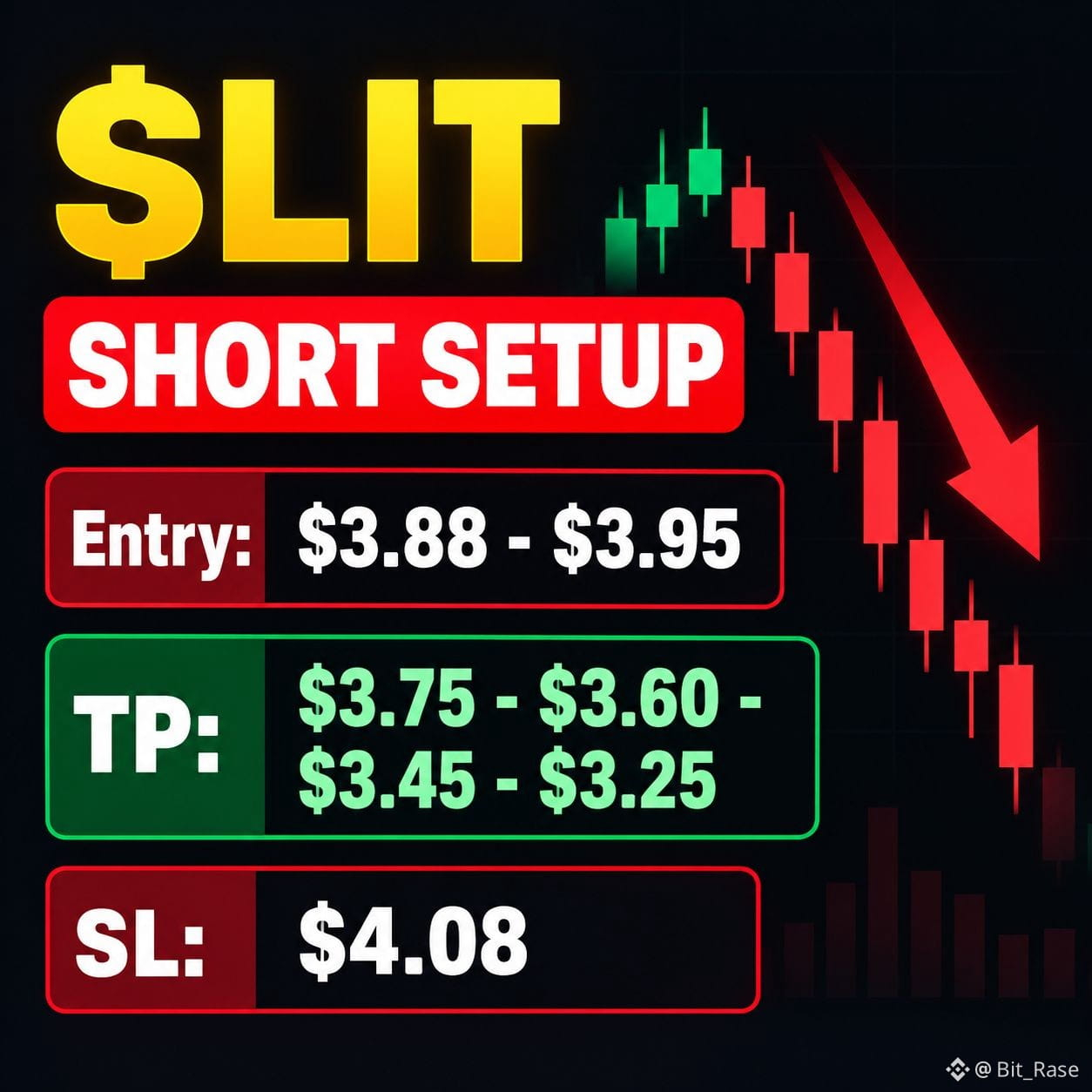
$LIT
{future}(LITUSDT)
LIT is pushing back toward the $3.92 resistance after a sharp rebound, but the rally is stretched and the recent Robinhood setback remains a major overhang.
Short setup.
Entry: $3.88 - $3.95
TP: $3.75 - $3.60 - $3.45 - $3.25
SL: $4.08
$LIT
LIT is pushing back toward the $3.92 resistance after a sharp rebound, but the rally is stretched and the recent Robinhood setback remains a major overhang.
Short setup.
Entry: $3.88 - $3.95
TP: $3.75 - $3.60 - $3.45 - $3.25
SL: $4.08
LIT is pushing back toward the $3.92 resistance after a sharp rebound, but the rally is stretched and the recent Robinhood setback remains a major overhang.
Short setup.
Entry: $3.88 - $3.95
TP: $3.75 - $3.60 - $3.45 - $3.25
SL: $4.08
1
338
·
--
$MOVR
{future}(MOVRUSDT)
MOVR is exploding back above $2.20 with strong momentum. Holding $2.20 could open the next move toward $3.00 after the recent Base migration catalyst.
Long setup.
Entry: $2.20 - $2.30
TP: $2.45 - $2.65 - $2.90 - $3.20
SL: $2.05
$MOVR
MOVR is exploding back above $2.20 with strong momentum. Holding $2.20 could open the next move toward $3.00 after the recent Base migration catalyst.
Long setup.
Entry: $2.20 - $2.30
TP: $2.45 - $2.65 - $2.90 - $3.20
SL: $2.05
MOVR is exploding back above $2.20 with strong momentum. Holding $2.20 could open the next move toward $3.00 after the recent Base migration catalyst.
Long setup.
Entry: $2.20 - $2.30
TP: $2.45 - $2.65 - $2.90 - $3.20
SL: $2.05
2
402
·
--
$ZK
{future}(ZKUSDT)
ZK is holding near $0.013 with technical momentum turning bullish. A clean break above $0.0132 could push the next move toward $0.015–$0.017.
Long setup.
Entry: $0.0127 - $0.0131
TP: $0.0138 - $0.0148 - $0.0160 - $0.0175
SL: $0.0120
$ZK
ZK is holding near $0.013 with technical momentum turning bullish. A clean break above $0.0132 could push the next move toward $0.015–$0.017.
Long setup.
Entry: $0.0127 - $0.0131
TP: $0.0138 - $0.0148 - $0.0160 - $0.0175
SL: $0.0120
ZK is holding near $0.013 with technical momentum turning bullish. A clean break above $0.0132 could push the next move toward $0.015–$0.017.
Long setup.
Entry: $0.0127 - $0.0131
TP: $0.0138 - $0.0148 - $0.0160 - $0.0175
SL: $0.0120
1
301
·
--
Partiellement vrai
$SOXL
{future}(SOXLUSDT)
SOXL is holding above $163 with semiconductor momentum still strong. A break above $168 could open the way toward $175–$200.
Long setup.
Entry: $162 - $168
TP: $175 - $180 - $190 - $200
SL: $150
$SOXL
SOXL is holding above $163 with semiconductor momentum still strong. A break above $168 could open the way toward $175–$200.
Long setup.
Entry: $162 - $168
TP: $175 - $180 - $190 - $200
SL: $150
SOXL is holding above $163 with semiconductor momentum still strong. A break above $168 could open the way toward $175–$200.
Long setup.
Entry: $162 - $168
TP: $175 - $180 - $190 - $200
SL: $150
2
700
·
--
$XAG
{future}(XAGUSDT)
Silver is holding above $61 after reclaiming the $60.7 pivot, with fresh technical data showing a strong-buy bias. A break above $61.75 could extend the recovery toward $63–$64.
Long setup.
Entry: $61.20 - $61.60
TP: $62.20 - $63.00 - $64.00 - $65.00
SL: $60.50
$XAG
Silver is holding above $61 after reclaiming the $60.7 pivot, with fresh technical data showing a strong-buy bias. A break above $61.75 could extend the recovery toward $63–$64.
Long setup.
Entry: $61.20 - $61.60
TP: $62.20 - $63.00 - $64.00 - $65.00
SL: $60.50
Silver is holding above $61 after reclaiming the $60.7 pivot, with fresh technical data showing a strong-buy bias. A break above $61.75 could extend the recovery toward $63–$64.
Long setup.
Entry: $61.20 - $61.60
TP: $62.20 - $63.00 - $64.00 - $65.00
SL: $60.50
2
406
·
--
$GIGGLE
{future}(GIGGLEUSDT)
GIGGLE is holding above $38 with volume rising sharply, while $40 is the next key resistance. The CZ/Giggle Academy catalyst is keeping momentum bullish; a clean break of $40 could accelerate the move.
Long setup.
Entry: $38.40 - $39.20
TP: $40.00 - $42.00 - $45.00 - $48.00
SL: $37.20
$GIGGLE
GIGGLE is holding above $38 with volume rising sharply, while $40 is the next key resistance. The CZ/Giggle Academy catalyst is keeping momentum bullish; a clean break of $40 could accelerate the move.
Long setup.
Entry: $38.40 - $39.20
TP: $40.00 - $42.00 - $45.00 - $48.00
SL: $37.20
GIGGLE is holding above $38 with volume rising sharply, while $40 is the next key resistance. The CZ/Giggle Academy catalyst is keeping momentum bullish; a clean break of $40 could accelerate the move.
Long setup.
Entry: $38.40 - $39.20
TP: $40.00 - $42.00 - $45.00 - $48.00
SL: $37.20
1
531
·
--
$AIN
{future}(AINUSDT)
AIN is up 147% in 24H after breaking sharply above $0.05, but the $0.0626 spike is facing heavy selling. With asks dominating the book, a pullback before another breakout looks likely.
Short setup.
Entry: $0.0585 - $0.0610
TP: $0.0550 - $0.0510 - $0.0470 - $0.0430
SL: $0.0640
$AIN
AIN is up 147% in 24H after breaking sharply above $0.05, but the $0.0626 spike is facing heavy selling. With asks dominating the book, a pullback before another breakout looks likely.
Short setup.
Entry: $0.0585 - $0.0610
TP: $0.0550 - $0.0510 - $0.0470 - $0.0430
SL: $0.0640
AIN is up 147% in 24H after breaking sharply above $0.05, but the $0.0626 spike is facing heavy selling. With asks dominating the book, a pullback before another breakout looks likely.
Short setup.
Entry: $0.0585 - $0.0610
TP: $0.0550 - $0.0510 - $0.0470 - $0.0430
SL: $0.0640
3
504
·
--
$ZRO
{future}(ZROUSDT)
Fresh update: ZRO is up ~15% in 24H and holding above $1.95, keeping the breakout structure bullish. $2.12 is the immediate resistance; a clean break could extend toward $2.20–$2.35.
Long setup.
Entry: $2.00 - $2.06
TP: $2.12 - $2.20 - $2.35 - $2.50
SL: $1.92
$ZRO
Fresh update: ZRO is up ~15% in 24H and holding above $1.95, keeping the breakout structure bullish. $2.12 is the immediate resistance; a clean break could extend toward $2.20–$2.35.
Long setup.
Entry: $2.00 - $2.06
TP: $2.12 - $2.20 - $2.35 - $2.50
SL: $1.92
Fresh update: ZRO is up ~15% in 24H and holding above $1.95, keeping the breakout structure bullish. $2.12 is the immediate resistance; a clean break could extend toward $2.20–$2.35.
Long setup.
Entry: $2.00 - $2.06
TP: $2.12 - $2.20 - $2.35 - $2.50
SL: $1.92
2
267
·
--
$HYPE
{future}(HYPEUSDT)
HYPE is rejecting the $89.17 area with sellers dominating the book, while a major $856M unlock is due October 6. The $90.38 high remains key resistance.
Short setup.
Entry: $89.00 - $89.80
TP: $87.50 - $86.10 - $84.50 - $82.50
SL: $91.00
$HYPE
HYPE is rejecting the $89.17 area with sellers dominating the book, while a major $856M unlock is due October 6. The $90.38 high remains key resistance.
Short setup.
Entry: $89.00 - $89.80
TP: $87.50 - $86.10 - $84.50 - $82.50
SL: $91.00
HYPE is rejecting the $89.17 area with sellers dominating the book, while a major $856M unlock is due October 6. The $90.38 high remains key resistance.
Short setup.
Entry: $89.00 - $89.80
TP: $87.50 - $86.10 - $84.50 - $82.50
SL: $91.00
410
·
--
$PUMP
{future}(PUMPUSDT)
PUMP is holding the $0.00567 support after a sharp pullback, while buybacks remain a bullish catalyst. The next major test is $0.00619, with a $40M unlock scheduled for October 12.
Long setup.
Entry: $0.00565 - $0.00575
TP: $0.00590 - $0.00605 - $0.00620 - $0.00650
SL: $0.00545
$PUMP
PUMP is holding the $0.00567 support after a sharp pullback, while buybacks remain a bullish catalyst. The next major test is $0.00619, with a $40M unlock scheduled for October 12.
Long setup.
Entry: $0.00565 - $0.00575
TP: $0.00590 - $0.00605 - $0.00620 - $0.00650
SL: $0.00545
PUMP is holding the $0.00567 support after a sharp pullback, while buybacks remain a bullish catalyst. The next major test is $0.00619, with a $40M unlock scheduled for October 12.
Long setup.
Entry: $0.00565 - $0.00575
TP: $0.00590 - $0.00605 - $0.00620 - $0.00650
SL: $0.00545
2
530
·
--
$SPCX
{future}(SPCXUSDT)
SPCX is holding near $159 after a 6.3% daily surge, while OI has dropped 13.36% and funding is neutral. Fresh catalysts around AI infrastructure and Starship operations support the rebound, but $160.1 remains the immediate breakout level.
Long setup.
Entry: $158.80 - $159.60
TP: $161.50 - $164.00 - $168.00 - $172.00
SL: $156.80
$SPCX
SPCX is holding near $159 after a 6.3% daily surge, while OI has dropped 13.36% and funding is neutral. Fresh catalysts around AI infrastructure and Starship operations support the rebound, but $160.1 remains the immediate breakout level.
Long setup.
Entry: $158.80 - $159.60
TP: $161.50 - $164.00 - $168.00 - $172.00
SL: $156.80
SPCX is holding near $159 after a 6.3% daily surge, while OI has dropped 13.36% and funding is neutral. Fresh catalysts around AI infrastructure and Starship operations support the rebound, but $160.1 remains the immediate breakout level.
Long setup.
Entry: $158.80 - $159.60
TP: $161.50 - $164.00 - $168.00 - $172.00
SL: $156.80
713
·
--
$CRV CRV is defending the $0.33 area after a sharp sell-off, while RSI has recovered and momentum is turning positive. Long setup.
Entry: $0.334 - $0.342
TP: $0.355 - $0.37 - $0.39 - $0.42
SL: $0.323
$CRV CRV is defending the $0.33 area after a sharp sell-off, while RSI has recovered and momentum is turning positive. Long setup.
Entry: $0.334 - $0.342
TP: $0.355 - $0.37 - $0.39 - $0.42
SL: $0.323
Entry: $0.334 - $0.342
TP: $0.355 - $0.37 - $0.39 - $0.42
SL: $0.323
2
235
·
--
$DASH DASH is under heavy selling after rejecting $73, with price now testing the $61 support zone. Momentum is bearish, but the market is already oversold. Short setup.
Entry: $65.50 - $67.00
TP: $63 - $61 - $58 - $55
SL: $69.20
$DASH DASH is under heavy selling after rejecting $73, with price now testing the $61 support zone. Momentum is bearish, but the market is already oversold. Short setup.
Entry: $65.50 - $67.00
TP: $63 - $61 - $58 - $55
SL: $69.20
Entry: $65.50 - $67.00
TP: $63 - $61 - $58 - $55
SL: $69.20
2
445
·
--
$OG OG is sitting near $2.76 after rejecting the $2.90 area, with $2.80 now the key support. Momentum is mixed, so the setup favors a cautious short.
Entry: $2.82 - $2.90
TP: $2.74 - $2.65 - $2.55 - $2.45
SL: $2.98
$OG OG is sitting near $2.76 after rejecting the $2.90 area, with $2.80 now the key support. Momentum is mixed, so the setup favors a cautious short.
Entry: $2.82 - $2.90
TP: $2.74 - $2.65 - $2.55 - $2.45
SL: $2.98
Entry: $2.82 - $2.90
TP: $2.74 - $2.65 - $2.55 - $2.45
SL: $2.98
3
607
Connectez-vous pour découvrir plus de contenu
Rejoignez la communauté mondiale des adeptes de cryptomonnaies sur Binance Square
⚡️ Suviez les dernières informations importantes sur les cryptomonnaies.
💬 Jugé digne de confiance par la plus grande plateforme d’échange de cryptomonnaies au monde.
👍 Découvrez les connaissances que partagent les créateurs vérifiés.
Adresse e-mail/Nº de téléphone
Sujets d’actualité
BinanceLaunchesBinanceIntelligence
443,638 vues
3,206 mentions
#BinanceLaunchesBinanceIntelligence
⚡ AI Meets Crypto Trading: Binance Intelligence is Live! ⚡
Trading just got a massive upgrade with Binance's new AI suite:
1️⃣ Binance AI: Personalized market dashboards & 4-hour macro market audio briefings.
2️⃣ Binance AI Pro: Build and run automated strategies using simple natural language prompts.
3️⃣ Binance Agent OS: Developer framework for autonomous financial AI agents.
Describe your strategy ➔ Paper test ➔ Execute 24/7.
Are you building your next trading strategy with AI? Drop your thoughts below! 👇
#BinanceLaunchesBinanceIntelligence #BinanceSquare #CryptoAI #Trading $EDEN
Hazi BNB
·2 mentions J’aime
·989 vues
BitcoinTargets2026OpenAt$87570
2,947 vues
83 mentions
BitcoinRejectedAt$87KThirdTime
2,730 vues
67 mentions