



When most traders glance at an order book, they look at the bid-ask spread to judge how liquid a market is. If the gap between the highest bid and lowest ask looks narrow, it feels safe to assume an order will fill smoothly. In practice, though, a tight spread only tells you the cost of trading the very top layer of the book—not what happens when real size hits a thin market.
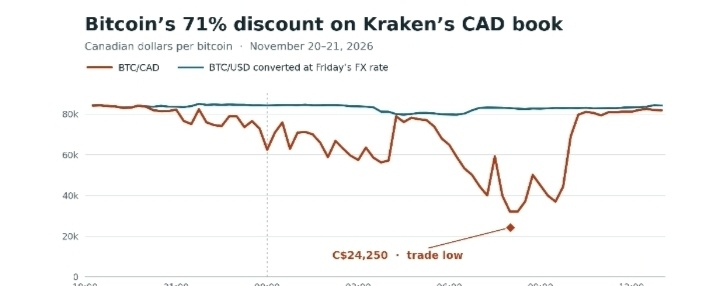
A clear example of this played out between Friday evening and Saturday morning on November 20–21, 2026, on Kraken’s Canadian dollar ($BTC/CAD) market. Over a 14-hour stretch, Bitcoin traded there at an average 37.3% discount compared to a benchmark derived from Kraken’s own US dollar trades.
During that window, 592.24 BTC changed hands on the CAD book at an average price of CA51,886 per coin[span_5](start_span)[span_5](end_span)[span_6](start_span)[span_6](end_span). For context, using the Bank of Canada’s Friday exchange rate, the USD-converted benchmark sat at CA82,798 per coin. At the sharpest point of the sell-off, a trade printed all the way down at C$24,250—a 71% discount against that benchmark.
The mechanics behind a move like this come down to order book depth. If a desk or large seller wants to exit 10 BTC immediately and the best available bid only absorbs a small fraction of that size, the rest of the order has no choice but to walk down the book, clearing progressively lower bids until the full amount is filled.
That slippage can unfold in a fraction of a moment. On Saturday, within a single second on the CAD market, selling 10.42 BTC required 104 separate fills. The very first fill executed at CA31,000 per coin, yet by the time the full 10.42 BTC cleared, the average execution price had dropped to CA25,505—nearly 18% lower than where that one-second trade began.
For anyone trading or managing execution in crypto, it is a solid reminder not to take surface-level quotes at face value. Liquidity on secondary fiat pairs tends to thin out considerably over weekends, and a narrow spread can easily mask how shallow the resting bids actually are. Checking depth beyond the top of the book—and relying on limit orders or staggered execution instead of market-selling size into quiet hours—can save you from taking unnecessary losses when liquidity dries up.