

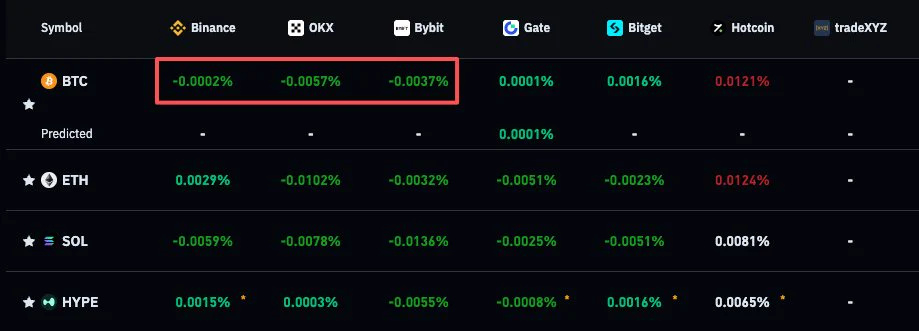
#Bitcoin's derivatives market has undergone a notable shift in positioning following the sharp sell-off on 13 November 2026, with funding rates across major cryptocurrency exchanges turning negative. The development signals a reversal in leveraged market sentiment, as traders increasingly favour short positions following a wave of liquidations that wiped out billions of dollars in leveraged exposure.
The shift was captured in data shared by #coinglass , which showed Bitcoin funding rates moving below zero across several major trading platforms, including #Binance , #OKX and Bybit. This is particularly significant because funding rates had remained predominantly positive for an extended period, reflecting sustained demand for leveraged long positions.
Understanding the Significance of Funding Rates
Funding rates are periodic payments exchanged between traders holding long and short positions in perpetual futures contracts. Unlike traditional futures, perpetual contracts have no expiry date. Exchanges therefore use funding mechanisms to keep their prices aligned with the underlying spot market.
When funding rates are positive, traders holding long positions pay those holding short positions. This generally happens when perpetual futures trade above the spot price, indicating stronger demand for bullish exposure.
Conversely, negative funding rates mean short-position holders pay long-position holders. This typically occurs when perpetual futures trade below the spot price, reflecting stronger demand for bearish exposure or an imbalance in market positioning.
Although funding payments are relatively small individually, they can accumulate significantly over time, particularly for traders using leverage. Consequently, funding rates provide an important indication of how aggressively traders are positioning themselves in the derivatives market.
Bitcoin Funding Rates Flip Negative Across Major Exchanges
The CoinGlass data showed negative Bitcoin funding rates across several leading derivatives platforms:
Binance: Approximately -0.0002%.
OKX: Approximately -0.0057% to -0.006%.
Bybit: Approximately -0.0037%.
Other major cryptocurrencies, including Ethereum and Solana, also recorded mixed or negative funding readings across certain exchanges.
The significance of these figures lies not simply in their negative values, but in the speed and circumstances surrounding the transition. A derivatives market that had previously favoured leveraged buyers was suddenly showing stronger demand for short exposure following a substantial decline in cryptocurrency prices.
The $1.5 Billion Liquidation Cascade Behind the Shift
The change in funding rates coincided with a sharp cryptocurrency market correction on 13 November 2026. Bitcoin declined by approximately 7%, falling towards the $68,000–$68,400 range and reaching its lowest levels in several months. Ethereum and other major digital assets also experienced significant selling pressure.
According to liquidation trackers, approximately $1.3 billion to $1.5 billion in leveraged positions were liquidated across the cryptocurrency market within 24 hours, with long positions accounting for the overwhelming majority.
Several developments contributed to the broader risk-off environment. Hotter-than-expected US inflation data intensified concerns about the Federal Reserve potentially maintaining restrictive monetary policy or considering further interest rate increases. At the same time, weakness in broader risk assets, partly associated with Nvidia-related developments, added to investor caution.
As Bitcoin prices declined, leveraged long positions came under increasing pressure. Traders unable to meet margin requirements faced forced liquidations, creating additional selling pressure and accelerating the downward move.
This liquidation cascade also affected derivatives pricing. As leveraged buyers were forced out of their positions and demand for short exposure increased, perpetual futures prices traded at discounts to spot prices on several exchanges. This contributed to the transition from positive to negative funding rates.
What Negative Funding Rates Mean for the Market
The transition to negative funding rates has several implications for cryptocurrency traders and the broader market.
1. A shift towards bearish positioning
Negative funding indicates that short-position demand has become relatively stronger than long-position demand. It suggests that traders are increasingly defensive, either anticipating further downside or positioning themselves to benefit from continued market weakness.
However, negative funding does not necessarily mean that every trader is bearish. It can also reflect the rapid removal of leveraged long positions following a liquidation event.
2. Long positions begin receiving funding payments
When funding rates turn negative, traders holding long positions receive payments from short-position holders. This creates an incentive for some traders to establish or maintain long positions, particularly those seeking to benefit from funding payments while anticipating a price recovery.
Such positioning can contribute to buying interest during periods of market weakness, although the funding incentive alone is insufficient to guarantee a price reversal.
3. Increasing potential for a short squeeze
One of the more interesting consequences of deeply negative funding is the possibility of a short squeeze.
When short positions become overcrowded, even a relatively modest recovery in Bitcoin's price can force some traders to close their positions. If short sellers begin buying back Bitcoin to limit losses or meet margin requirements, their covering activity can accelerate upward price movements.
This creates the possibility of a sharp recovery even when broader market sentiment remains cautious.
Historically, periods of deeply negative funding have sometimes preceded short squeezes and temporary market recoveries. However, negative funding is not a reliable standalone indicator of an imminent bottom.
4. A potential reduction in liquidation-driven selling pressure
The large number of long liquidations suggests that a substantial amount of excessive bullish leverage has already been removed from the market.
This matters because forced selling from leveraged traders can create self-reinforcing downward movements. Once those positions have been liquidated, one source of immediate selling pressure may diminish.
If spot-market demand stabilises, the combination of reduced long-side leverage and growing short exposure could create conditions for a recovery.
What Traders Should Watch Next
The critical question is whether negative funding rates persist and whether Bitcoin can stabilise around the levels reached during the sell-off.
A sustained period of negative funding, accompanied by stabilising spot prices and declining open interest, could suggest that excessive leverage is being flushed out of the market.
Conversely, if Bitcoin continues declining while open interest and short positioning increase, it could indicate that bearish momentum remains dominant rather than signalling an exhausted sell-off.
Traders should therefore monitor funding rates alongside open interest, liquidation volumes, spot trading activity and exchange-specific perpetual futures premiums or discounts. These indicators provide a more complete picture of whether the market is undergoing a temporary leverage reset or entering a deeper bearish phase.
Conclusion
The negative funding rates highlighted by CoinGlass represent an important development in Bitcoin's derivatives market. Following an extended period of predominantly positive funding, the sharp sell-off on 13 November triggered extensive long liquidations and shifted derivatives positioning towards bearish exposure.
While the development confirms a deterioration in leveraged market sentiment, it also introduces the possibility of a different market dynamic. With excessive long leverage being cleared and short positions becoming increasingly dominant, Bitcoin could become vulnerable to a short squeeze if spot demand returns and prices begin to recover.
The important distinction is that negative funding does not automatically signal a market bottom. Rather, it indicates that the balance of leveraged positioning has changed. Whether this becomes the foundation for a recovery or an early indication of further downside will depend on how spot prices, open interest and funding rates evolve in the sessions ahead.