

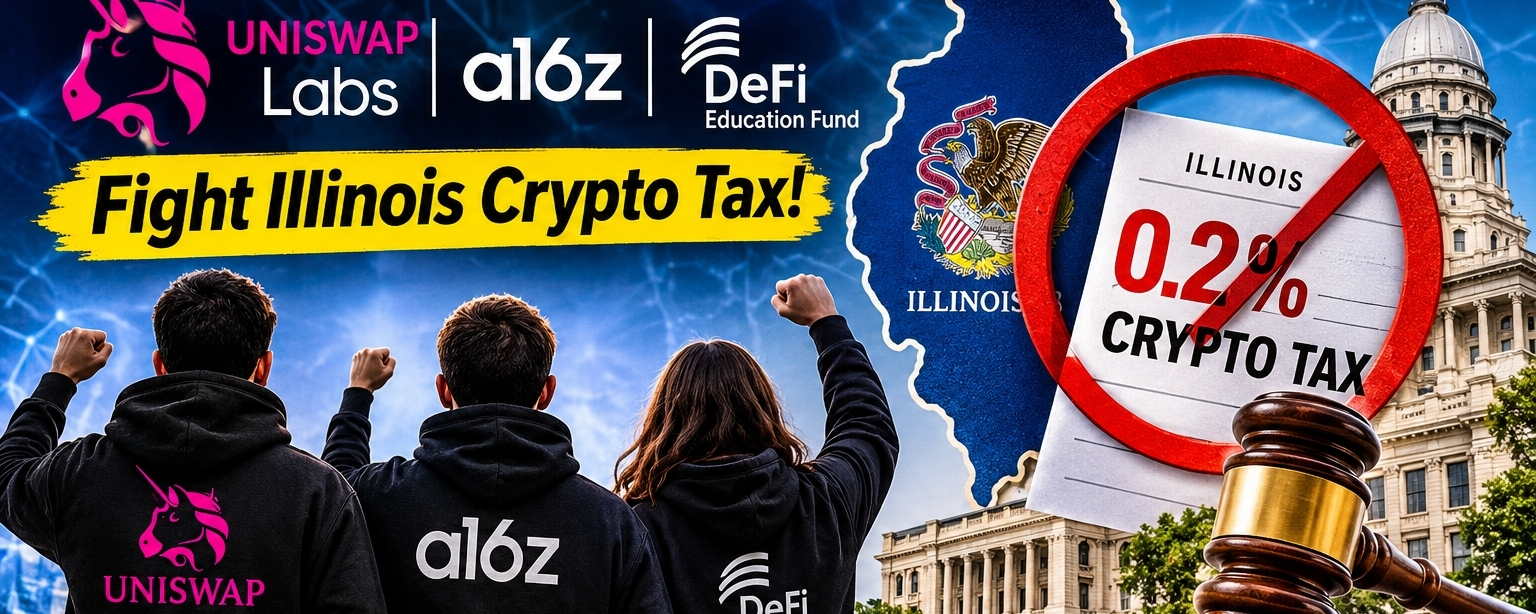

#UniswapA16zSeekDeFiExemptionFromIllinoisCryptoTax
Illinois has stirred up a major debate in the crypto world 🌐. Its proposed **0.2% digital asset tax** has sparked concern across the industry, and now some of the biggest names in the space are fighting back 💪. **Uniswap Labs**, **a16z**, and the **DeFi Education Fund** have joined forces to challenge the proposed framework, arguing that it could harm innovation, user privacy, and the future of decentralized finance 🔓.
## 📌 What Is Happening?
Illinois has put forward a crypto tax framework that would bring digital assets under a new tax structure 🏛️. The headline number is a **0.2% tax on digital assets** 💰. On paper this looks small, but critics say the real problem is not the rate. It is the **scope** and the **way the rules are written** ⚠️.
Uniswap Labs, a16z, and the DeFi Education Fund believe the framework fails to understand how decentralized technology actually works 🧠. Traditional finance has banks, brokers, and intermediaries that can collect and report taxes. DeFi has **no central operator** 🤖. Smart contracts run on their own, and users stay in control of their own funds.
## 🔹 Key Demand #1: Exempt DeFi Protocols and Front-End Interfaces
The first and most important demand is that **DeFi protocols and front-end interfaces** be taken out of the tax scope 🛑.
Here is why this matters:
- 🔸 DeFi protocols are **open-source software**, not financial companies
- 🔸 Front-end interfaces are simply **websites that let users interact** with smart contracts
- 🔸 Making these tools responsible for tax collection could push developers out of Illinois, or out of building altogether 🚪
If a software developer is treated like a tax collector, the result could be a chilling effect on innovation 🥶. Many builders may decide the legal risk is simply not worth it.
## 🔹 Key Demand #2: Exclude Self-Custody Withdrawals and Cross-Chain Bridges
The second demand is that **self-custody wallet withdrawals** and **cross-chain bridges** should not be treated as taxable events based on asset value 🌉.
Let's break this down:
- 👛 **Self-custody wallet withdrawals:** Moving your own crypto from an exchange to your own wallet is not a sale or a profit. You still own the same assets. Taxing it would be like taxing a person for moving money from one pocket to another.
- 🌉 **Cross-chain bridges:** Bridges let users move assets between blockchains, such as from Ethereum to another network. This is a technical transfer, not a change in ownership or value.
Taxing these activities could punish users for simply **using crypto the way it was designed to be used** 😤. It could also discourage people from taking self-custody, which is one of the core principles of crypto: *"not your keys, not your coins"* 🔑.
## 🔹 Key Demand #3: Remove Private-Key Recordkeeping Requirements
The third demand may be the most controversial. The coalition wants Illinois to **remove private-key recordkeeping requirements** 🔐.
This is a serious concern for several reasons:
- 🔸 Private keys are the **ultimate proof of ownership** in crypto
- 🔸 Forcing users or platforms to keep records tied to private keys creates **major security risks** 🚨
- 🔸 Any database holding such information becomes an **attractive target for hackers** 🕵️
- 🔸 It goes against the basic privacy and security model of blockchain technology
In simple terms, nobody should be required to store or document the one thing that protects their entire wealth 🛡️.
## ⚖️ The Bigger Question: Can Regulators Tax Decentralized Activity?
Beyond the specific demands lies a much larger question 🤔: **Can regulators tax decentralized activity without creating unnecessary barriers for users and developers?**
Governments have every right to collect taxes on real profits and income 🏦. Nobody in the industry disputes that. The real challenge is that DeFi does not fit neatly into the old financial system. There is no CEO, no headquarters, and often no single entity to hold accountable 🌍.
If regulators apply old rules to new technology without adjustment, they risk three outcomes:
- ❌ Driving innovation and talent to other states and countries
- ❌ Creating confusion for ordinary users who just want to follow the rules
- ❌ Weakening privacy and security for everyone
## 📈 Why This Matters for the Wider Crypto Market
This fight is not just about Illinois 👀. Other states and countries are watching closely. If Illinois moves forward with a broad framework, it could become a **template for other regions** 📋. On the other hand, if the industry succeeds in winning meaningful exemptions, it could set a **positive precedent** for how DeFi is treated worldwide 🌟.
For traders and investors, this is a story worth following 📊. Tax rules directly affect trading volume, liquidity, and the willingness of users to interact with DeFi platforms. Heavy rules can reduce activity, while clear and fair rules can bring in more users and institutions 🏦✨.
## 🎯 Final Thoughts
The push from **Uniswap Labs, a16z, and the DeFi Education Fund** shows that the crypto industry is no longer staying quiet when regulation threatens its core principles 🗣️. Their message is clear: **tax the profits, not the technology** ✅.
Will this fight protect DeFi innovation, or will it bring stricter crypto regulation? 🤷 Only time will tell. One thing is certain: the outcome in Illinois could shape how the world treats decentralized finance for years to come 🔮.
Stay tuned for updates, and always do your own research before making any financial decision 📚.
---
## 🏷️
#Uniswap #DeFi #CryptoTax #a16z #Illinois
#SwitzerlandFirstSpotBitcoinETFExpectedToTradeInNovember #BinanceWillListPredictPREDICT #StrategySTRCReaches$99.95ForFirstTimeIn165Days #USMidtermElections