


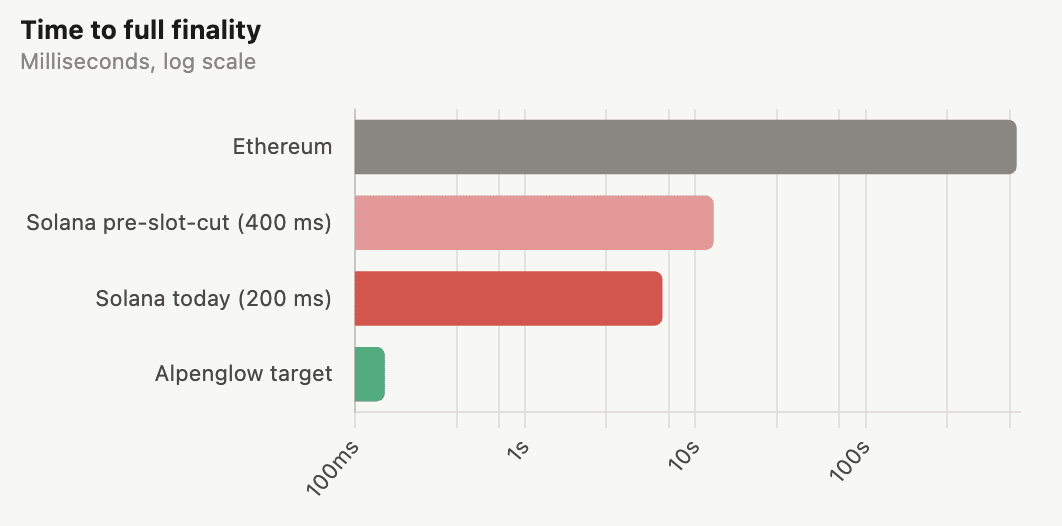
Solana is set to activate Alpenglow today, Wednesday, October 21. It is the network’s largest consensus change since mainnet launched in 2020, and it targets full transaction finality of about 150 milliseconds, down from roughly 6.4 seconds. The feature turns on at the start of epoch 1064. Consensus hands over about 18 minutes later, at slot 459,653,000.
Votes moved off the chain
Under TowerBFT, the system Solana has run since 2020, validators vote by submitting transactions to the chain. A block becomes final once enough of those votes accumulate over 32 slots. Alpenglow’s first phase, called Votor, has validators exchange votes directly and aggregate them into BLS certificates.
A block finalizes in one round if 80% of stake votes for it. Otherwise it takes a second round at 60% thresholds. Proof of History stops pacing block production once the migration completes.
According to Galaxy Digital, vote transactions have made up roughly three quarters of everything the network processes. Solana’s reported transaction counts will therefore drop sharply with no fall in real activity. Robin Nordnes, CEO and founder of trading infrastructure firm Raiku, told CoinDesk the trading activity is all still there.
A 40-fold finality cut on paper
Recent slot-time cuts already halved the wait for full finality, from 12.8 seconds to about 6.4 seconds. Alpenglow’s 150ms target would cut that by a further factor of about 40. For comparison, Ethereum takes roughly 13 minutes to reach full finality.
The Solana Foundation describes 150ms as an expectation rather than a constant. It will vary with stake distribution and with whether a block clears in one round or two, and it has not yet been measured on mainnet.
The change users notice may be smaller than the headline ratio suggests. Most applications already act on Solana’s optimistic “confirmed” status, which arrives in about one slot. What changes is that the irreversible guarantee now arrives at roughly the same speed, which matters most to exchanges and payment apps that wait for full finality before crediting deposits. Nordnes said faster finality was never the main bottleneck for trading desks; being close to where blocks are built still is.
Validator voting costs back below pre-cut levels
Under TowerBFT, validators pay a fee on every vote, once per slot. The cut to 200ms slots, completed on October 9, roughly doubled that bill per day to about 2 SOL.
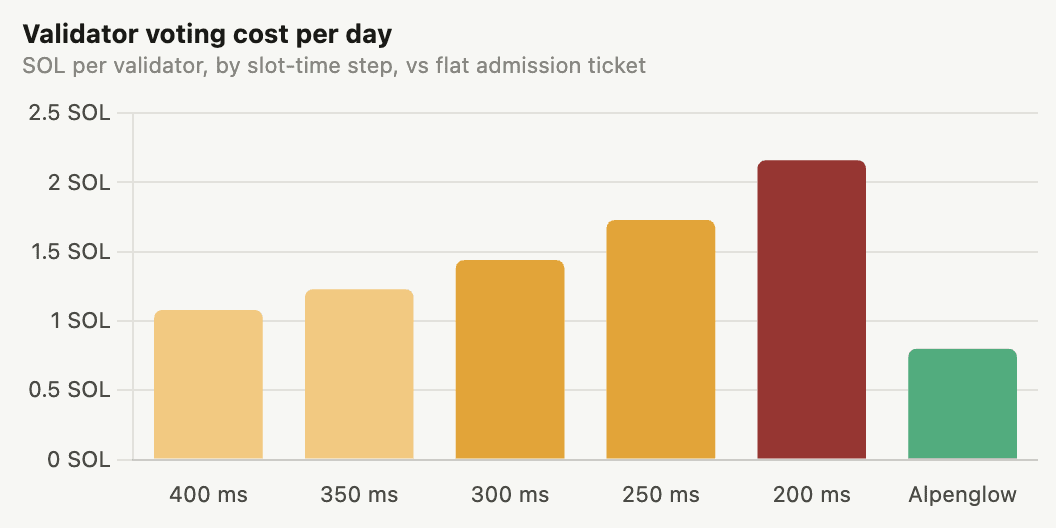
Alpenglow replaces per-vote fees with a validator admission ticket of 0.8 SOL per epoch, which is about 24 hours at current slot times. The ticket is charged to the vote account and burned in full. It is about 60% below current gross voting costs.
The net saving is smaller. Half of each vote fee previously went to the block leader, so validators that produce many blocks lose that income. Galaxy notes the net effect depends on each validator’s block production.
More tolerance for downtime, less for malice
Alpenglow is built to keep running with up to 20% of stake acting maliciously plus a further 20% offline. That is a 40% combined budget, against 33% under TowerBFT. The share that can be actively hostile, however, falls from 33% to 20%.
Galaxy says the designers accepted this because Solana’s past outages came from bugs, congestion and correlated crashes rather than coordinated attacks. Slashing for double-voting is defined but not switched on in this first iteration.
A bumpy road through the test cluster
The community test cluster launched in early May with about 50 operators and has grown to roughly 100 validators. Galaxy Digital joined in June. Since then the cluster has been wiped and restarted six times, and one migration attempt failed network-wide and was rolled back before a later attempt succeeded. No real funds were at risk.
Alpenglow activated on Solana’s testnet on September 24 and on devnet the following day. During the migration, validators must run an Agave-based client: Agave, Jito-Solana or Harmonic Salsa. Firedancer and Frankendancer are not supported for the switch.
Activation timing and what comes next
The Solana Foundation estimates epoch 1064 starts around 13:20 UTC, while Anza has pointed to about 14:50 UTC. Epoch timing drifts with slot speed. The network will confirm the handover through a new RPC call that returns Alpenglow’s genesis certificate.
Rotor, a second phase that replaces Turbine’s block propagation with a single relay layer, is planned for a later release and is not yet scheduled.