

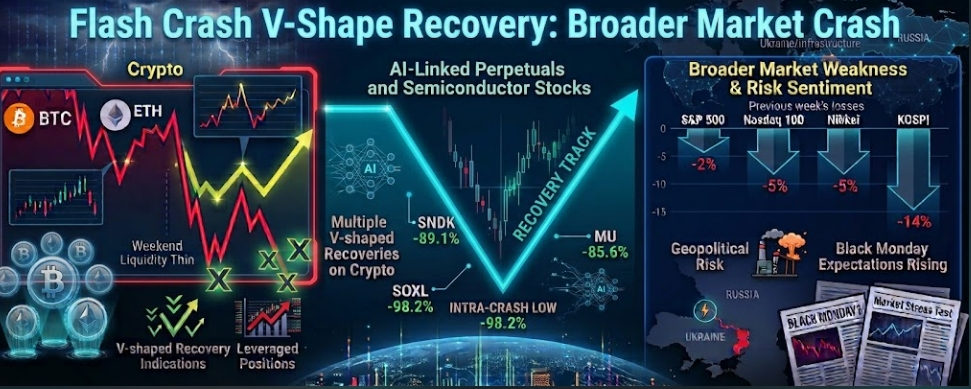


I’m paying more attention to the latest weekend selloff because the move wasn’t limited to crypto. Bitcoin and Ethereum suddenly dropped, while several perpetual contracts linked to AI and semiconductor stocks also experienced sharp declines before recovering.
That makes the episode more interesting than a routine crypto liquidation. The move happened against a backdrop of already-fragile risk sentiment, with investors increasingly discussing the possibility of a difficult Monday session.
For now, I see it as a warning about market positioning and weekend liquidity rather than confirmation that a major breakdown is already underway.
The Move Was Broader Than Crypto
The previous trading week had already left risk assets under pressure.
The S&P 500 lost around 2%, while the Nasdaq 100 and Nikkei fell roughly 5%. The KOSPI experienced an even sharper decline of nearly 14%.
Then, during the weekend, several perpetual contracts tied to AI and semiconductor stocks suddenly dropped. SOXL fell about 5.45%, SNDK around 3.6%, and MU roughly 3.42% in the cited moves.
What caught my attention was the speed of the reversal. Much of the decline was recovered quickly, but leveraged positions had already been liquidated during the brief period of extreme volatility.
That is a useful reminder that thin weekend liquidity can exaggerate relatively small changes in positioning.
Bitcoin and Ethereum Experienced a Similar Shakeout
Crypto saw its own version of the move.
Bitcoin briefly lost around $1,000 before recovering approximately $1,200. Ethereum experienced an even more noticeable intraday swing, dropping from roughly $2,420 to $2,360 before recovering toward $2,410.
I wouldn’t interpret that sequence as a clean directional signal yet.
When an asset drops sharply and immediately recovers a large portion of the move, I want to know whether the selling represented genuine spot distribution or simply leveraged positions being forced out.
At this stage, the latter appears to be an important part of the explanation.
Why Weekend Liquidity Matters
There is a structural reason these moves can become so violent.
Traditional financial markets are largely closed over the weekend, while crypto continues trading around the clock. That means liquidity can be thinner precisely when global news or positioning changes.
In a highly leveraged market, a relatively small price movement can trigger liquidations. Those liquidations create additional selling, which pushes the price lower and potentially triggers another wave.
The result can look dramatic on a chart even when the underlying market hasn't experienced an equally dramatic change in fundamental value.
“Black Monday” Expectations Are Rising
The sharp decline has also revived speculation about a potential “Black Monday.”
I’m cautious with that narrative.
After a difficult week, it is natural for traders to extrapolate the weakness into the next session. But extreme consensus can become its own positioning signal. If too many participants prepare for the same outcome, the market can eventually move in the opposite direction when those expectations fail to materialize.
That doesn’t mean a Monday rebound is guaranteed. It simply means the headline itself isn't enough to establish a trading thesis.
Geopolitical Risk Adds Another Layer
The volatility also coincided with another escalation in the Russia-Ukraine conflict.
Reports indicated that Ukraine targeted an oil port in St. Petersburg, following renewed tensions around attacks on energy infrastructure. This came after reported discussions between the two sides about avoiding strikes on energy facilities.
Geopolitical developments can influence markets through several channels, particularly energy prices, inflation expectations and overall risk appetite.
I wouldn’t claim that the geopolitical news directly caused the crypto flash crash without stronger evidence. The timing is notable, but correlation alone doesn't establish the mechanism.
What I’m Watching Next
For me, the key question is whether the weekend move survives into regular trading hours.
If Bitcoin and Ethereum maintain their recovered levels once broader markets reopen, the flash crash may prove to have been largely a liquidity and leverage event.
If selling returns across equities, crypto and other risk assets simultaneously, then the move becomes more significant. That would suggest the market is repricing broader macro and geopolitical risk rather than simply clearing leveraged positions.
I’m also watching liquidation activity and open interest. A sharp decline in open interest alongside stabilization in price would tell a different story from continued selling accompanied by aggressive new short positioning.
My Takeaway
The weekend selloff looks significant because multiple risk-sensitive markets experienced sudden volatility at roughly the same time.
Bitcoin and Ethereum recovered quickly after their initial drops, while AI and semiconductor-linked perpetuals also bounced from their lows. That makes me reluctant to label the move as the beginning of a new bear leg.
At the same time, the broader backdrop remains fragile. Weak equity performance, geopolitical uncertainty and heavy leverage can create conditions where relatively small catalysts produce outsized price movements.
For now, I’m treating this as a market stress test. The real information will come when liquidity returns and we see whether buyers can absorb the selling without another cascade.
#ElSalvadorBitcoinHoldingsSurpass7800BTC #USPPIRises6.3%YearOverYear #CelestiaRises16%To2026High #Ethereum


