

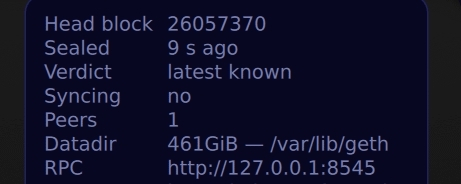


Ethereum is testing whether Glamsterdam can push Sepolia’s gas limit from 60M to 200M without compromising validator performance.
The 3.3× capacity jump could materially expand @ethereum’s L1 execution headroom for DeFi and stablecoin activity.
Here’s how $ETH is engineering the capacity jump.
— — —
► Ethereum needs more block capacity
Ethereum has steadily raised its gas limit from 30M in 2021 to 60M in 2025, rather than making one abrupt capacity jump.
Now, Glamsterdam is testing 60M → 200M, a 3.33× increase in available block capacity.
But 200M gas ≠ 3.33× TPS.
Gas measures computational work, while actual throughput depends on execution complexity, state access, propagation, demand, and validator hardware. Block time remains 12 seconds.
— — —
► Why not simply increase the gas limit?
Larger blocks increase the load on validators, bandwidth, CPUs, storage, and block propagation.
At 200M gas:
• Old state pricing → ~380 GiB/year of state growth
• New approach → ~120 GiB/year target
That is why Glamsterdam combines higher capacity with parallel execution and better state economics.
— — —
► ePBS: improve block production and propagation
EIP-7732 moves proposer-builder separation into Ethereum’s protocol, reducing reliance on external MEV-Boost relays.
Builder commits → proposer selects → payload revealed
• Propagation window: ~2s → ~9s
• Payload Timeliness Committee verifies timely payload reveal
This gives validators more time to handle larger blocks as Ethereum increases capacity.
— — —
► Block-Level Access Lists: parallelizing execution
EIP-7928 lets blocks include the accounts, storage slots, and state changes touched by transactions.
This enables:
• Parallel disk reads
• Parallel execution of non-conflicting transactions
• Cheaper state-root computation
200M gas creates more work, while BALs help process that work in parallel, making larger blocks more practical.
— — —
► State repricing: making higher capacity sustainable
Higher block capacity means more state-changing activity, increasing the long-term burden on Ethereum nodes.
State repricing separates the cost of creating new state from using existing state:
• Existing-account transfers can become up to ~71% cheaper
• New accounts and storage become more expensive
This makes persistent state growth more economically sustainable.
— — —
► Why the Prysm update matters
Prysm v7.2.1 was released just before the Sepolia test because the previous version still defaulted to a 60M gas limit.
• Prysm 7.2.0 → 60M default
• Prysm 7.2.1 → 200M scheduled default
• Teku 26.9.1 → 60M default
Without the update, validators could have continued proposing smaller blocks and weakened the 200M capacity test.
— — —
► devnet-11 already showed an early signal
Before Sepolia, Ethereum tested the BAL path on devnet-11.
• 2,302 BAL performance tests passed
• 570.7B gas processed in 3m 15s
• ~2.9B gas/s execution throughput
• Gas limit moved from 60M → 200M without loss of finality
However, 2.9B gas/s measures client execution throughput, not TPS.
— — —
► The biggest operational risk: fake builders
Under ePBS, builders bid → win the slot → reveal the payload.
On Sepolia, attackers can create multiple builder identities, win slots with aggressive bids, and withhold the payload.
This empty-payload griefing could disrupt the public rehearsal and interfere with testing the new builder pipeline.
Client-side builder identity rejection was proposed as a mitigation.
— — —
The real test is whether Ethereum can scale L1 capacity without pushing validators beyond practical hardware limits.
Glamsterdam is attacking that constraint through parallel execution, better block propagation, and sustainable state economics.
If Sepolia holds at 200M gas, Ethereum gets a stronger case for materially higher L1 capacity.