

Tahir_泰希尔
633 Publications

Tahir_泰希尔
Signaler
Bloquer l’utilisateur
💎 No hype. Just conviction. Learn, Grow, Build 🚀 Patience is the edge 🔥 X Tahir_Shafi7
125 Suivis
9.9K+ Abonnés
3.5K+ J’aime
Publications
Tous
Citations
Direct
PINNED
·
--
🐕 DOGE is more than just a meme.
Dogecoin has built one of the strongest communities in crypto, survived multiple market cycles, and remains one of the most recognized crypto brands worldwide.
The real question isn’t whether DOGE started as a joke…
It’s whether its community, liquidity, adoption, and brand can keep DOGE relevant for the next cycle. 🚀
Meme origins. Real market impact. 🐕💎
#DOGE #Dogecoin #Crypto #Bitcoin #Altcoins
🐕 DOGE is more than just a meme.
Dogecoin has built one of the strongest communities in crypto, survived multiple market cycles, and remains one of the most recognized crypto brands worldwide.
The real question isn’t whether DOGE started as a joke…
It’s whether its community, liquidity, adoption, and brand can keep DOGE relevant for the next cycle. 🚀
Meme origins. Real market impact. 🐕💎
#DOGE #Dogecoin #Crypto #Bitcoin #Altcoins
Dogecoin has built one of the strongest communities in crypto, survived multiple market cycles, and remains one of the most recognized crypto brands worldwide.
The real question isn’t whether DOGE started as a joke…
It’s whether its community, liquidity, adoption, and brand can keep DOGE relevant for the next cycle. 🚀
Meme origins. Real market impact. 🐕💎
#DOGE #Dogecoin #Crypto #Bitcoin #Altcoins

2.3k
35
134
2.3k
·
--
#fedratewatch September FOMC: I’m checking the bond market first.
A 25bp hike is my working expectation after August core CPI rose 0.3% month over month. The uncertainty is how much more tightening officials think the economy needs.
I’d start with Treasury yields and the dollar. If both climb after the press conference, I’d become more cautious about BTC, altcoins and tech stocks.
If yields fall despite a hike, I’d ask why. Less aggressive policy expectations could help markets recover. Growing recession fears would tell a different story.
Gold deserves that distinction too. Higher real yields can pressure it, while demand for protection can support it. A gold rally alongside falling stocks wouldn’t surprise me.
Oil could struggle on weaker demand expectations, although supply disruptions could outweigh that pressure.
I wouldn’t declare a prolonged hiking cycle yet. Persistent inflation could justify more increases; cooling prices and weaker employment could support a pause.
For a possible BTC long, I’d want reclaimed resistance to hold as support. If it fails, I’d drop the setup. Position size would depend on the loss I can accept.
I can live with missing the first few minutes.
What would you check first: yields, the dollar, or BTC?
#FedRateWatch #BTC #XAU
#fedratewatch September FOMC: I’m checking the bond market first.
A 25bp hike is my working expectation after August core CPI rose 0.3% month over month. The uncertainty is how much more tightening officials think the economy needs.
I’d start with Treasury yields and the dollar. If both climb after the press conference, I’d become more cautious about BTC, altcoins and tech stocks.
If yields fall despite a hike, I’d ask why. Less aggressive policy expectations could help markets recover. Growing recession fears would tell a different story.
Gold deserves that distinction too. Higher real yields can pressure it, while demand for protection can support it. A gold rally alongside falling stocks wouldn’t surprise me.
Oil could struggle on weaker demand expectations, although supply disruptions could outweigh that pressure.
I wouldn’t declare a prolonged hiking cycle yet. Persistent inflation could justify more increases; cooling prices and weaker employment could support a pause.
For a possible BTC long, I’d want reclaimed resistance to hold as support. If it fails, I’d drop the setup. Position size would depend on the loss I can accept.
I can live with missing the first few minutes.
What would you check first: yields, the dollar, or BTC?
#FedRateWatch #BTC #XAU
A 25bp hike is my working expectation after August core CPI rose 0.3% month over month. The uncertainty is how much more tightening officials think the economy needs.
I’d start with Treasury yields and the dollar. If both climb after the press conference, I’d become more cautious about BTC, altcoins and tech stocks.
If yields fall despite a hike, I’d ask why. Less aggressive policy expectations could help markets recover. Growing recession fears would tell a different story.
Gold deserves that distinction too. Higher real yields can pressure it, while demand for protection can support it. A gold rally alongside falling stocks wouldn’t surprise me.
Oil could struggle on weaker demand expectations, although supply disruptions could outweigh that pressure.
I wouldn’t declare a prolonged hiking cycle yet. Persistent inflation could justify more increases; cooling prices and weaker employment could support a pause.
For a possible BTC long, I’d want reclaimed resistance to hold as support. If it fails, I’d drop the setup. Position size would depend on the loss I can accept.
I can live with missing the first few minutes.
What would you check first: yields, the dollar, or BTC?
#FedRateWatch #BTC #XAU

10
5
29
2.6k
·
--
Vérifié
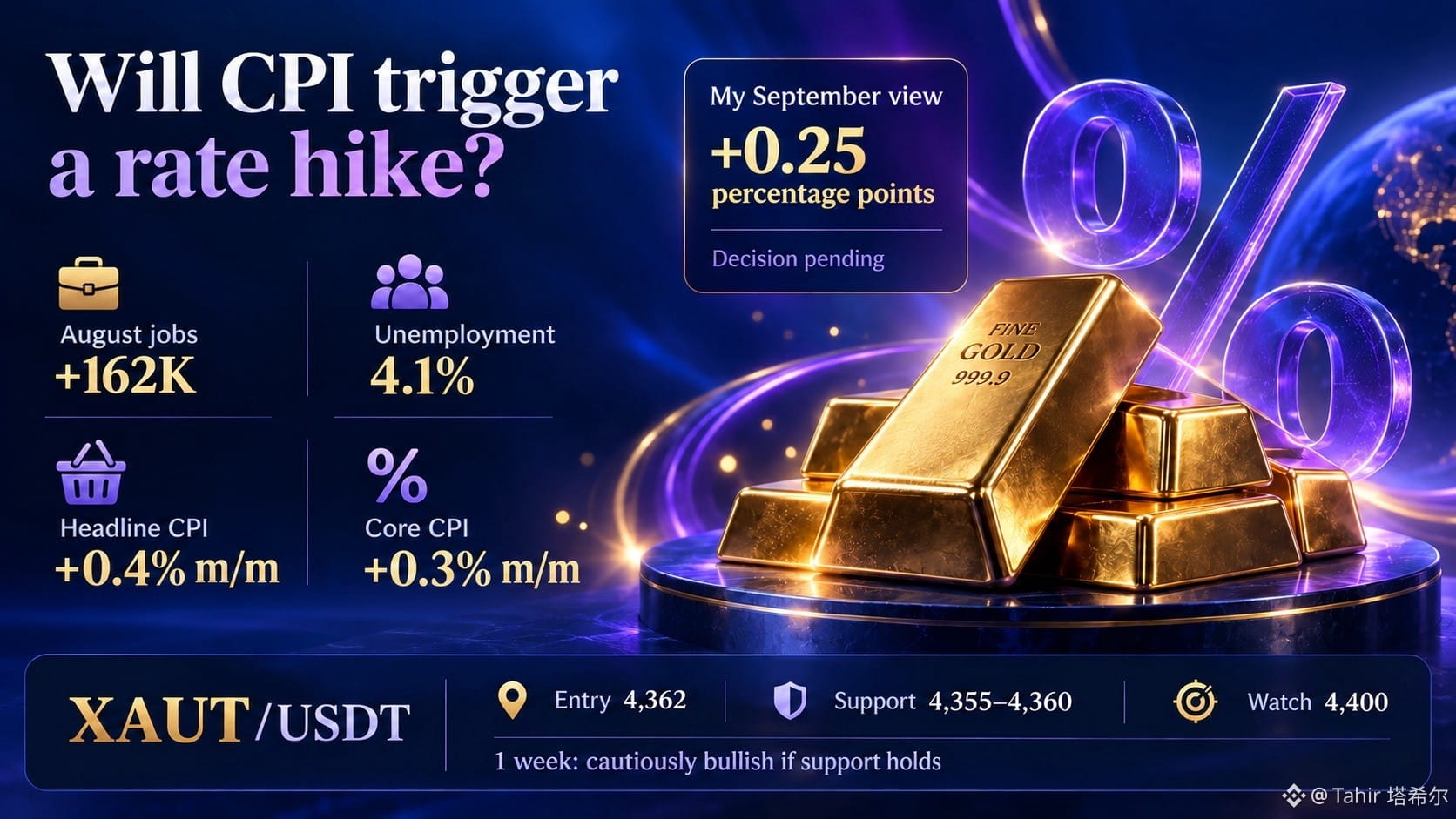
Will CPI Trigger a Rate Hike?
I think the Fed is more likely to raise rates by 0.25 percentage points in September. That’s my reading of the data. We still have to wait for the actual decision.
August added 162,000 jobs against a Reuters forecast of 55,000, with unemployment at 4.1%. That gives the Fed some room to deal with inflation.
CPI rose 0.4% for the month and 3.4% over the year. Core CPI was up 0.3% monthly, although the annual figure eased to 2.4%. There’s some progress there, but monthly inflation is picking up again.
I’m holding XAUT/USDT from 4,362 USDT. The move back from 4,400 looks like a pullback to me. I’m cautiously bullish for the next week if buyers defend 4,355–4,360. I’m holding for another attempt at 4,400.
The risk I’m watching is a stronger dollar alongside higher real bond yields. Gold pays no interest, so rising yields can make bonds more attractive and put pressure on my gold position.
If price stays below 4,355, I’d have to rethink the rebound. Clear signs of weaker hiring and cooling inflation would also make me reconsider the hike call.
#CPIWatch
Will CPI Trigger a Rate Hike?
I think the Fed is more likely to raise rates by 0.25 percentage points in September. That’s my reading of the data. We still have to wait for the actual decision.
August added 162,000 jobs against a Reuters forecast of 55,000, with unemployment at 4.1%. That gives the Fed some room to deal with inflation.
CPI rose 0.4% for the month and 3.4% over the year. Core CPI was up 0.3% monthly, although the annual figure eased to 2.4%. There’s some progress there, but monthly inflation is picking up again.
I’m holding XAUT/USDT from 4,362 USDT. The move back from 4,400 looks like a pullback to me. I’m cautiously bullish for the next week if buyers defend 4,355–4,360. I’m holding for another attempt at 4,400.
The risk I’m watching is a stronger dollar alongside higher real bond yields. Gold pays no interest, so rising yields can make bonds more attractive and put pressure on my gold position.
If price stays below 4,355, I’d have to rethink the rebound. Clear signs of weaker hiring and cooling inflation would also make me reconsider the hike call.
#CPIWatch
I think the Fed is more likely to raise rates by 0.25 percentage points in September. That’s my reading of the data. We still have to wait for the actual decision.
August added 162,000 jobs against a Reuters forecast of 55,000, with unemployment at 4.1%. That gives the Fed some room to deal with inflation.
CPI rose 0.4% for the month and 3.4% over the year. Core CPI was up 0.3% monthly, although the annual figure eased to 2.4%. There’s some progress there, but monthly inflation is picking up again.
I’m holding XAUT/USDT from 4,362 USDT. The move back from 4,400 looks like a pullback to me. I’m cautiously bullish for the next week if buyers defend 4,355–4,360. I’m holding for another attempt at 4,400.
The risk I’m watching is a stronger dollar alongside higher real bond yields. Gold pays no interest, so rising yields can make bonds more attractive and put pressure on my gold position.
If price stays below 4,355, I’d have to rethink the rebound. Clear signs of weaker hiring and cooling inflation would also make me reconsider the hike call.
#CPIWatch
10
2
30
4.7k
·
--
🎁🔥 BNB GIVEAWAY — CLAIM YOUR REWARD! 🔥🎁
💰 BNB rewards are waiting for lucky participants!
✅ Follow
✅ Like ❤️
✅ Comment “BNB”
✅ Share 🔄
🎯 Claim your chance to win BNB!
Good luck everyone! 🚀💛
#BNB #Giveaway #Claim #Crypto #Binance
🎁🔥 BNB GIVEAWAY — CLAIM YOUR REWARD! 🔥🎁
💰 BNB rewards are waiting for lucky participants!
✅ Follow
✅ Like ❤️
✅ Comment “BNB”
✅ Share 🔄
🎯 Claim your chance to win BNB!
Good luck everyone! 🚀💛
#BNB #Giveaway #Claim #Crypto #Binance
💰 BNB rewards are waiting for lucky participants!
✅ Follow
✅ Like ❤️
✅ Comment “BNB”
✅ Share 🔄
🎯 Claim your chance to win BNB!
Good luck everyone! 🚀💛
#BNB #Giveaway #Claim #Crypto #Binance

4.3k
74
297
4.3k
·
--
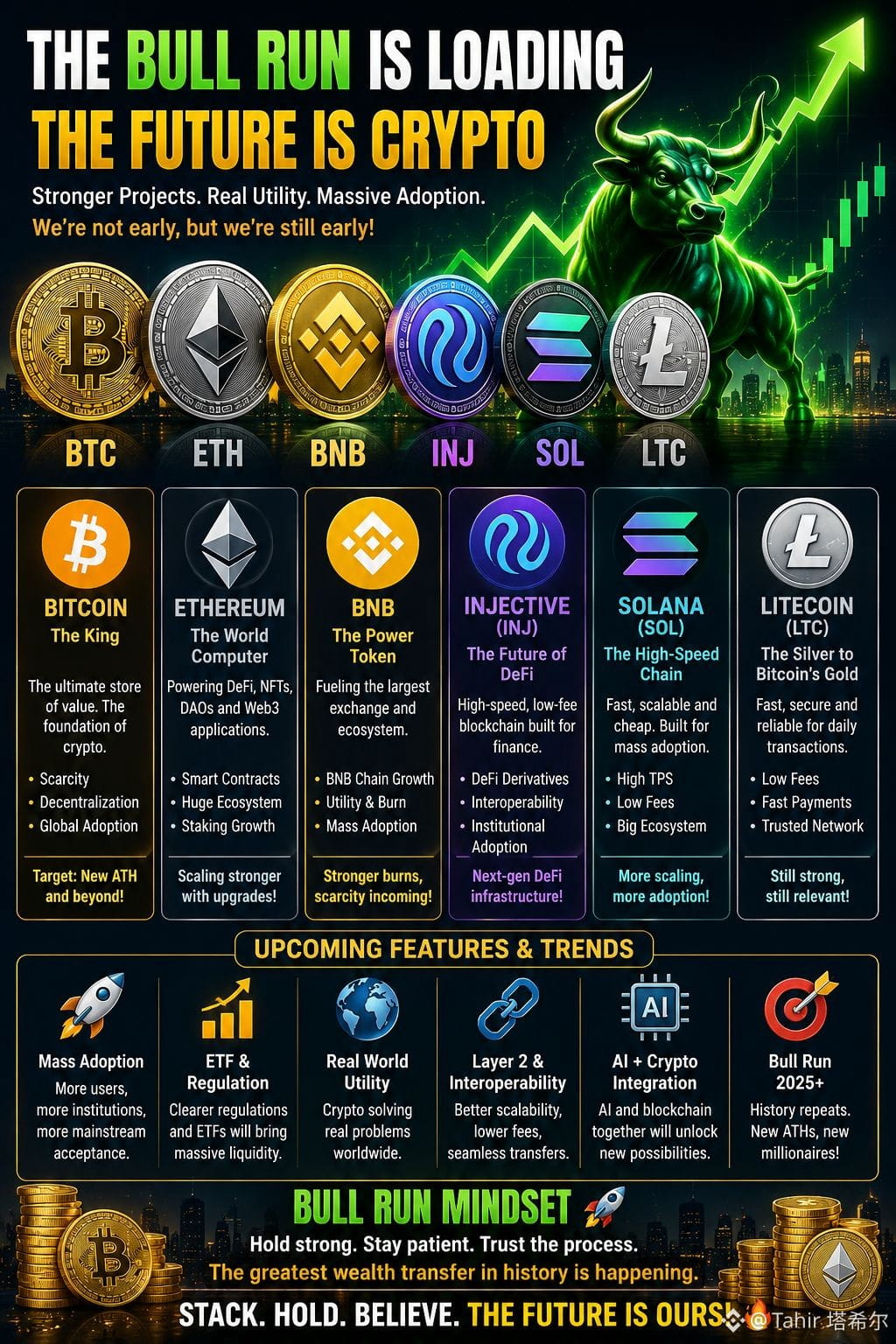
🚀 CRYPTO BULL RUN: THE NEXT BIG MOVE? 🐂🔥
The crypto market is evolving fast — and the next cycle may be driven by utility, adoption, institutions, and real on-chain finance, not just hype.
₿ BTC — The King
Digital scarcity + institutional adoption + ETF demand. Bitcoin remains the foundation of the entire market.
♦️ ETH — The World Computer
Ethereum continues pushing scalability and ecosystem growth, with major upgrades focused on making the network faster and more efficient.
🟡 BNB — The Ecosystem Engine
BNB Chain continues expanding its DeFi, Web3 and application ecosystem while BNB benefits from network utility and token economics.
🔵 INJ — Finance on-chain
Injective is building toward a finance-native blockchain with EVM + WASM, tokenized assets, stablecoin settlement, institutional access and an expanding RWA ecosystem.
🌈 SOL — Speed + Adoption
Solana continues pushing performance, while Alpenglow is one of the major protocol upgrades to watch in 2026, targeting dramatically faster finality.
⚡ LTC — The Veteran
Litecoin remains focused on fast, reliable payments, while upcoming developments include programmable functionality and its next halving cycle.
🔥 WHAT COULD DRIVE THE NEXT BULL RUN?
✅ Institutional capital
✅ ETF adoption
✅ Clearer crypto regulation
✅ Real-world asset tokenization
✅ Stablecoin growth
✅ DeFi expansion
✅ AI + blockchain
✅ Faster & cheaper networks
✅ Mass adoption
✅ New all-time highs
Bitcoin recently moved back above $80K, while ETH and SOL also posted strong gains — but a rally does not automatically guarantee a full bull market.
The real question isn't:
“Will crypto survive?”
It's:
“How big can the next adoption wave become?” 🌎🚀
BTC. ETH. BNB. INJ. SOL. LTC.
Different narratives.
Different technology.
One massive ecosystem.
🐂 The bull may be waking up.
#Bitcoin #Ethereum #BNB #Injective #Solana #Litecoin #Crypto #BullRun #DeFi #RWA #Web3 #Blockchain
🚀 CRYPTO BULL RUN: THE NEXT BIG MOVE? 🐂🔥
The crypto market is evolving fast — and the next cycle may be driven by utility, adoption, institutions, and real on-chain finance, not just hype.
₿ BTC — The King
Digital scarcity + institutional adoption + ETF demand. Bitcoin remains the foundation of the entire market.
♦️ ETH — The World Computer
Ethereum continues pushing scalability and ecosystem growth, with major upgrades focused on making the network faster and more efficient.
🟡 BNB — The Ecosystem Engine
BNB Chain continues expanding its DeFi, Web3 and application ecosystem while BNB benefits from network utility and token economics.
🔵 INJ — Finance on-chain
Injective is building toward a finance-native blockchain with EVM + WASM, tokenized assets, stablecoin settlement, institutional access and an expanding RWA ecosystem.
🌈 SOL — Speed + Adoption
Solana continues pushing performance, while Alpenglow is one of the major protocol upgrades to watch in 2026, targeting dramatically faster finality.
⚡ LTC — The Veteran
Litecoin remains focused on fast, reliable payments, while upcoming developments include programmable functionality and its next halving cycle.
🔥 WHAT COULD DRIVE THE NEXT BULL RUN?
✅ Institutional capital
✅ ETF adoption
✅ Clearer crypto regulation
✅ Real-world asset tokenization
✅ Stablecoin growth
✅ DeFi expansion
✅ AI + blockchain
✅ Faster & cheaper networks
✅ Mass adoption
✅ New all-time highs
Bitcoin recently moved back above $80K, while ETH and SOL also posted strong gains — but a rally does not automatically guarantee a full bull market.
The real question isn't:
“Will crypto survive?”
It's:
“How big can the next adoption wave become?” 🌎🚀
BTC. ETH. BNB. INJ. SOL. LTC.
Different narratives.
Different technology.
One massive ecosystem.
🐂 The bull may be waking up.
#Bitcoin #Ethereum #BNB #Injective #Solana #Litecoin #Crypto #BullRun #DeFi #RWA #Web3 #Blockchain
The crypto market is evolving fast — and the next cycle may be driven by utility, adoption, institutions, and real on-chain finance, not just hype.
₿ BTC — The King
Digital scarcity + institutional adoption + ETF demand. Bitcoin remains the foundation of the entire market.
♦️ ETH — The World Computer
Ethereum continues pushing scalability and ecosystem growth, with major upgrades focused on making the network faster and more efficient.
🟡 BNB — The Ecosystem Engine
BNB Chain continues expanding its DeFi, Web3 and application ecosystem while BNB benefits from network utility and token economics.
🔵 INJ — Finance on-chain
Injective is building toward a finance-native blockchain with EVM + WASM, tokenized assets, stablecoin settlement, institutional access and an expanding RWA ecosystem.
🌈 SOL — Speed + Adoption
Solana continues pushing performance, while Alpenglow is one of the major protocol upgrades to watch in 2026, targeting dramatically faster finality.
⚡ LTC — The Veteran
Litecoin remains focused on fast, reliable payments, while upcoming developments include programmable functionality and its next halving cycle.
🔥 WHAT COULD DRIVE THE NEXT BULL RUN?
✅ Institutional capital
✅ ETF adoption
✅ Clearer crypto regulation
✅ Real-world asset tokenization
✅ Stablecoin growth
✅ DeFi expansion
✅ AI + blockchain
✅ Faster & cheaper networks
✅ Mass adoption
✅ New all-time highs
Bitcoin recently moved back above $80K, while ETH and SOL also posted strong gains — but a rally does not automatically guarantee a full bull market.
The real question isn't:
“Will crypto survive?”
It's:
“How big can the next adoption wave become?” 🌎🚀
BTC. ETH. BNB. INJ. SOL. LTC.
Different narratives.
Different technology.
One massive ecosystem.
🐂 The bull may be waking up.
#Bitcoin #Ethereum #BNB #Injective #Solana #Litecoin #Crypto #BullRun #DeFi #RWA #Web3 #Blockchain
3.3k
65
266
3.3k
·
--
Vérifié
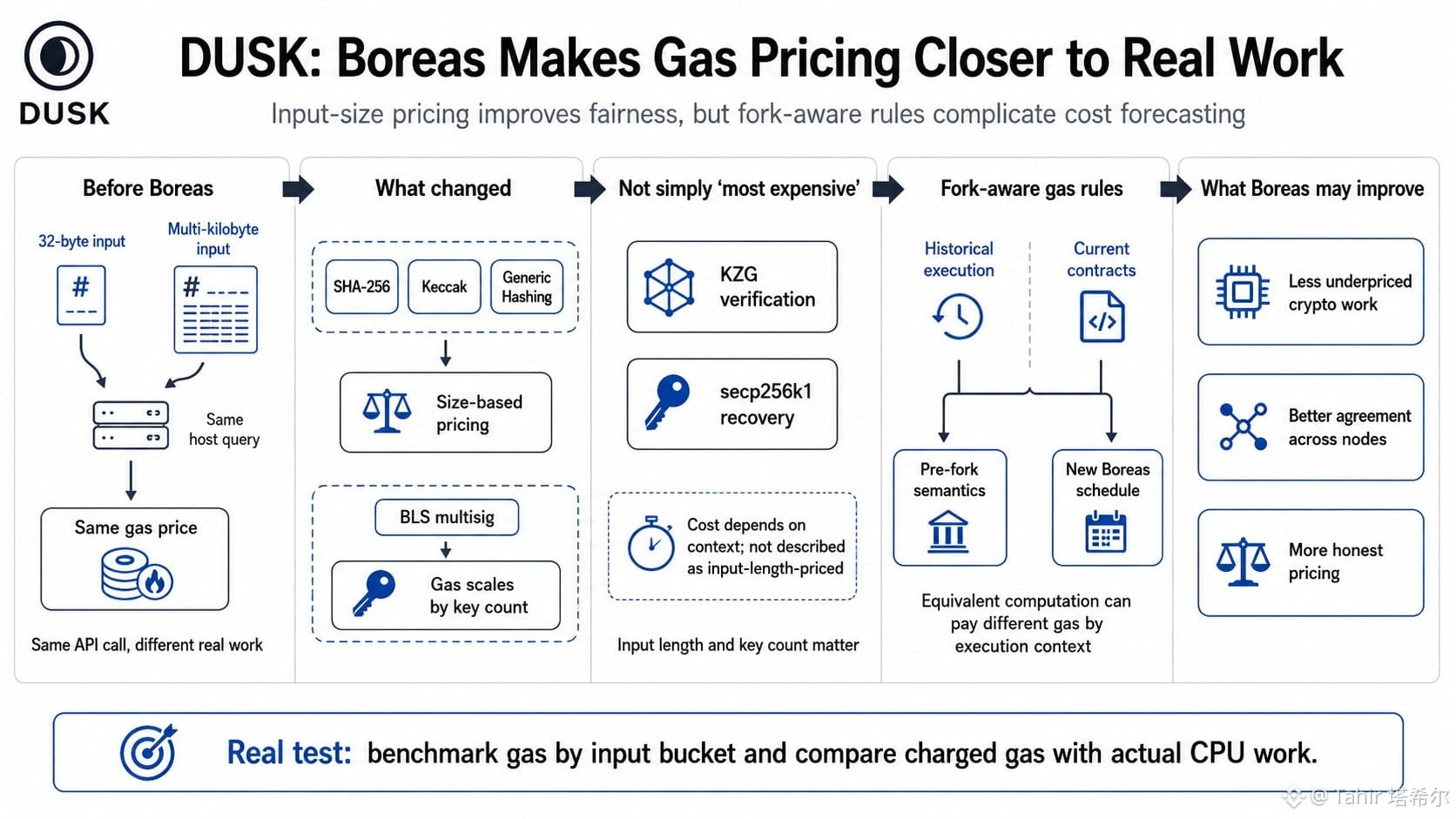
#dusk $DUSK @Dusk_Foundation While reading the Boreas release notes, I stopped at one small change DUSK no longer prices SHA-256, Keccak and generic hashing as if every input costs the same.
A 32-byte hash and a multi-kilobyte hash call the same host query, but they do not demand equal work. Boreas adds size-based pricing for those three, while BLS multisig verification scales by key count. KZG verification and secp256k1 recovery are not described as input-length-priced. Asking which query is “most expensive” without fixing input length and key count is almost the wrong question.
The comparison is flat API-call pricing versus computation imposed on validators. DUSK moved closer to the second.
There is a complication. Boreas is fork-aware: historical execution keeps pre-fork semantics, while current contracts receive the new schedule. Equivalent computation can carry different gas by execution context necessary for replay, awkward for developers forecasting costs.
For DUSK, better gas accuracy should reduce underpriced cryptographic workloads and make execution more consistent across nodes. It does not prove successful state transitions became cheaper. Maybe they became more honestly priced, even when the number rises.
I’m still waiting for benchmark data by input bucket. Deterministic accounting is only convincing when charged gas tracks real CPU work.
@Dusk_Foundation #dusk #Dusk
#dusk $DUSK @Dusk While reading the Boreas release notes, I stopped at one small change DUSK no longer prices SHA-256, Keccak and generic hashing as if every input costs the same.
A 32-byte hash and a multi-kilobyte hash call the same host query, but they do not demand equal work. Boreas adds size-based pricing for those three, while BLS multisig verification scales by key count. KZG verification and secp256k1 recovery are not described as input-length-priced. Asking which query is “most expensive” without fixing input length and key count is almost the wrong question.
The comparison is flat API-call pricing versus computation imposed on validators. DUSK moved closer to the second.
There is a complication. Boreas is fork-aware: historical execution keeps pre-fork semantics, while current contracts receive the new schedule. Equivalent computation can carry different gas by execution context necessary for replay, awkward for developers forecasting costs.
For DUSK, better gas accuracy should reduce underpriced cryptographic workloads and make execution more consistent across nodes. It does not prove successful state transitions became cheaper. Maybe they became more honestly priced, even when the number rises.
I’m still waiting for benchmark data by input bucket. Deterministic accounting is only convincing when charged gas tracks real CPU work.
@Dusk #dusk #Dusk
A 32-byte hash and a multi-kilobyte hash call the same host query, but they do not demand equal work. Boreas adds size-based pricing for those three, while BLS multisig verification scales by key count. KZG verification and secp256k1 recovery are not described as input-length-priced. Asking which query is “most expensive” without fixing input length and key count is almost the wrong question.
The comparison is flat API-call pricing versus computation imposed on validators. DUSK moved closer to the second.
There is a complication. Boreas is fork-aware: historical execution keeps pre-fork semantics, while current contracts receive the new schedule. Equivalent computation can carry different gas by execution context necessary for replay, awkward for developers forecasting costs.
For DUSK, better gas accuracy should reduce underpriced cryptographic workloads and make execution more consistent across nodes. It does not prove successful state transitions became cheaper. Maybe they became more honestly priced, even when the number rises.
I’m still waiting for benchmark data by input bucket. Deterministic accounting is only convincing when charged gas tracks real CPU work.
@Dusk #dusk #Dusk
5
2
21
9.3k
·
--
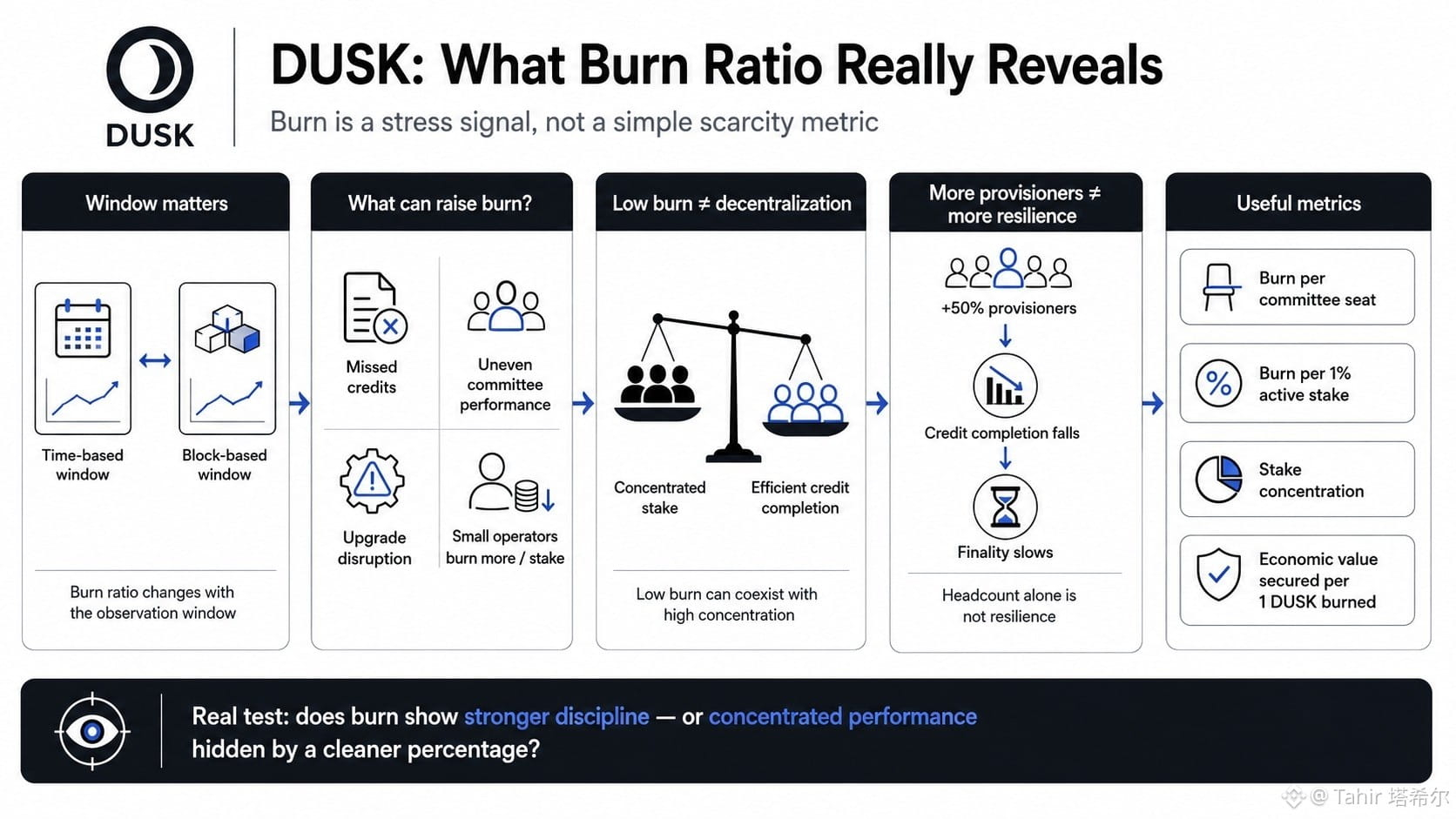
#dusk $DUSK @Dusk_Foundation One figure kept bothering me as I lined up DUSK gross rewards with what provisioners actually received: the missing share changed depending on where I started the window.
That makes burn ratio less like a clean token metric and more like a stress signal. A high ratio could reflect failed credit completion, uneven committee performance, upgrade disruption, or smaller provisioners burning more per unit of stake. It does not automatically mean stronger economics.
For DUSK, I would compare stake concentration against burn per committee seat and burn per 1% of active stake. If five large operators hold most consensus weight but complete credits efficiently, the network may show a low burn ratio while participation remains highly centralized. Efficiency, yes. Decentralization, no.
The reverse matters too. Adding 50% more provisioners sounds healthier, but if credit completion falls and finality slows during extreme burn windows, headcount is not resilience.
The hardest measure is economic value secured per 1 DUSK burned, calculated alongside gross rewards that never reach participants. Time-based windows capture real operational periods; block-based windows control for chain output. I’d use both, especially around upgrades.
I’m watching whether DUSK burn reveals better discipline or merely hides concentrated performance behind a cleaner percentage.
@Dusk_Foundation #dusk
#dusk $DUSK @Dusk One figure kept bothering me as I lined up DUSK gross rewards with what provisioners actually received: the missing share changed depending on where I started the window.
That makes burn ratio less like a clean token metric and more like a stress signal. A high ratio could reflect failed credit completion, uneven committee performance, upgrade disruption, or smaller provisioners burning more per unit of stake. It does not automatically mean stronger economics.
For DUSK, I would compare stake concentration against burn per committee seat and burn per 1% of active stake. If five large operators hold most consensus weight but complete credits efficiently, the network may show a low burn ratio while participation remains highly centralized. Efficiency, yes. Decentralization, no.
The reverse matters too. Adding 50% more provisioners sounds healthier, but if credit completion falls and finality slows during extreme burn windows, headcount is not resilience.
The hardest measure is economic value secured per 1 DUSK burned, calculated alongside gross rewards that never reach participants. Time-based windows capture real operational periods; block-based windows control for chain output. I’d use both, especially around upgrades.
I’m watching whether DUSK burn reveals better discipline or merely hides concentrated performance behind a cleaner percentage.
@Dusk #dusk
That makes burn ratio less like a clean token metric and more like a stress signal. A high ratio could reflect failed credit completion, uneven committee performance, upgrade disruption, or smaller provisioners burning more per unit of stake. It does not automatically mean stronger economics.
For DUSK, I would compare stake concentration against burn per committee seat and burn per 1% of active stake. If five large operators hold most consensus weight but complete credits efficiently, the network may show a low burn ratio while participation remains highly centralized. Efficiency, yes. Decentralization, no.
The reverse matters too. Adding 50% more provisioners sounds healthier, but if credit completion falls and finality slows during extreme burn windows, headcount is not resilience.
The hardest measure is economic value secured per 1 DUSK burned, calculated alongside gross rewards that never reach participants. Time-based windows capture real operational periods; block-based windows control for chain output. I’d use both, especially around upgrades.
I’m watching whether DUSK burn reveals better discipline or merely hides concentrated performance behind a cleaner percentage.
@Dusk #dusk
2
13
4.2k
·
--
Partiellement vrai
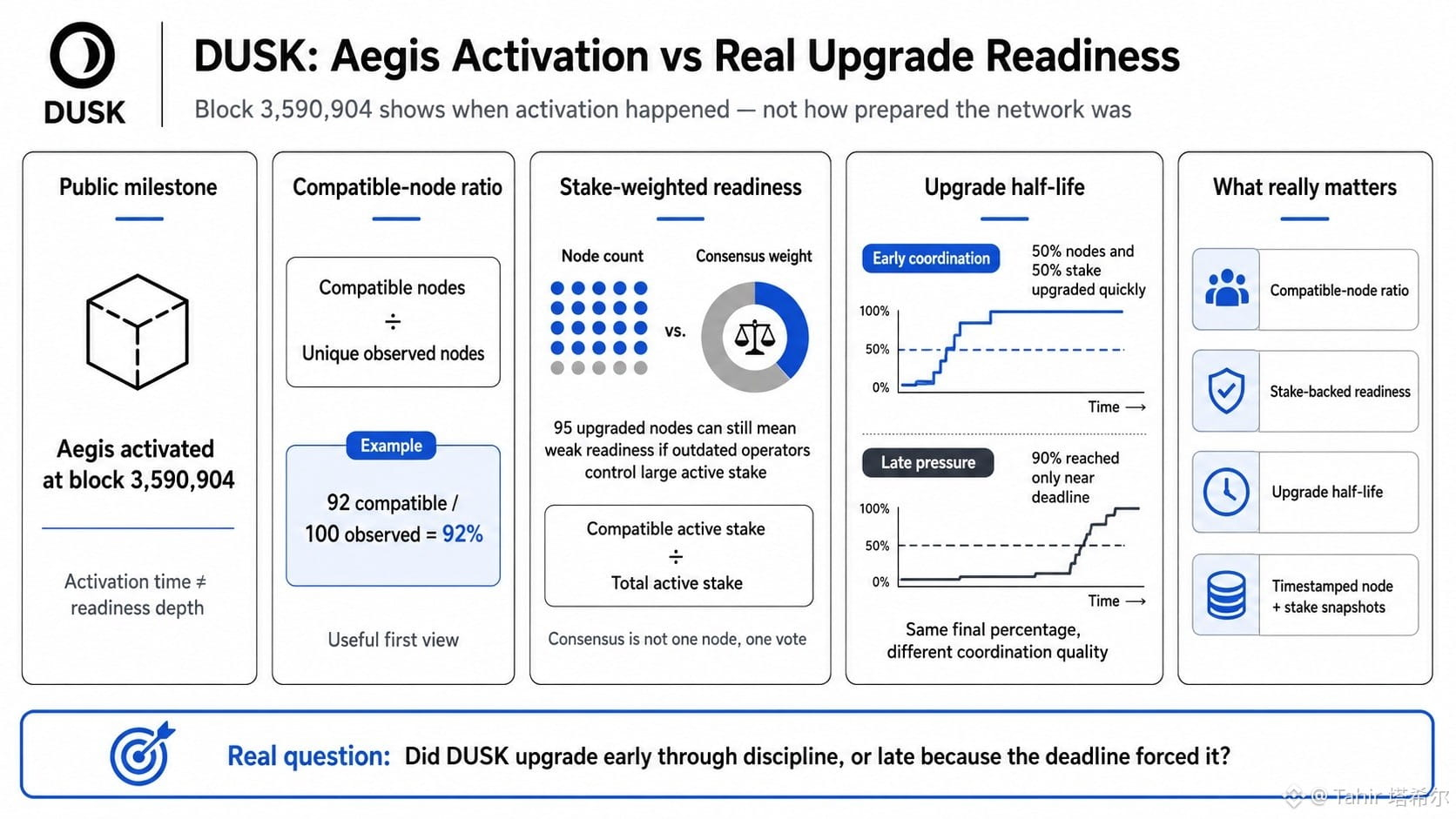
#dusk $DUSK @Dusk_Foundation I was checking DUSK’s Aegis activation at block 3,590,904 and noticed the public milestone answers when the upgrade happened, but not how ready the network actually was.
A basic measure would be compatible nodes divided by all unique observed nodes. If 92 of 100 nodes were running Rusk 1.6.0+, DUSK had a 92% compatible-node ratio.
Useful, yes. But consensus is not simply one node, one vote.
Provisioners operate with active stake, so 95 upgraded nodes could still represent only 60% of consensus weight if five outdated operators controlled the remaining 40%. That is the comparison most summaries miss operator participation versus stake-backed readiness.
Timing matters too. I would want the upgrade half-life how many hours it took 50% of observable nodes and 50% of active DUSK stake to become compatible. Reaching 90% gradually over several days signals something different from operators rushing into Rusk 1.6.0 during the final 24 hours.
Both paths can produce the same final percentage, but only one shows comfortable coordination.
Without timestamped node-version and stake snapshots, any claimed Aegis readiness ratio remains incomplete. DUSK activated successfully, but I’m still watching whether the network upgraded early by discipline, or late because the deadline finally created enough pressure.
@Dusk_Foundation #dusk
#dusk $DUSK @Dusk I was checking DUSK’s Aegis activation at block 3,590,904 and noticed the public milestone answers when the upgrade happened, but not how ready the network actually was.
A basic measure would be compatible nodes divided by all unique observed nodes. If 92 of 100 nodes were running Rusk 1.6.0+, DUSK had a 92% compatible-node ratio.
Useful, yes. But consensus is not simply one node, one vote.
Provisioners operate with active stake, so 95 upgraded nodes could still represent only 60% of consensus weight if five outdated operators controlled the remaining 40%. That is the comparison most summaries miss operator participation versus stake-backed readiness.
Timing matters too. I would want the upgrade half-life how many hours it took 50% of observable nodes and 50% of active DUSK stake to become compatible. Reaching 90% gradually over several days signals something different from operators rushing into Rusk 1.6.0 during the final 24 hours.
Both paths can produce the same final percentage, but only one shows comfortable coordination.
Without timestamped node-version and stake snapshots, any claimed Aegis readiness ratio remains incomplete. DUSK activated successfully, but I’m still watching whether the network upgraded early by discipline, or late because the deadline finally created enough pressure.
@Dusk #dusk
A basic measure would be compatible nodes divided by all unique observed nodes. If 92 of 100 nodes were running Rusk 1.6.0+, DUSK had a 92% compatible-node ratio.
Useful, yes. But consensus is not simply one node, one vote.
Provisioners operate with active stake, so 95 upgraded nodes could still represent only 60% of consensus weight if five outdated operators controlled the remaining 40%. That is the comparison most summaries miss operator participation versus stake-backed readiness.
Timing matters too. I would want the upgrade half-life how many hours it took 50% of observable nodes and 50% of active DUSK stake to become compatible. Reaching 90% gradually over several days signals something different from operators rushing into Rusk 1.6.0 during the final 24 hours.
Both paths can produce the same final percentage, but only one shows comfortable coordination.
Without timestamped node-version and stake snapshots, any claimed Aegis readiness ratio remains incomplete. DUSK activated successfully, but I’m still watching whether the network upgraded early by discipline, or late because the deadline finally created enough pressure.
@Dusk #dusk
9
14
4.6k
·
--
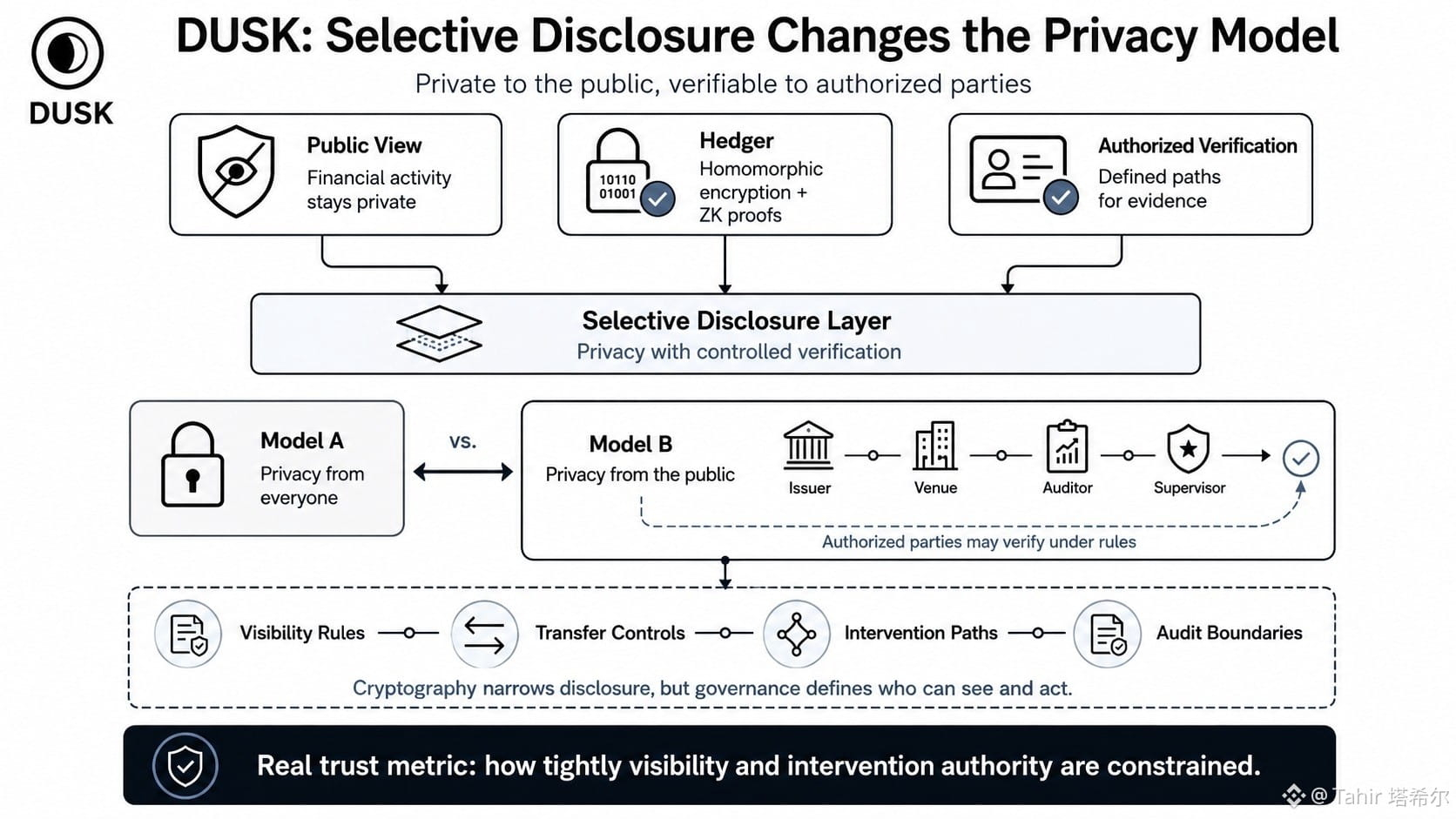
#dusk $DUSK @Dusk_Foundation I was reading Dusk’s privacy material and one phrase kept changing how I saw the whole design: “selective disclosure.” The system is not really promising that nobody can ever see anything. It is trying to keep financial activity private from the public while still leaving defined paths for verification.
That makes Hedger more interesting than a simple privacy feature. DUSK combines homomorphic encryption and zero-knowledge proofs so data can stay hidden while execution remains provable. But “auditable” quietly introduces another question: who gets the extra visibility, and what can they do with it?
The comparison I keep coming back to is privacy from everyone versus privacy from everyone except authorized parties. Those are very different guarantees.
For regulated finance, DUSK may actually need the second model. Issuers, venues, auditors or supervisors can require evidence, transfer controls, even intervention paths. Strong cryptography does not remove that governance layer. It can make disclosure narrower, but somebody still defines the rules.
That is where I’m still watching DUSK carefully. If privacy is selective, the real trust metric may not be how well data is hidden, but how tightly visibility and intervention authority are constrained.
@Dusk_Foundation #DUSK #dusk
#dusk $DUSK @Dusk I was reading Dusk’s privacy material and one phrase kept changing how I saw the whole design: “selective disclosure.” The system is not really promising that nobody can ever see anything. It is trying to keep financial activity private from the public while still leaving defined paths for verification.
That makes Hedger more interesting than a simple privacy feature. DUSK combines homomorphic encryption and zero-knowledge proofs so data can stay hidden while execution remains provable. But “auditable” quietly introduces another question: who gets the extra visibility, and what can they do with it?
The comparison I keep coming back to is privacy from everyone versus privacy from everyone except authorized parties. Those are very different guarantees.
For regulated finance, DUSK may actually need the second model. Issuers, venues, auditors or supervisors can require evidence, transfer controls, even intervention paths. Strong cryptography does not remove that governance layer. It can make disclosure narrower, but somebody still defines the rules.
That is where I’m still watching DUSK carefully. If privacy is selective, the real trust metric may not be how well data is hidden, but how tightly visibility and intervention authority are constrained.
@Dusk #DUSK #dusk
That makes Hedger more interesting than a simple privacy feature. DUSK combines homomorphic encryption and zero-knowledge proofs so data can stay hidden while execution remains provable. But “auditable” quietly introduces another question: who gets the extra visibility, and what can they do with it?
The comparison I keep coming back to is privacy from everyone versus privacy from everyone except authorized parties. Those are very different guarantees.
For regulated finance, DUSK may actually need the second model. Issuers, venues, auditors or supervisors can require evidence, transfer controls, even intervention paths. Strong cryptography does not remove that governance layer. It can make disclosure narrower, but somebody still defines the rules.
That is where I’m still watching DUSK carefully. If privacy is selective, the real trust metric may not be how well data is hidden, but how tightly visibility and intervention authority are constrained.
@Dusk #DUSK #dusk
8
11
5.6k
·
--
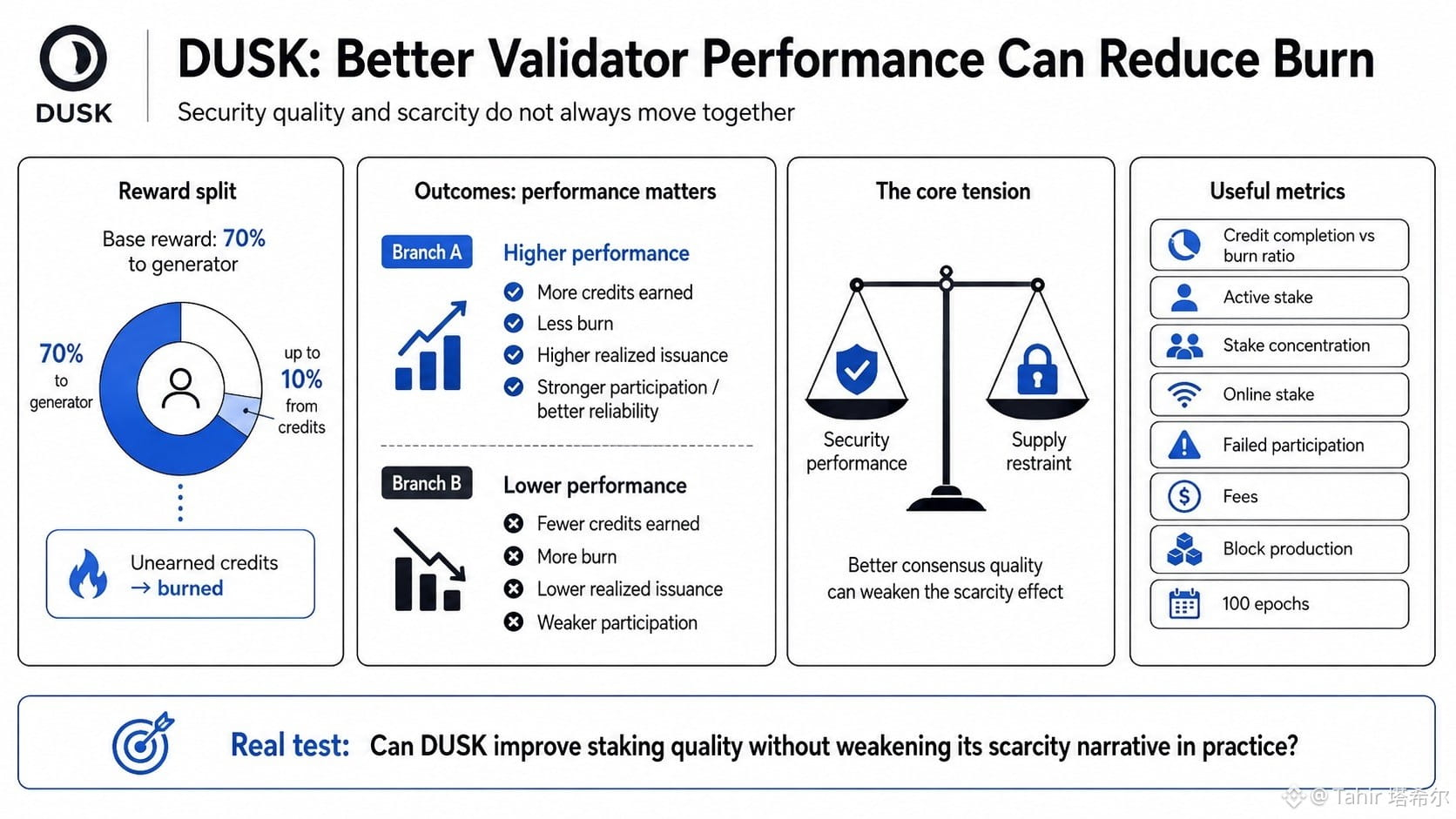
#dusk $DUSK @Dusk_Foundation I was checking how DUSK staking rewards are actually split, and one detail kept bothering me: better validator performance can reduce burn.
The generator receives 70% of the reward, with up to another 10% tied to credits. If those conditional credits are not earned, that portion is burned. So realized issuance is not just a fixed tokenomics number. It partly depends on how well consensus participants perform.
That creates a strange tension inside DUSK.
Better staking performance strengthens security, increases successful participation, and should make block production more reliable. But the same improvement can also mean fewer rewards are burned, which pushes realized inflation higher.
Most people hear “DUSK burns unearned rewards” and read it as pure scarcity. I think that is too simple.
The more useful comparison is security performance versus supply restraint. They are connected, but not always aligned.
I would track generator credit completion against burn ratio across 100 epochs, then compare it with active stake, concentration, online stake, failed participation, fees, and block production.
My quiet question is whether DUSK can improve staking quality without making its scarcity narrative weaker in practice.
@Dusk_Foundation #dusk #DUSK
#dusk $DUSK @Dusk I was checking how DUSK staking rewards are actually split, and one detail kept bothering me: better validator performance can reduce burn.
The generator receives 70% of the reward, with up to another 10% tied to credits. If those conditional credits are not earned, that portion is burned. So realized issuance is not just a fixed tokenomics number. It partly depends on how well consensus participants perform.
That creates a strange tension inside DUSK.
Better staking performance strengthens security, increases successful participation, and should make block production more reliable. But the same improvement can also mean fewer rewards are burned, which pushes realized inflation higher.
Most people hear “DUSK burns unearned rewards” and read it as pure scarcity. I think that is too simple.
The more useful comparison is security performance versus supply restraint. They are connected, but not always aligned.
I would track generator credit completion against burn ratio across 100 epochs, then compare it with active stake, concentration, online stake, failed participation, fees, and block production.
My quiet question is whether DUSK can improve staking quality without making its scarcity narrative weaker in practice.
@Dusk #dusk #DUSK
The generator receives 70% of the reward, with up to another 10% tied to credits. If those conditional credits are not earned, that portion is burned. So realized issuance is not just a fixed tokenomics number. It partly depends on how well consensus participants perform.
That creates a strange tension inside DUSK.
Better staking performance strengthens security, increases successful participation, and should make block production more reliable. But the same improvement can also mean fewer rewards are burned, which pushes realized inflation higher.
Most people hear “DUSK burns unearned rewards” and read it as pure scarcity. I think that is too simple.
The more useful comparison is security performance versus supply restraint. They are connected, but not always aligned.
I would track generator credit completion against burn ratio across 100 epochs, then compare it with active stake, concentration, online stake, failed participation, fees, and block production.
My quiet question is whether DUSK can improve staking quality without making its scarcity narrative weaker in practice.
@Dusk #dusk #DUSK
8
11
366
·
--
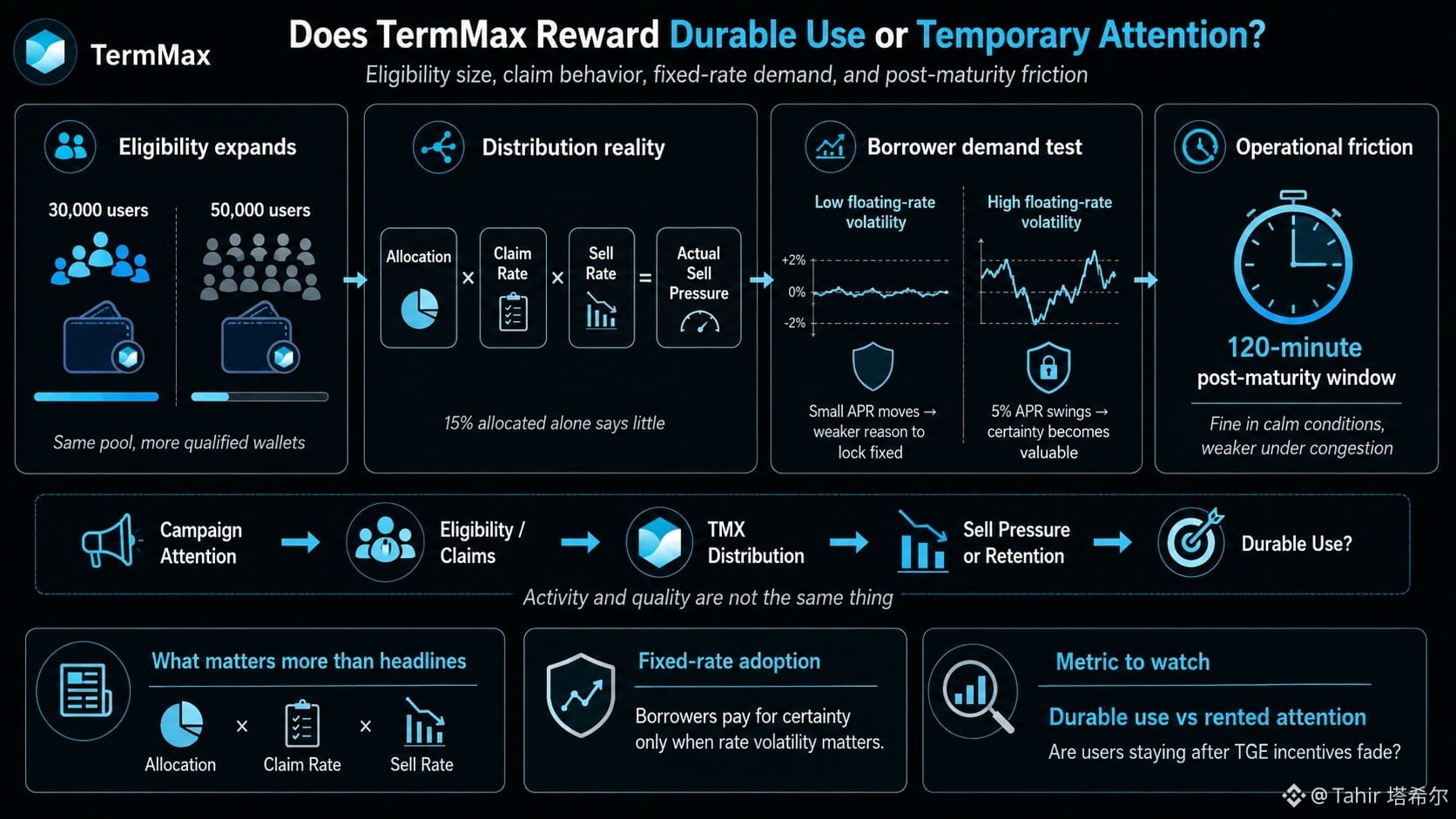
#termmax @termmax I was checking TermMax eligibility numbers and kept switching between the 30,000 and 50,000-user cases. The same pool can look generous at one threshold and thin very fast once more wallets qualify.
That is the hidden tension. TermMax wants sticky capital and real fixed-rate borrowers, but a large TMX distribution can reward people whose strongest incentive appears right before TGE, not after it. Activity and quality are not the same thing.
The sell-pressure story is also usually simplified too much. “15% allocated” tells me little unless I know the claim rate and, after claiming, the sell rate. Allocation × claim rate × sell rate is the number that actually matters.
I see a similar issue on the lending side. Fixed rates are useful only when borrowers value certainty enough to pay a premium over floating APR. If variable rates barely move, adoption may stay weak. If APR swings 5%, suddenly a few hundred basis points for certainty can look rational.
Then there is the 120-minute post-maturity window. Fine in normal conditions, maybe less fine during congestion.
What I am watching is whether TermMax rewards durable use, or temporarily rents attention.
@termmax #termmax
#termmax @TermMax I was checking TermMax eligibility numbers and kept switching between the 30,000 and 50,000-user cases. The same pool can look generous at one threshold and thin very fast once more wallets qualify.
That is the hidden tension. TermMax wants sticky capital and real fixed-rate borrowers, but a large TMX distribution can reward people whose strongest incentive appears right before TGE, not after it. Activity and quality are not the same thing.
The sell-pressure story is also usually simplified too much. “15% allocated” tells me little unless I know the claim rate and, after claiming, the sell rate. Allocation × claim rate × sell rate is the number that actually matters.
I see a similar issue on the lending side. Fixed rates are useful only when borrowers value certainty enough to pay a premium over floating APR. If variable rates barely move, adoption may stay weak. If APR swings 5%, suddenly a few hundred basis points for certainty can look rational.
Then there is the 120-minute post-maturity window. Fine in normal conditions, maybe less fine during congestion.
What I am watching is whether TermMax rewards durable use, or temporarily rents attention.
@TermMax #termmax
That is the hidden tension. TermMax wants sticky capital and real fixed-rate borrowers, but a large TMX distribution can reward people whose strongest incentive appears right before TGE, not after it. Activity and quality are not the same thing.
The sell-pressure story is also usually simplified too much. “15% allocated” tells me little unless I know the claim rate and, after claiming, the sell rate. Allocation × claim rate × sell rate is the number that actually matters.
I see a similar issue on the lending side. Fixed rates are useful only when borrowers value certainty enough to pay a premium over floating APR. If variable rates barely move, adoption may stay weak. If APR swings 5%, suddenly a few hundred basis points for certainty can look rational.
Then there is the 120-minute post-maturity window. Fine in normal conditions, maybe less fine during congestion.
What I am watching is whether TermMax rewards durable use, or temporarily rents attention.
@TermMax #termmax
9
13
2.6k
·
--
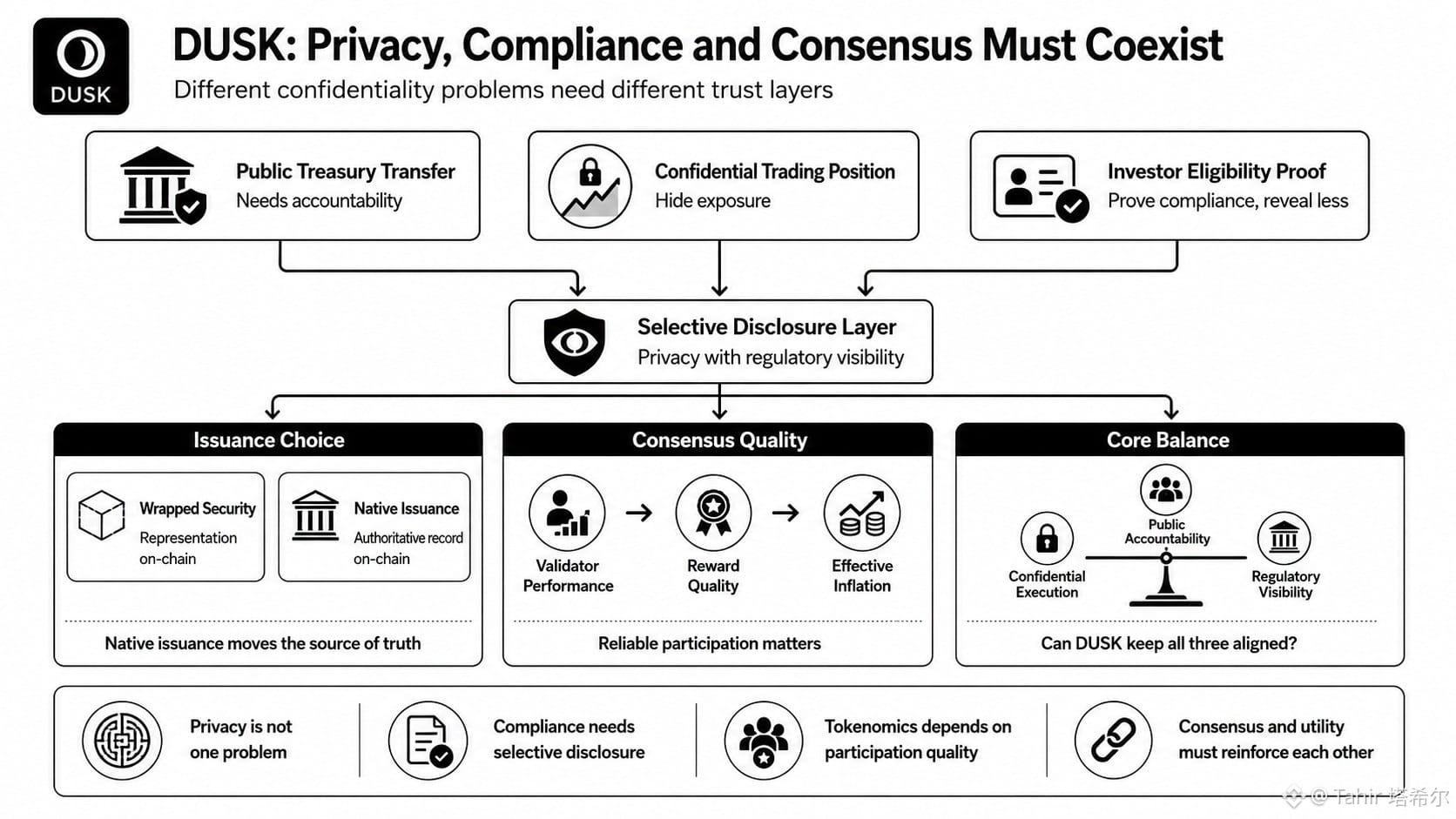
#dusk $DUSK @Dusk_Foundation Yesterday I was checking how staking rewards change with validator performance, and one detail kept bothering me: DUSK is trying to make consensus economics coexist with very different kinds of financial privacy.
A public treasury transfer, a confidential trading position, and proof that an investor is eligible are not the same privacy problem. Hiding a balance is different from hiding a position, and both are different from keeping business logic confidential while still allowing selective disclosure.
That distinction matters for DUSK because institutional utility may depend less on anonymous finance and more on proving compliance without exposing unnecessary identity data.
The same tension appears in asset issuance. A wrapped security can bring representation on-chain, but native issuance changes something deeper: where the authoritative record actually lives.
Then there is staking. If effective inflation depends partly on validator performance, tokenomics is not isolated from consensus quality. What DUSK says it rewards is participation; what the system may really reward is reliable participation.
Still, I keep one question open. Can DUSK maintain public accountability, confidential execution and regulatory visibility simultaneously without one layer weakening the others?
That balance matters more to me than simply calling the network private.
@Dusk_Foundation #dusk #Dusk
#dusk $DUSK @Dusk Yesterday I was checking how staking rewards change with validator performance, and one detail kept bothering me: DUSK is trying to make consensus economics coexist with very different kinds of financial privacy.
A public treasury transfer, a confidential trading position, and proof that an investor is eligible are not the same privacy problem. Hiding a balance is different from hiding a position, and both are different from keeping business logic confidential while still allowing selective disclosure.
That distinction matters for DUSK because institutional utility may depend less on anonymous finance and more on proving compliance without exposing unnecessary identity data.
The same tension appears in asset issuance. A wrapped security can bring representation on-chain, but native issuance changes something deeper: where the authoritative record actually lives.
Then there is staking. If effective inflation depends partly on validator performance, tokenomics is not isolated from consensus quality. What DUSK says it rewards is participation; what the system may really reward is reliable participation.
Still, I keep one question open. Can DUSK maintain public accountability, confidential execution and regulatory visibility simultaneously without one layer weakening the others?
That balance matters more to me than simply calling the network private.
@Dusk #dusk #Dusk
A public treasury transfer, a confidential trading position, and proof that an investor is eligible are not the same privacy problem. Hiding a balance is different from hiding a position, and both are different from keeping business logic confidential while still allowing selective disclosure.
That distinction matters for DUSK because institutional utility may depend less on anonymous finance and more on proving compliance without exposing unnecessary identity data.
The same tension appears in asset issuance. A wrapped security can bring representation on-chain, but native issuance changes something deeper: where the authoritative record actually lives.
Then there is staking. If effective inflation depends partly on validator performance, tokenomics is not isolated from consensus quality. What DUSK says it rewards is participation; what the system may really reward is reliable participation.
Still, I keep one question open. Can DUSK maintain public accountability, confidential execution and regulatory visibility simultaneously without one layer weakening the others?
That balance matters more to me than simply calling the network private.
@Dusk #dusk #Dusk
26
29
6.1k
·
--
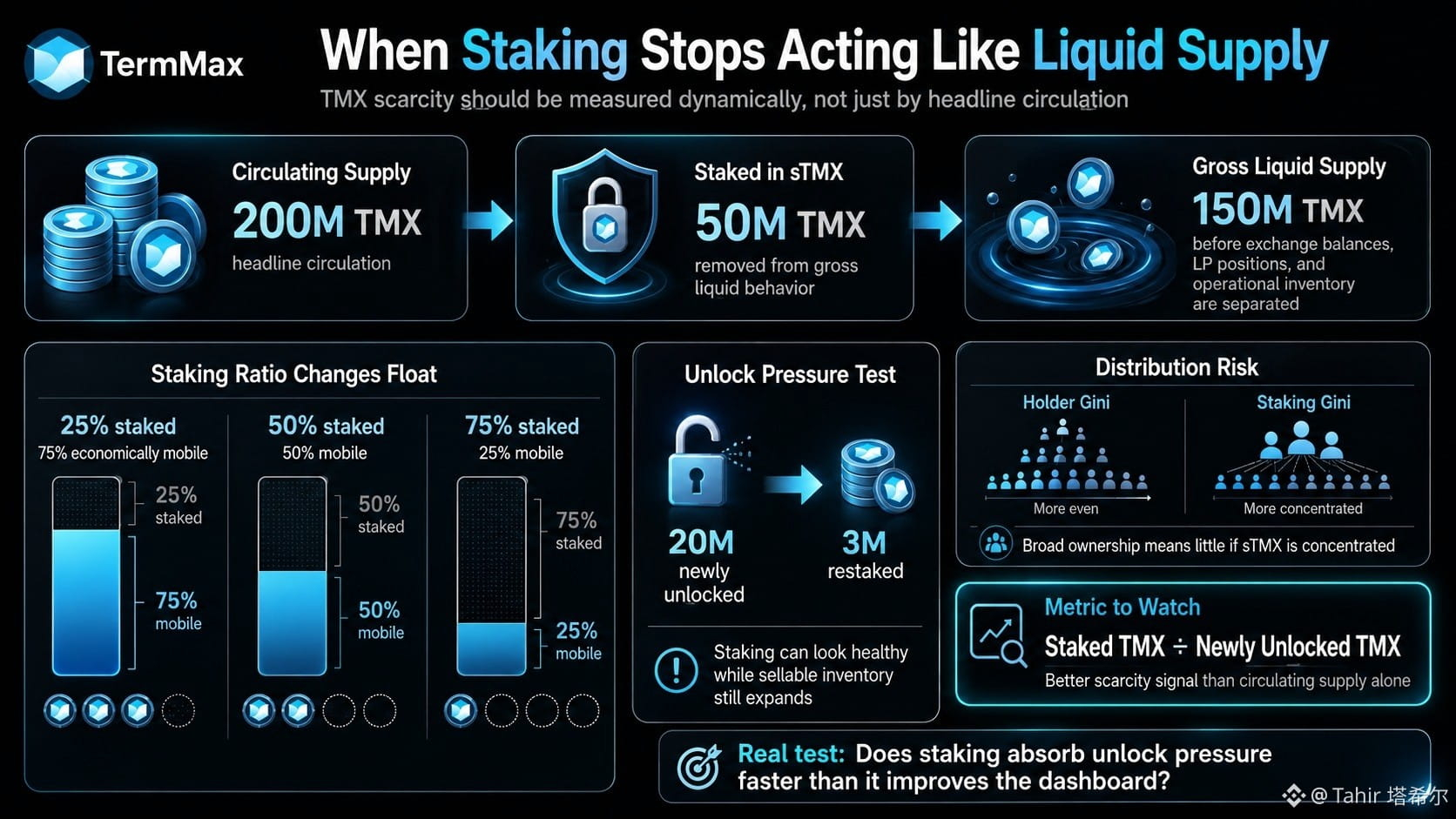
#termmax @termmax I was looking at the TMX staking screen and the number I cared about wasn’t APY. It was how much of the circulating supply had quietly stopped behaving like liquid supply.
If 200M TMX is circulating and 50M sits in sTMX, the market may technically see 200M tokens, but only 150M remains gross liquid before exchange balances, LP positions and locked operational inventory are separated.
That gap matters more after unlocks.
A 25% staking ratio leaves 75% economically mobile. At 50%, the float is cut in half. At 75%, the headline circulating supply starts to describe ownership better than actual liquidity.
But staking alone is not conviction. The harder metric is staked TMX divided by newly unlocked TMX. If vesting releases 20M and only 3M gets restaked, staking may look healthy while fresh sellable inventory is still expanding.
I also want staking Gini beside holder Gini. Broad ownership means little if sTMX control is concentrated in a few large wallets.
The protocol story is long-term alignment. The real test is whether staking absorbs unlock pressure faster than it creates a cleaner-looking dashboard.
TMX scarcity should be measured dynamically. Otherwise “low float” can become a very convenient illusion.
@termmax #termmax
#termmax @TermMax I was looking at the TMX staking screen and the number I cared about wasn’t APY. It was how much of the circulating supply had quietly stopped behaving like liquid supply.
If 200M TMX is circulating and 50M sits in sTMX, the market may technically see 200M tokens, but only 150M remains gross liquid before exchange balances, LP positions and locked operational inventory are separated.
That gap matters more after unlocks.
A 25% staking ratio leaves 75% economically mobile. At 50%, the float is cut in half. At 75%, the headline circulating supply starts to describe ownership better than actual liquidity.
But staking alone is not conviction. The harder metric is staked TMX divided by newly unlocked TMX. If vesting releases 20M and only 3M gets restaked, staking may look healthy while fresh sellable inventory is still expanding.
I also want staking Gini beside holder Gini. Broad ownership means little if sTMX control is concentrated in a few large wallets.
The protocol story is long-term alignment. The real test is whether staking absorbs unlock pressure faster than it creates a cleaner-looking dashboard.
TMX scarcity should be measured dynamically. Otherwise “low float” can become a very convenient illusion.
@TermMax #termmax
If 200M TMX is circulating and 50M sits in sTMX, the market may technically see 200M tokens, but only 150M remains gross liquid before exchange balances, LP positions and locked operational inventory are separated.
That gap matters more after unlocks.
A 25% staking ratio leaves 75% economically mobile. At 50%, the float is cut in half. At 75%, the headline circulating supply starts to describe ownership better than actual liquidity.
But staking alone is not conviction. The harder metric is staked TMX divided by newly unlocked TMX. If vesting releases 20M and only 3M gets restaked, staking may look healthy while fresh sellable inventory is still expanding.
I also want staking Gini beside holder Gini. Broad ownership means little if sTMX control is concentrated in a few large wallets.
The protocol story is long-term alignment. The real test is whether staking absorbs unlock pressure faster than it creates a cleaner-looking dashboard.
TMX scarcity should be measured dynamically. Otherwise “low float” can become a very convenient illusion.
@TermMax #termmax
2
10
4.5k
·
--
#dusk $DUSK @Dusk_Foundation As I mapped a hypothetical €2M dividend across 20,000 hidden balances, I hit the part of DUSK that matters more than privacy itself: how do you prove every holder was paid correctly when nobody can see the full ledger?
A public chain solves this crudely. Anyone can recompute the distribution. Confidential securities cannot expose that holder-level breakdown without defeating the point.
So DUSK needs something stronger than the transfers succeeded. It needs global correctness without global visibility.
For a 2-for-1 share split, the real proof is not that 20,000 private balances changed. It is that every eligible balance changed by exactly the right ratio, no holder was skipped, no phantom balance was added, and total supply still reconciles.
Dividends are even sharper. Declared €2M must equal distributed €2M, while individual payouts remain private.
This is where activity vs quality becomes irrelevant; protocol trust comes from verifiable accounting.
My concern is simple: one wrong private payment is harder for outsiders to spot than one public error.
If DUSK shifts corporate-action verification from visible spreadsheets to cryptographic proofs, the question is not whether privacy works.
It is whether the proof catches the mistake we cannot see.
@Dusk_Foundation #dusk $DUSK
#dusk $DUSK @Dusk As I mapped a hypothetical €2M dividend across 20,000 hidden balances, I hit the part of DUSK that matters more than privacy itself: how do you prove every holder was paid correctly when nobody can see the full ledger?
A public chain solves this crudely. Anyone can recompute the distribution. Confidential securities cannot expose that holder-level breakdown without defeating the point.
So DUSK needs something stronger than the transfers succeeded. It needs global correctness without global visibility.
For a 2-for-1 share split, the real proof is not that 20,000 private balances changed. It is that every eligible balance changed by exactly the right ratio, no holder was skipped, no phantom balance was added, and total supply still reconciles.
Dividends are even sharper. Declared €2M must equal distributed €2M, while individual payouts remain private.
This is where activity vs quality becomes irrelevant; protocol trust comes from verifiable accounting.
My concern is simple: one wrong private payment is harder for outsiders to spot than one public error.
If DUSK shifts corporate-action verification from visible spreadsheets to cryptographic proofs, the question is not whether privacy works.
It is whether the proof catches the mistake we cannot see.
@Dusk #dusk $DUSK
A public chain solves this crudely. Anyone can recompute the distribution. Confidential securities cannot expose that holder-level breakdown without defeating the point.
So DUSK needs something stronger than the transfers succeeded. It needs global correctness without global visibility.
For a 2-for-1 share split, the real proof is not that 20,000 private balances changed. It is that every eligible balance changed by exactly the right ratio, no holder was skipped, no phantom balance was added, and total supply still reconciles.
Dividends are even sharper. Declared €2M must equal distributed €2M, while individual payouts remain private.
This is where activity vs quality becomes irrelevant; protocol trust comes from verifiable accounting.
My concern is simple: one wrong private payment is harder for outsiders to spot than one public error.
If DUSK shifts corporate-action verification from visible spreadsheets to cryptographic proofs, the question is not whether privacy works.
It is whether the proof catches the mistake we cannot see.
@Dusk #dusk $DUSK
27
19
5.5k
·
--
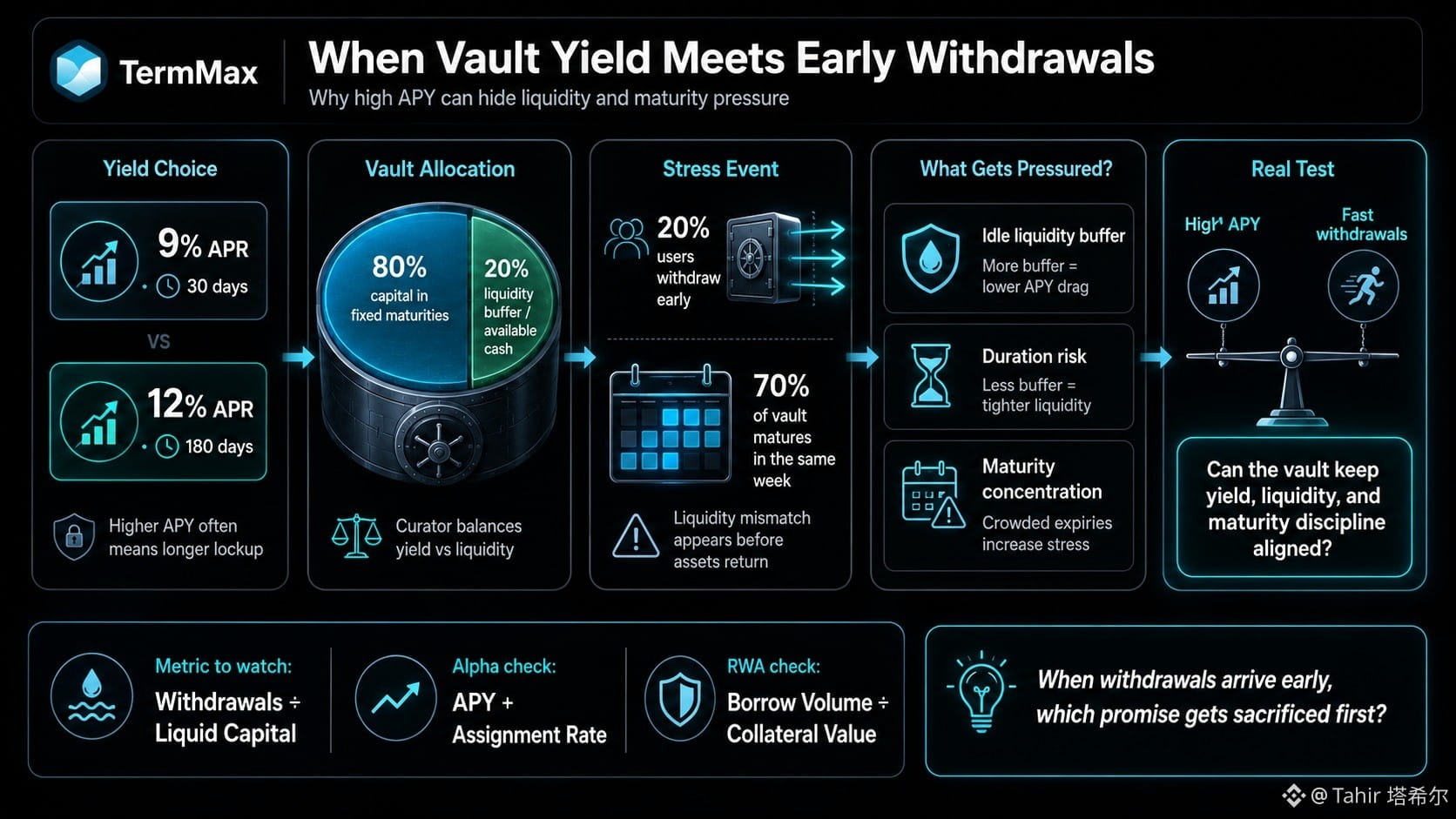
#termmax @termmax I think TermMax’s hardest vault problem is not finding yield. It is surviving the moment when users want liquidity before the assets inside the vault are ready to come back.
A 12% APR for 180 days looks better than 9% for 30 days. But that extra 300 bps means little if 20% of users withdraw while 80% of capital is still tied to fixed maturities.
That is the behavior I would stress-test first.
What happens if 70% of a TermMax vault matures in the same week? How much liquidity does the curator keep idle? And how much APY is created by smart allocation versus simply accepting more duration risk?
Some mismatch is normal. Fixed-term lending cannot offer instant liquidity without cost. The real test is whether TermMax manages that mismatch deliberately, not whether APY looks high.
I have the same concern with Alpha. Option-vault APY without assignment rate hides part of the outcome. For RWA markets, borrow volume divided by collateral value may tell more about real demand than deposits alone.
TMX becomes more interesting if yield, liquidity, and maturity discipline stay aligned.
My doubt is simple when withdrawals arrive early, which promise gets sacrificed first?
@termmax #termmax
#termmax @TermMax I think TermMax’s hardest vault problem is not finding yield. It is surviving the moment when users want liquidity before the assets inside the vault are ready to come back.
A 12% APR for 180 days looks better than 9% for 30 days. But that extra 300 bps means little if 20% of users withdraw while 80% of capital is still tied to fixed maturities.
That is the behavior I would stress-test first.
What happens if 70% of a TermMax vault matures in the same week? How much liquidity does the curator keep idle? And how much APY is created by smart allocation versus simply accepting more duration risk?
Some mismatch is normal. Fixed-term lending cannot offer instant liquidity without cost. The real test is whether TermMax manages that mismatch deliberately, not whether APY looks high.
I have the same concern with Alpha. Option-vault APY without assignment rate hides part of the outcome. For RWA markets, borrow volume divided by collateral value may tell more about real demand than deposits alone.
TMX becomes more interesting if yield, liquidity, and maturity discipline stay aligned.
My doubt is simple when withdrawals arrive early, which promise gets sacrificed first?
@TermMax #termmax
A 12% APR for 180 days looks better than 9% for 30 days. But that extra 300 bps means little if 20% of users withdraw while 80% of capital is still tied to fixed maturities.
That is the behavior I would stress-test first.
What happens if 70% of a TermMax vault matures in the same week? How much liquidity does the curator keep idle? And how much APY is created by smart allocation versus simply accepting more duration risk?
Some mismatch is normal. Fixed-term lending cannot offer instant liquidity without cost. The real test is whether TermMax manages that mismatch deliberately, not whether APY looks high.
I have the same concern with Alpha. Option-vault APY without assignment rate hides part of the outcome. For RWA markets, borrow volume divided by collateral value may tell more about real demand than deposits alone.
TMX becomes more interesting if yield, liquidity, and maturity discipline stay aligned.
My doubt is simple when withdrawals arrive early, which promise gets sacrificed first?
@TermMax #termmax
10
11
5.1k
·
--
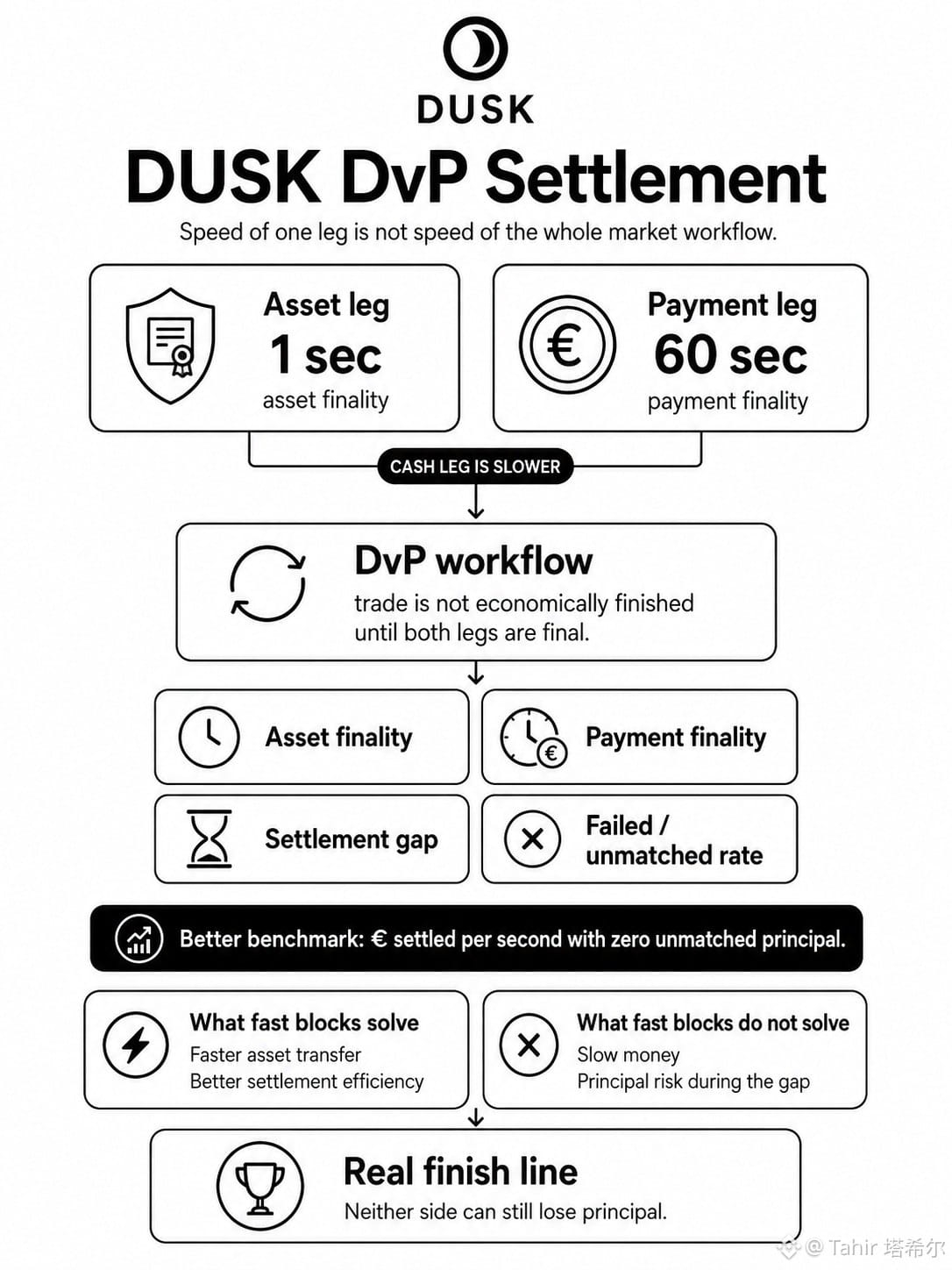
#dusk $DUSK @Dusk_Foundation When I compare the asset and payment legs, I keep landing on a simple issue a one-second asset transfer does not create a one-second market workflow if the cash leg still takes 60 seconds.
That makes “10-second settlement” a weaker DUSK metric than it first appears. For delivery-versus-payment, I would separate at least four things: asset finality, payment finality, the gap between them, and the rate of failed or unmatched settlements.
The behavioral consequence matters more than the block time. An institution cannot treat a trade as economically finished while one side is final and the other still carries principal risk. Faster blocks help, but they do not make slow money disappear.
The stronger benchmark for DUSK may eventually be value settled per second with zero unmatched principal, not raw transaction speed. Even a bond that completes 20 coupon payments correctly has not proved the hardest event: the €100M principal repayment at maturity.
I can see why DUSK’s settlement speed matters. What I still cannot resolve from one headline number is how quickly both legs become irreversible together.
For institutional markets, the real finish line is when neither side can still lose principal.
@Dusk_Foundation #dusk $DUSK
#dusk $DUSK @Dusk When I compare the asset and payment legs, I keep landing on a simple issue a one-second asset transfer does not create a one-second market workflow if the cash leg still takes 60 seconds.
That makes “10-second settlement” a weaker DUSK metric than it first appears. For delivery-versus-payment, I would separate at least four things: asset finality, payment finality, the gap between them, and the rate of failed or unmatched settlements.
The behavioral consequence matters more than the block time. An institution cannot treat a trade as economically finished while one side is final and the other still carries principal risk. Faster blocks help, but they do not make slow money disappear.
The stronger benchmark for DUSK may eventually be value settled per second with zero unmatched principal, not raw transaction speed. Even a bond that completes 20 coupon payments correctly has not proved the hardest event: the €100M principal repayment at maturity.
I can see why DUSK’s settlement speed matters. What I still cannot resolve from one headline number is how quickly both legs become irreversible together.
For institutional markets, the real finish line is when neither side can still lose principal.
@Dusk #dusk $DUSK
That makes “10-second settlement” a weaker DUSK metric than it first appears. For delivery-versus-payment, I would separate at least four things: asset finality, payment finality, the gap between them, and the rate of failed or unmatched settlements.
The behavioral consequence matters more than the block time. An institution cannot treat a trade as economically finished while one side is final and the other still carries principal risk. Faster blocks help, but they do not make slow money disappear.
The stronger benchmark for DUSK may eventually be value settled per second with zero unmatched principal, not raw transaction speed. Even a bond that completes 20 coupon payments correctly has not proved the hardest event: the €100M principal repayment at maturity.
I can see why DUSK’s settlement speed matters. What I still cannot resolve from one headline number is how quickly both legs become irreversible together.
For institutional markets, the real finish line is when neither side can still lose principal.
@Dusk #dusk $DUSK
44
40
3.7k
·
--
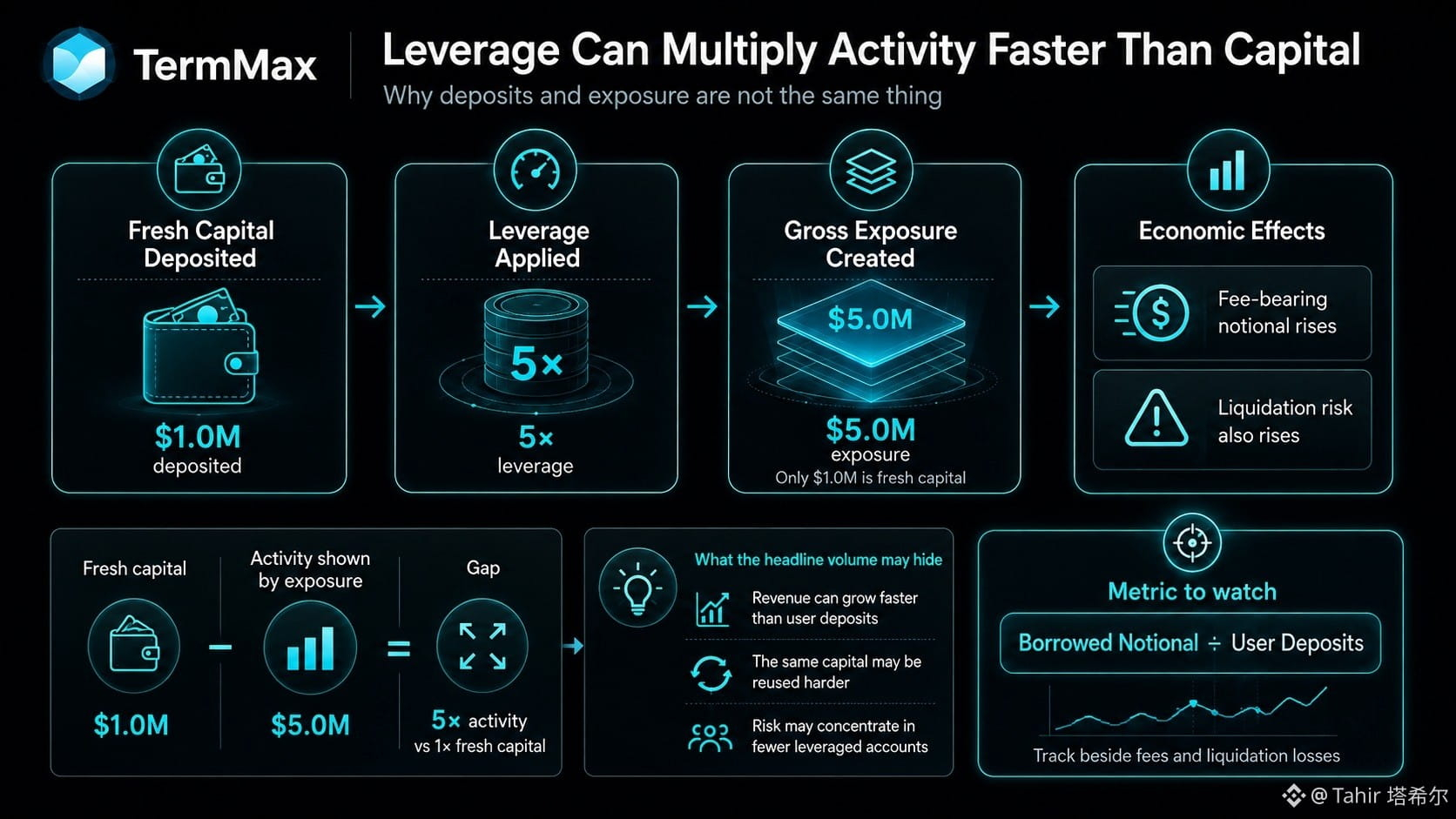
#termmax @termmax The TermMax number I keep circling is not volume. It is the gap between capital deposited and exposure created once leverage starts doing the work.
A wallet bringing in $1 million and building $5 million of gross exposure can look like $5 million of activity, but only $1 million is fresh capital. For TermMax, that distinction matters because leverage can multiply fee-bearing notional without multiplying wallets or deposits at the same pace.
If fees scale with borrowed notional, each extra 1.0× of leverage should add roughly another deposit-sized layer of fee exposure, before maturity and rate differences. Short maturities can make that incremental fee look small while the economic risk still rises sharply if liquidation conditions worsen.
That creates an awkward comparison for TMX economics: protocol revenue may improve faster than user growth, yet liquidation exposure may also be concentrating inside fewer highly leveraged accounts.
High leverage itself is not a flaw. Capital efficiency is part of the product. What I still cannot resolve from headline volume is whether TermMax is attracting more capital, or mainly recycling the same capital harder.
The metric I want is borrowed notional divided by user deposits, tracked beside fees and liquidation losses.
@termmax #termmax
#termmax @TermMax The TermMax number I keep circling is not volume. It is the gap between capital deposited and exposure created once leverage starts doing the work.
A wallet bringing in $1 million and building $5 million of gross exposure can look like $5 million of activity, but only $1 million is fresh capital. For TermMax, that distinction matters because leverage can multiply fee-bearing notional without multiplying wallets or deposits at the same pace.
If fees scale with borrowed notional, each extra 1.0× of leverage should add roughly another deposit-sized layer of fee exposure, before maturity and rate differences. Short maturities can make that incremental fee look small while the economic risk still rises sharply if liquidation conditions worsen.
That creates an awkward comparison for TMX economics: protocol revenue may improve faster than user growth, yet liquidation exposure may also be concentrating inside fewer highly leveraged accounts.
High leverage itself is not a flaw. Capital efficiency is part of the product. What I still cannot resolve from headline volume is whether TermMax is attracting more capital, or mainly recycling the same capital harder.
The metric I want is borrowed notional divided by user deposits, tracked beside fees and liquidation losses.
@TermMax #termmax
A wallet bringing in $1 million and building $5 million of gross exposure can look like $5 million of activity, but only $1 million is fresh capital. For TermMax, that distinction matters because leverage can multiply fee-bearing notional without multiplying wallets or deposits at the same pace.
If fees scale with borrowed notional, each extra 1.0× of leverage should add roughly another deposit-sized layer of fee exposure, before maturity and rate differences. Short maturities can make that incremental fee look small while the economic risk still rises sharply if liquidation conditions worsen.
That creates an awkward comparison for TMX economics: protocol revenue may improve faster than user growth, yet liquidation exposure may also be concentrating inside fewer highly leveraged accounts.
High leverage itself is not a flaw. Capital efficiency is part of the product. What I still cannot resolve from headline volume is whether TermMax is attracting more capital, or mainly recycling the same capital harder.
The metric I want is borrowed notional divided by user deposits, tracked beside fees and liquidation losses.
@TermMax #termmax
26
29
5.1k
·
--
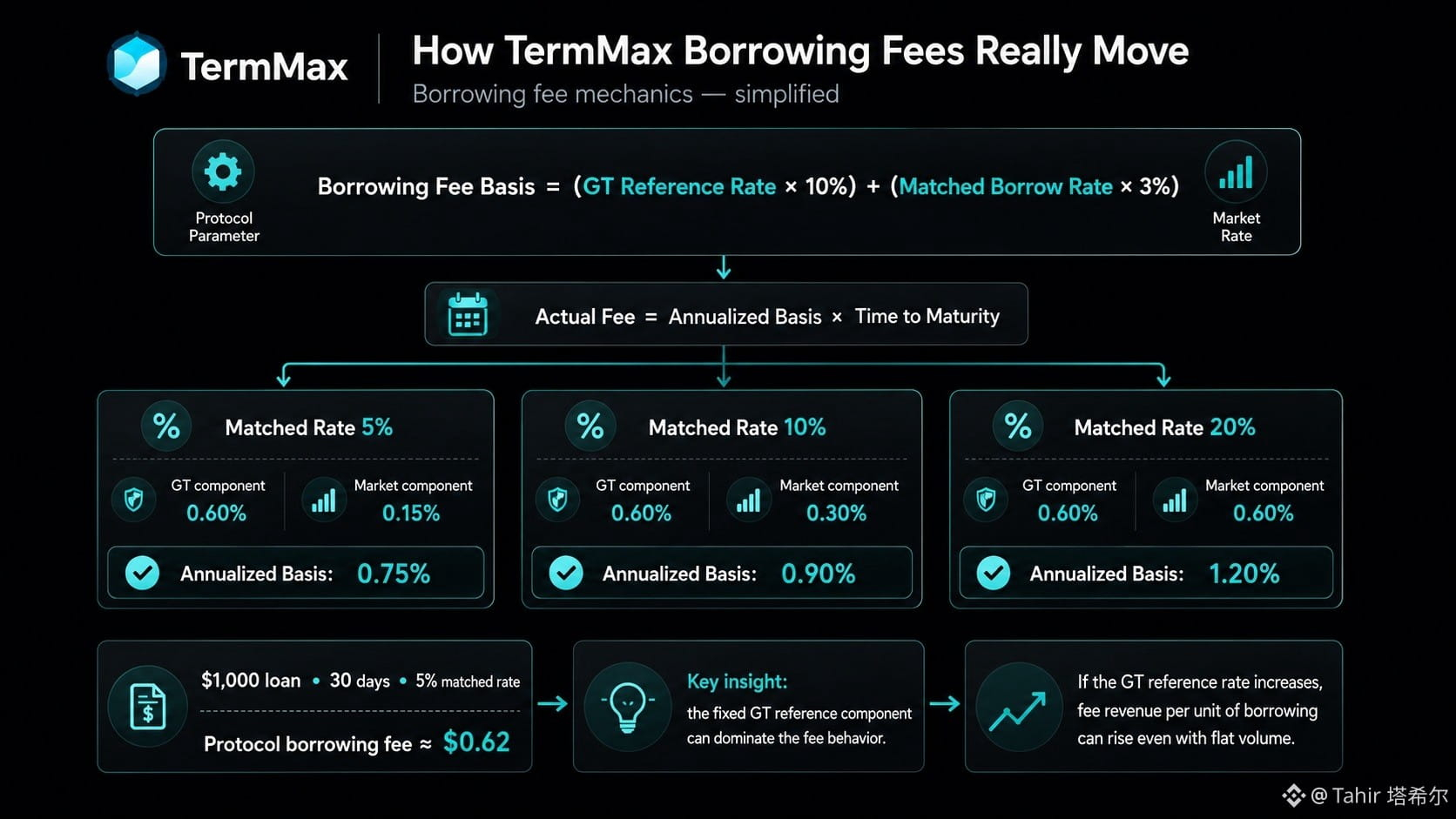
#termmax @termmax The number that changed my view of TermMax fees was not the borrowing rate itself. It was the fixed GT-minting component sitting beside it.
For a stablecoin example, TermMax’s documentation uses a 6% GT minting reference rate with a 10% fee multiplier, plus 3% of the matched borrowing rate. At a 5% borrow rate, those pieces contribute 0.60% and 0.15% respectively before maturity adjustment. Double the matched rate to 10%, and the combined annualized fee basis only moves from 0.75% to 0.90%.
That is a useful behavioral detail. Borrowers may focus on the visible market rate, while part of TermMax’s protocol charge barely reacts to it. Even at a 20% borrowing rate, the matched-rate component contributes only 0.60% the same size as the 6% GT reference component.
For a 30-day, $1,000 loan at 5%, that formula works out to roughly $0.62 in protocol borrowing fee.
What I still want to understand is how often that GT reference rate changes. If it moves upward, TermMax can raise fee revenue per unit of borrowing without higher volume or a higher matched rate. That parameter looks economically more important than its quiet placement suggests.
@termmax #TermMax
#termmax @TermMax The number that changed my view of TermMax fees was not the borrowing rate itself. It was the fixed GT-minting component sitting beside it.
For a stablecoin example, TermMax’s documentation uses a 6% GT minting reference rate with a 10% fee multiplier, plus 3% of the matched borrowing rate. At a 5% borrow rate, those pieces contribute 0.60% and 0.15% respectively before maturity adjustment. Double the matched rate to 10%, and the combined annualized fee basis only moves from 0.75% to 0.90%.
That is a useful behavioral detail. Borrowers may focus on the visible market rate, while part of TermMax’s protocol charge barely reacts to it. Even at a 20% borrowing rate, the matched-rate component contributes only 0.60% the same size as the 6% GT reference component.
For a 30-day, $1,000 loan at 5%, that formula works out to roughly $0.62 in protocol borrowing fee.
What I still want to understand is how often that GT reference rate changes. If it moves upward, TermMax can raise fee revenue per unit of borrowing without higher volume or a higher matched rate. That parameter looks economically more important than its quiet placement suggests.
@TermMax #TermMax
For a stablecoin example, TermMax’s documentation uses a 6% GT minting reference rate with a 10% fee multiplier, plus 3% of the matched borrowing rate. At a 5% borrow rate, those pieces contribute 0.60% and 0.15% respectively before maturity adjustment. Double the matched rate to 10%, and the combined annualized fee basis only moves from 0.75% to 0.90%.
That is a useful behavioral detail. Borrowers may focus on the visible market rate, while part of TermMax’s protocol charge barely reacts to it. Even at a 20% borrowing rate, the matched-rate component contributes only 0.60% the same size as the 6% GT reference component.
For a 30-day, $1,000 loan at 5%, that formula works out to roughly $0.62 in protocol borrowing fee.
What I still want to understand is how often that GT reference rate changes. If it moves upward, TermMax can raise fee revenue per unit of borrowing without higher volume or a higher matched rate. That parameter looks economically more important than its quiet placement suggests.
@TermMax #TermMax
29
30
5.6k
·
--
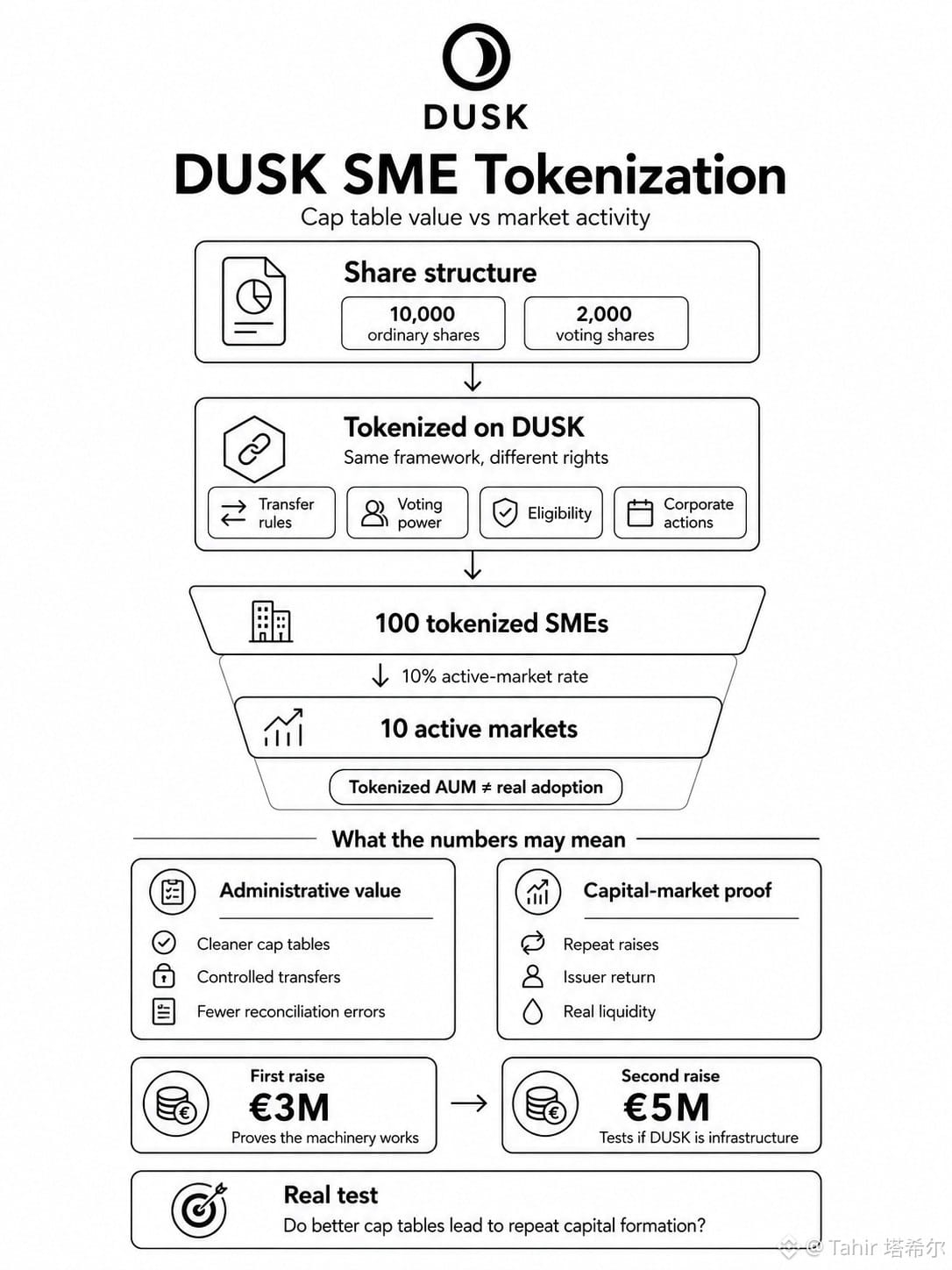
#dusk $DUSK @Dusk_Foundation The part of SME tokenization I keep returning to is surprisingly unglamorous the cap table may matter more than the trading screen.
Take a simple company with 10,000 ordinary shares and 2,000 voting shares. Putting both on DUSK using the same token framework does not make them economically identical. Transfer restrictions, voting power, shareholder eligibility and corporate actions still have to follow the rights attached to each class.
That changes how I read adoption numbers.
If DUSK eventually supports 100 tokenized SMEs but only 10 develop active secondary markets, calling the other 90 failures would miss part of the value. Cleaner ownership records, controlled transfers and fewer reconciliation errors could already improve administration.
But it also exposes a weaker metric: tokenized AUM. €100 million represented on-chain tells me very little if those shares rarely change hands and issuers never return for another raise.
A first €3 million issuance can prove the machinery works. A later €5 million raise from the same issuer would tell me much more about whether DUSK became useful infrastructure.
I can see the administrative case. What remains unclear is whether better cap tables eventually produce repeat capital formation, or simply better records of illiquid ownership.
@Dusk_Foundation #dusk $DUSK
#dusk $DUSK @Dusk The part of SME tokenization I keep returning to is surprisingly unglamorous the cap table may matter more than the trading screen.
Take a simple company with 10,000 ordinary shares and 2,000 voting shares. Putting both on DUSK using the same token framework does not make them economically identical. Transfer restrictions, voting power, shareholder eligibility and corporate actions still have to follow the rights attached to each class.
That changes how I read adoption numbers.
If DUSK eventually supports 100 tokenized SMEs but only 10 develop active secondary markets, calling the other 90 failures would miss part of the value. Cleaner ownership records, controlled transfers and fewer reconciliation errors could already improve administration.
But it also exposes a weaker metric: tokenized AUM. €100 million represented on-chain tells me very little if those shares rarely change hands and issuers never return for another raise.
A first €3 million issuance can prove the machinery works. A later €5 million raise from the same issuer would tell me much more about whether DUSK became useful infrastructure.
I can see the administrative case. What remains unclear is whether better cap tables eventually produce repeat capital formation, or simply better records of illiquid ownership.
@Dusk #dusk $DUSK
Take a simple company with 10,000 ordinary shares and 2,000 voting shares. Putting both on DUSK using the same token framework does not make them economically identical. Transfer restrictions, voting power, shareholder eligibility and corporate actions still have to follow the rights attached to each class.
That changes how I read adoption numbers.
If DUSK eventually supports 100 tokenized SMEs but only 10 develop active secondary markets, calling the other 90 failures would miss part of the value. Cleaner ownership records, controlled transfers and fewer reconciliation errors could already improve administration.
But it also exposes a weaker metric: tokenized AUM. €100 million represented on-chain tells me very little if those shares rarely change hands and issuers never return for another raise.
A first €3 million issuance can prove the machinery works. A later €5 million raise from the same issuer would tell me much more about whether DUSK became useful infrastructure.
I can see the administrative case. What remains unclear is whether better cap tables eventually produce repeat capital formation, or simply better records of illiquid ownership.
@Dusk #dusk $DUSK
33
33
9.6k
·
--
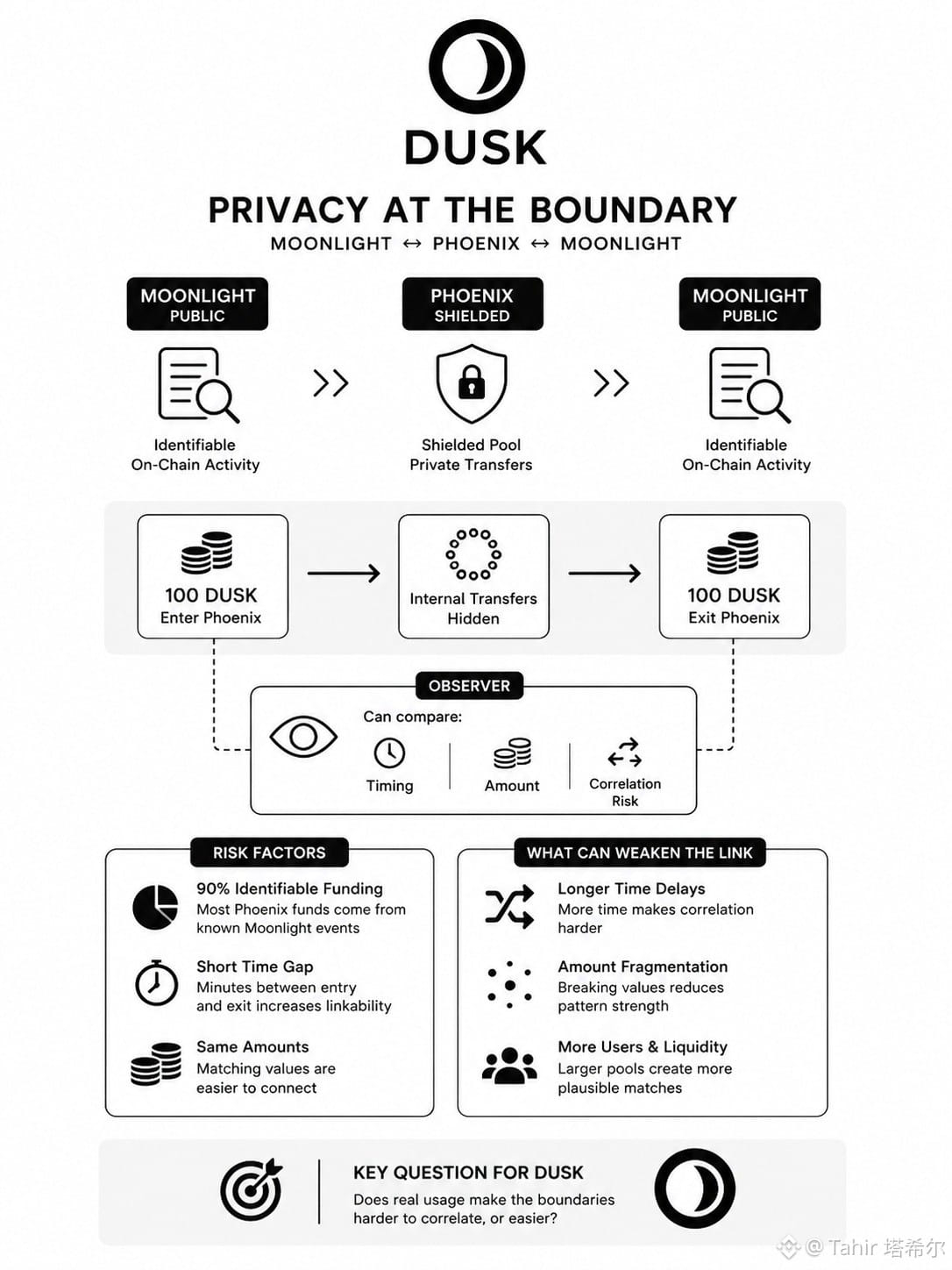
#dusk $DUSK Last week I kept thinking about one weakness that may matter more than Phoenix’s theoretical privacy set: what happens at the boundary between public and shielded activity.
Imagine 100 DUSK moving from Moonlight into Phoenix, then roughly 100 DUSK leaving Phoenix a few minutes later. Phoenix may hide the internal transaction path, but an observer could still compare entry amount, exit amount and timing. That does not prove the two events belong to the same user, yet it may narrow the practical anonymity far more than the headline privacy-set size suggests.
The same issue becomes sharper if, hypothetically, 90% of Phoenix funding originates from identifiable Moonlight events. A large privacy pool can exist cryptographically while funding patterns still create strong external clues.
That is the distinction I keep coming back to with DUSK: privacy-set size and boundary-linkability are not the same metric.
The counterpoint is important. Timing correlation is inference, not proof, and larger flows, delays, fragmented amounts and more users could weaken those links.
Still, variable transparency only works if switching between Moonlight and Phoenix does not quietly rebuild the transaction graph.
For DUSK the question is whether real usage makes those boundaries harder to correlate, or easier.
@Dusk_Foundation #dusk $DUSK
#dusk $DUSK Last week I kept thinking about one weakness that may matter more than Phoenix’s theoretical privacy set: what happens at the boundary between public and shielded activity.
Imagine 100 DUSK moving from Moonlight into Phoenix, then roughly 100 DUSK leaving Phoenix a few minutes later. Phoenix may hide the internal transaction path, but an observer could still compare entry amount, exit amount and timing. That does not prove the two events belong to the same user, yet it may narrow the practical anonymity far more than the headline privacy-set size suggests.
The same issue becomes sharper if, hypothetically, 90% of Phoenix funding originates from identifiable Moonlight events. A large privacy pool can exist cryptographically while funding patterns still create strong external clues.
That is the distinction I keep coming back to with DUSK: privacy-set size and boundary-linkability are not the same metric.
The counterpoint is important. Timing correlation is inference, not proof, and larger flows, delays, fragmented amounts and more users could weaken those links.
Still, variable transparency only works if switching between Moonlight and Phoenix does not quietly rebuild the transaction graph.
For DUSK the question is whether real usage makes those boundaries harder to correlate, or easier.
@Dusk #dusk $DUSK
Imagine 100 DUSK moving from Moonlight into Phoenix, then roughly 100 DUSK leaving Phoenix a few minutes later. Phoenix may hide the internal transaction path, but an observer could still compare entry amount, exit amount and timing. That does not prove the two events belong to the same user, yet it may narrow the practical anonymity far more than the headline privacy-set size suggests.
The same issue becomes sharper if, hypothetically, 90% of Phoenix funding originates from identifiable Moonlight events. A large privacy pool can exist cryptographically while funding patterns still create strong external clues.
That is the distinction I keep coming back to with DUSK: privacy-set size and boundary-linkability are not the same metric.
The counterpoint is important. Timing correlation is inference, not proof, and larger flows, delays, fragmented amounts and more users could weaken those links.
Still, variable transparency only works if switching between Moonlight and Phoenix does not quietly rebuild the transaction graph.
For DUSK the question is whether real usage makes those boundaries harder to correlate, or easier.
@Dusk #dusk $DUSK
30
35
11.6k
Connectez-vous pour découvrir plus de contenu
Rejoignez la communauté mondiale des adeptes de cryptomonnaies sur Binance Square
⚡️ Suviez les dernières informations importantes sur les cryptomonnaies.
💬 Jugé digne de confiance par la plus grande plateforme d’échange de cryptomonnaies au monde.
👍 Découvrez les connaissances que partagent les créateurs vérifiés.
Adresse e-mail/Nº de téléphone
Sujets d’actualité
BitwiseFilesFinalNEARSpotETFProspectus
43,979 vues
1,082 mentions
#bitwisefilesfinalnearspotetfprospectus
Can $NEAR REALLY reach $562 with an ETF approval? 🚀
The crypto market is buzzing as Bitwise files its final prospectus for a Spot NEAR ETF (Ticker: NRR on NYSE Arca)! 📊🔥
Is institutional money about to unleash the biggest pump in NEAR’s history? Analysts are throwing around mind-blowing price targets:
🎯 Intermediate Target: $155
🎯 2030 Long-Term Target: $562
💡 Let's do the math:
At $562, $NEAR would sit at roughly a $680 Billion market cap—putting it right up there with Ethereum's potential valuation. With NEAR leading the Chain Abstraction & AI crypto narrative, this might not be as crazy as it sounds!
With SEC regulations turning more crypto-friendly and Wall Street knocking on the door, are you Accumulating or Holding?
👇 Drop your realistic price prediction for $NEAR in the comments! 👇
#BitwiseFilesFinalNEARSpotETFProspectus #Altcoins #CryptoNews #ETF
Doomsday-Trader
·4 mentions J’aime
·3.2k vues
BitgetHackerMoves$83MStolenXRP
22,895 vues
147 mentions
SOLSpotETFWeeklyInflow$188M
13,137 vues
112 mentions