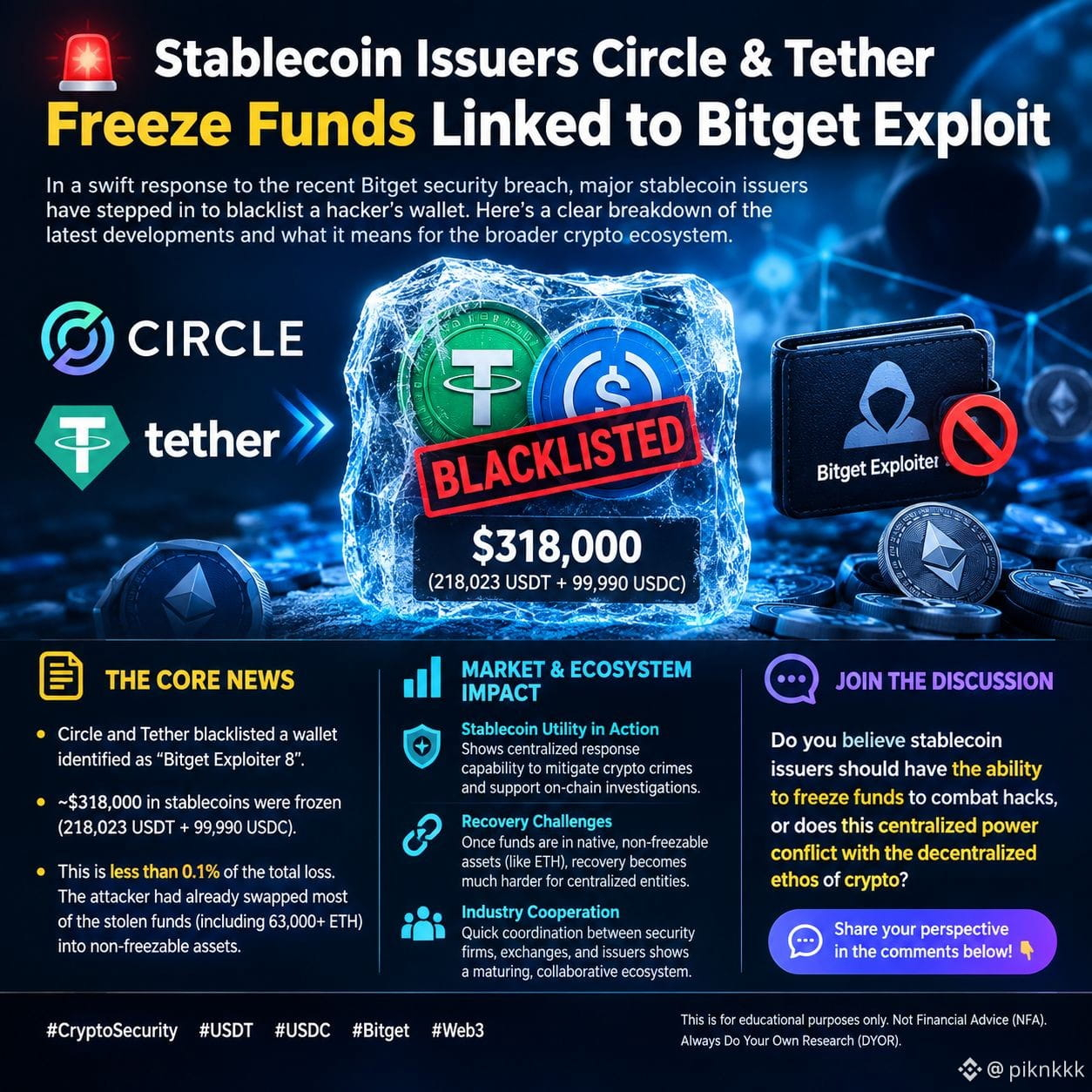
#circletetherfreezebitgethackerwallet 🚨 Stablecoin Issuers Circle & Tether Freeze Funds Linked to Bitget Exploit
In a swift response to the recent Bitget security breach, major stablecoin issuers have stepped in to blacklist a hacker’s wallet. Here is a clear breakdown of the latest developments and what it means for the broader crypto ecosystem.
📌 The Core News
• Circle and Tether have jointly blacklisted a wallet identified by security firms as "Bitget Exploiter 8" [[4]].
• This coordinated action successfully froze approximately $318,000 in stablecoins, consisting of roughly 218,023 USDT and 99,990 USDC [[13]].
• Notably, this frozen amount represents less than 0.1% of the total reported loss. The attacker had already swapped the majority of the stolen funds (including over 63,000 ETH) into decentralized, non-freezable assets before the blacklist was applied [[14]].
📊 Market & Ecosystem Impact
• Stablecoin Utility in Action This event highlights the centralized response capability of fiat-backed stablecoin issuers to actively mitigate crypto-related crimes and assist in on-chain investigations.
• Recovery Challenges It underscores a critical security reality: once funds are converted into native, non-freezable blockchain assets (like ETH), recovery becomes significantly more complex for centralized entities.
• Industry Cooperation The rapid coordination between blockchain security firms, exchanges, and stablecoin issuers demonstrates a maturing, collaborative ecosystem response to large-scale exploits.
💬 Join the Discussion
Do you believe stablecoin issuers should have the ability to freeze funds to combat hacks, or does this centralized power conflict with the decentralized ethos of crypto? Share your perspective in the comments below! 👇
🔖 Hashtags
#CryptoSecurity #USDT #USDC #Bitget #Web3
This is for educational purposes only. Not Financial Advice (NFA). Always Do Your Own Research (DYOR).
$RAY $SUPER $DASH
In a swift response to the recent Bitget security breach, major stablecoin issuers have stepped in to blacklist a hacker’s wallet. Here is a clear breakdown of the latest developments and what it means for the broader crypto ecosystem.
📌 The Core News
• Circle and Tether have jointly blacklisted a wallet identified by security firms as "Bitget Exploiter 8" [[4]].
• This coordinated action successfully froze approximately $318,000 in stablecoins, consisting of roughly 218,023 USDT and 99,990 USDC [[13]].
• Notably, this frozen amount represents less than 0.1% of the total reported loss. The attacker had already swapped the majority of the stolen funds (including over 63,000 ETH) into decentralized, non-freezable assets before the blacklist was applied [[14]].
📊 Market & Ecosystem Impact
• Stablecoin Utility in Action This event highlights the centralized response capability of fiat-backed stablecoin issuers to actively mitigate crypto-related crimes and assist in on-chain investigations.
• Recovery Challenges It underscores a critical security reality: once funds are converted into native, non-freezable blockchain assets (like ETH), recovery becomes significantly more complex for centralized entities.
• Industry Cooperation The rapid coordination between blockchain security firms, exchanges, and stablecoin issuers demonstrates a maturing, collaborative ecosystem response to large-scale exploits.
💬 Join the Discussion
Do you believe stablecoin issuers should have the ability to freeze funds to combat hacks, or does this centralized power conflict with the decentralized ethos of crypto? Share your perspective in the comments below! 👇
🔖 Hashtags
#CryptoSecurity #USDT #USDC #Bitget #Web3
This is for educational purposes only. Not Financial Advice (NFA). Always Do Your Own Research (DYOR).
$RAY $SUPER $DASH