

The AI story is still moving fast.
New chips are coming out, data centers are getting bigger, and companies are continuing to put huge amounts of money into computing capacity.
But lately, I’ve been thinking about a slightly different question.
What happens after all that money is spent?
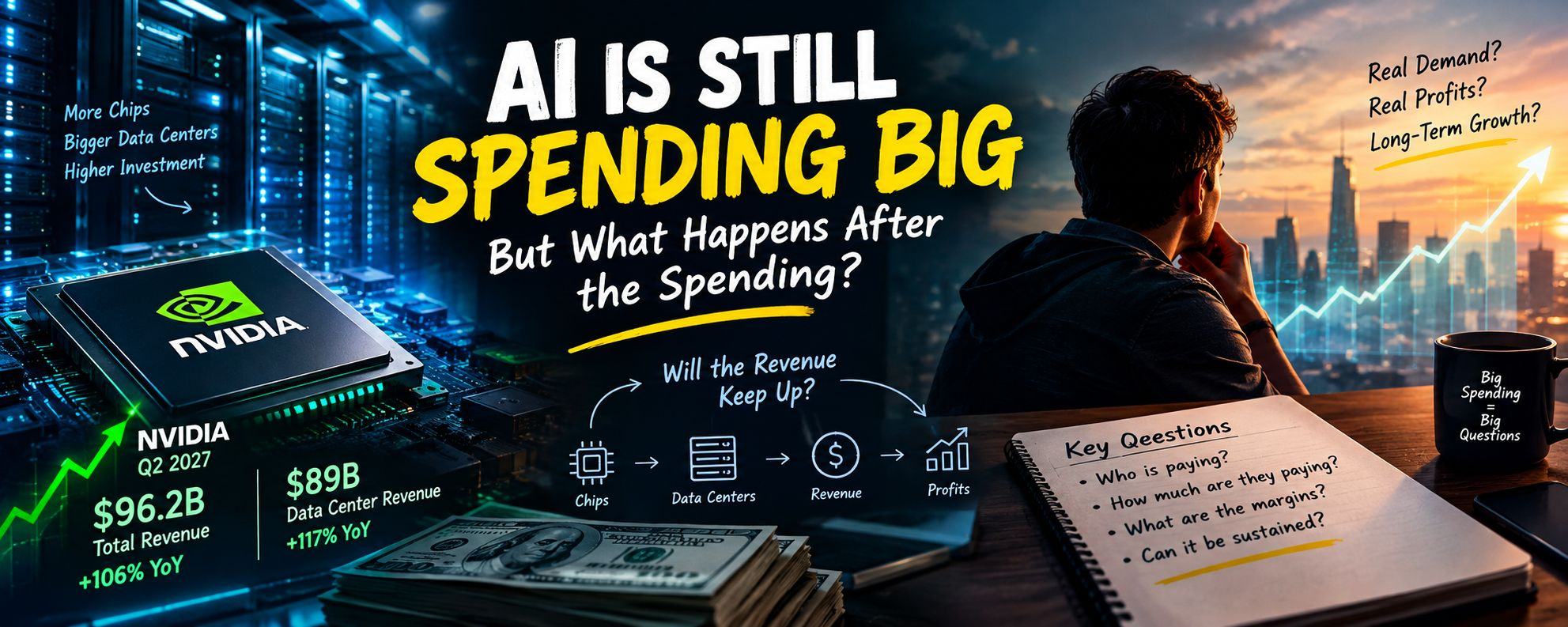
There’s really no question that demand for AI computing is strong right now. NVIDIA’s latest numbers make that pretty clear. The company reported $96.2 billion in revenue for fiscal Q2 2027, while its Data Center business generated $89 billion, up 117% from a year earlier. NVIDIA is also expecting around $108 billion in revenue for the next quarter.
That is a remarkable level of growth.
But strong demand for chips is only one part of the story.
Someone has to pay for those chips.
Someone has to keep those data centers busy.
And eventually, the companies using all that computing power need to make enough money from AI to justify what they’re spending.
That’s the part I find more interesting now.
Take AI infrastructure companies.
Some of them are seeing very fast revenue growth, but the costs involved are enormous. Nscale, for example, reported $140.6 million in revenue during the first half of 2026, while also recording a net loss of roughly $1.02 billion.
I don’t think a large loss automatically means the business is a bad one.
Building AI infrastructure is expensive, and companies are clearly spending ahead of where they are today because they expect demand to keep growing.
Still, numbers like that make me stop and think.
If a company has to spend several dollars today to create one dollar of future revenue, how long can that model keep working?
Maybe the answer is that AI demand becomes so large that the economics improve with scale.
Maybe cheaper inference, better hardware utilization and more enterprise customers eventually change the equation.
Or maybe some of today’s spending will turn out to have been too aggressive.
We simply don’t know yet.
And I think that uncertainty is important.
The same thing is happening with the larger semiconductor companies.
AMD recently crossed the $1 trillion market-capitalization mark as AI-related stocks rallied. The excitement around AI infrastructure is clearly still strong.
But there’s an interesting difference between a company benefiting from a powerful industry trend and a stock being attractively priced.
Those are two separate questions.
A business can have excellent growth and still have a stock price that already assumes a lot of good news.
That’s why I’m paying more attention to earnings and cash flow than I was earlier in the AI cycle.
I want to see whether companies can turn all this demand into something that lasts.
Not just another quarter of strong orders.
Not just another big data-center announcement.
I mean actual customers, recurring revenue, improving margins and eventually stronger free cash flow.
There’s another side to this as well.
The amount of capital going into AI is becoming so large that financing itself is becoming part of the story. Reuters recently reported on major financing deals supporting AI infrastructure projects, including a $22 billion loan connected to Crux, a cloud venture involving Blackstone and Alphabet.
That doesn’t necessarily concern me by itself.
Large infrastructure projects have always required financing.
But when an industry starts needing enormous amounts of outside capital, I think it becomes even more important to understand the returns those investments are expected to produce.
That’s really where I am with AI right now.
I’m not questioning whether the technology has demand.
It obviously does.
I’m more curious about how much of today’s spending will eventually turn into durable profits.
Because if AI genuinely helps companies cut costs, create new products and increase productivity, then this investment cycle could continue for a long time.
But if infrastructure keeps expanding much faster than profitable AI applications, investors may eventually become more selective.
And that could change the market quite a bit.
My view
I’m still positive about the long-term growth of AI.
But I’m less interested in simply finding the next stock connected to the AI theme.
I’d rather understand the business behind it.
Who is paying?
How much are they paying?
How expensive is it to serve them?
And after all those costs, how much money is actually left?
Those questions aren’t as exciting as another record revenue headline.
But I think they may become much more important as the AI industry gets bigger.
For me, the next chapter of the AI story is going to be about economics, not excitement.
🟢 Bullish — AI adoption continues to spread and demand for computing keeps expanding
🔴 Bearish — Spending gets ahead of the revenue and profits needed to support it
⚖️ My view — Positive on AI adoption, but selective about the companies and valuations attached to it
The technology is moving quickly.
Now I’m watching to see whether the money can keep up with it.