


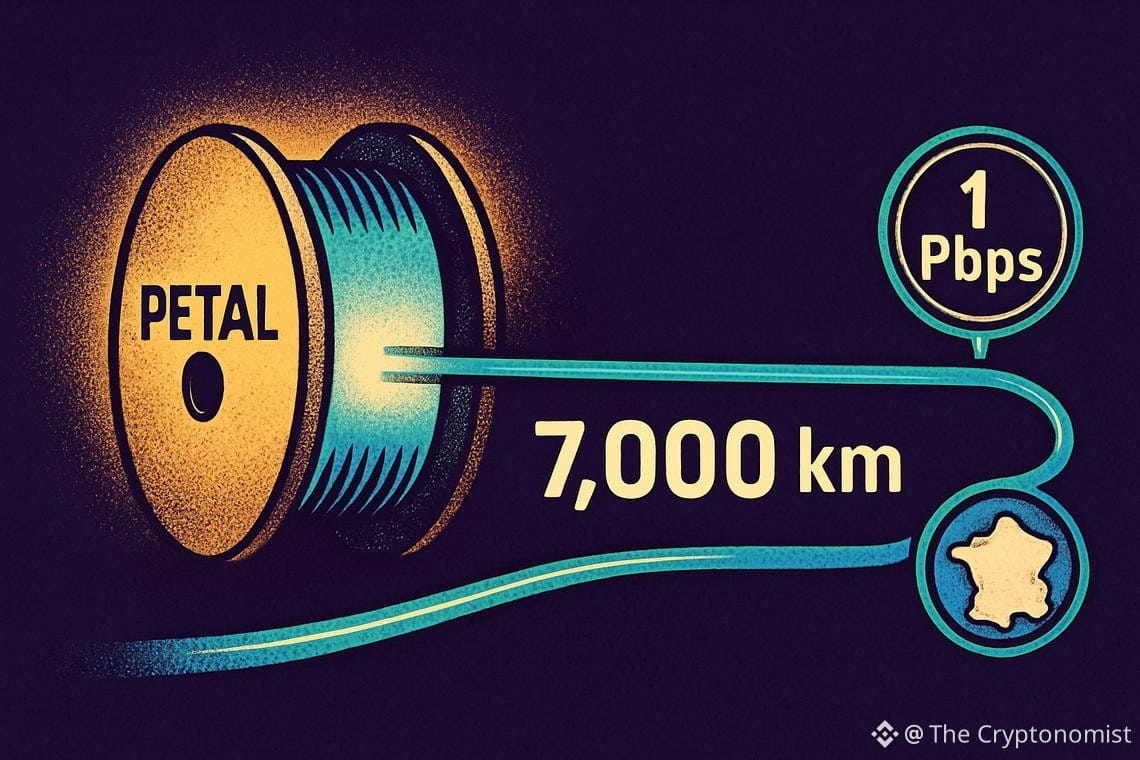
Meta is stepping into new territory with the announcement of Petal, described as the first petabit subsea cable ever built to span an ocean. The project promises to double the data-carrying capacity of today’s most advanced transatlantic systems, and it does so using a fiber technology that has never before been deployed at this scale across thousands of kilometers of ocean floor.
Key takeaways
Petal will be the first transoceanic subsea cable to deliver petabit capacity, connecting France and the United States over roughly 7,000 km.
The cable is expected to enter service in 2029 and will carry 1 Pbps — double the capacity of Anjana, currently the most advanced transatlantic system.
Petal introduces 2-core fiber technology at scale, packing the equivalent of 48 fiber pairs into a 24 fiber-pair system.
Meta is building Petal with NEC as the turnkey supplier, Sumitomo Electric Industries as the fiber manufacturer, and Orange handling the French landing.
Its capacity is roughly enough for 75% of the world’s population to stream music at the same time.
Meta Launches Petal, the First Petabit-Capacity Transoceanic Subsea Cable
Petal marks a genuine first for the subsea industry: no other cable crossing an ocean has ever been engineered to move a full petabit of data per second. Meta unveiled the project as the newest addition to its growing portfolio of privately built undersea systems, positioning it as a direct answer to surging demand for cross-continental bandwidth.
Record-Breaking Capacity for Transatlantic Data Transmission
Petal will deliver 1 Pbps — that’s 1,000 terabits per second — which doubles the throughput of Anjana, Meta’s 24 fiber-pair system that currently holds the title of the most capable transatlantic cable at 0.5 Pbps. To put that scale into perspective, Meta says Petal’s total capacity is roughly what would be needed for 75% of the world’s population to stream music simultaneously. Few pieces of internet infrastructure operate at that kind of scale, which is part of why the announcement is drawing attention well beyond telecom engineering circles.
Route and Service Timeline
The cable will run approximately 7,000 km (4,300 mi), linking France directly to the United States. Meta expects Petal to enter service in 2029, giving the company and its partners a multi-year construction and testing window before the system goes live. That timeline places Petal alongside a broader wave of next-generation subsea projects the industry is racing to complete by the end of the decade.
Innovative Multi-Core Fiber Technology Powers Petal’s High Capacity
What sets Petal apart isn’t just its raw throughput — it’s the fiber technology making that throughput possible. Petal will be the first subsea cable system to deploy multi-core fiber technology at scale, a shift Meta describes as a rethinking of how the industry approaches cable design altogether.
Scaling Multi-Core Fiber at Subsea Distances
Subsea capacity has grown through several distinct eras. The erbium-doped fiber amplifier arrived in the 1980s, and coherent optical transmission in the 2010s pushed fiber capacity up by 10x or more — until physical limits started closing that door. The industry’s next move was spatial division multiplexing, simply adding more fiber pairs inside each cable. Meta walked that path itself, scaling from Marea’s eight fiber pairs to Amitié’s 16, then to Anjana’s 24.
Petal takes a different route. Rather than physically doubling the number of fiber pairs to 48, Meta opted for 2-core fiber technology packed into a 24 fiber-pair system — mathematically equivalent to 48 fiber pairs, but without the added bulk, materials, or power draw that a literal doubling would require. Meta calls it the single largest generational leap in capacity of any repeatered subsea system built to date.
Technical Challenges in Fiber and Repeater Design
Squeezing two cores into one strand of glass isn’t trivial. Engineers had to solve two separate problems: keeping attenuation low while preserving the fiber’s standard 125 μm width, and minimizing crosstalk between the two cores so signals don’t bleed into each other. Meta addressed the first challenge with ultra-pure synthetic silica during preform manufacturing, and the second by carefully tuning refractive indexes between the cores and the surrounding material, combined with counter-propagating the optical signals — a method that reduces crosstalk to what Meta calls nearly immeasurable levels.
The repeaters that amplify signals along the cable’s length needed their own redesign. A 7,000 km run typically requires around a hundred repeaters, and Petal’s version amplifies 96 fiber cores in a single body using a Fan-In/Fan-Out interface, which converts 2-core fiber into single-core fiber for amplification before converting it back. That approach lets Petal keep the efficiency and reliability of single-core amplification while doubling capacity — and crucially, it does so without pushing power requirements past existing limits. Petal will stay within power feeding equipment rated up to 18 kV, meaning the system avoids the costly requalification process that higher voltages would trigger.
Strategic Partnerships Drive Petal’s Construction and Deployment
Petal’s design only works because of the engineering behind it, and Meta is building the cable with three key partners. NEC serves as the turnkey system supplier, responsible for engineering, qualifying, manufacturing, and installing the finished cable — work Meta says required NEC to make significant new investments in manufacturing facilities capable of producing petabit-class repeaters and multicore fiber cable.
Sumitomo Electric Industries, acting as NEC’s fiber supplier, developed and manufactured the 2-core fiber itself, achieving what Meta describes as optical performance nearly identical to standard single-core fiber despite the added complexity.
Orange, meanwhile, is working with Meta on landing Petal along France’s Atlantic coast and integrating it into the European terrestrial network. Jean-Louis Le Roux, EVP of Orange International Networks, framed the milestone in historical terms: “Reaching one petabit on a transatlantic link, 25 years after the terabit milestone, represents a significant breakthrough to meet the exponential traffic growth while optimizing network capacity. This makes us very proud to welcome this new generation petabit subsea cable with dual-core fiber technology in our infrastructure, as the landing party in France. This new project reinforces our commitment with Meta and demonstrates our leading expertise in landing subsea systems, and extending connectivity to other European countries. It underlines our dedication to developing reliable infrastructure that guarantees the security and resilience of the terrestrial segment of those connections.”
Implications for Global Connectivity and Network Infrastructure
Petal isn’t happening in isolation. Meta has become one of the world’s largest private investors in subsea cable infrastructure, and this announcement lands alongside other major projects already underway — including Project Waterworth, a system spanning over 50,000 kilometers across five continents that also uses a 24 fiber-pair architecture, and Aurora, a transatlantic cable connecting the US to Denmark over roughly 7,268 kilometers, targeting around 497 Tbps and expected to enter service in 2028.
Supporting Massive Data Demand
Why does this matter beyond the engineering specs? Subsea cables remain the physical backbone carrying the overwhelming majority of intercontinental internet traffic — the messages, calls, and video streams moving between continents almost entirely travel through glass strands on the ocean floor. As demand for bandwidth keeps climbing, driven in part by AI workloads and growing reliance on cloud infrastructure, the pressure to expand capacity without proportionally expanding power and materials becomes a defining engineering problem. Petal’s approach — doubling throughput through fiber design rather than sheer physical scale — offers one answer to that problem, and Meta is positioning the technology as something the wider industry can adopt, not just a proprietary advantage.
Industry and Regional Impact
The push toward petabit-class subsea cables reflects a broader shift already visible across the tech sector, where hyperscalers have moved from leasing capacity on telecom-built cables to designing and owning their own systems outright. Meta isn’t alone in that race — other major technology companies have made similar moves into subsea infrastructure — but the scale of its recent commitments, from Waterworth’s five-continent reach to Petal’s petabit ambitions, stands out even within that competitive field. For France and the broader European market, Petal’s landing through Orange also reinforces the region’s role as a key terrestrial gateway for transatlantic data flows, a factor that matters as demand for reliable, high-capacity connectivity keeps rising on both sides of the Atlantic.
FAQ
What is Petal and what makes it innovative?
Petal is the first transoceanic subsea cable to deliver petabit capacity using multi-core fiber technology at scale, doubling previous cable capacities.
When will Petal enter service and what route does it cover?
Petal is expected to enter service in 2029 and will connect France and the United States over approximately 7,000 km.
How does Petal’s technology improve subsea cable capacity?
Petal uses 2-core fiber technology and a 24 fiber-pair system equivalent to 48 fiber pairs, enabling 1 Pbps capacity with efficient repeaters.
Which companies are partnering with Meta on the Petal cable project?
Meta is partnering with NEC, Sumitomo Electric Industries, and Orange to build and land the Petal subsea cable.
Article produced with the assistance of artificial intelligence and reviewed by the editorial team.