



The XRP and XLM stories are becoming increasingly interesting because both cryptocurrencies are moving around the same broad theme: the future of blockchain-based payments and the rules governing digital assets in the United States.
But while XRP and XLM are often compared because both are designed around fast and efficient payments, their current developments are taking somewhat different paths. XRP is attracting attention around institutional adoption, regulatory developments and the XRP Ledger, while Stellar is preparing for a major protocol upgrade and gaining attention from financial-infrastructure experiments.
The biggest short-term catalyst for both could now be the U.S. CLARITY Act.
XRP: Regulation Becomes the Main Story
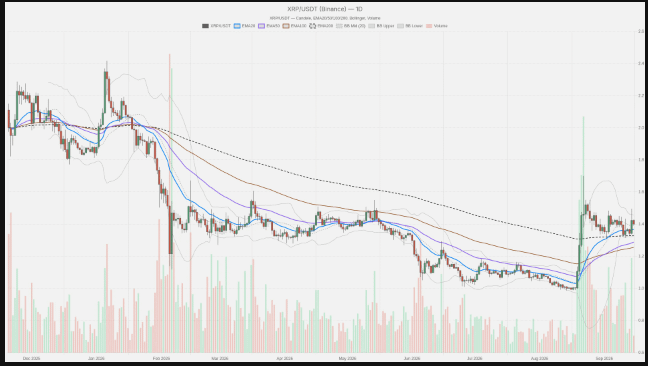
XRP is trading around the $1.40 area on September 15, with market momentum showing signs of hesitation after a stronger period of performance. Current technical analysis describes XRP as being in a zone where buyers and sellers are fighting for control rather than where a clear trend has already been established.
The timing is important.
The U.S. Senate is scheduled to conduct a procedural vote on the CLARITY Act today. The vote is not the final passage of the legislation; it is a vote related to moving the bill forward. The measure has become an important focus for crypto investors because clearer definitions around digital assets could influence how cryptocurrencies are regulated in the United States.
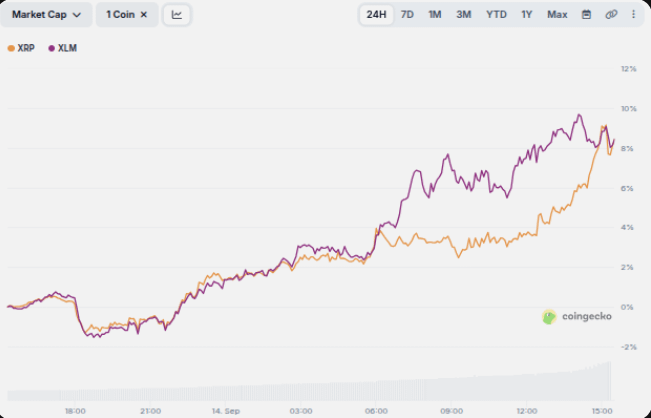
XRP has already shown how sensitive it can be to regulatory developments. Reports indicated that XRP and XLM both gained more than 8% on September 14 as traders positioned around the expected Senate vote.
However, the market is now facing a different question:
Can positive regulatory expectations turn into sustained demand, or was the recent move simply positioning ahead of an event?
That distinction could determine XRP's next major direction.
XRP Ledger Activity Is Another Important Signal
Beyond price, activity on the XRP Ledger is attracting attention.
Recent data reported that the XRP Ledger reached a new all-time high in total addresses, while XRP's market capitalization had increased substantially over the previous month.
That type of network growth is worth watching because price alone does not tell the complete story.
A cryptocurrency can rally because of speculation, but growing network participation can provide another layer of information about the ecosystem.
There is also continued institutional interest around XRP-related investment products. Earlier in September, reports highlighted strong XRP ETF inflows, including a 2026 weekly record of more than $110 million in one reported period.
At the same time, investors still need to watch supply dynamics. Ripple's scheduled September 1 release of 1 billion XRP from escrow was closely monitored by the market, although reports indicated that a large portion was subsequently returned to escrow.
So XRP currently has several forces operating at once: regulatory expectations, institutional demand, network activity and supply management.
XLM: Stellar Is Building a Different Institutional Story
XLM is following a similar market theme but with a different development path.
Stellar has recently been attracting attention from financial infrastructure projects, with XLM trading near $0.19–$0.20 in recent reports.
One of the more interesting developments involves a stablecoin clearing prototype built using the Stellar network.
The prototype was integrated with the Bank of England's RTGS test environment to explore stablecoin clearing and settlement flows alongside central-bank infrastructure.
This does not mean that Stellar has been adopted as part of the Bank of England's permanent payment system. Instead, the development is significant because it demonstrates how blockchain infrastructure can be tested in environments connected to traditional financial systems.
That is exactly the type of development XLM investors should watch.
The long-term question is not simply whether XLM's price rises.
It is whether Stellar can become useful infrastructure for real-world settlement, tokenized assets and financial applications.
Protocol 28 Could Become Another Catalyst
Stellar is also approaching an important technical milestone.
The network is preparing for its Protocol 28 upgrade vote on September 16, giving the XLM ecosystem another event to monitor immediately after today's U.S. regulatory developments.
This creates an interesting sequence for the market.
First, traders are watching U.S. crypto regulation.
Then, Stellar has its own protocol-level event.
That means XLM could remain sensitive to both macro crypto sentiment and developments specific to the Stellar ecosystem.
XRP vs XLM: Same Theme, Different Positioning
XRP and XLM are frequently placed in the same category because both focus heavily on payments and fast settlement.
But their ecosystems have different structures and strategies.
XRP is closely associated with Ripple's institutional payments business and the XRP Ledger, while Stellar has developed as an open network with a strong focus on financial inclusion, payments and tokenized assets.
That difference matters.
XRP's story increasingly involves institutional finance, regulatory clarity and investment products.
XLM's story is increasingly connected to network upgrades, tokenized financial infrastructure and experiments involving stablecoin settlement.
Neither story guarantees a price increase.
But both demonstrate why the payments sector remains one of the most closely watched areas of blockchain development.
What Happens Next?
For XRP, the immediate focus is the U.S. Senate's CLARITY Act process, followed by the market's reaction to the result and any changes in expectations surrounding digital-asset regulation.
For XLM, the regulatory environment is also important, but the September 16 Protocol 28 vote gives the Stellar ecosystem an additional near-term catalyst.
The biggest risk is that traders have already priced in too much optimism.
If regulatory expectations disappoint, both XRP and XLM could experience sharp volatility. Recent reporting already showed how quickly sentiment can change around the CLARITY Act, with prediction-market odds for passage moving lower and broader crypto prices reacting negatively.
There is also the wider macro environment.
With U.S. markets dealing with Federal Reserve uncertainty, higher Treasury yields and shifting risk appetite, XRP and XLM are not trading in isolation. The broader crypto market remains highly sensitive to liquidity, interest rates and investor confidence.
Final Takeaway
XRP and XLM are entering an important period, but their stories should not be reduced to simple price predictions.
XRP is being watched for regulatory clarity, institutional demand, XRP Ledger growth and ETF-related interest.
XLM is being watched for Stellar's protocol development, institutional infrastructure experiments and its role in tokenized settlement.
The next few days could therefore provide more information about whether recent buying interest represents a temporary event-driven rally or the beginning of a deeper shift in how investors value payment-focused blockchain networks.
For traders, the key is to watch the actual outcomes rather than the headlines alone.
Will the CLARITY Act become the regulatory catalyst that gives XRP and XLM a stronger foundation, or will the market discover that expectations were already priced in?

