
🔥 Iceland Rejects EU Accession Talks in Closely Watched Referendum: Why Markets Should Pay Attention 🔥
The night in Reykjavik felt like a political thriller. As votes arrived, the result kept shifting, leaving Icelanders waiting to discover whether the country would reopen a door it had left closed for more than a decade.
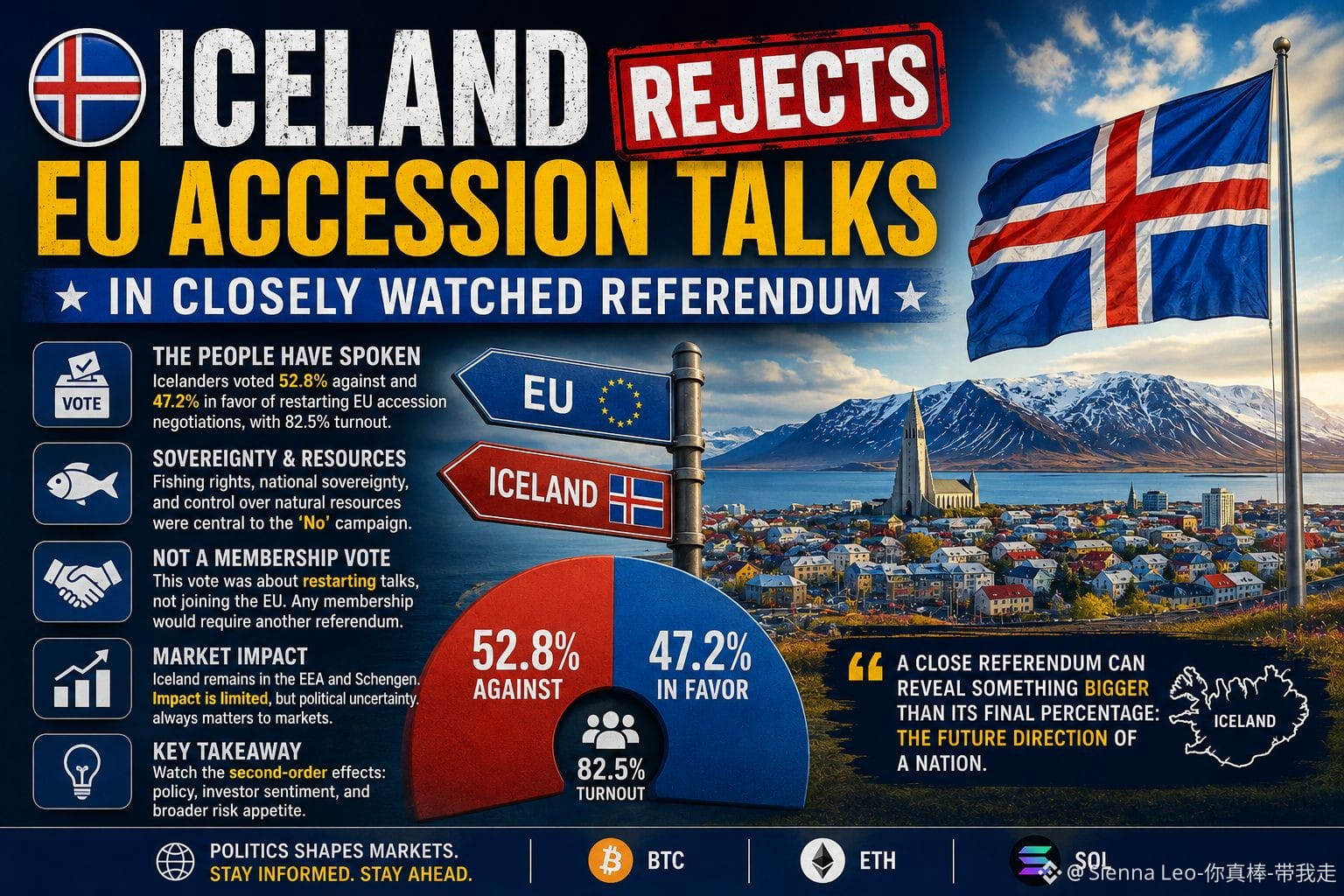
That door is now closed again, at least for the foreseeable future. Icelanders voted 52.8% against and 47.2% in favor of restarting European Union accession negotiations, with turnout reaching 82.5%.
The debate was never simply about Brussels. Fishing rights, national sovereignty, economic independence, and concerns about how EU rules could affect Iceland's resources became central to the "No" campaign.
There is an important detail many headlines can miss: Iceland was not voting directly on EU membership. The referendum asked whether accession negotiations should resume, while any eventual membership agreement would have required another referendum.
For markets, the bigger lesson is about political uncertainty. Iceland remains deeply connected to Europe through the European Economic Area and Schengen, so this result changes less economically than the dramatic headlines might suggest.
For crypto traders, geopolitical and political headlines can influence risk sentiment, but this vote alone is not a reason to assume Bitcoin or altcoins will move in one direction.
The smarter approach is to watch the second-order effects: currency expectations, European policy, investor confidence, and broader risk appetite.
A close referendum can reveal something bigger than its final percentage: markets are increasingly shaped by how nations choose independence, integration, and economic security.
Disclaimer: This article is for informational purposes only and does not constitute financial or investment advice.
#Iceland #EUReferendum #Geopolitics #Write2Earn #GrowWithSAC
The night in Reykjavik felt like a political thriller. As votes arrived, the result kept shifting, leaving Icelanders waiting to discover whether the country would reopen a door it had left closed for more than a decade.
That door is now closed again, at least for the foreseeable future. Icelanders voted 52.8% against and 47.2% in favor of restarting European Union accession negotiations, with turnout reaching 82.5%.
The debate was never simply about Brussels. Fishing rights, national sovereignty, economic independence, and concerns about how EU rules could affect Iceland's resources became central to the "No" campaign.
There is an important detail many headlines can miss: Iceland was not voting directly on EU membership. The referendum asked whether accession negotiations should resume, while any eventual membership agreement would have required another referendum.
For markets, the bigger lesson is about political uncertainty. Iceland remains deeply connected to Europe through the European Economic Area and Schengen, so this result changes less economically than the dramatic headlines might suggest.
For crypto traders, geopolitical and political headlines can influence risk sentiment, but this vote alone is not a reason to assume Bitcoin or altcoins will move in one direction.
The smarter approach is to watch the second-order effects: currency expectations, European policy, investor confidence, and broader risk appetite.
A close referendum can reveal something bigger than its final percentage: markets are increasingly shaped by how nations choose independence, integration, and economic security.
Disclaimer: This article is for informational purposes only and does not constitute financial or investment advice.
#Iceland #EUReferendum #Geopolitics #Write2Earn #GrowWithSAC