

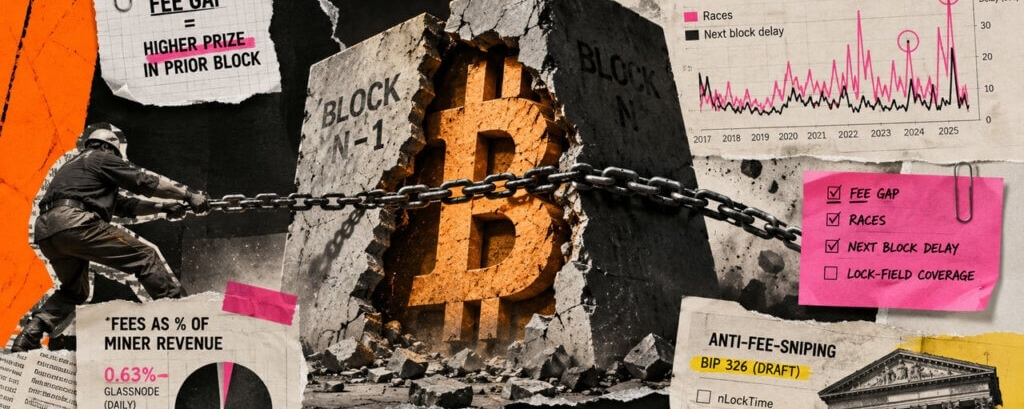

As Bitcoin’s block subsidy declines, researchers are looking beyond total miner revenue and toward a more granular security signal: how sharply transaction fees change from one block to the next.
itcoin’s security-budget debate usually starts with one total: how much miners collect in transaction fees as the block subsidy shrinks.
A July 2026 NBER working paper by Fabian Schär, Dario Thürkauf, and David Yermack points to a second variable. Using data from 2017 through 2025, the authors report that larger fee differences between adjacent Bitcoin blocks are associated with more competing blocks at the same height and a longer wait for the next block.
The evidence is observational and identifies a network-level relationship, while miner intent and the cause of any individual block race remain unresolved. The finding still gives wallets, miners, and users a measurable signal: Bitcoin security incentives respond to how fees arrive from block to block, as well as how much the network pays over time.
Bitcoin currently pays miners a fixed subsidy of 3.125 BTC for each block, plus the transaction fees included in that block. Successive subsidy reductions place more long-run weight on fees as a source of mining revenue.
Block-level data can show much sharper variation than those aggregate readings. An Aug. 26 Blockchain.com block snapshot showed 0.0077 BTC in fees in block 964,120 and 0.0536 BTC in block 964,121, an almost seven-fold change between adjacent blocks. The comparison illustrates how sharply fee rewards can vary from one block to the next, while the fee values alone leave miner behavior unresolved.
The attempt begins behind the accepted tip, and its economic appeal rises when fees in the prior block greatly exceed the expected fees in a new tip-extending block. Hash-rate share, propagation, and other miners’ reactions affect the odds, so the incentive is probabilistic. Variable fees can change the payoff calculation even during periods when the network’s aggregate fee revenue is low.
They also report a lower probability that the next block appears in the first seconds after a large fee gap, a timing pattern consistent with some hash rate contesting the prior height. Since the analysis is observational, the result establishes an association at the network level and leaves individual miner motives unresolved.
Implementation coverage therefore belongs inside the security-budget discussion because a mitigation can be technically available while its network effect depends on the share of pending transactions that use it. Broader and more consistent lock-field behavior would reduce the fees available to a miner trying to rebuild the previous height.
Miners also face a coordination problem because the return from contesting a block depends partly on whether other miners extend the accepted tip. A broad migration toward protective transaction construction changes the available reward directly and can occur under existing consensus rules, avoiding a miner-coordination requirement.
Bitcoin’s fee market can produce occasional outlier blocks even while fees remain a small share of miner revenue. Those outliers deserve closer attention because mining incentives emerge in each block interval, while monthly revenue charts blur the short-lived extremes.