
Techno BNB
16.8k Publications

Techno BNB
 Compte Square Vérifié+
Content Creator | Researcher | Strategy Architect 🌟

Détenteur pour XPL
Trade régulièrement
4.6 an(s)
1.6K+ Suivis
53.4K+ Abonnés
35.3K+ J’aime
Publications
Tous
Citations
Direct
PINNED
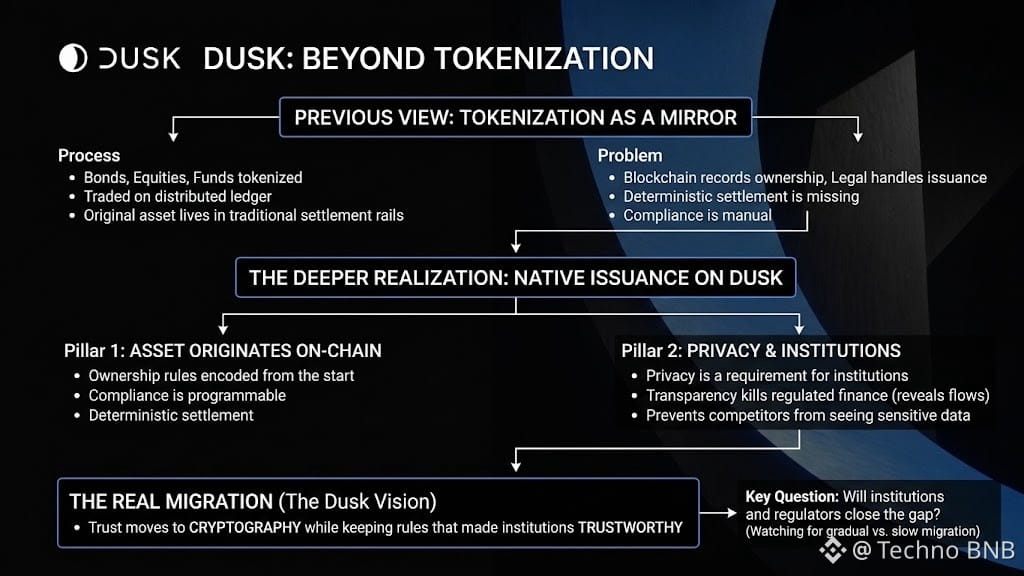
#dusk $DUSK @Dusk Previously, I used to think the migration to blockchain was about bringing existing assets on-chain.
Bonds. Equities. Funds. Tokenize them, trade them on a distributed ledger, and the hardest part was done.
But the more I looked into Dusk, the more I realized that view was incomplete.
Tokenization is a mirror. It reflects an existing asset onto a new system while the original instrument still lives in traditional settlement rails. The blockchain records ownership. The legal system still handles issuance and enforcement. The token is a representation, not a replacement.
Dusk is building for something different.
Native issuance means the asset itself originates on-chain. The ownership rules are encoded from the start. The settlement is deterministic, not probabilistic. The privacy is selective, not optional. The compliance is programmable, not manual.
Most chains treat privacy as a feature for users who want discretion. Dusk treats it as a requirement for institutions that cannot expose sensitive data to competitors. Most chains celebrate transparency as a virtue. Dusk recognizes that transparency kills regulated finance because a public ledger reveals positions and flows that institutions are legally bound to protect.
I find this approach far more practical than the standard crypto narrative.
The real migration is not assets moving to blockchain. It is trust moving to cryptography while keeping the rules that made institutions trustworthy. Dusk does not ask finance to abandon compliance. It asks finance to enforce compliance through code.
That is a harder path. It requires regulators to accept on-chain records as legal records. It requires institutions to trust confidential smart contracts with custody and settlement.
I am still watching whether that migration happens gradually or whether the gap between what Dusk can do and what institutions are ready to adopt remains wider than the technology alone can bridge.
That is the gap I want to keep observing.
@Dusk
$DUSK
#dusk
Bonds. Equities. Funds. Tokenize them, trade them on a distributed ledger, and the hardest part was done.
But the more I looked into Dusk, the more I realized that view was incomplete.
Tokenization is a mirror. It reflects an existing asset onto a new system while the original instrument still lives in traditional settlement rails. The blockchain records ownership. The legal system still handles issuance and enforcement. The token is a representation, not a replacement.
Dusk is building for something different.
Native issuance means the asset itself originates on-chain. The ownership rules are encoded from the start. The settlement is deterministic, not probabilistic. The privacy is selective, not optional. The compliance is programmable, not manual.
Most chains treat privacy as a feature for users who want discretion. Dusk treats it as a requirement for institutions that cannot expose sensitive data to competitors. Most chains celebrate transparency as a virtue. Dusk recognizes that transparency kills regulated finance because a public ledger reveals positions and flows that institutions are legally bound to protect.
I find this approach far more practical than the standard crypto narrative.
The real migration is not assets moving to blockchain. It is trust moving to cryptography while keeping the rules that made institutions trustworthy. Dusk does not ask finance to abandon compliance. It asks finance to enforce compliance through code.
That is a harder path. It requires regulators to accept on-chain records as legal records. It requires institutions to trust confidential smart contracts with custody and settlement.
I am still watching whether that migration happens gradually or whether the gap between what Dusk can do and what institutions are ready to adopt remains wider than the technology alone can bridge.
That is the gap I want to keep observing.
@Dusk
$DUSK
#dusk
PINNED

Sua

Suadagar Ali
·
--
#BNB $
follow ☘️🥀🌹like
comments repost
follow ☘️🥀🌹like
comments repost



Yii

奕澤YiiiiiZze
·
--
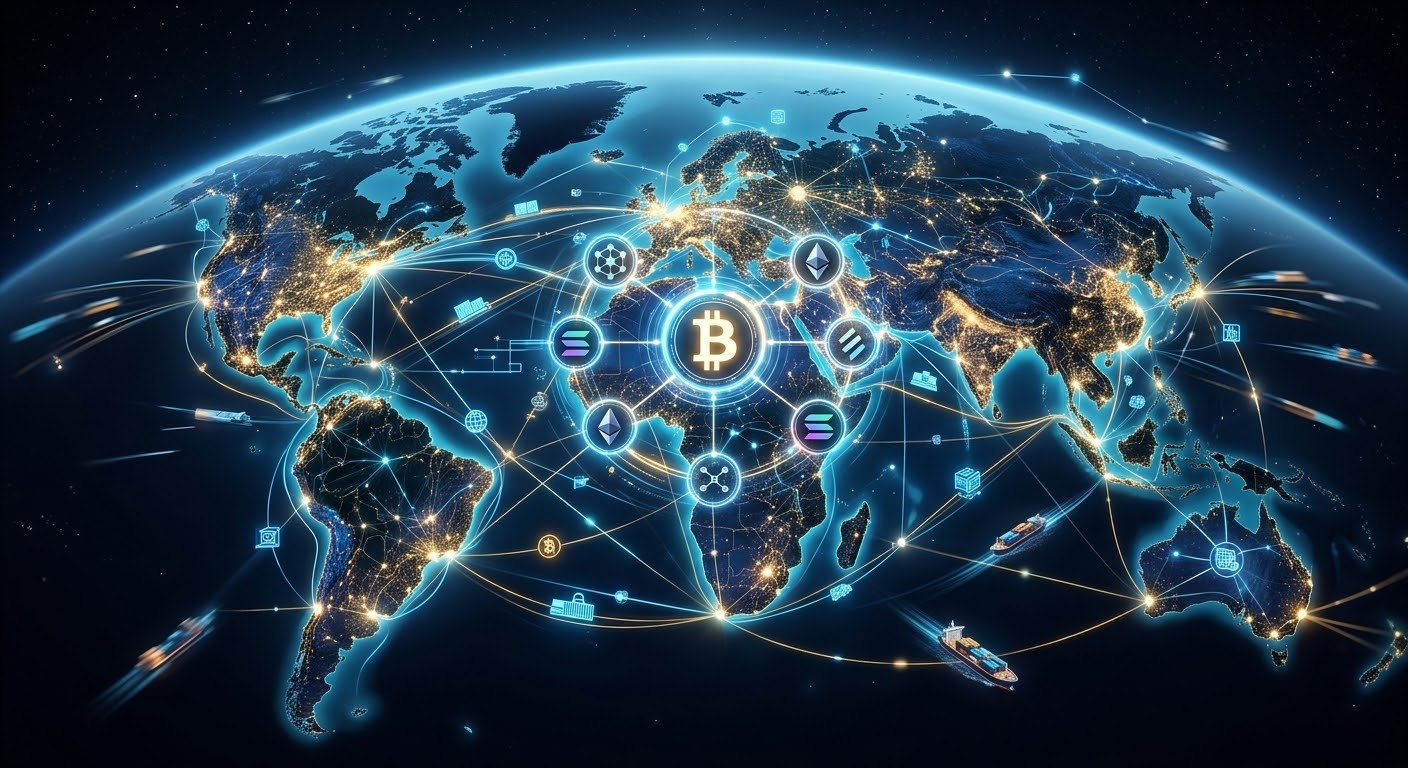
近日 BTC 強勢突破 80,000 美元大關,機構資金持續流入。在宏觀政策支持下,比特幣的抗通脹屬性再次獲得認可。你認為這波漲勢能否延續?
关注&点赞&转发领取SOL🎁🎁🎁
关注&点赞&转发领取SOL🎁🎁🎁
AH

Ahli Hidaya Doka hy Sab Kuch
·
--
Haussier🚨 Major Milestone: StarkWare Executes Bitcoin’s First Quantum-Safe Mainnet Transaction!
The crypto world just took a massive leap toward future-proofing its security. StarkWare researcher Avihu Levy has successfully executed and confirmed the first-ever quantum-safe transaction on the Bitcoin mainnet!
Key Highlights of the Breakthrough:
No Soft Fork Required: This groundbreaking transaction utilized the Quantum-Safe Bitcoin (QSB) method, proving that Bitcoin can handle quantum-resistant spends without modifying existing consensus rules or waiting for a network-wide soft fork.
Defeating Shor’s Algorithm: Standard Bitcoin transactions rely on elliptic-curve cryptography (ECDSA), which is vulnerable to advanced quantum computers running Shor’s algorithm. QSB bypasses this by implementing hash-based protections.
How It Works: By leveraging clever hash-based puzzles and off-chain GPU computations (costing roughly $150–$200 in power/compute per transaction and direct miner submission), the transaction was securely mined into the Bitcoin blockchain.
What does this mean for the Future?
While QSB is currently an experimental safety net and too costly for everyday retail use, it proves that Bitcoin has a defensive shield against future quantum threats even before protocol-level upgrades happen. It's a monumental step for blockchain longevity!
Do you think quantum computing poses an imminent threat to crypto, or are developers fixing the problem well in time? Drop your thoughts below! 👇
#Bitcoin #StarkWare #QuantumSafe #CryptoNews #BinanceSquare #Blockchain #TechTrends$BTC $USDC
#DYOR!!
The crypto world just took a massive leap toward future-proofing its security. StarkWare researcher Avihu Levy has successfully executed and confirmed the first-ever quantum-safe transaction on the Bitcoin mainnet!
Key Highlights of the Breakthrough:
No Soft Fork Required: This groundbreaking transaction utilized the Quantum-Safe Bitcoin (QSB) method, proving that Bitcoin can handle quantum-resistant spends without modifying existing consensus rules or waiting for a network-wide soft fork.
Defeating Shor’s Algorithm: Standard Bitcoin transactions rely on elliptic-curve cryptography (ECDSA), which is vulnerable to advanced quantum computers running Shor’s algorithm. QSB bypasses this by implementing hash-based protections.
How It Works: By leveraging clever hash-based puzzles and off-chain GPU computations (costing roughly $150–$200 in power/compute per transaction and direct miner submission), the transaction was securely mined into the Bitcoin blockchain.
What does this mean for the Future?
While QSB is currently an experimental safety net and too costly for everyday retail use, it proves that Bitcoin has a defensive shield against future quantum threats even before protocol-level upgrades happen. It's a monumental step for blockchain longevity!
Do you think quantum computing poses an imminent threat to crypto, or are developers fixing the problem well in time? Drop your thoughts below! 👇
#Bitcoin #StarkWare #QuantumSafe #CryptoNews #BinanceSquare #Blockchain #TechTrends$BTC $USDC
#DYOR!!


RJ

⁰MR RAJ⁰
·
--
Haussier💰 In 2015, Gravity Payments CEO Dan Price made headlines by cutting his own salary from about $1 million to $70,000 — a roughly 94% reduction. He used the move to help raise the company’s minimum salary to $70,000 for employees.
❤️🏢 Price said the decision was about giving his Seattle-based team greater financial stability, after seeing employees struggle with rising living costs. The move sparked a huge debate about CEO pay and fair wages.
$DUSK $RIVER $POWER
#XRPRallies44%InAWeek #IranSaysHormuzOmanDealNotFinalized #SECSendsCryptoCustodyRuleToWhiteHouse #CryptoFearGreedIndexHits74 #USBitcoinETFsExtendInflowsToSixthDay
❤️🏢 Price said the decision was about giving his Seattle-based team greater financial stability, after seeing employees struggle with rising living costs. The move sparked a huge debate about CEO pay and fair wages.
$DUSK $RIVER $POWER
#XRPRallies44%InAWeek #IranSaysHormuzOmanDealNotFinalized #SECSendsCryptoCustodyRuleToWhiteHouse #CryptoFearGreedIndexHits74 #USBitcoinETFsExtendInflowsToSixthDay

SY

Syco 疯子
·
--
💖😘 𝐌𝐀𝐆𝐈𝐂 𝐒𝐔𝐑𝐏𝐑𝐈𝐒𝐄 😘💖
𝐖𝐚𝐫𝐦𝐥𝐲✨
𝐒𝐲𝐜𝐨 😘💖
$BNB
𝐖𝐚𝐫𝐦𝐥𝐲✨
𝐒𝐲𝐜𝐨 😘💖
$BNB

BM

JANNAT BM_
·
--
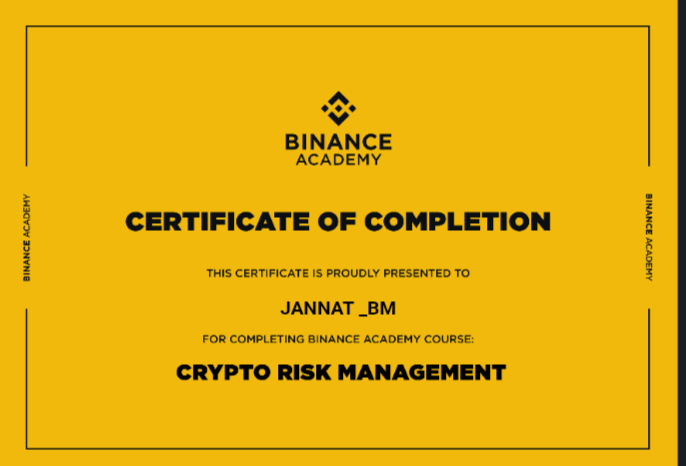
Thank you #Binance 💛
My first certificate form @Binance Academy 💛💛💛
My first certificate form @Binance Academy 💛💛💛
555
龟龟财神到
·
--
关注吧,宇宙无敌财神龟

I keep coming back to one decision Dusk made early.
Europe.
Not global. Not permissionless. Europe. MiCA. AFM-regulated exchanges. EU-licensed institutions. That is where the partnerships are. That is where the regulatory clarity exists. That is where NPEX operates. @Dusk
Most crypto projects I follow chase global reach from day one. Deploy anywhere. List everywhere. Capture the largest possible market. Dusk narrowed the aperture deliberately. It built for a regulatory framework that is specific, complex, and still evolving. $DUSK
I think that focus is either brilliant or limiting.
Brilliant because Europe has actual rules. Institutions know what compliance looks like. A regulated MTF has legal standing. Native issuance under MiCA has a pathway to recognition. There is no guessing whether the regulator will show up tomorrow and invalidate everything.
Limiting because global capital moves to where the liquidity is. And right now, the deepest liquidity, the most active developers, and the largest RWA experiments are happening on US-centric or globally neutral infrastructure. Dusk's European focus means it must win in Europe before it can expand. That is a sequential strategy in a market that rewards parallel expansion. #dusk
I am not sure whether European regulatory alignment creates enough institutional pull to bootstrap an ecosystem before global competitors absorb the same institutions with broader market access.
That is the bet I am watching.
#dusk
$DUSK
@Dusk
Europe.
Not global. Not permissionless. Europe. MiCA. AFM-regulated exchanges. EU-licensed institutions. That is where the partnerships are. That is where the regulatory clarity exists. That is where NPEX operates. @Dusk
Most crypto projects I follow chase global reach from day one. Deploy anywhere. List everywhere. Capture the largest possible market. Dusk narrowed the aperture deliberately. It built for a regulatory framework that is specific, complex, and still evolving. $DUSK
I think that focus is either brilliant or limiting.
Brilliant because Europe has actual rules. Institutions know what compliance looks like. A regulated MTF has legal standing. Native issuance under MiCA has a pathway to recognition. There is no guessing whether the regulator will show up tomorrow and invalidate everything.
Limiting because global capital moves to where the liquidity is. And right now, the deepest liquidity, the most active developers, and the largest RWA experiments are happening on US-centric or globally neutral infrastructure. Dusk's European focus means it must win in Europe before it can expand. That is a sequential strategy in a market that rewards parallel expansion. #dusk
I am not sure whether European regulatory alignment creates enough institutional pull to bootstrap an ecosystem before global competitors absorb the same institutions with broader market access.
That is the bet I am watching.
#dusk
$DUSK
@Dusk
EU focus is Dusk's strength
50%
Global reach matters more
50%
Regulatory clarity beats speed
0%
Need both to win
0%
2 Votes • Vote fermé
Bittensor is showing renewed strength as $TAO continues to defend the important $200 support zone. The token is trading around $232.32 after gaining 5.78% over the past 24 hours, while daily trading volume stands near $217.9 million and market capitalization around $2.61 billion...
The $200 level has repeatedly attracted buyers during periods of weakness, making it an important area for the current market structure. If TAO can maintain this support and eventually break through higher resistance, analysts see the possibility of a move toward $500, with more ambitious targets such as $1,000 and $1,500 dependent on sustained momentum.
A major development for Bittensor is its expansion toward the Base ecosystem through Chainlink's CCIP. The integration is designed to improve cross-chain connectivity and make Bittensor's decentralized AI capabilities more accessible to users within DeFi.
The connection between decentralized AI and DeFi could become an important growth area as blockchain networks increasingly combine AI services, data and financial applications. Bittensor's compute, code, vision and prediction-related subnetworks could gain additional exposure as these ecosystems become more interconnected.
From a technical perspective, $200 remains the key level to watch. Holding above it keeps the bullish reversal scenario intact, while a sustained break below could weaken the current setup.. On the upside, reclaiming major resistance would be necessary before the higher price targets become technically relevant.
For now, TAO's combination of resilient support, improving momentum and expanding AI-DeFi connectivity makes it one of the more closely watched assets in the decentralized AI sector.
$TAO
#TAO
The $200 level has repeatedly attracted buyers during periods of weakness, making it an important area for the current market structure. If TAO can maintain this support and eventually break through higher resistance, analysts see the possibility of a move toward $500, with more ambitious targets such as $1,000 and $1,500 dependent on sustained momentum.
A major development for Bittensor is its expansion toward the Base ecosystem through Chainlink's CCIP. The integration is designed to improve cross-chain connectivity and make Bittensor's decentralized AI capabilities more accessible to users within DeFi.
The connection between decentralized AI and DeFi could become an important growth area as blockchain networks increasingly combine AI services, data and financial applications. Bittensor's compute, code, vision and prediction-related subnetworks could gain additional exposure as these ecosystems become more interconnected.
From a technical perspective, $200 remains the key level to watch. Holding above it keeps the bullish reversal scenario intact, while a sustained break below could weaken the current setup.. On the upside, reclaiming major resistance would be necessary before the higher price targets become technically relevant.
For now, TAO's combination of resilient support, improving momentum and expanding AI-DeFi connectivity makes it one of the more closely watched assets in the decentralized AI sector.
$TAO
#TAO
$XRP has delivered one of its strongest short-term rallies of the current market cycle, climbing more than 50% in roughly 65 hours and adding around $30 billion to its market capitalization.
The move has outpaced several major assets. Over the latest seven-day period referenced in the report, Bitcoin gained about 22%, Ethereum rose 30%, while XRP posted a significantly stronger advance. Solana and Dogecoin also recorded notable gains, but XRP remained among the strongest large-cap performers...
XRP's market cap jumped from roughly $63 billion to $93 billion during the rally, highlighting the speed at which capital entered the asset. Such a rapid expansion can attract additional momentum traders, but it can also increase the risk of sharp profit-taking...
After the explosive move, XRP has started to consolidate. Holding the $1.50 area is now an important test for the bullish structure. If buyers continue defending this level, the recent breakout could have room to develop further. A sustained loss of support, however, could lead to a deeper correction.
Profit-taking is another factor to watch. Traders who entered before the rally are sitting on substantial gains, creating the potential for increased selling pressure. The market's ability to absorb those sales without breaking key support will likely determine the next direction...
For now, XRP remains in a strong momentum phase, but the next move may depend less on another immediate surge and more on whether the token can stabilize above its newly reclaimed levels.
Note: Not Financial Advice
$XRP #xrp
The move has outpaced several major assets. Over the latest seven-day period referenced in the report, Bitcoin gained about 22%, Ethereum rose 30%, while XRP posted a significantly stronger advance. Solana and Dogecoin also recorded notable gains, but XRP remained among the strongest large-cap performers...
XRP's market cap jumped from roughly $63 billion to $93 billion during the rally, highlighting the speed at which capital entered the asset. Such a rapid expansion can attract additional momentum traders, but it can also increase the risk of sharp profit-taking...
After the explosive move, XRP has started to consolidate. Holding the $1.50 area is now an important test for the bullish structure. If buyers continue defending this level, the recent breakout could have room to develop further. A sustained loss of support, however, could lead to a deeper correction.
Profit-taking is another factor to watch. Traders who entered before the rally are sitting on substantial gains, creating the potential for increased selling pressure. The market's ability to absorb those sales without breaking key support will likely determine the next direction...
For now, XRP remains in a strong momentum phase, but the next move may depend less on another immediate surge and more on whether the token can stabilize above its newly reclaimed levels.
Note: Not Financial Advice
$XRP #xrp
Vérifié
Arthur Hayes has outlined a potential $500,000 Bitcoin scenario, but the target is conditional rather than a guaranteed prediction. His thesis centers on a possible shift in U.S. monetary policy and how the Federal Reserve communicates its future decisions.
The argument is less about a specific price timeline and more about liquidity. If monetary conditions become more supportive of risk assets, Bitcoin could benefit from renewed capital flows and stronger investor demand.
Hayes has previously made bullish Bitcoin forecasts, but his latest $500K scenario should be viewed as a market thesis rather than a confirmed outcome. The key factor is whether monetary policy actually changes in a way that supports his assumptions.
For traders, the important signal is therefore not the $500K figure itself. Fed policy, liquidity expectations and market positioning could have a much greater influence on Bitcoin's next major trend.
A sustained shift toward easier financial conditions could strengthen the bullish case, while tighter policy or weaker liquidity could delay such a move. Until those conditions change, the $500K target remains a long-term scenario rather than an immediate price expectation...
Note: Not Financial Advice
$BTC
#ArthurHayes
The argument is less about a specific price timeline and more about liquidity. If monetary conditions become more supportive of risk assets, Bitcoin could benefit from renewed capital flows and stronger investor demand.
Hayes has previously made bullish Bitcoin forecasts, but his latest $500K scenario should be viewed as a market thesis rather than a confirmed outcome. The key factor is whether monetary policy actually changes in a way that supports his assumptions.
For traders, the important signal is therefore not the $500K figure itself. Fed policy, liquidity expectations and market positioning could have a much greater influence on Bitcoin's next major trend.
A sustained shift toward easier financial conditions could strengthen the bullish case, while tighter policy or weaker liquidity could delay such a move. Until those conditions change, the $500K target remains a long-term scenario rather than an immediate price expectation...
Note: Not Financial Advice
$BTC
#ArthurHayes
Spot Bitcoin and Ethereum ETFs recorded their strongest combined weekly inflows in roughly ten months, signaling a renewed wave of institutional demand as crypto markets moved higher...
The surge marks a notable change after a period of relatively muted ETF activity. Spot ETFs have become an important indicator of traditional investor interest because they provide exposure to Bitcoin and Ethereum through regulated investment products without requiring investors to directly hold the underlying assets.
Strong inflows can also support spot prices because ETF issuers generally need to acquire the underlying assets when new capital enters their funds. If the trend continues, sustained demand could provide an additional source of buying pressure and improve market liquidity.
However, one strong week is not enough to confirm a lasting shift in institutional sentiment. The key test will be whether inflows remain elevated over the coming weeks or quickly return to previous levels.
The latest data therefore offers an encouraging signal for the broader crypto market, but investors will be watching future flow figures closely to determine whether this represents the beginning of a sustained institutional accumulation trend or simply a temporary reaction to rising prices.
Note: Not Financial Advice
$BTC
$ETH
#ETFs
The surge marks a notable change after a period of relatively muted ETF activity. Spot ETFs have become an important indicator of traditional investor interest because they provide exposure to Bitcoin and Ethereum through regulated investment products without requiring investors to directly hold the underlying assets.
Strong inflows can also support spot prices because ETF issuers generally need to acquire the underlying assets when new capital enters their funds. If the trend continues, sustained demand could provide an additional source of buying pressure and improve market liquidity.
However, one strong week is not enough to confirm a lasting shift in institutional sentiment. The key test will be whether inflows remain elevated over the coming weeks or quickly return to previous levels.
The latest data therefore offers an encouraging signal for the broader crypto market, but investors will be watching future flow figures closely to determine whether this represents the beginning of a sustained institutional accumulation trend or simply a temporary reaction to rising prices.
Note: Not Financial Advice
$BTC
$ETH
#ETFs
I spent last evening reading through Dusk's documentation and comparing it with what I actually see running live.
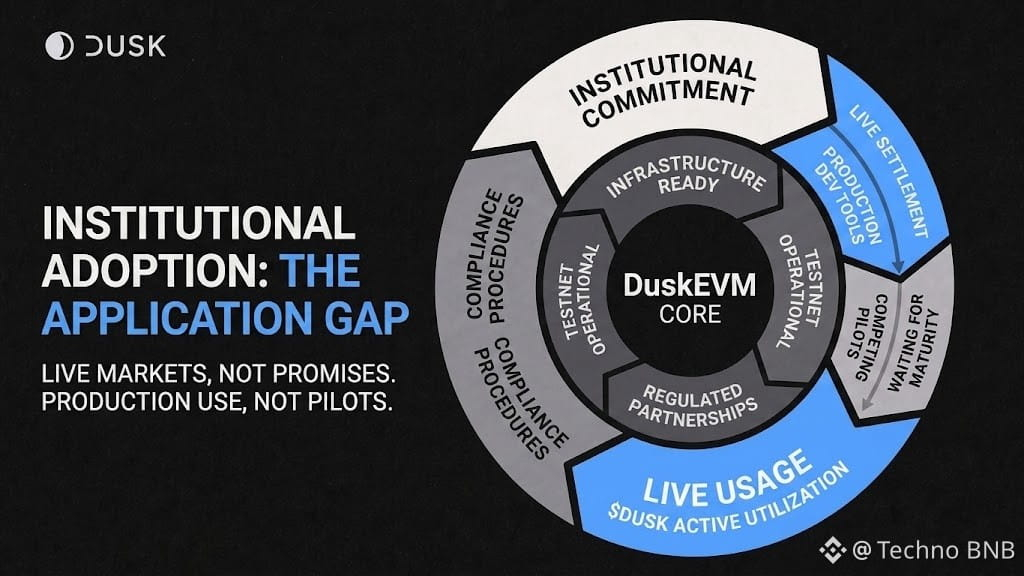
The architecture is thorough. DuskEVM mainnet is coming. The testnet is operational. The partnerships with regulated exchanges are announced. @Dusk
What I am looking for now is the application layer.
Not announcements. Not documentation. Live markets settling real transactions daily. Developer tools being used in production. Financial institutions running workflows that depend on Dusk specifically rather than experimenting across multiple chains simultaneously. $DUSK
This gap between infrastructure readiness and live usage is what I keep returning to. Every protocol faces it. Ethereum had it for years. But the difference today is that alternative paths exist. Institutions exploring RWA tokenization can pilot on established networks with existing liquidity and developer communities while waiting for specialized infrastructure to mature. #dusk
Dusk's bet is that regulated markets will eventually prefer a purpose-built chain over an adapted one. That requires institutions to commit to migrating not just their assets but their operational workflows, compliance procedures, and settlement habits onto new infrastructure.
The technology supports that migration. Whether the timeline for institutional decision-making matches the pace of ecosystem development is what remains unclear to me.
That is the part I am watching now.
#dusk
$DUSK
@Dusk
The architecture is thorough. DuskEVM mainnet is coming. The testnet is operational. The partnerships with regulated exchanges are announced. @Dusk
What I am looking for now is the application layer.
Not announcements. Not documentation. Live markets settling real transactions daily. Developer tools being used in production. Financial institutions running workflows that depend on Dusk specifically rather than experimenting across multiple chains simultaneously. $DUSK
This gap between infrastructure readiness and live usage is what I keep returning to. Every protocol faces it. Ethereum had it for years. But the difference today is that alternative paths exist. Institutions exploring RWA tokenization can pilot on established networks with existing liquidity and developer communities while waiting for specialized infrastructure to mature. #dusk
Dusk's bet is that regulated markets will eventually prefer a purpose-built chain over an adapted one. That requires institutions to commit to migrating not just their assets but their operational workflows, compliance procedures, and settlement habits onto new infrastructure.
The technology supports that migration. Whether the timeline for institutional decision-making matches the pace of ecosystem development is what remains unclear to me.
That is the part I am watching now.
#dusk
$DUSK
@Dusk
Connectez-vous pour découvrir plus de contenu