
Jaxson Bull
73 Publications

Jaxson Bull
Crypto Explorer | Alpha Seeker | Charts & Chill Vibes | Let's in the Bull Run
Ouvert au trading
Trade régulièrement
10 mois
198 Suivis
2.3K+ Abonnés
974 J’aime
Publications
Portefeuille
Tous
Citations
PINNED
🎉🎁 JAXSON BULL BTC SURPRISE DROP! 🎁🎉
✨ The Lucky Bag is full and ready to open! ✨
👇 Simple Steps to Participate 👇
❤️ Follow Jaxson Bull
🔁 Like & Share
💬 Comment “BTC”
🚀 Stay active for the next reward round!
#BTC #Crypto #JaxsonBull #redpacket
✨ The Lucky Bag is full and ready to open! ✨
👇 Simple Steps to Participate 👇
❤️ Follow Jaxson Bull
🔁 Like & Share
💬 Comment “BTC”
🚀 Stay active for the next reward round!
#BTC #Crypto #JaxsonBull #redpacket

ok


Muqeeem
·
--
🚨 Three coins are showing strong momentum today, but which one has the best chance of extending the move from here? 👀📈
$TUT | $GRVT | $BEAT
The three are currently up around +18.58%, -15.17%, and -13.53% respectively, showing that momentum is still mixed across the market. The next question is whether buyers can push these levels higher. 📊
Poll time 🗳️
1️⃣ TUT from $0.05845 → $0.10 🚀
2️⃣ GRVT from $0.2298 → $0.50 ⚡
3️⃣ BEAT from $0.1317 → $0.30 🔥
4️⃣ None — waiting for confirmation ⏳
Your Pick: _ 🎯
Reason: _ 🧠
Which one has the strongest setup in your view? Drop your pick below. 👇💬
#CryptoPol l #Altcoins #cryptotrading #BİNANCEFUTURES #DYOR
$TUT | $GRVT | $BEAT
The three are currently up around +18.58%, -15.17%, and -13.53% respectively, showing that momentum is still mixed across the market. The next question is whether buyers can push these levels higher. 📊
Poll time 🗳️
1️⃣ TUT from $0.05845 → $0.10 🚀
2️⃣ GRVT from $0.2298 → $0.50 ⚡
3️⃣ BEAT from $0.1317 → $0.30 🔥
4️⃣ None — waiting for confirmation ⏳
Your Pick: _ 🎯
Reason: _ 🧠
Which one has the strongest setup in your view? Drop your pick below. 👇💬
#CryptoPol l #Altcoins #cryptotrading #BİNANCEFUTURES #DYOR
ok

Prince-7³
·
--
🌸 𝑨𝒔𝒔𝒂𝒍𝒂𝒎𝒖𝒂𝒍𝒂𝒊𝒌𝒖𝒎 😊🌹
☀️ 𝑮𝒐𝒐𝒅 𝑴𝒐𝒓𝒏𝒊𝒏𝒈, 𝑺𝒒𝒖𝒂𝒓𝒆 𝑭𝒂𝒎𝒊𝒍𝒚! 💛
🧧 𝑪𝒍𝒂𝒊𝒎
❤️ 𝑭𝒐𝒍𝒍𝒐𝒘
🔄 𝑹𝒆𝒑𝒐𝒔𝒕
✨ 𝑳𝒆𝒕’𝒔 𝒔𝒕𝒂𝒓𝒕 𝒕𝒉𝒊𝒔 𝒅𝒂𝒚 𝒘𝒊𝒕𝒉 𝒑𝒐𝒔𝒊𝒕𝒊𝒗𝒊𝒕𝒚 & 𝒔𝒎𝒊𝒍𝒆𝒔! 🌹🫶
🤝 𝑳𝒐𝒗𝒆 & 𝒔𝒖𝒑𝒑𝒐𝒓𝒕 𝒇𝒐𝒓 𝒎𝒚 𝑺𝒒𝒖𝒂𝒓𝒆 𝑭𝒂𝒎𝒊𝒍𝒚! ❤️🔥
$BTC
$SHIB
#GIVEAWAY🎁
☀️ 𝑮𝒐𝒐𝒅 𝑴𝒐𝒓𝒏𝒊𝒏𝒈, 𝑺𝒒𝒖𝒂𝒓𝒆 𝑭𝒂𝒎𝒊𝒍𝒚! 💛
🧧 𝑪𝒍𝒂𝒊𝒎
❤️ 𝑭𝒐𝒍𝒍𝒐𝒘
🔄 𝑹𝒆𝒑𝒐𝒔𝒕
✨ 𝑳𝒆𝒕’𝒔 𝒔𝒕𝒂𝒓𝒕 𝒕𝒉𝒊𝒔 𝒅𝒂𝒚 𝒘𝒊𝒕𝒉 𝒑𝒐𝒔𝒊𝒕𝒊𝒗𝒊𝒕𝒚 & 𝒔𝒎𝒊𝒍𝒆𝒔! 🌹🫶
🤝 𝑳𝒐𝒗𝒆 & 𝒔𝒖𝒑𝒑𝒐𝒓𝒕 𝒇𝒐𝒓 𝒎𝒚 𝑺𝒒𝒖𝒂𝒓𝒆 𝑭𝒂𝒎𝒊𝒍𝒚! ❤️🔥
$BTC
$SHIB
#GIVEAWAY🎁

ok

KING BRO 1
·
--
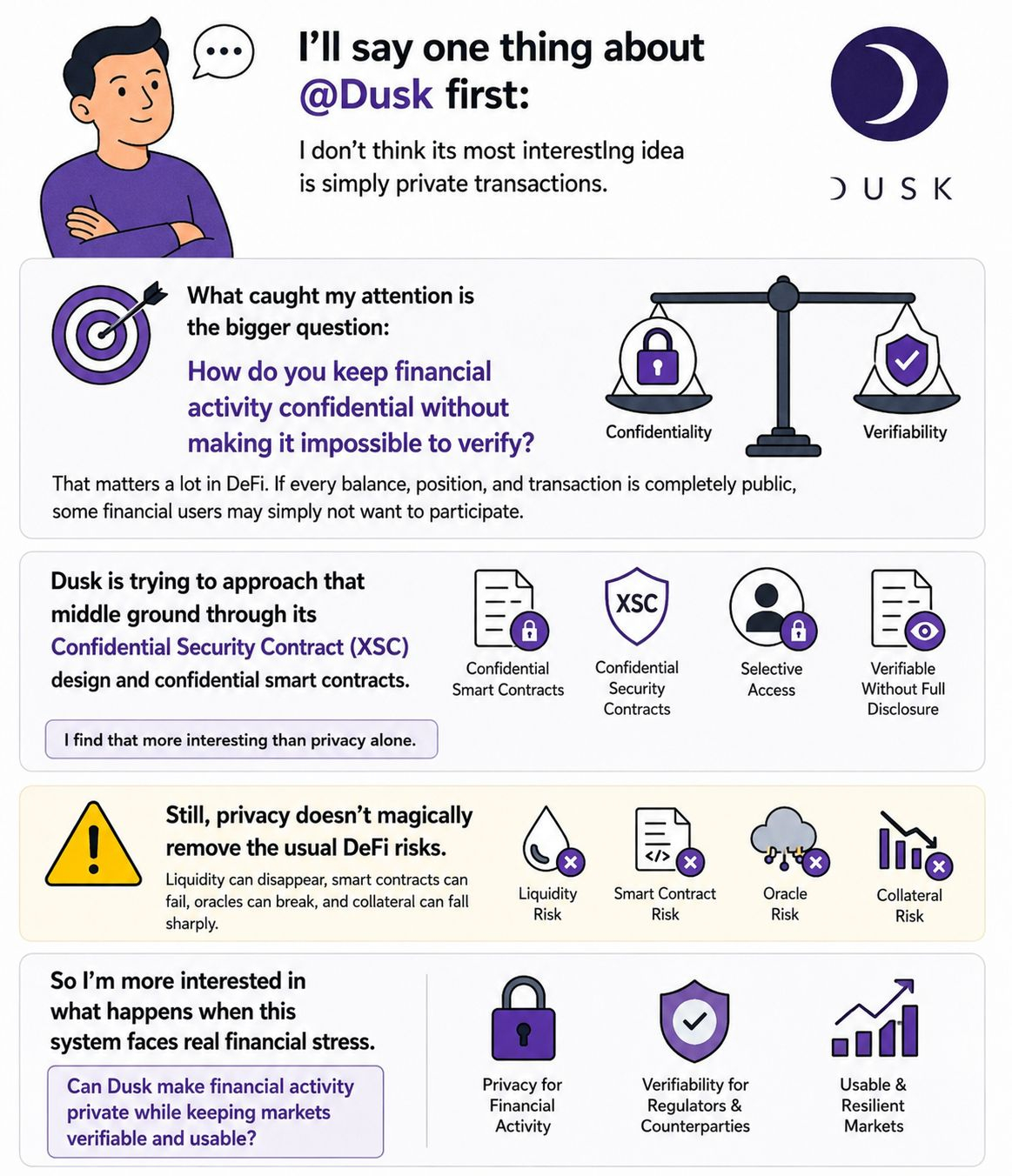
Haussier I’ll say one thing about @Dusk first:
I don’t think its most interesting idea is simply private transactions.
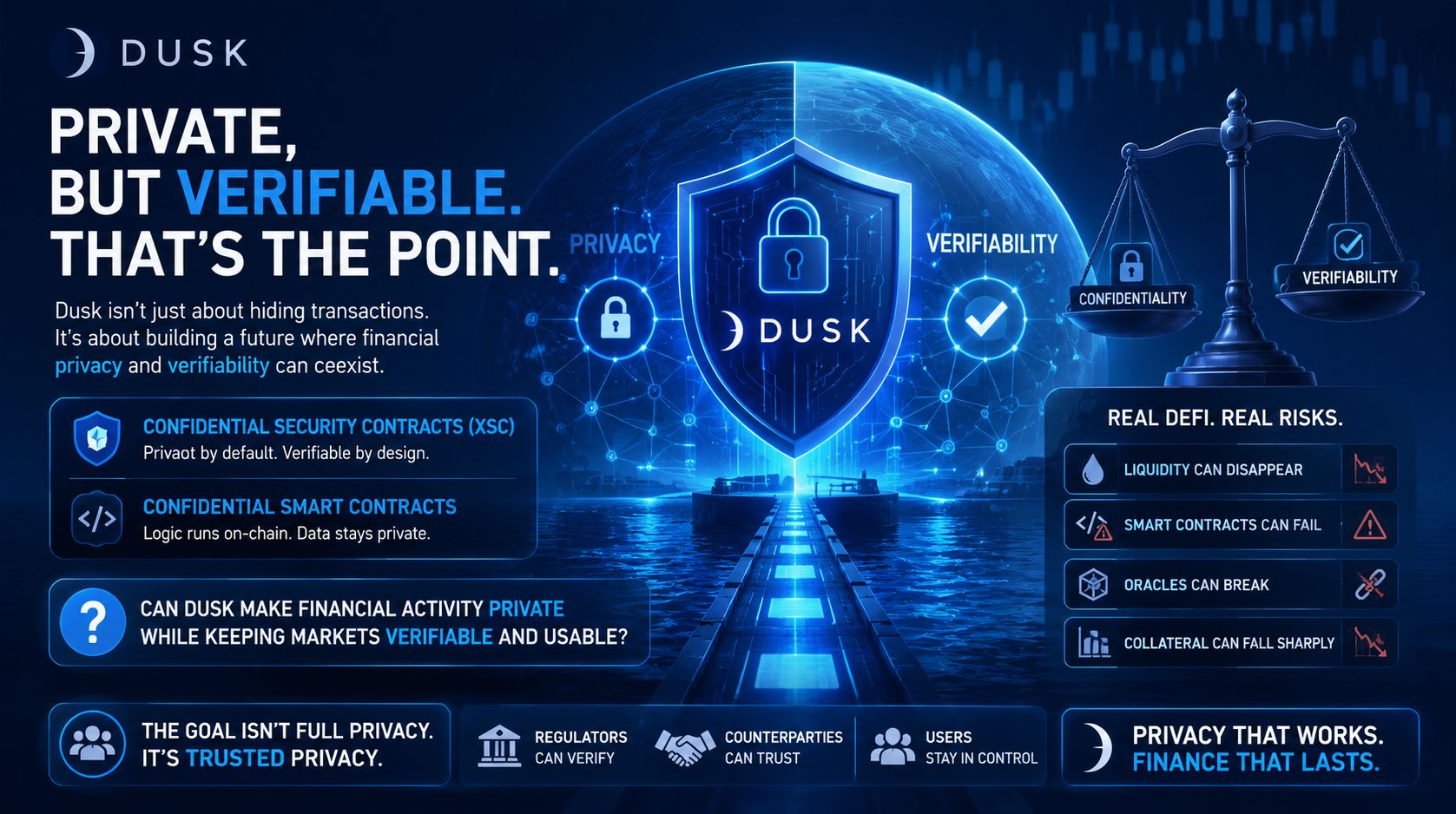
What caught my attention is the bigger question: how do you keep financial activity confidential without making it impossible to verify?
That matters a lot in DeFi. If every balance, position, and transaction is completely public, some financial users may simply not want to participate. But going fully private creates another problem: how do regulators, counterparties, or other authorized parties know that the activity is legitimate?
Dusk is trying to approach that middle ground through its Confidential Security Contract (XSC) design and confidential smart contracts.
I find that more interesting than privacy alone.
Still, privacy doesn’t magically remove the usual DeFi risks. Liquidity can disappear, smart contracts can fail, oracles can break, and collateral can fall sharply.
So I’m more interested in what happens when this system faces real financial stress.
Can Dusk make financial activity private while keeping markets verifiable and usable?
I don’t think its most interesting idea is simply private transactions.
What caught my attention is the bigger question: how do you keep financial activity confidential without making it impossible to verify?
That matters a lot in DeFi. If every balance, position, and transaction is completely public, some financial users may simply not want to participate. But going fully private creates another problem: how do regulators, counterparties, or other authorized parties know that the activity is legitimate?
Dusk is trying to approach that middle ground through its Confidential Security Contract (XSC) design and confidential smart contracts.
I find that more interesting than privacy alone.
Still, privacy doesn’t magically remove the usual DeFi risks. Liquidity can disappear, smart contracts can fail, oracles can break, and collateral can fall sharply.
So I’m more interested in what happens when this system faces real financial stress.
Can Dusk make financial activity private while keeping markets verifiable and usable?
ok

KAN_ 加密 143
·
--
BNB (originally Binance Coin) is a major native cryptocurrency that powers the BNB Chain ecosystem and the Binance exchange🌹💕
follow 💕🌹
like💕🌹
repost💕🌹
$BNB $XRP
follow 💕🌹
like💕🌹
repost💕🌹
$BNB $XRP


ok
KING BRO 1
·
--
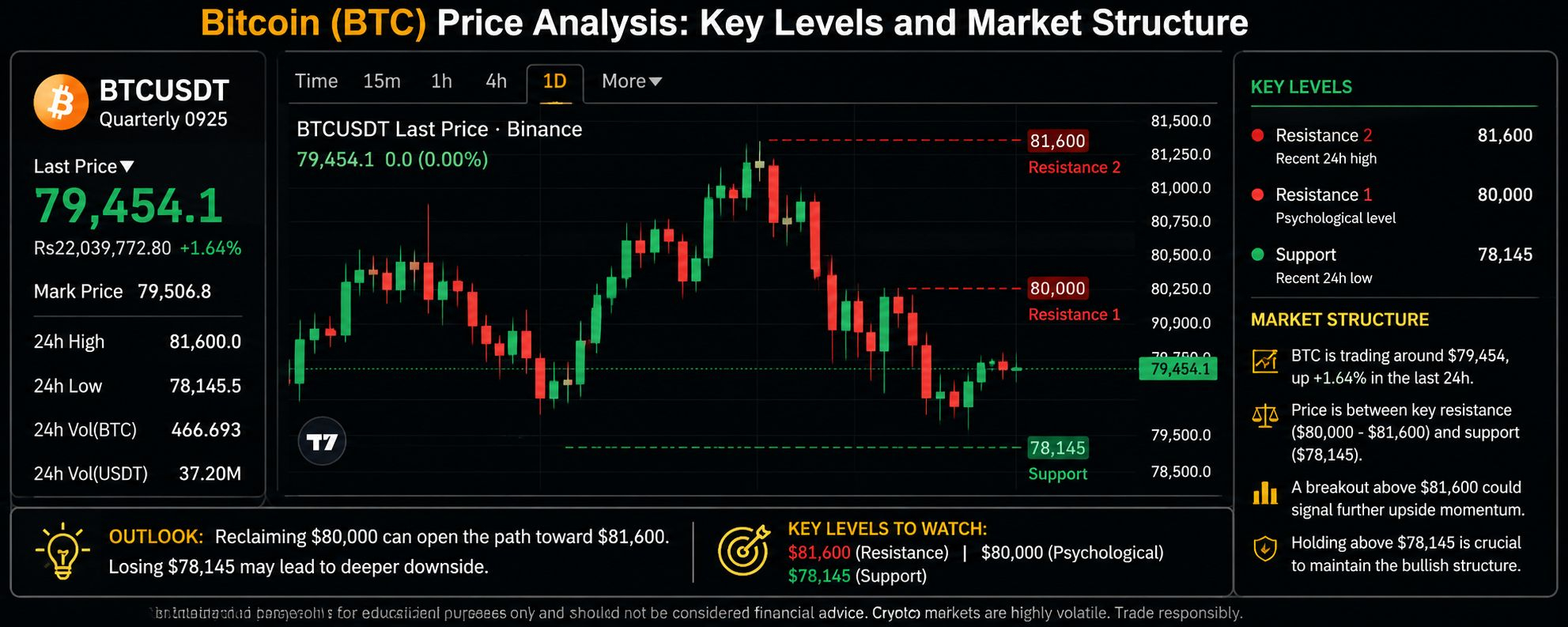
Bitcoin (BTC) Price Analysis: Key Levels and Market Structure
Bitcoin (BTC) is currently trading around $79,454, based on the market data provided. The price is showing a daily gain of approximately 1.64%, while the 24-hour trading range stands between $78,145 and $81,600. This puts Bitcoin in an important area where buyers and sellers are actively testing the next direction.
The first thing that stands out is the distance between the current price and the recent 24-hour high. Bitcoin reached $81,600 but failed to maintain that level, pulling back toward the $79,000–$80,000 region. This suggests that the higher levels are attracting selling pressure. However, the recovery from the $78,145 low also shows that buyers are still willing to step in when price moves lower.
The $80,000 level is therefore an important psychological area. If Bitcoin can reclaim this level and hold above it, market sentiment could improve and traders may begin watching the previous high around $81,600. A sustained move above that resistance would indicate that buyers are gaining stronger control.
On the other hand, failure to reclaim $80,000 could keep Bitcoin inside a short-term consolidation range. In that situation, the $78,000–$78,150 area becomes an important support zone because it is close to the current 24-hour low. Losing this region could increase short-term selling pressure and open the possibility of a deeper correction.
Another important point is volume. The provided data shows approximately 466.7 BTC in 24-hour volume, equivalent to around $37.2 million in USDT volume for the displayed contract. Volume matters because a price breakout supported by stronger participation generally carries more significance than a move occurring on weak activity.
The current market structure is therefore more about confirmation than prediction. Bitcoin is sitting between meaningful support and resistance rather than showing a completely clear trend from the provided snapshot. Traders and analysts would need to watch how price behaves around $78,000, $80,000 and $81,600 before drawing stronger conclusions.
The $79,000 area is also worth monitoring because it is close to the current price. Holding this region could allow Bitcoin to build another attempt toward $80,000. Conversely, repeated rejection from the $80,000 area could indicate that sellers are defending the psychological resistance.
Overall, Bitcoin remains in a sensitive zone. The recent move above $79,000 is constructive, but the rejection near $81,600 shows that the market still needs confirmation. Rather than focusing only on whether BTC goes up or down, the more useful question is whether buyers can establish support above key resistance levels.
For the short term, $80,000 and $81,600 are the main upside areas to watch, while $78,145 is the key downside reference from the current data. A decisive move beyond either side could provide a clearer signal about the next phase of Bitcoin's price structure.
This analysis is based on the market snapshot provided and should not be treated as financial advice. Crypto prices can change rapidly, and leveraged trading carries significant risk.
@Bitcoin #bitcoin #BTC
@Binance South Africa Official
$BTC
$BTW
$ONG
The first thing that stands out is the distance between the current price and the recent 24-hour high. Bitcoin reached $81,600 but failed to maintain that level, pulling back toward the $79,000–$80,000 region. This suggests that the higher levels are attracting selling pressure. However, the recovery from the $78,145 low also shows that buyers are still willing to step in when price moves lower.
The $80,000 level is therefore an important psychological area. If Bitcoin can reclaim this level and hold above it, market sentiment could improve and traders may begin watching the previous high around $81,600. A sustained move above that resistance would indicate that buyers are gaining stronger control.
On the other hand, failure to reclaim $80,000 could keep Bitcoin inside a short-term consolidation range. In that situation, the $78,000–$78,150 area becomes an important support zone because it is close to the current 24-hour low. Losing this region could increase short-term selling pressure and open the possibility of a deeper correction.
Another important point is volume. The provided data shows approximately 466.7 BTC in 24-hour volume, equivalent to around $37.2 million in USDT volume for the displayed contract. Volume matters because a price breakout supported by stronger participation generally carries more significance than a move occurring on weak activity.
The current market structure is therefore more about confirmation than prediction. Bitcoin is sitting between meaningful support and resistance rather than showing a completely clear trend from the provided snapshot. Traders and analysts would need to watch how price behaves around $78,000, $80,000 and $81,600 before drawing stronger conclusions.
The $79,000 area is also worth monitoring because it is close to the current price. Holding this region could allow Bitcoin to build another attempt toward $80,000. Conversely, repeated rejection from the $80,000 area could indicate that sellers are defending the psychological resistance.
Overall, Bitcoin remains in a sensitive zone. The recent move above $79,000 is constructive, but the rejection near $81,600 shows that the market still needs confirmation. Rather than focusing only on whether BTC goes up or down, the more useful question is whether buyers can establish support above key resistance levels.
For the short term, $80,000 and $81,600 are the main upside areas to watch, while $78,145 is the key downside reference from the current data. A decisive move beyond either side could provide a clearer signal about the next phase of Bitcoin's price structure.
This analysis is based on the market snapshot provided and should not be treated as financial advice. Crypto prices can change rapidly, and leveraged trading carries significant risk.
@Bitcoin #bitcoin #BTC
@Binance South Africa Official
$BTC
$BTW
$ONG
ok

TYSON BNB
·
--
🚨 BREAKING: BNB Chain’s Pasteur Hardfork is now live on BSC Mainnet.
The upgrade strengthens bridge, staking and governance security, while keeping BSC’s 450ms block time and improving transaction capacity. ⚡
$BNB
#BNBChain #Mainnet #ThailandToExpandSECDigitalAssetProbePowers
The upgrade strengthens bridge, staking and governance security, while keeping BSC’s 450ms block time and improving transaction capacity. ⚡
$BNB
#BNBChain #Mainnet #ThailandToExpandSECDigitalAssetProbePowers

ok

阿斯玛_06
·
--
$KORU Strong move today.
But the chart needs confirmation before chasing.
Entry: 19.50–20.20
TP1: 21.00
TP2: 22.20
TP3: 22.50
SL: 18.50
let's go👇👀
$TMX
But the chart needs confirmation before chasing.
Entry: 19.50–20.20
TP1: 21.00
TP2: 22.20
TP3: 22.50
SL: 18.50
let's go👇👀
$TMX
ok

Emma-加密貨幣
·
--
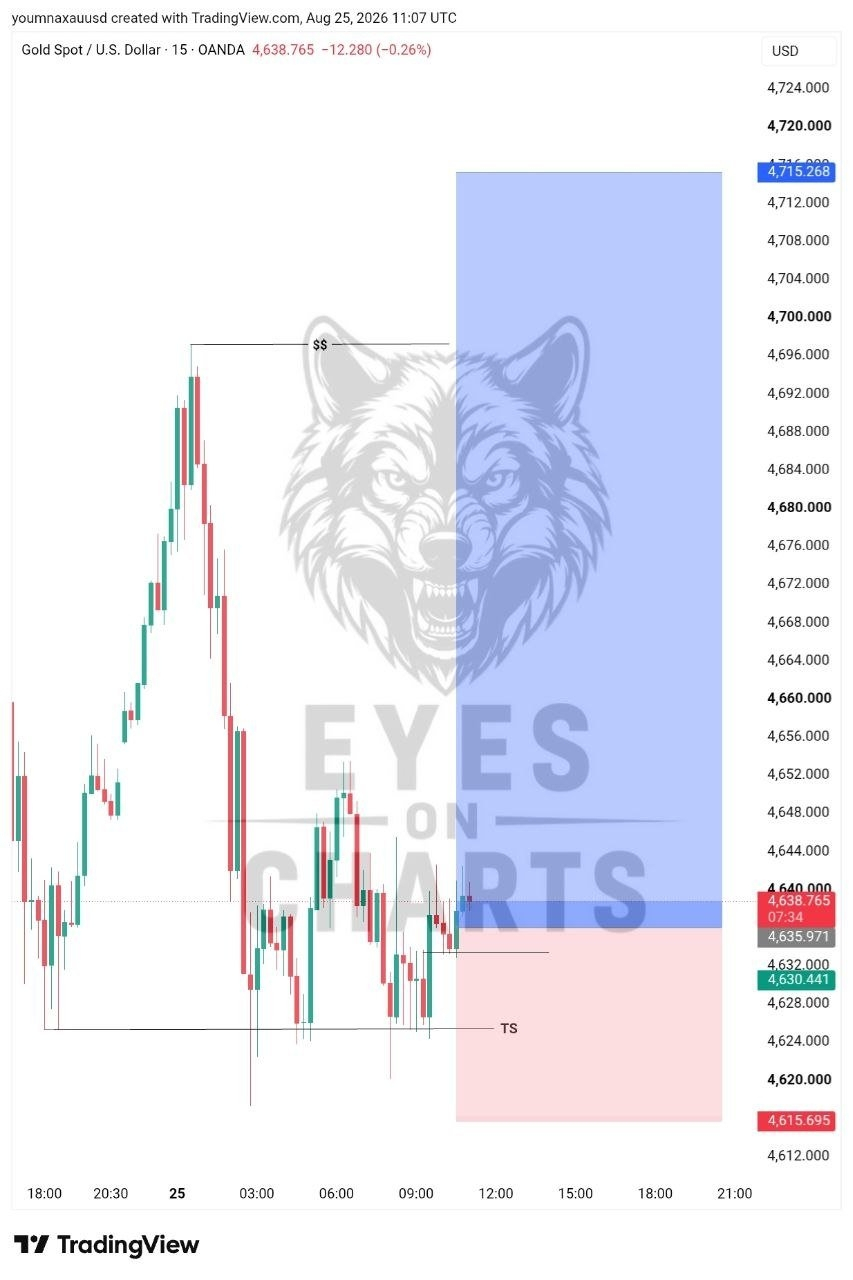
HaussierBUY 📶 $XAU
ENTRY: 4635-4625
SL: 4615
TP1: 4644
TP2: 4658
TP3: 4673
TP4: 4687
TP5: 4701
TP6: 4715
SMC Structure: Sell-side liquidity swept at top. Trading session rejected. Order block holding into premium demand zone. Break of structure confirmed. Fresh buyers in control.
Risk/Reward: 1:5.7
$XAU
ENTRY: 4635-4625
SL: 4615
TP1: 4644
TP2: 4658
TP3: 4673
TP4: 4687
TP5: 4701
TP6: 4715
SMC Structure: Sell-side liquidity swept at top. Trading session rejected. Order block holding into premium demand zone. Break of structure confirmed. Fresh buyers in control.
Risk/Reward: 1:5.7
$XAU
ok

T H I N G _
·
--
TØ𝓭𝐚𝔂 𝓝𝓮𝔀 𝓻𝓮𝔀𝓪𝓻𝓭 🍄🍄🐬
Claim👀👀👀👀👀
Reply - BIO
Claim👀👀👀👀👀
Reply - BIO

ok

younglp
·
--
🧧 BINANCE RED PACKET GIVEAWAY #redpacketgiveawaycampaign
$DEXE
$DEXE
ok

唯一 BRUCE
·
--
Haussier$NVDA.US
$ZEC
$ETH
#OilHoldsLosses
#ZECBreaksKeyResistanceUp75.5%
#KOSPI200NightFuturesFall1.77%
#SKHynixFalls5.63%AfterUnionRejectsWageDeal
$ZEC
$ETH
#OilHoldsLosses
#ZECBreaksKeyResistanceUp75.5%
#KOSPI200NightFuturesFall1.77%
#SKHynixFalls5.63%AfterUnionRejectsWageDeal

ok

艾伦Eren1688
·
--
Haussier*雪地里的每一步都算数* ❄️🚶
寒夜,空旷的街道,身后留下一串脚印。
没人看见这行进的过程,也没人看见那份默默的坚持与磨砺。
但前方的群山依旧矗立,路灯依然照亮前路。
成功不在于短时间的冲刺,而在于即便步履维艰,依然选择坚持,迈出下一步。
这就是持之以恒,这就是全心投入,这就是传奇铸就的方式 💎
无论是交易还是生活,道理都一样:你不需要完美的外部条件,你需要的是坚定的信念和周密的计划。
我正通过 *Predict Token* 磨练自己的判断力——在这里,你可以基于真实事件验证自己的预判,在每一次预测中培养自律。每一次决策,都是向目标迈进的一步 📈
继续前行吧,朋友们。风暴过后,风景自会不同。 感谢大家的支持——向着 2 万大关进发!🙏
本周,你打算迈出哪一步来向目标靠近?👇
answer:7
回答 :7
#1688家族family #predictons
寒夜,空旷的街道,身后留下一串脚印。
没人看见这行进的过程,也没人看见那份默默的坚持与磨砺。
但前方的群山依旧矗立,路灯依然照亮前路。
成功不在于短时间的冲刺,而在于即便步履维艰,依然选择坚持,迈出下一步。
这就是持之以恒,这就是全心投入,这就是传奇铸就的方式 💎
无论是交易还是生活,道理都一样:你不需要完美的外部条件,你需要的是坚定的信念和周密的计划。
我正通过 *Predict Token* 磨练自己的判断力——在这里,你可以基于真实事件验证自己的预判,在每一次预测中培养自律。每一次决策,都是向目标迈进的一步 📈
继续前行吧,朋友们。风暴过后,风景自会不同。 感谢大家的支持——向着 2 万大关进发!🙏
本周,你打算迈出哪一步来向目标靠近?👇
answer:7
回答 :7
#1688家族family #predictons

ok

远方1688 BNB
·
--
市场轮番上演悲欢起落,有人踏浪收获惊喜,有人错过暗自惋惜。行情起起落落,不必追着热点盲目冲动,守住本金才是根本。保持好心态,静待属于自己的机会。愿大家手中持仓节节向上,得失从容,步步皆有收获🧧

ok

作手Trader
·
--
Haussier🚀 $SPCX 跌回IPO附近:1.8万亿美元SpaceX,是机会还是估值考验?
6月,SpaceX上市,IPO价格135美元。上市冲高至225美元后回落,目前重新接近发行价。
一家改变全球航天成本结构的公司,现在是否值得关注?
我的观点:短期仍有估值消化压力,但长期依然是全球商业航天最具竞争力的平台之一。
🚀 最大的护城河:火箭复用
过去火箭是一次性消耗品。2015年Falcon 9完成陆地回收,2016年实现海上无人船回收。如今SpaceX已形成“制造→发射→回收→重复使用”的商业闭环,部分助推器已完成30次以上任务。
真正改变行业的,是持续降低进入太空的成本。目前很多企业都在研发可回收火箭,但能同时做到高频发射、技术成熟和商业运营的,SpaceX仍然独树一帜。
🌎 价值不只是火箭,更是生态
1. Starlink卫星互联网:未来重要现金流来源,覆盖个人、企业、航空、海运等场景。
2. Starship下一代完全可复用火箭:若成功,将打开月球运输、深空探索、太空制造等巨大市场。
所以市场给SpaceX高估值,买的不只是火箭发射,而是未来商业航天生态。
💰 那么135美元贵吗?
看好理由:
✅ 全球领先的火箭复用体系
✅ Starlink增长潜力
✅ 商业航天长期趋势
✅ 马斯克强大的执行能力
风险同样存在:135美元对应约1.77万亿美元估值,提前计入了大量未来预期。因此跌回IPO价格,不代表一定低估。
未来重点关注三个指标:
1. Starlink用户和收入增长
2. 火箭复用次数和发射频率
3. Starship商业化进展
如果未来沿“火箭复用成熟 → 成本下降 → 太空商业化扩大 → 新产业入口打开”演进,SpaceX仍可能成为未来10年的超级科技平台。
欢迎留言A/B/C + 你的目标价格!👇
6月,SpaceX上市,IPO价格135美元。上市冲高至225美元后回落,目前重新接近发行价。
一家改变全球航天成本结构的公司,现在是否值得关注?
我的观点:短期仍有估值消化压力,但长期依然是全球商业航天最具竞争力的平台之一。
🚀 最大的护城河:火箭复用
过去火箭是一次性消耗品。2015年Falcon 9完成陆地回收,2016年实现海上无人船回收。如今SpaceX已形成“制造→发射→回收→重复使用”的商业闭环,部分助推器已完成30次以上任务。
真正改变行业的,是持续降低进入太空的成本。目前很多企业都在研发可回收火箭,但能同时做到高频发射、技术成熟和商业运营的,SpaceX仍然独树一帜。
🌎 价值不只是火箭,更是生态
1. Starlink卫星互联网:未来重要现金流来源,覆盖个人、企业、航空、海运等场景。
2. Starship下一代完全可复用火箭:若成功,将打开月球运输、深空探索、太空制造等巨大市场。
所以市场给SpaceX高估值,买的不只是火箭发射,而是未来商业航天生态。
💰 那么135美元贵吗?
看好理由:
✅ 全球领先的火箭复用体系
✅ Starlink增长潜力
✅ 商业航天长期趋势
✅ 马斯克强大的执行能力
风险同样存在:135美元对应约1.77万亿美元估值,提前计入了大量未来预期。因此跌回IPO价格,不代表一定低估。
未来重点关注三个指标:
1. Starlink用户和收入增长
2. 火箭复用次数和发射频率
3. Starship商业化进展
如果未来沿“火箭复用成熟 → 成本下降 → 太空商业化扩大 → 新产业入口打开”演进,SpaceX仍可能成为未来10年的超级科技平台。
欢迎留言A/B/C + 你的目标价格!👇
ok

DK短线复刻
·
--
关注回复领取红包🎁🎁

Connectez-vous pour découvrir plus de contenu