#dusk $DUSK @Dusk #DUSK
Most "RWA chains" are vaporware. Dusk might not be.
I say that after actually reading their documentation instead of their Twitter threads — a habit I'd recommend to anyone allocating capital based on narrative alone.
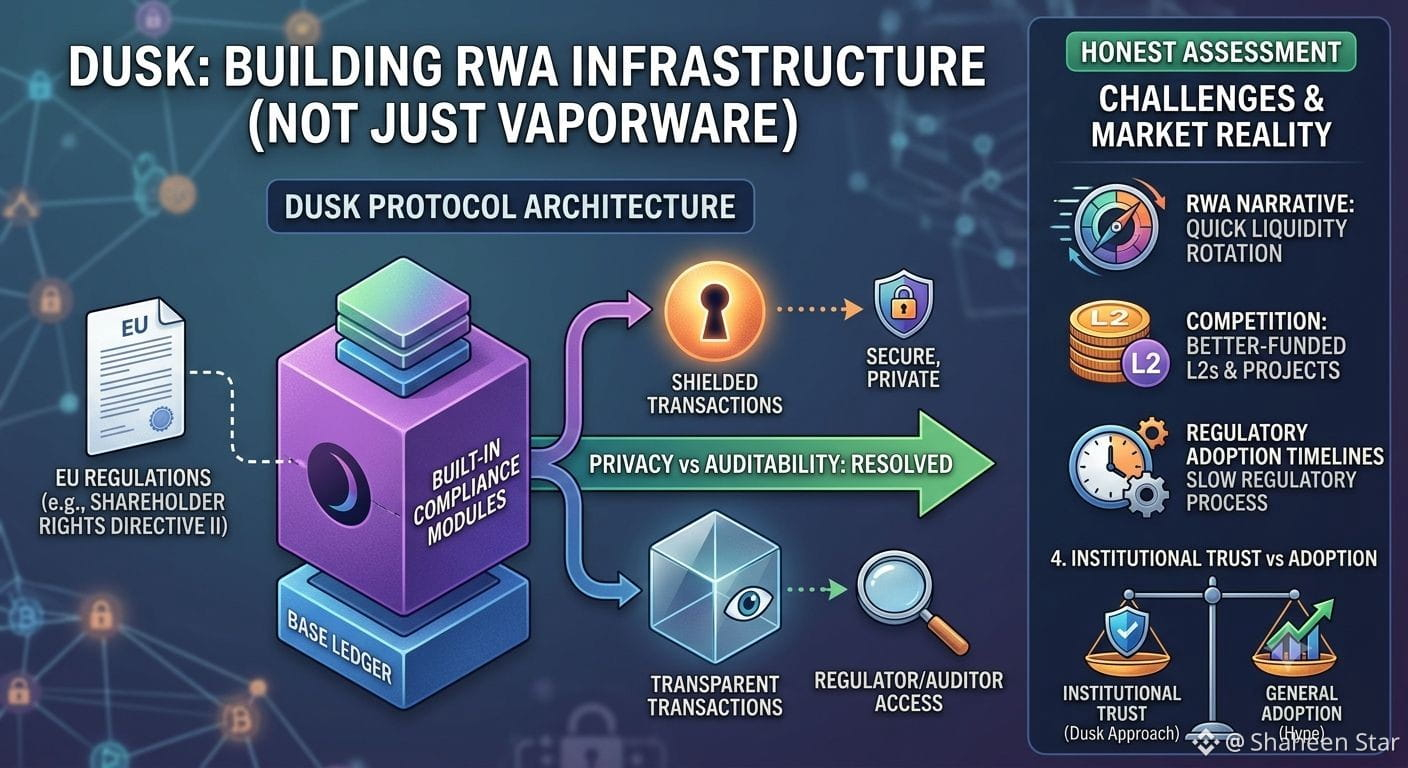
What separates Dusk from the RWA crowd isn't the privacy pitch, it's the compliance architecture underneath it. Most chains treat regulation as an afterthought bolted onto a generic ledger. Dusk builds it into the protocol itself. Their system is designed to handle < cite index="6-1">Shareholder Rights Directive II obligations — the EU framework pushing for stronger shareholder identification, engagement, and long-term transparency in listed companies.</cite> That's not a headline feature, it's the unglamorous plumbing institutions actually need before they'll touch tokenized equities or bonds.
The technical choice that matters most: < cite index="4-1">Dusk supports both shielded and transparent transaction models, letting confidential balances stay private while still being disclosable to authorized regulators or auditors on demand.</cite> That's the exact tension traditional finance has never resolved on public blockchains — privacy versus auditability — and it's why this project is worth watching past the current price chart.
Now the honest part. RWA has been the "next big narrative" for over a year, and liquidity rotates out of these stories fast when nothing ships on schedule. Dusk competes against better-funded L2s with deeper liquidity, and regulatory approval timelines rarely match crypto's attention span. Pilots proving product-market fit is one thing — sustained institutional volume is another entirely.
Solid thesis, early innings. Does compliance-first infrastructure actually earn institutional trust faster, or does adoption always outrun the rules?
Most "RWA chains" are vaporware. Dusk might not be.
I say that after actually reading their documentation instead of their Twitter threads — a habit I'd recommend to anyone allocating capital based on narrative alone.
What separates Dusk from the RWA crowd isn't the privacy pitch, it's the compliance architecture underneath it. Most chains treat regulation as an afterthought bolted onto a generic ledger. Dusk builds it into the protocol itself. Their system is designed to handle < cite index="6-1">Shareholder Rights Directive II obligations — the EU framework pushing for stronger shareholder identification, engagement, and long-term transparency in listed companies.</cite> That's not a headline feature, it's the unglamorous plumbing institutions actually need before they'll touch tokenized equities or bonds.
The technical choice that matters most: < cite index="4-1">Dusk supports both shielded and transparent transaction models, letting confidential balances stay private while still being disclosable to authorized regulators or auditors on demand.</cite> That's the exact tension traditional finance has never resolved on public blockchains — privacy versus auditability — and it's why this project is worth watching past the current price chart.
Now the honest part. RWA has been the "next big narrative" for over a year, and liquidity rotates out of these stories fast when nothing ships on schedule. Dusk competes against better-funded L2s with deeper liquidity, and regulatory approval timelines rarely match crypto's attention span. Pilots proving product-market fit is one thing — sustained institutional volume is another entirely.
Solid thesis, early innings. Does compliance-first infrastructure actually earn institutional trust faster, or does adoption always outrun the rules?