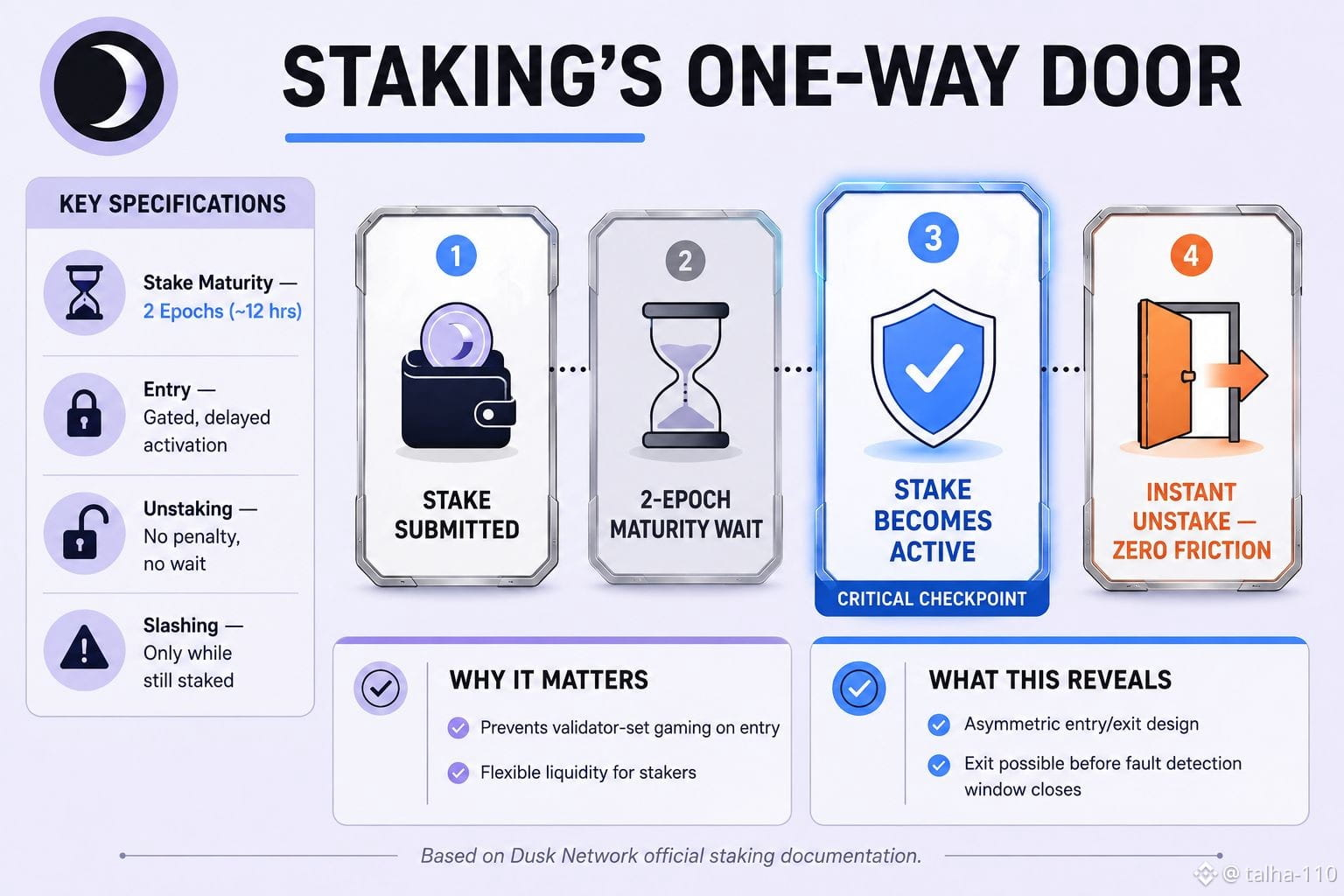
I've been digging into Dusk's staking mechanics lately, and there's something about the entry-vs-exit design that keeps nagging at me. When you stake DUSK, your funds don't start working right away — they sit in a 2-epoch maturity period, roughly 4320 blocks, close to 12 hours, before that stake is even eligible to vote or produce blocks and start earning anything. Fair enough, most PoS networks have some version of this, it stops people from gaming the validator set the moment they show up.
What caught me off guard was the other side of it. Unstaking on Dusk has none of that friction. No cooldown, no penalty, nothing. The official docs are blunt about it — you can pull your entire stake out whenever you want, instantly. Compare that to networks like Ethereum or Cosmos-based chains where unbonding can take days or weeks, specifically so slashing has a window to catch bad behavior before someone can walk away clean.
So you end up with this lopsided setup: getting in takes patience, getting out takes nothing. And because slashing only fires when a fault is actually caught on-chain while you're still staked, it opens up a scenario worth sitting with — a provisioner who's quietly built up a good track record could, in theory, pull their entire stake out an instant before doing something risky, and simply be gone before any penalty mechanism even has a chance to react.
I'm not saying this is being exploited, I have no evidence of that. But when the door out is that wide open, it makes me wonder how much weight the "no exit friction" design choice was actually given during the tokenomics planning, versus it just being a convenience feature that nobody stress-tested against this exact angle.
$DUSK #dusk @Dusk
What caught me off guard was the other side of it. Unstaking on Dusk has none of that friction. No cooldown, no penalty, nothing. The official docs are blunt about it — you can pull your entire stake out whenever you want, instantly. Compare that to networks like Ethereum or Cosmos-based chains where unbonding can take days or weeks, specifically so slashing has a window to catch bad behavior before someone can walk away clean.
So you end up with this lopsided setup: getting in takes patience, getting out takes nothing. And because slashing only fires when a fault is actually caught on-chain while you're still staked, it opens up a scenario worth sitting with — a provisioner who's quietly built up a good track record could, in theory, pull their entire stake out an instant before doing something risky, and simply be gone before any penalty mechanism even has a chance to react.
I'm not saying this is being exploited, I have no evidence of that. But when the door out is that wide open, it makes me wonder how much weight the "no exit friction" design choice was actually given during the tokenomics planning, versus it just being a convenience feature that nobody stress-tested against this exact angle.
$DUSK #dusk @Dusk