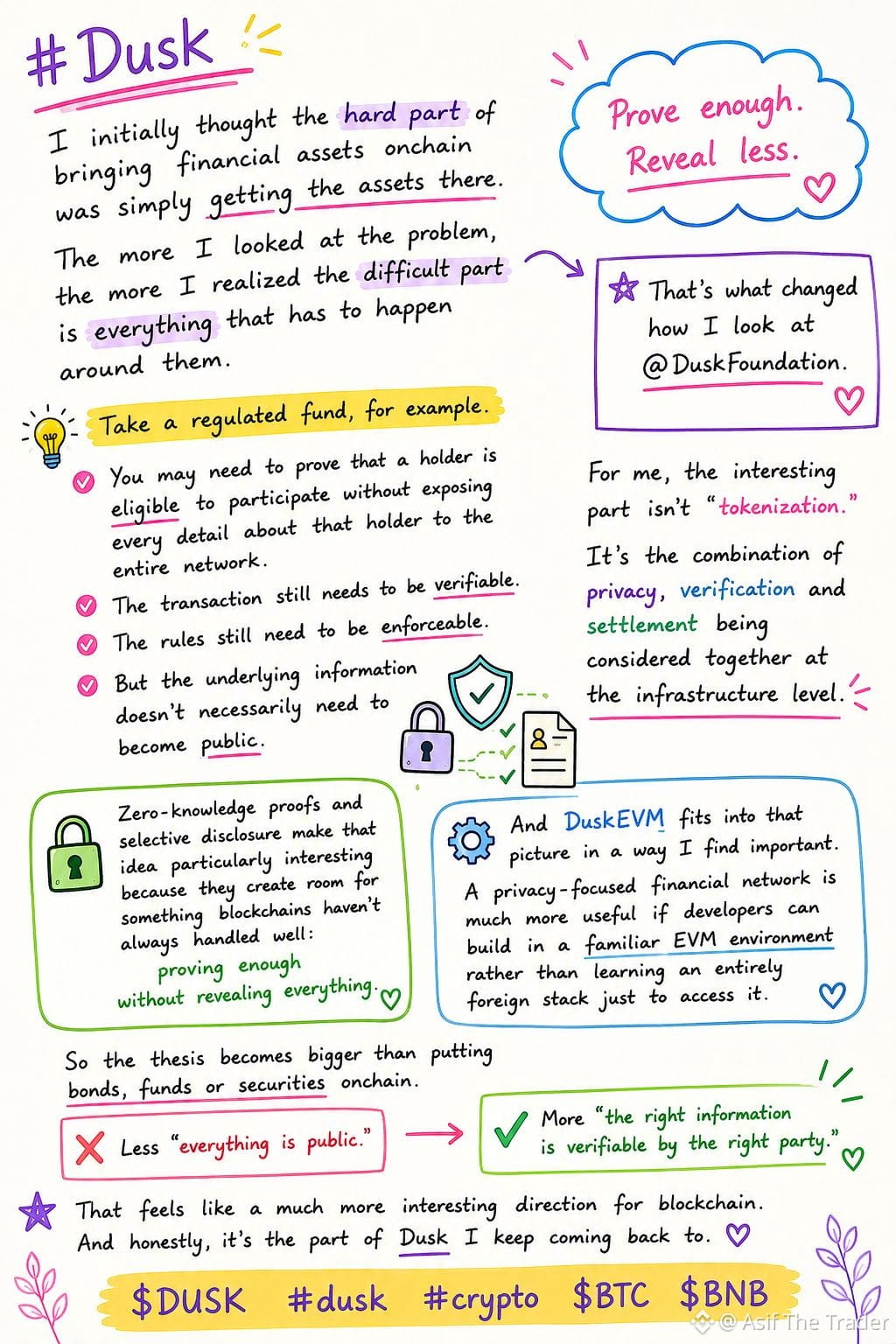
#Dusk
I initially thought the hard part of bringing financial assets onchain was simply getting the assets there.
The more I looked at the problem, the more I realized the difficult part is everything that has to happen around them.
Take a regulated fund, for example.
You may need to prove that a holder is eligible to participate without exposing every detail about that holder to the entire network.
The transaction still needs to be verifiable.
The rules still need to be enforceable.
But the underlying information doesn't necessarily need to become public.
That shift in perspective is what made
@Dusk more interesting to me.
For me, the real opportunity isn't simply “ tokenization.”
It's bringing privacy, verification and settlement together at the infrastructure layer.
Zero-knowledge proofs and selective disclosure are especially interesting here because they point toward a model where you can prove what matters without revealing everything behind the proof.
Prove enough. Reveal less.
And DuskEVM makes that thesis even more practical.
If developers can work in a familiar EVM environment while building for privacy-focused financial infrastructure, the barrier to experimenting with these ideas becomes much lower.
So I don't think the bigger story is simply putting bonds, funds or securities onchain.
It's what happens when the underlying financial infrastructure is designed around a more selective idea of transparency from the start.
Not:
“ Make everything public.”
But:
“ Make the right information verifiable by the right party.”
That distinction might end up mattering a lot more than the tokenization narrative itself.
$DUSK #dusk #crypto $BTC $BNB
I initially thought the hard part of bringing financial assets onchain was simply getting the assets there.
The more I looked at the problem, the more I realized the difficult part is everything that has to happen around them.
Take a regulated fund, for example.
You may need to prove that a holder is eligible to participate without exposing every detail about that holder to the entire network.
The transaction still needs to be verifiable.
The rules still need to be enforceable.
But the underlying information doesn't necessarily need to become public.
That shift in perspective is what made
@Dusk more interesting to me.
For me, the real opportunity isn't simply “ tokenization.”
It's bringing privacy, verification and settlement together at the infrastructure layer.
Zero-knowledge proofs and selective disclosure are especially interesting here because they point toward a model where you can prove what matters without revealing everything behind the proof.
Prove enough. Reveal less.
And DuskEVM makes that thesis even more practical.
If developers can work in a familiar EVM environment while building for privacy-focused financial infrastructure, the barrier to experimenting with these ideas becomes much lower.
So I don't think the bigger story is simply putting bonds, funds or securities onchain.
It's what happens when the underlying financial infrastructure is designed around a more selective idea of transparency from the start.
Not:
“ Make everything public.”
But:
“ Make the right information verifiable by the right party.”
That distinction might end up mattering a lot more than the tokenization narrative itself.
$DUSK #dusk #crypto $BTC $BNB