One thing I keep coming back to with Dusk Network is security.
Privacy gets most of the attention, but I think the boring stuff underneath matters just as much for a financial blockchain. If the execution layer has a weakness, fancy cryptography doesn’t mean much.
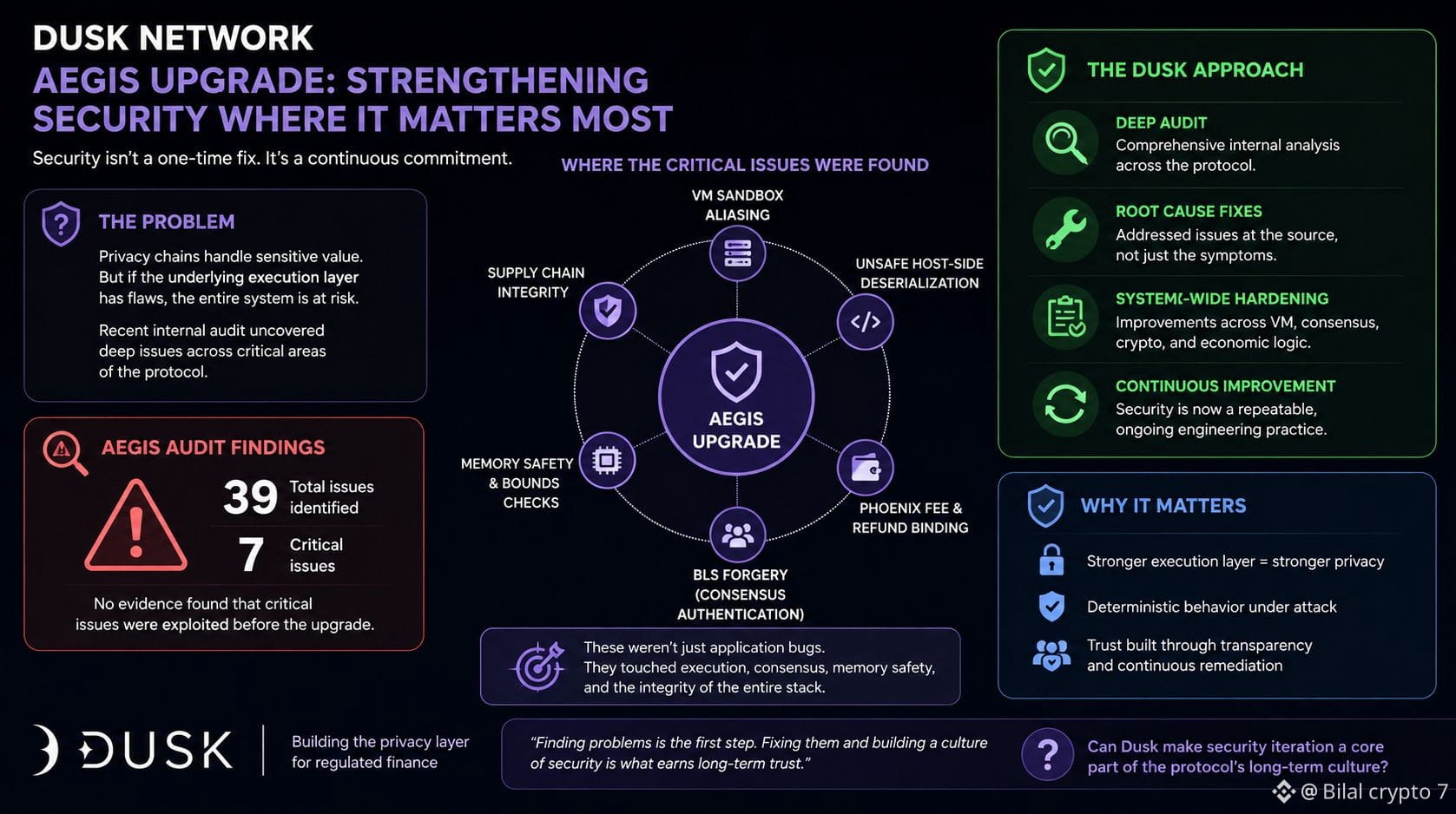
Dusk’s AEGIS upgrade caught my attention because it wasn’t just about polishing the edges. Dusk says the audit uncovered 39 issues, including seven critical ones, involving areas like VM sandboxing, deserialization, fee handling, and BLS signatures.
What I find interesting is that these problems weren’t all sitting in one corner of the stack. They touched execution, security and how the network handles transactions.
I’ve watched enough projects to know that an audit itself doesn’t prove much. Finding problems is useful, but I care more about what happens afterward. Are the fixes properly tested? Does the team keep looking for weaknesses? Does security become part of the development process?
That’s where I’m still a little cautious with Dusk. Good remediation is encouraging, but it has to become a habit.
I’m curious whether Dusk can make that security discipline part of the protocol’s long-term culture.
@Dusk #dusk $DUSK
Privacy gets most of the attention, but I think the boring stuff underneath matters just as much for a financial blockchain. If the execution layer has a weakness, fancy cryptography doesn’t mean much.
Dusk’s AEGIS upgrade caught my attention because it wasn’t just about polishing the edges. Dusk says the audit uncovered 39 issues, including seven critical ones, involving areas like VM sandboxing, deserialization, fee handling, and BLS signatures.
What I find interesting is that these problems weren’t all sitting in one corner of the stack. They touched execution, security and how the network handles transactions.
I’ve watched enough projects to know that an audit itself doesn’t prove much. Finding problems is useful, but I care more about what happens afterward. Are the fixes properly tested? Does the team keep looking for weaknesses? Does security become part of the development process?
That’s where I’m still a little cautious with Dusk. Good remediation is encouraging, but it has to become a habit.
I’m curious whether Dusk can make that security discipline part of the protocol’s long-term culture.
@Dusk #dusk $DUSK