#dusk $DUSK
Spent some time this week trying to understand why @Dusk didn't just ship privacy as a bolt-on to a normal EVM chain, and it comes down to a problem most people skip past: on a public EVM, every balance and transfer is visible to anyone who looks, even if you wrap it in a "private" app on top. The base layer leaks.
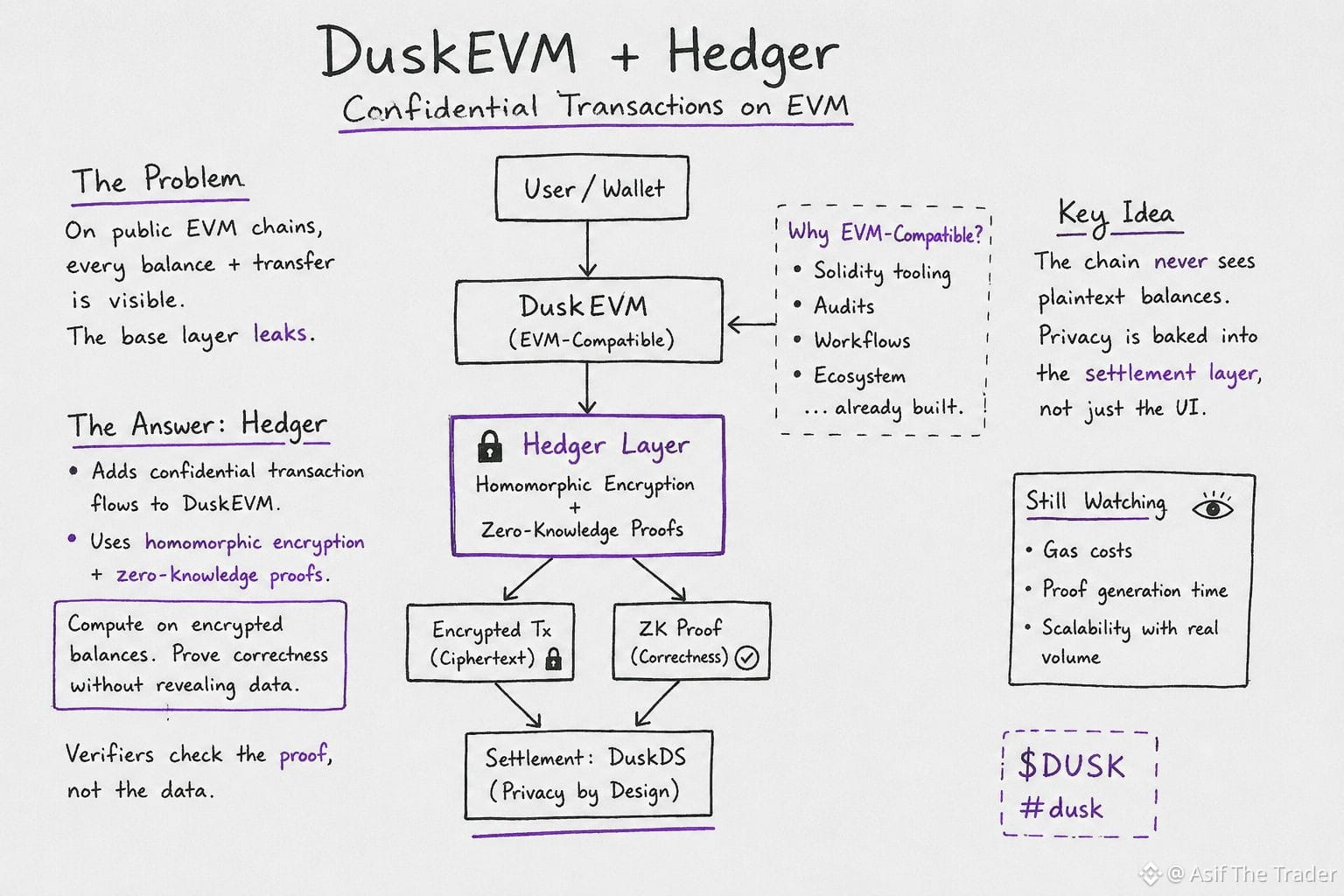
Dusk's answer is Hedger — it adds confidential transaction flows directly to DuskEVM using homomorphic encryption combined with zero-knowledge proofs. The idea is that a contract can compute over encrypted balances and still produce a proof that the computation was done correctly, without ever decrypting the underlying numbers. Verifiers check the proof, not the data. That's a very different guarantee than "the frontend hides your balance" it means the chain itself never has the plaintext to leak in the first place.
Why put that on an EVM-compatible layer instead of a totally custom VM? Because institutions already have Solidity tooling, audits, and workflows built up over a decade. DuskEVM (OP Stack, settling back to DuskDS) lets that tooling stay, while Hedger changes what the base layer is allowed to see. Privacy becomes a property of settlement, not a UI trick.
Still watching how gas costs and proof generation scale once real transaction volume hits it, but the architecture itself is the more interesting story than the price chart right now.
$DUSK #dusk
Spent some time this week trying to understand why @Dusk didn't just ship privacy as a bolt-on to a normal EVM chain, and it comes down to a problem most people skip past: on a public EVM, every balance and transfer is visible to anyone who looks, even if you wrap it in a "private" app on top. The base layer leaks.
Dusk's answer is Hedger — it adds confidential transaction flows directly to DuskEVM using homomorphic encryption combined with zero-knowledge proofs. The idea is that a contract can compute over encrypted balances and still produce a proof that the computation was done correctly, without ever decrypting the underlying numbers. Verifiers check the proof, not the data. That's a very different guarantee than "the frontend hides your balance" it means the chain itself never has the plaintext to leak in the first place.
Why put that on an EVM-compatible layer instead of a totally custom VM? Because institutions already have Solidity tooling, audits, and workflows built up over a decade. DuskEVM (OP Stack, settling back to DuskDS) lets that tooling stay, while Hedger changes what the base layer is allowed to see. Privacy becomes a property of settlement, not a UI trick.
Still watching how gas costs and proof generation scale once real transaction volume hits it, but the architecture itself is the more interesting story than the price chart right now.
$DUSK #dusk