@Dusk $DUSK #dusk
I used to think making a blockchain institution-ready was mostly about EVM compatibility.
Give developers Solidity tooling, keep the UX familiar, and adoption would follow.
The more I look at DuskEVM, the more I think the harder problem is actually privacy.
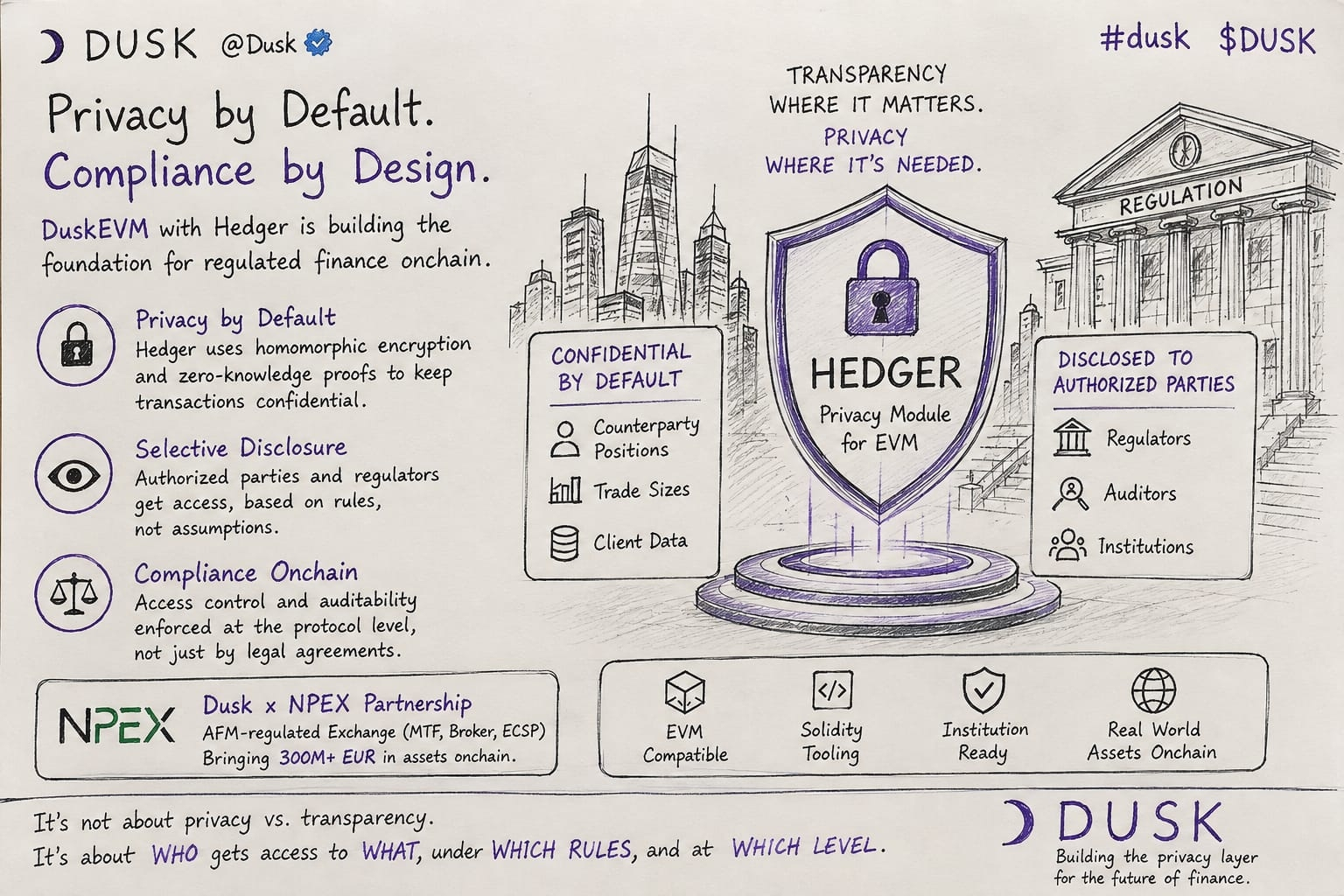
Regulated finance needs a middle ground. You can’t put every trade size, position, or piece of client data on a fully transparent ledger. But you also can’t make everything invisible. Regulators, auditors, and authorized participants still need the right information at the right time.
That’s where Hedger gets interesting.
Dusk presents Hedger as a privacy module for EVM designed to keep transactions confidential while enabling selective disclosure when access is required.
And that changes how I think about privacy:
Privacy doesn’t mean hiding everything.
It means controlling who can see what, when they can see it, and why.
That last part matters for regulated markets.
The NPEX connection makes the idea even more interesting. Combined with the push toward putting real-world assets onchain, it points to a use case that goes beyond the typical crypto-native audience.
Still, I wouldn’t call the problem solved.
The real test is whether this architecture can handle institutional-scale activity while satisfying serious disclosure, audit, and compliance requirements.
That’s what I’ll be watching.
Because maybe the real question isn’t:
Privacy or transparency?
Maybe it’s:
Who gets access to what, under which rules, and at what level?
@Dusk $DUSK #dusk
I used to think making a blockchain institution-ready was mostly about EVM compatibility.
Give developers Solidity tooling, keep the UX familiar, and adoption would follow.
The more I look at DuskEVM, the more I think the harder problem is actually privacy.
Regulated finance needs a middle ground. You can’t put every trade size, position, or piece of client data on a fully transparent ledger. But you also can’t make everything invisible. Regulators, auditors, and authorized participants still need the right information at the right time.
That’s where Hedger gets interesting.
Dusk presents Hedger as a privacy module for EVM designed to keep transactions confidential while enabling selective disclosure when access is required.
And that changes how I think about privacy:
Privacy doesn’t mean hiding everything.
It means controlling who can see what, when they can see it, and why.
That last part matters for regulated markets.
The NPEX connection makes the idea even more interesting. Combined with the push toward putting real-world assets onchain, it points to a use case that goes beyond the typical crypto-native audience.
Still, I wouldn’t call the problem solved.
The real test is whether this architecture can handle institutional-scale activity while satisfying serious disclosure, audit, and compliance requirements.
That’s what I’ll be watching.
Because maybe the real question isn’t:
Privacy or transparency?
Maybe it’s:
Who gets access to what, under which rules, and at what level?
@Dusk $DUSK #dusk