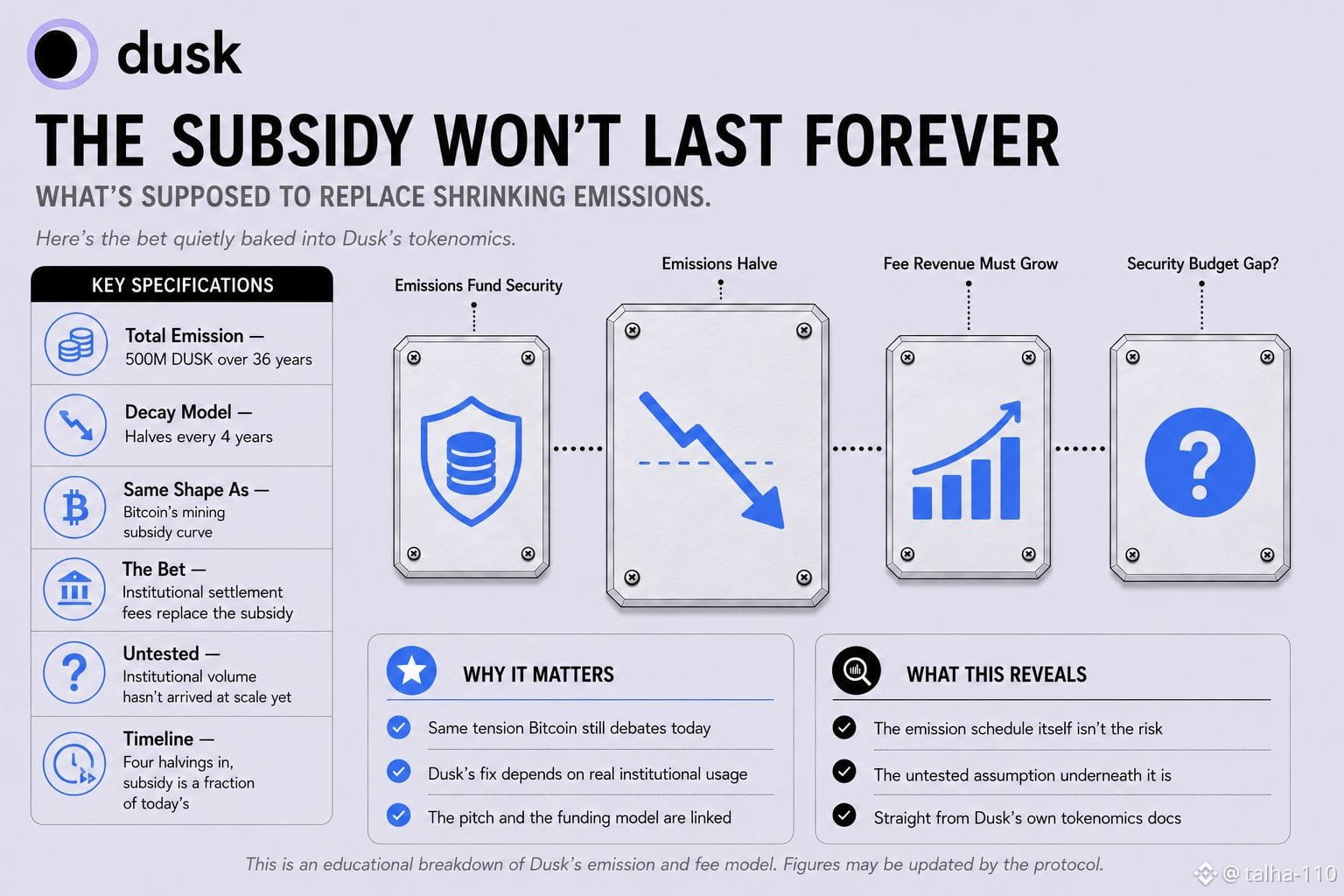
Dusk's staking rewards run on a geometric decay curve that cuts emissions in half every four years, the same halving shape Bitcoin's mining reward follows, spread across a fixed 500 million DUSK budget released over 36 years on top of the 500 million that already existed before mainnet. That detail alone isn't surprising, plenty of networks taper emissions. What's worth sitting with is what's supposed to replace that funding once it shrinks far enough. Bitcoin's version of this exact problem gets debated constantly, miners eventually need transaction fees to fully replace the block subsidy, and whether fee revenue alone can sustain enough security is still an open argument decades in. Dusk is walking into a structurally similar position, except its entire pitch depends on becoming infrastructure for regulated financial settlement, tokenized securities, institutional RWA flows, the kind of usage that's supposed to generate real fee volume precisely because it's real financial activity, not speculative trading. So there's an implicit bet baked into the tokenomics. Early on, emissions carry most of the weight of paying provisioners to secure the network. Four halvings in, sixteen years out, that subsidy is a fraction of where it started, and gas fees from actual settlement activity are supposed to have grown enough to pick up the difference. Nobody knows yet whether institutional-grade transaction volume actually generates fee revenue at that scale, because the institutions this network is built for mostly haven't shown up in volume yet. The emission schedule isn't the risk. The assumption baked quietly underneath it, that real-world asset settlement will eventually generate enough fee revenue to replace a shrinking subsidy, is the part nobody's actually tested.
$DUSK #dusk @Dusk
$HEMI
$CYS
$DUSK #dusk @Dusk
$HEMI
$CYS