A friend once asked me why I refuse to move a single Binance P2P conversation off the app, so I laid out my reasoning for him step by step.
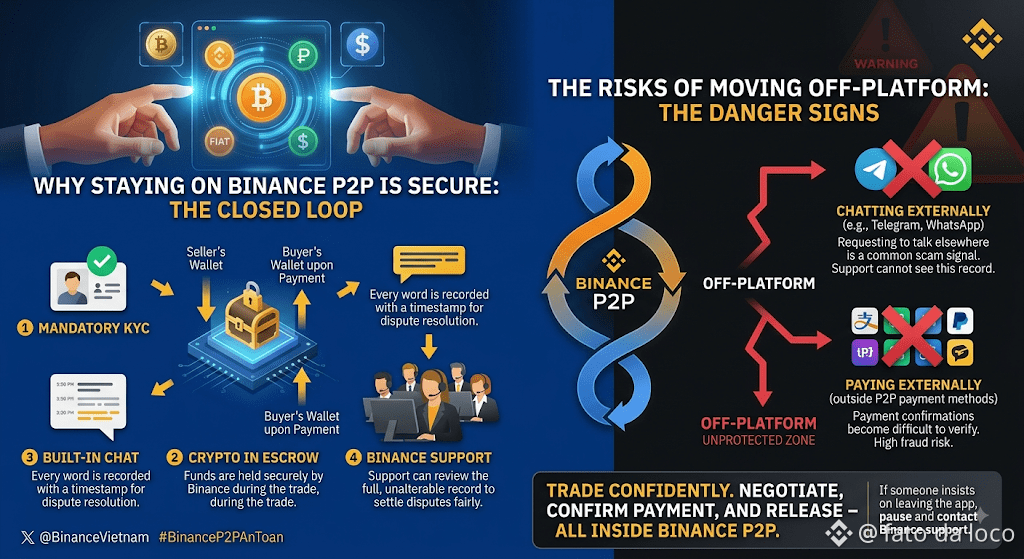
Binance P2P is designed as a closed loop on purpose, starting with mandatory KYC verification on every account. The seller's crypto sits in escrow from the moment an order opens, the built in chat records every word exchanged with a timestamp, and if a disagreement happens, Binance support can look at that exact record to settle a dispute fairly. None of that works once a conversation or a payment leaves the platform. If a trade falls apart and the key details were discussed somewhere the platform cannot see, support has nothing solid to review, and the dispute process loses most of its power to help either side. That is also exactly why staying on Binance P2P matters just as much for honest counterparties as it does for catching dishonest ones, since a request to talk elsewhere is one of the more consistent warning signs I have learned to watch for.
I told my friend about a trade where the other side asked, almost casually, to continue our chat outside the app to sort out a small detail faster. It was such a minor sounding request that it would have been easy to agree without thinking twice. I said no and kept the entire negotiation inside Binance P2P instead, and the trade finished normally within minutes anyway, proving the outside chat was never actually necessary. My rule for him, and for myself, stays consistent: negotiate, confirm payment, and release, all without ever stepping outside the platform. If someone insists otherwise, that insistence itself is worth pausing on and, if needed, raising with Binance support. My friend trades confidently now using that same rule, and he tells me it feels less like a restriction and more like knowing exactly where the boundary sits before a deal even begins.
#binancep2pantoan @Binance Vietnam $PORTAL
Binance P2P is designed as a closed loop on purpose, starting with mandatory KYC verification on every account. The seller's crypto sits in escrow from the moment an order opens, the built in chat records every word exchanged with a timestamp, and if a disagreement happens, Binance support can look at that exact record to settle a dispute fairly. None of that works once a conversation or a payment leaves the platform. If a trade falls apart and the key details were discussed somewhere the platform cannot see, support has nothing solid to review, and the dispute process loses most of its power to help either side. That is also exactly why staying on Binance P2P matters just as much for honest counterparties as it does for catching dishonest ones, since a request to talk elsewhere is one of the more consistent warning signs I have learned to watch for.
I told my friend about a trade where the other side asked, almost casually, to continue our chat outside the app to sort out a small detail faster. It was such a minor sounding request that it would have been easy to agree without thinking twice. I said no and kept the entire negotiation inside Binance P2P instead, and the trade finished normally within minutes anyway, proving the outside chat was never actually necessary. My rule for him, and for myself, stays consistent: negotiate, confirm payment, and release, all without ever stepping outside the platform. If someone insists otherwise, that insistence itself is worth pausing on and, if needed, raising with Binance support. My friend trades confidently now using that same rule, and he tells me it feels less like a restriction and more like knowing exactly where the boundary sits before a deal even begins.
#binancep2pantoan @Binance Vietnam $PORTAL