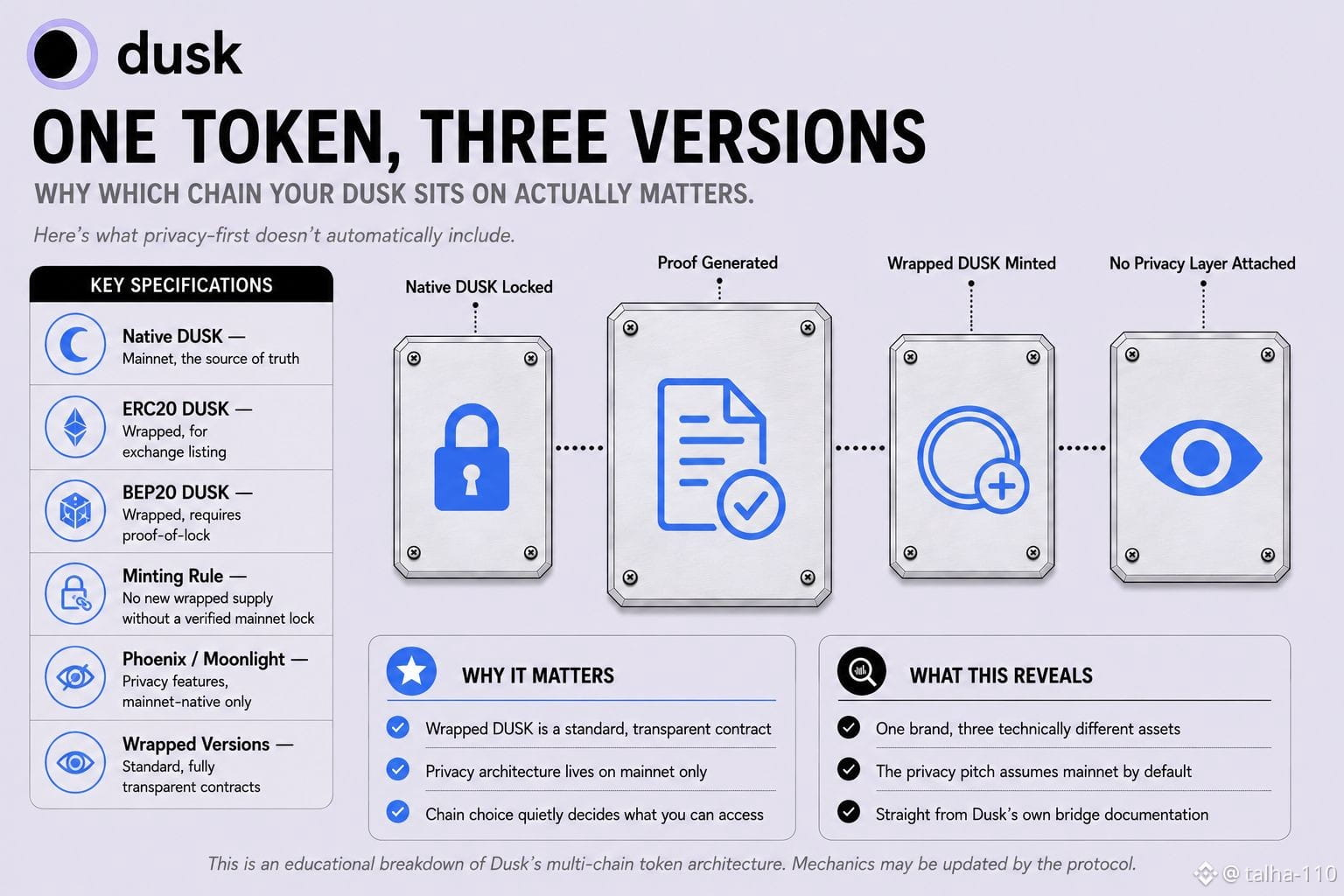
At first I assumed DUSK was just DUSK, one token, one ledger, wherever you held it. Reading Dusk's own bridge documentation, that assumption breaks down the moment you look at how the network actually structures its multi-chain presence. DUSK exists as three separate assets right now, native DUSK on the Dusk mainnet, plus ERC20 and BEP20 versions on Ethereum and BSC for exchange listings and migration. The bridge connecting them isn't symmetric. BEP20 DUSK is explicitly treated as a wrapped asset, and minting new BEP20 supply is only permitted after cryptographic proof that an equivalent amount got locked on the mainnet side first. Dusk's own team describes native mainnet DUSK as the source of truth for exactly this reason, everything else is a derivative that only exists because something real got locked up somewhere else. That's a normal bridge design, plenty of networks work this way. But it collides with the privacy pitch in a way that's easy to miss. Phoenix and Moonlight, the two transaction models actually offering privacy or public transparency by design, are mainnet-native concepts. ERC20 and BEP20 DUSK are just standard token contracts sitting on Ethereum and BSC, fully transparent by definition, with none of Dusk's own privacy architecture attached to them at all. So depending on which version of DUSK someone actually holds, native mainnet or a wrapped bridge asset, they may not have access to any of Dusk's privacy features at all, regardless of whether they'd choose Phoenix or Moonlight if they did. The brand is privacy-first. Whether a given holder's DUSK is even capable of touching that privacy layer depends entirely on which chain it's sitting on, a detail the "privacy-first" framing doesn't really surface.
$DUSK #dusk @Dusk
$HEMI
$APR
$DUSK #dusk @Dusk
$HEMI
$APR