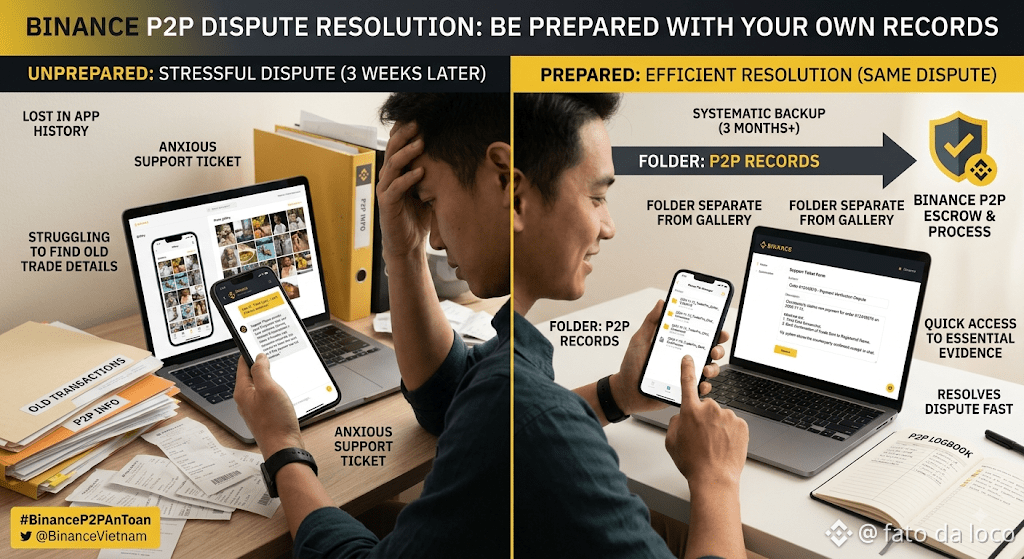
I keep a folder on my phone named simply 'P2P records,' and it has saved me more times than I can count. Every trade I complete on Binance P2P gets a screenshot before I even close the order, and I always start by noting the counterparty's completion rate and registered name too, since that quick check matters just as much as the paperwork that comes after.
Binance P2P protects every trade through KYC verification, an escrow system, a logged chat window, and a dispute appeal process, and the platform stores the order ID and chat log on its own. Relying only on that archive means digging through app history instead of having everything ready when a dispute happens fast. I save the order ID, a screenshot of the final chat exchange, and a screenshot of my own bank confirmation, the one I check directly rather than trusting anything the counterparty sends me, for every single trade, then I label the file with the date and the counterparty's username.
This habit matters most when something goes wrong weeks after a trade closes. I had a situation where a counterparty tried disputing a completed order almost 3 weeks later, claiming payment was never received. Because I had kept my bank confirmation and the full chat screenshot, I was able to open a support ticket and provide everything in the first message instead of scrambling to reconstruct the trade from memory.
My personal system: save records right after every trade, not later, store them somewhere separate from your regular photo gallery so they do not get lost in the shuffle, and keep at least 3 months of history even for uneventful trades. When you reach out to Binance support, include the order ID, the approximate date and time, and a short factual description of the issue rather than an emotional one. Clear, organized tickets get resolved faster because the support team can verify details immediately instead of asking follow up questions first.
#binancep2pantoan @Binance Vietnam $ACE
Binance P2P protects every trade through KYC verification, an escrow system, a logged chat window, and a dispute appeal process, and the platform stores the order ID and chat log on its own. Relying only on that archive means digging through app history instead of having everything ready when a dispute happens fast. I save the order ID, a screenshot of the final chat exchange, and a screenshot of my own bank confirmation, the one I check directly rather than trusting anything the counterparty sends me, for every single trade, then I label the file with the date and the counterparty's username.
This habit matters most when something goes wrong weeks after a trade closes. I had a situation where a counterparty tried disputing a completed order almost 3 weeks later, claiming payment was never received. Because I had kept my bank confirmation and the full chat screenshot, I was able to open a support ticket and provide everything in the first message instead of scrambling to reconstruct the trade from memory.
My personal system: save records right after every trade, not later, store them somewhere separate from your regular photo gallery so they do not get lost in the shuffle, and keep at least 3 months of history even for uneventful trades. When you reach out to Binance support, include the order ID, the approximate date and time, and a short factual description of the issue rather than an emotional one. Clear, organized tickets get resolved faster because the support team can verify details immediately instead of asking follow up questions first.
#binancep2pantoan @Binance Vietnam $ACE