

When people ask why Walrus never trends the way other projects do, my answer is usually simple. It was never built to entertain. Most of the criticism I see comes down to the same point. There is no loud story, no constant excitement, and no reason to trade every day. And that absence is exactly what attracts serious users.
Wallets that pay for storage behave very differently from speculative wallets. They fund usage upfront and then go quiet. There is no looping, no farming, and no constant repositioning. At first, that silence can feel uncomfortable if you are used to fast and noisy systems. But silence often signals confidence. People do not hover when they trust what they have committed to.
The payment model explains much of this behavior. Storage is paid in advance. There is no anxiety about missing payments or losing access because of a bad market week. Operators are compensated to honor commitments that already exist, not to chase new inflows every day. That removes pressure, reduces panic selling, and limits forced exits when conditions become unstable.
WAL trading reflects the same mindset. Liquidity is not aggressive, but it is clean. There are no heavy emissions driving short term chaos. Price movements are slower. Spreads may widen under stress, but they do so calmly and then settle. It behaves less like a casino chip and more like infrastructure capital. Not exciting, but structurally sound.
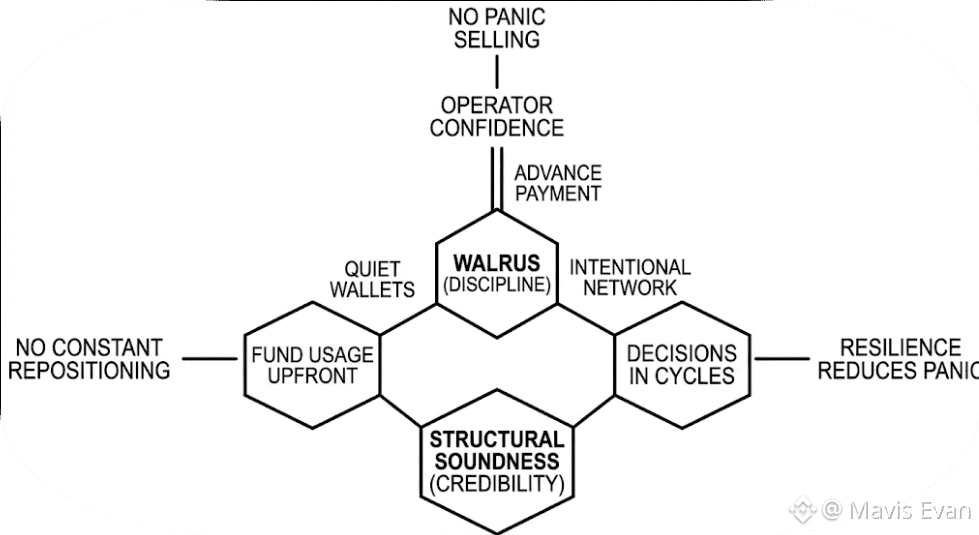
The network itself moves with intention rather than impulse. Decisions unfold in cycles, not minutes. Operators review performance. Delegators rebalance deliberately. Nothing in the system rewards emotional reactions. Participants who need constant stimulation tend to leave early, which is likely healthy. What remains are users who understand patience.
Failure is handled differently as well. Because data remains retrievable even when parts of the system are under stress, users do not rush for the exits. There is no collapse driven purely by fear. Many crypto projects fail not because they break, but because people believe they might. Here, resilience reduces panic before it has a chance to spread.
Walrus makes a clear tradeoff. It gives up fast liquidity in order to protect credibility. Large holders are often tied to real usage or network operations, which naturally reduces circulating supply. Traders may dislike that. The system benefits from it. Short term capital cannot flee if it was never invited in.
The capital settling here feels tired in a good way. Builders and funds burned by downtime, vague guarantees, and narrative driven promises elsewhere are choosing something quieter and more durable. This is not ideology. It is responsibility. Commitments are explicit. Exits are intentional. Trust is earned, not advertised.
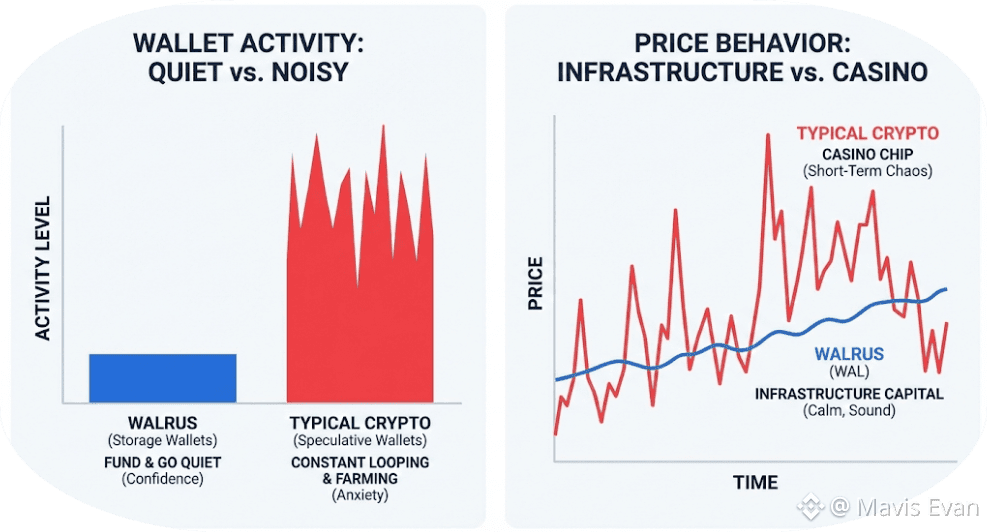
Walrus does not try to dominate conversations or promise overnight revolutions. It enforces discipline instead. And in a market exhausted by noise and fragile systems, that discipline is not a weakness. It is the point.

