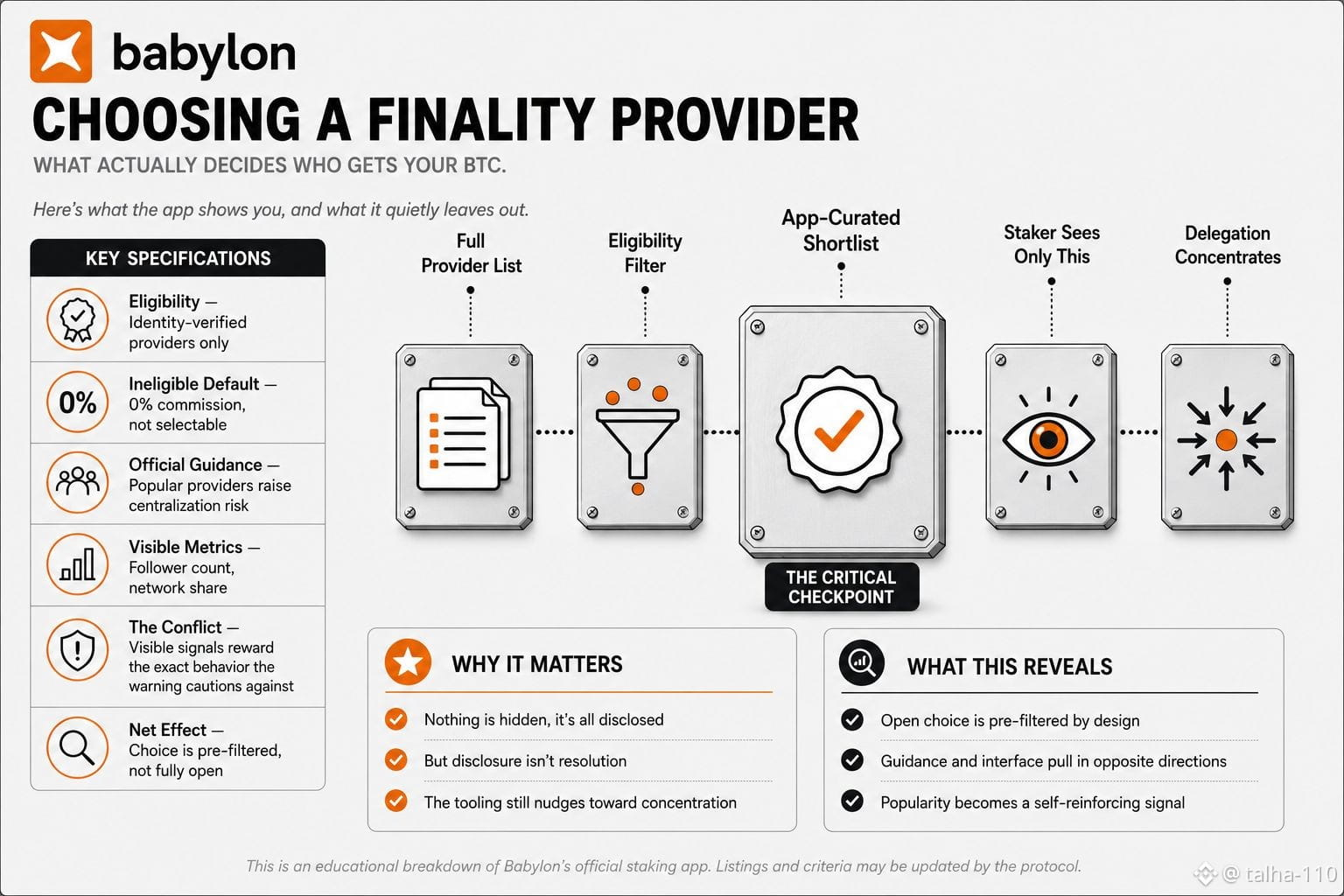
At first I assumed choosing a Finality Provider worked like picking any Cosmos validator, open list, pick whoever you like, the network naturally stays distributed as people spread their stake around based on preference. Reading Babylon's own eligibility rules for the official staking app, the process nudges toward concentration in a way that assumption doesn't account for. Only Finality Providers that pass strict identity verification and registration criteria get listed in the app with their commission rate, website, and a visible checkmark. Providers that don't meet that bar can technically still receive BTC delegations if someone delegates to them directly outside the app, but they're capped at 0% commission by default and the app won't even let a regular staker select them as an option. So the "open choice" is really open only within a pre-filtered, officially curated shortlist, everyone outside that list is functionally invisible to anyone using the standard flow. Babylon's own staking guide adds a second layer to this, explicitly warning stakers that delegating to the most popular providers increases centralization risk, while also listing follower count and network share as the main signals to evaluate a provider by. Those two pieces of advice pull in opposite directions. The visible signals the app surfaces are exactly the ones that make popular providers look more trustworthy, which is exactly the behavior the same documentation says to be cautious about. Nothing here is hidden or dishonest, it's all disclosed. But disclosing a tension isn't the same as resolving it, and right now the tooling quietly rewards the concentration the guidance is warning people against.
@BabylonLabs_io $BABY #baby $BTC
@BabylonLabs_io $BABY #baby $BTC