
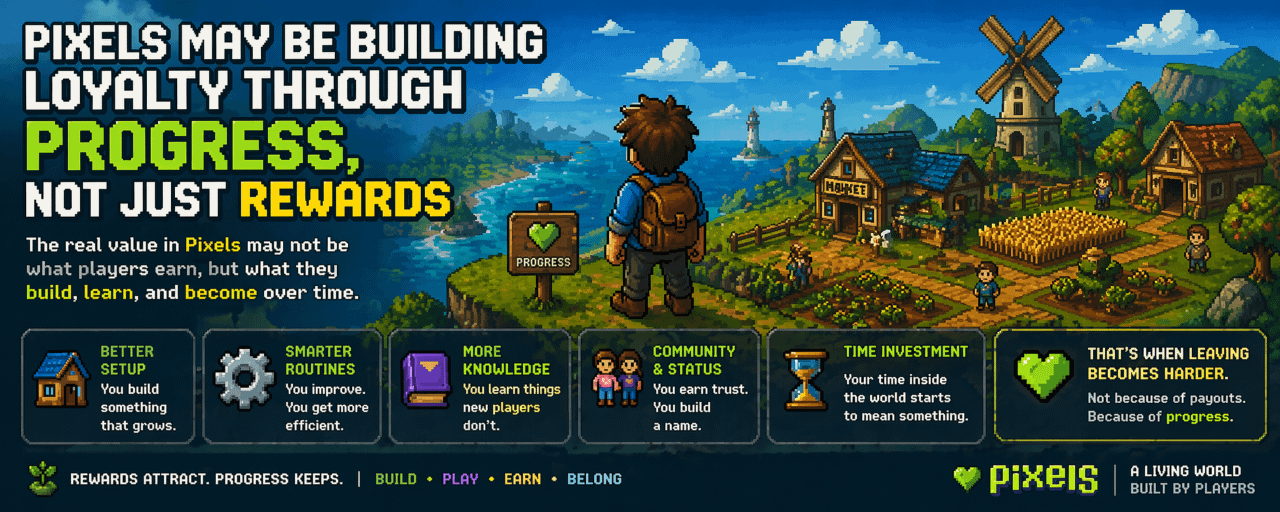
Most people explain active Web3 games in a very simple way:
Users are playing because rewards are good 💰
It sounds logical
If activity is high, incentives must be working
If players return daily, payouts must be attractive
If engagement continues, token rewards must be driving it
Sometimes that explanation is true
But I don’t think it tells the full story of what may be happening inside Pixels
Because rewards are excellent at attracting attention
They are much less reliable at keeping it 👀
Attention can be rented
Loyalty usually has to be earned
That difference matters more than many people realize
Across Web3, we’ve seen many ecosystems create temporary spikes through incentives. Users arrive quickly, activity rises, metrics look strong, and excitement spreads
Then rewards weaken
And many users disappear with them
Why?
Because nothing deeper was built
No attachment
No identity
No meaningful progress
No reason to stay once payouts fade
Pixels may be trying to build something different ⚙️
The longer players spend time inside a live world, the more value can shift away from short-term rewards and toward long-term progress
A stronger land setup 🏡
Better routines and workflows 🔄
Knowledge newer players don’t have 🧠
Understanding profitable loops 📈
Smarter reactions to updates 🔧
Recognition inside the community 🤝
These things may look smaller than token rewards on paper
But over time, they can become more powerful
Because progress creates memory
Once players feel that yesterday’s effort still matters today, behavior changes
They stop acting like visitors
They start acting like participants
👉 They plan further ahead
👉 They compare strategies
👉 They protect momentum
👉 They care about updates
👉 They return with purpose
That is very different from simply farming rewards
It becomes investment of time, not just extraction of value ⏳
This may also explain why some ecosystems survive incentive cycles while others collapse after hype fades
One system rented attention
The other built attachment
Of course, rewards still matter. They help attract users, energize activity, and create momentum. But rewards alone rarely create durable communities
Progress often does
If Pixels continues improving systems where player time compounds into something meaningful, then it may be building a stronger foundation than many people realize
Not just activity
Commitment 🎯
