
Dr Nohawn
25.3k Publications

Dr Nohawn
 Compte Square Vérifié+
Not New, Not Pro. Just Experienced Enough To Know Most People Are Guessing.
497 Suivis
50.0K+ Abonnés
60.6K+ J’aime
Publications
Tous
Citations
Vidéos
Vérifié
Been going through the latest Dusk update and one detail keeps getting framed wrong.
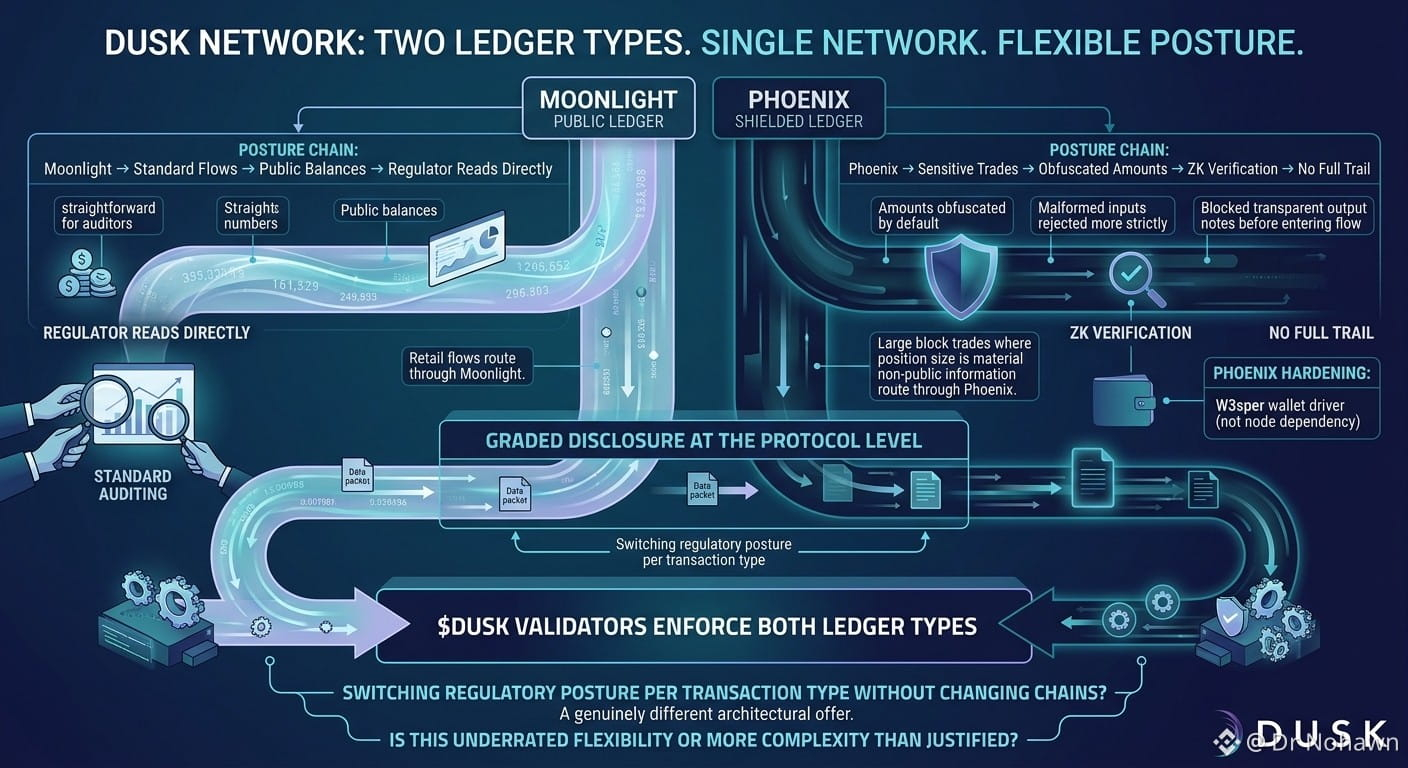
The usual question is: does this chain have privacy or not. That is the wrong question for institutions. I checked how Moonlight and Phoenix sit inside the same Dusk network and found a
single institution can run both postures depending on what each transaction requires.
Think about it this way. Moonlight is the fully public ledger, transparent balances, straightforward for auditors. Phoenix is the shielded ledger, amounts obfuscated by default, proof-backed verification. Same institution, same network, two regulatory postures available on demand.
POSTURE CHAIN: Moonlight → Standard Flows → Public Balances → Regulator Reads Directly | Phoenix → Sensitive Trades → Obfuscated Amounts → ZK Verification → No Full Trail → DUSK Validators Enforce Both
What struck me here is the practical implication. Retail flows route through Moonlight. Large block trades where position size is material non-public information route through Phoenix. That is graded disclosure at the protocol level, not a workaround.
And honestly, the Phoenix hardening in this update matters specifically because of this. Transfers now obfuscate value by default. W3sper packages its own wallet driver rather than depending on the nOde, strengthening the privacy boundary. Malformed inputs are rejected more strictly. Non-zero transparent output notes are blocked before entering the flow.
I kept thinking about what this means against any L1 offEring privacy as a single fixed mode. Switching regulatory posture per transaction type without changing chains is a genuinely different architectural offer.
Is the Moonlight and Phoenix split the most underrated part of DUSK, or does managing two ledger types create more complexity than the flexibility justifies?
#dusk $DUSK @Dusk
The usual question is: does this chain have privacy or not. That is the wrong question for institutions. I checked how Moonlight and Phoenix sit inside the same Dusk network and found a
single institution can run both postures depending on what each transaction requires.
Think about it this way. Moonlight is the fully public ledger, transparent balances, straightforward for auditors. Phoenix is the shielded ledger, amounts obfuscated by default, proof-backed verification. Same institution, same network, two regulatory postures available on demand.
POSTURE CHAIN: Moonlight → Standard Flows → Public Balances → Regulator Reads Directly | Phoenix → Sensitive Trades → Obfuscated Amounts → ZK Verification → No Full Trail → DUSK Validators Enforce Both
What struck me here is the practical implication. Retail flows route through Moonlight. Large block trades where position size is material non-public information route through Phoenix. That is graded disclosure at the protocol level, not a workaround.
And honestly, the Phoenix hardening in this update matters specifically because of this. Transfers now obfuscate value by default. W3sper packages its own wallet driver rather than depending on the nOde, strengthening the privacy boundary. Malformed inputs are rejected more strictly. Non-zero transparent output notes are blocked before entering the flow.
I kept thinking about what this means against any L1 offEring privacy as a single fixed mode. Switching regulatory posture per transaction type without changing chains is a genuinely different architectural offer.
Is the Moonlight and Phoenix split the most underrated part of DUSK, or does managing two ledger types create more complexity than the flexibility justifies?
#dusk $DUSK @Dusk
Dusk’s Privacy Model
Moonlight vs Phoenix
Dual Ledger Design
9 heure(s) restante(s)
Vérifié
I kept coming back to one question while looking at Dusk: what actually connects ecosystem growth to Dusk?
The answer is more interesting than simply “more users means more value.”
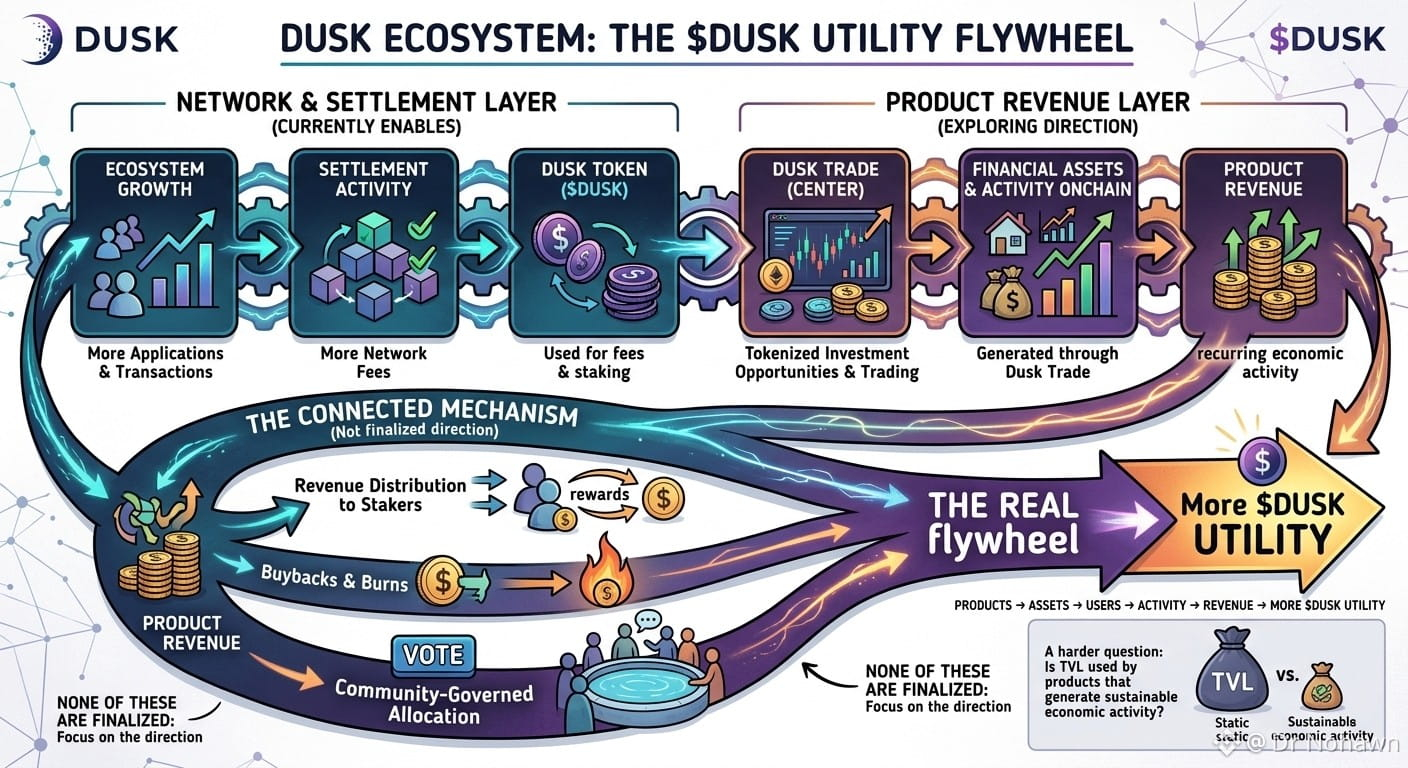
Dusk is building products designed to bring financial assets and real activity onchain. Dusk Trade sits at the center, with tokenized investment opportunities and trading. Around it, the network already has infrastructure for identity, privacy, execution and settlement.
So the flywheel starts with activity.
More assets and users can mean more applications and transactions. More settlement activity means more network fees, and Dusk is already used for those fees and staking.
But here’s where it gets interesting.
Dusk is also exploring ways for product revenue to expand token utility further, including revenue distribution to stakers, buybacks and burns, or community-governed allocation.
None of those mechanisms should be treated as finalized. The important part is the direction.
I see the model as:
Products → Assets → Users → Activity → Revenue → MOre Dusk utility
And honestly, this is the part I think deserves more attention.
A blockchain can attract TVL. A much harder question is whether that capital is being used by products that generate sustainable economic activity.
If Dusk can turn regulated financial activity into recurring product revenue while simultaneously increasing network usage, the token utility story becomes connected to the actual ecosystem rather than existing sepArately from it.
That is the flywheel I’m watching.
Now, Guys you tell me inquiz below
What can more Dusk activity generate?
#dusk $DUSK @Dusk
The answer is more interesting than simply “more users means more value.”
Dusk is building products designed to bring financial assets and real activity onchain. Dusk Trade sits at the center, with tokenized investment opportunities and trading. Around it, the network already has infrastructure for identity, privacy, execution and settlement.
So the flywheel starts with activity.
More assets and users can mean more applications and transactions. More settlement activity means more network fees, and Dusk is already used for those fees and staking.
But here’s where it gets interesting.
Dusk is also exploring ways for product revenue to expand token utility further, including revenue distribution to stakers, buybacks and burns, or community-governed allocation.
None of those mechanisms should be treated as finalized. The important part is the direction.
I see the model as:
Products → Assets → Users → Activity → Revenue → MOre Dusk utility
And honestly, this is the part I think deserves more attention.
A blockchain can attract TVL. A much harder question is whether that capital is being used by products that generate sustainable economic activity.
If Dusk can turn regulated financial activity into recurring product revenue while simultaneously increasing network usage, the token utility story becomes connected to the actual ecosystem rather than existing sepArately from it.
That is the flywheel I’m watching.
Now, Guys you tell me inquiz below
What can more Dusk activity generate?
#dusk $DUSK @Dusk
Revenue
100%
Just TVL
0%
11 Votes • Vote fermé


Binance Wallet
·
--
Binance Alpha will be the first platform to feature Teller (DEBIT) on August 26.
Eligible users can claim their airdrop using Binance Alpha Points on the Alpha Events page once trading opens. Further details will be announced soon.
Please stay tuned to Binance’s official channels for the latest updates.
Eligible users can claim their airdrop using Binance Alpha Points on the Alpha Events page once trading opens. Further details will be announced soon.
Please stay tuned to Binance’s official channels for the latest updates.
Binance Wallet
·
--
Binance Alpha would like to clarify the reward distribution arrangements for MarsCoin holders:
🔸 Binance Wallet holders
Rewards will be automatically distributed by Flap to users' on-chain Binance Wallet addresses, based on Flap's distribution rules. Details: https://flap.sh/bnb/0xfe189e97832da1573e4e4ff034f4ffc3a15c7777/taxinfo?lang=en
🔸 Alpha 2.0 holders (CEX)
As rewards from Flap will be distributed to the Binance Alpha treasury contract address, Binance Alpha will calculate rewards based on users' average monthly holdings, using one random snapshot per day.
To qualify, users must maintain an average monthly holding of at least 10,000 MarsCoin. Rewards for the previous month will be distributed in SPCXB to eligible users' Spot Accounts at the beginning of the next month. Eligibility for receiving rewards is subject to applicable product and jurisdictional restrictions, including whether the user is eligible to access bStocks on Binance.
The reward distribution is set by the token deployer in the token contract, using the standard token launch platform Flap's infrastructure. Binance is acting solely as a distribution facilitator for eligible holders on its platform. This is not an offer or solicitation to trade any financial product. Not available to users in restricted jurisdictions.
🔸 Binance Wallet holders
Rewards will be automatically distributed by Flap to users' on-chain Binance Wallet addresses, based on Flap's distribution rules. Details: https://flap.sh/bnb/0xfe189e97832da1573e4e4ff034f4ffc3a15c7777/taxinfo?lang=en
🔸 Alpha 2.0 holders (CEX)
As rewards from Flap will be distributed to the Binance Alpha treasury contract address, Binance Alpha will calculate rewards based on users' average monthly holdings, using one random snapshot per day.
To qualify, users must maintain an average monthly holding of at least 10,000 MarsCoin. Rewards for the previous month will be distributed in SPCXB to eligible users' Spot Accounts at the beginning of the next month. Eligibility for receiving rewards is subject to applicable product and jurisdictional restrictions, including whether the user is eligible to access bStocks on Binance.
The reward distribution is set by the token deployer in the token contract, using the standard token launch platform Flap's infrastructure. Binance is acting solely as a distribution facilitator for eligible holders on its platform. This is not an offer or solicitation to trade any financial product. Not available to users in restricted jurisdictions.


Ahli Hidaya Doka hy Sab Kuch
·
--
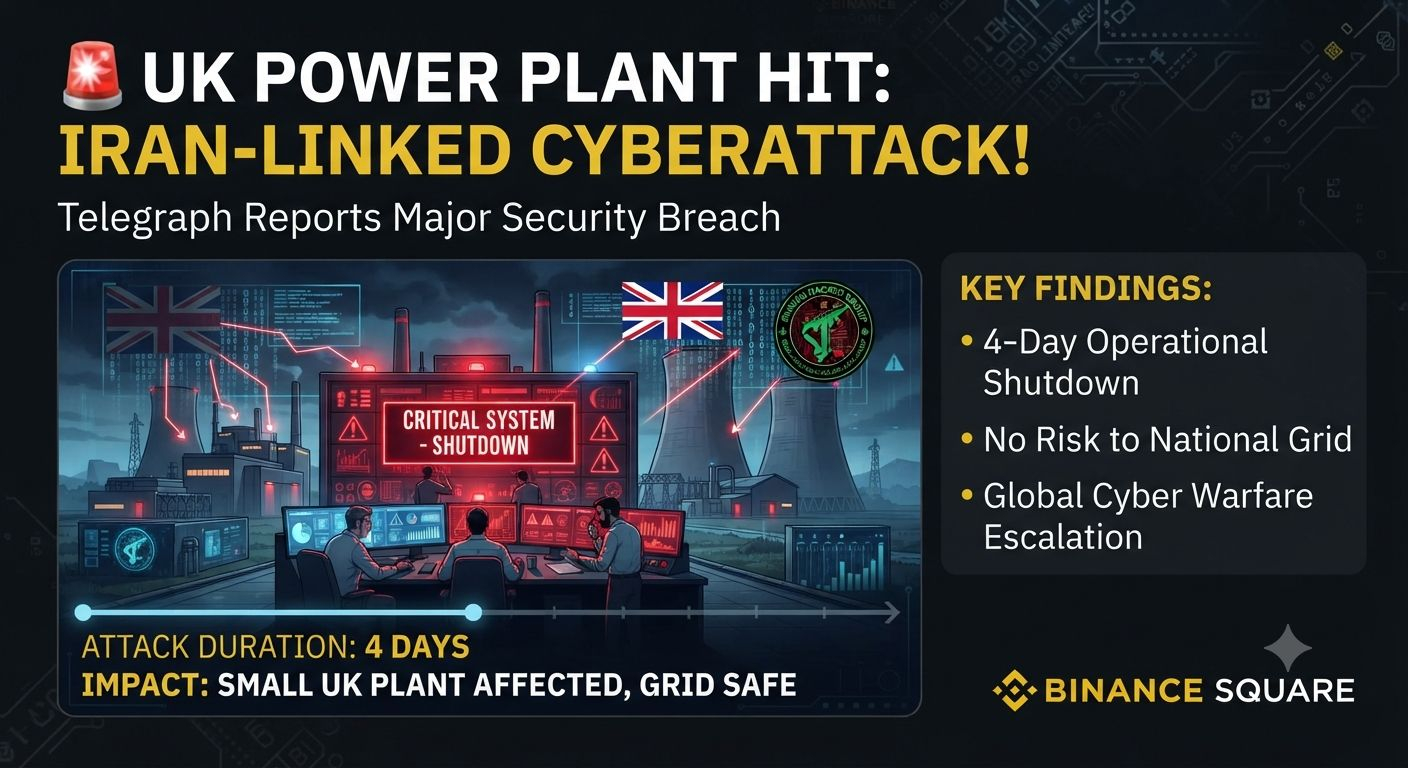
🚨 CYBER WARFARE UPDATE: UK Power Plant Hit!
According to The Telegraph, hackers linked to Iran successfully shut down a small British power plant for four days last month in an unprecedented cyberattack.
Key highlights of the incident:
The Incident: Staff spent 4 days working to bring the facility back online after the digital breach.
Grid Impact: British officials and sources confirmed that the site was small and the wider national power grid was not put at risk.
Global Context: This comes right alongside a wave of suspected Iranian cyberattacks targeting U.S. water infrastructure across 12 states last month.
As global tensions rise, cybersecurity for critical infrastructure is becoming a massive focal point for governments worldwide.
What are your thoughts on the growing wave of state-sponsored cyberattacks? Let's discuss below! 👇
#CyberSecurity #Geopolitics #News #Crypto #BinanceSquare
Aap ise directly copy kar ke Binance Square par post kar sakte hain!$BTC $XAUT #DYOR🟢
According to The Telegraph, hackers linked to Iran successfully shut down a small British power plant for four days last month in an unprecedented cyberattack.
Key highlights of the incident:
The Incident: Staff spent 4 days working to bring the facility back online after the digital breach.
Grid Impact: British officials and sources confirmed that the site was small and the wider national power grid was not put at risk.
Global Context: This comes right alongside a wave of suspected Iranian cyberattacks targeting U.S. water infrastructure across 12 states last month.
As global tensions rise, cybersecurity for critical infrastructure is becoming a massive focal point for governments worldwide.
What are your thoughts on the growing wave of state-sponsored cyberattacks? Let's discuss below! 👇
#CyberSecurity #Geopolitics #News #Crypto #BinanceSquare
Aap ise directly copy kar ke Binance Square par post kar sakte hain!$BTC $XAUT #DYOR🟢

DIYA_加密
·
--
الله اکبر
🧧 RED PACKET DROP! 🎁
A fresh Red Packet is here! 🔥
Don’t miss your chance to grab your reward and be part of the excitement.
⏰ Be quick — Red Packets can be limited and rewards may run out fast!
💰 Claim yours, share the opportunity with your friends, and keep an eye out for the next drop.
#RedPacket #Crypto #Binance #CryptoCommunity #Web3
🧧 RED PACKET DROP! 🎁
A fresh Red Packet is here! 🔥
Don’t miss your chance to grab your reward and be part of the excitement.
⏰ Be quick — Red Packets can be limited and rewards may run out fast!
💰 Claim yours, share the opportunity with your friends, and keep an eye out for the next drop.
#RedPacket #Crypto #Binance #CryptoCommunity #Web3

Fabixxlo
·
--
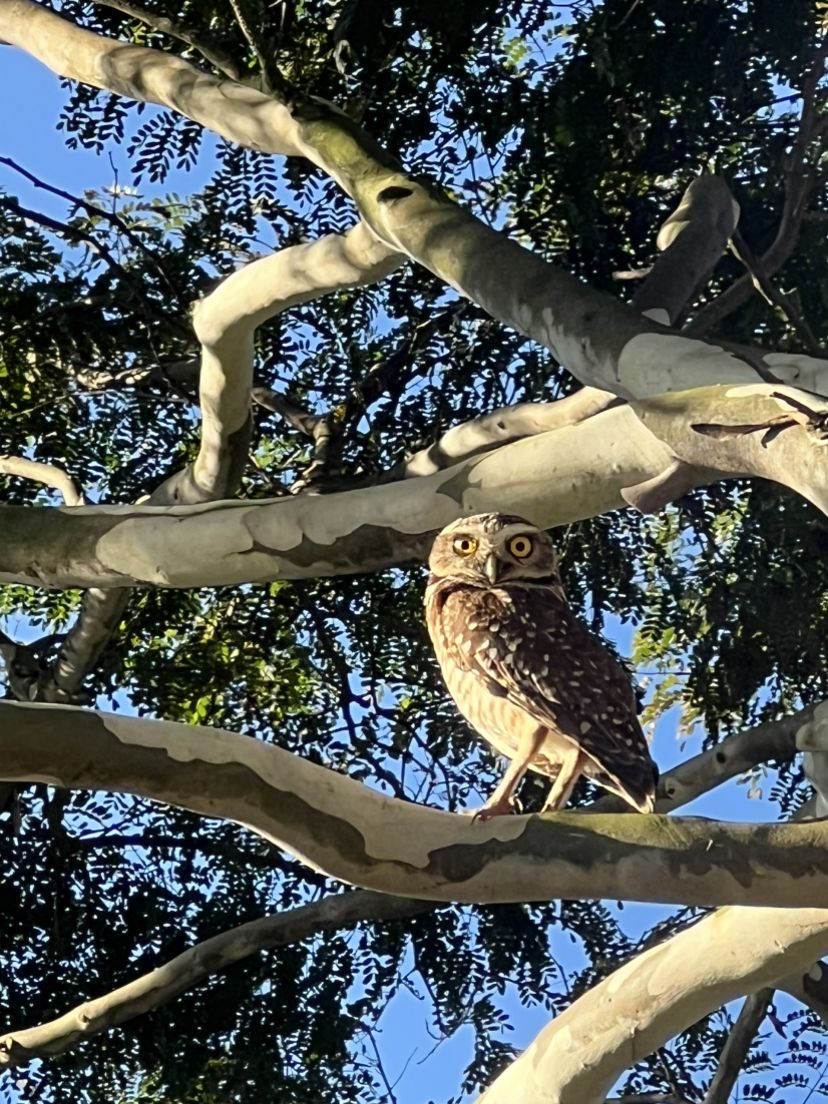
De olho sempre aberto🎁🎁
$BTC
#BitcoinStrongestWeekSinceMarch2023
$BTC
#BitcoinStrongestWeekSinceMarch2023
Bobbypk
·
--
Happiest 🥰 moments for friend's when received the gifting 💝 from friend's 💐💝 #USCanadaTradeTalksCollapseCanadaVowsRetaliation
#SP500EndsWeeklyWinStreak
@Bitcoin
#bnb
#SP500EndsWeeklyWinStreak
@Bitcoin
#bnb

ANUUONCHAIN
·
--
❣️❤🩹❣️❤🩹❣️❤🩹❣️❤🩹❣️❤🩹❣️❤🩹❣️❤🩹❣️
follow me please
btc btc btc btc btc btc btc btc btc btc btc btc
follow me please
btc btc btc btc btc btc btc btc btc btc btc btc

Leo - F0
·
--
Haussier🔥🧧🧧RED PACKAGE SEASON🧧🧧🔥
"Trade the quiet life for golden days,
Chasing the empire through the rising haze."
$BTC 🔥🔥🧧🧧
#金价升破4400美元创两月高
$BNB $ETH
#1688家族family 💚 @周周1688
#GrayscaleFilesFifthZECETFAmendment #USTariffsOnCanadianGoodsTakeEffect #trump
"Trade the quiet life for golden days,
Chasing the empire through the rising haze."
$BTC 🔥🔥🧧🧧
#金价升破4400美元创两月高
$BNB $ETH
#1688家族family 💚 @周周1688
#GrayscaleFilesFifthZECETFAmendment #USTariffsOnCanadianGoodsTakeEffect #trump
$AAPLB @Dr Nohawn

周周1688
·
--
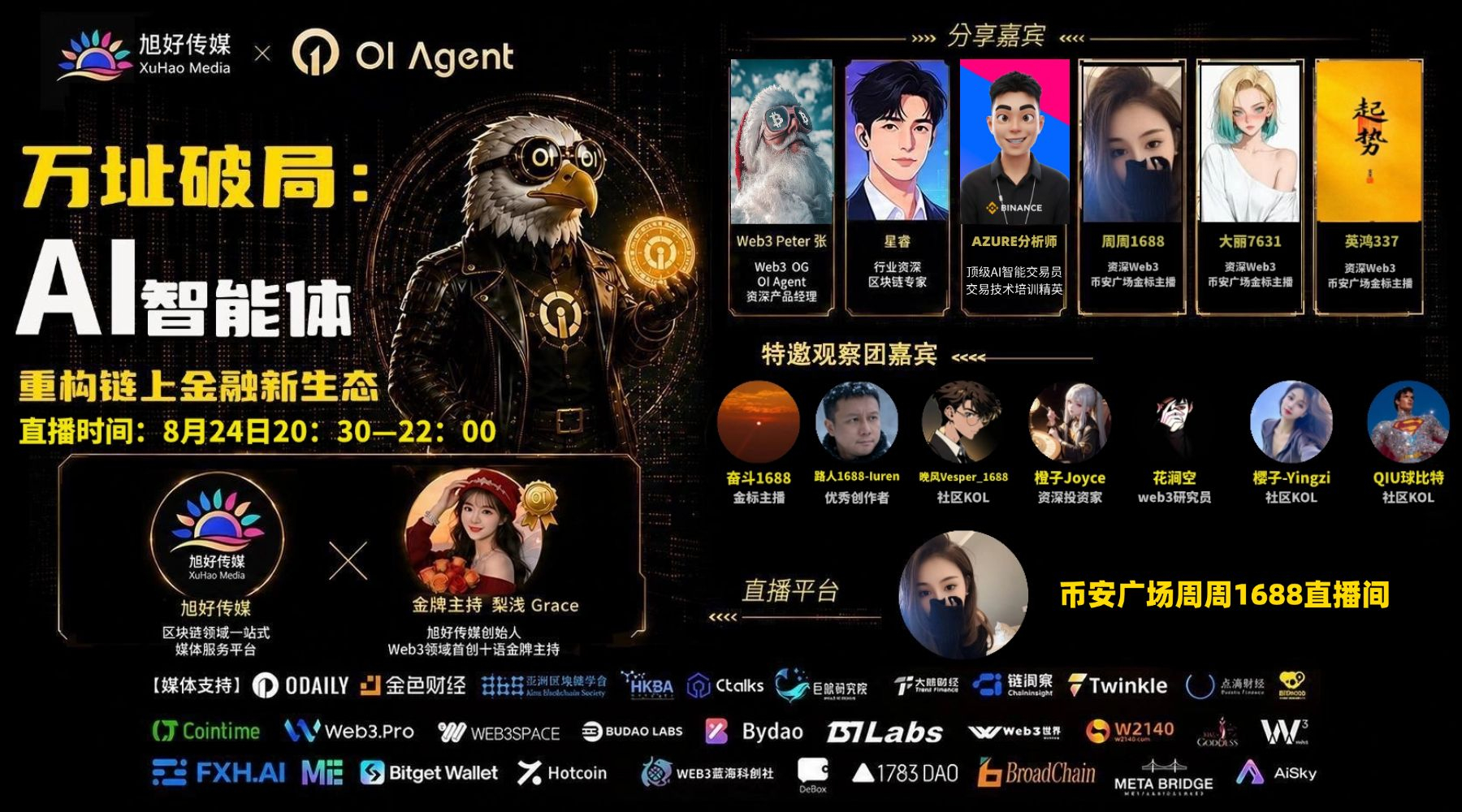
🌏【主题】万址破局|AI智能体重构链上金融新生态$BNB 🧧
📅 【时间】2026年8月24日 20:30(UTC+8)
🌕【导入语】
大河奔涌千帆竞,时代浪潮日月新。纵观Web3行业潮起潮落,多少项目随喧嚣而来,又随浪花消散。赛道之上从不缺华丽的概念叙事,难的是沉心打磨产品,用真实用户见证生态力量。而今OI Agent注册地址已然突破一万,一万份信任汇聚,万址破局,正是产品从冷启动走向全球化共建的里程碑。
今夜星光齐聚,共赴AI+Web3思想盛宴。我们汇聚行业OG、深耕一线的技术专家、币安广场头部金标主播、资深投研大咖同台论道,拆解智能金融的底层逻辑,共同眺望链上智能化的浩瀚前路,诚邀各位家人屏息以待!
🎤 特邀主持(Host)
🎙Web3领域金牌主持👉🏻梨浅Grace @梨浅Grace
🎙共同主持人👉🏻旭好传媒@旭好传媒
🎙共同主持人👉🏻OI Agent @oiagent_
👥【特邀重磅嘉宾】(Speakers)
🔹Web3 Peter 张 @Web3-PeterZhang |Web3 OG
OI Agent资深产品经理
🔹星睿 @星睿 |行业资深区块链专家
🔹AZURE分析师
@Azure蔚蓝分析师 |巨石WEB3学院|顶级AI智能交易员|交易技术培训精英
🔹周周1688@周周1688 |资深Web3币安广场金标主播
🔹大丽7613@大丽7613 |资深Web3币安广场金标主播
🔹英鸿337@英鸿³³₇ |资深Web3币安广场金标主播
📅 【时间】2026年8月24日 20:30(UTC+8)
🌕【导入语】
大河奔涌千帆竞,时代浪潮日月新。纵观Web3行业潮起潮落,多少项目随喧嚣而来,又随浪花消散。赛道之上从不缺华丽的概念叙事,难的是沉心打磨产品,用真实用户见证生态力量。而今OI Agent注册地址已然突破一万,一万份信任汇聚,万址破局,正是产品从冷启动走向全球化共建的里程碑。
今夜星光齐聚,共赴AI+Web3思想盛宴。我们汇聚行业OG、深耕一线的技术专家、币安广场头部金标主播、资深投研大咖同台论道,拆解智能金融的底层逻辑,共同眺望链上智能化的浩瀚前路,诚邀各位家人屏息以待!
🎤 特邀主持(Host)
🎙Web3领域金牌主持👉🏻梨浅Grace @梨浅Grace
🎙共同主持人👉🏻旭好传媒@旭好传媒
🎙共同主持人👉🏻OI Agent @oiagent_
👥【特邀重磅嘉宾】(Speakers)
🔹Web3 Peter 张 @Web3-PeterZhang |Web3 OG
OI Agent资深产品经理
🔹星睿 @星睿 |行业资深区块链专家
🔹AZURE分析师
@Azure蔚蓝分析师 |巨石WEB3学院|顶级AI智能交易员|交易技术培训精英
🔹周周1688@周周1688 |资深Web3币安广场金标主播
🔹大丽7613@大丽7613 |资深Web3币安广场金标主播
🔹英鸿337@英鸿³³₇ |资深Web3币安广场金标主播
$AAPL.US @Dr Nohawn

Jaxson Bull
·
--
Haussier🎉 BTC SURPRISE GIVEAWAY! 🧧✨
Ready to get involved? 👀🎁
Don’t miss your chance to join the BTC community drop!
✅ Follow me ❤️
❤️ Like this post
🔁 Share / Repost
💬 Comment “BTC” below 👇
🔥 Bring your crypto friends!
🧧 Stay active because more BTC surprises are coming!
#BTC #RedPacket #GIVEAWAY🎁 #Crypto #CryptoCommunity
Ready to get involved? 👀🎁
Don’t miss your chance to join the BTC community drop!
✅ Follow me ❤️
❤️ Like this post
🔁 Share / Repost
💬 Comment “BTC” below 👇
🔥 Bring your crypto friends!
🧧 Stay active because more BTC surprises are coming!
#BTC #RedPacket #GIVEAWAY🎁 #Crypto #CryptoCommunity

AAPLUS-1,00%
Dr Nohawn
·
--
🎁🧧 Fresh Risers $PORTAL $AOP $TUT Boooommmmm. . . . . 🧧🎁
⚡⚡ ♥️💐Hi..... Like, Claim, Re Post & Join My Chatroom Via Link Below 👉 Double Box & Live Trade Daily😎😎 💐♥️ ⚡⚡
👉Claim Double Red Box Here👈
⚡⚡ ♥️💐Hi..... Like, Claim, Re Post & Join My Chatroom Via Link Below 👉 Double Box & Live Trade Daily😎😎 💐♥️ ⚡⚡
👉Claim Double Red Box Here👈

Dr Nohawn
·
--
🎁🧧 Fresh Risers $PORTAL $AOP $TUT Boooommmmm. . . . . 🧧🎁
⚡⚡ ♥️💐Hi..... Like, Claim, Re Post & Join My Chatroom Via Link Below 👉 Double Box & Live Trade Daily😎😎 💐♥️ ⚡⚡
👉Claim Double Red Box Here👈
⚡⚡ ♥️💐Hi..... Like, Claim, Re Post & Join My Chatroom Via Link Below 👉 Double Box & Live Trade Daily😎😎 💐♥️ ⚡⚡
👉Claim Double Red Box Here👈

AYESHA ABID 阿伊莎 阿比德
·
--
🎁 SOL Red Packet is here! Claim your reward before it’s gone.


Ayan -X
·
--
claim 🛄🛄 repost like for updates
😍😍😍😍😍😍🤪🤪🤪🤪❤️❤️❤️❤️❤️
😍😍😍😍😍😍🤪🤪🤪🤪❤️❤️❤️❤️❤️
周周1688
·
--
🌏【主题】万址破局|AI智能体重构链上金融新生态$BNB 🧧
📅 【时间】2026年8月24日 20:30(UTC+8)
🌕【导入语】
大河奔涌千帆竞,时代浪潮日月新。纵观Web3行业潮起潮落,多少项目随喧嚣而来,又随浪花消散。赛道之上从不缺华丽的概念叙事,难的是沉心打磨产品,用真实用户见证生态力量。而今OI Agent注册地址已然突破一万,一万份信任汇聚,万址破局,正是产品从冷启动走向全球化共建的里程碑。
今夜星光齐聚,共赴AI+Web3思想盛宴。我们汇聚行业OG、深耕一线的技术专家、币安广场头部金标主播、资深投研大咖同台论道,拆解智能金融的底层逻辑,共同眺望链上智能化的浩瀚前路,诚邀各位家人屏息以待!
🎤 特邀主持(Host)
🎙Web3领域金牌主持👉🏻梨浅Grace @梨浅Grace
🎙共同主持人👉🏻旭好传媒@旭好传媒
🎙共同主持人👉🏻OI Agent @oiagent_
👥【特邀重磅嘉宾】(Speakers)
🔹Web3 Peter 张 @Web3-PeterZhang |Web3 OG
OI Agent资深产品经理
🔹星睿 @星睿 |行业资深区块链专家
🔹AZURE分析师
@Azure蔚蓝分析师 |巨石WEB3学院|顶级AI智能交易员|交易技术培训精英
🔹周周1688@周周1688 |资深Web3币安广场金标主播
🔹大丽7613@大丽7613 |资深Web3币安广场金标主播
🔹英鸿337@英鸿³³₇ |资深Web3币安广场金标主播
📅 【时间】2026年8月24日 20:30(UTC+8)
🌕【导入语】
大河奔涌千帆竞,时代浪潮日月新。纵观Web3行业潮起潮落,多少项目随喧嚣而来,又随浪花消散。赛道之上从不缺华丽的概念叙事,难的是沉心打磨产品,用真实用户见证生态力量。而今OI Agent注册地址已然突破一万,一万份信任汇聚,万址破局,正是产品从冷启动走向全球化共建的里程碑。
今夜星光齐聚,共赴AI+Web3思想盛宴。我们汇聚行业OG、深耕一线的技术专家、币安广场头部金标主播、资深投研大咖同台论道,拆解智能金融的底层逻辑,共同眺望链上智能化的浩瀚前路,诚邀各位家人屏息以待!
🎤 特邀主持(Host)
🎙Web3领域金牌主持👉🏻梨浅Grace @梨浅Grace
🎙共同主持人👉🏻旭好传媒@旭好传媒
🎙共同主持人👉🏻OI Agent @oiagent_
👥【特邀重磅嘉宾】(Speakers)
🔹Web3 Peter 张 @Web3-PeterZhang |Web3 OG
OI Agent资深产品经理
🔹星睿 @星睿 |行业资深区块链专家
🔹AZURE分析师
@Azure蔚蓝分析师 |巨石WEB3学院|顶级AI智能交易员|交易技术培训精英
🔹周周1688@周周1688 |资深Web3币安广场金标主播
🔹大丽7613@大丽7613 |资深Web3币安广场金标主播
🔹英鸿337@英鸿³³₇ |资深Web3币安广场金标主播
Connectez-vous pour découvrir plus de contenu