

#dex
dex
18.3M vues
111,302 mentions
Populaire
Récents

·
--
Haussier
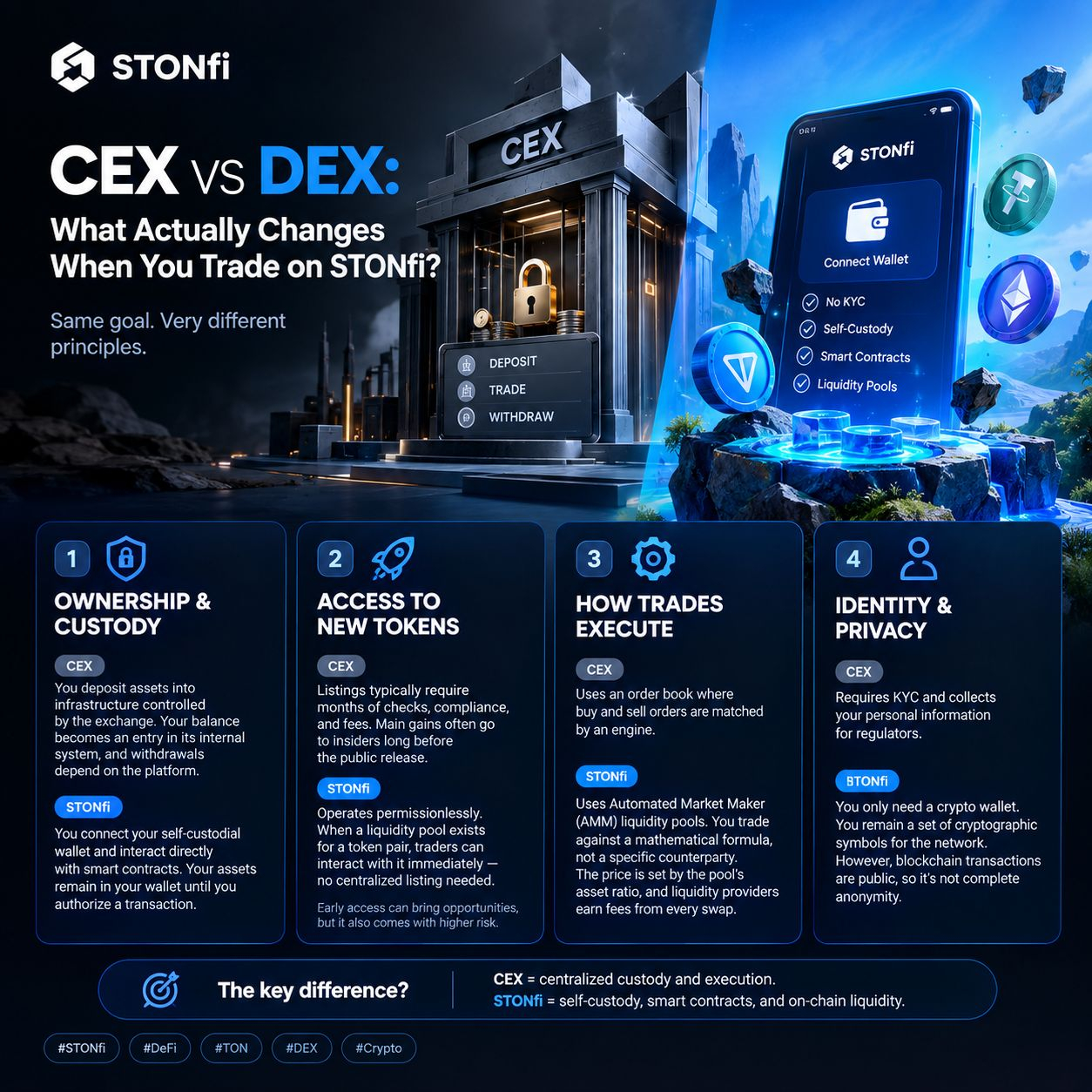
CEX vs DEX: What Really Changes When You Trade on STONfi?
At a glance, both platforms let you swap tokens.
The difference shows up in what happens behind the interface. 👇
🔐 1. OWNERSHIP & CUSTODY
On a CEX, you deposit assets with the exchange, which then tracks them through its own internal systems.
With STONfi, you connect a self-custodial wallet and interact directly with smart contracts.
Your tokens stay in your wallet until you approve a transaction. That part feels pretty different.
🌐 2. ACCESS TO NEW TOKENS
CEX listings typically depend on centralized reviews and listing decisions.
STONfi works permissionlessly at the protocol level.
Once a liquidity pool is available, traders can use it without waiting for a centralized exchange to approve and list the token.
That earlier access can be useful, but honestly, it can also bring more risk.
⚙️ 3. HOW TRADES EXECUTE
CEXs generally rely on order books, matching buyers with sellers.
STONfi uses an Automated Market Maker (AMM).
Rather than trading with one specific counterparty, your swap uses a liquidity pool and follows the protocol's pricing mechanism.
Liquidity providers may earn fees from eligible swaps.
🛡️ 4. IDENTITY & PRIVACY
CEXs commonly require KYC and collect information about their users.
A self-custodial DEX interaction begins with a crypto wallet, not an exchange account.
Still, wallet-based trading does not mean complete anonymity. Blockchain transactions remain publicly visible.
The core distinction is simple:
CEX → centralized custody and trade execution
STONfi → self-custody, smart contracts, and on-chain liquidity
That difference matters because it shows what you're actually placing your trust in when you trade. Honestly, it feels like a small detail until you look at who controls the funds and how each trade is processed.
{spot}(BTCUSDT)
#STONfi #DeFi #TON #DEX #crypto
$BTC $GRAM
CEX vs DEX: What Really Changes When You Trade on STONfi?
At a glance, both platforms let you swap tokens.
The difference shows up in what happens behind the interface. 👇
🔐 1. OWNERSHIP & CUSTODY
On a CEX, you deposit assets with the exchange, which then tracks them through its own internal systems.
With STONfi, you connect a self-custodial wallet and interact directly with smart contracts.
Your tokens stay in your wallet until you approve a transaction. That part feels pretty different.
🌐 2. ACCESS TO NEW TOKENS
CEX listings typically depend on centralized reviews and listing decisions.
STONfi works permissionlessly at the protocol level.
Once a liquidity pool is available, traders can use it without waiting for a centralized exchange to approve and list the token.
That earlier access can be useful, but honestly, it can also bring more risk.
⚙️ 3. HOW TRADES EXECUTE
CEXs generally rely on order books, matching buyers with sellers.
STONfi uses an Automated Market Maker (AMM).
Rather than trading with one specific counterparty, your swap uses a liquidity pool and follows the protocol's pricing mechanism.
Liquidity providers may earn fees from eligible swaps.
🛡️ 4. IDENTITY & PRIVACY
CEXs commonly require KYC and collect information about their users.
A self-custodial DEX interaction begins with a crypto wallet, not an exchange account.
Still, wallet-based trading does not mean complete anonymity. Blockchain transactions remain publicly visible.
The core distinction is simple:
CEX → centralized custody and trade execution
STONfi → self-custody, smart contracts, and on-chain liquidity
That difference matters because it shows what you're actually placing your trust in when you trade. Honestly, it feels like a small detail until you look at who controls the funds and how each trade is processed.
#STONfi #DeFi #TON #DEX #crypto
$BTC $GRAM
At a glance, both platforms let you swap tokens.
The difference shows up in what happens behind the interface. 👇
🔐 1. OWNERSHIP & CUSTODY
On a CEX, you deposit assets with the exchange, which then tracks them through its own internal systems.
With STONfi, you connect a self-custodial wallet and interact directly with smart contracts.
Your tokens stay in your wallet until you approve a transaction. That part feels pretty different.
🌐 2. ACCESS TO NEW TOKENS
CEX listings typically depend on centralized reviews and listing decisions.
STONfi works permissionlessly at the protocol level.
Once a liquidity pool is available, traders can use it without waiting for a centralized exchange to approve and list the token.
That earlier access can be useful, but honestly, it can also bring more risk.
⚙️ 3. HOW TRADES EXECUTE
CEXs generally rely on order books, matching buyers with sellers.
STONfi uses an Automated Market Maker (AMM).
Rather than trading with one specific counterparty, your swap uses a liquidity pool and follows the protocol's pricing mechanism.
Liquidity providers may earn fees from eligible swaps.
🛡️ 4. IDENTITY & PRIVACY
CEXs commonly require KYC and collect information about their users.
A self-custodial DEX interaction begins with a crypto wallet, not an exchange account.
Still, wallet-based trading does not mean complete anonymity. Blockchain transactions remain publicly visible.
The core distinction is simple:
CEX → centralized custody and trade execution
STONfi → self-custody, smart contracts, and on-chain liquidity
That difference matters because it shows what you're actually placing your trust in when you trade. Honestly, it feels like a small detail until you look at who controls the funds and how each trade is processed.
#STONfi #DeFi #TON #DEX #crypto
$BTC $GRAM
2
494

·
--
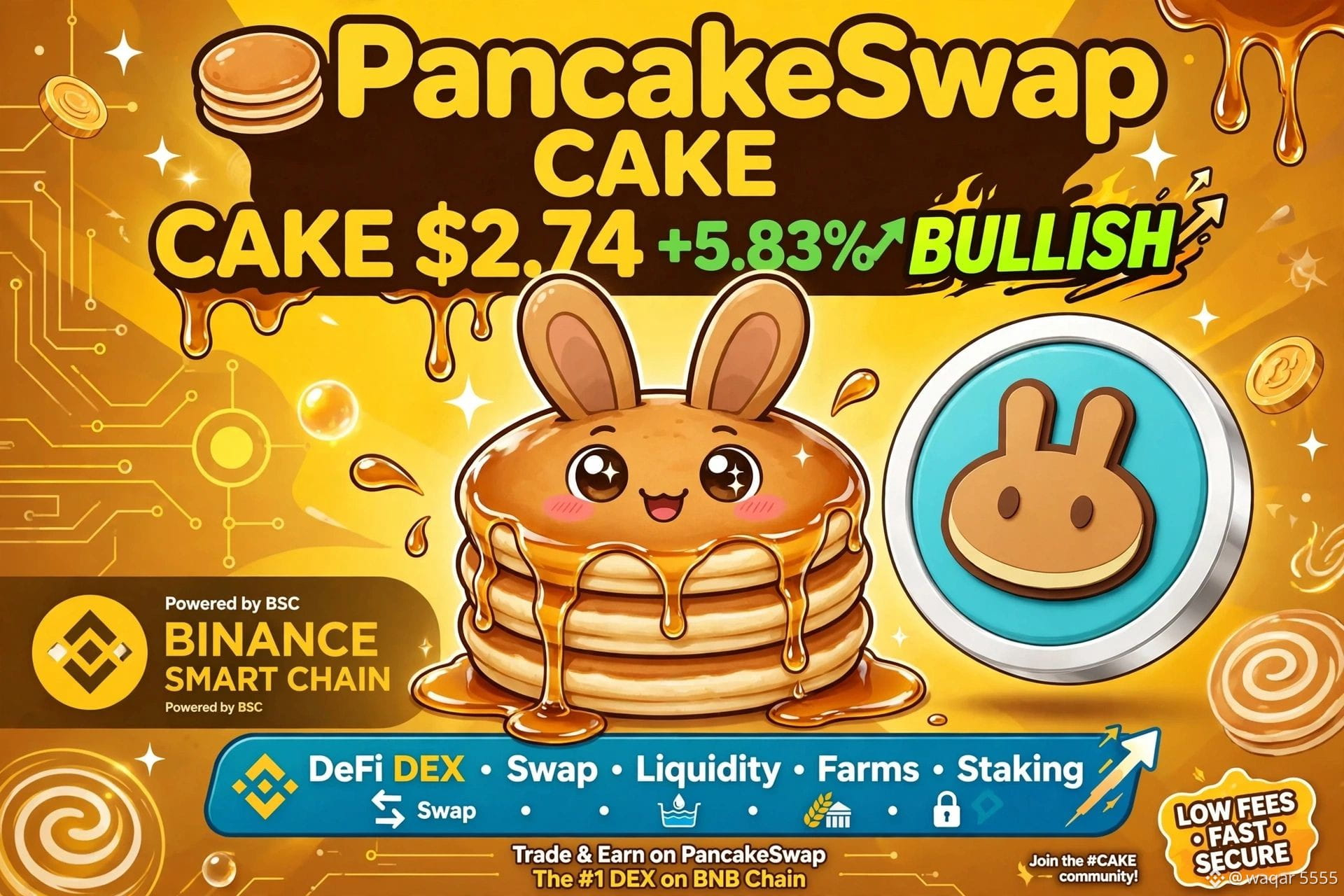
🥞 PancakeSwap $CAKE $2.74 +5.83% BULLISH! 🚀
CAKE is cooking! 🔥
PancakeSwap is the #1 DEX on BNB Chain:
✅ Swap - Low fees
✅ Liquidity Farms
✅ Staking Rewards
✅ Lottery & NFTs
Price pumping +5.83% in 24h! Next target $3.00? 🎯
Hold CAKE or flip it? 👇
$CAKE #PancakeSwap #CAKE #BNB #defi #DEX #Binance
🥞 PancakeSwap $CAKE $2.74 +5.83% BULLISH! 🚀
CAKE is cooking! 🔥
PancakeSwap is the #1 DEX on BNB Chain:
✅ Swap - Low fees
✅ Liquidity Farms
✅ Staking Rewards
✅ Lottery & NFTs
Price pumping +5.83% in 24h! Next target $3.00? 🎯
Hold CAKE or flip it? 👇
$CAKE #PancakeSwap #CAKE #BNB #defi #DEX #Binance
CAKE is cooking! 🔥
PancakeSwap is the #1 DEX on BNB Chain:
✅ Swap - Low fees
✅ Liquidity Farms
✅ Staking Rewards
✅ Lottery & NFTs
Price pumping +5.83% in 24h! Next target $3.00? 🎯
Hold CAKE or flip it? 👇
$CAKE #PancakeSwap #CAKE #BNB #defi #DEX #Binance
2
321

·
--
Haussier
تهيمن منصة Uniswap V4 على حجم التداول في منصات التداول اللامركزية وسط نمو الأسهم المُرمّزة ووضوح اللوائح التنظيمية. تستحوذ Uniswap V4 على 50% من حجم التداول في منصات التداول اللامركزية على شبكة إيثيريوم، مدفوعةً بالأسهم المُرمّزة وسلسلة Robinhood. وتشير التوجيهات الإيجابية من هيئة الأوراق المالية والبورصات الأمريكية بشأن عمليات إعادة شراء الأسهم واعتماد PROOF للإصدار V4 إلى نمو قوي للنظام البيئي.
#uniswap #UNI #DEX #ALPHA
$UNI
{future}(UNIUSDT)
تهيمن منصة Uniswap V4 على حجم التداول في منصات التداول اللامركزية وسط نمو الأسهم المُرمّزة ووضوح اللوائح التنظيمية. تستحوذ Uniswap V4 على 50% من حجم التداول في منصات التداول اللامركزية على شبكة إيثيريوم، مدفوعةً بالأسهم المُرمّزة وسلسلة Robinhood. وتشير التوجيهات الإيجابية من هيئة الأوراق المالية والبورصات الأمريكية بشأن عمليات إعادة شراء الأسهم واعتماد PROOF للإصدار V4 إلى نمو قوي للنظام البيئي.
#uniswap #UNI #DEX #ALPHA
$UNI
#uniswap #UNI #DEX #ALPHA
$UNI
1
77


·
--
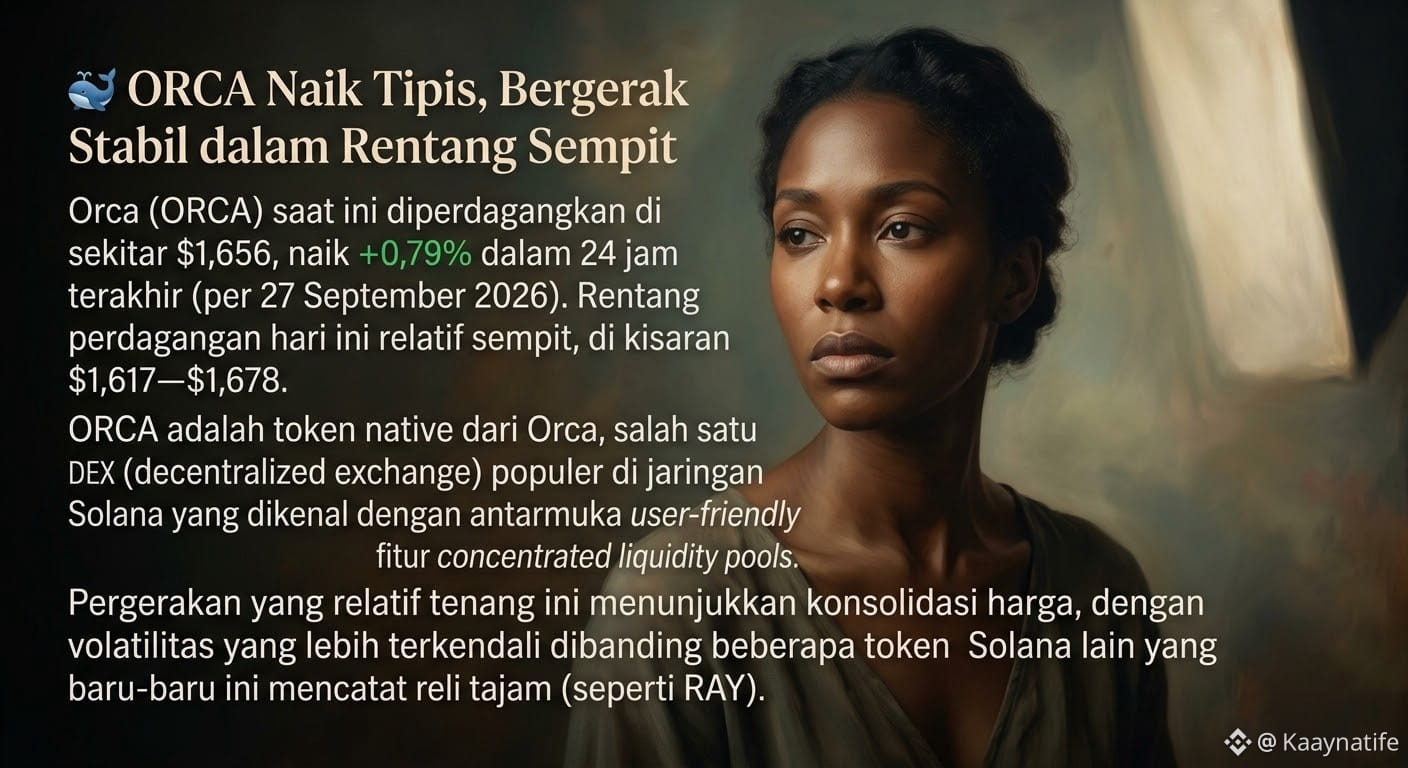
🐋 ORCA Naik Tipis, Bergerak Stabil dalam Rentang Sempit
Orca (ORCA) saat ini diperdagangkan di sekitar $1,656, naik +0,79% dalam 24 jam terakhir (per 27 September 2026). Rentang perdagangan hari ini relatif sempit, di kisaran $1,617–$1,678.
ORCA adalah token native dari Orca, salah satu DEX (decentralized exchange) populer di jaringan Solana yang dikenal dengan antarmuka user-friendly dan fitur concentrated liquidity pools.
Pergerakan yang relatif tenang ini menunjukkan konsolidasi harga, dengan volatilitas yang lebih terkendali dibanding beberapa token Solana lain yang baru-baru ini mencatat reli tajam (seperti RAY).
$ORCA
{spot}(ORCAUSDT)
$RAY
{spot}(RAYUSDT)
$$SOL
{spot}(SOLUSDT)
#ORCA #PolymarketBankFailureBetsDrawFDICConcern #DEX
🐋 ORCA Naik Tipis, Bergerak Stabil dalam Rentang Sempit
Orca (ORCA) saat ini diperdagangkan di sekitar $1,656, naik +0,79% dalam 24 jam terakhir (per 27 September 2026). Rentang perdagangan hari ini relatif sempit, di kisaran $1,617–$1,678.
ORCA adalah token native dari Orca, salah satu DEX (decentralized exchange) populer di jaringan Solana yang dikenal dengan antarmuka user-friendly dan fitur concentrated liquidity pools.
Pergerakan yang relatif tenang ini menunjukkan konsolidasi harga, dengan volatilitas yang lebih terkendali dibanding beberapa token Solana lain yang baru-baru ini mencatat reli tajam (seperti RAY).
$ORCA
$RAY
$$SOL
#ORCA #PolymarketBankFailureBetsDrawFDICConcern #DEX
Orca (ORCA) saat ini diperdagangkan di sekitar $1,656, naik +0,79% dalam 24 jam terakhir (per 27 September 2026). Rentang perdagangan hari ini relatif sempit, di kisaran $1,617–$1,678.
ORCA adalah token native dari Orca, salah satu DEX (decentralized exchange) populer di jaringan Solana yang dikenal dengan antarmuka user-friendly dan fitur concentrated liquidity pools.
Pergerakan yang relatif tenang ini menunjukkan konsolidasi harga, dengan volatilitas yang lebih terkendali dibanding beberapa token Solana lain yang baru-baru ini mencatat reli tajam (seperti RAY).
$ORCA
$RAY
$$SOL
#ORCA #PolymarketBankFailureBetsDrawFDICConcern #DEX
263

·
--
优化后可直接发布:
CZ 最新发声:并不反对 Hyperliquid,欢迎更多 DEX 参与竞争。
去中心化交易所竞争越充分,对用户和行业越有利。
#CZ #Hyperliquid #DEX #DeFi
优化后可直接发布:
CZ 最新发声:并不反对 Hyperliquid,欢迎更多 DEX 参与竞争。
去中心化交易所竞争越充分,对用户和行业越有利。
#CZ #Hyperliquid #DEX #DeFi
CZ 最新发声:并不反对 Hyperliquid,欢迎更多 DEX 参与竞争。
去中心化交易所竞争越充分,对用户和行业越有利。
#CZ #Hyperliquid #DEX #DeFi
76

·
--
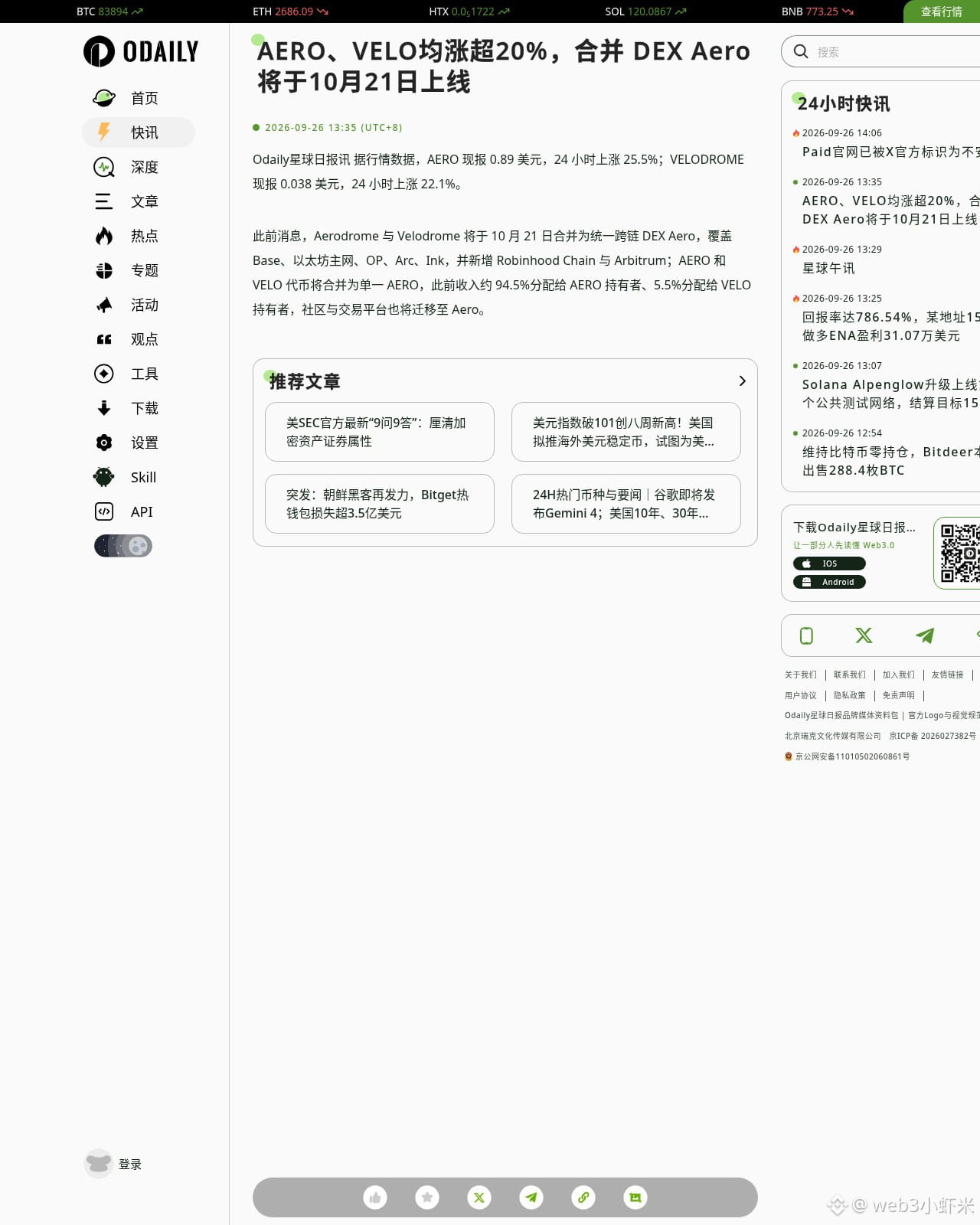
刷到 Odaily:Aerodrome 和 Velodrome 要合并了——10 月 21 日上线统一跨链 DEX Aero,消息一出 AERO、VELO 双双涨超 20%。
AERO 现报约 0.89 美元(24h +25.5%),VELODROME 约 0.038 美元(+22.1%)。合并后覆盖 Base、以太坊主网、OP、Arc、Ink,还要加 Robinhood Chain 与 Arbitrum;AERO 和 VELO 会并成单一 AERO。此前收入大约 94.5% 分给 AERO 持有者、5.5% 给 VELO,社区和交易入口也会迁到 Aero。
Base 生态头部 DEX 跨链合体,等于把流动性叙事再拧成一股——日期定得挺具体,市场先涨一波不算奇怪。
$AERO $VELO #DEX #Base
刷到 Odaily:Aerodrome 和 Velodrome 要合并了——10 月 21 日上线统一跨链 DEX Aero,消息一出 AERO、VELO 双双涨超 20%。
AERO 现报约 0.89 美元(24h +25.5%),VELODROME 约 0.038 美元(+22.1%)。合并后覆盖 Base、以太坊主网、OP、Arc、Ink,还要加 Robinhood Chain 与 Arbitrum;AERO 和 VELO 会并成单一 AERO。此前收入大约 94.5% 分给 AERO 持有者、5.5% 给 VELO,社区和交易入口也会迁到 Aero。
Base 生态头部 DEX 跨链合体,等于把流动性叙事再拧成一股——日期定得挺具体,市场先涨一波不算奇怪。
$AERO $VELO #DEX #Base
AERO 现报约 0.89 美元(24h +25.5%),VELODROME 约 0.038 美元(+22.1%)。合并后覆盖 Base、以太坊主网、OP、Arc、Ink,还要加 Robinhood Chain 与 Arbitrum;AERO 和 VELO 会并成单一 AERO。此前收入大约 94.5% 分给 AERO 持有者、5.5% 给 VELO,社区和交易入口也会迁到 Aero。
Base 生态头部 DEX 跨链合体,等于把流动性叙事再拧成一股——日期定得挺具体,市场先涨一波不算奇怪。
$AERO $VELO #DEX #Base
14

·
--
Decentralized Exchanges (DEX) vs. CEX Centralized exchanges provide unmatched execution speed and deep order-book liquidity, while DEXs offer permissionless access and non-custodial asset control. A mature crypto strategy uses both: CEX for high-frequency execution and fiat on-ramps; DEX for direct smart contract interactions and early liquidity pools. Where do you execute the majority of your trades? 🌐 #DEX #DeFi #CEX #CryptoInfrastructure
Decentralized Exchanges (DEX) vs. CEX Centralized exchanges provide unmatched execution speed and deep order-book liquidity, while DEXs offer permissionless access and non-custodial asset control. A mature crypto strategy uses both: CEX for high-frequency execution and fiat on-ramps; DEX for direct smart contract interactions and early liquidity pools. Where do you execute the majority of your trades? 🌐 #DEX #DeFi #CEX #CryptoInfrastructure

61


·
--
中文版:
Solana的DEX交易量暴增背后暗藏猫腻!调查显示大量机器人在进行循环交易,自己买卖自己,人为虚高交易数据。这就像是刷单刷出来的销量,看起来热闹,但实际深度根本不够。#DEX #VolumeManipulation $SOL $DEX
English:
Solana's DEX volume spike is hiding dirty laundry! Bots are running circular trades, buying and selling to themselves to artificially inflate volume numbers. It's like fake sales data - looks impressive on paper but doesn't reflect real market depth. #DEX #VolumeManipulation $SOL $DEX
中文版:
Solana的DEX交易量暴增背后暗藏猫腻!调查显示大量机器人在进行循环交易,自己买卖自己,人为虚高交易数据。这就像是刷单刷出来的销量,看起来热闹,但实际深度根本不够。#DEX #VolumeManipulation $SOL $DEX
English:
Solana's DEX volume spike is hiding dirty laundry! Bots are running circular trades, buying and selling to themselves to artificially inflate volume numbers. It's like fake sales data - looks impressive on paper but doesn't reflect real market depth. #DEX #VolumeManipulation $SOL $DEX
Solana的DEX交易量暴增背后暗藏猫腻!调查显示大量机器人在进行循环交易,自己买卖自己,人为虚高交易数据。这就像是刷单刷出来的销量,看起来热闹,但实际深度根本不够。#DEX #VolumeManipulation $SOL $DEX
English:
Solana's DEX volume spike is hiding dirty laundry! Bots are running circular trades, buying and selling to themselves to artificially inflate volume numbers. It's like fake sales data - looks impressive on paper but doesn't reflect real market depth. #DEX #VolumeManipulation $SOL $DEX
175

·
--
Article
What Is a DEX? A Beginner’s Guide to Decentralized ExchangesIf you are learning about DeFi, one term you will come across repeatedly is DEX.
DEX stands for Decentralized Exchange.
But what makes an exchange decentralized, and how is it different from a traditional centralized exchange?
Let’s break it down.
What Is a DEX?
A decentralized exchange is a blockchain-based platform that allows users to trade crypto assets directly through smart contracts.
Instead of depositing your assets into an exchange-controlled account, you generally connect your own crypto wallet and interact with the DEX through a blockchain transaction.
This introduces a different model of trading:
Wallet → Smart Contract → Blockchain
The exchange logic is handled by blockchain-based smart contracts rather than relying entirely on a centralized company to execute and custody trades.
DEX vs CEX
The easiest way to understand a DEX is to compare it with a centralized exchange, or CEX.
A centralized exchange typically operates through a company that manages the trading platform and, depending on the service, may hold users’ assets.
DEX is designed around smart contracts and self-custody.
With a DEX, the user generally keeps control of their wallet and authorizes transactions themselves.
This difference is important because custody and execution work differently in the two models.
How Does a DEX Work?
Most modern DEXs use smart contracts to facilitate trading.
A simplified process looks like this:
1. Connect Your Wallet
You connect a compatible crypto wallet to the DEX.
Your assets remain in your wallet until you approve a transaction.
2. Choose Your Trading Pair
You select the asset you want to trade and the asset you want to receive.
For example:
Token A → Token B
3. Check the Trade
Before confirming, the interface may show information such as:
- Exchange rate
- Network fee
- Price impact
- Slippage
- Minimum amount received
4. Approve the Transaction
You authorize the transaction from your wallet.
The blockchain then processes the interaction with the DEX's smart contract.
5. Receive the Asset
If the transaction executes successfully, the swapped asset arrives in your wallet.
The entire process can happen without creating a traditional exchange account.
Where Does the Liquidity Come From?
This is one of the most important concepts in DeFi.
Many DEXs use liquidity pools.
A liquidity pool contains crypto assets supplied by users known as liquidity providers.
For example, a pool could contain two assets that traders can swap between.
When someone makes a trade, the smart contract interacts with the available liquidity in the pool.
Liquidity providers may receive a portion of trading fees according to the rules of the protocol.
This creates an ecosystem where:
Traders use liquidity → Liquidity providers supply liquidity → The protocol facilitates the swap
We will explore liquidity pools and liquidity providers in more detail later in this series.
What Is an AMM?
Many DEXs use a mechanism called an Automated Market Maker, or AMM.
An AMM uses mathematical rules and liquidity pools to determine how trades are executed instead of relying on a traditional order book.
This is one of the major innovations behind modern decentralized trading.
Rather than waiting for a specific buyer and seller to match, users can trade against available liquidity.
But AMMs also introduce concepts such as price impact, slippage, and impermanent loss.
These are important topics for anyone using DeFi.
Advantages of DEXs
DEXs can provide several important features.
Self-Custody
Users can generally maintain control of their assets through their own wallets.
On-Chain Transparency
Transactions and smart-contract activity can often be verified on the blockchain.
Open Access
Depending on the blockchain and protocol, users may be able to interact with a DEX without opening a traditional exchange account.
DeFi Integration
DEXs can interact with other decentralized applications and smart contracts, making them an important part of the broader DeFi ecosystem.
What Are the Risks?
Decentralized does not mean risk-free.
Users should understand several risks before trading on a DEX.
Smart Contract Risk
A vulnerability in a smart contract can potentially lead to loss of funds.
Slippage
The final execution price may differ from the expected price, especially when liquidity is limited or markets move quickly.
Price Impact
Large trades can move the price within a liquidity pool.
Network Fees
Every blockchain transaction may require a network fee.
Irreversible Transactions
Blockchain transactions are generally difficult or impossible to reverse once confirmed.
Fake Tokens and Malicious Contracts
Users must verify token addresses and interact with legitimate protocols. A DEX does not automatically make every token or contract safe.
Why DEXs Matter
DEXs represent a major shift in how digital assets can be exchanged.
Instead of relying entirely on a centralized intermediary, decentralized exchanges use:
Wallets + Smart Contracts + Blockchain + Liquidity
This model is one of the foundations of decentralized finance.
But understanding what a DEX is only gives us the starting point.
The next question is even more important:
How does a DEX actually determine the price of a token and execute a swap?
That takes us to the next topic in this series:
What Is an AMM? — Understanding Automated Market Makers
Stay tuned as we continue breaking down DeFi, one concept at a time.
#CryptoEducation #DeFi #DEX #Blockchain
What Is a DEX? A Beginner’s Guide to Decentralized Exchanges
If you are learning about DeFi, one term you will come across repeatedly is DEX.
DEX stands for Decentralized Exchange.
But what makes an exchange decentralized, and how is it different from a traditional centralized exchange?
Let’s break it down.
What Is a DEX?
A decentralized exchange is a blockchain-based platform that allows users to trade crypto assets directly through smart contracts.
Instead of depositing your assets into an exchange-controlled account, you generally connect your own crypto wallet and interact with the DEX through a blockchain transaction.
This introduces a different model of trading:
Wallet → Smart Contract → Blockchain
The exchange logic is handled by blockchain-based smart contracts rather than relying entirely on a centralized company to execute and custody trades.
DEX vs CEX
The easiest way to understand a DEX is to compare it with a centralized exchange, or CEX.
A centralized exchange typically operates through a company that manages the trading platform and, depending on the service, may hold users’ assets.
DEX is designed around smart contracts and self-custody.
With a DEX, the user generally keeps control of their wallet and authorizes transactions themselves.
This difference is important because custody and execution work differently in the two models.
How Does a DEX Work?
Most modern DEXs use smart contracts to facilitate trading.
A simplified process looks like this:
1. Connect Your Wallet
You connect a compatible crypto wallet to the DEX.
Your assets remain in your wallet until you approve a transaction.
2. Choose Your Trading Pair
You select the asset you want to trade and the asset you want to receive.
For example:
Token A → Token B
3. Check the Trade
Before confirming, the interface may show information such as:
- Exchange rate
- Network fee
- Price impact
- Slippage
- Minimum amount received
4. Approve the Transaction
You authorize the transaction from your wallet.
The blockchain then processes the interaction with the DEX's smart contract.
5. Receive the Asset
If the transaction executes successfully, the swapped asset arrives in your wallet.
The entire process can happen without creating a traditional exchange account.
Where Does the Liquidity Come From?
This is one of the most important concepts in DeFi.
Many DEXs use liquidity pools.
A liquidity pool contains crypto assets supplied by users known as liquidity providers.
For example, a pool could contain two assets that traders can swap between.
When someone makes a trade, the smart contract interacts with the available liquidity in the pool.
Liquidity providers may receive a portion of trading fees according to the rules of the protocol.
This creates an ecosystem where:
Traders use liquidity → Liquidity providers supply liquidity → The protocol facilitates the swap
We will explore liquidity pools and liquidity providers in more detail later in this series.
What Is an AMM?
Many DEXs use a mechanism called an Automated Market Maker, or AMM.
An AMM uses mathematical rules and liquidity pools to determine how trades are executed instead of relying on a traditional order book.
This is one of the major innovations behind modern decentralized trading.
Rather than waiting for a specific buyer and seller to match, users can trade against available liquidity.
But AMMs also introduce concepts such as price impact, slippage, and impermanent loss.
These are important topics for anyone using DeFi.
Advantages of DEXs
DEXs can provide several important features.
Self-Custody
Users can generally maintain control of their assets through their own wallets.
On-Chain Transparency
Transactions and smart-contract activity can often be verified on the blockchain.
Open Access
Depending on the blockchain and protocol, users may be able to interact with a DEX without opening a traditional exchange account.
DeFi Integration
DEXs can interact with other decentralized applications and smart contracts, making them an important part of the broader DeFi ecosystem.
What Are the Risks?
Decentralized does not mean risk-free.
Users should understand several risks before trading on a DEX.
Smart Contract Risk
A vulnerability in a smart contract can potentially lead to loss of funds.
Slippage
The final execution price may differ from the expected price, especially when liquidity is limited or markets move quickly.
Price Impact
Large trades can move the price within a liquidity pool.
Network Fees
Every blockchain transaction may require a network fee.
Irreversible Transactions
Blockchain transactions are generally difficult or impossible to reverse once confirmed.
Fake Tokens and Malicious Contracts
Users must verify token addresses and interact with legitimate protocols. A DEX does not automatically make every token or contract safe.
Why DEXs Matter
DEXs represent a major shift in how digital assets can be exchanged.
Instead of relying entirely on a centralized intermediary, decentralized exchanges use:
Wallets + Smart Contracts + Blockchain + Liquidity
This model is one of the foundations of decentralized finance.
But understanding what a DEX is only gives us the starting point.
The next question is even more important:
How does a DEX actually determine the price of a token and execute a swap?
That takes us to the next topic in this series:
What Is an AMM? — Understanding Automated Market Makers
Stay tuned as we continue breaking down DeFi, one concept at a time.
#CryptoEducation #DeFi #DEX #Blockchain
DEX stands for Decentralized Exchange.
But what makes an exchange decentralized, and how is it different from a traditional centralized exchange?
Let’s break it down.
What Is a DEX?
A decentralized exchange is a blockchain-based platform that allows users to trade crypto assets directly through smart contracts.
Instead of depositing your assets into an exchange-controlled account, you generally connect your own crypto wallet and interact with the DEX through a blockchain transaction.
This introduces a different model of trading:
Wallet → Smart Contract → Blockchain
The exchange logic is handled by blockchain-based smart contracts rather than relying entirely on a centralized company to execute and custody trades.
DEX vs CEX
The easiest way to understand a DEX is to compare it with a centralized exchange, or CEX.
A centralized exchange typically operates through a company that manages the trading platform and, depending on the service, may hold users’ assets.
DEX is designed around smart contracts and self-custody.
With a DEX, the user generally keeps control of their wallet and authorizes transactions themselves.
This difference is important because custody and execution work differently in the two models.
How Does a DEX Work?
Most modern DEXs use smart contracts to facilitate trading.
A simplified process looks like this:
1. Connect Your Wallet
You connect a compatible crypto wallet to the DEX.
Your assets remain in your wallet until you approve a transaction.
2. Choose Your Trading Pair
You select the asset you want to trade and the asset you want to receive.
For example:
Token A → Token B
3. Check the Trade
Before confirming, the interface may show information such as:
- Exchange rate
- Network fee
- Price impact
- Slippage
- Minimum amount received
4. Approve the Transaction
You authorize the transaction from your wallet.
The blockchain then processes the interaction with the DEX's smart contract.
5. Receive the Asset
If the transaction executes successfully, the swapped asset arrives in your wallet.
The entire process can happen without creating a traditional exchange account.
Where Does the Liquidity Come From?
This is one of the most important concepts in DeFi.
Many DEXs use liquidity pools.
A liquidity pool contains crypto assets supplied by users known as liquidity providers.
For example, a pool could contain two assets that traders can swap between.
When someone makes a trade, the smart contract interacts with the available liquidity in the pool.
Liquidity providers may receive a portion of trading fees according to the rules of the protocol.
This creates an ecosystem where:
Traders use liquidity → Liquidity providers supply liquidity → The protocol facilitates the swap
We will explore liquidity pools and liquidity providers in more detail later in this series.
What Is an AMM?
Many DEXs use a mechanism called an Automated Market Maker, or AMM.
An AMM uses mathematical rules and liquidity pools to determine how trades are executed instead of relying on a traditional order book.
This is one of the major innovations behind modern decentralized trading.
Rather than waiting for a specific buyer and seller to match, users can trade against available liquidity.
But AMMs also introduce concepts such as price impact, slippage, and impermanent loss.
These are important topics for anyone using DeFi.
Advantages of DEXs
DEXs can provide several important features.
Self-Custody
Users can generally maintain control of their assets through their own wallets.
On-Chain Transparency
Transactions and smart-contract activity can often be verified on the blockchain.
Open Access
Depending on the blockchain and protocol, users may be able to interact with a DEX without opening a traditional exchange account.
DeFi Integration
DEXs can interact with other decentralized applications and smart contracts, making them an important part of the broader DeFi ecosystem.
What Are the Risks?
Decentralized does not mean risk-free.
Users should understand several risks before trading on a DEX.
Smart Contract Risk
A vulnerability in a smart contract can potentially lead to loss of funds.
Slippage
The final execution price may differ from the expected price, especially when liquidity is limited or markets move quickly.
Price Impact
Large trades can move the price within a liquidity pool.
Network Fees
Every blockchain transaction may require a network fee.
Irreversible Transactions
Blockchain transactions are generally difficult or impossible to reverse once confirmed.
Fake Tokens and Malicious Contracts
Users must verify token addresses and interact with legitimate protocols. A DEX does not automatically make every token or contract safe.
Why DEXs Matter
DEXs represent a major shift in how digital assets can be exchanged.
Instead of relying entirely on a centralized intermediary, decentralized exchanges use:
Wallets + Smart Contracts + Blockchain + Liquidity
This model is one of the foundations of decentralized finance.
But understanding what a DEX is only gives us the starting point.
The next question is even more important:
How does a DEX actually determine the price of a token and execute a swap?
That takes us to the next topic in this series:
What Is an AMM? — Understanding Automated Market Makers
Stay tuned as we continue breaking down DeFi, one concept at a time.
#CryptoEducation #DeFi #DEX #Blockchain
2
95

·
--
UNI一晚站上10美元,空头一把被打穿381万美金,币安广场瞬间刷屏——所有人都在喊"DeFi蓝筹觉醒了"。可协议真的开始分钱了吗?
先看数字:讨论量冲到12.25万条,是5天均值的2.26倍;现货成交5.9亿美元;爆仓总量559万里,空单占381万,接近七成。
这波是价格先动的。10美元是个干净的心理关口,空头一被逼平,买盘顺势跟上。手续费开关、Arc稳定币扩张、v4动态费率——这些叙事早就摆在那儿,没人理。价格一涨,旧故事全被翻出来当"早该涨"的理由。
反过来想:协议要是真金白银开始收费分钱了,这波涨幅才配得上"价值重估"四个字。可现在呢?手续费开关还没真正打开,UNI能不能吃到协议现金流,依然是空话。
这波我不看多——空头逼空撑起来的10美元,跟协议真金白银分钱是两码事。真要我改主意,只有一种可能:10美元这个位置放量站稳、不是靠空头回补撑着,那才说明钱真在往里进,不是短线情绪。
$UNI #DeFi #Uniswap #DEX
UNI一晚站上10美元,空头一把被打穿381万美金,币安广场瞬间刷屏——所有人都在喊"DeFi蓝筹觉醒了"。可协议真的开始分钱了吗?
先看数字:讨论量冲到12.25万条,是5天均值的2.26倍;现货成交5.9亿美元;爆仓总量559万里,空单占381万,接近七成。
这波是价格先动的。10美元是个干净的心理关口,空头一被逼平,买盘顺势跟上。手续费开关、Arc稳定币扩张、v4动态费率——这些叙事早就摆在那儿,没人理。价格一涨,旧故事全被翻出来当"早该涨"的理由。
反过来想:协议要是真金白银开始收费分钱了,这波涨幅才配得上"价值重估"四个字。可现在呢?手续费开关还没真正打开,UNI能不能吃到协议现金流,依然是空话。
这波我不看多——空头逼空撑起来的10美元,跟协议真金白银分钱是两码事。真要我改主意,只有一种可能:10美元这个位置放量站稳、不是靠空头回补撑着,那才说明钱真在往里进,不是短线情绪。
$UNI #DeFi #Uniswap #DEX
先看数字:讨论量冲到12.25万条,是5天均值的2.26倍;现货成交5.9亿美元;爆仓总量559万里,空单占381万,接近七成。
这波是价格先动的。10美元是个干净的心理关口,空头一被逼平,买盘顺势跟上。手续费开关、Arc稳定币扩张、v4动态费率——这些叙事早就摆在那儿,没人理。价格一涨,旧故事全被翻出来当"早该涨"的理由。
反过来想:协议要是真金白银开始收费分钱了,这波涨幅才配得上"价值重估"四个字。可现在呢?手续费开关还没真正打开,UNI能不能吃到协议现金流,依然是空话。
这波我不看多——空头逼空撑起来的10美元,跟协议真金白银分钱是两码事。真要我改主意,只有一种可能:10美元这个位置放量站稳、不是靠空头回补撑着,那才说明钱真在往里进,不是短线情绪。
$UNI #DeFi #Uniswap #DEX
238


·
--
Haussier
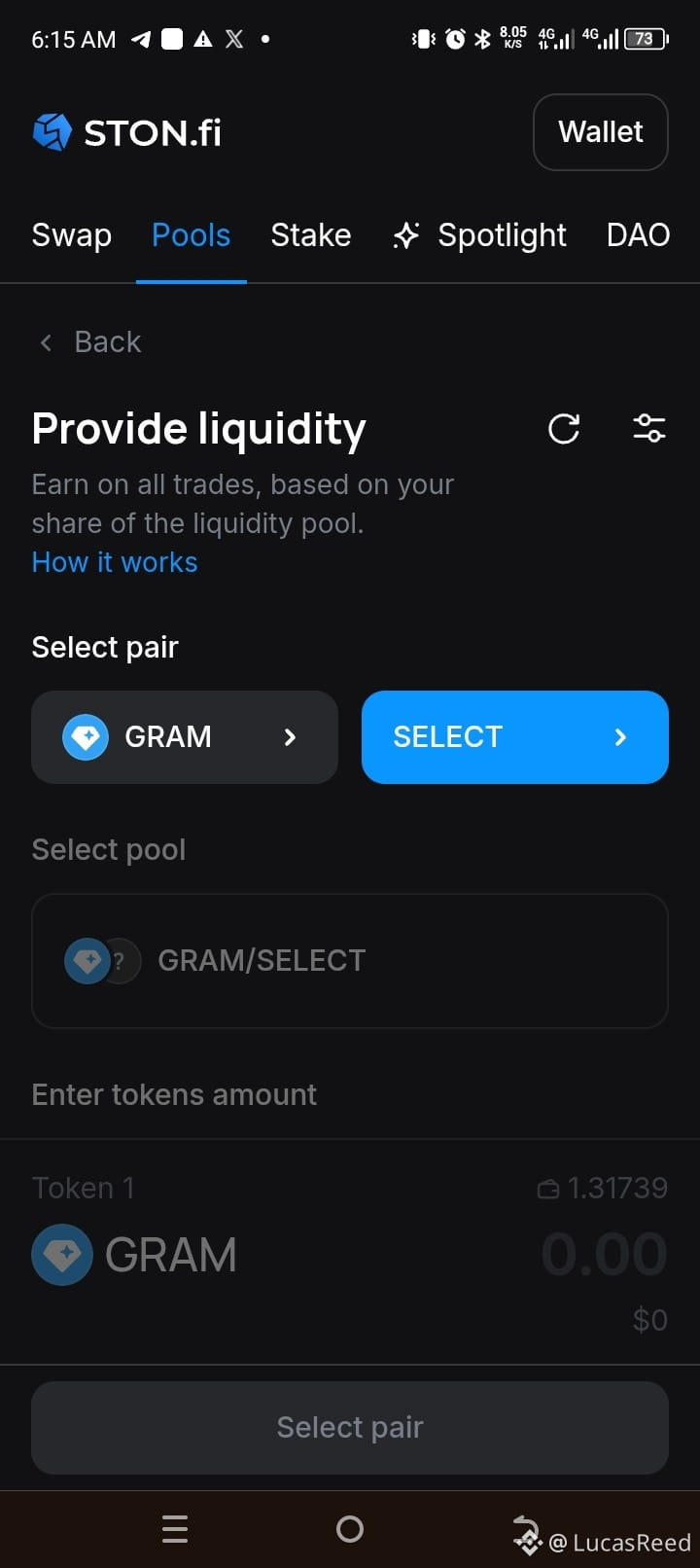
A token having a price doesn’t mean you can actually trade it properly.
When I check a new TON token, I look beyond the chart.
First, I verify the contract.
Then I check if there’s an actual liquidity pool and look at its TVL, volume and pool balance.
After that, I enter the amount I’m considering on @ston_fi and check the quote and Price Impact.
That last part matters.
A small pool can make even a normal-sized swap move the price significantly. STON.fi shows the expected output and price impact before you confirm.
I also check for token warnings. Fake and Honeypot tokens, for example, can be restricted in the STON.fi interface.
So my checklist is simple:
Contract → Pool → Liquidity → Quote → Price Impact → Warnings
Having a token on-chain is one thing.
Having a usable market is another.
🌐 STON.fi: app.ston.fi
📝 STON.fi Blog: blog.ston.fi
#STONfi #TON #DeFi #DEX
$TRUMP $HYPE $BNB
A token having a price doesn’t mean you can actually trade it properly.
When I check a new TON token, I look beyond the chart.
First, I verify the contract.
Then I check if there’s an actual liquidity pool and look at its TVL, volume and pool balance.
After that, I enter the amount I’m considering on @ston_fi and check the quote and Price Impact.
That last part matters.
A small pool can make even a normal-sized swap move the price significantly. STON.fi shows the expected output and price impact before you confirm.
I also check for token warnings. Fake and Honeypot tokens, for example, can be restricted in the STON.fi interface.
So my checklist is simple:
Contract → Pool → Liquidity → Quote → Price Impact → Warnings
Having a token on-chain is one thing.
Having a usable market is another.
🌐 STON.fi: app.ston.fi
📝 STON.fi Blog: blog.ston.fi
#STONfi #TON #DeFi #DEX
$TRUMP $HYPE $BNB
When I check a new TON token, I look beyond the chart.
First, I verify the contract.
Then I check if there’s an actual liquidity pool and look at its TVL, volume and pool balance.
After that, I enter the amount I’m considering on @ston_fi and check the quote and Price Impact.
That last part matters.
A small pool can make even a normal-sized swap move the price significantly. STON.fi shows the expected output and price impact before you confirm.
I also check for token warnings. Fake and Honeypot tokens, for example, can be restricted in the STON.fi interface.
So my checklist is simple:
Contract → Pool → Liquidity → Quote → Price Impact → Warnings
Having a token on-chain is one thing.
Having a usable market is another.
🌐 STON.fi: app.ston.fi
📝 STON.fi Blog: blog.ston.fi
#STONfi #TON #DeFi #DEX
$TRUMP $HYPE $BNB
268

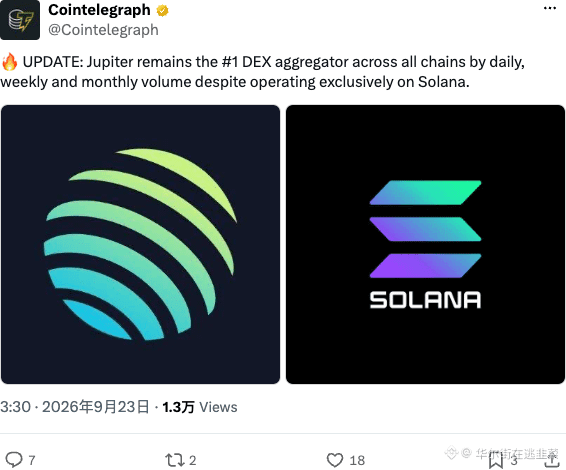
UNI 这波走强不是单纯的情绪推动,而是基本面催化在密集落地。
1)SEC 代币化股票新规推进,合规通道打开,头部 DEX 最先受益;
2)V4 在 Robinhood Chain 与 Arc Chain 上的 TVL 快速攀升,多链扩张开始兑现;
3)协议近 30 天手续费收入约 1.95 亿美元,是真金白银的现金流;
4)品牌域名纠纷落定,尾部不确定性消除。
现价约 8.72 美元,24 小时成交近 10 亿美元,市值约 54 亿美元。监管、扩张、收入、利空出清四条线同时共振,这才是市场信心修复的核心逻辑。
短线波动难免,但一个能持续产生手续费的协议,长期估值终归有支撑。接下来重点跟踪 V4 多链 TVL 数据能否延续。
$UNI #Uniswap #DEX
UNI 这波走强不是单纯的情绪推动,而是基本面催化在密集落地。
1)SEC 代币化股票新规推进,合规通道打开,头部 DEX 最先受益;
2)V4 在 Robinhood Chain 与 Arc Chain 上的 TVL 快速攀升,多链扩张开始兑现;
3)协议近 30 天手续费收入约 1.95 亿美元,是真金白银的现金流;
4)品牌域名纠纷落定,尾部不确定性消除。
现价约 8.72 美元,24 小时成交近 10 亿美元,市值约 54 亿美元。监管、扩张、收入、利空出清四条线同时共振,这才是市场信心修复的核心逻辑。
短线波动难免,但一个能持续产生手续费的协议,长期估值终归有支撑。接下来重点跟踪 V4 多链 TVL 数据能否延续。
$UNI #Uniswap #DEX
1)SEC 代币化股票新规推进,合规通道打开,头部 DEX 最先受益;
2)V4 在 Robinhood Chain 与 Arc Chain 上的 TVL 快速攀升,多链扩张开始兑现;
3)协议近 30 天手续费收入约 1.95 亿美元,是真金白银的现金流;
4)品牌域名纠纷落定,尾部不确定性消除。
现价约 8.72 美元,24 小时成交近 10 亿美元,市值约 54 亿美元。监管、扩张、收入、利空出清四条线同时共振,这才是市场信心修复的核心逻辑。
短线波动难免,但一个能持续产生手续费的协议,长期估值终归有支撑。接下来重点跟踪 V4 多链 TVL 数据能否延续。
$UNI #Uniswap #DEX
21

·
--
Haussier
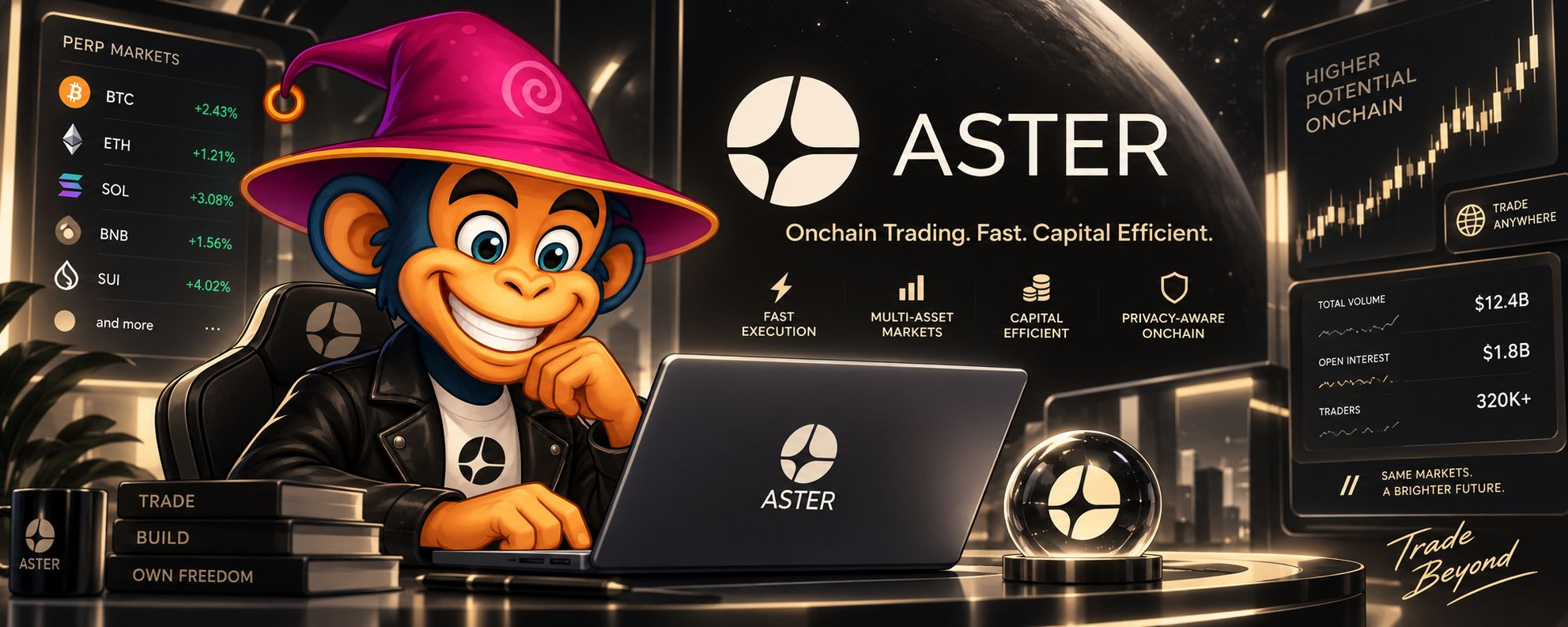
Aster Is Becoming One of the Most Interesting Onchain Trading Bets
The next battle in #defi is not only about liquidity.
It is about where traders actually want to trade.
That is where Aster becomes interesting.
Aster combines perpetuals with access to crypto, stocks, forex, commodities and prediction markets, while also focusing on capital efficiency and privacy.
$ASTER sits directly inside the growing onchain trading economy.
The thesis is simple.
Traders want deep markets.
They want fast execution.
They want capital that keeps working.
And they increasingly want more control over their strategies and data.
Of course, competition between perp #DEX s is brutal and liquidity can move quickly.
But if trading continues migrating onchain, platforms that can deliver a CEX-like experience while keeping crypto-native advantages could capture serious activity.
Aster is one of the names worth watching in that race.
Aster Is Becoming One of the Most Interesting Onchain Trading Bets
The next battle in #defi is not only about liquidity.
It is about where traders actually want to trade.
That is where Aster becomes interesting.
Aster combines perpetuals with access to crypto, stocks, forex, commodities and prediction markets, while also focusing on capital efficiency and privacy.
$ASTER sits directly inside the growing onchain trading economy.
The thesis is simple.
Traders want deep markets.
They want fast execution.
They want capital that keeps working.
And they increasingly want more control over their strategies and data.
Of course, competition between perp #DEX s is brutal and liquidity can move quickly.
But if trading continues migrating onchain, platforms that can deliver a CEX-like experience while keeping crypto-native advantages could capture serious activity.
Aster is one of the names worth watching in that race.
The next battle in #defi is not only about liquidity.
It is about where traders actually want to trade.
That is where Aster becomes interesting.
Aster combines perpetuals with access to crypto, stocks, forex, commodities and prediction markets, while also focusing on capital efficiency and privacy.
$ASTER sits directly inside the growing onchain trading economy.
The thesis is simple.
Traders want deep markets.
They want fast execution.
They want capital that keeps working.
And they increasingly want more control over their strategies and data.
Of course, competition between perp #DEX s is brutal and liquidity can move quickly.
But if trading continues migrating onchain, platforms that can deliver a CEX-like experience while keeping crypto-native advantages could capture serious activity.
Aster is one of the names worth watching in that race.
2
922
·
--
Haussier
Uniswap تهيمن على إطلاق Arc وتستحوذ على 86% من حجم تداول المنصات اللامركزية (DEX) ورسوم التطبيقات الرئيسية.. استحوذت Uniswap على 86% من حجم التداول عبر المنصات اللامركزية (DEX) على الشبكة الرئيسية لبروتوكول Arc التابع لشركة Circle، كما حصدت تقريباً كامل رسوم التطبيقات في اليوم الأول، والتي بلغت قيمتها الإجمالية نحو 450 ألف دولار. ويُعد هذا الإقبال القوي مؤشراً على إمكانات نمو كبيرة للمنصة.
#UNI #Uniswp #DEX #ARC
$UNI
{spot}(UNIUSDT)
Uniswap تهيمن على إطلاق Arc وتستحوذ على 86% من حجم تداول المنصات اللامركزية (DEX) ورسوم التطبيقات الرئيسية.. استحوذت Uniswap على 86% من حجم التداول عبر المنصات اللامركزية (DEX) على الشبكة الرئيسية لبروتوكول Arc التابع لشركة Circle، كما حصدت تقريباً كامل رسوم التطبيقات في اليوم الأول، والتي بلغت قيمتها الإجمالية نحو 450 ألف دولار. ويُعد هذا الإقبال القوي مؤشراً على إمكانات نمو كبيرة للمنصة.
#UNI #Uniswp #DEX #ARC
$UNI
#UNI #Uniswp #DEX #ARC
$UNI
1
118


·
--
The Importance of Liquidity Depth
A token can have a strong community and an active market, but without enough liquidity, trading can still be difficult.
Liquidity depth affects how easily users can buy or sell an asset without significantly moving its price.
This is why STON.fi's liquidity pools are an important part of the TON DeFi ecosystem.
When liquidity is available:
🔹 Traders can execute swaps
🔹 Projects have more accessible markets
🔹 Users can enter or exit positions more easily
🔹 DeFi applications can build on existing markets
But liquidity isn't simply about having a large number on a dashboard.
Its distribution across pools and trading pairs also matters.
A pool with limited liquidity can experience greater price impact when a relatively large trade enters it.
The bigger lesson:
DeFi growth isn't only about launching more tokens.
It also requires the infrastructure and liquidity that allow those tokens to actually be traded efficiently.
That's why I look beyond the token itself and pay attention to the markets supporting it.
A healthy DeFi ecosystem needs both assets people want to trade and liquidity that lets them trade them.
#STONfi #TON #DeFi #Liquidity #DEX $TON @stonfi
The Importance of Liquidity Depth
A token can have a strong community and an active market, but without enough liquidity, trading can still be difficult.
Liquidity depth affects how easily users can buy or sell an asset without significantly moving its price.
This is why STON.fi's liquidity pools are an important part of the TON DeFi ecosystem.
When liquidity is available:
🔹 Traders can execute swaps
🔹 Projects have more accessible markets
🔹 Users can enter or exit positions more easily
🔹 DeFi applications can build on existing markets
But liquidity isn't simply about having a large number on a dashboard.
Its distribution across pools and trading pairs also matters.
A pool with limited liquidity can experience greater price impact when a relatively large trade enters it.
The bigger lesson:
DeFi growth isn't only about launching more tokens.
It also requires the infrastructure and liquidity that allow those tokens to actually be traded efficiently.
That's why I look beyond the token itself and pay attention to the markets supporting it.
A healthy DeFi ecosystem needs both assets people want to trade and liquidity that lets them trade them.
#STONfi #TON #DeFi #Liquidity #DEX $TON @STONfi DEX
A token can have a strong community and an active market, but without enough liquidity, trading can still be difficult.
Liquidity depth affects how easily users can buy or sell an asset without significantly moving its price.
This is why STON.fi's liquidity pools are an important part of the TON DeFi ecosystem.
When liquidity is available:
🔹 Traders can execute swaps
🔹 Projects have more accessible markets
🔹 Users can enter or exit positions more easily
🔹 DeFi applications can build on existing markets
But liquidity isn't simply about having a large number on a dashboard.
Its distribution across pools and trading pairs also matters.
A pool with limited liquidity can experience greater price impact when a relatively large trade enters it.
The bigger lesson:
DeFi growth isn't only about launching more tokens.
It also requires the infrastructure and liquidity that allow those tokens to actually be traded efficiently.
That's why I look beyond the token itself and pay attention to the markets supporting it.
A healthy DeFi ecosystem needs both assets people want to trade and liquidity that lets them trade them.
#STONfi #TON #DeFi #Liquidity #DEX $TON @STONfi DEX
93

·
--
$SEI : Built from the ground up for high-speed DEX trading ⚡🏎️
With sub-second finality and twin-turbo consensus, Sei was specifically engineered to give decentralized exchanges the speed and feel of a centralized order book.
Fast settlement + low slippage = the dream combo for on-chain day traders.
Have you used DEXs on $SEI yet? How does the speed compare to Solana? Drop your review! 💬
#SEINetwork #DEX #CryptoSpeed
$SEI : Built from the ground up for high-speed DEX trading ⚡🏎️
With sub-second finality and twin-turbo consensus, Sei was specifically engineered to give decentralized exchanges the speed and feel of a centralized order book.
Fast settlement + low slippage = the dream combo for on-chain day traders.
Have you used DEXs on $SEI yet? How does the speed compare to Solana? Drop your review! 💬
#SEINetwork #DEX #CryptoSpeed
With sub-second finality and twin-turbo consensus, Sei was specifically engineered to give decentralized exchanges the speed and feel of a centralized order book.
Fast settlement + low slippage = the dream combo for on-chain day traders.
Have you used DEXs on $SEI yet? How does the speed compare to Solana? Drop your review! 💬
#SEINetwork #DEX #CryptoSpeed
85
Connectez-vous pour découvrir plus de contenu
Rejoignez la communauté mondiale des adeptes de cryptomonnaies sur Binance Square
⚡️ Suviez les dernières informations importantes sur les cryptomonnaies.
💬 Jugé digne de confiance par la plus grande plateforme d’échange de cryptomonnaies au monde.
👍 Découvrez les connaissances que partagent les créateurs vérifiés.
Adresse e-mail/Nº de téléphone
Sujets d’actualité
1
#UKFCAWinsCourtOrderToRecover851400Pounds
938 vues
170 mentions
2
#ChainlinkLaunchesCCIP2WithEnterpriseVerification
10,578 vues
473 mentions
3
#GoldFallsTo$4144
5,124 vues
105 mentions
4
#QNTFallsOver40%FromMorningHigh
38,850 vues
881 mentions
5
#USDTAdds845900HoldersInPast7Days
1,803 vues
154 mentions
6
#KospiFalls2.7%SamsungSKHynixDropOver5%
8,107 vues
392 mentions
7
#BitgetCEOConfirms$388MStolenInHack
3,294 vues
38 mentions
8
#BTCFallsBelow$83000
18,043 vues
143 mentions
9
#BitgetDetailsSecurityIncidentTimeline
22,764 vues
543 mentions
10
#BitcoinSpotETFs$2.39BWeeklyNetInflow
7,607 vues
36 mentions