

#defisecurity
defisecurity
128,023 vues
659 mentions
Populaire
Récents

·
--
🚨 NEAR Intents blocked $50M linked to Bitget hackers, showing proactive on-chain defense. Unlike THORChain’s neutral stance, this highlights a security-first approach that could boost trust in NEAR’s ecosystem. Market may view this as a bullish signal for protocol integrity.
How does selective censorship affect long-term decentralization ideals?
#DeFiSecurity
$NEAR #TradingSignal #CryptoAnalysis
🚨 NEAR Intents blocked $50M linked to Bitget hackers, showing proactive on-chain defense. Unlike THORChain’s neutral stance, this highlights a security-first approach that could boost trust in NEAR’s ecosystem. Market may view this as a bullish signal for protocol integrity.
How does selective censorship affect long-term decentralization ideals?
#DeFiSecurity
$NEAR #TradingSignal #CryptoAnalysis
How does selective censorship affect long-term decentralization ideals?
#DeFiSecurity
$NEAR #TradingSignal #CryptoAnalysis

135
·
--
🚨 Scammers mimicked the GIWA L2 with a fake RPC, bridge, and Chain ID 9134, tricking 1,333 wallets into sending 767 ETH before draining funds. This highlights rising sophistication in DeFi exploits targeting layer-2 expectations. Always verify network contracts and RPCs—never trust UI alone. How deep does this rabbit hole go? #DeFiSecurity
$ETH #TradingSignal #CryptoAnalysis
🚨 Scammers mimicked the GIWA L2 with a fake RPC, bridge, and Chain ID 9134, tricking 1,333 wallets into sending 767 ETH before draining funds. This highlights rising sophistication in DeFi exploits targeting layer-2 expectations. Always verify network contracts and RPCs—never trust UI alone. How deep does this rabbit hole go? #DeFiSecurity
$ETH #TradingSignal #CryptoAnalysis
$ETH #TradingSignal #CryptoAnalysis

4
·
--
🚨 Scammers deployed a fake Giwa-backed ETH L2 chain, stealing over 760 ETH from users. DYORSWAP identified the fraud and initiated a compensation process. This highlights rising risks in L2 ecosystems and the need for rigorous contract verification before bridging funds. Traders should scrutinize chain authenticity and avoid unverified bridges.
How can users better detect fake L2 deployments before connecting wallets?
#DeFiSecurity
$ETH #TradingSignal #CryptoAnalysis
🚨 Scammers deployed a fake Giwa-backed ETH L2 chain, stealing over 760 ETH from users. DYORSWAP identified the fraud and initiated a compensation process. This highlights rising risks in L2 ecosystems and the need for rigorous contract verification before bridging funds. Traders should scrutinize chain authenticity and avoid unverified bridges.
How can users better detect fake L2 deployments before connecting wallets?
#DeFiSecurity
$ETH #TradingSignal #CryptoAnalysis
How can users better detect fake L2 deployments before connecting wallets?
#DeFiSecurity
$ETH #TradingSignal #CryptoAnalysis

17

LayerZero is facing severe pressure as a massive $292M lawsuit challenges its core security design following the KelpDAO rsETH exploit. With nearly $15B exiting the protocol and mounting reputational damage, the legal battle goes beyond a financial dispute—it puts omnichain trust on trial. Cross-chain infra must prioritize bulletproof validation, or user capital will keep fleeing. Security is everything in DeFi. #LayerZero #DeFiSecurity #CryptoNews
LayerZero is facing severe pressure as a massive $292M lawsuit challenges its core security design following the KelpDAO rsETH exploit. With nearly $15B exiting the protocol and mounting reputational damage, the legal battle goes beyond a financial dispute—it puts omnichain trust on trial. Cross-chain infra must prioritize bulletproof validation, or user capital will keep fleeing. Security is everything in DeFi. #LayerZero #DeFiSecurity #CryptoNews
14

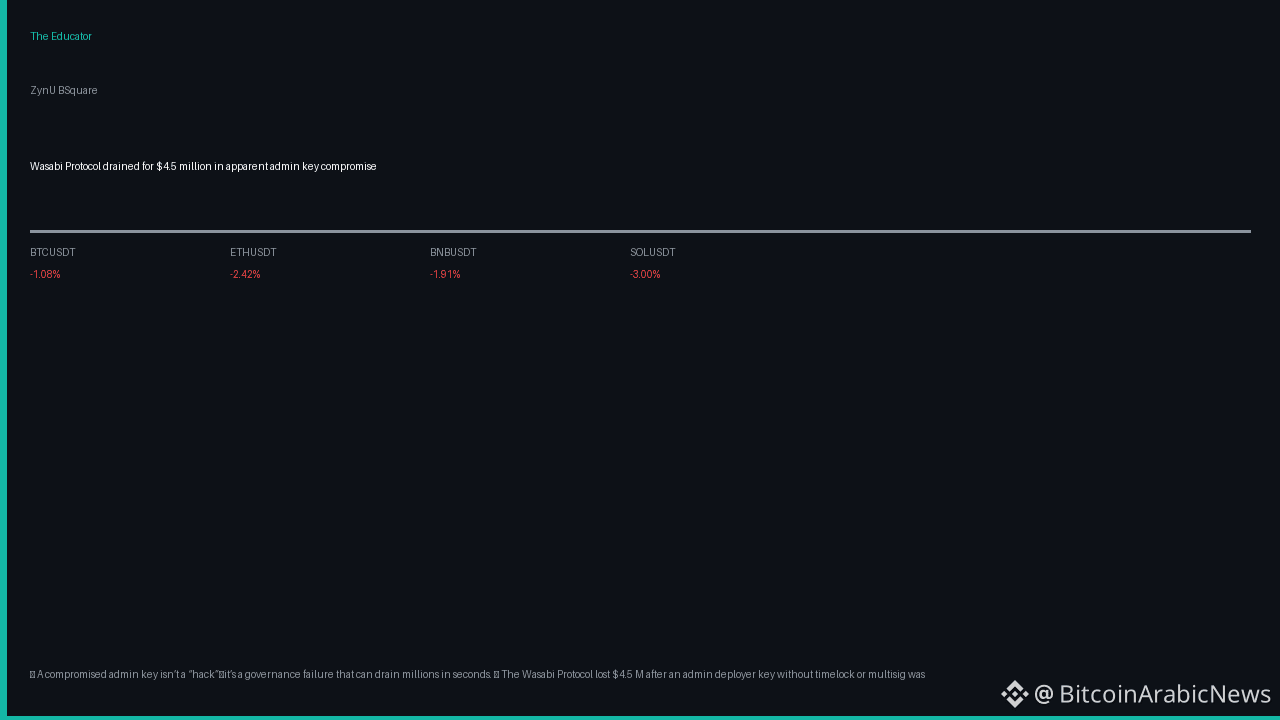
🔥 A compromised admin key isn’t a “hack”—it’s a governance failure that can drain millions in seconds.
📊 The Wasabi Protocol lost $4.5 M after an admin deployer key without timelock or multisig was seized, echoing Drift’s $285 M breach earlier this week #DeFiSecurity #SmartContractRisk.
💡 With #Bitcoin trading at $80,416, RSI 61.2 and open interest $8.76 B, the market shows bullish confidence (funding +0.0100% longs paying), yet governance lapses still bite, underscoring why #CryptoSafety will separate resilient projects from the rest.
📌 Practical move: audit any protocol you stake in for multisig controls and timelocks; prioritize platforms that publish transparent governance dashboards before allocating capital.
❓ How do you vet a project’s contract security—relying on community audits, formal verification, or on‑chain monitoring tools?
🔥 A compromised admin key isn’t a “hack”—it’s a governance failure that can drain millions in seconds.
📊 The Wasabi Protocol lost $4.5 M after an admin deployer key without timelock or multisig was seized, echoing Drift’s $285 M breach earlier this week #DeFiSecurity #SmartContractRisk.
💡 With #Bitcoin trading at $80,416, RSI 61.2 and open interest $8.76 B, the market shows bullish confidence (funding +0.0100% longs paying), yet governance lapses still bite, underscoring why #CryptoSafety will separate resilient projects from the rest.
📌 Practical move: audit any protocol you stake in for multisig controls and timelocks; prioritize platforms that publish transparent governance dashboards before allocating capital.
❓ How do you vet a project’s contract security—relying on community audits, formal verification, or on‑chain monitoring tools?
📊 The Wasabi Protocol lost $4.5 M after an admin deployer key without timelock or multisig was seized, echoing Drift’s $285 M breach earlier this week #DeFiSecurity #SmartContractRisk.
💡 With #Bitcoin trading at $80,416, RSI 61.2 and open interest $8.76 B, the market shows bullish confidence (funding +0.0100% longs paying), yet governance lapses still bite, underscoring why #CryptoSafety will separate resilient projects from the rest.
📌 Practical move: audit any protocol you stake in for multisig controls and timelocks; prioritize platforms that publish transparent governance dashboards before allocating capital.
❓ How do you vet a project’s contract security—relying on community audits, formal verification, or on‑chain monitoring tools?
60

·
--
中文版:
MEV机器人太秀了!黑客想通过自定义Safe模块搞事情,偷走770万美元rsETH,结果被"Yoink"机器人先下手为强,截获了赃款。Kelp赶紧冻结了接收地址。这表明DeFi安全机制在进化,黑客空间被压缩。短期内rsETH价格可能因消息影响波动,但长期看,这类积极事件反而能增强市场信心。#DeFiSecurity #MEVProtection $rsETH $ETH
英文版:
MEV bot just pulled off the ultimate flex! A hacker tried exploiting a custom Safe module to steal $7.7M in rsETH, but the "Yoink" bot front-ran the attack and snatched the funds before Kelp froze the receiving address. This shows DeFi security is evolving fast, squeezing hackers out. Short-term rsETH price might see volatility, but long-term, these positive events actually boost market confidence. #DeFiSecurity #MEVProtection $rsETH $ETH
中文版:
MEV机器人太秀了!黑客想通过自定义Safe模块搞事情,偷走770万美元rsETH,结果被"Yoink"机器人先下手为强,截获了赃款。Kelp赶紧冻结了接收地址。这表明DeFi安全机制在进化,黑客空间被压缩。短期内rsETH价格可能因消息影响波动,但长期看,这类积极事件反而能增强市场信心。#DeFiSecurity #MEVProtection $rsETH $ETH
英文版:
MEV bot just pulled off the ultimate flex! A hacker tried exploiting a custom Safe module to steal $7.7M in rsETH, but the "Yoink" bot front-ran the attack and snatched the funds before Kelp froze the receiving address. This shows DeFi security is evolving fast, squeezing hackers out. Short-term rsETH price might see volatility, but long-term, these positive events actually boost market confidence. #DeFiSecurity #MEVProtection $rsETH $ETH
MEV机器人太秀了!黑客想通过自定义Safe模块搞事情,偷走770万美元rsETH,结果被"Yoink"机器人先下手为强,截获了赃款。Kelp赶紧冻结了接收地址。这表明DeFi安全机制在进化,黑客空间被压缩。短期内rsETH价格可能因消息影响波动,但长期看,这类积极事件反而能增强市场信心。#DeFiSecurity #MEVProtection $rsETH $ETH
英文版:
MEV bot just pulled off the ultimate flex! A hacker tried exploiting a custom Safe module to steal $7.7M in rsETH, but the "Yoink" bot front-ran the attack and snatched the funds before Kelp froze the receiving address. This shows DeFi security is evolving fast, squeezing hackers out. Short-term rsETH price might see volatility, but long-term, these positive events actually boost market confidence. #DeFiSecurity #MEVProtection $rsETH $ETH
169

·
--

Article
Symbiosis Recovered 15 BTC After Bridge Exploit, Offers 20% BountyMost traders watch price. Smart money watches the recovery rate of stolen assets.
The latest shockwave in the DeFi security arena came from Symbiosis, the cross‑chain bridge that recently fell victim to a sophisticated exploit. Blockaid, a leading blockchain security firm, confirmed that the attacker managed to mint a staggering 46.1 billion syBTC—an equivalent of roughly $336,000 in proceeds. Yet, what’s truly eye‑opening is that Symbiosis has already recovered 15 BTC (about $450,000) from the stolen pool and has dangled a 20 % bounty to any party that can help locate the remaining assets.
#DeFiSecurity #BridgeExploit #CryptoRecovery
Why does this matter for $BTC and the broader market? First, the sheer scale of the minting—46.1 billion syBTC—highlights how vulnerable cross‑chain bridges remain, even for projects with robust security audits. Second, the rapid recovery of 15 BTC indicates that Symbiosis’ incident response team is not only vigilant but also actively collaborating with the community. A 20 % bounty is a clear signal that the project is willing to pay handsomely for any leads, which could accelerate the return of the remaining funds. For traders, this means that the bridge’s liquidity and user confidence are likely to rebound faster than the typical 3‑4 month recovery cycle seen in past incidents.
Watch the following: the movement of the recovered 15 BTC on the blockchain. If you see a sudden influx into a single address or a pattern of clustering, it could be a hint that the attacker is consolidating assets before moving them. Keep an eye on the address that received the bounty payout—if it starts receiving additional inflows, that might signal the attacker’s next move.
What will the next 30 days reveal about the resilience of cross‑chain bridges, and how will this incident reshape the risk appetite of institutional investors?
Symbiosis Recovered 15 BTC After Bridge Exploit, Offers 20% Bounty
Most traders watch price. Smart money watches the recovery rate of stolen assets.
The latest shockwave in the DeFi security arena came from Symbiosis, the cross‑chain bridge that recently fell victim to a sophisticated exploit. Blockaid, a leading blockchain security firm, confirmed that the attacker managed to mint a staggering 46.1 billion syBTC—an equivalent of roughly $336,000 in proceeds. Yet, what’s truly eye‑opening is that Symbiosis has already recovered 15 BTC (about $450,000) from the stolen pool and has dangled a 20 % bounty to any party that can help locate the remaining assets.
#DeFiSecurity #BridgeExploit #CryptoRecovery
Why does this matter for $BTC and the broader market? First, the sheer scale of the minting—46.1 billion syBTC—highlights how vulnerable cross‑chain bridges remain, even for projects with robust security audits. Second, the rapid recovery of 15 BTC indicates that Symbiosis’ incident response team is not only vigilant but also actively collaborating with the community. A 20 % bounty is a clear signal that the project is willing to pay handsomely for any leads, which could accelerate the return of the remaining funds. For traders, this means that the bridge’s liquidity and user confidence are likely to rebound faster than the typical 3‑4 month recovery cycle seen in past incidents.
Watch the following: the movement of the recovered 15 BTC on the blockchain. If you see a sudden influx into a single address or a pattern of clustering, it could be a hint that the attacker is consolidating assets before moving them. Keep an eye on the address that received the bounty payout—if it starts receiving additional inflows, that might signal the attacker’s next move.
What will the next 30 days reveal about the resilience of cross‑chain bridges, and how will this incident reshape the risk appetite of institutional investors?
The latest shockwave in the DeFi security arena came from Symbiosis, the cross‑chain bridge that recently fell victim to a sophisticated exploit. Blockaid, a leading blockchain security firm, confirmed that the attacker managed to mint a staggering 46.1 billion syBTC—an equivalent of roughly $336,000 in proceeds. Yet, what’s truly eye‑opening is that Symbiosis has already recovered 15 BTC (about $450,000) from the stolen pool and has dangled a 20 % bounty to any party that can help locate the remaining assets.
#DeFiSecurity #BridgeExploit #CryptoRecovery
Why does this matter for $BTC and the broader market? First, the sheer scale of the minting—46.1 billion syBTC—highlights how vulnerable cross‑chain bridges remain, even for projects with robust security audits. Second, the rapid recovery of 15 BTC indicates that Symbiosis’ incident response team is not only vigilant but also actively collaborating with the community. A 20 % bounty is a clear signal that the project is willing to pay handsomely for any leads, which could accelerate the return of the remaining funds. For traders, this means that the bridge’s liquidity and user confidence are likely to rebound faster than the typical 3‑4 month recovery cycle seen in past incidents.
Watch the following: the movement of the recovered 15 BTC on the blockchain. If you see a sudden influx into a single address or a pattern of clustering, it could be a hint that the attacker is consolidating assets before moving them. Keep an eye on the address that received the bounty payout—if it starts receiving additional inflows, that might signal the attacker’s next move.
What will the next 30 days reveal about the resilience of cross‑chain bridges, and how will this incident reshape the risk appetite of institutional investors?
19

🚨 $BTX LIQUIDITY DRAINED AS FLASH LOAN EXPLOIT EXPOSES ORACLE VULNERABILITY ⚠️
🔍 BeatSwap ($BTX ) suffered a contract exploit draining roughly $77.5K (2.98M $BTX ) through spot price manipulation. The attacker deployed a 6M $BTX flash loan into a DEX pool to artificially crush spot pricing metrics before calling deposit functions to mint skewed LP positions.
📊 This attack vector succeeded by exploiting a missing Time-Weighted Average Price (TWAP) implementation and lacking price deviation safeguards. When smart contracts rely solely on instantaneous spot prices, massive temporary liquidity shifts can easily distort structural mechanics for immediate extraction.
💬 Should DEX protocols mandate TWAP filters before launching LP conversion contracts? 👇
⚠️ Not financial advice. Always manage your risk. 🛡️
🏷️ #BTX #DeFiSecurity #SmartMoney #CryptoAnalysis
🔍 🛡️
🚨 $BTX LIQUIDITY DRAINED AS FLASH LOAN EXPLOIT EXPOSES ORACLE VULNERABILITY ⚠️
🔍 BeatSwap ($BTX ) suffered a contract exploit draining roughly $77.5K (2.98M $BTX ) through spot price manipulation. The attacker deployed a 6M $BTX flash loan into a DEX pool to artificially crush spot pricing metrics before calling deposit functions to mint skewed LP positions.
📊 This attack vector succeeded by exploiting a missing Time-Weighted Average Price (TWAP) implementation and lacking price deviation safeguards. When smart contracts rely solely on instantaneous spot prices, massive temporary liquidity shifts can easily distort structural mechanics for immediate extraction.
💬 Should DEX protocols mandate TWAP filters before launching LP conversion contracts? 👇
⚠️ Not financial advice. Always manage your risk. 🛡️
🏷️ #BTX #DeFiSecurity #SmartMoney #CryptoAnalysis
🔍 🛡️
🔍 BeatSwap ($BTX ) suffered a contract exploit draining roughly $77.5K (2.98M $BTX ) through spot price manipulation. The attacker deployed a 6M $BTX flash loan into a DEX pool to artificially crush spot pricing metrics before calling deposit functions to mint skewed LP positions.
📊 This attack vector succeeded by exploiting a missing Time-Weighted Average Price (TWAP) implementation and lacking price deviation safeguards. When smart contracts rely solely on instantaneous spot prices, massive temporary liquidity shifts can easily distort structural mechanics for immediate extraction.
💬 Should DEX protocols mandate TWAP filters before launching LP conversion contracts? 👇
⚠️ Not financial advice. Always manage your risk. 🛡️
🏷️ #BTX #DeFiSecurity #SmartMoney #CryptoAnalysis
🔍 🛡️
42

🚨 استنزاف احتياطي إقراض بقيمة 9.3 مليون دولار من منصة More Markets
أفادت شركة Blockaid المتخصصة في أمن البلوكتش بأن مهاجماً استخدم عملة Ankr للستاكينغ السائل ونمط E-mode لاستغلال بروتوكول الإقراض More Markets. أسفر الهجوم عن سحب حوالي 9.3 مليون دولار من عملة WFLOW من احتياطي الإقراض الخاص بالمنصة.
━━━━━━━━━━━━━━
📊 التأثير: 📈 مرتفع
🏷️ DEFI
#DeFiSecurity #Exploit #MoreMarkets #Blockchain
📰 المصدر: cointelegraph.com
🚨 استنزاف احتياطي إقراض بقيمة 9.3 مليون دولار من منصة More Markets
أفادت شركة Blockaid المتخصصة في أمن البلوكتش بأن مهاجماً استخدم عملة Ankr للستاكينغ السائل ونمط E-mode لاستغلال بروتوكول الإقراض More Markets. أسفر الهجوم عن سحب حوالي 9.3 مليون دولار من عملة WFLOW من احتياطي الإقراض الخاص بالمنصة.
━━━━━━━━━━━━━━
📊 التأثير: 📈 مرتفع
🏷️ DEFI
#DeFiSecurity #Exploit #MoreMarkets #Blockchain
📰 المصدر: cointelegraph.com
أفادت شركة Blockaid المتخصصة في أمن البلوكتش بأن مهاجماً استخدم عملة Ankr للستاكينغ السائل ونمط E-mode لاستغلال بروتوكول الإقراض More Markets. أسفر الهجوم عن سحب حوالي 9.3 مليون دولار من عملة WFLOW من احتياطي الإقراض الخاص بالمنصة.
━━━━━━━━━━━━━━
📊 التأثير: 📈 مرتفع
🏷️ DEFI
#DeFiSecurity #Exploit #MoreMarkets #Blockchain
📰 المصدر: cointelegraph.com
20
·
--
🚨 Crypto.com’s Cronos blockchain halted after a $75M exploit on Tectonic, with ~$6M bridged to Ethereum before validators froze the chain.
The incident highlights cross-chain vulnerability risks, especially for assets moving between Cronos and Ethereum.
Ethereum remains operational, but the event may trigger short-term caution around wrapped assets and bridge usage.
Market participants are watching for potential ripple effects on DeFi protocols reliant on Cronos liquidity.
How will this affect trust in cross-chain bridges moving forward?
#Cronos #DeFiSecurity
$ETH #TradingSignal #CryptoAnalysis
🚨 Crypto.com’s Cronos blockchain halted after a $75M exploit on Tectonic, with ~$6M bridged to Ethereum before validators froze the chain.
The incident highlights cross-chain vulnerability risks, especially for assets moving between Cronos and Ethereum.
Ethereum remains operational, but the event may trigger short-term caution around wrapped assets and bridge usage.
Market participants are watching for potential ripple effects on DeFi protocols reliant on Cronos liquidity.
How will this affect trust in cross-chain bridges moving forward?
#Cronos #DeFiSecurity
$ETH #TradingSignal #CryptoAnalysis
The incident highlights cross-chain vulnerability risks, especially for assets moving between Cronos and Ethereum.
Ethereum remains operational, but the event may trigger short-term caution around wrapped assets and bridge usage.
Market participants are watching for potential ripple effects on DeFi protocols reliant on Cronos liquidity.
How will this affect trust in cross-chain bridges moving forward?
#Cronos #DeFiSecurity
$ETH #TradingSignal #CryptoAnalysis

31

·
--
Most traders are worried about the latest Cosmos hack. Smart money is looking at what it means for the broader DeFi ecosystem.
THE SIGNAL: A recent exploit targeting the Cosmos EVM, leading to roughly $5.72 million in stolen assets across multiple chains like MANTRA, TAC, and KiiChain. This happened between Aug 20th and Aug 25th. #CosmosHack #DeFiSecurity
THE INTERPRETATION: While this is a clear setback for the affected projects, it highlights the ongoing security challenges in cross-chain interoperability. For the informed investor, this isn't a reason to panic sell everything. Instead, it’s a critical reminder to focus on projects with robust security audits and a proven track record of defending against sophisticated attacks. We’ve seen this movie before; vulnerabilities get patched, and resilient projects emerge stronger. This also puts a spotlight on the need for better insurance protocols within DeFi.
THE WATCH LIST: Keep a close eye on how quickly other Cosmos-based projects implement enhanced security measures in response. #SecurityFirst
This incident underscores the importance of due diligence. What are you doing to protect your portfolio from these kinds of emergent risks?
Most traders are worried about the latest Cosmos hack. Smart money is looking at what it means for the broader DeFi ecosystem.
THE SIGNAL: A recent exploit targeting the Cosmos EVM, leading to roughly $5.72 million in stolen assets across multiple chains like MANTRA, TAC, and KiiChain. This happened between Aug 20th and Aug 25th. #CosmosHack #DeFiSecurity
THE INTERPRETATION: While this is a clear setback for the affected projects, it highlights the ongoing security challenges in cross-chain interoperability. For the informed investor, this isn't a reason to panic sell everything. Instead, it’s a critical reminder to focus on projects with robust security audits and a proven track record of defending against sophisticated attacks. We’ve seen this movie before; vulnerabilities get patched, and resilient projects emerge stronger. This also puts a spotlight on the need for better insurance protocols within DeFi.
THE WATCH LIST: Keep a close eye on how quickly other Cosmos-based projects implement enhanced security measures in response. #SecurityFirst
This incident underscores the importance of due diligence. What are you doing to protect your portfolio from these kinds of emergent risks?
THE SIGNAL: A recent exploit targeting the Cosmos EVM, leading to roughly $5.72 million in stolen assets across multiple chains like MANTRA, TAC, and KiiChain. This happened between Aug 20th and Aug 25th. #CosmosHack #DeFiSecurity
THE INTERPRETATION: While this is a clear setback for the affected projects, it highlights the ongoing security challenges in cross-chain interoperability. For the informed investor, this isn't a reason to panic sell everything. Instead, it’s a critical reminder to focus on projects with robust security audits and a proven track record of defending against sophisticated attacks. We’ve seen this movie before; vulnerabilities get patched, and resilient projects emerge stronger. This also puts a spotlight on the need for better insurance protocols within DeFi.
THE WATCH LIST: Keep a close eye on how quickly other Cosmos-based projects implement enhanced security measures in response. #SecurityFirst
This incident underscores the importance of due diligence. What are you doing to protect your portfolio from these kinds of emergent risks?
46

·
--
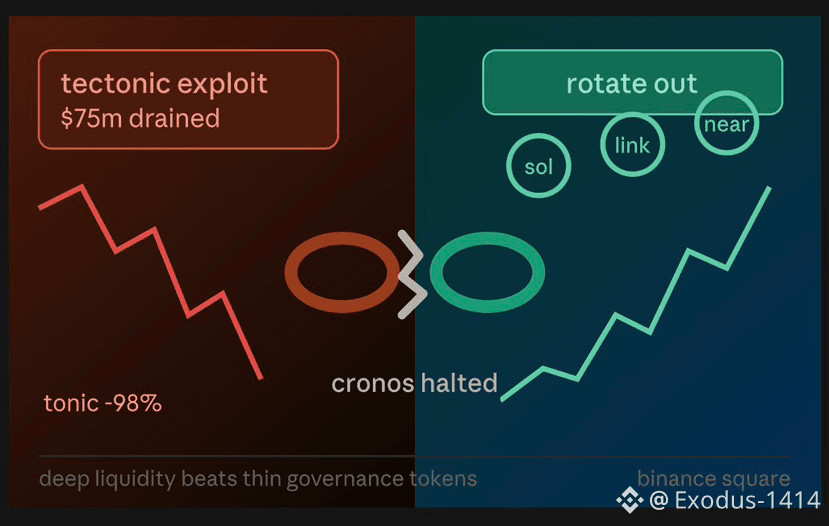
🚨 Cronos halted after $75M Tectonic exploit — here’s the risk
Cronos ($CRO) froze block production after an attacker manipulated the price of Tectonic’s illiquid $TONIC governance token ~100x in just 20 minutes, then borrowed against the inflated collateral to drain an estimated $66–75M from the chain’s largest lending protocol. Validators halted the entire chain to stop the bleeding, with only ~$6M reaching Ethereum before the freeze . Crypto.com’s exchange and app itself were unaffected — this hit DeFi infrastructure on Cronos, not custodial funds.
This is a classic Mango Markets-style oracle exploit: thin liquidity + collateral-backed borrowing = a token that can be pumped and used as fake-value collateral. It’s a reminder that chain security is only as strong as the weakest liquidity pool sitting on top of it.
Why rotate to $SOL / $NEAR / $LINK instead:
•Deeper, more battle-tested DeFi liquidity — harder for a single actor to manipulate an oracle price 100x in minutes
•Larger, more decentralized validator sets vs. Cronos’s capped ~100-validator Tendermint setup
•Established track record without a governance-token collateral vulnerability like this
DYOR — this isn’t financial advice, just a reminder that chain-level halts like this are a real tail risk worth pricing in. 🧵
#Cronos #DeFiSecurity #Exploit #solana #NEARProtocol
🚨 Cronos halted after $75M Tectonic exploit — here’s the risk
Cronos ($CRO) froze block production after an attacker manipulated the price of Tectonic’s illiquid $TONIC governance token ~100x in just 20 minutes, then borrowed against the inflated collateral to drain an estimated $66–75M from the chain’s largest lending protocol. Validators halted the entire chain to stop the bleeding, with only ~$6M reaching Ethereum before the freeze . Crypto.com’s exchange and app itself were unaffected — this hit DeFi infrastructure on Cronos, not custodial funds.
This is a classic Mango Markets-style oracle exploit: thin liquidity + collateral-backed borrowing = a token that can be pumped and used as fake-value collateral. It’s a reminder that chain security is only as strong as the weakest liquidity pool sitting on top of it.
Why rotate to $SOL / $NEAR / $LINK instead:
•Deeper, more battle-tested DeFi liquidity — harder for a single actor to manipulate an oracle price 100x in minutes
•Larger, more decentralized validator sets vs. Cronos’s capped ~100-validator Tendermint setup
•Established track record without a governance-token collateral vulnerability like this
DYOR — this isn’t financial advice, just a reminder that chain-level halts like this are a real tail risk worth pricing in. 🧵
#Cronos #DeFiSecurity #Exploit #solana #NEARProtocol
Cronos ($CRO) froze block production after an attacker manipulated the price of Tectonic’s illiquid $TONIC governance token ~100x in just 20 minutes, then borrowed against the inflated collateral to drain an estimated $66–75M from the chain’s largest lending protocol. Validators halted the entire chain to stop the bleeding, with only ~$6M reaching Ethereum before the freeze . Crypto.com’s exchange and app itself were unaffected — this hit DeFi infrastructure on Cronos, not custodial funds.
This is a classic Mango Markets-style oracle exploit: thin liquidity + collateral-backed borrowing = a token that can be pumped and used as fake-value collateral. It’s a reminder that chain security is only as strong as the weakest liquidity pool sitting on top of it.
Why rotate to $SOL / $NEAR / $LINK instead:
•Deeper, more battle-tested DeFi liquidity — harder for a single actor to manipulate an oracle price 100x in minutes
•Larger, more decentralized validator sets vs. Cronos’s capped ~100-validator Tendermint setup
•Established track record without a governance-token collateral vulnerability like this
DYOR — this isn’t financial advice, just a reminder that chain-level halts like this are a real tail risk worth pricing in. 🧵
#Cronos #DeFiSecurity #Exploit #solana #NEARProtocol
202

Article
The Sandbox a perdu 14,7M SAND. La faille était dans le bridge.Le 22 août 2026.
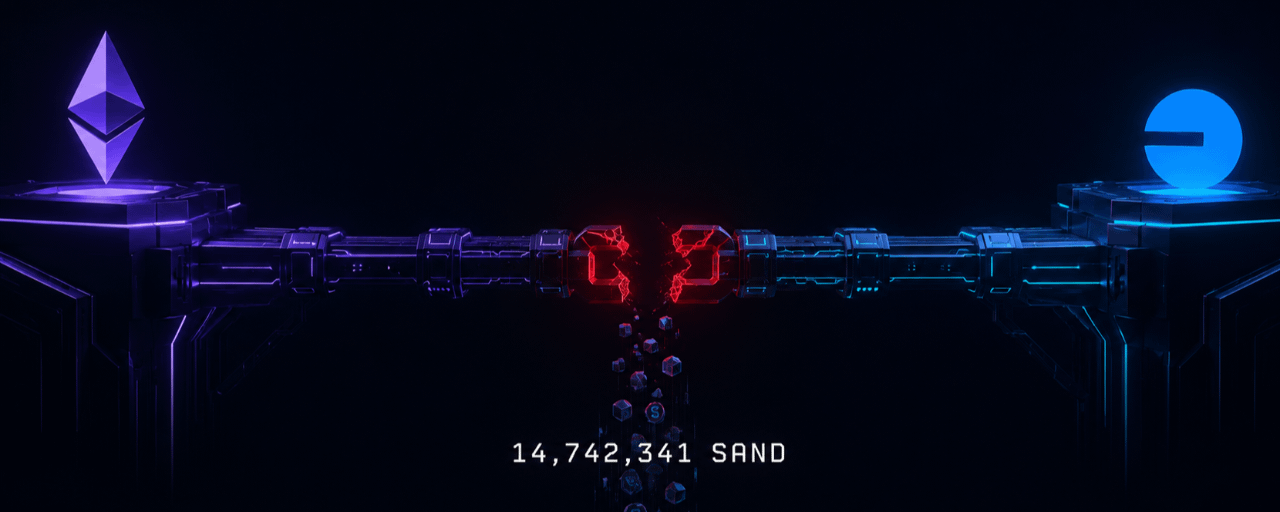
Un attaquant a drainé 14 742 341 SAND
depuis le vault Ethereum de The Sandbox.
Via une faille de configuration dans leur bridge Base/BSC.
Ethereum et Polygon non jamais été affectés, ujste le bridge.
C'est le même vecteur d'attaque qu'on voit
se répéter depuis 2 ans.
Et la majorité des farmers l'ignorent encore.
📌 Étape 1: Identifier la cible (le bridge)
The Sandbox a confirmé qu'un attaquant a drainé 14 742 341,84 SAND soit 0,5% du supply maximum et ce depuis son vault Ethereum via une faille de configuration de bridge sur Base/BSC.
Traduction simple :
Le problème n'était pas le smart contract principal.
C'était la configuration du bridge entre chaînes.
Les bridges sont le maillon faible du Web3.
Ils ont été à l'origine des plus grands hacks de l'histoire crypto
Ronin 625M, Wormhole 320M, Nomad 190M$.
📌 Étape 2: La méthode de l'attaquant
Flaw de configuration = une mauvaise règle dans le code du bridge qui autorise des transactions non voulues.
Ce n'est pas du génie. C'est de la patience.
L'attaquant a cherché une incohérence de configuration.
Il l'a trouvée. Il a exécuté.
The Sandbox a rapporté le wallet de l'attaquant à TRM Labs. Mais les fonds bougent vite en DeFi.
📌 Étape 3: Ce que ça révèle sur ta sécurité
Tu utilises des bridges pour farmer tes airdrops.
Linea. Base. Arbitrum.
Voici ce que tu dois vérifier avant chaque bridge :
✅ Est-ce que le bridge a été audité récemment ?
✅ Est-ce que le TVL est suffisamment important pour justifier la sécurité ?
✅ Est-ce que tu bridges plus que ce que tu peux perdre ?
✅ Est-ce que tu utilises des bridges officiels ?
La règle que j'applique :
Bridge uniquement ce que tu acceptes de perdre.
Pas parce que les bridges sont tous dangereux.
Parce que la configuration peut toujours avoir une faille.
📌 Ce que ça change pour tes airdrops
Tu farmes Linea. Tu bridges vers Base.
Ces actions sont nécessaires pour les airdrops MetaMask et Base.
Mais elles t'exposent à ce type de risque.
La solution n'est pas d'arrêter de farmer.
C'est de comprendre le risque et de le dimensionner correctement.
Petit montant sur le bridge. Grande régularité sur le temps.
C'est la stratégie qui maximise les points
sans exposer tes économies.
Tu as déjà eu des fonds bloqués ou perdus via un bridge ?
Et tu vérifiais les audits avant de bridger ?
Oui ou non dis-moi en commentaire.
$SAND
{spot}(SANDUSDT)
#TheSandbox #DeFiSecurity #BridgeHack
The Sandbox a perdu 14,7M SAND. La faille était dans le bridge.
Le 22 août 2026.
Un attaquant a drainé 14 742 341 SAND
depuis le vault Ethereum de The Sandbox.
Via une faille de configuration dans leur bridge Base/BSC.
Ethereum et Polygon non jamais été affectés, ujste le bridge.
C'est le même vecteur d'attaque qu'on voit
se répéter depuis 2 ans.
Et la majorité des farmers l'ignorent encore.
📌 Étape 1: Identifier la cible (le bridge)
The Sandbox a confirmé qu'un attaquant a drainé 14 742 341,84 SAND soit 0,5% du supply maximum et ce depuis son vault Ethereum via une faille de configuration de bridge sur Base/BSC.
Traduction simple :
Le problème n'était pas le smart contract principal.
C'était la configuration du bridge entre chaînes.
Les bridges sont le maillon faible du Web3.
Ils ont été à l'origine des plus grands hacks de l'histoire crypto
Ronin 625M, Wormhole 320M, Nomad 190M$.
📌 Étape 2: La méthode de l'attaquant
Flaw de configuration = une mauvaise règle dans le code du bridge qui autorise des transactions non voulues.
Ce n'est pas du génie. C'est de la patience.
L'attaquant a cherché une incohérence de configuration.
Il l'a trouvée. Il a exécuté.
The Sandbox a rapporté le wallet de l'attaquant à TRM Labs. Mais les fonds bougent vite en DeFi.
📌 Étape 3: Ce que ça révèle sur ta sécurité
Tu utilises des bridges pour farmer tes airdrops.
Linea. Base. Arbitrum.
Voici ce que tu dois vérifier avant chaque bridge :
✅ Est-ce que le bridge a été audité récemment ?
✅ Est-ce que le TVL est suffisamment important pour justifier la sécurité ?
✅ Est-ce que tu bridges plus que ce que tu peux perdre ?
✅ Est-ce que tu utilises des bridges officiels ?
La règle que j'applique :
Bridge uniquement ce que tu acceptes de perdre.
Pas parce que les bridges sont tous dangereux.
Parce que la configuration peut toujours avoir une faille.
📌 Ce que ça change pour tes airdrops
Tu farmes Linea. Tu bridges vers Base.
Ces actions sont nécessaires pour les airdrops MetaMask et Base.
Mais elles t'exposent à ce type de risque.
La solution n'est pas d'arrêter de farmer.
C'est de comprendre le risque et de le dimensionner correctement.
Petit montant sur le bridge. Grande régularité sur le temps.
C'est la stratégie qui maximise les points
sans exposer tes économies.
Tu as déjà eu des fonds bloqués ou perdus via un bridge ?
Et tu vérifiais les audits avant de bridger ?
Oui ou non dis-moi en commentaire.
$SAND
#TheSandbox #DeFiSecurity #BridgeHack
Un attaquant a drainé 14 742 341 SAND
depuis le vault Ethereum de The Sandbox.
Via une faille de configuration dans leur bridge Base/BSC.
Ethereum et Polygon non jamais été affectés, ujste le bridge.
C'est le même vecteur d'attaque qu'on voit
se répéter depuis 2 ans.
Et la majorité des farmers l'ignorent encore.
📌 Étape 1: Identifier la cible (le bridge)
The Sandbox a confirmé qu'un attaquant a drainé 14 742 341,84 SAND soit 0,5% du supply maximum et ce depuis son vault Ethereum via une faille de configuration de bridge sur Base/BSC.
Traduction simple :
Le problème n'était pas le smart contract principal.
C'était la configuration du bridge entre chaînes.
Les bridges sont le maillon faible du Web3.
Ils ont été à l'origine des plus grands hacks de l'histoire crypto
Ronin 625M, Wormhole 320M, Nomad 190M$.
📌 Étape 2: La méthode de l'attaquant
Flaw de configuration = une mauvaise règle dans le code du bridge qui autorise des transactions non voulues.
Ce n'est pas du génie. C'est de la patience.
L'attaquant a cherché une incohérence de configuration.
Il l'a trouvée. Il a exécuté.
The Sandbox a rapporté le wallet de l'attaquant à TRM Labs. Mais les fonds bougent vite en DeFi.
📌 Étape 3: Ce que ça révèle sur ta sécurité
Tu utilises des bridges pour farmer tes airdrops.
Linea. Base. Arbitrum.
Voici ce que tu dois vérifier avant chaque bridge :
✅ Est-ce que le bridge a été audité récemment ?
✅ Est-ce que le TVL est suffisamment important pour justifier la sécurité ?
✅ Est-ce que tu bridges plus que ce que tu peux perdre ?
✅ Est-ce que tu utilises des bridges officiels ?
La règle que j'applique :
Bridge uniquement ce que tu acceptes de perdre.
Pas parce que les bridges sont tous dangereux.
Parce que la configuration peut toujours avoir une faille.
📌 Ce que ça change pour tes airdrops
Tu farmes Linea. Tu bridges vers Base.
Ces actions sont nécessaires pour les airdrops MetaMask et Base.
Mais elles t'exposent à ce type de risque.
La solution n'est pas d'arrêter de farmer.
C'est de comprendre le risque et de le dimensionner correctement.
Petit montant sur le bridge. Grande régularité sur le temps.
C'est la stratégie qui maximise les points
sans exposer tes économies.
Tu as déjà eu des fonds bloqués ou perdus via un bridge ?
Et tu vérifiais les audits avant de bridger ?
Oui ou non dis-moi en commentaire.
$SAND
#TheSandbox #DeFiSecurity #BridgeHack
1
378

·
--
EVM 生态的"底层漏洞=全网停机"剧本,这次轮到 MANTRA 了。
链条一挂就是 30 多个小时,币价直接被砸出 9% 的坑。对 DeFi 项目来说,最致命的从来不是行情波动,而是"我没法确认自己链上那一笔账还在不在"——宕机窗口越长,机构级用户和流动性提供商的容忍度就越低,9% 只是情绪反应,真正的代价在链重启后能不能把信任捞回来。
对散户来说,这类事件的信号其实很清晰:
1. 单条 EVM 链的宕机 30 小时+,基本不是"临时抖动",而是补丁级别的安全事件,后续大概率会看到 TVL 外流和质押赎回压力。
2. 短期价格修复往往靠的是"补丁已上线、审计已复盘"这类确定性信息,而不是情绪反转,所以别急着抄底,先看官方公告的完整时间线。
3. 分散持仓的意义在这一刻才真正被验证——一条链宕机,另一条链照常跑,才是真正的抗风险结构。
安全从来不是"要不要有"的问题,而是"出了事能不能 30 小时撑住"的问题。#MANTRA #DeFiSecurity
EVM 生态的"底层漏洞=全网停机"剧本,这次轮到 MANTRA 了。
链条一挂就是 30 多个小时,币价直接被砸出 9% 的坑。对 DeFi 项目来说,最致命的从来不是行情波动,而是"我没法确认自己链上那一笔账还在不在"——宕机窗口越长,机构级用户和流动性提供商的容忍度就越低,9% 只是情绪反应,真正的代价在链重启后能不能把信任捞回来。
对散户来说,这类事件的信号其实很清晰:
1. 单条 EVM 链的宕机 30 小时+,基本不是"临时抖动",而是补丁级别的安全事件,后续大概率会看到 TVL 外流和质押赎回压力。
2. 短期价格修复往往靠的是"补丁已上线、审计已复盘"这类确定性信息,而不是情绪反转,所以别急着抄底,先看官方公告的完整时间线。
3. 分散持仓的意义在这一刻才真正被验证——一条链宕机,另一条链照常跑,才是真正的抗风险结构。
安全从来不是"要不要有"的问题,而是"出了事能不能 30 小时撑住"的问题。#MANTRA #DeFiSecurity
链条一挂就是 30 多个小时,币价直接被砸出 9% 的坑。对 DeFi 项目来说,最致命的从来不是行情波动,而是"我没法确认自己链上那一笔账还在不在"——宕机窗口越长,机构级用户和流动性提供商的容忍度就越低,9% 只是情绪反应,真正的代价在链重启后能不能把信任捞回来。
对散户来说,这类事件的信号其实很清晰:
1. 单条 EVM 链的宕机 30 小时+,基本不是"临时抖动",而是补丁级别的安全事件,后续大概率会看到 TVL 外流和质押赎回压力。
2. 短期价格修复往往靠的是"补丁已上线、审计已复盘"这类确定性信息,而不是情绪反转,所以别急着抄底,先看官方公告的完整时间线。
3. 分散持仓的意义在这一刻才真正被验证——一条链宕机,另一条链照常跑,才是真正的抗风险结构。
安全从来不是"要不要有"的问题,而是"出了事能不能 30 小时撑住"的问题。#MANTRA #DeFiSecurity
171
·
--
Ajna v2 遭清算会计操纵攻击,损失约 77.5 万美元。
官方已发推警示:用户需立即取出全部资金、偿还贷款,暂停与协议交互。据 Defimon Alerts 监测,syrupUSDC、wstETH、rETH、cbETH、WBTC、WETH/USDC、sDAI 等多个资金池均受影响。
这次攻击路径聚焦在清算模块的会计计算逻辑,说明即便经过审计的协议,边缘计算路径仍可能存在未被覆盖的攻击面。安全审计不是终点,持续监控和应急响应才是底线。
#DeFiSecurity
Ajna v2 遭清算会计操纵攻击,损失约 77.5 万美元。
官方已发推警示:用户需立即取出全部资金、偿还贷款,暂停与协议交互。据 Defimon Alerts 监测,syrupUSDC、wstETH、rETH、cbETH、WBTC、WETH/USDC、sDAI 等多个资金池均受影响。
这次攻击路径聚焦在清算模块的会计计算逻辑,说明即便经过审计的协议,边缘计算路径仍可能存在未被覆盖的攻击面。安全审计不是终点,持续监控和应急响应才是底线。
#DeFiSecurity
官方已发推警示:用户需立即取出全部资金、偿还贷款,暂停与协议交互。据 Defimon Alerts 监测,syrupUSDC、wstETH、rETH、cbETH、WBTC、WETH/USDC、sDAI 等多个资金池均受影响。
这次攻击路径聚焦在清算模块的会计计算逻辑,说明即便经过审计的协议,边缘计算路径仍可能存在未被覆盖的攻击面。安全审计不是终点,持续监控和应急响应才是底线。
#DeFiSecurity
54

·
--
🚨 $AVICI PROTOCOL SUFFERS $1.02M ON-CHAIN EXPLOIT AS FUNDS FLOW TO MIXERS 🔻
On-chain tracking reveals a critical exploit within the $AVICI framework, draining approximately $1.02M in liquidity. 🔍 The malicious actor routed 10,000 $SOL through stablecoins before executing a cross-chain swap into 418 $ETH .
The stolen capital has officially entered privacy protocols, confirming institutional capital flight and rapid washing mechanisms. 📉 Smart money dynamics always demand strict risk parameters when fundamental protocols experience severe structural breaches. 💬 How do you evaluate security risk before placing capital into emerging project vaults? 👇
⚠️ Not financial advice. Always manage your risk. 🛡️
🏷️ #AVICI #DeFiSecurity #OnChainAnalysis #CryptoExploit
🚨 🛡️
🚨 $AVICI PROTOCOL SUFFERS $1.02M ON-CHAIN EXPLOIT AS FUNDS FLOW TO MIXERS 🔻
On-chain tracking reveals a critical exploit within the $AVICI framework, draining approximately $1.02M in liquidity. 🔍 The malicious actor routed 10,000 $SOL through stablecoins before executing a cross-chain swap into 418 $ETH .
The stolen capital has officially entered privacy protocols, confirming institutional capital flight and rapid washing mechanisms. 📉 Smart money dynamics always demand strict risk parameters when fundamental protocols experience severe structural breaches. 💬 How do you evaluate security risk before placing capital into emerging project vaults? 👇
⚠️ Not financial advice. Always manage your risk. 🛡️
🏷️ #AVICI #DeFiSecurity #OnChainAnalysis #CryptoExploit
🚨 🛡️
On-chain tracking reveals a critical exploit within the $AVICI framework, draining approximately $1.02M in liquidity. 🔍 The malicious actor routed 10,000 $SOL through stablecoins before executing a cross-chain swap into 418 $ETH .
The stolen capital has officially entered privacy protocols, confirming institutional capital flight and rapid washing mechanisms. 📉 Smart money dynamics always demand strict risk parameters when fundamental protocols experience severe structural breaches. 💬 How do you evaluate security risk before placing capital into emerging project vaults? 👇
⚠️ Not financial advice. Always manage your risk. 🛡️
🏷️ #AVICI #DeFiSecurity #OnChainAnalysis #CryptoExploit
🚨 🛡️
35
·
--
🚨 The Sandbox pledges 1:1 repayment for $700K bridge exploit, issuing Ethereum-based SAND from treasury to eligible Base and BNB Chain holders. Claims open in ~2 weeks. This restores user trust without market dilution—treasury-funded, not token inflation. Smart money may view this as responsible risk management, reducing long-term sell pressure. Will holders trust the bridge again?
#DeFiSecurity
$SAND #TradingSignal #CryptoAnalysis
🚨 The Sandbox pledges 1:1 repayment for $700K bridge exploit, issuing Ethereum-based SAND from treasury to eligible Base and BNB Chain holders. Claims open in ~2 weeks. This restores user trust without market dilution—treasury-funded, not token inflation. Smart money may view this as responsible risk management, reducing long-term sell pressure. Will holders trust the bridge again?
#DeFiSecurity
$SAND #TradingSignal #CryptoAnalysis
#DeFiSecurity
$SAND #TradingSignal #CryptoAnalysis

42

·
--
🚨 $BNC HIT BY $720K POOL EXPLOIT — STOLEN FUNDS FLOW INTO TOP EXCHANGES 💥
On August 8th, an attacker exploited a Bifrost liquidity pool vulnerability, draining ~$720K from the vDOT single-asset pool plus vASTR/ASTR and vMANTA/MANTA. 💥 The stolen funds were routed through centralized venues and landed on a top-tier exchange, triggering an immediate response.
Bifrost engaged the exchange's security team to freeze assets and handed law enforcement a full chain-of-custody package — transaction trails, wallet addresses, timestamps. 🚨 All liquidity mining rewards are paused pending a comprehensive security review. 🔍
The real damage isn't the dollar figure — it's the trust recalibration across the liquid staking narrative. 💬 Does transparent incident response outweigh the structural risk for you? 👇
⚠️ Not financial advice. Always manage your risk. 🛡️
🏷️ #BNC #HackAlert #DefiSecurity #Crypto
🚨 🛡️
🚨 $BNC HIT BY $720K POOL EXPLOIT — STOLEN FUNDS FLOW INTO TOP EXCHANGES 💥
On August 8th, an attacker exploited a Bifrost liquidity pool vulnerability, draining ~$720K from the vDOT single-asset pool plus vASTR/ASTR and vMANTA/MANTA. 💥 The stolen funds were routed through centralized venues and landed on a top-tier exchange, triggering an immediate response.
Bifrost engaged the exchange's security team to freeze assets and handed law enforcement a full chain-of-custody package — transaction trails, wallet addresses, timestamps. 🚨 All liquidity mining rewards are paused pending a comprehensive security review. 🔍
The real damage isn't the dollar figure — it's the trust recalibration across the liquid staking narrative. 💬 Does transparent incident response outweigh the structural risk for you? 👇
⚠️ Not financial advice. Always manage your risk. 🛡️
🏷️ #BNC #HackAlert #DefiSecurity #Crypto
🚨 🛡️
On August 8th, an attacker exploited a Bifrost liquidity pool vulnerability, draining ~$720K from the vDOT single-asset pool plus vASTR/ASTR and vMANTA/MANTA. 💥 The stolen funds were routed through centralized venues and landed on a top-tier exchange, triggering an immediate response.
Bifrost engaged the exchange's security team to freeze assets and handed law enforcement a full chain-of-custody package — transaction trails, wallet addresses, timestamps. 🚨 All liquidity mining rewards are paused pending a comprehensive security review. 🔍
The real damage isn't the dollar figure — it's the trust recalibration across the liquid staking narrative. 💬 Does transparent incident response outweigh the structural risk for you? 👇
⚠️ Not financial advice. Always manage your risk. 🛡️
🏷️ #BNC #HackAlert #DefiSecurity #Crypto
🚨 🛡️
24

XRP Ledger Says "No Flash Loans Here"
A new XRPL Upgrade proposal includes a blunt note: flash loan attacks can't happen on XRP Ledger because transactions can't chain multiple actions together. One transaction, one action. Done.
Ethereum DeFi has lost billions to flash loan exploits. XRPL's design kills that attack vector outright. The catch is you also lose flash loans for arbitrage and quick liquidations. With over $3B n tokenized assets already on XRPL, some teams are betting security beats speed.
Banks are stepping in, geopolitics is heating up, betting markets are exploding, and blockchains are making hard design choices. Intitutions want safety. Traders want options. Builders are picking sides.
#XRPledger #XRP #Flashloans #DeFiSecurity #AMM
XRP Ledger Says "No Flash Loans Here"
A new XRPL Upgrade proposal includes a blunt note: flash loan attacks can't happen on XRP Ledger because transactions can't chain multiple actions together. One transaction, one action. Done.
Ethereum DeFi has lost billions to flash loan exploits. XRPL's design kills that attack vector outright. The catch is you also lose flash loans for arbitrage and quick liquidations. With over $3B n tokenized assets already on XRPL, some teams are betting security beats speed.
Banks are stepping in, geopolitics is heating up, betting markets are exploding, and blockchains are making hard design choices. Intitutions want safety. Traders want options. Builders are picking sides.
#XRPledger #XRP #Flashloans #DeFiSecurity #AMM
A new XRPL Upgrade proposal includes a blunt note: flash loan attacks can't happen on XRP Ledger because transactions can't chain multiple actions together. One transaction, one action. Done.
Ethereum DeFi has lost billions to flash loan exploits. XRPL's design kills that attack vector outright. The catch is you also lose flash loans for arbitrage and quick liquidations. With over $3B n tokenized assets already on XRPL, some teams are betting security beats speed.
Banks are stepping in, geopolitics is heating up, betting markets are exploding, and blockchains are making hard design choices. Intitutions want safety. Traders want options. Builders are picking sides.
#XRPledger #XRP #Flashloans #DeFiSecurity #AMM
140

Vérifié
🚨 BREAKING !!!
HACKER BẮC TRIỀU TIÊN RỬA SẠCH 220 TRIỆU USD TỪ VỤ HACK KELP DAO — CỬA SỔ PHỤC HỒI GẦN NHƯ ĐÓNG 💀
Dữ liệu on-chain xác nhận nhóm hacker TraderTraitor (được quy kết cho Bắc Triều Tiên) đã rửa tiền gần như toàn bộ 220 triệu USD qua các kênh bảo mật cao như THORChain, Wasabi, Tornado Cash và Umbra 🛠
Chỉ còn khoảng 1.7 triệu USD trong ví gốc của hacker — phần lớn dấu vết giao dịch đã bị xóa, cơ hội truy tìm và thu hồi tài sản trực tiếp gần như bằng không 📊
Đây là một trong những vụ rửa tiền crypto có tổ chức nhất từ trước đến nay, cho thấy năng lực kỹ thuật ngày càng tinh vi của các nhóm hacker nhà nước ⚠️
220 triệu USD biến mất hoàn toàn. Vụ việc một lần nữa đặt ra câu hỏi về giới hạn của các công cụ tracing on-chain khi đối mặt với mixer và cross-chain bridge có chủ đích.
#CryptoHack #DeFiSecurity
$ETH $BTC $LAB
🚨 BREAKING !!!
HACKER BẮC TRIỀU TIÊN RỬA SẠCH 220 TRIỆU USD TỪ VỤ HACK KELP DAO — CỬA SỔ PHỤC HỒI GẦN NHƯ ĐÓNG 💀
Dữ liệu on-chain xác nhận nhóm hacker TraderTraitor (được quy kết cho Bắc Triều Tiên) đã rửa tiền gần như toàn bộ 220 triệu USD qua các kênh bảo mật cao như THORChain, Wasabi, Tornado Cash và Umbra 🛠
Chỉ còn khoảng 1.7 triệu USD trong ví gốc của hacker — phần lớn dấu vết giao dịch đã bị xóa, cơ hội truy tìm và thu hồi tài sản trực tiếp gần như bằng không 📊
Đây là một trong những vụ rửa tiền crypto có tổ chức nhất từ trước đến nay, cho thấy năng lực kỹ thuật ngày càng tinh vi của các nhóm hacker nhà nước ⚠️
220 triệu USD biến mất hoàn toàn. Vụ việc một lần nữa đặt ra câu hỏi về giới hạn của các công cụ tracing on-chain khi đối mặt với mixer và cross-chain bridge có chủ đích.
#CryptoHack #DeFiSecurity
$ETH $BTC $LAB
HACKER BẮC TRIỀU TIÊN RỬA SẠCH 220 TRIỆU USD TỪ VỤ HACK KELP DAO — CỬA SỔ PHỤC HỒI GẦN NHƯ ĐÓNG 💀
Dữ liệu on-chain xác nhận nhóm hacker TraderTraitor (được quy kết cho Bắc Triều Tiên) đã rửa tiền gần như toàn bộ 220 triệu USD qua các kênh bảo mật cao như THORChain, Wasabi, Tornado Cash và Umbra 🛠
Chỉ còn khoảng 1.7 triệu USD trong ví gốc của hacker — phần lớn dấu vết giao dịch đã bị xóa, cơ hội truy tìm và thu hồi tài sản trực tiếp gần như bằng không 📊
Đây là một trong những vụ rửa tiền crypto có tổ chức nhất từ trước đến nay, cho thấy năng lực kỹ thuật ngày càng tinh vi của các nhóm hacker nhà nước ⚠️
220 triệu USD biến mất hoàn toàn. Vụ việc một lần nữa đặt ra câu hỏi về giới hạn của các công cụ tracing on-chain khi đối mặt với mixer và cross-chain bridge có chủ đích.
#CryptoHack #DeFiSecurity
$ETH $BTC $LAB
586
Connectez-vous pour découvrir plus de contenu
Rejoignez la communauté mondiale des adeptes de cryptomonnaies sur Binance Square
⚡️ Suviez les dernières informations importantes sur les cryptomonnaies.
💬 Jugé digne de confiance par la plus grande plateforme d’échange de cryptomonnaies au monde.
👍 Découvrez les connaissances que partagent les créateurs vérifiés.
Adresse e-mail/Nº de téléphone
Sujets d’actualité
1
#NvidiaApproves$150BBuyback
321 vues
18 mentions
2
#OpenAIDelaysGPT6.1OverSafetyIssues
1,031 vues
91 mentions
3
#AMDToAcquireWorldLabsFor$8.2B
150 vues
20 mentions
4
#AnthropicIPOProspectusCouldValueItOver$2T
1,665 vues
49 mentions
5
#HackersDrainOver12.4MXRPFromDCENTWallets
11,918 vues
303 mentions
6
#SECSaysDecentralizedTokenBuybacksNotInvestmentContracts
894 vues
19 mentions
7
#UKFCAWinsCourtOrderToRecover851400Pounds
66,991 vues
1,189 mentions
8
#ChainlinkLaunchesCCIP2WithEnterpriseVerification
75,263 vues
1,298 mentions
9
#GoldFallsTo$4144
24,092 vues
186 mentions
10
#QNTFallsOver40%FromMorningHigh
126,127 vues
1,665 mentions