

#bstockscis
bstockscis
328,866 vues
9,259 mentions
Populaire
Récents

🌎 Мені подобається сама ідея глобального портфеля
Світовий ринок набагато ширший за компанії та активи, які ми бачимо щодня.
Технології, фінанси, споживчий сектор, енергетика — кожен напрямок має власну динаміку та ризики.
Тому я б не хотів, щоб весь мій результат залежав від економіки лише однієї країни чи одного сектору.
bStocks можуть бути одним із варіантів отримання експозиції до глобальних компаній у цифровому форматі.
Але диверсифікація для мене — це не «купити все підряд», а свідомо розподілити ризики між різними напрямами.
@BinanceCIS #bStocksCIS
🌎 Мені подобається сама ідея глобального портфеля
Світовий ринок набагато ширший за компанії та активи, які ми бачимо щодня.
Технології, фінанси, споживчий сектор, енергетика — кожен напрямок має власну динаміку та ризики.
Тому я б не хотів, щоб весь мій результат залежав від економіки лише однієї країни чи одного сектору.
bStocks можуть бути одним із варіантів отримання експозиції до глобальних компаній у цифровому форматі.
Але диверсифікація для мене — це не «купити все підряд», а свідомо розподілити ризики між різними напрямами.
@BinanceCIS #bStocksCIS
Світовий ринок набагато ширший за компанії та активи, які ми бачимо щодня.
Технології, фінанси, споживчий сектор, енергетика — кожен напрямок має власну динаміку та ризики.
Тому я б не хотів, щоб весь мій результат залежав від економіки лише однієї країни чи одного сектору.
bStocks можуть бути одним із варіантів отримання експозиції до глобальних компаній у цифровому форматі.
Але диверсифікація для мене — це не «купити все підряд», а свідомо розподілити ризики між різними напрямами.
@BinanceCIS #bStocksCIS
83

🌐Традиційні фінанси поступово змінюють форму
Мені цікаво спостерігати, як стирається межа між традиційними фінансами та цифровою інфраструктурою.
Раніше фондовий ринок і крипторинок сприймалися як майже два окремі світи.
Зараз з'являються продукти, які намагаються поєднати традиційні активи з блокчейн-інфраструктурою.
bStocks — один із прикладів такого підходу.
Для мене головне тут навіть не сам факт появи нового формату, а можливість вибору: інвестор може розглядати різні інструменти залежно від своєї стратегії, горизонту та ставлення до ризику.
Цікаво, куди ця тенденція приведе фінансовий ринок далі.
#bStocksCIS @BinanceCIS
🌐Традиційні фінанси поступово змінюють форму
Мені цікаво спостерігати, як стирається межа між традиційними фінансами та цифровою інфраструктурою.
Раніше фондовий ринок і крипторинок сприймалися як майже два окремі світи.
Зараз з'являються продукти, які намагаються поєднати традиційні активи з блокчейн-інфраструктурою.
bStocks — один із прикладів такого підходу.
Для мене головне тут навіть не сам факт появи нового формату, а можливість вибору: інвестор може розглядати різні інструменти залежно від своєї стратегії, горизонту та ставлення до ризику.
Цікаво, куди ця тенденція приведе фінансовий ринок далі.
#bStocksCIS @BinanceCIS
Мені цікаво спостерігати, як стирається межа між традиційними фінансами та цифровою інфраструктурою.
Раніше фондовий ринок і крипторинок сприймалися як майже два окремі світи.
Зараз з'являються продукти, які намагаються поєднати традиційні активи з блокчейн-інфраструктурою.
bStocks — один із прикладів такого підходу.
Для мене головне тут навіть не сам факт появи нового формату, а можливість вибору: інвестор може розглядати різні інструменти залежно від своєї стратегії, горизонту та ставлення до ризику.
Цікаво, куди ця тенденція приведе фінансовий ринок далі.
#bStocksCIS @BinanceCIS
102
📈 А що важливіше: точка входу чи горизонт?
Звичайно, ціна входу має значення.
Але інколи інвестор настільки зосереджується на пошуку «ідеальної точки», що забуває про головне — навіщо взагалі купується актив.
Якщо горизонт короткий, одна логіка. Якщо мова про роки — зовсім інша.
Тому при розгляді bStocks я б спочатку визначив мету та горизонт, а вже потім оцінював конкретний актив.
Для мене хороший портфель — це не спроба вгадати кожен рух графіка, а структура, яку можна пояснити навіть без відкритого терміналу.
#bStocksCIS @BinanceCIS $AMDB
{spot}(AMDBUSDT)
📈 А що важливіше: точка входу чи горизонт?
Звичайно, ціна входу має значення.
Але інколи інвестор настільки зосереджується на пошуку «ідеальної точки», що забуває про головне — навіщо взагалі купується актив.
Якщо горизонт короткий, одна логіка. Якщо мова про роки — зовсім інша.
Тому при розгляді bStocks я б спочатку визначив мету та горизонт, а вже потім оцінював конкретний актив.
Для мене хороший портфель — це не спроба вгадати кожен рух графіка, а структура, яку можна пояснити навіть без відкритого терміналу.
#bStocksCIS @BinanceCIS $AMDB
Звичайно, ціна входу має значення.
Але інколи інвестор настільки зосереджується на пошуку «ідеальної точки», що забуває про головне — навіщо взагалі купується актив.
Якщо горизонт короткий, одна логіка. Якщо мова про роки — зовсім інша.
Тому при розгляді bStocks я б спочатку визначив мету та горизонт, а вже потім оцінював конкретний актив.
Для мене хороший портфель — це не спроба вгадати кожен рух графіка, а структура, яку можна пояснити навіть без відкритого терміналу.
#bStocksCIS @BinanceCIS $AMDB
KiSerVik:
цікава інформація. підписуюсь на тебе. подивись, у мене також є цікаві публікації
1
1
161
·
--
🚀 Фінансовий ринок стає все більш цифровим
Токенізація, блокчейн та традиційні фінансові активи поступово перетинаються в одному просторі.
І мені цікаво спостерігати не тільки за конкретними продуктами, а й за самим напрямком розвитку.
bStocks показує один із можливих варіантів такого поєднання — доступ до глобальних компаній через токенізований формат.
Чи стане токенізація стандартною частиною фінансової інфраструктури в майбутньому — покаже час.
Але вже зараз цей напрямок достатньо цікавий, щоб за ним уважно стежити. 🌍📈
#bStocksCIS $AMZNB $TSMB
{spot}(TSMBUSDT)
🚀 Фінансовий ринок стає все більш цифровим
Токенізація, блокчейн та традиційні фінансові активи поступово перетинаються в одному просторі.
І мені цікаво спостерігати не тільки за конкретними продуктами, а й за самим напрямком розвитку.
bStocks показує один із можливих варіантів такого поєднання — доступ до глобальних компаній через токенізований формат.
Чи стане токенізація стандартною частиною фінансової інфраструктури в майбутньому — покаже час.
Але вже зараз цей напрямок достатньо цікавий, щоб за ним уважно стежити. 🌍📈
#bStocksCIS $AMZNB $TSMB
Токенізація, блокчейн та традиційні фінансові активи поступово перетинаються в одному просторі.
І мені цікаво спостерігати не тільки за конкретними продуктами, а й за самим напрямком розвитку.
bStocks показує один із можливих варіантів такого поєднання — доступ до глобальних компаній через токенізований формат.
Чи стане токенізація стандартною частиною фінансової інфраструктури в майбутньому — покаже час.
Але вже зараз цей напрямок достатньо цікавий, щоб за ним уважно стежити. 🌍📈
#bStocksCIS $AMZNB $TSMB
85

$SPCXB 149.28 +2.36% · 出现在本活动,因为题目是代币化美股
本活动题目是 代币化美股 / bStocks,所以正文围着 $SPCXB 的机制写,而不是文末贴个币名充相关。
你觉得「相关」应该写在机制里,还是写在标签里?
关注 $SPCXB
@BinanceCIS #bStocksCIS $SPCXB
$SPCXB 149.28 +2.36% · 出现在本活动,因为题目是代币化美股
本活动题目是 代币化美股 / bStocks,所以正文围着 $SPCXB 的机制写,而不是文末贴个币名充相关。
你觉得「相关」应该写在机制里,还是写在标签里?
关注 $SPCXB
@BinanceCIS #bStocksCIS $SPCXB
本活动题目是 代币化美股 / bStocks,所以正文围着 $SPCXB 的机制写,而不是文末贴个币名充相关。
你觉得「相关」应该写在机制里,还是写在标签里?
关注 $SPCXB
@BinanceCIS #bStocksCIS $SPCXB
96
·
--
🌎 Чому мені цікаво дивитися за межі одного ринку?
Тому що економіка однієї країни не відображає всю світову економіку.
Десь зростає споживання.
Десь розвивається технологічний сектор.
Десь запускаються нові виробничі потужності.
Десь, навпаки, певна галузь стикається зі складнощами.
Тому глобальні компанії можуть давати зовсім іншу картину, ніж локальний ринок.
Саме тут я бачу цікаву роль Binance BStock у портфельній стратегії.
Не як єдиний напрямок.
А як можливість дивитися ширше на компанії та економіку різних регіонів.
🌐 Для мене глобальний портфель — це насамперед спроба не прив'язувати всі очікування до одного ринку.
А вже конкретний розподіл має залежати від цілей, горизонту та допустимого ризику.
#bStocksCIS $AAPLB
{spot}(AAPLBUSDT)
@BinanceCIS
🌎 Чому мені цікаво дивитися за межі одного ринку?
Тому що економіка однієї країни не відображає всю світову економіку.
Десь зростає споживання.
Десь розвивається технологічний сектор.
Десь запускаються нові виробничі потужності.
Десь, навпаки, певна галузь стикається зі складнощами.
Тому глобальні компанії можуть давати зовсім іншу картину, ніж локальний ринок.
Саме тут я бачу цікаву роль Binance BStock у портфельній стратегії.
Не як єдиний напрямок.
А як можливість дивитися ширше на компанії та економіку різних регіонів.
🌐 Для мене глобальний портфель — це насамперед спроба не прив'язувати всі очікування до одного ринку.
А вже конкретний розподіл має залежати від цілей, горизонту та допустимого ризику.
#bStocksCIS $AAPLB
@BinanceCIS
Тому що економіка однієї країни не відображає всю світову економіку.
Десь зростає споживання.
Десь розвивається технологічний сектор.
Десь запускаються нові виробничі потужності.
Десь, навпаки, певна галузь стикається зі складнощами.
Тому глобальні компанії можуть давати зовсім іншу картину, ніж локальний ринок.
Саме тут я бачу цікаву роль Binance BStock у портфельній стратегії.
Не як єдиний напрямок.
А як можливість дивитися ширше на компанії та економіку різних регіонів.
🌐 Для мене глобальний портфель — це насамперед спроба не прив'язувати всі очікування до одного ринку.
А вже конкретний розподіл має залежати від цілей, горизонту та допустимого ризику.
#bStocksCIS $AAPLB
@BinanceCIS
175

bStocks стають все ближчими до звичайного трейдингу
Раніше я сприймав bStocks просто як спосіб отримати експозицію до TradFi.
Але зараз функціональність реально розширюється.
Binance вже дозволяє використовувати bStocks як забезпечення для Cross Margin та Portfolio Margin. Тобто актив може не просто лежати на балансі, а використовуватися в маржинальній інфраструктурі Binance.
І це для мене цікавіше, ніж просто черговий список нових тикерів.
Умовно логіка стає такою:
купив bStocks → тримаєш позицію → можеш використовувати її як collateral → продовжуєш працювати з іншими активами.
Але тут я б точно не поспішав.
Binance прямо вводить додаткові risk controls і suitability assessment для користувачів, які використовують bStocks як забезпечення.
Тому питання вже не тільки «що купити?», а й «як правильно використовувати цей актив у портфелі?»
Як ви ставитеся до bStocks як до collateral?
🟢 Цікава можливість
🟡 Потрібно більше практики
🔴 Не хочу використовувати плече
@BinanceCIS
#bStocksCIS #Binance #TradFi #BinanceEarn
bStocks стають все ближчими до звичайного трейдингу
Раніше я сприймав bStocks просто як спосіб отримати експозицію до TradFi.
Але зараз функціональність реально розширюється.
Binance вже дозволяє використовувати bStocks як забезпечення для Cross Margin та Portfolio Margin. Тобто актив може не просто лежати на балансі, а використовуватися в маржинальній інфраструктурі Binance.
І це для мене цікавіше, ніж просто черговий список нових тикерів.
Умовно логіка стає такою:
купив bStocks → тримаєш позицію → можеш використовувати її як collateral → продовжуєш працювати з іншими активами.
Але тут я б точно не поспішав.
Binance прямо вводить додаткові risk controls і suitability assessment для користувачів, які використовують bStocks як забезпечення.
Тому питання вже не тільки «що купити?», а й «як правильно використовувати цей актив у портфелі?»
Як ви ставитеся до bStocks як до collateral?
🟢 Цікава можливість
🟡 Потрібно більше практики
🔴 Не хочу використовувати плече
@BinanceCIS
#bStocksCIS #Binance #TradFi #BinanceEarn
Раніше я сприймав bStocks просто як спосіб отримати експозицію до TradFi.
Але зараз функціональність реально розширюється.
Binance вже дозволяє використовувати bStocks як забезпечення для Cross Margin та Portfolio Margin. Тобто актив може не просто лежати на балансі, а використовуватися в маржинальній інфраструктурі Binance.
І це для мене цікавіше, ніж просто черговий список нових тикерів.
Умовно логіка стає такою:
купив bStocks → тримаєш позицію → можеш використовувати її як collateral → продовжуєш працювати з іншими активами.
Але тут я б точно не поспішав.
Binance прямо вводить додаткові risk controls і suitability assessment для користувачів, які використовують bStocks як забезпечення.
Тому питання вже не тільки «що купити?», а й «як правильно використовувати цей актив у портфелі?»
Як ви ставитеся до bStocks як до collateral?
🟢 Цікава можливість
🟡 Потрібно більше практики
🔴 Не хочу використовувати плече
@BinanceCIS
#bStocksCIS #Binance #TradFi #BinanceEarn
77

·
--
bStocks — коли хочеться дивитися на ринок ширше 📈
Я звикла стежити за криптою, але останнім часом мені стало цікаво поєднувати цей світ із традиційними фондовими активами. Саме тому звернула увагу на Binance bStocks.
Особливо цікава для мене NVIDIA — компанія, яка знаходиться в центрі тренду на AI та високопродуктивні технології. Мені подобається сама ідея мати доступ до різних типів активів в екосистемі Binance та самостійно вибирати, що підходить моїй стратегії.
bStocks для мене — це ще один спосіб дивитися на інвестиції ширше, а не зосереджуватися лише на криптовалютах.
@BinanceCIS #bStocksCIS
bStocks — коли хочеться дивитися на ринок ширше 📈
Я звикла стежити за криптою, але останнім часом мені стало цікаво поєднувати цей світ із традиційними фондовими активами. Саме тому звернула увагу на Binance bStocks.
Особливо цікава для мене NVIDIA — компанія, яка знаходиться в центрі тренду на AI та високопродуктивні технології. Мені подобається сама ідея мати доступ до різних типів активів в екосистемі Binance та самостійно вибирати, що підходить моїй стратегії.
bStocks для мене — це ще один спосіб дивитися на інвестиції ширше, а не зосереджуватися лише на криптовалютах.
@BinanceCIS #bStocksCIS
Я звикла стежити за криптою, але останнім часом мені стало цікаво поєднувати цей світ із традиційними фондовими активами. Саме тому звернула увагу на Binance bStocks.
Особливо цікава для мене NVIDIA — компанія, яка знаходиться в центрі тренду на AI та високопродуктивні технології. Мені подобається сама ідея мати доступ до різних типів активів в екосистемі Binance та самостійно вибирати, що підходить моїй стратегії.
bStocks для мене — це ще один спосіб дивитися на інвестиції ширше, а не зосереджуватися лише на криптовалютах.
@BinanceCIS #bStocksCIS
94

·
--
Haussier
📈 Binance bStocks: что будет с рынком дальше?
Binance bStocks открывает новый способ получить экспозицию к традиционным акциям через криптоэкосистему.
💡 Интересный вопрос: что произойдёт с bStocks, если фондовый рынок резко пойдёт вниз?
Возможны разные сценарии:
• 📉 падение базовых акций может отражаться на стоимости bStocks;
• 📊 высокая волатильность может увеличить торговую активность;
• 🔄 корреляция с традиционным фондовым рынком может стать заметнее;
• 🌐 инвесторы смогут сравнивать движение bStocks с крипторынком.
❓ Как вы думаете, bStocks станут мостом между крипто- и фондовым рынком или останутся отдельным инструментом внутри экосистемы Binance?
💬 Пишите своё мнение в комментариях.
@BinanceCIS #bStocksCIS
📈 Binance bStocks: что будет с рынком дальше?
Binance bStocks открывает новый способ получить экспозицию к традиционным акциям через криптоэкосистему.
💡 Интересный вопрос: что произойдёт с bStocks, если фондовый рынок резко пойдёт вниз?
Возможны разные сценарии:
• 📉 падение базовых акций может отражаться на стоимости bStocks;
• 📊 высокая волатильность может увеличить торговую активность;
• 🔄 корреляция с традиционным фондовым рынком может стать заметнее;
• 🌐 инвесторы смогут сравнивать движение bStocks с крипторынком.
❓ Как вы думаете, bStocks станут мостом между крипто- и фондовым рынком или останутся отдельным инструментом внутри экосистемы Binance?
💬 Пишите своё мнение в комментариях.
@BinanceCIS #bStocksCIS
Binance bStocks открывает новый способ получить экспозицию к традиционным акциям через криптоэкосистему.
💡 Интересный вопрос: что произойдёт с bStocks, если фондовый рынок резко пойдёт вниз?
Возможны разные сценарии:
• 📉 падение базовых акций может отражаться на стоимости bStocks;
• 📊 высокая волатильность может увеличить торговую активность;
• 🔄 корреляция с традиционным фондовым рынком может стать заметнее;
• 🌐 инвесторы смогут сравнивать движение bStocks с крипторынком.
❓ Как вы думаете, bStocks станут мостом между крипто- и фондовым рынком или останутся отдельным инструментом внутри экосистемы Binance?
💬 Пишите своё мнение в комментариях.
@BinanceCIS #bStocksCIS
127

·
--
Текст посту
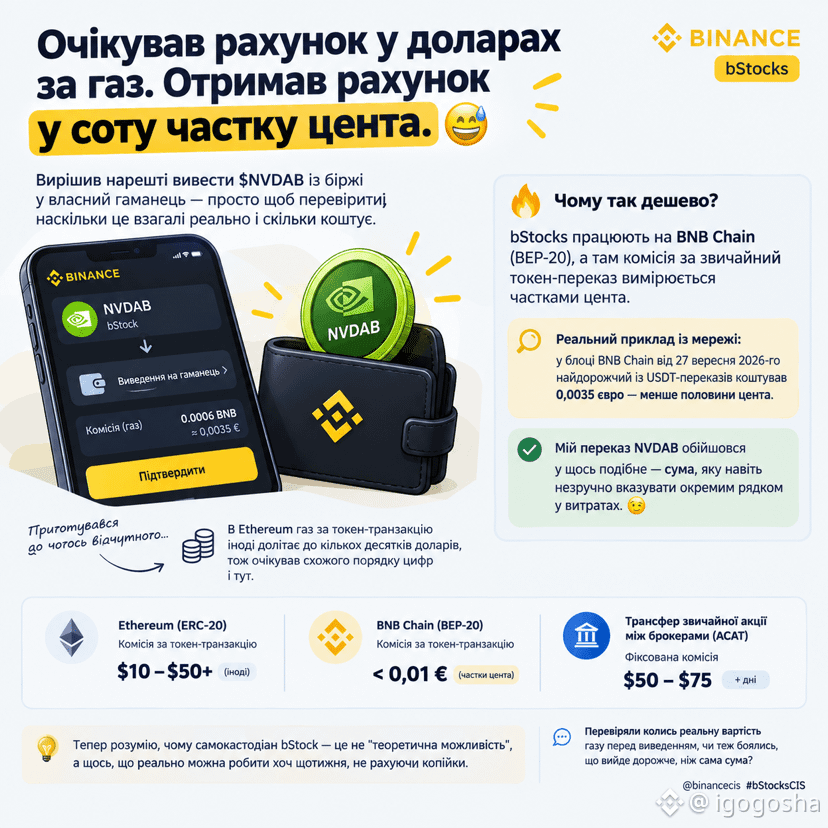
Очікував рахунок у доларах за газ. Отримав рахунок у соту частку цента. 😅
Вирішив нарешті спробувати вивести $NVDAB із біржі у власний гаманець — просто щоб перевірити, наскільки це взагалі реально і скільки коштує.
Приготувався до чогось відчутного: в Ethereum газ за токен-транзакцію іноді долітає до кількох десятків доларів, тож очікував схожого порядку цифр і тут.
Виявилось — ні. bStocks працюють на BNB Chain (BEP-20), а там комісія за звичайний токен-переказ вимірюється частками цента. Знайшов навіть реальний приклад: у блоці мережі від 27 вересня 2026-го найдорожчий із USDT-переказів коштував 0,0035 євро — менше половини цента.
Мій переказ NVDAB обійшовся в щось подібне: сума, яку навіть незручно вказувати окремим рядком у витратах.
Для порівняння — трансфер звичайної акції між брокерами (ACAT) часто коштує $50-75 фіксованої комісії й займає дні. Тут — секунди й фактично безкоштовно.
Тепер розумію, чому самокастодіан bStock — це не "теоретична можливість", а щось, що реально можна робити хоч щотижня, не рахуючи копійки.
Перевіряли колись реальну вартість газу перед виведенням, чи теж боялись, що вийде дорожче, ніж сама сума?
@BinanceCIS #bStocksCIS
{spot}(NVDABUSDT)
Текст посту
Очікував рахунок у доларах за газ. Отримав рахунок у соту частку цента. 😅
Вирішив нарешті спробувати вивести $NVDAB із біржі у власний гаманець — просто щоб перевірити, наскільки це взагалі реально і скільки коштує.
Приготувався до чогось відчутного: в Ethereum газ за токен-транзакцію іноді долітає до кількох десятків доларів, тож очікував схожого порядку цифр і тут.
Виявилось — ні. bStocks працюють на BNB Chain (BEP-20), а там комісія за звичайний токен-переказ вимірюється частками цента. Знайшов навіть реальний приклад: у блоці мережі від 27 вересня 2026-го найдорожчий із USDT-переказів коштував 0,0035 євро — менше половини цента.
Мій переказ NVDAB обійшовся в щось подібне: сума, яку навіть незручно вказувати окремим рядком у витратах.
Для порівняння — трансфер звичайної акції між брокерами (ACAT) часто коштує $50-75 фіксованої комісії й займає дні. Тут — секунди й фактично безкоштовно.
Тепер розумію, чому самокастодіан bStock — це не "теоретична можливість", а щось, що реально можна робити хоч щотижня, не рахуючи копійки.
Перевіряли колись реальну вартість газу перед виведенням, чи теж боялись, що вийде дорожче, ніж сама сума?
@BinanceCIS #bStocksCIS
Очікував рахунок у доларах за газ. Отримав рахунок у соту частку цента. 😅
Вирішив нарешті спробувати вивести $NVDAB із біржі у власний гаманець — просто щоб перевірити, наскільки це взагалі реально і скільки коштує.
Приготувався до чогось відчутного: в Ethereum газ за токен-транзакцію іноді долітає до кількох десятків доларів, тож очікував схожого порядку цифр і тут.
Виявилось — ні. bStocks працюють на BNB Chain (BEP-20), а там комісія за звичайний токен-переказ вимірюється частками цента. Знайшов навіть реальний приклад: у блоці мережі від 27 вересня 2026-го найдорожчий із USDT-переказів коштував 0,0035 євро — менше половини цента.
Мій переказ NVDAB обійшовся в щось подібне: сума, яку навіть незручно вказувати окремим рядком у витратах.
Для порівняння — трансфер звичайної акції між брокерами (ACAT) часто коштує $50-75 фіксованої комісії й займає дні. Тут — секунди й фактично безкоштовно.
Тепер розумію, чому самокастодіан bStock — це не "теоретична можливість", а щось, що реально можна робити хоч щотижня, не рахуючи копійки.
Перевіряли колись реальну вартість газу перед виведенням, чи теж боялись, що вийде дорожче, ніж сама сума?
@BinanceCIS #bStocksCIS
143

·
--
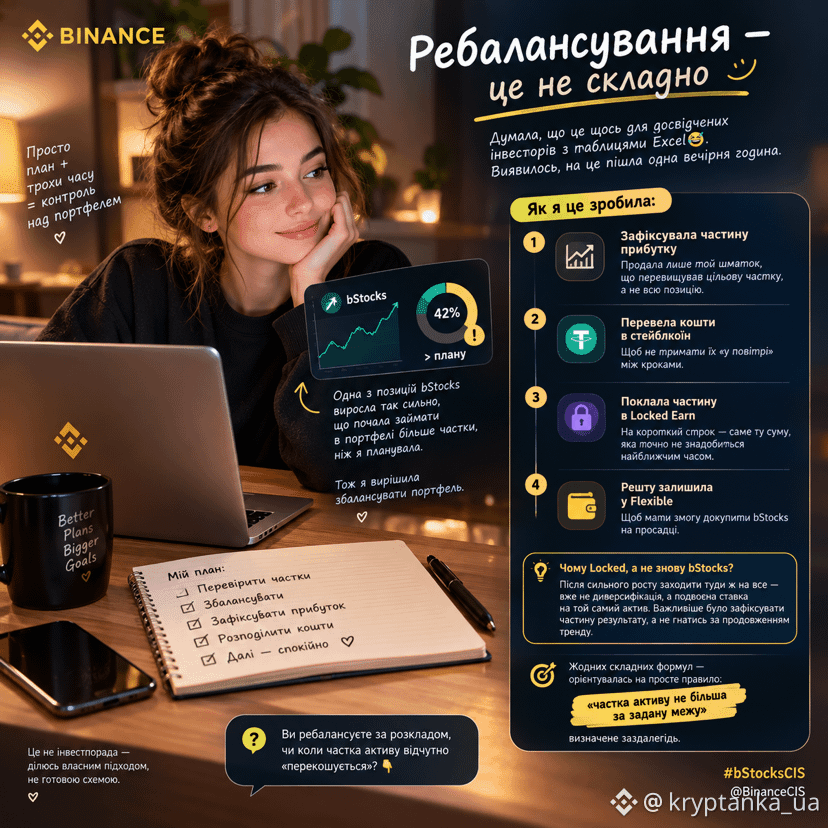
Думала, що ребалансування — це щось, чим займаються тільки досвідчені інвестори з таблицями Excel😅. Виявилось, на це пішла одна вечірня година.
Одна з позицій bStocks виросла настільки, що почала займати в портфелі більше частки, ніж я планувала спочатку — а це вже не «стратегія», а «як вийшло само».
Покроково:
— зафіксувала частину прибутку, продавши лише той шматок, що перевищував цільову частку, а не всю позицію;
— перевела кошти в стейблкоїн, щоб не тримати їх «у повітрі» між кроками;
— поклала частину в Locked Earn на короткий строк — саме суму, яка точно не знадобиться найближчим часом;
— решту залишила у Flexible, щоб мати змогу докупити bStocks на просадці.
Чому Locked, а не знову bStocks: після сильного росту заходити туди ж на все — вже не диверсифікація, а подвоєна ставка на той самий актив. Важливіше було зафіксувати частину, а не гнатись за продовженням тренду.
Чесно: жодних складних формул — орієнтувалась на просте правило «частка активу не більша за задану межу», визначене заздалегідь.
Це не інвестпорада — ділюсь власним підходом, не готовою схемою.
Ви ребалансуєте за розкладом, чи коли частка активу відчутно «перекошується»?👇
#bStocksCIS #Earnbianance
Думала, що ребалансування — це щось, чим займаються тільки досвідчені інвестори з таблицями Excel😅. Виявилось, на це пішла одна вечірня година.
Одна з позицій bStocks виросла настільки, що почала займати в портфелі більше частки, ніж я планувала спочатку — а це вже не «стратегія», а «як вийшло само».
Покроково:
— зафіксувала частину прибутку, продавши лише той шматок, що перевищував цільову частку, а не всю позицію;
— перевела кошти в стейблкоїн, щоб не тримати їх «у повітрі» між кроками;
— поклала частину в Locked Earn на короткий строк — саме суму, яка точно не знадобиться найближчим часом;
— решту залишила у Flexible, щоб мати змогу докупити bStocks на просадці.
Чому Locked, а не знову bStocks: після сильного росту заходити туди ж на все — вже не диверсифікація, а подвоєна ставка на той самий актив. Важливіше було зафіксувати частину, а не гнатись за продовженням тренду.
Чесно: жодних складних формул — орієнтувалась на просте правило «частка активу не більша за задану межу», визначене заздалегідь.
Це не інвестпорада — ділюсь власним підходом, не готовою схемою.
Ви ребалансуєте за розкладом, чи коли частка активу відчутно «перекошується»?👇
#bStocksCIS #Earnbianance
Одна з позицій bStocks виросла настільки, що почала займати в портфелі більше частки, ніж я планувала спочатку — а це вже не «стратегія», а «як вийшло само».
Покроково:
— зафіксувала частину прибутку, продавши лише той шматок, що перевищував цільову частку, а не всю позицію;
— перевела кошти в стейблкоїн, щоб не тримати їх «у повітрі» між кроками;
— поклала частину в Locked Earn на короткий строк — саме суму, яка точно не знадобиться найближчим часом;
— решту залишила у Flexible, щоб мати змогу докупити bStocks на просадці.
Чому Locked, а не знову bStocks: після сильного росту заходити туди ж на все — вже не диверсифікація, а подвоєна ставка на той самий актив. Важливіше було зафіксувати частину, а не гнатись за продовженням тренду.
Чесно: жодних складних формул — орієнтувалась на просте правило «частка активу не більша за задану межу», визначене заздалегідь.
Це не інвестпорада — ділюсь власним підходом, не готовою схемою.
Ви ребалансуєте за розкладом, чи коли частка активу відчутно «перекошується»?👇
#bStocksCIS #Earnbianance
1
135
bStocks тепер реально цікаво тестувати
Зараз Binance запустив нову кампанію Trade bStocks 24/7 — до 14 жовтня можна виконувати завдання та отримувати шанси на винагороди до 500 USDT у токен-ваучерах.
Але мене більше цікавить сам продукт.
bStocks можна торгувати 24/7, як криптоактивами, при цьому вони дають експозицію до американських акцій. Почати можна навіть із невеликої суми.
Для мене тут цікаве поєднання:
📈 Crypto — волатильність
🏦 bStocks — експозиція до TradFi
💰 Binance Earn — робота з вільними активами
Але є важливий нюанс: bStocks — це не пряме володіння акціями компанії. Це токенізовані цінні папери, які представляють інтерес до базового активу.
Тому перед покупкою я б дивився не тільки на тикер і ціну, а й на те, що саме я купую і яку роль цей актив має в моєму портфелі.
А ви вже користувалися bStocks?
1️⃣ Так, торгую
2️⃣ Пробував, але поки спостерігаю
3️⃣ Ще не заходив
@BinanceCIS
#bStocksCIS #Binance #TradFi #BinanceEarn
bStocks тепер реально цікаво тестувати
Зараз Binance запустив нову кампанію Trade bStocks 24/7 — до 14 жовтня можна виконувати завдання та отримувати шанси на винагороди до 500 USDT у токен-ваучерах.
Але мене більше цікавить сам продукт.
bStocks можна торгувати 24/7, як криптоактивами, при цьому вони дають експозицію до американських акцій. Почати можна навіть із невеликої суми.
Для мене тут цікаве поєднання:
📈 Crypto — волатильність
🏦 bStocks — експозиція до TradFi
💰 Binance Earn — робота з вільними активами
Але є важливий нюанс: bStocks — це не пряме володіння акціями компанії. Це токенізовані цінні папери, які представляють інтерес до базового активу.
Тому перед покупкою я б дивився не тільки на тикер і ціну, а й на те, що саме я купую і яку роль цей актив має в моєму портфелі.
А ви вже користувалися bStocks?
1️⃣ Так, торгую
2️⃣ Пробував, але поки спостерігаю
3️⃣ Ще не заходив
@BinanceCIS
#bStocksCIS #Binance #TradFi #BinanceEarn
Зараз Binance запустив нову кампанію Trade bStocks 24/7 — до 14 жовтня можна виконувати завдання та отримувати шанси на винагороди до 500 USDT у токен-ваучерах.
Але мене більше цікавить сам продукт.
bStocks можна торгувати 24/7, як криптоактивами, при цьому вони дають експозицію до американських акцій. Почати можна навіть із невеликої суми.
Для мене тут цікаве поєднання:
📈 Crypto — волатильність
🏦 bStocks — експозиція до TradFi
💰 Binance Earn — робота з вільними активами
Але є важливий нюанс: bStocks — це не пряме володіння акціями компанії. Це токенізовані цінні папери, які представляють інтерес до базового активу.
Тому перед покупкою я б дивився не тільки на тикер і ціну, а й на те, що саме я купую і яку роль цей актив має в моєму портфелі.
А ви вже користувалися bStocks?
1️⃣ Так, торгую
2️⃣ Пробував, але поки спостерігаю
3️⃣ Ще не заходив
@BinanceCIS
#bStocksCIS #Binance #TradFi #BinanceEarn
85
$SPCXB 149.09 +0.37% · 和纽股不是同一个钟
代币化美股跟现货盘不是同一个钟。时差、流动性、信息披露节奏,哪一个最容易让「看起来在涨」变成误读?结合 BinanceCIS · bStocks CreatorPad 写判断依据(学习向)。
时差和流动性,你觉得哪个更容易造成误读?
讨论向,不构成投资建议。
关注 $SPCXB
@BinanceCIS #bStocksCIS $SPCXB
$SPCXB 149.09 +0.37% · 和纽股不是同一个钟
代币化美股跟现货盘不是同一个钟。时差、流动性、信息披露节奏,哪一个最容易让「看起来在涨」变成误读?结合 BinanceCIS · bStocks CreatorPad 写判断依据(学习向)。
时差和流动性,你觉得哪个更容易造成误读?
讨论向,不构成投资建议。
关注 $SPCXB
@BinanceCIS #bStocksCIS $SPCXB
代币化美股跟现货盘不是同一个钟。时差、流动性、信息披露节奏,哪一个最容易让「看起来在涨」变成误读?结合 BinanceCIS · bStocks CreatorPad 写判断依据(学习向)。
时差和流动性,你觉得哪个更容易造成误读?
讨论向,不构成投资建议。
关注 $SPCXB
@BinanceCIS #bStocksCIS $SPCXB
90
·
--
🌐 Один із головних плюсів цифрових фінансів — доступ
Світові ринки завжди були цікавими, але доступ до них традиційно вимагав певної інфраструктури.
Токенізація намагається змінити саме цю частину фінансової системи.
bStocks цікавий мені як приклад поєднання традиційних фондових активів із блокчейн-інфраструктурою Binance.
При цьому технологічна зручність не скасовує необхідності аналізувати ризики.
Навпаки — чим простішим стає доступ, тим важливіше розуміти, що саме знаходиться за кнопкою Buy. 👀
#bStocksCIS @BinanceCIS $NVDAB
{spot}(NVDABUSDT)
🌐 Один із головних плюсів цифрових фінансів — доступ
Світові ринки завжди були цікавими, але доступ до них традиційно вимагав певної інфраструктури.
Токенізація намагається змінити саме цю частину фінансової системи.
bStocks цікавий мені як приклад поєднання традиційних фондових активів із блокчейн-інфраструктурою Binance.
При цьому технологічна зручність не скасовує необхідності аналізувати ризики.
Навпаки — чим простішим стає доступ, тим важливіше розуміти, що саме знаходиться за кнопкою Buy. 👀
#bStocksCIS @BinanceCIS $NVDAB
Світові ринки завжди були цікавими, але доступ до них традиційно вимагав певної інфраструктури.
Токенізація намагається змінити саме цю частину фінансової системи.
bStocks цікавий мені як приклад поєднання традиційних фондових активів із блокчейн-інфраструктурою Binance.
При цьому технологічна зручність не скасовує необхідності аналізувати ризики.
Навпаки — чим простішим стає доступ, тим важливіше розуміти, що саме знаходиться за кнопкою Buy. 👀
#bStocksCIS @BinanceCIS $NVDAB
84
·
--
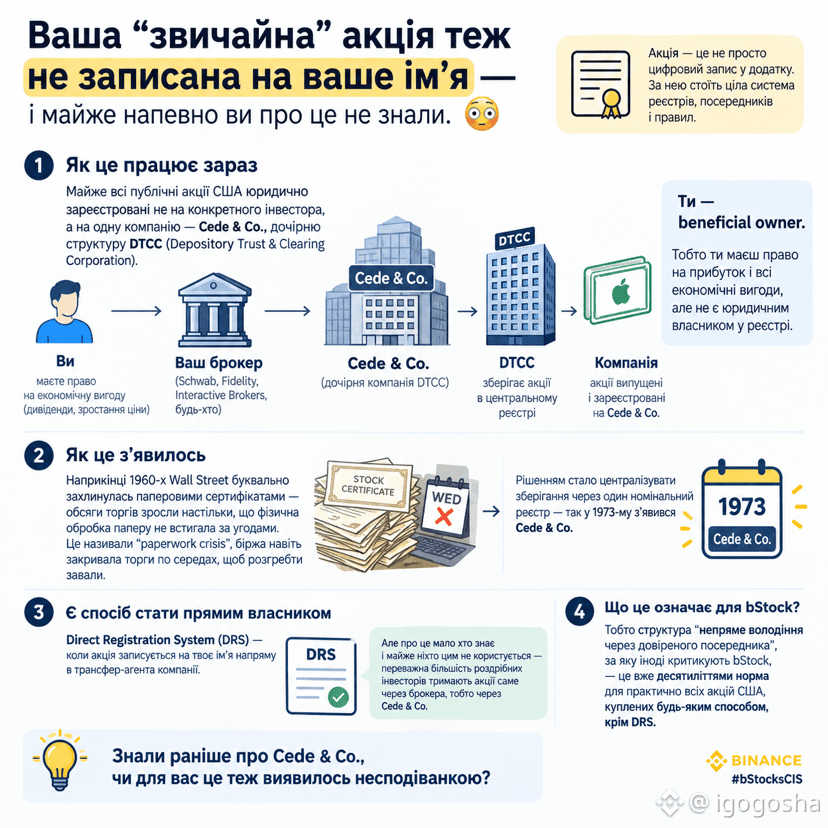
Ваша "звичайна" акція теж не записана на ваше ім'я — і майже напевно ви про це не знали. 😳
Писав раніше, що bStock — сертифікат, а не пряме володіння з правом голосу, і в коментарях часто чую: "от якби через нормального брокера, тримав би напряму". Перевірив — зовсім ні. Майже всі акції США юридично записані не на інвестора, а на одну компанію, Cede & Co. (дочірня структура DTCC). Купуєш через Schwab, Fidelity чи будь-кого — в реєстрі записаний не ти, а Cede & Co.; ти лише "beneficial owner" з правом на вигоду, але не власник у реєстрі.
Причина не випадкова: наприкінці 1960-х Wall Street захлинулась паперовими сертифікатами, і біржа навіть закривала торги по середах, щоб розгребти завали. Рішенням стало звести зберігання до одного реєстру — так у 1973-му з'явився Cede & Co.
Стати прямим власником можна через Direct Registration System (DRS) — акція записується на твоє ім'я в трансфер-агента напряму. Але про це мало хто знає: переважна більшість тримає акції через брокера, тобто через Cede & Co.
Тобто "непряме володіння через посередника", за яке критикують bStock, — уже десятиліттями норма для майже всіх акцій США, крім DRS.
Знали раніше про Cede & Co., чи для вас це теж виявилось несподіванкою?
@Binance_Ukraine #bStocksCIS
Ваша "звичайна" акція теж не записана на ваше ім'я — і майже напевно ви про це не знали. 😳
Писав раніше, що bStock — сертифікат, а не пряме володіння з правом голосу, і в коментарях часто чую: "от якби через нормального брокера, тримав би напряму". Перевірив — зовсім ні. Майже всі акції США юридично записані не на інвестора, а на одну компанію, Cede & Co. (дочірня структура DTCC). Купуєш через Schwab, Fidelity чи будь-кого — в реєстрі записаний не ти, а Cede & Co.; ти лише "beneficial owner" з правом на вигоду, але не власник у реєстрі.
Причина не випадкова: наприкінці 1960-х Wall Street захлинулась паперовими сертифікатами, і біржа навіть закривала торги по середах, щоб розгребти завали. Рішенням стало звести зберігання до одного реєстру — так у 1973-му з'явився Cede & Co.
Стати прямим власником можна через Direct Registration System (DRS) — акція записується на твоє ім'я в трансфер-агента напряму. Але про це мало хто знає: переважна більшість тримає акції через брокера, тобто через Cede & Co.
Тобто "непряме володіння через посередника", за яке критикують bStock, — уже десятиліттями норма для майже всіх акцій США, крім DRS.
Знали раніше про Cede & Co., чи для вас це теж виявилось несподіванкою?
@Binance_Ukraine #bStocksCIS
Писав раніше, що bStock — сертифікат, а не пряме володіння з правом голосу, і в коментарях часто чую: "от якби через нормального брокера, тримав би напряму". Перевірив — зовсім ні. Майже всі акції США юридично записані не на інвестора, а на одну компанію, Cede & Co. (дочірня структура DTCC). Купуєш через Schwab, Fidelity чи будь-кого — в реєстрі записаний не ти, а Cede & Co.; ти лише "beneficial owner" з правом на вигоду, але не власник у реєстрі.
Причина не випадкова: наприкінці 1960-х Wall Street захлинулась паперовими сертифікатами, і біржа навіть закривала торги по середах, щоб розгребти завали. Рішенням стало звести зберігання до одного реєстру — так у 1973-му з'явився Cede & Co.
Стати прямим власником можна через Direct Registration System (DRS) — акція записується на твоє ім'я в трансфер-агента напряму. Але про це мало хто знає: переважна більшість тримає акції через брокера, тобто через Cede & Co.
Тобто "непряме володіння через посередника", за яке критикують bStock, — уже десятиліттями норма для майже всіх акцій США, крім DRS.
Знали раніше про Cede & Co., чи для вас це теж виявилось несподіванкою?
@Binance_Ukraine #bStocksCIS
1
120
·
--
💭 Мені подобається підхід «спочатку мета — потім інструмент»
Часто все відбувається навпаки: людина знаходить цікавий продукт, а вже потім намагається придумати, навіщо він їй потрібен.
Я б робив навпаки.
Спочатку визначив би мету: збереження, довгострокове зростання, диверсифікація або робота з тимчасово вільними активами.
І лише після цього дивився б, які інструменти відповідають цій задачі.
Саме тому bStocks, Binance Earn та інші продукти я сприймаю не як взаємозамінні пропозиції, а як різні інструменти, які потрібно підбирати під конкретну роль.
🎯 Мета визначає інструмент, а не навпаки.
#bStocksCIS @BinanceCIS
💭 Мені подобається підхід «спочатку мета — потім інструмент»
Часто все відбувається навпаки: людина знаходить цікавий продукт, а вже потім намагається придумати, навіщо він їй потрібен.
Я б робив навпаки.
Спочатку визначив би мету: збереження, довгострокове зростання, диверсифікація або робота з тимчасово вільними активами.
І лише після цього дивився б, які інструменти відповідають цій задачі.
Саме тому bStocks, Binance Earn та інші продукти я сприймаю не як взаємозамінні пропозиції, а як різні інструменти, які потрібно підбирати під конкретну роль.
🎯 Мета визначає інструмент, а не навпаки.
#bStocksCIS @BinanceCIS
Часто все відбувається навпаки: людина знаходить цікавий продукт, а вже потім намагається придумати, навіщо він їй потрібен.
Я б робив навпаки.
Спочатку визначив би мету: збереження, довгострокове зростання, диверсифікація або робота з тимчасово вільними активами.
І лише після цього дивився б, які інструменти відповідають цій задачі.
Саме тому bStocks, Binance Earn та інші продукти я сприймаю не як взаємозамінні пропозиції, а як різні інструменти, які потрібно підбирати під конкретну роль.
🎯 Мета визначає інструмент, а не навпаки.
#bStocksCIS @BinanceCIS
80
·
--
TradFi проти цифрових активів
📊 Я не бачу необхідності вибирати тільки один фінансовий світ
Традиційні фінансові інструменти існують десятиліттями.
Цифрові активи з'явилися набагато пізніше.
Але сьогодні між цими сферами поступово виникають точки перетину.
Для мене цікавий саме цей процес.
TradFi дає величезний пласт традиційних фінансових інструментів та підходів.
А цифрова інфраструктура відкриває нові способи взаємодії з ними.
У такому контексті Binance BStock для мене цікавий не просто як окремий продукт.
Це приклад того, як традиційні активи можуть переходити у більш цифрове середовище.
🌐 Можливо, майбутнє фінансів буде не про перемогу одного підходу над іншим.
Можливо, найцікавіші рішення виникатимуть саме на їхньому перетині.
#bStocksCIS $TSMB
{spot}(TSMBUSDT)
@BinanceCIS
TradFi проти цифрових активів
📊 Я не бачу необхідності вибирати тільки один фінансовий світ
Традиційні фінансові інструменти існують десятиліттями.
Цифрові активи з'явилися набагато пізніше.
Але сьогодні між цими сферами поступово виникають точки перетину.
Для мене цікавий саме цей процес.
TradFi дає величезний пласт традиційних фінансових інструментів та підходів.
А цифрова інфраструктура відкриває нові способи взаємодії з ними.
У такому контексті Binance BStock для мене цікавий не просто як окремий продукт.
Це приклад того, як традиційні активи можуть переходити у більш цифрове середовище.
🌐 Можливо, майбутнє фінансів буде не про перемогу одного підходу над іншим.
Можливо, найцікавіші рішення виникатимуть саме на їхньому перетині.
#bStocksCIS $TSMB
@BinanceCIS
📊 Я не бачу необхідності вибирати тільки один фінансовий світ
Традиційні фінансові інструменти існують десятиліттями.
Цифрові активи з'явилися набагато пізніше.
Але сьогодні між цими сферами поступово виникають точки перетину.
Для мене цікавий саме цей процес.
TradFi дає величезний пласт традиційних фінансових інструментів та підходів.
А цифрова інфраструктура відкриває нові способи взаємодії з ними.
У такому контексті Binance BStock для мене цікавий не просто як окремий продукт.
Це приклад того, як традиційні активи можуть переходити у більш цифрове середовище.
🌐 Можливо, майбутнє фінансів буде не про перемогу одного підходу над іншим.
Можливо, найцікавіші рішення виникатимуть саме на їхньому перетині.
#bStocksCIS $TSMB
@BinanceCIS
89
$SPCXB 148.62 +0.18% · 是可交易的合规包装,不是暴富标的
只深挖一条:$SPCXB 讨论的是「可交易的合规包装」,不是一夜暴富故事。主题:代币化美股 / bStocks。
你更关心合规路径还是交易体验?
关注 $SPCXB
@BinanceCIS #bStocksCIS $SPCXB
$SPCXB 148.62 +0.18% · 是可交易的合规包装,不是暴富标的
只深挖一条:$SPCXB 讨论的是「可交易的合规包装」,不是一夜暴富故事。主题:代币化美股 / bStocks。
你更关心合规路径还是交易体验?
关注 $SPCXB
@BinanceCIS #bStocksCIS $SPCXB
只深挖一条:$SPCXB 讨论的是「可交易的合规包装」,不是一夜暴富故事。主题:代币化美股 / bStocks。
你更关心合规路径还是交易体验?
关注 $SPCXB
@BinanceCIS #bStocksCIS $SPCXB
123
·
--
🔥 Коли ринок росте, легко забути про ризик
На зростаючому ринку майже кожна ідея здається геніальною.
Але саме в такі моменти я б особливо уважно дивився на те, яку частину портфеля займає конкретний актив.
Навіть якісний продукт може бути недоречним у занадто великій концентрації.
Тому якщо розглядати bStocks як частину стратегії, для мене важливе питання не тільки «що купити?», а й «яку роль і яку частку це має займати?».
Розмір позиції іноді не менш важливий, ніж сам вибір активу. 📊
#bStocksCIS @BinanceCIS
🔥 Коли ринок росте, легко забути про ризик
На зростаючому ринку майже кожна ідея здається геніальною.
Але саме в такі моменти я б особливо уважно дивився на те, яку частину портфеля займає конкретний актив.
Навіть якісний продукт може бути недоречним у занадто великій концентрації.
Тому якщо розглядати bStocks як частину стратегії, для мене важливе питання не тільки «що купити?», а й «яку роль і яку частку це має займати?».
Розмір позиції іноді не менш важливий, ніж сам вибір активу. 📊
#bStocksCIS @BinanceCIS
На зростаючому ринку майже кожна ідея здається геніальною.
Але саме в такі моменти я б особливо уважно дивився на те, яку частину портфеля займає конкретний актив.
Навіть якісний продукт може бути недоречним у занадто великій концентрації.
Тому якщо розглядати bStocks як частину стратегії, для мене важливе питання не тільки «що купити?», а й «яку роль і яку частку це має займати?».
Розмір позиції іноді не менш важливий, ніж сам вибір активу. 📊
#bStocksCIS @BinanceCIS
1
600
📱 Цікаво, наскільки сильно змінився доступ до фінансових ринків
Ще не так давно для багатьох людей вихід на глобальні фондові активи асоціювався з брокером, окремим рахунком і досить складною інфраструктурою.
Зараз фінансові продукти поступово переходять у цифровий формат.
bStocks — приклад того, як традиційні фондові активи можуть бути представлені через блокчейн-інфраструктуру.
Для мене тут найцікавіше не саме слово «токенізація», а те, як технології змінюють звичний спосіб доступу до фінансових інструментів. 🌐
При цьому механіку конкретного продукту та його ризики все одно потрібно розуміти до прийняття рішення.
#bStocksCIS @BinanceCIS $AMZNB
📱 Цікаво, наскільки сильно змінився доступ до фінансових ринків
Ще не так давно для багатьох людей вихід на глобальні фондові активи асоціювався з брокером, окремим рахунком і досить складною інфраструктурою.
Зараз фінансові продукти поступово переходять у цифровий формат.
bStocks — приклад того, як традиційні фондові активи можуть бути представлені через блокчейн-інфраструктуру.
Для мене тут найцікавіше не саме слово «токенізація», а те, як технології змінюють звичний спосіб доступу до фінансових інструментів. 🌐
При цьому механіку конкретного продукту та його ризики все одно потрібно розуміти до прийняття рішення.
#bStocksCIS @BinanceCIS $AMZNB
Ще не так давно для багатьох людей вихід на глобальні фондові активи асоціювався з брокером, окремим рахунком і досить складною інфраструктурою.
Зараз фінансові продукти поступово переходять у цифровий формат.
bStocks — приклад того, як традиційні фондові активи можуть бути представлені через блокчейн-інфраструктуру.
Для мене тут найцікавіше не саме слово «токенізація», а те, як технології змінюють звичний спосіб доступу до фінансових інструментів. 🌐
При цьому механіку конкретного продукту та його ризики все одно потрібно розуміти до прийняття рішення.
#bStocksCIS @BinanceCIS $AMZNB
119
Connectez-vous pour découvrir plus de contenu
Rejoignez la communauté mondiale des adeptes de cryptomonnaies sur Binance Square
⚡️ Suviez les dernières informations importantes sur les cryptomonnaies.
💬 Jugé digne de confiance par la plus grande plateforme d’échange de cryptomonnaies au monde.
👍 Découvrez les connaissances que partagent les créateurs vérifiés.
Adresse e-mail/Nº de téléphone
Sujets d’actualité
1
#EtherGains70.9%InQ3
94,796 vues
908 mentions
2
#TreasuryLetsStatesFileStablecoinCertificationsEarly
4,967 vues
54 mentions
3
#US10YearYieldNears5.3%
119,294 vues
969 mentions
4
#DollarIndexHitsHighestSinceMay2025
25,225 vues
511 mentions
5
#USWeeklyJoblessClaimsFallTo197000
25,428 vues
426 mentions
6
#BitcoinETFsTake$6.34BillionInQ3
7,830 vues
63 mentions
7
#KoreaProposesTokenizingStocksAndBonds
61,040 vues
774 mentions
8
#MetaMaskExitsLidoValidatorsAfterSecurityIncident
157,503 vues
1,490 mentions
9
#MicronBeatsEarningsLiftsGuidance
79,015 vues
1,081 mentions
10
#CFTCSubmitsTwoEventContractRulesToWhiteHouse
54,050 vues
810 mentions