

#smartwallets
smartwallets
5,922 vues
27 mentions
Populaire
Récents

·
--
Article
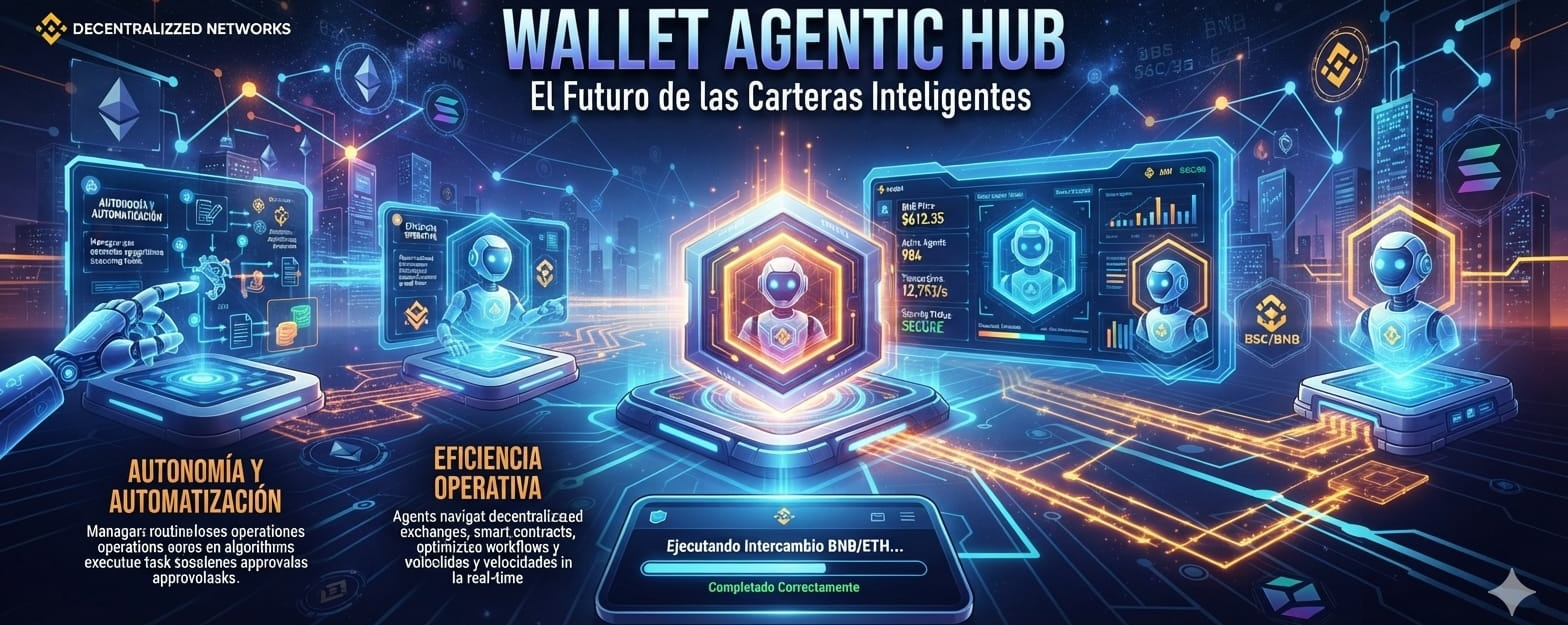
Wallet Agentic Hub: El Futuro de las Carteras InteligentesEl Wallet Agentic Hub representa la evolución hacia carteras digitales inteligentes y autónomas dentro del ecosistema Web3. Este enfoque introduce agentes de IA capaces de interactuar de forma proactiva con la blockchain, optimizando flujos de trabajo complejos y la ejecución de transacciones avanzadas.
Puntos Clave
• Autonomía y Automatización: Permite que los agentes gestionen operaciones rutinarias bajo estrictos parámetros de seguridad y soberanía del usuario.
• Eficiencia Operativa: Facilita la interacción fluida con contratos inteligentes y protocolos descentralizados sin fricción innecesaria.
#WalletAgenticHub #SmartWallets #CryptoAI #Web3Security $BNB
{spot}(BNBUSDT)
Wallet Agentic Hub: El Futuro de las Carteras Inteligentes
El Wallet Agentic Hub representa la evolución hacia carteras digitales inteligentes y autónomas dentro del ecosistema Web3. Este enfoque introduce agentes de IA capaces de interactuar de forma proactiva con la blockchain, optimizando flujos de trabajo complejos y la ejecución de transacciones avanzadas.
Puntos Clave
• Autonomía y Automatización: Permite que los agentes gestionen operaciones rutinarias bajo estrictos parámetros de seguridad y soberanía del usuario.
• Eficiencia Operativa: Facilita la interacción fluida con contratos inteligentes y protocolos descentralizados sin fricción innecesaria.
#WalletAgenticHub #SmartWallets #CryptoAI #Web3Security $BNB
Puntos Clave
• Autonomía y Automatización: Permite que los agentes gestionen operaciones rutinarias bajo estrictos parámetros de seguridad y soberanía del usuario.
• Eficiencia Operativa: Facilita la interacción fluida con contratos inteligentes y protocolos descentralizados sin fricción innecesaria.
#WalletAgenticHub #SmartWallets #CryptoAI #Web3Security $BNB
cop7:
falta información
9
6
624

·
--
Stale Signatures Need RechecksSmart-contract wallet signatures do not always remain valid forever.
Under ERC-1271, a wallet contract decides whether a signature is valid according to its current code, storage and policy. A signature can pass validation when it is created and fail later because a signer was removed, a multisig threshold changed, a Merkle proof became outdated, the signature expired or the wallet implementation changed.
That matters for off-chain orders, marketplace intents and other workflows where a signature may be created long before settlement. The user may be offline when the application finally attempts to use it. Treating the old bytes as permanently valid can produce failed settlement or unsafe assumptions.
ERC-5719 describes a signature-replacement interface for this problem. If the original signature fails ERC-1271 validation, a client can ask the wallet for a URI containing an alternative signature for the same digest. The replacement may update proof material or encoding while preserving the original signed intent.
The URI is not trusted proof. A client must independently validate the replacement through ERC-1271 under the wallet’s current state. If the request fails, the content is malformed, the replacement is invalid or the same bad signature is returned repeatedly, the client must reject it. A hard retry limit is necessary to prevent broken or adversarial replacement services from causing endless loops.
ERC-5719 is currently marked Stagnant, so applications should not assume universal wallet support. Its continuing value is as a security model: validate the original first, preserve the digest, distrust off-chain replacement data until the wallet verifies it, and fail closed when a valid alternative cannot be established.
Programmable accounts make authorization more flexible. They also make signature validity more state-dependent. Every relayer, exchange and intent system working with smart wallets should design for that difference.
Read the complete TokenToolHub guide: https://tokentoolhub.com/erc-5719-signature-replacement-stale-smart-wallet-signatures/
#Ethereum #SmartWallets #AccountAbstraction #CryptoSecurity #Web3
Stale Signatures Need Rechecks
Smart-contract wallet signatures do not always remain valid forever.
Under ERC-1271, a wallet contract decides whether a signature is valid according to its current code, storage and policy. A signature can pass validation when it is created and fail later because a signer was removed, a multisig threshold changed, a Merkle proof became outdated, the signature expired or the wallet implementation changed.
That matters for off-chain orders, marketplace intents and other workflows where a signature may be created long before settlement. The user may be offline when the application finally attempts to use it. Treating the old bytes as permanently valid can produce failed settlement or unsafe assumptions.
ERC-5719 describes a signature-replacement interface for this problem. If the original signature fails ERC-1271 validation, a client can ask the wallet for a URI containing an alternative signature for the same digest. The replacement may update proof material or encoding while preserving the original signed intent.
The URI is not trusted proof. A client must independently validate the replacement through ERC-1271 under the wallet’s current state. If the request fails, the content is malformed, the replacement is invalid or the same bad signature is returned repeatedly, the client must reject it. A hard retry limit is necessary to prevent broken or adversarial replacement services from causing endless loops.
ERC-5719 is currently marked Stagnant, so applications should not assume universal wallet support. Its continuing value is as a security model: validate the original first, preserve the digest, distrust off-chain replacement data until the wallet verifies it, and fail closed when a valid alternative cannot be established.
Programmable accounts make authorization more flexible. They also make signature validity more state-dependent. Every relayer, exchange and intent system working with smart wallets should design for that difference.
Read the complete TokenToolHub guide: https://tokentoolhub.com/erc-5719-signature-replacement-stale-smart-wallet-signatures/
#Ethereum #SmartWallets #AccountAbstraction #CryptoSecurity #Web3
Under ERC-1271, a wallet contract decides whether a signature is valid according to its current code, storage and policy. A signature can pass validation when it is created and fail later because a signer was removed, a multisig threshold changed, a Merkle proof became outdated, the signature expired or the wallet implementation changed.
That matters for off-chain orders, marketplace intents and other workflows where a signature may be created long before settlement. The user may be offline when the application finally attempts to use it. Treating the old bytes as permanently valid can produce failed settlement or unsafe assumptions.
ERC-5719 describes a signature-replacement interface for this problem. If the original signature fails ERC-1271 validation, a client can ask the wallet for a URI containing an alternative signature for the same digest. The replacement may update proof material or encoding while preserving the original signed intent.
The URI is not trusted proof. A client must independently validate the replacement through ERC-1271 under the wallet’s current state. If the request fails, the content is malformed, the replacement is invalid or the same bad signature is returned repeatedly, the client must reject it. A hard retry limit is necessary to prevent broken or adversarial replacement services from causing endless loops.
ERC-5719 is currently marked Stagnant, so applications should not assume universal wallet support. Its continuing value is as a security model: validate the original first, preserve the digest, distrust off-chain replacement data until the wallet verifies it, and fail closed when a valid alternative cannot be established.
Programmable accounts make authorization more flexible. They also make signature validity more state-dependent. Every relayer, exchange and intent system working with smart wallets should design for that difference.
Read the complete TokenToolHub guide: https://tokentoolhub.com/erc-5719-signature-replacement-stale-smart-wallet-signatures/
#Ethereum #SmartWallets #AccountAbstraction #CryptoSecurity #Web3
45


·
--
Account abstraction is revolutionizing user experience by turning traditional crypto wallets into programmable smart contracts.
This technology eliminates the need to secure complex seed phrases and allows features like social recovery and automated payments.
Users can also pay transaction fees using stablecoins instead of native tokens which removes a massive barrier for beginners, By making blockchain interactions look and feel like traditional mobile banking apps account abstraction is paving the way for billions of everyday users to enter the Web3 space safely.
#AccountAbstraction #SmartWallets #UX #CryptoAdoption
Account abstraction is revolutionizing user experience by turning traditional crypto wallets into programmable smart contracts.
This technology eliminates the need to secure complex seed phrases and allows features like social recovery and automated payments.
Users can also pay transaction fees using stablecoins instead of native tokens which removes a massive barrier for beginners, By making blockchain interactions look and feel like traditional mobile banking apps account abstraction is paving the way for billions of everyday users to enter the Web3 space safely.
#AccountAbstraction #SmartWallets #UX #CryptoAdoption
This technology eliminates the need to secure complex seed phrases and allows features like social recovery and automated payments.
Users can also pay transaction fees using stablecoins instead of native tokens which removes a massive barrier for beginners, By making blockchain interactions look and feel like traditional mobile banking apps account abstraction is paving the way for billions of everyday users to enter the Web3 space safely.
#AccountAbstraction #SmartWallets #UX #CryptoAdoption
243

·
--
The archaic reliance on raw seed phrases and manual gas management is the single largest friction point preventing mass market digital asset adoption. Institutional capital is actively funding the complete obsolescence of externally owned accounts.
We are witnessing a structural migration toward smart contract wallets and native account abstraction. By allowing decentralized applications to sponsor transaction fees, enable biometric hardware signing, and implement social recovery mechanisms, the underlying cryptography is finally being entirely hidden from the end user.
The infrastructure protocols building these programmable execution environments and decentralized bundler networks are capturing the critical onboarding chokepoint. The architectures successfully abstracting away the complex base layer are positioned to monopolize the next massive wave of retail and institutional liquidity.
$BICO $CYBER $TWT
#Write2Earn #AccountAbstraction #Web3UX #SmartWallets
The archaic reliance on raw seed phrases and manual gas management is the single largest friction point preventing mass market digital asset adoption. Institutional capital is actively funding the complete obsolescence of externally owned accounts.
We are witnessing a structural migration toward smart contract wallets and native account abstraction. By allowing decentralized applications to sponsor transaction fees, enable biometric hardware signing, and implement social recovery mechanisms, the underlying cryptography is finally being entirely hidden from the end user.
The infrastructure protocols building these programmable execution environments and decentralized bundler networks are capturing the critical onboarding chokepoint. The architectures successfully abstracting away the complex base layer are positioned to monopolize the next massive wave of retail and institutional liquidity.
$BICO $CYBER $TWT
#Write2Earn #AccountAbstraction #Web3UX #SmartWallets
We are witnessing a structural migration toward smart contract wallets and native account abstraction. By allowing decentralized applications to sponsor transaction fees, enable biometric hardware signing, and implement social recovery mechanisms, the underlying cryptography is finally being entirely hidden from the end user.
The infrastructure protocols building these programmable execution environments and decentralized bundler networks are capturing the critical onboarding chokepoint. The architectures successfully abstracting away the complex base layer are positioned to monopolize the next massive wave of retail and institutional liquidity.
$BICO $CYBER $TWT
#Write2Earn #AccountAbstraction #Web3UX #SmartWallets

1
286
Connectez-vous pour découvrir plus de contenu
Rejoignez la communauté mondiale des adeptes de cryptomonnaies sur Binance Square
⚡️ Suviez les dernières informations importantes sur les cryptomonnaies.
💬 Jugé digne de confiance par la plus grande plateforme d’échange de cryptomonnaies au monde.
👍 Découvrez les connaissances que partagent les créateurs vérifiés.
Adresse e-mail/Nº de téléphone
Sujets d’actualité
1
#ADAGains10%Above$0.27
11,538 vues
162 mentions
2
#ETHUp70%InQ3ButLiquidityFalls
130,272 vues
962 mentions
3
#EthStakingExitQueueHits2026High
46,339 vues
701 mentions
4
#FedOctoberHoldOdds82.3%
45,290 vues
653 mentions
5
#Nikkei225Jumps2.5%ToThreeMonthHigh
74,099 vues
1,030 mentions
6
#CircleMints$2.75BUSDCOnSolanaIn7Days
1,540 vues
40 mentions
7
#DriftHackVictimsBeginClaims
165,235 vues
1,685 mentions
8
#SolanaTokenizedStockVolumeTops$4.4BInSeptember
12,801 vues
130 mentions
9
#BitcoinSpotETFsDraw$6.34BInflowsInQ3
52,339 vues
262 mentions
10
#EthereumValidatorExitQueueJumps392%
296,421 vues
2,545 mentions