

#signdigitalsovereigninfra
signdigitalsovereigninfra
12.2M vues
97,300 mentions
Populaire
Récents

·
--
#openledger $OPEN Focus on Sovereign Infrastructure
Empowering regions with robust decentralized architecture is the next massive frontier for Web3. By building foundational digital sovereign infrastructure, @SignOfficial is positioning itself perfectly to drive real-world economic growth and scale utility. Looking forward to seeing the long-term impact of $SIGN across emerging markets. #SignDigitalSovereignInfra
#openledger $OPEN Focus on Sovereign Infrastructure
Empowering regions with robust decentralized architecture is the next massive frontier for Web3. By building foundational digital sovereign infrastructure, @SignOfficial is positioning itself perfectly to drive real-world economic growth and scale utility. Looking forward to seeing the long-term impact of $SIGN across emerging markets. #SignDigitalSovereignInfra
Empowering regions with robust decentralized architecture is the next massive frontier for Web3. By building foundational digital sovereign infrastructure, @SignOfficial is positioning itself perfectly to drive real-world economic growth and scale utility. Looking forward to seeing the long-term impact of $SIGN across emerging markets. #SignDigitalSovereignInfra
277

·
--
Haussier
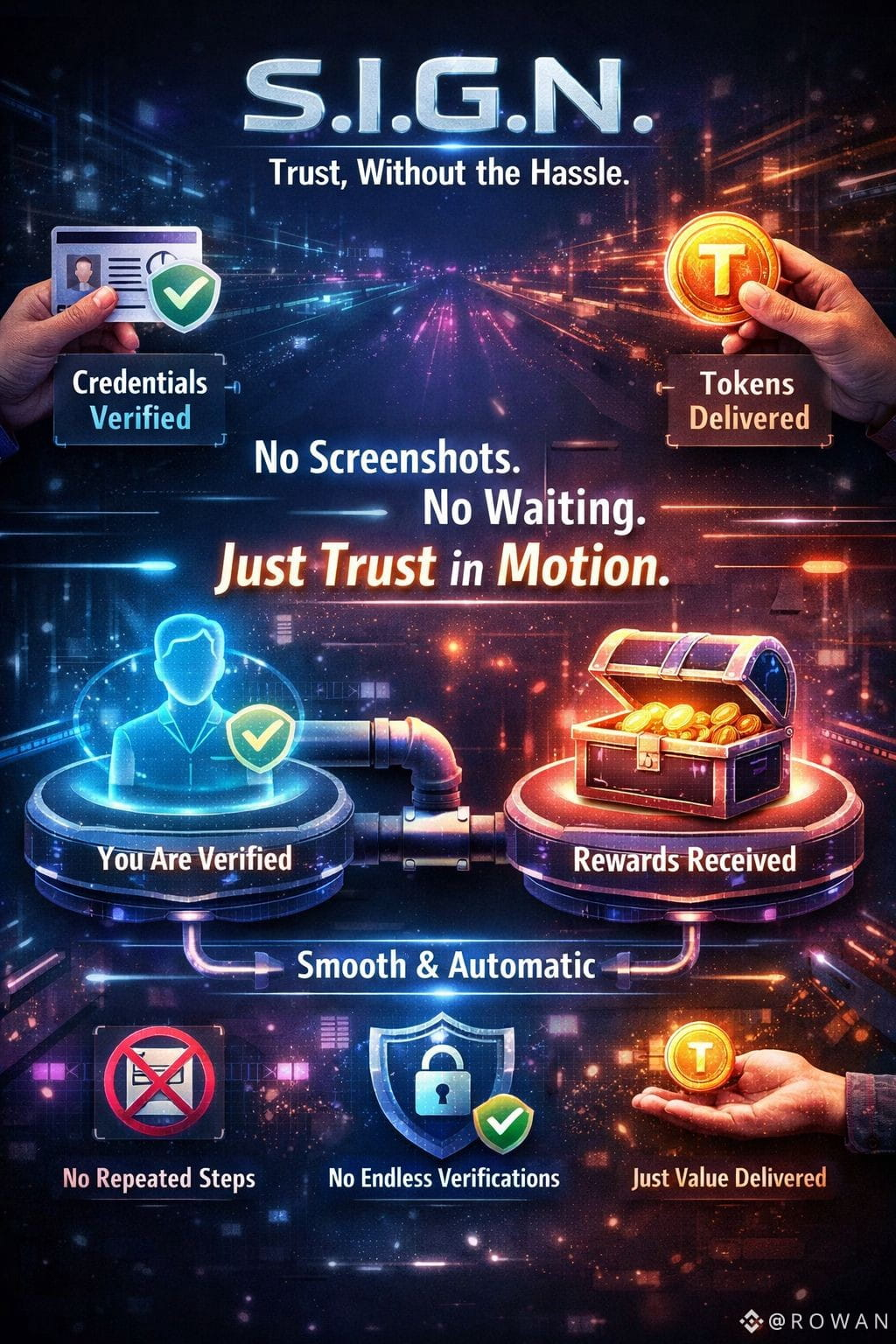
S.I.G.N. is one of those projects I didn’t fully get at first. Like… okay, credentials, tokens—cool. But then you sit with it a bit, and it starts to click in a different way. It’s not really about either of those things on their own. It’s about how they connect—how trust moves without you having to constantly prove yourself again and again.
And that’s the part that got me thinking. Why do we keep repeating the same steps everywhere? Upload this, verify that, wait again. It’s kind of messy when you think about it. S.I.G.N. feels like it’s trying to clean that up, but not in a loud way. More like… it just gets it. You are who you are, you’ve already proven it—so why not let things flow from there?
I don’t know, maybe I’m overthinking it. But there’s something about the idea of things just… working, quietly in the background, that sticks with me. No friction, no extra noise. And once you notice that kind of simplicity, it’s hard not to wonder why everything else still feels so complicated.
#SignDigitalSovereignInfra @SignOfficial $SIGN
S.I.G.N. is one of those projects I didn’t fully get at first. Like… okay, credentials, tokens—cool. But then you sit with it a bit, and it starts to click in a different way. It’s not really about either of those things on their own. It’s about how they connect—how trust moves without you having to constantly prove yourself again and again.
And that’s the part that got me thinking. Why do we keep repeating the same steps everywhere? Upload this, verify that, wait again. It’s kind of messy when you think about it. S.I.G.N. feels like it’s trying to clean that up, but not in a loud way. More like… it just gets it. You are who you are, you’ve already proven it—so why not let things flow from there?
I don’t know, maybe I’m overthinking it. But there’s something about the idea of things just… working, quietly in the background, that sticks with me. No friction, no extra noise. And once you notice that kind of simplicity, it’s hard not to wonder why everything else still feels so complicated.
#SignDigitalSovereignInfra @SignOfficial $SIGN
And that’s the part that got me thinking. Why do we keep repeating the same steps everywhere? Upload this, verify that, wait again. It’s kind of messy when you think about it. S.I.G.N. feels like it’s trying to clean that up, but not in a loud way. More like… it just gets it. You are who you are, you’ve already proven it—so why not let things flow from there?
I don’t know, maybe I’m overthinking it. But there’s something about the idea of things just… working, quietly in the background, that sticks with me. No friction, no extra noise. And once you notice that kind of simplicity, it’s hard not to wonder why everything else still feels so complicated.
#SignDigitalSovereignInfra @SignOfficial $SIGN
3
12
79

·
--
#signdigitalsovereigninfra $SIGN Most people are chasing hype, but very few actually understand infrastructure plays.
After checking updates from @SignOfficial , it’s clear that $SIGN is not just another short-term token — it’s building toward Digital Sovereign Infrastructure, a narrative that could scale with real adoption.
In markets like this, attention shifts fast. The projects that survive are the ones solving long-term problems, not just pumping short-term charts.
$SIGN still feels early. The question is not “how fast it pumps”, but whether this narrative catches mass attention.
Worth watching closely.
#signdigitalsovereigninfra $SIGN Most people are chasing hype, but very few actually understand infrastructure plays.
After checking updates from @SignOfficial , it’s clear that $SIGN is not just another short-term token — it’s building toward Digital Sovereign Infrastructure, a narrative that could scale with real adoption.
In markets like this, attention shifts fast. The projects that survive are the ones solving long-term problems, not just pumping short-term charts.
$SIGN still feels early. The question is not “how fast it pumps”, but whether this narrative catches mass attention.
Worth watching closely.
After checking updates from @SignOfficial , it’s clear that $SIGN is not just another short-term token — it’s building toward Digital Sovereign Infrastructure, a narrative that could scale with real adoption.
In markets like this, attention shifts fast. The projects that survive are the ones solving long-term problems, not just pumping short-term charts.
$SIGN still feels early. The question is not “how fast it pumps”, but whether this narrative catches mass attention.
Worth watching closely.
1
50

·
--
Article
SIGN: Scaling Systems Without Losing ControlI’ve spent years building large scale systems.
And here’s the reality, scaling isn’t the hard part anymore.
Keeping control while you scale?
That’s where everything breaks.
We’ve seen what happens when systems grow faster than their foundations.
One team builds payments.
Another builds identity.
A third handles compliance.
Individually, everything works. Together?
Chaos.
Data doesn’t line up. Logs don’t match. And when something goes wrong, everyone’s pointing at each other’s system trying to figure out where the truth actually lives.
The hard part isn’t processing millions of transactions.
It’s being able to answer a simple question:
“What exactly happened here?”
In real time.
And six months later.
That’s the lens I look at @SignOfficial through.
Not as a feature set. Not as a framework.
As a way to prevent the kind of system failure you only notice when it’s already too late.
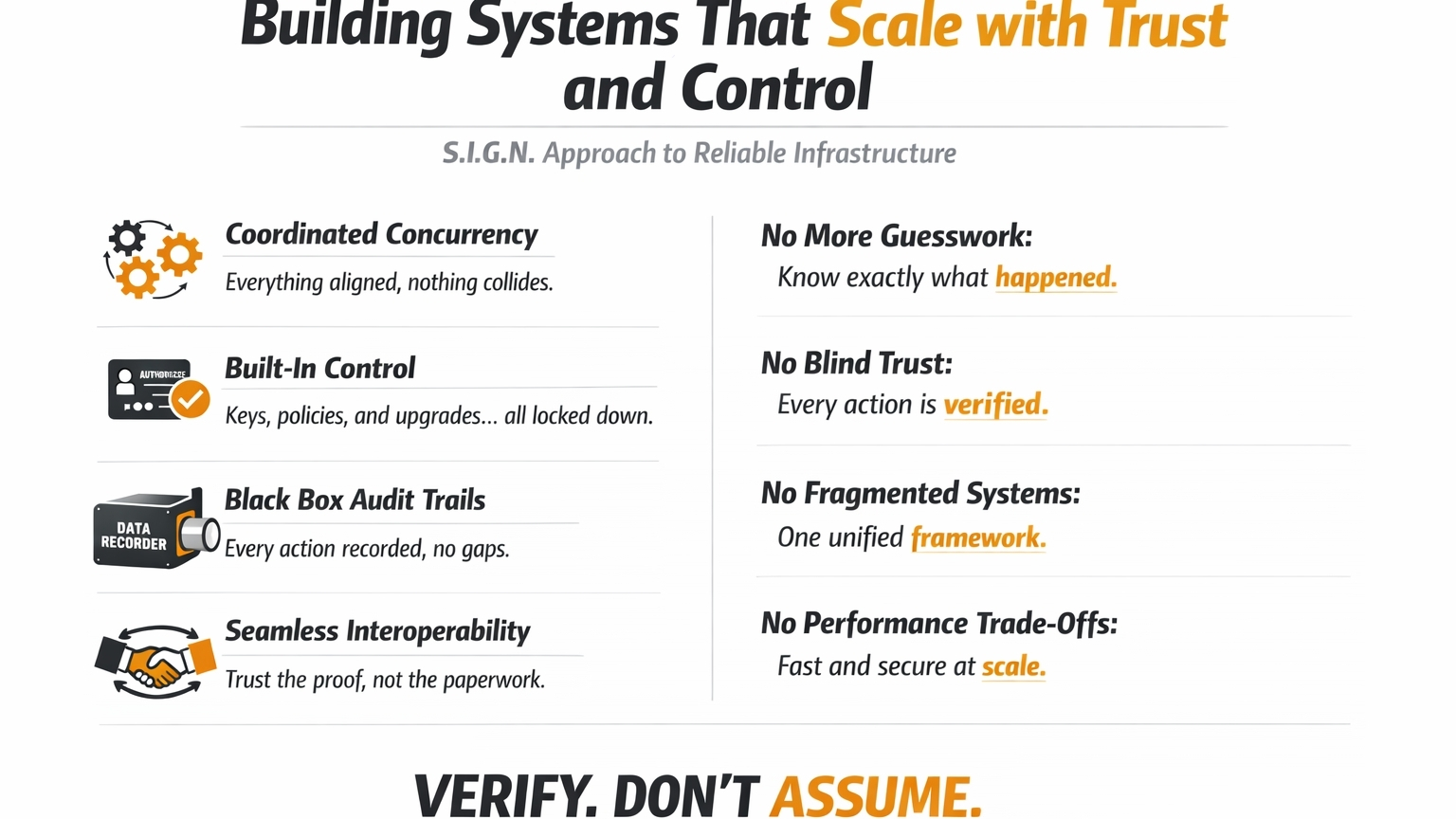
Take concurrency.
Everyone talks about it like it’s a performance problem. It’s not.
It’s a coordination problem.
When you have thousands or millions of actions happening at once across different agencies or services, things don’t just “run in parallel.” They collide.
Race conditions. Conflicting states. Inconsistent records.
I’ve seen systems where two departments process the same request differently at the same time and now you’ve got two versions of reality.
SIGN forces alignment by tying everything back to a shared structure: execution, identity, and evidence.
So even if things happen simultaneously, they don’t contradict each other.
Now let’s talk about control.
Because this is where most systems quietly fail.
In theory, you have governance. Policies. Access controls.
In practice?
Someone has a key they shouldn’t.
An upgrade gets pushed without full visibility.
An emergency patch breaks something downstream.
And suddenly you’re not in control you’re reacting.
SIGN builds control into the architecture itself.
Not as a dashboard. Not as a permission layer duct-taped on later.
But as something enforced at the system level where every change, every override, every intervention is tracked and provable.
Auditability is another one that sounds good on paper.
Until you’ve actually had to run an audit.
Then it becomes a nightmare.
You’re digging through logs from five different systems. Half the data is missing. The other half doesn’t match. And everyone’s scrambling to reconstruct a timeline after the fact.
It’s like trying to investigate a plane crash without a black box.
SIGN flips that completely.
Every action produces its own record automatically. Not logs you hope are there. Actual evidence.
So instead of rebuilding history, you just read it.
Interoperability is usually sold as “systems working together.”
But what it really means in the real world is:
“Can I trust your data without calling you?”
Because that’s what slows everything down.
APIs exist. Integrations exist. But trust doesn’t.
SIGN solves that by standardizing how proof is created and verified.
So different systems don’t need to trust each other directly they trust the evidence.
And then there’s performance.
Because none of this matters if the system can’t handle load.
The tricky part is that most systems optimize for speed first… and integrity later.
That’s backwards.
If your system is fast but unreliable, you’re just scaling problems faster.
SIGN is built to handle both high throughput without losing the integrity of records underneath.
At the end of the day, this isn’t about adding more features.
It’s about removing uncertainty.
Because the moment you rely on “trust us” in a system operating at national or institutional scale, you’ve already lost.
What you need are systems where:
You don’t guess.
You don’t assume.
You don’t reconstruct.
You verify.
That’s the shift SIGN is making.
And if you’ve ever had to debug a distributed system at scale or sit through a failed audit you already know why that matters.
#SignDigitalSovereignInfra
$SIGN
{spot}(SIGNUSDT)
$A2Z
{spot}(A2ZUSDT)
$ONT
{spot}(ONTUSDT)
SIGN: Scaling Systems Without Losing Control
I’ve spent years building large scale systems.
And here’s the reality, scaling isn’t the hard part anymore.
Keeping control while you scale?
That’s where everything breaks.
We’ve seen what happens when systems grow faster than their foundations.
One team builds payments.
Another builds identity.
A third handles compliance.
Individually, everything works. Together?
Chaos.
Data doesn’t line up. Logs don’t match. And when something goes wrong, everyone’s pointing at each other’s system trying to figure out where the truth actually lives.
The hard part isn’t processing millions of transactions.
It’s being able to answer a simple question:
“What exactly happened here?”
In real time.
And six months later.
That’s the lens I look at @SignOfficial through.
Not as a feature set. Not as a framework.
As a way to prevent the kind of system failure you only notice when it’s already too late.
Take concurrency.
Everyone talks about it like it’s a performance problem. It’s not.
It’s a coordination problem.
When you have thousands or millions of actions happening at once across different agencies or services, things don’t just “run in parallel.” They collide.
Race conditions. Conflicting states. Inconsistent records.
I’ve seen systems where two departments process the same request differently at the same time and now you’ve got two versions of reality.
SIGN forces alignment by tying everything back to a shared structure: execution, identity, and evidence.
So even if things happen simultaneously, they don’t contradict each other.
Now let’s talk about control.
Because this is where most systems quietly fail.
In theory, you have governance. Policies. Access controls.
In practice?
Someone has a key they shouldn’t.
An upgrade gets pushed without full visibility.
An emergency patch breaks something downstream.
And suddenly you’re not in control you’re reacting.
SIGN builds control into the architecture itself.
Not as a dashboard. Not as a permission layer duct-taped on later.
But as something enforced at the system level where every change, every override, every intervention is tracked and provable.
Auditability is another one that sounds good on paper.
Until you’ve actually had to run an audit.
Then it becomes a nightmare.
You’re digging through logs from five different systems. Half the data is missing. The other half doesn’t match. And everyone’s scrambling to reconstruct a timeline after the fact.
It’s like trying to investigate a plane crash without a black box.
SIGN flips that completely.
Every action produces its own record automatically. Not logs you hope are there. Actual evidence.
So instead of rebuilding history, you just read it.
Interoperability is usually sold as “systems working together.”
But what it really means in the real world is:
“Can I trust your data without calling you?”
Because that’s what slows everything down.
APIs exist. Integrations exist. But trust doesn’t.
SIGN solves that by standardizing how proof is created and verified.
So different systems don’t need to trust each other directly they trust the evidence.
And then there’s performance.
Because none of this matters if the system can’t handle load.
The tricky part is that most systems optimize for speed first… and integrity later.
That’s backwards.
If your system is fast but unreliable, you’re just scaling problems faster.
SIGN is built to handle both high throughput without losing the integrity of records underneath.
At the end of the day, this isn’t about adding more features.
It’s about removing uncertainty.
Because the moment you rely on “trust us” in a system operating at national or institutional scale, you’ve already lost.
What you need are systems where:
You don’t guess.
You don’t assume.
You don’t reconstruct.
You verify.
That’s the shift SIGN is making.
And if you’ve ever had to debug a distributed system at scale or sit through a failed audit you already know why that matters.
#SignDigitalSovereignInfra
$SIGN
$A2Z
$ONT
And here’s the reality, scaling isn’t the hard part anymore.
Keeping control while you scale?
That’s where everything breaks.
We’ve seen what happens when systems grow faster than their foundations.
One team builds payments.
Another builds identity.
A third handles compliance.
Individually, everything works. Together?
Chaos.
Data doesn’t line up. Logs don’t match. And when something goes wrong, everyone’s pointing at each other’s system trying to figure out where the truth actually lives.
The hard part isn’t processing millions of transactions.
It’s being able to answer a simple question:
“What exactly happened here?”
In real time.
And six months later.
That’s the lens I look at @SignOfficial through.
Not as a feature set. Not as a framework.
As a way to prevent the kind of system failure you only notice when it’s already too late.
Take concurrency.
Everyone talks about it like it’s a performance problem. It’s not.
It’s a coordination problem.
When you have thousands or millions of actions happening at once across different agencies or services, things don’t just “run in parallel.” They collide.
Race conditions. Conflicting states. Inconsistent records.
I’ve seen systems where two departments process the same request differently at the same time and now you’ve got two versions of reality.
SIGN forces alignment by tying everything back to a shared structure: execution, identity, and evidence.
So even if things happen simultaneously, they don’t contradict each other.
Now let’s talk about control.
Because this is where most systems quietly fail.
In theory, you have governance. Policies. Access controls.
In practice?
Someone has a key they shouldn’t.
An upgrade gets pushed without full visibility.
An emergency patch breaks something downstream.
And suddenly you’re not in control you’re reacting.
SIGN builds control into the architecture itself.
Not as a dashboard. Not as a permission layer duct-taped on later.
But as something enforced at the system level where every change, every override, every intervention is tracked and provable.
Auditability is another one that sounds good on paper.
Until you’ve actually had to run an audit.
Then it becomes a nightmare.
You’re digging through logs from five different systems. Half the data is missing. The other half doesn’t match. And everyone’s scrambling to reconstruct a timeline after the fact.
It’s like trying to investigate a plane crash without a black box.
SIGN flips that completely.
Every action produces its own record automatically. Not logs you hope are there. Actual evidence.
So instead of rebuilding history, you just read it.
Interoperability is usually sold as “systems working together.”
But what it really means in the real world is:
“Can I trust your data without calling you?”
Because that’s what slows everything down.
APIs exist. Integrations exist. But trust doesn’t.
SIGN solves that by standardizing how proof is created and verified.
So different systems don’t need to trust each other directly they trust the evidence.
And then there’s performance.
Because none of this matters if the system can’t handle load.
The tricky part is that most systems optimize for speed first… and integrity later.
That’s backwards.
If your system is fast but unreliable, you’re just scaling problems faster.
SIGN is built to handle both high throughput without losing the integrity of records underneath.
At the end of the day, this isn’t about adding more features.
It’s about removing uncertainty.
Because the moment you rely on “trust us” in a system operating at national or institutional scale, you’ve already lost.
What you need are systems where:
You don’t guess.
You don’t assume.
You don’t reconstruct.
You verify.
That’s the shift SIGN is making.
And if you’ve ever had to debug a distributed system at scale or sit through a failed audit you already know why that matters.
#SignDigitalSovereignInfra
$SIGN
$A2Z
$ONT
1
296

#signdigitalsovereigninfra $SIGN
Middle East economies are evolving fast, but true growth needs control over digital identity and infrastructure. @SignOfficial ficial is leading this shift by building sovereign digital layers that empower nations and individuals alike.
With $SIGN , the focus is on decentralization, trust, and scalable systems that reduce dependency on external platforms. This is how real digital independence begins.
#SignDigitalSovereignInfra isn’t just a hashtag—it’s a movement toward a secure, self-owned digital future for the region and beyond.
#signdigitalsovereigninfra $SIGN
Middle East economies are evolving fast, but true growth needs control over digital identity and infrastructure. @SignOfficial ficial is leading this shift by building sovereign digital layers that empower nations and individuals alike.
With $SIGN , the focus is on decentralization, trust, and scalable systems that reduce dependency on external platforms. This is how real digital independence begins.
#SignDigitalSovereignInfra isn’t just a hashtag—it’s a movement toward a secure, self-owned digital future for the region and beyond.
Middle East economies are evolving fast, but true growth needs control over digital identity and infrastructure. @SignOfficial ficial is leading this shift by building sovereign digital layers that empower nations and individuals alike.
With $SIGN , the focus is on decentralization, trust, and scalable systems that reduce dependency on external platforms. This is how real digital independence begins.
#SignDigitalSovereignInfra isn’t just a hashtag—it’s a movement toward a secure, self-owned digital future for the region and beyond.
2
19

The future of Middle East economies is digital. @SignOfficial and $SIGN are building the infrastructure for sovereign growth and innovation. #SignDigitalSovereignInfra
The future of Middle East economies is digital. @SignOfficial and $SIGN are building the infrastructure for sovereign growth and innovation. #SignDigitalSovereignInfra


AI Researcher
·
--
BaissierGood night guys 🤧… I’m done for today.
We’ll meet again tomorrow with more setups and more opportunities 💚
If I break down today… honestly it was a great day.
1–2 trades hit SL, but the rest were all green
That’s how the game works… you don’t need to win every trade, you just need to stay consistent.
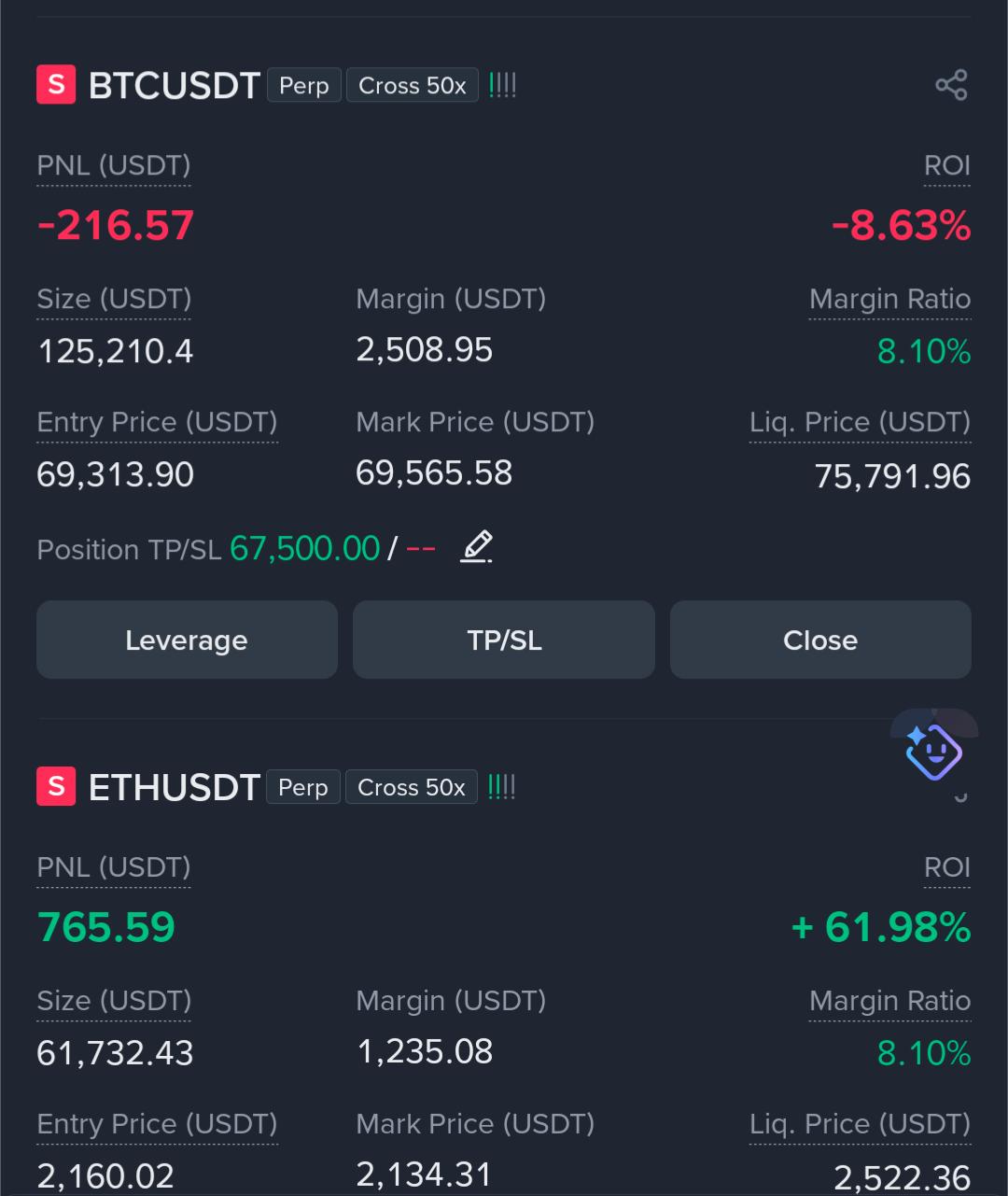
Some trades are still running… especially BTC short, I’m still holding it 🫡
This one has the biggest margin and risk from my side… but looking at the fundamentals and market sentiment, it feels like $BTC can drop towards $65K tomorrow 👀
And if that happens… we’re gonna print hard 💰🤑
Also don’t forget… I already said it
If BTC short hits TP, I’ll give away 30% profit to my chatroom members 🎁
So stay ready… big moves loading. $ETH
Sleep well, think smart, and come back stronger tomorrow 😮💨 see you all tomorrow.
We’ll meet again tomorrow with more setups and more opportunities 💚
If I break down today… honestly it was a great day.
1–2 trades hit SL, but the rest were all green
That’s how the game works… you don’t need to win every trade, you just need to stay consistent.
Some trades are still running… especially BTC short, I’m still holding it 🫡
This one has the biggest margin and risk from my side… but looking at the fundamentals and market sentiment, it feels like $BTC can drop towards $65K tomorrow 👀
And if that happens… we’re gonna print hard 💰🤑
Also don’t forget… I already said it
If BTC short hits TP, I’ll give away 30% profit to my chatroom members 🎁
So stay ready… big moves loading. $ETH
Sleep well, think smart, and come back stronger tomorrow 😮💨 see you all tomorrow.

42

·
--
Article
Pakistan’s Digital Finance Boom Attracts Global Investors .Pakistan’s digital finance sector is rapidly evolving, capturing the attention of global investors and opening doors to massive opportunities in fintech, blockchain, and financial inclusion.
Recently, a high-level delegation from China’s leading FinVolution Group and its subsidiary FinLeap engaged in strategic discussions with SECP Chairman Dr. Akif Saeed. The focus? Strengthening Pakistan’s digital finance ecosystem through regulatory innovation and inclusive financial solutions.
--Key Highlights:
• Strong emphasis on regulatory reforms to support fintech growth
• Commitment to boosting financial inclusion across underserved communities
• Introduction of innovative digital lending solutions like FinLeap’s Daira platform
• Expansion of global fintech operations into Pakistan.
The Daira platform is already transforming access to credit by offering fast, easy digital loans—empowering individuals who were previously excluded from formal financial systems.
-- The entry and expansion of a New York Stock Exchange-listed company like FinVolution signals growing global confidence in Pakistan’s economic future. This is more than just investment—it's a shift toward a digitally …
** Crypto & Web3?**
As digital finance infrastructure strengthens, it creates a fertile ground for blockchain adoption, decentralized finance (DeFi), and digital identity solutions—aligning perfectly with the vision of projects like @SignOfficial and the future of decentralized sovereignty.
- The Bigger Picture:
Pakistan is positioning itself as a rising hub for digital finance innovation. With supportive regulations and international collaboration, the country is stepping into a new era of:
✔ Financial Inclusion
✔ Digital Transformation
✔ Global Investment Inflows
The future of finance in Pakistan is digital—and it’s just getting started.
#DigitalFinance #Fintech #Pakistan #CryptoAdoption #Web3 #SignDigitalSovereignInfra
$SIGN
$SIGN
{spot}(SIGNUSDT)
Pakistan’s Digital Finance Boom Attracts Global Investors .
Pakistan’s digital finance sector is rapidly evolving, capturing the attention of global investors and opening doors to massive opportunities in fintech, blockchain, and financial inclusion.
Recently, a high-level delegation from China’s leading FinVolution Group and its subsidiary FinLeap engaged in strategic discussions with SECP Chairman Dr. Akif Saeed. The focus? Strengthening Pakistan’s digital finance ecosystem through regulatory innovation and inclusive financial solutions.
--Key Highlights:
• Strong emphasis on regulatory reforms to support fintech growth
• Commitment to boosting financial inclusion across underserved communities
• Introduction of innovative digital lending solutions like FinLeap’s Daira platform
• Expansion of global fintech operations into Pakistan.
The Daira platform is already transforming access to credit by offering fast, easy digital loans—empowering individuals who were previously excluded from formal financial systems.
-- The entry and expansion of a New York Stock Exchange-listed company like FinVolution signals growing global confidence in Pakistan’s economic future. This is more than just investment—it's a shift toward a digitally …
** Crypto & Web3?**
As digital finance infrastructure strengthens, it creates a fertile ground for blockchain adoption, decentralized finance (DeFi), and digital identity solutions—aligning perfectly with the vision of projects like @SignOfficial and the future of decentralized sovereignty.
- The Bigger Picture:
Pakistan is positioning itself as a rising hub for digital finance innovation. With supportive regulations and international collaboration, the country is stepping into a new era of:
✔ Financial Inclusion
✔ Digital Transformation
✔ Global Investment Inflows
The future of finance in Pakistan is digital—and it’s just getting started.
#DigitalFinance #Fintech #Pakistan #CryptoAdoption #Web3 #SignDigitalSovereignInfra
$SIGN
$SIGN
Recently, a high-level delegation from China’s leading FinVolution Group and its subsidiary FinLeap engaged in strategic discussions with SECP Chairman Dr. Akif Saeed. The focus? Strengthening Pakistan’s digital finance ecosystem through regulatory innovation and inclusive financial solutions.
--Key Highlights:
• Strong emphasis on regulatory reforms to support fintech growth
• Commitment to boosting financial inclusion across underserved communities
• Introduction of innovative digital lending solutions like FinLeap’s Daira platform
• Expansion of global fintech operations into Pakistan.
The Daira platform is already transforming access to credit by offering fast, easy digital loans—empowering individuals who were previously excluded from formal financial systems.
-- The entry and expansion of a New York Stock Exchange-listed company like FinVolution signals growing global confidence in Pakistan’s economic future. This is more than just investment—it's a shift toward a digitally …
** Crypto & Web3?**
As digital finance infrastructure strengthens, it creates a fertile ground for blockchain adoption, decentralized finance (DeFi), and digital identity solutions—aligning perfectly with the vision of projects like @SignOfficial and the future of decentralized sovereignty.
- The Bigger Picture:
Pakistan is positioning itself as a rising hub for digital finance innovation. With supportive regulations and international collaboration, the country is stepping into a new era of:
✔ Financial Inclusion
✔ Digital Transformation
✔ Global Investment Inflows
The future of finance in Pakistan is digital—and it’s just getting started.
#DigitalFinance #Fintech #Pakistan #CryptoAdoption #Web3 #SignDigitalSovereignInfra
$SIGN
$SIGN
1
87

·
--
Article
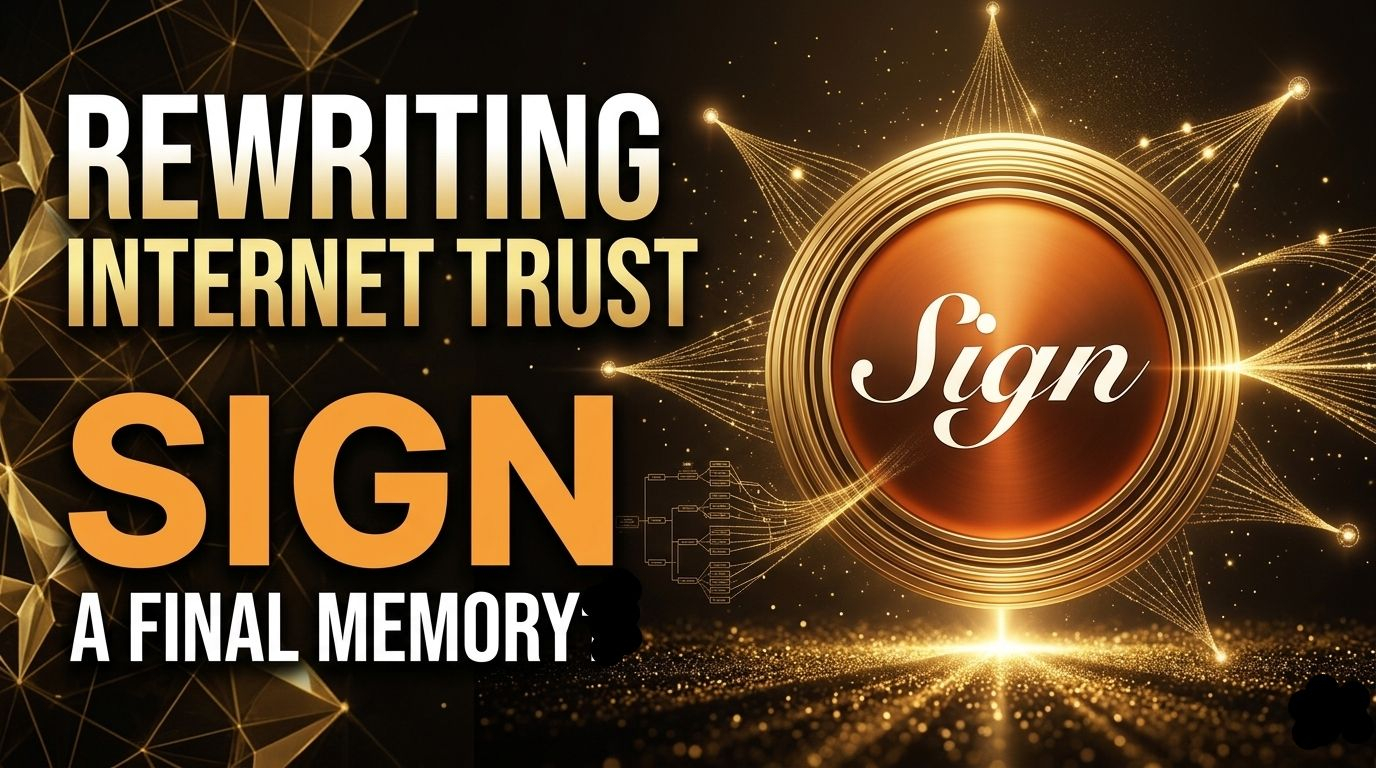
SIGN PROTOCOL IS QUIETLY REWRITING INTERNET TRUSTI want to share something with you last night at maybe 2:17 AM just after the TokenTable snapshot window quietly closed and I found myself still staring at a stream of addresses resolving into final states. And you know there was no announcement no surge of excitement just a quiet finality. Allocations had settled, claims had been verified, and somewhere beneath the surface, attestations had already been written into a layer that doesn’t negotiate with time. That moment did nat feel like watching a product in action. It felt like observing a system that is trying to remove doubt itself from the equation.
What stayed with me was not the interfac but the evidence underneath it. I noticed contract traces referencing something like 0x8f... likely tied to an attestation registry I alongside a brief but noticeable spike in gas hovering between 38 and 52 gwei as claim validations peaked. There ware clusters of wallet interactions that didn’t resemble speculative behavior at all they looked procedural almost administrative, like records being finalized rather than value being chased. The entire flow felt less like crypto and more like infrastructure quietly doing its job, and that subtle shft in tone is what made it stand out.
And I was still staring and at one point during testing I initiated a simple attestation nothing complex just a straightforward schema interaction. The transaction did not fail but it did not move either. It sat there in a pending state longer than expected, long enough to make me pause. In that stillness I realized the nature of what was happening. This wasn’t a system optimized purely for speed or convenience. It was a system designed for permanence. When it finally confirmed, there was no sense of relief, just a quiet awareness that something had been recorded in a way that couldn’t be casually undne. That feeling is very different from what most digital interactions have conditioned us to expect.
The more I sat with it, the clearer it became that @SignOfficial is not built in isolated layers but in a loop where each part reinforces the other. The economic aspect doesn’t just distribute tokens it transforms distribution into something provable, something that carries a narrative that can not be rewritten later. TokenTable in that sense, is less about efficiency and more about accountability. It removes the ambiguity that has long surrounded who receives what and under what conditions, and replaces it with a structure where those answers are no longer negotiable.
And at night I just figure out what coming next the ambition feels even more complex. It’s not just about operating across multiple chains, but about maintaining consistency of truth between them. That’s where the real challenge emerges. Coordinaing state across different environments, ensuring verification doesn’t lag or fragment and managing throughput without creating bottlenecks is far from trivial. What I observed suggests that this is still an evolving process, not a solved problem. The system is being tested in real time, and it carries the tension of something that is both functional and unfinished.
Where things become more complicated at least for me, is at the identity and governance level. Attestations are not neutral. They represent claims, validations, and decisions about what is considered true. And those decisions don’t emerge from nowhere. Someone defines the schemas, someone sets the standards, and over time those frameworks begin to shape how reality is recorded. The system may be transparent, but influence doesn’t disappear it just becomes more structured and, in some ways, more subtle.
When I briefly compared this to networks like Fetch.ai or Bittensor, the difference became sharper. Those systems are focused on intelligence, on generating or coordinating knowledge. Sign Protocol is doing something almost opposite. It is focused on memory, on ensuring that once something is declared and verified, it remains intact. Intelligence can evolve and correct itself, but memory at this level doesn’t have that flexibility. It preserves everything with equal weight, whether it was perfect or flawed at the moment it was recorded.
The one and for meh most important part I keep returning to is that this kind of system doesn’t eliminate power, it redistributes it. Early participants, major attesters, and those who define the initial schemas will inevitably carry more influence in shaping what becomes accepted truth. Even in a transparent environment, interpretation still exists, and with it comes a new kind of asymmetry. There is also a deeper psychological layer that feels unresolved. We often say we want truth and transparency, but we are used to systems that allow for quiet corrections, for things to fade or be adjusted over time.
I keep thinking about how this translates to everyday life. Not in grand, abstract terms, but in something simple. A person signs a document online, maybe under pressure, maybe with incomplete understading. Today, there are ways to revisit that moment, to amend or dispute it. In a system built on immutable attestations, that moment doesn’t softn with time. It stays exactly as it was, preserved in a way that doesn’t account for context or change.
So I find myself sitting with a question that feels less technical and more human. If Sign Protocol succeeds in makng authenticity unquestionable, if it quietly becomes part of the infrastructure we rely on without even noticing it, what happens to the space we currently have for error, for revision, for being imperfect? Becuse the future it points toward isn’t just one where we can finally trust what we see. It’s one where that trust comes at the cost of never being able to look away from what has already been recorded.
#SignDigitalSovereignInfra
$SIGN
{future}(SIGNUSDT)
SIGN PROTOCOL IS QUIETLY REWRITING INTERNET TRUST
I want to share something with you last night at maybe 2:17 AM just after the TokenTable snapshot window quietly closed and I found myself still staring at a stream of addresses resolving into final states. And you know there was no announcement no surge of excitement just a quiet finality. Allocations had settled, claims had been verified, and somewhere beneath the surface, attestations had already been written into a layer that doesn’t negotiate with time. That moment did nat feel like watching a product in action. It felt like observing a system that is trying to remove doubt itself from the equation.
What stayed with me was not the interfac but the evidence underneath it. I noticed contract traces referencing something like 0x8f... likely tied to an attestation registry I alongside a brief but noticeable spike in gas hovering between 38 and 52 gwei as claim validations peaked. There ware clusters of wallet interactions that didn’t resemble speculative behavior at all they looked procedural almost administrative, like records being finalized rather than value being chased. The entire flow felt less like crypto and more like infrastructure quietly doing its job, and that subtle shft in tone is what made it stand out.
And I was still staring and at one point during testing I initiated a simple attestation nothing complex just a straightforward schema interaction. The transaction did not fail but it did not move either. It sat there in a pending state longer than expected, long enough to make me pause. In that stillness I realized the nature of what was happening. This wasn’t a system optimized purely for speed or convenience. It was a system designed for permanence. When it finally confirmed, there was no sense of relief, just a quiet awareness that something had been recorded in a way that couldn’t be casually undne. That feeling is very different from what most digital interactions have conditioned us to expect.
The more I sat with it, the clearer it became that @SignOfficial is not built in isolated layers but in a loop where each part reinforces the other. The economic aspect doesn’t just distribute tokens it transforms distribution into something provable, something that carries a narrative that can not be rewritten later. TokenTable in that sense, is less about efficiency and more about accountability. It removes the ambiguity that has long surrounded who receives what and under what conditions, and replaces it with a structure where those answers are no longer negotiable.
And at night I just figure out what coming next the ambition feels even more complex. It’s not just about operating across multiple chains, but about maintaining consistency of truth between them. That’s where the real challenge emerges. Coordinaing state across different environments, ensuring verification doesn’t lag or fragment and managing throughput without creating bottlenecks is far from trivial. What I observed suggests that this is still an evolving process, not a solved problem. The system is being tested in real time, and it carries the tension of something that is both functional and unfinished.
Where things become more complicated at least for me, is at the identity and governance level. Attestations are not neutral. They represent claims, validations, and decisions about what is considered true. And those decisions don’t emerge from nowhere. Someone defines the schemas, someone sets the standards, and over time those frameworks begin to shape how reality is recorded. The system may be transparent, but influence doesn’t disappear it just becomes more structured and, in some ways, more subtle.
When I briefly compared this to networks like Fetch.ai or Bittensor, the difference became sharper. Those systems are focused on intelligence, on generating or coordinating knowledge. Sign Protocol is doing something almost opposite. It is focused on memory, on ensuring that once something is declared and verified, it remains intact. Intelligence can evolve and correct itself, but memory at this level doesn’t have that flexibility. It preserves everything with equal weight, whether it was perfect or flawed at the moment it was recorded.
The one and for meh most important part I keep returning to is that this kind of system doesn’t eliminate power, it redistributes it. Early participants, major attesters, and those who define the initial schemas will inevitably carry more influence in shaping what becomes accepted truth. Even in a transparent environment, interpretation still exists, and with it comes a new kind of asymmetry. There is also a deeper psychological layer that feels unresolved. We often say we want truth and transparency, but we are used to systems that allow for quiet corrections, for things to fade or be adjusted over time.
I keep thinking about how this translates to everyday life. Not in grand, abstract terms, but in something simple. A person signs a document online, maybe under pressure, maybe with incomplete understading. Today, there are ways to revisit that moment, to amend or dispute it. In a system built on immutable attestations, that moment doesn’t softn with time. It stays exactly as it was, preserved in a way that doesn’t account for context or change.
So I find myself sitting with a question that feels less technical and more human. If Sign Protocol succeeds in makng authenticity unquestionable, if it quietly becomes part of the infrastructure we rely on without even noticing it, what happens to the space we currently have for error, for revision, for being imperfect? Becuse the future it points toward isn’t just one where we can finally trust what we see. It’s one where that trust comes at the cost of never being able to look away from what has already been recorded.
#SignDigitalSovereignInfra
$SIGN
What stayed with me was not the interfac but the evidence underneath it. I noticed contract traces referencing something like 0x8f... likely tied to an attestation registry I alongside a brief but noticeable spike in gas hovering between 38 and 52 gwei as claim validations peaked. There ware clusters of wallet interactions that didn’t resemble speculative behavior at all they looked procedural almost administrative, like records being finalized rather than value being chased. The entire flow felt less like crypto and more like infrastructure quietly doing its job, and that subtle shft in tone is what made it stand out.
And I was still staring and at one point during testing I initiated a simple attestation nothing complex just a straightforward schema interaction. The transaction did not fail but it did not move either. It sat there in a pending state longer than expected, long enough to make me pause. In that stillness I realized the nature of what was happening. This wasn’t a system optimized purely for speed or convenience. It was a system designed for permanence. When it finally confirmed, there was no sense of relief, just a quiet awareness that something had been recorded in a way that couldn’t be casually undne. That feeling is very different from what most digital interactions have conditioned us to expect.
The more I sat with it, the clearer it became that @SignOfficial is not built in isolated layers but in a loop where each part reinforces the other. The economic aspect doesn’t just distribute tokens it transforms distribution into something provable, something that carries a narrative that can not be rewritten later. TokenTable in that sense, is less about efficiency and more about accountability. It removes the ambiguity that has long surrounded who receives what and under what conditions, and replaces it with a structure where those answers are no longer negotiable.
And at night I just figure out what coming next the ambition feels even more complex. It’s not just about operating across multiple chains, but about maintaining consistency of truth between them. That’s where the real challenge emerges. Coordinaing state across different environments, ensuring verification doesn’t lag or fragment and managing throughput without creating bottlenecks is far from trivial. What I observed suggests that this is still an evolving process, not a solved problem. The system is being tested in real time, and it carries the tension of something that is both functional and unfinished.
Where things become more complicated at least for me, is at the identity and governance level. Attestations are not neutral. They represent claims, validations, and decisions about what is considered true. And those decisions don’t emerge from nowhere. Someone defines the schemas, someone sets the standards, and over time those frameworks begin to shape how reality is recorded. The system may be transparent, but influence doesn’t disappear it just becomes more structured and, in some ways, more subtle.
When I briefly compared this to networks like Fetch.ai or Bittensor, the difference became sharper. Those systems are focused on intelligence, on generating or coordinating knowledge. Sign Protocol is doing something almost opposite. It is focused on memory, on ensuring that once something is declared and verified, it remains intact. Intelligence can evolve and correct itself, but memory at this level doesn’t have that flexibility. It preserves everything with equal weight, whether it was perfect or flawed at the moment it was recorded.
The one and for meh most important part I keep returning to is that this kind of system doesn’t eliminate power, it redistributes it. Early participants, major attesters, and those who define the initial schemas will inevitably carry more influence in shaping what becomes accepted truth. Even in a transparent environment, interpretation still exists, and with it comes a new kind of asymmetry. There is also a deeper psychological layer that feels unresolved. We often say we want truth and transparency, but we are used to systems that allow for quiet corrections, for things to fade or be adjusted over time.
I keep thinking about how this translates to everyday life. Not in grand, abstract terms, but in something simple. A person signs a document online, maybe under pressure, maybe with incomplete understading. Today, there are ways to revisit that moment, to amend or dispute it. In a system built on immutable attestations, that moment doesn’t softn with time. It stays exactly as it was, preserved in a way that doesn’t account for context or change.
So I find myself sitting with a question that feels less technical and more human. If Sign Protocol succeeds in makng authenticity unquestionable, if it quietly becomes part of the infrastructure we rely on without even noticing it, what happens to the space we currently have for error, for revision, for being imperfect? Becuse the future it points toward isn’t just one where we can finally trust what we see. It’s one where that trust comes at the cost of never being able to look away from what has already been recorded.
#SignDigitalSovereignInfra
$SIGN
80
44
1.1k

·
--
Article
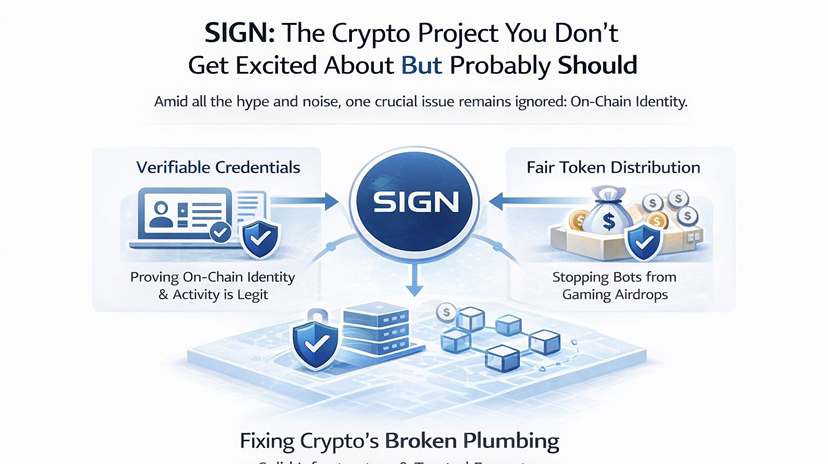
SIGN: The Crypto Project You Don’t Get Excited About (But Probably Should)@SignOfficial #SignDigitalSovereignInfra $SIGN
I honestly can't pinpoint exactly when crypto stopped feeling revolutionary and started feeling like a broken record, but we are definitely there. Every new cycle just feels like a remixed version of the last one. New buzzwords, exact same behavior. First it was DeFi, then NFTs, and now we’re just slapping "AI" onto everything hoping it makes the project look smarter. Influencers are still LARPing as early adopters. Twitter threads are still screaming "this changes everything!" And predictably, 90% of it vanishes a year later.
It’s exhausting, to be real with you.
You reach a point where you just keep scrolling. You stop reading whitepapers. You stop taking roadmaps seriously. Even the actually good ideas get buried under such a mountain of garbage that your default setting becomes extreme skepticism, not curiosity.
That was exactly my headspace when I stumbled onto SIGN.
Let me clear right away: this project isn’t going to give you that immediate dopamine hit. There’s no crazy narrative. No emotional moon-math hook. It doesn't scream "next 100x gem." Honestly? It’s kind of the opposite. It’s quiet. Functional. Borderline boring.
But weirdly enough, I think that’s exactly why it caught my attention.
Beneath all the casino noise in crypto, we still have massive, glaring problems that nobody ever bothered to actually fix. The biggest one? Trust. Not the philosophical "trustless code" kind, but the everyday, practical kind. Who actually are you on-chain? Why should anyone trust a random wallet? Why are airdrops still getting farmed to death by bots like it’s 2021? On-chain identity is this massive elephant in the room that everyone knows about but nobody wants to touch.
And that’s the mess SIGN is stepping right into.
The concept is pretty straightforward when you strip away the jargon: verifiable credentials. It's about actually proving you are who you say you are, or that your on-chain activity is legit, without needing blind trust. And no, not in a creepy "give us your passport and all your data" way, but a way that actually bridges the gap between total anonymity and real credibility.
I know, I know. That sounds like pure infrastructure.
The stuff nobody wants to talk about. But it's also the exact foundation everything else actually needs to survive.
Let’s be real for a second. We've built this entire industry on top of a house of cards. Airdrops are gamed. DAO governance is basically a joke of fake participation. We flex community numbers when half the wallets aren't even real people. We preach decentralization, but we rarely admit we have zero clue who or what is on the other side of the screen most of the time.
So when SIGN shows up saying, "Hey, maybe we should fix the plumbing," it doesn't feel revolutionary. It just feels wildly overdue.
But here’s where my inner skeptic kicks back in. Solving a real problem in crypto doesn’t automatically mean you win. It just means you found a broken pipe. The brutal part is getting anyone to actually care enough to use your fix.
To actually pull this off, SIGN has to play peacemaker between two groups that don't mix well. On one side, crypto natives who value absolute privacy and refuse to link their identity to anything. On the other side, systems and institutions that refuse to touch anything unless it’s fully verified and structured.
Sitting in the middle of that crossfire is... complicated.
Maybe they pull it off. Maybe verifiable credentials just become the new norm, running quietly in the background, where users accept a baseline of identity for a system that actually works. Or, maybe people just keep ignoring the problem until a major protocol blows up because of it.
Oh, and then there’s the token.
Because of course, there’s always a token. I keep asking myself the same question I’ve asked a hundred times before: Does this actually need one? Or is it just there because that’s the only way crypto projects know how to fund themselves?
The standard answer is always "governance, incentives, ecosystem alignment." Sometimes that's true. But we’ve all seen infrastructure plays where the token just turns into a casino chip rather than having actual utility.
That’s what gives me pause here.
Credential verification should ideally be invisible. A layer that just works. But the second you attach a ticker to it, you invite the circus. Price action, weird narratives, impatient bagholders. People start paying attention for entirely the wrong reasons. Will that drive adoption? Maybe. Will it distort the actual product? Also maybe. Hard to say.
SIGN does have this whole angle about cleaning up token distribution—making airdrops actually fair and un-farmable. Which sounds fantastic on paper. Anyone who has been around long enough knows how messy that whole meta is.
But tools alone don't fix human behavior. If other projects don't actually adopt these better systems, nothing changes. And crypto notoriously loves sticking to its broken, familiar habits.
So, that’s where I’m at with SIGN.
Not jumping out of my seat. Not dismissing it either. Just… watching it.
On one hand, this is exactly the medicine the space needs to swallow right now. Not another memecoin with a hat, but actual infrastructure that makes the whole ecosystem less fragile and a bit more real.
On the other hand, I’ve watched way too many "fundamentally important" projects bleed out because they just weren't sexy enough, or because the market simply didn't care.
That’s the ugly truth about crypto: utility isn’t always enough to win. Sometimes hype takes the crown. Sometimes timing beats tech. Sometimes great ideas just flat-out fail to launch.
Maybe SIGN becomes one of those invisible protocol layers that the whole ecosystem eventually runs on—the kind nobody talks about, but everyone uses. Or maybe it ends up as a brilliantly designed system trapped in its own niche.
Honestly? I have no idea.
And I'm finally at a point where I'm okay admitting that. Because when you've survived enough cycles, you stop trying to predict the future and start looking at the intent behind a project. SIGN actually feels like it’s trying to build something necessary, rather than just riding the coattails of whatever narrative is hot this month.
Maybe it works, maybe it doesn't. But in an industry deafened by noise, a project quietly trying to fix the foundation feels worth paying attention to.
#SignDigitalSovereignInfra $SIGN
{future}(SIGNUSDT)
SIGN: The Crypto Project You Don’t Get Excited About (But Probably Should)
@SignOfficial #SignDigitalSovereignInfra $SIGN
I honestly can't pinpoint exactly when crypto stopped feeling revolutionary and started feeling like a broken record, but we are definitely there. Every new cycle just feels like a remixed version of the last one. New buzzwords, exact same behavior. First it was DeFi, then NFTs, and now we’re just slapping "AI" onto everything hoping it makes the project look smarter. Influencers are still LARPing as early adopters. Twitter threads are still screaming "this changes everything!" And predictably, 90% of it vanishes a year later.
It’s exhausting, to be real with you.
You reach a point where you just keep scrolling. You stop reading whitepapers. You stop taking roadmaps seriously. Even the actually good ideas get buried under such a mountain of garbage that your default setting becomes extreme skepticism, not curiosity.
That was exactly my headspace when I stumbled onto SIGN.
Let me clear right away: this project isn’t going to give you that immediate dopamine hit. There’s no crazy narrative. No emotional moon-math hook. It doesn't scream "next 100x gem." Honestly? It’s kind of the opposite. It’s quiet. Functional. Borderline boring.
But weirdly enough, I think that’s exactly why it caught my attention.
Beneath all the casino noise in crypto, we still have massive, glaring problems that nobody ever bothered to actually fix. The biggest one? Trust. Not the philosophical "trustless code" kind, but the everyday, practical kind. Who actually are you on-chain? Why should anyone trust a random wallet? Why are airdrops still getting farmed to death by bots like it’s 2021? On-chain identity is this massive elephant in the room that everyone knows about but nobody wants to touch.
And that’s the mess SIGN is stepping right into.
The concept is pretty straightforward when you strip away the jargon: verifiable credentials. It's about actually proving you are who you say you are, or that your on-chain activity is legit, without needing blind trust. And no, not in a creepy "give us your passport and all your data" way, but a way that actually bridges the gap between total anonymity and real credibility.
I know, I know. That sounds like pure infrastructure.
The stuff nobody wants to talk about. But it's also the exact foundation everything else actually needs to survive.
Let’s be real for a second. We've built this entire industry on top of a house of cards. Airdrops are gamed. DAO governance is basically a joke of fake participation. We flex community numbers when half the wallets aren't even real people. We preach decentralization, but we rarely admit we have zero clue who or what is on the other side of the screen most of the time.
So when SIGN shows up saying, "Hey, maybe we should fix the plumbing," it doesn't feel revolutionary. It just feels wildly overdue.
But here’s where my inner skeptic kicks back in. Solving a real problem in crypto doesn’t automatically mean you win. It just means you found a broken pipe. The brutal part is getting anyone to actually care enough to use your fix.
To actually pull this off, SIGN has to play peacemaker between two groups that don't mix well. On one side, crypto natives who value absolute privacy and refuse to link their identity to anything. On the other side, systems and institutions that refuse to touch anything unless it’s fully verified and structured.
Sitting in the middle of that crossfire is... complicated.
Maybe they pull it off. Maybe verifiable credentials just become the new norm, running quietly in the background, where users accept a baseline of identity for a system that actually works. Or, maybe people just keep ignoring the problem until a major protocol blows up because of it.
Oh, and then there’s the token.
Because of course, there’s always a token. I keep asking myself the same question I’ve asked a hundred times before: Does this actually need one? Or is it just there because that’s the only way crypto projects know how to fund themselves?
The standard answer is always "governance, incentives, ecosystem alignment." Sometimes that's true. But we’ve all seen infrastructure plays where the token just turns into a casino chip rather than having actual utility.
That’s what gives me pause here.
Credential verification should ideally be invisible. A layer that just works. But the second you attach a ticker to it, you invite the circus. Price action, weird narratives, impatient bagholders. People start paying attention for entirely the wrong reasons. Will that drive adoption? Maybe. Will it distort the actual product? Also maybe. Hard to say.
SIGN does have this whole angle about cleaning up token distribution—making airdrops actually fair and un-farmable. Which sounds fantastic on paper. Anyone who has been around long enough knows how messy that whole meta is.
But tools alone don't fix human behavior. If other projects don't actually adopt these better systems, nothing changes. And crypto notoriously loves sticking to its broken, familiar habits.
So, that’s where I’m at with SIGN.
Not jumping out of my seat. Not dismissing it either. Just… watching it.
On one hand, this is exactly the medicine the space needs to swallow right now. Not another memecoin with a hat, but actual infrastructure that makes the whole ecosystem less fragile and a bit more real.
On the other hand, I’ve watched way too many "fundamentally important" projects bleed out because they just weren't sexy enough, or because the market simply didn't care.
That’s the ugly truth about crypto: utility isn’t always enough to win. Sometimes hype takes the crown. Sometimes timing beats tech. Sometimes great ideas just flat-out fail to launch.
Maybe SIGN becomes one of those invisible protocol layers that the whole ecosystem eventually runs on—the kind nobody talks about, but everyone uses. Or maybe it ends up as a brilliantly designed system trapped in its own niche.
Honestly? I have no idea.
And I'm finally at a point where I'm okay admitting that. Because when you've survived enough cycles, you stop trying to predict the future and start looking at the intent behind a project. SIGN actually feels like it’s trying to build something necessary, rather than just riding the coattails of whatever narrative is hot this month.
Maybe it works, maybe it doesn't. But in an industry deafened by noise, a project quietly trying to fix the foundation feels worth paying attention to.
#SignDigitalSovereignInfra $SIGN
I honestly can't pinpoint exactly when crypto stopped feeling revolutionary and started feeling like a broken record, but we are definitely there. Every new cycle just feels like a remixed version of the last one. New buzzwords, exact same behavior. First it was DeFi, then NFTs, and now we’re just slapping "AI" onto everything hoping it makes the project look smarter. Influencers are still LARPing as early adopters. Twitter threads are still screaming "this changes everything!" And predictably, 90% of it vanishes a year later.
It’s exhausting, to be real with you.
You reach a point where you just keep scrolling. You stop reading whitepapers. You stop taking roadmaps seriously. Even the actually good ideas get buried under such a mountain of garbage that your default setting becomes extreme skepticism, not curiosity.
That was exactly my headspace when I stumbled onto SIGN.
Let me clear right away: this project isn’t going to give you that immediate dopamine hit. There’s no crazy narrative. No emotional moon-math hook. It doesn't scream "next 100x gem." Honestly? It’s kind of the opposite. It’s quiet. Functional. Borderline boring.
But weirdly enough, I think that’s exactly why it caught my attention.
Beneath all the casino noise in crypto, we still have massive, glaring problems that nobody ever bothered to actually fix. The biggest one? Trust. Not the philosophical "trustless code" kind, but the everyday, practical kind. Who actually are you on-chain? Why should anyone trust a random wallet? Why are airdrops still getting farmed to death by bots like it’s 2021? On-chain identity is this massive elephant in the room that everyone knows about but nobody wants to touch.
And that’s the mess SIGN is stepping right into.
The concept is pretty straightforward when you strip away the jargon: verifiable credentials. It's about actually proving you are who you say you are, or that your on-chain activity is legit, without needing blind trust. And no, not in a creepy "give us your passport and all your data" way, but a way that actually bridges the gap between total anonymity and real credibility.
I know, I know. That sounds like pure infrastructure.
The stuff nobody wants to talk about. But it's also the exact foundation everything else actually needs to survive.
Let’s be real for a second. We've built this entire industry on top of a house of cards. Airdrops are gamed. DAO governance is basically a joke of fake participation. We flex community numbers when half the wallets aren't even real people. We preach decentralization, but we rarely admit we have zero clue who or what is on the other side of the screen most of the time.
So when SIGN shows up saying, "Hey, maybe we should fix the plumbing," it doesn't feel revolutionary. It just feels wildly overdue.
But here’s where my inner skeptic kicks back in. Solving a real problem in crypto doesn’t automatically mean you win. It just means you found a broken pipe. The brutal part is getting anyone to actually care enough to use your fix.
To actually pull this off, SIGN has to play peacemaker between two groups that don't mix well. On one side, crypto natives who value absolute privacy and refuse to link their identity to anything. On the other side, systems and institutions that refuse to touch anything unless it’s fully verified and structured.
Sitting in the middle of that crossfire is... complicated.
Maybe they pull it off. Maybe verifiable credentials just become the new norm, running quietly in the background, where users accept a baseline of identity for a system that actually works. Or, maybe people just keep ignoring the problem until a major protocol blows up because of it.
Oh, and then there’s the token.
Because of course, there’s always a token. I keep asking myself the same question I’ve asked a hundred times before: Does this actually need one? Or is it just there because that’s the only way crypto projects know how to fund themselves?
The standard answer is always "governance, incentives, ecosystem alignment." Sometimes that's true. But we’ve all seen infrastructure plays where the token just turns into a casino chip rather than having actual utility.
That’s what gives me pause here.
Credential verification should ideally be invisible. A layer that just works. But the second you attach a ticker to it, you invite the circus. Price action, weird narratives, impatient bagholders. People start paying attention for entirely the wrong reasons. Will that drive adoption? Maybe. Will it distort the actual product? Also maybe. Hard to say.
SIGN does have this whole angle about cleaning up token distribution—making airdrops actually fair and un-farmable. Which sounds fantastic on paper. Anyone who has been around long enough knows how messy that whole meta is.
But tools alone don't fix human behavior. If other projects don't actually adopt these better systems, nothing changes. And crypto notoriously loves sticking to its broken, familiar habits.
So, that’s where I’m at with SIGN.
Not jumping out of my seat. Not dismissing it either. Just… watching it.
On one hand, this is exactly the medicine the space needs to swallow right now. Not another memecoin with a hat, but actual infrastructure that makes the whole ecosystem less fragile and a bit more real.
On the other hand, I’ve watched way too many "fundamentally important" projects bleed out because they just weren't sexy enough, or because the market simply didn't care.
That’s the ugly truth about crypto: utility isn’t always enough to win. Sometimes hype takes the crown. Sometimes timing beats tech. Sometimes great ideas just flat-out fail to launch.
Maybe SIGN becomes one of those invisible protocol layers that the whole ecosystem eventually runs on—the kind nobody talks about, but everyone uses. Or maybe it ends up as a brilliantly designed system trapped in its own niche.
Honestly? I have no idea.
And I'm finally at a point where I'm okay admitting that. Because when you've survived enough cycles, you stop trying to predict the future and start looking at the intent behind a project. SIGN actually feels like it’s trying to build something necessary, rather than just riding the coattails of whatever narrative is hot this month.
Maybe it works, maybe it doesn't. But in an industry deafened by noise, a project quietly trying to fix the foundation feels worth paying attention to.
#SignDigitalSovereignInfra $SIGN
6
7
289

·
--
Haussier
What keeps drawing me back to SIGN is not the pitch. It is the problem underneath it.
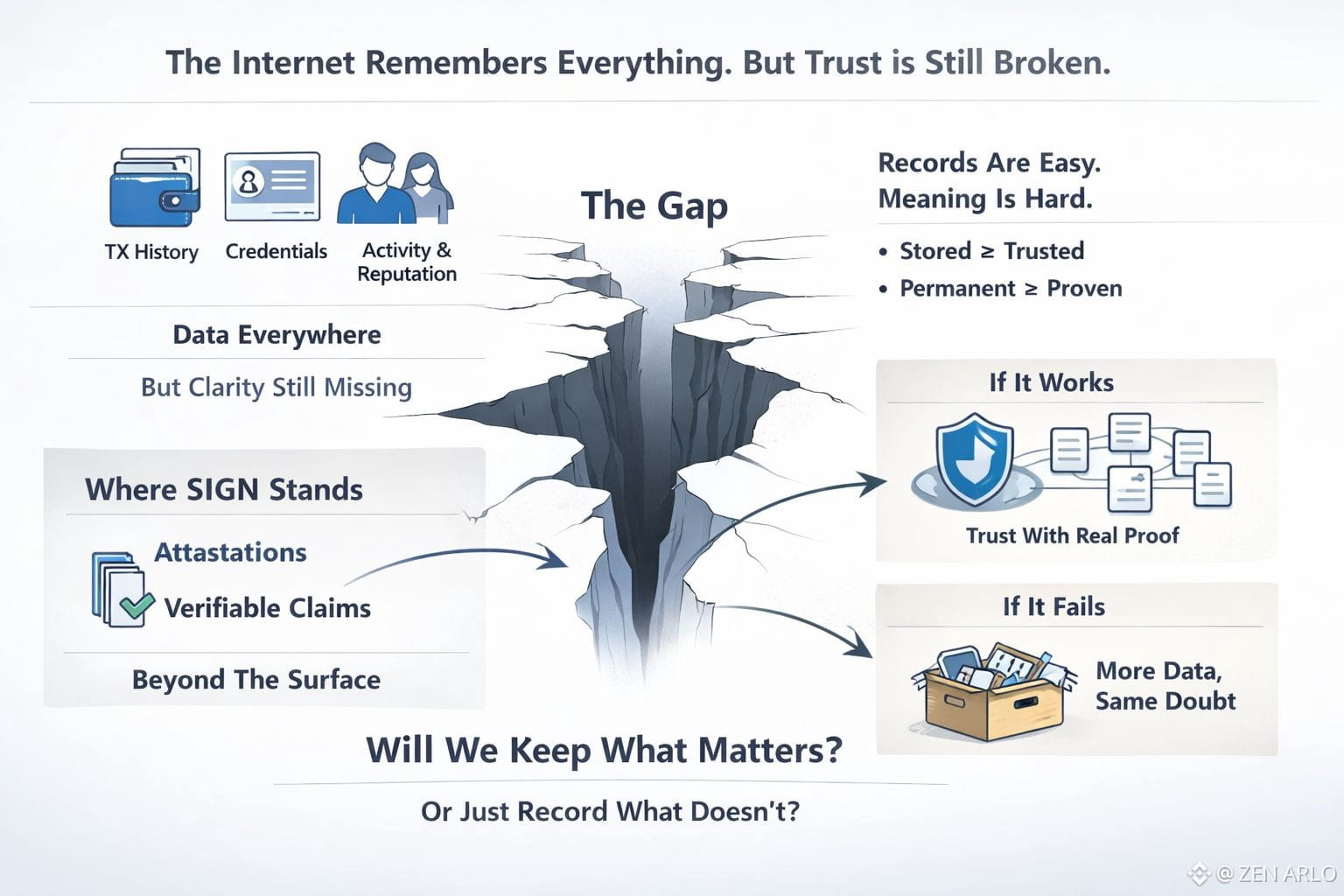
The internet already records almost everything. Activity, identity, reputation, participation. There is no shortage of data. And yet trust still feels thin. We still have the same problem we had before all this infrastructure showed up: too much can be seen, not enough can be believed.
That is where SIGN becomes worth paying attention to. Not because it promises to fix trust in some grand, final way, but because it is working inside a part of the stack that most projects either oversimplify or deliberately avoid. The question is not whether information can be stored. That part is easy now. The harder question is whether any of it can carry meaning once it leaves the moment it was created in.
I have watched enough cycles to be skeptical of anything that treats permanence like proof. Crypto does this all the time. It takes something messy and social, turns it into a record, and then pretends the record is the truth. Usually it is not. Usually it is just a cleaner version of the same confusion.
That is why SIGN feels interesting, but not in a comfortable way. It is close to a real fault line. If it works, it could make parts of the internet easier to trust without pretending trust itself can be automated. If it fails, it will probably fail the same way a lot of infrastructure does by preserving more data without solving the question of what actually matters.
And that is the part I keep coming back to.
Not whether it can record something.
Whether anyone will care when it matters.
#SignDigitalSovereignInfra @SignOfficial $SIGN
What keeps drawing me back to SIGN is not the pitch. It is the problem underneath it.
The internet already records almost everything. Activity, identity, reputation, participation. There is no shortage of data. And yet trust still feels thin. We still have the same problem we had before all this infrastructure showed up: too much can be seen, not enough can be believed.
That is where SIGN becomes worth paying attention to. Not because it promises to fix trust in some grand, final way, but because it is working inside a part of the stack that most projects either oversimplify or deliberately avoid. The question is not whether information can be stored. That part is easy now. The harder question is whether any of it can carry meaning once it leaves the moment it was created in.
I have watched enough cycles to be skeptical of anything that treats permanence like proof. Crypto does this all the time. It takes something messy and social, turns it into a record, and then pretends the record is the truth. Usually it is not. Usually it is just a cleaner version of the same confusion.
That is why SIGN feels interesting, but not in a comfortable way. It is close to a real fault line. If it works, it could make parts of the internet easier to trust without pretending trust itself can be automated. If it fails, it will probably fail the same way a lot of infrastructure does by preserving more data without solving the question of what actually matters.
And that is the part I keep coming back to.
Not whether it can record something.
Whether anyone will care when it matters.
#SignDigitalSovereignInfra @SignOfficial $SIGN
The internet already records almost everything. Activity, identity, reputation, participation. There is no shortage of data. And yet trust still feels thin. We still have the same problem we had before all this infrastructure showed up: too much can be seen, not enough can be believed.
That is where SIGN becomes worth paying attention to. Not because it promises to fix trust in some grand, final way, but because it is working inside a part of the stack that most projects either oversimplify or deliberately avoid. The question is not whether information can be stored. That part is easy now. The harder question is whether any of it can carry meaning once it leaves the moment it was created in.
I have watched enough cycles to be skeptical of anything that treats permanence like proof. Crypto does this all the time. It takes something messy and social, turns it into a record, and then pretends the record is the truth. Usually it is not. Usually it is just a cleaner version of the same confusion.
That is why SIGN feels interesting, but not in a comfortable way. It is close to a real fault line. If it works, it could make parts of the internet easier to trust without pretending trust itself can be automated. If it fails, it will probably fail the same way a lot of infrastructure does by preserving more data without solving the question of what actually matters.
And that is the part I keep coming back to.
Not whether it can record something.
Whether anyone will care when it matters.
#SignDigitalSovereignInfra @SignOfficial $SIGN
3
599

·
--
I’m usually pretty skeptical of hackathons.
Most of them create a lot of noise, a lot of posts, and just enough unfinished demos for everyone to pretend momentum happened.
That’s why Sign’s hackathons feel a bit different to me.
Not because hackathons suddenly became magical. They didn’t. But these seem more structured in the right way. Good docs. Real protocol access. Actual mentorship. Enough support to help people build, not just wander around calling ideas “innovation.”
That’s the part I keep coming back to.
The value is not the prize.
It’s not the hype either.
It’s seeing who can actually ship something, learn fast, and pressure test the protocol under real time constraints.
And honestly, that’s a much better signal than another event where everyone talks big and nothing usable comes out of it.
@SignOfficial #SignDigitalSovereignInfra $SIGN
I’m usually pretty skeptical of hackathons.
Most of them create a lot of noise, a lot of posts, and just enough unfinished demos for everyone to pretend momentum happened.
That’s why Sign’s hackathons feel a bit different to me.
Not because hackathons suddenly became magical. They didn’t. But these seem more structured in the right way. Good docs. Real protocol access. Actual mentorship. Enough support to help people build, not just wander around calling ideas “innovation.”
That’s the part I keep coming back to.
The value is not the prize.
It’s not the hype either.
It’s seeing who can actually ship something, learn fast, and pressure test the protocol under real time constraints.
And honestly, that’s a much better signal than another event where everyone talks big and nothing usable comes out of it.
@SignOfficial #SignDigitalSovereignInfra $SIGN
Most of them create a lot of noise, a lot of posts, and just enough unfinished demos for everyone to pretend momentum happened.
That’s why Sign’s hackathons feel a bit different to me.
Not because hackathons suddenly became magical. They didn’t. But these seem more structured in the right way. Good docs. Real protocol access. Actual mentorship. Enough support to help people build, not just wander around calling ideas “innovation.”
That’s the part I keep coming back to.
The value is not the prize.
It’s not the hype either.
It’s seeing who can actually ship something, learn fast, and pressure test the protocol under real time constraints.
And honestly, that’s a much better signal than another event where everyone talks big and nothing usable comes out of it.
@SignOfficial #SignDigitalSovereignInfra $SIGN
1
114

·
--
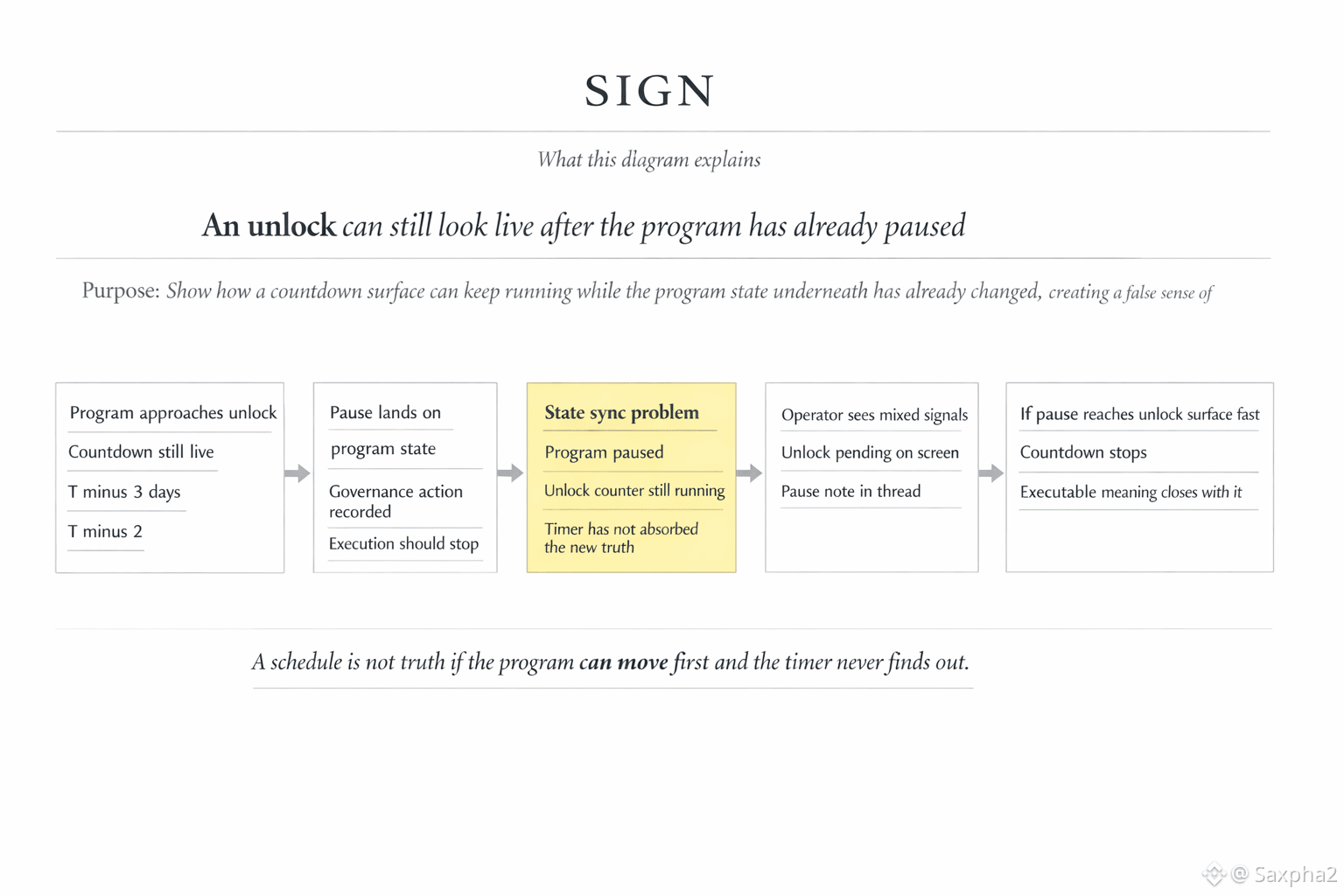
The unlock counter was still running at 02:19. The pause note had already landed on the program four hours earlier. I went back through the log twice before I accepted that was not a display error.
That kind of mismatch bothers me more than a hard freeze. A hard freeze is honest. This one leaves the schedule looking alive while the program behind it has already changed its mind.
That is the Sign surface worth paying attention to here. A vesting schedule and a program state are two separate layers, and when a pause lands on one without reaching the other, the countdown does not stop. It just stops meaning anything. On screen everything looks orderly. T minus 3 days. T minus 2. Unlock pending. The disorder shows up in the desk habits forming around it.
Pause note copied into the thread. Release line parked anyway. One more recalculation pass because nobody wants to be the person who treats a still-ticking unlock as if the program behind it had not already been stopped. The schedule looks executable. The program behind it is not.
A schedule is not truth if the program can move first and the timer never finds out.
The stricter fix costs more. Tighter coupling between governance state and unlock surface, less room for a paused program to leave a live countdown behind as if nothing had changed.
$SIGN starts feeling more serious at exactly that boundary, where a pause instruction stops being a side note and starts reaching the unlock layer itself.
This gets convincing when a paused program stops leaving behind countdowns that still sound like permissions.
@SignOfficial $SIGN #SignDigitalSovereignInfra
The unlock counter was still running at 02:19. The pause note had already landed on the program four hours earlier. I went back through the log twice before I accepted that was not a display error.
That kind of mismatch bothers me more than a hard freeze. A hard freeze is honest. This one leaves the schedule looking alive while the program behind it has already changed its mind.
That is the Sign surface worth paying attention to here. A vesting schedule and a program state are two separate layers, and when a pause lands on one without reaching the other, the countdown does not stop. It just stops meaning anything. On screen everything looks orderly. T minus 3 days. T minus 2. Unlock pending. The disorder shows up in the desk habits forming around it.
Pause note copied into the thread. Release line parked anyway. One more recalculation pass because nobody wants to be the person who treats a still-ticking unlock as if the program behind it had not already been stopped. The schedule looks executable. The program behind it is not.
A schedule is not truth if the program can move first and the timer never finds out.
The stricter fix costs more. Tighter coupling between governance state and unlock surface, less room for a paused program to leave a live countdown behind as if nothing had changed.
$SIGN starts feeling more serious at exactly that boundary, where a pause instruction stops being a side note and starts reaching the unlock layer itself.
This gets convincing when a paused program stops leaving behind countdowns that still sound like permissions.
@SignOfficial $SIGN #SignDigitalSovereignInfra
That kind of mismatch bothers me more than a hard freeze. A hard freeze is honest. This one leaves the schedule looking alive while the program behind it has already changed its mind.
That is the Sign surface worth paying attention to here. A vesting schedule and a program state are two separate layers, and when a pause lands on one without reaching the other, the countdown does not stop. It just stops meaning anything. On screen everything looks orderly. T minus 3 days. T minus 2. Unlock pending. The disorder shows up in the desk habits forming around it.
Pause note copied into the thread. Release line parked anyway. One more recalculation pass because nobody wants to be the person who treats a still-ticking unlock as if the program behind it had not already been stopped. The schedule looks executable. The program behind it is not.
A schedule is not truth if the program can move first and the timer never finds out.
The stricter fix costs more. Tighter coupling between governance state and unlock surface, less room for a paused program to leave a live countdown behind as if nothing had changed.
$SIGN starts feeling more serious at exactly that boundary, where a pause instruction stops being a side note and starts reaching the unlock layer itself.
This gets convincing when a paused program stops leaving behind countdowns that still sound like permissions.
@SignOfficial $SIGN #SignDigitalSovereignInfra
2
1
178

1
1
27

·
--
Most systems still treat verification like a one time event.
But in reality, trust is something you carry not something you redo.
That’s what makes Sign interesting to me. It turns verification into something reusable, almost like a personal layer you build over time. One attestation can unlock multiple actions without exposing everything again.
What stands out recently is how this idea is becoming more practical. With updates improving cross chain speed and privacy (especially with ZK-based selective disclosure), and tools like TokenTable already handling large scale, rule-based distributions, it’s moving beyond theory into actual usage.
The upcoming SuperApp direction also feels important not because it adds features, but because it might finally connect identity, credentials, and value flows in one place.
For me, the exciting part isn’t just verification.
It’s the idea that trust becomes composable something apps can build on, and users can carry with control.
Are you curious how others see it is reusable trust the missing piece in Web3 UX?
@SignOfficial $SIGN #SignDigitalSovereignInfra
Most systems still treat verification like a one time event.
But in reality, trust is something you carry not something you redo.
That’s what makes Sign interesting to me. It turns verification into something reusable, almost like a personal layer you build over time. One attestation can unlock multiple actions without exposing everything again.
What stands out recently is how this idea is becoming more practical. With updates improving cross chain speed and privacy (especially with ZK-based selective disclosure), and tools like TokenTable already handling large scale, rule-based distributions, it’s moving beyond theory into actual usage.
The upcoming SuperApp direction also feels important not because it adds features, but because it might finally connect identity, credentials, and value flows in one place.
For me, the exciting part isn’t just verification.
It’s the idea that trust becomes composable something apps can build on, and users can carry with control.
Are you curious how others see it is reusable trust the missing piece in Web3 UX?
@SignOfficial $SIGN #SignDigitalSovereignInfra
But in reality, trust is something you carry not something you redo.
That’s what makes Sign interesting to me. It turns verification into something reusable, almost like a personal layer you build over time. One attestation can unlock multiple actions without exposing everything again.
What stands out recently is how this idea is becoming more practical. With updates improving cross chain speed and privacy (especially with ZK-based selective disclosure), and tools like TokenTable already handling large scale, rule-based distributions, it’s moving beyond theory into actual usage.
The upcoming SuperApp direction also feels important not because it adds features, but because it might finally connect identity, credentials, and value flows in one place.
For me, the exciting part isn’t just verification.
It’s the idea that trust becomes composable something apps can build on, and users can carry with control.
Are you curious how others see it is reusable trust the missing piece in Web3 UX?
@SignOfficial $SIGN #SignDigitalSovereignInfra
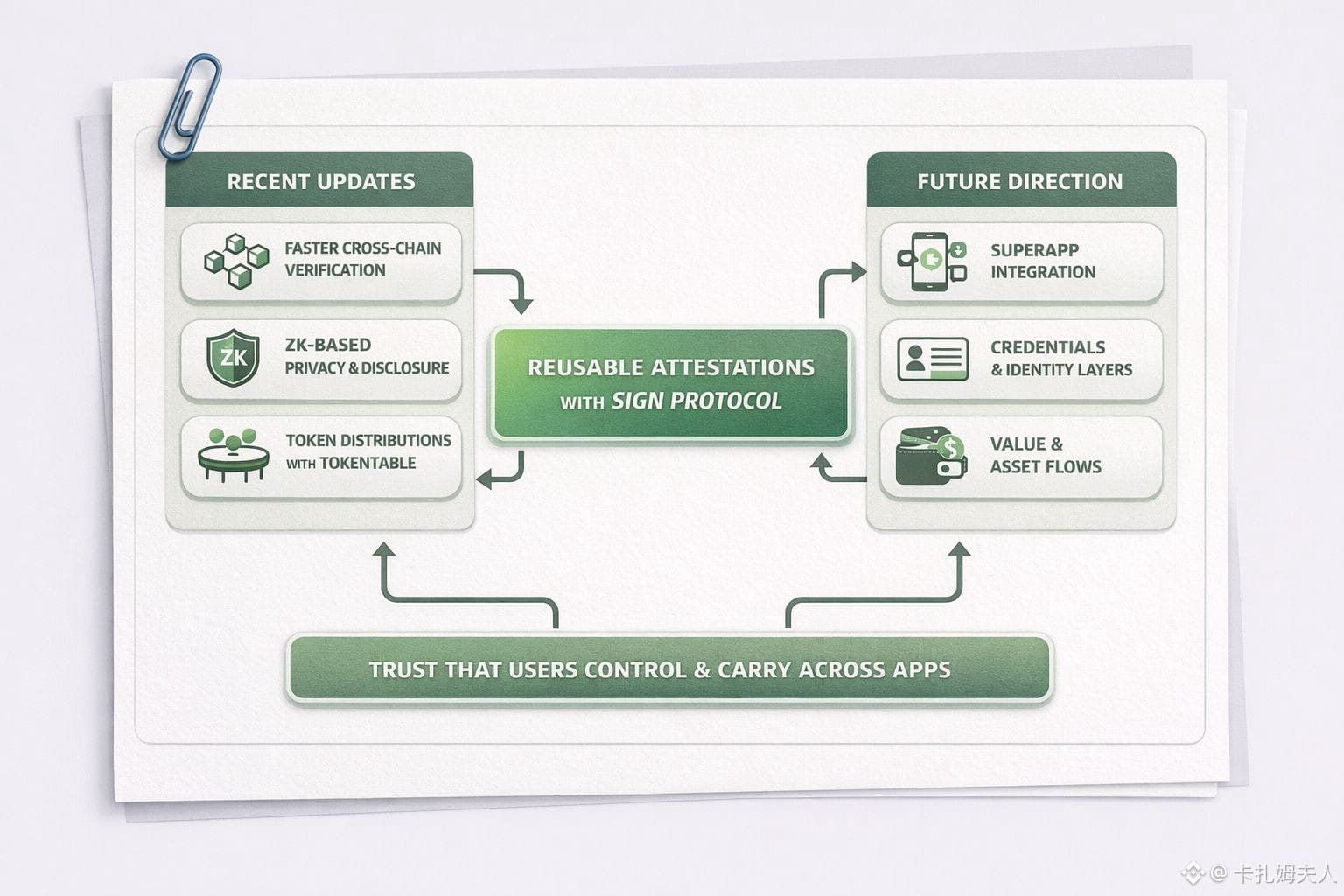
2
1
111


Article
The Quiet Weight of Crypto InfrastructureI’ve been watching this space long enough to feel a certain fatigue with grand declarations. Most crypto projects chase velocity—liquidity, narratives, token launches. They rarely pause at the heavier question of whether they can actually bear weight once the hype recedes. Lately, though, one effort has been occupying more of my notebook pages. It’s positioning itself not as another flashy application, but as something closer to foundational plumbing: a global system for credential verification and token distribution. The shift feels deliberate and frankly, a little unsettling. Infrastructure carries consequences that simple products do not.
Myself, I keep returning to the operational reality beneath the surface. Verifying credentials at scale is not elegant cryptography for its own sake. It means building records that must remain trustworthy when they determine access to jobs, capital, licenses, or participation rights. A single point of failure or subtle manipulation here ripples outward for years. Then comes the distribution layer—moving tokens accurately, transparently, across chains and jurisdictions, without the usual custodians stepping in to “fix” things when pressure mounts. This is not innovation theater. It is the slow, grinding work of settlement and accountability. Logs that auditors can examine. Mechanisms that balance privacy against real-world legibility. Governance that does not quietly erode the moment adversarial interests test it.
I’m tired of the recycled narratives that have dominated cycle after cycle. Another decentralized identity protocol. Another rewards layer promising neutrality. They sound compelling on paper until the first exploit, the first coordinated attack, or the first time regulators or large players decide the rules no longer serve them. Surface-level primitives rarely survive that transition from speculation to dependence. What matters now, to me at least, is whether a project is willing to shoulder the boring, expensive liabilities: immutable yet usable records, verification flows that hold up under scrutiny, and distribution logic that remains neutral even when nobody is watching the dashboards.
This one still feels raw in places—complex attestation chains, cross-chain reconciliation that must not break, token mechanics designed to resist sybil attacks and insider capture. That unfinished quality strikes me as more honest than the usual polished decks. It suggests the builders understand they are not shipping a consumer app but assembling machinery that might one day sit beneath larger systems. The records will need to stand when millions rely on them for economic access. The distribution engine will face its true test not during bull runs, but in the long quiet periods when trust becomes non-negotiable.
Most projects never reach this threshold. They dissolve back into speculation before the weight truly arrives. This one is inching closer, whether by intention or the logic of its own design. I find myself watching with a researcher’s caution rather than excitement.
And yet the central question remains unresolved, heavy in my notes: when ordinary people begin to depend on it—when livelihoods, credentials, and value flows are entangled in its correctness—can this system actually hold under real pressure, or will it bend like so many others before it?
#SignDigitalSovereignInfra
@SignOfficial
$SIGN
{spot}(SIGNUSDT)
The Quiet Weight of Crypto Infrastructure
I’ve been watching this space long enough to feel a certain fatigue with grand declarations. Most crypto projects chase velocity—liquidity, narratives, token launches. They rarely pause at the heavier question of whether they can actually bear weight once the hype recedes. Lately, though, one effort has been occupying more of my notebook pages. It’s positioning itself not as another flashy application, but as something closer to foundational plumbing: a global system for credential verification and token distribution. The shift feels deliberate and frankly, a little unsettling. Infrastructure carries consequences that simple products do not.
Myself, I keep returning to the operational reality beneath the surface. Verifying credentials at scale is not elegant cryptography for its own sake. It means building records that must remain trustworthy when they determine access to jobs, capital, licenses, or participation rights. A single point of failure or subtle manipulation here ripples outward for years. Then comes the distribution layer—moving tokens accurately, transparently, across chains and jurisdictions, without the usual custodians stepping in to “fix” things when pressure mounts. This is not innovation theater. It is the slow, grinding work of settlement and accountability. Logs that auditors can examine. Mechanisms that balance privacy against real-world legibility. Governance that does not quietly erode the moment adversarial interests test it.
I’m tired of the recycled narratives that have dominated cycle after cycle. Another decentralized identity protocol. Another rewards layer promising neutrality. They sound compelling on paper until the first exploit, the first coordinated attack, or the first time regulators or large players decide the rules no longer serve them. Surface-level primitives rarely survive that transition from speculation to dependence. What matters now, to me at least, is whether a project is willing to shoulder the boring, expensive liabilities: immutable yet usable records, verification flows that hold up under scrutiny, and distribution logic that remains neutral even when nobody is watching the dashboards.
This one still feels raw in places—complex attestation chains, cross-chain reconciliation that must not break, token mechanics designed to resist sybil attacks and insider capture. That unfinished quality strikes me as more honest than the usual polished decks. It suggests the builders understand they are not shipping a consumer app but assembling machinery that might one day sit beneath larger systems. The records will need to stand when millions rely on them for economic access. The distribution engine will face its true test not during bull runs, but in the long quiet periods when trust becomes non-negotiable.
Most projects never reach this threshold. They dissolve back into speculation before the weight truly arrives. This one is inching closer, whether by intention or the logic of its own design. I find myself watching with a researcher’s caution rather than excitement.
And yet the central question remains unresolved, heavy in my notes: when ordinary people begin to depend on it—when livelihoods, credentials, and value flows are entangled in its correctness—can this system actually hold under real pressure, or will it bend like so many others before it?
#SignDigitalSovereignInfra
@SignOfficial
$SIGN
Myself, I keep returning to the operational reality beneath the surface. Verifying credentials at scale is not elegant cryptography for its own sake. It means building records that must remain trustworthy when they determine access to jobs, capital, licenses, or participation rights. A single point of failure or subtle manipulation here ripples outward for years. Then comes the distribution layer—moving tokens accurately, transparently, across chains and jurisdictions, without the usual custodians stepping in to “fix” things when pressure mounts. This is not innovation theater. It is the slow, grinding work of settlement and accountability. Logs that auditors can examine. Mechanisms that balance privacy against real-world legibility. Governance that does not quietly erode the moment adversarial interests test it.
I’m tired of the recycled narratives that have dominated cycle after cycle. Another decentralized identity protocol. Another rewards layer promising neutrality. They sound compelling on paper until the first exploit, the first coordinated attack, or the first time regulators or large players decide the rules no longer serve them. Surface-level primitives rarely survive that transition from speculation to dependence. What matters now, to me at least, is whether a project is willing to shoulder the boring, expensive liabilities: immutable yet usable records, verification flows that hold up under scrutiny, and distribution logic that remains neutral even when nobody is watching the dashboards.
This one still feels raw in places—complex attestation chains, cross-chain reconciliation that must not break, token mechanics designed to resist sybil attacks and insider capture. That unfinished quality strikes me as more honest than the usual polished decks. It suggests the builders understand they are not shipping a consumer app but assembling machinery that might one day sit beneath larger systems. The records will need to stand when millions rely on them for economic access. The distribution engine will face its true test not during bull runs, but in the long quiet periods when trust becomes non-negotiable.
Most projects never reach this threshold. They dissolve back into speculation before the weight truly arrives. This one is inching closer, whether by intention or the logic of its own design. I find myself watching with a researcher’s caution rather than excitement.
And yet the central question remains unresolved, heavy in my notes: when ordinary people begin to depend on it—when livelihoods, credentials, and value flows are entangled in its correctness—can this system actually hold under real pressure, or will it bend like so many others before it?
#SignDigitalSovereignInfra
@SignOfficial
$SIGN
14
7
1.3k

#signdigitalsovereigninfra $SIGN Market looking choppy today, but smart money knows this is where patience pays. Accumulating solid projects during uncertainty has always been the winning strategy. Are you buying fear or waiting for confirmation?
#signdigitalsovereigninfra $SIGN Market looking choppy today, but smart money knows this is where patience pays. Accumulating solid projects during uncertainty has always been the winning strategy. Are you buying fear or waiting for confirmation?
1
23

·
--
#signdigitalsovereigninfra $SIGN Bliski Wschód szybko rozwija gospodarkę cyfrową, a kluczowe będzie zaufanie do danych i tożsamości. Sign buduje cyfrową suwerenną infrastrukturę, która może wspierać administrację, biznes i innowacje w regionie. To realny fundament pod nowe modele gospodarcze. Obserwuję rozwój projektu @SignOfficial SignOfficial i potencjał tokena $SIGN #SignDigitalSovereignInfrap
#signdigitalsovereigninfra $SIGN Bliski Wschód szybko rozwija gospodarkę cyfrową, a kluczowe będzie zaufanie do danych i tożsamości. Sign buduje cyfrową suwerenną infrastrukturę, która może wspierać administrację, biznes i innowacje w regionie. To realny fundament pod nowe modele gospodarcze. Obserwuję rozwój projektu @SignOfficial SignOfficial i potencjał tokena $SIGN #SignDigitalSovereignInfrap
1
87

·
--
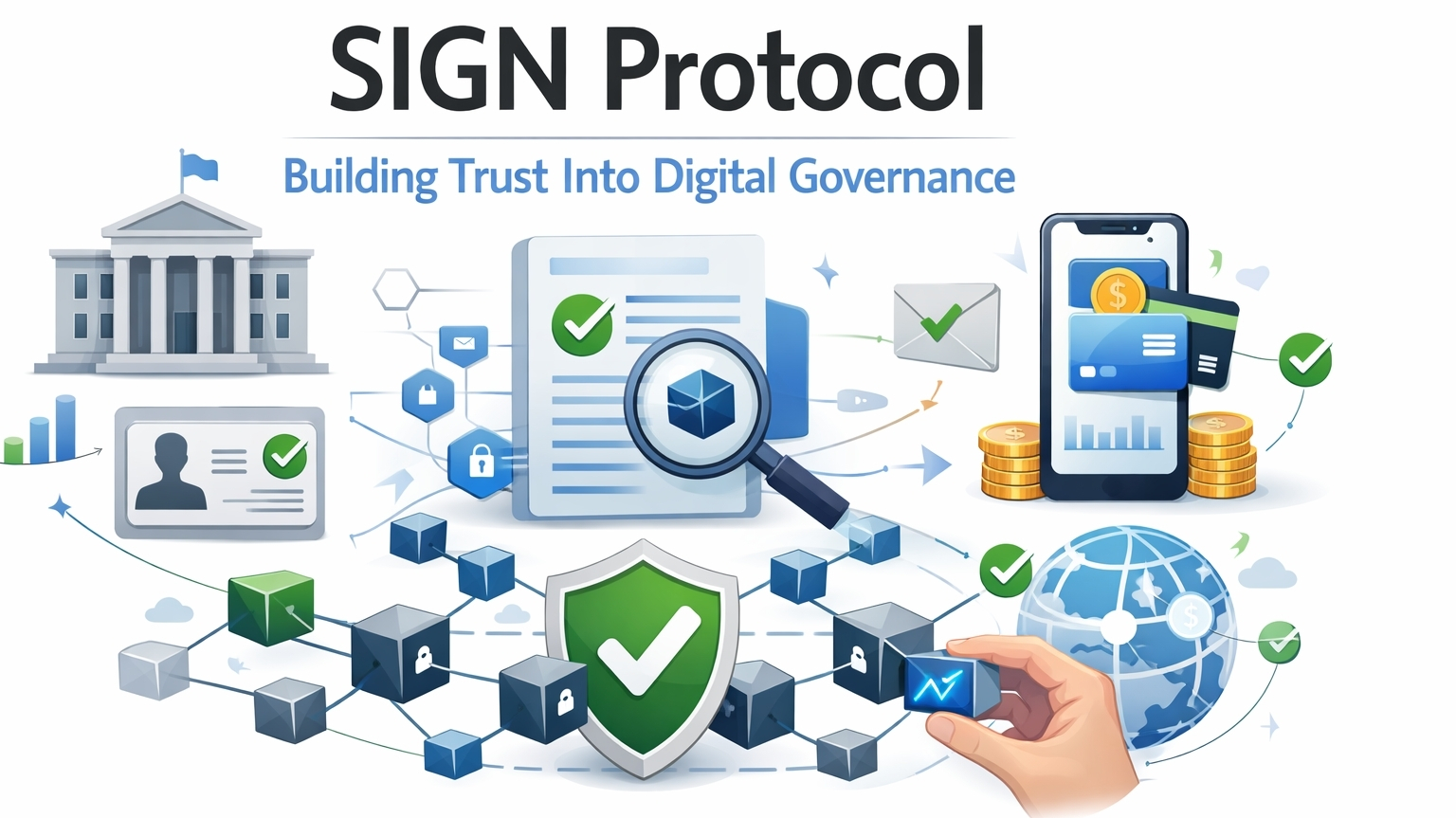
Article
SIGN Protocol: Building Trust Into Digital GovernanceSIGN Protocol feels different because it is not trying to impress people with noise first and meaning later. A lot of projects in this space come in loud. Big promises, big words, polished branding, but once you look under the surface, there is not much there besides another token narrative. SIGN does not really hit like that. The more you look at it, the more it feels like a project built around a real problem.
That problem is simple to understand. The digital world keeps expanding, but trust inside digital systems is still weak. Records are scattered. Verification is fragmented. One system says one thing, another says something else, and nobody is fully sure where the final truth sits. A document can be approved, a credential can be issued, a payment can be processed, but proving the full story behind it later is often harder than it should be. That is where SIGN starts to matter.
At the center of the project is the idea of attestations. That sounds technical at first, but the meaning is actually very human. It is about turning a claim into something that can be verified instead of just believed. A person, an institution, or a system says something is true, and that truth is structured, signed, and made usable across different environments. That changes the whole feeling of digital interaction. Instead of depending on closed databases and disconnected approvals, there is a clearer way to carry proof.
What makes SIGN stand out is that it is not only solving this for one app or one isolated use case. The project feels like it is thinking at a much larger level. Identity, credentials, payments, compliance, access, public records, digital capital — all of these things depend on trusted data. If the trust layer is weak, every other layer becomes shaky too. SIGN seems to understand that better than most. It is not just building tools. It is building the base logic that lets digital systems rely on each other without falling into chaos.
That is why the project feels more serious the longer you sit with it. It is not trying to decorate governance and make it look trendy. It is trying to make digital governance actually work. And that matters, because governance in the digital era is not just about elections or policy language. It is about how systems decide what is valid, who is eligible, what is approved, what can be checked, and what can be trusted later when questions come up. That is a hard layer to build. It is not flashy work. But it is the kind of work that lasts.
There is also something mature about the way SIGN approaches structure. It does not pretend the world is simple. Real systems need roles, accountability, revocation, audits, permissions, upgrades, boundaries. In other words, they need discipline. A lot of crypto projects try to skip that part and act like pure openness solves everything. It does not. In real life, systems break when nobody knows who is responsible or when proof cannot survive stress. SIGN seems built with that reality in mind. That alone gives the project more weight.
The identity side of SIGN is especially important. Digital identity has been talked about for years, but most approaches still feel shallow. They treat identity like a login feature instead of what it really is — the base layer for access, services, credentials, benefits, compliance, and participation. Once that layer is weak, everything built on top of it starts to wobble. SIGN gives the impression that identity should not just exist, it should be provable, reusable, and portable. That is a much stronger vision than the usual disconnected database model.
The payment and distribution angle makes the project even more interesting. In the real world, identity and money are deeply connected. Who gets paid, who qualifies, who has authority, who can receive benefits, who can prove ownership — none of that works smoothly if trust is broken at the record level. SIGN is valuable because it sits close to that pressure point. It is trying to make trusted coordination possible between systems that normally struggle to speak the same language. That is not a small ambition. It is actually one of the biggest infrastructure problems out there.
What I like most is that the project does not feel like it is chasing hype first. It feels like it is building something that institutions, governments, businesses, and digital ecosystems could actually use when things become more complex. And that is usually where real value lives. Not in whatever sounds exciting for one week, but in whatever keeps making sense when the attention cools down. SIGN has that kind of shape. The kind that becomes more relevant as the digital world grows more serious.
Of course, no project is automatically great just because the idea is strong. Execution still matters. Adoption matters. Integration matters. A framework can look smart on paper and still struggle in practice. That part is real, and it should never be ignored. But even with that in mind, SIGN still feels like one of the more thoughtful projects in this lane because it is trying to fix something fundamental. It is asking how digital systems can create proof that survives doubt, not just activity that looks impressive on a dashboard.
That is why the project leaves a stronger impression than a lot of louder names. It is not forcing a revolution story. It is working on trust infrastructure. And trust infrastructure is one of those things people ignore until they realize everything depends on it. Once identity, governance, credentials, and value all move deeper into digital rails, the systems underneath will need more than speed. They will need structure. They will need proof. They will need something that can be checked, reused, and trusted across environments.
That is the lane SIGN is moving in, and honestly, that is what gives the project real depth. It is not just building another crypto product. It is trying to build a foundation for how digital systems can function with more clarity, more accountability, and less blind trust. That makes it feel less like a trend and more like a serious long-term project.
#SignDigitalSovereignInfra @SignOfficial $SIGN
SIGN Protocol: Building Trust Into Digital Governance
SIGN Protocol feels different because it is not trying to impress people with noise first and meaning later. A lot of projects in this space come in loud. Big promises, big words, polished branding, but once you look under the surface, there is not much there besides another token narrative. SIGN does not really hit like that. The more you look at it, the more it feels like a project built around a real problem.
That problem is simple to understand. The digital world keeps expanding, but trust inside digital systems is still weak. Records are scattered. Verification is fragmented. One system says one thing, another says something else, and nobody is fully sure where the final truth sits. A document can be approved, a credential can be issued, a payment can be processed, but proving the full story behind it later is often harder than it should be. That is where SIGN starts to matter.
At the center of the project is the idea of attestations. That sounds technical at first, but the meaning is actually very human. It is about turning a claim into something that can be verified instead of just believed. A person, an institution, or a system says something is true, and that truth is structured, signed, and made usable across different environments. That changes the whole feeling of digital interaction. Instead of depending on closed databases and disconnected approvals, there is a clearer way to carry proof.
What makes SIGN stand out is that it is not only solving this for one app or one isolated use case. The project feels like it is thinking at a much larger level. Identity, credentials, payments, compliance, access, public records, digital capital — all of these things depend on trusted data. If the trust layer is weak, every other layer becomes shaky too. SIGN seems to understand that better than most. It is not just building tools. It is building the base logic that lets digital systems rely on each other without falling into chaos.
That is why the project feels more serious the longer you sit with it. It is not trying to decorate governance and make it look trendy. It is trying to make digital governance actually work. And that matters, because governance in the digital era is not just about elections or policy language. It is about how systems decide what is valid, who is eligible, what is approved, what can be checked, and what can be trusted later when questions come up. That is a hard layer to build. It is not flashy work. But it is the kind of work that lasts.
There is also something mature about the way SIGN approaches structure. It does not pretend the world is simple. Real systems need roles, accountability, revocation, audits, permissions, upgrades, boundaries. In other words, they need discipline. A lot of crypto projects try to skip that part and act like pure openness solves everything. It does not. In real life, systems break when nobody knows who is responsible or when proof cannot survive stress. SIGN seems built with that reality in mind. That alone gives the project more weight.
The identity side of SIGN is especially important. Digital identity has been talked about for years, but most approaches still feel shallow. They treat identity like a login feature instead of what it really is — the base layer for access, services, credentials, benefits, compliance, and participation. Once that layer is weak, everything built on top of it starts to wobble. SIGN gives the impression that identity should not just exist, it should be provable, reusable, and portable. That is a much stronger vision than the usual disconnected database model.
The payment and distribution angle makes the project even more interesting. In the real world, identity and money are deeply connected. Who gets paid, who qualifies, who has authority, who can receive benefits, who can prove ownership — none of that works smoothly if trust is broken at the record level. SIGN is valuable because it sits close to that pressure point. It is trying to make trusted coordination possible between systems that normally struggle to speak the same language. That is not a small ambition. It is actually one of the biggest infrastructure problems out there.
What I like most is that the project does not feel like it is chasing hype first. It feels like it is building something that institutions, governments, businesses, and digital ecosystems could actually use when things become more complex. And that is usually where real value lives. Not in whatever sounds exciting for one week, but in whatever keeps making sense when the attention cools down. SIGN has that kind of shape. The kind that becomes more relevant as the digital world grows more serious.
Of course, no project is automatically great just because the idea is strong. Execution still matters. Adoption matters. Integration matters. A framework can look smart on paper and still struggle in practice. That part is real, and it should never be ignored. But even with that in mind, SIGN still feels like one of the more thoughtful projects in this lane because it is trying to fix something fundamental. It is asking how digital systems can create proof that survives doubt, not just activity that looks impressive on a dashboard.
That is why the project leaves a stronger impression than a lot of louder names. It is not forcing a revolution story. It is working on trust infrastructure. And trust infrastructure is one of those things people ignore until they realize everything depends on it. Once identity, governance, credentials, and value all move deeper into digital rails, the systems underneath will need more than speed. They will need structure. They will need proof. They will need something that can be checked, reused, and trusted across environments.
That is the lane SIGN is moving in, and honestly, that is what gives the project real depth. It is not just building another crypto product. It is trying to build a foundation for how digital systems can function with more clarity, more accountability, and less blind trust. That makes it feel less like a trend and more like a serious long-term project.
#SignDigitalSovereignInfra @SignOfficial $SIGN
That problem is simple to understand. The digital world keeps expanding, but trust inside digital systems is still weak. Records are scattered. Verification is fragmented. One system says one thing, another says something else, and nobody is fully sure where the final truth sits. A document can be approved, a credential can be issued, a payment can be processed, but proving the full story behind it later is often harder than it should be. That is where SIGN starts to matter.
At the center of the project is the idea of attestations. That sounds technical at first, but the meaning is actually very human. It is about turning a claim into something that can be verified instead of just believed. A person, an institution, or a system says something is true, and that truth is structured, signed, and made usable across different environments. That changes the whole feeling of digital interaction. Instead of depending on closed databases and disconnected approvals, there is a clearer way to carry proof.
What makes SIGN stand out is that it is not only solving this for one app or one isolated use case. The project feels like it is thinking at a much larger level. Identity, credentials, payments, compliance, access, public records, digital capital — all of these things depend on trusted data. If the trust layer is weak, every other layer becomes shaky too. SIGN seems to understand that better than most. It is not just building tools. It is building the base logic that lets digital systems rely on each other without falling into chaos.
That is why the project feels more serious the longer you sit with it. It is not trying to decorate governance and make it look trendy. It is trying to make digital governance actually work. And that matters, because governance in the digital era is not just about elections or policy language. It is about how systems decide what is valid, who is eligible, what is approved, what can be checked, and what can be trusted later when questions come up. That is a hard layer to build. It is not flashy work. But it is the kind of work that lasts.
There is also something mature about the way SIGN approaches structure. It does not pretend the world is simple. Real systems need roles, accountability, revocation, audits, permissions, upgrades, boundaries. In other words, they need discipline. A lot of crypto projects try to skip that part and act like pure openness solves everything. It does not. In real life, systems break when nobody knows who is responsible or when proof cannot survive stress. SIGN seems built with that reality in mind. That alone gives the project more weight.
The identity side of SIGN is especially important. Digital identity has been talked about for years, but most approaches still feel shallow. They treat identity like a login feature instead of what it really is — the base layer for access, services, credentials, benefits, compliance, and participation. Once that layer is weak, everything built on top of it starts to wobble. SIGN gives the impression that identity should not just exist, it should be provable, reusable, and portable. That is a much stronger vision than the usual disconnected database model.
The payment and distribution angle makes the project even more interesting. In the real world, identity and money are deeply connected. Who gets paid, who qualifies, who has authority, who can receive benefits, who can prove ownership — none of that works smoothly if trust is broken at the record level. SIGN is valuable because it sits close to that pressure point. It is trying to make trusted coordination possible between systems that normally struggle to speak the same language. That is not a small ambition. It is actually one of the biggest infrastructure problems out there.
What I like most is that the project does not feel like it is chasing hype first. It feels like it is building something that institutions, governments, businesses, and digital ecosystems could actually use when things become more complex. And that is usually where real value lives. Not in whatever sounds exciting for one week, but in whatever keeps making sense when the attention cools down. SIGN has that kind of shape. The kind that becomes more relevant as the digital world grows more serious.
Of course, no project is automatically great just because the idea is strong. Execution still matters. Adoption matters. Integration matters. A framework can look smart on paper and still struggle in practice. That part is real, and it should never be ignored. But even with that in mind, SIGN still feels like one of the more thoughtful projects in this lane because it is trying to fix something fundamental. It is asking how digital systems can create proof that survives doubt, not just activity that looks impressive on a dashboard.
That is why the project leaves a stronger impression than a lot of louder names. It is not forcing a revolution story. It is working on trust infrastructure. And trust infrastructure is one of those things people ignore until they realize everything depends on it. Once identity, governance, credentials, and value all move deeper into digital rails, the systems underneath will need more than speed. They will need structure. They will need proof. They will need something that can be checked, reused, and trusted across environments.
That is the lane SIGN is moving in, and honestly, that is what gives the project real depth. It is not just building another crypto product. It is trying to build a foundation for how digital systems can function with more clarity, more accountability, and less blind trust. That makes it feel less like a trend and more like a serious long-term project.
#SignDigitalSovereignInfra @SignOfficial $SIGN
9
13
625

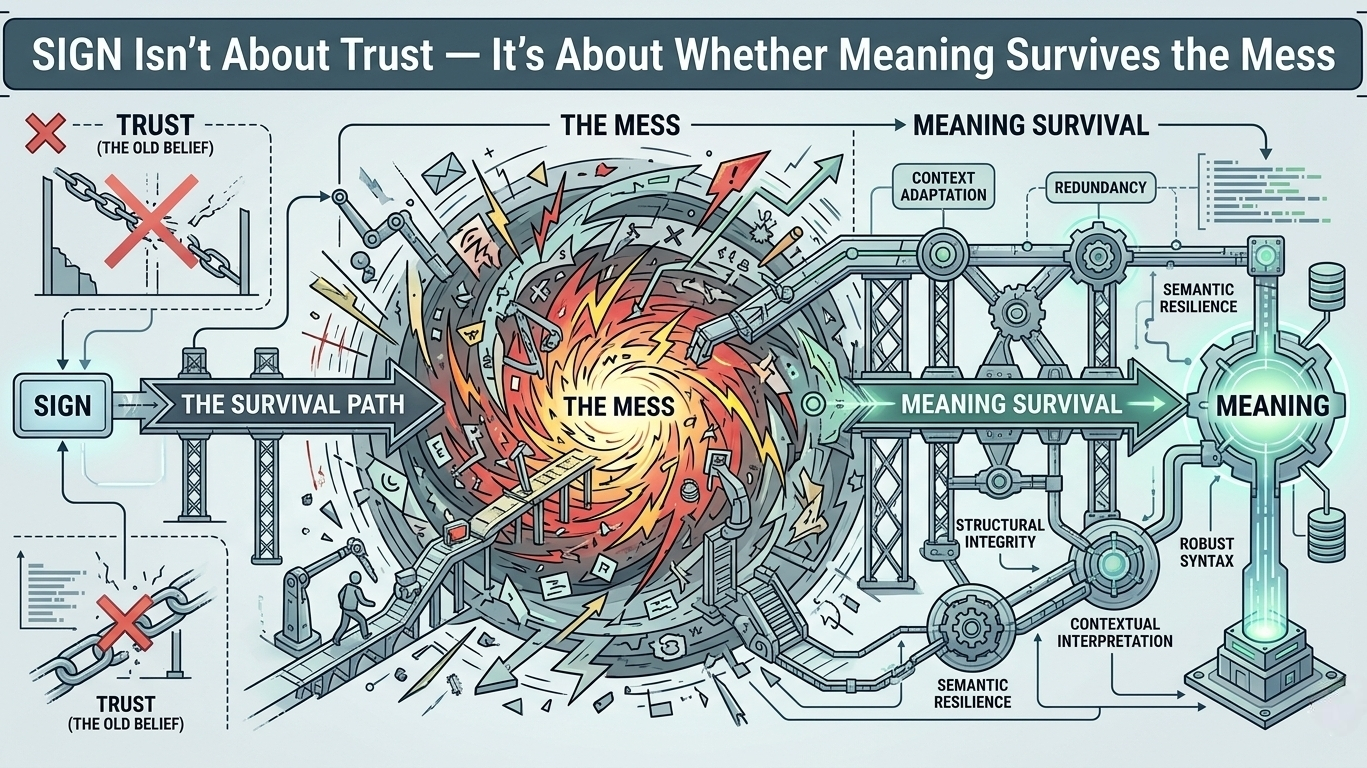
Article
SIGN Isn’t About Trust It’s About Whether Meaning Survives the MessLook, I’ll be honest. The market is exhausted.
Every other project talks about “trust,” “identity,” “coordination.” I’ve seen this movie before. Same script, different logo. And yeah, it sounds smart at first… until you actually try to use these systems and everything starts breaking in weird, quiet ways.
Data doesn’t move cleanly. Credentials don’t mean the same thing everywhere. And suddenly all that “composable infrastructure” talk? It falls apart.
So when something like SIGN shows up positioning itself as infrastructure for credential verification and token distribution I don’t get excited. I get suspicious. That’s just how this space trains you.
Because the idea itself isn’t new. Not even close.
But here’s where it gets interesting… and also messy.
The first thing people don’t talk about enough is this: a credential and a token distribution are not the same thing. Not even remotely.
A credential is basically someone saying, “yeah, this person qualifies.”
A distribution is actually giving them something of value.
Simple, right? You’d think.
But most systems just mash these together like it’s one clean pipeline prove something → get tokens. Done.
That’s lazy thinking. Honestly.
Because in real life, eligibility changes. Issuers aren’t always reliable. And sometimes… even if someone qualifies, they still don’t get anything. Policies, timing, funding there’s always something.
If SIGN treats these two layers like they’re identical, that’s a crack in the foundation. A big one.
Now let’s talk about the real problem. Not storage. Not speed.
Meaning.
Yeah, meaning. The thing nobody builds for.
A credential isn’t just data sitting somewhere. It’s a claim. And that claim comes with baggage:
Who issued it?
Under what rules?
At what time?
And who actually trusts that issuer?
Move that credential somewhere else and boom, half that context disappears.
I’ve seen this happen over and over. A proof that made total sense in one system suddenly looks useless somewhere else. Not because it’s wrong… but because nobody knows how to interpret it anymore.
That’s what I call proof decay. And it’s everywhere.
So the real question for SIGN isn’t “can you verify something?”
That part’s easy.
The real question is: can that meaning survive travel?
Because if it can’t, then what’s the point?
And then there’s the real world. Which, let’s be real, is a mess.
People lose wallets.
They reuse identities.
They forget things.
Institutions? Even worse. Inconsistent, slow, sometimes just wrong.
Records aren’t clean. They’re incomplete. Sometimes duplicated. Sometimes outdated.
This is the environment SIGN has to live in.
Not a perfect, trustless fantasy. Chaos.
So yeah, I start asking uncomfortable questions:
What happens when a credential needs to be revoked… but it’s already everywhere?
What if two issuers say opposite things about the same person?
What if someone only has half the credentials they need?
What stops someone from reusing a valid claim in a totally different context?
These aren’t edge cases. This is normal behavior.
If SIGN doesn’t handle this stuff, it won’t fail loudly. It’ll fail quietly. And that’s worse.
Another thing that bugs me and it happens a lot in Web3 is how people flatten everything into “proofs.”
Not all data is the same. Not even close.
A signed agreement? That’s a commitment between parties. Context-heavy. Legal implications.
A credential? That’s just a claim about someone. Might expire. Might get revoked.
A token distribution record? That’s history. It happened. Done.
Three completely different things.
But systems love to treat them like identical Lego blocks. Plug and play.
Bad idea.
You end up with weird situations like treating a temporary credential as permanent truth, or assuming a financial transaction somehow proves legitimacy.
It doesn’t.
If SIGN can’t keep these categories separate, things will get confusing fast. And confusion in financial systems? Yeah… that’s where problems start.
Now let’s get into token distribution, because this is where things usually break.
Most people think distribution is just logistics. Who gets what.
It’s not.
It’s a verification problem. And honestly, it’s kind of adversarial.
Airdrops, grants, incentives they fail all the time. Not because the system can’t send tokens, but because it can’t define who actually deserves them.
SIGN tries to flip this by focusing on claims instead of addresses.
That’s smart. I’ll give it that.
Instead of “this wallet gets tokens,” it’s more like “this person qualifies based on these proofs.”
But here’s the catch.
The more precise you make those rules, the harder they are to understand. And if people can’t understand why they qualify or don’t they stop trusting the system.
And then you get gaming.
People don’t contribute real value. They just optimize for the criteria. Farm the credentials. Hit the checklist.
You’ve seen it. I’ve seen it.
So yeah, better verification helps… but it doesn’t magically fix behavior.
There’s also the time problem. Nobody wants to deal with this, but it matters.
Every credential expires. Or at least, it should.
Something that was true last year might not be true today. But systems love to treat proofs like they’re eternal.
They’re not.
If SIGN doesn’t build in time like actual expiration, renewal, context awareness it’s just going to collect stale claims. And over time, those claims start misleading people.
That’s how trust quietly erodes.
So where does that leave us?
Honestly… somewhere in the middle.
I’m not dismissing SIGN. There’s something here. The focus on claims, on portability, on tying verification to distribution it’s directionally right.
But direction isn’t enough.
If this turns into just another attestation layer, it’ll fade into the background. We’ve got plenty of those already.
If it tries to force rigid standards, institutions won’t play along. They never do.
And if it ignores how messy the real world is, it’ll break the moment it scales.
But if and it’s a big if it manages to carry meaning across systems… not just data, but actual meaning, with context, constraints, and time baked in?
That’s different.
That’s not exciting. It’s not flashy. Nobody’s going to hype it on a bull run.
But it’s useful. Quietly useful.
And when the noise dies down and it always does systems that preserve order tend to stick around.
Everything else?
It just adds to the pile of things that almost worked.
#SignDigitalSovereignInfra @SignOfficial $SIGN
{future}(SIGNUSDT)
SIGN Isn’t About Trust It’s About Whether Meaning Survives the Mess
Look, I’ll be honest. The market is exhausted.
Every other project talks about “trust,” “identity,” “coordination.” I’ve seen this movie before. Same script, different logo. And yeah, it sounds smart at first… until you actually try to use these systems and everything starts breaking in weird, quiet ways.
Data doesn’t move cleanly. Credentials don’t mean the same thing everywhere. And suddenly all that “composable infrastructure” talk? It falls apart.
So when something like SIGN shows up positioning itself as infrastructure for credential verification and token distribution I don’t get excited. I get suspicious. That’s just how this space trains you.
Because the idea itself isn’t new. Not even close.
But here’s where it gets interesting… and also messy.
The first thing people don’t talk about enough is this: a credential and a token distribution are not the same thing. Not even remotely.
A credential is basically someone saying, “yeah, this person qualifies.”
A distribution is actually giving them something of value.
Simple, right? You’d think.
But most systems just mash these together like it’s one clean pipeline prove something → get tokens. Done.
That’s lazy thinking. Honestly.
Because in real life, eligibility changes. Issuers aren’t always reliable. And sometimes… even if someone qualifies, they still don’t get anything. Policies, timing, funding there’s always something.
If SIGN treats these two layers like they’re identical, that’s a crack in the foundation. A big one.
Now let’s talk about the real problem. Not storage. Not speed.
Meaning.
Yeah, meaning. The thing nobody builds for.
A credential isn’t just data sitting somewhere. It’s a claim. And that claim comes with baggage:
Who issued it?
Under what rules?
At what time?
And who actually trusts that issuer?
Move that credential somewhere else and boom, half that context disappears.
I’ve seen this happen over and over. A proof that made total sense in one system suddenly looks useless somewhere else. Not because it’s wrong… but because nobody knows how to interpret it anymore.
That’s what I call proof decay. And it’s everywhere.
So the real question for SIGN isn’t “can you verify something?”
That part’s easy.
The real question is: can that meaning survive travel?
Because if it can’t, then what’s the point?
And then there’s the real world. Which, let’s be real, is a mess.
People lose wallets.
They reuse identities.
They forget things.
Institutions? Even worse. Inconsistent, slow, sometimes just wrong.
Records aren’t clean. They’re incomplete. Sometimes duplicated. Sometimes outdated.
This is the environment SIGN has to live in.
Not a perfect, trustless fantasy. Chaos.
So yeah, I start asking uncomfortable questions:
What happens when a credential needs to be revoked… but it’s already everywhere?
What if two issuers say opposite things about the same person?
What if someone only has half the credentials they need?
What stops someone from reusing a valid claim in a totally different context?
These aren’t edge cases. This is normal behavior.
If SIGN doesn’t handle this stuff, it won’t fail loudly. It’ll fail quietly. And that’s worse.
Another thing that bugs me and it happens a lot in Web3 is how people flatten everything into “proofs.”
Not all data is the same. Not even close.
A signed agreement? That’s a commitment between parties. Context-heavy. Legal implications.
A credential? That’s just a claim about someone. Might expire. Might get revoked.
A token distribution record? That’s history. It happened. Done.
Three completely different things.
But systems love to treat them like identical Lego blocks. Plug and play.
Bad idea.
You end up with weird situations like treating a temporary credential as permanent truth, or assuming a financial transaction somehow proves legitimacy.
It doesn’t.
If SIGN can’t keep these categories separate, things will get confusing fast. And confusion in financial systems? Yeah… that’s where problems start.
Now let’s get into token distribution, because this is where things usually break.
Most people think distribution is just logistics. Who gets what.
It’s not.
It’s a verification problem. And honestly, it’s kind of adversarial.
Airdrops, grants, incentives they fail all the time. Not because the system can’t send tokens, but because it can’t define who actually deserves them.
SIGN tries to flip this by focusing on claims instead of addresses.
That’s smart. I’ll give it that.
Instead of “this wallet gets tokens,” it’s more like “this person qualifies based on these proofs.”
But here’s the catch.
The more precise you make those rules, the harder they are to understand. And if people can’t understand why they qualify or don’t they stop trusting the system.
And then you get gaming.
People don’t contribute real value. They just optimize for the criteria. Farm the credentials. Hit the checklist.
You’ve seen it. I’ve seen it.
So yeah, better verification helps… but it doesn’t magically fix behavior.
There’s also the time problem. Nobody wants to deal with this, but it matters.
Every credential expires. Or at least, it should.
Something that was true last year might not be true today. But systems love to treat proofs like they’re eternal.
They’re not.
If SIGN doesn’t build in time like actual expiration, renewal, context awareness it’s just going to collect stale claims. And over time, those claims start misleading people.
That’s how trust quietly erodes.
So where does that leave us?
Honestly… somewhere in the middle.
I’m not dismissing SIGN. There’s something here. The focus on claims, on portability, on tying verification to distribution it’s directionally right.
But direction isn’t enough.
If this turns into just another attestation layer, it’ll fade into the background. We’ve got plenty of those already.
If it tries to force rigid standards, institutions won’t play along. They never do.
And if it ignores how messy the real world is, it’ll break the moment it scales.
But if and it’s a big if it manages to carry meaning across systems… not just data, but actual meaning, with context, constraints, and time baked in?
That’s different.
That’s not exciting. It’s not flashy. Nobody’s going to hype it on a bull run.
But it’s useful. Quietly useful.
And when the noise dies down and it always does systems that preserve order tend to stick around.
Everything else?
It just adds to the pile of things that almost worked.
#SignDigitalSovereignInfra @SignOfficial $SIGN
Every other project talks about “trust,” “identity,” “coordination.” I’ve seen this movie before. Same script, different logo. And yeah, it sounds smart at first… until you actually try to use these systems and everything starts breaking in weird, quiet ways.
Data doesn’t move cleanly. Credentials don’t mean the same thing everywhere. And suddenly all that “composable infrastructure” talk? It falls apart.
So when something like SIGN shows up positioning itself as infrastructure for credential verification and token distribution I don’t get excited. I get suspicious. That’s just how this space trains you.
Because the idea itself isn’t new. Not even close.
But here’s where it gets interesting… and also messy.
The first thing people don’t talk about enough is this: a credential and a token distribution are not the same thing. Not even remotely.
A credential is basically someone saying, “yeah, this person qualifies.”
A distribution is actually giving them something of value.
Simple, right? You’d think.
But most systems just mash these together like it’s one clean pipeline prove something → get tokens. Done.
That’s lazy thinking. Honestly.
Because in real life, eligibility changes. Issuers aren’t always reliable. And sometimes… even if someone qualifies, they still don’t get anything. Policies, timing, funding there’s always something.
If SIGN treats these two layers like they’re identical, that’s a crack in the foundation. A big one.
Now let’s talk about the real problem. Not storage. Not speed.
Meaning.
Yeah, meaning. The thing nobody builds for.
A credential isn’t just data sitting somewhere. It’s a claim. And that claim comes with baggage:
Who issued it?
Under what rules?
At what time?
And who actually trusts that issuer?
Move that credential somewhere else and boom, half that context disappears.
I’ve seen this happen over and over. A proof that made total sense in one system suddenly looks useless somewhere else. Not because it’s wrong… but because nobody knows how to interpret it anymore.
That’s what I call proof decay. And it’s everywhere.
So the real question for SIGN isn’t “can you verify something?”
That part’s easy.
The real question is: can that meaning survive travel?
Because if it can’t, then what’s the point?
And then there’s the real world. Which, let’s be real, is a mess.
People lose wallets.
They reuse identities.
They forget things.
Institutions? Even worse. Inconsistent, slow, sometimes just wrong.
Records aren’t clean. They’re incomplete. Sometimes duplicated. Sometimes outdated.
This is the environment SIGN has to live in.
Not a perfect, trustless fantasy. Chaos.
So yeah, I start asking uncomfortable questions:
What happens when a credential needs to be revoked… but it’s already everywhere?
What if two issuers say opposite things about the same person?
What if someone only has half the credentials they need?
What stops someone from reusing a valid claim in a totally different context?
These aren’t edge cases. This is normal behavior.
If SIGN doesn’t handle this stuff, it won’t fail loudly. It’ll fail quietly. And that’s worse.
Another thing that bugs me and it happens a lot in Web3 is how people flatten everything into “proofs.”
Not all data is the same. Not even close.
A signed agreement? That’s a commitment between parties. Context-heavy. Legal implications.
A credential? That’s just a claim about someone. Might expire. Might get revoked.
A token distribution record? That’s history. It happened. Done.
Three completely different things.
But systems love to treat them like identical Lego blocks. Plug and play.
Bad idea.
You end up with weird situations like treating a temporary credential as permanent truth, or assuming a financial transaction somehow proves legitimacy.
It doesn’t.
If SIGN can’t keep these categories separate, things will get confusing fast. And confusion in financial systems? Yeah… that’s where problems start.
Now let’s get into token distribution, because this is where things usually break.
Most people think distribution is just logistics. Who gets what.
It’s not.
It’s a verification problem. And honestly, it’s kind of adversarial.
Airdrops, grants, incentives they fail all the time. Not because the system can’t send tokens, but because it can’t define who actually deserves them.
SIGN tries to flip this by focusing on claims instead of addresses.
That’s smart. I’ll give it that.
Instead of “this wallet gets tokens,” it’s more like “this person qualifies based on these proofs.”
But here’s the catch.
The more precise you make those rules, the harder they are to understand. And if people can’t understand why they qualify or don’t they stop trusting the system.
And then you get gaming.
People don’t contribute real value. They just optimize for the criteria. Farm the credentials. Hit the checklist.
You’ve seen it. I’ve seen it.
So yeah, better verification helps… but it doesn’t magically fix behavior.
There’s also the time problem. Nobody wants to deal with this, but it matters.
Every credential expires. Or at least, it should.
Something that was true last year might not be true today. But systems love to treat proofs like they’re eternal.
They’re not.
If SIGN doesn’t build in time like actual expiration, renewal, context awareness it’s just going to collect stale claims. And over time, those claims start misleading people.
That’s how trust quietly erodes.
So where does that leave us?
Honestly… somewhere in the middle.
I’m not dismissing SIGN. There’s something here. The focus on claims, on portability, on tying verification to distribution it’s directionally right.
But direction isn’t enough.
If this turns into just another attestation layer, it’ll fade into the background. We’ve got plenty of those already.
If it tries to force rigid standards, institutions won’t play along. They never do.
And if it ignores how messy the real world is, it’ll break the moment it scales.
But if and it’s a big if it manages to carry meaning across systems… not just data, but actual meaning, with context, constraints, and time baked in?
That’s different.
That’s not exciting. It’s not flashy. Nobody’s going to hype it on a bull run.
But it’s useful. Quietly useful.
And when the noise dies down and it always does systems that preserve order tend to stick around.
Everything else?
It just adds to the pile of things that almost worked.
#SignDigitalSovereignInfra @SignOfficial $SIGN
56
32
543

·
--
Haussier
Crypto feels repetitive lately.
New chain
New narrative
Same underlying problems
We built speed.
But not structure.
Identity is fragmented
Credentials don’t transfer
Token distribution is still messy
Airdrops get farmed
Sybil attacks scale
Systems break when real users show up
$SIGN isn’t trying to be loud.
It’s working on: Credential verification
Structured distribution
The boring layer.
The one nobody notices until it fails.
If this works, it becomes invisible infrastructure.
If it doesn’t, it stays niche.
Either way, this is where real problems are being solved.
#Sign #Web3 #crypto
#signdigitalsovereigninfra $SIGN
{future}(SIGNUSDT)
Crypto feels repetitive lately.
New chain
New narrative
Same underlying problems
We built speed.
But not structure.
Identity is fragmented
Credentials don’t transfer
Token distribution is still messy
Airdrops get farmed
Sybil attacks scale
Systems break when real users show up
$SIGN isn’t trying to be loud.
It’s working on: Credential verification
Structured distribution
The boring layer.
The one nobody notices until it fails.
If this works, it becomes invisible infrastructure.
If it doesn’t, it stays niche.
Either way, this is where real problems are being solved.
#Sign #Web3 #crypto
#signdigitalsovereigninfra $SIGN
New chain
New narrative
Same underlying problems
We built speed.
But not structure.
Identity is fragmented
Credentials don’t transfer
Token distribution is still messy
Airdrops get farmed
Sybil attacks scale
Systems break when real users show up
$SIGN isn’t trying to be loud.
It’s working on: Credential verification
Structured distribution
The boring layer.
The one nobody notices until it fails.
If this works, it becomes invisible infrastructure.
If it doesn’t, it stays niche.
Either way, this is where real problems are being solved.
#Sign #Web3 #crypto
#signdigitalsovereigninfra $SIGN
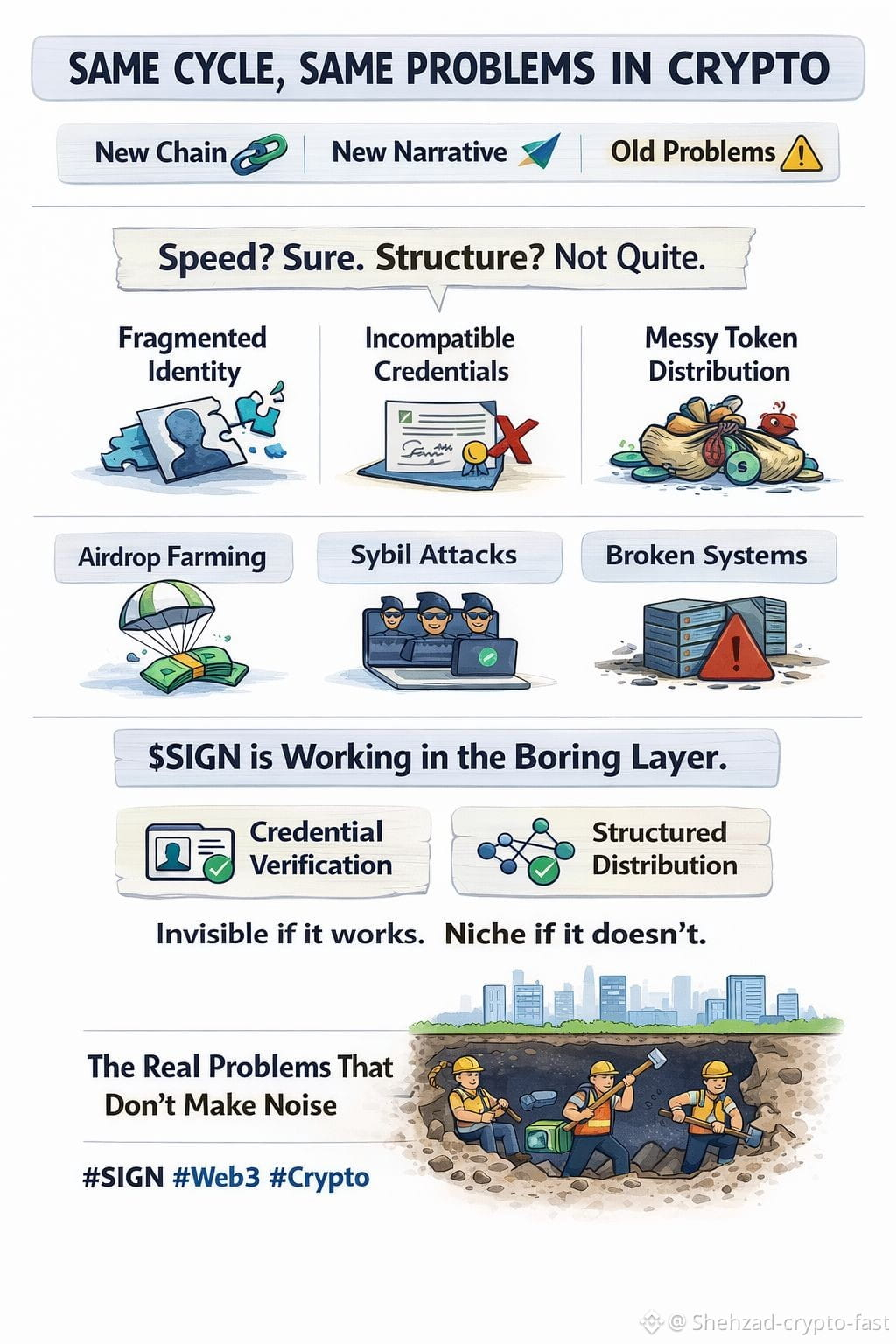
1
2
437
Connectez-vous pour découvrir plus de contenu
Rejoignez la communauté mondiale des adeptes de cryptomonnaies sur Binance Square
⚡️ Suviez les dernières informations importantes sur les cryptomonnaies.
💬 Jugé digne de confiance par la plus grande plateforme d’échange de cryptomonnaies au monde.
👍 Découvrez les connaissances que partagent les créateurs vérifiés.
Adresse e-mail/Nº de téléphone
Cryptos associées
Sujets d’actualité
1
#BinanceLaunchesBinanceIntelligence
27,379 vues
335 mentions
2
#EvernorthXRPTreasuryCompletesSPACMerger
23,370 vues
231 mentions
3
#ADAGains10%Above$0.27
29,279 vues
200 mentions
4
#ETHUp70%InQ3ButLiquidityFalls
218,865 vues
1,318 mentions
5
#EthStakingExitQueueHits2026High
80,714 vues
898 mentions
6
#FedOctoberHoldOdds82.3%
80,969 vues
884 mentions
7
#Nikkei225Jumps2.5%ToThreeMonthHigh
93,149 vues
1,212 mentions
8
#CircleMints$2.75BUSDCOnSolanaIn7Days
2,510 vues
53 mentions
9
#DriftHackVictimsBeginClaims
195,978 vues
1,862 mentions
10
#SolanaTokenizedStockVolumeTops$4.4BInSeptember
14,584 vues
136 mentions