

#acurast
acurast
94,492 vues
228 mentions
Populaire
Récents


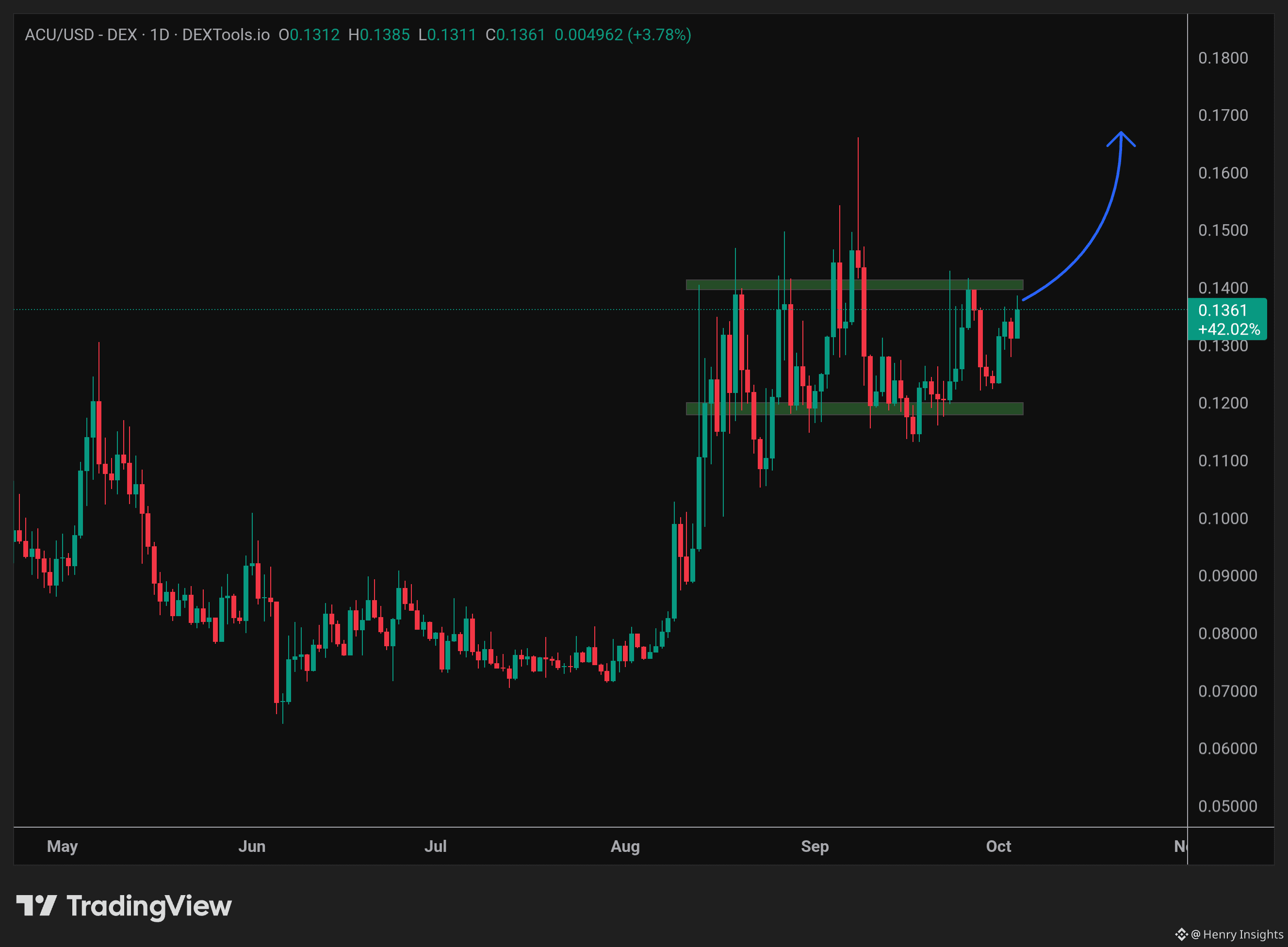
$ACU looking primed for expansion.
The Razor Navigator is flashing strong bullish confluence across timeframes:
🔹 State: Bullish (HTF Bull)
🔹 Power / TQI: 74% / 72% Strong
🔹 Regime: Trending
Entry: 0.13079
TP1: 0.13995
TP2: 0.14758
TP3: 0.15673
SL: 0.11553
Price is bouncing clean off entry and pushing up toward TP1. Momentum looks solid.
#ACUSDT #Acurast
$ACU looking primed for expansion.
The Razor Navigator is flashing strong bullish confluence across timeframes:
🔹 State: Bullish (HTF Bull)
🔹 Power / TQI: 74% / 72% Strong
🔹 Regime: Trending
Entry: 0.13079
TP1: 0.13995
TP2: 0.14758
TP3: 0.15673
SL: 0.11553
Price is bouncing clean off entry and pushing up toward TP1. Momentum looks solid.
#ACUSDT #Acurast
The Razor Navigator is flashing strong bullish confluence across timeframes:
🔹 State: Bullish (HTF Bull)
🔹 Power / TQI: 74% / 72% Strong
🔹 Regime: Trending
Entry: 0.13079
TP1: 0.13995
TP2: 0.14758
TP3: 0.15673
SL: 0.11553
Price is bouncing clean off entry and pushing up toward TP1. Momentum looks solid.
#ACUSDT #Acurast
2
222

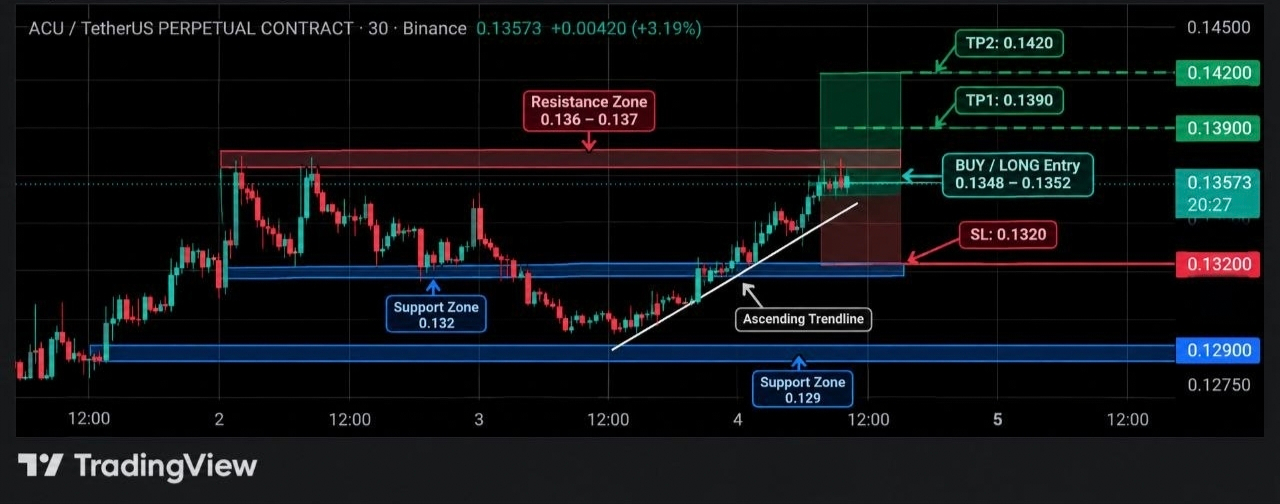
$ACU is quietly building something interesting.
After bouncing from the $0.129 area, price has pushed back toward $0.136 and buyers keep defending the dips. The higher-low structure is what catches my attention here.
Now I’m watching the $0.137–$0.138 zone closely.
Hold $0.136 → reclaim $0.138 → $0.140 becomes the first test, with $0.145 opening up if momentum follows through.
Not calling a breakout yet. I want to see buyers prove it before chasing.
$ACU DYOR.
Ref: x3snmv
#Acurast
$ACU is quietly building something interesting.
After bouncing from the $0.129 area, price has pushed back toward $0.136 and buyers keep defending the dips. The higher-low structure is what catches my attention here.
Now I’m watching the $0.137–$0.138 zone closely.
Hold $0.136 → reclaim $0.138 → $0.140 becomes the first test, with $0.145 opening up if momentum follows through.
Not calling a breakout yet. I want to see buyers prove it before chasing.
$ACU DYOR.
Ref: x3snmv
#Acurast
After bouncing from the $0.129 area, price has pushed back toward $0.136 and buyers keep defending the dips. The higher-low structure is what catches my attention here.
Now I’m watching the $0.137–$0.138 zone closely.
Hold $0.136 → reclaim $0.138 → $0.140 becomes the first test, with $0.145 opening up if momentum follows through.
Not calling a breakout yet. I want to see buyers prove it before chasing.
$ACU DYOR.
Ref: x3snmv
#Acurast
BLOCK_SIPER:
That $0.129 bounce was stronger than I expected. $0.138 is the next real checkpoint.
19
21
576

·
--
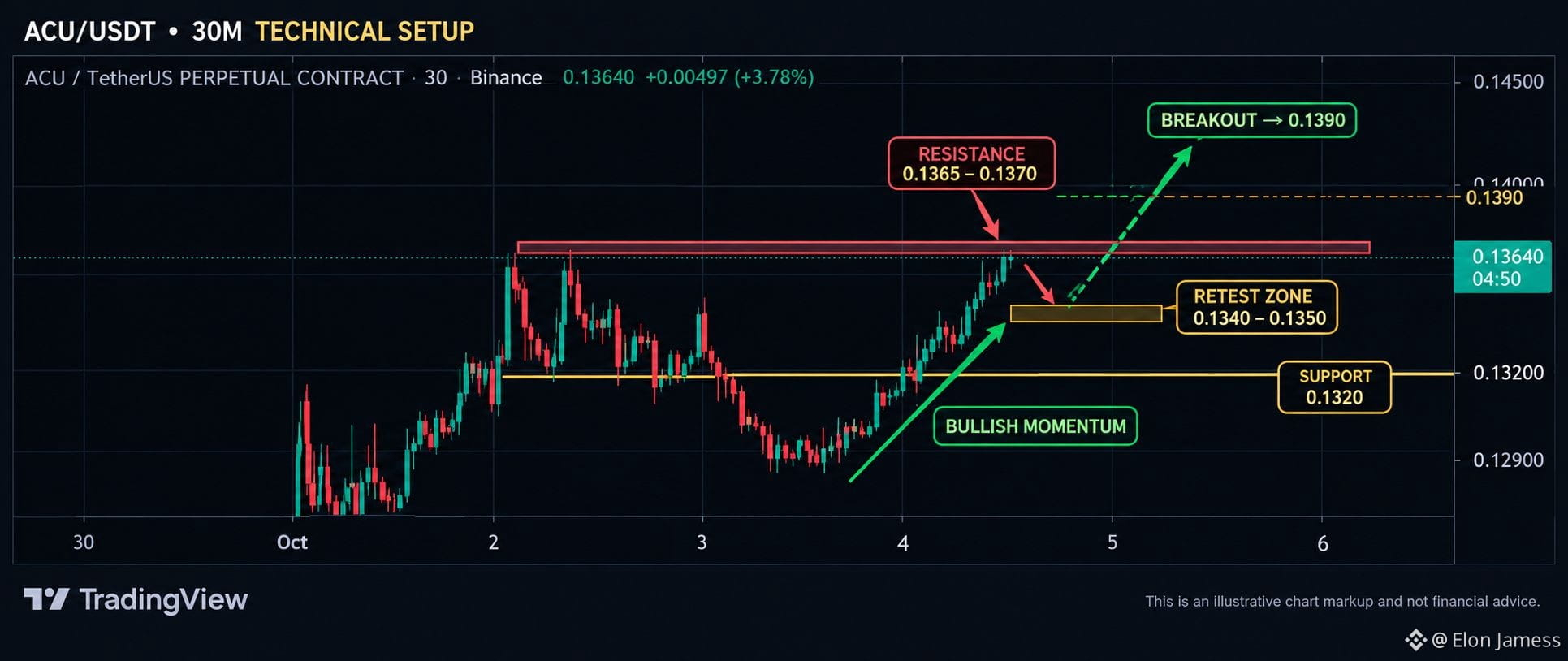
$ACU is starting to look bullish here.
Price has recovered strongly from the $0.129 area and is now trading around $0.136.
The structure is showing steady higher lows with buyers stepping in on every dip.
→ Hold above $0.136
→ Break above $0.137–$0.138
→ Next area to watch: $0.140 → $0.145
Momentum is building, but I’d still wait for confirmation instead of chasing the move.
$ACU DYOR.
Ref: yix56m
#Acurast
$ACU is starting to look bullish here.
Price has recovered strongly from the $0.129 area and is now trading around $0.136.
The structure is showing steady higher lows with buyers stepping in on every dip.
→ Hold above $0.136
→ Break above $0.137–$0.138
→ Next area to watch: $0.140 → $0.145
Momentum is building, but I’d still wait for confirmation instead of chasing the move.
$ACU DYOR.
Ref: yix56m
#Acurast
Price has recovered strongly from the $0.129 area and is now trading around $0.136.
The structure is showing steady higher lows with buyers stepping in on every dip.
→ Hold above $0.136
→ Break above $0.137–$0.138
→ Next area to watch: $0.140 → $0.145
Momentum is building, but I’d still wait for confirmation instead of chasing the move.
$ACU DYOR.
Ref: yix56m
#Acurast
N O R A 莉莎:
$ACU is building nicely here. Higher lows + steady dip buying make the $0.138 breakout the key confirmation.
51
3
20
753

·
--
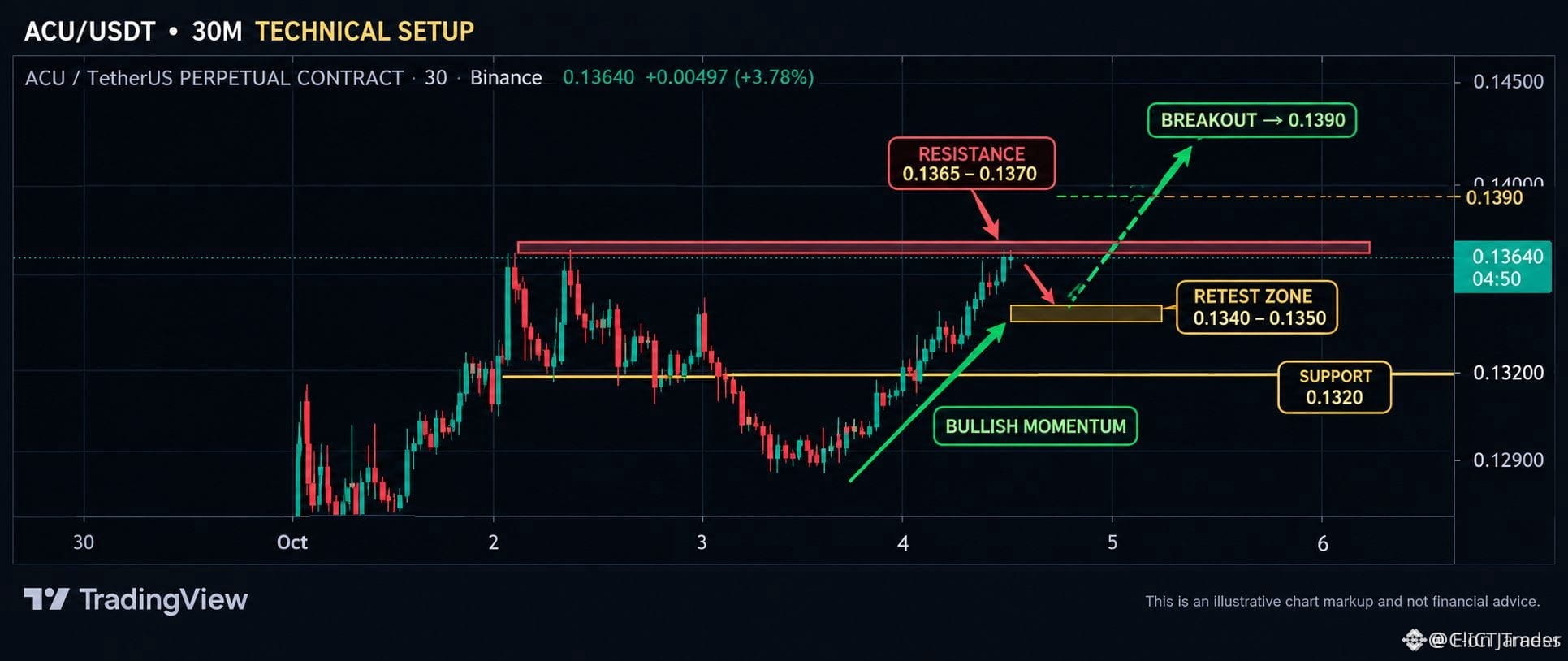
🚨 $ACU RECLAIMS KEY DEMAND ZONE AS INSTITUTIONAL ACCUMULATION BUILDS FOR BREAKOUT 📈
Entry: 0.136 ⚡
Target: 0.145 🚀
After a clean liquidity sweep down to $0.129, $ACU has established a crisp structural shift with aggressive dip-buying forming consistent higher lows around $0.136. 📊 Smart money flow is quietly absorbing sell-side inefficiency, keeping price compressed beneath the $0.137–$0.138 order block.
💡 A confirmed structural reclaim above $0.138 opens a direct path toward the $0.140 and $0.145 liquidity pools. Patience remains critical—await momentum confirmation on the breakout rather than chasing execution inside the range. 🔍
💬 Are you waiting for the $0.138 breakout confirmation, or building exposure inside this demand block? 👇
⚠️ Not financial advice. Always manage your risk. 🛡️
🏷️ #ACU #Acurast #MarketStructure #Crypto
🎯 🦈
🚨 $ACU RECLAIMS KEY DEMAND ZONE AS INSTITUTIONAL ACCUMULATION BUILDS FOR BREAKOUT 📈
Entry: 0.136 ⚡
Target: 0.145 🚀
After a clean liquidity sweep down to $0.129, $ACU has established a crisp structural shift with aggressive dip-buying forming consistent higher lows around $0.136. 📊 Smart money flow is quietly absorbing sell-side inefficiency, keeping price compressed beneath the $0.137–$0.138 order block.
💡 A confirmed structural reclaim above $0.138 opens a direct path toward the $0.140 and $0.145 liquidity pools. Patience remains critical—await momentum confirmation on the breakout rather than chasing execution inside the range. 🔍
💬 Are you waiting for the $0.138 breakout confirmation, or building exposure inside this demand block? 👇
⚠️ Not financial advice. Always manage your risk. 🛡️
🏷️ #ACU #Acurast #MarketStructure #Crypto
🎯 🦈
Entry: 0.136 ⚡
Target: 0.145 🚀
After a clean liquidity sweep down to $0.129, $ACU has established a crisp structural shift with aggressive dip-buying forming consistent higher lows around $0.136. 📊 Smart money flow is quietly absorbing sell-side inefficiency, keeping price compressed beneath the $0.137–$0.138 order block.
💡 A confirmed structural reclaim above $0.138 opens a direct path toward the $0.140 and $0.145 liquidity pools. Patience remains critical—await momentum confirmation on the breakout rather than chasing execution inside the range. 🔍
💬 Are you waiting for the $0.138 breakout confirmation, or building exposure inside this demand block? 👇
⚠️ Not financial advice. Always manage your risk. 🛡️
🏷️ #ACU #Acurast #MarketStructure #Crypto
🎯 🦈
4

·
--
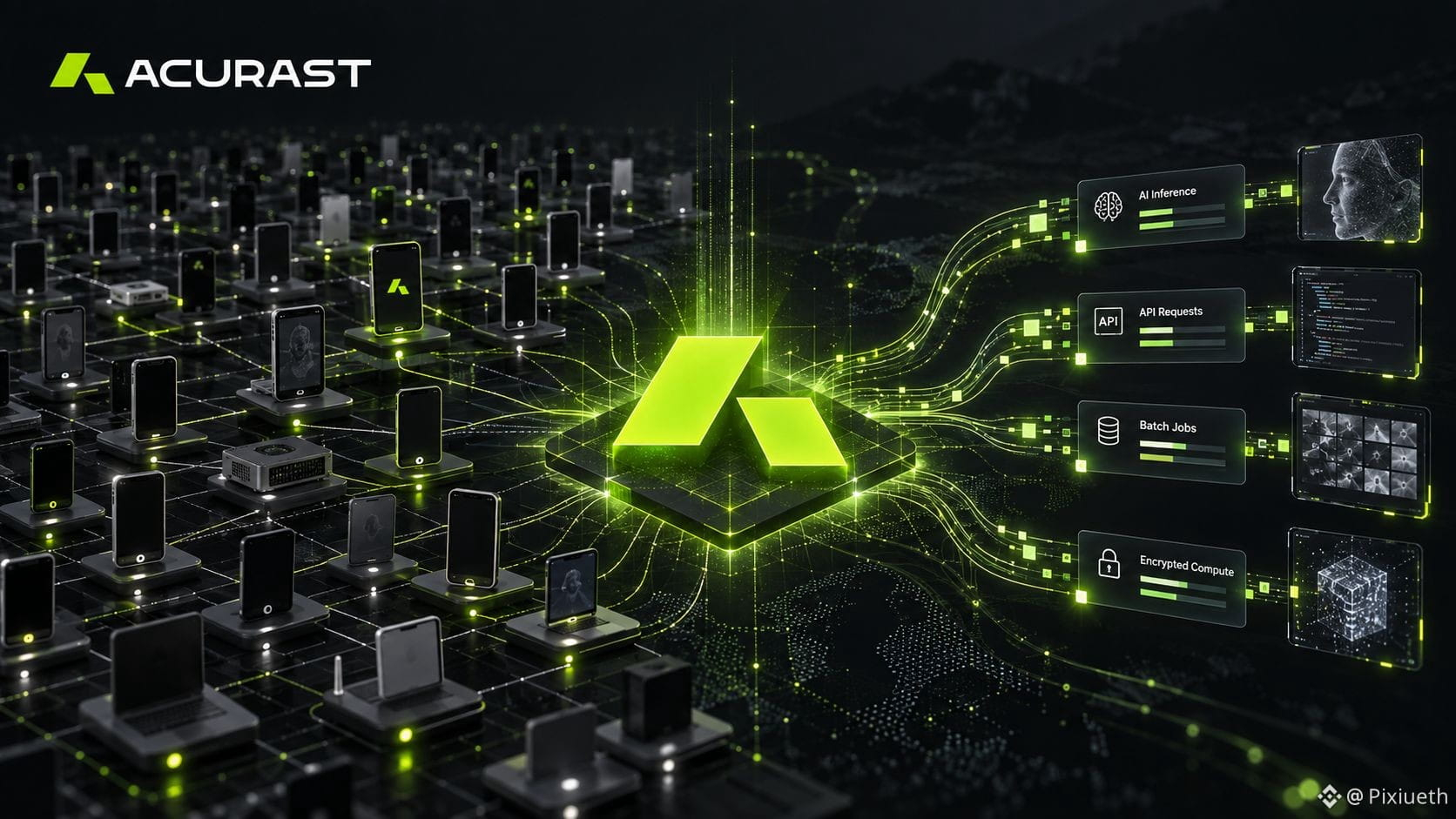
A lot of DePIN projects can prove one thing quickly: people are willing to add devices.
The harder question is whether anyone is willing to keep using them.
For a compute network, supply and demand need to be separated. More processors mean more potential capacity, but an idle network is still just unused capacity. The metric I care about is not only how many devices are online, but who is paying for computation and how often that demand returns.
@Acurast has already shown that its network can run different workloads, from APIs and scheduled jobs to LLM inference and confidential computing. Laya/System One also shows that specific AI inference workloads can run on the network. That proves execution capability.
It does not automatically prove a mature demand market.
The next thing I would watch is the structure behind deployments: what kinds of workloads keep coming back, whether developers are willing to continue paying compute costs, and whether the protocol can turn available compute into recurring usage.
Supply decides how much capacity exists.
Demand decides whether that capacity matters.
That’s the part I’m watching.
#Acurast https://hub.acurast.com/rebellion?ref=u09wbr
A lot of DePIN projects can prove one thing quickly: people are willing to add devices.
The harder question is whether anyone is willing to keep using them.
For a compute network, supply and demand need to be separated. More processors mean more potential capacity, but an idle network is still just unused capacity. The metric I care about is not only how many devices are online, but who is paying for computation and how often that demand returns.
@Acurast has already shown that its network can run different workloads, from APIs and scheduled jobs to LLM inference and confidential computing. Laya/System One also shows that specific AI inference workloads can run on the network. That proves execution capability.
It does not automatically prove a mature demand market.
The next thing I would watch is the structure behind deployments: what kinds of workloads keep coming back, whether developers are willing to continue paying compute costs, and whether the protocol can turn available compute into recurring usage.
Supply decides how much capacity exists.
Demand decides whether that capacity matters.
That’s the part I’m watching.
#Acurast https://hub.acurast.com/rebellion?ref=u09wbr
The harder question is whether anyone is willing to keep using them.
For a compute network, supply and demand need to be separated. More processors mean more potential capacity, but an idle network is still just unused capacity. The metric I care about is not only how many devices are online, but who is paying for computation and how often that demand returns.
@Acurast has already shown that its network can run different workloads, from APIs and scheduled jobs to LLM inference and confidential computing. Laya/System One also shows that specific AI inference workloads can run on the network. That proves execution capability.
It does not automatically prove a mature demand market.
The next thing I would watch is the structure behind deployments: what kinds of workloads keep coming back, whether developers are willing to continue paying compute costs, and whether the protocol can turn available compute into recurring usage.
Supply decides how much capacity exists.
Demand decides whether that capacity matters.
That’s the part I’m watching.
#Acurast https://hub.acurast.com/rebellion?ref=u09wbr
风中浪客:
说白了就是别只看节点数,得看谁掏钱、复购咋样;否则一堆设备在线也就是报表好看。@Acurast 真能跑出持续付费需求才算数,不然还是供给端自嗨。
1
77

·
--
Haussier
🤖 #ACU — Acurast aka The Decentralized Phone Farm 📱🚜
💰 Price: ∼$0.13 right now — cheaper than a samosa 🥟
📈 Today: +6.42% — little pump, big dreams
📉 ATH: $0.3206 back in Jan — down 59% since, like my motivation on Monday 😭
$ACU be like:
"I'm powering decentralized compute with old phones" 📱⚡️
Also $ACU chart: vibrates nervously 📉📈
Forecast says $0.134 tomorrow — wow, $0.004 profit, lambo soon? 🏎️😂
Max supply? 1 Billion phones... I mean tokens 📦
Holders? Only 2K — exclusive club, VIP only 😎
Still building tho. Small but mighty 💪
#ACU #Acurast $ACU
{future}(ACUUSDT)
🤖 #ACU — Acurast aka The Decentralized Phone Farm 📱🚜
💰 Price: ∼$0.13 right now — cheaper than a samosa 🥟
📈 Today: +6.42% — little pump, big dreams
📉 ATH: $0.3206 back in Jan — down 59% since, like my motivation on Monday 😭
$ACU be like:
"I'm powering decentralized compute with old phones" 📱⚡️
Also $ACU chart: vibrates nervously 📉📈
Forecast says $0.134 tomorrow — wow, $0.004 profit, lambo soon? 🏎️😂
Max supply? 1 Billion phones... I mean tokens 📦
Holders? Only 2K — exclusive club, VIP only 😎
Still building tho. Small but mighty 💪
#ACU #Acurast $ACU
💰 Price: ∼$0.13 right now — cheaper than a samosa 🥟
📈 Today: +6.42% — little pump, big dreams
📉 ATH: $0.3206 back in Jan — down 59% since, like my motivation on Monday 😭
$ACU be like:
"I'm powering decentralized compute with old phones" 📱⚡️
Also $ACU chart: vibrates nervously 📉📈
Forecast says $0.134 tomorrow — wow, $0.004 profit, lambo soon? 🏎️😂
Max supply? 1 Billion phones... I mean tokens 📦
Holders? Only 2K — exclusive club, VIP only 😎
Still building tho. Small but mighty 💪
#ACU #Acurast $ACU
37

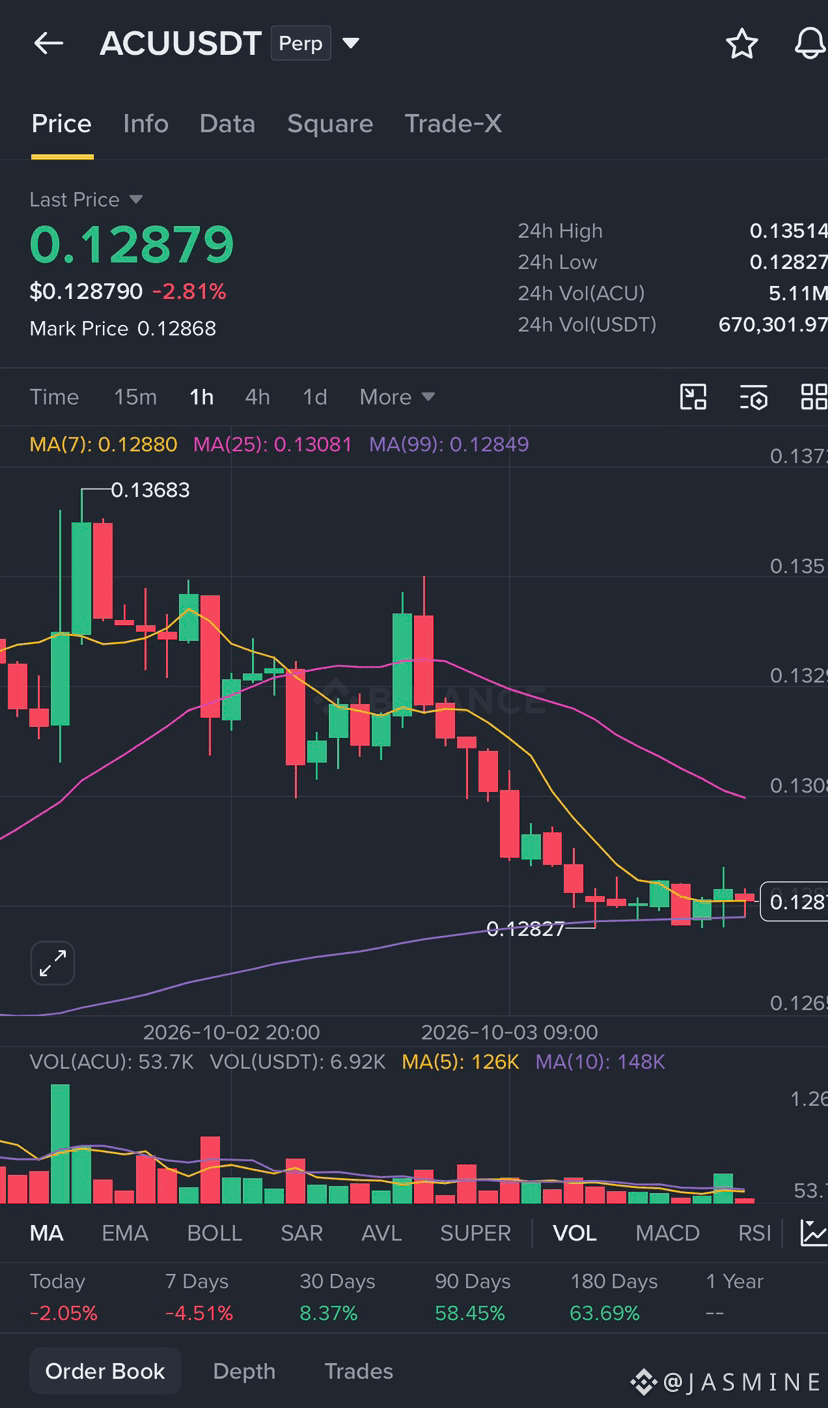
$ACU looks like it’s COOKING!!
Price got slapped down to $0.12827 and buyers are already defending the zone.
Reclaim $0.1308 and things could get spicy fast 🔥
$0.132 → $0.135 is where the chart starts getting interesting.
Ref: o3e9h1
$ACU #Acurast
$ACU looks like it’s COOKING!!
Price got slapped down to $0.12827 and buyers are already defending the zone.
Reclaim $0.1308 and things could get spicy fast 🔥
$0.132 → $0.135 is where the chart starts getting interesting.
Ref: o3e9h1
$ACU #Acurast
Price got slapped down to $0.12827 and buyers are already defending the zone.
Reclaim $0.1308 and things could get spicy fast 🔥
$0.132 → $0.135 is where the chart starts getting interesting.
Ref: o3e9h1
$ACU #Acurast
Stuart Crown:
The risk scenarios are explained very clearly.
1
2
107
·
--
Haussier
Stuart Crown:
Price momentum is exciting, but the product story is even more important.
1
1
183
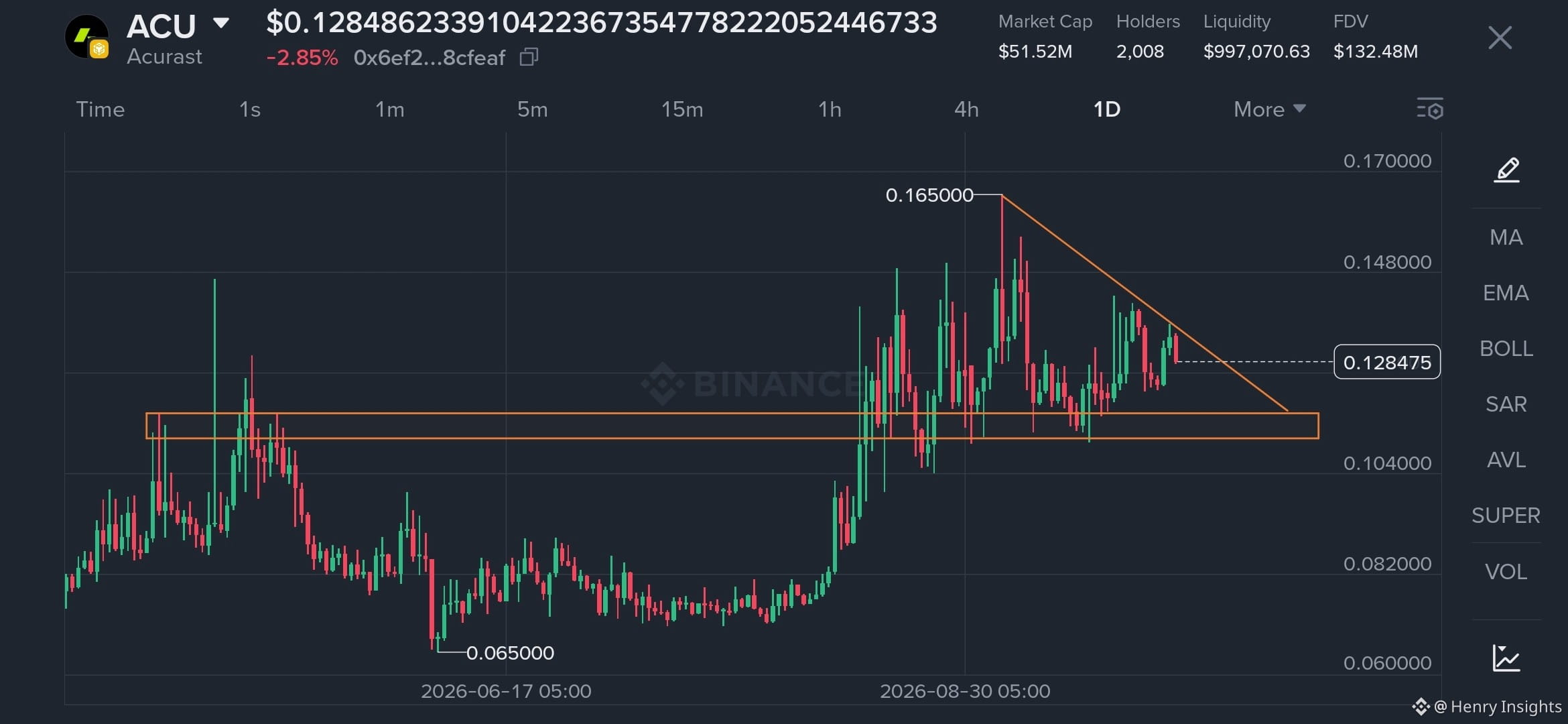
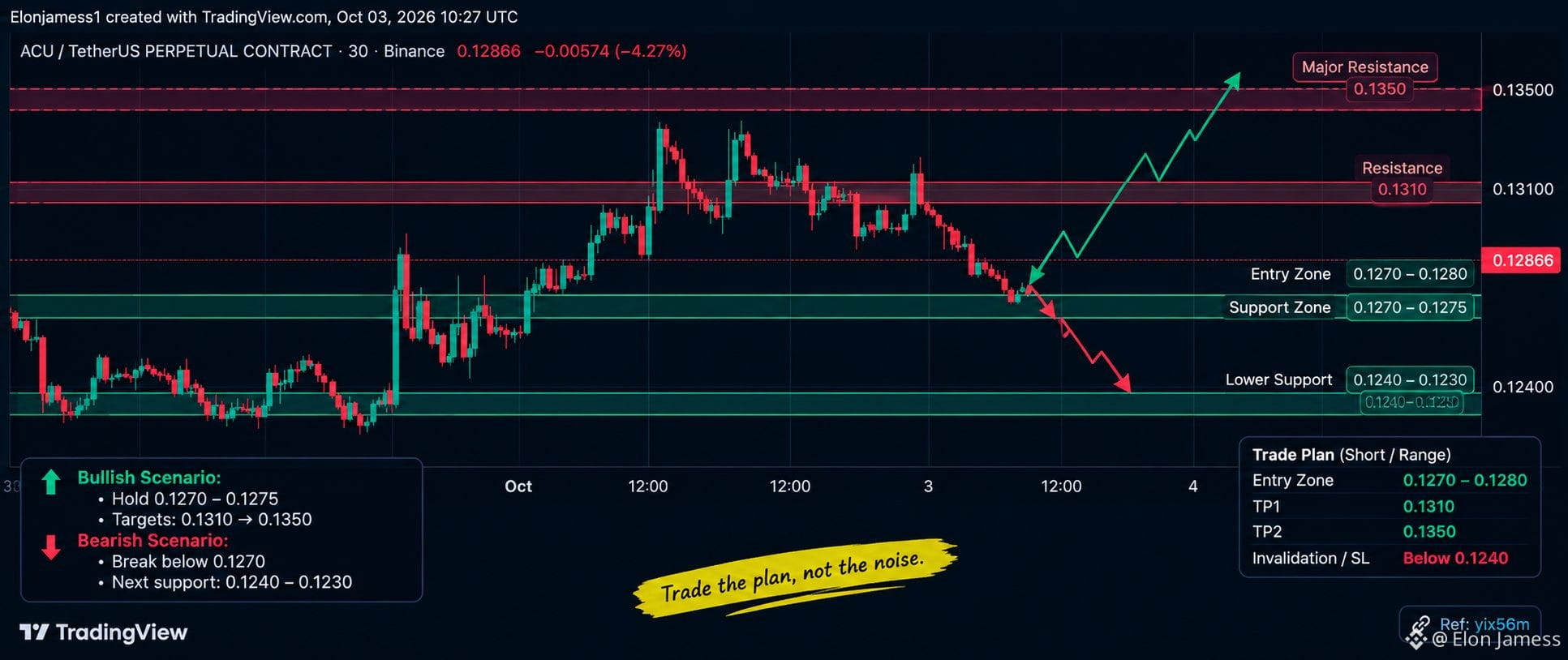
$ACU got rejected around $0.135 and is now pulling back toward an area that could decide the next move.
Price is sitting near $0.1287–$0.1290, with $0.1270–$0.1275 being the level I’m watching most closely.
If buyers step in there and hold the zone, a bounce toward $0.1310 and potentially another test of $0.1350 makes sense.
But if $0.1270 gives way, I’d expect the pullback to stretch toward $0.1240–$0.1230.
Nothing to force here. Let the levels do the talking.
Ref: x3snmv
#Acurast
$ACU got rejected around $0.135 and is now pulling back toward an area that could decide the next move.
Price is sitting near $0.1287–$0.1290, with $0.1270–$0.1275 being the level I’m watching most closely.
If buyers step in there and hold the zone, a bounce toward $0.1310 and potentially another test of $0.1350 makes sense.
But if $0.1270 gives way, I’d expect the pullback to stretch toward $0.1240–$0.1230.
Nothing to force here. Let the levels do the talking.
Ref: x3snmv
#Acurast
Price is sitting near $0.1287–$0.1290, with $0.1270–$0.1275 being the level I’m watching most closely.
If buyers step in there and hold the zone, a bounce toward $0.1310 and potentially another test of $0.1350 makes sense.
But if $0.1270 gives way, I’d expect the pullback to stretch toward $0.1240–$0.1230.
Nothing to force here. Let the levels do the talking.
Ref: x3snmv
#Acurast
A R M I N:
I think will go towars the support 1st. Whats your thoughts
15
18
803
·
--
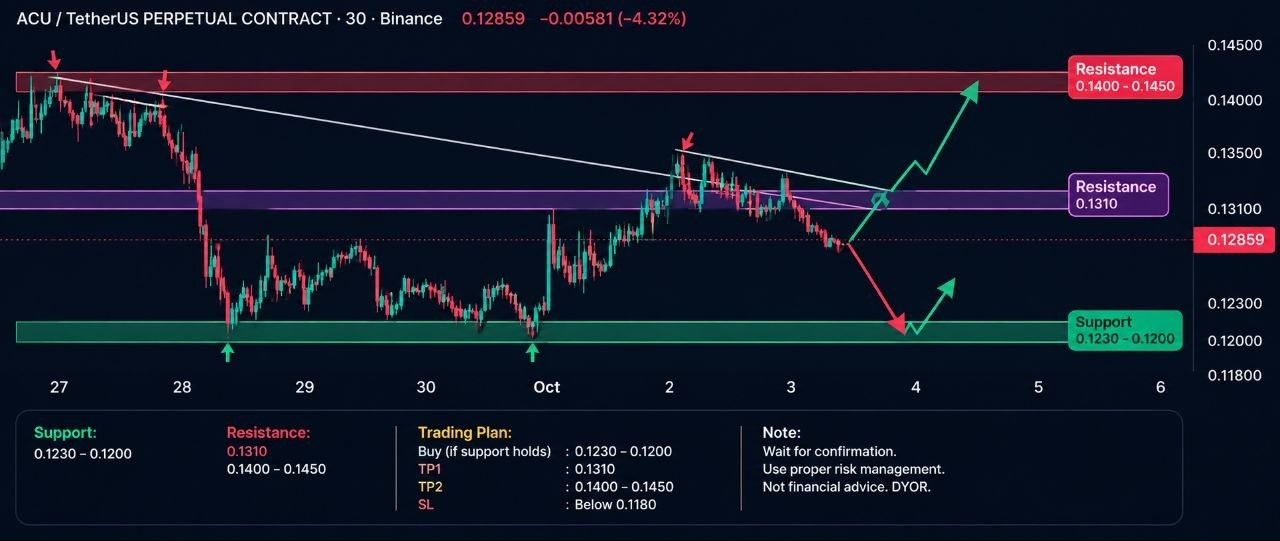
$ACU is showing some weakness after getting rejected from the $0.135 area. 👀
Price is now around $0.1287–$0.1290.
Key level to watch: $0.1270–$0.1275
If buyers hold this zone $0.1310 → $0.1350 could come back into focus.
Lose $0.1270 and a retest of $0.1240–$0.1230 becomes possible.
For now patience > chasing.
Ref: yix56m
#Acurast
$ACU is showing some weakness after getting rejected from the $0.135 area. 👀
Price is now around $0.1287–$0.1290.
Key level to watch: $0.1270–$0.1275
If buyers hold this zone $0.1310 → $0.1350 could come back into focus.
Lose $0.1270 and a retest of $0.1240–$0.1230 becomes possible.
For now patience > chasing.
Ref: yix56m
#Acurast
Price is now around $0.1287–$0.1290.
Key level to watch: $0.1270–$0.1275
If buyers hold this zone $0.1310 → $0.1350 could come back into focus.
Lose $0.1270 and a retest of $0.1240–$0.1230 becomes possible.
For now patience > chasing.
Ref: yix56m
#Acurast
N O R A 莉莎:
If support holds upside could become interesting here.
56
1
35
8.8k
·
--
Partiellement vrai
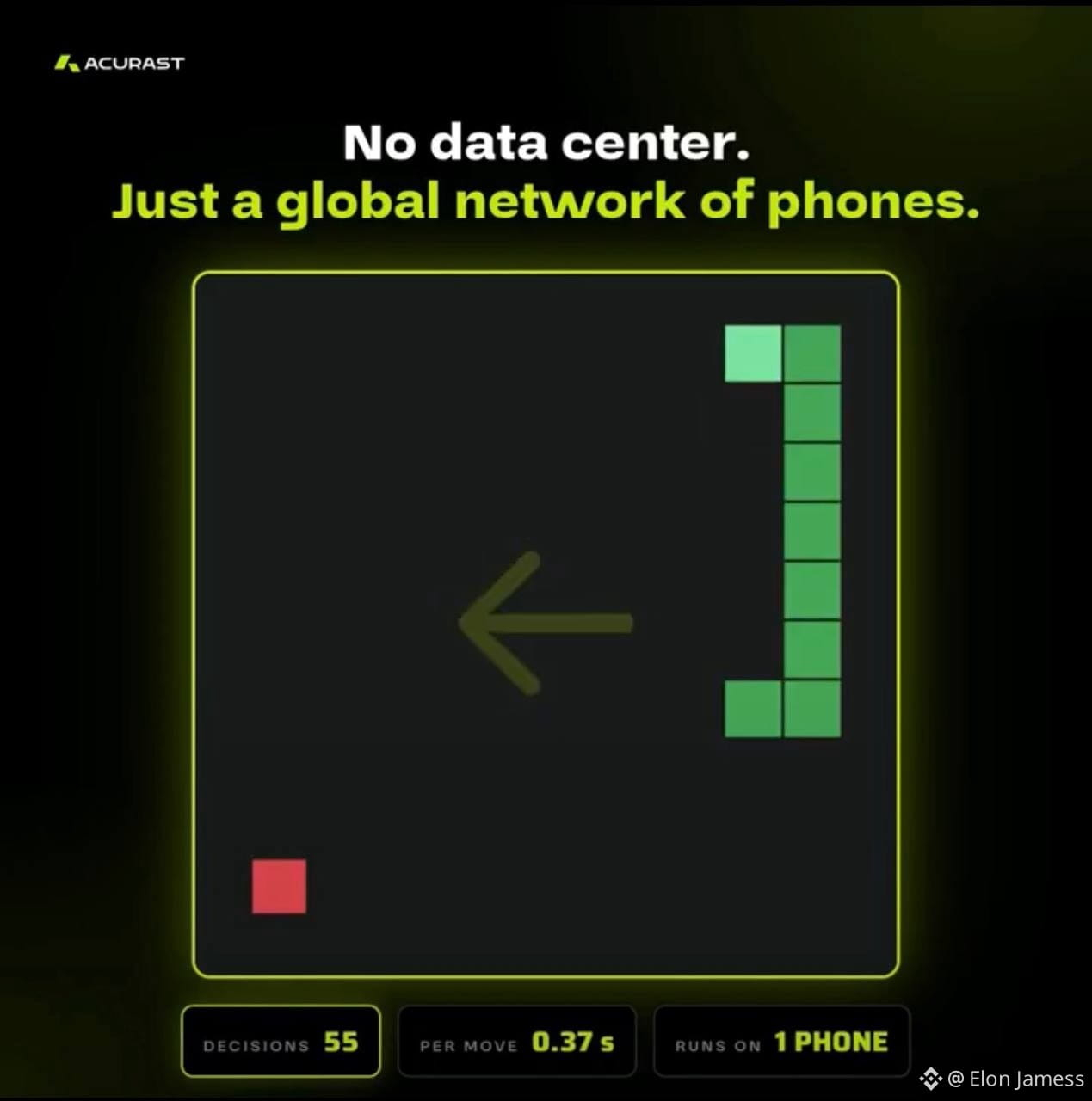
What if AI didn’t need a massive data center to run?
@Acurast is showing a different possibility.
→ Model One Systems is playing Snake live
→ Running on a single smartphone
→ No human player involved
→ No traditional data center
→ No server farm
→ Around 0.37 seconds per move
The interesting part isn’t the game itself.
It’s the fact that real AI inference can run on everyday devices instead of relying entirely on centralized infrastructure.
→ More distributed compute
→ Devices we already carry
→ A different approach to scaling AI
This is the kind of demo that makes decentralized computing easier to understand.
AI doesn’t always have to live in a giant server farm.
Sometimes it can fit in your pocket.
REF: yix56m
$ACU #Acurast
What if AI didn’t need a massive data center to run?
@Acurast is showing a different possibility.
→ Model One Systems is playing Snake live
→ Running on a single smartphone
→ No human player involved
→ No traditional data center
→ No server farm
→ Around 0.37 seconds per move
The interesting part isn’t the game itself.
It’s the fact that real AI inference can run on everyday devices instead of relying entirely on centralized infrastructure.
→ More distributed compute
→ Devices we already carry
→ A different approach to scaling AI
This is the kind of demo that makes decentralized computing easier to understand.
AI doesn’t always have to live in a giant server farm.
Sometimes it can fit in your pocket.
REF: yix56m
$ACU #Acurast
@Acurast is showing a different possibility.
→ Model One Systems is playing Snake live
→ Running on a single smartphone
→ No human player involved
→ No traditional data center
→ No server farm
→ Around 0.37 seconds per move
The interesting part isn’t the game itself.
It’s the fact that real AI inference can run on everyday devices instead of relying entirely on centralized infrastructure.
→ More distributed compute
→ Devices we already carry
→ A different approach to scaling AI
This is the kind of demo that makes decentralized computing easier to understand.
AI doesn’t always have to live in a giant server farm.
Sometimes it can fit in your pocket.
REF: yix56m
$ACU #Acurast


Villain Bear:
I wouldn't be surprised with such models kept back. They already create inefficient models but have better effective models available to push on after profiting on inefficient models. Technology has been monopolized like that by the big tech companies!
67
1
34
8.6k

·
--
兄弟们,刚刚富贵又刷到一个能认真玩的零撸活动。
@Acurast × @EchoHunt_ai 创作者活动已经开了。时间 9/30–10/25,奖池 20 万 $ACU,Impact Share 前 150 名分。
这次跟以前不太一样:内容占 60%,邀请占 40%。不是谁发得多谁赢,有社区、能拉朋友一起玩的,反而更占优势。
参加也不麻烦,直接去 EchoHunt 报名,绑好自己的 X 和收款地址就行。每周最多算 2 篇有效内容,同一周同步到币安广场还有额外加成,而且不占这 2 篇名额。
Acurast 本身是把闲置手机算力串成去中心化计算网络。官方说现在大概 30 万个计算单元,覆盖 175+ 国家,主网已经上了。$ACU 用来付网络费、发算力激励,也能质押和治理。
有社区的这次可以认真玩玩。@Acurast @EchoHunt_ai
#Acurast #ACU #DePIN
兄弟们,刚刚富贵又刷到一个能认真玩的零撸活动。
@Acurast × @EchoHunt_ai 创作者活动已经开了。时间 9/30–10/25,奖池 20 万 $ACU,Impact Share 前 150 名分。
这次跟以前不太一样:内容占 60%,邀请占 40%。不是谁发得多谁赢,有社区、能拉朋友一起玩的,反而更占优势。
参加也不麻烦,直接去 EchoHunt 报名,绑好自己的 X 和收款地址就行。每周最多算 2 篇有效内容,同一周同步到币安广场还有额外加成,而且不占这 2 篇名额。
Acurast 本身是把闲置手机算力串成去中心化计算网络。官方说现在大概 30 万个计算单元,覆盖 175+ 国家,主网已经上了。$ACU 用来付网络费、发算力激励,也能质押和治理。
有社区的这次可以认真玩玩。@Acurast @EchoHunt_ai
#Acurast #ACU #DePIN
@Acurast × @EchoHunt_ai 创作者活动已经开了。时间 9/30–10/25,奖池 20 万 $ACU,Impact Share 前 150 名分。
这次跟以前不太一样:内容占 60%,邀请占 40%。不是谁发得多谁赢,有社区、能拉朋友一起玩的,反而更占优势。
参加也不麻烦,直接去 EchoHunt 报名,绑好自己的 X 和收款地址就行。每周最多算 2 篇有效内容,同一周同步到币安广场还有额外加成,而且不占这 2 篇名额。
Acurast 本身是把闲置手机算力串成去中心化计算网络。官方说现在大概 30 万个计算单元,覆盖 175+ 国家,主网已经上了。$ACU 用来付网络费、发算力激励,也能质押和治理。
有社区的这次可以认真玩玩。@Acurast @EchoHunt_ai
#Acurast #ACU #DePIN

149

·
--
Vérifié
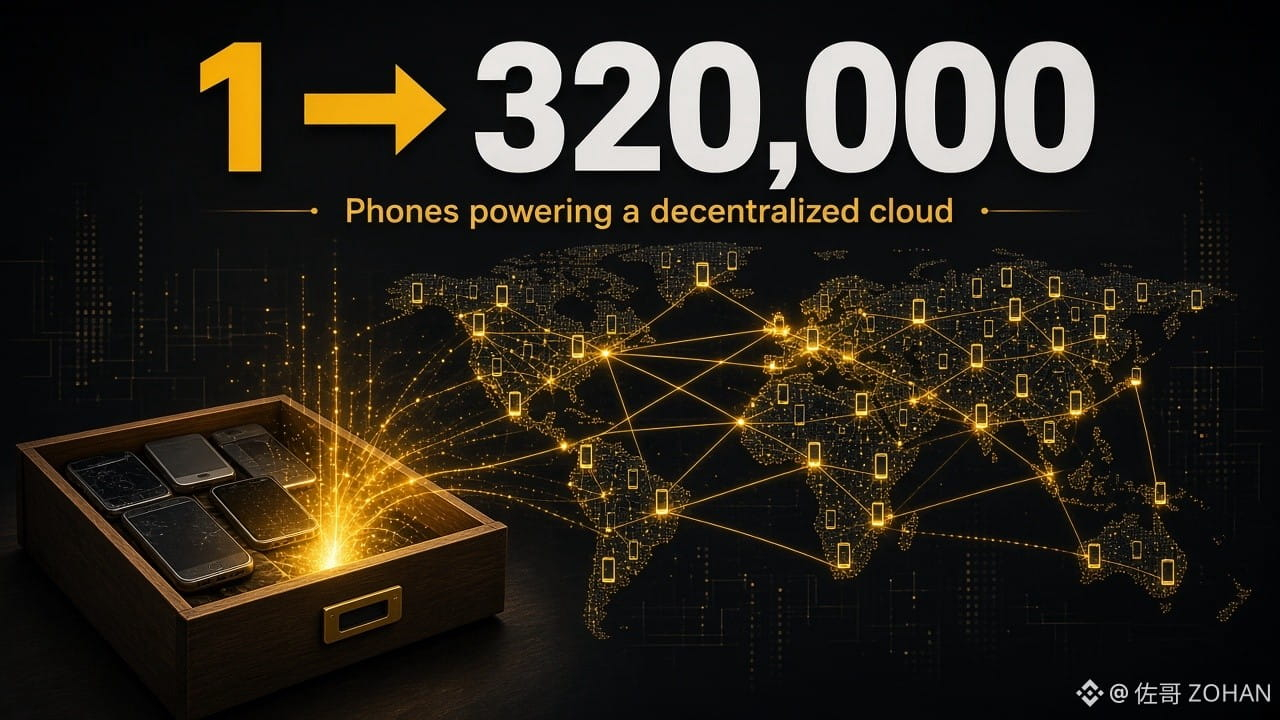
2023 年它只有 1 支手機開始
現在 32 萬支
#Acurast 這三年到底發生什麼事
團隊在瑞士楚格
共同創辦人 Alessandro De Carli 跟 Pascal Brun,之前做過 AirGap
就是用一支舊手機當冷錢包的那個,幣圈老玩家應該有印象
Alessandro 更早在瑞士信貸做手機銀行資安
目前累計募了大約 1,100 萬美元
支持者裡有以太坊共同創辦人 Gavin Wood
對有閒置手機的人,抽屜裡的舊手機有機會再派上用場
官方也有 $ACU 獎勵機制
Acurast 現在正在跟 XHunt、EchoHunt 合作辦創作者活動,想一起玩的可以關注官方消息
2023 年它只有 1 支手機開始
現在 32 萬支
#Acurast 這三年到底發生什麼事
團隊在瑞士楚格
共同創辦人 Alessandro De Carli 跟 Pascal Brun,之前做過 AirGap
就是用一支舊手機當冷錢包的那個,幣圈老玩家應該有印象
Alessandro 更早在瑞士信貸做手機銀行資安
目前累計募了大約 1,100 萬美元
支持者裡有以太坊共同創辦人 Gavin Wood
對有閒置手機的人,抽屜裡的舊手機有機會再派上用場
官方也有 $ACU 獎勵機制
Acurast 現在正在跟 XHunt、EchoHunt 合作辦創作者活動,想一起玩的可以關注官方消息
現在 32 萬支
#Acurast 這三年到底發生什麼事
團隊在瑞士楚格
共同創辦人 Alessandro De Carli 跟 Pascal Brun,之前做過 AirGap
就是用一支舊手機當冷錢包的那個,幣圈老玩家應該有印象
Alessandro 更早在瑞士信貸做手機銀行資安
目前累計募了大約 1,100 萬美元
支持者裡有以太坊共同創辦人 Gavin Wood
對有閒置手機的人,抽屜裡的舊手機有機會再派上用場
官方也有 $ACU 獎勵機制
Acurast 現在正在跟 XHunt、EchoHunt 合作辦創作者活動,想一起玩的可以關注官方消息
2
1.8k

·
--

Article
Acurast :让闲置手机创造价值每次聊 AI 算力,大家最先想到的都是 GPU、机房和云厂商。但 @Acurast 让我开始关注另一个问题:我们换下来的那些手机,除了放在抽屉里吃灰,还有多少计算能力没有被利用?
手机“过时”,很多时候只是电池不耐用、存储不够,或者我们想换新机了。它的处理器,并不一定已经失去使用价值。Acurast 做的事情,就是把这些分散的手机接入计算网络,让开发者在上面运行应用。
听起来有点另类,不过已经有一些可以核对的进展。
2026 年 1 月 20 日,Acurast 正式上线主网和 ACU 。按照当时的官方公告,网络此前已累计接入超过 16.9 万部手机,部署超过 36.4 万次,链上交易超过 5.89 亿笔。
我更关心的是:这些手机到底能做什么?
官方文档列出的应用包括 API、定时任务、Telegram 机器人,以及 LLM 推理等。这里面其实有不少很具体的需求:定时抓取数据、运行自动化服务、处理请求,并不需要每项任务都搬进大型机房。
当然,把任务交给陌生人的手机,马上会遇到一个问题:设备主人能不能看到数据?代码有没有被改过?
Acurast 的技术路线里,TEE,也就是可信执行环境,是很关键的一环。按照官方说明,它通过硬件支持的隔离执行和验证机制,保护计算输入,并验证代码执行。对需要处理敏感数据的应用来说,这比单纯强调“节点很多”更有意义。官方技术说明
再往下看,才是 $ACU 的角色。
它用于网络及部署费用、算力激励、质押和治理。当前经济模型设定 5% 年通胀,其中 70% 分配给 Staked Compute Pool,10% 分配给基础算力奖励池。这意味着网络在用代币激励设备提供算力、参与质押;
同时,也需要实际使用来支撑这套机制。官方代币经济模型
所以,我会继续观察三件事:有没有开发者持续部署应用,设备能不能稳定完成任务,以及使用需求能否跟上算力供给。
手机接入数量是一个起点。有人愿意反复使用这些算力,才是更值得关注的下一步。
对普通用户来说,参与路径也比较直观:检查闲置手机是否兼容,按官方指引安装 Processor、接入网络,再观察设备表现与奖励。奖励会受硬件性能、质押等条件影响,不能把“有一部手机”理解成固定收益。
真想尝试,我觉得从手里现成的一部闲置手机开始就够了。别急着买一堆设备,先把流程、稳定性和实际成本弄明白,也别用存有钱包或加密资产的手机接入。
我对 Acurast 的兴趣就在这里:抽屉里那部已经不用的手机,或许还能为一个真实应用完成下一次计算。
这件事能走多远,要看开发者和用户接下来怎么用它。
$ACU #Acurast #DePIN
Acurast :让闲置手机创造价值
每次聊 AI 算力,大家最先想到的都是 GPU、机房和云厂商。但 @Acurast 让我开始关注另一个问题:我们换下来的那些手机,除了放在抽屉里吃灰,还有多少计算能力没有被利用?
手机“过时”,很多时候只是电池不耐用、存储不够,或者我们想换新机了。它的处理器,并不一定已经失去使用价值。Acurast 做的事情,就是把这些分散的手机接入计算网络,让开发者在上面运行应用。
听起来有点另类,不过已经有一些可以核对的进展。
2026 年 1 月 20 日,Acurast 正式上线主网和 ACU 。按照当时的官方公告,网络此前已累计接入超过 16.9 万部手机,部署超过 36.4 万次,链上交易超过 5.89 亿笔。
我更关心的是:这些手机到底能做什么?
官方文档列出的应用包括 API、定时任务、Telegram 机器人,以及 LLM 推理等。这里面其实有不少很具体的需求:定时抓取数据、运行自动化服务、处理请求,并不需要每项任务都搬进大型机房。
当然,把任务交给陌生人的手机,马上会遇到一个问题:设备主人能不能看到数据?代码有没有被改过?
Acurast 的技术路线里,TEE,也就是可信执行环境,是很关键的一环。按照官方说明,它通过硬件支持的隔离执行和验证机制,保护计算输入,并验证代码执行。对需要处理敏感数据的应用来说,这比单纯强调“节点很多”更有意义。官方技术说明
再往下看,才是 $ACU 的角色。
它用于网络及部署费用、算力激励、质押和治理。当前经济模型设定 5% 年通胀,其中 70% 分配给 Staked Compute Pool,10% 分配给基础算力奖励池。这意味着网络在用代币激励设备提供算力、参与质押;
同时,也需要实际使用来支撑这套机制。官方代币经济模型
所以,我会继续观察三件事:有没有开发者持续部署应用,设备能不能稳定完成任务,以及使用需求能否跟上算力供给。
手机接入数量是一个起点。有人愿意反复使用这些算力,才是更值得关注的下一步。
对普通用户来说,参与路径也比较直观:检查闲置手机是否兼容,按官方指引安装 Processor、接入网络,再观察设备表现与奖励。奖励会受硬件性能、质押等条件影响,不能把“有一部手机”理解成固定收益。
真想尝试,我觉得从手里现成的一部闲置手机开始就够了。别急着买一堆设备,先把流程、稳定性和实际成本弄明白,也别用存有钱包或加密资产的手机接入。
我对 Acurast 的兴趣就在这里:抽屉里那部已经不用的手机,或许还能为一个真实应用完成下一次计算。
这件事能走多远,要看开发者和用户接下来怎么用它。
$ACU #Acurast #DePIN
手机“过时”,很多时候只是电池不耐用、存储不够,或者我们想换新机了。它的处理器,并不一定已经失去使用价值。Acurast 做的事情,就是把这些分散的手机接入计算网络,让开发者在上面运行应用。
听起来有点另类,不过已经有一些可以核对的进展。
2026 年 1 月 20 日,Acurast 正式上线主网和 ACU 。按照当时的官方公告,网络此前已累计接入超过 16.9 万部手机,部署超过 36.4 万次,链上交易超过 5.89 亿笔。
我更关心的是:这些手机到底能做什么?
官方文档列出的应用包括 API、定时任务、Telegram 机器人,以及 LLM 推理等。这里面其实有不少很具体的需求:定时抓取数据、运行自动化服务、处理请求,并不需要每项任务都搬进大型机房。
当然,把任务交给陌生人的手机,马上会遇到一个问题:设备主人能不能看到数据?代码有没有被改过?
Acurast 的技术路线里,TEE,也就是可信执行环境,是很关键的一环。按照官方说明,它通过硬件支持的隔离执行和验证机制,保护计算输入,并验证代码执行。对需要处理敏感数据的应用来说,这比单纯强调“节点很多”更有意义。官方技术说明
再往下看,才是 $ACU 的角色。
它用于网络及部署费用、算力激励、质押和治理。当前经济模型设定 5% 年通胀,其中 70% 分配给 Staked Compute Pool,10% 分配给基础算力奖励池。这意味着网络在用代币激励设备提供算力、参与质押;
同时,也需要实际使用来支撑这套机制。官方代币经济模型
所以,我会继续观察三件事:有没有开发者持续部署应用,设备能不能稳定完成任务,以及使用需求能否跟上算力供给。
手机接入数量是一个起点。有人愿意反复使用这些算力,才是更值得关注的下一步。
对普通用户来说,参与路径也比较直观:检查闲置手机是否兼容,按官方指引安装 Processor、接入网络,再观察设备表现与奖励。奖励会受硬件性能、质押等条件影响,不能把“有一部手机”理解成固定收益。
真想尝试,我觉得从手里现成的一部闲置手机开始就够了。别急着买一堆设备,先把流程、稳定性和实际成本弄明白,也别用存有钱包或加密资产的手机接入。
我对 Acurast 的兴趣就在这里:抽屉里那部已经不用的手机,或许还能为一个真实应用完成下一次计算。
这件事能走多远,要看开发者和用户接下来怎么用它。
$ACU #Acurast #DePIN
173

·
--
姐妹们,晚上好!
看到 #Acurast Deploy Agent支持Base USDC,写着no ACU account needed,我一下就懵了,等等,直接USDC就能部署吗?ACU不用了吗?
看完文档才搞明白。
@Acurast 本来就有多条部署通路,CLI、SDK 依旧走ACU,Deploy Agent单独开了x402 / USDC这条通道,是完全独立的一套入口。
之前我一直把两件事混在一起了。部署付费用什么,和ACU在网络里的职能,根本不是一码事。ACU原有场景全部保留,部署费、网络手续费、各类奖励、collator奖励都还在。所以这个入口不用ACU账户,不等于ACU废掉。
至于USDC支付后的底层结算、会不会自动兑换、算力费用怎么核算,目前官方还没有完整说明。
不瞎猜,底层逻辑继续蹲官方后续披露吧。
https://hub.acurast.com/rebellion?ref=ikgnqo
姐妹们,晚上好!
看到 #Acurast Deploy Agent支持Base USDC,写着no ACU account needed,我一下就懵了,等等,直接USDC就能部署吗?ACU不用了吗?
看完文档才搞明白。
@Acurast 本来就有多条部署通路,CLI、SDK 依旧走ACU,Deploy Agent单独开了x402 / USDC这条通道,是完全独立的一套入口。
之前我一直把两件事混在一起了。部署付费用什么,和ACU在网络里的职能,根本不是一码事。ACU原有场景全部保留,部署费、网络手续费、各类奖励、collator奖励都还在。所以这个入口不用ACU账户,不等于ACU废掉。
至于USDC支付后的底层结算、会不会自动兑换、算力费用怎么核算,目前官方还没有完整说明。
不瞎猜,底层逻辑继续蹲官方后续披露吧。
https://hub.acurast.com/rebellion?ref=ikgnqo
看到 #Acurast Deploy Agent支持Base USDC,写着no ACU account needed,我一下就懵了,等等,直接USDC就能部署吗?ACU不用了吗?
看完文档才搞明白。
@Acurast 本来就有多条部署通路,CLI、SDK 依旧走ACU,Deploy Agent单独开了x402 / USDC这条通道,是完全独立的一套入口。
之前我一直把两件事混在一起了。部署付费用什么,和ACU在网络里的职能,根本不是一码事。ACU原有场景全部保留,部署费、网络手续费、各类奖励、collator奖励都还在。所以这个入口不用ACU账户,不等于ACU废掉。
至于USDC支付后的底层结算、会不会自动兑换、算力费用怎么核算,目前官方还没有完整说明。
不瞎猜,底层逻辑继续蹲官方后续披露吧。
https://hub.acurast.com/rebellion?ref=ikgnqo

风中浪客:
哦,那Deploy Agent只是走x402用USDC结算,CLI/SDK照样绕不开$ACU,不算完全脱钩。别被no ACU account needed带偏,真需求还得看后面部署量。
1
123
·
--
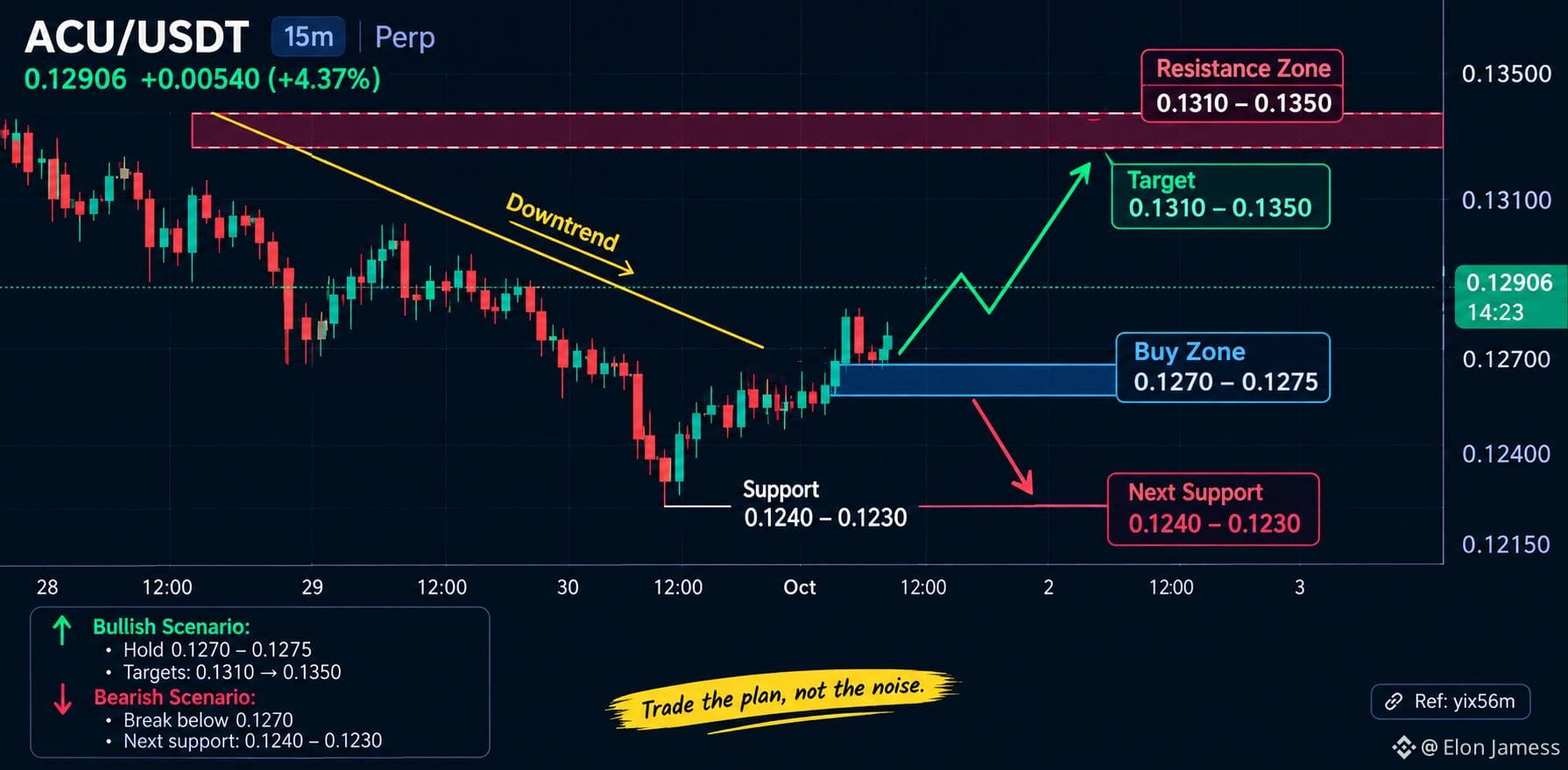
$ACU is showing strength after bouncing from the $0.1230–$0.1240 zone. 👀
Price is now around $0.1290–$0.1300.
Key level to watch: $0.1270–$0.1275
If buyers hold this zone $0.1310 → $0.1350 could come into focus.
Lose $0.1270 and a retest of $0.1240–$0.1230 becomes possible.
Patience > chasing.
Ref: yix56m
#Acurast
$ACU is showing strength after bouncing from the $0.1230–$0.1240 zone. 👀
Price is now around $0.1290–$0.1300.
Key level to watch: $0.1270–$0.1275
If buyers hold this zone $0.1310 → $0.1350 could come into focus.
Lose $0.1270 and a retest of $0.1240–$0.1230 becomes possible.
Patience > chasing.
Ref: yix56m
#Acurast
Price is now around $0.1290–$0.1300.
Key level to watch: $0.1270–$0.1275
If buyers hold this zone $0.1310 → $0.1350 could come into focus.
Lose $0.1270 and a retest of $0.1240–$0.1230 becomes possible.
Patience > chasing.
Ref: yix56m
#Acurast
Hija__:
Good reminder that support matters more than hype. Let ACU show whether $0.1270 can hold.
55
1
35
9k

·
--
Haussier
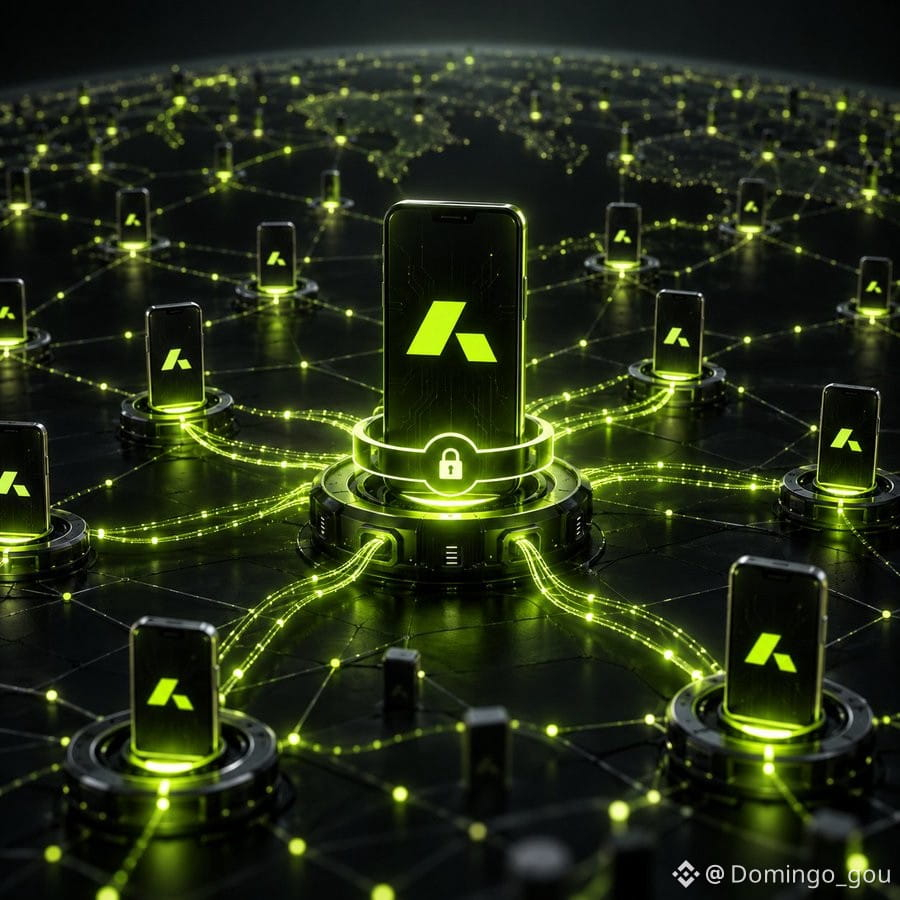
过去几个周期,看一个网络有没有增长,大家习惯先看规模。
多少机器、覆盖多少地区、网络规模多大,这些数字确实重要。但当一个网络开始扩大规模后,我觉得还有一个问题值得思考,就是这些设备为什么愿意一直留下?
peaq这次宣布首批1000+ Acurast Processor已经在 peaqOS上线,并计划让更多Processor进入这个环境。其中一个比较有意思的变量,是Processor激活需要 bond
$PEAQ
。
按照peaq公布的规则,bond以美元计价、锁定为
$PEAQ
,这部分不可恢复;机器退出时,50%按照规则销毁,50%进入peaq Treasury。
这个机制本身不能证明网络一定会更稳定,也不能提前判断它一定会带来更多真实任务。但它让我想到一个长期问题:去中心化算力网络走到一定规模后,参与者的进入和退出成本,会不会开始影响网络质量。
设备在线,和设备愿意长期在线,是两个不同的问题。
后面我会更关注Processor数量是否持续增长,激活后的机器是否留下,是否有真实任务需求,以及有没有持续付费使用。
规模解决的是供给问题,时间才能告诉我们,这些参与者有没有真正成为网络的一部分。
@Acurast #Acurast
https://hub.acurast.com/rebellion?ref=qqj0i8
过去几个周期,看一个网络有没有增长,大家习惯先看规模。
多少机器、覆盖多少地区、网络规模多大,这些数字确实重要。但当一个网络开始扩大规模后,我觉得还有一个问题值得思考,就是这些设备为什么愿意一直留下?
peaq这次宣布首批1000+ Acurast Processor已经在 peaqOS上线,并计划让更多Processor进入这个环境。其中一个比较有意思的变量,是Processor激活需要 bond
$PEAQ
。
按照peaq公布的规则,bond以美元计价、锁定为
$PEAQ
,这部分不可恢复;机器退出时,50%按照规则销毁,50%进入peaq Treasury。
这个机制本身不能证明网络一定会更稳定,也不能提前判断它一定会带来更多真实任务。但它让我想到一个长期问题:去中心化算力网络走到一定规模后,参与者的进入和退出成本,会不会开始影响网络质量。
设备在线,和设备愿意长期在线,是两个不同的问题。
后面我会更关注Processor数量是否持续增长,激活后的机器是否留下,是否有真实任务需求,以及有没有持续付费使用。
规模解决的是供给问题,时间才能告诉我们,这些参与者有没有真正成为网络的一部分。
@Acurast #Acurast
https://hub.acurast.com/rebellion?ref=qqj0i8
多少机器、覆盖多少地区、网络规模多大,这些数字确实重要。但当一个网络开始扩大规模后,我觉得还有一个问题值得思考,就是这些设备为什么愿意一直留下?
peaq这次宣布首批1000+ Acurast Processor已经在 peaqOS上线,并计划让更多Processor进入这个环境。其中一个比较有意思的变量,是Processor激活需要 bond
$PEAQ
。
按照peaq公布的规则,bond以美元计价、锁定为
$PEAQ
,这部分不可恢复;机器退出时,50%按照规则销毁,50%进入peaq Treasury。
这个机制本身不能证明网络一定会更稳定,也不能提前判断它一定会带来更多真实任务。但它让我想到一个长期问题:去中心化算力网络走到一定规模后,参与者的进入和退出成本,会不会开始影响网络质量。
设备在线,和设备愿意长期在线,是两个不同的问题。
后面我会更关注Processor数量是否持续增长,激活后的机器是否留下,是否有真实任务需求,以及有没有持续付费使用。
规模解决的是供给问题,时间才能告诉我们,这些参与者有没有真正成为网络的一部分。
@Acurast #Acurast
https://hub.acurast.com/rebellion?ref=qqj0i8
153

·
--
有个短平快的项目,下个月应该要tge了,看了下融资了 22m 美金,挺多机构都参与投资了,还不错,建议兄弟们做一下
@Acurast 做的是一个由手机驱动的去中心化计算网络,简单理解,就是把我们平时闲置手机的算力利用起来,为网络提供计算服务。
相比很多 DePIN 项目需要额外购买矿机和硬件,Acurast 的参与门槛会低不少,手里有闲置的安卓或者苹果手机就能部署成 Processor。
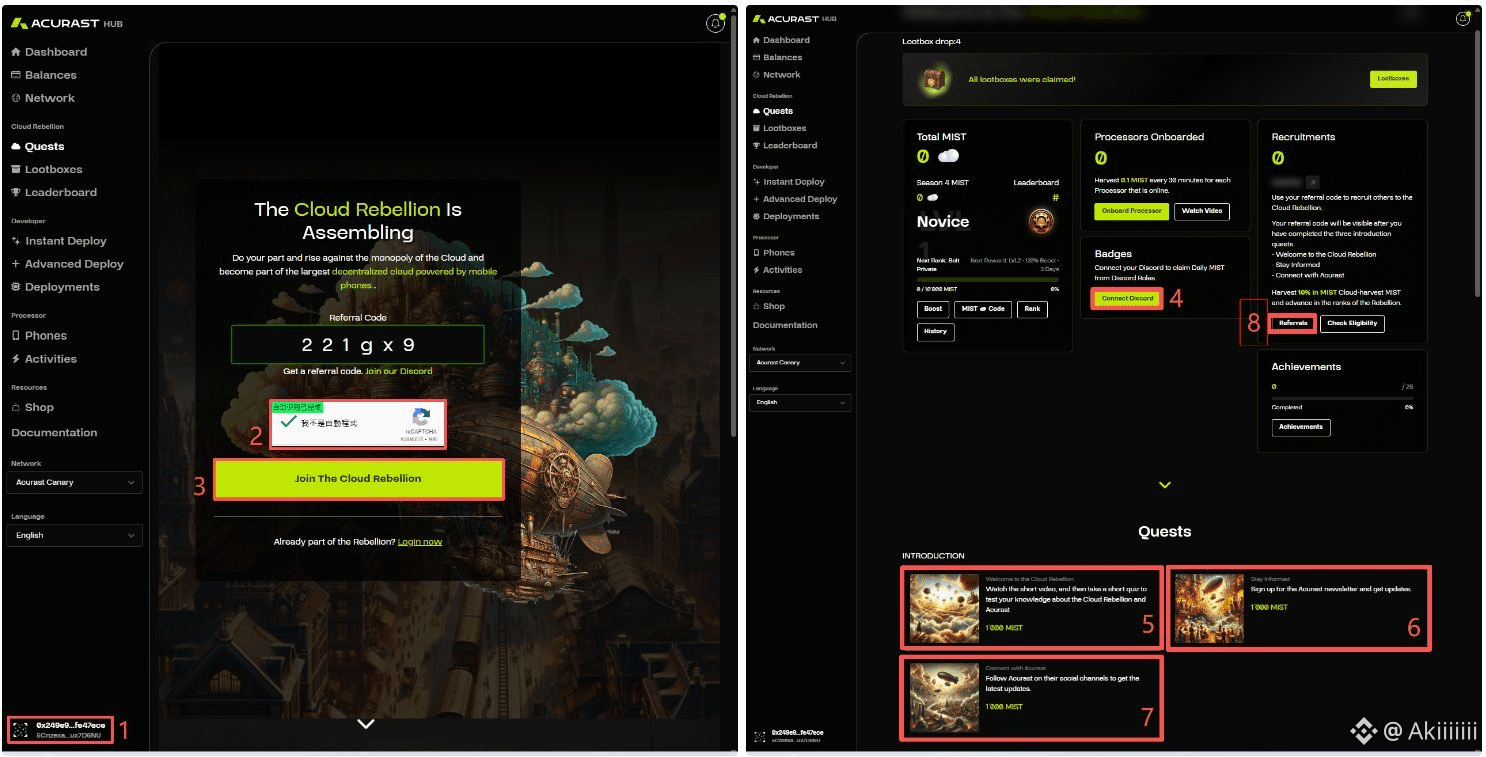
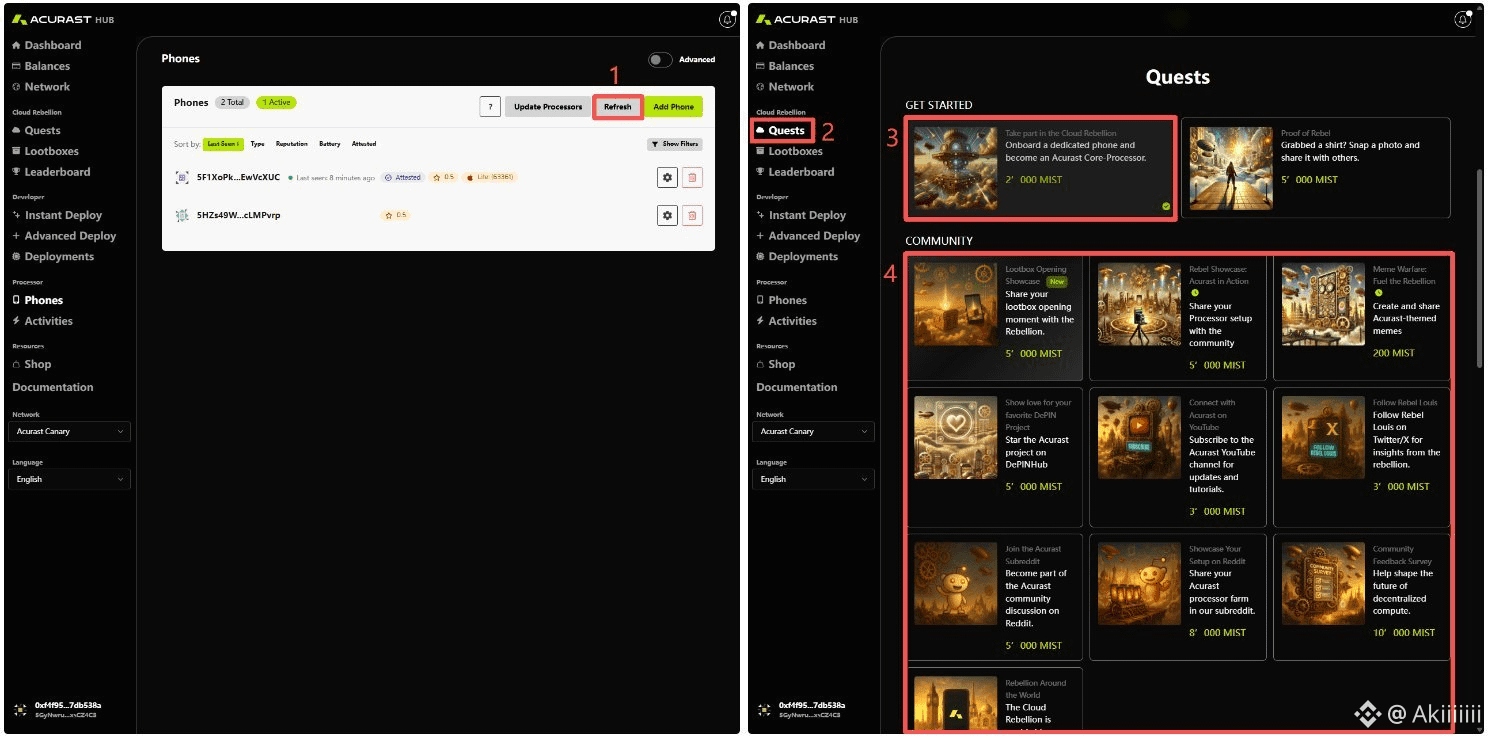
目前主要参与的就是 Cloud Rebellion,流程给大家捋一下👇
1️⃣ 进入 Cloud Rebellion,连接钱包
2️⃣ 完成人机验证,加入活动
3️⃣ 绑定 Discord、邮箱以及社交账号
4️⃣ 完成基础任务和小测验,开始积累 MIST
5️⃣ 完成 3 个基础任务后解锁自己的邀请码
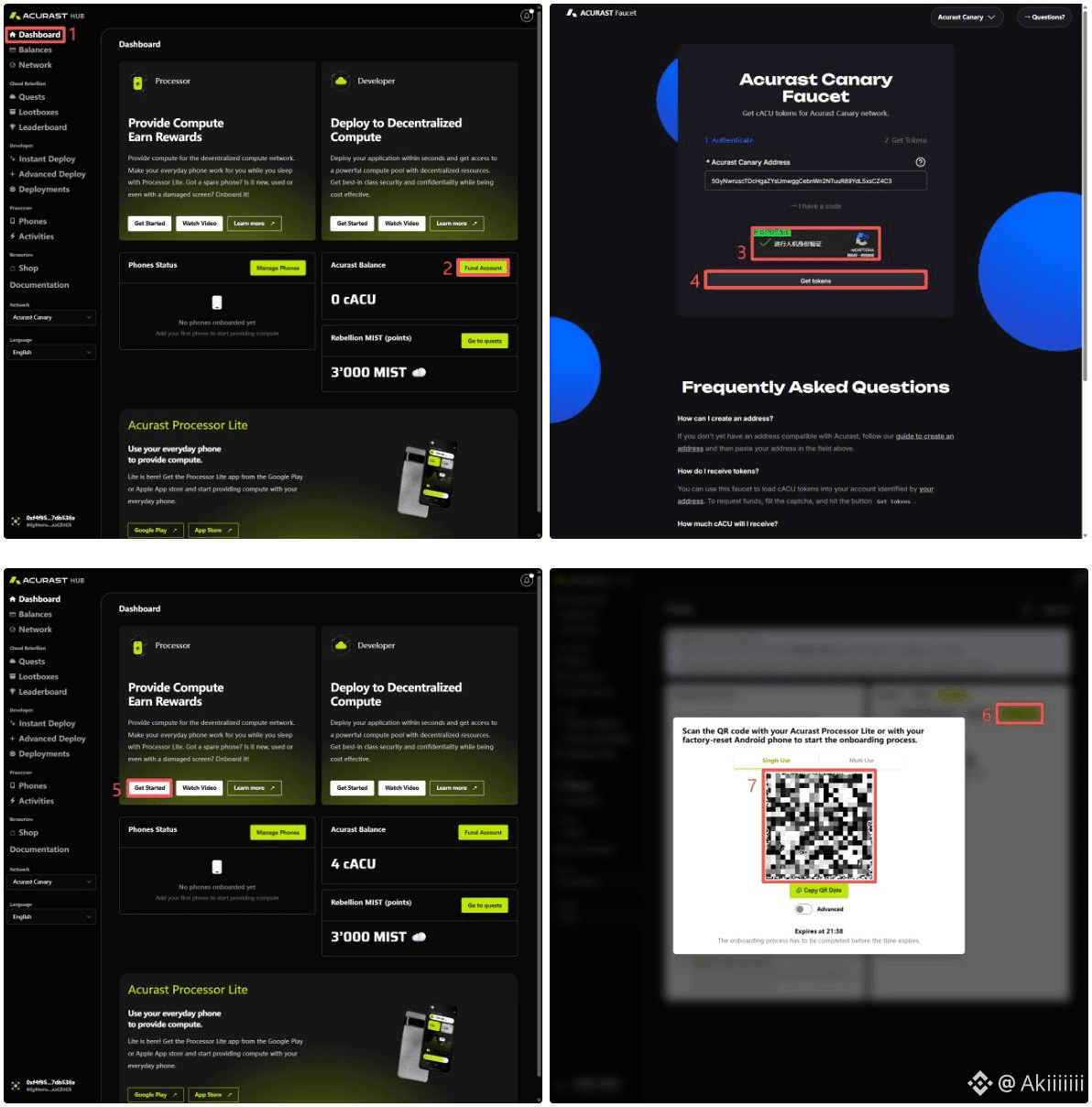
6️⃣ 切换到 Dashboard,领取测试代币
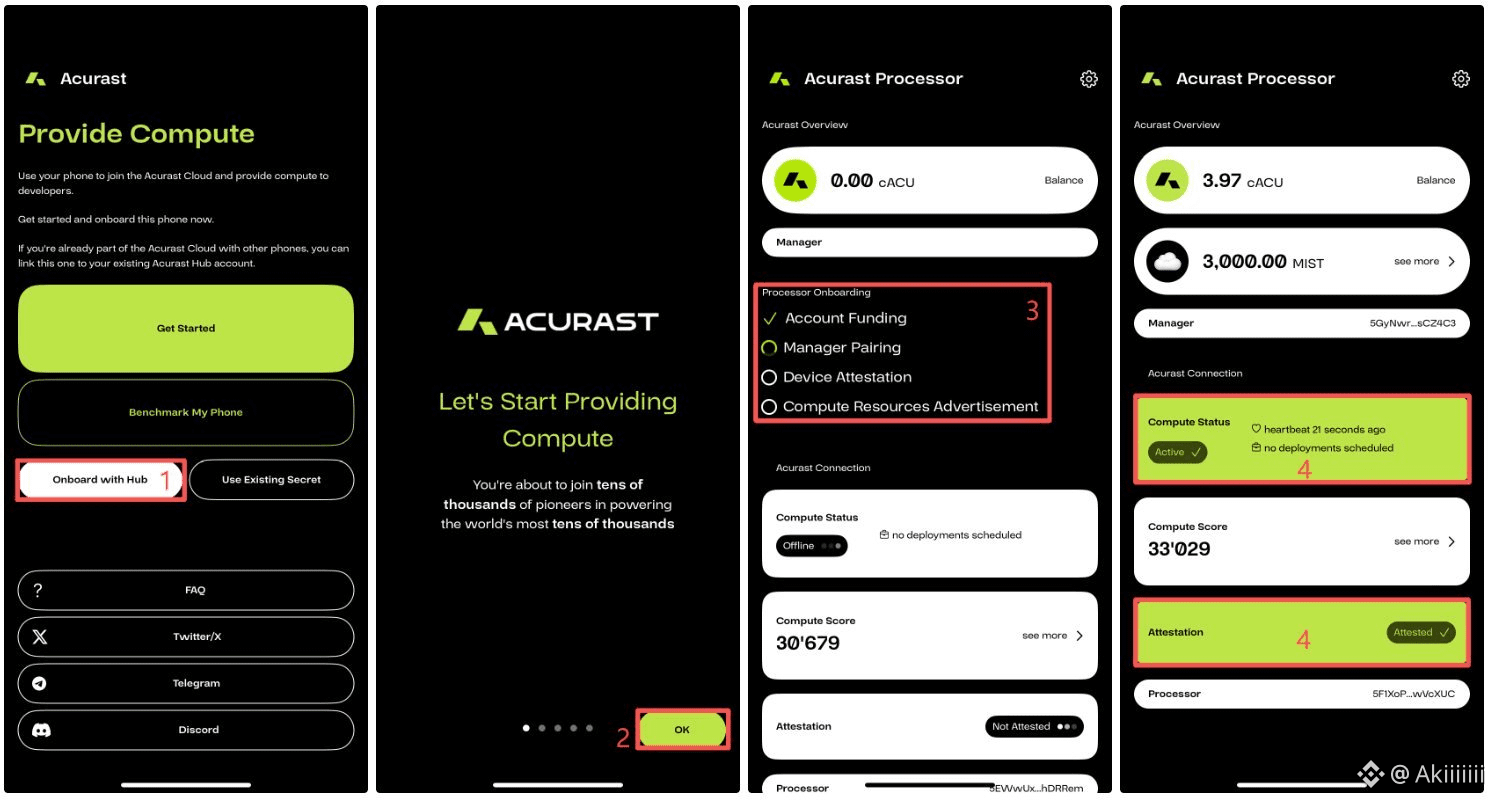
7️⃣ 下载并安装 Acurast Processor APP
8️⃣ 点击 Add Phone,钱包签名后生成二维码
9️⃣ 手机打开 APP,选择 Onboard with Hub 完成绑定
🔟 等待初始化完成,设备上线后就可以作为 Processor 参与计算
后面就比较省心了,手机保持运行,有新的任务就顺手做一下,慢慢积累 MIST 和相关奖励。
具体每一步怎么操作,在金这篇已经写得很细了,大家直接照着教程一步一步来就行。
整个项目不需要额外买专业设备,有闲置手机的正好可以利用起来,花点时间把前面的流程跑通,后面就轻松很多。
#Acurast #IRYS
有个短平快的项目,下个月应该要tge了,看了下融资了 22m 美金,挺多机构都参与投资了,还不错,建议兄弟们做一下
@Acurast 做的是一个由手机驱动的去中心化计算网络,简单理解,就是把我们平时闲置手机的算力利用起来,为网络提供计算服务。
相比很多 DePIN 项目需要额外购买矿机和硬件,Acurast 的参与门槛会低不少,手里有闲置的安卓或者苹果手机就能部署成 Processor。
目前主要参与的就是 Cloud Rebellion,流程给大家捋一下👇
1️⃣ 进入 Cloud Rebellion,连接钱包
2️⃣ 完成人机验证,加入活动
3️⃣ 绑定 Discord、邮箱以及社交账号
4️⃣ 完成基础任务和小测验,开始积累 MIST
5️⃣ 完成 3 个基础任务后解锁自己的邀请码
6️⃣ 切换到 Dashboard,领取测试代币
7️⃣ 下载并安装 Acurast Processor APP
8️⃣ 点击 Add Phone,钱包签名后生成二维码
9️⃣ 手机打开 APP,选择 Onboard with Hub 完成绑定
🔟 等待初始化完成,设备上线后就可以作为 Processor 参与计算
后面就比较省心了,手机保持运行,有新的任务就顺手做一下,慢慢积累 MIST 和相关奖励。
具体每一步怎么操作,在金这篇已经写得很细了,大家直接照着教程一步一步来就行。
整个项目不需要额外买专业设备,有闲置手机的正好可以利用起来,花点时间把前面的流程跑通,后面就轻松很多。
#Acurast #IRYS
@Acurast 做的是一个由手机驱动的去中心化计算网络,简单理解,就是把我们平时闲置手机的算力利用起来,为网络提供计算服务。
相比很多 DePIN 项目需要额外购买矿机和硬件,Acurast 的参与门槛会低不少,手里有闲置的安卓或者苹果手机就能部署成 Processor。
目前主要参与的就是 Cloud Rebellion,流程给大家捋一下👇
1️⃣ 进入 Cloud Rebellion,连接钱包
2️⃣ 完成人机验证,加入活动
3️⃣ 绑定 Discord、邮箱以及社交账号
4️⃣ 完成基础任务和小测验,开始积累 MIST
5️⃣ 完成 3 个基础任务后解锁自己的邀请码
6️⃣ 切换到 Dashboard,领取测试代币
7️⃣ 下载并安装 Acurast Processor APP
8️⃣ 点击 Add Phone,钱包签名后生成二维码
9️⃣ 手机打开 APP,选择 Onboard with Hub 完成绑定
🔟 等待初始化完成,设备上线后就可以作为 Processor 参与计算
后面就比较省心了,手机保持运行,有新的任务就顺手做一下,慢慢积累 MIST 和相关奖励。
具体每一步怎么操作,在金这篇已经写得很细了,大家直接照着教程一步一步来就行。
整个项目不需要额外买专业设备,有闲置手机的正好可以利用起来,花点时间把前面的流程跑通,后面就轻松很多。
#Acurast #IRYS
春庭雪落:
值得做吗
10
2
76
15.5k

·
--
很多项目都会列一长串代币用途,看完还是不知道它平时在哪里流转。
$ACU
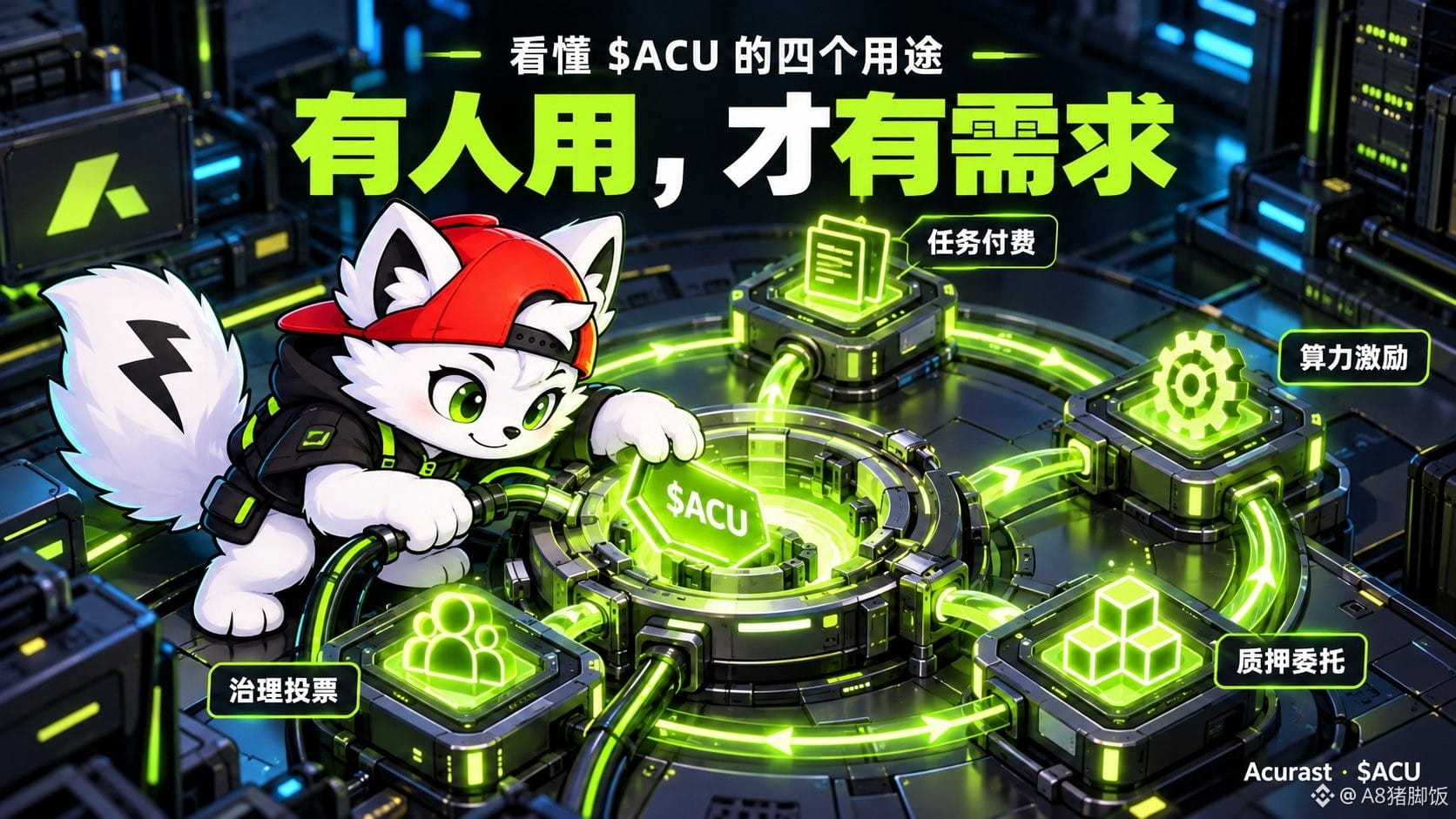
这部分相对好理解:开发者发布计算任务时用 ACU 付费;跑 Processor 的人获得激励;持币者可以质押、委托,也能参与网络投票。
我把它理解成一套围绕算力运转的结算和协作方式。
开发者把任务发出来,设备提供计算,网络按照规则分配激励,规则有变化再由持币者表决。使用的人越多,ACU 在其中出现的次数也会增加。
Acurast也曾公开ACU的分配、解锁安排和治理权限。
官方资料还注明,网络没有特权多签,任何一方都不能私下修改余额或重定向奖励。
后面我会继续看任务量和开发者付费情况,这两项比短期热度更有参考价值。
@Acurast
#Acurast #ACU #DePIN
很多项目都会列一长串代币用途,看完还是不知道它平时在哪里流转。
$ACU
这部分相对好理解:开发者发布计算任务时用 ACU 付费;跑 Processor 的人获得激励;持币者可以质押、委托,也能参与网络投票。
我把它理解成一套围绕算力运转的结算和协作方式。
开发者把任务发出来,设备提供计算,网络按照规则分配激励,规则有变化再由持币者表决。使用的人越多,ACU 在其中出现的次数也会增加。
Acurast也曾公开ACU的分配、解锁安排和治理权限。
官方资料还注明,网络没有特权多签,任何一方都不能私下修改余额或重定向奖励。
后面我会继续看任务量和开发者付费情况,这两项比短期热度更有参考价值。
@Acurast
#Acurast #ACU #DePIN
$ACU
这部分相对好理解:开发者发布计算任务时用 ACU 付费;跑 Processor 的人获得激励;持币者可以质押、委托,也能参与网络投票。
我把它理解成一套围绕算力运转的结算和协作方式。
开发者把任务发出来,设备提供计算,网络按照规则分配激励,规则有变化再由持币者表决。使用的人越多,ACU 在其中出现的次数也会增加。
Acurast也曾公开ACU的分配、解锁安排和治理权限。
官方资料还注明,网络没有特权多签,任何一方都不能私下修改余额或重定向奖励。
后面我会继续看任务量和开发者付费情况,这两项比短期热度更有参考价值。
@Acurast
#Acurast #ACU #DePIN
115

·
--
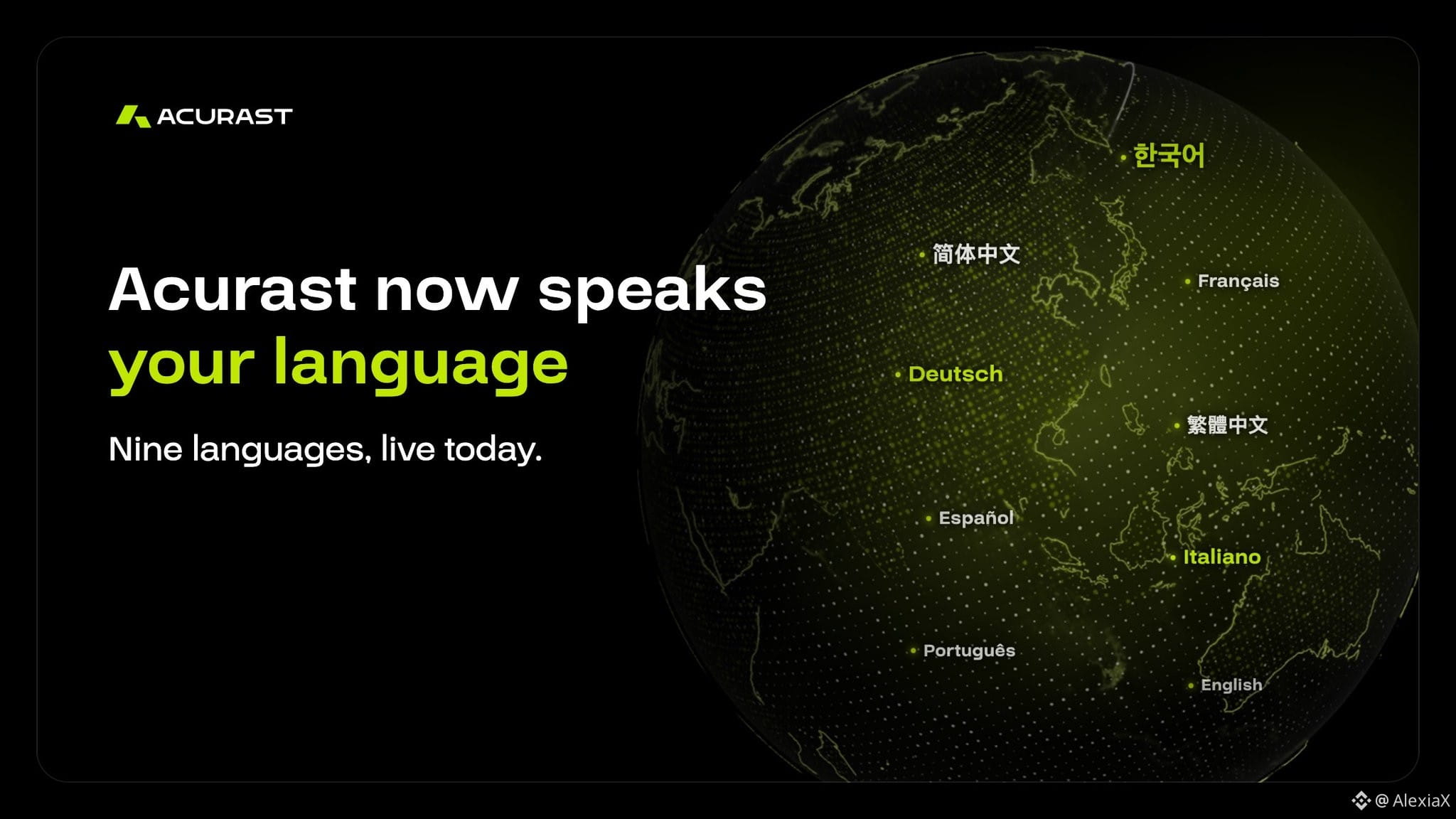
Acurast is making its ecosystem easier to access for a wider community.
The Acurast Hub, website, and Processor app are now available in 9 languages, including Deutsch and 한국어.
For a global Web3 project, having key information and tools in different languages can make it easier for more people to explore and understand the ecosystem.
A simple update, but a useful step toward better accessibility
#Acurast $ACU
Acurast is making its ecosystem easier to access for a wider community.
The Acurast Hub, website, and Processor app are now available in 9 languages, including Deutsch and 한국어.
For a global Web3 project, having key information and tools in different languages can make it easier for more people to explore and understand the ecosystem.
A simple update, but a useful step toward better accessibility
#Acurast $ACU
The Acurast Hub, website, and Processor app are now available in 9 languages, including Deutsch and 한국어.
For a global Web3 project, having key information and tools in different languages can make it easier for more people to explore and understand the ecosystem.
A simple update, but a useful step toward better accessibility
#Acurast $ACU
J A S M I N E:
Decentralized compute, now more global
3
3
398
Connectez-vous pour découvrir plus de contenu
Rejoignez la communauté mondiale des adeptes de cryptomonnaies sur Binance Square
⚡️ Suviez les dernières informations importantes sur les cryptomonnaies.
💬 Jugé digne de confiance par la plus grande plateforme d’échange de cryptomonnaies au monde.
👍 Découvrez les connaissances que partagent les créateurs vérifiés.
Adresse e-mail/Nº de téléphone
Sujets d’actualité
1
#BNBSurpasses$790
13,061 vues
108 mentions
2
#ZamaRises15.99%ToIntradayHigh$0.09
8,509 vues
88 mentions
3
#BitcoinSpotETFsDraw$6.34BInflowsInQ3
4,432 vues
72 mentions
4
#EthereumValidatorExitQueueJumps392%
69,734 vues
815 mentions
5
#IMFApprovesElSalvador$138MWithBitcoinWaiver
9,781 vues
53 mentions
6
#SECHaltsCryptoETFReviewsAmidFundingLapse
226,536 vues
1,708 mentions
7
#ZcashETFPostsFirstWeeklyOutflow$93.6M
91,408 vues
250 mentions
8
#GreekPoliceBustCryptoScamRingArrest17
353,800 vues
2,373 mentions
9
#BitcoinRejectedAt$87K
211,673 vues
314 mentions
10
#FedOctoberRateHikeOddsFallTo17%
354,086 vues
2,476 mentions