

CRYPTO_NOVAA
16 Publicaciones

CRYPTO_NOVAA
Denunciar
Bloquear usuario
106 Siguiendo
51 Seguidores
0 Me gusta
Publicaciones
·
--
La adopción institucional de la tecnología blockchain se enfrenta a un desafío fundamental: equilibrar la transparencia con la confidencialidad. Las instituciones financieras tradicionales no pueden desplegar capital en libros contables públicos totalmente transparentes, donde cada saldo, operación y movimiento estratégico es visible para los competidores. Al mismo tiempo, las redes de privacidad puras carecen de la auditabilidad necesaria para cumplir marcos estrictos de cumplimiento normativo.
Aquí es donde @Dusk redefine el paradigma para las finanzas reguladas en cadena.
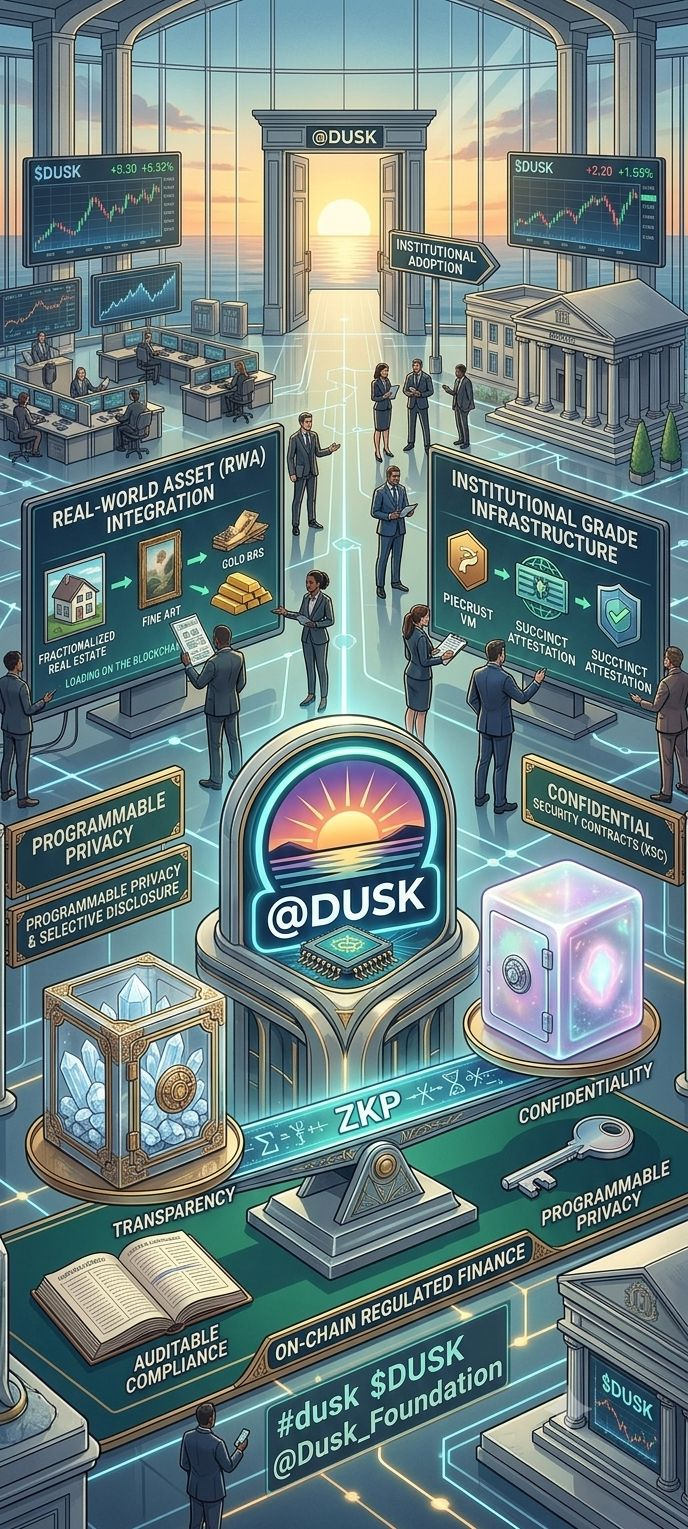
Como un protocolo dedicado de Capa 1, @Dusk integra Pruebas de Conocimiento Cero (ZKPs) nativas directamente en su arquitectura, llevando activos del mundo real (RWAs), valores tokenizados e instrumentos financieros confidenciales en cadena con precisión institucional.
Puntos clave del ecosistema de @Dusk:
Privacidad Programable y Divulgación Selectiva: Impulsada por criptografía de conocimiento cero, @Dusk permite la confidencialidad total de las transacciones mientras preserva el cumplimiento regulatorio. Los participantes del mercado pueden verificar la elegibilidad y ejecutar la liquidación sin filtrar datos operativos sensibles.
Infraestructura de grado institucional: Utilizando la Piecrust VM y el consenso de Acuerdos (Attestation) Concisos, @Dusk ofrece ejecución de bajo costo, liquidación determinista y alta capacidad de procesamiento diseñada para aplicaciones financieras modernas.
Integración de Activos del Mundo Real: Al admitir estándares como los Confidential Security Contracts (XSC), @Dusk permite a las instituciones emitir y gestionar valores digitales conformes directamente en cadena.
El token $DUSK impulsa esta economía centrada en la privacidad: impulsa la seguridad de la red mediante el staking, ejecuta contratos inteligentes confidenciales y habilita la gobernanza descentralizada. A medida que las finanzas institucionales avanzan hacia infraestructura pública, @Dusk proporciona el puente necesario entre el cumplimiento y la privacidad.
Conoce más sobre el proyecto en
#dusk
$DUSK
@Dusk_Foundation
@BinanceBurmese @BinanceTurkish
La adopción institucional de la tecnología blockchain se enfrenta a un desafío fundamental: equilibrar la transparencia con la confidencialidad. Las instituciones financieras tradicionales no pueden desplegar capital en libros contables públicos totalmente transparentes, donde cada saldo, operación y movimiento estratégico es visible para los competidores. Al mismo tiempo, las redes de privacidad puras carecen de la auditabilidad necesaria para cumplir marcos estrictos de cumplimiento normativo.
Aquí es donde @Dusk redefine el paradigma para las finanzas reguladas en cadena.
Como un protocolo dedicado de Capa 1, @Dusk integra Pruebas de Conocimiento Cero (ZKPs) nativas directamente en su arquitectura, llevando activos del mundo real (RWAs), valores tokenizados e instrumentos financieros confidenciales en cadena con precisión institucional.
Puntos clave del ecosistema de @Dusk:
Privacidad Programable y Divulgación Selectiva: Impulsada por criptografía de conocimiento cero, @Dusk permite la confidencialidad total de las transacciones mientras preserva el cumplimiento regulatorio. Los participantes del mercado pueden verificar la elegibilidad y ejecutar la liquidación sin filtrar datos operativos sensibles.
Infraestructura de grado institucional: Utilizando la Piecrust VM y el consenso de Acuerdos (Attestation) Concisos, @Dusk ofrece ejecución de bajo costo, liquidación determinista y alta capacidad de procesamiento diseñada para aplicaciones financieras modernas.
Integración de Activos del Mundo Real: Al admitir estándares como los Confidential Security Contracts (XSC), @Dusk permite a las instituciones emitir y gestionar valores digitales conformes directamente en cadena.
El token $DUSK impulsa esta economía centrada en la privacidad: impulsa la seguridad de la red mediante el staking, ejecuta contratos inteligentes confidenciales y habilita la gobernanza descentralizada. A medida que las finanzas institucionales avanzan hacia infraestructura pública, @Dusk proporciona el puente necesario entre el cumplimiento y la privacidad.
Conoce más sobre el proyecto en
#dusk
$DUSK
@Dusk
@Binance Burmese @Binance Global Türkçe
Aquí es donde @Dusk redefine el paradigma para las finanzas reguladas en cadena.
Como un protocolo dedicado de Capa 1, @Dusk integra Pruebas de Conocimiento Cero (ZKPs) nativas directamente en su arquitectura, llevando activos del mundo real (RWAs), valores tokenizados e instrumentos financieros confidenciales en cadena con precisión institucional.
Puntos clave del ecosistema de @Dusk:
Privacidad Programable y Divulgación Selectiva: Impulsada por criptografía de conocimiento cero, @Dusk permite la confidencialidad total de las transacciones mientras preserva el cumplimiento regulatorio. Los participantes del mercado pueden verificar la elegibilidad y ejecutar la liquidación sin filtrar datos operativos sensibles.
Infraestructura de grado institucional: Utilizando la Piecrust VM y el consenso de Acuerdos (Attestation) Concisos, @Dusk ofrece ejecución de bajo costo, liquidación determinista y alta capacidad de procesamiento diseñada para aplicaciones financieras modernas.
Integración de Activos del Mundo Real: Al admitir estándares como los Confidential Security Contracts (XSC), @Dusk permite a las instituciones emitir y gestionar valores digitales conformes directamente en cadena.
El token $DUSK impulsa esta economía centrada en la privacidad: impulsa la seguridad de la red mediante el staking, ejecuta contratos inteligentes confidenciales y habilita la gobernanza descentralizada. A medida que las finanzas institucionales avanzan hacia infraestructura pública, @Dusk proporciona el puente necesario entre el cumplimiento y la privacidad.
Conoce más sobre el proyecto en
#dusk
$DUSK
@Dusk
@Binance Burmese @Binance Global Türkçe
75
·
--
$TMX Tokenomics: El Enfoque de Gobernanza del Año 1 Detrás del Periodo de 12 Meses con Franquicia
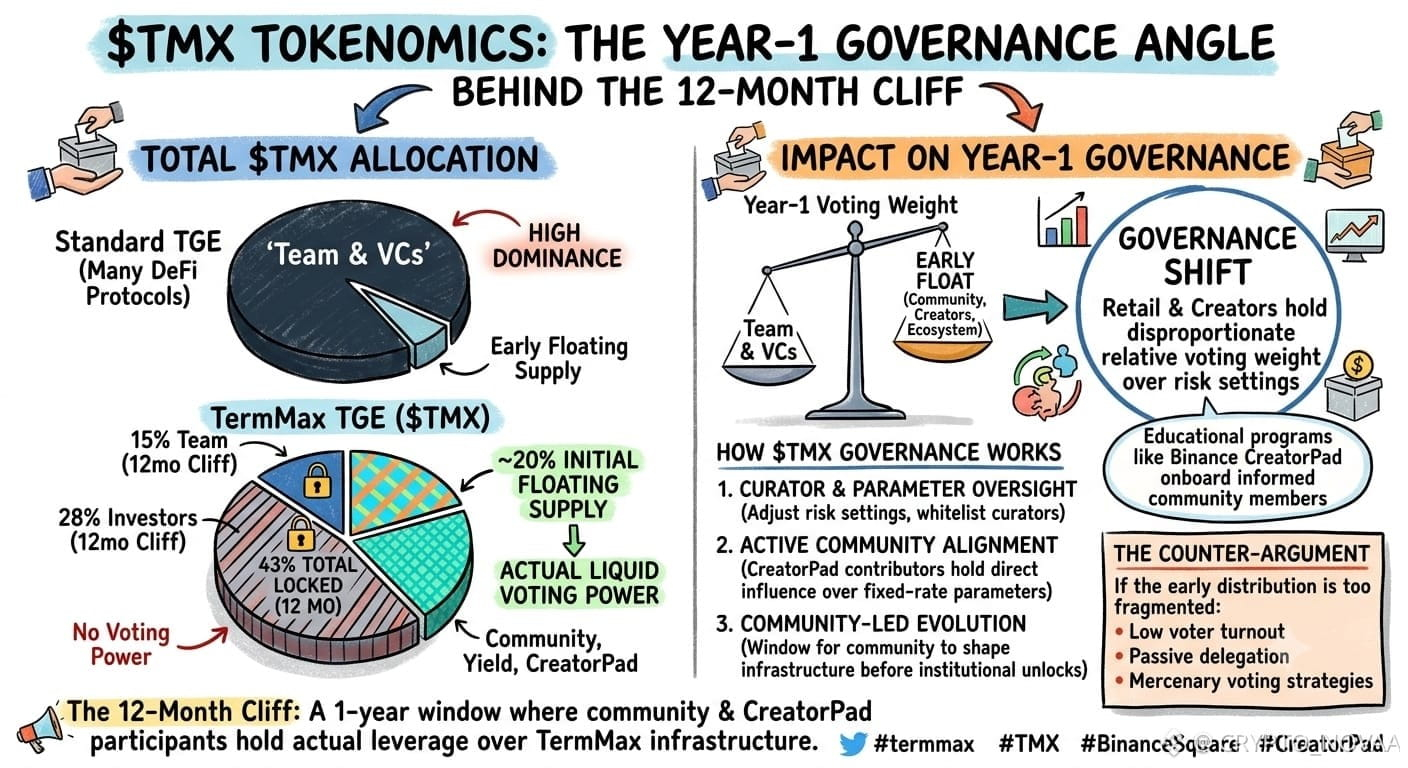
Al analizar los eventos de generación de tokens, las conversaciones suelen centrarse en la presión de venta inicial frente a los cronogramas de desbloqueo a largo plazo. Para @TermMax ($TMX), el planteamiento está bien documentado: una oferta flotante inicial de ~20% en el TGE junto con una estricta franquicia de 12 meses para el Equipo (15%) y para los Inversionistas (28%).
Sin embargo, hay una dinámica poco analizada en esta estructura: la Distribución de la Gobernanza Temprana del Protocolo.
En muchos protocolos DeFi, la gobernanza temprana está fuertemente dominada por los tokens del equipo y de venture capital. Pero como el 43% de la oferta total de $TMX permanece completamente bloqueada en contratos inteligentes durante el primer año completo, el poder de votación líquido durante el Año 1 se concentra casi por completo dentro de la oferta circulante desbloqueada en etapas tempranas.
Esta flotación inicial consta de asignaciones de la comunidad, participantes de rendimiento y creadores recompensados mediante programas como la campaña de 300.000 $TMX Binance CreatorPad en Binance Square.
Lo que esto significa para la ejecución temprana de TermMax:
Cambio Temporal en la Gobernanza: Durante la franquicia interna de 12 meses, los participantes minoristas activos, los Creadores y los votantes del ecosistema tienen un peso de votación desproporcionado en relación con la configuración del riesgo del protocolo.
Alineación Impulsada por la Comunidad: Programas educativos como Binance CreatorPad no solo distribuyen tokens; incorporan a miembros informados de la comunidad que ejercen influencia directa sobre parámetros de mercado de tarifa fija antes de que entren en efecto los desbloqueos institucionales.
El Contrargumento
Si la distribución temprana de tokens está demasiado fragmentada o queda en manos de traders de corto plazo, la participación en la gobernanza podría verse afectada por una baja asistencia de votantes, dejando potencialmente los ajustes de parámetros expuestos a delegación pasiva o a estrategias de votación mercenarias.
Conclusión
La franquicia de 12 meses no solo protege al mercado de los desvíos de venta de insiders; crea una ventana de 1 año donde los participantes de la comunidad y los contribuyentes de CreatorPad poseen un poder real de gobernanza sobre la evolución de la infraestructura de tasa fija de TermMax.
#termmax #TMX #BinanceSquare #CreatorPad
@termmax
$TMX Tokenomics: El Enfoque de Gobernanza del Año 1 Detrás del Periodo de 12 Meses con Franquicia
Al analizar los eventos de generación de tokens, las conversaciones suelen centrarse en la presión de venta inicial frente a los cronogramas de desbloqueo a largo plazo. Para @TermMax ($TMX), el planteamiento está bien documentado: una oferta flotante inicial de ~20% en el TGE junto con una estricta franquicia de 12 meses para el Equipo (15%) y para los Inversionistas (28%).
Sin embargo, hay una dinámica poco analizada en esta estructura: la Distribución de la Gobernanza Temprana del Protocolo.
En muchos protocolos DeFi, la gobernanza temprana está fuertemente dominada por los tokens del equipo y de venture capital. Pero como el 43% de la oferta total de $TMX permanece completamente bloqueada en contratos inteligentes durante el primer año completo, el poder de votación líquido durante el Año 1 se concentra casi por completo dentro de la oferta circulante desbloqueada en etapas tempranas.
Esta flotación inicial consta de asignaciones de la comunidad, participantes de rendimiento y creadores recompensados mediante programas como la campaña de 300.000 $TMX Binance CreatorPad en Binance Square.
Lo que esto significa para la ejecución temprana de TermMax:
Cambio Temporal en la Gobernanza: Durante la franquicia interna de 12 meses, los participantes minoristas activos, los Creadores y los votantes del ecosistema tienen un peso de votación desproporcionado en relación con la configuración del riesgo del protocolo.
Alineación Impulsada por la Comunidad: Programas educativos como Binance CreatorPad no solo distribuyen tokens; incorporan a miembros informados de la comunidad que ejercen influencia directa sobre parámetros de mercado de tarifa fija antes de que entren en efecto los desbloqueos institucionales.
El Contrargumento
Si la distribución temprana de tokens está demasiado fragmentada o queda en manos de traders de corto plazo, la participación en la gobernanza podría verse afectada por una baja asistencia de votantes, dejando potencialmente los ajustes de parámetros expuestos a delegación pasiva o a estrategias de votación mercenarias.
Conclusión
La franquicia de 12 meses no solo protege al mercado de los desvíos de venta de insiders; crea una ventana de 1 año donde los participantes de la comunidad y los contribuyentes de CreatorPad poseen un poder real de gobernanza sobre la evolución de la infraestructura de tasa fija de TermMax.
#termmax #TMX #BinanceSquare #CreatorPad
@TermMax
Al analizar los eventos de generación de tokens, las conversaciones suelen centrarse en la presión de venta inicial frente a los cronogramas de desbloqueo a largo plazo. Para @TermMax ($TMX), el planteamiento está bien documentado: una oferta flotante inicial de ~20% en el TGE junto con una estricta franquicia de 12 meses para el Equipo (15%) y para los Inversionistas (28%).
Sin embargo, hay una dinámica poco analizada en esta estructura: la Distribución de la Gobernanza Temprana del Protocolo.
En muchos protocolos DeFi, la gobernanza temprana está fuertemente dominada por los tokens del equipo y de venture capital. Pero como el 43% de la oferta total de $TMX permanece completamente bloqueada en contratos inteligentes durante el primer año completo, el poder de votación líquido durante el Año 1 se concentra casi por completo dentro de la oferta circulante desbloqueada en etapas tempranas.
Esta flotación inicial consta de asignaciones de la comunidad, participantes de rendimiento y creadores recompensados mediante programas como la campaña de 300.000 $TMX Binance CreatorPad en Binance Square.
Lo que esto significa para la ejecución temprana de TermMax:
Cambio Temporal en la Gobernanza: Durante la franquicia interna de 12 meses, los participantes minoristas activos, los Creadores y los votantes del ecosistema tienen un peso de votación desproporcionado en relación con la configuración del riesgo del protocolo.
Alineación Impulsada por la Comunidad: Programas educativos como Binance CreatorPad no solo distribuyen tokens; incorporan a miembros informados de la comunidad que ejercen influencia directa sobre parámetros de mercado de tarifa fija antes de que entren en efecto los desbloqueos institucionales.
El Contrargumento
Si la distribución temprana de tokens está demasiado fragmentada o queda en manos de traders de corto plazo, la participación en la gobernanza podría verse afectada por una baja asistencia de votantes, dejando potencialmente los ajustes de parámetros expuestos a delegación pasiva o a estrategias de votación mercenarias.
Conclusión
La franquicia de 12 meses no solo protege al mercado de los desvíos de venta de insiders; crea una ventana de 1 año donde los participantes de la comunidad y los contribuyentes de CreatorPad poseen un poder real de gobernanza sobre la evolución de la infraestructura de tasa fija de TermMax.
#termmax #TMX #BinanceSquare #CreatorPad
@TermMax
63
·
--
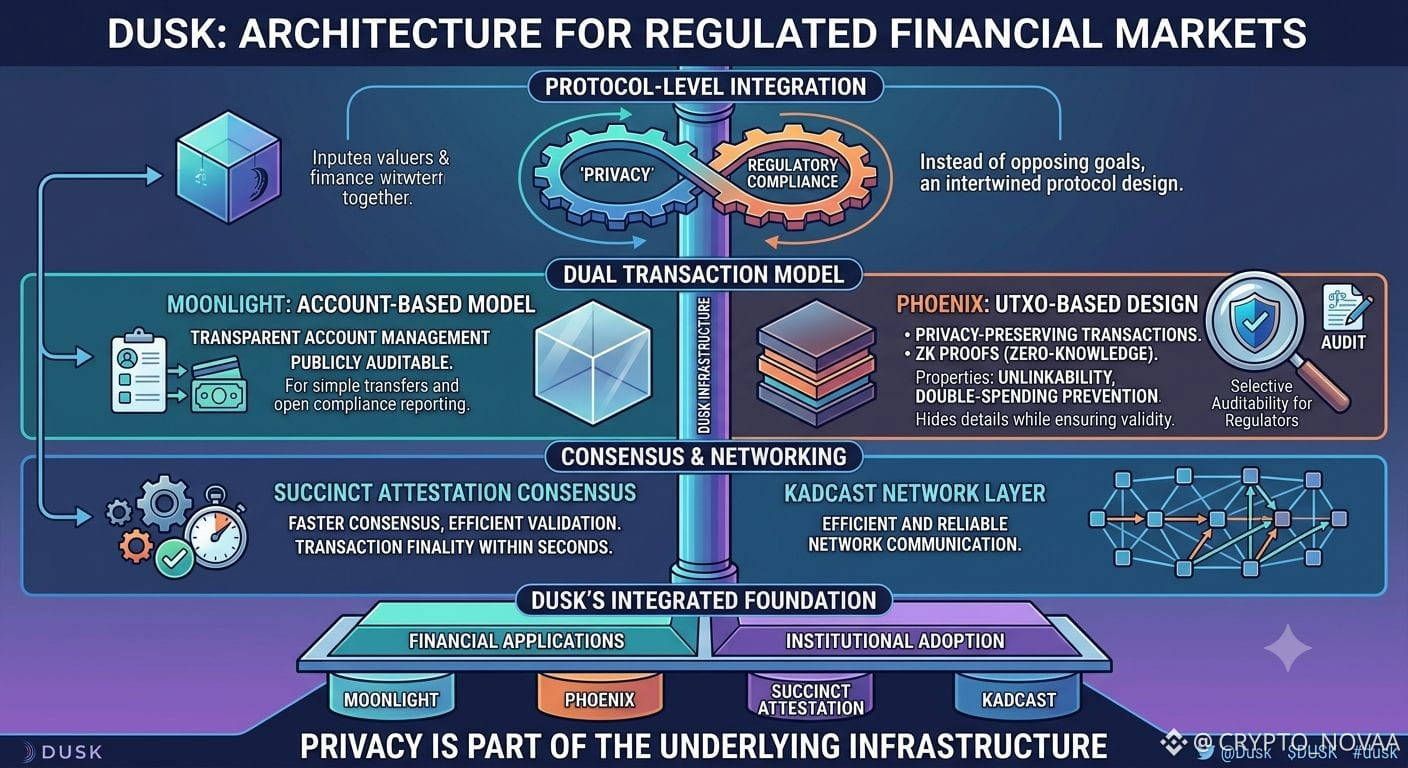
El atardecer está adoptando un enfoque diferente para la infraestructura blockchain: en lugar de tratar la privacidad y el cumplimiento normativo como objetivos opuestos, su arquitectura está diseñada para integrar ambos.
Al leer el whitepaper de Dusk, lo que más me llamó la atención es lo profundamente que esta idea está incorporada en el protocolo. Dusk se enfoca en mercados financieros regulados donde los datos sensibles de las transacciones necesitan confidencialidad, pero las instituciones aun así requieren cumplimiento y capacidad de auditoría.
Su conciso consenso de atestación está diseñado para proporcionar la finalidad de las transacciones en cuestión de segundos, mientras que Kadcast se encarga de gestionar de forma eficiente y fiable la comunicación de red.
Luego están los modelos de transacción Moonlight y Phoenix. Moonlight ofrece un modelo transparente basado en cuentas, mientras que Phoenix utiliza un diseño basado en UTXO con pruebas ZK para transacciones que preservan la privacidad.
El whitepaper explica que Phoenix puede proporcionar propiedades como la no vinculabilidad y la prevención del doble gasto sin exponer públicamente los detalles subyacentes de las transacciones.
Esa combinación es lo que hace que Dusk me resulte interesante: la privacidad no se está agregando como una ocurrencia tardía. Forma parte de la infraestructura subyacente que se está construyendo para aplicaciones financieras.
#dusk $DUSK @Dusk_Foundation
El atardecer está adoptando un enfoque diferente para la infraestructura blockchain: en lugar de tratar la privacidad y el cumplimiento normativo como objetivos opuestos, su arquitectura está diseñada para integrar ambos.
Al leer el whitepaper de Dusk, lo que más me llamó la atención es lo profundamente que esta idea está incorporada en el protocolo. Dusk se enfoca en mercados financieros regulados donde los datos sensibles de las transacciones necesitan confidencialidad, pero las instituciones aun así requieren cumplimiento y capacidad de auditoría.
Su conciso consenso de atestación está diseñado para proporcionar la finalidad de las transacciones en cuestión de segundos, mientras que Kadcast se encarga de gestionar de forma eficiente y fiable la comunicación de red.
Luego están los modelos de transacción Moonlight y Phoenix. Moonlight ofrece un modelo transparente basado en cuentas, mientras que Phoenix utiliza un diseño basado en UTXO con pruebas ZK para transacciones que preservan la privacidad.
El whitepaper explica que Phoenix puede proporcionar propiedades como la no vinculabilidad y la prevención del doble gasto sin exponer públicamente los detalles subyacentes de las transacciones.
Esa combinación es lo que hace que Dusk me resulte interesante: la privacidad no se está agregando como una ocurrencia tardía. Forma parte de la infraestructura subyacente que se está construyendo para aplicaciones financieras.
#dusk $DUSK @Dusk
Al leer el whitepaper de Dusk, lo que más me llamó la atención es lo profundamente que esta idea está incorporada en el protocolo. Dusk se enfoca en mercados financieros regulados donde los datos sensibles de las transacciones necesitan confidencialidad, pero las instituciones aun así requieren cumplimiento y capacidad de auditoría.
Su conciso consenso de atestación está diseñado para proporcionar la finalidad de las transacciones en cuestión de segundos, mientras que Kadcast se encarga de gestionar de forma eficiente y fiable la comunicación de red.
Luego están los modelos de transacción Moonlight y Phoenix. Moonlight ofrece un modelo transparente basado en cuentas, mientras que Phoenix utiliza un diseño basado en UTXO con pruebas ZK para transacciones que preservan la privacidad.
El whitepaper explica que Phoenix puede proporcionar propiedades como la no vinculabilidad y la prevención del doble gasto sin exponer públicamente los detalles subyacentes de las transacciones.
Esa combinación es lo que hace que Dusk me resulte interesante: la privacidad no se está agregando como una ocurrencia tardía. Forma parte de la infraestructura subyacente que se está construyendo para aplicaciones financieras.
#dusk $DUSK @Dusk
73
·
--
Pasé más tiempo hoy con la documentación propia de Dusk y creo que encontré la historia de RWA más interesante que se esconde debajo del titular.
La pieza sobre tokenización del 15 de agosto de SME es inusualmente explícita sobre lo que la tokenización no reemplaza.
El notario se mantiene.
El centro regulado se mantiene.
El operador responsable se mantiene.
La fijación de precios se mantiene.
Eso importa.
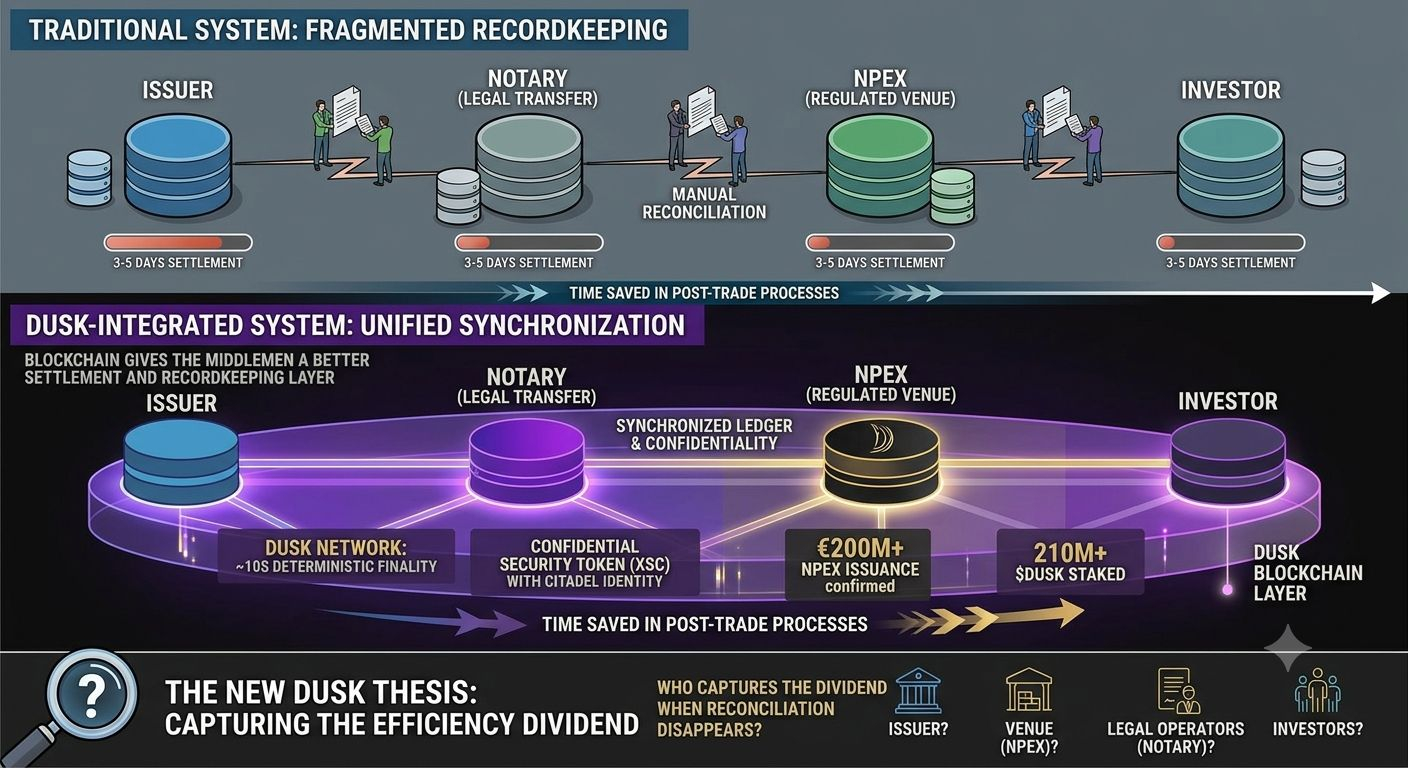
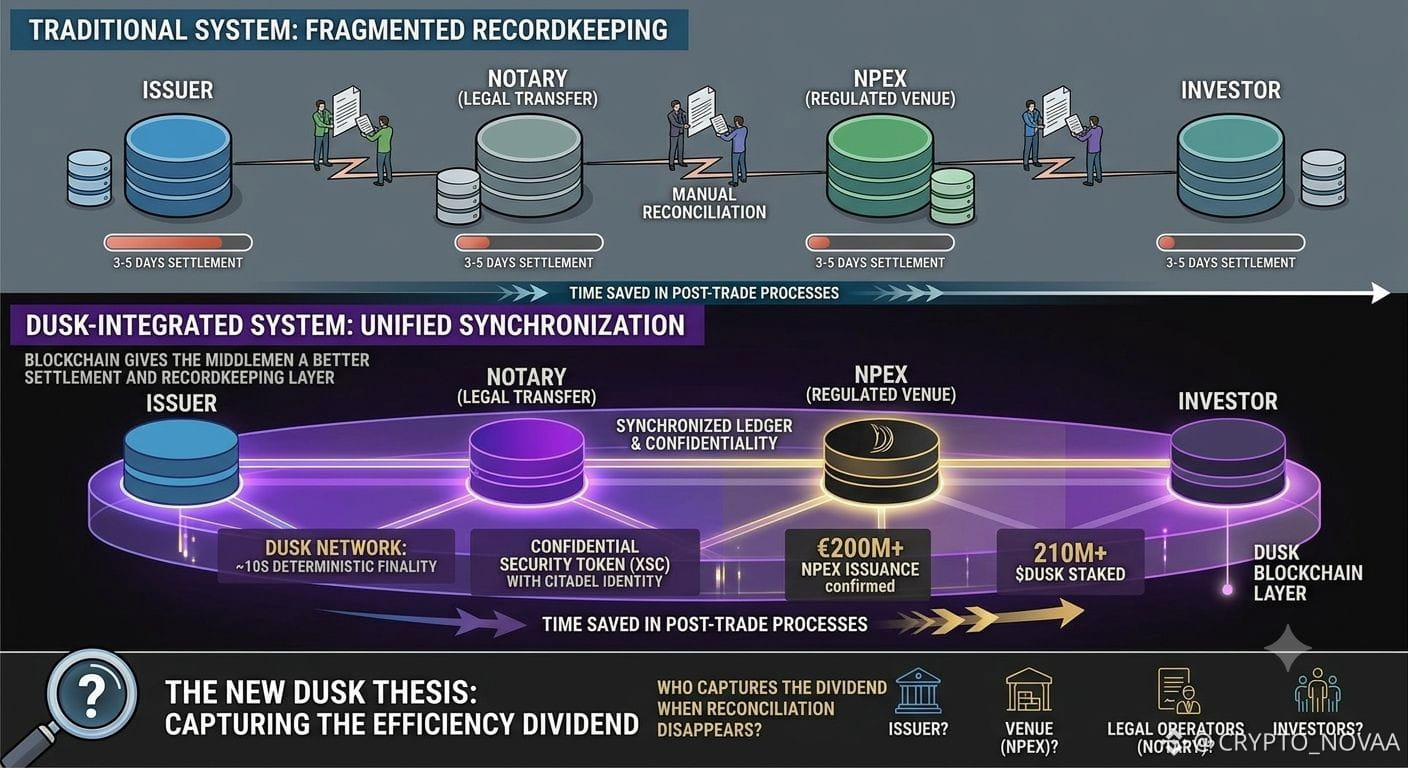
Porque Dusk puede tener las impresionantes cifras técnicas — 210M+ $DUSK staked, ~10s de finalidad determinista, €200M+ en emisión NPEX confirmada — mientras que el flujo real de propiedad legal sigue pasando por la infraestructura neerlandesa establecida.
Así que quizá la historia no sea:
“Blockchain elimina a los intermediarios.”
Quizá sea:
“Blockchain le da a los intermediarios una capa de mejor liquidación y mantenimiento de registros.”
Y, sinceramente, eso podría ser un caso de uso institucional mucho más realista.
Si NPEX permanece como el centro regulado y el notario sigue siendo responsable de la transferencia legal, la propuesta de valor de Dusk deja de tratarse tanto de reemplazar el sistema existente y pasa a centrarse en hacer que el sistema que hay debajo sea más rápido, más sincronizado y más fácil de conciliar.
Eso cambia la pregunta que me estoy haciendo sobre Dusk.
No “¿Puede la tokenización eliminar intermediarios?”
Sino:
¿Quién se queda con el dividendo de eficiencia cuando los intermediarios ya no tienen que conciliar tanto?
¿El emisor?
¿El centro?
¿Los operadores legales?
¿O eventualmente los inversores?
Eso es lo que se siente como la tesis de Dusk más interesante que vale la pena investigar.
#dusk $DUSK @Dusk_Foundation
Pasé más tiempo hoy con la documentación propia de Dusk y creo que encontré la historia de RWA más interesante que se esconde debajo del titular.
La pieza sobre tokenización del 15 de agosto de SME es inusualmente explícita sobre lo que la tokenización no reemplaza.
El notario se mantiene.
El centro regulado se mantiene.
El operador responsable se mantiene.
La fijación de precios se mantiene.
Eso importa.
Porque Dusk puede tener las impresionantes cifras técnicas — 210M+ $DUSK staked, ~10s de finalidad determinista, €200M+ en emisión NPEX confirmada — mientras que el flujo real de propiedad legal sigue pasando por la infraestructura neerlandesa establecida.
Así que quizá la historia no sea:
“Blockchain elimina a los intermediarios.”
Quizá sea:
“Blockchain le da a los intermediarios una capa de mejor liquidación y mantenimiento de registros.”
Y, sinceramente, eso podría ser un caso de uso institucional mucho más realista.
Si NPEX permanece como el centro regulado y el notario sigue siendo responsable de la transferencia legal, la propuesta de valor de Dusk deja de tratarse tanto de reemplazar el sistema existente y pasa a centrarse en hacer que el sistema que hay debajo sea más rápido, más sincronizado y más fácil de conciliar.
Eso cambia la pregunta que me estoy haciendo sobre Dusk.
No “¿Puede la tokenización eliminar intermediarios?”
Sino:
¿Quién se queda con el dividendo de eficiencia cuando los intermediarios ya no tienen que conciliar tanto?
¿El emisor?
¿El centro?
¿Los operadores legales?
¿O eventualmente los inversores?
Eso es lo que se siente como la tesis de Dusk más interesante que vale la pena investigar.
#dusk $DUSK @Dusk
La pieza sobre tokenización del 15 de agosto de SME es inusualmente explícita sobre lo que la tokenización no reemplaza.
El notario se mantiene.
El centro regulado se mantiene.
El operador responsable se mantiene.
La fijación de precios se mantiene.
Eso importa.
Porque Dusk puede tener las impresionantes cifras técnicas — 210M+ $DUSK staked, ~10s de finalidad determinista, €200M+ en emisión NPEX confirmada — mientras que el flujo real de propiedad legal sigue pasando por la infraestructura neerlandesa establecida.
Así que quizá la historia no sea:
“Blockchain elimina a los intermediarios.”
Quizá sea:
“Blockchain le da a los intermediarios una capa de mejor liquidación y mantenimiento de registros.”
Y, sinceramente, eso podría ser un caso de uso institucional mucho más realista.
Si NPEX permanece como el centro regulado y el notario sigue siendo responsable de la transferencia legal, la propuesta de valor de Dusk deja de tratarse tanto de reemplazar el sistema existente y pasa a centrarse en hacer que el sistema que hay debajo sea más rápido, más sincronizado y más fácil de conciliar.
Eso cambia la pregunta que me estoy haciendo sobre Dusk.
No “¿Puede la tokenización eliminar intermediarios?”
Sino:
¿Quién se queda con el dividendo de eficiencia cuando los intermediarios ya no tienen que conciliar tanto?
¿El emisor?
¿El centro?
¿Los operadores legales?
¿O eventualmente los inversores?
Eso es lo que se siente como la tesis de Dusk más interesante que vale la pena investigar.
#dusk $DUSK @Dusk
41
·
--
Pasé más tiempo hoy revisando la documentación propia de Dusk, y creo que encontré la historia de RWA más interesante que se esconde debajo del titular.
La pieza sobre tokenización del 15 de agosto es inusualmente explícita sobre lo que la tokenización no reemplaza.
El notario se mantiene.
La sede regulada se mantiene.
El operador responsable se mantiene.
La formación de precios se mantiene.
Eso importa.
Porque Dusk puede tener los impresionantes números técnicos — 210M+ $DUSK en stake, ~10s de finalidad determinista, €200M+ en emisión NPEX confirmada — mientras que el flujo real de propiedad legal sigue funcionando a través de la infraestructura neerlandesa establecida.
Así que quizá la historia no sea:
“Blockchain elimina a los intermediarios.”
Quizá sea:
“Blockchain le da a los intermediarios una capa de liquidación y mantenimiento de registros mejor.”
Y honestamente, eso podría ser un caso de uso institucional mucho más realista.
Si NPEX sigue siendo la sede regulada y el notario sigue siendo responsable de la transferencia legal, la propuesta de valor de Dusk deja de tratar tanto de reemplazar el sistema existente y pasa a centrarse en hacer que la capa subyacente de ese sistema sea más rápida, más sincronizada y más fácil de conciliar.
Eso cambia la pregunta que me planteo sobre Dusk.
No “¿Puede la tokenización eliminar intermediarios?”
Sino:
¿Quién se queda con el dividendo de eficiencia cuando los intermediarios ya no tienen que conciliar tanto?
¿El emisor?
¿La sede?
¿Los operadores legales?
¿O eventualmente los inversores?
Eso es lo que suena a la tesis de Dusk más interesante para investigar.
@Dusk_Foundation #Dusk.
Pasé más tiempo hoy revisando la documentación propia de Dusk, y creo que encontré la historia de RWA más interesante que se esconde debajo del titular.
La pieza sobre tokenización del 15 de agosto es inusualmente explícita sobre lo que la tokenización no reemplaza.
El notario se mantiene.
La sede regulada se mantiene.
El operador responsable se mantiene.
La formación de precios se mantiene.
Eso importa.
Porque Dusk puede tener los impresionantes números técnicos — 210M+ $DUSK en stake, ~10s de finalidad determinista, €200M+ en emisión NPEX confirmada — mientras que el flujo real de propiedad legal sigue funcionando a través de la infraestructura neerlandesa establecida.
Así que quizá la historia no sea:
“Blockchain elimina a los intermediarios.”
Quizá sea:
“Blockchain le da a los intermediarios una capa de liquidación y mantenimiento de registros mejor.”
Y honestamente, eso podría ser un caso de uso institucional mucho más realista.
Si NPEX sigue siendo la sede regulada y el notario sigue siendo responsable de la transferencia legal, la propuesta de valor de Dusk deja de tratar tanto de reemplazar el sistema existente y pasa a centrarse en hacer que la capa subyacente de ese sistema sea más rápida, más sincronizada y más fácil de conciliar.
Eso cambia la pregunta que me planteo sobre Dusk.
No “¿Puede la tokenización eliminar intermediarios?”
Sino:
¿Quién se queda con el dividendo de eficiencia cuando los intermediarios ya no tienen que conciliar tanto?
¿El emisor?
¿La sede?
¿Los operadores legales?
¿O eventualmente los inversores?
Eso es lo que suena a la tesis de Dusk más interesante para investigar.
@Dusk #Dusk.
La pieza sobre tokenización del 15 de agosto es inusualmente explícita sobre lo que la tokenización no reemplaza.
El notario se mantiene.
La sede regulada se mantiene.
El operador responsable se mantiene.
La formación de precios se mantiene.
Eso importa.
Porque Dusk puede tener los impresionantes números técnicos — 210M+ $DUSK en stake, ~10s de finalidad determinista, €200M+ en emisión NPEX confirmada — mientras que el flujo real de propiedad legal sigue funcionando a través de la infraestructura neerlandesa establecida.
Así que quizá la historia no sea:
“Blockchain elimina a los intermediarios.”
Quizá sea:
“Blockchain le da a los intermediarios una capa de liquidación y mantenimiento de registros mejor.”
Y honestamente, eso podría ser un caso de uso institucional mucho más realista.
Si NPEX sigue siendo la sede regulada y el notario sigue siendo responsable de la transferencia legal, la propuesta de valor de Dusk deja de tratar tanto de reemplazar el sistema existente y pasa a centrarse en hacer que la capa subyacente de ese sistema sea más rápida, más sincronizada y más fácil de conciliar.
Eso cambia la pregunta que me planteo sobre Dusk.
No “¿Puede la tokenización eliminar intermediarios?”
Sino:
¿Quién se queda con el dividendo de eficiencia cuando los intermediarios ya no tienen que conciliar tanto?
¿El emisor?
¿La sede?
¿Los operadores legales?
¿O eventualmente los inversores?
Eso es lo que suena a la tesis de Dusk más interesante para investigar.
@Dusk #Dusk.
66
·
--
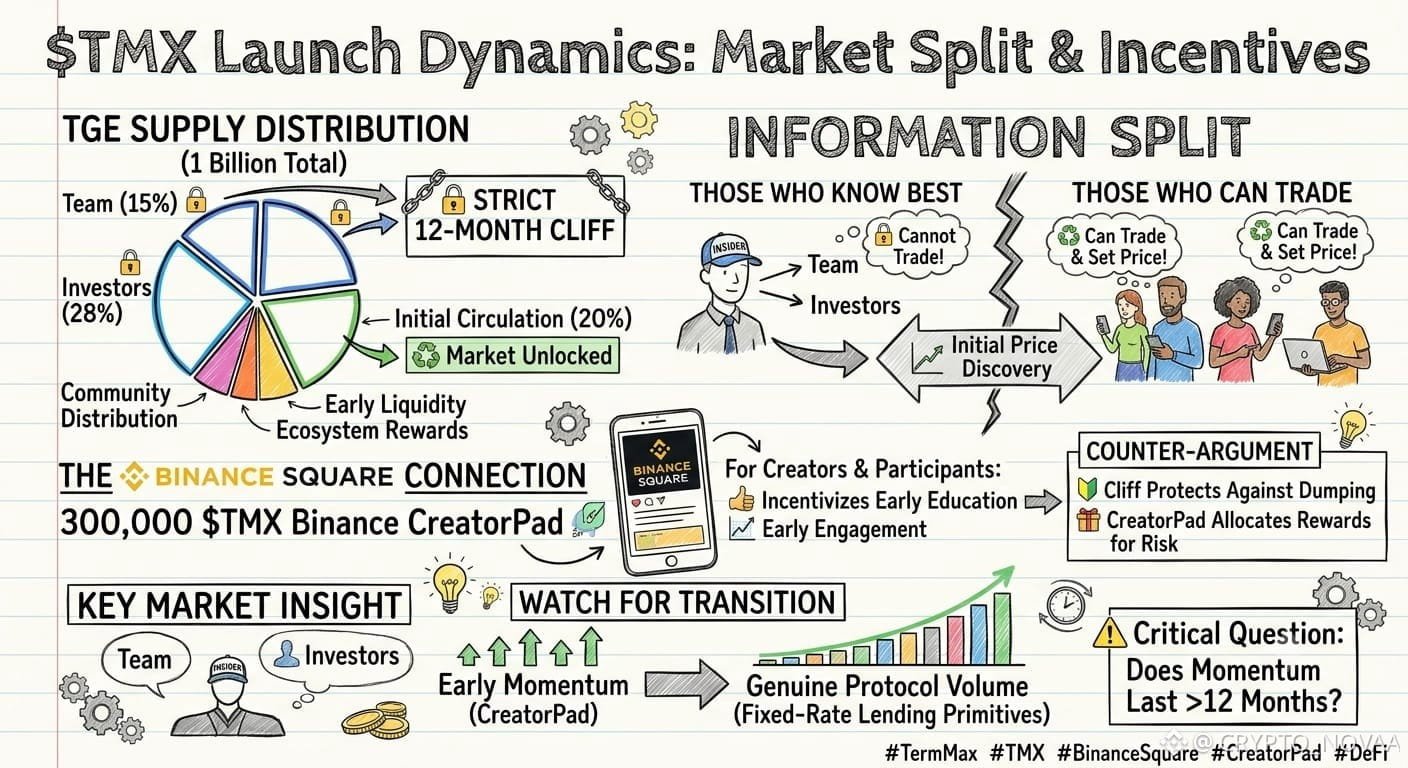
Al observar la estructura de lanzamiento de $TMX en TermMax, se aprecia una dinámica de mercado clara desarrollándose en torno a su TGE: el 20% del suministro de 1.000 millones entra en circulación de inmediato, mientras que el equipo (15%) y los inversores (28%) están bloqueados bajo un estricto cliff de 12 meses.
Esto crea una división de información interesante entre quienes conocen mejor las operaciones internas y quienes realmente pueden operar. El float inicial sirve principalmente para liquidez temprana, recompensas del ecosistema y distribución comunitaria—destacado por iniciativas como la campaña de 300.000 $TMX Binance CreatorPad en Binance Square.
Para creadores y participantes tempranos, CreatorPad incentiva la educación y la participación tempranas. Sin embargo, desde una perspectiva de mercado, el descubrimiento inicial del precio refleja el sentimiento del grupo con tokens liberados al inicio más que una demanda a largo plazo comprobada para primitivas de préstamos con tasa fija.
Contraargumento: los cliffs obligatorios protegen contra el dumping temprano, mientras que las asignaciones de CreatorPad compensan a los primeros adoptantes por asumir el riesgo inicial del protocolo.
Vale la pena observar si el impulso inicial de CreatorPad se transforma en un volumen real del protocolo de tasa fija antes de que expire el cliff de 12 meses.
#TermMax #TMX #BinanceSquare #CreatorPad #DeFi
#termmax @termmax
Al observar la estructura de lanzamiento de $TMX en TermMax, se aprecia una dinámica de mercado clara desarrollándose en torno a su TGE: el 20% del suministro de 1.000 millones entra en circulación de inmediato, mientras que el equipo (15%) y los inversores (28%) están bloqueados bajo un estricto cliff de 12 meses.
Esto crea una división de información interesante entre quienes conocen mejor las operaciones internas y quienes realmente pueden operar. El float inicial sirve principalmente para liquidez temprana, recompensas del ecosistema y distribución comunitaria—destacado por iniciativas como la campaña de 300.000 $TMX Binance CreatorPad en Binance Square.
Para creadores y participantes tempranos, CreatorPad incentiva la educación y la participación tempranas. Sin embargo, desde una perspectiva de mercado, el descubrimiento inicial del precio refleja el sentimiento del grupo con tokens liberados al inicio más que una demanda a largo plazo comprobada para primitivas de préstamos con tasa fija.
Contraargumento: los cliffs obligatorios protegen contra el dumping temprano, mientras que las asignaciones de CreatorPad compensan a los primeros adoptantes por asumir el riesgo inicial del protocolo.
Vale la pena observar si el impulso inicial de CreatorPad se transforma en un volumen real del protocolo de tasa fija antes de que expire el cliff de 12 meses.
#TermMax #TMX #BinanceSquare #CreatorPad #DeFi
#termmax @TermMax
Esto crea una división de información interesante entre quienes conocen mejor las operaciones internas y quienes realmente pueden operar. El float inicial sirve principalmente para liquidez temprana, recompensas del ecosistema y distribución comunitaria—destacado por iniciativas como la campaña de 300.000 $TMX Binance CreatorPad en Binance Square.
Para creadores y participantes tempranos, CreatorPad incentiva la educación y la participación tempranas. Sin embargo, desde una perspectiva de mercado, el descubrimiento inicial del precio refleja el sentimiento del grupo con tokens liberados al inicio más que una demanda a largo plazo comprobada para primitivas de préstamos con tasa fija.
Contraargumento: los cliffs obligatorios protegen contra el dumping temprano, mientras que las asignaciones de CreatorPad compensan a los primeros adoptantes por asumir el riesgo inicial del protocolo.
Vale la pena observar si el impulso inicial de CreatorPad se transforma en un volumen real del protocolo de tasa fija antes de que expire el cliff de 12 meses.
#TermMax #TMX #BinanceSquare #CreatorPad #DeFi
#termmax @TermMax
69
·
--
#dusk
Algo pequeño en la arquitectura de Dusk me hizo detenerme.
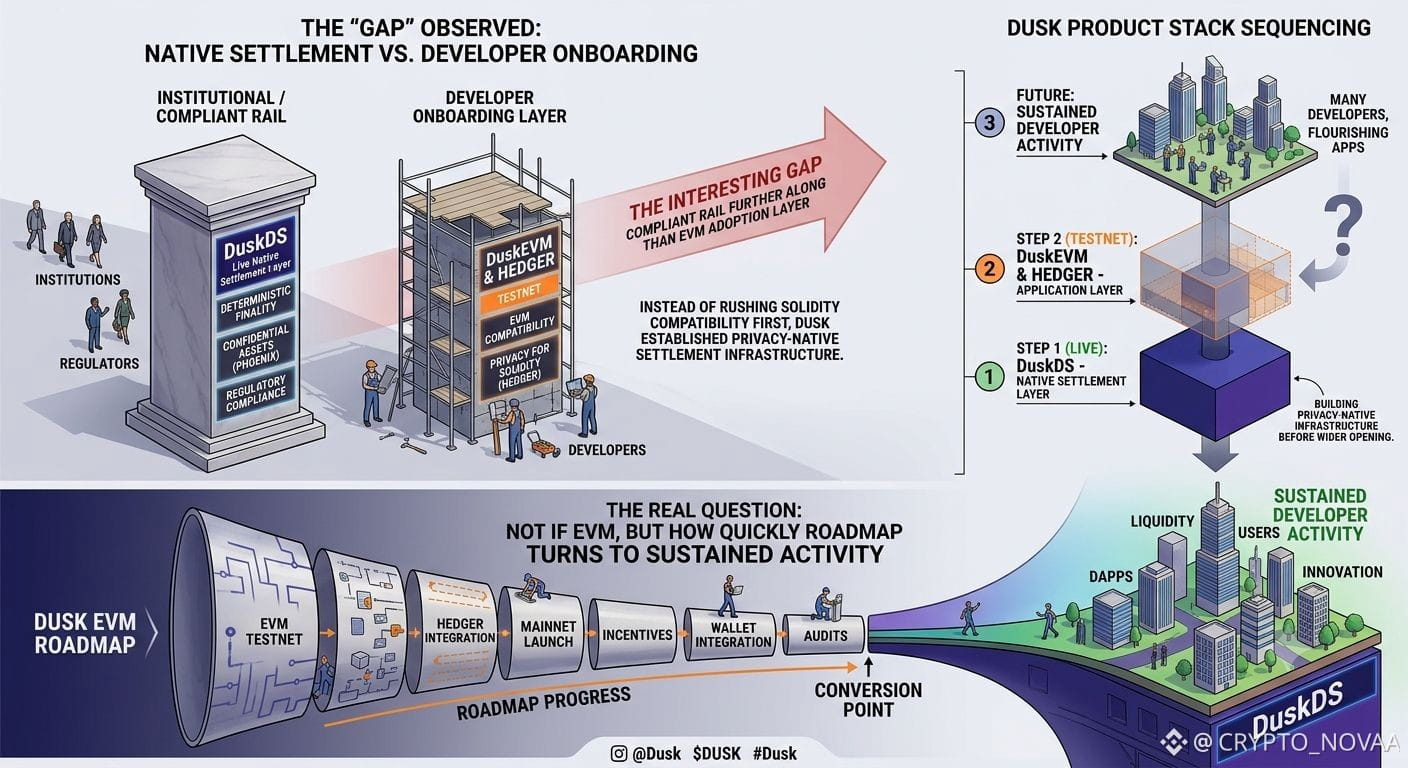
La pila de productos actualmente cuenta una historia más matizada que el típico relato de “Dusk está construyendo una cadena de privacidad compatible con EVM”.
DuskDS ya está en funcionamiento como la capa nativa de liquidación, mientras que DuskEVM y Hedger aún están marcados como testnet.
Esa secuencia en realidad tiene sentido.
En lugar de apresurarse con la compatibilidad de Solidity primero, parece que Dusk está estableciendo la infraestructura de liquidación nativa de la privacidad antes de abrir la puerta para los desarrolladores de EVM.
Pero también crea una brecha interesante: el carril institucional/de cumplimiento va más adelantado que la capa de incorporación de desarrolladores con la que la mayoría de la gente asocia la adopción de EVM.
Así que la pregunta real para mí no es si Dusk tiene una hoja de ruta de EVM.
Es qué tan rápido esa hoja de ruta se convierte en una actividad sostenida de desarrolladores.
$DUSK @Dusk_Foundation
#dusk
Algo pequeño en la arquitectura de Dusk me hizo detenerme.
La pila de productos actualmente cuenta una historia más matizada que el típico relato de “Dusk está construyendo una cadena de privacidad compatible con EVM”.
DuskDS ya está en funcionamiento como la capa nativa de liquidación, mientras que DuskEVM y Hedger aún están marcados como testnet.
Esa secuencia en realidad tiene sentido.
En lugar de apresurarse con la compatibilidad de Solidity primero, parece que Dusk está estableciendo la infraestructura de liquidación nativa de la privacidad antes de abrir la puerta para los desarrolladores de EVM.
Pero también crea una brecha interesante: el carril institucional/de cumplimiento va más adelantado que la capa de incorporación de desarrolladores con la que la mayoría de la gente asocia la adopción de EVM.
Así que la pregunta real para mí no es si Dusk tiene una hoja de ruta de EVM.
Es qué tan rápido esa hoja de ruta se convierte en una actividad sostenida de desarrolladores.
$DUSK @Dusk
Algo pequeño en la arquitectura de Dusk me hizo detenerme.
La pila de productos actualmente cuenta una historia más matizada que el típico relato de “Dusk está construyendo una cadena de privacidad compatible con EVM”.
DuskDS ya está en funcionamiento como la capa nativa de liquidación, mientras que DuskEVM y Hedger aún están marcados como testnet.
Esa secuencia en realidad tiene sentido.
En lugar de apresurarse con la compatibilidad de Solidity primero, parece que Dusk está estableciendo la infraestructura de liquidación nativa de la privacidad antes de abrir la puerta para los desarrolladores de EVM.
Pero también crea una brecha interesante: el carril institucional/de cumplimiento va más adelantado que la capa de incorporación de desarrolladores con la que la mayoría de la gente asocia la adopción de EVM.
Así que la pregunta real para mí no es si Dusk tiene una hoja de ruta de EVM.
Es qué tan rápido esa hoja de ruta se convierte en una actividad sostenida de desarrolladores.
$DUSK @Dusk
61
·
--
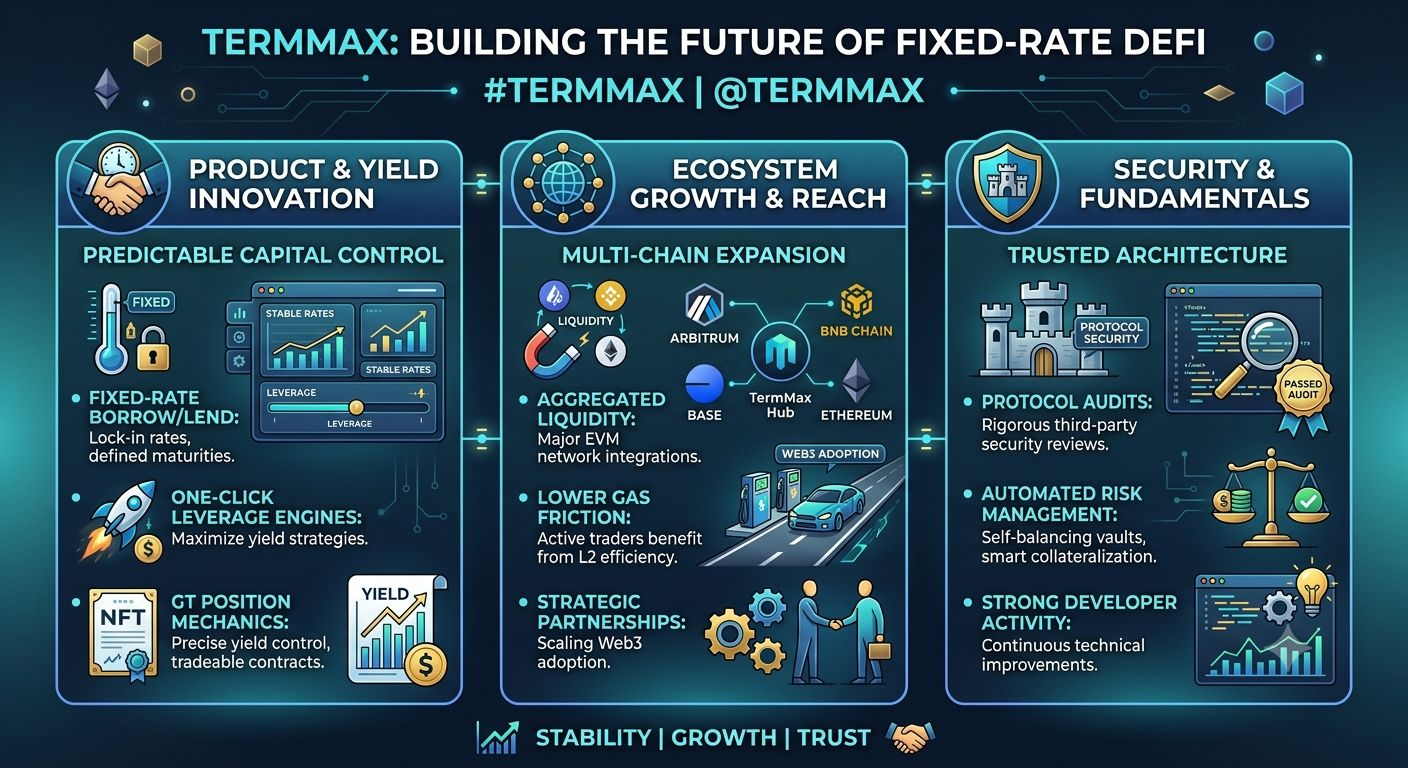
• Producto y seguridad: Actualizaciones continuas de motores de préstamos a tipo fijo, contratos inteligentes de bóveda y la arquitectura de liquidación refuerzan la estabilidad del proyecto. Las rigurosas prácticas de seguridad y la previsibilidad del rendimiento brindan a los traders una base DeFi fiable.
• Ecosistema y liquidez: Despliegue multichain en redes EVM que amplía el acceso de los usuarios y reduce las barreras de gas. Las asociaciones estratégicas con agregadores de rendimiento y DEXs ayudan a escalar la utilidad real, impulsando un crecimiento sostenible de Web3.
• Fundamentos del token: A medida que la adopción crece en todas las cadenas, la integración del token nativo en la gobernanza del protocolo y en los mecanismos de comisiones crea una alineación a largo plazo para la comunidad.
#termmax @termmax
• Producto y seguridad: Actualizaciones continuas de motores de préstamos a tipo fijo, contratos inteligentes de bóveda y la arquitectura de liquidación refuerzan la estabilidad del proyecto. Las rigurosas prácticas de seguridad y la previsibilidad del rendimiento brindan a los traders una base DeFi fiable.
• Ecosistema y liquidez: Despliegue multichain en redes EVM que amplía el acceso de los usuarios y reduce las barreras de gas. Las asociaciones estratégicas con agregadores de rendimiento y DEXs ayudan a escalar la utilidad real, impulsando un crecimiento sostenible de Web3.
• Fundamentos del token: A medida que la adopción crece en todas las cadenas, la integración del token nativo en la gobernanza del protocolo y en los mecanismos de comisiones crea una alineación a largo plazo para la comunidad.
#termmax @TermMax
• Ecosistema y liquidez: Despliegue multichain en redes EVM que amplía el acceso de los usuarios y reduce las barreras de gas. Las asociaciones estratégicas con agregadores de rendimiento y DEXs ayudan a escalar la utilidad real, impulsando un crecimiento sostenible de Web3.
• Fundamentos del token: A medida que la adopción crece en todas las cadenas, la integración del token nativo en la gobernanza del protocolo y en los mecanismos de comisiones crea una alineación a largo plazo para la comunidad.
#termmax @TermMax
73
·
--
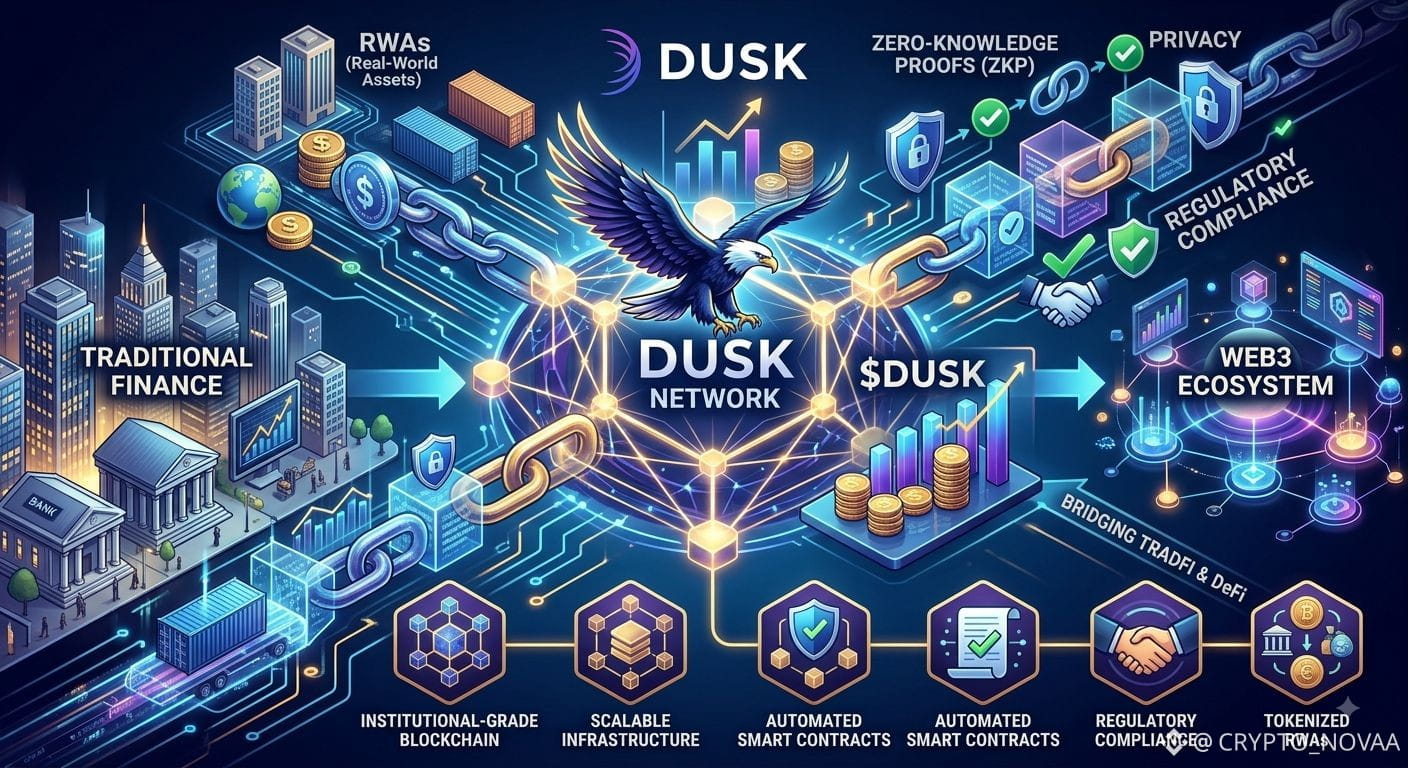
El futuro de las finanzas descentralizadas exige tanto una privacidad sólida como una plena conformidad regulatoria, y @Dusk está liderando la iniciativa con su innovadora infraestructura de blockchain de capa 1. Construido específicamente para aplicaciones financieras de nivel institucional, $DUSK integra tecnología avanzada de Pruebas de Conocimiento Cero (ZKP) para permitir que usuarios e instituciones realicen transacciones de forma segura, manteniendo una estricta confidencialidad de los datos sin renunciar al cumplimiento.
Al cerrar la brecha entre las finanzas tradicionales (TradFi) y los protocolos del ecosistema descentralizado, Dusk permite que los activos del mundo real (RWAs) se tokenicen de forma segura on-chain. Esto aporta una gran liquidez y confianza al espacio Web3, a la vez que garantiza que los datos financieros sensibles permanezcan completamente privados frente a ojos no autorizados.
Ya sea que busques contratos inteligentes automatizados que preserven la privacidad o una infraestructura institucional escalable, la innovación que está ocurriendo detrás de este proyecto está estableciendo un nuevo estándar para las finanzas digitales modernas. ¡Emocionado por ver cómo se expande el ecosistema y impulsa la próxima ola de adopción Web3 con cumplimiento! #dusk
#dusk $DUSK @Dusk_Foundation
El futuro de las finanzas descentralizadas exige tanto una privacidad sólida como una plena conformidad regulatoria, y @Dusk está liderando la iniciativa con su innovadora infraestructura de blockchain de capa 1. Construido específicamente para aplicaciones financieras de nivel institucional, $DUSK integra tecnología avanzada de Pruebas de Conocimiento Cero (ZKP) para permitir que usuarios e instituciones realicen transacciones de forma segura, manteniendo una estricta confidencialidad de los datos sin renunciar al cumplimiento.
Al cerrar la brecha entre las finanzas tradicionales (TradFi) y los protocolos del ecosistema descentralizado, Dusk permite que los activos del mundo real (RWAs) se tokenicen de forma segura on-chain. Esto aporta una gran liquidez y confianza al espacio Web3, a la vez que garantiza que los datos financieros sensibles permanezcan completamente privados frente a ojos no autorizados.
Ya sea que busques contratos inteligentes automatizados que preserven la privacidad o una infraestructura institucional escalable, la innovación que está ocurriendo detrás de este proyecto está estableciendo un nuevo estándar para las finanzas digitales modernas. ¡Emocionado por ver cómo se expande el ecosistema y impulsa la próxima ola de adopción Web3 con cumplimiento! #dusk
#dusk $DUSK @Dusk
Al cerrar la brecha entre las finanzas tradicionales (TradFi) y los protocolos del ecosistema descentralizado, Dusk permite que los activos del mundo real (RWAs) se tokenicen de forma segura on-chain. Esto aporta una gran liquidez y confianza al espacio Web3, a la vez que garantiza que los datos financieros sensibles permanezcan completamente privados frente a ojos no autorizados.
Ya sea que busques contratos inteligentes automatizados que preserven la privacidad o una infraestructura institucional escalable, la innovación que está ocurriendo detrás de este proyecto está estableciendo un nuevo estándar para las finanzas digitales modernas. ¡Emocionado por ver cómo se expande el ecosistema y impulsa la próxima ola de adopción Web3 con cumplimiento! #dusk
#dusk $DUSK @Dusk
70
·
--
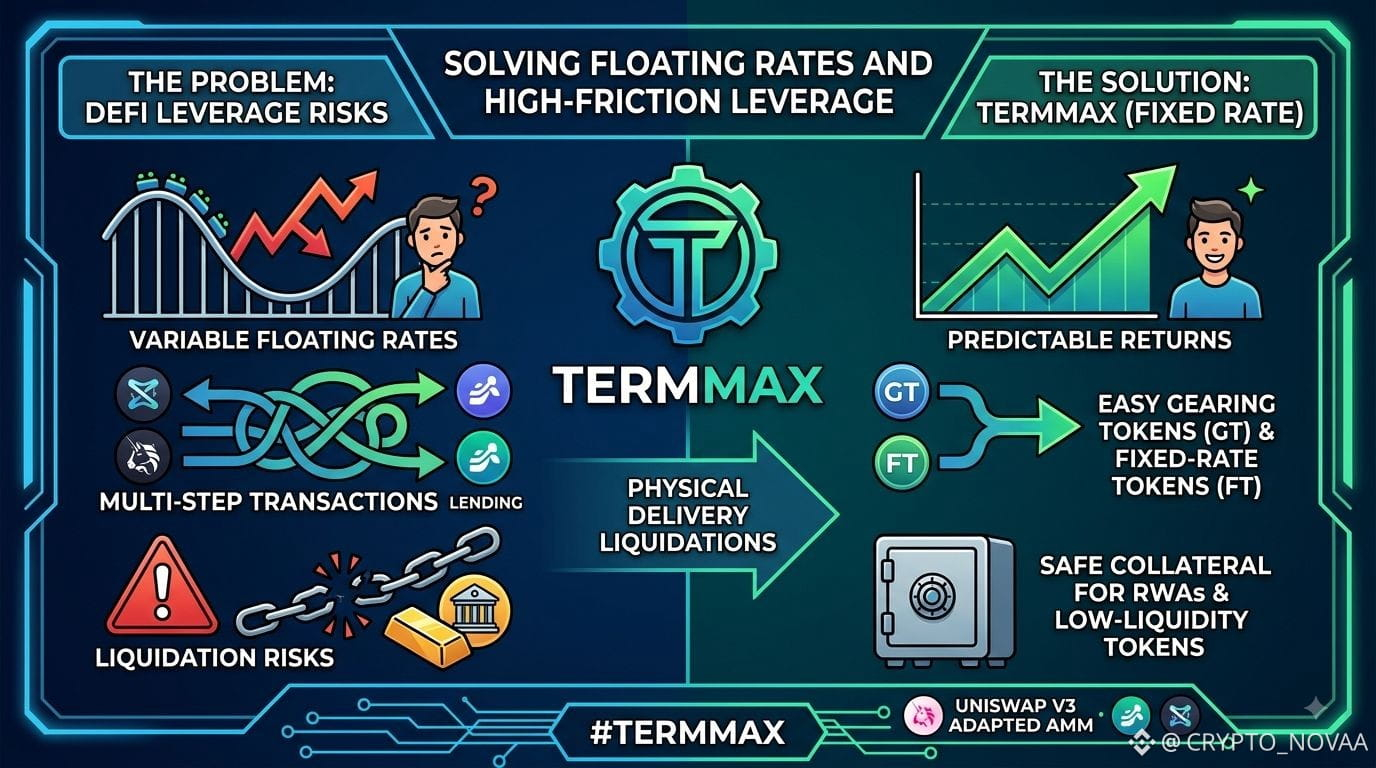
Si estás cansado de los riesgos de tipos variables y del apalancamiento DeFi de alta fricción, @termmax ofrece una solución muy necesaria para el sector.
El problema: el yield looping convencional exige transacciones complejas en múltiples pasos a través de varios protocolos, exponiendo a los usuarios a la imprevisibilidad de los tipos de interés variables y a curvas de precios AMM rígidas. Los prestamistas también se enfrentan a riesgos de liquidación cuando los activos en garantía no cuentan con suficiente liquidez.
La solución TermMax: impulsada por un modelo de AMM de Uniswap V3 adaptado, TermMax entrega plazos fijos de préstamo y de préstamo mediante órdenes de rango personalizables. Los usuarios disfrutan de rendimientos predecibles con operaciones simples de Gearing Token (GT) y Fixed-Rate Token (FT). Además, las liquidaciones con entrega física abren una mejor colateralización segura para RWAs y reducen el riesgo para tokens de menor liquidez. #TermMax
#termmax @termmax
Si estás cansado de los riesgos de tipos variables y del apalancamiento DeFi de alta fricción, @TermMax ofrece una solución muy necesaria para el sector.
El problema: el yield looping convencional exige transacciones complejas en múltiples pasos a través de varios protocolos, exponiendo a los usuarios a la imprevisibilidad de los tipos de interés variables y a curvas de precios AMM rígidas. Los prestamistas también se enfrentan a riesgos de liquidación cuando los activos en garantía no cuentan con suficiente liquidez.
La solución TermMax: impulsada por un modelo de AMM de Uniswap V3 adaptado, TermMax entrega plazos fijos de préstamo y de préstamo mediante órdenes de rango personalizables. Los usuarios disfrutan de rendimientos predecibles con operaciones simples de Gearing Token (GT) y Fixed-Rate Token (FT). Además, las liquidaciones con entrega física abren una mejor colateralización segura para RWAs y reducen el riesgo para tokens de menor liquidez. #TermMax
#termmax @TermMax
El problema: el yield looping convencional exige transacciones complejas en múltiples pasos a través de varios protocolos, exponiendo a los usuarios a la imprevisibilidad de los tipos de interés variables y a curvas de precios AMM rígidas. Los prestamistas también se enfrentan a riesgos de liquidación cuando los activos en garantía no cuentan con suficiente liquidez.
La solución TermMax: impulsada por un modelo de AMM de Uniswap V3 adaptado, TermMax entrega plazos fijos de préstamo y de préstamo mediante órdenes de rango personalizables. Los usuarios disfrutan de rendimientos predecibles con operaciones simples de Gearing Token (GT) y Fixed-Rate Token (FT). Además, las liquidaciones con entrega física abren una mejor colateralización segura para RWAs y reducen el riesgo para tokens de menor liquidez. #TermMax
#termmax @TermMax
53
·
--
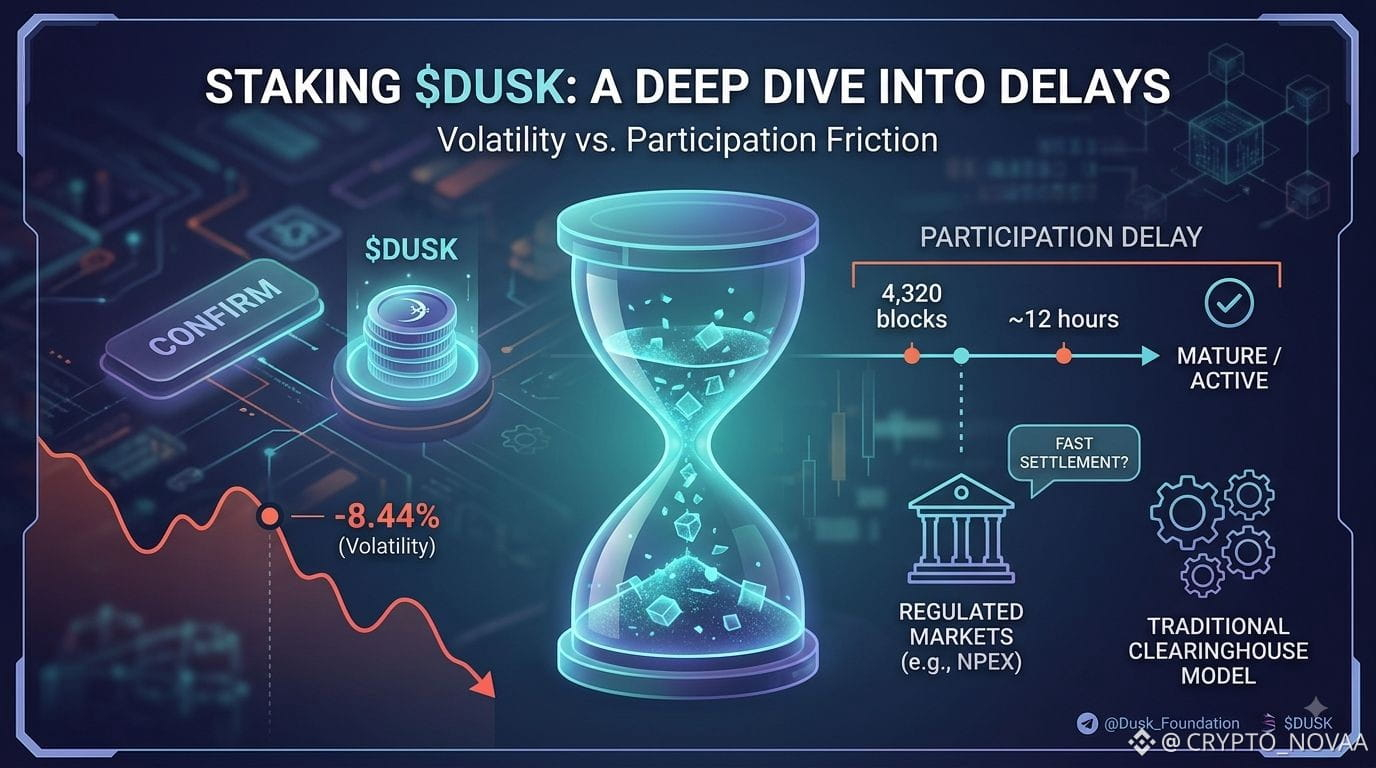
Apuesté una cantidad pequeña de $DUSK durante una tarea reciente de #dusk para ver qué pasa después de pulsar confirmar. Caída de ~8,44% durante la semana anterior: volatilidad cripto estándar, no pánico. Lo que realmente llamó la atención fue el retraso en la participación.
Una nueva apuesta tarda 4.320 bloques (~12 horas) en madurar antes de volverse activa. Lo mismo ocurre con los pools de Hyperstaking. ¿Actualizar una apuesta existente? Solo el 90% se activa de inmediato; el 10% permanece inactivo hasta que se complete la desinversión total.
Es un contraste extraño para una red que está impecable en la liquidación rápida para mercados regulados como NPEX. La liquidación rápida no significa participación instantánea: se siente como la agrupación por tandas de una cámara de compensación tradicional. La documentación lo explica claramente, pero no está en el discurso de moda. ¿Fricción para retail o barrera institucional? Todavía estoy esperando que mi apuesta entre en funcionamiento mientras lo escribo.
@Dusk_Foundation $DUSK
Apuesté una cantidad pequeña de $DUSK durante una tarea reciente de #dusk para ver qué pasa después de pulsar confirmar. Caída de ~8,44% durante la semana anterior: volatilidad cripto estándar, no pánico. Lo que realmente llamó la atención fue el retraso en la participación.
Una nueva apuesta tarda 4.320 bloques (~12 horas) en madurar antes de volverse activa. Lo mismo ocurre con los pools de Hyperstaking. ¿Actualizar una apuesta existente? Solo el 90% se activa de inmediato; el 10% permanece inactivo hasta que se complete la desinversión total.
Es un contraste extraño para una red que está impecable en la liquidación rápida para mercados regulados como NPEX. La liquidación rápida no significa participación instantánea: se siente como la agrupación por tandas de una cámara de compensación tradicional. La documentación lo explica claramente, pero no está en el discurso de moda. ¿Fricción para retail o barrera institucional? Todavía estoy esperando que mi apuesta entre en funcionamiento mientras lo escribo.
@Dusk $DUSK
Una nueva apuesta tarda 4.320 bloques (~12 horas) en madurar antes de volverse activa. Lo mismo ocurre con los pools de Hyperstaking. ¿Actualizar una apuesta existente? Solo el 90% se activa de inmediato; el 10% permanece inactivo hasta que se complete la desinversión total.
Es un contraste extraño para una red que está impecable en la liquidación rápida para mercados regulados como NPEX. La liquidación rápida no significa participación instantánea: se siente como la agrupación por tandas de una cámara de compensación tradicional. La documentación lo explica claramente, pero no está en el discurso de moda. ¿Fricción para retail o barrera institucional? Todavía estoy esperando que mi apuesta entre en funcionamiento mientras lo escribo.
@Dusk $DUSK
65
Inicia sesión para explorar más contenidos
Únete a usuarios de criptomonedas de todo el mundo en Binance Square
⚡️ Obtén la información más reciente y útil sobre criptomonedas.
💬 Confía en el mayor exchange de criptomonedas del mundo.
👍 Descubre opiniones reales de creadores verificados.
Correo electrónico/número de teléfono
Temas en tendencia
MetaMaskExitsLidoValidatorsAfterSecurityIncident
41,962 visualizaciones
707 participa(n) en el debate
🚨 #MetaMaskExitsLidoValidatorsAfterSecurityIncident ¿Peligran tus fondos en Staking?
El ecosistema DeFi se sacude. ConsenSys retiró sus validadores tras un incidente de seguridad en Lido. El debate sobre los riesgos de centralización en los protocolos de staking líquido vuelve a estallar con fuerza sobre el futuro de $LDO y la red de $ETH . ¿Estamos realmente seguros?
La seguridad está cambiando el juego esta semana. No te quedes fuera de la conversación.
💬 ¿Tienes fondos invertidos en Lido o haciendo staking en alguna DeFi? ¿Crees que este susto afectará el precio de las Alts?
¡Deja tu opinión abajo, comparte para alertar a otros y debatamos en los comentarios! 👇
#defi #Ethereum✅ #Lido #security
TinCrypto
·5 «Me gusta»
·412 visualizaciones
MicronBeatsEarningsLiftsGuidance
26,586 visualizaciones
567 participa(n) en el debate
CFTCSubmitsTwoEventContractRulesToWhiteHouse
20,338 visualizaciones
499 participa(n) en el debate