
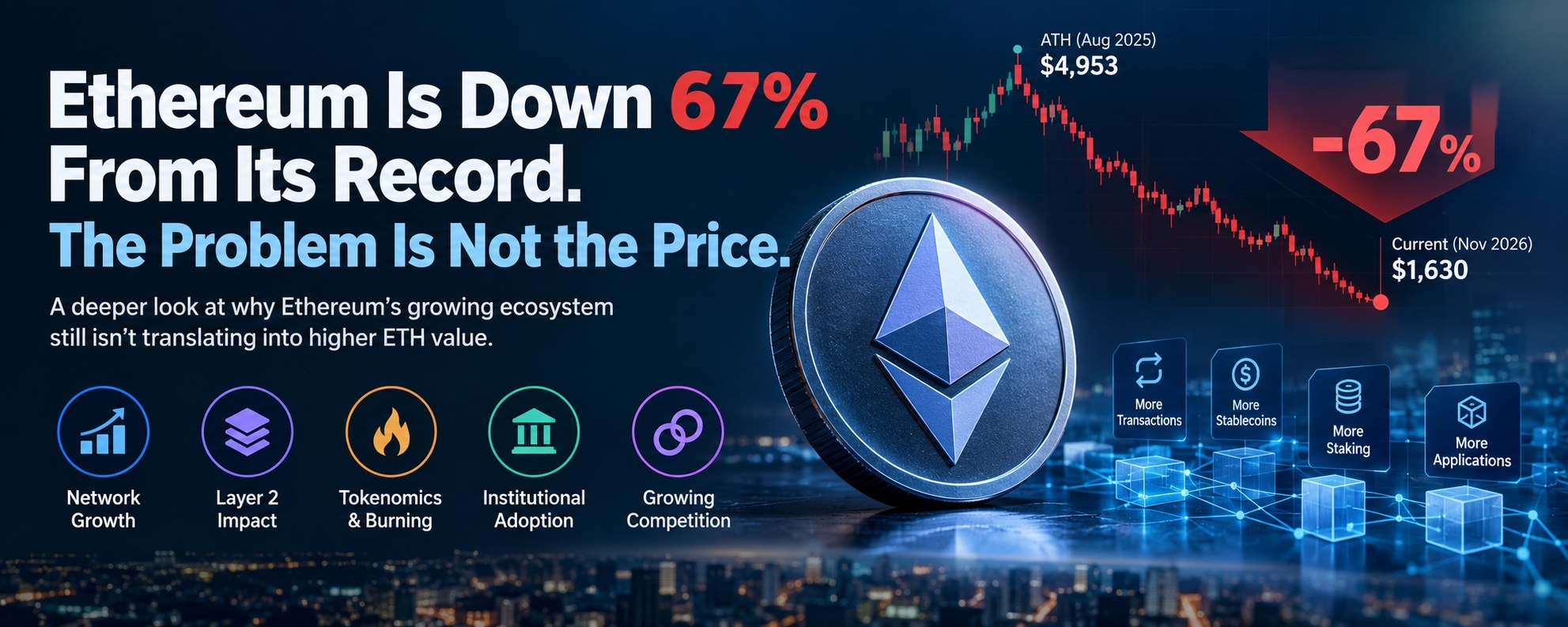

Ethereum is facing one of the most significant market corrections in its history. As of November 29, 2026, ETH is trading around $1,630, approximately 67% below its August 2025 all-time high of $4,953.
At first glance, this looks like another cryptocurrency bear market. But looking beyond the price chart reveals a more complicated situation.
Ethereum’s network continues to expand. Stablecoin activity is increasing, institutional infrastructure is developing, staking participation is growing, and Layer 2 networks are processing millions of transactions.
Yet ETH’s market performance remains weak.
This creates an important question:
If Ethereum’s ecosystem is growing, why isn’t ETH capturing that growth in its market valuation?
To understand the problem, we need to examine five important areas.
1. Network Growth Is Not Automatically Token Value Growth
Ethereum has made considerable progress in expanding its ecosystem.
According to Ethereum Institutional’s November 2026 research:
▪ Ethereum mainnet averaged approximately 2.17 million daily transactions between January and October 2026, representing 54% year-over-year growth.
▪ Ethereum and its Layer 2 ecosystem processed approximately 25 million transactions daily.
▪ Stablecoin transfer volume on Ethereum mainnet reached $25.8 trillion during the first ten months of 2026, increasing 61% compared with the same period in 2025.
▪ Approximately 44.2 million ETH was staked by October 31, representing 36.1% of circulating supply.
These numbers demonstrate that Ethereum remains an important settlement and financial infrastructure layer.
However, there is a critical distinction between network adoption and token demand.
More transactions do not necessarily mean more ETH purchases. More applications do not automatically translate into higher ETH valuation.
The market ultimately needs to understand how ecosystem growth creates sustainable economic demand for the underlying asset.
That is where the discussion becomes interesting.
2. The Layer 2 Success Has Created a Value-Capture Challenge
Ethereum’s long-term scaling strategy has increasingly focused on Layer 2 networks.
Platforms such as Arbitrum, Optimism and Base allow users to conduct transactions faster and at significantly lower costs while relying on Ethereum for settlement and data availability.
Technically, this is a major achievement.
But economically, it introduces a difficult question.
When users move from expensive Ethereum mainnet transactions to cheaper Layer 2 transactions, the amount of fees generated directly on Ethereum mainnet can decline.
Consider the numbers.
According to CoinDesk Research’s 2025 blockchain analysis, average monthly Ethereum Layer 1 fee revenue fell from approximately $100 million to below $15 million in its Q4 comparison.
Meanwhile, application revenue remained relatively stable.
This illustrates the difference between ecosystem activity and the revenue captured by the base layer.
Ethereum is successfully making transactions cheaper and expanding access to its infrastructure.
But cheaper transactions also mean less fee revenue per transaction.
The challenge is not necessarily that Ethereum is losing utility.
The challenge is ensuring that increasing ecosystem activity translates into sufficient economic value for ETH.
3. Ethereum’s Tokenomics Deserve More Attention
One of Ethereum’s most important economic features is its fee-burning mechanism, introduced through EIP-1559.
A portion of transaction fees is permanently removed from circulation.
When network activity is strong and fees are sufficiently high, ETH burning can offset or even exceed new issuance.
This creates the possibility of a deflationary supply environment.
However, the opposite can happen.
When transaction fees decline, fewer ETH tokens are burned. Meanwhile, validators continue receiving staking rewards, creating new ETH issuance.
Consequently, ETH can become net inflationary when issuance exceeds burning.
This is particularly important because Ethereum’s scaling improvements have reduced transaction costs considerably.
Lower fees benefit users, developers and applications. But they can also reduce the economic pressure that previously supported ETH burning.
Therefore, investors should monitor three indicators together:
▪ ETH issuance.
▪ ETH burned through transaction fees.
▪ Net annual supply growth.
Looking at staking participation alone is insufficient to understand Ethereum’s monetary dynamics.
4. Institutional Adoption Is Growing, But Capital Flows Matter
Ethereum has developed a significant institutional presence through exchange-traded products, tokenization, stablecoins and decentralized financial infrastructure.
Its ecosystem continues to attract institutional attention.
Ethereum Institutional’s October 2026 research highlighted approximately:
▪ $23.1 billion in tokenized assets on Ethereum mainnet.
▪ $49.4 billion in DeFi value locked across the Ethereum ecosystem.
▪ $17.1 trillion in stablecoin transfer volume across Ethereum and its Layer 2 networks over the reported 90-day period.
These figures demonstrate that Ethereum remains deeply embedded in the digital asset financial infrastructure.
However, institutional adoption should not be confused with continuous institutional buying.
Capital can flow into Ethereum-based applications, stablecoins and tokenized assets without necessarily creating equivalent demand for ETH.
Recent market data also highlights the importance of actual investment flows.
According to CoinGlass, US spot ETH ETFs recorded approximately $69.4 million in net outflows on November 27, 2026.
This is an important reminder that institutional infrastructure can expand while institutional demand for the underlying asset weakens.
The distinction between adoption and investment demand is essential.
5. Competition Is Becoming More Serious
Ethereum is no longer competing only with traditional blockchain networks.
It is competing for developers, liquidity, applications, users and institutional capital.
Solana, for example, has established a strong position in high-throughput, low-cost transactions.
Other blockchain ecosystems are also targeting decentralized finance, payments, tokenization and consumer applications.
Ethereum’s Layer 2 strategy has helped preserve its broader ecosystem position, but it has also introduced fragmentation.
Users may interact with multiple networks, each with its own liquidity, applications and infrastructure.
This creates additional complexity.
The long-term question is whether Ethereum can maintain a unified and competitive ecosystem while allowing different Layer 2 networks to develop independently.
Its upcoming Glamsterdam upgrade is designed to improve Layer 1 scalability through parallel processing, block-level access lists and improvements to block production.
However, as of November 29, its mainnet activation date has not been confirmed.
The technology is progressing, but execution and adoption will determine whether these improvements translate into stronger economic value.
6. What Should Investors Actually Watch?
Instead of focusing exclusively on ETH’s distance from its all-time high, investors should monitor the underlying indicators.
Here are six particularly important areas:
1. ETH ETF flows
Consistent institutional inflows could indicate renewed demand for direct ETH exposure. Persistent outflows would suggest weakening investment appetite.
2. Network fee revenue
Transaction growth without meaningful improvement in fee economics could remain a concern for ETH valuation.
3. ETH burning versus issuance
This helps determine whether Ethereum’s supply is expanding or contracting.
4. Layer 2 economic contribution
The important question is whether Layer 2 growth creates sustainable demand for Ethereum settlement, data availability and ETH itself.
5. Staking participation
Higher staking participation strengthens network security, although investors must also consider staking concentration, liquidity and validator risks.
6. Competition and liquidity
Ethereum needs to maintain developer activity, application adoption, stablecoin liquidity and institutional relevance against competing networks.
These indicators provide a more complete picture than price movements alone.
Final Perspective: Ethereum’s Biggest Challenge Is Economic, Not Technological
A 67% decline from an all-time high is significant, but it does not automatically mean Ethereum’s underlying technology is failing.
In fact, several important network metrics are moving in the opposite direction.
Transactions are increasing. Stablecoin activity is expanding. More ETH is being staked. Institutional infrastructure continues to develop.
But markets do not value blockchain networks solely on technological progress.
They also evaluate scarcity, capital flows, economic incentives, revenue generation and the ability of a native token to capture value from its ecosystem.
This is the central challenge facing Ethereum today.
Ethereum may be becoming more useful as infrastructure, but the market still needs convincing evidence that this growing utility translates into sustainable value for ETH.
That is why the next chapter of Ethereum’s story should not be judged by price recovery alone.
It should be judged by whether ecosystem growth eventually produces stronger and more sustainable economic demand for its native asset.
The technology is evolving. The ecosystem is expanding. Now the economic model must prove itself.
#Ethereum #CryptoAnalysis #cryptoeducation #ArifAlpha